Dallas–Fort Worth Water Station Rentals for Events & Job Sites, 24/7 Dispatch
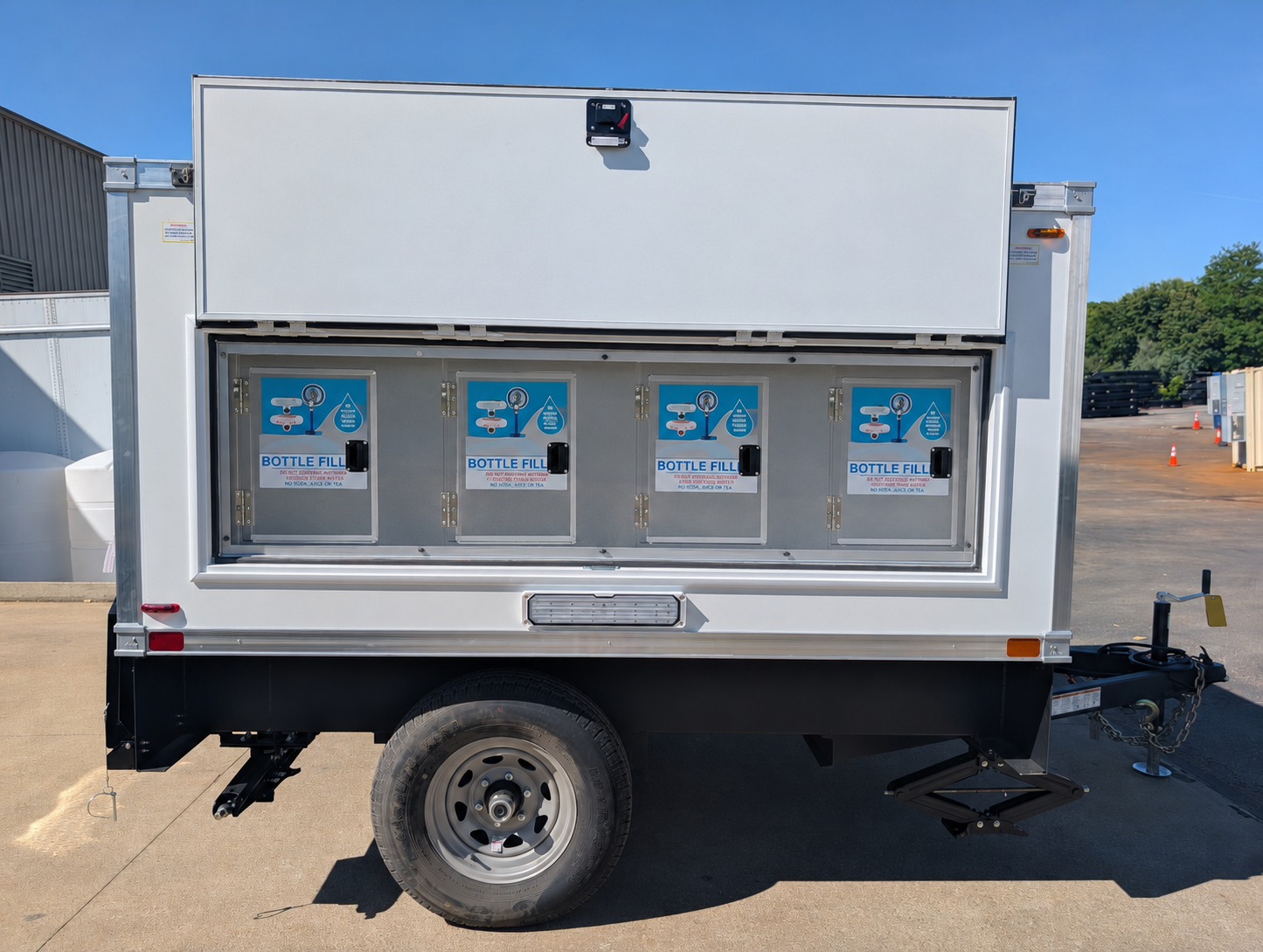
We deliver cold, filtered drinking water across Dallas–Fort Worth for events and job sites, available same-day and 24/7. We tow in a self-contained water station that chills and filters its own supply and refills all day, so we cover a wedding lawn in Southlake, a 400-person concrete pour at AllianceTexas, or a State Fair midway at Fair Park. The Metroplex summer runs hot and long. With a station on site, the crowd stays comfortable, the crew keeps working, and nobody is babysitting a melting pallet of bottled water by noon.
- Same-day across the metro
- Chilled, four-stage filtration
- Wheelchair-height fill point
- Heat-illness compliance ready
- Fully licensed & insured
- Round-the-clock emergencies
A North Texas hydration partner who knows how to plan for a Metroplex summer
We are a local hydration partner that keeps DFW crews and crowds supplied with cold water through the worst of the heat. Running short on cold water on a 102-degree afternoon means a stalled crew, an unhappy crowd, and a safety lead with a real problem. We stage mobile water stations as far north as Denton, as far south as Waxahachie, and clear across the west side of Tarrant County, for the people who can’t pull their teams off the line when the heat index climbs: contractors on the data-center builds in Red Oak and Garland, the AllianceTexas warehouse crews north of Fort Worth, and the event teams working AT&T Stadium and Fair Park. We have answers to the questions you’ll ask on the first call: how soon can a trailer get here, will the water still be cold by mid-afternoon, and what happens when 300 gallons runs low during a weekend tournament.
Same-day delivery across the metro
We deliver same-day across DFW, with around-the-clock emergency drops when a heat advisory hits. When a superintendent realizes at dawn that a 70-person crew has nothing but a warm cooler and a long shift ahead, getting cold water there fast is the whole job, and that’s what we do.
Cold at quitting time, not just at sunrise
Every station chills its own supply, so the last pour of a long Texas afternoon is as cold as the first. Crews ignore warm water, and water nobody drinks protects nobody. Here the heat index can stay punishing past sundown because of the humidity, and that’s the reason to rent a station instead of stacking bottles.
We drop it, fill it, service it, and haul it
You don’t have to chase a bottled-water vendor, an ice supplier, and a waste hauler across three invoices. We set the station, keep it filled from our own water trucks, service it through the rental, and pull it when the job wraps. One local contact handles all your water on your DFW site or event.
Here’s what I tell every new North Texas client on the first call: a station only works if your people actually drink from it. I learned that years back. “Son, my guys won’t walk across a yard for warm water,” a foreman told me before I’d finished the pitch, and he was right. I’ve watched a forklift driver in a Mesquite distribution yard walk past a case of bath-warm bottles twice an hour and slide into trouble, and I’ve watched the opposite: a cold station fifteen steps from the dock that a crew drains and refills all shift. So we don’t drop a trailer and disappear. We size it to your headcount, set the refill schedule to your real demand, and answer a hot-weather emergency call fast, because in a Texas summer the difference shows up in degrees and minutes.
One road-towable trailer built to work outdoors across North Texas
We run one trailer in our Metroplex lineup: the Signature Series water station. It sits on a highway-rated chassis, so it follows the job anywhere, whether that’s a grading pad out by Alliance, a festival lawn at Fair Park, or the tournament fields up in Frisco. There’s nothing to build and no plumbing to run, just cold filtered water at the spout by the time the afternoon rolls in.
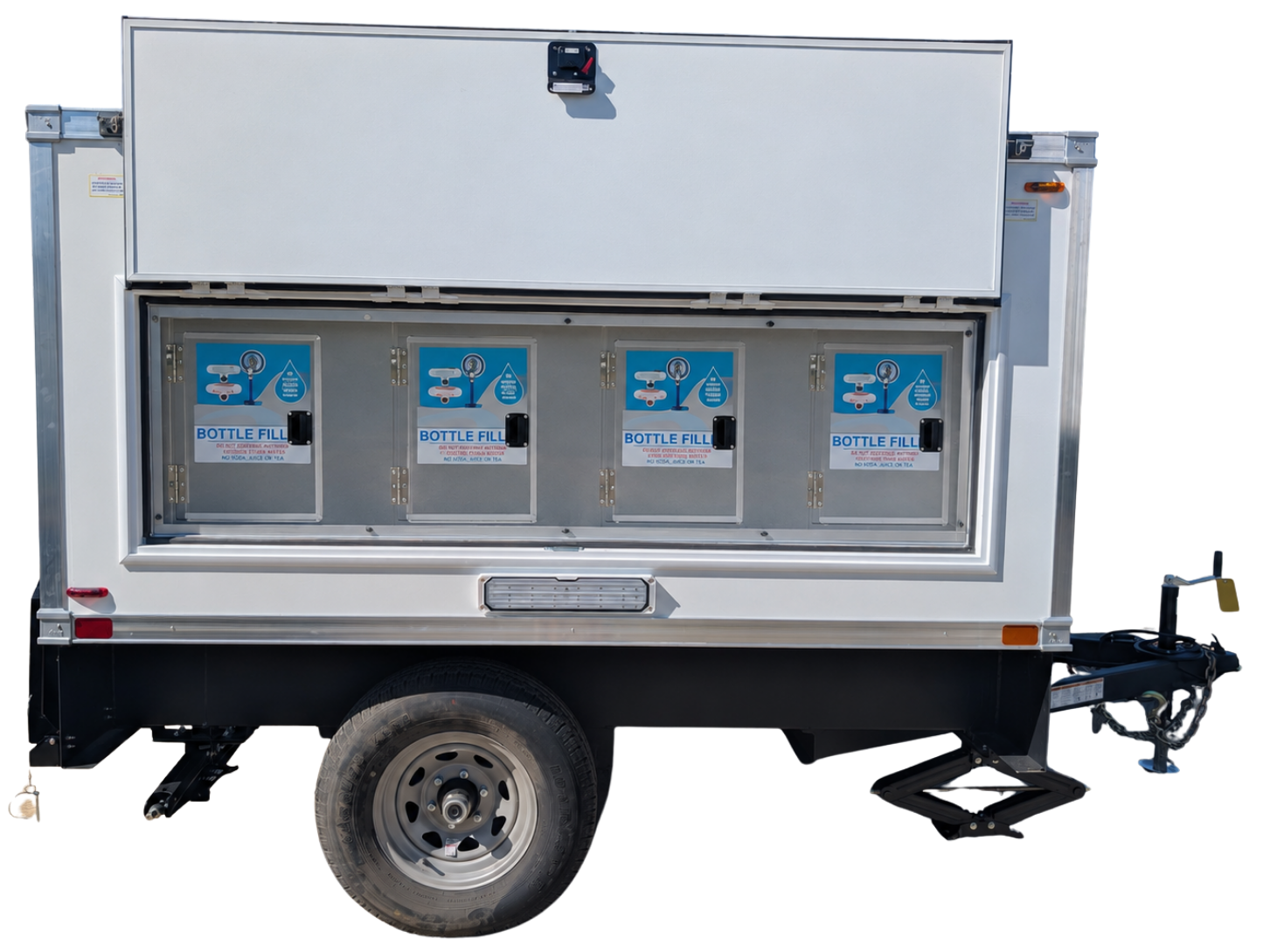
Signature Series specifications
It tows behind a hitch on real tires, so it reaches a remote jobsite, a wedding lawn, a ranch, or an emergency staging area. DFW contractors and planners request it by name because it rolls in, levels, and starts pouring the same day it shows up.
| No. of stations | (4) Bottle Filling Stations |
| Length | 12′ 3″ |
| Weight | 3,100 lbs. |
| Height | 8′ |
| Fresh water tank | 300 Gallons |
| Power requirements | 1–4 dedicated 20A/120V circuits OR 1 dedicated 50A/240V circuit |
| No. of AC units | 1 |
Why this is the right trailer for a Metroplex job
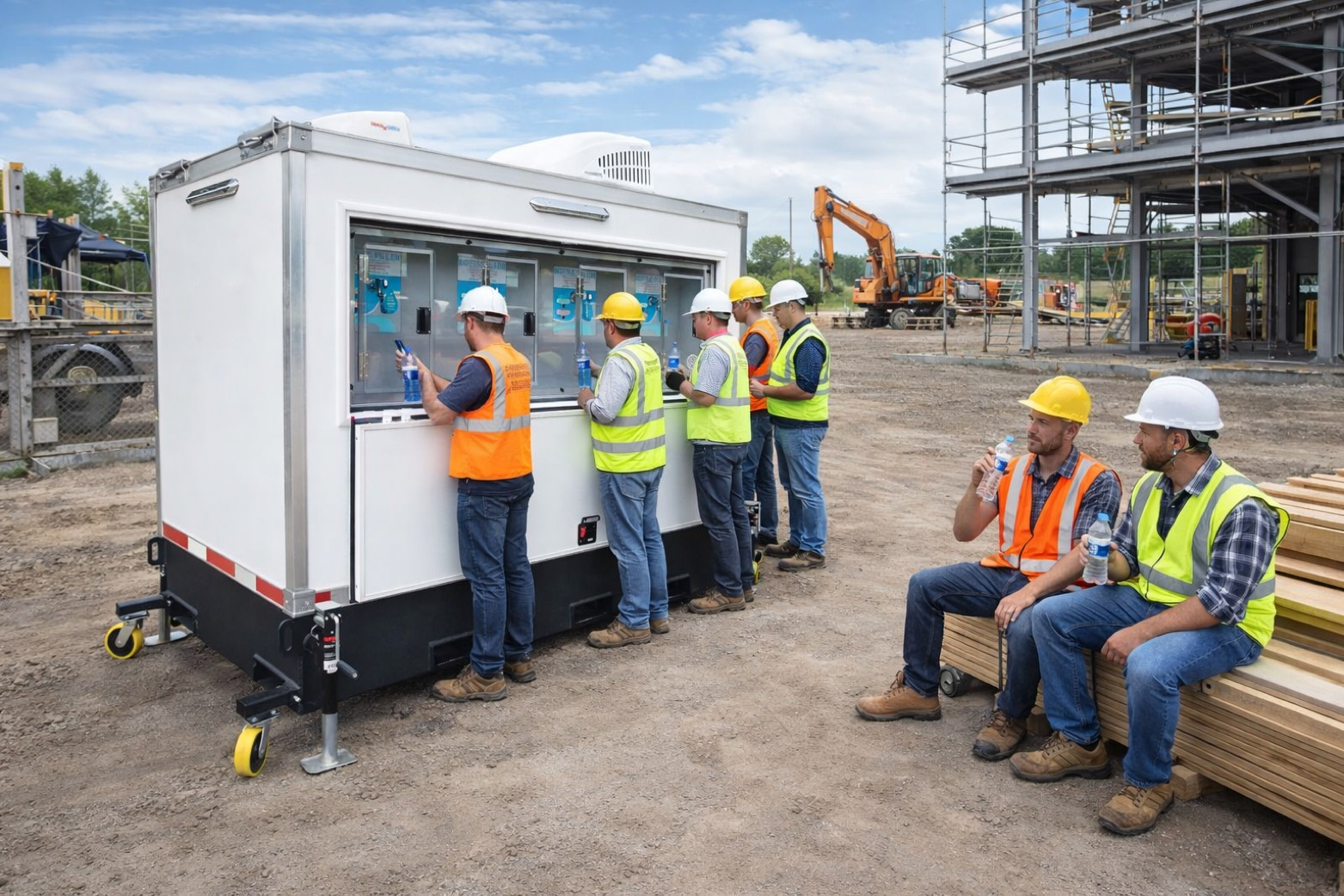
The Signature is built for distance and heat. Its four fill points line an outside wall under an awning, so a full crew rotates through quickly on a tight break and no single tap becomes a bottleneck. The rooftop AC and internal chillers keep the water cold even after the unit has sat in open North Texas sun all afternoon, which is exactly where coolers and bottled-water plans fail here in July.
Three hundred gallons aboard carries a good-sized crew through a full shift. Because it tows, we can move it across a large Alliance-corridor site or roll it to the next phase of a build without removing anything fixed. It runs on a wide range of everyday jobsite power, so the same trailer works at a finished event venue or on a raw dirt lot where we set up power.
It carries more than the four main taps. Out back, a jug spout fills five-gallon coolers and personal gear, and a bank of hose-bibs handles crew chores, wash-up, and field work. One trailer covers all the water for a DFW jobsite, a festival, or a game-day setup.
Hydration sized to the way the Metroplex works and plays
Dallas–Fort Worth has a different hydration need for almost every kind of job. A data-center build calls for one setup, a State Fair midway calls for another, and a youth-soccer tournament in Frisco calls for a third. Here is where our trailers go to work across North Texas.
Construction, data centers & the Alliance corridor
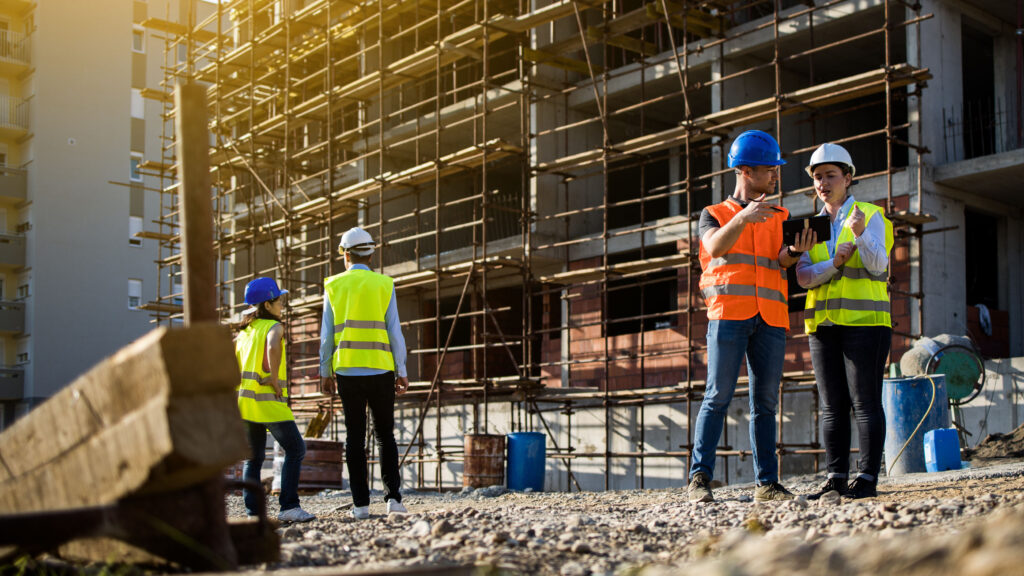
The Metroplex is in the middle of a generational build-out: the DataBank Red Oak data-center campus, the Garland and south-Fort-Worth data centers, and the largest industrial construction pipeline in the country running through the AllianceTexas corridor, with millions of square feet under way at once. Those sites mean hundreds of workers in open sun. We line these corridors with stations so general and trade contractors keep documented, chilled water a few steps from wherever the crew is swinging hammers.
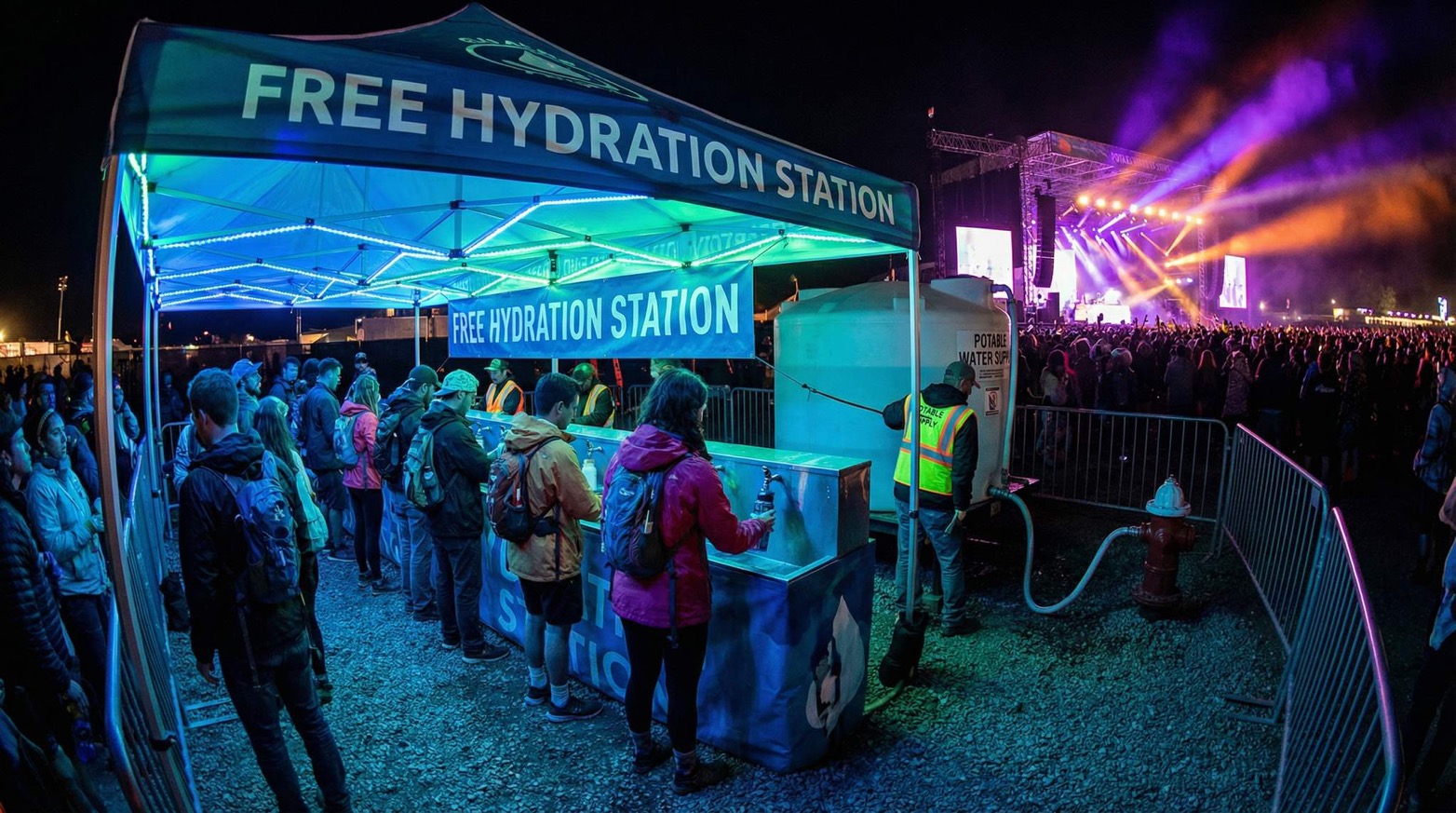
Fair Park, festivals & the World Cup crowds
The State Fair of Texas pulls more than two million people through Fair Park across its run, Arlington hosts nine 2026 FIFA World Cup matches at AT&T Stadium, and the Metroplex festival and concert calendar barely pauses for summer. An outdoor crowd in North Texas empties cups quickly. A station hands organizers open, cold refill points and skips the round-trip of carting pallets in and dragging the empties back out.
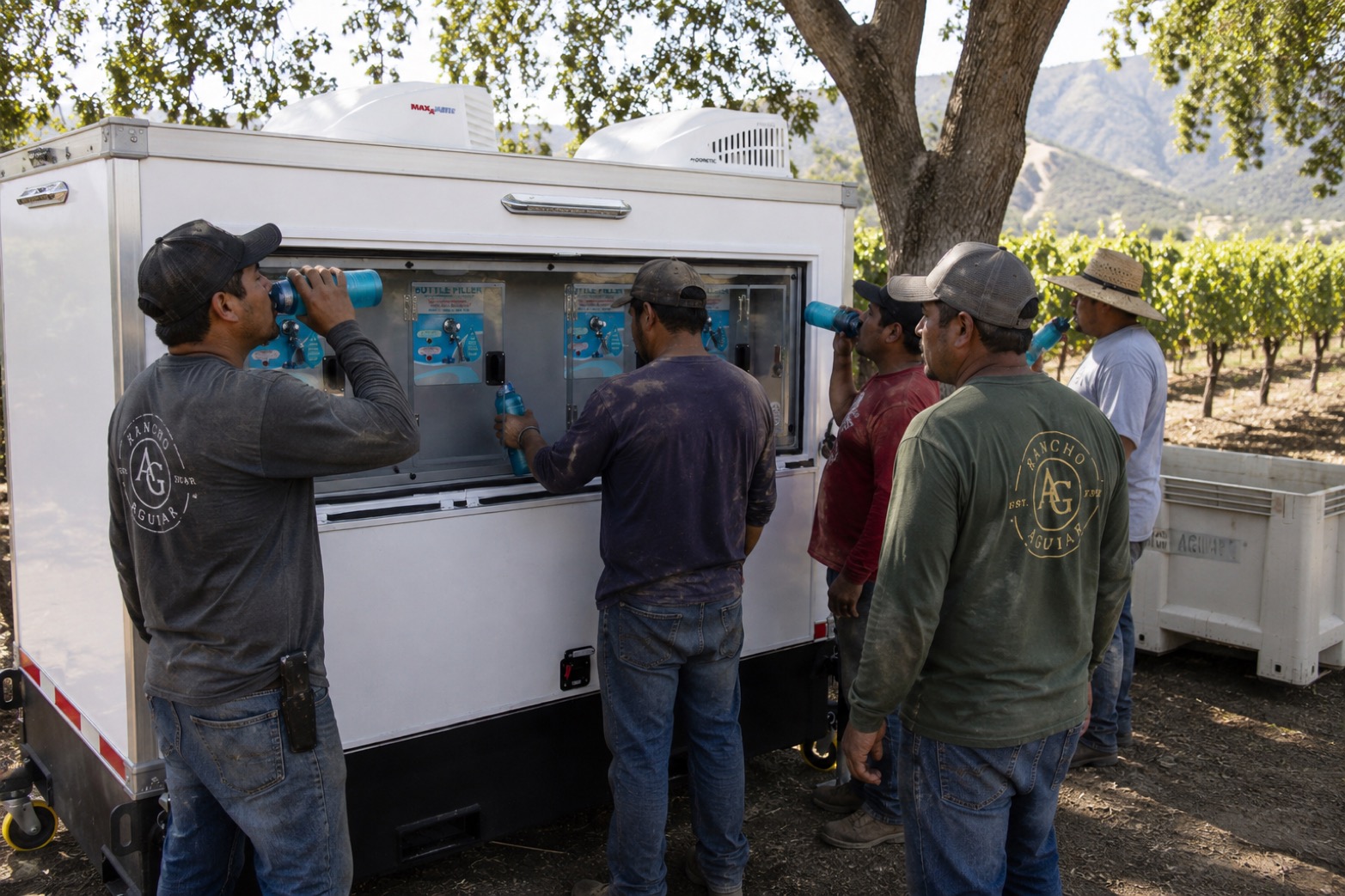
Outdoor labor, landscaping & ag east of the metro
Past the suburbs, the ranchland and farms of Ellis, Kaufman, and Parker counties, the solar installs, and the landscaping and utility crews threading the metro put people in some of the most heat-exposed work in the state. The rear jug spout and the hose-bibs let those crews refill coolers and personal gear at the row they’re standing in, no hike back to the truck for water.
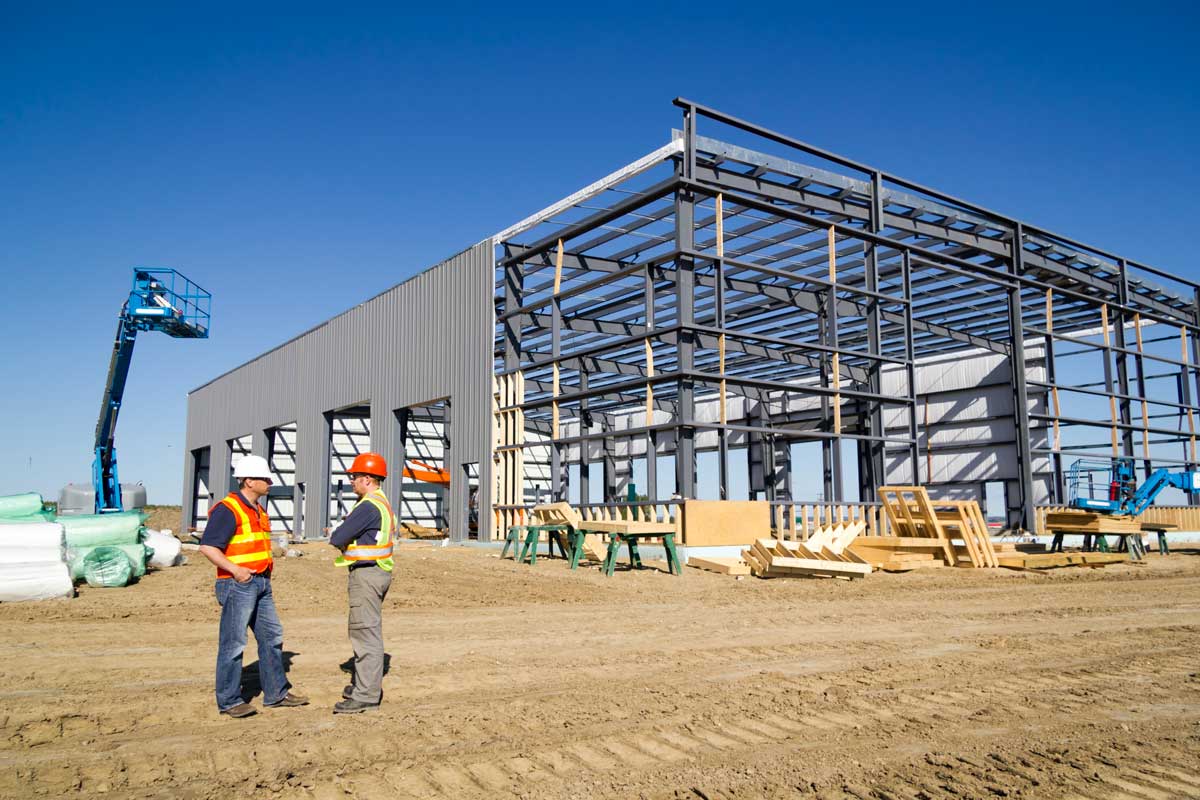
Industrial yards, logistics & rodeo grounds
The distribution yards around Mesquite, Grand Prairie, and the Alliance logistics parks put crews in the same open heat as any build, and a towable station drops right into the laydown area where they work. The Fort Worth Stockyards run year-round rodeo, and outdoor venues across the metro lean on staged stations to keep staff and stock handlers supplied through the hottest part of the day.
The math that ends the bottled-water habit
Put fifty workers on a North Texas pad for one summer and the numbers make the case. Figure six bottles each on a hot afternoon and the site is buying, hauling, chilling, and tossing close to 300 of them a day, on top of the actual work of getting a beam up or a slab poured.
Over a 200-day schedule that’s more than 60,000 bottles. On the multi-phase jobs along the data-center and warehouse corridors, the count climbs over 100,000. One trailer replaces all of it: cold water at the tap and not a single empty headed for the landfill.
It’s a logistics win first, and a green one second
The plastic-waste numbers are real. Americans throw out roughly 60 million water bottles a day, only about a third get recycled, and a single bottle can sit in a North Texas landfill for centuries, all worth a line in your sustainability report. But most DFW project managers switch for a simpler reason: one station ends the daily scramble. There’s no recurring bottled-water order to chase, no cooler that turns warm before mid-morning, and no wall of crushed empties baking by the gate. Your superintendent manages the build instead of managing the water.
Our own potable water trucks keep the trailer charged, so the volume on site tracks the volume of work. When a Metroplex crew doubles up for a slab pour, the plan never runs dry, we just tighten the fill route and top off the tank.
Filtered in four stages, disinfected, then chilled before it pours
A station only works if people want to drink from it. Ours run city water through a three-stage filter set and a UV pass, then send it to the chiller, so the water tastes clean and comes out cold even on the hottest North Texas afternoon.
Sediment capture
The first stage removes grit, rust flecks, and the fine particles that DFW supply lines pick up, before anything else touches the water.
Carbon polish
Activated carbon removes chlorine, odors, and off-tastes so the water tastes clean. That’s the difference between a station crews drain and one they walk past.
Micro-particulate stage
A tight sub-micron cartridge picks off the microscopic particles that make it past the carbon, which keeps both workers and the public safe when they fill up at the trailer.
UV disinfection
An ultraviolet chamber kills bacteria and pathogens with light instead of added chemicals, the final safeguard before the tap.
Three ways to fill, one of them ADA-height
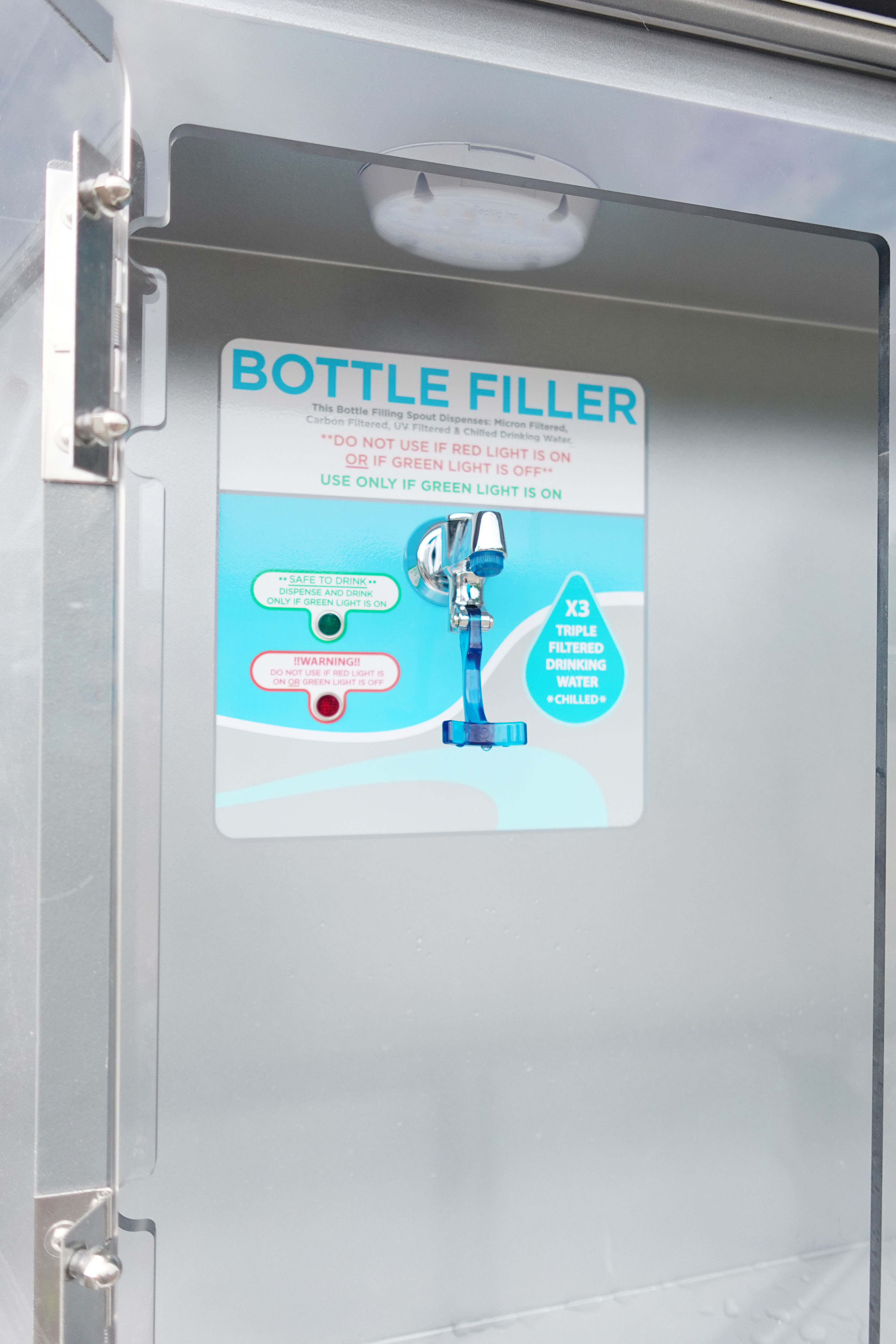
The unit has four push-back nozzles on its side. Press a bottle to the bar and it pours, with nothing to twist. One of the four sits at wheelchair height, so the same trailer serves a whole crowd or crew with no second setup added on. Out back, a jug station fills five-gallon coolers and hydration packs, and a row of hose-bibs handles wash-up, field work, and event support. Every part the water touches on the way out, fittings and tanks alike, is food-grade and stainless, so the water comes out as clean as it left the filter.
One trailer’s 300 gallons is roughly 2,400 average pours, and because we refill against your real usage, the station won’t be what slows a busy DFW shift or a peak hour at the gate.
In a Texas summer, documented cold-water access is part of the safety plan, not a nicety
A hot DFW year brings dozens of triple-digit afternoons. The 2011 summer ran more than 70 days at or above 100 degrees here, including a 40-day straight streak, and even an average season passes 100 enough times to matter. In Texas the rules run through federal OSHA, which already requires an employer to keep potable drinking water within reach of the job. The national heat-illness standard OSHA has proposed would tighten that further, toward cool water that’s documented and kept close to where the work happens.
A station turns that requirement into something an auditor can see. It’s a marked spot on the site that pours cold, potable water whenever a worker walks up, which is exactly what a Heat Illness Prevention Plan (HIPP) is built around and what a safety review wants to find already documented.
- A standing source of cool, drinkable water within reach of the work face
- A named, mappable hydration point your HIPP paperwork can cite by location
- Room to run real acclimatization and timed water breaks for sun-exposed crews
- Out ahead of the tightening federal heat rule instead of reacting once it lands
Cold water for outdoor crowds in the North Texas sun
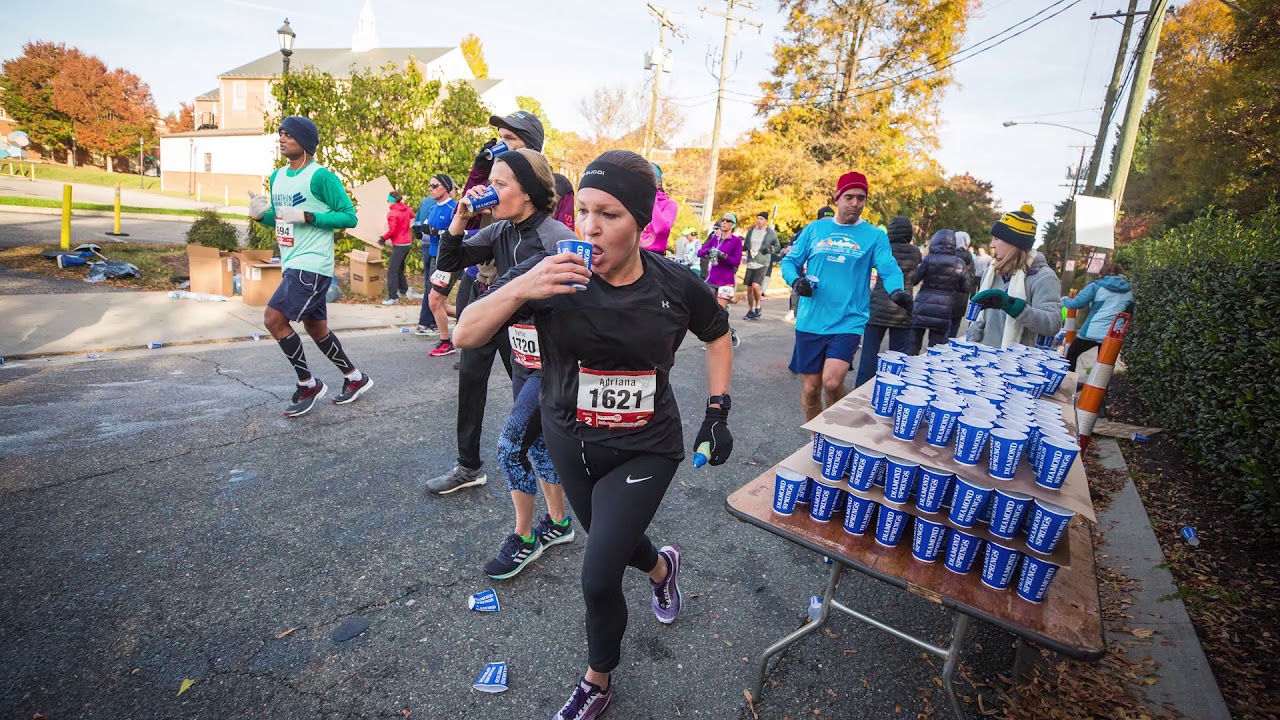
Event teams across the Metroplex plan around heat the way other regions plan around rain. Whether it’s a Klyde Warren Park festival, a Sundance Square street fair, a Cowtown Marathon water stop, a corporate field day at a Las Colinas resort, or a youth tournament weekend in Frisco, a station puts cold water and clean refill points right in the crowd. It also takes the trucking-in, icing-down, and hauling-out off your crew. Guests get hospitality and your operations lead gets one less risk to manage.
On a big footprint we place several units so water is never a long walk, and our team times the drop and pickup to your run-of-show. We learned this at a North Texas music festival: one station by the main stage had a line thirty deep by mid-afternoon, because sun plus a packed crowd adds up fast. The next year we spread four across the grounds and the lines disappeared. The organizer asked me at strike, “Why didn’t we do that the first time?” I didn’t have a good answer, but we’ve planned every festival that way since.
Why the Metroplex is one of the harder climates to plan hydration around
A lot of cities get a hot week or two. Dallas–Fort Worth gets a hot stretch measured in months, and the heat here comes with humidity, so the heat index runs above the thermometer all summer.
A typical DFW summer brings around twenty triple-digit days, and the hot years run well past that. The record 2011 season hit more than 70, with 40 straight over 100 degrees. What makes planning hard isn’t a single peak day. It’s how long the danger window stays open and how the Gulf humidity pushes the heat index well above the air temperature. A crew can be in real heat-illness territory by mid-morning while the readout still says “only” 98. Fresh asphalt and bare concrete on a North Texas pad get far hotter than the air, and overnight lows in late July often stay in the 80s, so a site never fully cools off between shifts.
That long window is exactly what a cooler-and-ice plan can’t handle. You can’t ice through a six-month Metroplex build: consumption is too high, the water warms up too fast, and the daily chore of hauling, chilling, and dumping bottled water adds up shift after shift. A single self-chilling trailer is the one setup that lasts a whole North Texas summer without becoming a job of its own.
Demand keeps climbing too, because DFW is in the middle of one of the country’s biggest growth runs. The region led the nation in corporate headquarters relocations in recent years, bringing names like Morgan Stanley and Scotiabank into new Dallas hubs and a wave of financial-services expansion into AllianceTexas. The data-center pipeline keeps breaking ground, including DataBank’s Red Oak campus, the Garland expansions, and the new south-Fort-Worth sites, and the Alliance corridor alone carries the largest industrial construction pipeline in the United States. Every one of those projects means hundreds of workers in open Texas sun, often on schedules that start before dawn to get ahead of the afternoon.
There’s a hard lesson behind all of this too. I was here for Winter Storm Uri in February 2021, when the Metroplex froze for days and water disappeared across huge stretches of North Texas. It taught a lot of us in this business that potable water can’t be taken for granted in either direction, a brutal summer or a once-in-a-generation freeze. “I never thought I’d be hunting for drinking water in Texas,” one yard manager told me that week, and he wasn’t alone. We built our DFW dispatch around that: fills timed to crew size instead of a fixed calendar, emergency drops during heat advisories, and the ability to stage potable-water stations fast when a neighborhood or a base camp suddenly needs them. I ran fills that week to places that had never thought to ask us before.
We place it, fill it, and connect it, usually pouring cold water within the hour
There’s no project to run on your end. We handle placement, the fresh-water fill, and the power hookup, and we walk your team through the unit before we pull off the site.
Tell us the basics
Your headcount or gate number, the run length, the parking spot, and the power waiting on site. That handful of facts is all we need to scope it.
We deliver across the metro
Same-day delivery is available throughout Dallas–Fort Worth, with emergency drops around the clock during heat events and tournaments.
We set it up
We level it, charge the fresh tank, and tie into whatever power the site offers. A few household circuits will do, or a single heavy 50-amp drop.
We keep it supplied
Our water trucks top the tank off on a cadence matched to your demand, and we service the unit for the full length of the rental.
No power on a remote pad? It comes up in the quote. Between the trailer’s modest draw and our service fleet, we’ve staged stations on bare lots with no permanent power at all out past the metro’s edge. Tell us what’s there and we’ll engineer around it.
The trucks behind the station that keep a DFW site supplied end to end
The trailer is only the visible piece. Behind it runs a support fleet that covers the supply coming in, the reserve kept on site, and the wastewater hauled out, so one phone call covers everything instead of three vendors getting in each other’s way across the Metroplex.
Potable water trucks
These haul drinking-grade water by the truckload and keep the station’s tank from running low, on a schedule we size to your crew. The same trucks load cisterns, onsite tanks, and bladders when one delivery can’t cover a spike, such as a World Cup gate day at AT&T Stadium or a large concrete pour.
Bladder bags & reserve supply
A collapsible bladder gives you reserve capacity for the heavy stretches, or holds greywater temporarily where a pad has nowhere to drain. On a remote North Texas site, it’s the simple piece that covers the gap between truck visits.
Pump trucks
Any time water needs to be moved, drawn down, or pushed into storage, the pump truck does the work. It pays off on the Alliance-scale sites where the fill point and the station sit a few hundred yards apart.
Vacuum & waste trucks
The waste truck pulls off used water and takes it to permitted disposal, so the whole job is covered. Where the used water ends up is never your problem to solve. That’s built into the service from the first call.
The pieces work together. A far-east site might pair a station with a bladder for reserve and a standing truck route. A big Fair Park run might want a pump truck moving supply and a waste pull at the end. Tell us about the project and we’ll build the right setup behind it, with one number to call, one bill, and a crew that already knows your site.
The handful of things we’ll ask, and why each answer changes the plan
A couple of minutes on the phone is enough for a real quote. Here’s what we’ll reach for, so you can have it handy, and so you can watch us tailor a DFW job instead of leaning on one stock answer.
The four answers that shape the recommendation
- How many people? A 15-person framing crew and a 5,000-strong festival gate are nothing alike. That number sets how many trailers we stage and how hard we run the refills behind them.
- How long? A two-day tournament, a three-week pour, and a year-long build each ride a different service rhythm. The short jobs lean on reserve storage, and the long ones on a standing truck route.
- Where will it sit? Yard, lot, field, or event lawn, the towable unit drops into any of them. Once we know the exact spot and the path a truck takes to it, we can park it where feet actually traffic.
- What power is on site? Anywhere from a trio of 20-amp circuits to one 50-amp drop will run it. Bare pads with no permanent power are routine out past the metro, and entirely workable, as long as it’s on the table early.
The details that help us get it exactly right
- The exact parking spot, plus how a truck threads its way to it
- Whether the crew is scattered across the ground or stacked at one face or gate
- Any heat-illness paperwork your safety program will lean on the station to back up
- Whether bulk delivery, a bladder, or waste pickup should ride on the same ticket
The costs a pallet of bottled water never shows on the invoice
On paper, bottled water looks cheap. The real cost is in the labor, the space it takes up, the warm-up, and the trash it leaves, and a North Texas summer makes every one of those worse.
The labor no one counts
Someone has to place the bottled-water order, receive the pallets, open them, ice coolers at dawn, top them off through the day, and flatten the empties at the end. Across a big Metroplex crew that’s hours of wages every day, pulled off the actual build. A station removes that work. We sat down with an Arlington contractor and ran the numbers, and the labor he got back more than paid for the trailer. As he put it later, the bottle runs had quietly been eating close to a half-day of payroll every week. The trailer rolls in loaded, refills itself off our tankers, and needs nothing from your superintendent but a place to park.
The warm-up problem
Ice a cooler at 6 a.m. and by mid-morning in a Dallas July it’s warm, and crews won’t drink warm water. The moment a crew stops drinking is the moment the heat starts winning. A chilled station doesn’t have that problem: the last pour of the day is as cold as the first, right when a tired, sun-baked crew needs the cold most.
The space it takes up
Stacks of bottled water eat up laydown room, crowd a tight downtown Dallas lot, and bake in the sun waiting to be opened. Empties pile up faster than anyone carts them away, and on a packed infill job that pile becomes its own problem. A lone trailer occupies one stall and serves a crew that would burn hundreds of bottles a day otherwise.
The waste it leaves behind
Every bottle you buy is one more to throw away, and a busy site piles up a season’s worth fast. That’s haul-away cost, a mark against your sustainability numbers, and in a county where a tossed bottle can sit for centuries, waste that outlasts whatever you’re building. A refill station removes that line and gives your ESG report a number worth showing.
What years of DFW summers taught us about staging water right
Staging units across the Metroplex, summer after summer, taught us how to run a job right. Here are a few of the lessons that stuck with us:
Placement turned out to matter as much as the trailer itself, and we learned that by getting it wrong first. On an Uptown Dallas high-rise we parked a unit by the entrance the first morning and it barely got used, because the work was a dozen floors up and nobody spent a break walking down for water. We moved it to the hoist landing the next day and usage roughly doubled before lunch. The super put it plainly: “Make the water closer than the shade and they’ll drink it.” He was right, and we’ve never staged a high-rise unit anywhere but the work face since.
We also learned to time refills off the forecast instead of the calendar. During one run of back-to-back advisories we’d already parked spare trucks nearby, so when three Alliance-corridor sites called within the same hot afternoon, all three stayed supplied and not one crew ran dry. A safety lead messaged that night that we’d beaten them to their own shortage. That head start isn’t luck. We build it into every warm-season agreement now.
We also learned that crews stick with bottled water until they feel the difference for themselves. At a Grand Prairie logistics yard, the super doubted we could keep a tank of water cold while it sat on open asphalt. We dropped it, set the top-off schedule, and a week later he called to add a second trailer. “The crew stopped asking for ice,” is all he said. That settled it. Water that stays genuinely cold is the whole argument, the rest is just routing, and in this climate it sells itself the day it arrives.
Every one of those jobs taught us the same thing the weather does: in Dallas–Fort Worth, hydration isn’t something you set up once and forget. It’s an operation, and we run it like one for the length of every rental, through the triple-digit afternoons and, when it comes to it, through the rare hard freeze too.
Staging cold water across the whole Metroplex, county to county
Our local dispatch covers Dallas, Fort Worth, and the surrounding Metroplex, including the Dallas core, the Mid-Cities, the fast-growing northern suburbs, and the industrial corridors of Tarrant and Dallas counties. If your address is inside the Metroplex, it’s on our route map.
PlanoFriscoIrvingLas Colinas
Grand PrairieMesquiteGarlandRichardson
McKinneyDentonSouthlakeGrapevine
AllianceTexasMansfieldCedar HillWaxahachie
Working a corridor instead of a single address? We run the freeways the Metroplex is built on, including I-35E and I-35W, I-20 and I-30, the LBJ, the Dallas North Tollway, and SH 121, so corridor and multi-site projects get the same fast turnaround as one location.
The questions Metroplex crews and organizers actually put to us
How fast can you get a water station to my DFW jobsite or event?
For most of the Metroplex, we deliver same-day. When a heat advisory hits or a stadium weekend fills the calendar, our dispatch runs through the night so nobody is stuck without water at sunrise. A crew that shows up to a bare 104-degree site can usually have cold water flowing before the morning break. The timing depends on how a truck reaches your spot and what power is waiting there, so walk us through both on the call and we’ll schedule the run.
Is it actually cold, or only filtered?
It’s both, and the cold part is what we work hardest on. An onboard chiller keeps the supply cold all shift, so the fill at 7 p.m. is the same as the one at 7 a.m. We’re careful about it because warm water in a muggy North Texas July just sits there while a crew falls behind on fluids. Water people won’t drink protects no one, so we treat chilling as safety equipment, not a perk.
How much water does one station hold, and what happens when it gets low?
Each station holds 300 gallons, which is around 2,400 average bottle-pours. On a big crew or a busy event hour we follow that consumption with our own water trucks and refill on a schedule we set to your usage, so you never run the tank dry. Tracking the refill schedule is our job, not yours.
Does renting a station help with OSHA heat-illness compliance in Texas?
Yes, it directly helps. The federal rules already require employers to keep potable drinking water within reach on the job, and the heat-illness standard moving through OSHA leans toward water that’s documented, cool, and close to the crew. A station gives you a fixed point on the site map that provides exactly that, which is what a Heat Illness Prevention Plan is built around and what a reviewer wants to see in the file. You write the plan. We supply the hydration behind it.
Can someone in a wheelchair use the station?
Yes. Of the four push-back fill points on every trailer, one rides at a wheelchair-reachable height, so the entire crew or crowd draws from one unit with no add-on. The rear jug-fill takes five-gallon coolers and packs, and the hose-bibs cover wash-up and field tasks.
Can you handle large outdoor events as well as construction sites?
Yes, we handle events all year. A festival, a race, a county fair, a youth tournament, or a corporate field day might take one station or a half-dozen placed across the grounds, with the drop and pickup set to your run-of-show. Your guests get cold water on tap and clean refill points, and you skip the pallets of single-use plastic you’d otherwise haul both ways. We’ve worked Fair Park, the Stockyards, and the Frisco tournament complexes.
What should I have ready before I call?
Just the basics of the job: headcount, how long, where it’ll park, and the power on hand. A station runs on as little as one 20-amp household circuit, three of them, or a single 50-amp drop, whatever the site has. If the pad has no permanent power, tell us, and we’ll include a solution in the quote.
Do you only serve Dallas, or the whole Metroplex?
The whole metro. Dallas and Fort Worth at the core, then Arlington, Plano, Frisco, Irving, Grand Prairie, Mesquite, Garland, McKinney, Denton, Southlake, Grapevine, the AllianceTexas corridor, and the rest of Tarrant and Dallas counties. Corridor work along I-35, I-20, I-30, and the Dallas North Tollway is routine for us.
How does the water taste compared to bottled?
Clean and neutral, with no chlorine taste. The carbon stage removes the chlorine and the faint off-tastes North Texas tap water can carry, so a pour tastes clean instead of like a garden hose. It matters more than it sounds: people only use a station they like drinking from, so taste is part of the safety equation for us, not separate from it.
How big a crew will one station keep up with?
A large one, because the real limit is how fast we refill, not the spout. With four positions a crew gets through a break quickly, and the tank’s roughly 2,400 pours give you real time between top-offs. When headcount climbs, we either run the trucks more often or park a second trailer alongside, so capacity matches your peak instead of capping it. Give us the busiest number you expect and we’ll build the supply to cover it.
Can you deliver during a heat emergency or a hard freeze on short notice?
Yes, and it’s half the reason our number stays in people’s phones. Heat advisories trigger round-the-clock drops and pre-positioned trucks before the worst of it hits. North Texas also remembers what Uri did to the water supply in February 2021, so we keep the ability to roll potable stations out fast to warming centers, base camps, and neighborhoods when a freeze, not just a heat wave, takes the taps offline.
Trusted by the DFW teams that can’t afford a hydration gap
“We had seventy people on a slab pour out near Alliance in August and our bottled-water plan was warm by nine. They had a cold station on site that afternoon, same day. We never went back to pallets.”
“At our fall festival by Fair Park the refill trailers dropped our plastic-bottle order to nearly zero and kept the queues short. They flexed around our schedule for drop-off and pickup, not the reverse. We’ve already booked them again.”
“An audit flagged that our heat-exposed Arlington crew needed cold water we could document. One station on the site plan checked that box for the HIPP, and the top-offs always landed well before we were ever close to running empty.”
Service information current as of June 2026.
Get cold, filtered water on your Dallas–Fort Worth site or event before the next heat wave
Give us the headcount or crowd, the dates, and the spot it’ll park. We’ll match the job and roll a trailer out across the Metroplex, same day through most of DFW.