
Freezer Trailer Rentals
Mobile freezer trailers that hold 0°F under triple-digit summer heat. NSF approved, fully insured, and delivered same-day across our West Coast service area. Three sizes (6×8, 6×12, 6×16) for catering operations, festival ice staging, grocery overflow, emergency walk-in replacement, and disaster-response cold chain.
Cold Storage That Travels To You
We deploy NSF-approved freezer trailers built to hold a steady 0°F even when outside ambient pushes past 110°F. Same direct-owner fleet that runs our hydration and refrigeration operations, same dispatch team, same same-day delivery window across California, Nevada, Arizona, Utah, and the West Coast.
Whether you need a 6×8 for a single-event ice and frozen overflow, a 6×12 to step in when a restaurant walk-in fails on a Friday night, or a 6×16 for grocery remodels and festival vendor staging, our freezer trailers plug into a standard 110/120V 20-amp dedicated circuit and run quietly enough to sit next to a wedding reception or corporate event without disrupting it.
We answer the phone, we show up, and we keep your cold chain intact.
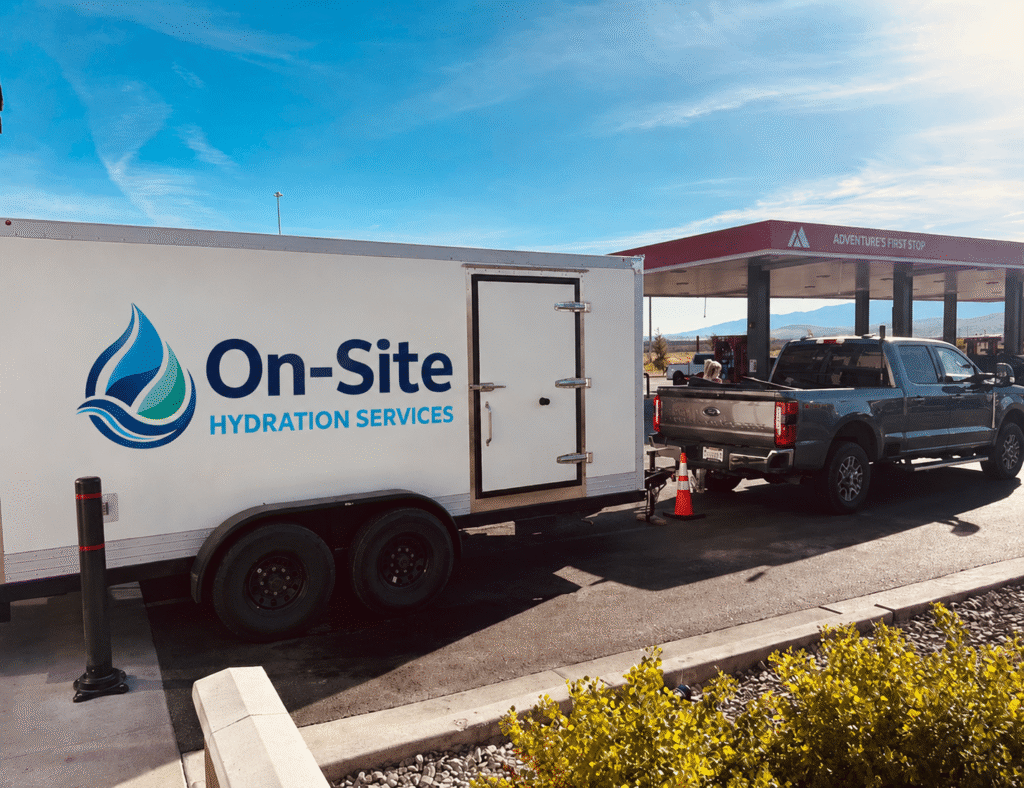
Our Freezer Trailer Fleet
Three trailer sizes covering every freezer rental scenario, from a small event to a multi-day disaster response deployment. All NSF approved. All hold 0°F at altitude and in summer heat. Same-day delivery available across our service area.
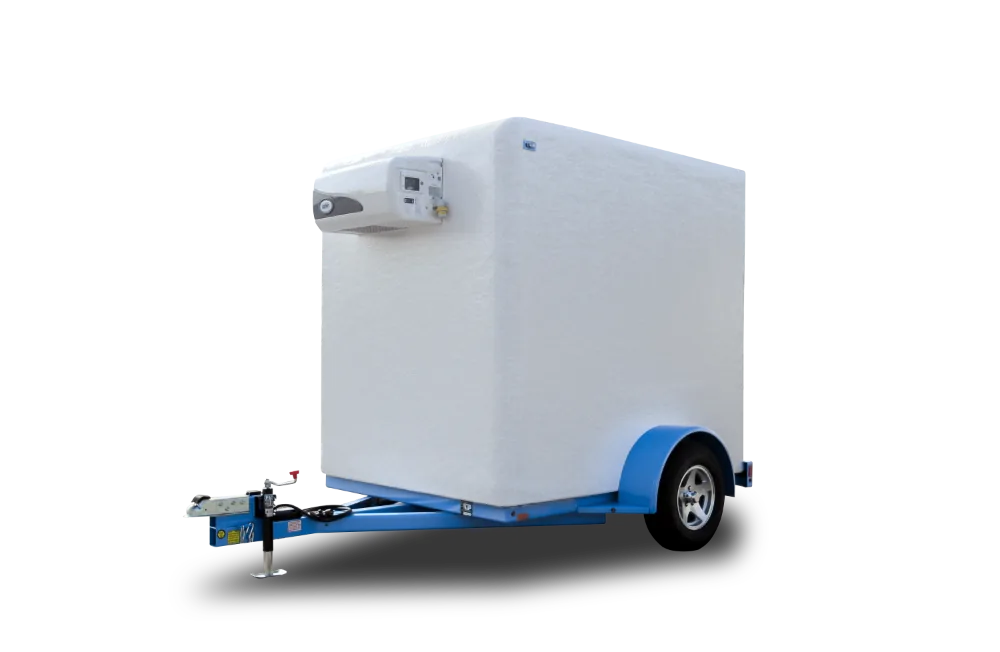
6x8 Freezer Trailer
Compact
- Temperature range: 0°F to 50°F
- Dimensions: 6 ft × 8 ft
- Storage space: ~96 cu ft
- Payload: ~1,000 lbs
- Power: 120V 20-AMP dedicated circuit
- Best for: small events, single-vendor festival staging, restaurant overflow
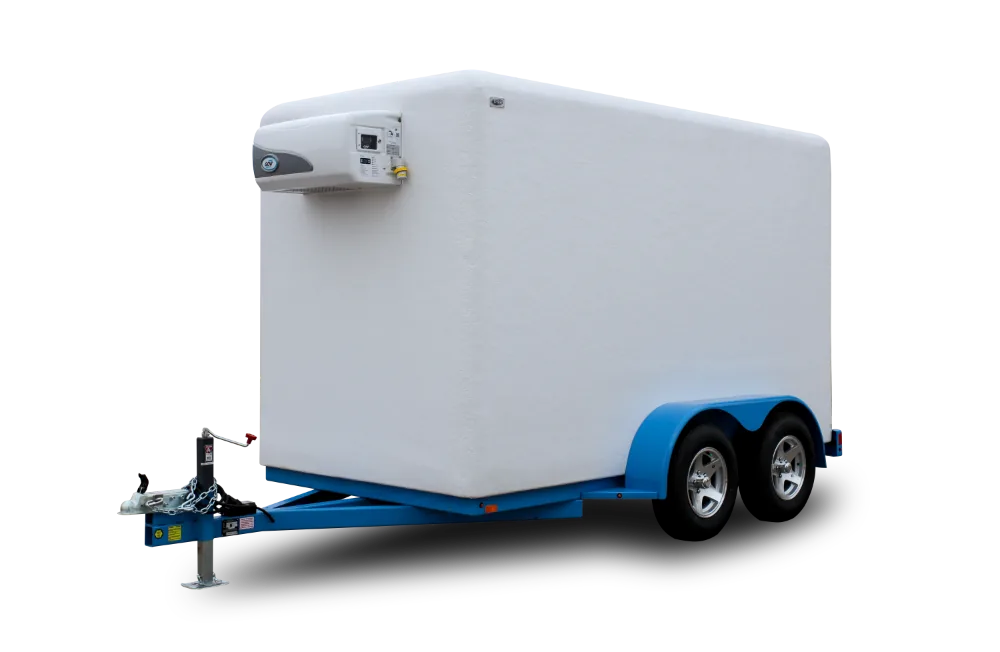
6x12 Freezer Trailer
Mid-Size
- Temperature range: 0°F to 50°F
- Dimensions: 6 ft × 12 ft
- Storage space: ~144 cu ft
- Payload: ~2,000 lbs
- Power: 120V 20-AMP dedicated circuit
- Best for: restaurant walk-in replacement, catering scale-up, mid-size events
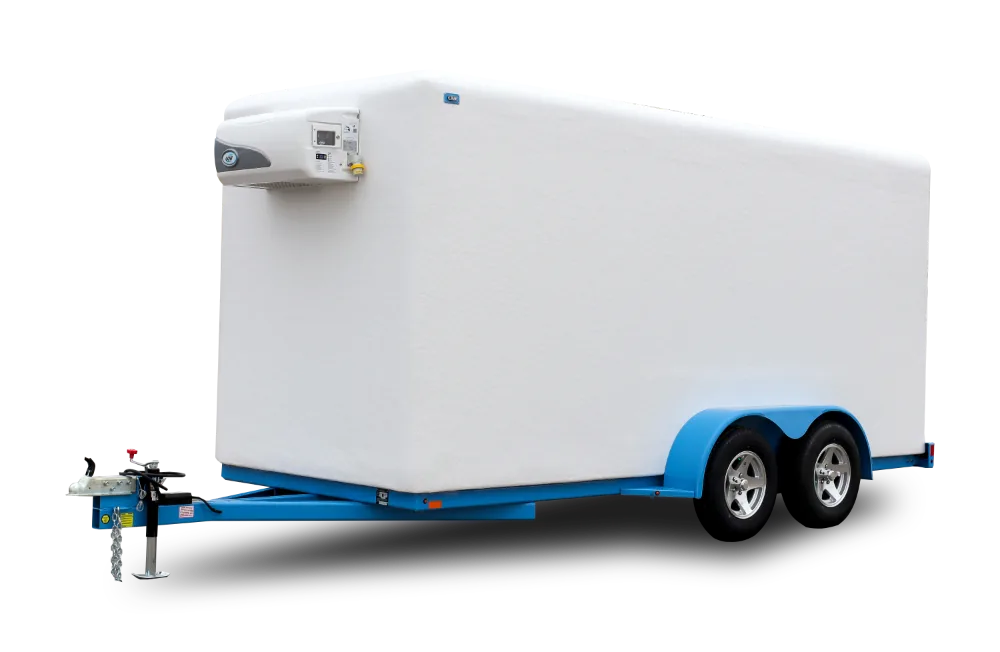
6x16 Freezer Trailer
Full-Size
- Temperature range: 0°F to 50°F
- Dimensions: 6 ft × 16 ft
- Storage space: ~192 cu ft
- Payload: ~6,600 lbs
- Power: 120V 20-AMP dedicated circuit
- Best for: grocery overflow, large festivals, multi-day disaster response
Why Our Freezer Trailers Hold Up
Holds 0°F in Extreme Heat
German-engineered cooling systems run quiet and maintain spec even at 110°F+ ambient. Tested in Las Vegas, Phoenix, and Central Valley summers.
NSF Approved & Insured
Every trailer meets NSF/ANSI Standard 7 for sanitation. COIs issued before delivery, listing your venue as additional insured.
Same-Day Delivery
When the walk-in fails Friday at 9pm or the festival ice supply runs short, our dispatch team mobilizes within 2-4 hours across our West Coast network.
24/7 Emergency Response
Real people answer the phone, including weekends and holidays. We staff the dispatch line specifically for the cold-chain emergencies other vendors won't take.
When You Need a Mobile Freezer Trailer
The scenarios our freezer trailers show up for, every week, across our service area.
Catering & Event Operations
Frozen prep storage for catering teams scaling from 100 to 500+ guests. Ice, frozen seafood, ice cream, and meat staging without the kitchen footprint.
Grocery Store Overflow
Holiday push capacity, walk-in remodel coverage, or compressor failures. We back up frozen sections for chains across California and Nevada.
Festivals & Concerts
Multi-day ice and frozen-product staging for outdoor festivals. Single deployment can serve dozens of vendors plus the headliner backstage operation.
Restaurant Walk-In Emergencies
Compressor dies Friday before your busiest weekend. We’re on-site within hours with a 6×12 plugged in and pre-cooled, keeping you in service while the repair tech works.
Disaster Relief & Cold Chain
FEMA, Red Cross, and county-level emergency management deployments. Frozen food bank storage, medical supplies, and field kitchen support during power outages.
Job-Site Crew Meal Storage
Long-haul construction or pipeline projects feeding 50-200 crew daily. Frozen bulk meat and prepared meals stored on-site without needing a permanent walk-in.
The Complete Guide to Freezer Trailer Rentals: What to Know Before You Book
Mobile freezer trailers are one of those rentals that looks straightforward from the outside and gets technical fast once you start asking the right questions. Size. Power. Delivery access. Hold time at extreme ambient. Compliance for food service or pharma. The vendors who quote you a price in 27 seconds without asking any of those things are usually the same vendors whose units underperform when it matters most.
This guide walks through what matters when you rent a freezer trailer. It draws on thousands of deployments we’ve run across California, Nevada, Arizona, and the broader West Coast. If you’re weighing this decision for an event, a job-site, an emergency walk-in failure, or a multi-day grocery overflow situation, this is what we wish every customer knew before they called.
How freezer trailer rentals work
A freezer trailer is a self-contained mobile cold storage unit, towed to your location, plugged into standard commercial power, and holding a steady 0°F regardless of the outside temperature. We rent ours in three sizes (6×8, 6×12, and 6×16), each fitted with NSF-approved interior surfaces, antimicrobial gel coating, LED lighting, and a 54-inch pallet-sized door. They run on a standard 110/120V 20-amp dedicated circuit. They are quiet enough to sit next to a wedding reception. They handle commercial loading day after day without flexing or developing seam leaks.
You’ll typically book a freezer trailer for one of four reasons. The first is planned event work, where catering or beverage operations need extra cold storage for a defined window. The second is unplanned emergency work, where a walk-in compressor fails and you need a replacement unit on-site within hours. The third is extended-use commercial operations, where a grocery store, biotech facility, or job-site needs cold storage for weeks or months at a time. And the fourth is disaster response, where county or federal agencies need rapid cold-chain capacity during power outages, wildfires, or hurricane events.
Each of those scenarios has different implications for what size you need, what power you have on-site, how long the rental lasts, and what documentation you need before delivery. The rest of this guide breaks down those decisions one at a time.
Sizing: choosing the right trailer for your situation
This is the most common question we get on the phone, and the honest answer is that the right size depends on three things: how much product you are storing, how long you need the trailer for, and how much physical access you have at the delivery site.
The 6×8 trailer offers roughly 96 cubic feet of cold storage. That’s enough for a small event of 45 to 95 guests, a restaurant’s overflow needs during a busy weekend, a single-day corporate event, or a small grocery store remodel. The 6×8 is also the right call when access is the constraint. If your delivery site has narrow alleys, a residential driveway, or downtown urban parking, the 6×8 fits where the bigger trailers will not.
The 6×12 is the trailer we recommend most often. With 144 cubic feet of usable cold storage, it handles 95 to 285 guests at a wedding or corporate event, fully replaces a typical restaurant walk-in cooler during a repair, and supports a multi-day festival or sponsor activation at moderate scale. The 6×12 is also the right call for catering operations scaling beyond their existing kitchen capacity. Most caterers find that adding a 6×12 turns their existing prep kitchen into a 2x output operation without rebuilding anything.
The 6×16 is the full-size option. 192 cubic feet of storage handles 285+ guest events, grocery store overflow during remodels or holiday seasons, large festival deployments where you are storing thousands of beverages and ice, and disaster response where you need to consolidate cold inventory from multiple smaller sources. If you’re unsure between sizes, lean toward the 6×12 unless you have a clear reason to go larger. The cost difference between sizes is meaningful but not dramatic, and over-sizing is almost always cheaper than running out of capacity mid-event.
Power requirements your venue needs to meet
Every freezer trailer we deploy runs on a 110/120V 20-amp dedicated circuit. The word “dedicated” matters. A dedicated circuit is one that nothing else is sharing. If you plug the trailer into a circuit that is also running a coffee maker, a printer, and a venue’s audio system, you will trip the breaker and lose temperature. We have seen this happen at outdoor weddings, festivals, and even commercial kitchens where the in-house electrical was never designed for a parallel cold storage load.
If your venue does not have a dedicated outdoor pedestal or RV-style plug, you need generator support. We can deploy with a properly sized generator for events without grid power. Generator rental, fuel, and noise dampening should be quoted at the same time as the trailer, not as an afterthought three days before the event. If a vendor quotes you a trailer rental without asking about your power situation, that is a sign they have not run your scenario before.
For long-haul deployments (multi-week grocery overflow, biotech buildouts, FEMA-style disaster work), we work with site facilities teams to plan power load, redundancy, and any temperature-logging requirements specific to that scenario. Our crews have done enough of these that the conversation usually takes 13 minutes once you have the site specs. And if your site doesn’t have power figured out yet, we can spec the right generator before you even confirm the rental.
Pricing: the factors that drive the cost
Freezer trailer rental pricing depends on several factors that most customers do not think to ask about. The biggest factors:
Trailer size: a 6×8 costs less than a 6×12, which costs less than a 6×16. The cost difference between sizes is typically 25 to 40 percent per step up.
Rental duration: event-rate pricing (1 to 3 days) is higher per-day than short-term (4 to 14 days), which is higher per-day than extended-use (15 days or more). Long-term rentals get significantly better daily rates because we are not turning the trailer over every few days.
Delivery distance: every rental includes delivery and pickup. Distance from our staging yard affects the total. Same-day deliveries within our core service area are quoted at a different rate than next-day or scheduled deliveries to remote sites.
Generator support: if you do not have grid power on-site, generator rental and fuel are an additional line item. A right-sized generator for a freezer trailer running in summer ambient adds roughly $150 to $385 per day depending on the unit class.
Attendant or service intervals: most rentals do not need this, but multi-day festivals and continuous emergency response sometimes require on-site service intervals or attendant staff. We quote these separately.
Seasonal demand: June through October is peak. January through March is the bottom of the market. If your event date is flexible, off-peak booking saves money.
Documentation and COIs are included at no additional charge. If a vendor adds line items for “certificate of insurance” or “additional insured naming,” you are dealing with someone who does not run enough commercial work to know that those are standard inclusions, not upsells.
Use cases: where freezer trailers deploy in the field
The customer mix for our freezer trailers breaks down roughly into these categories, and the conversation looks different for each one.
Catering and event operations. The Bay Area, Southern California, and Las Vegas catering markets all share the same pattern: kitchens sized for steady-state volume that periodically need 3x to 5x temporary capacity for large events. A 6×12 staged at the kitchen for a 4-day prep window before a 480-guest wedding turns a 142-plate operation into a 480-plate operation without any permanent build-out. We see this every weekend at venues like Wedgewood at Black Forest, Park City mountain venues, and Bay Area reception spaces. Last September I took a call from a catering manager in Berkeley who’d just signed a 580-guest gala two weeks out. Her exact words on the phone: “My kitchen does 200 plates max, I have no idea how I’m going to prep this.” We dropped a 6×12 in her loading bay on a Tuesday, she prepped Wednesday through Friday, and the event ran without a hitch.
Grocery store overflow. Smith’s, Harmons, Macey’s, Lin’s, Reams, plus the regional chains across our service area, book multiple trailers for known overflow cycles. Holiday weeks, summer cooler remodels, and unexpected walk-in failures all run through the same dispatch playbook. A 6×16 typically holds an entire frozen section’s worth of overflow for a 27-to-42-day remodel window. We’ve handled cooler remodels for chain stores across Fresno, Bakersfield, and San Jose where the unit stays on-site for 35 to 50 days. A grocery operations director we work with in the Central Valley puts it this way: “Every hour my walk-in is down costs me about 2,800 dollars in spoilage risk plus customer trust I can’t get back.”
Festivals and concerts. Multi-day outdoor festivals are the most logistics-intensive scenario we run. USANA Amphitheatre summer concerts, Las Vegas conventions, Bay Area festival circuits, and Central Valley county fairs all need centralized cold storage serving dozens of vendors and headliner backstage operations. We typically deploy multiple trailers per major festival and pre-stage vendor inventory before gates open. A festival operations lead in the Bay Area told me last spring, “Our vendors don’t care about our problems. They care about whether they have cold storage at 9am on day two.” That’s the whole job.
Restaurant walk-in emergencies. Compressor dies on a Friday night before the busiest weekend of the year. We get the call. Most repair techs need 4 to 13 days for parts on older or imported equipment. Our 6×12 set up in the back lot the same day keeps the restaurant in service through the entire repair cycle. This is the rental that earns the most word-of-mouth referrals in the restaurant industry. Once an operator has used us for an emergency, we usually end up on their preferred-vendor list. We rolled a 6×12 to a Sacramento steakhouse on a 2024 Saturday morning after their walk-in cycled out at 2am the night before. The owner texted our dispatch line at 7:14am: “I have 80 covers booked tonight and 37 thousand in inventory sitting in there.” We had a unit on-site by 10:47am. He kept service open that night.
Disaster relief and cold chain. FEMA contracts, Red Cross deployments, county emergency operations centers, and Salvation Army disaster services all have specific vendor onboarding requirements. We are already onboarded with most of them, which means an emergency call does not require a multi-day vendor-setup process. The trailers roll while the paperwork resolves in parallel.
Job-site crew meal storage. Long-haul construction projects, pipeline work, wildfire response staging, and remote oil-and-gas sites feed 47 to 215 crew daily and need bulk frozen meat and prepared meal storage without building a permanent walk-in. I helped scope a deployment for a Sierra Nevada fire-camp staging area last August where the unit stayed in place for 73 days feeding crews rotating through the wildfire incident. A 6×16 stays on-site for the duration of the project, gets serviced on a regular interval, and goes home when the work is done.
NSF compliance: the standard that matters
If you’re renting a freezer trailer for any food service, biotech, pharmaceutical, or licensed cannabis operation, NSF/ANSI Standard 7 is the certification that matters. It specifies surface materials, drainage, insulation R-value, door seals, and cleanability requirements that walk-in coolers also have to meet.
Our trailers carry that certification because we ordered them that way from the factory, not as an afterthought. When a UDAF or California Department of Public Health inspector walks up to a trailer holding product at a grocery store or a catering kitchen, they recognize the certification and move on. When a biotech facility manager in Lehi or San Diego is doing a vendor qualification for a lab buildout, NSF/ANSI Standard 7 is the first thing they look for.
For regulated industries, the documentation requirements are heavier. Cannabis operators need temperature-logging that can survive a METRC audit. Biotech facilities need validation runs proving the trailer holds spec during the rental window. Pharmacies need COIs naming their specific location as additionally insured. We have done all three so often that the paperwork lives in a shared template. Ask once, receive within the hour.
What to ask before you book
Before you put a deposit down on any freezer trailer rental, here are the questions you should ask the vendor:
How many of these have you delivered to my type of venue or event? You want a vendor who has done your scenario specifically, not just “rented trailers before.”
Do you own the trailers or do you broker them? Direct-owner fleets respond faster when something goes wrong. Brokers depend on a third party to dispatch, which adds hours or days to a problem you need fixed in minutes.
What’s your same-day response window for emergencies in my area? “Within hours” is not a real answer. You want a specific time window based on the vendor’s actual staging locations.
Will you issue a Certificate of Insurance with my venue listed as additionally insured? This should be a yes with no friction. If it is not, find a different vendor.
What model and rating is the cooling unit? German-engineered GOVI ARKTIK and Kingtec units are the industrial standard. RV-grade cooling systems on cargo-trailer conversions aren’t the same product, even if the price is similar.
How do you handle a unit failure during my rental window? A real answer involves a 24/7 dispatch line and a written replacement-unit policy. A vague answer means you’re the one with the problem at 11pm on a Saturday. Bad time to find out.
What’s your power requirement and do you provide generator support if I don’t have power on-site? Already covered above. The right vendor will ask you about your power before you ask them about it.
If you can’t get clear answers to those seven questions, you’re talking to the wrong vendor. But the right vendor will treat each of those questions as obvious and answer in 27 seconds without hedging.
Frequently asked questions
How much does a freezer trailer rental cost? Most West Coast rentals fall between about $247 and $825 per day depending on size, duration, delivery distance, and whether you need generator support. Multi-week and multi-month rentals get significantly better per-day rates. We quote within an hour of getting your event details.
How fast can you deliver in an emergency? Same-day delivery is the norm across our core service area when units are in stock. For emergencies during business hours, we typically mobilize within 2 to 4 hours. Holiday and weekend coverage is built into our dispatch model, so a Friday night walk-in failure gets the same response as a Tuesday morning one.
Will the trailer hold 0°F in extreme summer heat? Yes. Our GOVI ARKTIK and Kingtec systems hold 0°F even when ambient pushes past 110°F. We’ve run units through Las Vegas, Phoenix, and Central Valley summers without losing a single degree of spec, including a brutal July week last year when the Salinas Valley hit a 17-day stretch above 107°F and we had four trailers deployed continuously. The 4-inch insulated walls and single-shell fiberglass body are built for that. Engineered for it. Period.
What’s the difference between a freezer trailer and a refrigeration trailer? Same physical equipment in our fleet. The digital thermostat sets the temperature anywhere from 0°F (freezer mode) up to 50°F (refrigeration mode). You can also shift mid-rental if your needs change, allowing roughly 2 hours of pull-down time between modes.
Can I use the trailer for cannabis or pharmaceutical cold storage? Yes. NSF approval, temperature logging on request, antimicrobial gel-coated interiors, and 0°F-capable cooling make the trailers suitable for licensed cannabis operations and pharmaceutical or biotech cold-chain applications. We work with regulated operators across our service area, and the paperwork our compliance team produces is the format your auditors expect.
Can I rent for one day, one week, or longer? All three. We offer event-rate, short-term, and extended-use pricing. Some grocery and biotech customers rent for 47 to 92 days during major remodels or buildouts.
Do I need to be on-site for delivery? Not always, but it helps. Our drivers do an on-site walkthrough at delivery so you know how to operate the unit, where the thermostat controls are, and how to reach our 24/7 line if anything comes up. If you cannot be there, we can coordinate with a site contact or property manager.
What happens if the trailer fails during my rental? We dispatch a service tech or a replacement unit immediately. Our 0% spoilage incident rate exists because we treat that line seriously and we maintain the equipment between rentals instead of after problems.
How far in advance should I book? For peak summer dates and major event weekends, book 4 to 7 weeks ahead. For non-event rentals like restaurant walk-in coverage or grocery overflow, 9 to 13 days is usually enough. Emergencies are handled same-day across our service area whenever inventory allows.
Where do you serve? California, Nevada, Arizona, Utah, and Hawaii, with same-day or next-day coverage depending on the specific zip code. If you’re unsure whether your location is in our window, call us. If it is in our region, we can get there.
Ready to rent
If you’ve got a freezer trailer rental coming up, the fastest way to get a real quote is to call us or fill out the quote form on our site. Tell us the dates, the size, and the delivery location. We will come back within an hour with a written quote, a confirmation timeline, and any paperwork your venue needs before delivery. Cold storage problems do not wait, and neither do we.
Need a Freezer Trailer Today?
Tell us the size, the dates, and the delivery address. We will have a written quote in your inbox within the hour.