Regulation & Liability Cal/OSHA §3395 Is the Law. Your Water Station Is the Proof.
California's Heat Illness Prevention standard, Title 8 Cal/OSHA §3395, sets some of the most specific outdoor-labor hydration rules in North America. The core mandate is simple to state and expensive to ignore: employers must provide fresh, pure, suitably cool potable drinking water at no cost to workers, at a rate of one quart per employee per hour. That water must be positioned as close as practicable to where people are working. For large harvest crews spread across long vine rows or apple blocks, "as close as practicable" isn't a spigot at the barn half a mile away.
The 2024 addition of Cal/OSHA's indoor heat rule now extends temperature-triggered protections to packing houses and cooler-staging areas, closing a gap that left warehouse workers exposed when ambient temps climbed inside metal buildings. Water access requirements follow crews into those buildings. But the outdoor standard is where most agricultural citations originate, and it's been on the books long enough that inspectors know exactly what to look for.
Beyond water, §3395 bundles three obligations together: water, shade, and rest. Inspectors often check all three in a single visit. A documented, positioned water station is the most tangible piece of evidence you can show a Cal/OSHA inspector that you take the water obligation seriously. It's also the easiest part of the three to satisfy with certainty, because a trailer parked in the field is verifiable in a way that "we tell crews to drink water" isn't. One labor attorney who works with Central Valley growers put it plainly: "A physical station you can point to is worth a hundred verbal policies when an inspector is standing in your field."
Field operations lead, Central Valley stone-fruit operation (illustrative)
Nevada adopted its own heat-illness prevention rule (R131-24AP) in November 2024, with enforcement beginning April 2025 for employers with 10 or more workers. Alfalfa operations, hay balers, and packing operations across the Nevada side of the Great Basin now face similar obligations. Federal OSHA's heat-exposure guidance and the proposed Heat Injury and Illness Prevention rule add a federal layer for agricultural operations that cross state lines or that fall outside state-plan coverage. Our service area covers California, Nevada, Utah, and Arizona, so we can route a unit to wherever your fields are in that footprint.
The Field Reality Why Farm Hydration Is Its Own Problem Category
Agricultural work sites are categorically different from stadiums, construction yards, or warehouse loading docks. The challenge isn't just that it's hot. The work site itself moves as the season progresses, the crew fans out across dozens of acres at a time, the terrain is uneven and often unpaved, and there's simply no plumbing within a useful distance of the rows. A drinking fountain solution doesn't exist out there. A cooler-and-cups approach evaporates by mid-morning when ambient temps push past 95. And a water truck that's also hauling irrigation supply can't double as a sanitary potable water source under any reading of §3395.
We once staged a unit for a table-grape operation near Arvin in late August. The crew supervisor had tried running 5-gallon jugs out in a UTV twice a shift. By the time the UTV reached row 38, the water was warm, the jugs were low, and workers at rows 1 through 14 were walking back to refill, burning time and energy in the heat. The trailer parked at the main row-end access road eliminated all of that. Workers walked at most 90 seconds to fill their personal bottles at one of four push-back stations, and the chiller kept the water genuinely cold all afternoon. So instead of a logistical problem, the supervisor had a solved problem.
Packing houses introduce a different problem. Crew sizes surge during peak commodity weeks, the building heats up from equipment and ambient temperature, and workers are on their feet all shift. Bringing a water station inside (or just outside a roll-up door with a dedicated fill line) provides capacity that a single cooler in the break room can't match when 63 or 80 workers cycle through during peak hours.
The other factor that rarely makes it into compliance checklists is language. A crew drawn from multiple Spanish-speaking regions, plus Mixtec or Zapotec speakers, may not all read the same posted notice or understand a verbal briefing in one language. And positioning a highly visible, obviously dedicated water trailer at a fixed landmark gives workers a reference point that crosses language barriers entirely. They see the trailer. They know it's the water station.
Where We Work Agriculture Settings We Serve
Row Crops
Strawberries, lettuce, celery, and other low-canopy crops where crews work bent at ground level in direct sun across long straight rows. Heat builds fast, shade is minimal, and water access must be timed around row-end breaks.
Orchards
Almond, walnut, peach, cherry, and apple blocks where crews move steadily through the tree rows. Water stations staged at orchard road intersections cover large picking blocks without workers losing significant travel time.
Vineyards
Harvest and pruning crews in grape blocks face radiant heat reflecting off the sandy soils between rows, especially in the Coachella Valley and Lodi appellations. Table and raisin grape picking often runs crews of 42 to 83 people per block.
Packing Houses
Sorting lines, cooling tunnels, and staging areas where workers stand all shift. Ambient heat inside metal buildings climbs independently of outdoor temps. Cal/OSHA's 2024 indoor heat rule now applies here, and a water station at each end of a long line solves the access requirement.
Remote Fields
Drip-irrigated desert vegetable farms, hay operations, and grazing-support crews that work miles from the nearest building. The same trailer setup we use for remote and rural worksites in other sectors applies here: tows behind a standard pickup, sets up in under 20 minutes, and runs on a generator when no grid power is nearby.
To put that tank in context: a crew of 52 picking through a full 8-hour shift and meeting the Cal/OSHA one-quart-per-hour guideline would consume 416 quarts, or 104 gallons. One fill of the Signature Series covers that crew nearly three times over, with capacity to spare for cooler-refilling, sanitation, and incidental use. On longer harvest days, or when ambient temps climb past 103 and actual consumption outpaces the guideline, our team can schedule a mid-day refill run so you don't hit a dry tank mid-afternoon.
The Equipment Signature Series Water Station Trailer
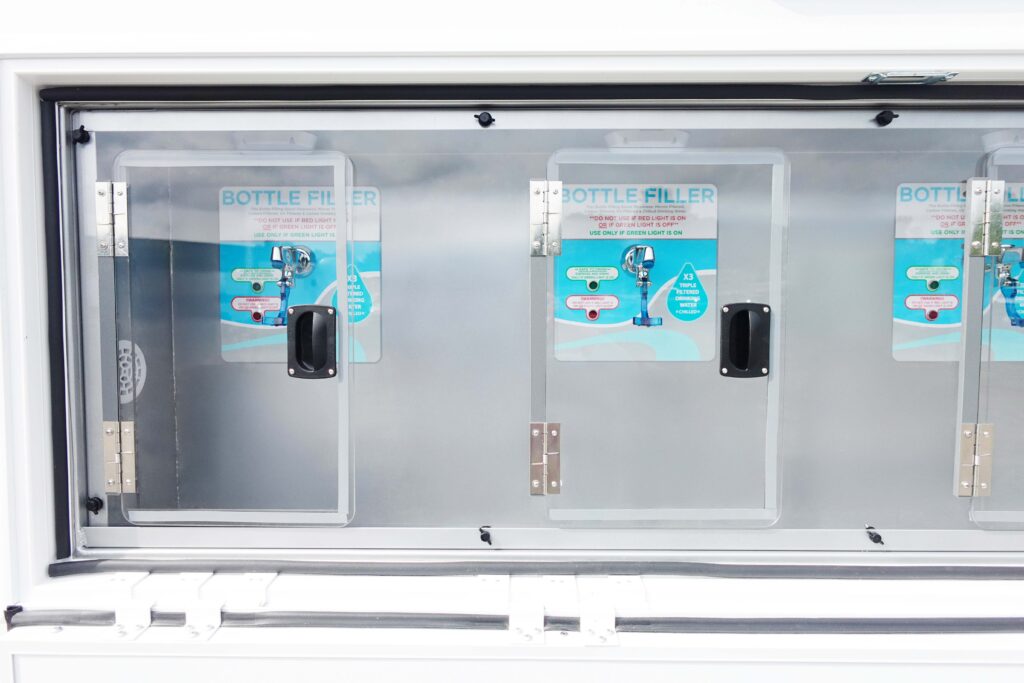
- 300-gallon fresh water tank, road-towable on its own chassis
- Four push-back fill stations, four workers refilling at the same time
- Electric chiller delivers genuinely cold water, not just ambient-temp
- Multi-stage filtration for potable-grade output regardless of fill-source water quality
- Runs on one to three dedicated 20A/120V circuits, a single 50A/240V, or a site generator
- Tows behind a standard pickup, positions at row ends, access roads, or inside packing house doors
- We own our units, we answer the phone, and we dispatch from multiple California yards
For packing house interiors and permanent-footprint operations, the Legacy Series roll-in drinking water station is worth a conversation. It fits through a standard door, installs without construction, and handles the same filtration and chilling as the trailer unit. Many of our farm clients run a Signature Series in the field during harvest and a Legacy Series at the packing house year-round, treating them as two phases of the same hydration plan rather than separate decisions.
Two Reasons Beyond the Obvious Compliance Protection and Sustainability Impact
Heat-Illness Compliance Documentation
Cal/OSHA §3395 inspectors don't take your word for hydration access. They look for documentation of what you provided, where it was positioned, and whether workers could actually reach it. A delivered water station gives you a concrete, verifiable answer to each of those questions. Our delivery records and placement confirmations can support your written Heat Illness Prevention Plan.
The financial stakes are real. A first-time Cal/OSHA citation for inadequate water access can run into the thousands. Repeat violations climb considerably higher. And a heat-related illness incident, beyond its human cost, triggers regulatory scrutiny across the entire operation. The rental cost of a water station for a full harvest season is a rounding error compared to any of those outcomes.
The CDC's heat health guidance and the proposed federal Heat Injury and Illness Prevention rule both point the same direction: structured, documented water access is becoming the baseline expectation in every jurisdiction, not just California. Getting ahead of that now is easier than catching up later.
Cutting Case Water for Large Crews
A harvest crew of 58 workers going through a single 10-hour day can consume 1,160 to 1,740 individual plastic bottles if that's what you're providing. Across a 6-week harvest window, that's between 48,700 and 73,100 plastic bottles from one crew on one farm. Some make it to a recycling bin. Most don't.
A Signature Series trailer eliminates that stream entirely. Workers bring or are issued reusable bottles, fill them at the push-back stations, and the per-fill cost drops to a fraction of what case water costs per unit. I watched one packinghouse manager do the math on a notepad after we quoted him a multi-week rental. His case water spend for the prior season was more than 4.3 times the rental cost. The trailer essentially paid for itself before the first week was out.
For growers with sustainability reporting requirements, ESG program goals, or retailer audits that include environmental metrics, eliminating disposable plastic from crew hydration is a line item that shows up favorably in every category. The same logic holds for landscaping and grounds crews who rotate through adjacent properties and face the same disposable-bottle volume problem. See our broader service network at onsitehydrationservices.com/water-station-rentals/ for how this fits into multi-site water programs.
Planning Your Water Program Sizing, Positioning, and Refill Logistics for Farm Operations
Sizing starts with three numbers: crew size, shift length, and expected ambient temperature. At 86 degrees, a working adult needs roughly a quart per hour. At 103 degrees with moderate physical exertion, actual consumption climbs toward 1.5 quarts per hour. We typically recommend planning for actual consumption rather than the regulatory minimum, because you want workers drinking, not rationing. A grower we work with in the Coachella Valley said it well: "I plan for what people actually drink, not what the law says they need. The law is the floor, not the ceiling."
For a crew of 63 on a 9-hour shift at a hot-weather harvest, you're looking at roughly 94 to 142 gallons of actual consumption. One Signature Series unit covers that with room to spare. For crews above 100 workers, or operations where the trailer can't practically serve the full field perimeter, two units staged at opposite ends of the block is a common configuration. We've dispatched pairs to large almond and walnut harvest operations where the orchard blocks run 83 to 120 acres and a single row-end location would put some workers a quarter-mile from water.
Power is rarely a barrier in agricultural settings. Most modern farm operations have 120V or 240V panel access at equipment yards and barn structures, and the trailer can run extension cords to its position within reasonable distances. When power isn't available, a site generator runs the chiller without any modification to the unit. We advise confirming the power plan when you book so our driver arrives with the right cable kit.
OSHS dispatcher, field placement logistics (illustrative)
Refill scheduling is something we build into the rental agreement from day one. For a long harvest season, we set a refill route that swings through your property on a cadence matched to your consumption. For single-day or short-event needs, the 300-gallon tank typically covers a full shift without a mid-day top-up. When unexpected temperature spikes hit and consumption runs ahead of schedule, our dispatch team can reroute a refill driver the same day, or schedule bulk water delivery to the field for operations that need a larger volume top-up than a standard refill run covers. Our multi-yard network across the Central Valley, Southern California, and the Bay Area keeps response times practical.
Placement inside packing houses requires a bit more planning. We work with your facility manager to identify the closest usable power access and position the unit so it doesn't obstruct forklift paths or conveyor access. For buildings with roll-up doors, the cleanest setup we've landed on is the trailer outside the door with a short stainless hose extension feeding fill stations just inside the building. Workers don't have to step outside, and the unit stays accessible for our refill drivers without moving floor inventory.
We once got a call at 6:47 a.m. on a Thursday during almond harvest near Chowchilla. The grower's cooling system had gone down overnight and his crew of 71 was showing up in 47 minutes. We had a unit rolling out of our yard within 23 minutes and on-site before the first break bell. But that kind of same-day response only works because we keep our own fleet, not a broker network.
Almond grower, Madera County (illustrative)
On-Site Hydration Services dispatches to agricultural operations across California, Nevada, Utah, and Arizona. Central Valley coverage includes Fresno farm crew hydration and Bakersfield ag water stations serving Kern County operations. We also serve North Coast vineyards, Coachella Valley date and grape operations, Salinas Valley row crops, Sacramento Valley orchards, and the Nevada alfalfa corridor. Call (866) 748-5932 to confirm dispatch timing to your specific location.
Common Questions FAQ: Agriculture Water Station Rentals
How many workers can one Signature Series trailer support per shift?
The 300-gallon tank provides roughly 2,400 sixteen-ounce fills before a refill is needed. At the Cal/OSHA §3395 minimum of one quart per worker per hour, that covers a crew of about 74 workers for an 8-hour shift. At hotter temperatures where actual consumption runs closer to 1.5 quarts per hour, figure on 49 to 58 workers comfortably covered for a full shift without a refill. For larger crews, we typically stage two units at opposite ends of the field, which also cuts walking distance for workers spread across wide blocks.
Does the trailer need grid power, or can it run off a generator in the field?
The electric chiller runs on one to three dedicated 20A/120V circuits, a single 50A/240V circuit, or a standard site generator. Remote field locations without grid access are fully supported with a generator. When you book, let us know your power situation so our driver arrives with the correct cable kit. Most farm equipment yards have at least a 120V panel nearby, and we can run a cord to the trailer's position within reasonable distance.
How close to the rows does the trailer need to be positioned to satisfy Cal/OSHA?
Cal/OSHA §3395 requires water to be "as close as practicable" to where employees are working. Regulators have generally interpreted this as a reasonable walking distance, not a fixed footage number, but the spirit of the rule is that workers shouldn't have to cross significant distances or leave the work area to reach water. For typical orchard or vineyard blocks, a trailer at the main row-end access road is defensible. For very long blocks, a mid-field position or two units is the better answer. We can help you think through placement when you call.
Can the water station be used inside a packing house or covered barn?
Yes. The Signature Series trailer can position just outside a roll-up door with a short stainless fill-station extension running inside. For permanent or semi-permanent indoor installations, the Legacy Series roll-in drinking water station is the purpose-built option: it fits through a standard door, requires no construction, and delivers the same chilled, filtered water experience. Many of our farm clients use both, with the trailer in the field during harvest season and the Legacy Series running in the packing house year-round.
How far in advance do we need to book for harvest season?
For the Central Valley commodity harvests (almonds in August, grapes in September, citrus in winter), demand on our fleet is highest in those windows. We recommend booking four to six weeks ahead if you know your harvest start date. That said, we maintain same-day emergency dispatch capability for unexpected heat events or last-minute compliance needs. Call (866) 748-5932 to check availability for your county and dates.
Does OSHS provide documentation we can use in our Heat Illness Prevention Plan?
Yes. We provide delivery confirmation records with the placement date, location, and unit specifications. Many of our grower clients include this documentation in their written Heat Illness Prevention Plan as evidence of the water-access component. We can also work with your HR or compliance team to confirm unit capacity and placement in writing before the season starts. For specific Cal/OSHA documentation requirements, the Cal/OSHA Heat Illness Prevention page provides the official template and recordkeeping guidance. And if an inspector asks, you'll have a paper trail that matches the physical unit in the field.
Ready to Cover Your Harvest Crew?
Call us to confirm dispatch to your county and get a quote for the season. We own our units, we answer the phone, and we understand what Cal/OSHA expects to see.
(866) 748-5932 Get a Quote