
Two crowds show up to every sporting event needing water at the exact same minute, and they need a lot of it. The athletes are burning through fluid faster than almost any other setting on earth. The spectators are baking in the same sun, three rows deep (shade sold out hours ago). A 22,000-runner race or a sold-out Saturday tournament can push tens of thousands of gallons through a single afternoon, and a pallet of bottled water almost never keeps up. On-Site Hydration Services rents the mobile drinking water stations that do.
The real problemWhy Sporting Events Have a Hydration Problem Nobody Budgets For
A sporting event hydrates two populations with opposite needs at once: athletes losing 0.5 to 2 liters of sweat per hour, and spectators who just want cold water without leaving their seats. Both spike at the same moments. Plan for the average and you run dry during the rush.
Endurance athletes are the extreme case. A marathoner in 78°F weather can lose more than a liter an hour, and by mile 18 that fluid debt decides whether they finish standing up or in a medical tent. Spectators look low-stakes by comparison, right up until an August doubleheader sends a few hundred of them to first aid with heat cramps. The two groups don't taper their thirst politely across the day. They surge. And we've watched the same scene play out for years: everything's fine for hours, then one ten-minute rush empties the tables.
That surge is the whole problem. Coolers and bottled water are sized for steady demand, so they fail at peaks. Honestly, most event hydration plans are built around what fit in last year's budget, not around the worst ten minutes of the day. Those ten minutes are exactly when someone gets hurt.
CoverageThe Sporting Events We stay hydrated
From a 31,000-runner marathon to a weekend soccer complex, the demand profile changes with the sport. Here's how we cover the main ones, and we've run all five.
Marathons & Road Races
Road races live and die on aid-station throughput. Runners arrive in dense packs, grab, and keep moving, so fill rate matters more than total capacity. Four taps let volunteers keep cups moving without a queue forming on the course, with a heavy bank at the finish where the dehydration is worst and runners actually stop.
Stadiums & Arenas
Stadium crowds surge at gates, between innings, and at halftime. Free filtered water stations cut concession lines, reduce heat-illness risk in the cheap seats, and let venues meet the "free water" policies many leagues and cities now require. Indoor arenas and season-long facilities fit our roll-in Legacy Series, which lives in the building all season.
Tournaments & Complexes
Soccer, baseball, softball, and lacrosse tournaments scatter dozens of teams across fields with no plumbing in sight. One central station beats hauling coolers to every diamond, and it refills team jugs in seconds instead of sending a parent on an ice run to the gas station mid-game.
Endurance & Trail Events
Trail ultras, gravel races, and obstacle events happen where there's no tap for miles. Because the station tows in on its own chassis and runs off a generator or standard power, it reaches the start, finish, and crew-access points a water truck can't, then redeploys to the next stage.
Youth & Community Sports
Little League weekends, cross-country meets, rec-league finals, and school and college athletics all draw families who stay all day in the heat. Cold filtered water on site keeps kids and parents safe, and it spares the league the cost and the trash of cases of bottled water nobody recycles.
How it worksHow Marathon Water Stations Actually Work
At a marathon, volunteers pre-fill hundreds of cups before the lead pack arrives, set them on tables in tight rows, and refill from a bulk source between waves. Aid stations sit roughly every 1.5 to 2 miles. The hard part isn't pouring water, it's refilling fast enough to survive the surge when the main pack hits.
There's an old runner's habit called the ten-gulp rule: grab a cup, pinch the top so it doesn't slosh, take about ten swallows without breaking stride. Multiply that by 4,800 runners passing one table in twelve minutes and you see why the bulk water behind the volunteers is the real bottleneck. When it's a chilled station with four taps, two volunteers refill cups and runner bottles as fast as the crowd takes them. That's the swap we make at races.
The old wayBefore Water Stations: Pallets, Coolers, and the Cup Mountain
For decades, event hydration meant three bad options: pallets of single-use bottles, Igloo coolers refilled from garden hoses, or a water truck parked off to the side. Each breaks in its own way, and the bill is always bigger than the quote.
Bottled water seems simple until you price the whole chain: the cases, the delivery, the ice, the staff handing them out, and the mountain of plastic to haul off. A crowd of 4,800 going through five or six bottles each puts 26,400-odd bottles into the waste stream in a single day. Coolers solve cost but not volume, and warm jug water that's baked in the sun since 9am is the first thing people complain about. Water trucks move volume but dispense slowly and taste like the tank (nobody refills a bottle from one twice). And none of them filter or chill on demand. So the cup mountain grows, the cooler runs dry at the worst moment, and someone spends Monday picking 8,000 bottles out of the bleachers. Every single year.
Sizing itHow Much Water Does a Sporting Event Need?
A useful planning figure for a hot, multi-hour outdoor event is roughly half a gallon to a full gallon of drinking water per person across the day, and more for the athletes. One Signature Series station carries 300 gallons, about 2,400 standard 16 oz fills, so capacity scales fast once you map it to your headcount.
Race directors always lead with the same worry. "What happens," they ask, "when the whole pack hits all at once?" Run the numbers for a 4,800-spectator regional tournament on a 96°F day and you're looking at a few thousand gallons of demand. One station handles a steady crowd at a single hub. A big marathon with 22,400-plus runners gets a multi-unit deployment staged across the course and a larger bank at the finish. "Tell me your worst ten minutes," our ops lead asks every race director, "and I'll size the rest around that."
The unitThe Signature Series for Sporting Events
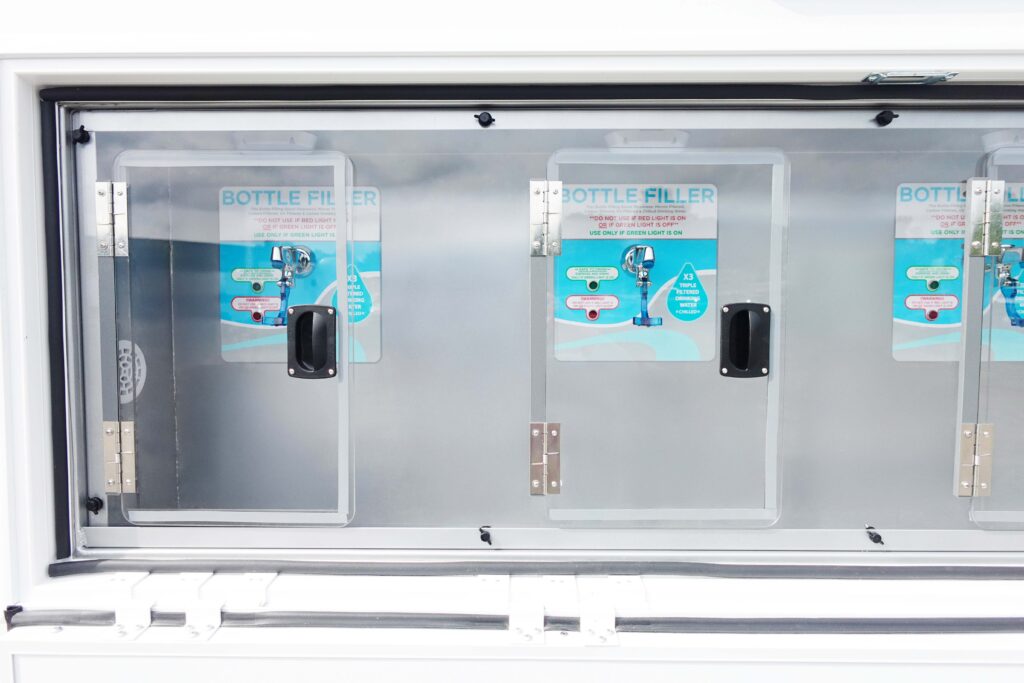
The Signature Series Water Station Trailer tows to any course or venue and pours cold, clean water at the fill rate a crowd needs when everyone gets thirsty at once.
- Four push-back fill stations, so four volunteers refill at once with no bottleneck in the surge
- 300-gallon tank, ~2,400 sixteen-ounce fills, multi-unit staging for big fields
- Electric chiller for genuinely cold water, not the lukewarm jug people walk past
- Multi-stage filtration, clean enough that people actually drink it instead of walking past
- Road-towable to the corral, the finish, or a remote trailhead
Heat, Safety & the Rules You Can't Skip
Event staff and crews are workers too. OSHA requires potable drinking water, and its heat-exposure guidance presses harder every season. Heat illness sends thousands of athletes to emergency care a year, and the CDC's extreme-heat resources put steady fluid access at the center of prevention. A documented water source gives your safety lead a real point of compliance.
Cutting the Plastic at Your Event
Sporting events, festivals and concerts, and large outdoor gatherings are some of the most visible plastic-waste generators there are. A crowd of 4,800 at five or six bottles each puts 26,400-odd bottles into the stream in a day. A refill station erases that line item at the source (no purchasing, no delivery, no crew chasing empties through the stands) and hands the event a clean sustainability number for its sponsor recap and post-event report.
The scienceWhat's Happening to an Athlete's Body, and Why Cold Filtered Water Wins
Under hard effort an athlete's core temperature climbs and sweat rate jumps, sometimes past two liters an hour in heat. Every liter of sweat carries sodium out with it. Replace too little and performance and judgment both slide. Ignore it long enough in the sun and you're looking at heat exhaustion.
Two things make a station the right tool instead of a warm jug. Cold water leaves the stomach faster and helps pull core temperature down from the inside, which is why a chilled station gets used and a sun-baked cooler gets walked past. And palatability drives intake: people drink more of water that tastes clean and feels cold. "Small sips," coaches tell their runners, "every station, and don't wait until you're thirsty." Our job is making sure the water is there when they listen.
LogisticsStaging Water Across a Course or a Venue
Where the stations go matters as much as how many you bring. For a race, cover the start corral, refill points along the route, and a heavy bank at the finish where the most depleted runners stop moving. For a stadium or complex, put hubs where the crowd pools: concourse entrances, near the bleachers, beside the vendor row. The same staging logic applies to private outdoor events where guests pool at the entrance, near food, and at any shaded seating.
Power and access trip people up. Each Signature Series station runs on one to three dedicated 20A/120V circuits or a single 50A/240V circuit, and on a remote course it runs off an event generator. Because it tows on its own chassis, it reaches the infield or festival lot a fixed line can't, and redeploys between days without a second delivery fee. A little planning here (a fifteen-minute call, usually) is the difference between a smooth event and a finish line that ran dry. We've seen finish-line tables empty at the four-hour mark, right as the most depleted walkers arrive, so we over-stage on purpose.
BonusA Branded Station Is a Sponsor Asset, Not Just a Cost
Free water is the most-used amenity at any sporting event, which makes the station one of the most-visited, most-photographed surfaces on the grounds. That's real sponsor inventory. Wrap a station in a sponsor's brand and their logo lands where every thirsty attendee walks, often more than once. The event recaps the gallons served and the bottles eliminated, the sponsor gets a wellness activation that photographs well, and attendees get cold water for free. We deliver units plain or branded for the date.
ScaleBig-City Marathons and Saturday Tournaments, Same Math
The math is the same whether the event has 500 people or 50,000, only the number of units changes. A big-city race like the Los Angeles Marathon sends tens of thousands of runners past dozens of aid stations, then funnels the most depleted into one finish area that pours non-stop for hours. We have staged that finish bank, and it does not stop pouring until the last walker is in. A December race like the California International Marathon runs cold, where organizers still fight lukewarm water and runners still dehydrate at effort. A youth soccer tournament across twelve fields needs one central hub instead of twelve coolers. Different scale, identical problem: cold water, in volume, exactly when and where the crowd peaks. Tell us the event and we map it before the date.
From the fieldWhat a Decade of Finish Lines Taught Us
The lessons that stuck did not come from a spec sheet. They came from the mornings something nearly went sideways. I remember a regional half-marathon a few Augusts back where the forecast jumped nine degrees overnight, and the race director called at 6am asking if we could get a fourth unit to the turnaround before the gun. We made it, barely, and that turnaround at mile 9 is exactly where the field bunched up in the worst of the heat. Without the extra station, a few hundred runners would have hit the hottest stretch of the course staring at empty tables.
Over the years we learned to read an event before we ever load a trailer. A youth soccer complex tells you one thing: families show up by 7am and do not leave until the bracket ends near dark (the demand never really dips, it just rolls field to field). A criterium bike race tells you another: the crowd is small but the riders cook, and they want bottles filled in the ninety seconds between laps or not at all. "Just keep my bottles moving," one masters racer told a volunteer at a crit outside Sacramento, "I'll handle the rest."
So the pattern underneath all of it is simple. The events that run smoothly are the ones where somebody walked the grounds in advance and asked where the crowd would pool and when. The ones that scramble are the ones that guessed. We ask first, every single time, and we would rather roll out one unit too many than watch a finish-line table run dry at 11:40am, right as the four-hour walkers come through.
AnswersSporting Event Water Station FAQs
How do water stations at marathons work?
Volunteers pre-fill cups and set them on tables at aid stations spaced every 1.5 to 2 miles, then refill from a bulk source between waves of runners. The station acts as that bulk source, feeding four taps so the cups keep coming even when the main pack hits at once.
How much water do you need per person at a sporting event?
Plan for roughly half a gallon to a gallon per person across a hot multi-hour day, plus extra for the athletes. One 300-gallon station covers about 2,400 sixteen-ounce fills, and we stage multiple units for large races and crowds.
Is renting a water station worth it versus bottled water?
For any event past a few hundred people, yes. Once you add up bottle purchasing, delivery, ice, staff, and disposal, a single station is usually cheaper and far less work, while removing thousands of plastic bottles from the day.
Do you deliver, set up, and pick up?
Yes. We deliver the station filled and ready, position it, connect power, verify it's running, and return for pickup after the event. You don't store it, fill it, or maintain it.
How fast can you get a station to my event?
Our West Coast yard network supports fast turnarounds, including same-day emergency dispatch when a plan falls through. Call (866) 748-5932 any time.
Indoor arena or outdoor course, which unit do I need?
Outdoor races, tournaments, and stadiums use the road-towable Signature Series. Indoor arenas and season-long facility placements use the roll-in Legacy Series, which fits through standard doors and stays in place.
Producing a race, tournament, or stadium event?
Tell us your attendance, field size, and date, and we'll size the right station deployment.
Call (866) 748-5932 Request a Quote