Temporary Water Station Trailer Rentals for Palm Springs
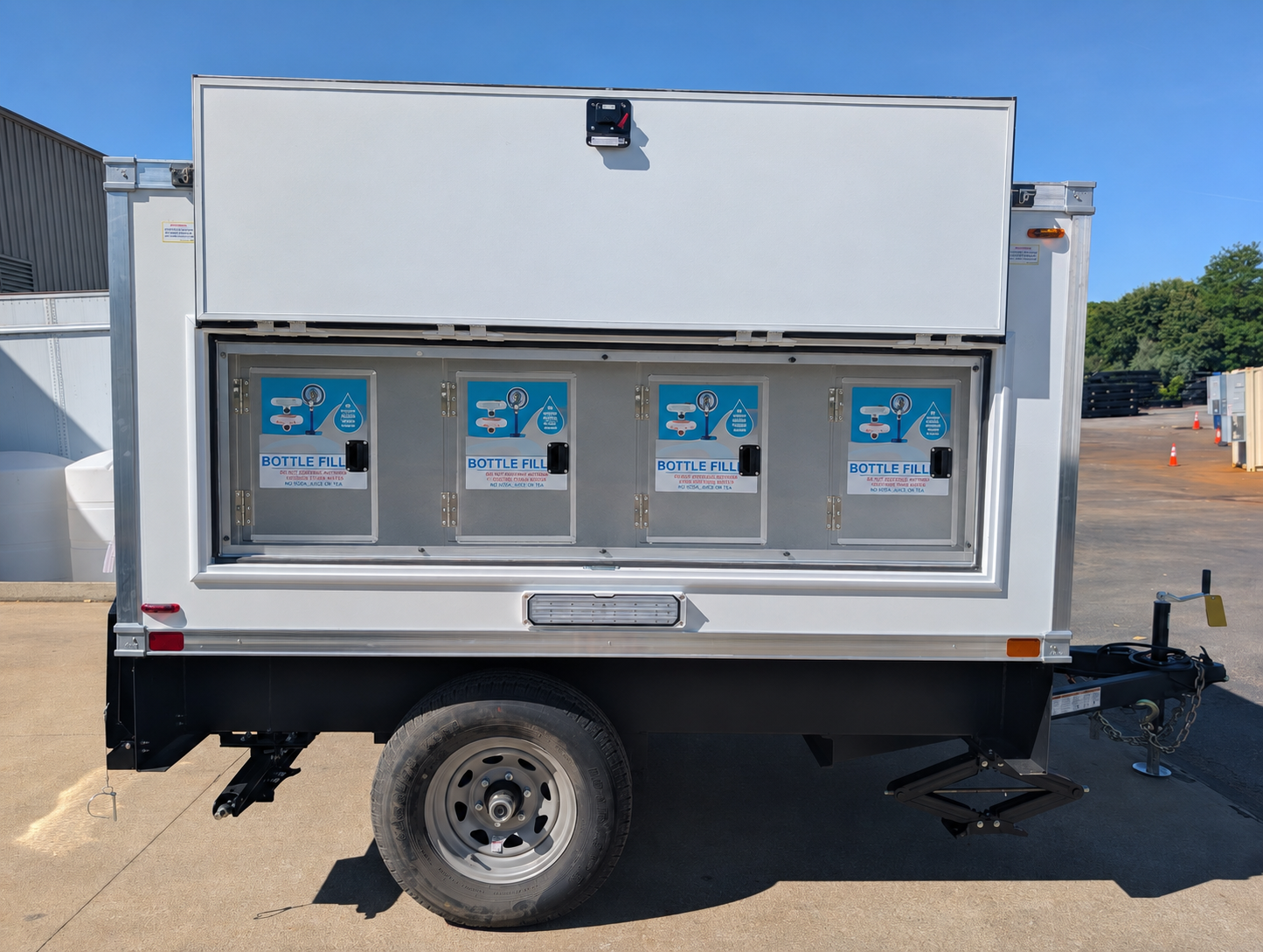
On-Site Hydration Services rolls filtered, flash-chilled, road-towable water stations onto Palm Springs job sites, festival grounds, and field edges, so clean drinking water is always within reach when the Coachella Valley climbs past 110 degrees.
- Palm Springs drops in about 45 minutes
- Chilled, filtered four-stage water
- ADA-height bottle fill
- §3395 heat-illness ready
- A+ BBB, licensed and insured
- Around-the-clock emergency runs
Years of Keeping Palm Springs Crews and Crowds in Cool Water
We have spent years parking mobile hydration stations at the edge of Coachella Valley job sites, festival builds, golf maintenance yards, and field rows, and that record is the whole reason Palm Springs operations keep our number saved. Framing crews at the downtown hotel sites, grounds teams on the golf properties, harvest crews down in the eastern valley, and event producers staging the April festivals all lean on us for one thing: cold, clean, filtered water that sits right where their people work, all shift long. We know exactly what a Palm Springs summer does to a pallet of bottled water baking in 115-degree sun, and we know what Cal/OSHA expects a valley employer to have in place once the thermometer clears 95 degrees. Years of doing this in one of the hottest places in the country is why so many local crews and organizers treat us as their standing water partner rather than a one-time rental.
A crowd on Saturday, a crew on Monday
One Signature trailer can pour for a weekend concert and be working a slab pour a couple of days later. Hiring one company for your events and a separate one for your worksites makes no sense. Either way, the planning, the delivery, and the refills are ours.
Cold water that holds past the 3 p.m. heat
The onboard chiller keeps the tank genuinely cold all the way through a Palm Springs afternoon, and that single detail carries the whole thing. Warm water is water people abandon, and midsummer is exactly when a crew or a crowd is drinking the most. Cold water gets finished, and finishing it is what keeps heat illness off the site.
Local dispatch, quick to the gate
Typical Palm Springs deliveries land in about 45 minutes, and we keep emergency runs going around the clock whenever a heat advisory or a power shutoff hits the Coachella Valley. The morning a foreman finds his 40-person crew stuck with one warm cooler, speed is the entire ballgame.
One rule sits under every job we take: water that people walk past might as well not be there. We’ve stood on a bare Palm Springs site and watched shrink-wrapped pallets cook next to the job-trailer while the crew baked thirty yards off. We’ve watched the opposite too, a chilled station ten steps off the work face run bone-dry twice inside one shift. Everything that matters lives in the distance between those two pictures. Which is why we don’t drop a unit and disappear. We match it to your headcount or your gate count, set the refill rhythm to how hard you’re really pulling on it, and treat a heat call the way you’d want your own treated, meaning right now, because out here one hot hour can swing the whole day.
One provider for the whole water loop. Most Palm Springs jobs need more than a station. We run the support fleet too, so a portable water truck refills your tanks on a cadence, a bladder bag adds fresh-water buffer for a big festival or a large crew, and a waste truck handles greywater pump-outs on a remote or unhooked site. In 115-degree heat the last thing anyone wants is a gap between when the tank runs low and when a separate vendor can get a truck out, so you get the whole fresh-in, waste-out loop from one local number.
Drinking Water Stations for Palm Springs Construction Sites
In Palm Springs, our road-towable Signature Series station is the desert workhorse, built to sit out at a construction gate, a golf maintenance yard, or a field edge through a full triple-digit day, while the roll-in Legacy Series covers the resort back-of-house, warehouse, and facility floors that fall under California’s newer indoor heat rule.

Signature Series specifications
With a frame, a hitch, and tires under it, the unit hauls out to a remote the Coachella Valley build, an event field, a working orchard, or a disaster staging yard with equal ease. Palm Springs contractors and event planners request this exact rig by name. The whole design is built around backing in, leveling off, and pouring cold by the same afternoon.
| No. of stations | (4) Bottle Filling Stations |
| Length | 12′ 3″ |
| Weight | 3,100 lbs. |
| Height | 8′ |
| Fresh water tank | 300 Gallons |
| Power requirements | 1 to 3 dedicated 20A/120V circuits OR 1 dedicated 50A/240V circuit |
| No. of AC units | 1 |
Why this is the right unit for a the Coachella Valley site
Downtown Palm Springs is being rebuilt, and every one of those projects is an open-air job site running through desert summers. The long-delayed Dream Hotel finally broke ground and is slated to open in 2027, adding 155 hotel rooms plus 89 condos and townhomes at 450 South Calle Alvarado, right next to the Convention Center. The Orchid Tree Hotel on Baristo Road is a decade-plus adaptive-reuse project pushing toward a 2028 finish. Each one means grading, framing, and finish crews out in the heat across multiple summers.
The city is also pursuing a 125 million dollar refresh of the Palm Springs Convention Center with Oak View Group. A modernization that size is a multi-year construction site with large trade crews on it through several hot seasons, and those crews fall squarely under Cal/OSHA’s high-heat construction rules for water, shade, and rest once the temperature clears 95 degrees, which in this valley is most of the summer.
On a live grading or framing site, bottled-water logistics are a genuine headache: pallets to buy, deliveries to schedule, ice to haul in daily, warm bottles nobody will touch by mid-afternoon, and a pile of empties to police at every shift change. After years of servicing valley job sites, we have watched a single missed ice run leave a crew short right when the heat peaks. One of our road-towable stations parked at the trailer-and-gate staging area gives every trade a filtered, flash-chilled fill point close to the work, and a 300-gallon tank keeps it flowing across the whole shift.
We also run the fleet that keeps a big desert site self-contained. A portable water truck tops off the station tanks on a cadence as the job moves, and where a site has no sewer tie-in yet, a waste truck handles greywater pump-outs. That way a superintendent gets the whole fresh-in, waste-out loop from one local provider instead of chasing three vendors across a 110-degree week.
Do the bottled-water arithmetic and one station wins the summer
Six bottles per person on a 100-degree the Coachella Valley day, a 38-person crew, and you’re already at roughly 228 plastic bottles to buy, cart in, ice down, and throw away. That’s one day. The season is where it gets ugly.
Multiply across a 175-day build and the tally clears 39,000 bottles, with the larger commercial jobs running far past that. A single trailer makes the entire pile disappear, leaving cold water at the tap and nothing for the dumpster.
This is a logistics decision before it’s a green one
Sustainability is the easy part of the pitch. Roughly 60 million plastic bottles get thrown out daily in this country, only about a third are ever recycled, and one bottle can sit in a landfill for centuries. Worth reporting, sure. But the Palm Springs project managers who actually switch usually do it to kill the daily hassle, not to pad a sustainability slide. A shared trailer means no recurring bottle order, no cooler going warm before first break, no wall of empties baking by the job-trailer. The super runs the build, not the water program.
Because our own potable tankers cover the refills, the supply scales with the job rather than fighting it. Double the crew for a big pour and they still can’t outdrink the plan. And the tankers just swing back and bring the level up.
Other Palm Springs Settings We Keep Supplied With Cool Water
Resorts and pool events
Palm Springs runs on hotels, resorts, and outdoor pool decks that fill with guests all summer, plus a busy outdoor wedding-and-events business. A branded, chilled bottle-fill station upgrades the guest experience while giving the property a clean answer for staff working the outdoor floor under the heat rules.
Warehouses and facilities
Any indoor floor without heavy climate control crosses 82 degrees on summer afternoons, which now triggers California’s indoor heat rule. Our roll-in Legacy station fits through facility doors and drops onto a warehouse, laundry, or back-of-house floor with the same filtration and chilling as the outdoor unit.
Emergency and storm response
When Tropical Storm Hilary swamped the valley in 2023 and Cathedral City crews rescued 47 people in a day, roads and water systems went down fast. A road-towable station tows in on short notice to supply responders, volunteers, and displaced residents with clean, filtered drinking water.
Wind-pass and utility crews
The San Gorgonio Pass wind farm near North Palm Springs is one of the windiest places in the country and powers nearly the whole valley. Turbine and utility maintenance crews work exposed sites in the pass, and a station tows right up to the staging point.
City water, pulled through three stages and a UV chamber, then chilled
A water source people don’t trust gets ignored, and an ignored station is rented money wasted. That’s why municipal water doesn’t reach the tap raw on our trailers. It passes through four filter stages and a UV chamber, then an onboard chiller drops the temperature. The result tastes clean and comes out cold, even on the worst Palm Springs afternoon of the year.
Sediment stage
The opening filter traps sand, scale, and the fine grit local mains occasionally push through. On a dusty Palm Springs lot, that’s what keeps a pour from tasting like the parcel it’s parked on.
Carbon stage
Activated carbon comes next, lifting the chlorine bite and the dull seasonal notes local tap can carry until the taste lands clean and neutral. When it’s 101 out, that flavor decides whether a crew keeps drinking or strolls past the spout dry.
Micro-particulate stage
A tight sub-micron cartridge picks off the microscopic particles that make it past the carbon, so every fill stays safe for the workers, the runners, and the event crowd topping off across Palm Springs.
UV disinfection
The last step is an ultraviolet chamber that wipes out bacteria and microbes without adding a single chemical. Even after a long tow to the far edge of the Coachella Valley, the water off the nozzle is clean.
Four ways to fill, and one of them is ADA
Along the wall sit four adjustable push-back spouts, press a bottle to the bar and it pours. One of them is set at ADA-reachable height, so a single trailer includes everybody at a Palm Springs crew or crowd with no add-on gear. Out back, a large-jug spout services five-gallon coolers and hydration packs, while a bank of hose-bib taps handles work-site chores, event support, and refills down the orchard rows. Stainless, food-grade plumbing the whole way through keeps the filtered, chilled water at quality right to the spout.
Every Signature trailer carries a 300-gallon load, roughly 2,400 cups at sixteen ounces each, and we recharge it on demand, so the unit doesn’t turn into the choke point on a busy Palm Springs shift or a packed show night.
We tow it in, fill it, wire it up, and it’s usually pouring cold inside the hour
There’s nothing here for you to run. Placement, fresh-water load, hookup, that’s all on us, and then we walk your Palm Springs crew or event staff through the basics before our truck pulls away.
Tell us the basics
People count, number of days, where exactly it parks on your Palm Springs site, and what power is there. Those four answers let us spec it correctly the first time around.
We come to you
Reckon roughly 45 minutes from our yard to anywhere in Palm Springs or the Coachella Valley, with round-the-clock emergency runs whenever a heat advisory or a power shutoff hits the area.
We make it pour
Once on site we set it level, charge the 300-gallon tank, and tie in power off one to three standard 120V circuits, or a single 50-amp 240V drop, depending on what the site gives us.
We keep it full
After that the tankers cycle back on a cadence matched to how fast your crew or crowd pulls it down, and we maintain the unit through the whole rental term.
No power on the parcel at all? We price that in. The unit draws very little, and with the service fleet backing it we’ve run Palm Springs stations on lots that had no permanent power whatsoever. Lay out what the site offers and the rest is on us.
What Cal/OSHA Expects From a Palm Springs Employer in the Heat
California has the country’s most developed heat-illness rules, and they are the legal backbone of any job-site water plan in Palm Springs. Under Cal/OSHA’s outdoor Heat Illness Prevention Standard, employers must provide enough fresh water for each employee to drink at least one quart per hour, roughly four 8-ounce glasses, and must encourage frequent drinking. That water has to be potable, fresh, suitably cool, free of charge, and located as close as practicable to where the crew is working, replenished so it never runs out.
Outdoor employers with crews in agriculture, construction, landscaping, and similar work must keep a written Heat Illness Prevention Plan covering water, shade, rest, acclimatization, and emergency response. Shade is required once the temperature passes 80 degrees, and high-heat procedures kick in at 95 degrees, including regular observation of workers and, for agriculture, a ten-minute cool-down every two hours. Palm Springs crosses both thresholds routinely from June through September, and Cal/OSHA issued fresh heat advisories to Southern California employers as recently as July 2026.
Since July 23, 2024, California has also had an indoor standard covering most workplaces that reach 82 degrees, naming warehouses, distribution centers, manufacturing plants, and restaurants directly. At 82 degrees a written indoor plan is required, and at 87 degrees additional measures apply. A filtered, chilled station, road-towable outdoors or roll-in for a facility floor, is a direct and documentable way to meet the water-access piece of all of these rules.
- Free, suitably cool, fresh potable water kept within easy reach of the work face
- Enough volume to meet the §3395 yardstick of a quart per worker each hour
- A fixed, documentable hydration point your written HIPP can cite directly
- Support for worker acclimatization and the paid recovery breaks the rule mandates
A few things staging water around Palm Springs has taught us
A lot of the Coachella Valley jobs have shaped how we run the next one. A few that stuck with us:
Site superintendent, downtown Palm Springs hotel build. A superintendent on a multi-summer downtown project called us after a stretch of 110-plus days wrecked his bottled-water plan for the third time. We set a road-towable station at the gate staging area and put a water truck on a refill cadence as the build progressed. Every trade had filtered, flash-chilled water within reach of the work, and he had a documentable water-access point for his written heat-illness plan.
Event producer, Palm Springs festival build. For a large outdoor event, the producer wanted water handled for the crew during the multi-week build, not just the public during show hours. We staged stations at the fabrication and vendor zones and topped the tanks off between shifts. The build crew stayed in cool water through the hottest part of the day, and the same stations rolled out to the public footprint once the gates opened.
Grounds superintendent, Coachella Valley golf property. A course superintendent needed cool water for a dawn-to-heat grounds crew all summer without hauling cases out to the maintenance yard every morning. We placed a chilled station at the yard and refilled it on a schedule. His crew kept their intake up through the worst afternoons, and he had a clean answer when the topic of the high-heat rules came up in a safety review.
Chilled Water Trailers for Desert Grounds and Harvest Crews
Golf is the valley’s economic bedrock and a year-round outdoor-labor employer, not just a winter spectator sport. The greater Palm Springs area runs well over 100 courses, each with a grounds crew out on the turf before dawn and through the morning heat all summer, mowing, irrigating, and rebuilding while play continues in triple-digit afternoons. Superintendents managing those crews sit inside Cal/OSHA’s high-heat landscaping tier from roughly May through September, and the January galleries at the American Express tournament at PGA West add thousands of spectators, volunteers, and staff outdoors for full days.
Just down-valley lies one of the most productive and heat-exposed farm belts in the country. The eastern Coachella Valley communities of Thermal, Mecca, and North Shore grow dates, citrus, table grapes, and winter vegetables worked by hand. Coachella table grapes are the earliest in the nation, hitting supermarkets in May as the valley floor already pushes past 100 degrees, and the date harvest runs from mid-September through Thanksgiving while the shoulder-season heat still spikes.
Cal/OSHA is exact about what a grower or labor contractor owes those workers: enough fresh water for each person to drink at least one quart per hour, kept suitably cool, located as close as practicable to the work, plus a ten-minute cool-down every two hours once it hits 95 degrees. A warm cooler at the end of a long row does not meet that bar. After years of setting stations at valley field edges, we have seen how fast water intake drops when the only water is warm and far away, and Coachella Valley farmworkers already face the highest heat-illness rates of any outdoor workers in the state.
Because the station is road-towable, we move it down the rows as the crew moves, and a water truck refills the 300-gallon tank so it never runs dry in the afternoon. For a grower racing a compressed harvest or a superintendent keeping a course playable, that is one less thing to manage and a clean, documentable answer for a heat-illness inspection.
A Palm Springs Summer Is the Whole Case for On-Site Water
Palm Springs holds some of the most extreme temperature records in the country. On July 5, 2024, the city reached 124 degrees, the hottest reading ever recorded here, and just months later, in October 2024, it hit 117 degrees and broke a 102-year-old record. Valley-wide, all-time highs have approached 120 degrees, and excessive-heat warnings routinely forecast highs of 118 to 121 degrees.
This is a low-elevation desert basin ringed by mountains, so the heat is dry, relentless, and slow to release. Average highs sit above 100 degrees from June into September, July peaks near 108, and overnight lows often stay above 70, which means the pavement, the equipment, and any water left outside never really cool off. A pallet of bottles that went warm at noon is still warm at dawn.
When the heat holds like that and thousands of people still have to work or gather outside, warm water in a sun-baked cooler simply does not get consumed. Flash-chilled water from a filtered station does, which is exactly why the demand for on-site hydration in Palm Springs is a summer-long certainty rather than a nice-to-have. It is also why Riverside County carries some of the highest heat-related emergency-room rates in the state.
The Coachella Valley is home to the two largest music festivals in North America, both staged at the Empire Polo Club in Indio, and Palm Springs absorbs the crowds, the crews, and the overflow. Coachella ran across two weekends in April 2026 with a daily capacity of roughly 125,000 people and total attendance near 250,000, and the country-music sister festival Stagecoach followed the very next weekend. Both run in real desert heat, and both already treat water as a system, with dozens of free filtered refill stations across the grounds.
The festival crowd is only half the water story. Empire Polo Club turns from an open field into a temporary city over several weeks, and the stagehands, riggers, fabricators, and grounds crews who build it are on an exposed site in April sun for long shifts before a single ticket-holder arrives. Those production crews are outdoor employees under the same Cal/OSHA rules as any construction crew, and years of watching valley event builds go up taught us to stage stations at the crew and vendor zones during build and strike, not just at the public gates during show hours.
Palm Springs itself never slows down, even in peak heat. Splash House fills the resort pools twice each August and moves its after-hours crowd onto the tarmac of the Palm Springs Air Museum. Dinah Shore Weekend brings the largest queer women’s festival in the world to the Riviera each September. VillageFest closes Palm Canyon Drive every Thursday evening, and Greater Palm Springs Pride turns downtown into a block party each November. Distributed bottle-fill stations across an event footprint keep attendees, staff, and vendors out of the first-aid tent and cut the mountain of single-use bottles a big outdoor gathering otherwise leaves behind.
For a multi-day event we set two or more stations across the grounds and top the tanks off with a water truck between crowd waves, with a bladder bag staged as a fresh-water buffer for the busiest nights. Organizers get reliable, chilled, filtered water for the whole crowd and a cleaner site at load-out, without babysitting a bottled-water supply chain in the desert.
Past the station: the trucks that keep a Palm Springs site supplied
Everyone sees the trailer. What they don’t see is the support fleet behind it, the trucks that deliver fresh water, hold reserve on site, and carry wastewater off, so a single call wraps the entire loop rather than stringing together three vendors.
Potable water trucks
Our tankers run drinking-grade water in bulk, recharging the 300-gallon tank on whatever interval the headcount demands. Those same trucks also top up cisterns, holding tanks, and bladder bags whenever a single drop can’t keep pace, like a big slab pour or a downtown night that packs the square.
Bladder bags & buffer supply
When demand spikes we set out fold-flat bladders to bank extra fresh reserve, and on a drain-less lot they’ll temporarily hold greywater too. It isn’t fancy equipment, but it’s what keeps a far-flung the Coachella Valley job pouring between tanker runs.
Pump trucks
Water that has to move across a job is a pump truck’s job, whether that’s charging holding tanks or shuttling supply end to end. It earns its keep on the sprawling parcels where the trailer and the fill point can end up a fair hike apart.
Vacuum & waste trucks
At the tail end, a vacuum truck draws off greywater and wastewater and carries it to permitted disposal, closing the loop clean. Nobody on your Palm Springs crew is left guessing where the used water ended up. That piece was built into the plan from day one.
It all interlocks. A remote parcel might run a station plus a bladder bag for reserve and a recurring water-truck schedule. A heavy event night might call for a pump truck to move supply and a teardown waste run at the end. Describe the shape of your job and we’ll put together the right combination, on one invoice, handled by one crew that already knows the ground.
The handful of questions that turn a two-minute call into a real quote
A couple of minutes on the phone is enough to get you a real number. Here’s what we’ll want to know, handy to have ready before you call, and proof that we size every job to the work in front of us rather than reading off one canned quote.
The four answers that shape the recommendation
- How many people? Fifteen framers on a tract and a four-thousand-head concert are not the same problem. Your peak headcount, or gate count, drives how many trailers we stage and how aggressively the tankers cycle.
- How long? Two days at a park tournament, three weeks of footings, nine months on a master-planned build, each wants its own rhythm. Short jobs usually lean on staged reserve; long ones ride a standing tanker schedule.
- Where will it sit? Towable means the Signature tucks into a gated yard, bare dirt, an event lawn, or a skinny staging lane just as well. Hand us the exact spot plus the route our truck takes past the gate and any stored material, and we’ll land it on the natural foot-traffic path.
- What power is on site? The unit runs on as little as one and as many as three standard 120V circuits, or one 50-amp 240V drop. A lot of the Coachella Valley parcels carry no permanent power, and that’s genuinely fine, provided you flag it before delivery day.
The smaller details that sharpen the plan
- Where on the site it should land, plus how a delivery truck reaches that spot
- Whether your people stay in one zone or spread across the full footprint
- Any §3395 heat-illness documentation your safety program needs the station to support
- Whether bulk hauls, bladder reserve, or a waste pickup should be bundled onto the job
The line items a pallet of bottled water keeps off your invoice
Bottled water reads as the budget choice on a purchase order. Its actual price tag is buried somewhere else, in handling hours, staging footprint, water that warms up, and trash piling up afterward, and on a hot inland lot each of those costs more than it would by the coast.
The labor nobody budgets for
Look at everything bottled water actually demands of a person: cutting the order, receiving and breaking down pallets, icing coolers before dawn, refilling through the day, then flattening empties for the bin. On a large Palm Springs crew that’s hours of paid time burned every single day, scraped right off the work that’s supposed to be getting done. The trailer erases that loop entirely. A local contractor once let us pencil it out with him, and the recovered labor by itself paid for the unit. His words were that the bottle runs had been quietly costing him close to a day of payroll a week. Our trailer arrives full, the tankers keep it full, and your superintendent owes it nothing but a parking spot.
The warm-up problem
Ice a cooler at 6 a.m. and by mid-morning in a the Coachella Valley July it’s pushing bathwater. Warm water is water people stop touching, and the slowdown that follows is precisely where heat illness gets its opening. A chilled station never rides that warm-up curve at all. Whatever pours at clock-out is as cold as the sunrise fill, which happens to be the moment a spent crew, or a crowd deep into a long concert, leans on it hardest.
The storage and footprint tax
Bottled-water pallets devour staging space, jam the lay-down area, and sit cooking in the sun until somebody finally cracks them open. Empties build up faster than anyone keeps up with, and on a tight commercial lot that pile turns into its own problem. Set a trailer in one parking stall instead and it serves a crew or crowd that would otherwise burn through hundreds of plastic bottles every day.
The waste that trails you
Every bottle bought is a bottle thrown out, and across a season a busy site or event generates a small mountain of them. That’s a disposal line on the budget, a dent in the sustainability numbers, and, given that a single bottle can linger in the ground for centuries, a footprint that outlives the project that made it. Move to a refill station and the line drops to zero, which finally gives your reporting a figure worth publishing.
Palm Springs Neighborhoods and Districts We Serve
We are based in the Palm Springs and greater Coachella Valley area and deliver across the city and the surrounding desert communities that share the same climate and the same crews. Because the stations are road-towable and we run our own delivery fleet, our practical service area reaches across all nine valley cities and out to the festival grounds and farm belt.
Uptown Design District
Movie Colony
Deepwell Estates
Warm Sands
Twin Palms
Racquet Club West
Historic Tennis Club
Sunrise Park
El Mirador
Vista Las Palmas
Araby Cove
Cathedral City
Rancho Mirage
Palm Desert
Indian Wells
La Quinta
Indio
Coachella
Desert Hot Springs
Thousand Palms
Thermal
Bermuda Dunes
North Palm Springs
Downtown and Palm Canyon Drive
El Mirador and Desert Regional
Working a corridor instead of a single address? We follow the routes the Coachella Valley runs on, so multi-site projects get the same fast turnaround as one stop.
The questions the Coachella Valley crews and event teams actually ask us
Do you deliver water stations anywhere in Palm Springs?
Yes. We deliver across the entire city, from Downtown and the Uptown Design District to Movie Colony, Deepwell Estates, and Racquet Club West, and out into the surrounding Coachella Valley. Because our stations are road-towable and we run our own fleet, we also reach Cathedral City, Rancho Mirage, Palm Desert, Indio, and the festival grounds and farm belt down-valley. Tell us the job address and we will confirm delivery.
How much water does one station hold and how many people can it serve?
Each Signature Series station carries a 300-gallon fresh-water tank, which is roughly 2,400 sixteen-ounce fills before a refill. That covers a large crew, a busy event zone, or a golf maintenance operation for a good stretch of a hot day. For multi-day events or very large crews, we stage more than one station and schedule water-truck top-offs so the tanks never run dry.
Is the water actually cold, even on a 115-degree Palm Springs afternoon?
Yes. Every station has built-in electric chillers that flash-chill the drinking water, so it stays cool through the hottest part of a desert day. That matters for more than comfort. Cal/OSHA requires suitably cool water, and warm water in a sun-baked cooler is exactly what workers stop drinking when they need it most. In this climate, cold water is the difference between a station people use and one they ignore.
Does renting a station help me meet Cal/OSHA heat rules?
It directly supports the water-access piece. Cal/OSHA requires fresh, potable, suitably cool water for each worker to drink at least one quart per hour, located close to the work and kept replenished, with high-heat procedures once it clears 95 degrees. A filtered, chilled station at the job gives you that, plus a documentable point of access to note in your written Heat Illness Prevention Plan. Shade, rest, and training remain your responsibility.
How is the water filtered and is it safe to drink?
Every station runs a four-stage system: sediment, carbon, and micro-particulate filtration followed by ultraviolet disinfection that kills bacteria and pathogens without added chemicals. The water system uses food-grade and stainless components from source to dispenser. The result is clean, filtered, chilled drinking water that people actually want to drink in the heat.
Can you handle a large multi-day event or a festival build?
Yes, that is one of our most common Palm Springs jobs. For a large event we distribute several stations across the grounds, top the tanks off with a water truck between crowd waves, and can stage a bladder bag as extra buffer for the busiest nights. We also cover the crew and vendor zones during the build and strike, not just the public gates during show hours, so your production team stays in cool water the whole time.
Do you have a unit for indoor warehouses and facilities?
Yes. Our Legacy Series station rolls in on caster wheels, fits through standard facility doors, and has rooftop air conditioning, so it drops onto a warehouse, laundry, resort back-of-house, or facility floor. It runs the same filtration and chilling as the outdoor unit and is a clean fit for California’s indoor heat standard, which now covers most indoor workplaces that reach 82 degrees.
Is there an ADA-accessible fill point?
Yes. Each station includes an ADA-accessible bottle-filling station so the water is reachable for everyone on the site or at the event. There is also a rear jug-fill point for coolers and larger containers and multiple hose-bib connections for jobsite, maintenance, and event needs.
How does a station compare to just buying bottled water?
The math favors a station fast in this heat. A 50-worker crew at six bottles a day burns 300 bottles daily, which is more than 60,000 over a long project. A station removes the purchasing, the delivery scheduling, the ice and cooler management, and the pile of empties, while cutting single-use plastic. For the resorts, the city, and the large employers in Palm Springs, that is also a clean win for a sustainability report.
What power does a station need on site?
The Signature Series station runs on one to three dedicated 20-amp, 120-volt circuits, or a single 50-amp, 240-volt circuit. On remote desert sites without convenient power, like a wind-pass staging point or an off-grid festival build, we can talk through generator options during planning. Tell us about your location and we will confirm the setup before delivery.
How far in advance should I book, especially around the festivals?
The April festival corridor and the summer months are our busiest stretches because events, harvest, and construction all peak at once, so earlier is better. For a specific event date or a harvest window we recommend reaching out as soon as you have the timing. For ongoing job sites we can usually get a station out quickly, but locking in ahead guarantees availability during the hottest and busiest weeks.
Can you also handle water delivery and waste for a site with no hookups?
Yes. Beyond the stations we run a support fleet, so a portable water truck can deliver and refill in volume, a bladder bag can add onsite fresh-water storage or temporary greywater containment, and a waste truck can pump out and haul away greywater. That lets us cover the full fresh-in, waste-out loop for a remote desert site with one local provider.
Palm Springs Water Station Resource Library
Meeting Cal/OSHA Heat Illness Rules on a Palm Springs Job Site
If you run a crew outdoors in Palm Springs, the heat is not just a comfort problem, it is a compliance one. California has the most developed heat-illness regime in the country, and from June through September a Palm Springs job site crosses the thresholds that trigger it almost every day. Knowing exactly what Cal/OSHA expects, and having the water piece handled cleanly, keeps your people safe and keeps an inspection from turning into a citation.
Start with the water requirement, because it is the heart of the rule. Employers must provide enough fresh water for each employee to drink at least one quart per hour, the equivalent of four 8-ounce glasses, and must actively encourage workers to drink. The water has to be potable, fresh, suitably cool, and free of charge. That phrase suitably cool carries real weight in this valley: warm water in a sun-baked cooler is exactly what a worker stops drinking right when the heat is worst, which is the failure the rule is written to prevent.
Cal/OSHA Outdoor Heat Illness Prevention · Cal/OSHA Heat Illness Prevention Guidance
Hydration Planning for Coachella Valley Festivals and Palm Springs Events
Few regions the size of the Coachella Valley draw crowds like this one does. Between Coachella and Stagecoach at the Empire Polo Club, the summer pool festivals in Palm Springs, and the weekly downtown street fairs, the valley pulls hundreds of thousands of people into the open air across a long, hot calendar. Planning water for crowds that size is its own discipline, and getting it right keeps an event memorable for the right reasons.
Consider the scale. Coachella runs a daily capacity of roughly 125,000 people across two April weekends, with total attendance near 250,000, and Stagecoach follows the very next weekend with comparable crowds. Both festivals already treat water as core infrastructure, allowing refillable bottles and running dozens of free filtered refill stations across the grounds. That is proof, at the largest possible scale, that distributed refill-based hydration is how you keep a six-figure desert crowd safe.
Keeping Coachella Valley Harvest Crews Safe Through the Desert Heat
The land down-valley from Palm Springs grows an astonishing share of the nation’s food. The eastern Coachella Valley, in communities like Thermal, Mecca, and North Shore, produces dates, citrus, table grapes, and winter vegetables on one of the longest growing seasons in the country. All of that bounty depends on seasonal hand-labor, and much of that labor happens in the hottest, most dangerous stretch of the year. Keeping those crews safe is both a moral duty and a legal one.
The timing is the crux. Coachella table grapes are the earliest in the nation, moving into supermarkets in May as the valley floor already pushes past 100 degrees, and for about a six-week window the valley owns the grape aisle in American grocery stores. The date harvest then runs from mid-September through Thanksgiving, while the shoulder-season heat still spikes. The city recorded 117 degrees in October 2024, so the harvest windows sit squarely inside real triple-digit danger.
Indoor Heat and Palm Springs Facilities: What Changed in 2024
For years, California’s heat-illness rules focused on outdoor work, which made sense in a desert built on construction, agriculture, and tourism. But indoor floors get dangerously hot in a Palm Springs summer too, and on July 23, 2024, the state closed the gap with a new indoor standard. For the warehouses, resort back-of-house areas, laundries, and facility floors in and around Palm Springs, that change reset what the law expects.
The scope is broad. The indoor Heat Illness Prevention standard applies to most indoor workplaces where the temperature reaches 82 degrees or higher, and it names warehouses, distribution centers, manufacturing plants, and restaurants directly. In a valley summer, an indoor floor without heavy climate control will cross 82 degrees on plenty of afternoons, which means a lot of local operations are now covered that were not before.
California Indoor Heat Protections Announcement · Cal/OSHA Heat Illness Prevention Resources
On-Site Water for Palm Springs Golf, Resorts, and Outdoor Labor
Palm Springs is a golf-and-resort town, and both industries put people outdoors in the heat all summer, not just during the winter tournament season. From the grounds crews on well over 100 valley courses to the pool decks, valets, and event staff at the resorts, warm-weather work in Palm Springs happens under a relentless desert sun. Planning water for those workers keeps them safe and keeps the operation running smoothly.
The golf side alone is substantial. The greater Palm Springs area is one of the densest golf markets on earth, and every course runs a grounds and maintenance crew that is out on the turf before dawn and through the morning heat, mowing, irrigating, sanding, and rebuilding while play continues into triple-digit afternoons. Those superintendents sit inside Cal/OSHA’s high-heat landscaping tier from roughly May through September, which makes a chilled station at the maintenance yard a direct answer to the water requirement.
Cal/OSHA Outdoor Heat Illness Prevention · CDC NIOSH Heat Stress
What Palm Springs Operations Say About Working With Us
“We had crews framing through a run of 110-plus days and the bottled-water runs kept falling apart. They dropped a station at our gate and kept the tank topped off. Cold, clean water right where the guys work, and the heat-plan box checked. Easy call to keep it all season.”
“During grape harvest every hour counts and you cannot have people walking off to find water. The station sat right at the field edge and stayed cold even in the afternoon. They moved it as we moved and refilled it before we ran low. My crew stayed in cool water all day.”
“For our festival weekend they set stations across the whole footprint and refilled between the day and evening crowds. Fewer trips to the first-aid tent and way less bottle trash at the end. The build crew had cold water the whole time we were setting up too.”
Service information current as of July 2026.
Lock in cold, filtered water for your Palm Springs site or event before the next hot stretch
Tell us the headcount or the gate count, the rental dates, and where the trailer should park, and we’ll spec the right setup and roll one out to you anywhere in the Coachella Valley, usually inside about 45 minutes of dispatch.