Temporary Portable Water Station Trailer Rentals in Draper
On-Site Hydration Services delivers clean, chilled, filtered drinking water stations to Draper job sites, events, and crews across the Point of the Mountain. One trailer trades pallets of bottled water for a steady, sustainable source of drinking water right where your people work.
- Draper drops in about 45 minutes
- Chilled, filtered four-stage water
- ADA-height bottle fill
- §3395 heat-illness ready
- A+ BBB, licensed and insured
- Around-the-clock emergency runs
The Name Draper Job Sites and Events Trust for On-Site Drinking Water
We are the local team Draper crews and event organizers call when they need clean drinking water on site instead of a truckload of plastic bottles. Our Signature Series trailer delivers clean, chilled, filtered drinking water through four bottle-filling stations, multi-stage filtration, UV disinfection, and a food-grade stainless system from source to dispenser. One unit serves a large construction crew, a festival crowd, or a public-works team without the cost, waste, and daily logistics of bottled water. We have staged these stations on the exposed, multi-phase work that defines Draper right now, from earthwork at the Point of the Mountain to open-air events in peak July heat, and that hands-on record is why crews here treat us as the most trusted name for on-site drinking water.
A crowd on Saturday, a crew on Monday
One Signature trailer can pour for a weekend concert and be working a slab pour a couple of days later. Hiring one company for your events and a separate one for your worksites makes no sense. Either way, the planning, the delivery, and the refills are ours.
Cold water that holds past the 3 p.m. heat
The onboard chiller keeps the tank genuinely cold all the way through a Draper afternoon, and that single detail carries the whole thing. Warm water is water people abandon, and midsummer is exactly when a crew or a crowd is drinking the most. Cold water gets finished, and finishing it is what keeps heat illness off the site.
Local dispatch, quick to the gate
Typical Draper deliveries land in about 45 minutes, and we keep emergency runs going around the clock whenever a heat advisory or a power shutoff hits the south Salt Lake Valley. The morning a foreman finds his 40-person crew stuck with one warm cooler, speed is the entire ballgame.
One rule sits under every job we take: water that people walk past might as well not be there. We’ve stood on a bare Draper site and watched shrink-wrapped pallets cook next to the job-trailer while the crew baked thirty yards off. We’ve watched the opposite too, a chilled station ten steps off the work face run bone-dry twice inside one shift. Everything that matters lives in the distance between those two pictures. Which is why we don’t drop a unit and disappear. We match it to your headcount or your gate count, set the refill rhythm to how hard you’re really pulling on it, and treat a heat call the way you’d want your own treated, meaning right now, because out here one hot hour can swing the whole day.
We run the whole water loop, not just the drop-off. Beyond the station itself, we back it with a support fleet: a portable water truck for potable delivery and refills, a pump truck, a waste and vacuum truck, and portable bladder bags for extra fresh storage or temporary waste containment. On a long Draper build, that means fresh water in, stored on site, and waste out from one provider, so a crew never runs dry and a site never has a water problem we cannot handle.
Drinking Water Stations Built for Point of the Mountain Job Sites
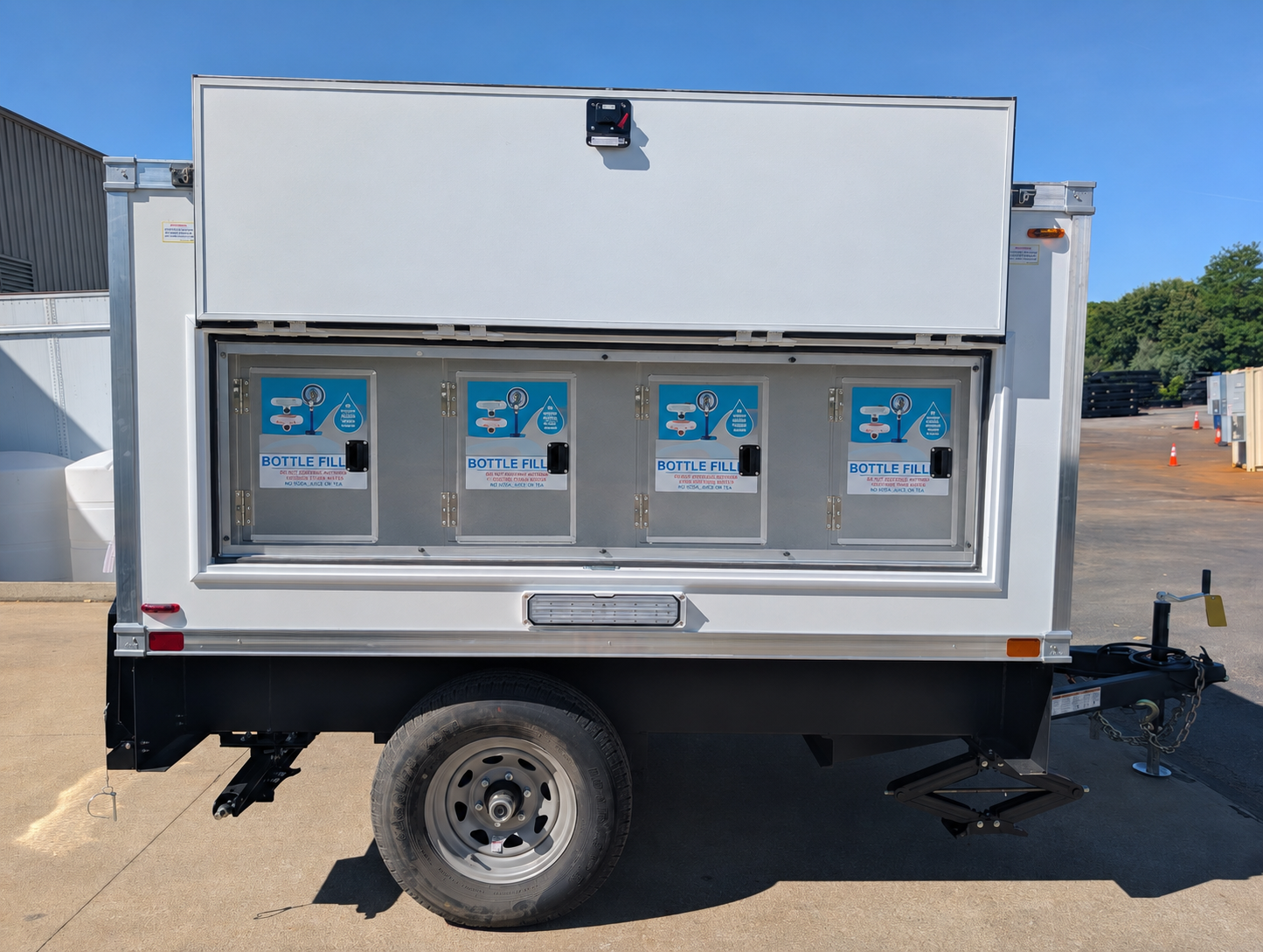
Our Signature Series trailer is the road-towable, off-grid unit built for exactly the exposed, multi-phase work Draper runs today, from the 600-acre grading and infrastructure job at The Point to remote data-center pads out toward Bluffdale. It tows straight to the working face and keeps four fill stations of chilled, filtered drinking water within a short walk of the crew.

Signature Series specifications
With a frame, a hitch, and tires under it, the unit hauls out to a remote the south Salt Lake Valley build, an event field, a working orchard, or a disaster staging yard with equal ease. Draper contractors and event planners request this exact rig by name. The whole design is built around backing in, leveling off, and pouring cold by the same afternoon.
| No. of stations | (4) Bottle Filling Stations |
| Length | 12′ 3″ |
| Weight | 3,100 lbs. |
| Height | 8′ |
| Fresh water tank | 300 Gallons |
| Power requirements | 1 to 3 dedicated 20A/120V circuits OR 1 dedicated 50A/240V circuit |
| No. of AC units | 1 |
Why this is the right unit for a south Salt Lake Valley site
The defining construction story in Draper is The Point, the redevelopment of the 600-acre former Utah State Prison site that broke ground on June 29, 2026. The first phase alone includes the 5,000-seat Mountain America Event Center, the 363-unit Chroma residential complex, and The Promenade, a 2,000-foot walkable main street, with Porter Rockwell Boulevard slated for completion by late 2026 and vertical construction not expected until spring 2028. That means the next two summers are all horizontal work: mass grading, road building, and utility trenching on a cleared, shadeless pad.
Horizontal earthwork is the thirstiest phase of any project, and we plan for it first. There is no finished building to duck into, no plumbed water on a raw pad, and the nearest store means a truck leaving the site. On a cleared 600-acre parcel under full high-desert sun, a centralized drinking water station is often the only reliable water source a crew has, so we stage it where the work actually is and keep it supplied as the job moves across the district.
The bottled-water math on a job this size is brutal. A single 50-worker crew at six bottles a day burns 300 bottles daily, more than 60,000 across a 200-day phase, and a multi-crew site like The Point pushes past 100,000 bottles fast. Every one has to be bought, delivered, iced, distributed, and then hauled off as trash. Our station collapses that entire loop into one filtered, chilled, refillable source, which is exactly why superintendents here stop reordering pallets once they run the numbers.
The same pattern holds across Draper’s other big builds: the FrontRunner double-tracking and the Draper-to-Lehi transit corridor, data-center pads out toward Bluffdale, and the constant campus and residential construction along I-15. Corridor and rail work moves down a right-of-way with no fixed facilities, which is the case our road-towable trailer was made for. It follows the work instead of forcing crews to walk back to a single water point.
Do the bottled-water arithmetic and one station wins the summer
Six bottles per person on a 100-degree the south Salt Lake Valley day, a 38-person crew, and you’re already at roughly 228 plastic bottles to buy, cart in, ice down, and throw away. That’s one day. The season is where it gets ugly.
Multiply across a 175-day build and the tally clears 39,000 bottles, with the larger commercial jobs running far past that. A single trailer makes the entire pile disappear, leaving cold water at the tap and nothing for the dumpster.
This is a logistics decision before it’s a green one
Sustainability is the easy part of the pitch. Roughly 60 million plastic bottles get thrown out daily in this country, only about a third are ever recycled, and one bottle can sit in a landfill for centuries. Worth reporting, sure. But the Draper project managers who actually switch usually do it to kill the daily hassle, not to pad a sustainability slide. A shared trailer means no recurring bottle order, no cooler going warm before first break, no wall of empties baking by the job-trailer. The super runs the build, not the water program.
Because our own potable tankers cover the refills, the supply scales with the job rather than fighting it. Double the crew for a big pour and they still can’t outdrink the plan. And the tankers just swing back and bring the level up.
What We Handle Across Draper
Construction job sites
From the multi-phase earthwork at The Point to campus and residential builds along I-15, we stage the station at the working face and keep it supplied as the job moves.
Outdoor events and festivals
Draper Days, amphitheater concerts, and community events get clean drinking water without pallets of plastic or an empty cooler at peak hour.
Trail races and recreation
Corner Canyon races and trailhead events get fast aid-station and finish-line resupply from the rear jug-fill station.
Data centers and industrial
Large remote pads near Bluffdale and the Point of the Mountain get continuous, documented potable water for big concurrent crews.
City water, pulled through three stages and a UV chamber, then chilled
A water source people don’t trust gets ignored, and an ignored station is rented money wasted. That’s why municipal water doesn’t reach the tap raw on our trailers. It passes through four filter stages and a UV chamber, then an onboard chiller drops the temperature. The result tastes clean and comes out cold, even on the worst Draper afternoon of the year.
Sediment stage
The opening filter traps sand, scale, and the fine grit local mains occasionally push through. On a dusty Draper lot, that’s what keeps a pour from tasting like the parcel it’s parked on.
Carbon stage
Activated carbon comes next, lifting the chlorine bite and the dull seasonal notes local tap can carry until the taste lands clean and neutral. When it’s 101 out, that flavor decides whether a crew keeps drinking or strolls past the spout dry.
Micro-particulate stage
A micro-particulate cartridge screens out the fine particles the earlier stages leave in, so every fill stays safe for the workers, the runners, and the event crowd topping off across Draper.
UV disinfection
The last step is an ultraviolet chamber that wipes out bacteria and microbes without adding a single chemical. Even after a long tow to the far edge of the south Salt Lake Valley, the water off the nozzle is clean.
Four ways to fill, and one of them is ADA
Along the wall sit four adjustable push-back spouts, press a bottle to the bar and it pours. One of them is set at ADA-reachable height, so a single trailer includes everybody at a Draper crew or crowd with no add-on gear. Out back, a large-jug spout services five-gallon coolers and hydration packs, while a bank of hose-bib taps handles work-site chores, event support, and refills down the orchard rows. Stainless, food-grade plumbing the whole way through keeps the filtered, chilled water at quality right to the spout.
Every Signature trailer carries a 300-gallon load, roughly 2,400 cups at sixteen ounces each, and we recharge it on demand, so the unit doesn’t turn into the choke point on a busy Draper shift or a packed show night.
We tow it in, fill it, wire it up, and it’s usually pouring cold inside the hour
There’s nothing here for you to run. Placement, fresh-water load, hookup, that’s all on us, and then we walk your Draper crew or event staff through the basics before our truck pulls away.
Tell us the basics
People count, number of days, where exactly it parks on your Draper site, and what power is there. Those four answers let us spec it correctly the first time around.
We come to you
Reckon roughly 45 minutes from our yard to anywhere in Draper or the south Salt Lake Valley, with round-the-clock emergency runs whenever a heat advisory or a power shutoff hits the area.
We make it pour
Once on site we set it level, charge the 300-gallon tank, and tie in power off one to three standard 120V circuits, or a single 50-amp 240V drop, depending on what the site gives us.
We keep it full
After that the tankers cycle back on a cadence matched to how fast your crew or crowd pulls it down, and we maintain the unit through the whole rental term.
No power on the parcel at all? We price that in. The unit draws very little, and with the service fleet backing it we’ve run Draper stations on lots that had no permanent power whatsoever. Lay out what the site offers and the rest is on us.
What Utah and Federal Rules Actually Require on a Draper Job Site
The baseline is not optional. Federal OSHA’s sanitation standard already requires employers to provide potable drinking water on work sites, and that requirement is enforced even where no dedicated heat rule exists. On any Draper construction or industrial site, reliable potable water is a legal obligation, not a nicety, and a centralized drinking water station is a clean, documentable way to meet it.
The heat picture is still developing. OSHA published a proposed federal heat standard in August 2024, held its public hearing through July 2025, and has not yet finalized the rule, so in the meantime OSHA continues enforcing heat hazards through its National Emphasis Program, revised in April 2026. Utah runs its own state plan through UOSH, which has stated plainly that there is no specific heat standard on its books to cite, so it investigates heat complaints and coaches employers toward best practices while the potable-water requirement still applies.
The practical takeaway for Draper employers is to get ahead of it now. The proposed federal standard and OSHA’s active emphasis program are both pushing serious contractors toward documented, planned drinking water access and Heat Illness Prevention Plans. Standing up a continuous, filtered, on-site drinking water source is the most direct way to satisfy today’s rules and be ready for tomorrow’s, especially through a record-hot, record-dry Utah summer.
- Free, suitably cool, fresh potable water kept within easy reach of the work face
- Enough volume to meet the §3395 yardstick of a quart per worker each hour
- A fixed, documentable hydration point your written HIPP can cite directly
- Support for worker acclimatization and the paid recovery breaks the rule mandates
A few things staging water around Draper has taught us
A lot of the south Salt Lake Valley jobs have shaped how we run the next one. A few that stuck with us:
Grading superintendent, Point of the Mountain earthwork phase. He was managing three crews on a cleared pad and drowning in the bottled-water loop, purchase orders, pallets, melting ice, and a dumpster full of empties by Friday. We put a Signature Series station at the center of the site and kept it supplied as the grading moved. He cut the plastic, freed up the labor hours his crew spent babysitting coolers, and never placed another bottle order for that phase.
Event coordinator, Draper summer festival at the city park. Her worry was the 2 p.m. wall, the point where bottled water always ran out in the July heat and volunteers spent the afternoon hauling cases. We staged a station with four fill points and the rear jug-fill station to keep aid tables and volunteer coolers topped off continuously. The crowd stayed served through the hottest hours and the park was not buried in plastic at closing.
Safety manager, data-center build near Bluffdale. In a record-heat, record-drought summer he wanted documented, continuous potable water access to get ahead of OSHA’s active heat emphasis program before his newest crews ever hit the pad. We set the station where the trades actually worked and kept it filled, giving him a clean answer for his safety plan and a real control for the first-few-days window when heat risk is highest.
Drinking Water Stations for Data-Center Pads, Campuses, and Municipal Crews
Draper anchors the south end of Silicon Slopes, home to more than 1,000 businesses and major employers like HealthEquity, Progressive Leasing, 1-800 Contacts, Control4, and a large eBay campus. Those campuses never stop building, tenant improvements, expansions, and outdoor corporate events run year-round, and a company that rents mountain bikes for employees to ride Corner Canyon at lunch is not going to serve warm bottled water in a bin at its summer all-hands. A clean, ADA-accessible drinking water station fits that brand.
The data-center surge is the other tech-adjacent driver. Utah hosts dozens of operational data centers with thousands of megawatts more under construction, clustered along the Wasatch Front in Bluffdale, Eagle Mountain, and West Jordan. Bluffdale sits immediately west of Draper at the Point of the Mountain, so data-center earthwork and the trades that build it pull from the same south-valley workforce we serve. These are enormous, remote, dust-heavy pads with large concurrent crews and long build windows, a textbook placement for our outdoor trailer.
Public works and municipal crews round out the picture. Road, utility, parks, and transit crews work the Draper corridor through the summer, often along an open right-of-way with no facilities. For these teams the value is continuous, documented potable water access at the point of work, which is both a practical need in dry heat and a smart move ahead of tightening federal heat guidance.
For indoor and facility settings we bring the Legacy Series, a caster roll-in station that fits through standard facility doors and serves the inside of warehouses, distribution centers, schools, expo halls, and corporate offices. Between the road-towable Signature Series outside and the roll-in Legacy Series inside, we cover Draper’s full range, from a raw grading pad at The Point to the interior of a finished campus, with the same clean, chilled, filtered drinking water.
Draper Summers Pull More Water Out of a Crew Than People Expect
July is the hottest month in Draper, with an average high of 89 degrees, an average low of 63, and roughly 17 hours of open sun a day. Summers here are hot, dry, and mostly clear, with July humidity averaging about 37 percent and only a slim chance of rain on a typical day. That combination is exactly what makes high-desert heat sneak up on people.
At 37 percent humidity, sweat evaporates before anyone feels wet, so a construction or event crew loses fluid all day without registering it. Thirst lags well behind actual fluid loss, and workers will not walk far or wait in line for warm water. That is why chilled, always-available drinking water at the point of work matters more in Draper, not less, and why we plan station placement around how far a crew realistically travels for a drink.
The 2026 drought sharpens all of it. Utah’s April 1 snowpack was a record-low 2.7 inches, the Wasatch Front sits in severe drought, and the National Weather Service issued its first-ever particularly dangerous situation red flag warning for the region amid single-digit humidity and high winds. In a summer this hot and this dry, reliable on-site drinking water is both a safety control and a resource-conscious choice a Draper client can stand behind.
Draper runs a busy summer event calendar for a city its size, and almost all of it happens outdoors in the hottest months. Draper Days, the city’s marquee festival, runs July 10 to 18, 2026 with a rodeo, a parade on the morning of July 18, concerts at Draper City Park on July 17 and 18, a drone show, and a fireworks finale. It lands square in the hottest week of the year, when the average high is 89 degrees and thousands of people pack open park space with no plumbed water nearby.
The Draper Amphitheater hosts ticketed concerts through the summer, and the city runs Concerts in the Park on June Wednesday evenings at Draper Historic Park. Draper deliberately runs a tight, modern event operation, tickets at the amphitheater are online only with no cash accepted, and modern operations increasingly want sustainable drinking water infrastructure over mountains of single-use plastic. A single station with four fill points and a rear jug-fill station resupplies aid tables and volunteer coolers all night without burying the park in empty bottles.
Trail racing is the other big draw. The Corner Canyon 5K, 10K, and Half Marathon starts and finishes at Ballard Arena on September 19, 2026, running the dirt trail system past Ghost Falls, the silica pit, and across the Bear Canyon Suspension Bridge, and Happy Trails Racing runs additional Corner Canyon series dates all season. Races start early to beat the heat, but a September morning half marathon still runs into rising temperatures on the back half, so aid-station and finish-line water logistics matter.
Our read on events is simple: the failure mode is always the empty cooler at 2 p.m. Organizers underestimate peak-hour demand, the bottled water runs out mid-afternoon, and volunteers spend the hottest part of the day running cases from a truck instead of running the event. A centralized drinking water station never hits that wall. It keeps aid tables, runner bottles, and volunteer coolers topped off continuously, which is why event coordinators across the south valley keep us on speed dial.
Past the station: the trucks that keep a Draper site supplied
Everyone sees the trailer. What they don’t see is the support fleet behind it, the trucks that deliver fresh water, hold reserve on site, and carry wastewater off, so a single call wraps the entire loop rather than stringing together three vendors.
Potable water trucks
Our tankers run drinking-grade water in bulk, recharging the 300-gallon tank on whatever interval the headcount demands. Those same trucks also top up cisterns, holding tanks, and bladder bags whenever a single drop can’t keep pace, like a big slab pour or a downtown night that packs the square.
Bladder bags & buffer supply
When demand spikes we set out fold-flat bladders to bank extra fresh reserve, and on a drain-less lot they’ll temporarily hold greywater too. It isn’t fancy equipment, but it’s what keeps a far-flung south Salt Lake Valley job pouring between tanker runs.
Pump trucks
Water that has to move across a job is a pump truck’s job, whether that’s charging holding tanks or shuttling supply end to end. It earns its keep on the sprawling parcels where the trailer and the fill point can end up a fair hike apart.
Vacuum & waste trucks
At the tail end, a vacuum truck draws off greywater and wastewater and carries it to permitted disposal, closing the loop clean. Nobody on your Draper crew is left guessing where the used water ended up. That piece was built into the plan from day one.
It all interlocks. A remote parcel might run a station plus a bladder bag for reserve and a recurring water-truck schedule. A heavy event night might call for a pump truck to move supply and a teardown waste run at the end. Describe the shape of your job and we’ll put together the right combination, on one invoice, handled by one crew that already knows the ground.
The handful of questions that turn a two-minute call into a real quote
A couple of minutes on the phone is enough to get you a real number. Here’s what we’ll want to know, handy to have ready before you call, and proof that we size every job to the work in front of us rather than reading off one canned quote.
The four answers that shape the recommendation
- How many people? Fifteen framers on a tract and a four-thousand-head concert are not the same problem. Your peak headcount, or gate count, drives how many trailers we stage and how aggressively the tankers cycle.
- How long? Two days at a park tournament, three weeks of footings, nine months on a master-planned build, each wants its own rhythm. Short jobs usually lean on staged reserve; long ones ride a standing tanker schedule.
- Where will it sit? Towable means the Signature tucks into a gated yard, bare dirt, an event lawn, or a skinny staging lane just as well. Hand us the exact spot plus the route our truck takes past the gate and any stored material, and we’ll land it on the natural foot-traffic path.
- What power is on site? The unit runs on as little as one and as many as three standard 120V circuits, or one 50-amp 240V drop. A lot of the south Salt Lake Valley parcels carry no permanent power, and that’s genuinely fine, provided you flag it before delivery day.
The smaller details that sharpen the plan
- Where on the site it should land, plus how a delivery truck reaches that spot
- Whether your people stay in one zone or spread across the full footprint
- Any §3395 heat-illness documentation your safety program needs the station to support
- Whether bulk hauls, bladder reserve, or a waste pickup should be bundled onto the job
The line items a pallet of bottled water keeps off your invoice
Bottled water reads as the budget choice on a purchase order. Its actual price tag is buried somewhere else, in handling hours, staging footprint, water that warms up, and trash piling up afterward, and on a hot inland lot each of those costs more than it would by the coast.
The labor nobody budgets for
Look at everything bottled water actually demands of a person: cutting the order, receiving and breaking down pallets, icing coolers before dawn, refilling through the day, then flattening empties for the bin. On a large Draper crew that’s hours of paid time burned every single day, scraped right off the work that’s supposed to be getting done. The trailer erases that loop entirely. A local contractor once let us pencil it out with him, and the recovered labor by itself paid for the unit. His words were that the bottle runs had been quietly costing him close to a day of payroll a week. Our trailer arrives full, the tankers keep it full, and your superintendent owes it nothing but a parking spot.
The warm-up problem
Ice a cooler at 6 a.m. and by mid-morning in a south Salt Lake Valley July it’s pushing bathwater. Warm water is water people stop touching, and the slowdown that follows is precisely where heat illness gets its opening. A chilled station never rides that warm-up curve at all. Whatever pours at clock-out is as cold as the sunrise fill, which happens to be the moment a spent crew, or a crowd deep into a long concert, leans on it hardest.
The storage and footprint tax
Bottled-water pallets devour staging space, jam the lay-down area, and sit cooking in the sun until somebody finally cracks them open. Empties build up faster than anyone keeps up with, and on a tight commercial lot that pile turns into its own problem. Set a trailer in one parking stall instead and it serves a crew or crowd that would otherwise burn through hundreds of plastic bottles every day.
The waste that trails you
Every bottle bought is a bottle thrown out, and across a season a busy site or event generates a small mountain of them. That’s a disposal line on the budget, a dent in the sustainability numbers, and, given that a single bottle can linger in the ground for centuries, a footprint that outlives the project that made it. Move to a refill station and the line drops to zero, which finally gives your reporting a figure worth publishing.
Every Corner of Draper, Served From One Local Hub
We dispatch drinking water stations across Draper and the neighboring communities that share the Point of the Mountain, from Sandy in the north to Lehi across the county line, so a local call gets a fast local response.
Suncrest
Traverse Ridge
South Mountain
Steep Mountain
Draper Historic District
Corner Canyon
Fields of Draper
Fox Crossing
Highlands
Hunter Ridge
Willow Creek
Draper Heights
Point of the Mountain
Sandy
Lehi
Bluffdale
Riverton
South Jordan
Herriman
Alpine
Highland
Suncrest and Traverse Ridge
Draper Historic core
Corner Canyon trailheads
West corridor toward Bluffdale
Working a corridor instead of a single address? We follow the routes the south Salt Lake Valley runs on, so multi-site projects get the same fast turnaround as one stop.
The questions the south Salt Lake Valley crews and event teams actually ask us
How fast can you deliver a drinking water station to a Draper job site or event?
We dispatch locally across Draper and the south Salt Lake Valley, so we can usually schedule delivery quickly, often within a day or two depending on the season. Summer and Draper Days week are our busiest stretch, so the earlier you reach out, the better we can lock in your date. Give us the site location, access details, and how long you need it, and we will handle the rest.
How many people can one station serve on a construction crew?
One Signature Series trailer carries 300 gallons of fresh water and four bottle-filling stations, which comfortably serves a large crew through the workday and refills as needed. On a multi-crew site like The Point, we plan placement and resupply so the water stays close to the working face. For very large or multi-phase jobs we can stage additional units and coordinate refills with our water truck.
Are the stations ADA accessible?
Yes. Each unit includes an ADA-accessible bottle-filling station so every worker or attendee can reach clean drinking water. It also has a rear-mounted large jug-filling station for coolers and containers and multiple hose-bib connections for job-site and event support. Accessibility is built in, not an add-on.
Is the water filtered and chilled, and how?
The water runs through multi-stage filtration that removes sediment, chlorine, odors, tastes, and microscopic particles, then through UV disinfection that kills bacteria and pathogens without added chemicals. It is flash-chilled so it stays refreshing even in Draper’s July heat, and the whole system is food-grade with stainless-steel components from source to dispenser.
Does Utah require employers to provide drinking water on job sites?
Yes. Federal OSHA’s sanitation standard requires employers to provide potable drinking water on work sites, and that is enforced even without a dedicated heat rule. Utah runs its own state plan through UOSH, which also expects potable water access. A centralized drinking water station is a clean, documentable way to meet that obligation on any Draper site.
Is there an OSHA heat rule, and do we need a station now?
There is no finalized federal heat standard yet. OSHA proposed one in 2024 and continues enforcing heat hazards through its National Emphasis Program, revised in April 2026, while Utah’s UOSH coaches employers toward best practices since it has no specific heat standard to cite. Standing up documented, continuous drinking water access now gets you ahead of the pending rule and supports a Heat Illness Prevention Plan.
Can you supply Corner Canyon trail races and Draper Days?
Absolutely, outdoor events are one of our core uses. The rear jug-fill station makes it fast to resupply aid stations and volunteer coolers, and the four bottle-filling points keep crowds and runners served through the hottest hours. We regularly support festivals, concerts, and trail races across the south valley, and we plan capacity around your expected attendance.
Do you serve Sandy, Lehi, Bluffdale, and the rest of the south valley?
Yes. Draper is our hub, and we serve the neighboring communities that share the Point of the Mountain, including Sandy, Lehi, Bluffdale, Riverton, South Jordan, Herriman, Alpine, and Highland. Because we dispatch locally, a call from anywhere in the south Salt Lake Valley gets a fast local response.
How does a station compare to buying bottled water for a big crew?
The bottled-water math adds up fast. A 50-worker crew at six bottles a day burns 300 bottles daily and more than 60,000 over a 200-day project, and a multi-crew site can top 100,000 bottles in a single phase. Every bottle has to be bought, delivered, iced, distributed, and hauled off as waste. A station replaces that entire loop with one refillable, filtered, chilled source and cuts the plastic and the labor that came with it.
Can you keep a station supplied on a long, multi-phase project?
Yes, that is a big part of what we do. On long Draper builds like The Point or a data-center pad, we coordinate refills with our water truck and can add bladder bags for extra fresh storage when demand runs ahead of a single delivery. We also handle waste water with our pump and vacuum trucks, so one provider runs the whole loop across every phase.
What power does the station need on a remote pad?
The Signature Series runs on 1 to 3 dedicated 20-amp, 120-volt circuits, or a single dedicated 50-amp, 240-volt circuit, to power its filtration, UV, chilling, and single AC unit. On a remote or off-grid pad we will talk through your power setup before delivery so the unit is ready to run the moment it arrives. It is designed for exactly the off-grid Draper job sites that have no plumbing yet.
Do you handle waste water and refills as well as delivery?
Yes. Our service is a layered loop, not just a drop-off. We bring the station, refill it with our portable water truck, add bladder bags for extra storage when needed, and handle waste and greywater with our pump and vacuum trucks. For a Draper site that needs fresh water in, storage on site, and waste out, we are the single provider for the whole cycle.
The Draper Drinking Water Resource Library
Hydration Planning for Horizontal Construction at The Point of the Mountain
If you are building on the 600-acre former prison site at The Point, or on any large Draper grading job, the water plan needs to be set before the first cut. The Point broke ground in June 2026, and its first two summers are all horizontal work: mass grading, road building, and utility trenching, with Porter Rockwell Boulevard due by late 2026 and vertical construction not expected until spring 2028. That sequence puts crews on a cleared, shadeless pad through the hottest months of the year.
Horizontal earthwork is the thirstiest phase of any project, and the reason is structural. There is no finished building to duck into, no plumbed water on a raw pad, and no shade anywhere on a 600-acre parcel. Heavy equipment radiates heat, dust is constant, and the nearest store is a truck trip away. On a site like this, a centralized drinking water station is frequently the only reliable water source a crew has all shift.
OSHA: Working in Outdoor and Indoor Heat Environments · Utah Occupational Safety and Health (UOSH)
Getting Ahead of the OSHA Heat Rule in Utah: What Draper Employers Should Do Now
Utah employers are in an in-between moment on heat safety, and it pays to understand exactly where the rules stand before the next heat wave. The short version: there is no finalized federal heat standard, Utah has no specific heat rule of its own, but the obligation to provide drinking water is already enforceable, and the direction of travel is clearly toward more documentation, not less.
On the federal side, OSHA published a proposed Heat Injury and Illness Prevention standard in August 2024. The public hearing ran through July 2025 and the comment period closed that fall, but the rule has not been finalized. In the meantime, OSHA has not gone quiet. It continues enforcing heat hazards through its National Emphasis Program for outdoor and indoor heat, which it revised in April 2026 to keep up inspections, outreach, and compliance assistance.
OSHA: Heat Injury and Illness Prevention Rulemaking · Utah Labor Commission: Working Outdoors in Utah’s Summer Heat
Water Logistics for Draper Events: Draper Days, the Amphitheater, and Corner Canyon Races
Draper packs a remarkable amount of outdoor programming into its summer, and every bit of it raises the same question: how do you keep a crowd supplied with water in July heat without burying the park in plastic? Between Draper Days, the amphitheater season, Concerts in the Park, and the Corner Canyon race series, event organizers here are managing water for thousands of people in the hottest, driest stretch of the year.
Draper Days is the marquee event, running July 10 to 18, 2026 with a rodeo, a parade on the morning of July 18, sports tournaments, park activities, and concerts at Draper City Park on July 17 and 18, capped by a drone show and fireworks. It lands in the hottest week of the year, when the average high is 89 degrees. A rodeo crowd, parade spectators, and concert-goers all need water in open space with no plumbed fountains nearby.
City of Draper: Draper Days · Utah Division of Water Resources
Dry-Heat Dehydration in High-Desert Utah: Why 89 Degrees Feels Safer Than It Is
One of the most dangerous things about working outdoors in Draper is how comfortable the heat can feel. At 89 degrees and 37 percent humidity under a bright, dry sky, the air does not feel oppressive the way a humid climate does. That comfort is exactly the trap. High-desert dry heat pulls fluid out of a working body faster than muggy heat, and it does it without the obvious warning signs.
The mechanism is evaporation. In dry air, sweat evaporates almost the instant it reaches the skin, so a worker never feels wet and never sees how much they are losing. In a humid climate, sweat pools and soaks a shirt, an unmistakable signal to drink. In Draper, that signal is gone. A crew can lose serious fluid across a morning and only notice when performance drops or a headache sets in, which is already too late.
OSHA: Heat Overview for Outdoor and Indoor Work · CDC NIOSH: Heat Stress
Sustainable Hydration in a Drought Year: Cutting Single-Use Plastic on Draper Job Sites and Events
In a normal summer, cutting bottled water is a nice-to-have. In the summer of 2026, with Utah in severe drought and the Wasatch Front on high fire alert, it reads differently. Water, waste, and resource use are top of mind for every public agency and serious contractor in the valley, and the choice to move off single-use plastic has become part of how Draper organizations show they are paying attention.
The scale of the plastic problem is easy to underestimate until you run the numbers on a real site. A 50-worker crew at six bottles a day burns 300 bottles daily, more than 60,000 across a 200-day project, and a multi-crew Draper build can top 100,000 bottles in a single phase. Nationally, roughly 60 million plastic water bottles are discarded every day, only about a third are recycled, and a single bottle can take up to 450 years to decompose.
Utah Division of Water Resources: Drought Updates · EPA: Reduce and Reuse
What Draper Crews and Organizers Say
“We stopped ordering bottled water pallets after the first week. The station stayed filled, the crew stayed on task, and I got my afternoons back instead of chasing coolers. Best call I made on that phase.”
“July events used to mean the water ran out by mid-afternoon. Now the aid tables just stay stocked and the park is not full of plastic at the end of the night. Our volunteers noticed the difference immediately.”
“Clean, documented drinking water access at the point of work made my heat plan simple. In a summer this dry, having chilled filtered water right on the pad is exactly what my newest crews needed.”
Service information current as of July 2026.
Lock in cold, filtered water for your Draper site or event before the next hot stretch
Tell us the headcount or the gate count, the rental dates, and where the trailer should park, and we’ll spec the right setup and roll one out to you anywhere in the south Salt Lake Valley, usually inside about 45 minutes of dispatch.