Refillable Water Station Trailer Rentals for Turlock
On-Site Hydration Services runs cold, filtered, flash-chilled water stations across Turlock. Almond blocks, dairy yards, the Stanislaus County Fairgrounds, the warehouse floors off Fulkerth Road. One station puts food-grade, chilled water in front of a whole crew or a full crowd, all day, through the worst of Central Valley heat.
- Turlock drops in about 45 minutes
- Chilled, filtered four-stage water
- ADA-height bottle fill
- §3395 heat-illness ready
- A+ BBB, licensed and insured
- Around-the-clock emergency runs
Turlock’s go-to source for cold, filtered water station rentals
We have spent close to a decade putting cool, filtered water where Turlock works and gathers. That decade is why growers, superintendents, and event teams keep our number handy. We know the harvest calendar crashes into the hottest weeks of the year here. We know how Cal/OSHA reads an orchard block when it is 102 on Golden State Boulevard. And we know the difference between a station that belongs on a dusty field edge and one that rolls onto a cold-storage floor in the industrial park. Our stations pull sediment, chlorine, lead, and bacteria out of the water, then flash-chill it. So a field hand, a paver, or a family at the county fair gets clean, food-grade water on demand. That mix of local know-how and dependable gear is what makes us the first call in the Heart of the Valley.
A crowd on Saturday, a crew on Monday
One Signature trailer can pour for a weekend concert and be working a slab pour a couple of days later. Hiring one company for your events and a separate one for your worksites makes no sense. Either way, the planning, the delivery, and the refills are ours.
Cold water that holds past the 3 p.m. heat
The onboard chiller keeps the tank genuinely cold all the way through a Turlock afternoon, and that single detail carries the whole thing. Warm water is water people abandon, and midsummer is exactly when a crew or a crowd is drinking the most. Cold water gets finished, and finishing it is what keeps heat illness off the site.
Local dispatch, quick to the gate
Typical Turlock deliveries land in about 45 minutes, and we keep emergency runs going around the clock whenever a heat advisory or a power shutoff hits Stanislaus County. The morning a foreman finds his 40-person crew stuck with one warm cooler, speed is the entire ballgame.
One rule sits under every job we take: water that people walk past might as well not be there. We’ve stood on a bare Turlock site and watched shrink-wrapped pallets cook next to the job-trailer while the crew baked thirty yards off. We’ve watched the opposite too, a chilled station ten steps off the work face run bone-dry twice inside one shift. Everything that matters lives in the distance between those two pictures. Which is why we don’t drop a unit and disappear. We match it to your headcount or your gate count, set the refill rhythm to how hard you’re really pulling on it, and treat a heat call the way you’d want your own treated, meaning right now, because out here one hot hour can swing the whole day.
We match the unit to the Turlock site. Turlock lives on both open ground and hot indoor floors, so we bring two kinds of stations. The road-towable trailer handles orchards, dairy yards, highway jobs, the fairgrounds, and tournament fields. The roll-in unit fits through a standard door for the cold-storage and processing plants in the industrial park, a campus arena, or a cooling center. You get the right station for the setting, not a one-size compromise.
Portable water station rentals for Turlock farm, orchard, and dairy crews
In Turlock that road-towable station, a temporary rental sized to the run of the job, earns its keep from May into October. Orchard turn-rows, dairy corrals, and greenfield job sites sit far from any tap, and the thermometer will not drop below 95 for days at a time.

Signature Series specifications
With a frame, a hitch, and tires under it, the unit hauls out to a remote Stanislaus County build, an event field, a working orchard, or a disaster staging yard with equal ease. Turlock contractors and event planners request this exact rig by name. The whole design is built around backing in, leveling off, and pouring cold by the same afternoon.
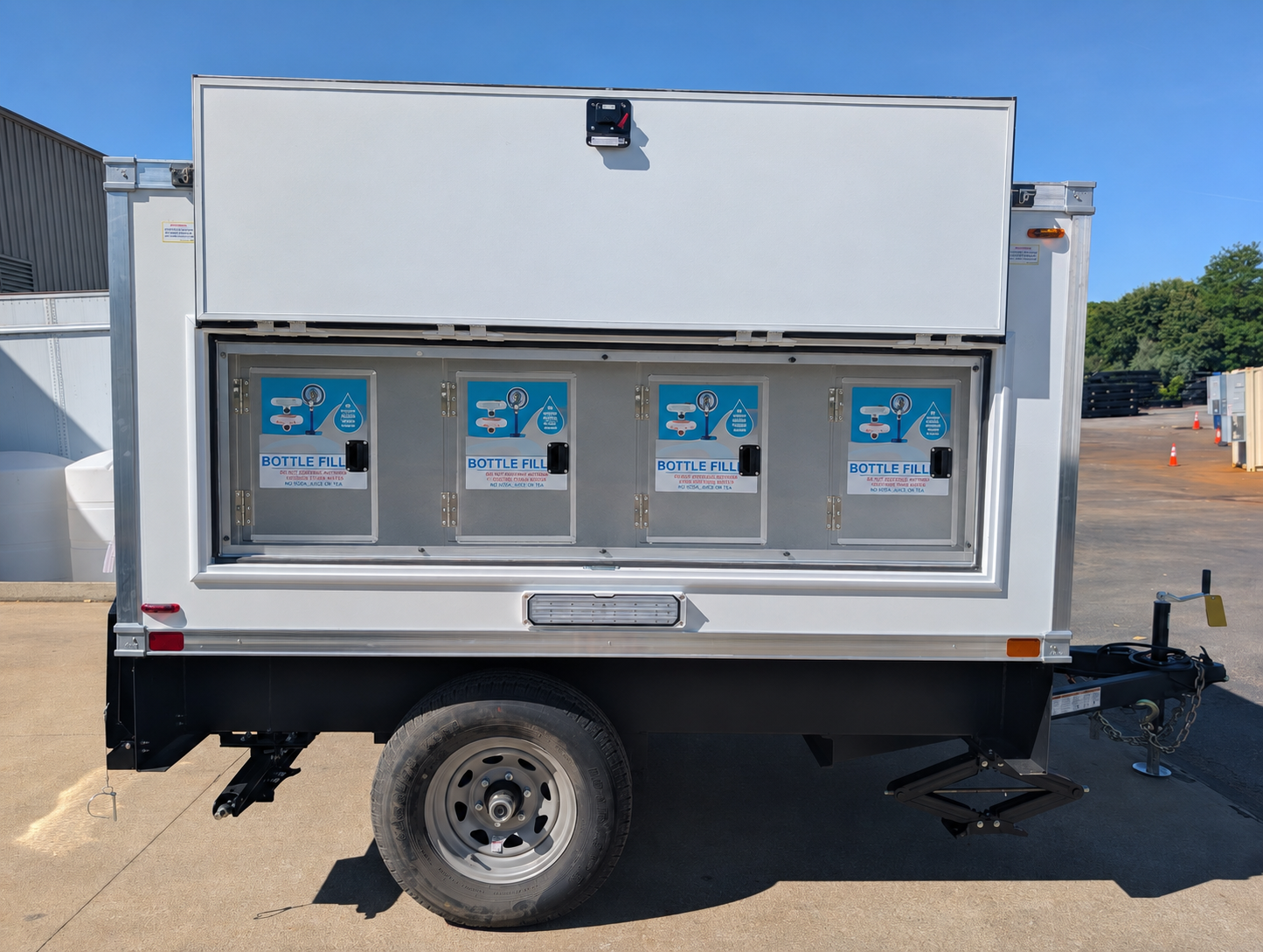
| No. of stations | (4) Bottle Filling Stations |
| Length | 12′ 3″ |
| Weight | 3,100 lbs. |
| Height | 8′ |
| Fresh water tank | 300 Gallons |
| Power requirements | 1 to 3 dedicated 20A/120V circuits OR 1 dedicated 50A/240V circuit |
| No. of AC units | 1 |
Why this is the right unit for a Stanislaus County site
Agriculture is the whole identity of this place. Stanislaus County ranks among the top 10 farm counties in the country, worth about 2.9 billion dollars a year, and Turlock earned the nickname Heart of the Valley for a reason. Milk led the county near 1.13 billion dollars in 2022. Almonds have since taken the top spot at roughly 825 million. Turlock alone has more than 20 dairy processors, names like California Dairies and Valley Milk. And Hilmar Cheese, just southwest of town, runs what is called the largest cheese and whey plant on earth. That is a lot of people working open ground and hot floors through the worst of the year.
The timing is the cruel part. Almond growers start shaking trees in late July. Harvest runs into October across varieties, right through the dustiest, most brutal stretch on the calendar. Walnuts follow, September into November. Dairy never stops, and the crews in the milking parlors and corrals carry heat load every single day. Most of that work sits a long way from a potable tap.
Our road-towable station drops in at a field edge, a turn-row, a drying yard, or a dairy corral. It puts four bottle-fill points and a rear jug-fill within a short walk of the crew. The water runs through three stages that strip sediment, chlorine and odor, and microscopic particles, then a UV chamber, then it is flash-chilled. So it stays cold when the air is 105. The tank holds 300 gallons. And when a job runs long or sits deep in the county, we back it with a water truck for refills and bladder bags for extra storage.
Cal/OSHA says the water has to be fresh, suitably cool, free, and as close as practicable to the work. On a moving harvest that is not a small thing. A warm cooler parked at the block edge fails that test by mid-afternoon. By then the crew is furthest down the rows and drinking the most. A station that follows the crew, kept full by our tankers, is how a grower keeps the quart-an-hour supply real instead of a line on a form.
Do the bottled-water arithmetic and one station wins the summer
Six bottles per person on a 100-degree Stanislaus County day, a 38-person crew, and you’re already at roughly 228 plastic bottles to buy, cart in, ice down, and throw away. That’s one day. The season is where it gets ugly.
Multiply across a 175-day build and the tally clears 39,000 bottles, with the larger commercial jobs running far past that. A single trailer makes the entire pile disappear, leaving cold water at the tap and nothing for the dumpster.
This is a logistics decision before it’s a green one
Sustainability is the easy part of the pitch. Roughly 60 million plastic bottles get thrown out daily in this country, only about a third are ever recycled, and one bottle can sit in a landfill for centuries. Worth reporting, sure. But the Turlock project managers who actually switch usually do it to kill the daily hassle, not to pad a sustainability slide. A shared trailer means no recurring bottle order, no cooler going warm before first break, no wall of empties baking by the job-trailer. The super runs the build, not the water program.
Because our own potable tankers cover the refills, the supply scales with the job rather than fighting it. Double the crew for a big pour and they still can’t outdrink the plan. And the tankers just swing back and bring the level up.
Other places a water station earns its keep in Turlock
Dairy processing floors
Turlock runs more than 20 dairy processors. Plants like California Dairies and Valley Milk keep hot indoor lines going all summer. Our roll-in unit gives those floors a documentable cool-water point under the indoor heat rule, right where staff work.
Warehouse and distribution
The industrial park off Fulkerth Road holds Amazon, US Cold Storage, and Blue Diamond. A roll-in station clears a standard dock door and needs no plumbing. So it fits a warehouse floor that bakes past 82 degrees on a Valley afternoon.
Cooling centers
When a heat wave settles in, the city and county open cooling centers for residents. A facility station gives those sites a steady supply of clean, cold water for the people who walk in for relief.
Public works and utility crews
City and TID crews work Turlock’s roads, canals, and parks straight through summer. A portable station rides out to the work zone and keeps a compliant quart-an-hour supply within easy reach.
City water, pulled through three stages and a UV chamber, then chilled
A water source people don’t trust gets ignored, and an ignored station is rented money wasted. That’s why municipal water doesn’t reach the tap raw on our trailers. It passes through four filter stages and a UV chamber, then an onboard chiller drops the temperature. The result tastes clean and comes out cold, even on the worst Turlock afternoon of the year.
Sediment stage
The opening filter traps sand, scale, and the fine grit local mains occasionally push through. On a dusty Turlock lot, that’s what keeps a pour from tasting like the parcel it’s parked on.
Carbon stage
Activated carbon comes next, lifting the chlorine bite and the dull seasonal notes local tap can carry until the taste lands clean and neutral. When it’s 101 out, that flavor decides whether a crew keeps drinking or strolls past the spout dry.
Micro-particulate stage
A tight sub-micron cartridge picks off the microscopic particles that make it past the carbon, so every fill stays safe for the workers, the runners, and the event crowd topping off across Turlock.
UV disinfection
The last step is an ultraviolet chamber that wipes out bacteria and microbes without adding a single chemical. Even after a long tow to the far edge of Stanislaus County, the water off the nozzle is clean.
Four ways to fill, and one of them is ADA
Along the wall sit four adjustable push-back spouts, press a bottle to the bar and it pours. One of them is set at ADA-reachable height, so a single trailer includes everybody at a Turlock crew or crowd with no add-on gear. Out back, a large-jug spout services five-gallon coolers and hydration packs, while a bank of hose-bib taps handles work-site chores, event support, and refills down the orchard rows. Stainless, food-grade plumbing the whole way through keeps the filtered, chilled water at quality right to the spout.
Every Signature trailer carries a 300-gallon load, roughly 2,400 cups at sixteen ounces each, and we recharge it on demand, so the unit doesn’t turn into the choke point on a busy Turlock shift or a packed show night.
We tow it in, fill it, wire it up, and it’s usually pouring cold inside the hour
There’s nothing here for you to run. Placement, fresh-water load, hookup, that’s all on us, and then we walk your Turlock crew or event staff through the basics before our truck pulls away.
Tell us the basics
People count, number of days, where exactly it parks on your Turlock site, and what power is there. Those four answers let us spec it correctly the first time around.
We come to you
Reckon roughly 45 minutes from our yard to anywhere in Turlock or Stanislaus County, with round-the-clock emergency runs whenever a heat advisory or a power shutoff hits the area.
We make it pour
Once on site we set it level, charge the 300-gallon tank, and tie in power off one to three standard 120V circuits, or a single 50-amp 240V drop, depending on what the site gives us.
We keep it full
After that the tankers cycle back on a cadence matched to how fast your crew or crowd pulls it down, and we maintain the unit through the whole rental term.
No power on the parcel at all? We price that in. The unit draws very little, and with the service fleet backing it we’ve run Turlock stations on lots that had no permanent power whatsoever. Lay out what the site offers and the rest is on us.
Cal/OSHA heat rules on a Turlock job site, in plain terms
California enforces one of the strictest outdoor-heat standards in the country, Title 8 Section 3395, Heat Illness Prevention in Outdoor Places of Employment. At its core it requires employers to provide enough fresh, pure, suitably cool, potable water so every employee can drink at least one quart per hour, about four 8-ounce glasses, and to encourage them to drink. The water must be free of charge. And it has to sit as close as practicable to where the crew is working.
The rule ramps up with the heat. A shade requirement triggers at 80 degrees. High-heat procedures kick in at 95 for agriculture, construction, and landscaping, and for ag work at 95 the employer must give a ten-minute cool-down rest every two hours. Turlock clears both the 80 and 95 marks routinely from June through September. So those procedures are in force here for weeks at a stretch, which puts real weight on a continuous cool-water supply instead of coolers that go warm by mid-morning.
California added an indoor standard too, Section 3396, effective July 23, 2024. It reaches most indoor work areas that hit 82 degrees, and it names warehouses, distribution centers, and manufacturing plants. That describes the cold-storage and processing floors across the Turlock Regional Industrial Park. A station, mobile or roll-in, gives a Turlock employer a clean way to meet the water piece of both rules and document a written Heat Illness Prevention Plan. None of this is legal advice, but it is the framework our stations are built to support.
- Free, suitably cool, fresh potable water kept within easy reach of the work face
- Enough volume to meet the §3395 yardstick of a quart per worker each hour
- A fixed, documentable hydration point your written HIPP can cite directly
- Support for worker acclimatization and the paid recovery breaks the rule mandates
A few things staging water around Turlock has taught us
A lot of Stanislaus County jobs have shaped how we run the next one. A few that stuck with us:
Almond-harvest safety lead during an August heat run. A harvest operation east of Turlock needed documented, quart-an-hour cool water for its crew across a stretch of 106-degree days. We staged a road-towable station at the orchard edge and set a refill schedule with our tanker. The safety lead got a food-grade supply the crew could reach without leaving the block. Their heat-plan paperwork got simpler. The crew stayed on the job.
Tournament director running a full weekend of soccer. A youth soccer weekend packed the Turlock Regional Sports Complex across a 99-degree Saturday and Sunday. Hundreds of players and families were on the fields all day. We placed a bottle-fill station with an ADA point and a rear jug-fill for the team coolers, right where the crowds were. Nobody ran for cases of water. And the plastic pile the organizers usually hauled off never happened.
Facilities lead on a Turlock cold-storage floor. A processing plant in the industrial park needed clean cold water on a floor that turns brutal on a July afternoon. We rolled a facility unit through the dock door with no plumbing at all. Filtered, cold, and simple. The floor team noticed it the first shift. And it gave the plant a documentable water point for the indoor heat standard.
Bottle-fill water stations for Turlock fairs, tournaments, and campus events
The biggest event in the whole county happens right here. The Stanislaus County Fair fills the fairgrounds at 900 North Broadway every July. The 114th run drew more than 250,000 visitors across ten days, July 11 to July 20, 2025, with rodeos, concerts, carnival rides, and livestock barns. It grew out of the 1911 Melon Carnival. And it lands in the single hottest stretch of the Turlock calendar. Big crowds, exhibitors, and vendors are outside from gate to gate.
Downtown carries its own season. The Turlock Certified Farmers Market runs Thursdays and Saturdays on 16th Street between H and I, spring into October. The Fourth of July celebration, the Turkey Trot, and the long-running Assyrian Festival all pull crowds into the sun. The December Downtown Christmas Parade caps the year on the first Friday of the month. Turlock Recreation Services on South Broadway keeps the calendar packed.
Youth sports may be the steadiest demand of all. The Turlock Regional Sports Complex runs about 10 soccer fields and 2 softball diamonds and rents year-round for local and state tournaments. Pedretti Sports Complex on North Tegner Road adds four softball fields and a hardball field under hundreds of shade trees. A packed summer bracket pushes hundreds of kids and parents into triple-digit afternoons. And young athletes are the worst at noticing when they are behind on water.
For all of it, a bottle-fill station keeps people cool without a mountain of plastic. The ADA-height fill point makes it usable for everyone. The rear jug-fill handles team coolers and vendor jugs. We place units where the crowd actually gathers. For indoor spaces like the fairgrounds buildings, a campus arena, or the Fitzpatrick Arena at CSU Stanislaus, our roll-in unit fits through a standard door and runs its own rooftop cooling. So the water is where the people are.
Central Valley summers are why Turlock crews need cold water on hand
Turlock sits on the flat floor of the San Joaquin Valley at just 102 feet of elevation. That geography bakes. Summers are hot, dry, and clear. July highs average in the mid-90s, some services put them as high as 97 or 98, and single days push past 100 from June into September. The all-time record is 114 degrees, set July 9, 1896. July is the least humid month of the year, with about 12 hours of sun a day and rain on barely a day and a half.
The heat is not just uncomfortable here. It is deadly. Reporting on farmworker deaths found that 168 died at work in California between 2018 and 2022. Of those, 83 died when temperatures topped 80 degrees within a day. The San Joaquin Valley gets named again and again as a dangerous place to work, because heat and PM2.5 smoke stack on top of each other during the same summer weeks.
The math favors a station, and it is simple. At one quart an hour over an eight-hour shift, one worker needs about two gallons of cool water a day. A 50-person crew needs on the order of 100 gallons just to clear the minimum. A single 300-gallon station covers a large crew for a full shift. Paired with a water truck for refills, it covers the long, remote, multi-week deployments that define a Turlock summer.
Turlock is building, and it is building on ground with no plumbing. State housing law has the city planning for at least 5,802 new homes over an eight-year cycle. The projects are moving. The Monte Vista Apartments, a 348-unit build at 1525 West Monte Vista Avenue, was among the largest to finish recently. JKB Living’s Legends North III added 65 building sites in the northeast. Grading, framing, and finish crews work every one of those blocks through Valley summers.
Then there is the industrial side. It is enormous. The Turlock Regional Industrial Park holds more than 1,700 acres of shovel-ready parcels, and the Westside Industrial Specific Plan covers about 2,600 more. Amazon’s MCE1 fulfillment center opened September 25, 2022, a 1.1 million square foot building off Fulkerth Road built toward roughly 1,500 workers. Blue Diamond Growers has made Almond Breeze here since 2013 and added a 52,000 square foot expansion in 2020. US Cold Storage, Valley Milk, and Hilmar Cheese all run floors in that footprint.
A road-towable station is built for exactly this. It tows to grade and sets up on a greenfield or a highway shoulder. It delivers filtered, chilled, potable water to a whole crew without one hookup to city water. Power runs off standard 20-amp circuits or a single 50-amp drop. The 300-gallon tank covers a large crew for a full shift, and a water truck keeps it topped off on the long jobs, like the Fulkerth Road interchange work along State Route 99.
There is a compliance angle too, and it cuts two ways. When an outdoor Turlock site clears 95 degrees, Cal/OSHA high-heat procedures kick in on top of the standing quart-an-hour water rule. And the indoor standard, Section 3396, now reaches warehouse and processing floors that hit 82 degrees. That describes most of the industrial park on a July afternoon. A station, mobile or roll-in, gives a safety manager a clean way to meet the water piece of both and document it in a written plan.
Past the station: the trucks that keep a Turlock site supplied
Everyone sees the trailer. What they don’t see is the support fleet behind it, the trucks that deliver fresh water, hold reserve on site, and carry wastewater off, so a single call wraps the entire loop rather than stringing together three vendors.
Potable water trucks
Our tankers run drinking-grade water in bulk, recharging the 300-gallon tank on whatever interval the headcount demands. Those same trucks also top up cisterns, holding tanks, and bladder bags whenever a single drop can’t keep pace, like a big slab pour or a downtown night that packs the square.
Bladder bags & buffer supply
When demand spikes we set out fold-flat bladders to bank extra fresh reserve, and on a drain-less lot they’ll temporarily hold greywater too. It isn’t fancy equipment, but it’s what keeps a far-flung Stanislaus County job pouring between tanker runs.
Pump trucks
Water that has to move across a job is a pump truck’s job, whether that’s charging holding tanks or shuttling supply end to end. It earns its keep on the sprawling parcels where the trailer and the fill point can end up a fair hike apart.
Vacuum & waste trucks
At the tail end, a vacuum truck draws off greywater and wastewater and carries it to permitted disposal, closing the loop clean. Nobody on your Turlock crew is left guessing where the used water ended up. That piece was built into the plan from day one.
It all interlocks. A remote parcel might run a station plus a bladder bag for reserve and a recurring water-truck schedule. A heavy event night might call for a pump truck to move supply and a teardown waste run at the end. Describe the shape of your job and we’ll put together the right combination, on one invoice, handled by one crew that already knows the ground.
The handful of questions that turn a two-minute call into a real quote
A couple of minutes on the phone is enough to get you a real number. Here’s what we’ll want to know, handy to have ready before you call, and proof that we size every job to the work in front of us rather than reading off one canned quote.
The four answers that shape the recommendation
- How many people? Fifteen framers on a tract and a four-thousand-head concert are not the same problem. Your peak headcount, or gate count, drives how many trailers we stage and how aggressively the tankers cycle.
- How long? Two days at a park tournament, three weeks of footings, nine months on a master-planned build, each wants its own rhythm. Short jobs usually lean on staged reserve; long ones ride a standing tanker schedule.
- Where will it sit? Towable means the Signature tucks into a gated yard, bare dirt, an event lawn, or a skinny staging lane just as well. Hand us the exact spot plus the route our truck takes past the gate and any stored material, and we’ll land it on the natural foot-traffic path.
- What power is on site? The unit runs on as little as one and as many as three standard 120V circuits, or one 50-amp 240V drop. A lot of Stanislaus County parcels carry no permanent power, and that’s genuinely fine, provided you flag it before delivery day.
The smaller details that sharpen the plan
- Where on the site it should land, plus how a delivery truck reaches that spot
- Whether your people stay in one zone or spread across the full footprint
- Any §3395 heat-illness documentation your safety program needs the station to support
- Whether bulk hauls, bladder reserve, or a waste pickup should be bundled onto the job
The line items a pallet of bottled water keeps off your invoice
Bottled water reads as the budget choice on a purchase order. Its actual price tag is buried somewhere else, in handling hours, staging footprint, water that warms up, and trash piling up afterward, and on a hot inland lot each of those costs more than it would by the coast.
The labor nobody budgets for
Look at everything bottled water actually demands of a person: cutting the order, receiving and breaking down pallets, icing coolers before dawn, refilling through the day, then flattening empties for the bin. On a large Turlock crew that’s hours of paid time burned every single day, scraped right off the work that’s supposed to be getting done. The trailer erases that loop entirely. A local contractor once let us pencil it out with him, and the recovered labor by itself paid for the unit. His words were that the bottle runs had been quietly costing him close to a day of payroll a week. Our trailer arrives full, the tankers keep it full, and your superintendent owes it nothing but a parking spot.
The warm-up problem
Ice a cooler at 6 a.m. and by mid-morning in a Stanislaus County July it’s pushing bathwater. Warm water is water people stop touching, and the slowdown that follows is precisely where heat illness gets its opening. A chilled station never rides that warm-up curve at all. Whatever pours at clock-out is as cold as the sunrise fill, which happens to be the moment a spent crew, or a crowd deep into a long concert, leans on it hardest.
The storage and footprint tax
Bottled-water pallets devour staging space, jam the lay-down area, and sit cooking in the sun until somebody finally cracks them open. Empties build up faster than anyone keeps up with, and on a tight commercial lot that pile turns into its own problem. Set a trailer in one parking stall instead and it serves a crew or crowd that would otherwise burn through hundreds of plastic bottles every day.
The waste that trails you
Every bottle bought is a bottle thrown out, and across a season a busy site or event generates a small mountain of them. That’s a disposal line on the budget, a dent in the sustainability numbers, and, given that a single bottle can linger in the ground for centuries, a footprint that outlives the project that made it. Move to a refill station and the line drops to zero, which finally gives your reporting a figure worth publishing.
Turlock neighborhoods and nearby towns we serve
We dispatch from Turlock and serve the city, the surrounding communities, and the wider county. If your job site, farm, venue, or facility is in or around Turlock, we can get a water station to it.
Northwest Turlock
West Turlock
East Turlock
Geer Road
Monte Vista
CSU Stanislaus
Denair
Hughson
Keyes
Delhi
Hilmar
Ballico
Winton
Ceres
Modesto
Livingston
Atwater
Merced
Turlock Lake
La Grange
Riverbank
Oakdale
Patterson
Turlock Regional Industrial Park
CSU Stanislaus and Monte Vista
West Turlock and Golden State
East Turlock and Geer Road
Hilmar and the dairy belt
Working a corridor instead of a single address? We follow the routes Stanislaus County runs on, so multi-site projects get the same fast turnaround as one stop.
The questions Stanislaus County crews and event teams actually ask us
How fast can you deliver a water station in Turlock?
Because we dispatch locally, we can usually get a station to a job site, farm, or venue on short notice, and we schedule ahead for harvest, the county fair, and multi-week construction jobs. Our service radius reaches the surrounding communities, including Modesto, Ceres, Denair, Hilmar, and Merced. Give us the location, the dates, and the crew or crowd size, and we will match the right unit and timing.
Does a water station help with Cal/OSHA heat rules on a Turlock job site?
Yes. California’s outdoor standard, Section 3395, requires enough cool, potable water for every worker to drink at least one quart an hour, kept close to the work and free of charge, and high-heat procedures trigger at 95 degrees, which Turlock clears often in summer. A permanent station provides that continuous supply and makes it easy to document a written Heat Illness Prevention Plan. There is also an indoor rule, Section 3396, that our roll-in unit supports for warehouse and processing floors. This is general information, not legal advice.
Is the water filtered and safe to drink?
Every station runs the water through three stages that remove sediment, chlorine and the tastes and odors that come with it, and microscopic particles, then a UV chamber that kills bacteria with no added chemicals. The equipment is food-grade from the source to the dispenser, and the water is flash-chilled so it stays cold even in triple-digit heat. It is clean, cold, potable drinking water.
How many people can one station serve?
Each station has four bottle-fill points plus a rear jug-fill station and a 300-gallon fresh tank, which is roughly 2,400 sixteen-ounce fills and covers a large crew or an event crowd. For long harvest runs, multi-week jobs, or big multi-day events like the county fair, we back the station with a water truck for refills and bladder bags for extra storage on site, so it never runs dry.
Do you serve farms and dairies outside Turlock city limits?
Absolutely, and it is a big part of what we do. We deliver to field edges, orchard turn-rows, drying yards, and dairy corrals across Stanislaus County, including the dairy belt around Hilmar and sites with no water hookup at all. The station runs off its fresh tank, our water truck handles remote refills, and bladder bags add storage when a deployment sits deep in the county.
Can you cover the Stanislaus County Fair or a full tournament weekend?
Yes. We set stations for multi-day events like the county fair at the fairgrounds on North Broadway and for youth soccer and softball tournaments at the Turlock Regional Sports Complex and Pedretti Sports Complex. The ADA-height fill point keeps it usable for everyone, the rear jug-fill handles team and vendor coolers, and we place units where the crowds actually gather across multiple fields or a large fairground footprint.
Do you have an indoor unit for warehouses and processing floors?
We do. For indoor settings we bring the roll-in facility unit. It fits through a standard door, runs its own rooftop cooling, and needs no fixed plumbing, so it works on a warehouse floor off Fulkerth Road, a dairy processing line, a campus arena, or a cooling center. It delivers the same filtered, chilled, food-grade water as the trailer, which matters under the indoor heat standard.
Do the stations work off-grid with no water hookup?
They do. The station carries its own 300-gallon fresh supply, so it does not need to tie into city water, and power runs off one to three standard 20-amp circuits or a single 50-amp connection. For jobs that outlast the tank, our water truck delivers refills on a schedule, which is how we cover remote Stanislaus County sites and the foothill edge east of town where there is no municipal tap.
Are the stations ADA accessible?
Yes. Each station includes an ADA-accessible bottle-fill point set at a reachable height, so everyone on a job site or at an event can use it, plus a rear-mounted large jug-fill station for coolers, water jugs, and larger containers. It is built for real crews and real crowds, not just single bottles.
How does a station compare to buying cases of bottled water for a Turlock crew?
The volume adds up fast. A 50-worker crew going through six bottles a day burns 300 bottles daily, more than 60,000 over a 200-day project, and past 100,000 on a larger multi-phase job. A station replaces all of that with filtered, chilled water on tap, and it clears out the delivery runs, the ice and cooler management, the storage, and the disposal, while cutting the single-use plastic that weighs on your sustainability reporting.
Can you support cooling centers or flood and fire response in Turlock?
Yes. When the city and county open cooling centers during a heat wave, our facility unit gives those sites a continuous supply of clean, cold water. The Stanislaus County Fairgrounds has served as an evacuation shelter during past floods on the Tuolumne River, and foothill fire camps spin up east of town, so our road-towable station and water truck can stage quickly for emergency and disaster response in the region.
How far ahead should I book for summer, harvest, or fair season?
Summer is the crunch in Turlock, because harvest, the Stanislaus County Fair in mid-July, construction, campus events, and youth tournaments all peak in the same weeks. For a fixed event date or a set harvest window, earlier is better. For an ongoing job site a temporary station can usually go out quickly, but locking in ahead is the difference between a station on the ground and a scramble during the hottest stretch.
Turlock water station resource library
Cal/OSHA Heat Rules on a Turlock Job Site: What the Water Requirement Actually Means
If you run a crew outdoors in Turlock, the summer heat is not just uncomfortable. It is a regulated hazard. California enforces Title 8 Section 3395, Heat Illness Prevention in Outdoor Places of Employment, one of the strictest outdoor-heat standards in the nation, and its water requirement is specific. Employers must provide enough fresh, pure, suitably cool, potable water so each employee can drink at least one quart per hour, the equivalent of four 8-ounce glasses, and must actively encourage them to drink.
The details matter on a real Turlock job. The water has to be free of charge. And it has to sit as close as practicable to where the crew is working, not parked at a trailer a quarter mile away. A sufficient quantity must be present at all times and readily accessible, so every worker can keep drinking a quart an hour until the supply is topped back up. On a hot day that adds up fast. Over an eight-hour shift, one worker needs roughly two gallons of cool water, and a 50-person crew needs on the order of 100 gallons a day just to meet the floor.
Cal/OSHA Outdoor Heat Illness Prevention · Title 8 Section 3395, full regulation text
Almond and Walnut Harvest Around Turlock: Keeping Field Crews Cool When It Hits 105
Harvest around Turlock has a hard bit of timing built into it. The crops that anchor the local economy come off during the hottest, driest, dustiest weeks of the year. And the crews that bring them in are outdoors for all of it. Almonds are now the top crop in Stanislaus County, worth about 825 million dollars, and almond harvest, the shake and sweep sequence, runs from late July into October. Walnuts follow, early September into November. Both windows put crews in the field through the worst heat.
The scale here is significant. Stanislaus County ranks among the top 10 farm counties in the entire country, with production around 2.9 billion dollars, and milk and almonds together make up close to half of it. Turlock earned the nickname Heart of the Valley honestly. That translates into a very large seasonal workforce spread across orchards, fields, and drying yards, most of them a long way from any building or permanent tap.
Cal/OSHA Outdoor Heat Illness Prevention · Almond Board of California, Harvest Overview
Water Stations for Turlock’s Event Season: The County Fair, the Farmers Market, and Tournament Weekends
Turlock’s event calendar is busy, outdoor, and packed into the warmest months. That makes cold water one of the quieter keys to running a good gathering. The signature event is the Stanislaus County Fair, the largest event in the county, held at the fairgrounds on North Broadway each July. The 114th fair ran ten days, July 11 to July 20, 2025, and drew more than 250,000 visitors for rodeos, concerts, carnival rides, motocross, and livestock barns. It grew out of the 1911 Melon Carnival. And it lands in the single hottest stretch of the year.
Downtown carries its own calendar. The Turlock Certified Farmers Market runs Thursdays and Saturdays on 16th Street between H and I, roughly April through October, with the Fourth of July celebration and the Turkey Trot filling the warm-season schedule. The long-running Assyrian Festival brings out the community that has anchored Turlock for a century. And the Downtown Christmas Parade caps the year on the first Friday in December. Turlock Recreation Services keeps all of it moving.
The Turlock Industrial Park and the Indoor Heat Standard: Cold Water on the Warehouse Floor
Turlock has quietly become a serious West Coast distribution and food-processing hub. And that growth runs straight into California’s newest heat rule. The Turlock Regional Industrial Park holds more than 1,700 acres of industrially zoned parcels, and the Westside Industrial Specific Plan covers about 2,600 more. The city put more than 14 million dollars into water and sewer backbone to make large areas shovel-ready. The tenants followed.
The names in that footprint are heavy hitters. Amazon’s MCE1 fulfillment center opened September 25, 2022, a 1.1 million square foot building off Fulkerth Road built toward roughly 1,500 workers. Blue Diamond Growers has made Almond Breeze at its Turlock plant since 2013 and finished a 52,000 square foot expansion on the existing 200,000 square foot facility in 2020. US Cold Storage, Valley Milk, California Dairies, and Hilmar Cheese all run processing and cold-storage lines in and around the park.
Cal/OSHA Section 3396, Indoor Heat Illness Prevention · City of Turlock Regional Industrial Park
What Turlock crews and organizers tell us
“We ran the station at the orchard edge through almond harvest and it was the easiest part of the whole season. Cold, clean water right there for the crew when it was over 100, and no more chasing pallets of bottles. The refill schedule hit on time every week.”
“A soccer weekend at the sports complex in that July heat used to mean hauling cases of water and cleaning up a mountain of plastic. One station with the ADA fill and the jug fill for the coaches covered every field. Parents actually thanked us for it.”
“No water service anywhere near our work zone, so a chilled station towed right to grade solved it. It kept us square on the cool-water rule and the crew stayed drinking. Setup was fast and it never ran dry.”
Service information current as of July 2026.
Lock in cold, filtered water for your Turlock site or event before the next hot stretch
Tell us the headcount or the gate count, the rental dates, and where the trailer should park, and we’ll spec the right setup and roll one out to you anywhere in Stanislaus County, usually inside about 45 minutes of dispatch.