Cold Filtered Water & Hydration Station Rentals in Atlanta
On-Site Hydration Services delivers temporary water station rentals across Atlanta, cold, filtered, and set up the day your crew or event needs it. Call us to reserve a trailer or request a free quote online and we will get back to you the same day. Our crews also serve water station rentals in Augusta across the region.
- Atlanta drops in about 45 minutes
- Chilled, filtered four-stage water
- ADA-height bottle fill
- Heat-illness ready
- A+ BBB, licensed and insured
- Around-the-clock emergency runs
Atlanta’s top-rated temporary water station rentals, handled by On-Site Hydration Services
Ask around a data center pad in Douglas County, a produce dock in Forest Park, or a tank farm fence line in Doraville. The companies that lose real money when heat stops a shift are the same ones that keep an On-Site Hydration trailer parked on site month after month. That repeat business from the highest-stakes jobs in the metro is the endorsement we point to. We are registered on SAM.gov for agency work and our units carry an ADA accessible filling station, so the same trailer serves a federal contract or a church festival. Call us to talk through your site, or request a free quote and have an answer before the end of the day.
A crowd on Saturday, a crew on Monday
One Signature trailer can pour for a weekend concert and be working a slab pour a couple of days later. Hiring one company for your events and a separate one for your worksites makes no sense. Either way, the planning, the delivery, and the refills are ours.
Cold water that holds past the 3 p.m. heat
The onboard chiller keeps the tank genuinely cold all the way through a Atlanta afternoon, and that single detail carries the whole thing. Warm water is water people abandon, and midsummer is exactly when a crew or a crowd is drinking the most. Cold water gets finished, and finishing it is what keeps heat illness off the site.
Local dispatch, quick to the gate
Typical Atlanta deliveries land in about 45 minutes, and we keep emergency runs going around the clock whenever a heat advisory or a power shutoff hits metro Atlanta. The morning a foreman finds his 40-person crew stuck with one warm cooler, speed is the entire ballgame.
One rule sits under every job we take: water that people walk past might as well not be there. We’ve stood on a bare Atlanta site and watched shrink-wrapped pallets cook next to the job-trailer while the crew baked thirty yards off. We’ve watched the opposite too, a chilled station ten steps off the work face run bone-dry twice inside one shift. Everything that matters lives in the distance between those two pictures. Which is why we don’t drop a unit and disappear. We match it to your headcount or your gate count, set the refill rhythm to how hard you’re really pulling on it, and treat a heat call the way you’d want your own treated, meaning right now, because out here one hot hour can swing the whole day.
We plan around Atlanta traffic. A delivery that misses its window on the Connector can blow a whole morning. We schedule drops around the Perimeter’s rhythms, run early on event days, and confirm exact arrival times the day before. It sounds small until the one vendor who does it is yours.
Three calls that went the way we plan every one of them
“With thousands of runners coming through the finish area you can’t have people waiting ten deep for water. The filling stations kept everyone moving. Volunteers loved that the water actually came out cold.”

“We had a three-week tank outage with forty contractors inside the fence and no drinkable tap anywhere near the work. Their trailer sat just inside our gate and ran the whole job without a hiccup. Top notch outfit.”

“Booking one of these stations has honestly changed how I plan outdoor events. No more cases of bottled water melting in the sun. My clients notice the difference and so does the cleanup crew.”

The delivery map for Atlanta and the metro Atlanta routes around it
We serve the full metro from our local hub, and we run water station rentals across Georgia through sister locations, so multi-site companies deal with one vendor statewide. If your site is anywhere inside the Perimeter or in the counties around it, we deliver.
Midtown
Buckhead
West Midtown
Vine City
Old Fourth Ward
Summerhill
Grant Park
East Atlanta
Decatur
Doraville
Chamblee
Tucker
Smyrna
Marietta
Sandy Springs
Alpharetta
Roswell
Every Atlanta neighborhood has its own water needs
Downtown and South Downtown
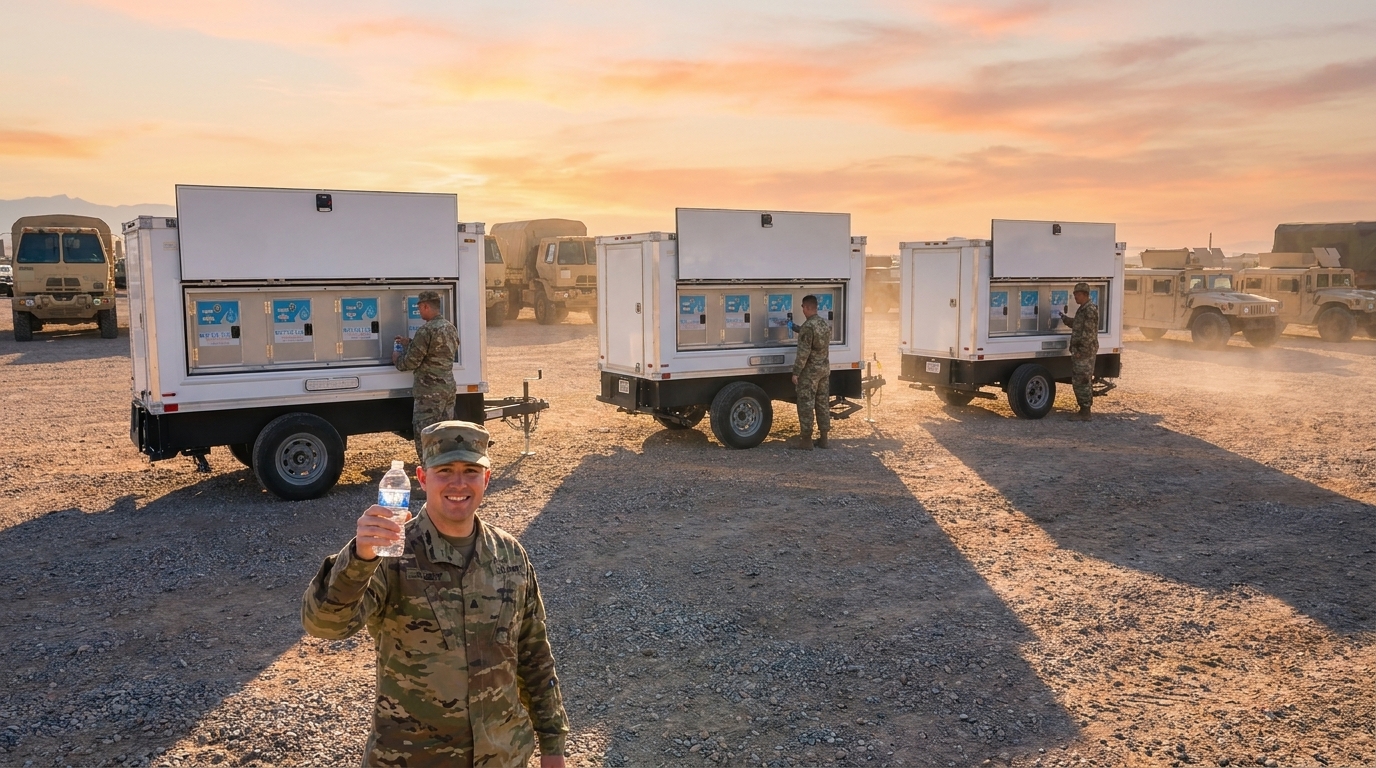
Centennial Yards construction, stadium and convention event load, and the tightest staging in the metro. Deliveries here are about timed street access and security perimeters, and we build both into the schedule.
Midtown
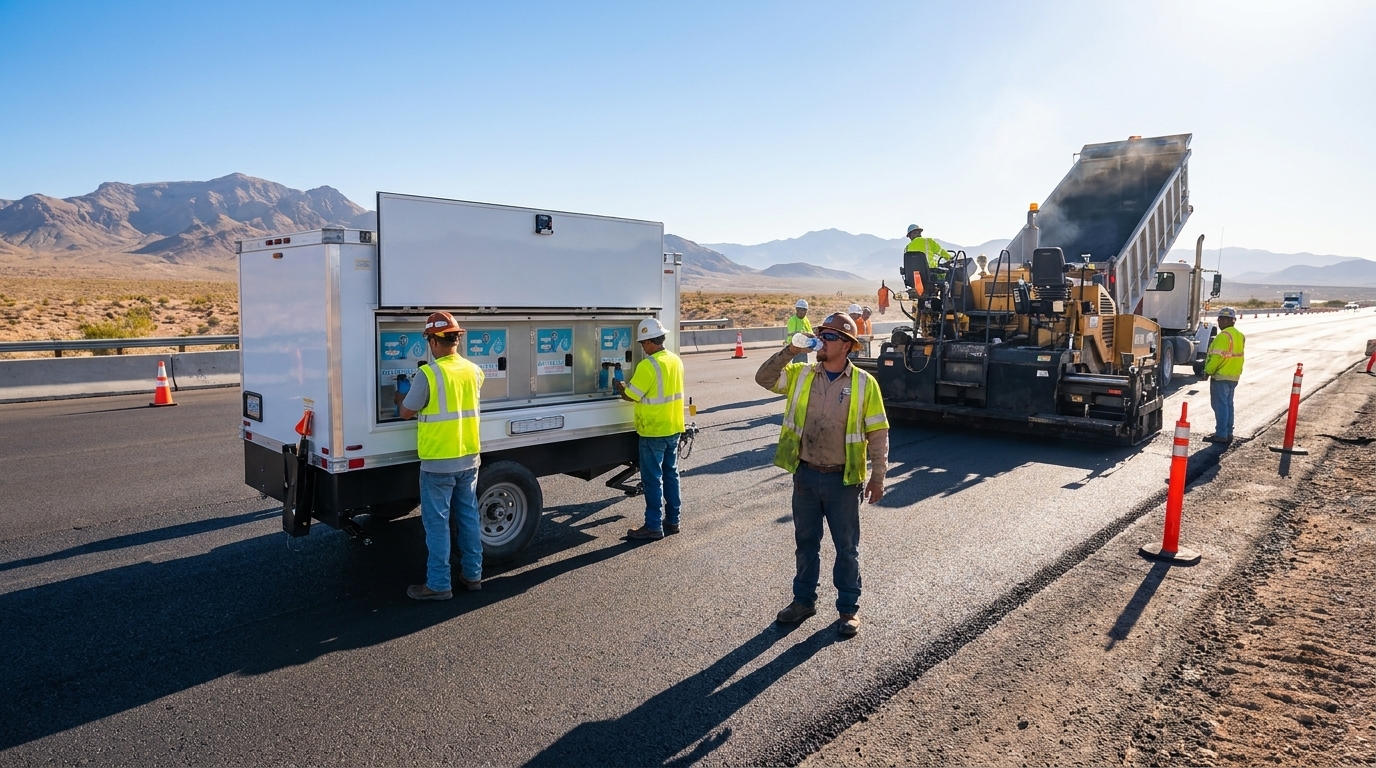
Piedmont Park’s festival calendar and a high-rise construction corridor share the same square mile. Tower crews want a station at the hoist base. Festival producers want four of them at the gates. We have parked trailers for both in the same week.
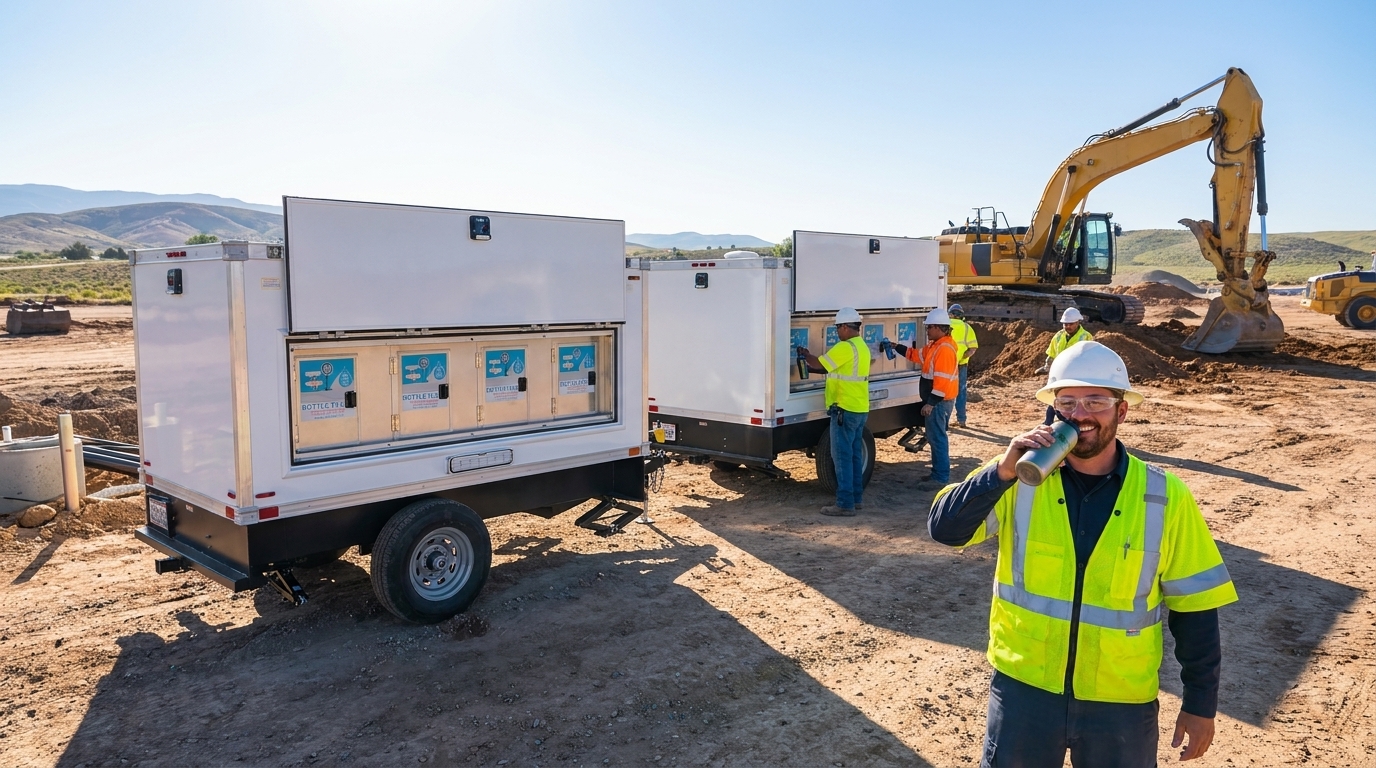
Westside and Vine City
This is where the 2024 water main crisis started, and it is also where the BeltLine and Franklin Park work keeps crews outdoors. Emergency preparedness questions come up more here than anywhere else in the city, for good reason.
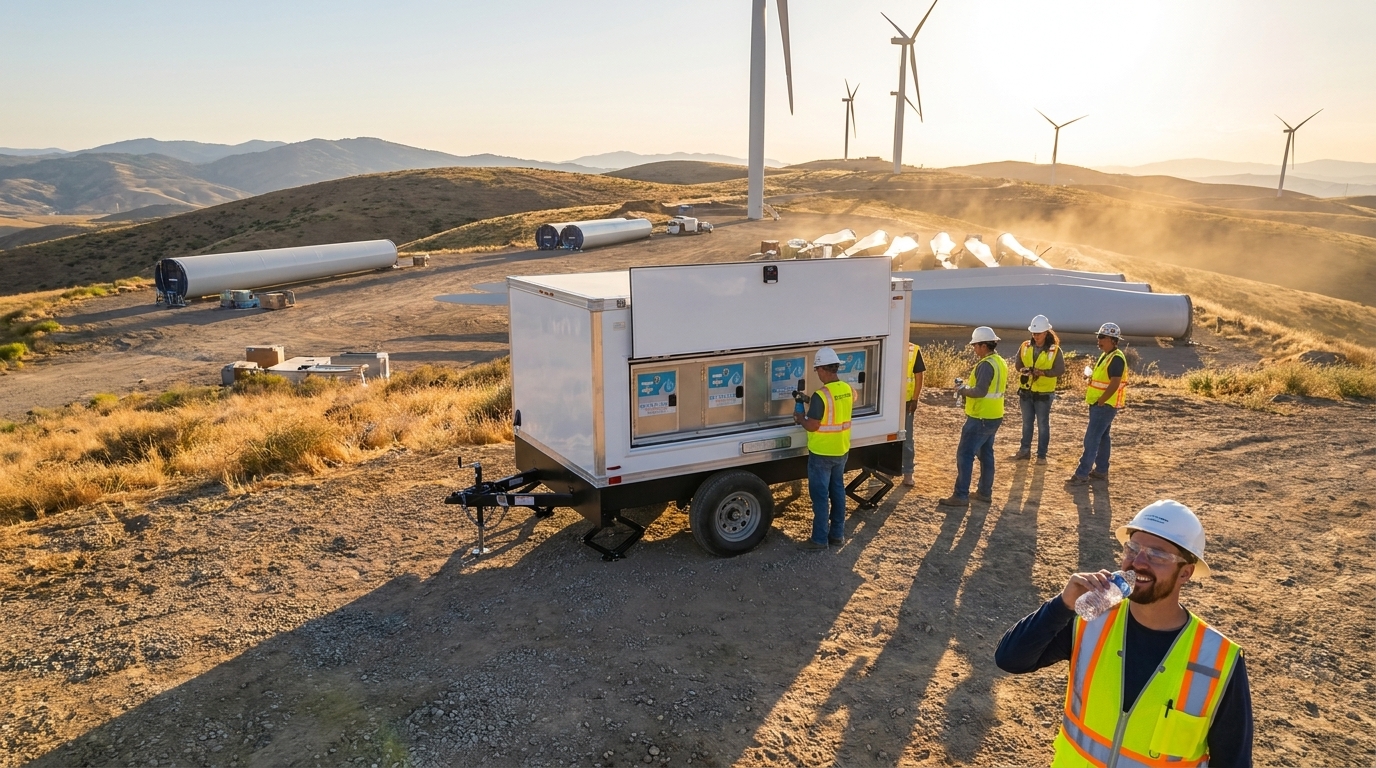
Doraville and Chamblee
Tank farm maintenance on New Peachtree Road, Assembly Studios on the old GM site, and dense light-industrial blocks in between. Fenced-site protocol work. Our drivers know the gate procedures because they repeat them weekly.
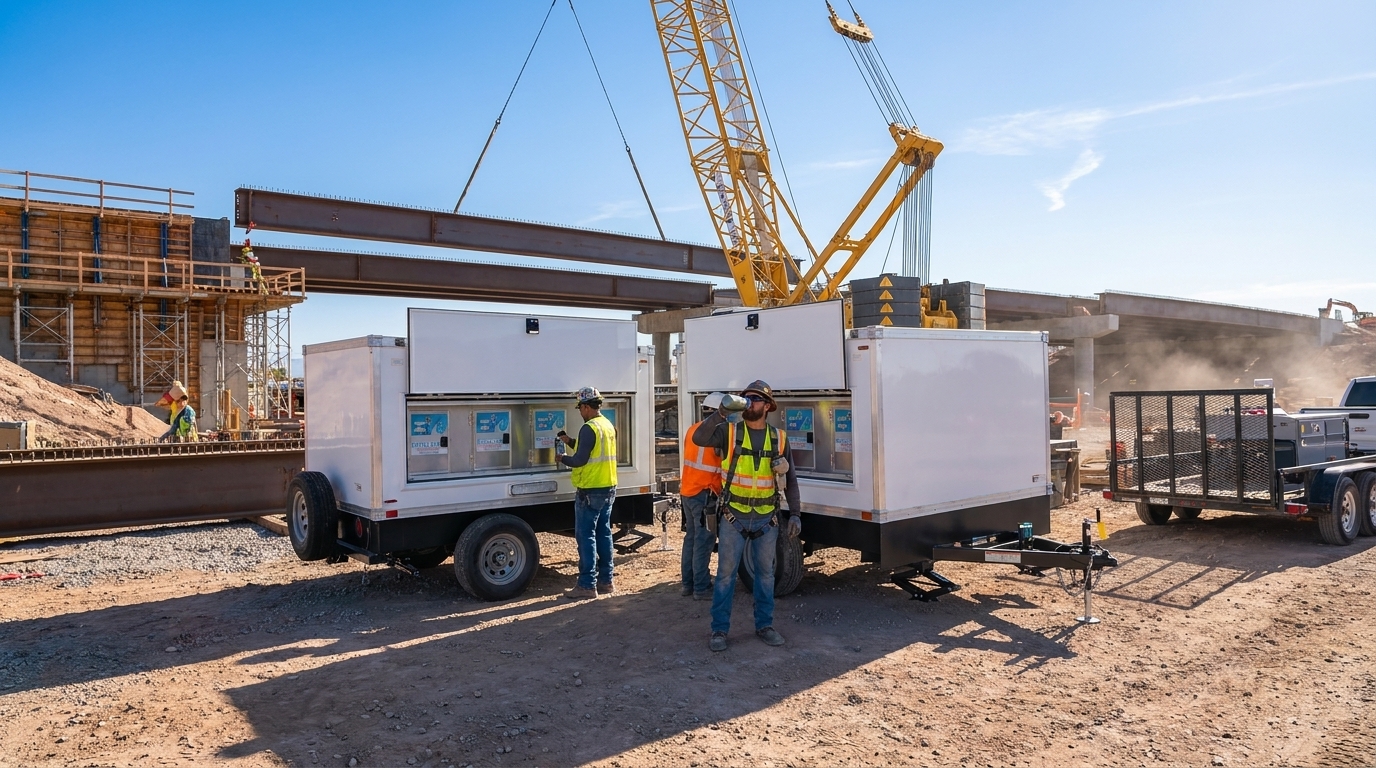
The airport southside
Hapeville, College Park, and Forest Park hold the Concourse D project, Delta’s operations, and the 150-acre farmers market. Badge-controlled airside deliveries and 24-hour dock schedules make this our most logistics-heavy zone.
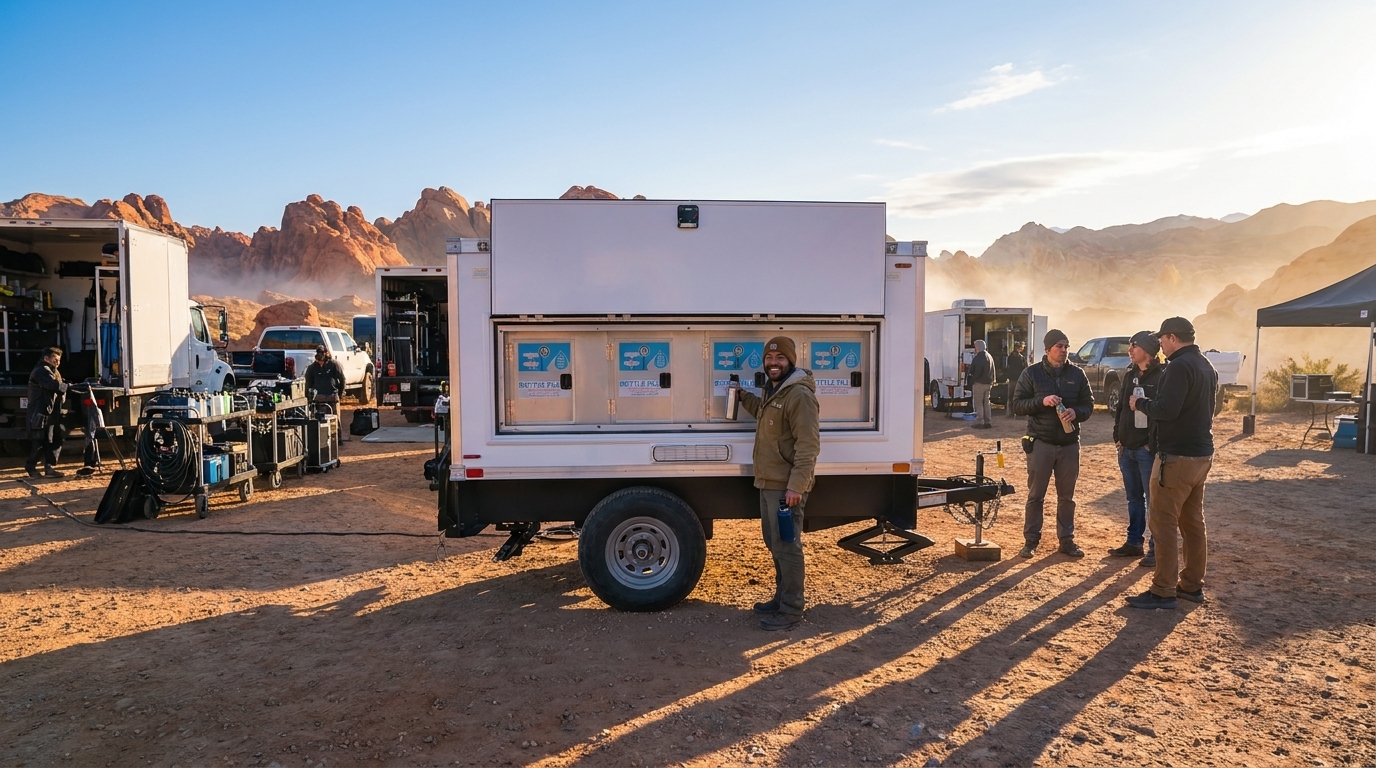
Fayetteville and the south metro
Trilith’s 700-acre studio campus and the QTS data center build sit minutes apart. Film basecamps move mid-production and construction pads run for years, so we serve this corridor with both short flexible rentals and long-term service plans.
Water service sized for server-farm construction
The data center wave has reached metro Atlanta, and those jobs drink differently. Hundreds of trades spread over huge fenced pads, gates that stay busy around the clock, and safety programs that expect a documented cold-water point. We stage jobsite-safe stations where the badging and the foot traffic actually are, and our trucks keep them full on a 24/7 cadence for as long as the build runs.
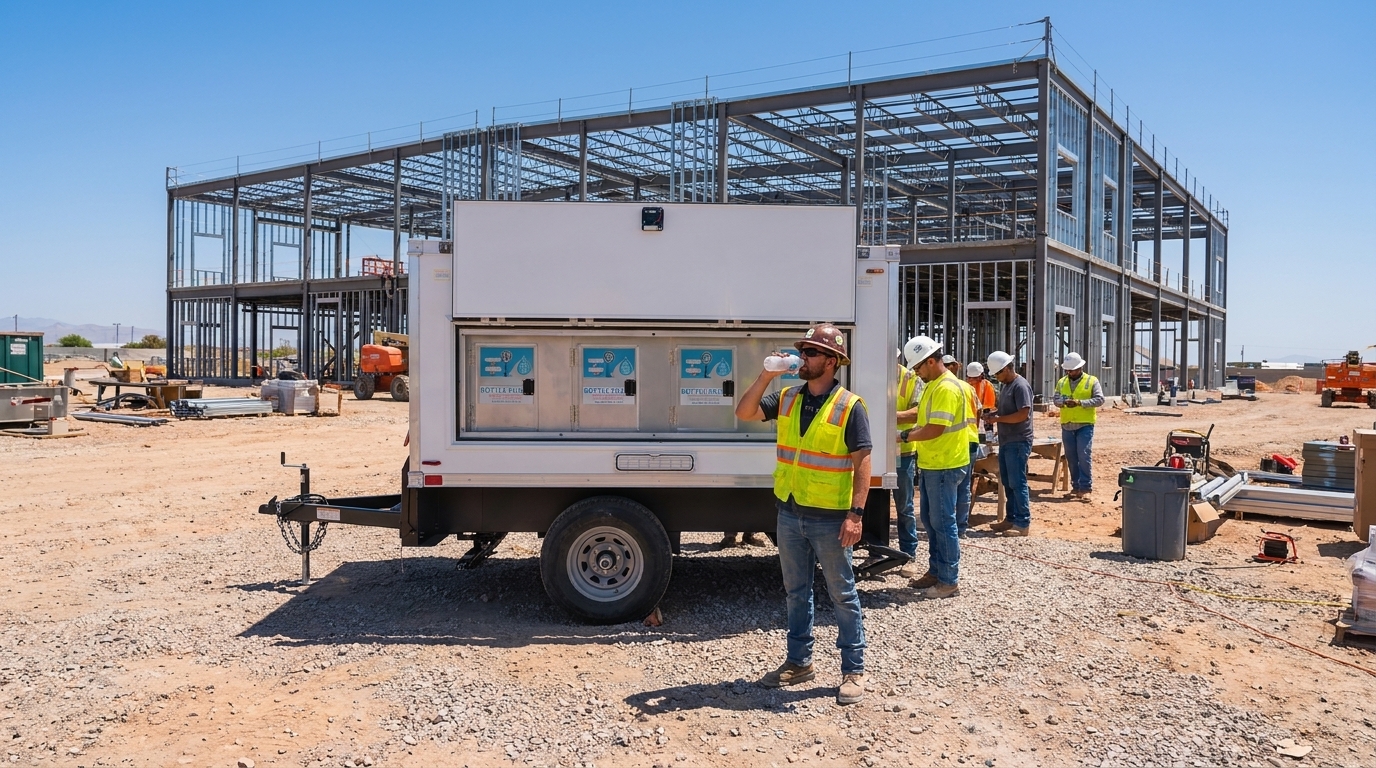
Field sanitation water for farm and market crews
The Signature Series was built for exactly the kind of sites Atlanta produces. Red clay pads with no hookups, locked terminal yards, and park lawns holding fifty thousand people all get the same cold, filtered water.
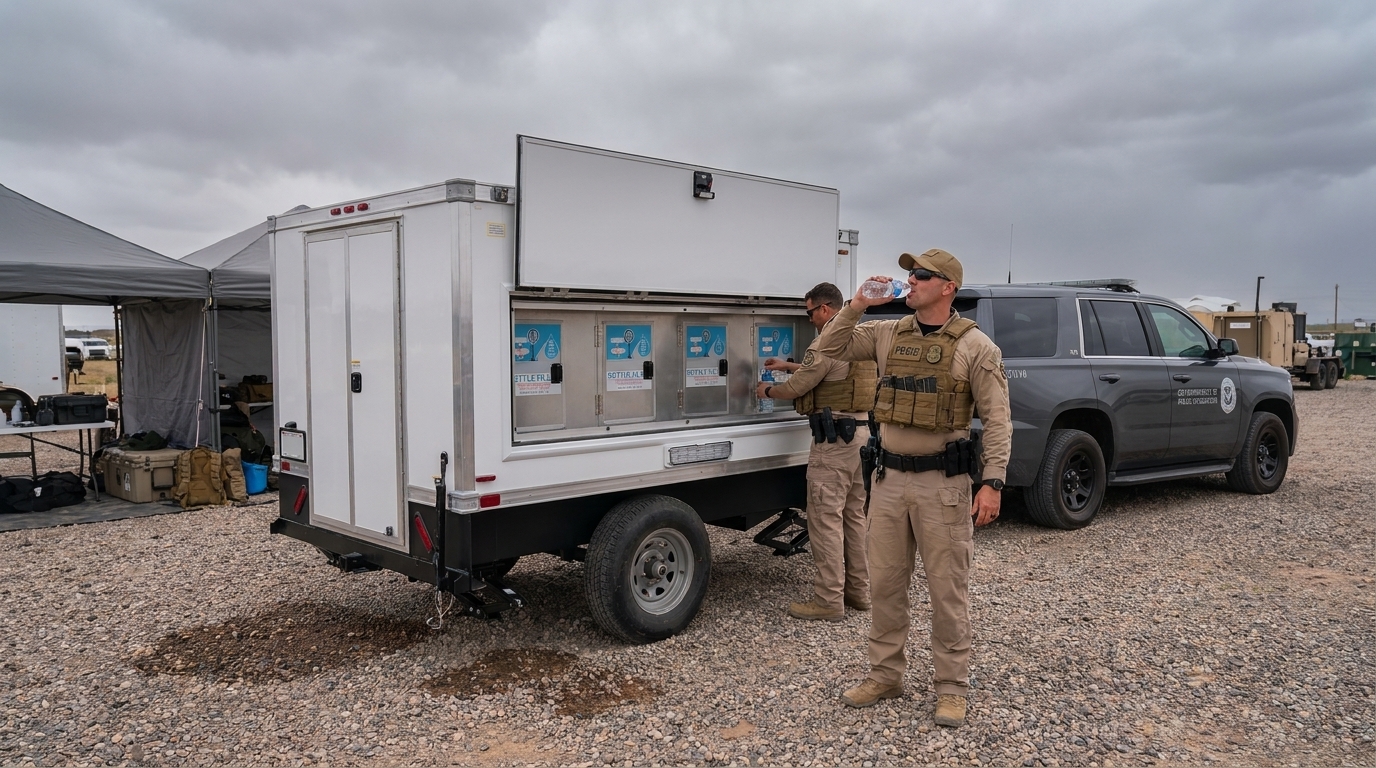
Signature Series specifications
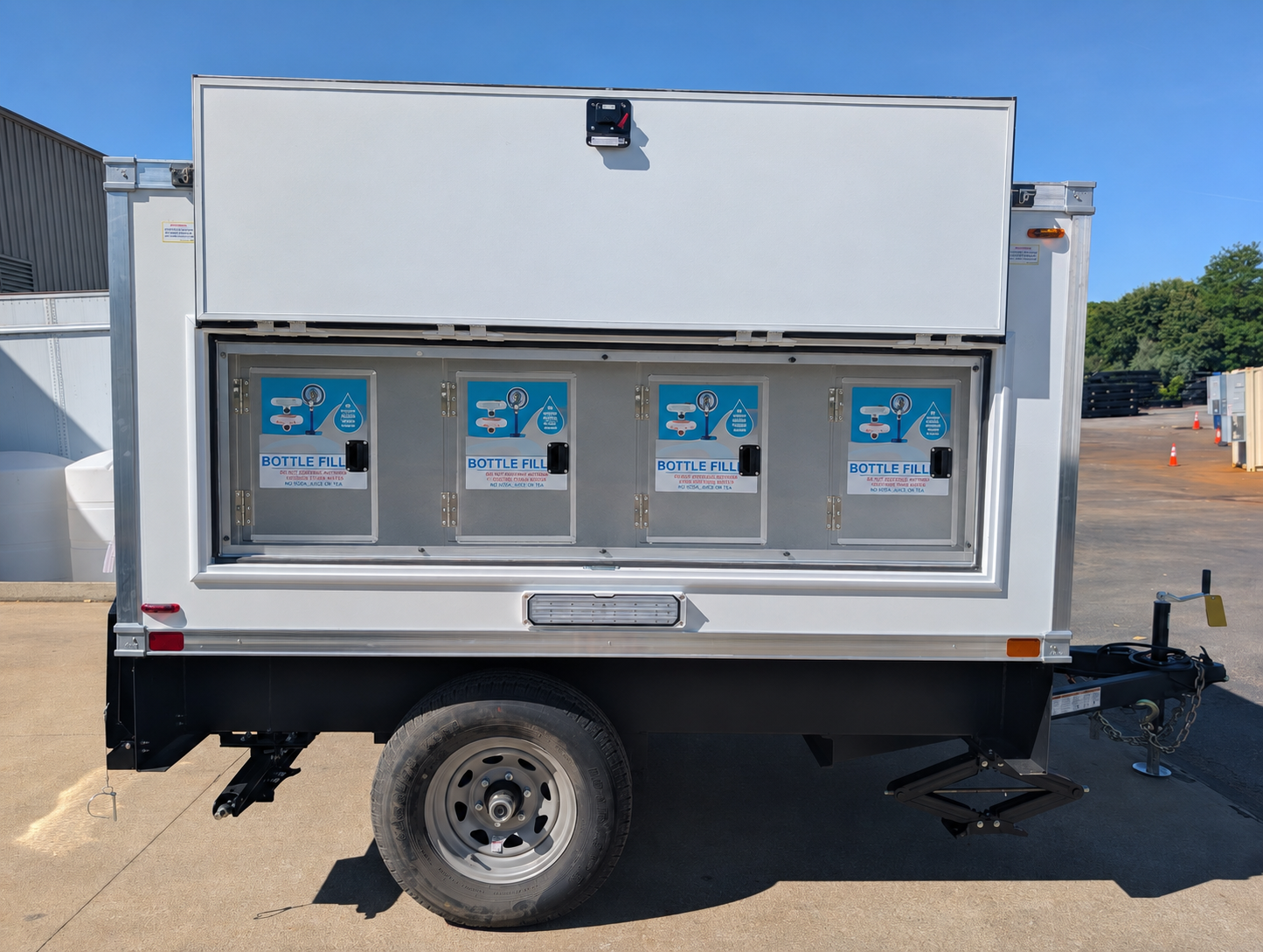
With a frame, a hitch, and tires under it, the unit hauls out to a remote metro Atlanta build, an event field, a working orchard, or a disaster staging yard with equal ease. Atlanta contractors and event planners request this exact rig by name. The whole design is built around backing in, leveling off, and pouring cold by the same afternoon.
| No. of stations | (4) Bottle Filling Stations |
| Length | 12′ 3″ |
| Weight | 3,100 lbs. |
| Height | 8′ |
| Fresh water tank | 300 Gallons |
| Power requirements | 1 to 3 dedicated 20A/120V circuits OR 1 dedicated 50A/240V circuit |
| No. of AC units | 1 |
Why this is the right unit for a metro Atlanta site
Agriculture is Georgia’s biggest industry, and its front door sits ten minutes south of the airport. The Atlanta State Farmers Market in Forest Park covers 150 acres and never closes. Produce trucked up overnight from south Georgia gets unloaded, graded, and reloaded by dock crews working outside or under open sheds, and in July that work happens in air that feels like 105. A water trailer parked between the sheds keeps cold water within a short walk of every pallet jack.
Federal field sanitation rules require farms with hand-labor crews to keep cool drinking water close to the work, and inspectors do check. Our trailers make that the easiest box on the audit. Four push-button filling stations, water run through sediment, carbon, micro-particulate, and UV stages, then chilled before it hits the bottle. The rear jug-fill station loads the big orange coolers that ride out to the rows on a Gator. Crews fill fast and get back to it.
Metro-fringe operations call us too. Sod farms in Henry County, wholesale nurseries out in Cherokee and Coweta counties, and the poultry country that starts an hour up the road around Gainesville. Harvest weeks move fast and the crew is never near a building. Our trailer tows behind a pickup, sets up on a field edge or gravel row, and runs without any water or sewer connection at all.
Hurricane Helene showed what this region’s farms are up against. The September 2024 storm did more than five billion dollars of damage to Georgia agriculture, flattened over 200 poultry houses, and left cleanup crews working for weeks in places with no power and no safe tap. We supported recovery work through that fall, and it changed how we stage equipment every August. The market in Forest Park kept running the whole time. So did we.
What One Water Station Saves Against Bottled Water
Six bottles per person on a 100-degree metro Atlanta day, a 38-person crew, and you’re already at roughly 228 plastic bottles to buy, cart in, ice down, and throw away. That’s one day. The season is where it gets ugly.
Multiply across a 175-day build and the tally clears 39,000 bottles, with the larger commercial jobs running far past that. A single trailer makes the entire pile disappear, leaving cold water at the tap and nothing for the dumpster.
This is a logistics decision before it’s a green one
Sustainability is the easy part of the pitch. Roughly 60 million plastic bottles get thrown out daily in this country, only about a third are ever recycled, and one bottle can sit in a landfill for centuries. Worth reporting, sure. But the Atlanta project managers who actually switch usually do it to kill the daily hassle, not to pad a sustainability slide. A shared trailer means no recurring bottle order, no cooler going warm before first break, no wall of empties baking by the job-trailer. The super runs the build, not the water program.
Because our own potable tankers cover the refills, the supply scales with the job rather than fighting it. Double the crew for a big pour and they still can’t outdrink the plan. And the tankers just swing back and bring the level up.
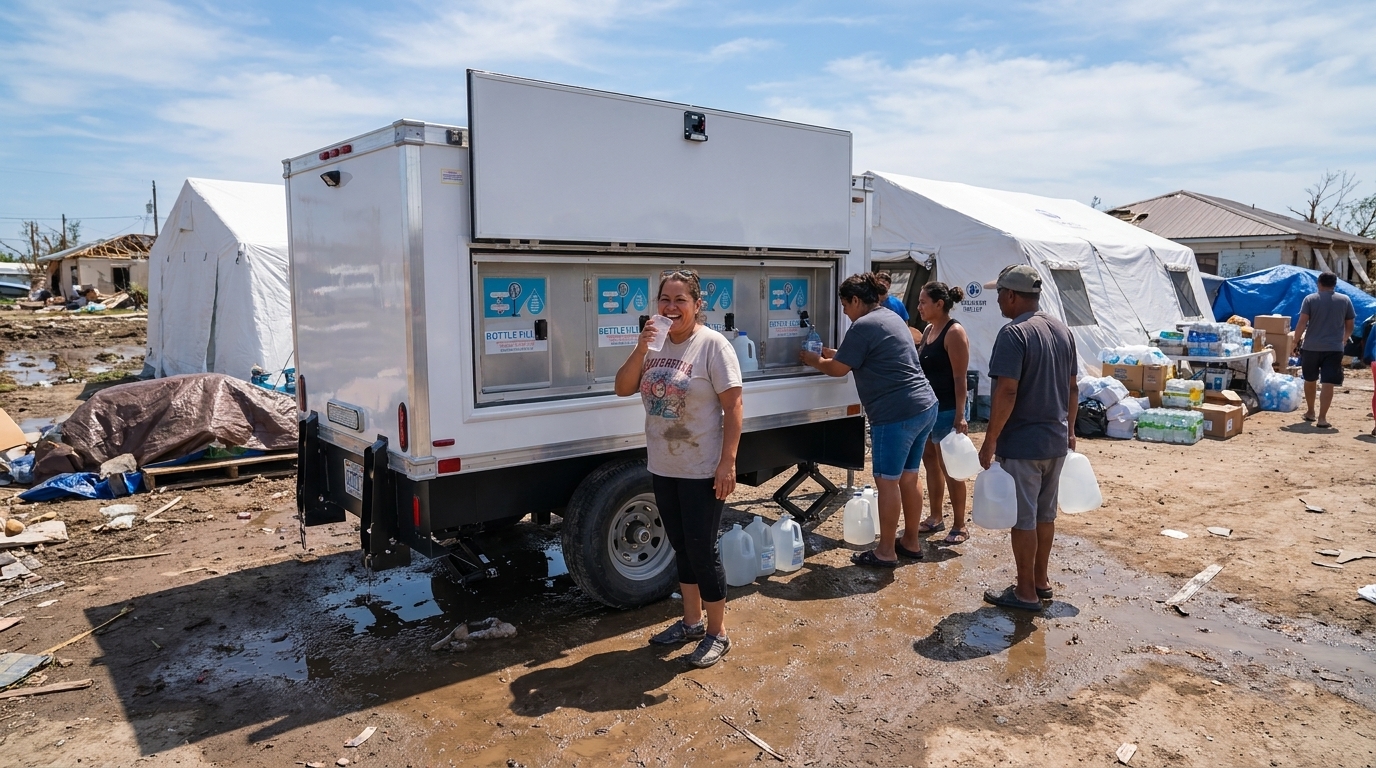
Want this math run for your own Atlanta job? Two minutes on the phone gets you a real number.
More ways Atlanta puts our stations to use
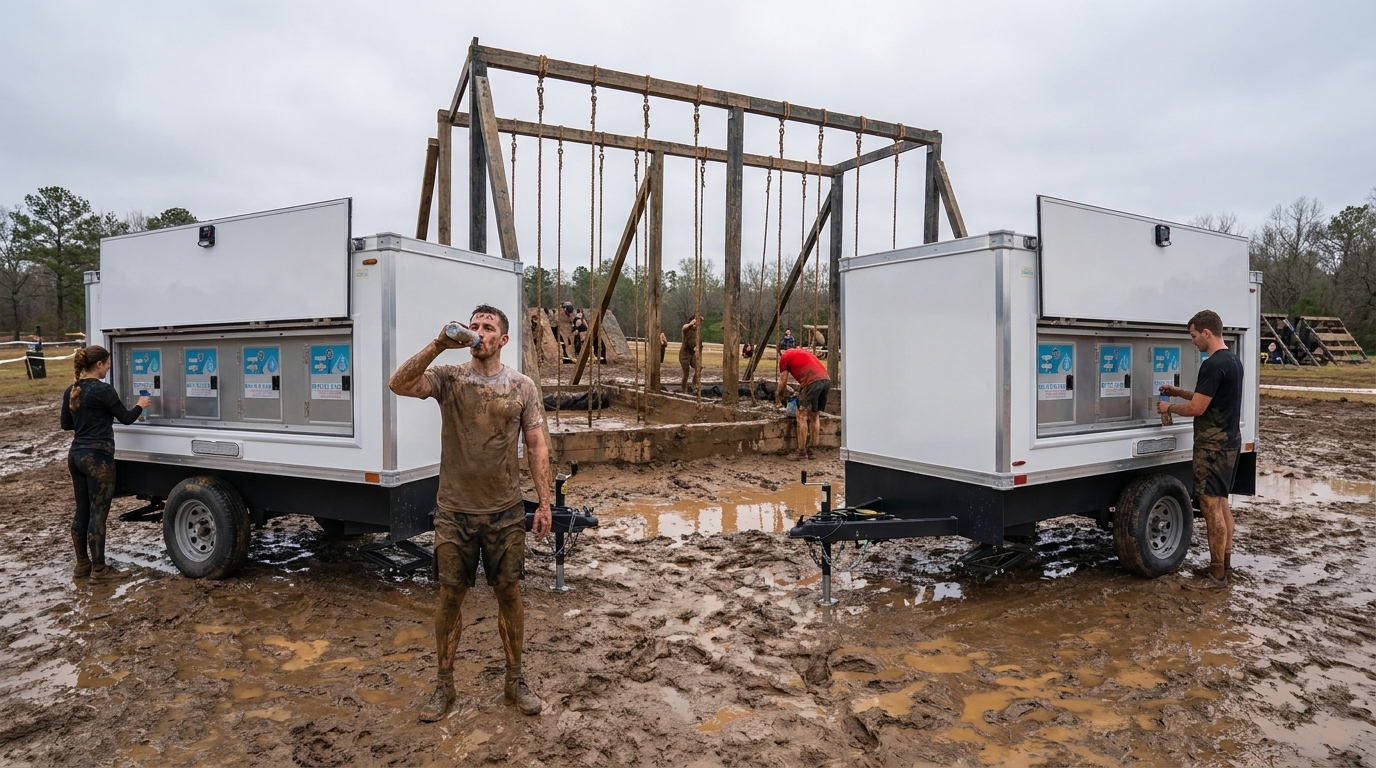
Races and festivals
Piedmont Park alone hosts Shaky Knees, ONE Musicfest, and the Peachtree Road Race finish. Refill stations at crowd nodes move faster than bottled water lines and cut the trash pull in half.
Film and TV productions
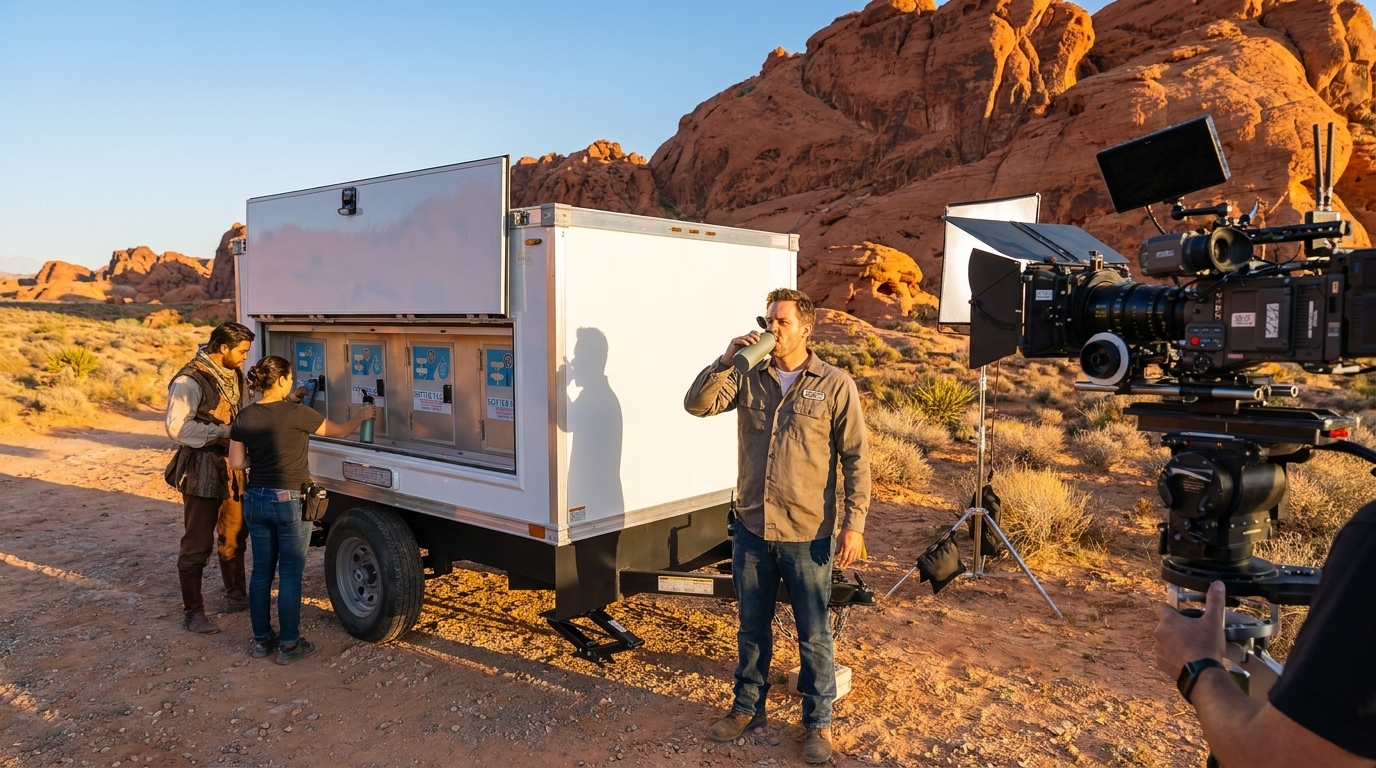
Trilith runs 32 soundstages south of town and Assembly Studios fills the old GM plant in Doraville. Basecamps and backlot days are off-grid by nature, and a towable chilled station fits right into the trailer line.
Warehouses and indoor facilities
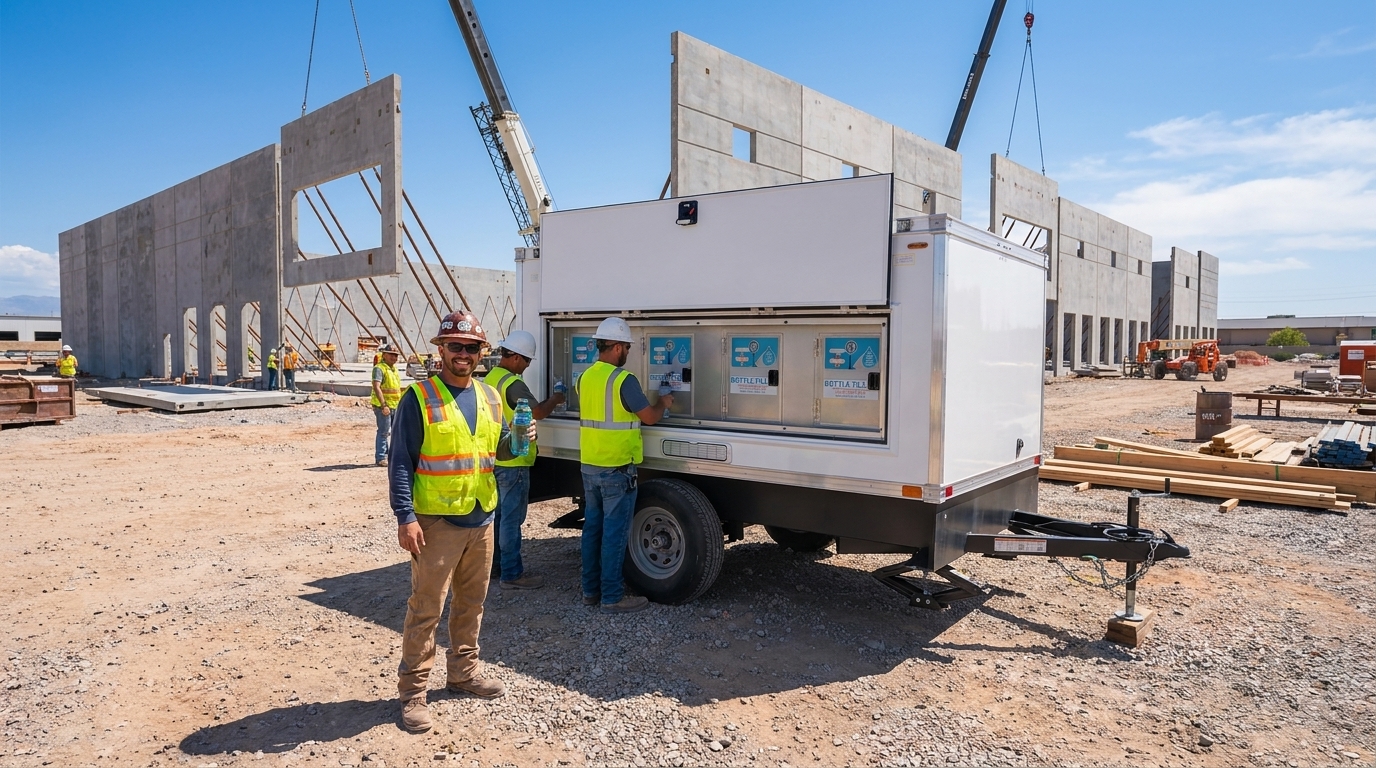
Our Legacy Series unit rolls through a standard facility door on caster wheels. Distribution centers along I-20 West and I-85 Northeast use it for dock and pick crews working hot aisles all summer.
Schools and campuses
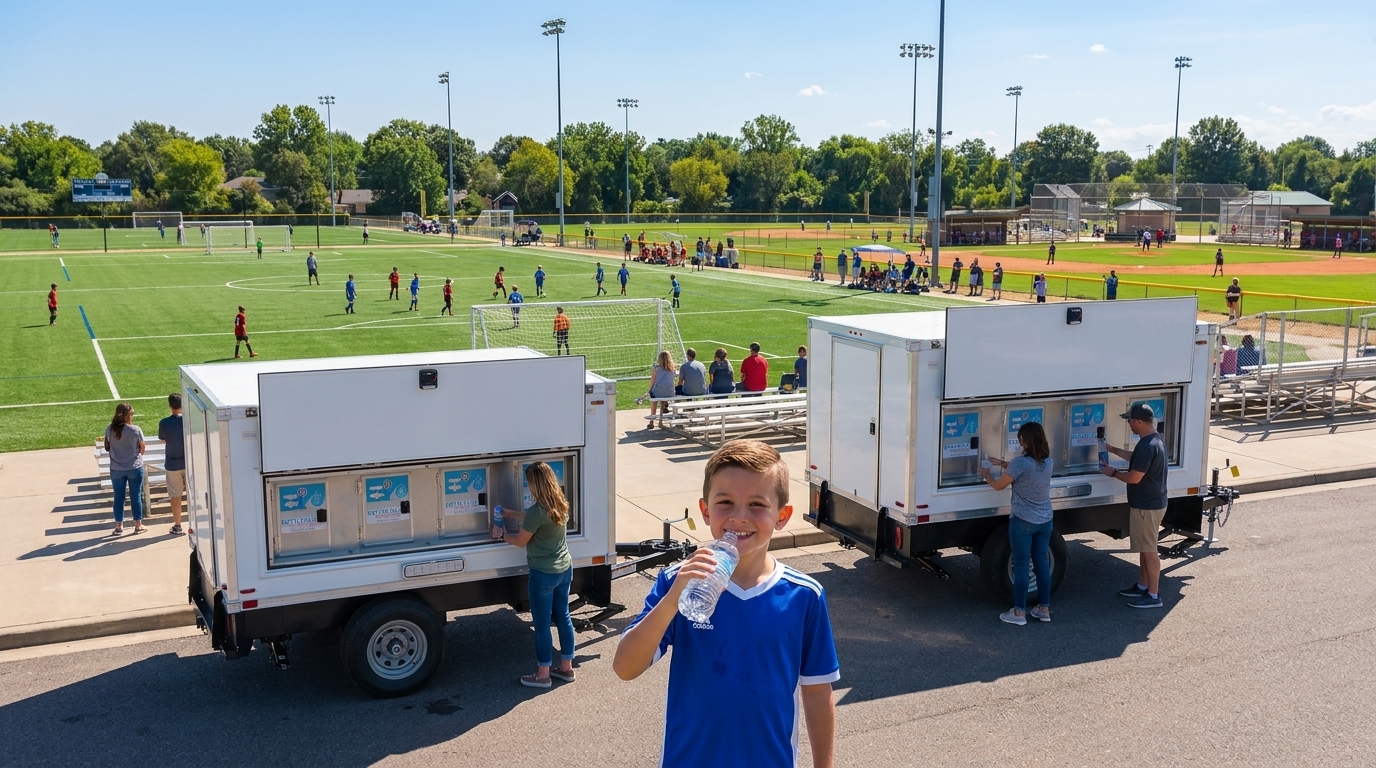
The filtration train includes a dedicated sub-micron polishing stage, which is the question every school facility manager asks first. Field days, summer programs, and campus construction all rent stations from us.
City water, pulled through three stages and a UV chamber, then chilled
A water source people don’t trust gets ignored, and an ignored station is rented money wasted. That’s why municipal water doesn’t reach the tap raw on our trailers. It passes through four filter stages and a UV chamber, then an onboard chiller drops the temperature. The result tastes clean and comes out cold, even on the worst Atlanta afternoon of the year.
Sediment stage
The opening filter traps sand, scale, and the fine grit local mains occasionally push through. On a dusty Atlanta lot, that’s what keeps a pour from tasting like the parcel it’s parked on.
Carbon stage
Activated carbon comes next, lifting the chlorine bite and the dull seasonal notes local tap can carry until the taste lands clean and neutral. When it’s 101 out, that flavor decides whether a crew keeps drinking or strolls past the spout dry.
Micro-particulate stage
A micro-particulate cartridge screens out the fine particles the earlier stages leave in, so every fill stays safe for the workers, the runners, and the event crowd topping off across Atlanta.
UV disinfection
The last step is an ultraviolet chamber that wipes out bacteria and microbes without adding a single chemical. Even after a long tow to the far edge of metro Atlanta, the water off the nozzle is clean.
Four ways to fill, and one of them is ADA
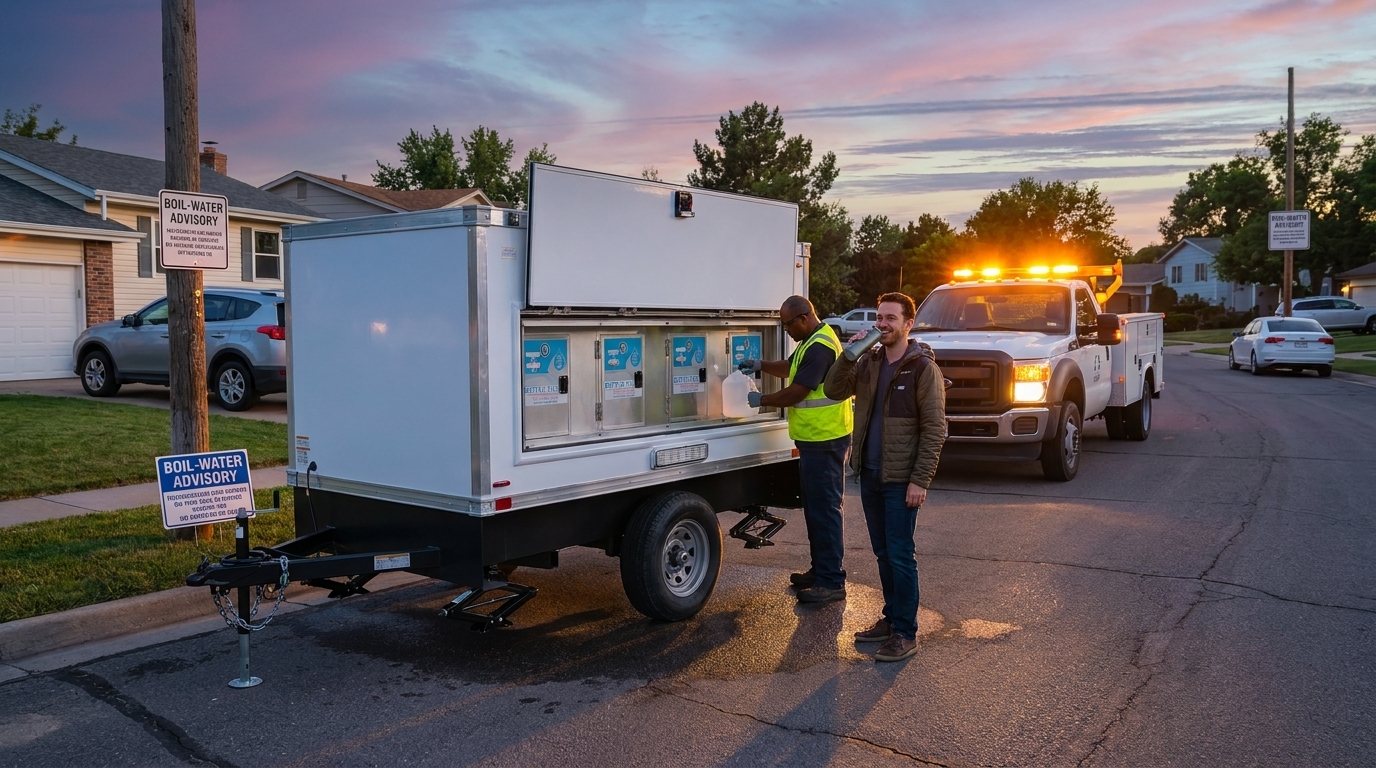
Along the wall sit four adjustable push-back spouts, press a bottle to the bar and it pours. One of them is set at ADA-reachable height, so a single trailer includes everybody at a Atlanta crew or crowd with no add-on gear. Out back, a large-jug spout services five-gallon coolers and hydration packs, while a bank of hose-bib taps handles work-site chores, event support, and refills down the orchard rows. Stainless, food-grade plumbing the whole way through keeps the filtered, chilled water at quality right to the spout.
Every Signature trailer carries a 300-gallon load, roughly 2,400 cups at sixteen ounces each, and we recharge it on demand, so the unit doesn’t turn into the choke point on a busy Atlanta shift or a packed show night.
We tow it in, fill it, wire it up, and it’s usually pouring cold inside the hour
There’s nothing here for you to run. Placement, fresh-water load, hookup, that’s all on us, and then we walk your Atlanta crew or event staff through the basics before our truck pulls away.
Tell us the basics
People count, number of days, where exactly it parks on your Atlanta site, and what power is there. Those four answers let us spec it correctly the first time around.
We come to you
Reckon roughly 45 minutes from our yard to anywhere in Atlanta or metro Atlanta, with round-the-clock emergency runs whenever a heat advisory or a power shutoff hits the area.
We make it pour
Once on site we set it level, charge the 300-gallon tank, and tie in power off one to three standard 120V circuits, or a single 50-amp 240V drop, depending on what the site gives us.
We keep it full
After that the tankers cycle back on a cadence matched to how fast your crew or crowd pulls it down, and we maintain the unit through the whole rental term.
No power on the parcel at all? We price that in. The unit draws very little, and with the service fleet backing it we’ve run Atlanta stations on lots that had no permanent power whatsoever. Lay out what the site offers and the rest is on us.
The rules that cover drinking water on Georgia sites
Georgia private-sector workplaces fall under federal OSHA, and the construction sanitation standard is blunt. Employers must provide an adequate supply of potable water, in containers that close tight and dispense through a tap. No dipping, no shared cups. Nonpotable outlets have to be labeled unsafe for drinking, and potable and nonpotable systems can never cross-connect. OSHA has also proposed a federal heat rule that would set specific water quantities per worker once heat triggers hit, and Georgia safety managers are writing their heat plans to it now rather than waiting.
Farm work has its own standard, and it is stricter than most people expect. Agricultural employers with 11 or more hand-labor workers must provide suitably cool drinking water in sufficient amounts, plus a toilet and handwashing station for every 20 workers, all within a quarter-mile walk of the work. The wage and hour inspectors who enforce it look at water temperature and access, not just presence. A chilled station that tows to the field edge answers the rule as written.
City of Atlanta sites have one more layer. Construction water from hydrants runs through rented meters from the Department of Watershed Management, and the city requires an inspected, permitted truck, an attached backflow preventer, monthly meter reads, and a six-month cap on the rental. None of that makes hydrant water a drinking supply. And with Georgia EPD declaring a statewide Level 1 drought response in April 2026, water sourcing on metro sites is getting more scrutiny, not less. A self-contained station with bulk potable delivery keeps your site clean on every count.
- Free, suitably cool, fresh potable water kept within easy reach of the work face
- Enough volume to meet the the federal OSHA general duty for heat illness yardstick of a quart per worker each hour
- A fixed, documentable hydration point your written heat plan can cite directly
- Support for worker acclimatization and the paid recovery breaks the rule mandates
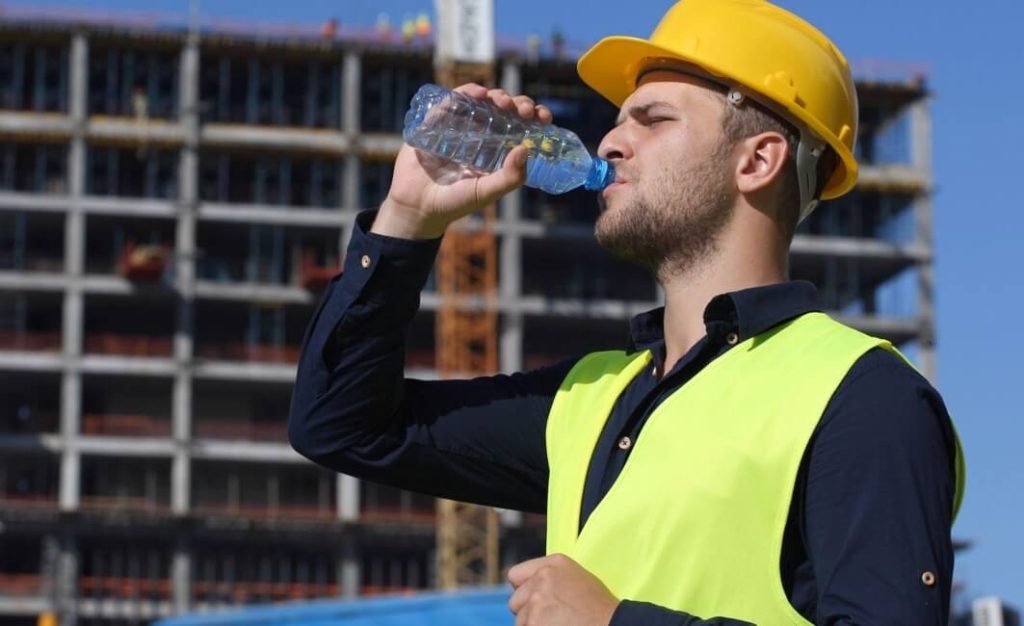
Need a station your written heat plan can point to? We can have one pouring cold within days.
A few things staging water around Atlanta has taught us
A lot of metro Atlanta jobs have shaped how we run the next one. A few that stuck with us:
Wholesale produce vendor, Atlanta State Farmers Market. A heat advisory landed in the middle of watermelon season, and his dock crew was going through bagged ice faster than the product. We set a trailer between two sheds on a Tuesday before sunrise, worked out a twice-weekly refill, and the ice runs stopped. His crew now treats the chilled stations as part of the market.
Concrete superintendent, Douglas County data center pad. Deck pours ran from March into August with crew counts swinging from 60 to 180 week to week. We rotated two trailers so a full one was always on the pad, and bumped refills to twice a week once the heat index crossed 100. When the owner’s safety audit asked for documented water access, he handed over our service log and moved on.
Hotel chief engineer, downtown Atlanta. The June 2024 boil water advisory hit his property on a sold-out weekend. He called Saturday morning, we staged a trailer at the loading dock by early afternoon, and his staff ran jug fills to the kitchen and floors until the advisory lifted five days later. His property now keeps us in its emergency plan, with a standing order that activates on one phone call.
Hydration support for terminal and pipeline work
Georgia has no refineries. What Atlanta has instead is one of the largest refined fuel hubs in the eastern United States. Colonial Pipeline runs its whole 5,500-mile system from headquarters in Alpharetta. The Austell terminal on the west side moves more than 30,000 barrels of fuel a day, and more than two-thirds of Georgia’s fuel comes through the Atlanta-area system. Out in Doraville, the Kinder Morgan tank farm holds over half a million barrels across 23 tanks, fed by both the Colonial and Plantation lines.
That much steel needs constant maintenance. Tank cleaning and inspection outages, coating work, terminal expansions, and integrity digs along the pipeline rights-of-way all put contractor crews inside fenced industrial sites where there is no potable water anywhere near the work face. The work is hot by nature. Flame-resistant clothing in an Atlanta August is its own heat load before anyone swings a tool.
We have learned how these sites run. Deliveries go through safety orientations and escorts. Placement stays clear of classified zones and truck lanes, usually just inside the gate where every crew passes it. The trailer needs only a couple of dedicated 120V circuits, or it pairs with a small generator on right-of-way work miles from the nearest outlet. The multiple hose-bib connections earn their keep on these jobs too, feeding wash stations and cooling gear alongside the drinking stations.
But the reason terminal contractors keep our number is what happened in 2021, when the Colonial ransomware shutdown emptied gas stations across the metro for days. Fuel companies here plan hard for disruptions now, and their contingency plans name their vendors. Being the on-site water station rentals company already inside the fence, already vetted, is worth more than any sales pitch we could write.
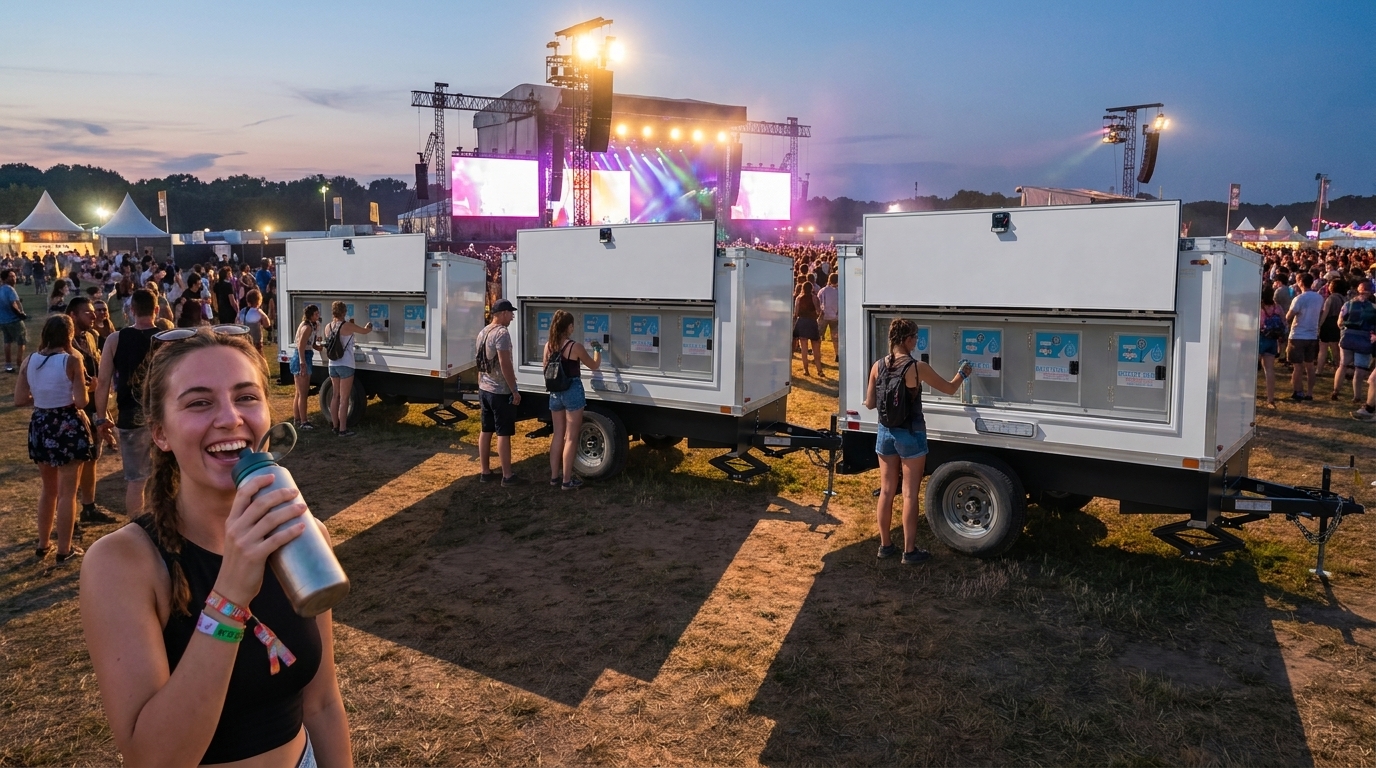
What Atlanta summers do to water demand
Atlanta heat is not desert heat. It is 94 degrees with a dew point in the 70s, which pushed the heat index to 105 to 110 during the advisories in late July 2026. The air does not dry out overnight either. Crews start the morning already sweating. By the 10 a.m. break, the coolers everyone filled at home are warm.
The event calendar leans into it anyway. The 2026 Peachtree Road Race sent more than 50,000 runners down Peachtree in temperatures that peaked in the mid 90s, with the first wave off at 6:50 a.m. specifically to beat the worst of it. September festivals still hit 90-degree afternoons. Even October weekends at Piedmont Park can run warm.
So demand for cold water here is not a June-to-August story. It stretches from the first 85-degree week in April to the last one in October, and every heat advisory in between turns a nice-to-have into the most-visited spot on the site. We watch the Peachtree City forecast office the way roofers do, and we stage extra units before advisory weekends, not after.
Nobody in the country is building like this metro right now. Centennial Yards is remaking the Gulch downtown, a five billion dollar district that opened hotels and the Cosm dome ahead of the World Cup and keeps going. At Hartsfield-Jackson, the 1.4 billion dollar Concourse D job is widening the concourse from 60 feet to nearly 100 using giant prefab modules, with three new gates opened in June 2026. The BeltLine’s Northeast Trail Segment 3 mobilized this summer on a 42-month schedule. Add the MARTA Rapid A-Line and the crane count speaks for itself.
Then there is the data center belt. Close to 4,000 megawatts of capacity was under construction across metro Atlanta at the peak, from the QTS campus on 615 acres in Fayetteville to Microsoft’s four-building site in Douglas County. Our water station rentals in Douglasville stay busy for the same reason, since DC BLOX and Flexential are both building there. These are tilt-wall shells going up on raw land, hundreds of trades on site, and no building water for months.
Here is the jobsite reality most people miss. A hydrant meter from the city fills a water truck for dust control and compaction. It does not make a drinking water source, and the city’s rules on backflow and permits back that up. So superintendents either stack pallets of bottled water in a conex, with all the ice runs and trash that come with it, or they put a filtered, chilled station by the gate and forget about it. A 50-worker crew burns through about 300 single-use bottles a day. Over a 200-day project that is 60,000 bottles that never get bought, hauled, or thrown away.
A decade of metro jobs has taught us how Atlanta builds actually go. Schedules slip when crews hit utilities nobody mapped, like the forgotten trolley tracks that surprised the MARTA A-Line contractor. Deployments run long, so we set monthly service plans instead of guessing. On big pour weeks we rotate two trailers so one is always full. And when the safety manager needs to show documented water access for a heat plan audit, the trailer and the service log are the proof.
Past the station: the trucks that keep a Atlanta site supplied
Everyone sees the trailer. What they don’t see is the support fleet behind it, the trucks that deliver fresh water, hold reserve on site, and carry wastewater off, so a single call wraps the entire loop rather than stringing together three vendors.
Potable water trucks
Our tankers run drinking-grade water in bulk, recharging the 300-gallon tank on whatever interval the headcount demands. Those same trucks also top up cisterns, holding tanks, and bladder bags whenever a single drop can’t keep pace, like a big slab pour or a downtown night that packs the square.
Bladder bags & buffer supply
When demand spikes we set out fold-flat bladders to bank extra fresh reserve, and on a drain-less lot they’ll temporarily hold greywater too. It isn’t fancy equipment, but it’s what keeps a far-flung metro Atlanta job pouring between tanker runs.
Pump trucks
Water that has to move across a job is a pump truck’s job, whether that’s charging holding tanks or shuttling supply end to end. It earns its keep on the sprawling parcels where the trailer and the fill point can end up a fair hike apart.
Vacuum & waste trucks
At the tail end, a vacuum truck draws off greywater and wastewater and carries it to permitted disposal, closing the loop clean. Nobody on your Atlanta crew is left guessing where the used water ended up. That piece was built into the plan from day one.
It all interlocks. A remote parcel might run a station plus a bladder bag for reserve and a recurring water-truck schedule. A heavy event night might call for a pump truck to move supply and a teardown waste run at the end. Describe the shape of your job and we’ll put together the right combination, on one invoice, handled by one crew that already knows the ground.
The handful of questions that turn a two-minute call into a real quote
A couple of minutes on the phone is enough to get you a real number. Here’s what we’ll want to know, handy to have ready before you call, and proof that we size every job to the work in front of us rather than reading off one canned quote.
The four answers that shape the recommendation
- How many people? Fifteen framers on a tract and a four-thousand-head concert are not the same problem. Your peak headcount, or gate count, drives how many trailers we stage and how aggressively the tankers cycle.
- How long? Two days at a park tournament, three weeks of footings, nine months on a master-planned build, each wants its own rhythm. Short jobs usually lean on staged reserve; long ones ride a standing tanker schedule.
- Where will it sit? Towable means the Signature tucks into a gated yard, bare dirt, an event lawn, or a skinny staging lane just as well. Hand us the exact spot plus the route our truck takes past the gate and any stored material, and we’ll land it on the natural foot-traffic path.
- What power is on site? The unit runs on as little as one and as many as three standard 120V circuits, or one 50-amp 240V drop. A lot of metro Atlanta parcels carry no permanent power, and that’s genuinely fine, provided you flag it before delivery day.
The smaller details that sharpen the plan
- Where on the site it should land, plus how a delivery truck reaches that spot
- Whether your people stay in one zone or spread across the full footprint
- Any heat-illness documentation your safety program needs the station to support
- Whether bulk hauls, bladder reserve, or a waste pickup should be bundled onto the job
Line items a pallet of bottled water keeps off your invoice
Bottled water reads as the budget choice on a purchase order. Its actual price tag is buried somewhere else, in handling hours, staging footprint, water that warms up, and trash piling up afterward, and on a hot inland lot each of those costs more than it would by the coast.
The labor nobody budgets for
Look at everything bottled water actually demands of a person: cutting the order, receiving and breaking down pallets, icing coolers before dawn, refilling through the day, then flattening empties for the bin. On a large Atlanta crew that’s hours of paid time burned every single day, scraped right off the work that’s supposed to be getting done. The trailer erases that loop entirely. A local contractor once let us pencil it out with him, and the recovered labor by itself paid for the unit. His words were that the bottle runs had been quietly costing him close to a day of payroll a week. Our trailer arrives full, the tankers keep it full, and your superintendent owes it nothing but a parking spot.
The warm-up problem
Ice a cooler at 6 a.m. and by mid-morning in a metro Atlanta July it’s pushing bathwater. Warm water is water people stop touching, and the slowdown that follows is precisely where heat illness gets its opening. A chilled station never rides that warm-up curve at all. Whatever pours at clock-out is as cold as the sunrise fill, which happens to be the moment a spent crew, or a crowd deep into a long concert, leans on it hardest.
The storage and footprint tax
Bottled-water pallets devour staging space, jam the lay-down area, and sit cooking in the sun until somebody finally cracks them open. Empties build up faster than anyone keeps up with, and on a tight commercial lot that pile turns into its own problem. Set a trailer in one parking stall instead and it serves a crew or crowd that would otherwise burn through hundreds of plastic bottles every day.
The waste that trails you
Every bottle bought is a bottle thrown out, and across a season a busy site or event generates a small mountain of them. That’s a disposal line on the budget, a dent in the sustainability numbers, and, given that a single bottle can linger in the ground for centuries, a footprint that outlives the project that made it. Move to a refill station and the line drops to zero, which finally gives your reporting a figure worth publishing.
How water needs change across the metro
We serve the full metro from our local hub, and we run water station rentals across Georgia through sister locations, so multi-site companies deal with one vendor statewide. If your site is anywhere inside the Perimeter or in the counties around it, we deliver.
Midtown
Buckhead
West Midtown
Vine City
Old Fourth Ward
Summerhill
Grant Park
East Atlanta
Decatur
Doraville
Chamblee
Tucker
Smyrna
Marietta
Sandy Springs
Alpharetta
Roswell
Austell
Douglasville
East Point
College Park
Hapeville
Forest Park
Downtown and South Downtown
Westside and Vine City
Doraville and Chamblee
The airport southside
Fayetteville and the south metro
Working a corridor instead of a single address? We follow the routes metro Atlanta runs on, so multi-site projects get the same fast turnaround as one stop.
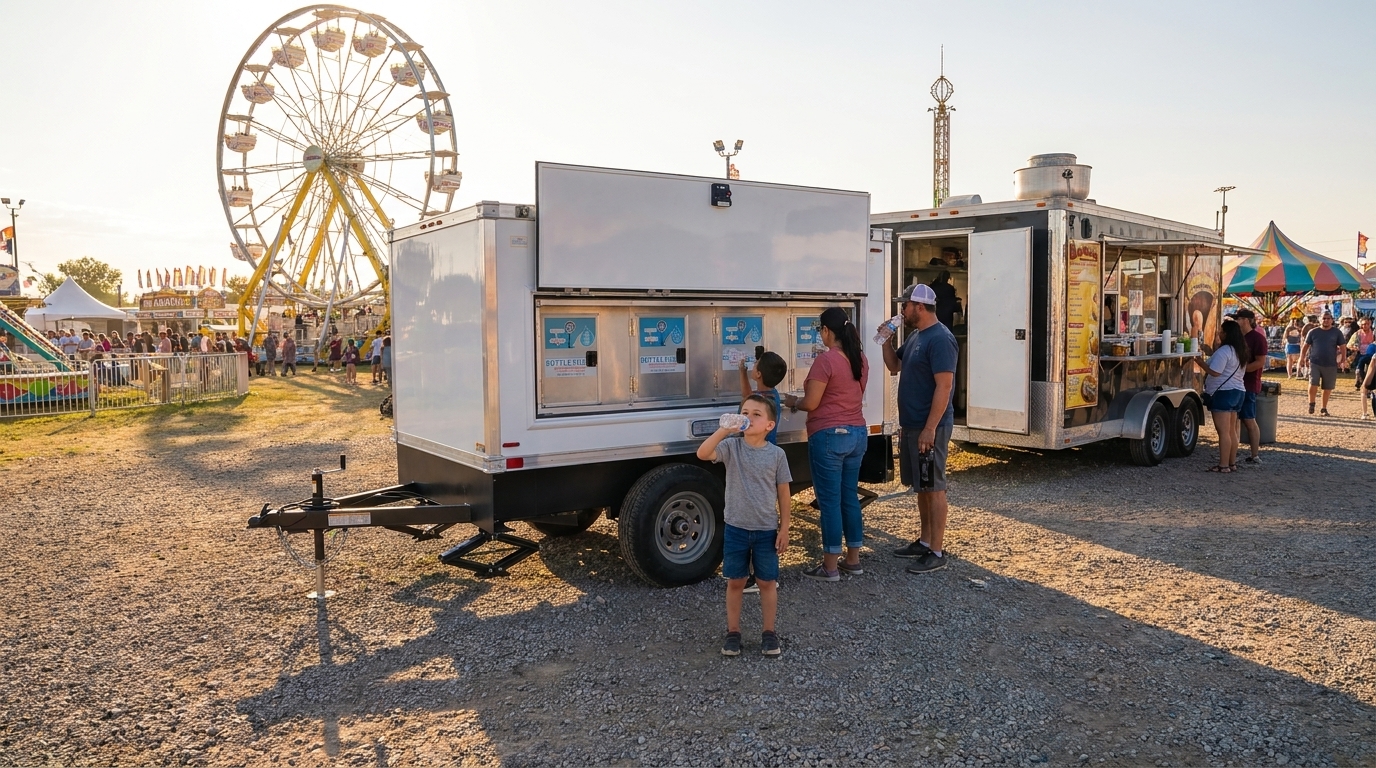
Still weighing it? Call and ask. Most of these questions get settled in one short conversation.
The questions metro Atlanta crews and event teams actually ask us
Can we keep the water trailer inside the fence on our jobsite overnight?
Yes, and we recommend it. Most Atlanta sites park the trailer just inside the gate where every crew passes it and the site’s own security covers it after hours. It tows behind a standard pickup, so your team can reposition it as phases move. For badge-controlled sites like the airport or fuel terminals, we coordinate placement with your security office at delivery.
Is the bottle filling station ADA accessible?
Yes. Every Signature Series trailer includes an ADA accessible bottle filling station, which matters for public events, government contracts, and any employer serious about access. Event planners and agency buyers ask us this constantly, and the answer is built into the unit rather than bolted on. If your permit or contract requires documentation, we provide it.
Where should water stations go at a big Atlanta festival so lines keep moving?
Spread them across crowd nodes instead of clustering them at one water point. Gates, the main stage bowl edge, and food rows are the three spots that work at Piedmont Park scale events. Each trailer has four push-button stations, so one unit clears a line far faster than a bottled water booth. We walk the site map with producers before load-in and place units where foot traffic actually flows, not where the map has spare room.
How often does the tank get topped off, and is that on us or you?
We do. Most rentals run on a set service route, weekly or twice weekly, with our own water truck topping off the tank with fresh potable water. Heavy-use sites get more frequent stops, and our drivers check levels rather than waiting for your call. You can always request an extra fill if a heat wave or a schedule change spikes demand. Nobody on your crew has to babysit a tank.
When does one trailer stop being enough for a crew working through an Atlanta July?
Watch two numbers, crew size and heat index. Once you have more than about 80 workers, or the heat index crosses 100 and everyone starts drinking harder, a second unit keeps walk time short and lines gone. Big pours and turnaround peaks are the classic moments. We can add a second trailer on days of notice and pull it when the peak passes, so size for the week you are in, not the whole job.
How does the trailer run on a site with no power or water hookups?
The tank carries 300 gallons of fresh water, so no water connection is ever needed. For power, the chiller runs on one to three dedicated 120V circuits or a single 50A/240V circuit. On raw land with no temporary power yet, we pair the trailer with a small generator, which is standard practice on data center pads and pipeline right-of-way jobs. It is a fully self-contained setup.
Do you handle long-term rentals that run through the winter?
Yes. Plenty of Atlanta deployments run a year or more, and our winter package protects the water system through the handful of hard freezes the metro gets. Long-term customers go on monthly service plans with scheduled refills and unit checks. If a project pauses for the season, we can pull the unit and redeliver in spring rather than billing through the gap.
Will we have any wastewater or drainage to deal with?
Very little. Bottle filling produces splash, not sewage, and the stations manage drips at the unit. If your site has strict containment rules, or you are running other trailers that generate greywater, our pumping and dumping service handles collection and permitted disposal as part of the same visit. One vendor closes the whole loop, fresh water in and wastewater out.
How fast can you deliver during a boil water advisory in Atlanta?
Same day is the goal and usually the reality. The 2024 main breaks taught this city that advisories can last five days and cover most of downtown, so we keep units ready to roll rather than fully committed. Call as soon as the advisory hits, because hotels, clinics, and restaurants all reach for the phone the same hour. Standing emergency agreements get first priority, and several downtown properties now hold one.
Does the filtered water count as potable water under OSHA rules?
Yes. We fill every tank from approved potable sources, and the onboard system then runs the water through sediment, carbon, micro-particulate, and UV stages in a food-grade stainless setup. That meets the construction sanitation standard’s requirements for potable supply, closed containers, and tap dispensing. Your safety manager also gets a documented sourcing trail, which is what auditors actually ask for.
Can the indoor Legacy unit really work inside a warehouse or school?
That is exactly what it is for. The Legacy Series rolls through a standard doorway on caster wheels, levels on jacks, and cools itself with a rooftop AC unit. Distribution centers along the I-20 and I-85 corridors use it for summer dock crews, and schools like it because the filtration includes a dedicated sub-micron polishing stage. Same cold, filtered water as the trailer, no road chassis.
Atlanta water planning guides
Sizing Site Water for an Atlanta Summer: The Math We Actually Use
Every summer we get the same call from a new superintendent. The crew is bigger than expected, the heat came early, and the bottled water budget is already blown. The fix is not more pallets of bottles. It is doing the water math once, in April, the way you would do concrete math. Here is the version we use for Atlanta jobs, with real numbers you can hand your safety manager.
Start with the federal benchmark. OSHA’s proposed heat rule uses one quart per worker per hour once heat triggers are met, and that figure has been the industry rule of thumb for years. It sounds like a lot until you watch an ironworker in August. A 40-person crew on a 10-hour day at a quart an hour needs 100 gallons. An 80-person crew needs 200. Simple so far.
OSHA heat injury and illness rulemaking · NWS Peachtree City forecast office
Planning Drinking Water for a Piedmont Park Festival or Race
Piedmont Park hosts a festival calendar that most cities would kill for. Shaky Knees in September, ONE Musicfest in October, the Peachtree Road Race finish every July 4, plus jazz festivals, food festivals, and charity runs all season. And the park’s fixed drinking fountains were never designed for 50,000 people on a lawn. If you are producing an event there, water is a line on your permit and a real operational plan. Here is what years of park load-ins have taught us.
First, know your permit chain. Street events and races run through the city’s special events office, park events through the parks department, and anything with food service touches the county health department. Water access questions show up in all three. Having your water vendor, station count, and refill plan on paper before the walkthrough makes those reviews short.
CDC extreme heat guidance · City of Atlanta permits and events
Before the Next Boil Water Advisory: Questions Atlanta Facility Managers Should Ask Now
At 8 a.m. on May 31, 2024, a transmission main let go in Vine City. By 2 p.m. the city had issued a boil water advisory. Downtown lost pressure, hotels and hospitals scrambled, and the advisory held until June 6, five days later, under a state of emergency. Every facility manager in Atlanta remembers that week. The useful question is not whether it happens again on some timeline. Parts of this water system date to the early 1900s, and Georgia Tech had its own campus main break just six months earlier. The useful question is what your building does in the first four hours.
Start by asking what your operation actually uses drinking water for, hour by hour. A hotel needs guest water, kitchen prep water, and coffee service. A clinic needs handwash and patient care supply. An office tower mostly needs bottle filling and food service. Write down the gallons honestly. Most buildings discover they need far less emergency drinking water than they feared, but they need it fast and they need it in a usable form.
EPA emergency drinking water guidance · Atlanta Department of Watershed Management
What Actually Changes the Quote on an Atlanta Water Station Rental
Nobody likes a mystery quote. So here is the honest list of what moves the number on a water station rental in this metro, in rough order of how much it matters. None of this requires a sales call to understand, and knowing it ahead of time lets you shape the rental to your budget before you ever ask for the number.
Rental length matters most, and it works in your favor. A single festival weekend and a 14-month deployment on a data center pad are different products. Long-term rentals shift to monthly service plans, and the per-month cost of a year-long rental sits well below a string of short rentals. If your project schedule is honest with itself, quote the real duration up front instead of extending month to month.
Georgia Environmental Protection Division · OSHA construction sanitation standard
What customers around Atlanta say
“Cleanest water setup I’ve worked around at a festival this size. Fifty thousand people over a weekend and the stations stayed spotless and cold. I’ve seen a lot of vendors cut corners out here. They don’t.”

“The driver called ahead with an exact arrival time, walked me through the whole unit, and answered every question without rushing. We used it for a campus event and then kept it an extra month for our engineering crew. Very pleased with this company.”

“The build quality surprised me. Stainless everywhere, well kept, and the water is genuinely cold even on a 95-degree shoot day. It looked right at home in a trailer line full of expensive equipment. Crew drained it daily.”

“On time, professional, and the nicest units I’ve had on a pad. Refills happened before we ever ran dry.”

“Great experience with this company. The driver set the trailer right on our field edge and showed the whole crew how the jug fill worked. During cutting season that thing earned its keep every single day. Good people to work with.”

“Two refills a week, never missed one.”

“Really clean and nicer than I expected. They bring it right to our spot at the market and the dock guys use it constantly in summer. We will absolutely rent again next season.”

“We ran a three-day baseball tournament in June heat and the station was the busiest spot at the complex. Delivery was prompt, pickup was easy, and the staff was friendly the whole way. Highly recommend.”

“During the water outage they answered on the first call and kept us updated until the trailer arrived. Great communication from start to finish. They cover the whole metro and it shows in how fast they moved for us.”

Service information current as of July 2026.
Lock in cold, filtered water for your Atlanta site or event before the next hot stretch
Tell us the headcount or the gate count, the rental dates, and where the trailer should park, and we’ll spec the right setup and roll one out to you anywhere in metro Atlanta, usually inside about 45 minutes of dispatch.