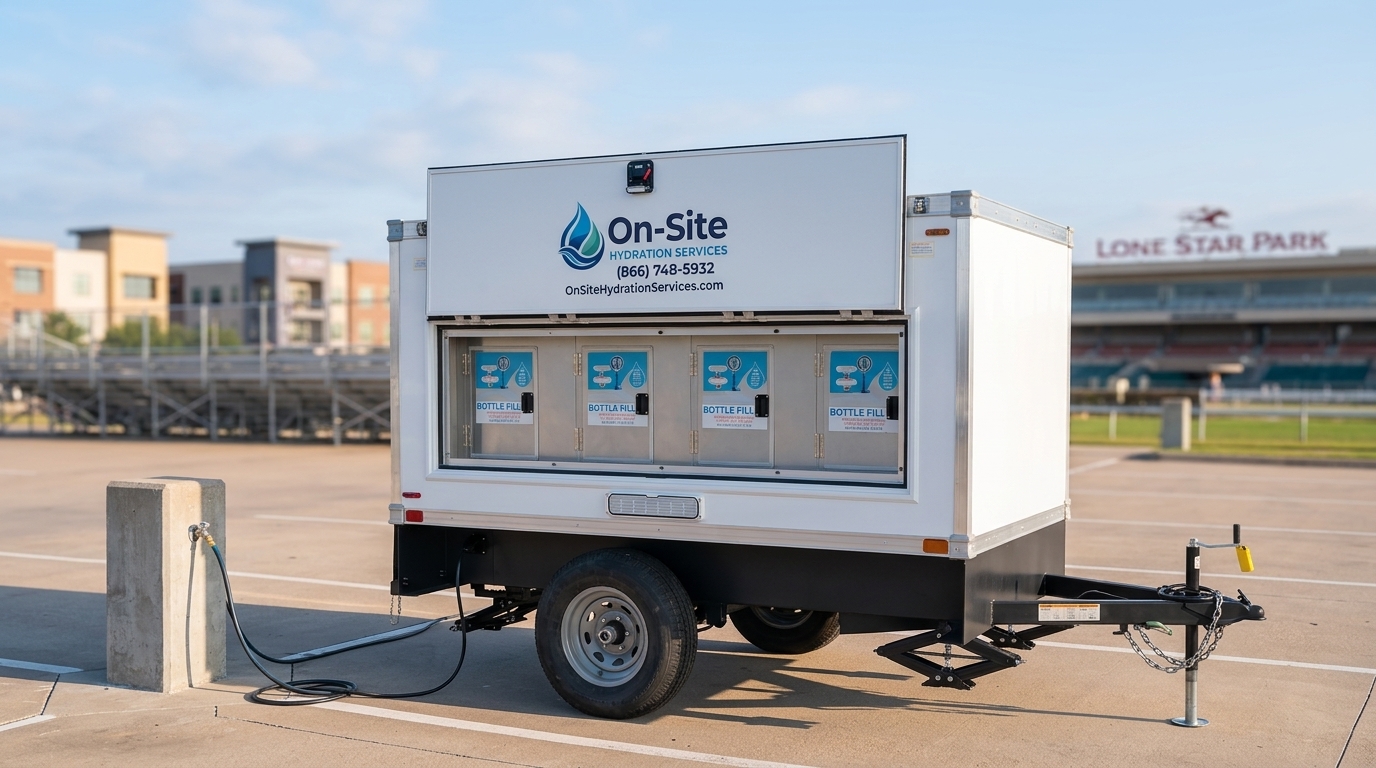
On-Site Hydration Services is the first call for cold filtered water station rentals in Grand Prairie, Texas. We tow the Signature Series trailer in, level it, wire it up, and leave it pouring cold water the same day. It works on a Belt Line Road warehouse pad, on a plant yard off State Highway 161, and on a race day crowd at Lone Star Park. Call now and we will hold a unit for your dates, or request a free quote and we will size the job with you today.
See the Signature Series water station specs
Crews working out in the open get held to a tighter water setup than anybody working indoors, and that is the job we built this service around. Out on open ground there is no break room. What a crew has is whatever came in the truck at six in the morning, and by ten it is bath warm. So we set the station close to the work. We keep it clean and keep it genuinely cold. Park it 300 feet off in open sun and the tank stays full while somebody gets sick. Years of drops on Grand Prairie ground taught us where that line sits, right down to which gate apron still holds a loaded trailer after a storm. You get a service ticket on every stop, so there is a written record of when the water was checked and topped, which is the part crews scramble for after an incident. We handle portable water station rentals in Austin the same way. We are SAM.gov registered, licensed and insured, part of an A plus BBB rated network with a 99.9 percent incident free record. Call now, or request a free quote and we will confirm your dates today.
One Signature trailer can pour for a weekend concert and be working a slab pour a couple of days later. Hiring one company for your events and a separate one for your worksites makes no sense. Either way, the planning, the delivery, and the refills are ours.
The onboard cooling unit keeps the tank genuinely cold all the way through a Grand Prairie afternoon, and that single detail carries the whole thing. Warm water is water people abandon, and midsummer is exactly when a crew or a crowd is drinking the most. Cold water gets finished, and finishing it is what keeps heat illness off the site.
Typical Grand Prairie deliveries land in about 45 minutes, and we keep emergency runs going around the clock whenever a heat advisory or a power shutoff hits the Mid-Cities. The morning a foreman finds his 40-person crew stuck with one warm cooler, speed is the whole game.
One rule sits under every job we take: water that people walk past might as well not be there. We've stood on a bare Grand Prairie site and watched shrink-wrapped pallets cook next to the job-trailer while the crew baked thirty yards off. We've watched the opposite too, a chilled station ten steps off the work face run bone-dry twice inside one shift. Everything that matters lives in the distance between those two pictures. Which is why we don't drop a unit and disappear. We match it to your headcount or your gate count, set the refill rhythm to how hard you're really pulling on it, and treat a heat call the way you'd want your own treated, meaning right now, because out here one hot hour can swing the whole day.
We cover both halves of this city in one day. Grand Prairie really has two delivery patterns sitting inside the same 81 square miles. A job site or plant yard on Belt Line Road wants a unit in place before a six in the morning crew start. A downtown festival or an EpicCentral event wants one mid afternoon before gates open. We build the route around both instead of making you take whichever slot is left.
“I needed documented water access for a written heat plan, not a pallet of bottles nobody tracks. The service tickets made my audit painless. My dock crew likes it cold better than warm cases too.”
“They walked the pad before quoting and put the station where my framing crews already walk past it on the way to the gang box. Sounds like a small thing. It is the reason the unit actually gets used instead of ignored in a corner.”
“We were chasing outages for four days straight and the tap water in half those neighborhoods was under a notice. Having our own filtered source at the staging yard took one whole problem off my list.”
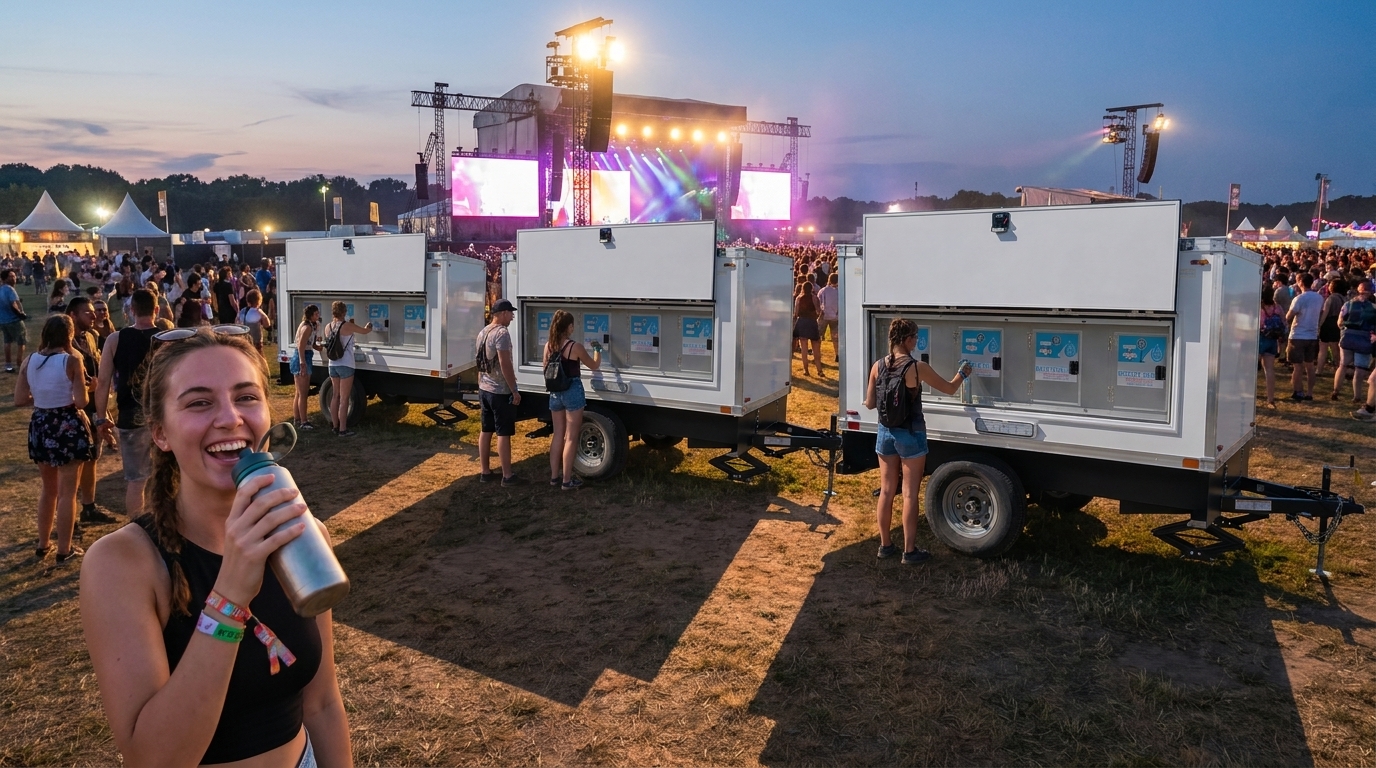
This is the civic core, where the festival parade route and City Hall events happen. Street placements downtown mean a closure map conversation rather than a parking conversation, and most drops go into a private lot or a lot apron instead of the curb.
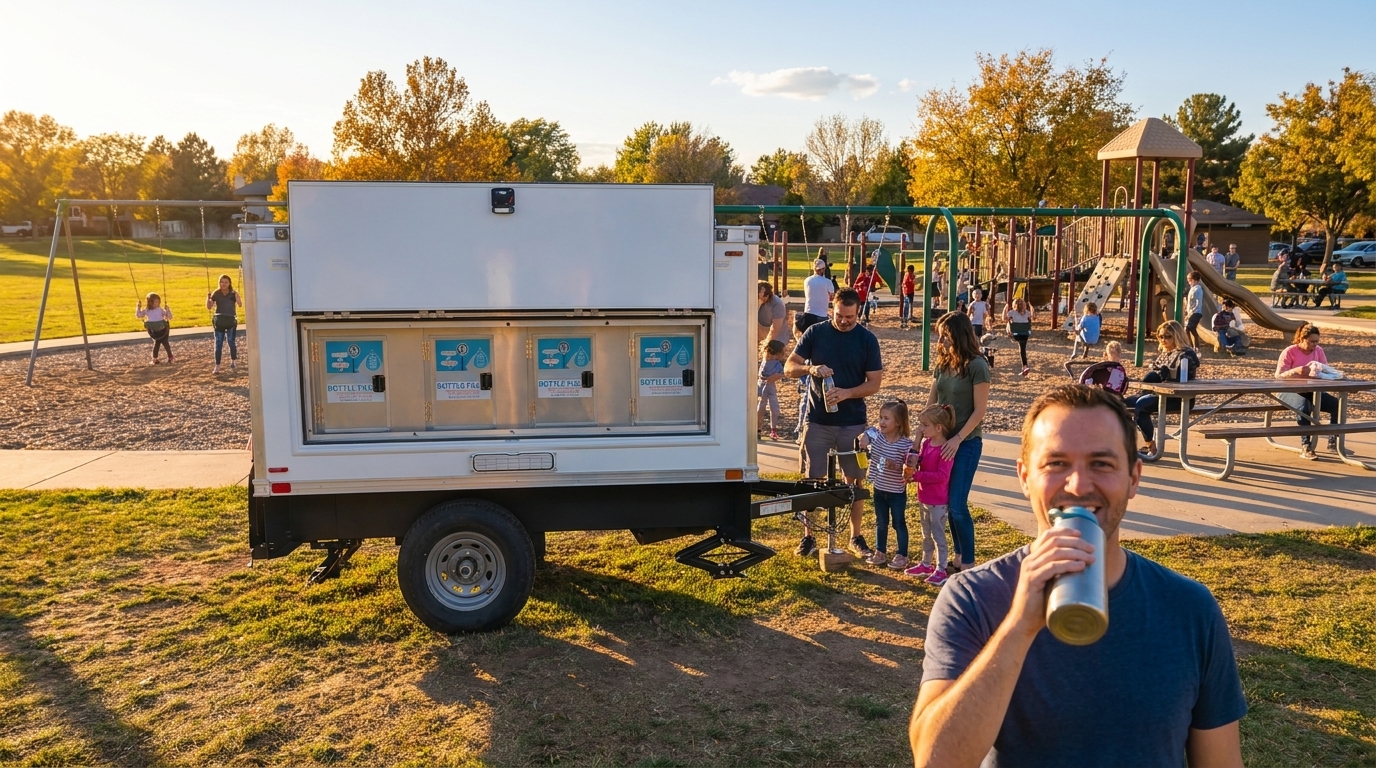
Lone Star Park, Epic Waters at 2970 Epic Place and the Texas Trust CU Theatre at 1001 Performance Place sit together in one entertainment district. Placement here is about credentials and load in windows, and the answer changes on an event day versus a Tuesday.
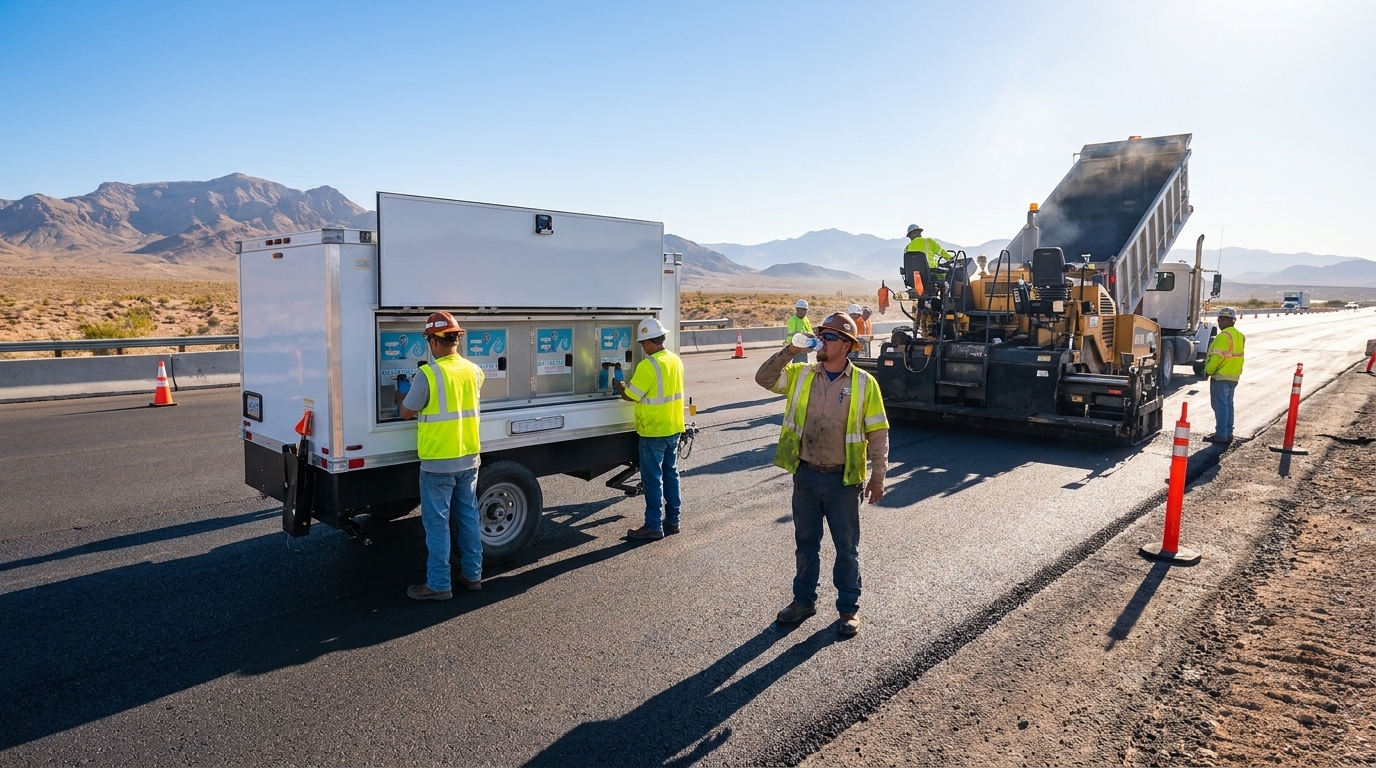
Belt Line Road runs the spine of this district, and the aprons are wide enough to park properly, which is rare. Units here tend to sit for months on a plant or warehouse account rather than a few days.
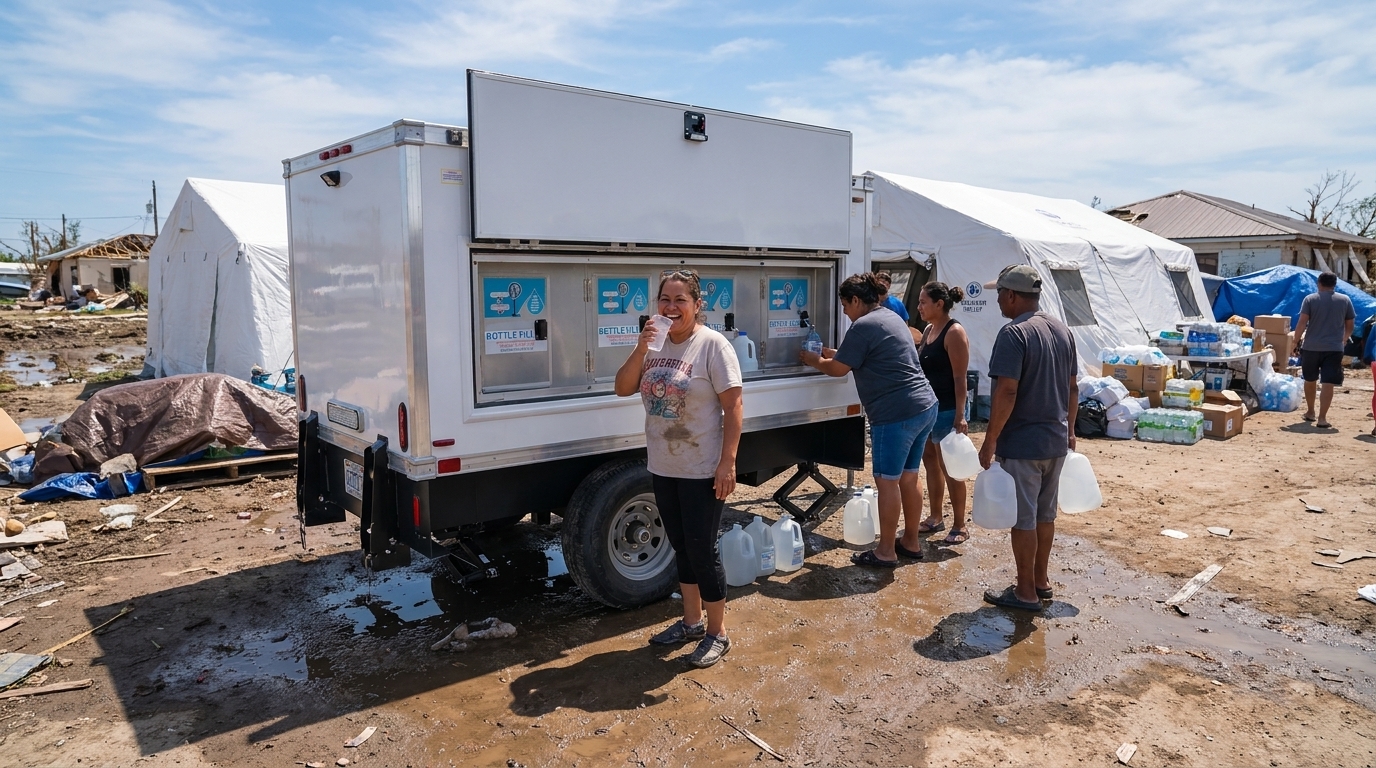
Fulfillment and distribution sites line this stretch, including the Amazon center at 1102 State Highway 161. Deliveries here get scheduled around gate traffic and trailer queues, so we aim for the window before the shift change.
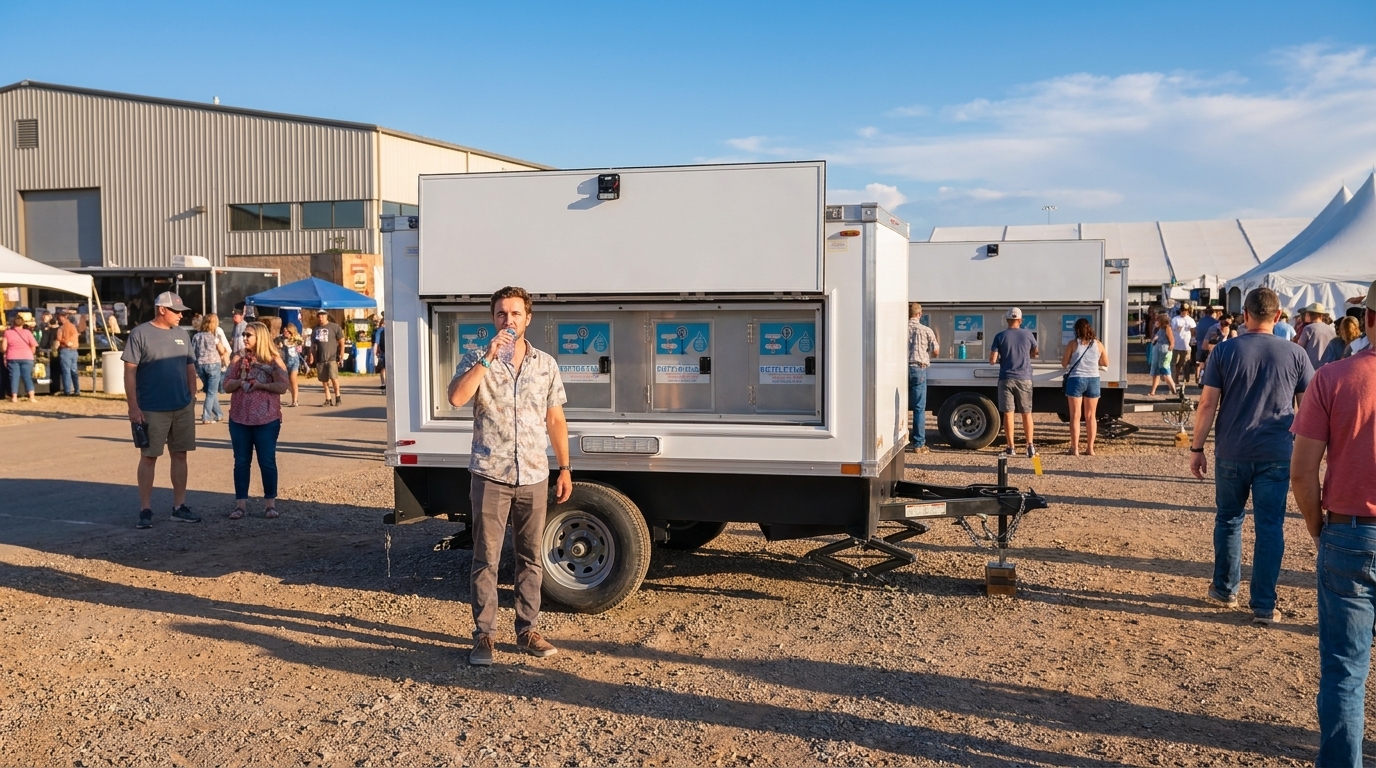
Lakeside placements sit far from any permanent tap and often on turf or gravel rather than pavement. We check the ground after rain before committing to a spot, because a soft shoulder by the water is a tow truck waiting to happen.
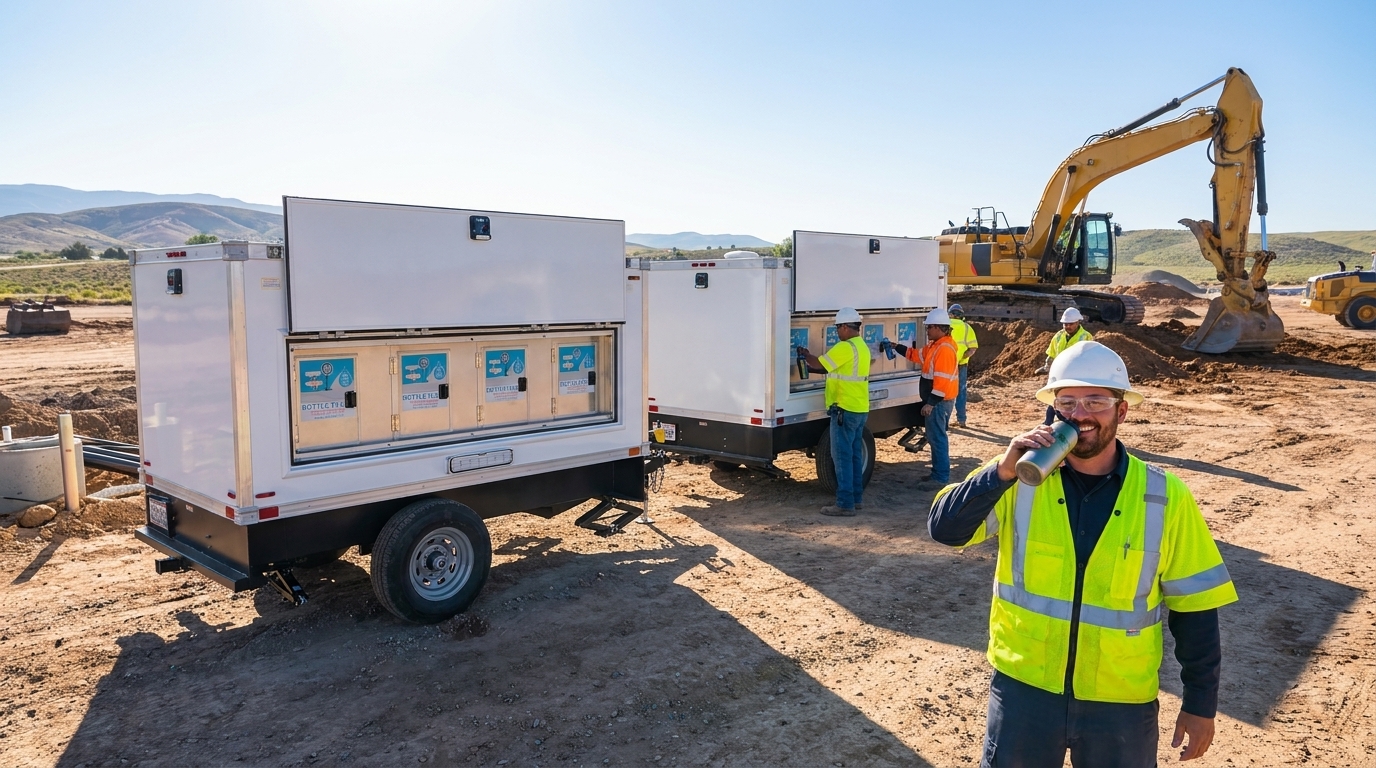
New housing keeps pushing south, with roughly 850 built units at Goodland and more than a thousand lots still to come. Site work crews out here are on raw dirt with no power and no shade, so most of these placements ship with a generator.
Few projects put as many trades on one pad as a data center build, and few run as long. Our stations serve the Mid-Cities sites with cold filtered water, ground protection where the site demands it, and a tanker schedule that follows the headcount as electricians and pipe crews stack up toward commissioning. Night pours and weekend shifts are covered too, because those campuses do not keep office hours.
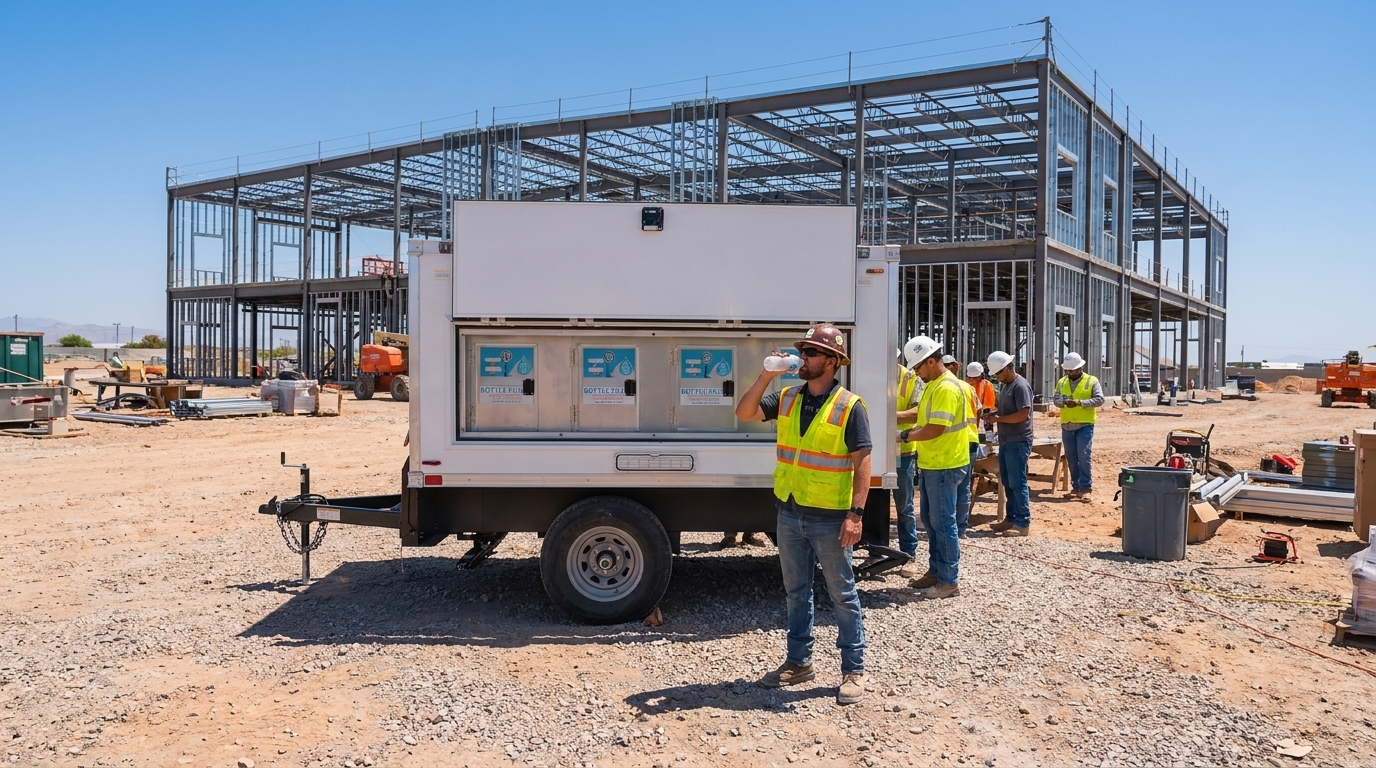
Grand Prairie sits in humid air, so sweat does not evaporate the way it does out west and people cook inside their own shirts. A unit placed here gets a tighter top off schedule than the same trailer would need in dry heat, and we set that schedule before it leaves our yard.
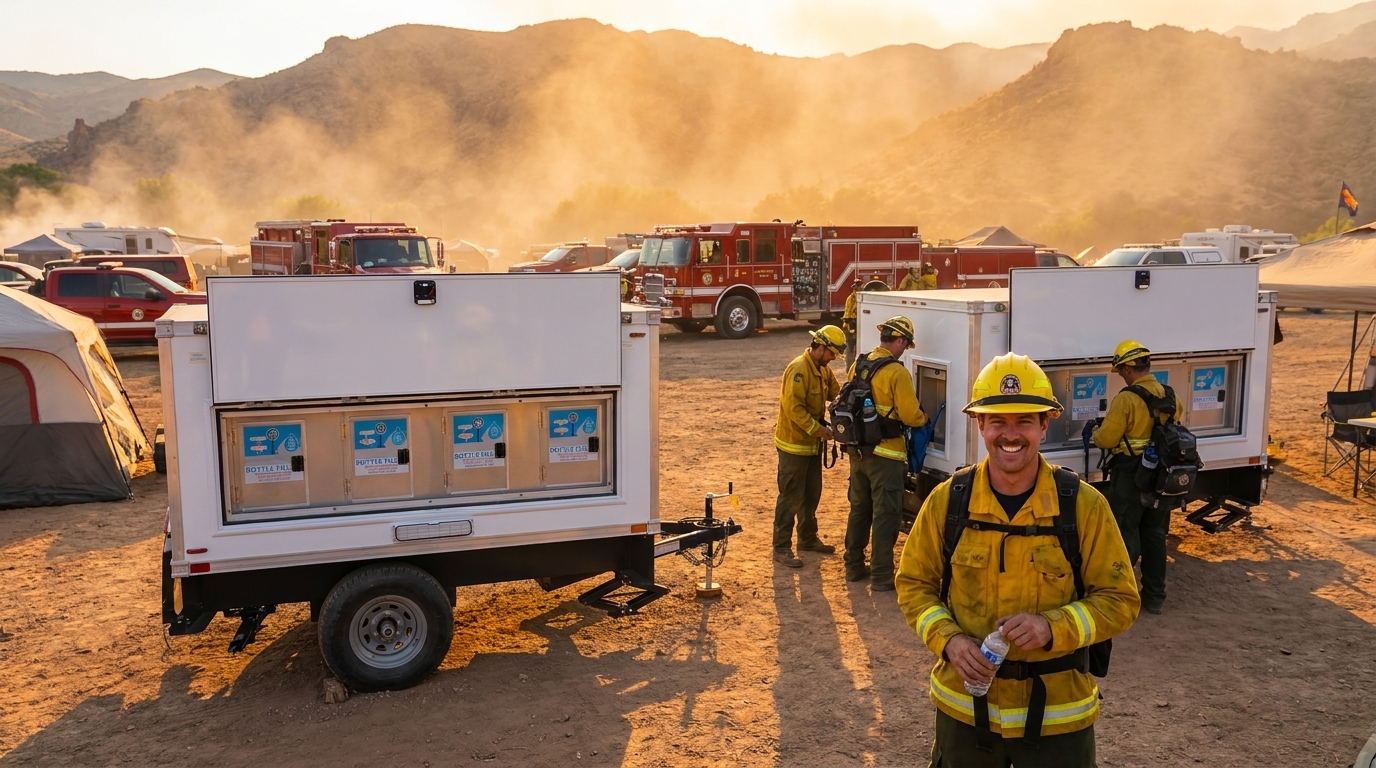
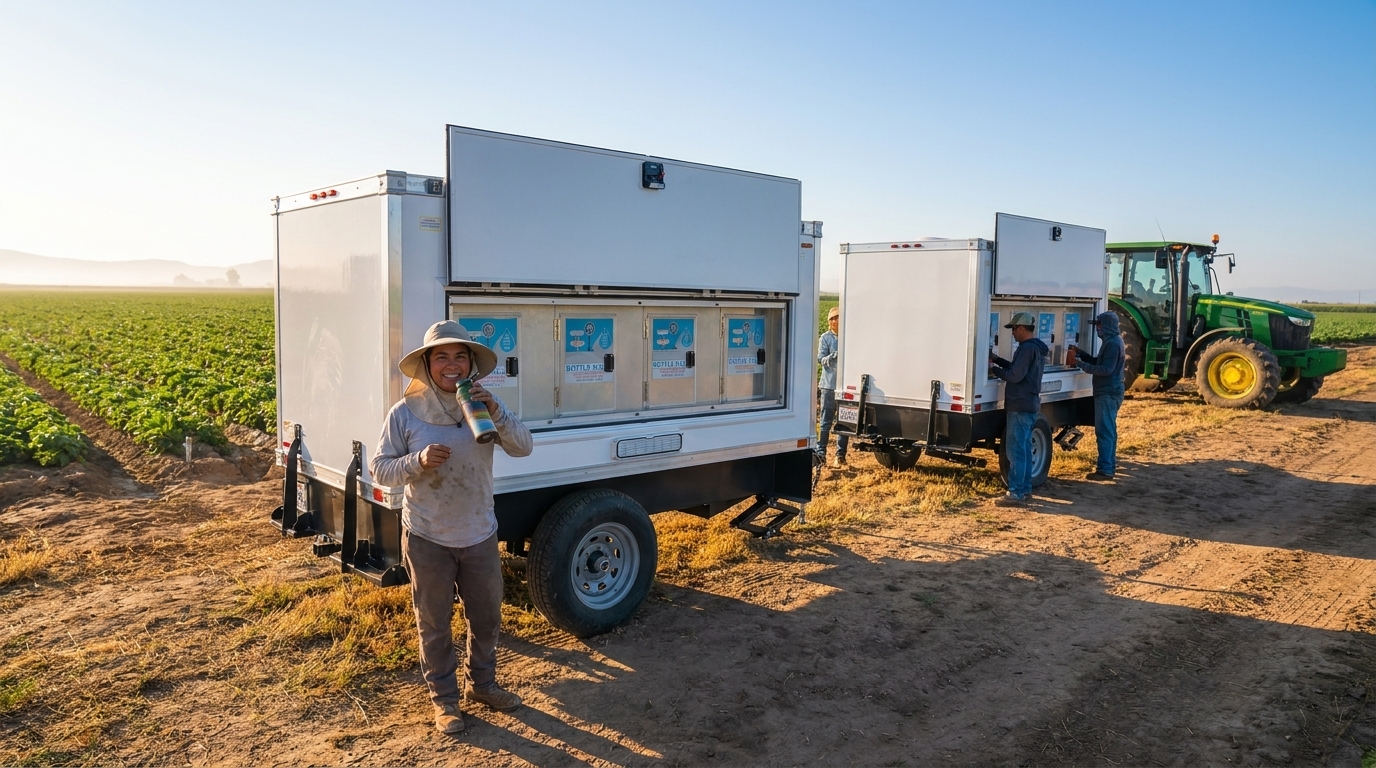
With a frame, a hitch, and tires under it, the unit hauls out to a remote build in the Mid-Cities, an event field, a working orchard, or a disaster staging yard with equal ease. Grand Prairie contractors and event planners request this exact rig by name. The whole design is built around backing in, leveling off, and pouring cold by the same afternoon.
| No. of stations | (4) Bottle Filling Stations |
| Length | 12' 3" |
| Weight | 3,100 lbs. |
| Height | 8' |
| Fresh water tank | 300 Gallons |
| Power requirements | 1 to 4 dedicated 20A/120V circuits OR 1 dedicated 50A/240V circuit |
| No. of AC units | 1 |
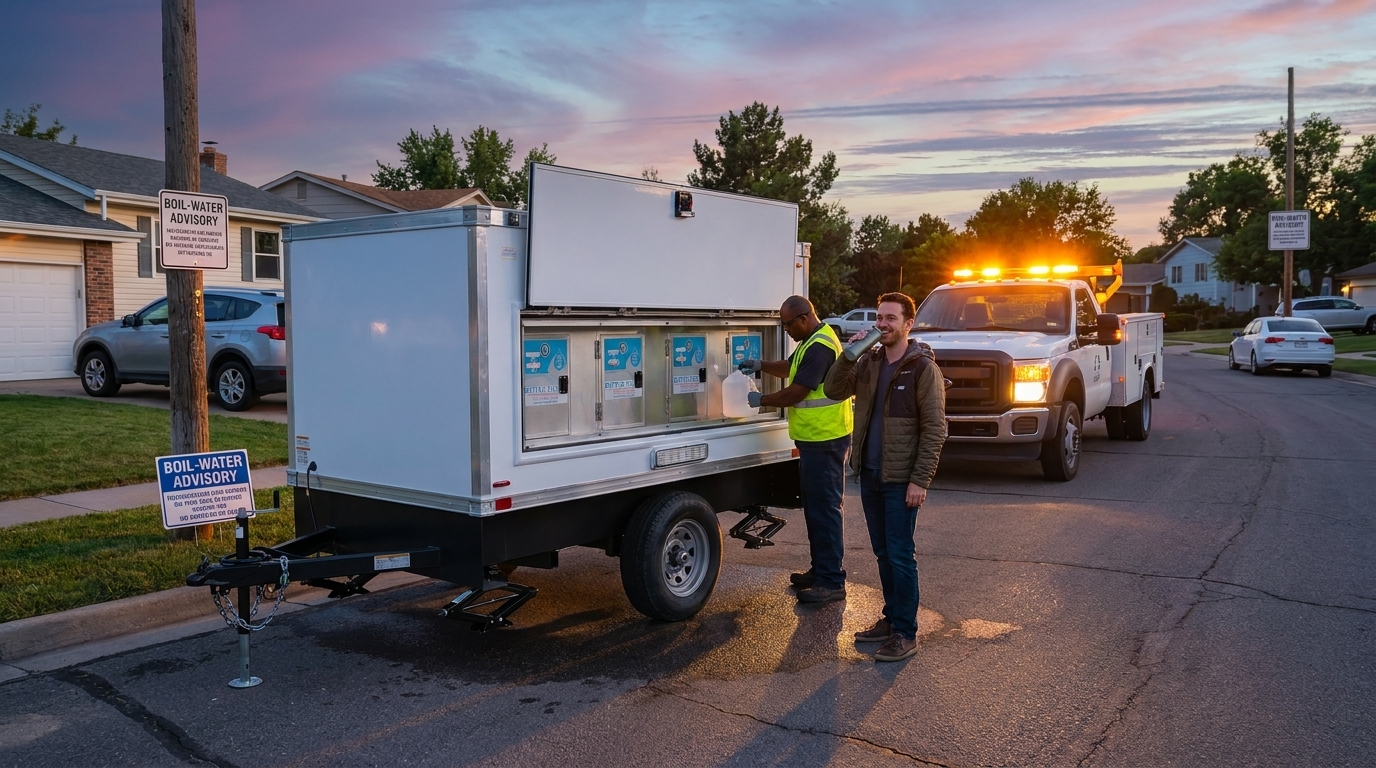
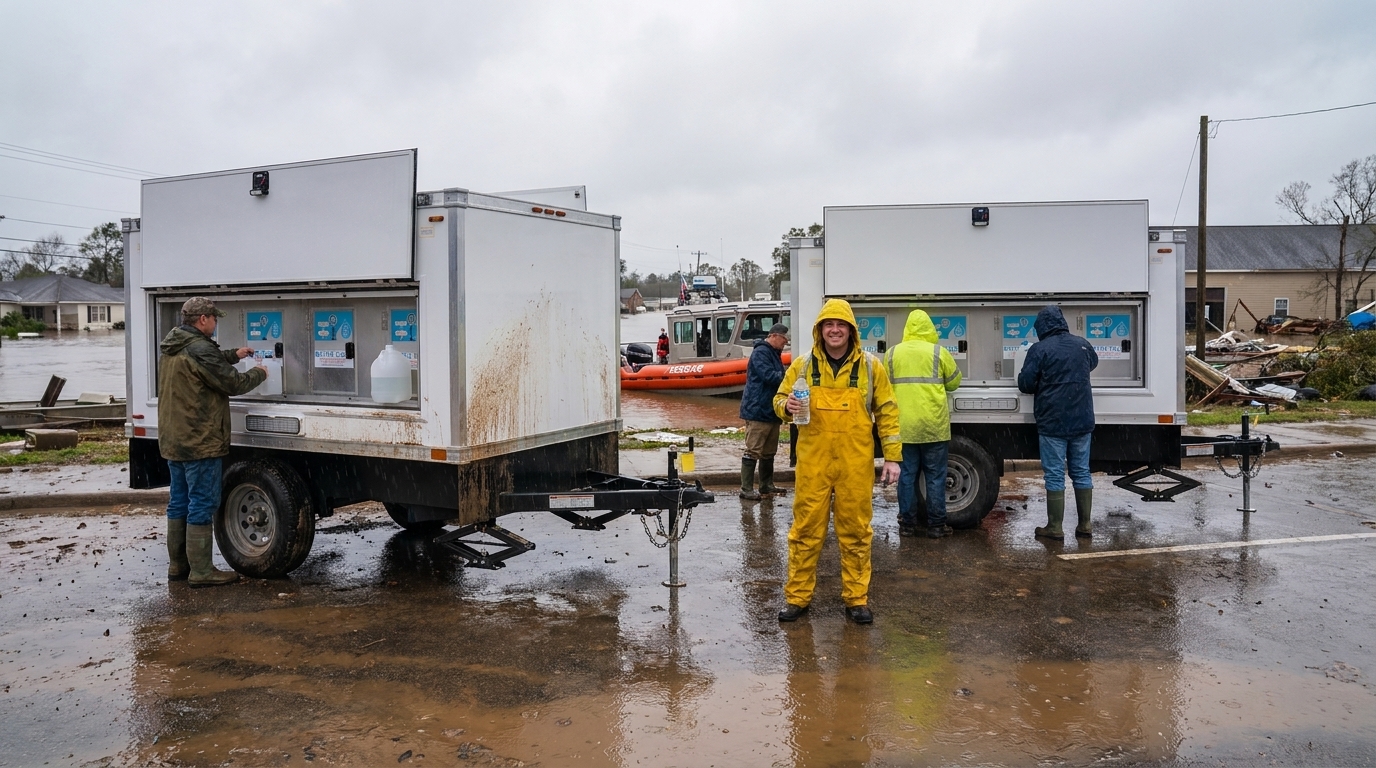
When the grid goes sideways in North Texas the work happens outside, and it does not wait for better weather. February of 2021 is the one people here still bring up. Winter Storm Uri cut power to more than 4.5 million Texas homes, and as treatment plants failed behind it, boil water notices reached more than 14 million people across the state. Line crews worked through all of it. So did the mutual aid crews who drove in from out of state with nowhere to fill a jug.
That is the job we stage for. A restoration crew moves along a right of way all day, a few blocks at a time. A truck cannot carry enough clean water to matter. We drop the station at a staging yard or a substation apron and top it on a set schedule, so a lineman coming down at two in the afternoon gets cold water instead of a warm bottle that has been rolling around the floor since dawn. When a boil notice is in effect, our filter stages and UV lamp mean what comes out of our tap does not depend on the city main at all.
The steady version of this work is far less dramatic. Grand Prairie keeps a road and storm drainage program moving through the whole construction season, and those cuts sit right on top of gas, water and fiber that belong to somebody else. Crews stand in an open trench in the middle of a North Texas July. There is no shade in a trench. We set units on the closed lane side of a work zone where a service truck can pull in without stopping traffic, and we walk the unit down the street as the dig moves.
Placement on utility work is mostly about the approach. We check gate width, turn radius, and what the ground does after rain before a truck ever rolls, because a loaded trailer sunk at a substation gate becomes everybody else's two hour problem. We keep the fill point clear of the equipment path. And on storm work we plan a generator with the unit by default, since the reason the crew is standing there is that the power is out.
Six bottles per person on a 90-degree day in the Mid-Cities, a 38-person crew, and you're already at roughly 228 plastic bottles to buy, cart in, ice down, and throw away. That's one day. The season is where it gets ugly.
Multiply across a 175-day build and the tally clears 39,000 bottles, with the larger commercial jobs running far past that. A single trailer makes the entire pile disappear, leaving cold water at the tap and nothing for the dumpster.
Sustainability is the easy part of the pitch. Roughly 60 million plastic bottles get thrown out daily in this country, only about a third are ever recycled, and one bottle can sit in a landfill for centuries. Worth reporting, sure. But the Grand Prairie project managers who actually switch usually do it to kill the daily hassle, not to pad a sustainability slide. A shared trailer means no recurring bottle order, no cooler going warm before first break, no wall of empty jugs baking by the job-trailer. The super runs the build, not the water program.
Because our own potable tankers cover the refills, the supply scales with the job rather than fighting it. Double the crew for a big pour and they still can't drink faster than the plan. And the tankers just swing back and bring the level up.
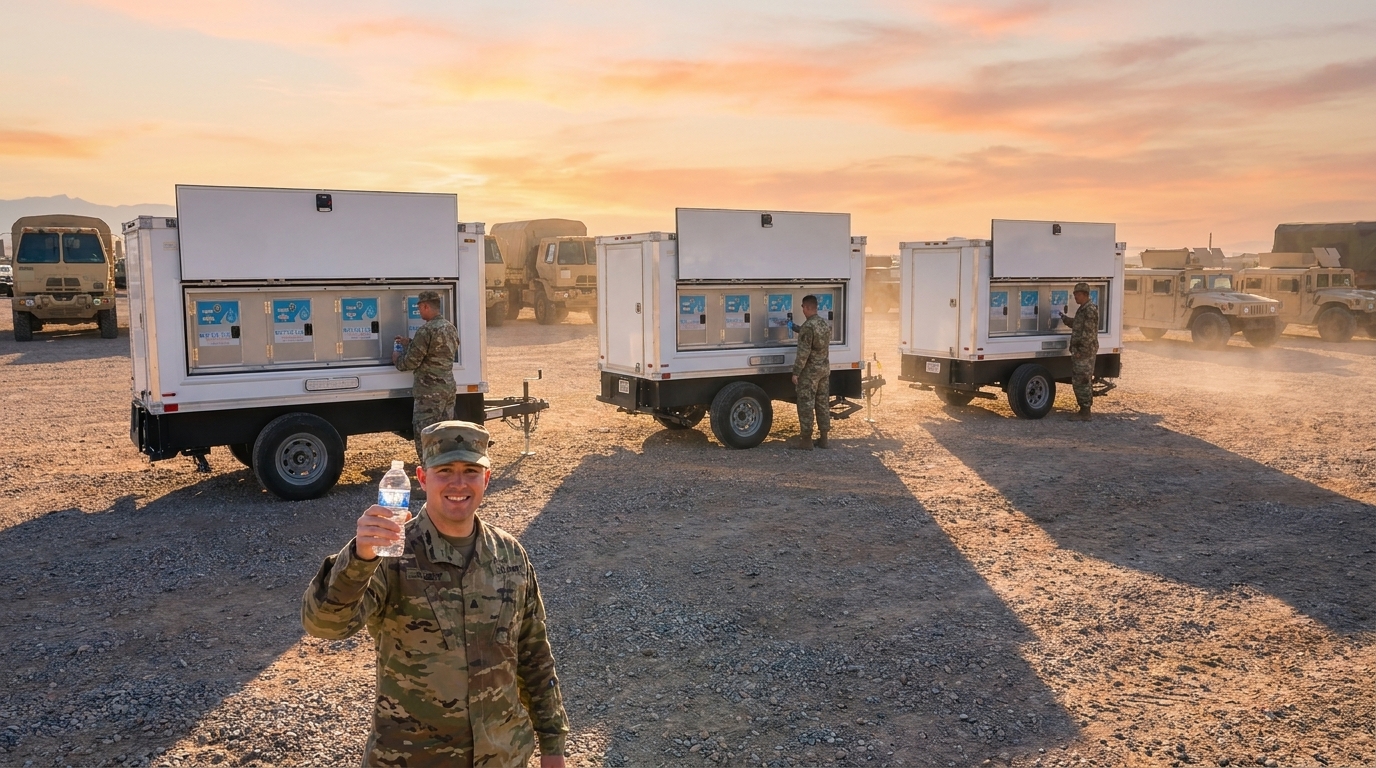
Want this math run for your own Grand Prairie job? Two minutes on the phone gets you a real number.
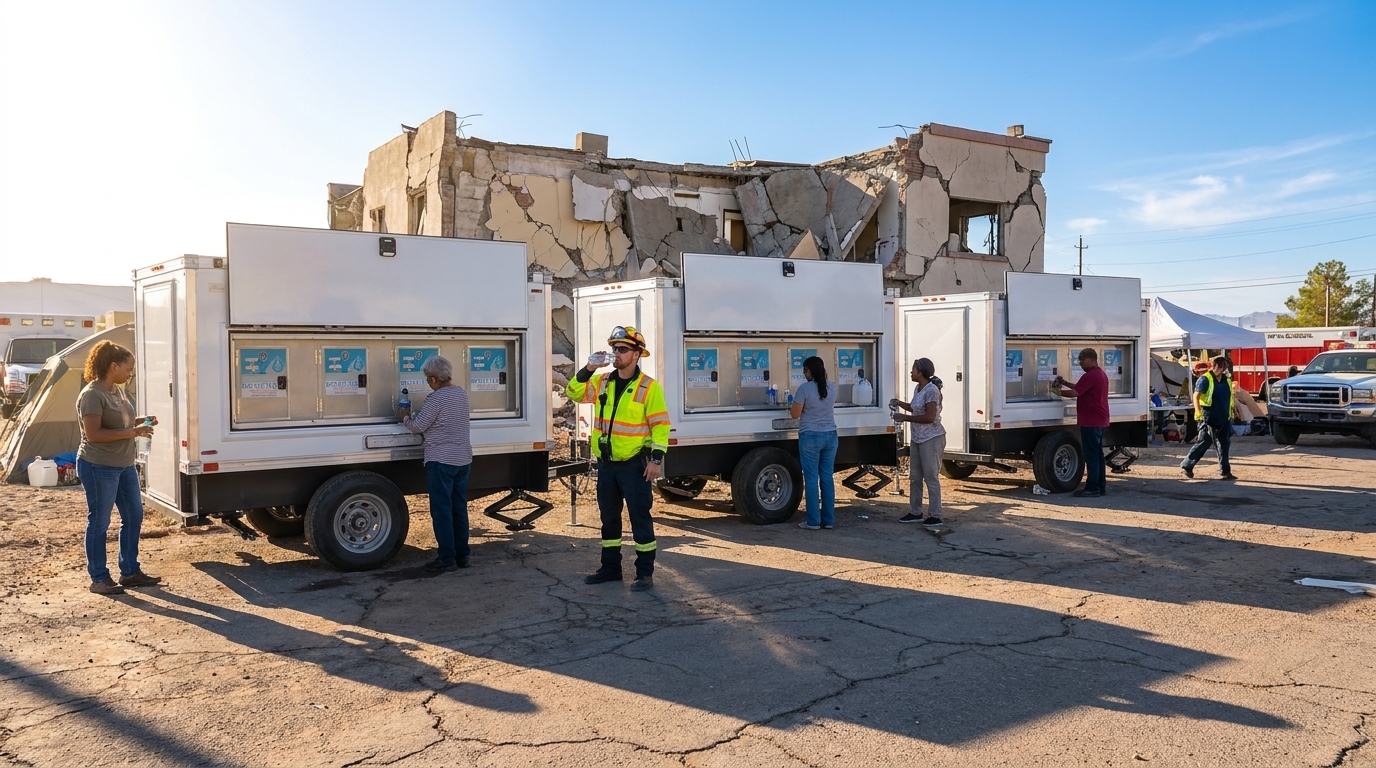
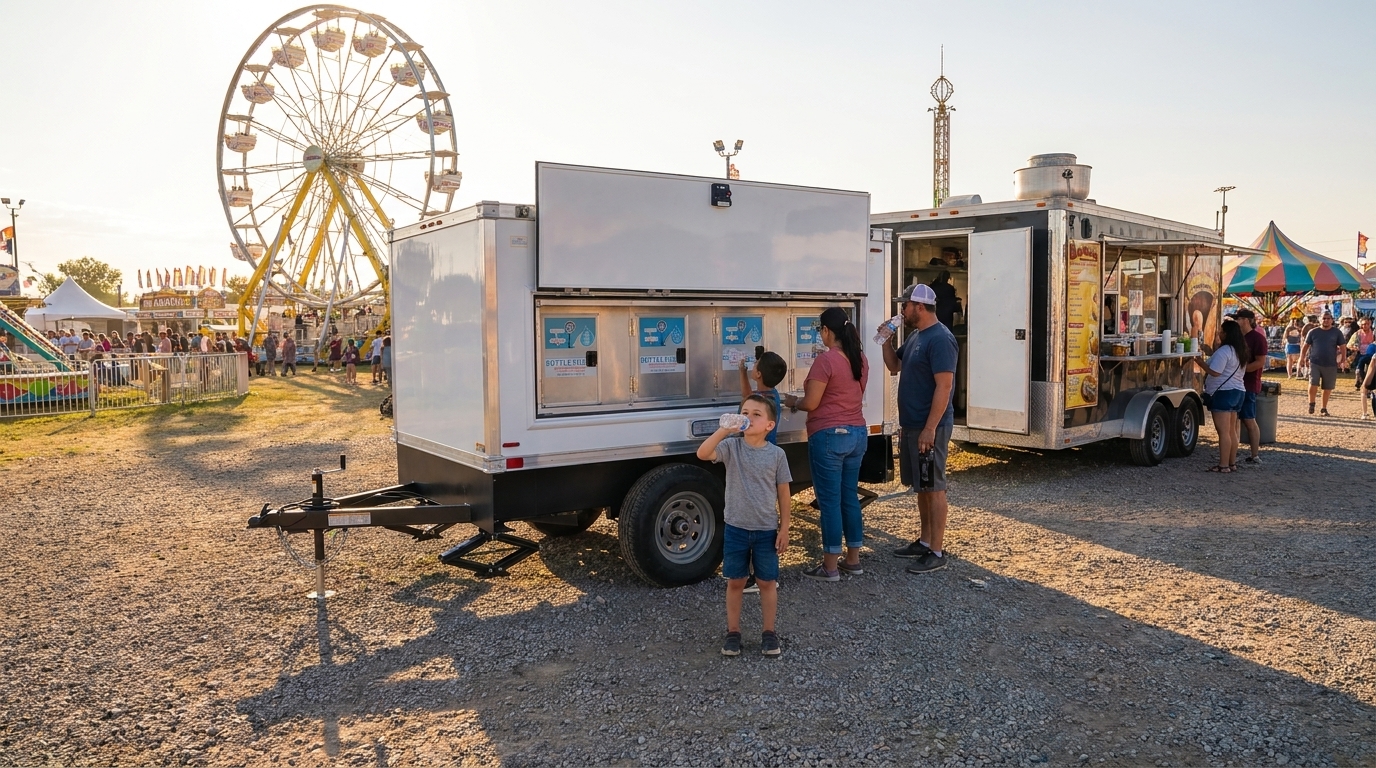
More than 3,500 dealers set up every Saturday and Sunday from 9 in the morning until 6 at night, drawing about 60,000 people a weekend. Dealers stand in open rows all day with no fountain behind the booth. A chilled fill point serves the vendor side as much as the crowd side.
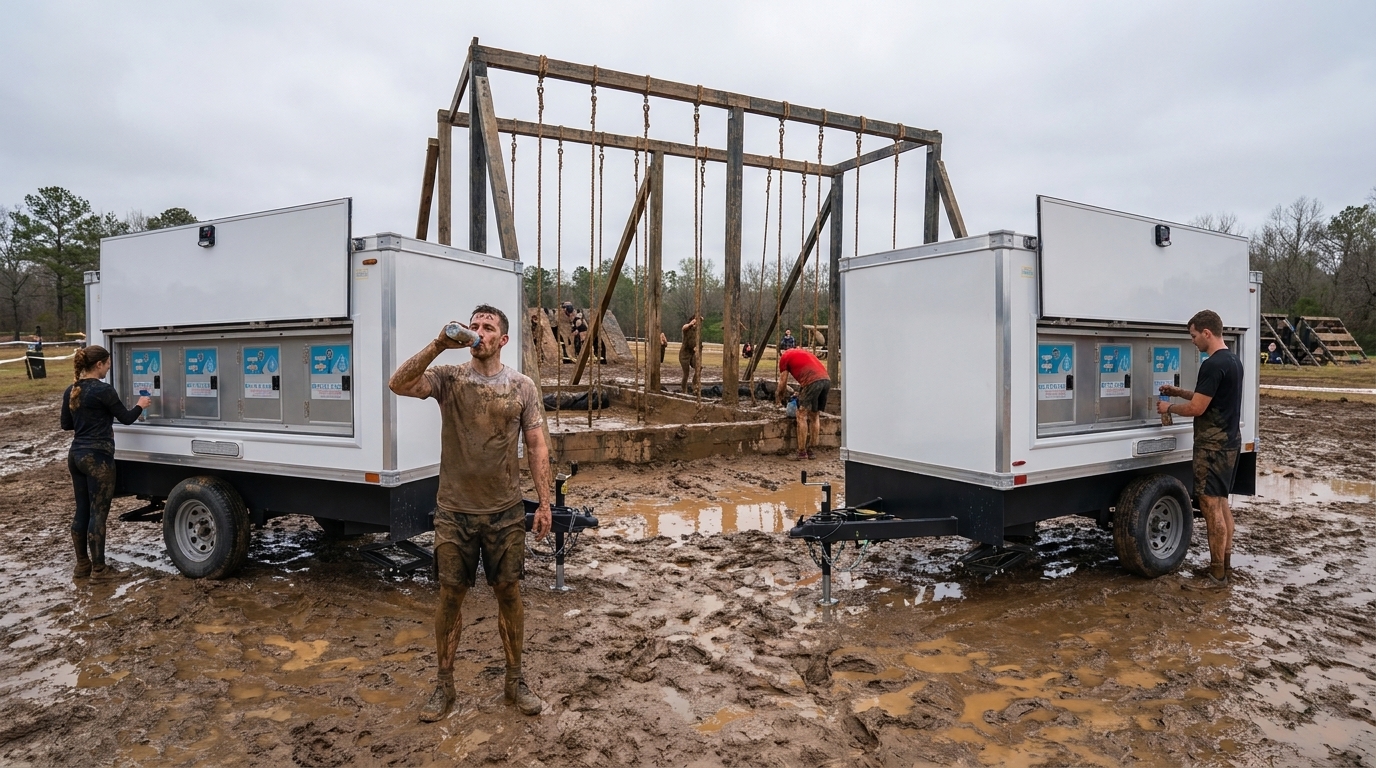
The track pulls better than 700,000 guests a year, and a single June race day hit 13,843 fans. Quarter horse season opened on September 11 of 2026, when afternoons here are still in the nineties. Grandstand and paddock crowds stand in direct sun for hours at a stretch.
The festival runs 11 to 7 downtown with more than 100 artisan vendors, and this edition added the Backroads to Main Street parade from West Church Street down Dolores Huerta Drive. An all day street event keeps vendor staff outdoors through the hottest window of the day.
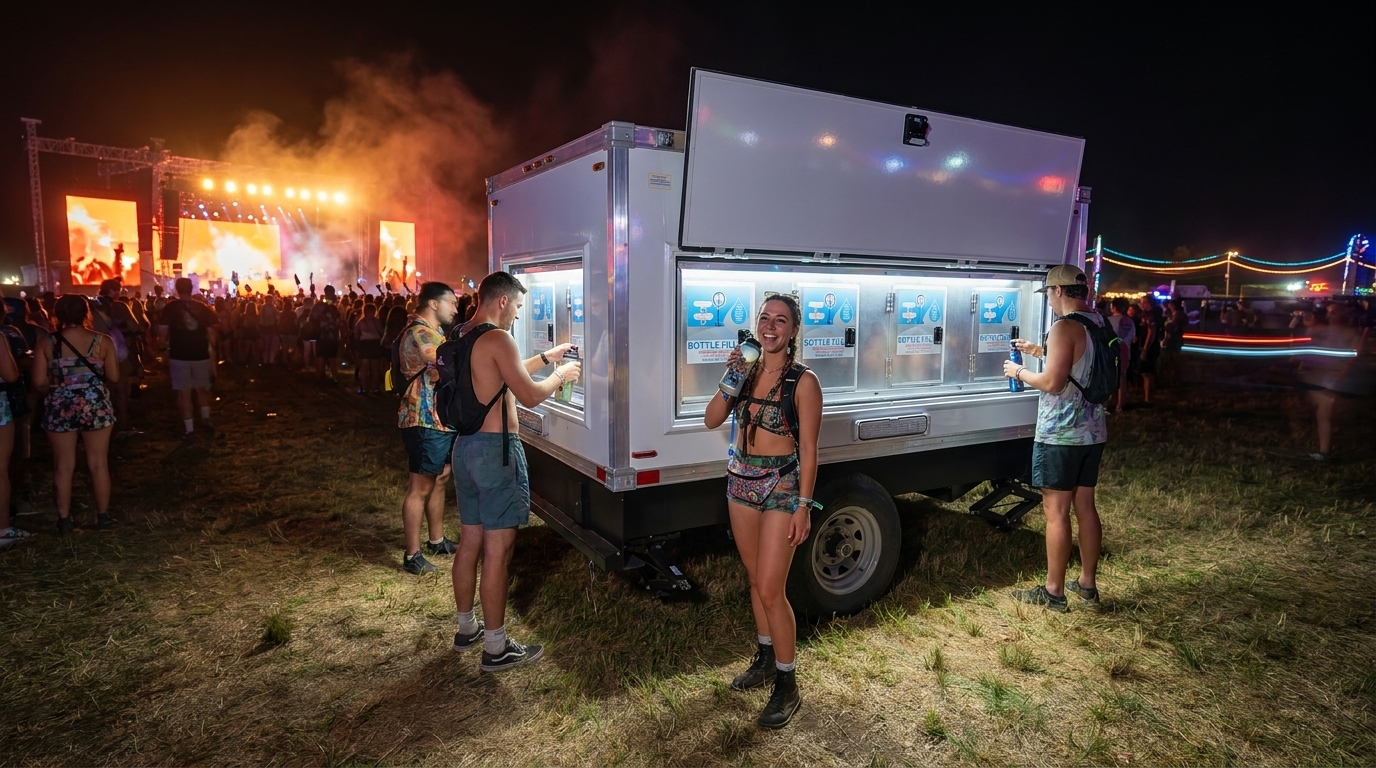
The venue at 1001 Performance Place has 28 dates on the books across 2026 and 2027. September shows still run at or above 90 degrees at curtain, and load in crews are out on the pad hours before any of that.
A water source people don't trust gets ignored, and an ignored station is rented money wasted. That's why municipal water doesn't reach the tap raw on our trailers. It passes through three filter stages and a UV chamber, then an onboard cooling unit drops the temperature. The result tastes clean and comes out cold, even on the worst Grand Prairie afternoon of the year.
The opening filter traps sand, scale, and the fine grit local mains occasionally push through. On a dusty Grand Prairie lot, that's what keeps a pour from tasting like the parcel it's parked on.
Activated carbon comes next, lifting the chlorine bite and the dull seasonal notes local tap can carry until the taste lands clean and neutral. When it's 90 out, that flavor decides whether a crew keeps drinking or walks past the tap dry.
A finer cartridge then catches the microscopic particles that slip past the first two, so what reaches the spout is clear rather than merely cold for the crews and crowds across Grand Prairie.
The last step is an ultraviolet chamber that wipes out bacteria and microbes without adding a single chemical. Even after a long tow to the far edge of the Mid-Cities, the water off the nozzle is clean.
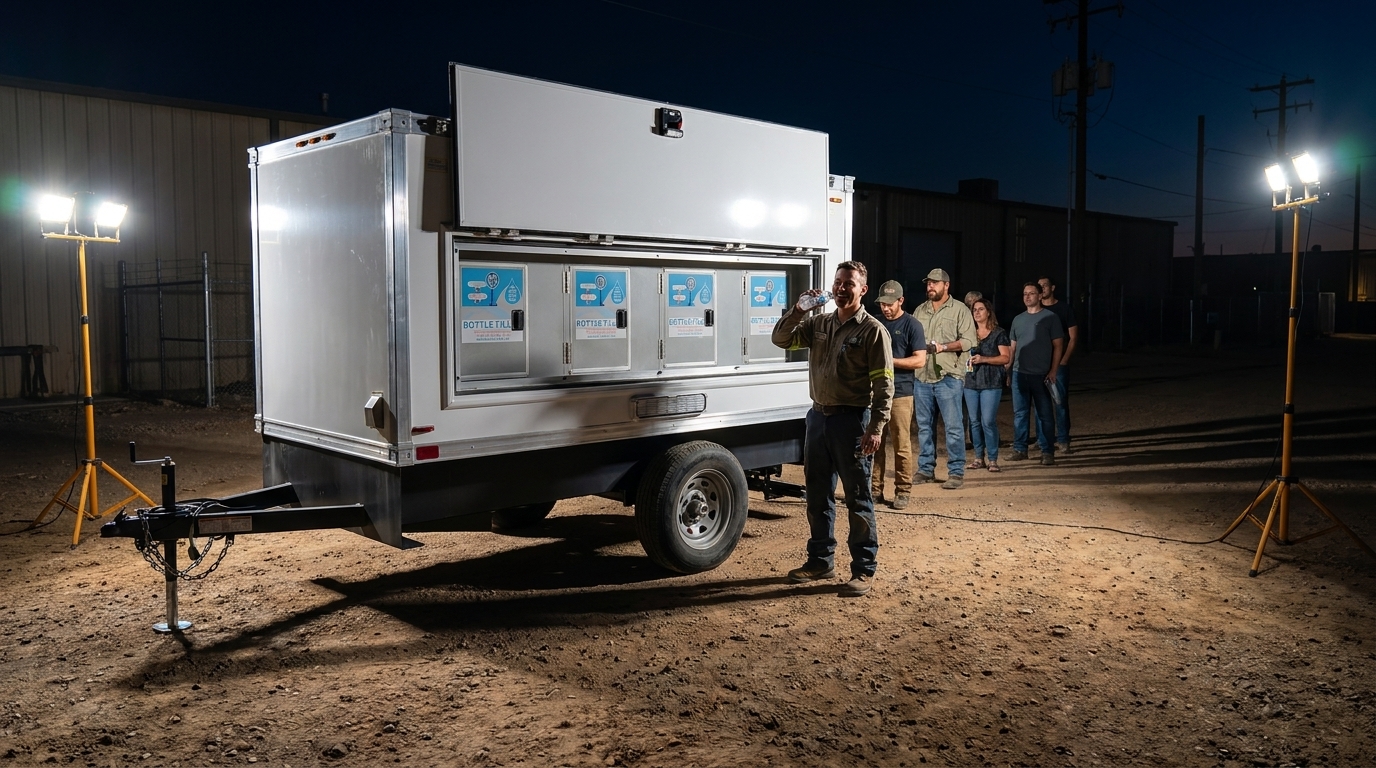
Along the wall sit four adjustable push-back taps, press a bottle to the bar and it pours. One of them is set at ADA-reachable height, so a single trailer includes everybody at a Grand Prairie crew or crowd with no add-on gear. Out back, a large-jug spout services five-gallon coolers and hydration packs, while a bank of hose connection taps handles work-site chores, event support, and refills down the orchard rows. Stainless, food-grade plumbing the whole way through keeps the filtered, chilled water at quality right to the spout.
Every Signature trailer carries a 300-gallon load, roughly 2,400 cups at sixteen ounces each, and we recharge it on demand, so the unit doesn't turn into the choke point on a busy Grand Prairie shift or a packed show night.
There's nothing here for you to run. Placement, fresh-water load, hookup, that's all on us, and then we walk your Grand Prairie crew or event staff through the basics before our truck pulls away.
People count, number of days, where exactly it parks on your Grand Prairie site, and what power is there. Those four answers let us spec it correctly the first time around.
Reckon roughly 45 minutes from our yard to anywhere in Grand Prairie or the Mid-Cities, with round-the-clock emergency runs whenever a heat advisory or a power shutoff hits the area.
Once on site we set it level, charge the 300-gallon tank, and tie in power off one to four standard 120V circuits, or a single 50-amp 240V drop, depending on what the site gives us.
After that the tankers cycle back on a cadence matched to how fast your crew or crowd pulls it down, and we maintain the unit through the whole rental term.
No power on the parcel at all? We price that in. The unit draws very little, and with the service fleet backing it we've run Grand Prairie stations on lots that had no permanent power whatsoever. Lay out what the site offers and the rest is on us.
Start with the federal floor, because it already covers every construction site in this city. OSHA requires an adequate supply of potable water at every place of employment, in clearly marked containers, with no common drinking cup and no cross connection between a potable line and anything that is not. The general duty clause sits underneath that and requires an employer to protect people from recognized hazards. Current water, rest and shade guidance is more specific than most crews expect: about a quart of water per worker per hour, kept between 50 and 60 degrees, positioned within 100 feet of the work, and no drinking out of a hose. Shaded rest areas are expected to run at least 5 degrees cooler than the air around them.
A federal heat injury and illness rule is still working its way through rulemaking, and what it would require is worth knowing now. Drinking water, break areas and an acclimatization plan once the heat index reaches 80 degrees. Paid rest breaks and active watching for heat illness signs at a 90 degree heat index. In high hazard industries, a written heat illness prevention plan and a named heat safety coordinator on site. Smart contractors in this metro are already building to that bar instead of waiting, and a chilled, filtered station handles the water half of it on delivery day. We watched the same thing play out with our hydration station trailer rentals in Flagstaff, where crews who moved early never had to rebuild a safety program mid project.
Local permitting is a separate track and it is the one that catches event people. A Grand Prairie special event permit is required when an event closes a street or right of way, and when an event draws 75 or more people while also involving amplified sound, traffic disruption, a tent of 400 square feet or larger, temporary structures, alcohol or food sales. Applications are due at least 30 days ahead and processing usually takes 7 to 14 business days. The city requires liability coverage at the limits named in its permit packet, with the city listed as certificate holder and additional insured, and it will not approve an application without it. A tent over that size threshold triggers a temporary structure permit and fire marshal review as well. Your site plan has to show structures, parking and entry routes, so the station footprint and the circuits it draws from belong on that drawing with everything else.
Need a station your written heat plan can point to? We can have one pouring cold within days.
A lot of the Mid-Cities jobs have shaped how we run the next one. A few that stuck with us:
Water line crew on the west side, Monday before daylight. They were cutting pavement at first light to beat the afternoon, working a trench with zero shade and no way to keep anything cold on the truck. We set a unit on the closed lane side Sunday evening and topped it at midday, then moved it two blocks down with the dig on Wednesday. The foreman told us his guys had been rotating to a convenience store six minutes away, which was eating close to half an hour a day out of the schedule.
Safety manager at a distribution yard, first week of August. Dock and yard staff were working a full shift outside while the break room sat at the far end of a very long building. He needed a cold water point people would actually use and a paper trail he could staple into his written heat plan. We placed two stations, one at the trailer staging lane and one by the guard shack, and the service tickets did the documenting for him.
Vendor coordinator at a weekend market, Saturday setup. Dealers were arriving at dawn and the nearest tap was a long walk from the back rows, so vendors were bringing flats of bottled water and leaving the empty coolers behind. We staged a unit at the end of the row before gates opened and topped it once at noon. Trash volume dropped, and the coordinator kept the same placement for the rest of the season.
Manufacturing employs about 12,544 people in Grand Prairie, second only to health care. Lockheed Martin Missiles and Fire Control keeps roughly 5,000 of them at its campus here and was still hiring into 2026, with 476 open local jobs posted. Poly-America accounts for about 2,000 more. Airbus Helicopters puts its United States headquarters in this city too. These are big campuses with yard work, loading docks and exterior projects going all summer.
Plant work has a rhythm nothing else has. During a shutdown the building systems come down with the line, so interior fountains go dry or get taped off at the exact moment a hundred outside contractors show up to work a hot building. We stage the unit at the contractor gate, usually on a generator, because every spare circuit during a turnaround is already feeding welding machines. Then we top it mid shift, every shift, until the line comes back up.
The distribution side never gets a slow month. Amazon runs its DHX5 fulfillment center at 1102 State Highway 161, and Ascend Distribution expanded inside the Great Southwest Industrial District to keep up with marketplace demand. Yard jockeys, dock staff and drivers work outside in the same heat as any framing crew. Difference is they are out there in February too, which is why warehouse accounts here tend to keep a unit for months rather than weeks.
Plant yards have their own layout problems and we plan around them: forklift lanes, fire lanes, rail spurs, badge gates. We ask who escorts the service truck before the first delivery instead of on the morning of it. On a badge controlled site we send the same driver every week, so access stops being a weekly project for your security desk.
July here averages 95.5 degrees. January averages 56.6, and snow barely registers at about 1.1 inches a year. Across North Texas the heat index clears 90 degrees on 80 to 120 days a year by mid July, which is not a handful of extreme days, it is most of a working season. Add humid air and the number on the thermometer sells it short, because sweat has nowhere to go.
That stretches the outdoor season from late spring clear through early fall, and it covers nearly every event on the local calendar. Not all of the demand is seasonal, though. Epic Waters holds an 85 degree tropical climate indoors every day of the year under the largest single fold-down roof in North America, so the guests and staff inside an 80,000 square foot water park are in warm air in January too.
Winter flips the problem. Ice, not snow, is what shuts this region down, and ice is what put crews outside during the worst days this region has had. So every unit we place between November and March leaves our yard with freeze protection already on it rather than getting a panic call the first night it drops below freezing. We would rather do that work in October.
Grand Prairie is carrying roughly 1,749 registered construction projects at once. About 678 of those are new builds and the rest are renovations, together covering close to 49.3 million square feet, and 74 of them registered in just the last six months. That is a lot of people standing on bare dirt with no fountain anywhere near them.
The big ones are easy to spot driving around town. Bear Creek Logistics Park Building B. The new Poly-America manufacturing building. Foxfern I-30 Apartments, Remington 30 Building 2, and the Gateway Multifamily buildings on the west and east sides. Beltline Industrial, a 167,595 square foot shell at 2415 South Belt Line Road, is due to wrap in October of 2026. Prologis, Paragon Outlet Partners and Grand Prairie ISD all turn up as owners in that same pipeline, which tells you the work is spread across private and public money rather than riding on one developer.
Housing is the other half. JPI broke ground on Jefferson Kirbybrook, a 269 home townhome community with private yards and garages, with the first homes due to lease in early 2026. Goodland, the Provident project in the south of the city, already has about 850 built units and more than 1,000 lots ready for construction, and a new roadway opened in late February to tie that ground back into the rest of the metro. Framing, concrete and site work crews will be out there for years. Our mobile water station rentals in San Antonio cover the same kind of long build, and the lesson travels: put the water where the crew already walks.
A jobsite drop lives or dies on that walk. Set a station at the trailer office and the framing crews on the far side of the slab will not make the trip, so the tank stays full while people quietly stop drinking. On a long site we would rather set two placements than one central one. We also decide where the drain water goes on day one, because fill points make runoff, and runoff on a freshly graded pad turns the approach into a mud hole by week three.
Everyone sees the trailer. What they don't see is the support fleet behind it, the trucks that deliver fresh water, hold reserve on site, and carry wastewater off, so a single call wraps the entire loop rather than stringing together three vendors.
Our tankers run drinking-grade water in bulk, recharging the 300-gallon tank on whatever interval the headcount demands. Those same trucks also top up storage tanks, holding tanks, and bladder bags whenever a single drop can't keep pace, like a big slab pour or a downtown night that packs the square.
When demand spikes we set out fold-flat bladders to bank extra fresh reserve, and on a drain-less lot they'll temporarily hold greywater too. It isn't fancy equipment, but it's what keeps a far-flung job in the Mid-Cities pouring between tanker runs.
Water that has to move across a job is a pump truck's job, whether that's charging holding tanks or hauling supply end to end. It earns its keep on the sprawling parcels where the trailer and the fill point can end up a fair hike apart.
At the tail end, a vacuum truck draws off greywater and wastewater and carries it to permitted disposal, closing the loop clean. Nobody on your Grand Prairie crew is left guessing where the used water ended up. That piece was built into the plan from day one.
Every job gets its own setup. A remote parcel might run a station plus a bladder bag for reserve and a recurring water-truck schedule. A heavy event night might call for a pump truck to move supply and a teardown waste run at the end. Describe the shape of your job and we'll put together the right combination, on one invoice, handled by one crew that already knows the ground.
A couple of minutes on the phone is enough to get you a real number. Here's what we'll want to know, handy to have ready before you call, and proof that we size every job to the work in front of us rather than reading off one canned quote.
Bottled water reads as the budget choice on a purchase order. Its actual price tag is buried somewhere else, in handling hours, staging footprint, water that warms up, and trash piling up afterward, and on a hot inland lot each of those costs more than it would by the coast.
Look at everything bottled water actually demands of a person: cutting the order, receiving and breaking down pallets, icing coolers before dawn, topping them up through the day, then flattening empty bottles for the bin. On a large Grand Prairie crew that's hours of paid time burned every single day, scraped right off the work that's supposed to be getting done. The trailer erases that loop entirely. A local contractor once let us pencil it out with him, and the recovered labor by itself paid for the unit. His words were that the bottle runs had been quietly costing him close to a day of payroll a week. Our trailer arrives full, the tankers keep it full, and your superintendent owes it nothing but a parking spot.
Ice a cooler at 6 a.m. and by mid-morning in July around the Mid-Cities it's as warm as a bath. Warm water is water people stop touching, and the slowdown that follows is precisely where heat illness gets its opening. A chilled station never rides that warm-up curve at all. Whatever pours at clock-out is as cold as the sunrise fill, which happens to be the moment a spent crew, or a crowd deep into a long concert, leans on it hardest.
Bottled-water pallets devour staging space, jam the lay-down area, and sit cooking in the sun until somebody finally cracks them open. Empties build up faster than anyone keeps up with, and on a tight commercial lot that pile turns into its own problem. Set a trailer in one parking stall instead and it serves a crew or crowd that would otherwise burn through hundreds of plastic bottles every day.
Every bottle bought is a bottle thrown out, and across a season a busy site or event generates a small mountain of them. That's a disposal line on the budget, a dent in the sustainability numbers, and, given that a single bottle can linger in the ground for centuries, a footprint that lasts longer than the project that made it. Move to a refill station and the line drops to zero, which finally gives your reporting a figure worth publishing.
On-Site Hydration Services covers Grand Prairie and the ground around it, from downtown and EpicCentral out through the Great Southwest Industrial District. Trucks also run north along Highway 161 and south past Goodland to the Joe Pool Lake shore. Because the city reaches across Dallas, Tarrant and Ellis counties, a single call can put a unit on three different kinds of ground. Arlington, Irving and Cedar Hill are daily stops for our trucks. Tell us the address and the head count and we will tell you what fits. Call now, or request a free quote and we will confirm how fast a unit can be there.
Working a corridor instead of a single address? We follow the main routes across the Mid-Cities, so multi-site projects get the same fast turnaround as one stop.
Still weighing it? Call and ask. Most of these questions get settled in one short conversation.
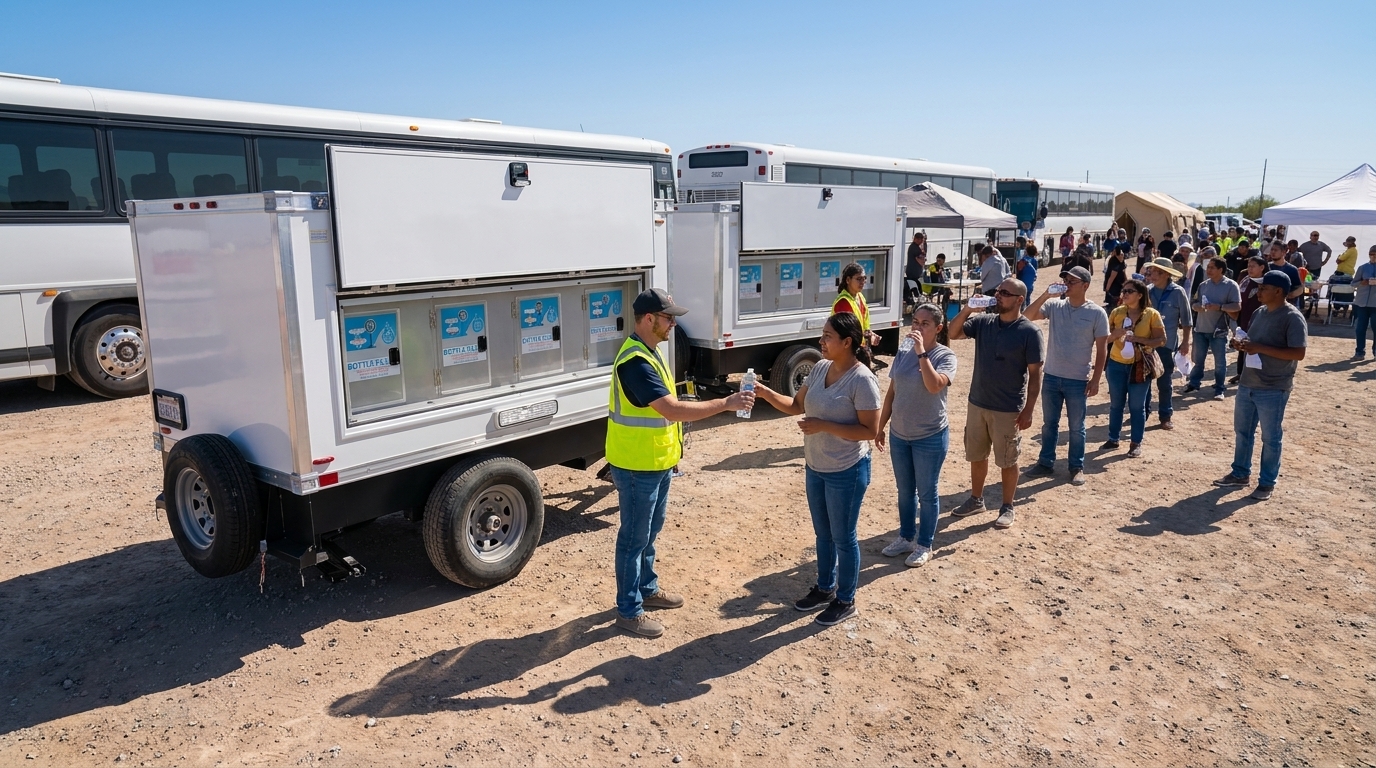
It is built for bottles first. Four push back fill stations along the side take a water bottle or a tumbler, and the taps adjust so a tall bottle fits without spilling. The back of the trailer carries a large jug fill station for five gallon bottles and cooler jugs, which is what most Grand Prairie job sites actually use in the morning. Crews top off a personal bottle at the side taps through the day and fill the cooler from the back station at break. Nobody shares a cup and nobody drinks from a hose.
We handle it. Every placement gets a service schedule before the trailer leaves our yard, and we set that schedule off your head count and your hours, not off a default. A downtown festival on a Saturday and a plant yard working three shifts get very different cadences. Your team never books anything, and if your head count jumps mid project you call us and we tighten the route. Every stop leaves a service ticket, so you have a record of when the tank was checked and topped.
One unit holds 300 gallons of chilled filtered water and refills fast at four side taps at the same time, which covers most single day crowds when we place it well. For a heavy surge, like a peak Saturday at the racetrack or a market weekend pulling tens of thousands through the rows, we would rather set two units in different zones than push one. That spreads the line and keeps a long walk from becoming the reason people stop drinking. Tell us the expected gate count and the peak window, and we will bring a top off truck on standby for that window if the numbers warrant it.
Yes. One of the four push back fill points is mounted at ADA height so it is reachable from a seated position with no assistance and no awkward reach over anything. The approach matters just as much, so we set the unit on firm level ground with a clear path from the walking route rather than parking it on a gravel shoulder. On public events in Grand Prairie we plan that path with your site drawing, alongside your ramps and accessible routes. Say the word during the quote call and we will confirm the placement works before delivery day.
There is. Every service stop generates a dated ticket showing the visit, the check and the top off, and those tickets are what people reach for when somebody asks how water was provided on a given afternoon. We also send insurance certificates naming the entity your contract requires, and our SAM.gov registration is current for agency and federal work. If your written heat plan needs a named water source with a service record behind it, this is a cleaner answer than a stack of receipts for bottled cases. Ask us for the file and we will get it to you the same week.
It needs about 13 by 8 feet of reasonably level ground that stays firm after rain, plus an approach a truck can back into. Beyond that, keep it out of the crane swing, off the forklift lane, clear of fire lanes, and close enough to the work that a person will actually walk over. On Belt Line Road warehouse pads there is usually room to do all of that at once. Downtown and on tight infill sites there is not, so we walk the ground with you and pick the least bad spot on purpose instead of by accident. We also plan where the drain water runs so the approach does not turn to mud.
It draws from 1 to 4 dedicated 20 amp 120 volt circuits, or from a single dedicated 50 amp 240 volt circuit if your site has one available. On a plant turnaround we assume the spare circuits are already committed, because they almost always are. When there is nothing at the pad, which describes most raw dirt on the south side of the city, the generator comes with the trailer and we size it for the unit ourselves. You do not need to source fuel logistics or guess at a rating. Tell us what is live and we fill the gap.
We deliver the day before a start or early on the morning of it, so the tank is cold when the first shift walks on. Same day is realistic for most Grand Prairie addresses because we stage off the 161 corridor. Your side is short: clear the spot, confirm the approach is passable, and tell us what power is available. If access runs through a badge gate or a guard shack, give us the contact name up front and we will put the same driver on the route every week.
Start with the footprint rather than the head count. A long Main Street layout with vendor rows spread over several blocks needs stations at both ends more than it needs one big one in the middle, because nobody walks four blocks for water and then four blocks back to their booth. For an all day event running 11 to 7 with a hundred plus vendors, we usually plan two placements and one midday top off. Then we adjust after the first year, since your own gate numbers beat any rule of thumb we could give you.
Yes, and a lot of them do. Ice is the real winter risk in this region, not snow, so every unit we place between November and March leaves our yard with freeze protection already fitted rather than getting a rush visit the first night it drops. Long term placements on plant and warehouse accounts often sit for months and simply shift to a winter service schedule. If a hard freeze is coming we check placements ahead of it rather than after. That is also when a self contained source is worth the most, since a regional freeze is exactly what puts pressure on the municipal system.
You hold the special event permit, but we give you what goes on the drawing. That means the unit footprint and the clearance we need around it, plus the power it draws from, so it appears on your site plan alongside tents, booths and parking. The city wants those applications in at least 30 days ahead and processing usually runs 7 to 14 business days, so ask us early rather than the week of. We can also send insurance certificates naming the city the way the permit packet requires.
That is one of our most common calls. During a turnaround the building systems go down with the line and interior fountains get taped off. At the same time, a hundred contractors arrive to work a hot building. We stage the unit at the contractor gate on a generator so we are not competing with welding machines for power. Then we top it mid shift, every shift, for the length of the outage. Give us your window and gate contact and we will build the service route around your shift change.
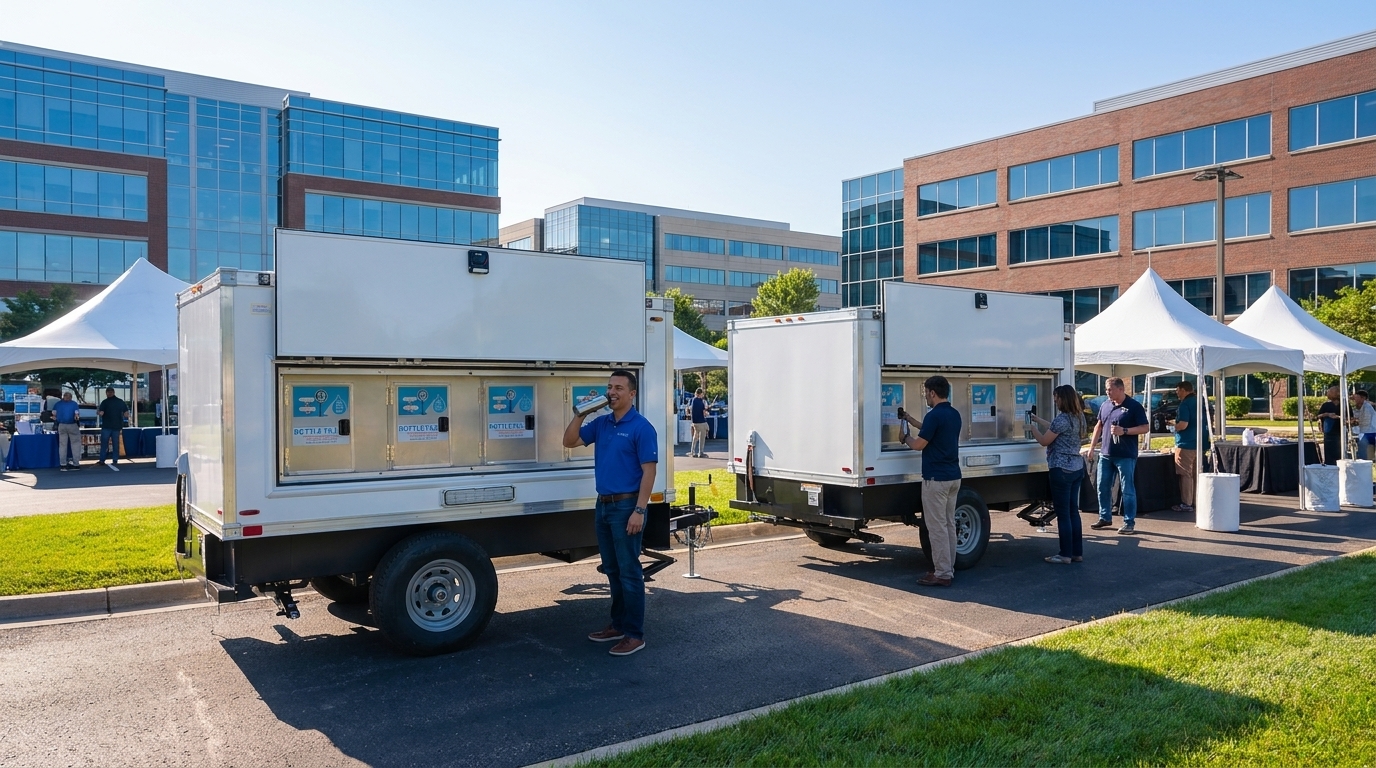
Most people size this backwards. They start with how many people are on the job and stop there, which is why so many sites end up with a full tank and a crew that is still buying drinks at the corner store. Head count is only one of four numbers that matter. The other three are the length of the shift, the distance from the work to the water, and how hard the work is.
Start with intake. Common guidance in heat work is roughly a quart per person per hour of steady outdoor labor. Run that against a crew of forty on a ten hour summer shift and you are looking at real volume, not a cooler. A 300 gallon tank covers a lot of that math in one drop, which is why the tank size question usually answers itself once you write the hours down.
Event water gets planned late, usually after tents, power and trash are already locked. That is backwards in a city with an event calendar this heavy, because the water plan depends on decisions those other vendors already made. Here is the checklist we run before agreeing to a date on a Grand Prairie event.
First, find out whether the event needs a special event permit at all. In Grand Prairie the threshold catches more events than people expect: any event that closes a street or right of way, and any event drawing 75 or more people that also involves amplified sound, traffic disruption, a tent of 400 square feet or larger, temporary structures, alcohol or food sales. Applications go in at least 30 days ahead and processing usually takes 7 to 14 business days. Water gear that shows up on a drawing late can hold up an approval that was otherwise ready.
Every business in this region has now lived through at least one stretch where the tap was not the answer. Municipal water depends on power, and power in Texas has proven it can go away for days at a time in the exact conditions that make water hardest to haul. This is a planning piece, not a scare piece. Here is what we would do in October if we ran your site.
Start by writing down where your water actually comes from and what it depends on. Most facility plans say potable water is available on site and stop there. Push one level deeper. Does that supply need a pump that needs power? Is your building on a booster? Does your break room ice machine count in anybody's plan? The answers are usually less comforting than the plan implies.
People ask what a station costs before they tell us anything about the job, which is a little like asking what a truckload costs before saying where it is going. We are not going to put numbers in an article, because your job is not the job we quoted last week. What we can do is explain exactly which details move a quote, so your first call is a short one.
Length of the rental is the first lever. A two day event and an eighteen month logistics build are completely different products wearing the same trailer. Long placements let us plan a steady service route and treat your site as a scheduled stop. Short ones carry the delivery and pickup on a small number of days. If you know you are going long, say so up front, because it changes the structure and not just the arithmetic.
Timing is the part of this that costs people money and nobody writes down. The equipment is the same in March and in August. What changes is availability, lead time and how much slack exists in anybody's schedule. Here is how a year actually plays out in this city.
January and February are quiet on the crowd side and busy on the risk side. Ice is what shuts this region down, and the work that happens during it is outdoor emergency work. If you are a contractor with winter exposure, this is the season to already have a vendor relationship rather than to start one. Placements running through these months ship with freeze protection fitted, which is a decision made in October, not in January.
“Dealers used to haul their own flats in and leave the empty coolers behind every Sunday. One station at the end of the row fixed most of that. Setup crew had it running before the first truck rolled in.”
“Every spare circuit during our shutdown was already feeding welders, so they brought a generator and sized it themselves. Topped mid shift for nine straight days without me chasing anybody.”
“August practice on the far field is the worst combination we deal with, heat plus a long walk back to the building. They put a unit right at that field. Kids drank more without me saying a word about it.”
“Raw dirt, no power, no water, middle of July. The trailer showed up with its own generator and we never talked about it again.”
“A big Saturday puts thousands of people in the sun for hours and our concession lines are already long. A free cold fill point spread the crowd out and cut down on heat calls to our medical tent.”
“We keep ours parked between the dock and the guard shack year round. Service truck shows up the same day every week with the same driver, which my security desk appreciates more than I expected.”
“There is no lay down room on this block at all. They found a spot on the lot apron that kept the fill line out of the truck path and still put it close enough to the deck crew. Good field judgment.”
“Our placements sit nowhere near a permanent tap and the ground gets soft after a storm. They checked it before committing to a spot instead of getting stuck and calling me about it.”
“Cold makes a bigger difference than you would guess. Our staff quit drinking the warm bottles by ten in the morning, and once the chilled station was there the whole crew stayed on their feet through close.”
Service information current as of September 2026.
Tell us the headcount or the gate count, the rental dates, and where the trailer should park, and we'll spec the right setup and roll one out to you anywhere in the Mid-Cities, usually inside about 45 minutes of dispatch.