Top-Rated Bottled Water Station Rentals Glendale for Job Sites & Events, Open 24/7
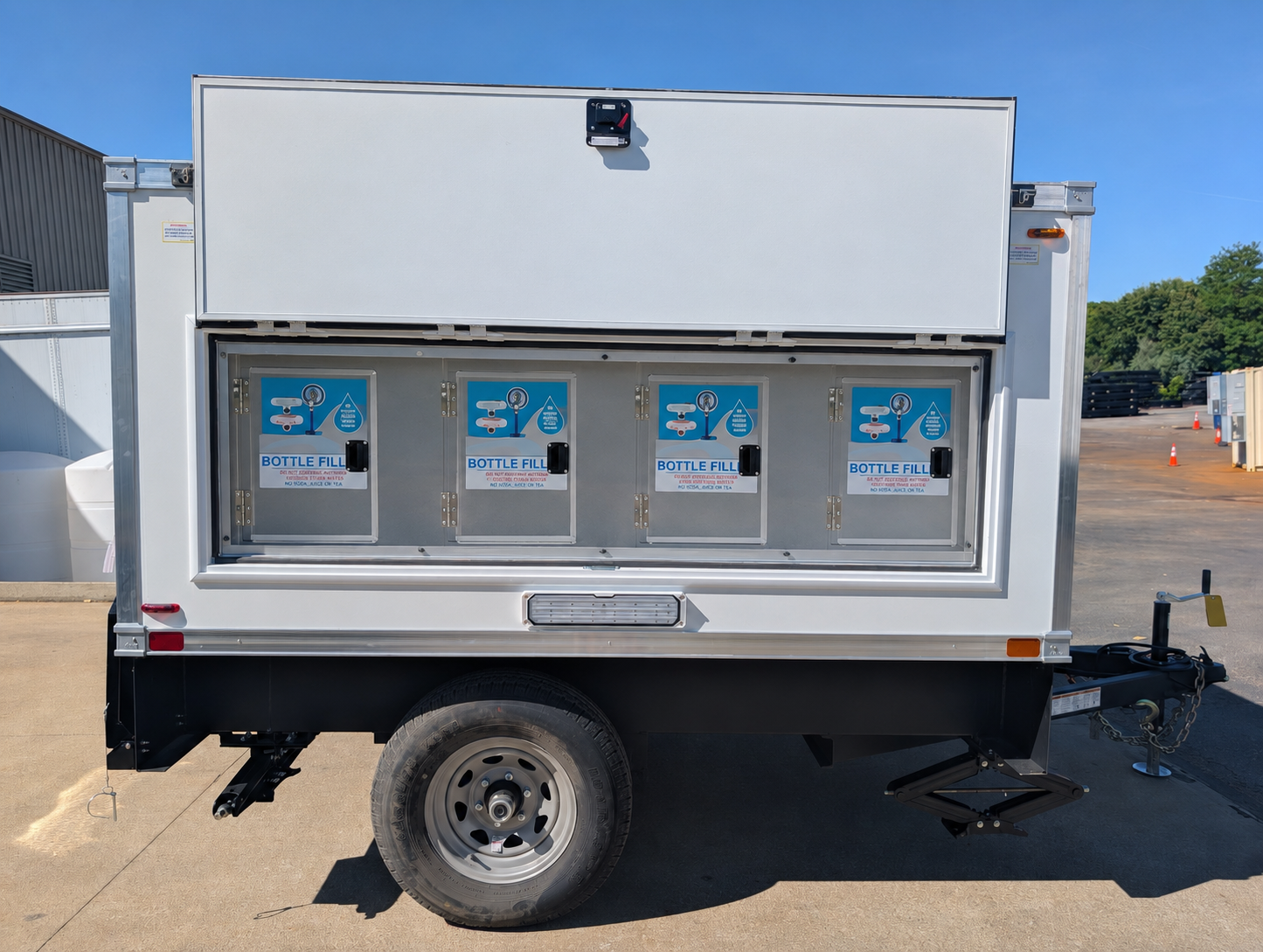
We deliver cold, filtered drinking water to events and job sites across Glendale and the West Valley. A sold-out show at Desert Diamond Arena and a 68-person framing crew off Loop 303 share one problem in a Glendale July: warm bottled water nobody finishes. We tow in a self-contained water station, cold, filtered, and refilling itself all day, so guests and crews stay hydrated and your event or build keeps rolling.
- Last-minute drops across the West Valley
- Genuinely cold, four-stage-filtered
- ADA-height fill point
- Built for federal-OSHA heat rules
- Fully licensed & insured
- Round-the-clock emergency dispatch
We know the difference between a Cardinals Sunday and a Loop 303 build
We stage mobile water stations for two kinds of Glendale work. One is events: Westgate filling and emptying around State Farm Stadium and Desert Diamond Arena, the spring-training rush at Camelback Ranch, the half-million people who pour into downtown for Glendale Glitters. The other is construction: warehouse shells and data-center pads going up along the Loop 303 industrial corridor through a summer that doesn’t break for months. The questions are the same either way: how fast can you get here, will the water still be cold at 3 p.m., and what happens when a 300-gallon tank runs low an hour before doors or an hour before the pour.
We run on a West Valley clock
Most Glendale drops land inside about 45 minutes of dispatch, and we keep last-minute and overnight delivery open through the hot months. When an event lead realizes the morning of the gates that the hydration plan is a stack of warm pallets, or a super finds an empty cooler at 6 a.m., that response window is the whole job.
Chilled water that survives the afternoon
Each station flash-chills its own supply, so the last pour before doors or before the whistle is as cold as the first one at dawn. Lukewarm water gets walked past, and water nobody drinks does nothing for heat safety. In a Glendale summer, cold water is what keeps a worker out of the back of an ambulance.
Dropped, filled, serviced, pulled
No separate bottled-water vendor, ice run, and disposal contractor to chase. We set the station, keep it filled from our own water trucks, service it through the rental, and haul it when you’re done, one point of contact for the entire hydration loop on a Glendale site or showground.
The first thing I tell a new Glendale client, whether it’s a stadium operations lead or a site safety manager, is that the trailer is the easy part. The job is matching cold water to the way people actually move. I have watched a beautifully placed station sit untouched because it was on the wrong side of a fence line, and I have watched a crew empty one twice a shift because we parked it ten steps off the work face. We size the trailer to your peak headcount (the busiest hour, not the average), dial the refill cadence to your real demand, and treat a hot-weather call the way you’d want it treated, fast. That is what a seasoned hydration partner brings that a pallet of bottles never can.
A single road-towable trailer built to work the open West Valley sun
One purpose-built unit comes to Glendale: the Signature Series water station trailer. It rolls on a full road chassis, so it hauls straight to the work, the warehouse pad off Sarival Avenue, the festival field at Murphy Park, the staging lot behind Westgate. Nothing to build, no permanent plumbing to run, just cold filtered water on tap the afternoon it arrives.
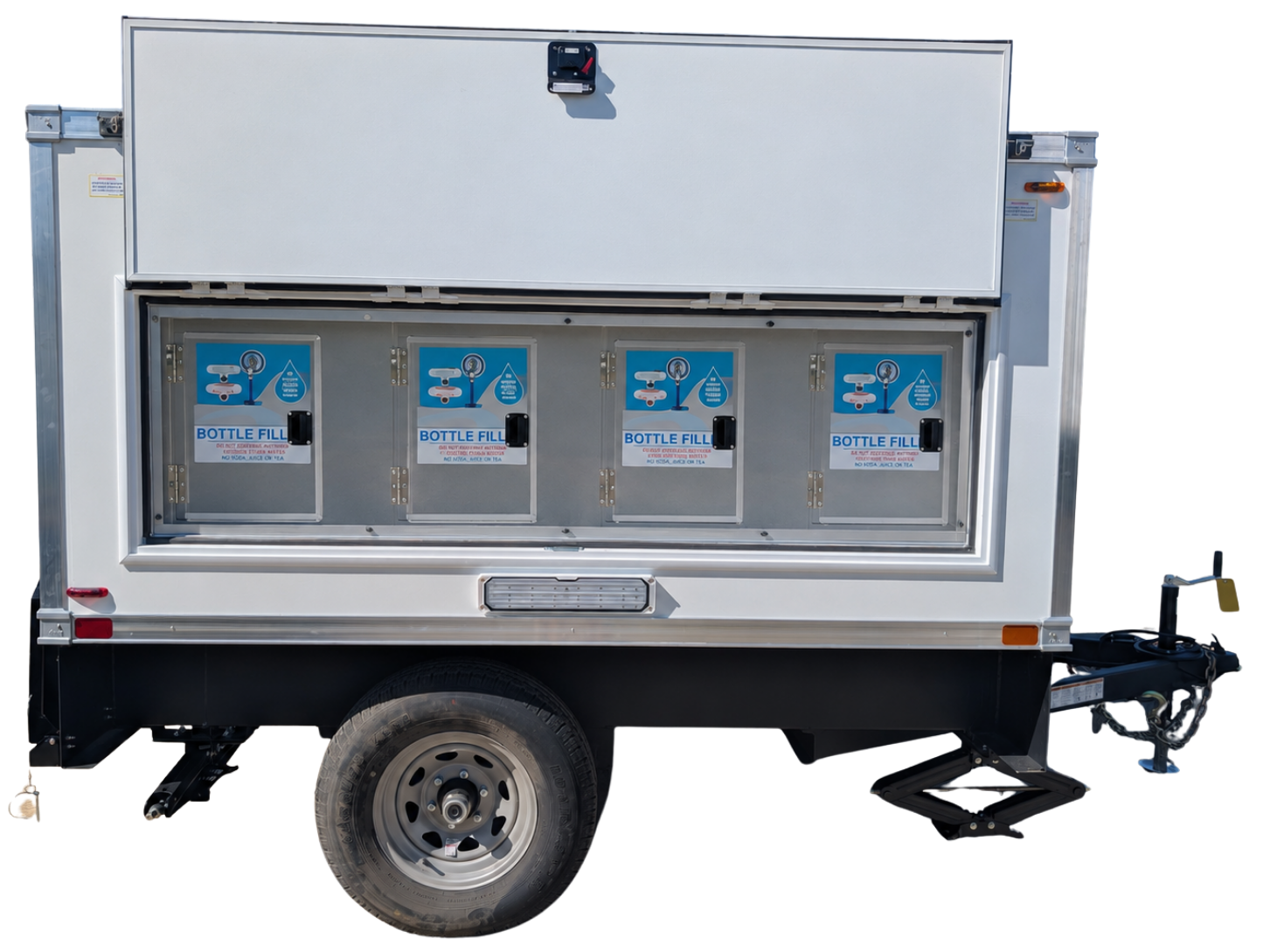
Signature Series specifications
It rides on a real trailer chassis with tires and a hitch, so it tows to a warehouse build, an arena event lot, a spring-training complex, or an emergency staging area and starts pouring the same day. This is the trailer West Valley contractors and event producers ask for by name, sized to drop in, level out, and serve a crowd or a crew without a fixed install.
| Filling stations on board | (4) Bottle Filling Stations |
| Fresh-water capacity | 300 Gallons |
| Trailer length | 12′ 3″ |
| Overall height | 8′ |
| Dry weight | 3,100 lbs. |
| Onboard cooling | 1 AC unit |
| Power needed | 1–4 dedicated 20A/120V circuits OR 1 dedicated 50A/240V circuit |
Why this is the trailer for Glendale work
The whole design answers to distance and heat. Four push-back positions run along an awning-shaded exterior wall, so a full crew, or a wave of arena-goers between sets, cycles through quickly rather than bunching at one tap. AC and built-in chillers keep the supply cold even as the trailer sits in full West Valley afternoon glare, which is precisely where a cooler or a bottled-water plan gives out on a Glendale July day.
That 300-gallon tank covers a healthy crew or a steady event crowd for a good stretch, and since the unit tows, we can walk it across a vast warehouse footprint or move it to the next phase of a 303 build without tearing anything down. Ordinary site power feeds it across a wide range, so one trailer handles an energized stadium lot or a raw desert pad we bring power to.
It carries more than the four headline stations, too: a rear large-jug filling point for five-gallon coolers and personal hydration packs, plus multiple hose-bib outlets for crew tasks, wash-up, and field use. One trailer covers the whole hydration picture for a Glendale event or job site.
A station costs less than bottled water once you run the numbers
A 62-person warehouse crew goes through about 372 plastic bottles every shift at six per person on a 110-degree day, and every one has to be bought, hauled, iced, and tossed, before anyone has poured a slab.
Stretch that across a 200-day project and you’re past 74,000 bottles, and on the bigger multi-building campuses rising near Luke Air Force Base and the 303, well north of that. One station replaces the whole pile, cold water on tap, with nothing left to cart to the dumpster.
A logistics call first, a sustainability win second
The plastic-waste angle is real, and worth a line in your sustainability report: Americans discard tens of millions of water bottles a day, only a fraction get recycled, and a single bottle can outlast the building it was drunk on by a few centuries in a Maricopa County landfill. But most Glendale project leads and event producers switch for a plainer reason, the daily scramble disappears. No standing bottled-water purchase order. No cooler gone lukewarm by mid-morning. No pallet of empties cooking by the gate or behind the concourse. Your superintendent supervises the build, and your event ops lead runs the show, instead of babysitting water.
Because our own potable water trucks keep the tank fed, the supply grows with the day rather than capping it. A framing crew that swells for a roof pour, or a lawn that sells through at the last minute, won’t drink the trailer dry. We just send a top-off.
Hydration shaped to the way Glendale actually fills up
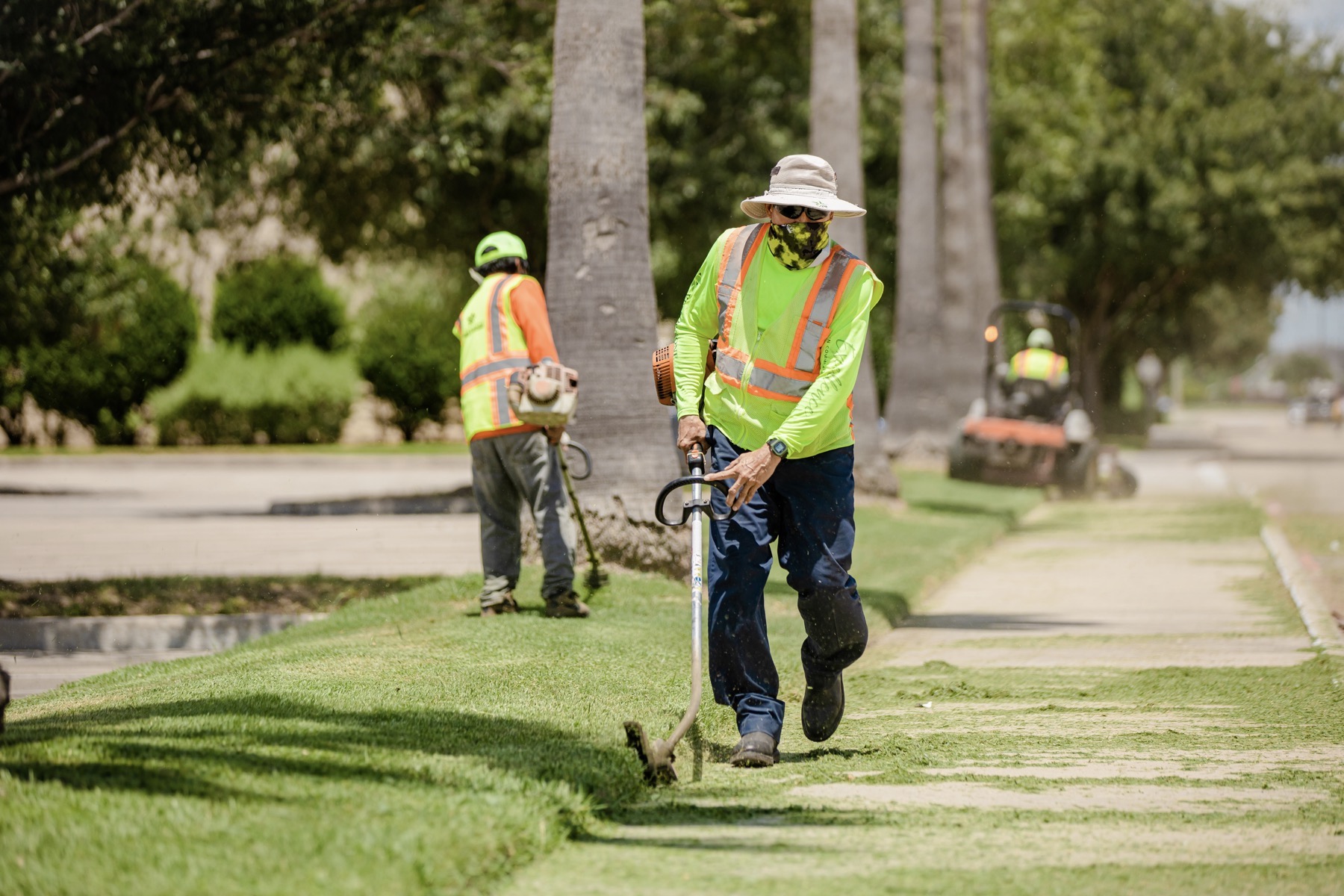
Glendale doesn’t have one hydration problem, it has a season of them. A Cardinals home Sunday at State Farm Stadium is a different equation from a Loop 303 warehouse pour, which is different again from spring training at Camelback Ranch or a melon-season harvest out west. Here’s where these trailers go to work.
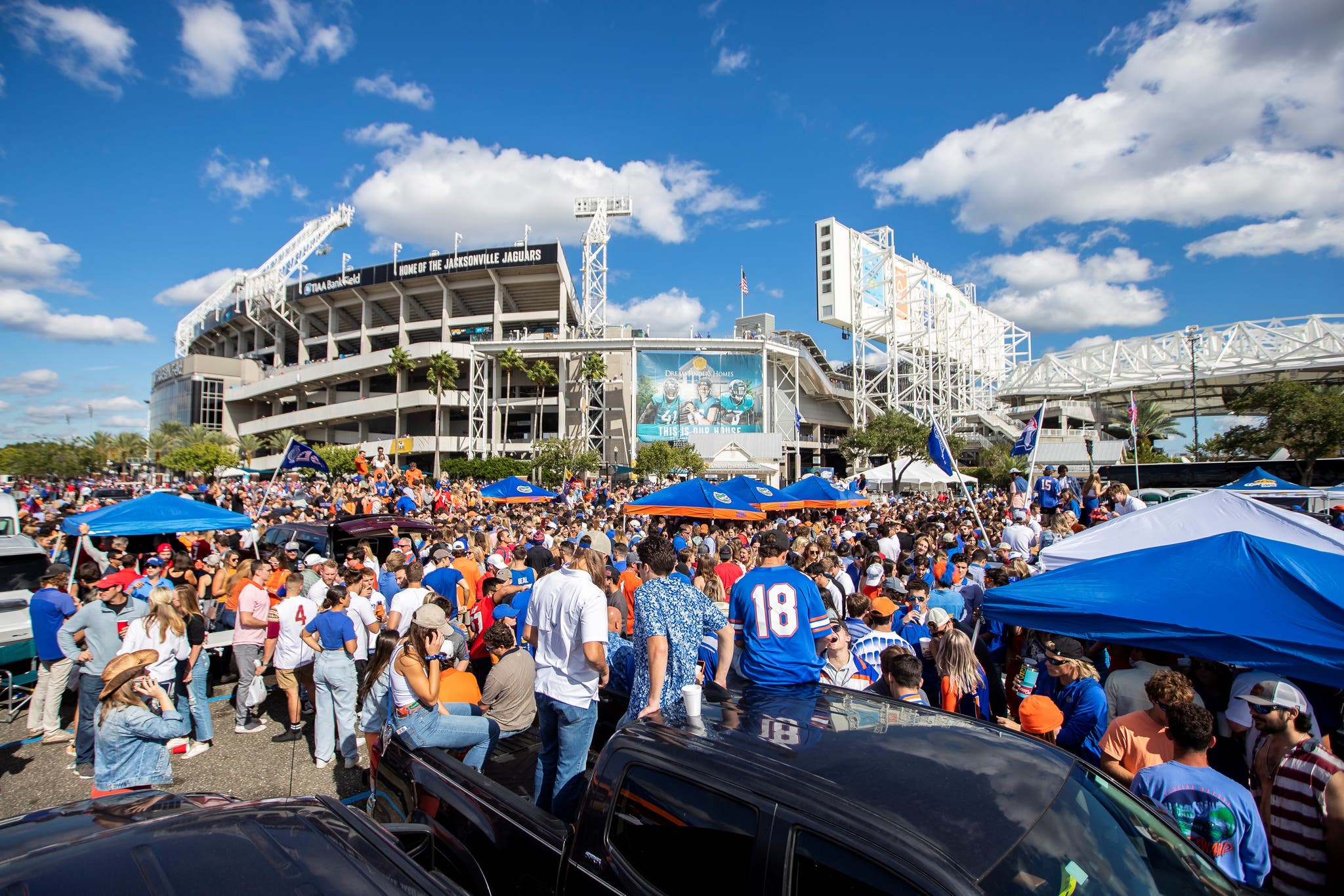
Stadium days, arena shows & Westgate
State Farm Stadium has hosted Super Bowls, the College Football Playoff title game, and Final Four weekends. Desert Diamond Arena packs concerts and Arizona Rattlers nights all summer. The Westgate plaza fills and empties around both. A station, or several across the footprint, gives the crowd free-flowing cold water and clean refill points without a freight container of single-use bottles to truck in and haul out.
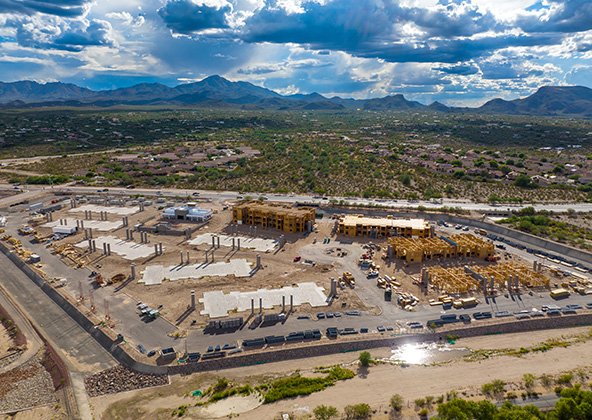
The Loop 303 warehouse & data-center build-out
Glendale’s industrial corridor is in a generational expansion, half-million-square-foot speculative warehouses near Camelback and Sarival, the Project Baccara data-center push near Luke Air Force Base, distribution shells feeding the semiconductor supply chain. Those are crews of hundreds in open sun. We staged our first corridor units along that stretch two summers back, and we keep documented cold water a short walk from every work face so contractors aren’t improvising hydration on a bare 110-degree pad.
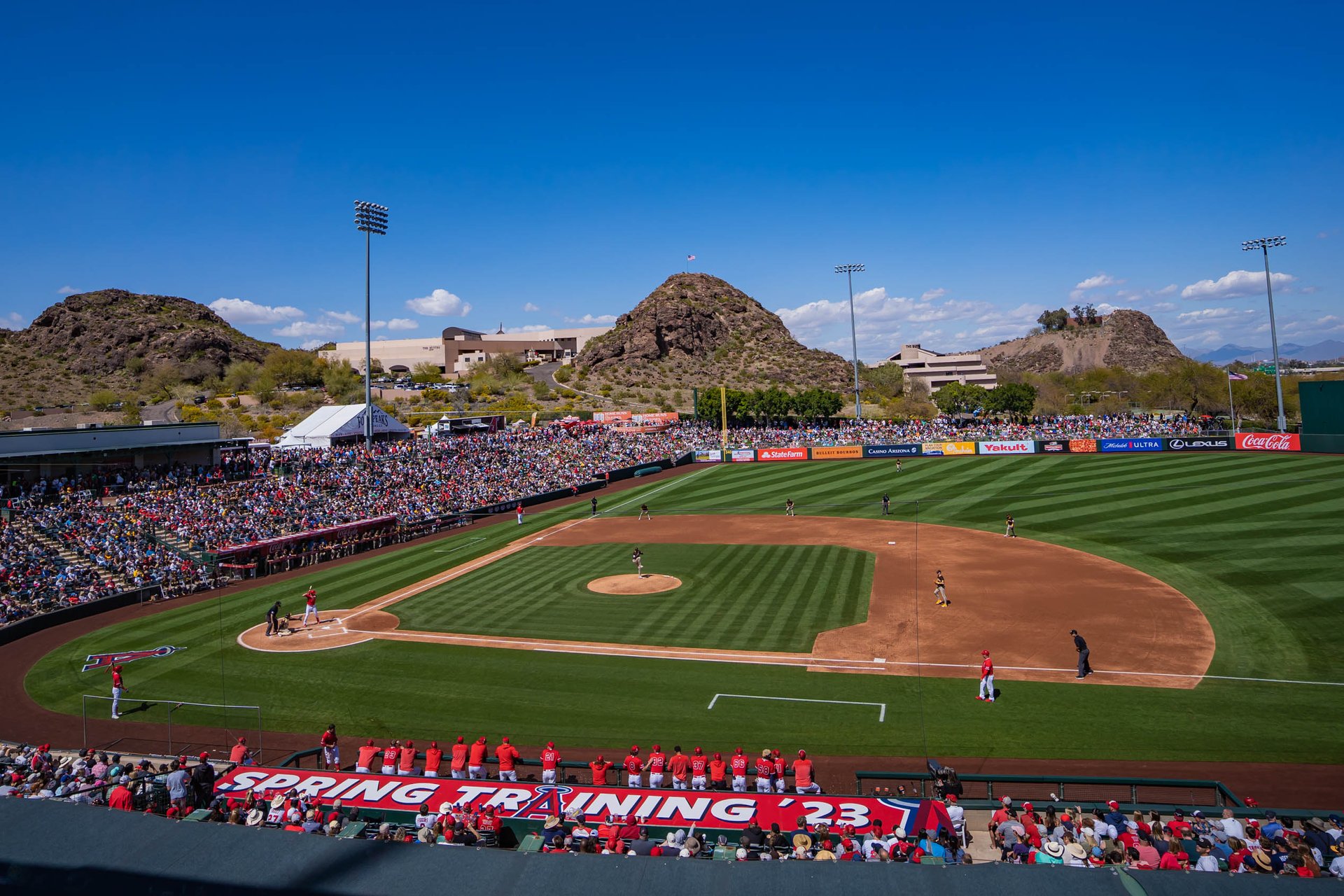
Spring training & tournament fields
Camelback Ranch brings the Dodgers and White Sox to Glendale-owned grounds, and the youth tournament complexes run all weekend in the sun. The crowds are thirsty. A towable station drops in at the gate or the practice fields, keeping fans, players, and staff in cold water without a wall of vending machines or a bottled-water tab that climbs all day.
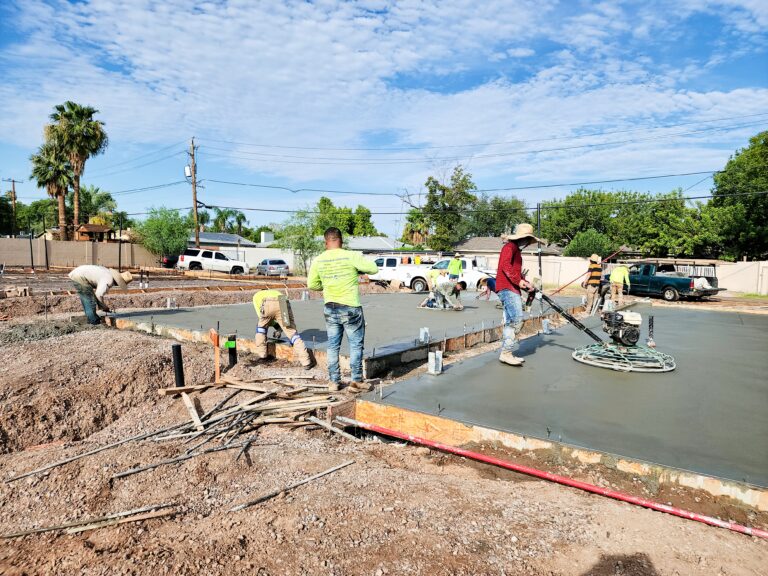
Outdoor industrial yards & disaster response
Laydown yards, equipment lots, and outdoor industrial work around Glendale put crews in the same brutal sun as any build, and a towable trailer drops right where they work. And when a heat emergency, power event, or water-main failure hits a West Valley neighborhood, we deploy potable water stations to cooling centers and base camps on short notice, the kind of last-minute call this number exists for.
Treated in three stages, run past UV, then chilled before it pours
Nobody drinks from a station they don’t trust, so the treatment matters as much as the chilling. Incoming municipal water runs a three-stage train and a UV pass before the chiller ever sees it, which is why the tap reads clean and genuinely cold on the meanest Glendale afternoon the calendar can throw.
Sediment first
The opening stage screens grit, rust flecks, and the fine particulate that older West Valley mains shed, clearing the water before any finer filtration goes to work.
Activated carbon
Next, carbon lifts out chlorine and the off-flavors tap water carries. Get this stage right and people actually choose the station. Get it wrong and they walk past it.
Micro-particulate stage
A sub-micron cartridge then captures the microscopic particles the earlier stages leave behind, a safeguard that protects workers and the public the same.
UV finish
Last, an ultraviolet chamber inactivates bacteria and pathogens using light alone, no added chemistry, the final check before water reaches the nozzle.
Three ways to fill, ADA height included
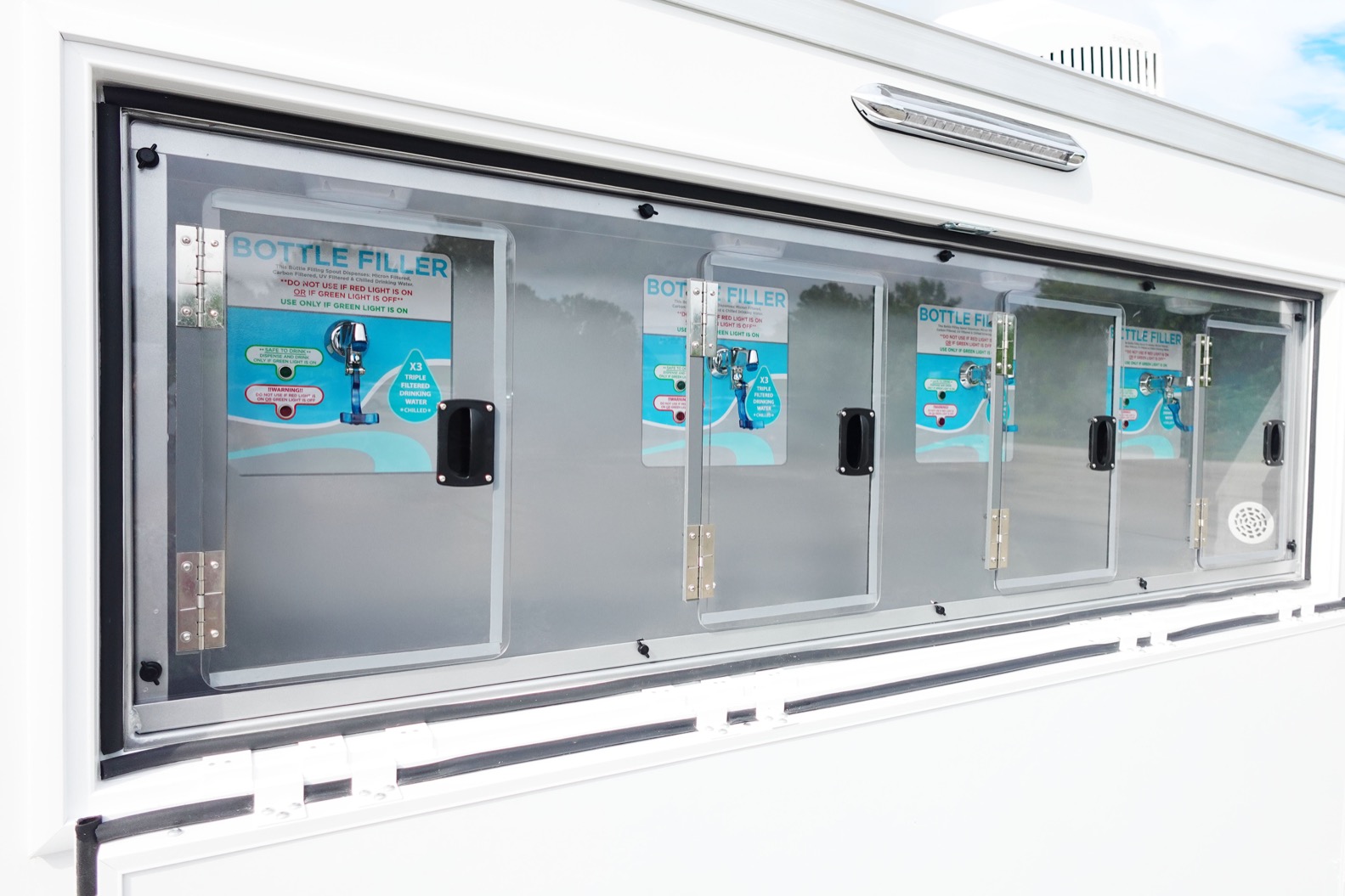
Each trailer wears four push-back filling positions with adjustable nozzles, press a bottle to the bar and it pours. One of the four sits at an ADA-accessible height, so a job site or an event is served for everyone without bolting on a second setup. Around back, a large-jug point fills five-gallon coolers and hydration packs, and a set of hose-bib outlets covers crew tasks, event support, and field work. Food-grade and stainless throughout, the unit protects that filtered-and-chilled quality at every contact point on the way to the tap.
One Signature trailer banks 300 gallons, on the order of 2,400 sixteen-ounce pours, and our trucks top it off on demand, so it never becomes the chokepoint on a packed Glendale gate day or a long warehouse shift.
We tow it in, fill it, and hook it up, usually pouring cold inside the hour
There’s nothing for your team to project-manage. We handle placement, the fresh-water fill, and the power hookup, and we walk your crew or event staff through the unit before we roll out.
Give us the basics
Crew or attendee count, how long you need it, where on the site or grounds it should park, and what power is available. Four answers, and we can spec the trailer.
We roll out to you
Reckon on roughly 45 minutes from dispatch across Glendale and the metro around it, with overnight and last-minute drops held open through heat events.
We level it and bring it live
We spot the trailer, charge the 300-gallon fresh tank, and tie into power, either three 20-amp 120-volt circuits at most, or one 50-amp 240-volt drop.
We keep it fed
For the length of the rental, our trucks return on a cadence set by your demand and we service the unit so it never falls behind.
A far corner of an event field or a remote pad with nothing wired to it? We sort the power in the quote. The trailer sips relatively little, and between that and the service fleet we’ve kept stations pouring on bare desert lots with no permanent hookup whatsoever. Describe what’s on the ground and we’ll build the rest around it.
In a Glendale summer, cold water on the work face is a documented safety duty
In an average year Glendale logs triple digits past a hundred days, and through stretches of July and August the night never lets go of the 90s. Work here answers to federal OSHA, and the rule on the books already obligates an employer to keep accessible potable drinking water on the job. The proposed national Heat Illness Prevention standard goes further still, leaning toward documented, suitably cool water held close to where the labor happens, which is precisely the role a refill station fills.
What the trailer really gives you is proof. Here is a fixed, mapped source pouring cold potable water on demand, the kind of evidence a Heat Illness Prevention Plan (HIPP) is built on and exactly what a West Valley inspector wants to walk up to, rather than your word that the coolers got topped off.
- Cool, potable water within reach of the work, all shift long
- A single mapped source you can log in your HIPP paperwork
- Backs scheduled water breaks and acclimatization for heat-exposed crews
- Already aligned with where the federal heat rule is headed, no last-minute scramble
Cold water for outdoor crowds in full Glendale sun
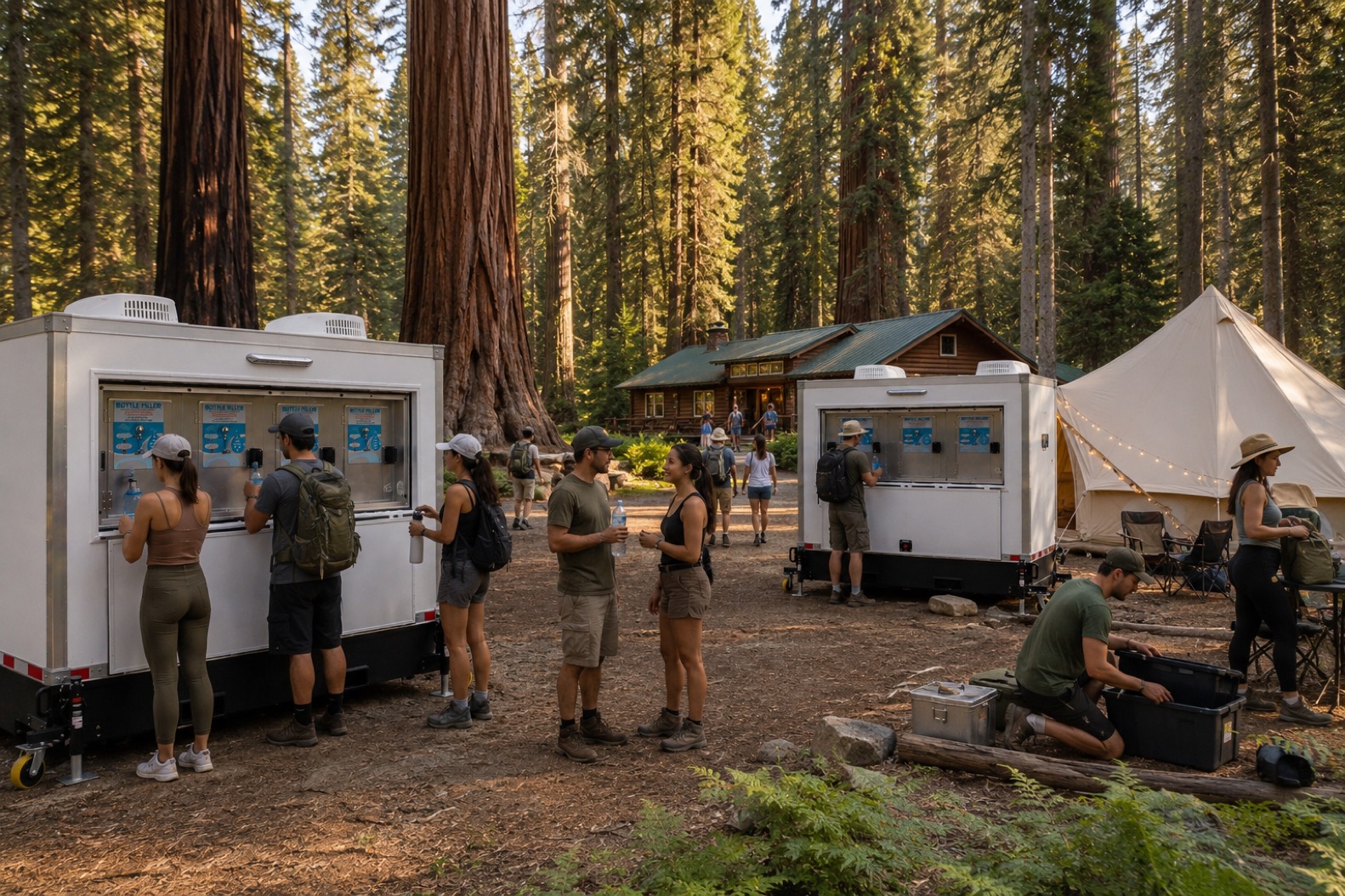
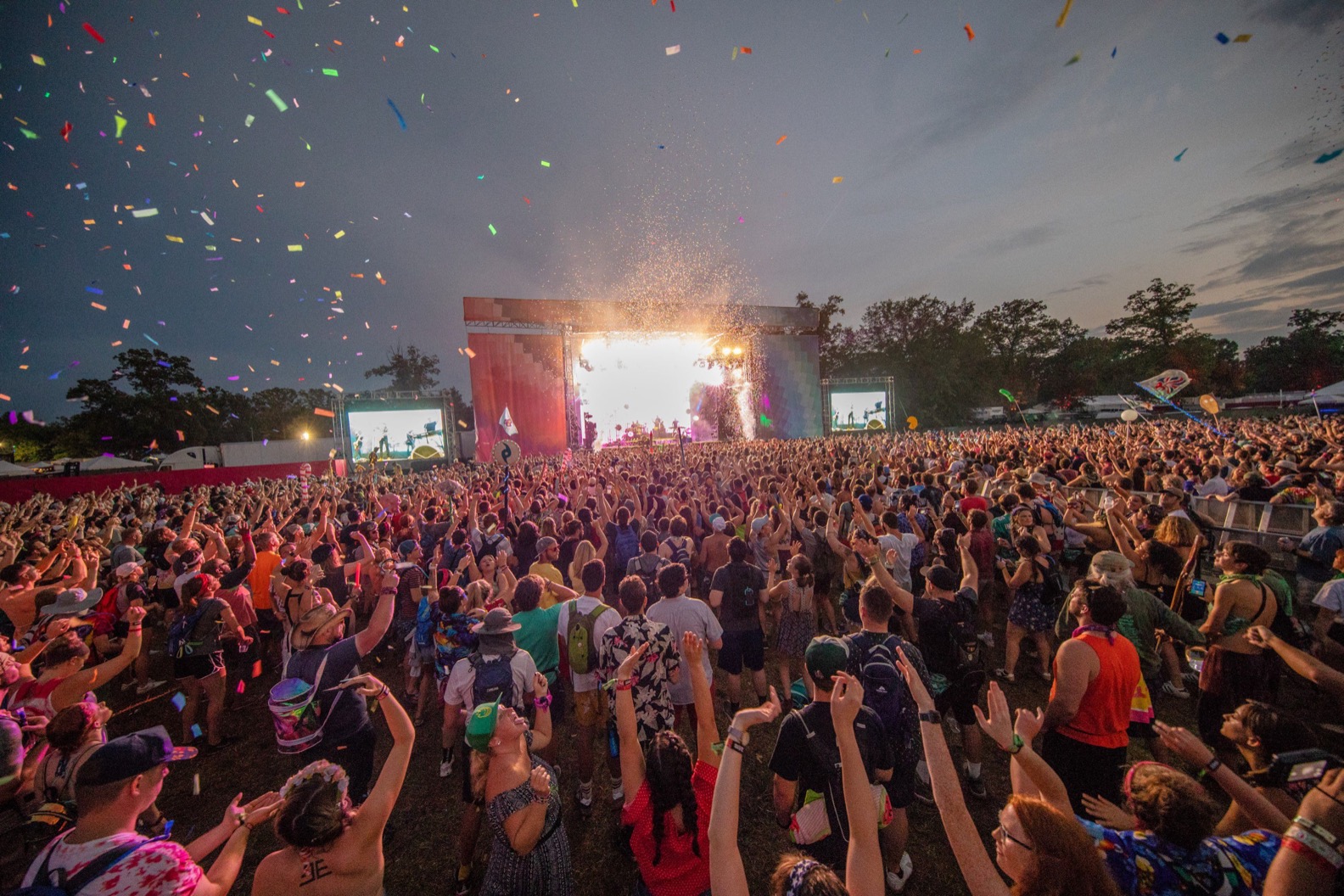
In Glendale, producers plan around the heat the way other markets plan around rain. A concert lawn at Desert Diamond Arena, a tailgate plaza outside State Farm Stadium, a downtown street fair at Murphy Park, a charity 5K that has to finish before the worst of the afternoon, each one needs a self-contained source pouring cold water and clean refills for the crowd. And each one is glad to be rid of the truck-in, ice-down, haul-out grind of single-use plastic, plus the recycling that spills over by mid-afternoon.
For a wide footprint we’ll set several units so nobody has to hunt for water, and the drop and pickup ride your run-of-show rather than our convenience. That lesson cost us once, at a packed West Valley show (gorgeous lawn, vicious afternoon glare) where a lone unit by the main gate grew a line dozens deep by 2 p.m. Thousands of people in that heat is a quick equation, and the producer’s text after was just three words: “Never one station again.” So the following year we scattered four across the grounds and the lines never formed. To a guest that feels like hospitality. To an ops lead it’s plain risk management. The same trailers, read two entirely different ways.
Why planning hydration in the West Valley is its own discipline
Plenty of cities get a hot week. Glendale gets a hot season measured in months, and the people building the West Valley’s future, and the crowds filling its stadiums, are out in the thick of it.
A typical Glendale calendar stacks up well over a hundred triple-digit days, plenty of them clearing 105, with deep-summer runs when the night air refuses to fall below the 90s. Asphalt and bare slab read far hotter than the shaded thermometer, so a crew can slide into real heat-illness risk by mid-morning while the official number still says a deceptive 102. In that kind of heat, cold water stops being a perk. It becomes the least expensive safety control on the lot, and the one most likely to be botched.
The hard part is the length of the exposure window. Somewhere temperate, a contractor absorbs a hot snap with a few extra coolers. A Glendale operation staring down half a year of summer can’t ice its way out, the throughput is too large, the warm-up too quick, and every day adds another round of buying, lugging, icing, and tossing bottled water. Only a centralized, self-chilling trailer carries a full West Valley season without turning into a side project of its own.
And demand keeps climbing, because Glendale is in the middle of a build-out and an events boom at the same time. The Loop 303 corridor is filling with speculative warehouses and distribution shells. And the Project Baccara data-center development pushing in near Luke Air Force Base would add millions of square feet (plus its own power plant and substation, by the plans that cleared county review). Each of those jobs puts hundreds of workers on open desert pads, many of them clocking in before sunrise just to get ahead of the afternoon. At the same time, Westgate, the stadium, and the arena keep funneling big outdoor crowds into the identical heat.
Our Glendale dispatch grew up around that twin rhythm. As we started seeding units along the 303 industrial belt and the Westgate event district, we pegged refills to headcount and gate count instead of a flat calendar, and we held overnight and emergency drops open whenever an advisory hit. On a West Valley megaproject or a packed arena night, a hydration gap isn’t a slowdown, it’s a hard stop, and the kind that lands somebody in the back of an ambulance.
Past the trailer: the trucks that keep a Glendale site supplied
The trailer is what people see. Out of sight, a support fleet moves fresh water in, parks buffer storage on site, and carries waste back out, which is why a single call settles the whole loop instead of juggling three vendors who don’t talk to each other.
Potable water trucks
Hauling drinking-grade water by the load, our trucks hold the 300-gallon tank full on a rhythm sized to your crew or crowd. They’ll also charge cisterns, onsite tanks, and bladders when a single delivery can’t keep up, think a slab pour or a sold-out gate day.
Bladder bags & buffer supply
Collapsible water bladders give you a fresh-water cushion through the busiest stretches, or sit as temporary greywater holding where a pad has nowhere to drain. It’s the understated piece that carries a far West Valley site between truck runs.
Pump trucks
Need supply shifted, drawn down, or relocated across the grounds? A pump truck does the moving, feeding storage or repositioning water wherever it has to go. It pays for itself on sprawling Westgate lots and 303 pads where the fill point and the station sit acres apart.
Vacuum & waste trucks
At the back end, a waste truck pumps and carries greywater and wastewater off to permitted disposal, which closes the loop. The question of where the used water ends up is never yours to solve. It’s been part of the service since we started.
These pieces interlock. A remote Loop 303 pad might take a station plus a bladder bag for buffer storage and a scheduled water-truck fill. A multi-day Westgate event might need a pump truck to move supply and a waste pickup at teardown. Describe the shape of your project and we’ll assemble the right combination, one contact, one invoice, one team that already knows your Glendale site.
The four answers that decide what we send, and why each one matters
Give us a couple of minutes on the phone and the quote comes back accurate. Below is what we’ll ask, partly so you can have it handy, and partly so you can watch us tailor each Glendale job rather than reach for one stock answer.
What shapes the recommendation
- How many people? A 15-person framing crew and a 12,000-seat arena night sit at opposite ends of the scale. Your peak headcount decides the number of stations and how hard we push the refill cadence.
- For how long? One concert, a three-week warehouse pour, and a nine-month Loop 303 build each want their own service rhythm. The short jobs lean on buffer storage on site, the long ones on a recurring truck-fill route.
- Where will it park? Being towable, the Signature settles into a yard, an event lot, a ballfield, or a corridor staging area. Pin the spot and the access route, and we can set it where foot traffic naturally flows.
- What’s the power situation? It runs on one 50-amp drop or as many as three 20-amp circuits. A West Valley pad with nothing wired yet is ordinary for us and fully workable, provided it comes up before delivery.
The details that get it exactly right
- The exact spot the station should sit, and the route a truck takes to reach it
- Whether your people are scattered across the grounds or clustered at one work face
- Any heat-illness paperwork your safety program needs the unit to stand behind
- Whether bulk water hauling, bladder storage, or waste pickup should ride on the same order
The costs a pallet of bottled water never prints on the invoice
On a purchase order, bottled water reads cheap. The true cost lives off the invoice, in the labor, the staging space, the warm-up, and the waste, and a Glendale summer turns up the heat under every one of those line items.
The labor that never makes the budget
Someone still has to place the bottled-water order, receive the pallets, break them open, ice the coolers at dawn, restock all day, and crush the empties for the bin. Across a big West Valley crew or a multi-day Westgate run, that’s hours of paid time every day, skimmed straight off the actual work. A station erases the chore. When we ran the comparison with one Loop 303 warehouse builder (a skeptic, going in), the labor savings alone covered the rental. He put it simply afterward: “I didn’t realize the bottles were eating half a day of payroll a week.” The trailer shows up full, refills itself from our trucks, and asks nothing of your super beyond a place to park. So the chore just disappears.
The warm-up problem
The cooler you iced at 6 a.m. is bath-warm by mid-morning on a Glendale July day. People stop reaching for warm water, and the minute a crew or a crowd stops drinking is the minute heat trouble starts to build. Onboard chilling skips that curve entirely. Whether it’s the last pour before the whistle or the final encore, it lands as cold as the dawn fill, right when an overheated crew or guest needs it most.
The staging and footprint tax
Stacked pallets eat staging space, choke laydown areas, and cook in the sun until somebody drinks them down. Empties accumulate faster than anyone hauls them off, and on a cramped Westgate event lot or a packed warehouse pad that pile turns into its own problem. A single trailer occupies one parking spot and handles the hydration of a crew or a crowd that would otherwise burn through hundreds of bottles a day.
The waste that trails you
Each bottle purchased is a bottle headed for the trash, and across one summer a busy Glendale site or showground throws off a small mountain of them. There’s the disposal bill, the ugly figure on a sustainability report, and the fact that in Maricopa County a tossed bottle can outlast the very building or event it served. Switch to a refill station and that line collapses to zero, leaving your ESG report a number actually worth printing.
A few things staging water in Glendale has drilled into us
Years of dropping stations across the West Valley have shaped how we run every job. A handful of lessons that stuck:
Lesson one: where you park it matters more than how big it is. On a Glendale warehouse shell, our first-day spot at the gate sat barely touched, because the work was deep inside and nobody burned a hot break walking out for it. A move to the interior staging door the next morning (thirty seconds closer) roughly doubled what crews drank by lunch. The foreman’s verdict stuck with me: “Make it closer than the shade and they’ll drink it.” Now that’s the question we settle before tank size ever comes up on a West Valley site.
Lesson two: schedule refills off the forecast, not the calendar. Reading one July advisory, we rolled extra trucks out ahead of it, and when three 303 sites all ran short the same brutal afternoon, none of them went dry. “You beat us to it, we didn’t even know we were low,” a safety lead wrote that night. The lesson actually landed a season before that, the time we didn’t pre-stage and spent the whole day a step behind. So now that cushion is written into every hot-weather contract rather than left to luck.
Lesson three: a crowd drinks faster than the plan ever assumes. At a Westgate-area summer show, the ops lead booked a single unit for a lawn that overfilled, and by mid-set the line had become a complaint of its own. A second trailer was pouring inside the hour (the producer flagged it in himself at the gate), and the next season we built the order off the gate count from the start. Water that never runs out is invisible to a guest, and invisible is exactly the goal. So we’ll happily over-stage and pull a unit rather than let a line form.
Every one of those calls hammered home what the heat already teaches: in Glendale, hydration isn’t a box you tick and forget. It’s a running operation, and we work it that way for the whole rental, whether there’s a crew or a crowd at the tap.
Cold water staged across Glendale and the West Valley
Our local dispatch covers Glendale and the surrounding metro end to end, from the Westgate and stadium district through Arrowhead and downtown’s historic Catlin Court out to the warehouse and ag corridors past the 303. If you’re in the West Valley, you’re inside our service radius.
Westgate DistrictState Farm StadiumDesert Diamond Arena
Arrowhead RanchArrowhead Towne CenterCamelback Ranch
Loop 303 corridorLuke AFB areaPeoria
SurpriseGlendale HeightsMaryvale edge
Litchfield ParkSun CityWest Phoenix
Working a corridor more than a single address? We follow the freeways the West Valley runs on, the Loop 101, the Loop 303, and I-10, so corridor and multi-site projects get the same fast turnaround as a one-stop drop.
The questions West Valley crews and event leads actually ask us
How fast can you get a water station to my Glendale job site or event?
Across the West Valley, reckon on roughly 45 minutes from dispatch, with overnight and last-minute runs held open all through the hot season. A crew that arrives to a 110-degree morning with nothing cold, or an event lead who discovers the hydration plan is warm pallets, can usually have a unit pouring before it becomes a real problem. The two honest unknowns are site access and what power you’ve got, so flag those and we’ll plan the run around them.
Will the water actually be cold, or just filtered?
Both, and that’s the whole point. A built-in chiller flash-cools each station’s own supply, so the temperature holds steady whether it’s the dawn fill or the last pour of the shift. The reason we engineer for it is simple, in Glendale a warm jug goes ignored while people quietly run themselves down. A cold one gets emptied, and emptied water is what keeps heat illness off your site, so chilling counts as safety equipment here, not a frill.
What’s the tank capacity, and who handles refills when it gets low?
Each Signature trailer banks 300 gallons of fresh water, on the order of 2,400 sixteen-ounce pours. When a crew is large or an event packs out, our potable water trucks return on a demand-driven cadence so the tank’s capacity never sets the ceiling. Refills aren’t your job to track. They’re ours.
Can you handle Westgate events and stadium days, not just construction?
Absolutely, events are core to what we do in Glendale. For a concert at Desert Diamond Arena, a tailgate plaza at State Farm Stadium, a downtown festival at Murphy Park, or a spring-training crowd at Camelback Ranch, we can stage one station or several across a large footprint, and we time the drop and the teardown to your run-of-show. Your crowd gets cold water flowing freely and clean refill points, while you sidestep the bill and the landfill pile that a truckload of single-use bottles leaves behind.
Will a rented station back up our OSHA heat-illness compliance?
Directly. Accessible potable drinking water on the job is already a federal OSHA requirement, and the proposed federal Heat Illness Prevention standard would tighten that toward documented, suitably cool water kept near the work. Drop in a station and you’ve got a fixed, mapped, chilled hydration point to write into a Heat Illness Prevention Plan and walk an auditor straight to. The safety program is yours to author. The hydration backbone underneath it is ours to deliver.
Is the station ADA-accessible for everyone on site?
They are. Of the four push-back filling positions on every unit, one sits at an ADA-accessible height, so a job site or an event covers everyone without a second arrangement bolted on. Out back there’s a large-jug fill for coolers and hydration packs, and hose-bib outlets handle crew tasks and field work.
Do you cover the whole West Valley or just central Glendale?
The whole West Valley. Our local dispatch reaches downtown Glendale and Catlin Court, the Westgate and stadium district, Arrowhead, Sahuaro Ranch, Camelback Ranch, and out along the Loop 303 toward Luke Air Force Base, plus neighboring Peoria, Surprise, and Litchfield Park. Corridor projects on the Loop 101, the 303, and I-10 are routine for us.
What does the water taste like next to bottled?
Clean and neutral, without the chlorine edge. Carbon filtration lifts out the chlorine and the flat off-notes West Valley tap can carry, so the nozzle gives you something that drinks fresh, not like a hose. It sounds minor, but it isn’t, a station earns its rental only when people genuinely reach for it, which is why we count taste as part of the safety math rather than a nicety.
What headcount can one station realistically carry?
More than most people expect, because the ceiling is how often we refill, not the tap itself. With four positions a crew or a crowd cycles through fast, and a single 300-gallon fill is good for somewhere near 2,400 sixteen-ounce pours. When the headcount climbs, we either tighten the truck cadence or drop a second trailer, so demand sets the size instead of the size capping demand. Give us your peak number and we’ll build the supply around it.
Can you deliver on short notice during a heat emergency?
Yes, and it’s why a lot of West Valley clients keep our number saved. Through heat advisories we keep last-minute and emergency drops running around the clock, and we move extra water trucks into position before a dangerous forecast lands. When a Glendale crew or event turns up on a triple-digit day with no working hydration, one quick call usually has a station pouring cold before the afternoon turns mean.
Trusted by the operations that can’t gamble on warm water
“My superintendent was spending the first hour of every shift babysitting coolers. We swapped the pallets for one trailer and that headache vanished overnight, and the pour at quitting time is still genuinely cold. That alone sold the rest of the team.”
“Booking it for a Westgate-area show meant our recycling pile all but disappeared and nobody waited in a water line. The crew dropped it and pulled it on our run-of-show, no chasing. We’ve already reserved units for next year.”
“An auditor wanted a mapped, documented cold-water source for our heat-exposed crew near Luke. A fixed station checked that box for the HIPP cleanly, and their truck topped us off ahead of demand rather than after we noticed a shortfall.”
Service details accurate as of mid-2026.
Lock in cold, filtered water for your Glendale crew or crowd before the next heat wave or gate time
Give us a headcount, your dates, and the spot the trailer should park. We’ll spec the job and put a unit on the road across the West Valley, generally landing within about 45 minutes of dispatch.