Water Station Rentals Sparks
Cold drinking water station rentals for Sparks jobsites, the TRIC corridor, and Victorian Square events, run on our scheduled northern-Nevada routes out of the Western U.S. yard network.
Sparks sits at 4,410 feet on the high-desert floor east of Reno, and that altitude is the part the thermometer won’t tell you. The dry air pulls water out of a crew through every breath, long before anyone feels thirsty. That’s the exact problem this service solves. We bring cold, filtered water straight to the work, whether it’s a data-center pad out at TRIC, a framing crew in Spanish Springs, or the Rib Cook-Off crowd packed onto Victorian Avenue over Labor Day. No warm cases by mid-morning, no cooler runs, no warehouse pallet melting in the sun.
Serving Sparks and Northern Nevada on Scheduled Routes
Let’s be straight about how we cover Sparks. Our closest staging yard isn’t in Washoe County, so we don’t run a 45-minute same-day truck the way a Reno-based outfit might claim to. What we do run is a real northern-Nevada route, supported out of our northern-California operation and the wider Western U.S. yard network, and Sparks is firmly on it. We dispatch to the Tahoe-Reno Industrial Center, Victorian Square, Spanish Springs, and the Sparks industrial area on a planned schedule, so the trick is simply giving us your dates a little earlier than a last-minute call. Tell us when and where, and a chilled station rolls onto your site full and cold. The map below is the ground we cover across the region.
Why Sparks Crews and Planners Book Us First
On a Sparks jobsite or at a Victorian Square event, keeping people supplied with cold water in high-desert heat isn’t a nice-to-have, it’s the difference between a full shift and a heat call. Everything that’s made us the name rental buyers trust across the West carries straight into Sparks, pointed at one job: getting cold, clean water within arm’s reach of crews and crowds at 4,400 feet.
A+ BBB Accredited
We carry an A+ rating with the Better Business Bureau and a long run of 5-star reviews behind it. Put a Sparks job in our hands and you're trusting a company with a documented record, not a name you found three pages deep on a search.
A Western Yard Network That Reaches Sparks
Our yards run through California, Nevada, Utah, Arizona and beyond, and Sparks sits on our scheduled northern-Nevada route off the northern-California operation. We don't promise a same-hour local truck. We do promise a chilled station on your site on the date you booked, every time.
A Live Person, 24/7
Dispatch, availability, and support run around the clock. So when a unit on a TRIC pad needs to move or a tap acts up at 3 a.m. on a graveyard shift, you reach somebody who can actually fix it instead of a recording.
Two Generations in the Event-Rental Trade
Renting gear for events and jobsites is the family business, and has been for two generations. That history is why we read a Sparks job, and the spots it can go sideways, faster than a newer crew ever could.
Big-Fleet Reliability, Local-Outfit Care
You get the equipment depth and dependability of a large operation with the attention of a small one. Scale up when a TRIC megasite needs it, get a straight answer and a real owner's accountability when one job matters.
Our Trailers, Our People, Our Name on It
We aren't a broker handing your Sparks job to whoever's cheapest that week. The stations are ours and the drivers are on our payroll, so the responsibility lands on the company you actually called.
Licensed, Insured, DOT-Compliant
You're covered for whatever the day throws at the site. We carry full licensing and insurance, run DOT-compliant on every haul into Nevada, and issue a Certificate of Insurance for any venue or general contractor that needs one.
Trusted by the Toughest Buyers
Corporate America, government agencies, municipalities, and school districts already choose us. When buyers with the strictest vendor-approval process say yes, the hard vetting is already done on your behalf.
American-Built for Real Work
Every station is made in the USA to take a beating. No DIY rigs, no YouTube-plan builds, nothing imported on the cheap, just equipment engineered to run hard in desert heat and keep running.
Introducing the Signature Series, Our Premier Cold Water Bottle Filling Station
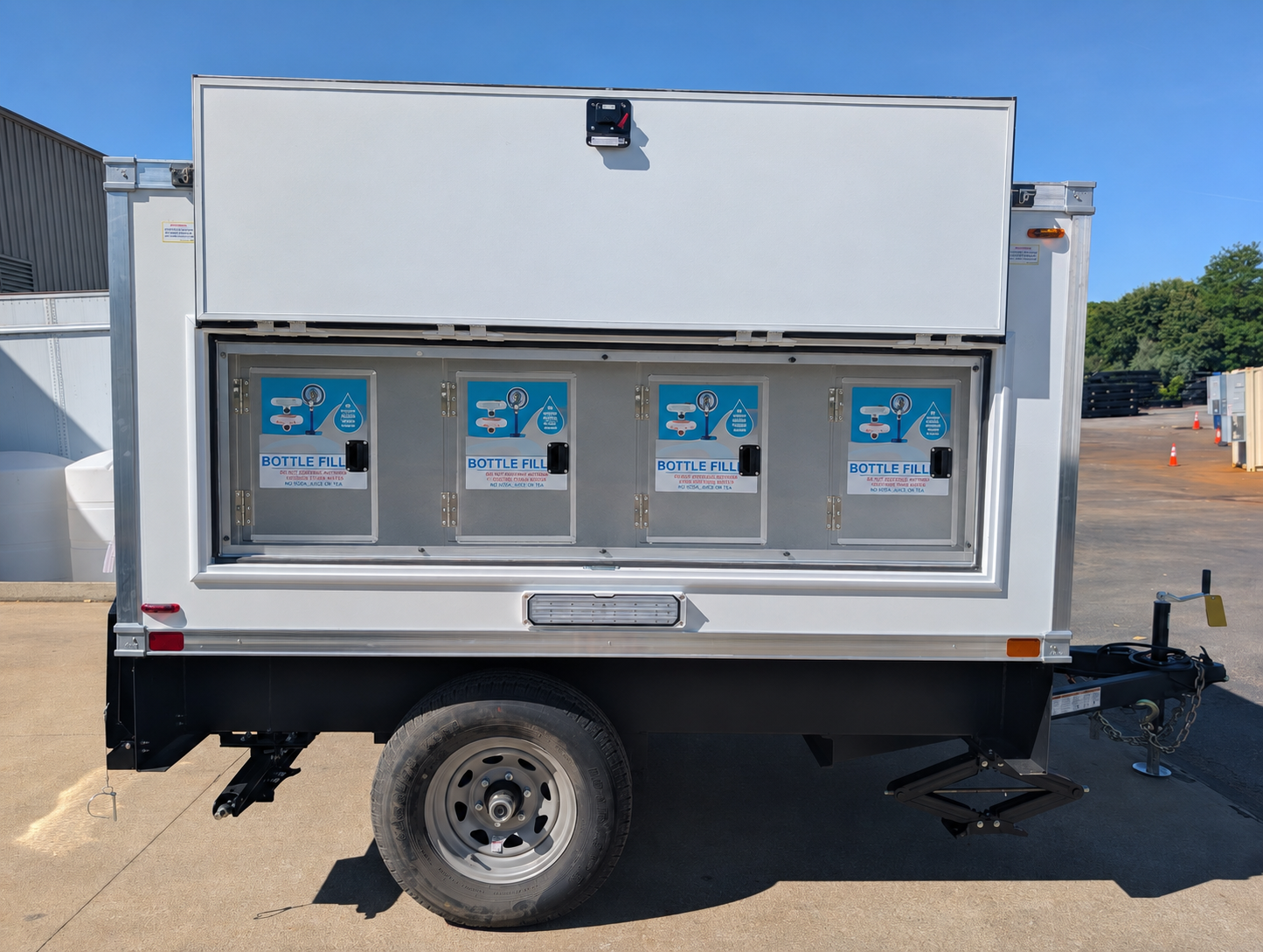
The Signature Series is our premier cold water bottle filling station, and it’s the entire focus of what we rent. One purpose-built rig, engineered for the dry high-desert heat Sparks gets all summer: four push-back taps, a 300-gallon insulated tank, an in-line chiller that holds water at drinking temperature when it’s 100°F outside, and multi-stage filtration that takes the hard-mineral edge off Truckee River water. It tows in, levels on uneven or unpaved ground, and runs self-contained on shore power or a small generator. That’s what lets it work a TRIC data-center deck, a Spanish Springs subdivision, and a Victorian Square stage with the same ease.
Setup is quick. We back it in, level it on whatever ground you’ve got, and either tie into a hose bib or run it off the onboard tank. A few minutes later it’s pouring. Your crew or your crowd pulls cold water from four taps all shift while we handle the refills and the haul-off, so water stops being something you have to think about until the job wraps.
| Spec | Value |
|---|---|
| No. of Stations | (4) Bottle Filling Stations |
| Length | 12′ 3″ |
| Weight | 3,100 lbs. |
| Height | 8′ |
| Fresh Water Tank | 300 Gallons |
| Power Requirements | 1-4 dedicated 20A/120V circuits OR 1 dedicated 50A/240V circuit |
| No. of AC Units | 1 |
Sparks Jobs and Events That Rely on Our Hydration Stations
A graveyard shift on a Switch data-center pad at TRIC and the Rib Cook-Off crowd on Victorian Avenue have almost nothing in common, except the high-desert heat, the altitude, and a need for cold water that’s actually close by. That single need is the whole business. Here are the Sparks and northern-Nevada situations we get called for most, with what the mobile drinking water station does in each.
Tahoe-Reno Industrial Center Data Centers
Switch, Google, and Microsoft run sprawling data-center campuses across the 107,000-acre TRIC just east of Sparks, with construction and operations crews spread over pads miles from any retail water. We stage chilled stations per active zone and refill on a route so a 1,000-worker buildout never runs dry.
Tesla Gigafactory & Manufacturing
The Tesla Gigafactory and the manufacturing tenants packed into the TRIC corridor put shift workers in big-box plants and on outdoor staging yards through the summer. A portable water station at the dock face and the yard keeps cold water within reach where the bottled-water cart never quite reaches.
Warehouse & Distribution
Sparks is the logistics hub of the northern-Nevada crossroads, with millions of square feet of warehouse along the I-80 corridor feeding Walmart, eBay, and the rest. Un-conditioned high-bay and dock space bakes in July, exactly the indoor heat Nevada's new rule now names. We position units at staging lanes and dock doors.
Spanish Springs Housing Build-Out
Sparks pushed its growth north into Spanish Springs and Wingfield Springs, and framing, roofing, and concrete crews work open slabs and bare rooftops all summer. Rooftop is the hottest exposure on any site. A chilled station parked at the model-home pad beats coolers that go warm by ten.
Best in the West Nugget Rib Cook-Off
Every Labor Day weekend the Rib Cook-Off closes Victorian Avenue and pulls hundreds of thousands of people onto open pavement for more than 240,000 pounds of ribs. We stage water station rentals for events across the footprint so the lines for cold water never become the bottleneck.
Hot August Nights
Hot August Nights brings classic-car crowds and outdoor staging into the Nugget and Victorian Square in the hottest stretch of the Sparks calendar. Distributed refill points keep tens of thousands of attendees stocked with cold, filtered water on hardscape that radiates heat well past sundown.
Golden Eagle Regional Park Tournaments
Golden Eagle's 1.4 million square feet of turf hosts USA Softball, Triple Crown, and youth baseball tournaments that draw over a million participants and spectators a year. Sun-exposed fields and parking with no shade make a drinking water station at the complex an easy call for organizers.
Sparks Marina & Outdoor Events
Festivals, races, and city gatherings at Sparks Marina put crowds on open shoreline trails in full sun. The self-contained tank serves a few hundred to a few thousand people with cold filtered water where there's no plumbing on the trail.
Endurance Races & Cycling
Northern-Nevada road races, gran fondos, and trail events string aid points across the high desert where no tap exists. We drop cold water at start areas, aid stations, and finish festivals, and the chiller holds drinking temperature through a 90-plus-degree afternoon.
Weddings & Private Events
Backyard and venue weddings around Spanish Springs and the Truckee Meadows put dressed-up guests in dry heat that's harder on the body than it looks. An elegant bottle filling station at cocktail hour serves a few hundred guests without the plastic-bottle clutter.
Film & Commercial Production
Nevada's film incentive keeps shoots working the Truckee Meadows and the open desert east of Sparks, often well past the end of any water line. A self-contained 300-gallon chilled tank stands up a base camp for catering, talent, and crew with zero hookup.
Roadwork & Utility Crews
NDOT and utility crews work hot asphalt and trenches on the USA Parkway, I-80, and the Pyramid Highway corridors, where the work front moves daily. A relocatable chilled station follows the crew instead of leaving them to truck warm cases out to the zone.
Disaster Response & Cooling Support
Washoe County opens cooling stations during extreme-heat stretches and stands up base camps during wildfire season in the Sierra foothills. The self-contained tank backs a center past its plumbed capacity or supplies a fire camp where municipal water isn't an option.
Government & Campus Crews
State and federal field crews, plus surge events at northern-Nevada campuses, put people far from a tap or pull big crowds into the heat. We hold active SAM.gov registration, so we can bid federal work in the region the day a solicitation posts.
Where We Run in and Around Sparks
Sparks isn’t one job, it’s a downtown event district, a fast-growing northern suburb, a heavy-industrial flat, and a 107,000-acre industrial corridor that technically sits in the next county over. Each drinks differently and routes differently. So we plan every rental against the real heat, the altitude, and the drive into that specific pocket. Here’s how each one works and what it needs.
Victorian Square & Downtown Sparks
Victorian Avenue · Nugget Casino Resort · the downtown event district
The Microclimate
High-desert valley floor at 4,410 feet. July highs average around 92°F, the air runs bone-dry, and the brick and pavement of Victorian Square hold heat into the evening. The altitude quietly doubles the water a body loses through breathing before anyone breaks a sweat.
Where It Is Needed
The densest event demand in Sparks: the Best in the West Nugget Rib Cook-Off over Labor Day, Hot August Nights, Sparks Hometowne Christmas, the Nugget's concert and convention calendar, and the street festivals that close Victorian Avenue all summer.
How the Signature Series Fills the Need
We stage hydration stations across the closed-street footprint, set distributed refill points so cold-water lines never back up, and position units at entry gates and stage areas where crowds pack in. Event dates book early here, so give us the calendar ahead of time.
Spanish Springs & North Sparks
Spanish Springs · Wingfield Springs · Sun Valley · the Pyramid Highway corridor
The Microclimate
The same dry high-desert heat as the valley floor, climbing slightly in elevation as you head north toward Pyramid Lake. Wide-open subdivisions and graded lots offer almost no shade, and afternoon sun on a bare slab or a new roof is brutal by mid-July.
Where It Is Needed
The residential build-out that's driven most of the city's growth, Golden Eagle Regional Park tournaments out near Wingfield Springs, and the school and community events that fill the northern suburbs. We cover this entire side of the Nevada service area with the same crew and the same equipment.
How the Signature Series Fills the Need
We park chilled stations at model-home pads and active framing zones, and cover tournament fields where a thousand-plus families sit in open bleachers. Self-contained operation matters because so much of this work happens on raw lots before any water line is run.
Sparks Industrial & the I-80 Corridor
the Sparks industrial area · the I-80 logistics corridor · the rail yards
The Microclimate
The valley-floor heat plus the radiant load of metal roofs, asphalt yards, and un-conditioned high-bay warehouse. Indoor dock and staging space can run hotter than the air outside, which is precisely the indoor-heat exposure Nevada's heat regulation now covers.
Where It Is Needed
The distribution centers feeding the northern-Nevada crossroads, manufacturing plants, rail-yard operations, and the trucking and logistics workforce that runs the corridor.
How the Signature Series Fills the Need
We position stations at dock doors, staging lanes, and yard work areas so crews don't lose ten minutes walking to water. For multi-month operations we keep the same unit on site and run a regular refill route built around your shift pattern.
The Tahoe-Reno Industrial Center (TRIC)
USA Parkway · the Switch / Google / Microsoft campuses · the Tesla Gigafactory corridor
The Microclimate
Open high-desert flat east of Sparks in Storey County, exposed to full sun with zero natural shade and the wind that whips across the bench. Pads sit miles from any town, so there is no retail water and often no plumbing on a fresh construction zone — the same isolation that makes Reno water stations the closest practical option for crews working the far end of USA Parkway.
Where It Is Needed
The largest industrial park in the country at 107,000 acres: data-center construction and operations, the Tesla Gigafactory, and the warehouse and manufacturing tenants spread along USA Parkway, with tens of thousands of workers across the corridor.
How the Signature Series Fills the Need
This is the clearest case for delivered hydration that needs nothing from the site. We bring the tank full, bring a generator when there's no shore power, stage a unit per active zone, and move it with the work front so a crew a mile from the gate still has cold water on hand.
What We've Learned Running Sparks and the High Desert
A lot of what makes a Sparks rental go right never shows up on a spec sheet. It's the stuff our dispatchers and drivers have picked up over years of routing the high desert, and it's worth passing on because it changes how you should plan.
The altitude does damage the thermometer hides
Sparks sits at 4,410 feet, and that elevation is the variable people skip when they plan water. Up here the dry, thin air pulls fluid out through every breath before a worker ever feels hot. We've watched crews start to drag at 'only' 89 degrees because somebody hydrated for the number on the dash, not for the altitude stacked on top of it. So we size the water for both. Every job.
Where you park the unit matters more than how many you bring
The mistake we see most is one station parked at the gate of a big TRIC pad. On a data-center zone we stage a unit per active area and move it as the pour moves. On a Spanish Springs subdivision we shift it with the framing crews each morning. A worker who has to walk a quarter mile across an exposed lot for water just drinks less, and then it's a heat call.
We plan deliveries around the Sparks event calendar
Labor Day weekend is the Rib Cook-Off, and Victorian Square goes from open street to a crowd of hundreds of thousands overnight. We stage water station rentals for that footprint days early and refill before the afternoon peak, because once the avenue fills you're not driving a truck through it. Hot August Nights gets the same treatment. The dangerous window at a downtown event is the whole hot afternoon, not one peak hour.
Routing Sparks is honest scheduling, not a same-hour promise
Here's the part some vendors won't say out loud. We don't keep a yard in Washoe County, so we don't pretend a truck is 45 minutes out. We run a planned northern-Nevada route, and Sparks is a regular stop on it. The fix is simple: book a little earlier than you would a same-day call, and we lock your date. We'd rather tell you that than overpromise and leave a crew dry on a Tuesday in July.
We refill against the shift, not against the clock
On a long TRIC or warehouse rotation a hot crew can pull a full 300-gallon tank down well before a shift ends, so we don't wait for it to run dry. We time a top-off into the rotation, usually mid-shift, so the swing and graveyard crews get the same cold water the day crew had. The gap nobody scheduled is always the one that turns into a problem.
We check the access road before we commit the trailer
Plenty of the hardest northern-Nevada deliveries aren't about heat at all, they're about getting a tow rig and a loaded trailer onto a fresh pad and back out. Before we promise a remote TRIC zone or a graded Spanish Springs lot, the driver checks the road, the turnaround, and the ground. We've saved more than one job by routing around a soft shoulder or a washed-out grade that would've stranded the unit when the crew needed it most.
What Sparks Crews and Event Planners Tell Us
We had crews scattered across a data-center pad out on USA Parkway and our bottled-water plan was a joke by mid-morning. I gave them our schedule, they had a Signature Series on the zone the day we needed it, then added units as we opened more areas. They basically wrote the water side of our heat plan for us.

Our Labor Day weekend on Victorian Avenue puts an enormous crowd on hot pavement and the old water points were a chokehold. They staged stations across the whole footprint and the cold-water lines vanished. Booked it well ahead, no drama, and they answered every call during build days.

Open lots, no shade, no water tap for blocks, and a July framing schedule. They dropped a self-contained unit at the model pad and moved it with my crews as we worked north. First summer in years I didn't lose hours to guys gassed out on the roof.

We run weekend baseball tournaments with a thousand-plus people in open bleachers in full sun. They showed up clean, set up fast, and the cold filtered water was a hit with families and umpires alike. We schedule them every tournament season now.

Get Cold Water Routed to Your Sparks Site
Whether it's water station rentals for an event on Victorian Square, a hydration station for a TRIC pad, or a bottle filling station for a Spanish Springs build, send us the location, the dates, and the headcount. Because Sparks runs on our scheduled northern-Nevada route, booking a little ahead gets you a locked delivery date, and your quote includes the Nevada water-per-worker capacity math. We answer 24/7.
📞 Call Now (866) 748-5932Request a QuoteEverything to Know Before You Rent in Sparks
The deeper detail, sorted so you can open only what you need: the heat-and-altitude science, Nevada’s new heat rule, where the water comes from and how we filter it, and the sustainability case. This is the knowledge base behind being the most informed water-station partner running northern Nevada.
Sparks sits at 4,410 feet on the high-desert floor east of Reno, with a semi-arid climate that runs hot and bone-dry all summer. July highs average about 92°F, and the city pushes into the upper 90s and occasional 100°F days during heat waves. The danger here isn’t only the number on the thermometer. It’s what the dry air and the elevation do underneath it.
Two things make Sparks heat sneakier than it feels. First, humidity: at the single-digit-to-low-30s percent levels northern Nevada runs, sweat evaporates the instant it surfaces, so a worker never feels wet and badly underestimates the fluid they’re losing. Second, elevation: at 4,400-plus feet the thinner, drier air roughly doubles the water lost through breathing before anyone sweats a drop. From there dehydration moves fast, through fatigue and clouded judgment to heat exhaustion and, once sweating stops, heat stroke. Cold water genuinely within reach is the most effective way to keep a Sparks crew or crowd ahead of that curve.
This is where Nevada differs from a lot of states, and it matters for your Sparks jobsite. Nevada adopted its own heat-illness prevention regulation, R131-24AP, on November 15, 2024, and Nevada OSHA began full enforcement on April 29, 2025. It applies to employers with more than 10 employees under Nevada OSHA jurisdiction, and it covers both indoor and outdoor work, which sweeps in Sparks warehouse docks and high-bay space, not just open pads.
The rule requires a job hazard analysis and, where heat is a hazard, a written Heat Illness Prevention Plan that includes providing potable water, rest breaks when symptoms appear, cooling methods, monitoring, and employee training. Federal OSHA’s water-rest-shade benchmark still sets the practical bar at one quart of cool water per worker per hour, kept as close to the work as practicable. A chilled, filtered station staged at the work zone is the cleanest way to satisfy the water piece of Nevada’s plan and the federal benchmark at once.
Sparks drinking water comes from the Truckee Meadows Water Authority, the community-owned utility serving more than 475,000 people across Reno, Sparks, and Washoe County. About 85 percent of that supply is surface water from the Truckee River system fed by Lake Tahoe and Sierra snowmelt, treated locally at the Glendale Water Treatment Plant in Sparks, with groundwater wells brought online in the hot, dry stretches of summer. You can read the source detail straight from TMWA.
We fill from tested, potable municipal sources like these, then run every drop through multi-stage on-board filtration, sediment, carbon, and a fine final filter, before it reaches the tap. Truckee Meadows water carries real mineral content, and that mineral edge is exactly the taste that keeps people from drinking enough on a hot jobsite or at a packed event. The filtration strips it out and the chiller serves it cold, and that combination is what actually gets crews and crowds to keep drinking.
Northern Nevada runs on a careful water budget. The Truckee River is the backbone of the supply for the whole Truckee Meadows, and the Southwest is in its driest multi-decade stretch in over a thousand years, so conservation and cutting single-use plastic sit squarely inside the sustainability goals events and public agencies get measured on.
At event scale the disposable-bottle stream gets ugly fast. A Labor Day Rib Cook-Off or a Hot August Nights weekend can push tens of thousands of plastic bottles toward a landfill in a few days. A refillable chilled station flips that, serving colder water and almost no waste at the same time. On the jobsite side, killing the truck-in, truck-out bottled-water cycle out at a TRIC pad is a small, visible win that also leaves the crew better hydrated than the cases ever did.
Sparks Water Station Rental Questions, Answered
Get your dates to us as soon as your event hits the calendar. Sparks rides our scheduled northern-Nevada route rather than a local same-day truck, so lead time is what locks your delivery slot. The Best in the West Rib Cook-Off, Hot August Nights, and Sparks Hometowne Christmas claim the busy weekends first, so a Victorian Avenue producer who calls early gets the date they want. Send the location and run-of-show and we’ll confirm availability.
Yes, and that crowd-on-pavement scenario is squarely what we plan for. The Rib Cook-Off packs hundreds of thousands of people onto a closed Victorian Avenue over Labor Day weekend, so we stage multiple stations across the footprint and set distributed refill points at entry gates and stage areas. The cold-water line stops being the bottleneck. We refill before the afternoon peak, since once the avenue fills you can’t drive a truck through it.
It does, and we’d rather say that plainly than overpromise. We don’t keep a yard in Washoe County, so we cover Sparks on a planned northern-Nevada route supported out of our northern-California operation and the Western U.S. yard network. The trade-off is simple: give us a little more notice than a last-minute call, and we lock your date. A chilled station then rolls onto your site on schedule, full and cold.
That’s a core Sparks job for us. The distribution centers feeding the northern-Nevada crossroads run un-conditioned high-bay and dock space that bakes in July, and Nevada’s heat rule now names that indoor exposure specifically. We position stations right at dock doors, staging lanes, and yard work areas so crews don’t burn ten minutes walking to water, and on multi-month operations we keep the same unit on site and refill against your shift pattern.
That’s exactly what the unit is built for. The 300-gallon tank arrives full and cold and runs self-contained, and for pads with no shore power we bring a right-sized generator to keep the chiller going. We get well out the USA Parkway corridor and onto fresh data-center construction zones that sit miles past the end of any water line, staging a unit per active area as the work front moves.
Yes. Nevada adopted its own heat-illness regulation, R131-24AP, and Nevada OSHA has enforced it since April 29, 2025. It applies to employers with more than 10 people, covers both indoor and outdoor work, and requires a written plan that includes providing potable water. Staging a chilled station at the work zone is a clean way to satisfy the water piece, and every quote we send includes the per-worker capacity math.
The practical benchmark, drawn from federal OSHA’s water-rest-shade guidance and folded into Nevada’s plan, is at least one quart of cool water per worker per hour. That’s roughly two gallons over an eight-hour shift, closer to three on a long warehouse or TRIC rotation in the high-desert heat. Our 300-gallon tank carries a large crew through a shift at that rate, and we run the headcount-times-hours math on every quote.
Tournament weekends are an easy yes. Golden Eagle’s sprawling turf complex out near Wingfield Springs hosts youth baseball and softball events that put a thousand-plus families in open bleachers with no shade and parking that radiates heat. We set chilled, filtered stations at the fields and concourse so players, umpires, and spectators pull cold water without leaving the complex, and we schedule them back across the tournament season.
Cold, even after the trailer has sat in full sun all afternoon. The in-line chiller and insulated tank are specified for high-desert summer, so water stays at drinking temperature at the tap when it’s 100 degrees out. That matters more than it sounds at 4,410 feet: cold water gets consumed and warm water gets walked past, and the dry altitude pulls fluid out of people faster than they notice.
We do. Festivals, races, and city gatherings at Sparks Marina put crowds on open shoreline trails with no plumbing nearby, and northern-Nevada endurance events string aid points across the high desert. The self-contained tank serves a few hundred to a few thousand people, and we drop cold water at start areas, aid stations, and finish festivals where there’s no tap for blocks.
Often the right move. A Rib Cook-Off footprint, a Hot August Nights weekend, or a TRIC data-center buildout regularly runs several units at once. It’s the same equipment and the same terms multiplied by the count, with a refill route built around your headcount and your layout so no single station ever runs dry.
For planning we budget roughly half a liter to a liter of drinking water per attendee at a multi-hour outdoor event, and one four-tap unit can’t move that alone at that crowd size. For 1,000 people we usually spread two to four stations across the grounds so nobody waits in the sun, then schedule refills against your run-of-show. We pin the exact count to your peak crowd and footprint.
We price per event or project rather than a flat rate, because the number depends on how many people the unit serves, how long you need it, and where in the region it’s headed. A weekend wedding in Spanish Springs and a 90-day TRIC data-center deployment carry very different logistics. Give us those three details and we’ll send a quote with the capacity math built in.
Yes. Sparks runs cold high-desert nights in spring and fall, with overnight lows that dip near or below freezing. For sites working into those temperatures we winterize the unit with insulated jacketing and heat tape so it keeps pouring through the cold. Tell us the season and we’ll set it up for it.
Yes. The push-back taps sit at a height that works from a seated position, and because we level the unit on delivery and can place it on firm, flat ground near an accessible path, it serves every guest or worker. Tell us your venue’s accessibility requirements, common at Victorian Square and the Marina, and we’ll set it up to meet them.
Absolutely, and most of our construction and industrial work runs this way. We rent by the week and by the month for multi-month GC schedules in Spanish Springs and along the I-80 corridor, keep the same unit on site, and run a regular service and refill route. Running concurrent Sparks and TRIC sites? We’ll put them on one contract with a single point of contact.
Northern Nevada is real service territory for us. Sparks rides on our scheduled regional route, supported out of the northern-California operation and a Western U.S. yard network across California, Nevada, Utah, and Arizona, so with a little lead time we can lock a delivery date for a Victorian Square festival, a 90-day TRIC data-center deployment, or a Spanish Springs build. Tell us where the job is, the rental window, and roughly how many people the unit needs to serve, and we'll come back with a quote that includes the Nevada water-per-worker capacity math, the delivery schedule, and any generator or accessory recommendations for your site. Call (866) 748-5932 today, or use the form on this page.
Cal Fire certified · SAM.gov registered · A+ BBB accredited · fully licensed & insured