Cold Water Station & Hydration Trailer Rentals in Columbus
On-Site Hydration Services delivers portable water trailer rentals across Columbus, cold, filtered, and refilled on a schedule our own drivers run. Call now for fast delivery or request a free quote today and a station can be pouring on your site this week. Our crews also serve water station rentals across Ohio across the region.
- Columbus drops in about 45 minutes
- Chilled, filtered four-stage water
- ADA-height bottle fill
- Heat-illness ready
- A+ BBB, licensed and insured
- Around-the-clock emergency runs
Built for big jobs: why On-Site Hydration Services leads on portable water trailer rentals in Columbus
The biggest builds in central Ohio spread thousands of trades across acres of ground, and one spout at the gate serves almost none of them. So we stage multiple stations across a site, zone by zone, and keep every one of them filled through the shift. That is the work this company was built around, and it is why the mega-projects east of the city keep calling us back. Years of hauling big-site water around Columbus taught us where stations belong and which one runs dry first. Request a free quote and we will map your site the same day, or just call and talk it through.
A crowd on Saturday, a crew on Monday
One Signature trailer can pour for a weekend concert and be working a slab pour a couple of days later. Hiring one company for your events and a separate one for your worksites makes no sense. Either way, the planning, the delivery, and the refills are ours.
Cold water that holds past the 3 p.m. heat
The onboard chiller keeps the tank genuinely cold all the way through a Columbus afternoon, and that single detail carries the whole thing. Warm water is water people abandon, and midsummer is exactly when a crew or a crowd is drinking the most. Cold water gets finished, and finishing it is what keeps heat illness off the site.
Local dispatch, quick to the gate
Typical Columbus deliveries land in about 45 minutes, and we keep emergency runs going around the clock whenever a heat advisory or a power shutoff hits central Ohio. The morning a foreman finds his 40-person crew stuck with one warm cooler, speed is the entire ballgame.
One rule sits under every job we take: water that people walk past might as well not be there. We’ve stood on a bare Columbus site and watched shrink-wrapped pallets cook next to the job-trailer while the crew baked thirty yards off. We’ve watched the opposite too, a chilled station ten steps off the work face run bone-dry twice inside one shift. Everything that matters lives in the distance between those two pictures. Which is why we don’t drop a unit and disappear. We match it to your headcount or your gate count, set the refill rhythm to how hard you’re really pulling on it, and treat a heat call the way you’d want your own treated, meaning right now, because out here one hot hour can swing the whole day.
Winter service, because Columbus freezes. January nights here average around 21 degrees, and campus builds do not pause for them. We run insulated units, drain-downs, and swap schedules so the water keeps flowing past the first hard freeze.
Three calls that went the way we plan every one of them
“Driver had the station set before our 6 am gate rush and was off site before anyone noticed. Gets the job done. Would recommend.”

“Very great service! The water actually stays cold, even that brutal week in July.”

“The station has been at our dock for over a year and it is always clean and in good shape. They communicate about every fill and work around our shift changes without being asked. Best arrangement we have found for keeping the floor crew out of the vending machines. Always respectful to our people, too.”

The Columbus map our dispatch board works from every morning
Our routes cover the whole metro, from water trailer rentals in Dublin on festival weekends to harvest drops past Pataskala and long-term campus stations out east. If your site sits anywhere inside the outerbelt or an hour past it, we already drive by.
Short North
Arena District
Franklinton
German Village
Clintonville
OSU Campus
Easton
New Albany
Dublin
Westerville
Gahanna
Hilliard
Grove City
Upper Arlington
Worthington
Reynoldsburg
Pickerington
Water needs shift from one Columbus neighborhood to the next
New Albany and the Beech Road corridor
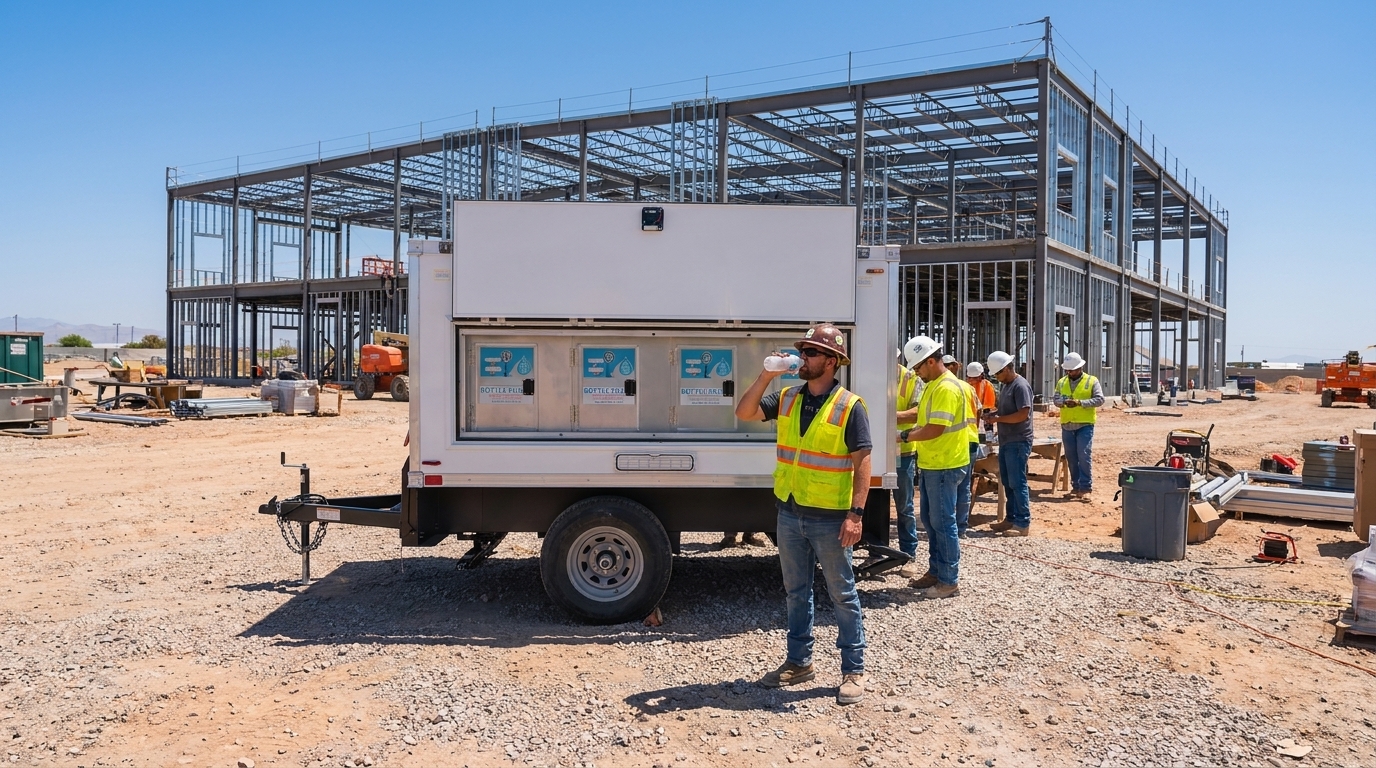
The densest stretch of data center construction in the Midwest, with badge-gated campuses and thousands of trades. Sites out here are measured in hundreds of acres, so station placement and refill timing matter more than anywhere else we serve.
Dublin
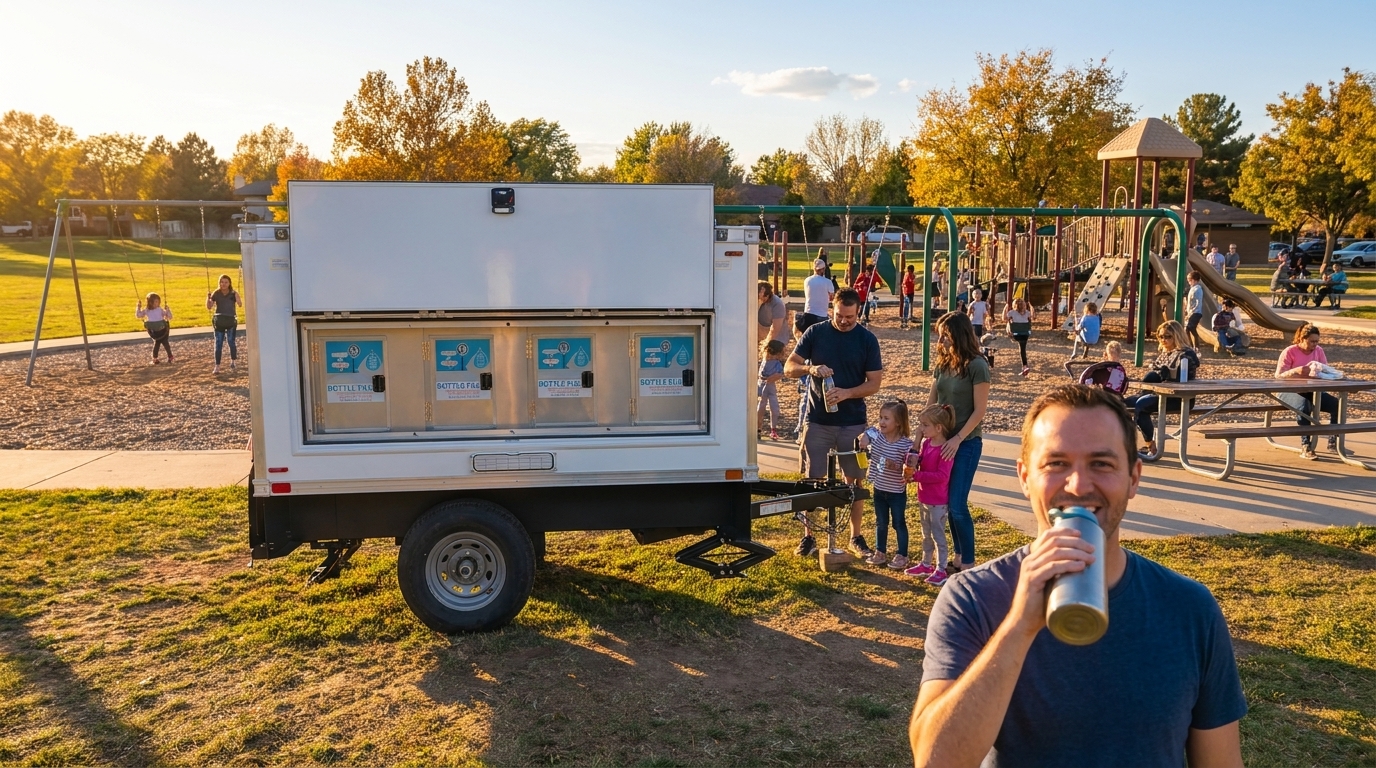
Coffman Park pulls more than 100,000 guests for the Irish Festival every August, and Muirfield Village hosts the Memorial each June. Event standards in Dublin run high, and setups are expected to look as clean as they pour.
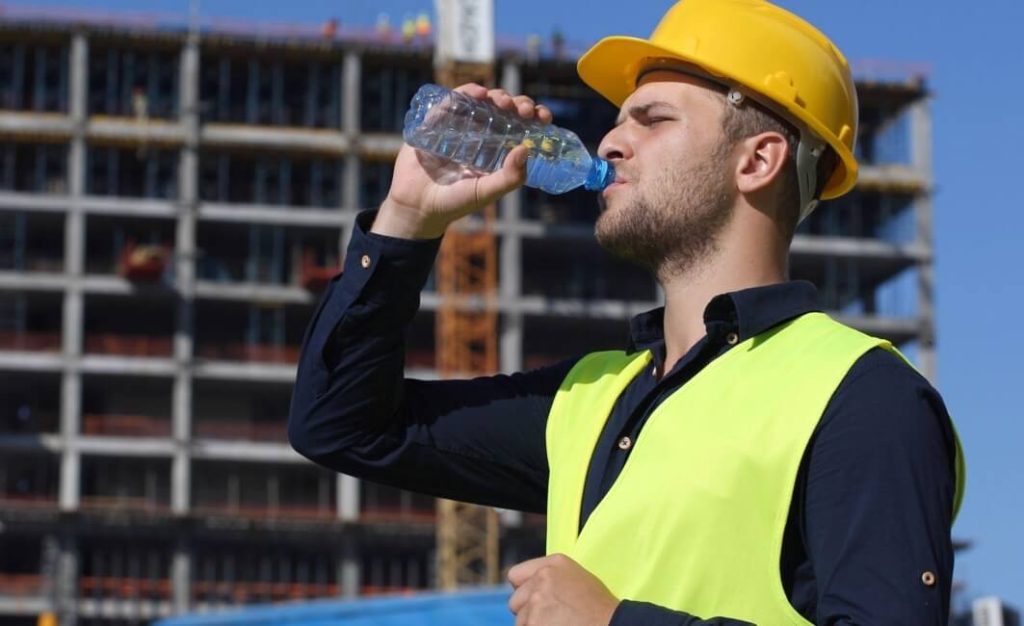
Groveport, Obetz, and the Rickenbacker belt
Freight country. Warehouse builds come first, then the dock and yard crews who work them, and both need cold water where the asphalt radiates heat all day. Stations here often stay for years, not weeks.
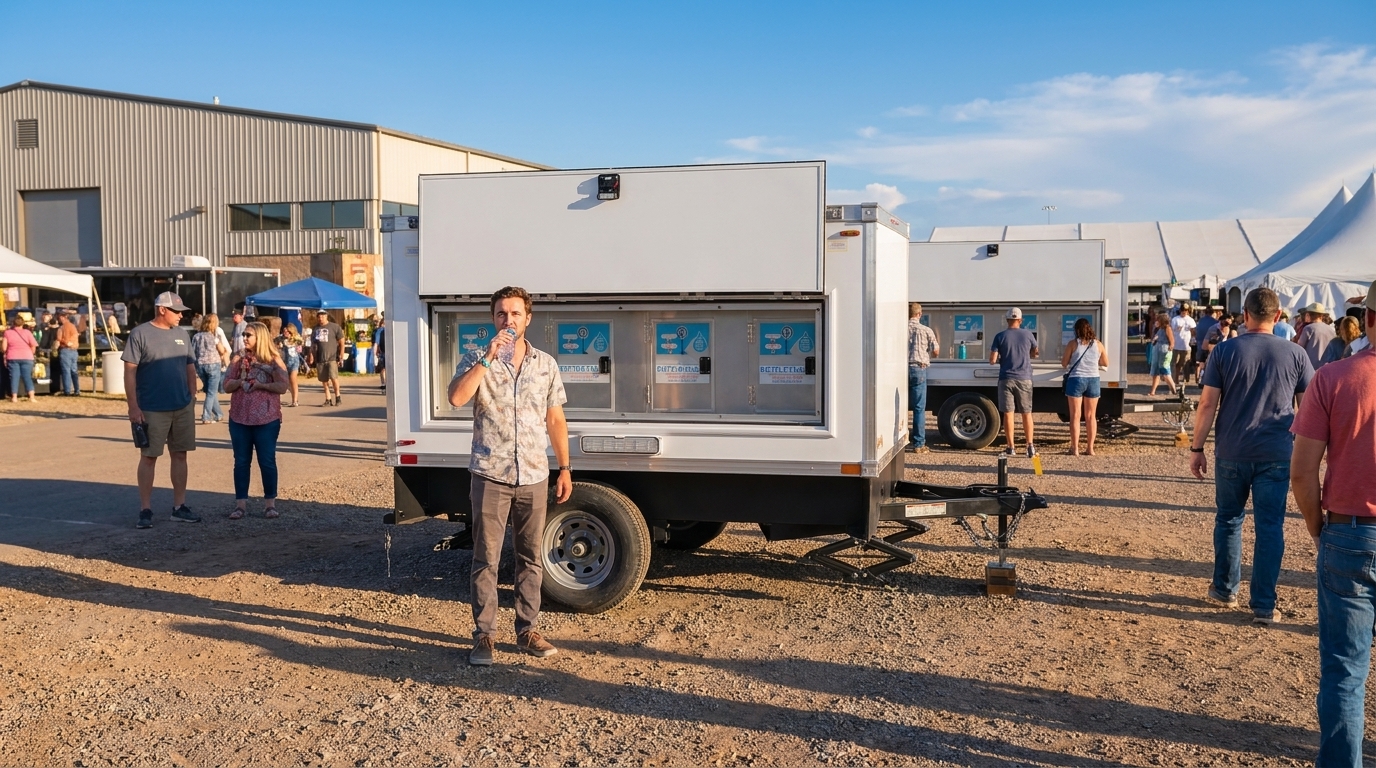
Pataskala and western Licking County
Orchard and produce ground colliding with the Intel construction radius, so harvest crews and building trades share the same roads every September. Field drops out here get planned around picking schedules.
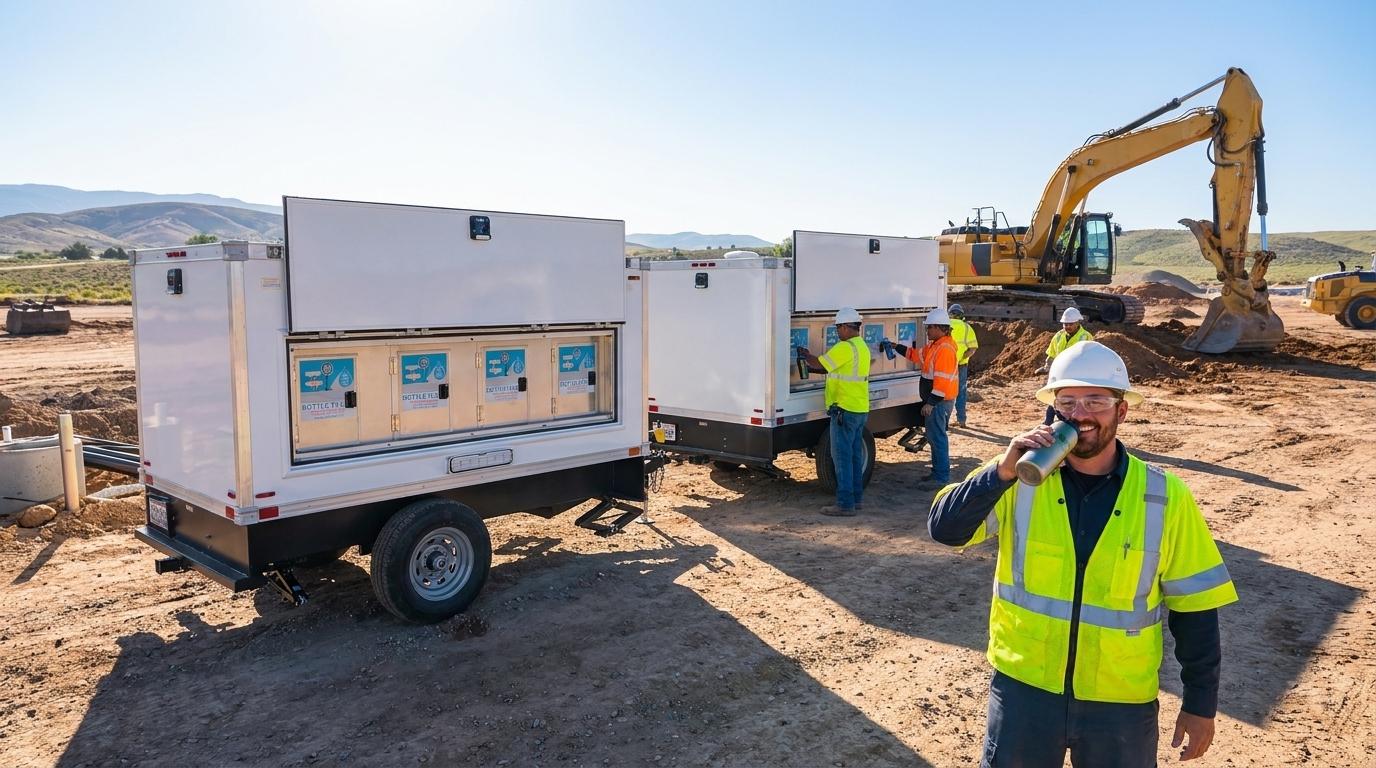
Downtown and the Arena District
Capitol Square work, the Merchant Building, Crew matches at ScottsMiracle-Gro Field, and the Jazz and Rib Fest crowding the Scioto Mile with about 200,000 people each July. Curb space is scarce, so we run early-morning refills with the permits already sorted.
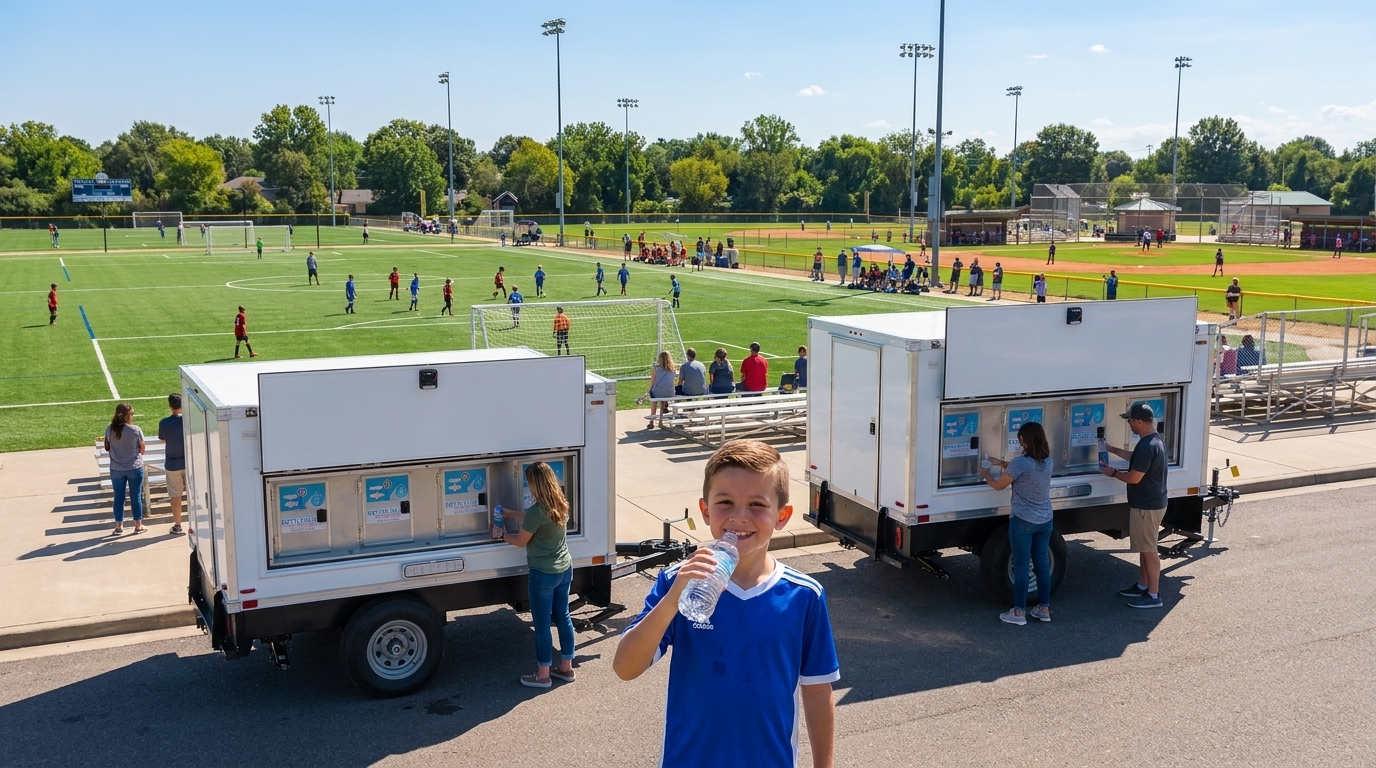
OSU campus and the University District
The medical campus keeps expanding and game days flood the district. Facility rules control where crews stage and drink indoors, which is exactly why contractor yards here keep a station of their own.
Hydration station trailers for the data center corridor
In a Columbus July the Signature Series earns its keep, because shade is scarce on a fresh-graded site and the humidity never lets up. One chilled station near the work beats a pallet of warm bottles every single day.
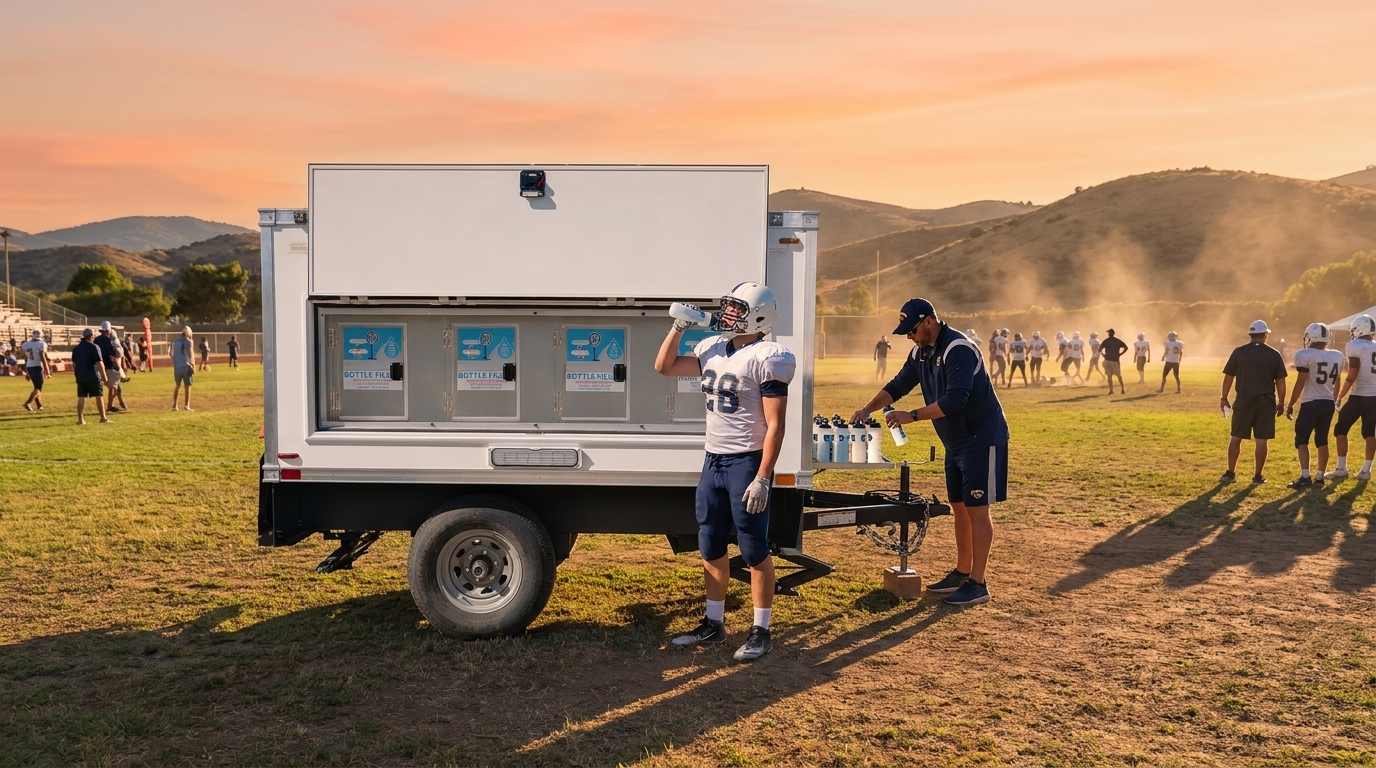
Signature Series specifications
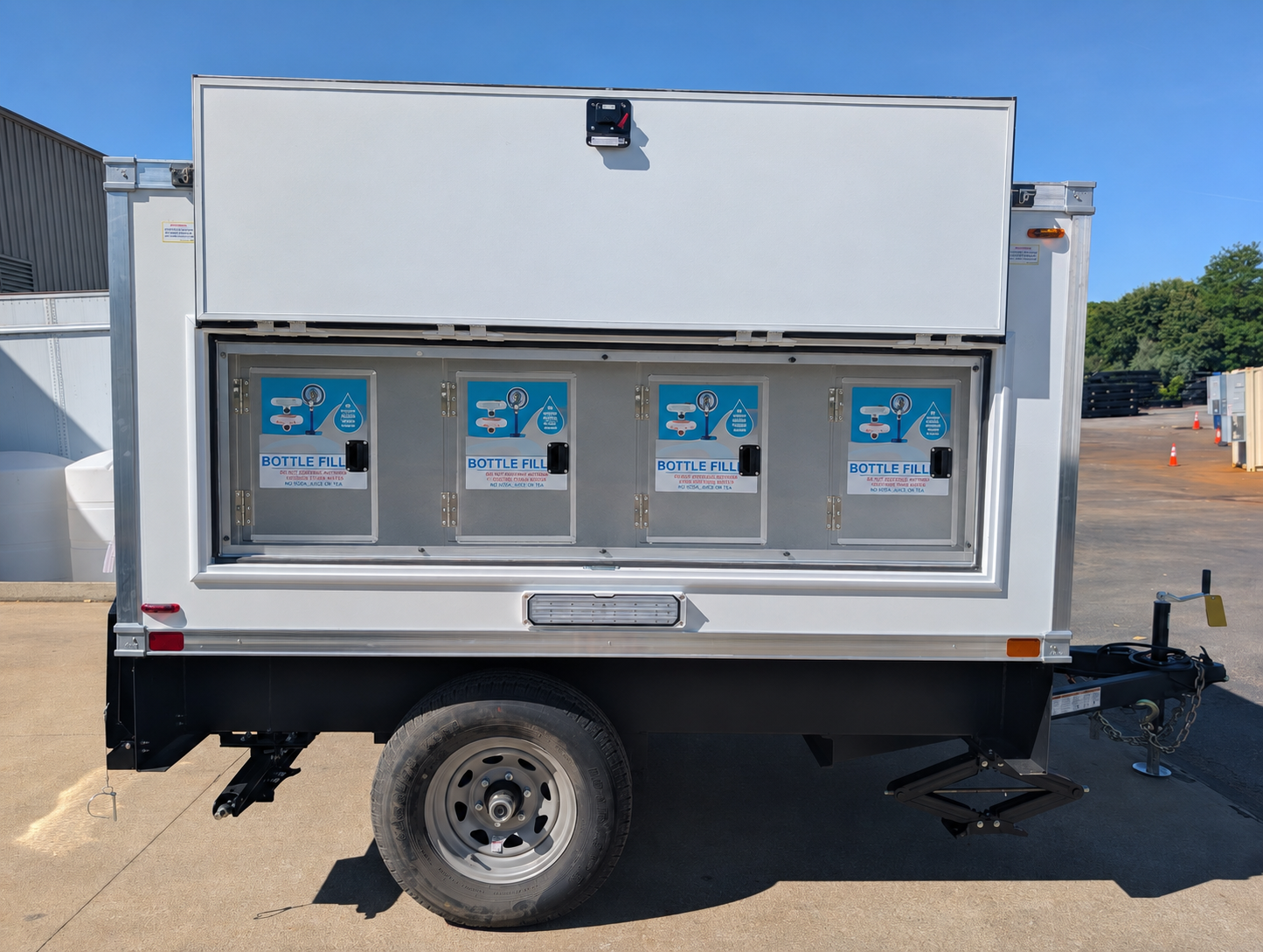
With a frame, a hitch, and tires under it, the unit hauls out to a remote central Ohio build, an event field, a working orchard, or a disaster staging yard with equal ease. Columbus contractors and event planners request this exact rig by name. The whole design is built around backing in, leveling off, and pouring cold by the same afternoon.
| No. of stations | (4) Bottle Filling Stations |
| Length | 12′ 3″ |
| Weight | 3,100 lbs. |
| Height | 8′ |
| Fresh water tank | 300 Gallons |
| Power requirements | 1 to 3 dedicated 20A/120V circuits OR 1 dedicated 50A/240V circuit |
| No. of AC units | 1 |
Why this is the right unit for a central Ohio site
A big share of our routes now start with water station rentals in New Albany, where 40 data centers are already running and more are on the way. Meta’s Prometheus project at 1500 Beech Road is expected to come online in 2026 as the world’s first gigawatt-scale data center, and state permits show five huge rapid-deployment structures going up to get it there. Microsoft is building on Beech Road too. Amazon Web Services agreed with the city on a 3.5 billion dollar expansion that adds five more buildings. All of that is open-air trade work, all summer long.
Intel’s Ohio One site sits on 1,000 acres in the New Albany International Business Park. The project needs more than 7,000 building-trades workers at its peak, and crews had already logged over 9.4 million work hours there through 2025. But a badge-gated campus that size has no corner store. Nobody walks off site for a drink at break. Water has to come to the zones where people actually work, and it has to be there before the 6 am gate rush.
Here is the strange part. Columbus-area data centers used more than 1.2 billion gallons of water in a single year for cooling, and Google’s New Albany building alone runs through about 405 million gallons a year. Yet the crews building the next campus are often working ground where the drinking water taps are the last thing energized. We fill from municipal potable supply, truck it in, and chill it at the tap, so the water problem the region argues about never becomes your crew’s problem.
Serving these campuses taught us things no brochure covers. Spring mud in Licking County will swallow a station parked on bare topsoil, so we set on laydown gravel. Refill trucks need to be on the badge list with an escort plan, so we handle that paperwork up front. And placements move. When a building front closes in, the station shifts to the next pour, and our drivers just track it.
What One Water Station Saves Against Bottled Water
Six bottles per person on a 100-degree central Ohio day, a 38-person crew, and you’re already at roughly 228 plastic bottles to buy, cart in, ice down, and throw away. That’s one day. The season is where it gets ugly.
Multiply across a 175-day build and the tally clears 39,000 bottles, with the larger commercial jobs running far past that. A single trailer makes the entire pile disappear, leaving cold water at the tap and nothing for the dumpster.
This is a logistics decision before it’s a green one
Sustainability is the easy part of the pitch. Roughly 60 million plastic bottles get thrown out daily in this country, only about a third are ever recycled, and one bottle can sit in a landfill for centuries. Worth reporting, sure. But the Columbus project managers who actually switch usually do it to kill the daily hassle, not to pad a sustainability slide. A shared trailer means no recurring bottle order, no cooler going warm before first break, no wall of empties baking by the job-trailer. The super runs the build, not the water program.
Because our own potable tankers cover the refills, the supply scales with the job rather than fighting it. Double the crew for a big pour and they still can’t outdrink the plan. And the tankers just swing back and bring the level up.
Want this math run for your own Columbus job? Two minutes on the phone gets you a real number.
More ways crews and events put our stations to work
Festivals and fairs
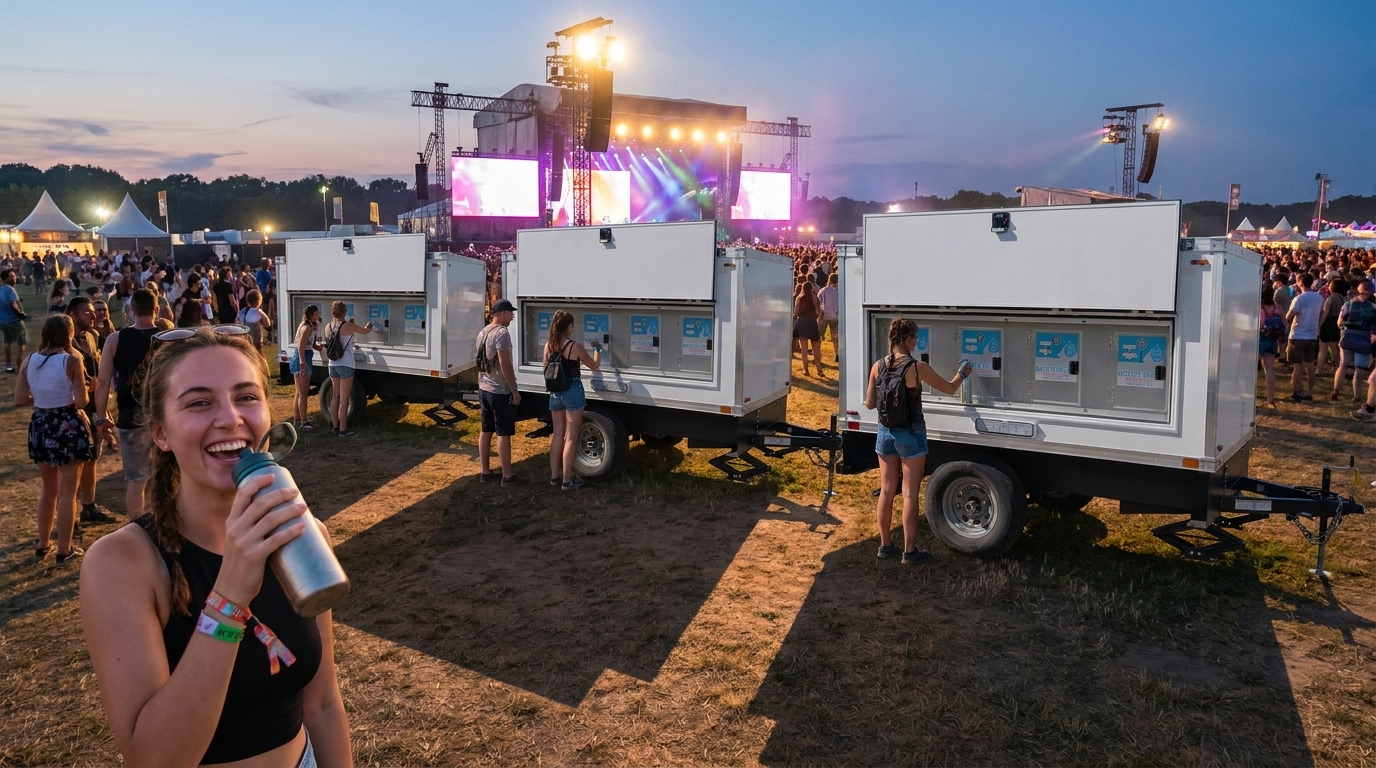
Central Ohio hosts over 325 festivals a year, topped by an Ohio State Fair that drew a record 1,025,190 people over twelve days in 2026. Vendor rows and stage crews work setup days before any public water is on. Staged stations cover both sides of the fence.
Races and outdoor sports
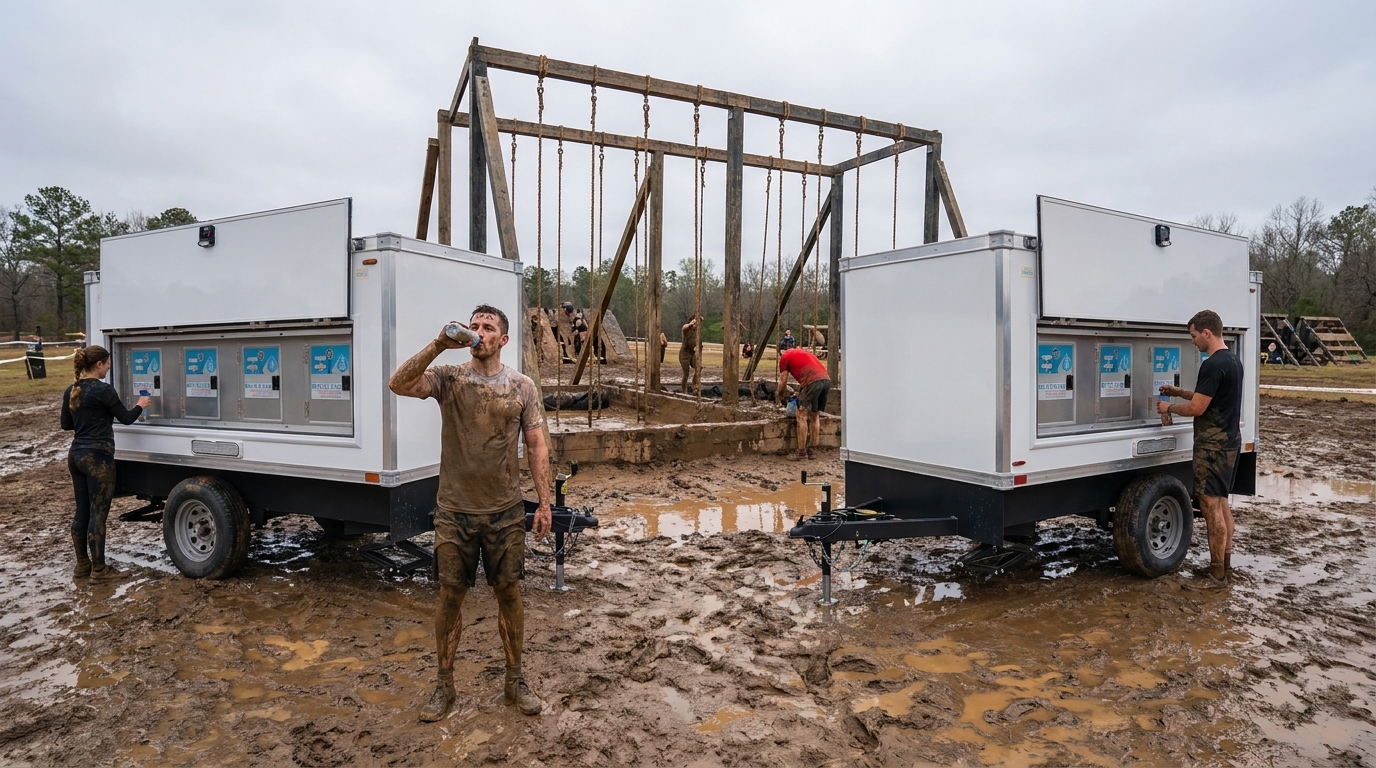
The Columbus Marathon in October is the largest in Ohio, and race courses are a string of water points fed by one refill plan. We also serve tailgate lots and event staff at stadium dates through the summer.
Storm and outage response
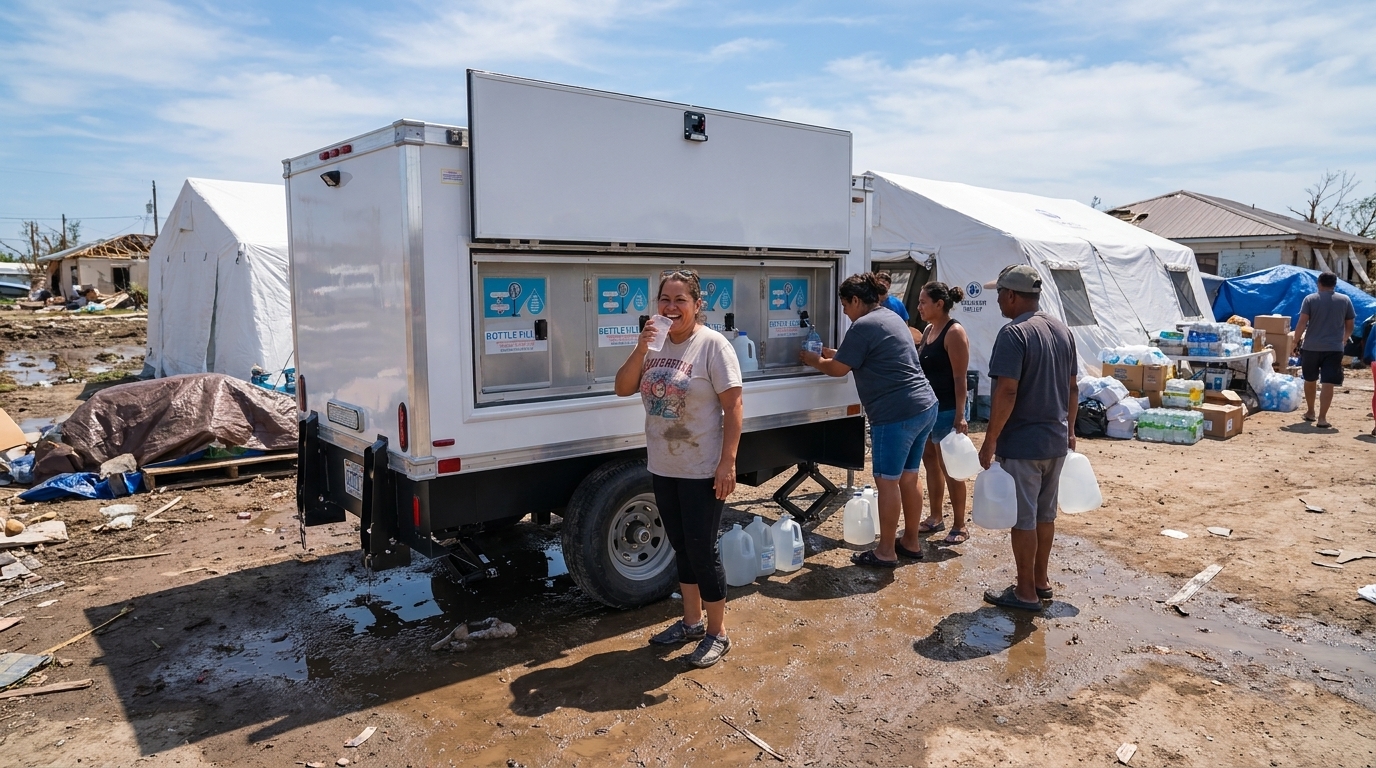
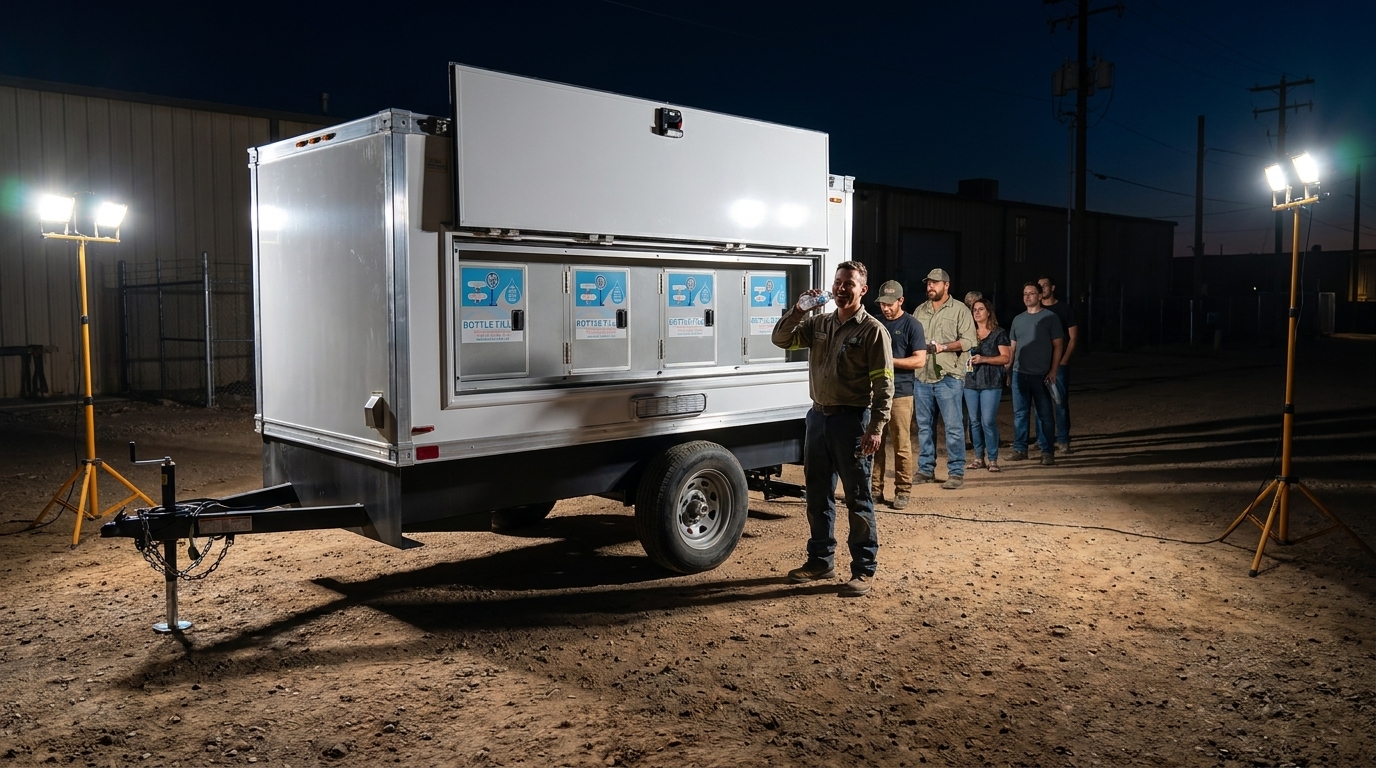
The August 2026 windstorm put about 89,000 AEP customers in the dark and sent firefighters on more than 1,100 runs in a day. When power drops, rural well pumps stop. Potable trailers roll to shelters, rec centers, and township garages within hours.
Warehouse and dock crews
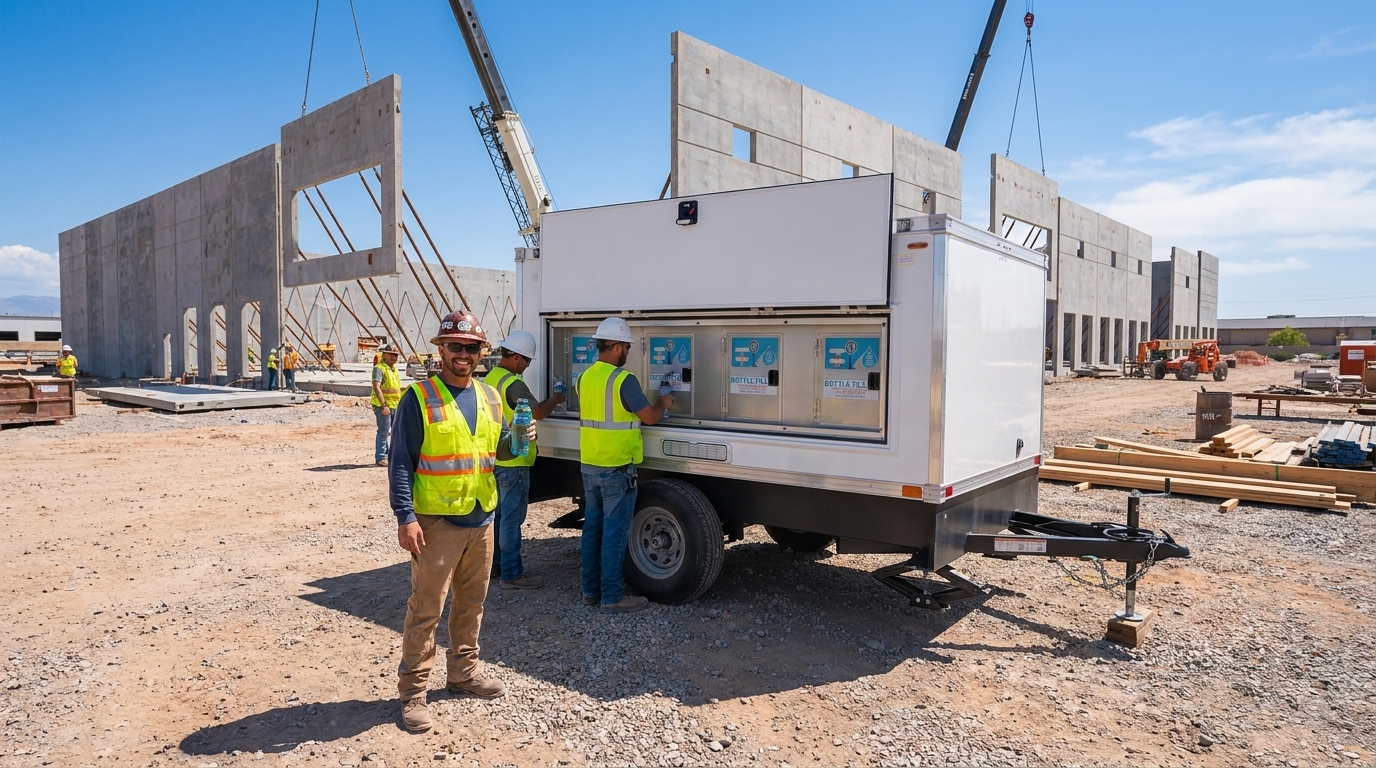
The Rickenbacker freight belt through Groveport and Obetz runs distribution floors for names like Gap, Sam’s Club, and FedEx Ground. Summer trailer yards are asphalt heat islands, and a station at the dock doors keeps pickers and loaders out of the vending machines.
City water, pulled through three stages and a UV chamber, then chilled
A water source people don’t trust gets ignored, and an ignored station is rented money wasted. That’s why municipal water doesn’t reach the tap raw on our trailers. It passes through four filter stages and a UV chamber, then an onboard chiller drops the temperature. The result tastes clean and comes out cold, even on the worst Columbus afternoon of the year.
Sediment stage
The opening filter traps sand, scale, and the fine grit local mains occasionally push through. On a dusty Columbus lot, that’s what keeps a pour from tasting like the parcel it’s parked on.
Carbon stage
Activated carbon comes next, lifting the chlorine bite and the dull seasonal notes local tap can carry until the taste lands clean and neutral. When it’s 101 out, that flavor decides whether a crew keeps drinking or strolls past the spout dry.
Micro-particulate stage
A final polishing stage captures microscopic particulate down to sub-micron size, so every fill stays safe for the workers, the runners, and the event crowd topping off across Columbus.
UV disinfection
The last step is an ultraviolet chamber that wipes out bacteria and microbes without adding a single chemical. Even after a long tow to the far edge of central Ohio, the water off the nozzle is clean.
Four ways to fill, and one of them is ADA
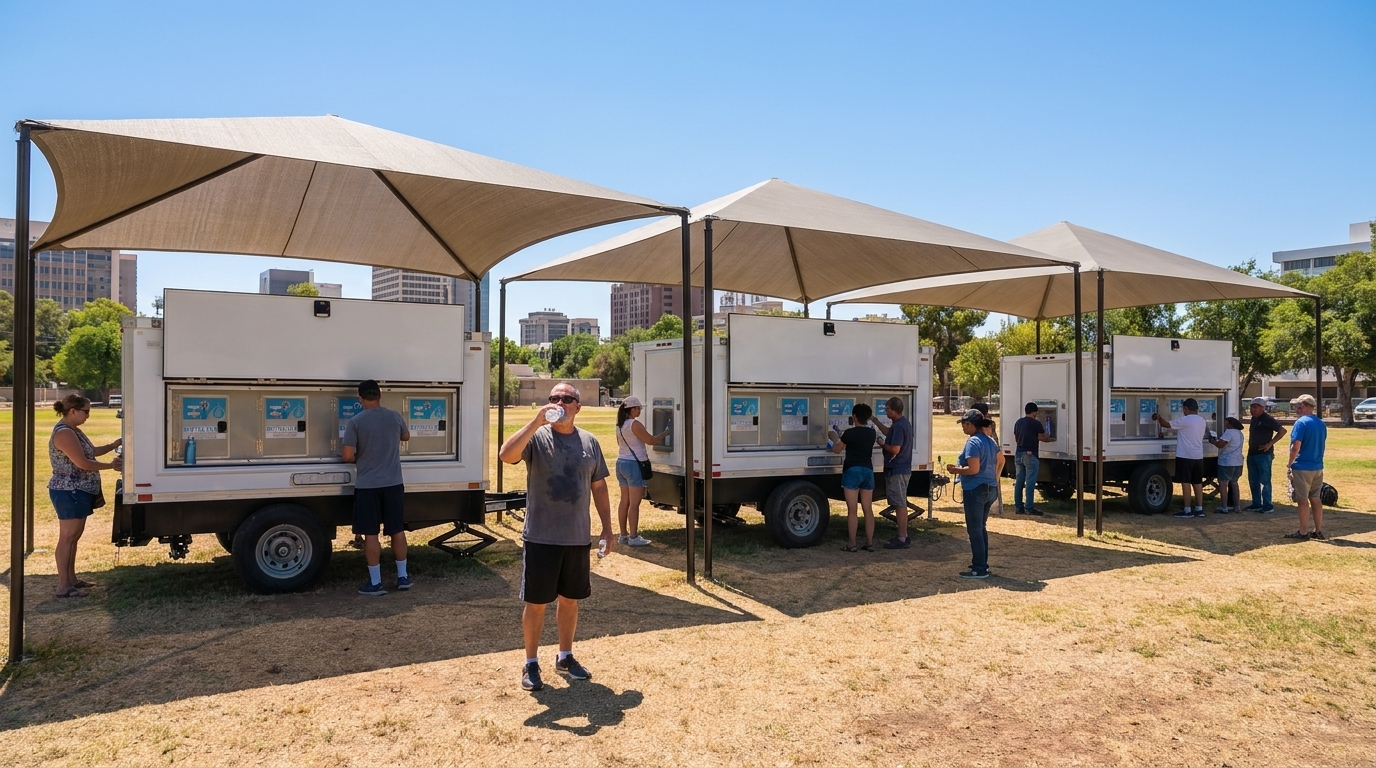
Along the wall sit four adjustable push-back spouts, press a bottle to the bar and it pours. One of them is set at ADA-reachable height, so a single trailer includes everybody at a Columbus crew or crowd with no add-on gear. Out back, a large-jug spout services five-gallon coolers and hydration packs, while a bank of hose-bib taps handles work-site chores, event support, and refills down the orchard rows. Stainless, food-grade plumbing the whole way through keeps the filtered, chilled water at quality right to the spout.
Every Signature trailer carries a 300-gallon load, roughly 2,400 cups at sixteen ounces each, and we recharge it on demand, so the unit doesn’t turn into the choke point on a busy Columbus shift or a packed show night.
We tow it in, fill it, wire it up, and it’s usually pouring cold inside the hour
There’s nothing here for you to run. Placement, fresh-water load, hookup, that’s all on us, and then we walk your Columbus crew or event staff through the basics before our truck pulls away.
Tell us the basics
People count, number of days, where exactly it parks on your Columbus site, and what power is there. Those four answers let us spec it correctly the first time around.
We come to you
Reckon roughly 45 minutes from our yard to anywhere in Columbus or central Ohio, with round-the-clock emergency runs whenever a heat advisory or a power shutoff hits the area.
We make it pour
Once on site we set it level, charge the 300-gallon tank, and tie in power off one to three standard 120V circuits, or a single 50-amp 240V drop, depending on what the site gives us.
We keep it full
After that the tankers cycle back on a cadence matched to how fast your crew or crowd pulls it down, and we maintain the unit through the whole rental term.
No power on the parcel at all? We price that in. The unit draws very little, and with the service fleet backing it we’ve run Columbus stations on lots that had no permanent power whatsoever. Lay out what the site offers and the rest is on us.
The rules that actually apply in Ohio
Ohio has no state OSHA plan and no state heat standard, so federal OSHA is the whole rulebook here. There is no numeric temperature trigger to point to. Instead, the General Duty Clause requires every employer to keep workers free from recognized hazards, and OSHA has used it to cite companies after heat incidents while the proposed federal heat rule from 2024 sits unfinished. When an inspector shows up after a bad afternoon, documented water access is the first thing checked. A logged refill route is cheap insurance.
Farms have the one bright-line federal water rule. Under 29 CFR 1928.110, any farm with 11 or more workers doing hand-labor field work must furnish suitably cool potable water in sufficient amounts, dispensed in single-use cups or fountains, at no cost, close to the work, with containers refilled daily and kept covered and clean. Potable means water meeting EPA drinking water standards. Our stations are built to check every one of those boxes, and we keep the fill records that prove it.
Wastewater has rules too, even for drinking stations. Ohio’s graywater rule, OAC 3701-29-17, treats wash and rinse water as regulated flow, and nothing from a station belongs in a storm drain, because Columbus storm sewers feed the same rivers that fill the city’s drinking reservoirs. We capture drip and rinse water and haul it to sanitary disposal. On public jobs, having that answer in writing has won our customers more than one inspection conversation.
- Free, suitably cool, fresh potable water kept within easy reach of the work face
- Enough volume to meet the the federal OSHA general duty for heat illness yardstick of a quart per worker each hour
- A fixed, documentable hydration point your written heat plan can cite directly
- Support for worker acclimatization and the paid recovery breaks the rule mandates
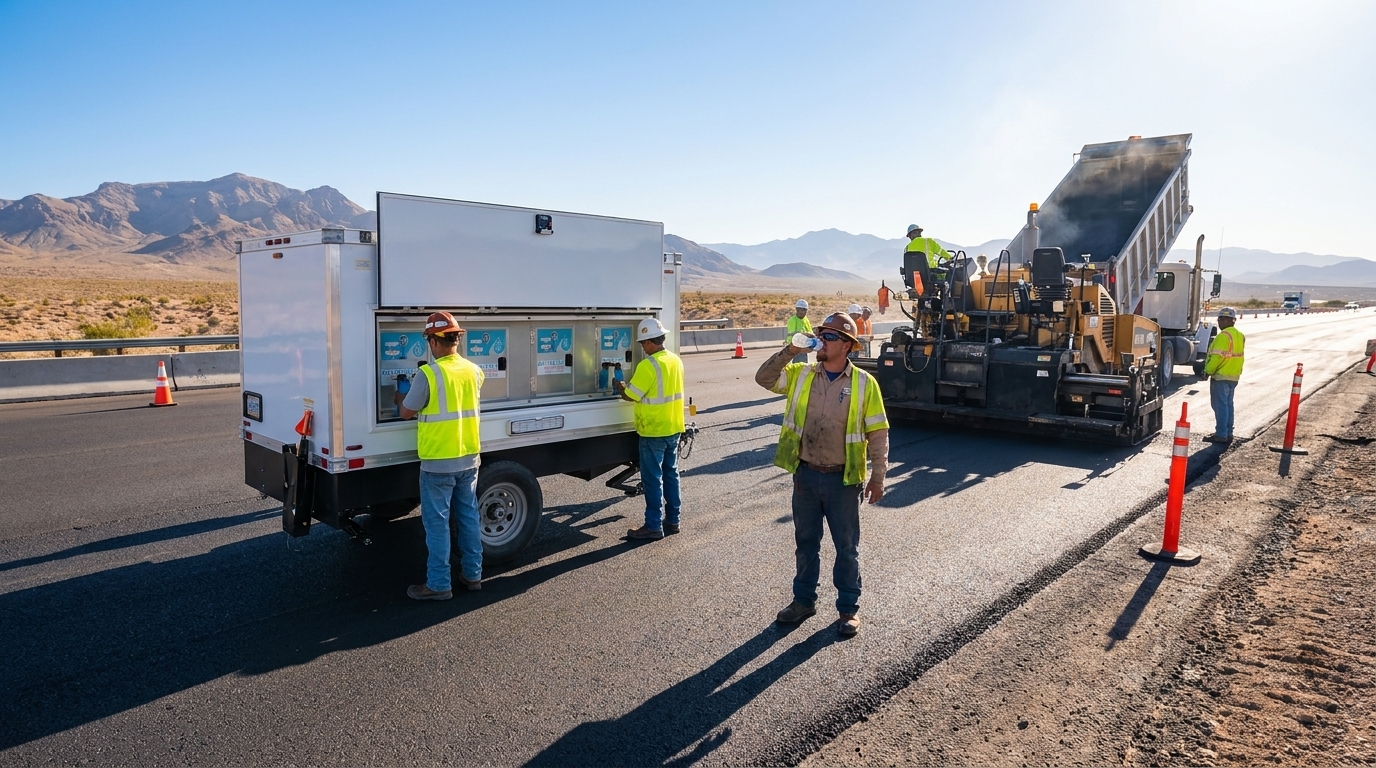
Need a station your written heat plan can point to? We can have one pouring cold within days.
A few things staging water around Columbus has taught us
A lot of central Ohio jobs have shaped how we run the next one. A few that stuck with us:
Site superintendent, hyperscale campus east of Columbus. Spring 2026, four stations placed at the gate, the laydown yard, and two building fronts, each on the badge list with an escort plan. The layout moved twice as phases shifted. Through the muggiest July stretch, not one tap ran dry, and the super stopped fielding water complaints entirely.
Crew lead, orchard harvest near Pataskala. September, picking crew in the rows Friday through Sunday while u-pick visitors packed the lanes. We set a station at the barn end of the rows, stocked cups with every fill, and doubled visits on the two hottest weekends. The farm’s field sanitation self-check passed without a note.
Township service director after the August windstorm. Power out across the eastern townships meant well pumps down and no water at home. A filled station was staged at the community building by the next morning and refilled each evening for five days until the lines were back up. He kept our card taped inside the office door.
Field water service for farm and harvest crews
Drive twenty minutes past the outerbelt in any direction and you are in working farm country. Ohio runs about 77,000 farms, most of them family operations, with corn and soybeans up front and more than 200 other crops behind them. The hand-labor operations that ring Columbus, orchards, produce fields, u-pick farms, are the ones federal law actually requires to furnish drinking water in the field. For any farm with 11 or more hand-harvest workers, cool potable water with single-use cups, at no cost to the crew, is not optional.
Lynd Fruit Farm in Pataskala shows what fall out here looks like. The family has farmed since 1919 and now runs 800 acres of apples, berries, and a corn maze, with u-pick weekends packed every Friday through Sunday in September and October. A farm like that carries two water needs at once, a paid picking crew doing hand labor in the rows, and thousands of visitors on wagon rides. Two different station layouts, same delivery.
The 2024 drought is still fresh out here. USDA declared 28 Ohio counties disaster areas that fall, Licking and Fairfield among them, and farmers spent months hauling water while ponds dropped and creeks ran dry. The state later opened 10 million dollars in recovery help. Our stations carry drinking water for people, and when wells get shaky or a pump fails at harvest, a filled potable trailer on the barn lane is the fastest bridge there is.
Field placements have their own rules of thumb. Stations go at the row ends crews actually pass, not at the farmhouse. Cups get restocked with every fill. And the schedule follows the picking calendar, so a September orchard gets more visits than a June hayfield. After years of harvest seasons around Pataskala and Johnstown, we plan that without being asked.
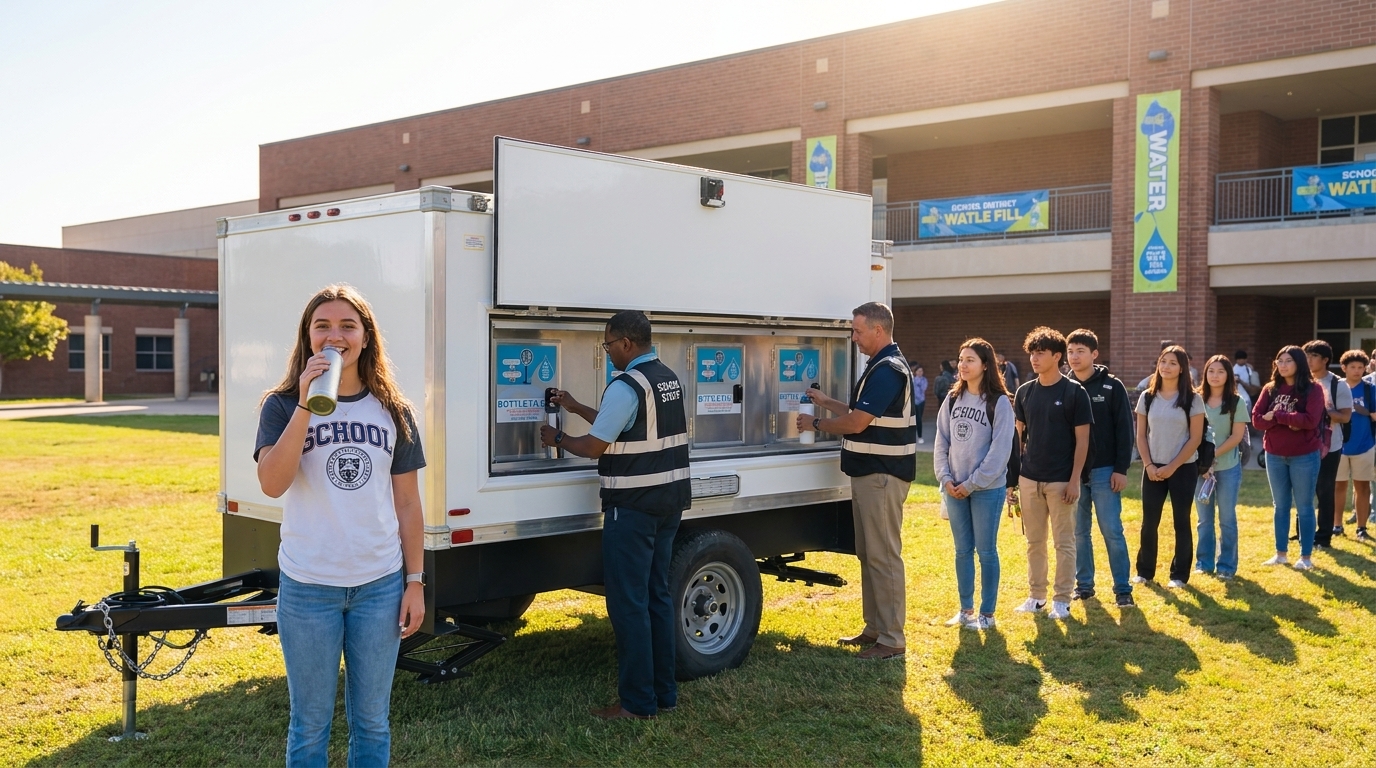
Central Ohio heat is a humidity problem
Columbus summers do not post desert numbers, and that fools people. July highs average in the mid 80s. But the summer of 2025 was one of the muggiest on record here, and Columbus logged 18 July nights that never dropped below 70 degrees, the fourth most of any month ever recorded. When nights stay that warm, crews clock in already worn down. The first water break of the day matters as much as the 2 pm one.
Humidity changes how much people drink and when. On muggy weeks, morning demand runs nearly as heavy as afternoon, so a cooler filled at 6 am is warm slush by 10. Chilled, filtered taps fix what ice cannot, and our drivers move fill times earlier when a heat advisory is posted.
The season is longer than most schedules assume. Harvest crews work hot September afternoons, festival crews strike stages in August humidity, and shoulder-season concrete pours still bring thirsty trades. We run water at full cadence from April into November, then shift to winter service instead of parking the fleet.
Downtown and the airport are carrying their own boom. CMH Next is a 2 billion dollar rebuild of John Glenn Columbus International Airport around a new terminal of nearly 1 million square feet, opening in early 2029, and airfield-side crews there work a long way from any concourse water fountain. The 600 million dollar Capitol Square redo, the Merchant Building with its North Market expansion, and the LOOM fashion center all keep trades working tight urban blocks where staging space is measured in feet.
Hospital campuses are their own animal. Ohio State’s 1.9 billion dollar inpatient tower, 26 stories and the largest single project in university history, opened in February 2026, and campus work keeps rolling with a rehab hospital already announced. A medical campus controls where crews can eat and drink indoors. A station in the contractor yard removes the whole question.
Go southwest and the radius gets long. The Honda and LG battery plant near Jeffersonville covers 2 million square feet about 40 miles down I-71, the kind of greenfield where crews worked years before permanent water lines went live. We build those runs into a route, not a one-off favor, so the far site gets the same cadence as a Grove City drop.
There is also a plain business reason contractors keep stations on their jobs. Central Ohio is short on skilled construction workers heading through 2026, and every superintendent knows it. Cold filtered water at the gate will not sign anyone’s paycheck. It does tell a crew which GC runs a site worth staying on.
Past the station: the trucks that keep a Columbus site supplied
Everyone sees the trailer. What they don’t see is the support fleet behind it, the trucks that deliver fresh water, hold reserve on site, and carry wastewater off, so a single call wraps the entire loop rather than stringing together three vendors.
Potable water trucks
Our tankers run drinking-grade water in bulk, recharging the 300-gallon tank on whatever interval the headcount demands. Those same trucks also top up cisterns, holding tanks, and bladder bags whenever a single drop can’t keep pace, like a big slab pour or a downtown night that packs the square.
Bladder bags & buffer supply
When demand spikes we set out fold-flat bladders to bank extra fresh reserve, and on a drain-less lot they’ll temporarily hold greywater too. It isn’t fancy equipment, but it’s what keeps a far-flung central Ohio job pouring between tanker runs.
Pump trucks
Water that has to move across a job is a pump truck’s job, whether that’s charging holding tanks or shuttling supply end to end. It earns its keep on the sprawling parcels where the trailer and the fill point can end up a fair hike apart.
Vacuum & waste trucks
At the tail end, a vacuum truck draws off greywater and wastewater and carries it to permitted disposal, closing the loop clean. Nobody on your Columbus crew is left guessing where the used water ended up. That piece was built into the plan from day one.
It all interlocks. A remote parcel might run a station plus a bladder bag for reserve and a recurring water-truck schedule. A heavy event night might call for a pump truck to move supply and a teardown waste run at the end. Describe the shape of your job and we’ll put together the right combination, on one invoice, handled by one crew that already knows the ground.
The handful of questions that turn a two-minute call into a real quote
A couple of minutes on the phone is enough to get you a real number. Here’s what we’ll want to know, handy to have ready before you call, and proof that we size every job to the work in front of us rather than reading off one canned quote.
The four answers that shape the recommendation
- How many people? Fifteen framers on a tract and a four-thousand-head concert are not the same problem. Your peak headcount, or gate count, drives how many trailers we stage and how aggressively the tankers cycle.
- How long? Two days at a park tournament, three weeks of footings, nine months on a master-planned build, each wants its own rhythm. Short jobs usually lean on staged reserve; long ones ride a standing tanker schedule.
- Where will it sit? Towable means the Signature tucks into a gated yard, bare dirt, an event lawn, or a skinny staging lane just as well. Hand us the exact spot plus the route our truck takes past the gate and any stored material, and we’ll land it on the natural foot-traffic path.
- What power is on site? The unit runs on as little as one and as many as three standard 120V circuits, or one 50-amp 240V drop. A lot of central Ohio parcels carry no permanent power, and that’s genuinely fine, provided you flag it before delivery day.
The smaller details that sharpen the plan
- Where on the site it should land, plus how a delivery truck reaches that spot
- Whether your people stay in one zone or spread across the full footprint
- Any heat-illness documentation your safety program needs the station to support
- Whether bulk hauls, bladder reserve, or a waste pickup should be bundled onto the job
Line items a pallet of bottled water keeps off your invoice
Bottled water reads as the budget choice on a purchase order. Its actual price tag is buried somewhere else, in handling hours, staging footprint, water that warms up, and trash piling up afterward, and on a hot inland lot each of those costs more than it would by the coast.
The labor nobody budgets for
Look at everything bottled water actually demands of a person: cutting the order, receiving and breaking down pallets, icing coolers before dawn, refilling through the day, then flattening empties for the bin. On a large Columbus crew that’s hours of paid time burned every single day, scraped right off the work that’s supposed to be getting done. The trailer erases that loop entirely. A local contractor once let us pencil it out with him, and the recovered labor by itself paid for the unit. His words were that the bottle runs had been quietly costing him close to a day of payroll a week. Our trailer arrives full, the tankers keep it full, and your superintendent owes it nothing but a parking spot.
The warm-up problem
Ice a cooler at 6 a.m. and by mid-morning in a central Ohio July it’s pushing bathwater. Warm water is water people stop touching, and the slowdown that follows is precisely where heat illness gets its opening. A chilled station never rides that warm-up curve at all. Whatever pours at clock-out is as cold as the sunrise fill, which happens to be the moment a spent crew, or a crowd deep into a long concert, leans on it hardest.
The storage and footprint tax
Bottled-water pallets devour staging space, jam the lay-down area, and sit cooking in the sun until somebody finally cracks them open. Empties build up faster than anyone keeps up with, and on a tight commercial lot that pile turns into its own problem. Set a trailer in one parking stall instead and it serves a crew or crowd that would otherwise burn through hundreds of plastic bottles every day.
The waste that trails you
Every bottle bought is a bottle thrown out, and across a season a busy site or event generates a small mountain of them. That’s a disposal line on the budget, a dent in the sustainability numbers, and, given that a single bottle can linger in the ground for centuries, a footprint that outlives the project that made it. Move to a refill station and the line drops to zero, which finally gives your reporting a figure worth publishing.
Where the need looks different around Columbus
Our routes cover the whole metro, from water trailer rentals in Dublin on festival weekends to harvest drops past Pataskala and long-term campus stations out east. If your site sits anywhere inside the outerbelt or an hour past it, we already drive by.
Short North
Arena District
Franklinton
German Village
Clintonville
OSU Campus
Easton
New Albany
Dublin
Westerville
Gahanna
Hilliard
Grove City
Upper Arlington
Worthington
Reynoldsburg
Pickerington
Canal Winchester
Groveport
Obetz
Pataskala
Johnstown
Newark
New Albany and the Beech Road corridor
Groveport, Obetz, and the Rickenbacker belt
Pataskala and western Licking County
Downtown and the Arena District
OSU campus and the University District
Working a corridor instead of a single address? We follow the routes central Ohio runs on, so multi-site projects get the same fast turnaround as one stop.
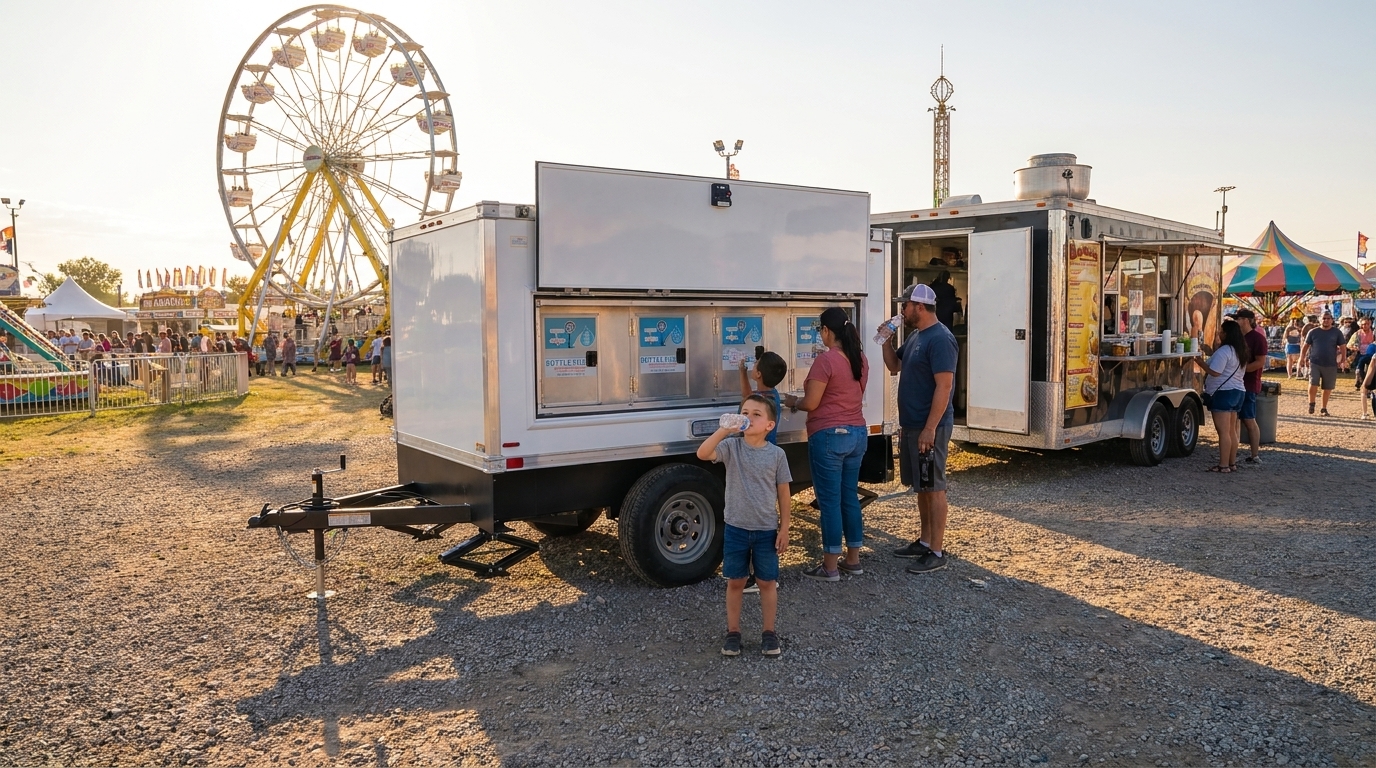
Still weighing it? Call and ask. Most of these questions get settled in one short conversation.
The questions central Ohio crews and event teams actually ask us
Where does the graywater from a rental water station go in Columbus?
Into a capture container, and then to sanitary disposal, never a storm drain. Columbus storm sewers drain to the Scioto and Big Walnut watersheds, the same rivers that feed the city’s drinking water reservoirs, so inspectors take this seriously. Ohio’s graywater rule treats even mild rinse water as regulated flow. We handle capture and haul-off as part of the service, and we can put that in writing for your compliance file.
What does my site need to have ready before delivery day?
Three things. A firm, level spot, ideally compacted gravel or asphalt, because spring topsoil around here will swallow a trailer axle. Clear access for our truck, including badge-list and escort arrangements on gated campuses, which we sort out with your office in advance. And a decision on power, since stations run self-contained off-grid or can plug into a standard connection if you have one live.
When should an event order extra water capacity?
Before the weekend, not during it. If a heat advisory shows up in the forecast, if ticket sales pass your original crowd plan, or if vendor and stage crews arrive days ahead of gates, that is the moment to add a reserve tank. Summer weekends here book tight. We hold surge capacity for events that flag it in advance and can swap or top off same-weekend.
How often are the tanks cleaned and sanitized?
Every station is fully sanitized between rentals, and tanks get flushed and refilled on route visits rather than sitting stale. Lines and taps are food-grade and cleaned on a set schedule. We log every service touch, and those records are available whenever a safety manager or health inspector asks.
Do the stations keep working through an Ohio winter?
Yes, with winter service planned up front. January nights in Columbus average around 21 degrees, cold enough to burst an unprotected line. So winter deployments get insulated units, scheduled drain-downs, or a swap cadence timed to hard freezes. Data center and warehouse jobs run all winter here, and so do we.
Will the setup meet ADA access requirements?
We plan for it. That means placing a station on the accessible route with a firm, stable surface, keeping a clear wheelchair approach to the taps, and setting at least one dispensing point at reachable height. For public events we coordinate with your permit layout so the accessible station sits next to the ADA viewing or parking area, where it actually gets used.
Can On-Site Hydration Services run the refill schedule so my team does not have to?
That is the standard arrangement, not an upgrade. Our drivers run logged routes, track how much each station is pouring, and move fill times earlier when muggy weeks push morning demand up. If a station starts running low ahead of schedule, the route adjusts. Your crew just drinks the water.
Is a multi-month or multi-year rental possible for a long build?
Yes, and the corridor east of Columbus has made long-term deployments a specialty of ours. Stations stay on site across seasons, get swapped out for deep cleaning, and are winterized on schedule. Terms are set for the project duration with room to add stations as headcount grows. Ask for the long-term structure when you request a quote.
Are the tanks filled with city water, and is it tested?
We fill from municipal potable supply, which in this region means water from the Griggs, O’Shaughnessy, and Hoover reservoir system that serves about 1.2 million people, treated and publicly tested to EPA drinking water standards. Then our onboard filtration polishes it and the chiller brings it down cold. You get the municipal testing paper trail plus our own service records.
Does a power outage shut the station down?
No. The stations are self-contained and built to run where there is no live power at all, which is exactly why townships call us during outages. When storms drop lines and rural well pumps stop, a filled station keeps pouring. That same independence is what makes greenfield jobsites easy.
Should crews working the New Albany corridor book ahead of summer?
Honestly, yes. Corridor demand keeps climbing as more campuses break ground, and summer is when every site wants stations at once. Contractors who reserve in spring get first call on multi-station layouts and locked route times. We will always try to work in a late request, but spring booking is how the big jobs guarantee coverage.
Water planning guides for Columbus crews and events
How many water stations does a Columbus event or jobsite really need?
The question comes up on almost every first call, and the honest answer is that headcount alone does not decide it. Federal OSHA’s heat guidance works from a simple planning number, about a quart of water per person per hour during hot work. Run that math on a 200-person site through a 10-hour summer shift and you are near 500 gallons a day. On a 500-person campus shift it passes 1,200 gallons. No single station carries that load once you account for queue time at the taps.
But volume is only half the problem. Distance is the half that hurts people. When a worker has to walk more than a few minutes each way for a drink, they start skipping drinks, and skipped drinks through a humid afternoon are how heat illness starts. The numbers are grim. Take them seriously. Construction recorded 18 heat deaths nationally in 2023, more than a third of all workplace heat fatalities from a sector that is only about 7 percent of the workforce, and heat deaths across the trades have climbed 77 percent over the past decade.
OSHA heat exposure guidance · CDC MMWR on worker heat illness
Renting drinking water stations for public jobs in central Ohio: the paperwork checklist
Public money changes a rental. The station pours the same cold water either way, but a publicly funded project in Ohio carries paperwork duties that flow down to every vendor on site, and a GC who discovers that at closeout has a bad month ahead. This checklist is what we walk through with contractors bidding public work around Columbus.
Start with whether prevailing wage applies. Ohio’s law covers public improvements paid in whole or in part with public funds when the estimated total passes 250,000 dollars for new construction, or 75,000 dollars for reconstruction, alteration, repair, or renovation work. Rate schedules come from the Ohio Department of Commerce, and contractors on covered jobs file weekly certified payroll and a final affidavit. Equipment rental itself sits outside the wage tables, but your paperwork reviewer will still want clean vendor records that match the project file.
Ohio Department of Commerce prevailing wage guide · SAM.gov federal award management
Getting a water trailer through a Columbus winter
Somewhere around mid-November, central Ohio quits pretending. January settles in with average highs near 33 and average lows around 21, and roughly 13 days of snowfall in that one month alone. Any water trailer sitting outside unprotected through that will burst a line, usually on the coldest night, usually discovered at 6 am by the crew that needed it.
And yet winter is not the off-season it used to be. The data center corridor pours and fits out year round. Warehouse floors in the freight belt run three shifts through February. Indoor trades still drink, arguably more, because forced-air heat dries people out in ways they do not notice until the headache shows up.
Bottled water or a refill station: what actually works on central Ohio sites
Walk most Ohio jobsites and you will still find the default setup, pallets of bottled water stacked by the connex, orange coolers on tailgates, and somebody’s laborer making ice runs. It works, sort of. It also costs more labor than anyone accounts for, and this is the honest comparison we give contractors who ask.
Do the pallet math first. Using the common hot-work planning figure of a quart per person per hour, a 200-person site can empty roughly 1,600 half-liter bottles in a single hot day. That is most of two pallets, every day. Each pallet needs a forklift touch at delivery, dry storage out of the sun, and restocking rounds to the coolers scattered across the site. The plastic pile at the end of the week is its own disposal line item.
Kind words from around Columbus
“Delivery was professional and easy to work with. In and out without slowing our pour.”

“We rented a station for a big backyard graduation party in June. It was spotless, the water was cold, and drop-off and pickup were both right on time. My guests kept commenting on it. Would recommend.”

“Wow, they nailed it for our company field day. The station was spotless and had everything we needed. Made the whole event easier.”

“Hard working crew. They set up fast, keep the fill log current, and my OSHA binder basically writes itself.”

“Awesome customer service! Having cold water stations at an outdoor July wedding was such a relief for our older guests. Everything was clean and looked nice in the photos. We will definitely be reordering for future parties!”

“Ours sits just inside the dock doors and it is way better than I expected. Highly recommend it for any warehouse floor.”

“Very professional outfit. The equipment showed up well maintained and clean, and it stayed that way through months on our site. Will use again.”

“I was honestly impressed. The taps pour genuinely cold filtered water, the unit is kept immaculate, and the crew treats a small vendor like a big account.”

“Always great to deal with. Fast, friendly, and the stations are clean every time. I point other crews their way whenever it comes up.”

Service information current as of July 2026.
Lock in cold, filtered water for your Columbus site or event before the next hot stretch
Tell us the headcount or the gate count, the rental dates, and where the trailer should park, and we’ll spec the right setup and roll one out to you anywhere in central Ohio, usually inside about 45 minutes of dispatch.