
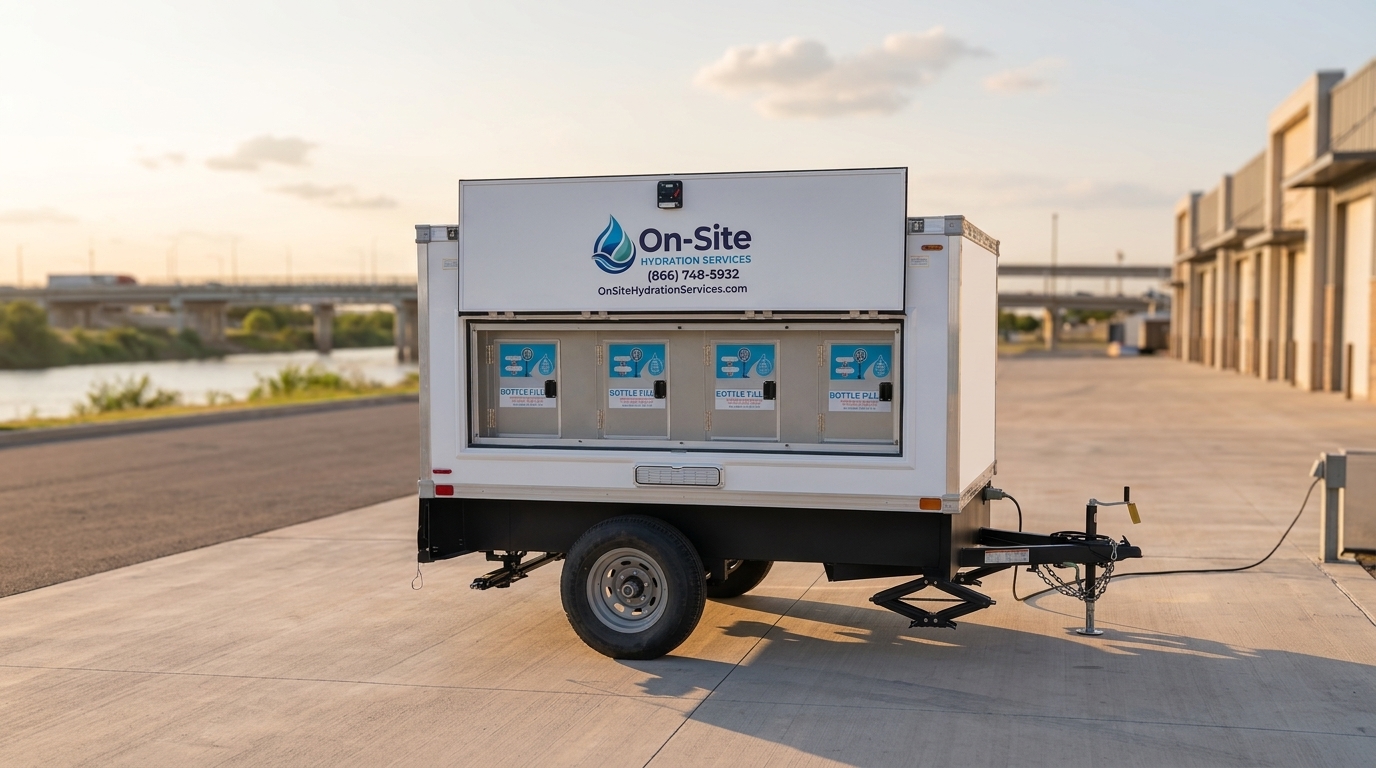
On-Site Hydration Services is the go-to team for mobile water station rentals in Laredo. Our Signature Series unit tows in with the tank already full, so people are drinking cold water the same day we set it, whether that is a parade route on San Bernardo Street, a torn up stretch near the bridge approach, or a practice field out past Alexander Estates. Call now and we will hold a unit for your dates. Or request a quote and we will size the station to your head count and your shift.
See the Signature Series water station specs
We are the first call here because of what comes out of the tap. Water on our units passes a sand stage, then carbon, then a fine filter, then a separate UV pass, and it moves through a food grade stainless cooler before anybody touches the button. It pours cold. That is a different thing from a pallet of warm plastic bottles that has been sitting in a gravel lot since the seven a.m. drop, and people drink far more of it, which is the entire point on a 104 degree afternoon. Our network is licensed and insured, carries an A plus BBB rating, is registered on SAM.gov for agency and district work, and stands on a 99.9 percent incident free record. Call now for a delivery window, or request a free quote and we will put the service schedule in writing with it.
One Signature trailer can pour for a weekend concert and be working a slab pour a couple of days later. Hiring one company for your events and a separate one for your worksites makes no sense. Either way, the planning, the delivery, and the refills are ours.
The onboard cooling unit keeps the tank genuinely cold all the way through a Laredo afternoon, and that single detail carries the whole thing. Warm water is water people abandon, and midsummer is exactly when a crew or a crowd is drinking the most. Cold water gets finished, and finishing it is what keeps heat illness off the site.
Typical Laredo deliveries land in about 45 minutes, and we keep emergency runs going around the clock whenever a heat advisory or a power shutoff hits the Webb County border area. The morning a foreman finds his 40-person crew stuck with one warm cooler, speed is the whole game.
One rule sits under every job we take: water that people walk past might as well not be there. We've stood on a bare Laredo site and watched shrink-wrapped pallets cook next to the job-trailer while the crew baked thirty yards off. We've watched the opposite too, a chilled station ten steps off the work face run bone-dry twice inside one shift. Everything that matters lives in the distance between those two pictures. Which is why we don't drop a unit and disappear. We match it to your headcount or your gate count, set the refill rhythm to how hard you're really pulling on it, and treat a heat call the way you'd want your own treated, meaning right now, because out here one hot hour can swing the whole day.
We route three corridors out of one yard. Everything here spreads out from Laredo in three directions: US 83 south to Zapata, I-35 northeast to Cotulla, and the highways southeast to Hebbronville. Each leg is a different driving speed and a different site type, and we schedule them as three routes rather than one radius. That is why a lake tournament and a north side campus drop can share a working day here and still both land on time.
“Eight months on one corridor and the unit got serviced the same day every week without me calling anybody. That is the whole review.”
“We ran a night festival on pavement that had been cooking all day. They set two stations at the crowd nodes and refilled overnight while we slept. One of my volunteers said it was the first year nobody asked her where the water was.”
“I needed dated service records for my own file and they just started sending them. Cold every time I checked it, including in August.”
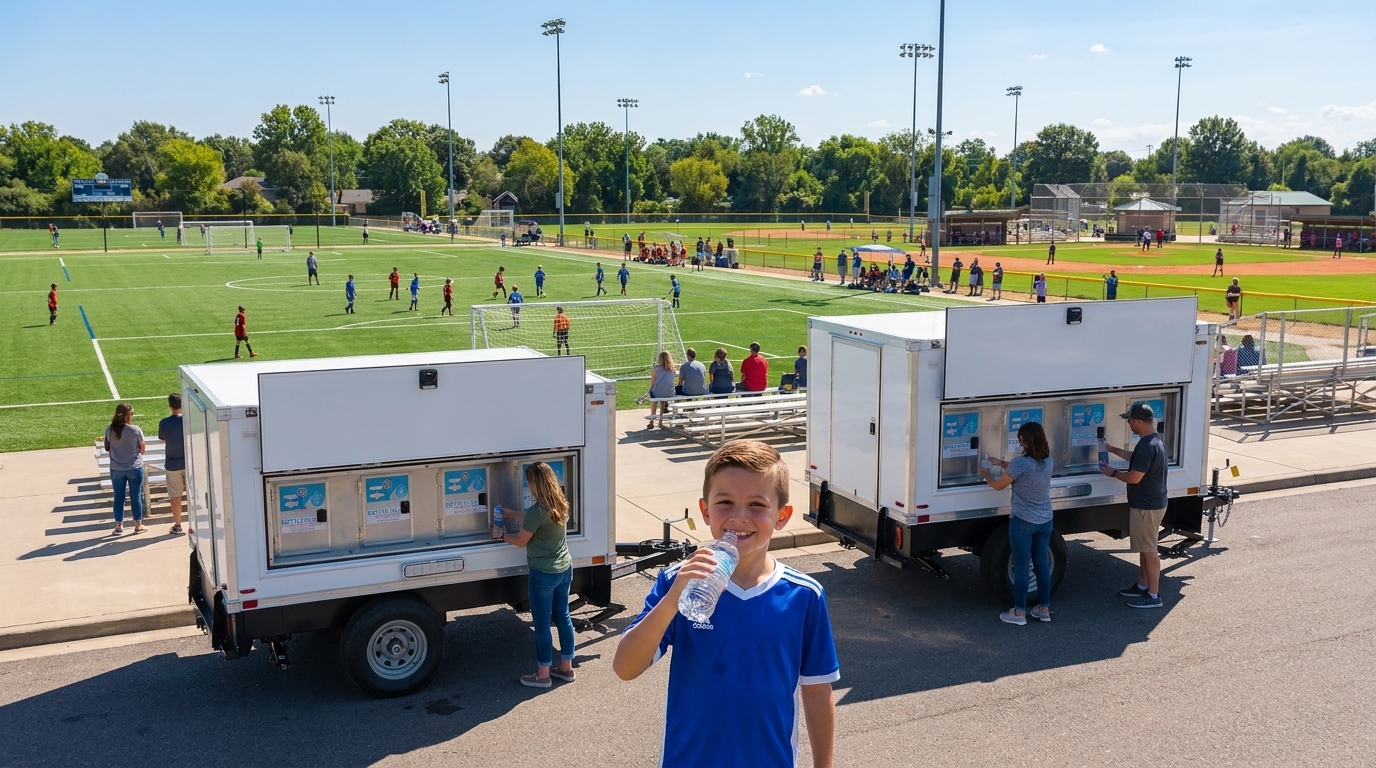
Family neighborhoods with newer schools and parks, and the fastest growing part of the city. Practice fields here are young, which means thin shade and one fountain. A station at the field gate does more good than a bigger cooler at the indoor sports building.
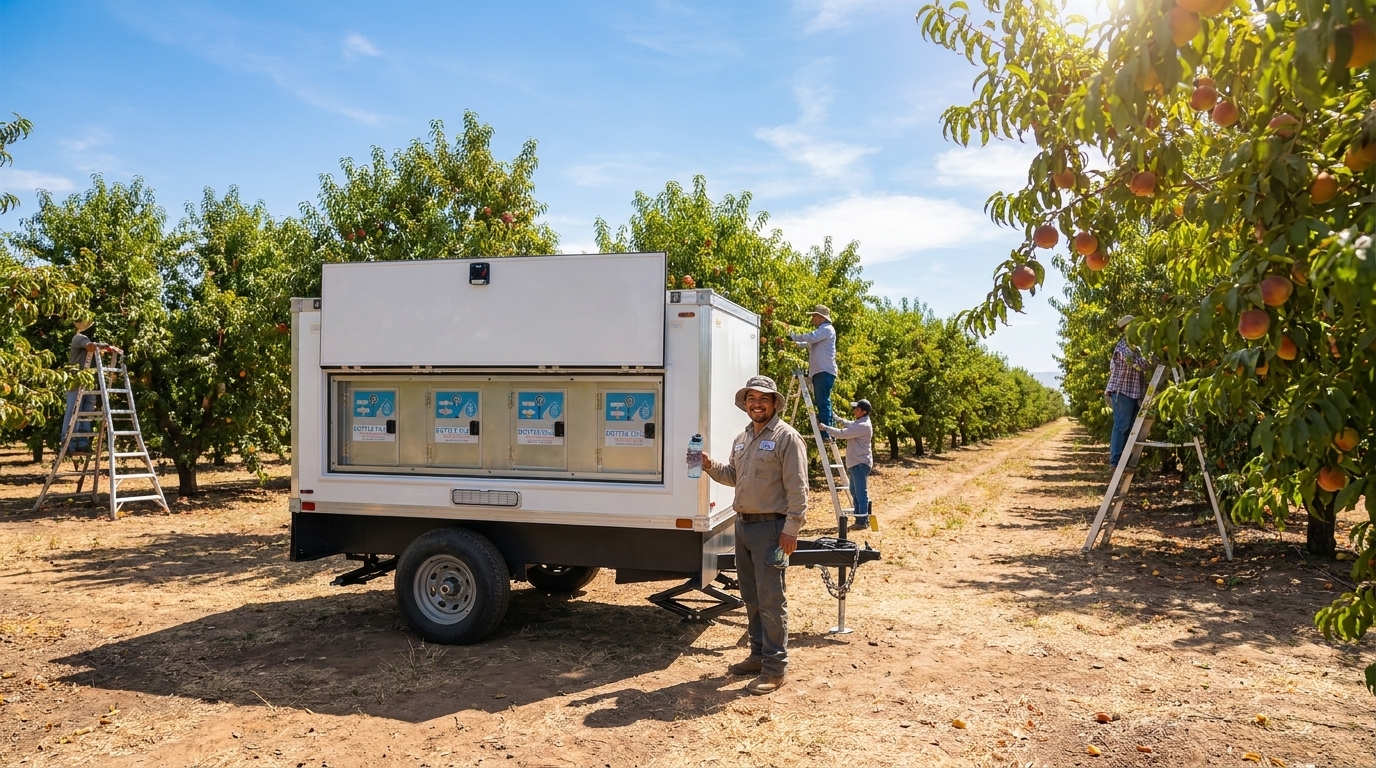
An established, tree lined part of town near the middle of everything. Deliveries here are easy on access and hard on parking, so we schedule them early rather than midday when the corridor fills up.
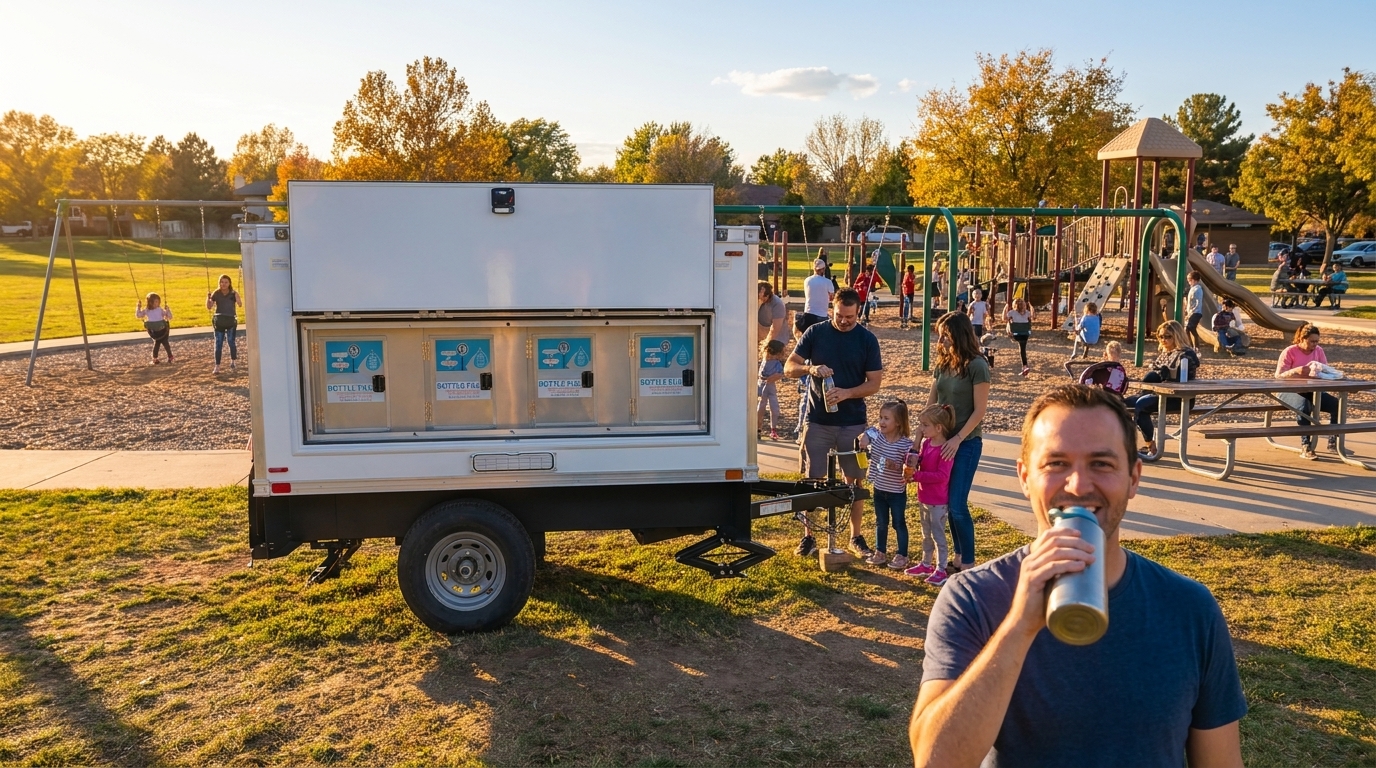
A gated community sitting near the new south side sports complex. Weekend tournament traffic is the whole story down here. We deliver on Friday, service Saturday night, and pull out Monday.
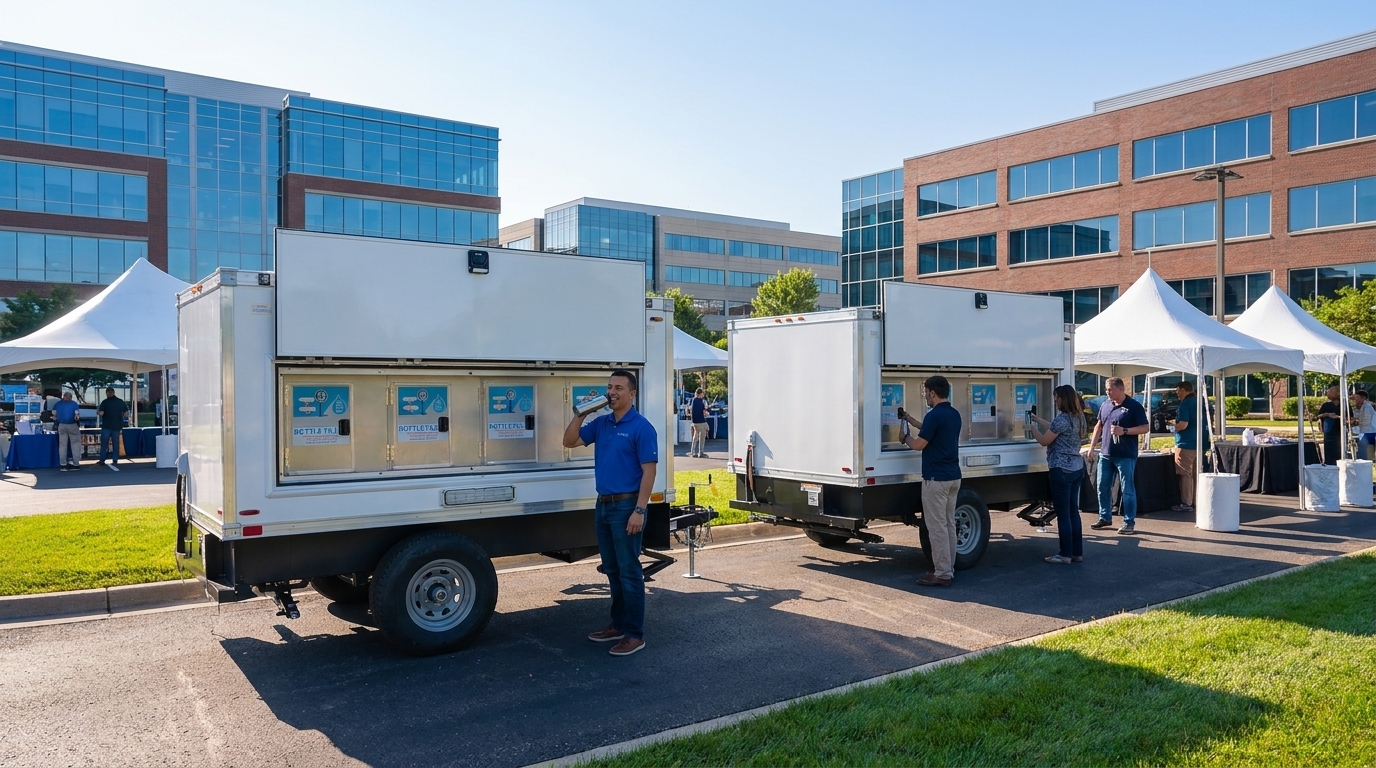
Retail, offices, and the newer commercial build out along the north corridor. Construction crews rotate through fast and rarely have power run yet, so a generator ships with most first deliveries on this side.
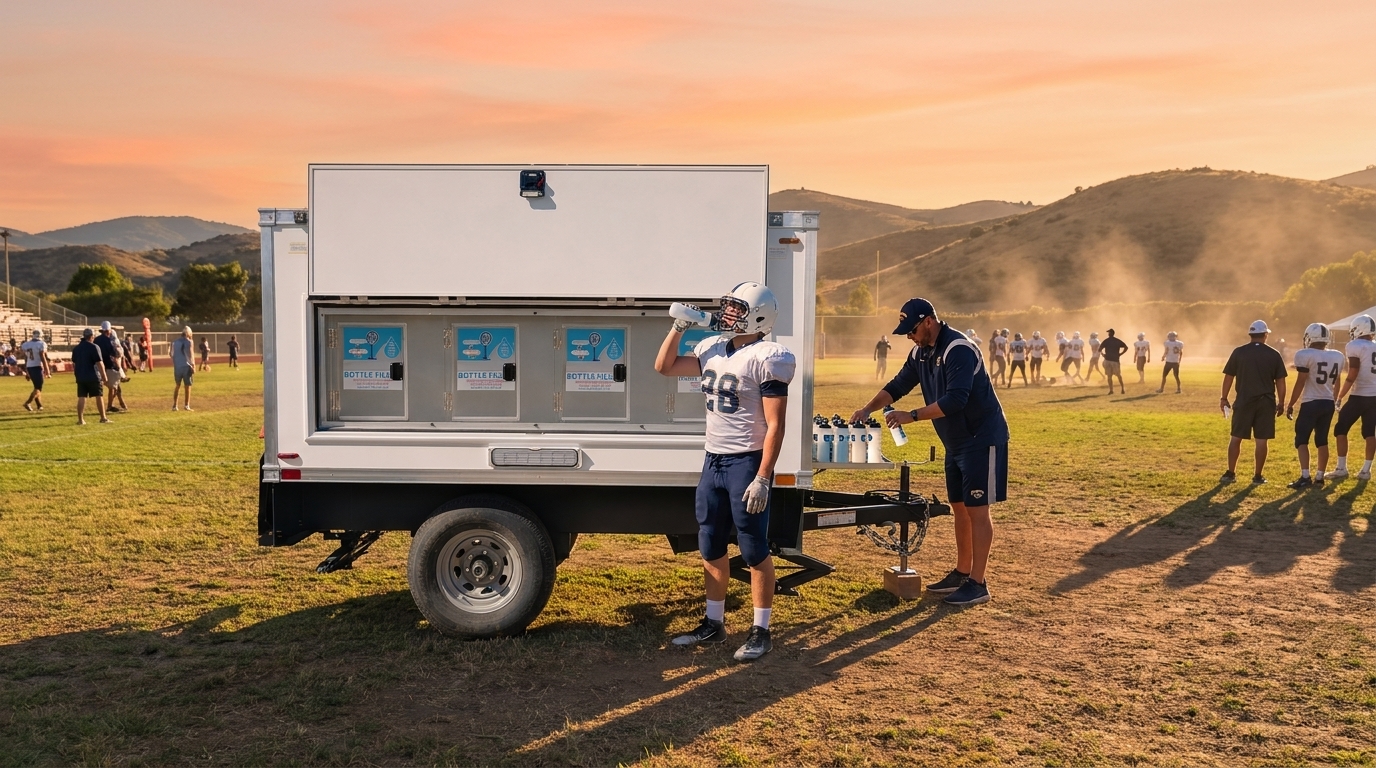
Established residential areas across the middle and east of the city. Most of our work here is street and utility jobs that sit on one block for weeks, plus school campus events. Same crew, same service day, every week.
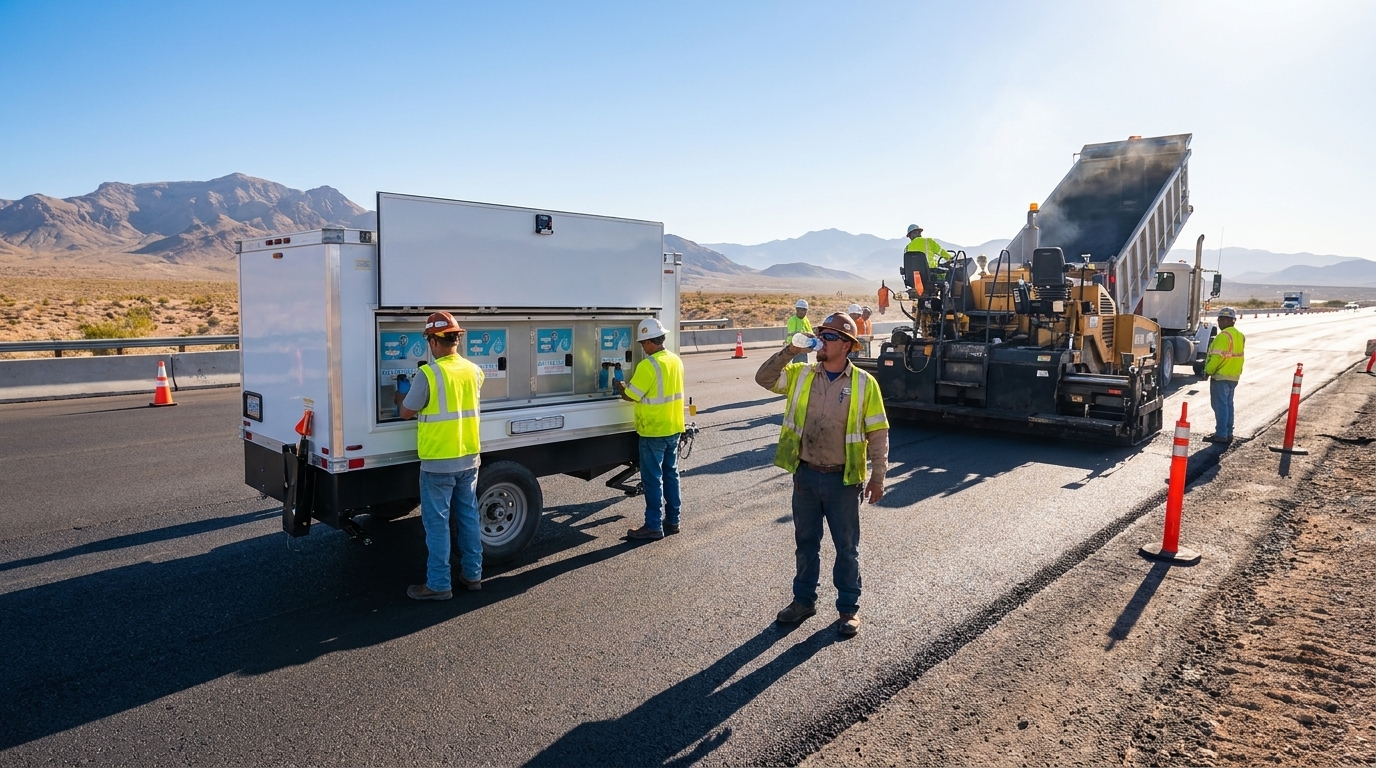
Small river cities south of town along the border road. Sites down here are spread out and access is narrow in places, so we send the tow vehicle that fits the road instead of the one that fits the schedule.
Data center construction never really slows down. Pads get graded through the worst of the summer, steel goes up in winter, and commissioning teams keep working after the shell closes in. We support the data center corridors growing across the Webb County border area with site-ready stations, chilled filtered water at ADA height, and refill runs timed to trade headcounts that change week to week. If your build runs 24/7, so does our service.
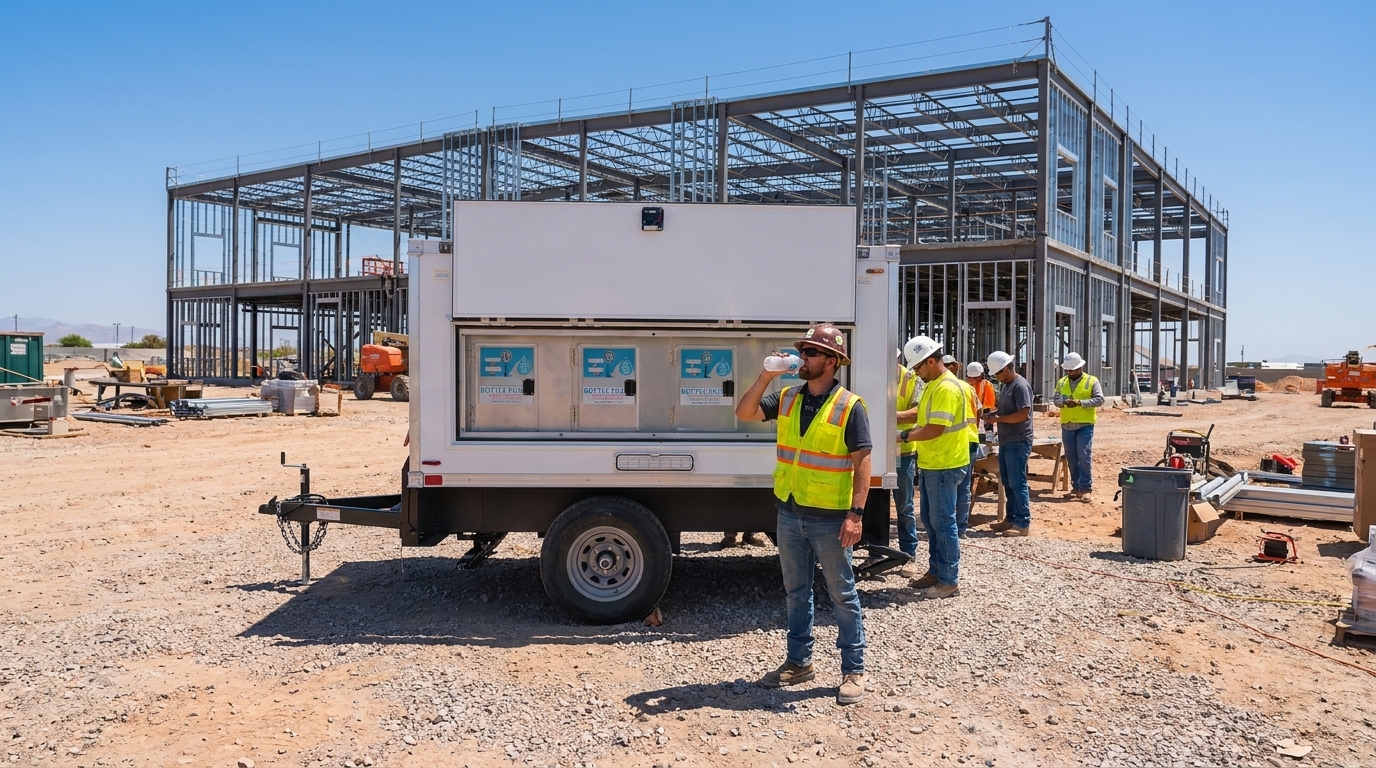
In Laredo we point the Signature Series at ground with no tap anywhere close, like a bridge approach corridor or a ranch road southeast of town. It tows in loaded and pours before a refill truck ever has to roll.
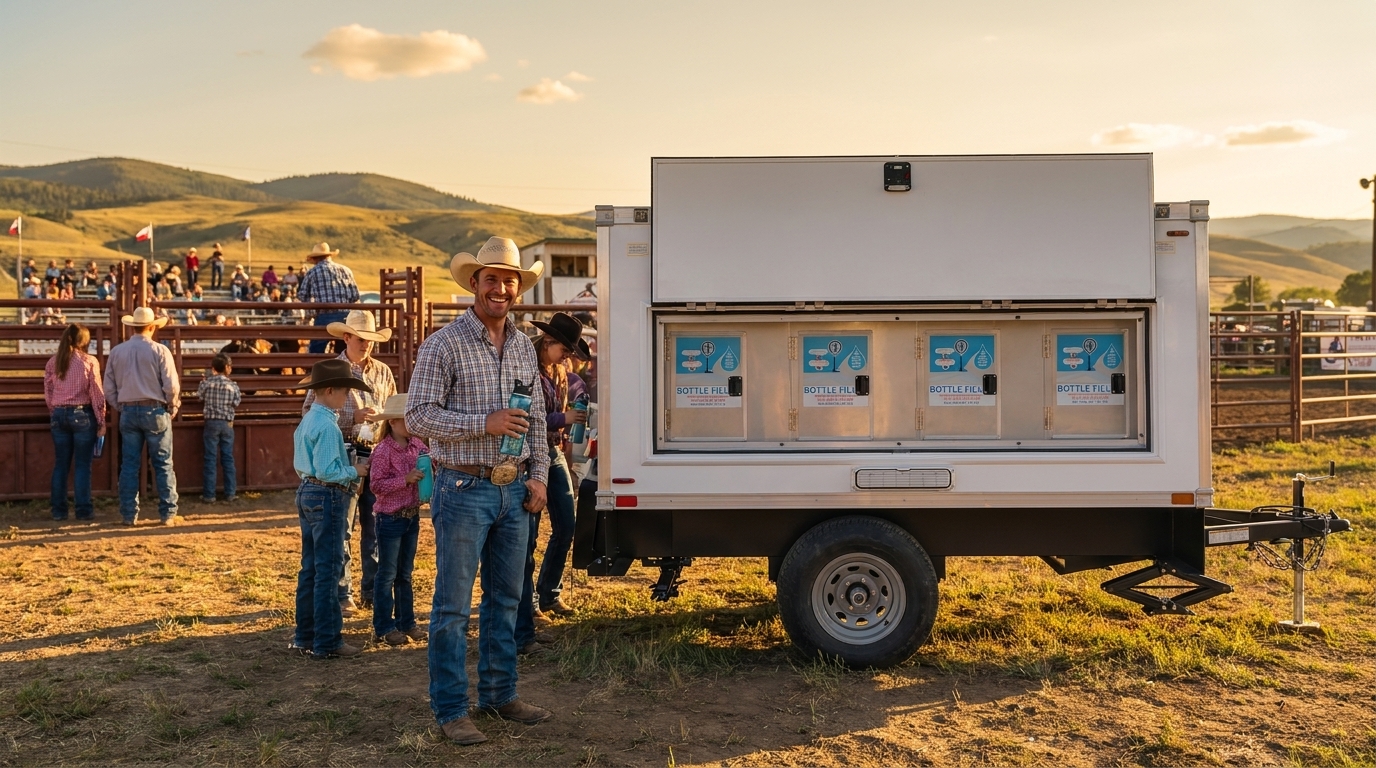
With a frame, a hitch, and tires under it, the unit hauls out to a remote build in the Webb County border area, an event field, a working orchard, or a disaster staging yard with equal ease. Laredo contractors and event planners request this exact rig by name. The whole design is built around backing in, leveling off, and pouring cold by the same afternoon.
| No. of stations | (4) Bottle Filling Stations |
| Length | 12' 3" |
| Weight | 3,100 lbs. |
| Height | 8' |
| Fresh water tank | 300 Gallons |
| Power requirements | 1 to 4 dedicated 20A/120V circuits OR 1 dedicated 50A/240V circuit |
| No. of AC units | 1 |
The Washington's Birthday Celebration has run since 1898, stretches roughly a month from mid January into late February, and draws about 400,000 people. The 2026 edition was the 128th. That is not one event. It is a parade down San Bernardo Street, a two week carnival, an air show on the tarmac at the airport, the Jalapeno Festival that started back in 1978, the Abrazo Ceremony out on Bridge Number Two, and more than twenty other dated pieces. Each one has its own water problem.
A parade route is a moving crowd. So we jump ahead with stations along the route instead of parking one at the start and hoping. Curb access decides everything on San Bernardo, and barricades go up before we can set anything, which means our delivery window has to land ahead of the street closure rather than inside it. A carnival is the opposite job. It sits in one spot for two weeks, and the real work is the overnight service visit that has the tank full again before the midway opens.
The air show is the hardest of the three. Open tarmac and grass at an airport that covers 1,796 acres, a crowd spread wide, and almost no shade anywhere on it. People will not walk back across open pavement in February sun any more than they will in August. We set more fill points rather than one big tank out there, and we put them where the crowd actually stands. The March music festival at San Agustin Plaza is a different shape again, a night crowd on pavement that has been baking all afternoon.
Races and fun runs size differently than any of it. A crowd does not drink steadily. It surges at the finish, then again when the sun clears a building, and line length becomes the constraint instead of volume. Event staff are their own account too. Marshals and public safety crews stand a full shift on the route while attendees drift toward shade, so we stage a separate station behind the line for them.
Six bottles per person on a 100-degree day in the Webb County border area, a 38-person crew, and you're already at roughly 228 plastic bottles to buy, cart in, ice down, and throw away. That's one day. The season is where it gets ugly.
Multiply across a 175-day build and the tally clears 39,000 bottles, with the larger commercial jobs running far past that. A single trailer makes the entire pile disappear, leaving cold water at the tap and nothing for the dumpster.
Sustainability is the easy part of the pitch. Roughly 60 million plastic bottles get thrown out daily in this country, only about a third are ever recycled, and one bottle can sit in a landfill for centuries. Worth reporting, sure. But the Laredo project managers who actually switch usually do it to kill the daily hassle, not to pad a sustainability slide. A shared trailer means no recurring bottle order, no cooler going warm before first break, no wall of empty jugs baking by the job-trailer. The super runs the build, not the water program.
Because our own potable tankers cover the refills, the supply scales with the job rather than fighting it. Double the crew for a big pour and they still can't drink faster than the plan. And the tankers just swing back and bring the level up.
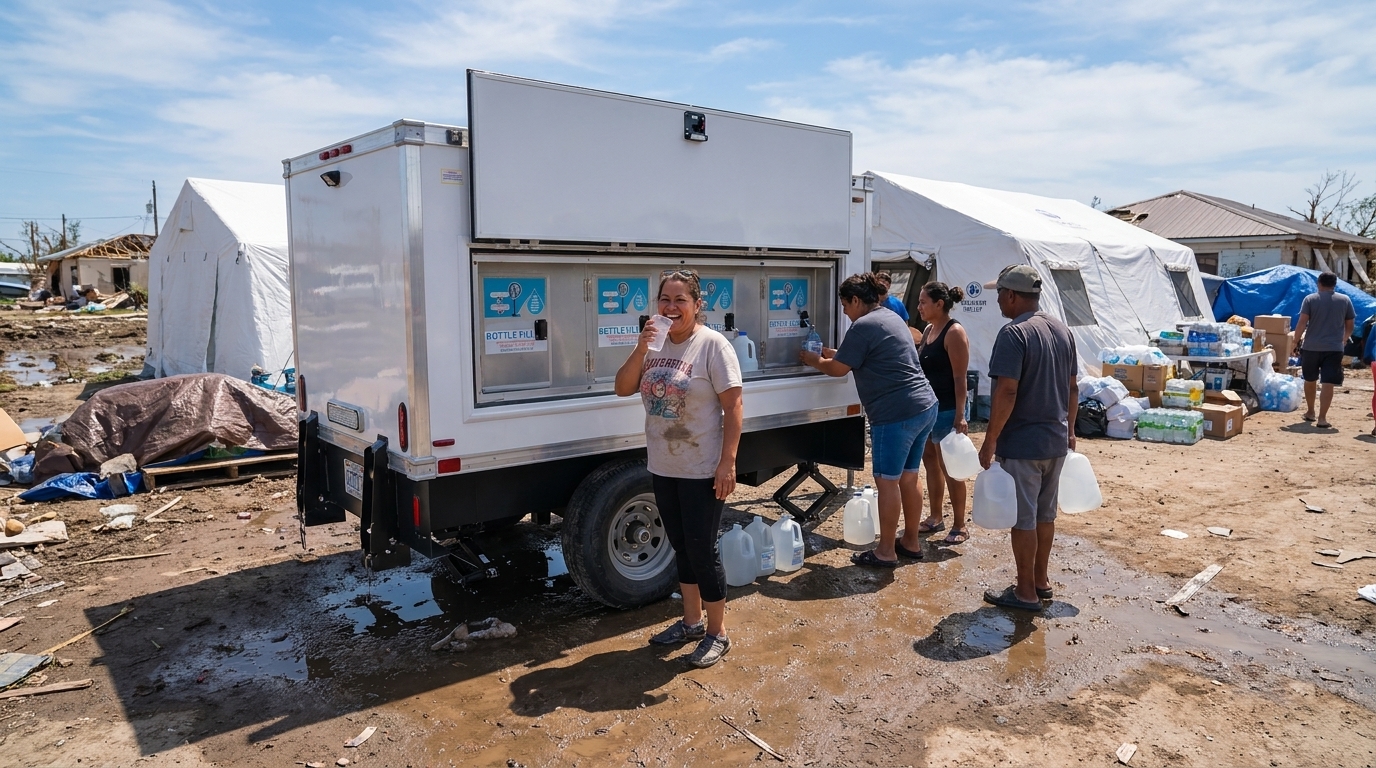
Want this math run for your own Laredo job? Two minutes on the phone gets you a real number.
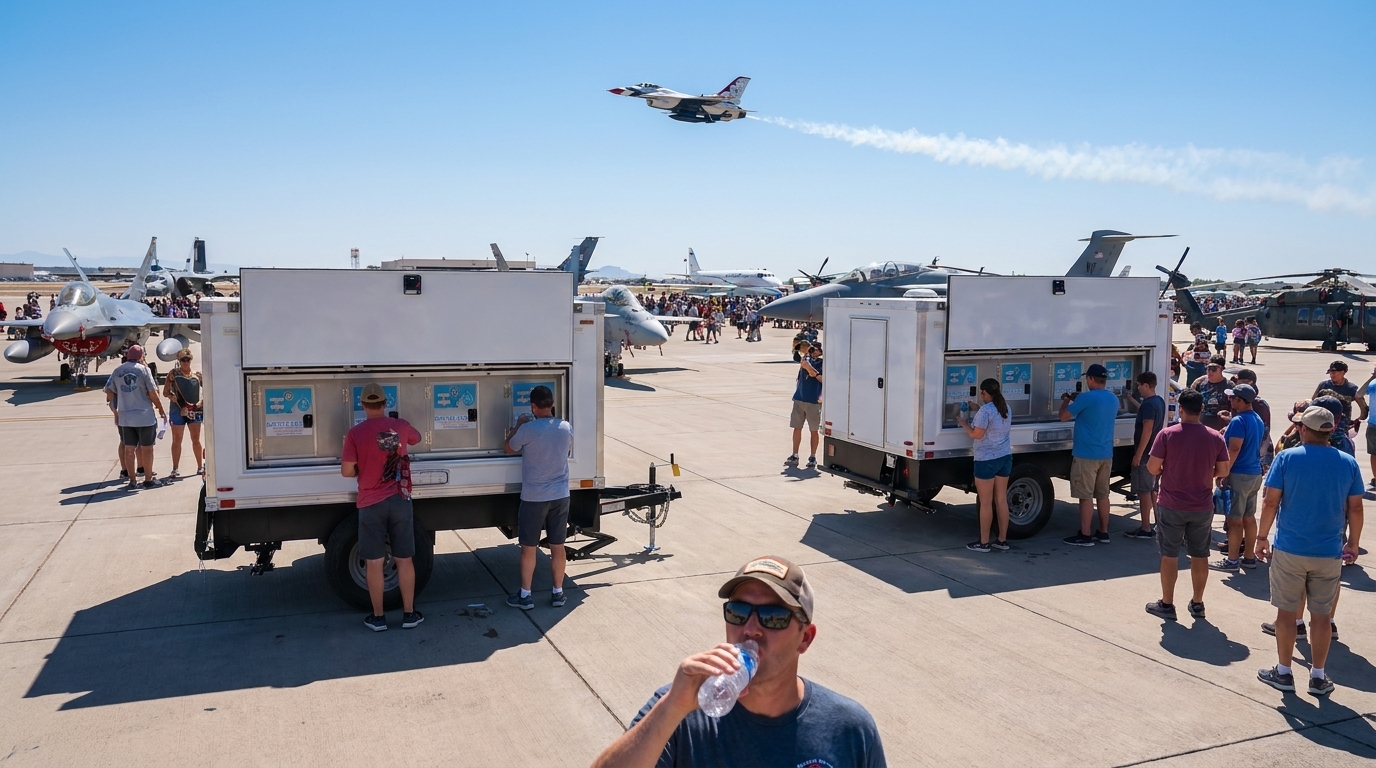
Graduation season puts families on folding chairs in open sun for hours. Campus facilities books the setup, and we stage stations at the aisles rather than at one table by the stage.
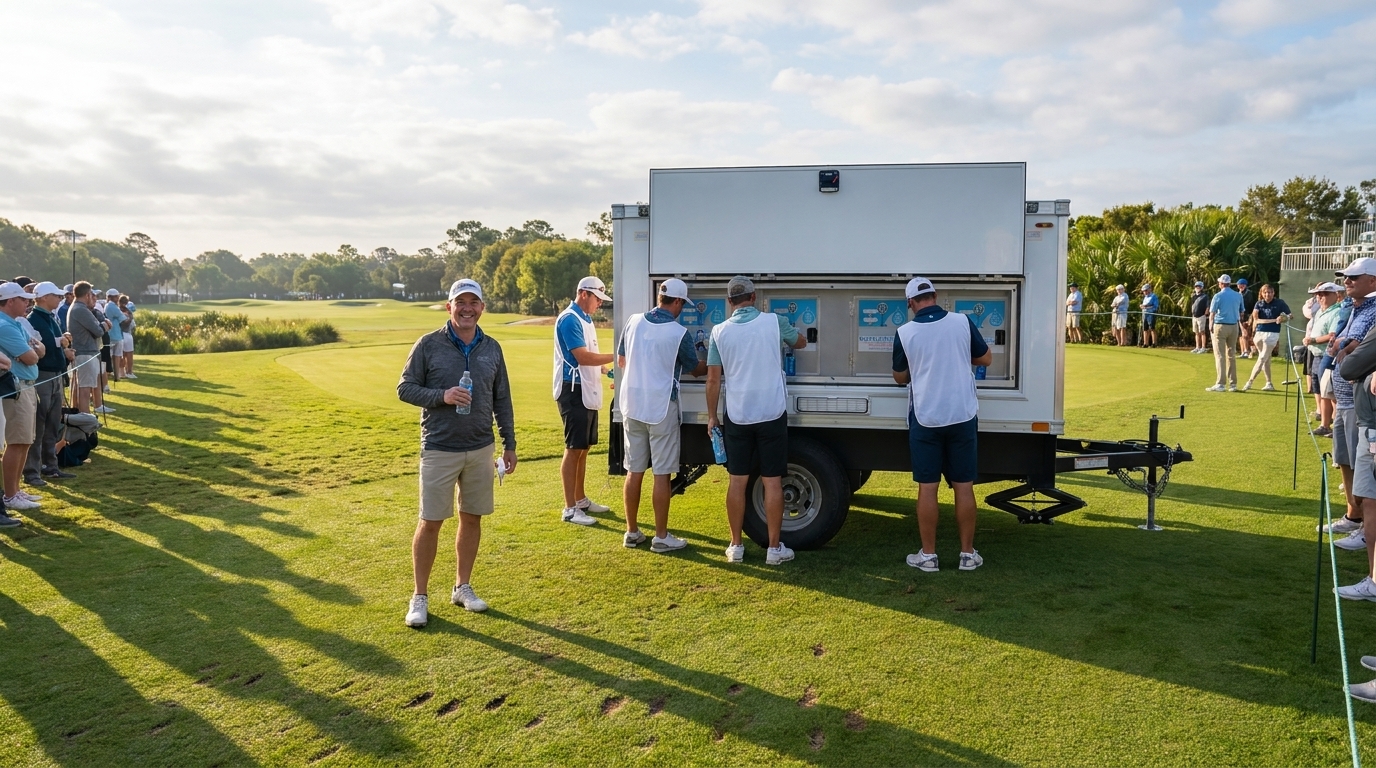
Lease camps run from late September into early February, and the working part of the day happens miles from the camp house. Units go out full because there is nothing to tie into down those ranch roads.
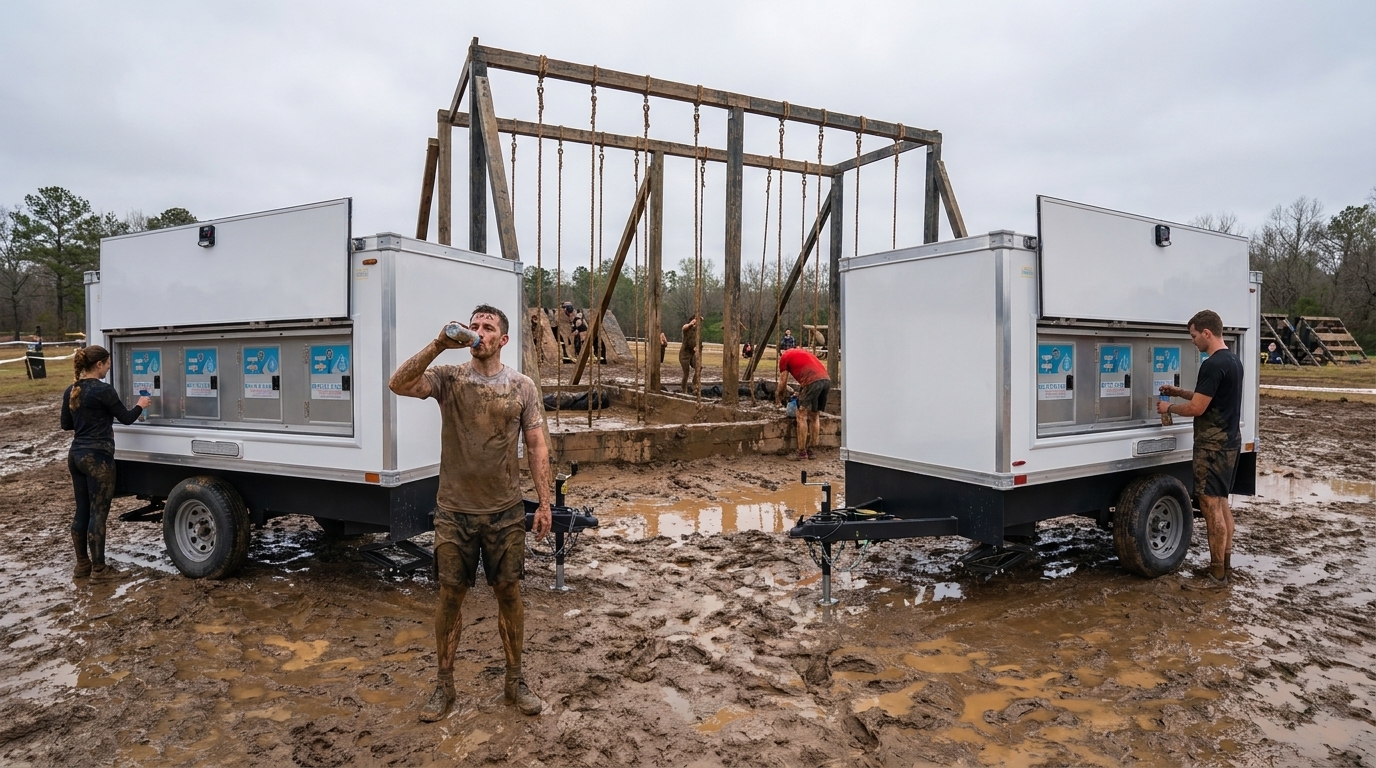
Weigh ins, boat ramps, and marshal boats put people on the shoreline from before sunrise. We set at the ramp where anglers and spectators both pass, and we top the tank between flights.
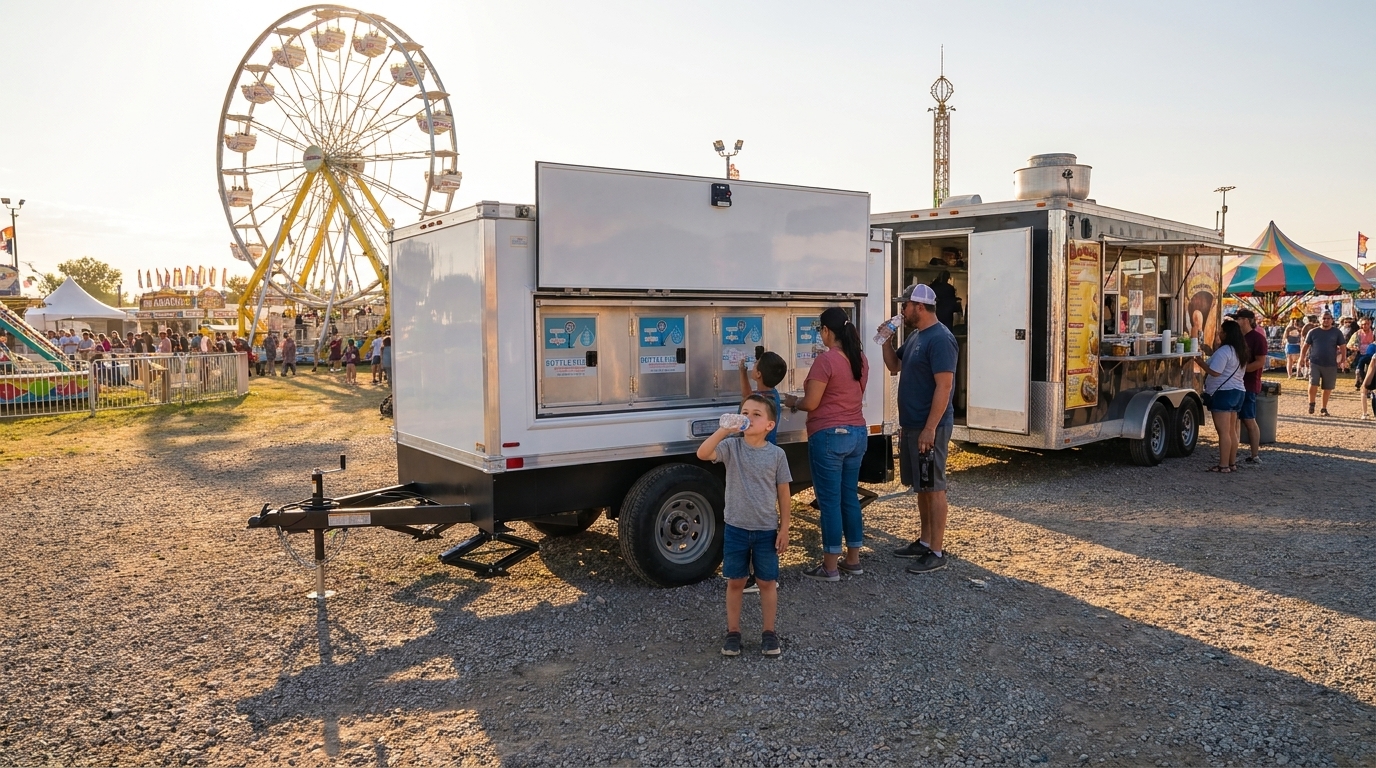
Eagle Ford field work is smaller than it was at the peak, but the crews are still outside all day with no shade. One unit covers a pad, and our truck refills it on a set route rather than a phone call.
A water source people don't trust gets ignored, and an ignored station is rented money wasted. That's why municipal water doesn't reach the tap raw on our trailers. It passes through three filter stages and a UV chamber, then an onboard cooling unit drops the temperature. The result tastes clean and comes out cold, even on the worst Laredo afternoon of the year.
The opening filter traps sand, scale, and the fine grit local mains occasionally push through. On a dusty Laredo lot, that's what keeps a pour from tasting like the parcel it's parked on.
Activated carbon comes next, lifting the chlorine bite and the dull seasonal notes local tap can carry until the taste lands clean and neutral. When it's 100 out, that flavor decides whether a crew keeps drinking or walks past the tap dry.
A finer cartridge then catches the microscopic particles that slip past the first two, so what reaches the spout is clear rather than merely cold for the crews and crowds across Laredo.
The last step is an ultraviolet chamber that wipes out bacteria and microbes without adding a single chemical. Even after a long tow to the far edge of the Webb County border area, the water off the nozzle is clean.
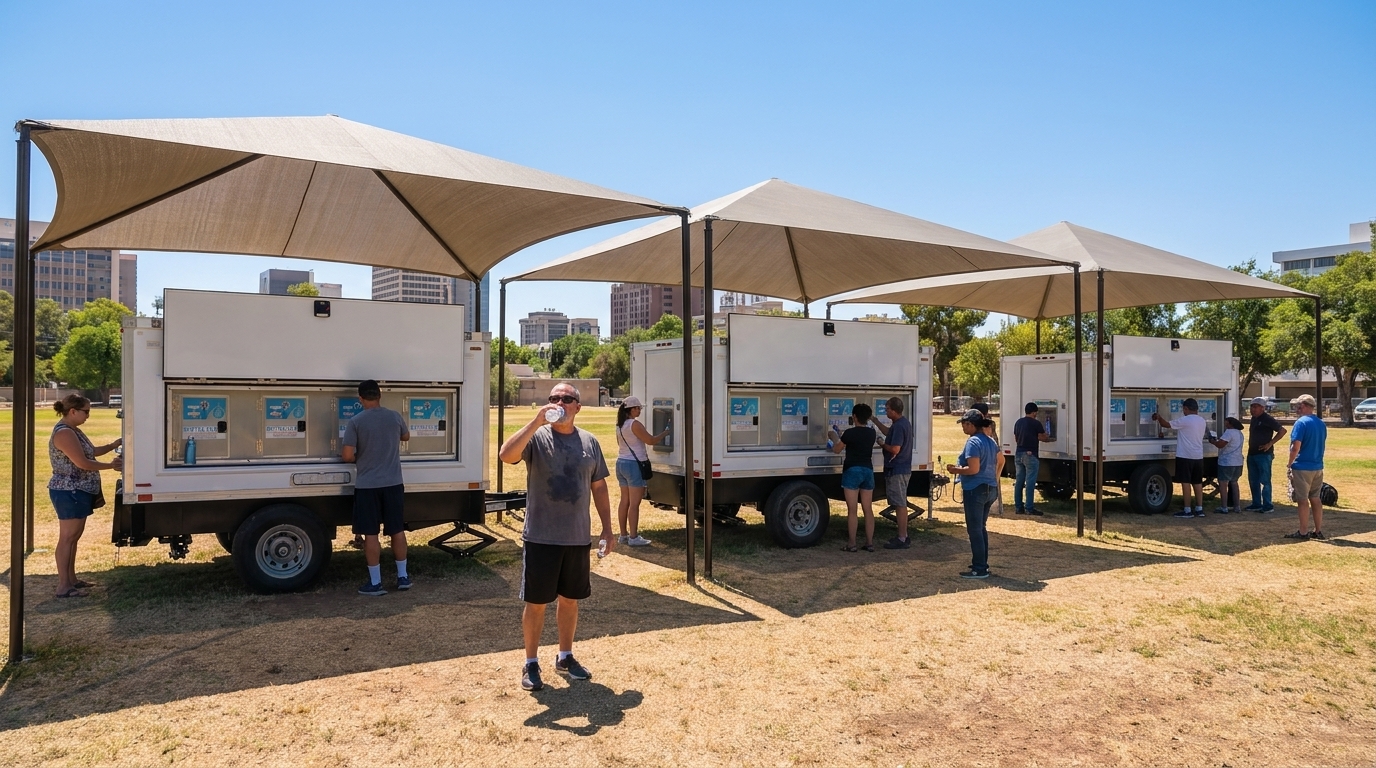
Along the wall sit four adjustable push-back taps, press a bottle to the bar and it pours. One of them is set at ADA-reachable height, so a single trailer includes everybody at a Laredo crew or crowd with no add-on gear. Out back, a large-jug spout services five-gallon coolers and hydration packs, while a bank of hose connection taps handles work-site chores, event support, and refills down the orchard rows. Stainless, food-grade plumbing the whole way through keeps the filtered, chilled water at quality right to the spout.
Every Signature trailer carries a 300-gallon load, roughly 2,400 cups at sixteen ounces each, and we recharge it on demand, so the unit doesn't turn into the choke point on a busy Laredo shift or a packed show night.
There's nothing here for you to run. Placement, fresh-water load, hookup, that's all on us, and then we walk your Laredo crew or event staff through the basics before our truck pulls away.
People count, number of days, where exactly it parks on your Laredo site, and what power is there. Those four answers let us spec it correctly the first time around.
Reckon roughly 45 minutes from our yard to anywhere in Laredo or the Webb County border area, with round-the-clock emergency runs whenever a heat advisory or a power shutoff hits the area.
Once on site we set it level, charge the 300-gallon tank, and tie in power off one to four standard 120V circuits, or a single 50-amp 240V drop, depending on what the site gives us.
After that the tankers cycle back on a cadence matched to how fast your crew or crowd pulls it down, and we maintain the unit through the whole rental term.
No power on the parcel at all? We price that in. The unit draws very little, and with the service fleet backing it we've run Laredo stations on lots that had no permanent power whatsoever. Lay out what the site offers and the rest is on us.
Start with worker safety, because that is the framework that touches almost every job we deliver to. The Texas Department of Insurance backs OSHA's national heat illness campaign, and the campaign is literally called "Water. Rest. Shade." The state's workers comp division hands out free Texas specific material on fluid replacement, heat stress, and outdoor summer safety, and it staffs a training line for companies that want it built for their own crews. OSHA's own numbers behind that push are not small: 344 heat related worker deaths and 24,660 serious heat related injuries nationally between 2011 and 2019, with 43 deaths in 2019 alone.
Federal rules already reach this. OSHA sanitation requirements cover accessible drinking water at the workplace, and the general duty clause requires an employer to protect people from recognized hazards, heat included. A dedicated federal heat standard is still moving through the rule making process, and the direction it points is clear: written water, rest, and shade planning, plus records that show it happened. Smart general contractors here already write water into the site plan and keep dated service records the same way they do for fall protection. We hand over a service log after every visit so that paperwork exists before anybody asks.
Events and campuses follow their own paths. An event on city property or public right of way goes through the city's permit process, and water service is part of that site plan rather than a detail to sort out the week before, so get the water plan on the map when the application goes in. School athletics run under UIL rules that structure practice and heat adjustment during hot weather months, which is why a district's August schedule looks the way it does. Campus events at either district or at the colleges usually route through facilities instead of a city desk. On the drinking water side, a station serving the public needs a filtered, food grade source and clean, food contact safe dispensing parts, which is exactly what we deliver and document.
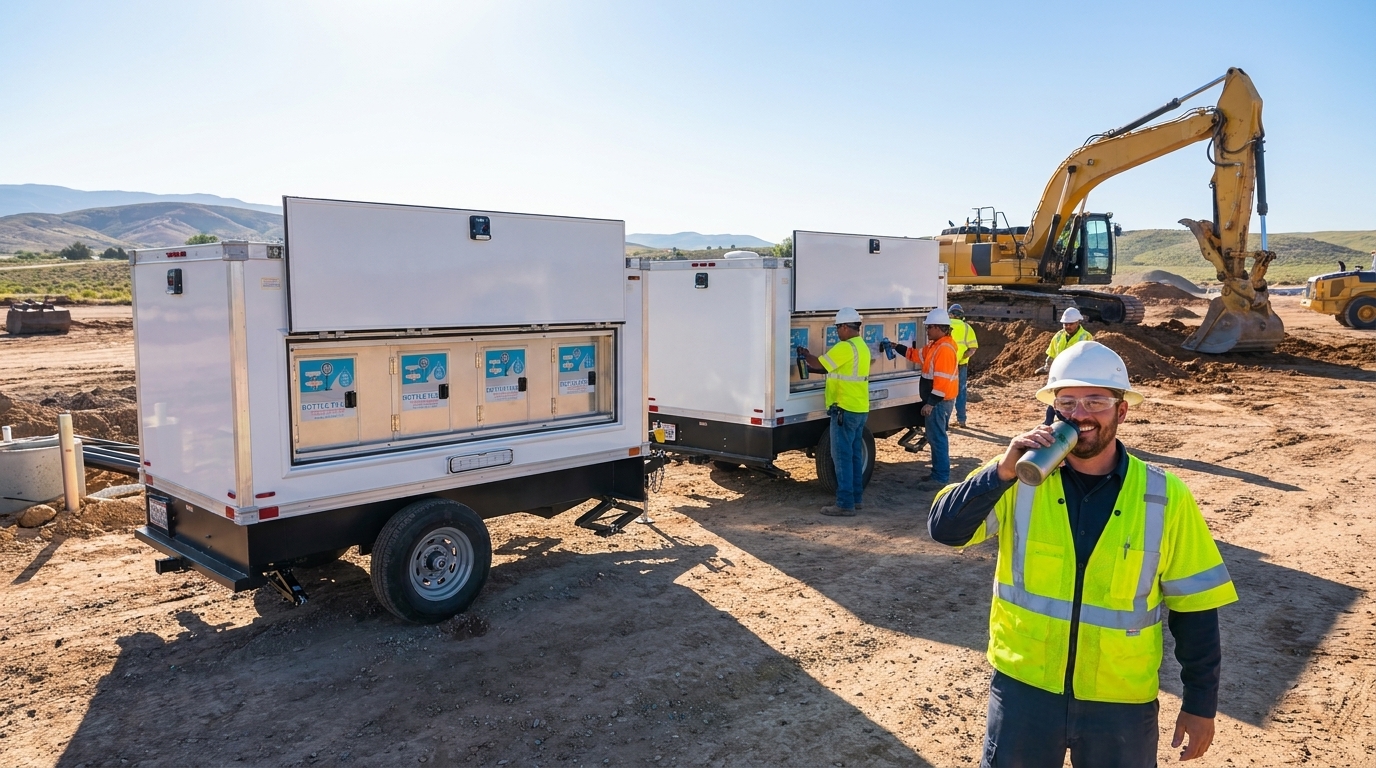
Need a station your written heat plan can point to? We can have one pouring cold within days.
A lot of the Webb County border area jobs have shaped how we run the next one. A few that stuck with us:
Safety manager, bridge approach corridor job. He called on a Thursday in June, two weeks before his crew moved onto the approach work. No circuit within reach of where the men would be standing, and the nearest tap was inside a building they did not have keys to. We brought a generator with the unit and set it at the pull off where the trucks park mid morning, then moved it twice as the work walked north. His heat related send homes went to zero that summer.
Carnival grounds manager, two week midway. His first year running the midway, he had one fixed fountain and a vendor selling bottles at the far end. Lines by four in the afternoon, every day. We put three stations at the crowd nodes and serviced them after close, so the tanks were full before gates opened. He told us the complaint he stopped hearing was about the walk, not the water.
Ranch foreman, hunting lease southeast of town. Fence line work in September, a crew of nine, and jugs on the truck bed that were warm before nine in the morning. The lease sits down a dirt road with no address you can hand a driver. We worked off a pin and a gate code, delivered full, and set a standing every other week refill through the season. He has not gone back to jugs.
United ISD runs 42 schools across a service area bigger than the state of Delaware. Laredo ISD runs 30 more with about 20,592 students. Together that is well over 60,000 kids, and a large share of them are outside in August for two a day football, cross country conditioning, drill team, and band camp. UIL sets how hot weather practice gets structured. Getting cold water to the field is the part that lands on the campus staff, and it is the part we take off their list.
Newer campuses are the ones that call first. A field built in the last few years under the district bond program often has young trees, little shade, and a single fixed fountain that was never meant to serve a marching band at seven in the morning. So we set a station at the gate the band walks through, not at the concession stand across the lot. On a tournament weekend at the Buena Vista Sports Complex on the south side, where Phase One of the baseball and all purpose fields opened in early 2025, we set more than one.
The college calendar is steadier and runs almost year round. Texas A and M International enrolled 9,137 students for fall 2025 and fields 13 varsity Division II programs on a 300 acre campus, and Laredo College works two campuses, the historic Fort McIntosh grounds downtown and the South Campus that opened on South Zapata Highway in 2004. Outdoor practice, campus sports, orientation, and commencement all land in hot months. Those bookings usually route through facilities rather than a city permit desk, and we handle that call.
Youth sport is its own thing. Parents, siblings, and a coach with a notepad outnumber the athletes on any given Saturday, and the athletes are the ones nobody is watching for early heat signs. We size for everybody on the grass, not the roster. And we put the station where a nine year old can reach it, which is the low tap on the unit.
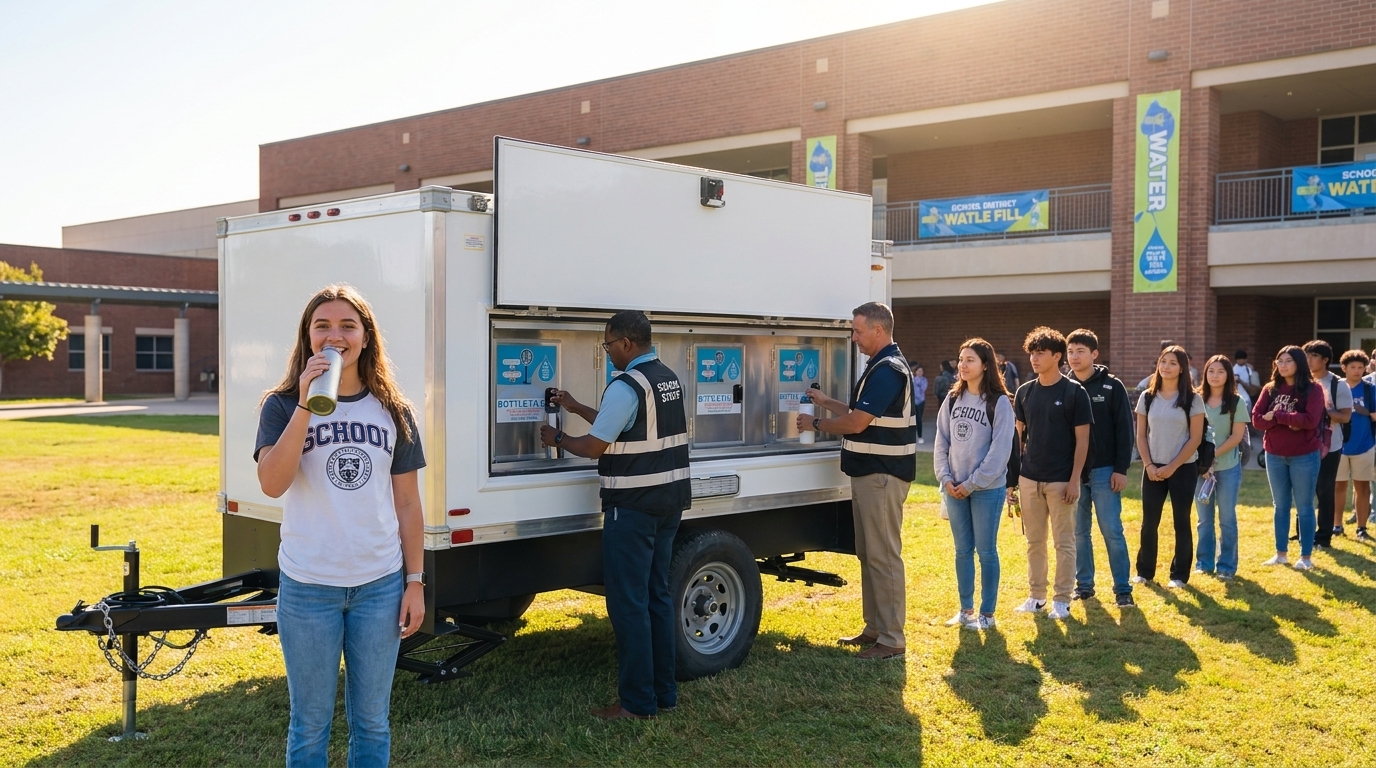
The hot season here is long rather than sharp, and that changes how people book. A crew that starts at five in the morning in August is already past its first tank by mid morning. So the service visit matters more than the delivery date. We write the refill day into the paperwork before the unit leaves our yard, and on peak summer jobs we schedule a mid week top off instead of waiting for somebody to call us at noon.
Rain is concentrated rather than spread out. Laredo averages close to 19.7 inches a year, and most of it falls between May and October, which is the same window as the heat. A hard packed dirt pad that was fine on Monday can be soft on Tuesday. We ask about the access road on every summer booking for that reason, and on ranch and well pad accounts we ask for a site contact who can tell us what the last storm did to it.
Winter is not a quiet season here and we do not treat it that way. The civic calendar loads up in January and February, and a hard freeze is a real Texas risk even this far south. February 2021 put record cold into all 254 counties, knocked out power for about 69 percent of Texans for an average of 42 hours, and disrupted water for more than 12 million people statewide, with hundreds of boil water notices behind it. Freeze protection is a service call for us, not a reason to park the fleet.
The World Trade Bridge expansion is the biggest outdoor job on the board here. TxDOT and the city are advancing a new eight lane span for northbound commercial traffic, parallel to the existing bridge, plus two added southbound lanes on the span that is already there, along with new lighting, electronic signage, and a hazardous materials collection system. Public input ran through spring 2026 and construction has been pointed at a summer or late 2026 start with completion targeted in late 2027. That is a crew working outside through at least one full Laredo summer on one corridor.
We place a station where people actually take a break, not where the gate happens to be. On a job that walks down a corridor, that means moving the unit as the work moves. Crews quietly stop drinking when the walk gets long. We have watched it happen on jobs here more than once, so the question we ask the superintendent is simple: where do the trucks park at ten in the morning. That is where the station goes.
Power is the other thing to settle before the truck leaves the yard. A bridge approach, an airport tarmac, or a well pad out in La Salle County usually has no dedicated circuit anywhere near where the crew stands, so the single 50 amp 240 volt path or a generator is the realistic default out there. Downtown venues and established yards are the reverse. They almost always have something to tie into. Sorting that out early is worth more in a market this spread out than it would be in one uniform suburb.
The rest of the construction work here follows the freight. Warehouse and distribution center building keeps pace with a border crossing that moved 213,008 rail cars in 2025 and handled more than 616 million pounds of air cargo the same year, and both school districts keep campus and athletic field construction going under their bond programs. Companies running crews in more than one Texas market often book this alongside our on-site water station rentals in San Antonio and keep a single contract instead of two.
Everyone sees the trailer. What they don't see is the support fleet behind it, the trucks that deliver fresh water, hold reserve on site, and carry wastewater off, so a single call wraps the entire loop rather than stringing together three vendors.
Our tankers run drinking-grade water in bulk, recharging the 300-gallon tank on whatever interval the headcount demands. Those same trucks also top up storage tanks, holding tanks, and bladder bags whenever a single drop can't keep pace, like a big slab pour or a downtown night that packs the square.
When demand spikes we set out fold-flat bladders to bank extra fresh reserve, and on a drain-less lot they'll temporarily hold greywater too. It isn't fancy equipment, but it's what keeps a far-flung job in the Webb County border area pouring between tanker runs.
Water that has to move across a job is a pump truck's job, whether that's charging holding tanks or hauling supply end to end. It earns its keep on the sprawling parcels where the trailer and the fill point can end up a fair hike apart.
At the tail end, a vacuum truck draws off greywater and wastewater and carries it to permitted disposal, closing the loop clean. Nobody on your Laredo crew is left guessing where the used water ended up. That piece was built into the plan from day one.
Every job gets its own setup. A remote parcel might run a station plus a bladder bag for reserve and a recurring water-truck schedule. A heavy event night might call for a pump truck to move supply and a teardown waste run at the end. Describe the shape of your job and we'll put together the right combination, on one invoice, handled by one crew that already knows the ground.

A couple of minutes on the phone is enough to get you a real number. Here's what we'll want to know, handy to have ready before you call, and proof that we size every job to the work in front of us rather than reading off one canned quote.
Bottled water reads as the budget choice on a purchase order. Its actual price tag is buried somewhere else, in handling hours, staging footprint, water that warms up, and trash piling up afterward, and on a hot inland lot each of those costs more than it would by the coast.
Look at everything bottled water actually demands of a person: cutting the order, receiving and breaking down pallets, icing coolers before dawn, topping them up through the day, then flattening empty bottles for the bin. On a large Laredo crew that's hours of paid time burned every single day, scraped right off the work that's supposed to be getting done. The trailer erases that loop entirely. A local contractor once let us pencil it out with him, and the recovered labor by itself paid for the unit. His words were that the bottle runs had been quietly costing him close to a day of payroll a week. Our trailer arrives full, the tankers keep it full, and your superintendent owes it nothing but a parking spot.
Ice a cooler at 6 a.m. and by mid-morning in July around the Webb County border area it's as warm as a bath. Warm water is water people stop touching, and the slowdown that follows is precisely where heat illness gets its opening. A chilled station never rides that warm-up curve at all. Whatever pours at clock-out is as cold as the sunrise fill, which happens to be the moment a spent crew, or a crowd deep into a long concert, leans on it hardest.
Bottled-water pallets devour staging space, jam the lay-down area, and sit cooking in the sun until somebody finally cracks them open. Empties build up faster than anyone keeps up with, and on a tight commercial lot that pile turns into its own problem. Set a trailer in one parking stall instead and it serves a crew or crowd that would otherwise burn through hundreds of plastic bottles every day.
Every bottle bought is a bottle thrown out, and across a season a busy site or event generates a small mountain of them. That's a disposal line on the budget, a dent in the sustainability numbers, and, given that a single bottle can linger in the ground for centuries, a footprint that lasts longer than the project that made it. Move to a refill station and the line drops to zero, which finally gives your reporting a figure worth publishing.
We cover Laredo, the rest of Webb County, and the ranch and lake country around it out of one dispatch. Zapata sits about 50 miles south on US 83, Hebbronville about 55 miles southeast, and Cotulla about 90 miles northeast on I-35, and all three are same day runs for us. Crews working sites in more than one Texas market often pair this page with our hydration station trailer rentals in Austin and deal with one vendor across both. Call us with your dates and we will tell you straight whether we can hit your window.
Working a corridor instead of a single address? We follow the main routes across the Webb County border area, so multi-site projects get the same fast turnaround as one stop.
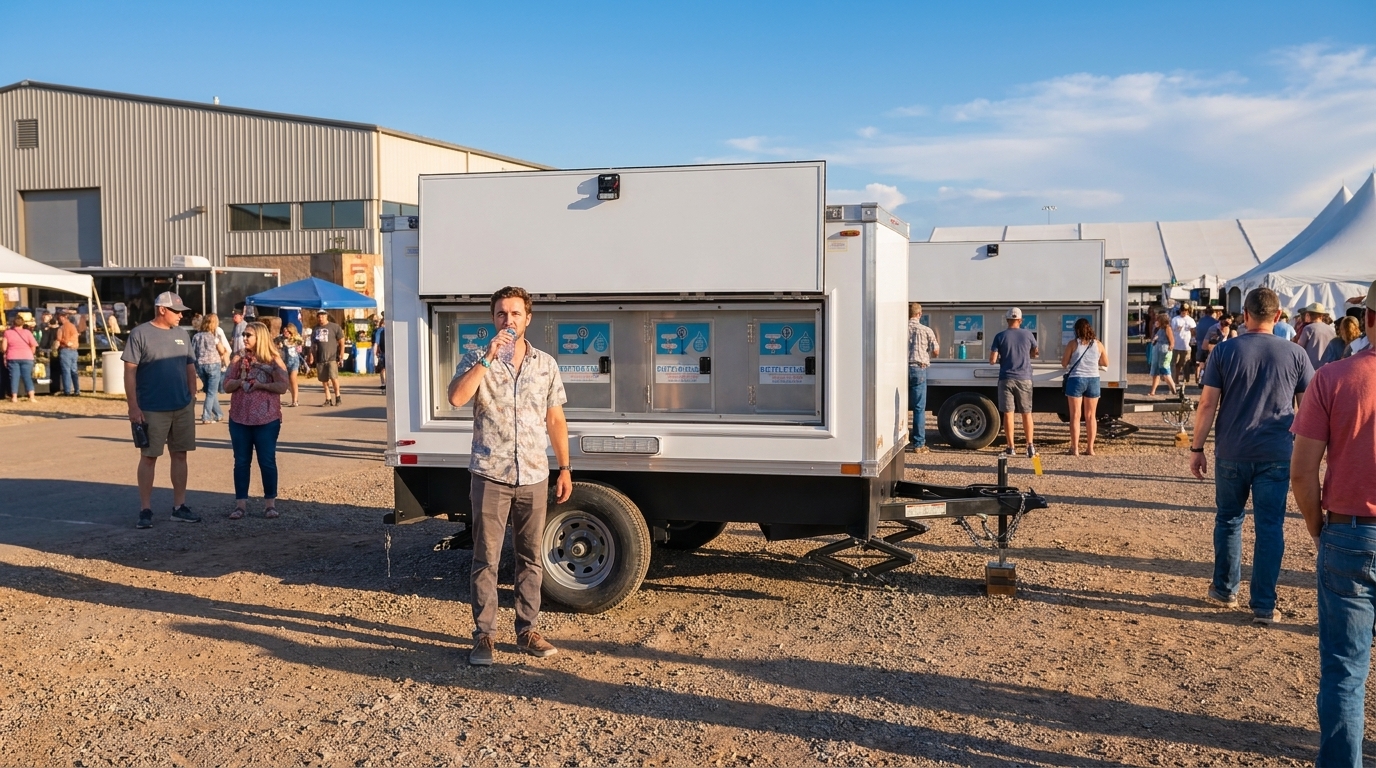
Still weighing it? Call and ask. Most of these questions get settled in one short conversation. See also: cold filtered water station rentals in El Paso.
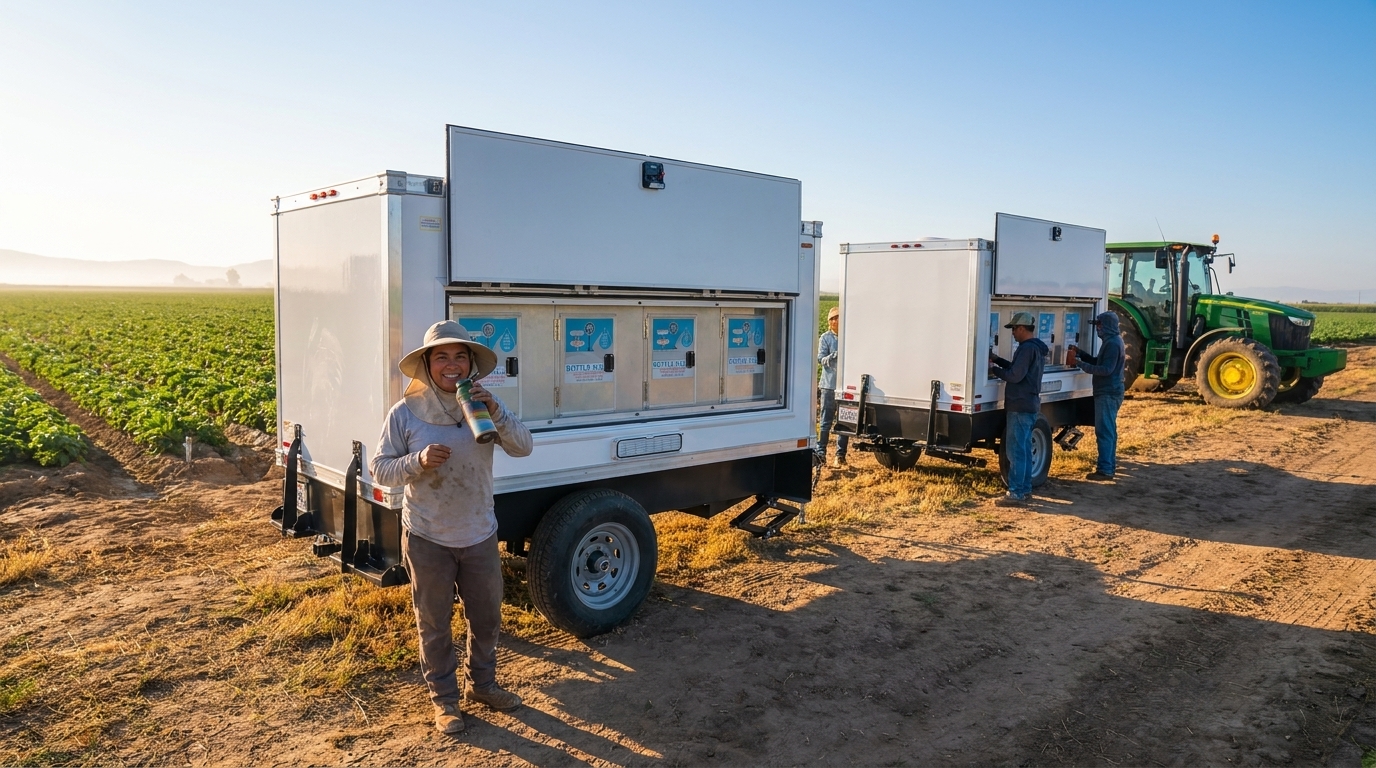
You get a dated service log after every visit that shows the refill, the cleaning, and who was on site. That log is what a general contractor or an agency inspector actually wants to see, because it proves water access was maintained rather than promised. On federal and state funded work we also supply our SAM.gov registration and certificates of insurance up front. Tell us at booking whose format you need it in and we will match it.
Inside the zone is fine when there is a stable, level spot clear of swing radius and traffic control, which on a corridor job usually means the pull off where the trucks park. Outside the barricades makes more sense when the work is moving fast down the line or when equipment needs the whole width. The general contractor's traffic control plan settles it, and we follow that plan rather than argue with it. What we push for is distance: the shorter the walk, the more people drink.
Start at two gallons per person for a full outdoor shift, then add for heavy work and for the heat index rather than the air temperature. Thirty people doing real labor through a 104 degree stretch will push well past that baseline by early afternoon. A 300 gallon tank covers a crew that size across a normal service interval, but in peak summer we usually add a mid week refill rather than stretch it. Give us the head count and the shift length and we will size it instead of guessing.
Very little. We need a level spot roughly 13 feet by 8 feet that a truck can back into, and a decision on power, which is either one to four dedicated 20 amp 120 volt circuits, a single 50 amp 240 volt circuit, or a generator from us. No water line is needed because the tank arrives full. On ranch and well pad deliveries the one thing we do need is a site contact and clear directions, since a pin on a map beats an address out there.
Yes, and long deployments are most of what we do here. Multi month terms get a written service calendar with refill and cleaning visits scheduled from day one, because water that sits is the failure mode on a long job. We can also move the unit as the work walks down a corridor at no drama to you. Tell us the projected end date and we will build the term and the service cadence around it.
Both. The four push button stations are built for bottle filling with adjustable taps, so a crew tops off personal bottles all day without a line forming. A rear jug station handles the big coolers that ride out with a field crew, which is the one most jobsite customers end up using the most. Extra hose connections cover whatever else the site needs water for. Nothing about it is drink and go.
Yes. We send a generator sized for the unit, and that is the default on ranch, lease, and well pad deliveries because there is rarely anything to tie into. The unit itself is modest on power, needing one to four dedicated 20 amp 120 volt circuits or a single 50 amp 240 volt circuit. The tank arrives full, so the site does not have to supply water either. Fuel and service on the generator are on us, not on your foreman.
Each fill station catches drips in its own basin, and those drips stay in the basin instead of on the ground. Nothing runs onto pavement or into a storm drain, which is the part a downtown event permit reviewer will ask about. We pump that tank out during the same visit that refills the fresh side. If your site already has a sanitary connection, we can tie into it instead.
It does, and the February crowds here surprise people. Four hundred thousand attendees across a month long celebration means long standing times, slow moving crowds, and food vendors working hot equipment. Staff and marshals are on their feet for full shifts with no chance to drift toward shade. Mild air does not stop dehydration when somebody has been standing on pavement since nine in the morning.
By not letting it sit. Every unit we place gets scheduled cleaning and refill visits written into the agreement, so the water in week ten is as fresh as the water on day one. The filter stack and the UV pass do their part, but the service calendar is what actually protects you. If your booking has a long gap in the middle, say so and we will schedule a service visit inside the gap rather than after it.
We are. Our network is SAM.gov registered, licensed and insured, and carries an A plus BBB rating, and we supply certificates and dated service records as standard on public work. School district bookings usually route through facilities, and city or county work through the project manager, and we are comfortable with either. Send us the solicitation or the requisition and we will tell you exactly what we can provide.
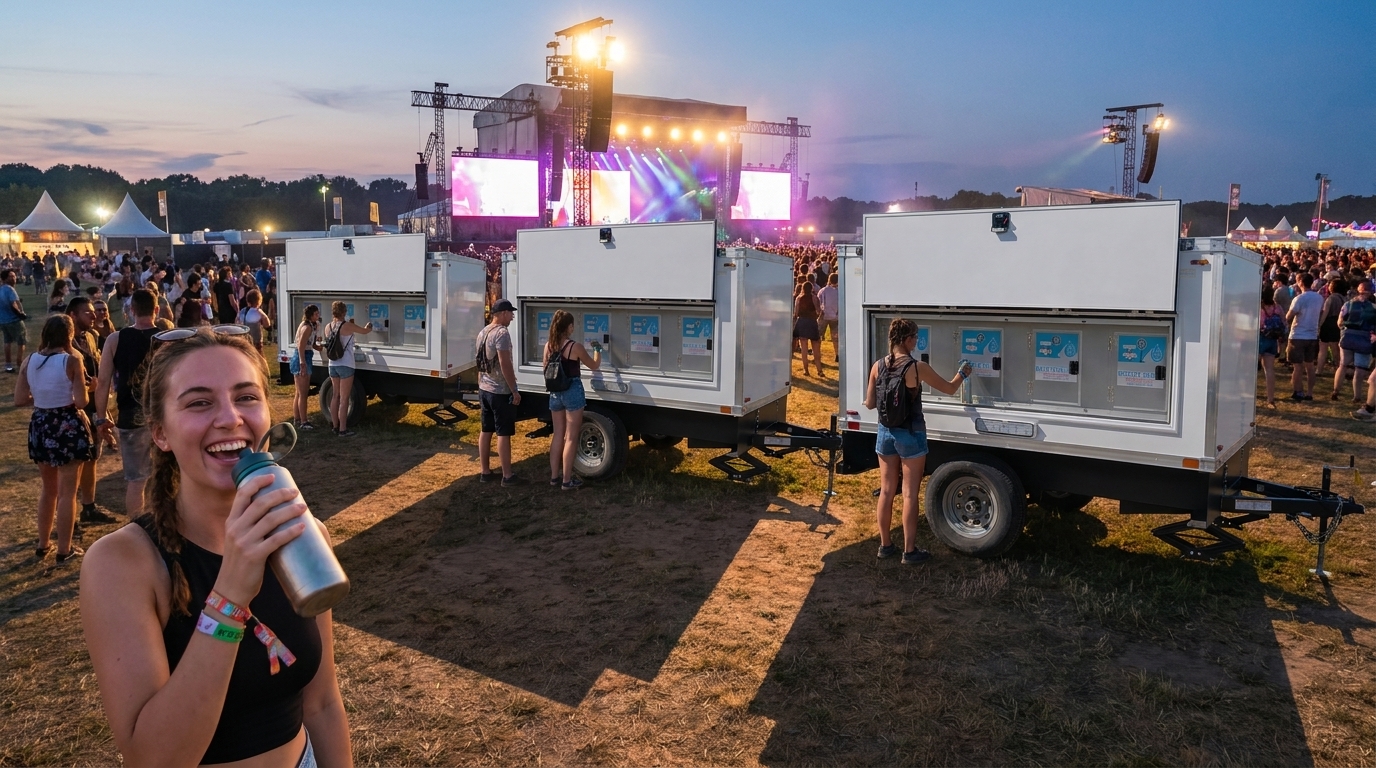
Almost every sizing chart starts at two gallons per person per day and stops there. That figure comes from moderate work in moderate weather. It is a floor. In a city where highs hold near 104 for weeks, it is a floor a lot of crews fall through before lunch.
Work the math in three pieces instead. Head count first. Then a factor for how hard the work is, because a concrete crew and a survey crew do not drink the same. Then a factor for the heat index rather than the plain air temperature, since humidity off the river changes how well sweat does its job. That third piece is the one most plans skip.
A month of events is not a big event. It is twenty five different events wearing one name, and each one hands you a different problem. That is the thing to sort out first, before anybody talks about how many stations to order.
Take a parade route. The crowd is linear and moving, curb access controls where anything can physically go, and barricades close the street hours before the first unit steps off. So your water delivery has to land ahead of the closure, not inside it. Plan on stations spaced along the route rather than clustered at the start, and confirm which cross streets stay open for a service vehicle.
A one week rental and a ten month deployment fail in completely different ways. The short one fails on delivery. The long one fails in month four, quietly, when nobody has opened the tank in a while and the water has gone flat and nobody says anything until somebody gets sick. Ask questions built for the long version.
Start with service cadence, and get it in writing. Not "we service regularly." An actual day of the week, an actual visit count, and what happens on that visit. Refill only, or refill plus cleaning. A vendor who will not put the cleaning visit on the contract is telling you something.
Demand here staggers instead of stacking, which is good news if you plan and bad news if you call late. The year has four distinct pulls on a fleet, and they barely overlap. Knowing where yours falls tells you how much lead time you actually have.
January and February are the civic months. A celebration that runs roughly four weeks, a parade, a two week carnival, an air show, a binational youth sports day, and a stack of smaller dated events all inside that window. Lead time here is the tightest of the year, and the constraint is not unit count so much as service capacity overnight. Book this season two to three months out.
People ask what a water station rental costs before they have given us the five things that decide it. We are not being cagey when we ask questions back. Two jobs with the same head count can look completely different once you know where they sit and how long they run.
Distance and corridor come first. Everything here radiates from Laredo in three directions: US 83 south toward Zapata, I-35 northeast toward Cotulla, and the highways southeast toward Hebbronville. Those are different driving times and different road speeds, and the last leg to a ranch or a lease is rarely paved. A site 55 miles out on a rural highway is not the same delivery as a site 55 miles up an interstate.
“Our new field has one fountain and no shade worth the name. Having a station right at the gate changed how much the kids actually drank during two a days.”
“There is no address out here. They worked off a pin and a gate code and showed up full.”
“Band camp starts at seven and the field is a long walk from the building. They put the unit where we line up instead of across the lot, which sounds small and was not.”
“Barricades went up early and I thought we were stuck. Their driver had already planned the drop ahead of the closure. My marshals had their own station behind the line all day, which had never happened before.”
“Drivers wait on open asphalt for hours. A station at the gate gets used. The vending machine in the office never did.”
“Three fields going at once in June and the parents outnumber the players two to one. They sized it for everybody on the grass, not just the rosters.”
“Nothing on our pad is plumbed. The refill truck runs a set route now and I stopped thinking about it.”
“We stood up a staging area during a flood advisory and had cold drinking water there within a few hours. That is not a small thing when nobody trusts the tap yet.”
“Graduation is two hours of families sitting in the sun. The low tap matters more than people expect at an event like that, and their crew set everything before guests arrived.”
Service information current as of September 2026.
Tell us the headcount or the gate count, the rental dates, and where the trailer should park, and we'll spec the right setup and roll one out to you anywhere in the Webb County border area, usually inside about 45 minutes of dispatch.