On-Site Hydration Services is the top rated name for portable water trailer rentals in Millcreek, with cold, filtered water ready for events, job sites, emergencies and more. Our five-star rated team brings the station with same-day delivery, sets it level, and refills it on schedule. Phone the yard or ask for a quote online in under a minute, and ask for a free site check so you know exactly where the trailer will sit before you book.
Trusted by thousands of customers · A+ BBB rated, licensed and insured · Serving events at Canyon Rim Park and Millcreek Common, plus job sites across the Salt Lake Valley
Free, no-obligation quote. One call books delivery, setup and service.
See the full Signature Series water station specs for Millcreek sites
Planning around bottled water means someone has to count every case and then carry all the empty bottles away once the day is over. One On-Site Hydration Services trailer does that whole job. It arrives with cold, filtered water and four places to fill a cup or bottle, we come back to top it off as the day goes on, and it leaves when you are done. Millcreek planners and site managers who want the most trusted water setup in the valley can browse our water station rentals in Utah, then phone the yard or ask for a quote online to lock in the right trailer for the day.
One Signature trailer can pour for a weekend concert and be working a slab pour a couple of days later. Hiring one company for your events and a separate one for your worksites makes no sense. Either way, the planning, the delivery, and the refills are ours.
The onboard cooling unit keeps the tank genuinely cold all the way through a Millcreek afternoon, and that single detail carries the whole thing. Warm water is water people abandon, and midsummer is exactly when a crew or a crowd is drinking the most. Cold water gets finished, and finishing it is what keeps heat illness off the site.
Across Millcreek we answer every call 24/7 and do our best to deliver as quickly as possible, and we keep emergency runs going around the clock whenever a heat advisory or a power shutoff hits the Salt Lake Valley. The morning a foreman finds his 40-person crew stuck with one warm cooler, speed is the whole game.
Water only counts if people actually reach it. We have seen wrapped cases sitting in the sun by a job trailer at one end of a lot while the crew worked a long walk away, and on another job a cold station right at the work face emptied twice in a single shift. Closing the distance between those two results is the job we take on. We pick the trailer by how many people will be on site or come through the gate, schedule refills by how much they actually drink, and take every heat related call as soon as it comes in. Picture a July afternoon at a Millcreek Common event or a roof going on near the foothills: one hot hour can change the whole day.
Foothill driveway check. Streets near Mount Olympus run narrow and steep, with overhead wires and parked cars. We check the grade and turn before booking, and suggest a spot on flat ground close to the party when the driveway will not work.
“We were staging a field exercise with no tap in sight. The trailer showed up, got set on gravel and the water was cold within the hour. The refill schedule came with it, and I never had to chase a tank.”

“Cold water in the middle of July is a safety item for my crew. The four spouts meant no line at break. Easy to work with.”

“We used it for a Monday concert night in the park and guests kept saying how good the water tasted. The placement was out of the way and looked tidy.”

North Holladay sits on Millcreek’s southern edge. Parties and school events here use foothill lots with long driveways, so the site check covers the turn into the property.
Business parks and city events in Murray need stations near paved lots with a short run to power. Daytime work shifts here put the most demand on the afternoon.
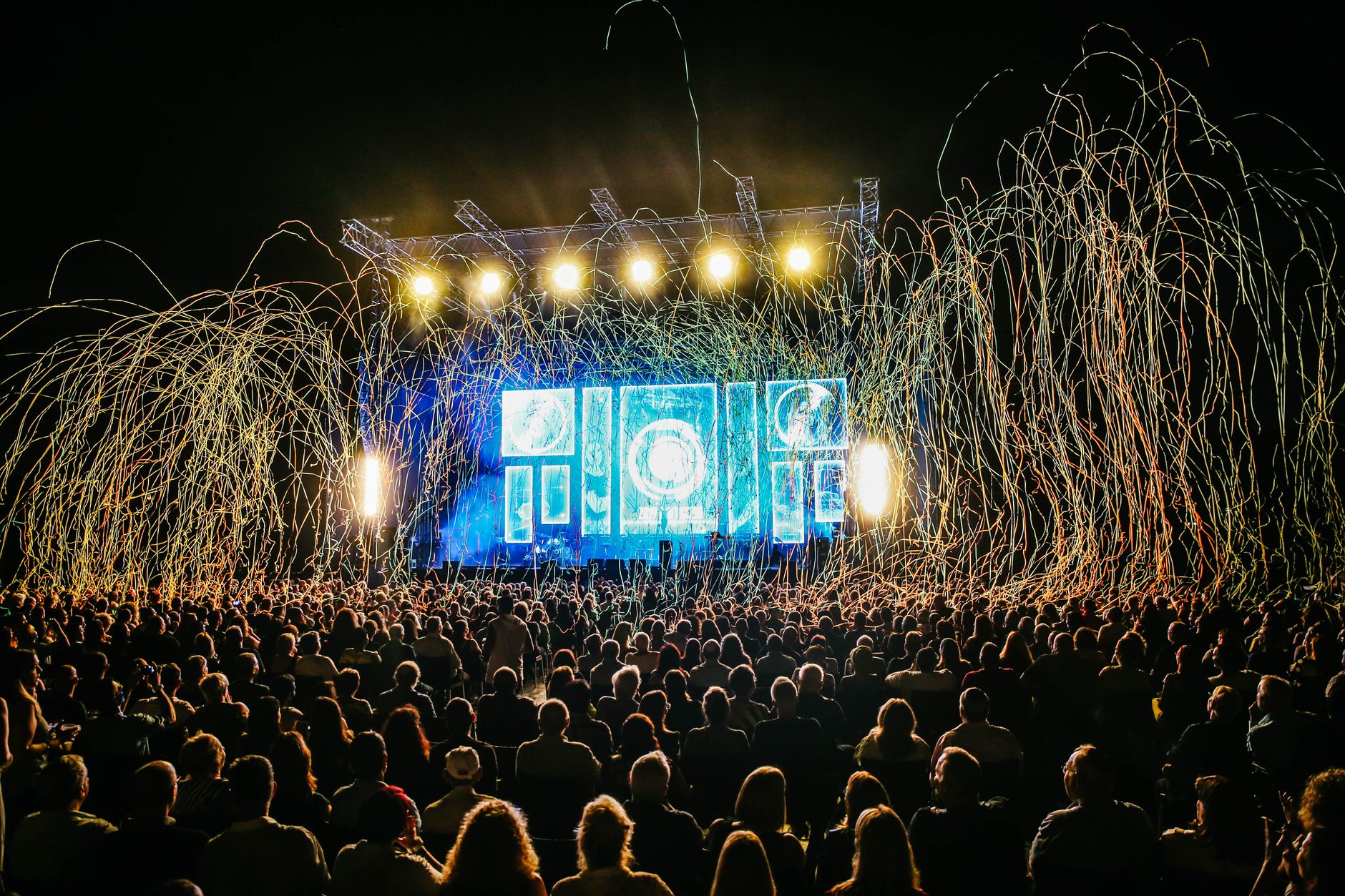
Park days and league play near the canyon mouths gather large groups with little warning. A trailer near the field edge keeps players and parents from crossing the lot for water.
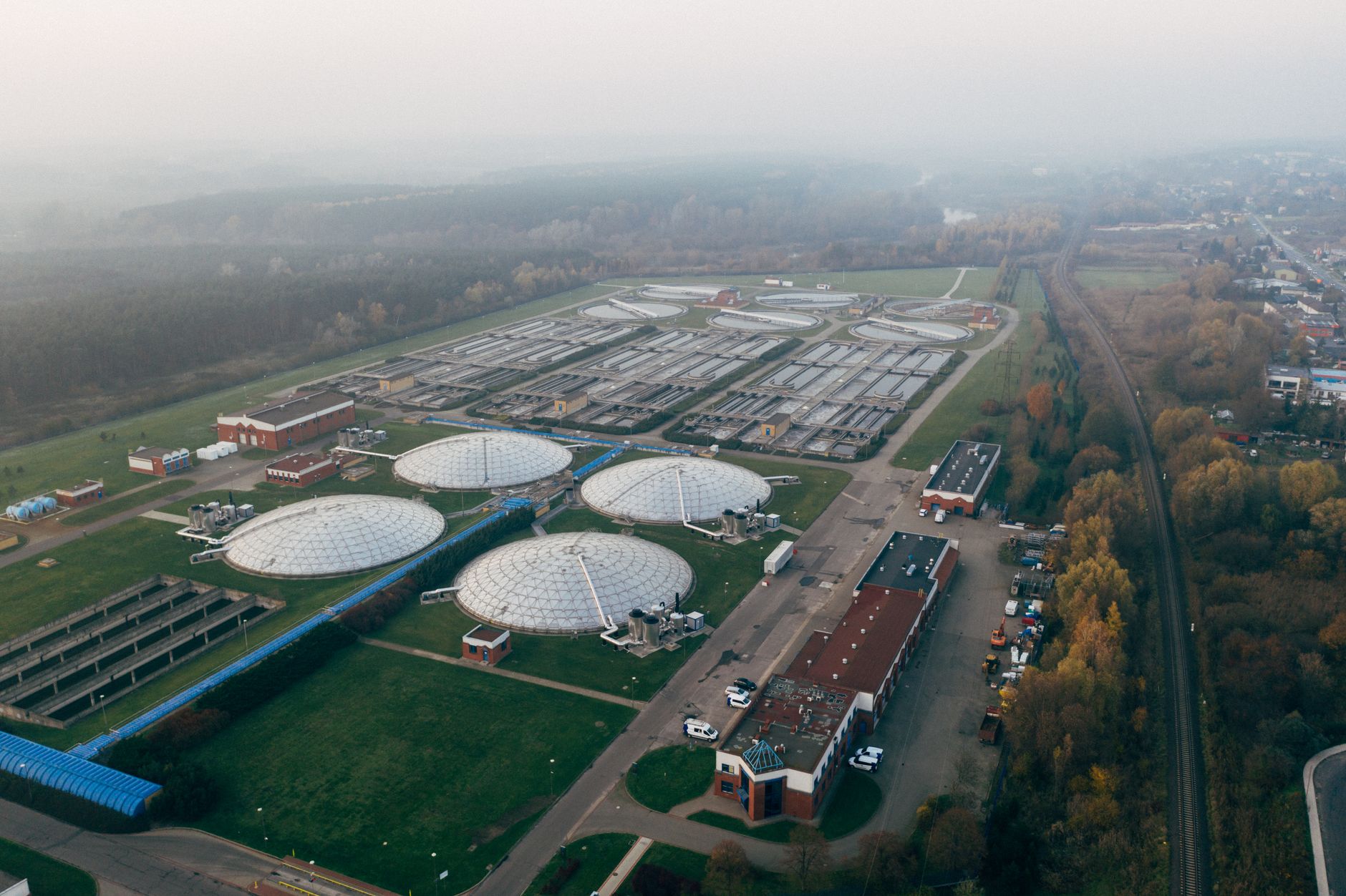
Warehouse and distribution lots are flat and paved, which makes placement easy. Shift work means the busiest water use is at break times, so spouts matter more than tank size.

City venues and public events draw crowds that a single station cannot serve. Larger gatherings are planned with several trailers spread across the grounds.
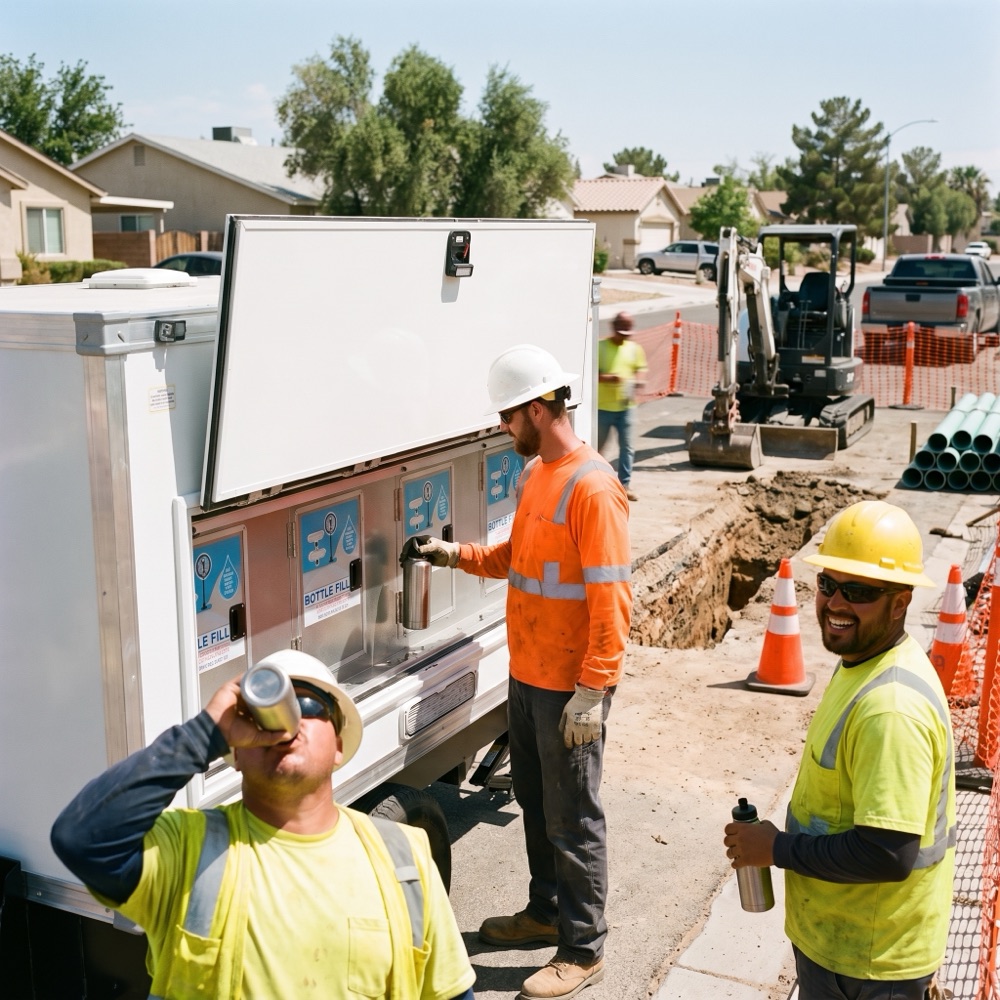
Growth in these cities means steady construction on open lots. Builders here want a station near the work zone and a refill day set around the concrete schedule.
Data center construction never really slows down. Pads get graded through the worst of the summer, steel goes up in winter, and commissioning teams keep working after the shell closes in. We support the data center corridors growing across the Salt Lake Valley with site-ready stations, chilled filtered water at ADA height, and refill runs timed to trade headcounts that change week to week. If your build runs 24/7, so does our service.

In a city where the normal July average sits at 81.1 F, a cold, filtered spout near the work area gets used all day, so the trailer is placed where people already walk.
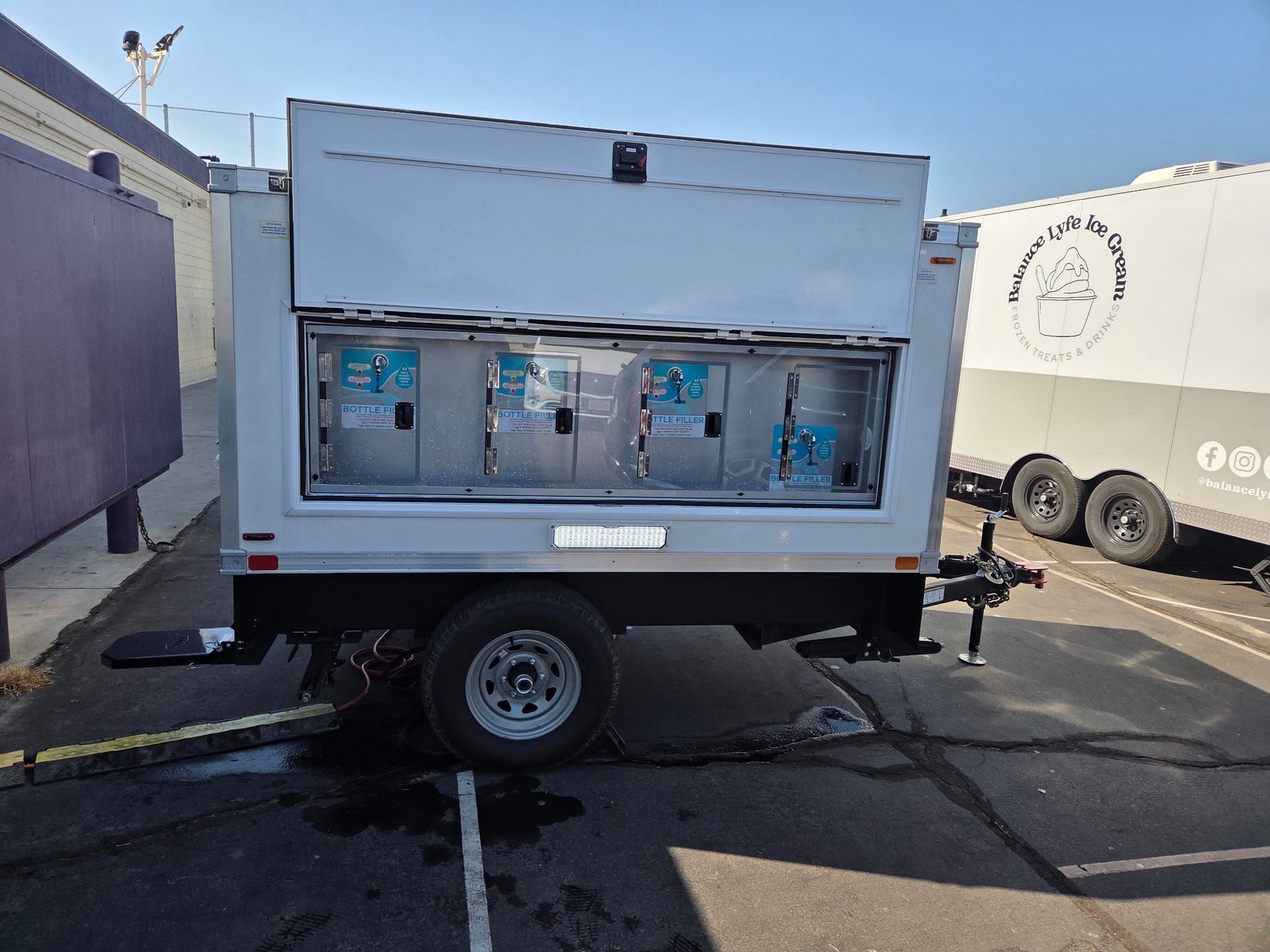
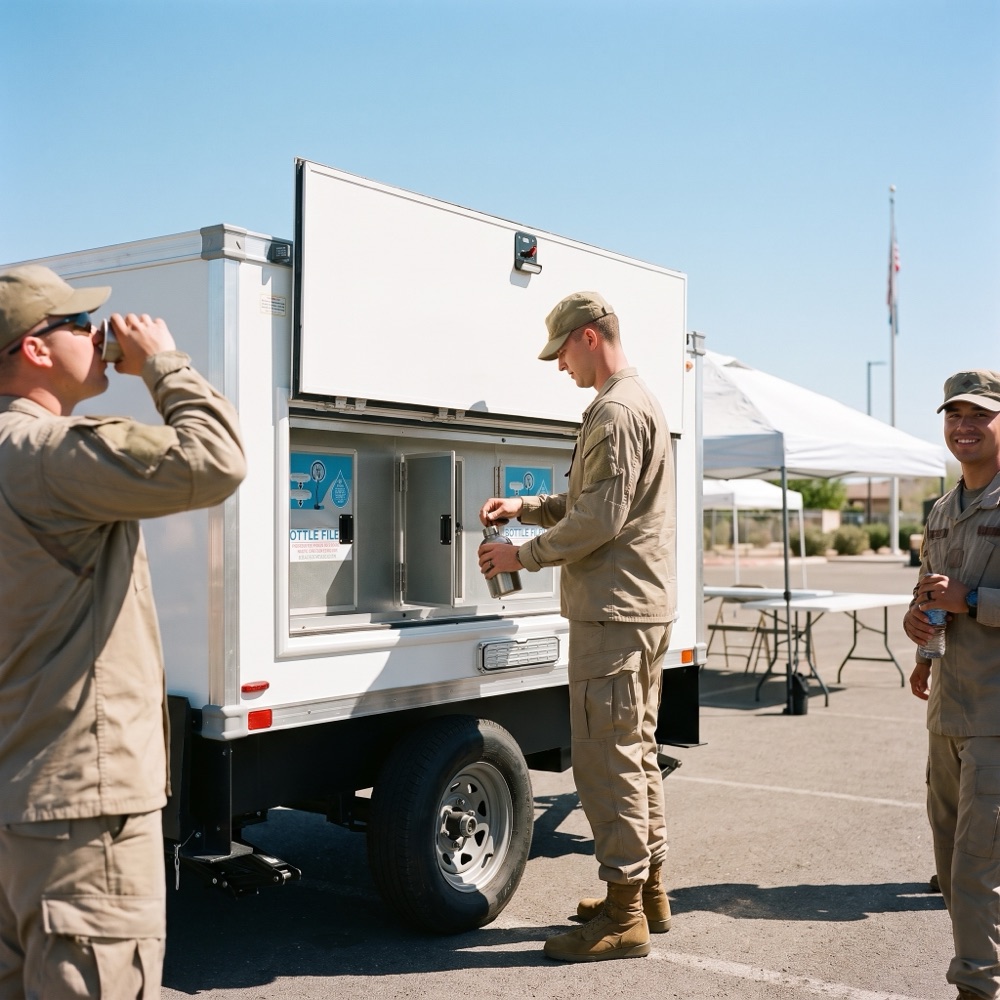
With a frame, a hitch, and tires under it, the unit hauls out to a remote build in the Salt Lake Valley, an event field, a working orchard, or a disaster staging yard with equal ease. Millcreek contractors and event planners request this exact rig by name. The whole design is built around backing in, leveling off, and pouring cold by the same afternoon.
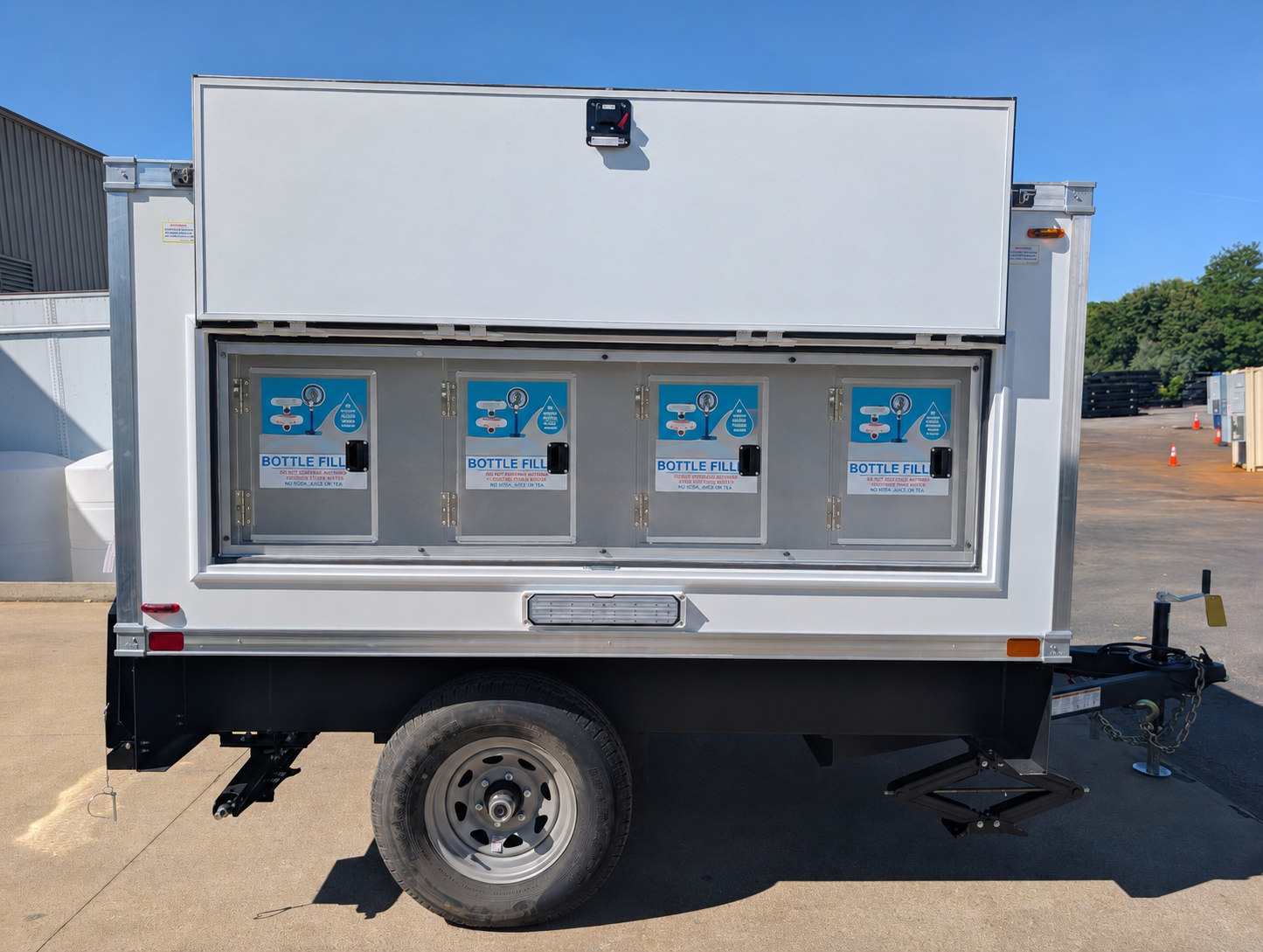
| No. of stations | (4) Bottle Filling Stations |
| Length | 12′ 3″ |
| Weight | 3,100 lbs. |
| Height | 8′ |
| Fresh water tank | 300 Gallons |
| Power requirements | 1 to 4 dedicated 20A/120V circuits OR 1 dedicated 50A/240V circuit |
| No. of AC units | 1 |
No base sits inside Millcreek, so military and federal work in the area means staging yards, training days and response operations set up around the valley by teams that plan from the East Bench. The September 2020 windstorm shows how fast that picture changes. Rocky Mountain Power reported a peak of 203,930 customers without service on September 8, gusts reached 112 mph, and the Utah National Guard was deployed for debris cleanup. A staging yard of a few dozen people needs drinking water the same day, whatever the grid is doing.
A field site rarely has a tap, so the station arrives as a self-contained trailer. Four spouts fill at once, the three filtration stages handle city or hauled-in water, and the unit pairs with a generator when no outlet is nearby. A short briefing at the site check covers where it sits, who watches the tank, and how cords and fuel stay clear of foot traffic.
After years of serving staging areas and field camps, the first thing we plan around is the refill schedule, because a tank that runs low at shift change causes more trouble than any piece of equipment. We settle refill days with the site lead and post them where the team can see them. If your office is weighing options, portable drinking water station rentals in the Salt Lake Valley in Millcreek can be quoted with the paperwork your contracting staff asks for.
The ADA spout position means everyone on the roster can fill a bottle without help, and the trailer stays out of the way of vehicle lanes. When a mission ends or moves, pickup is part of the rental, so the yard returns to bare ground.
Six bottles per person on a 100-degree day in the Salt Lake Valley, a 38-person crew, and you’re already at roughly 228 plastic bottles to buy, cart in, ice down, and throw away. That’s one day. The season is where it gets ugly.
Multiply across a 175-day build and the tally clears 39,000 bottles, with the larger commercial jobs running far past that. A single trailer makes the entire pile disappear, leaving cold water at the tap and nothing for the dumpster.
Sustainability is the easy part of the pitch. Roughly 60 million plastic bottles get thrown out daily in this country, only about a third are ever recycled, and one bottle can sit in a landfill for centuries. Worth reporting, sure, yet the Millcreek project managers who actually switch usually do it to kill the daily hassle, not to pad a sustainability slide. A shared trailer means no recurring bottle order, no cooler going warm before first break, no wall of empty jugs baking by the job-trailer. The super runs the build, not the water program.
Because our own potable tankers cover the refills, the supply scales with the job rather than fighting it. Double the crew for a big pour and they still can’t drink faster than the plan, since the tankers just swing back and bring the level up.
Want this math run for your own Millcreek job? One short call gets you a real number.
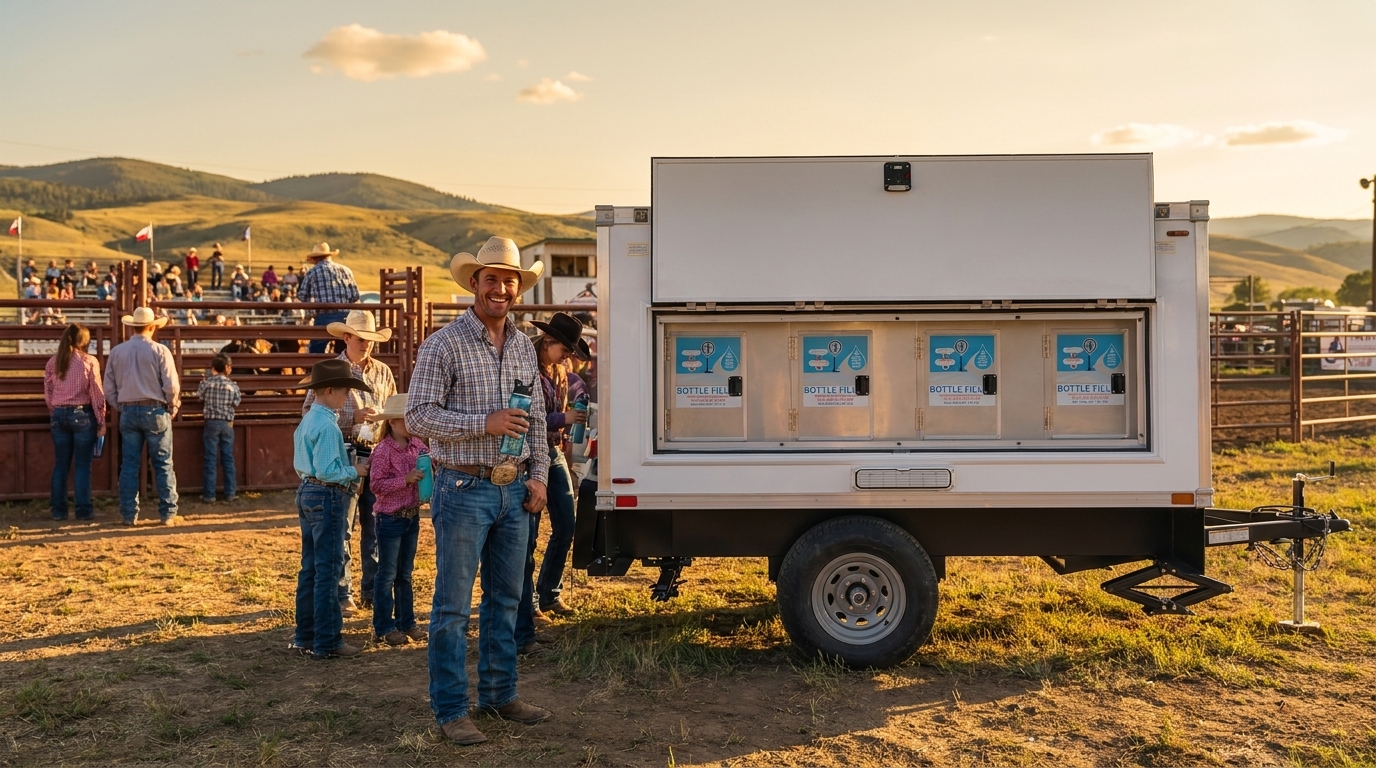
A weekly concert series fills the lawn from early evening on. A station at the seating edge keeps people from leaving the show for a drink.
Market days at city hall and evening events at Millcreek Common keep visitors outside for hours. A cold spout near the food vendors is the stop people use most.
Utah Food Bank has run Saturday mobile pantries in a church lot at 3400 South and 1100 East. Volunteers standing outside for hours need drinking water on site.
A wedding in the hills above the valley wants clean water for guests without a folding table of jugs. The trailer sits to one side of the lawn with a short cord run.
Before a drop reaches the spout, tap water gets three filter stages and a UV chamber, and a cooling unit on the trailer chills what comes out. People get a clean taste and a cold cup, which matters on a July afternoon at Cottonwood Regional Park or beside a home remodel on the East Bench.
Sediment comes first, and it earns its place on a gravel overflow lot or beside a home build in the foothills. Grit and scale from the mains stop here, which protects the taste and the stages after it.
Activated carbon is the second stage, and it softens the chlorine taste and the seasonal off flavors that tap water can pick up. Taste decides whether a landscaper or a market vendor keeps drinking on a hot dry afternoon, so we want the water to taste like nothing at all.
The last cartridge stops particles the first two stages miss, so the water comes out clear whether it fills cups for a remodel crew or bottles at a Millcreek Common event.
Last comes an ultraviolet chamber that eliminates bacteria and microbes with no chemicals added. The water stays clean after a long tow, even to a hillside lot up toward the canyons.
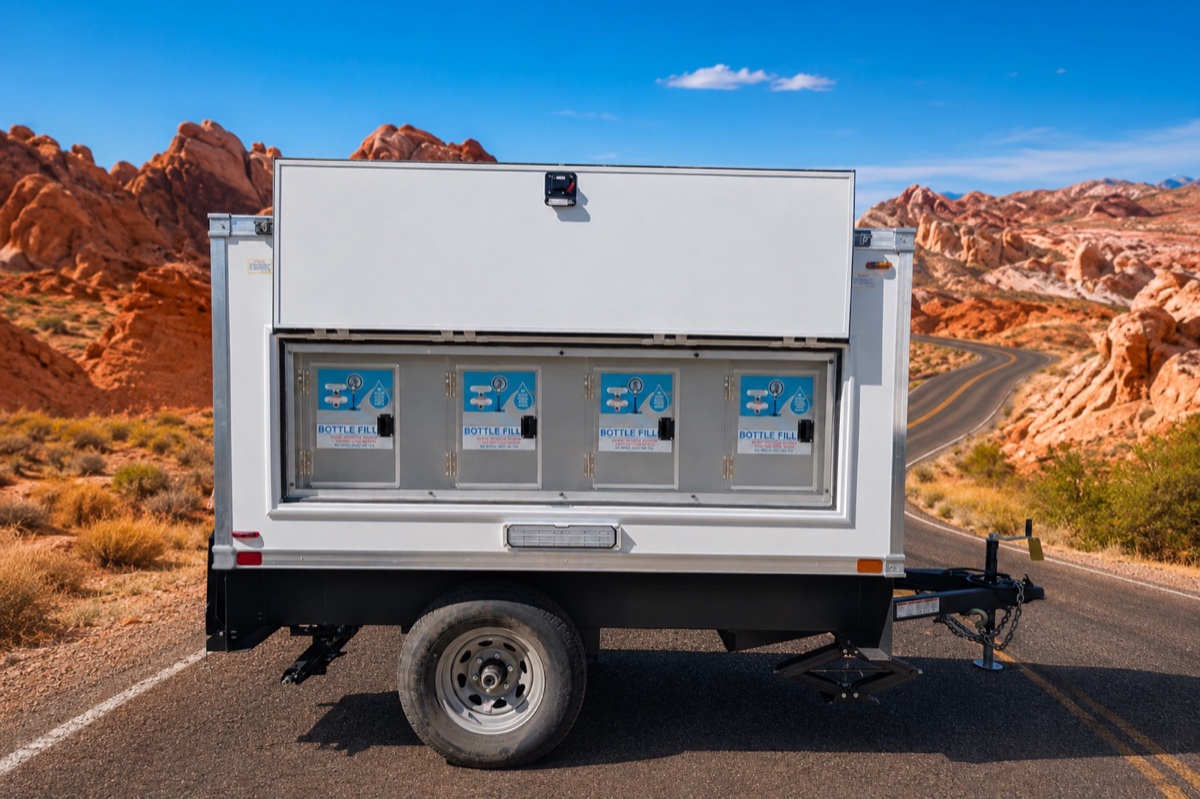
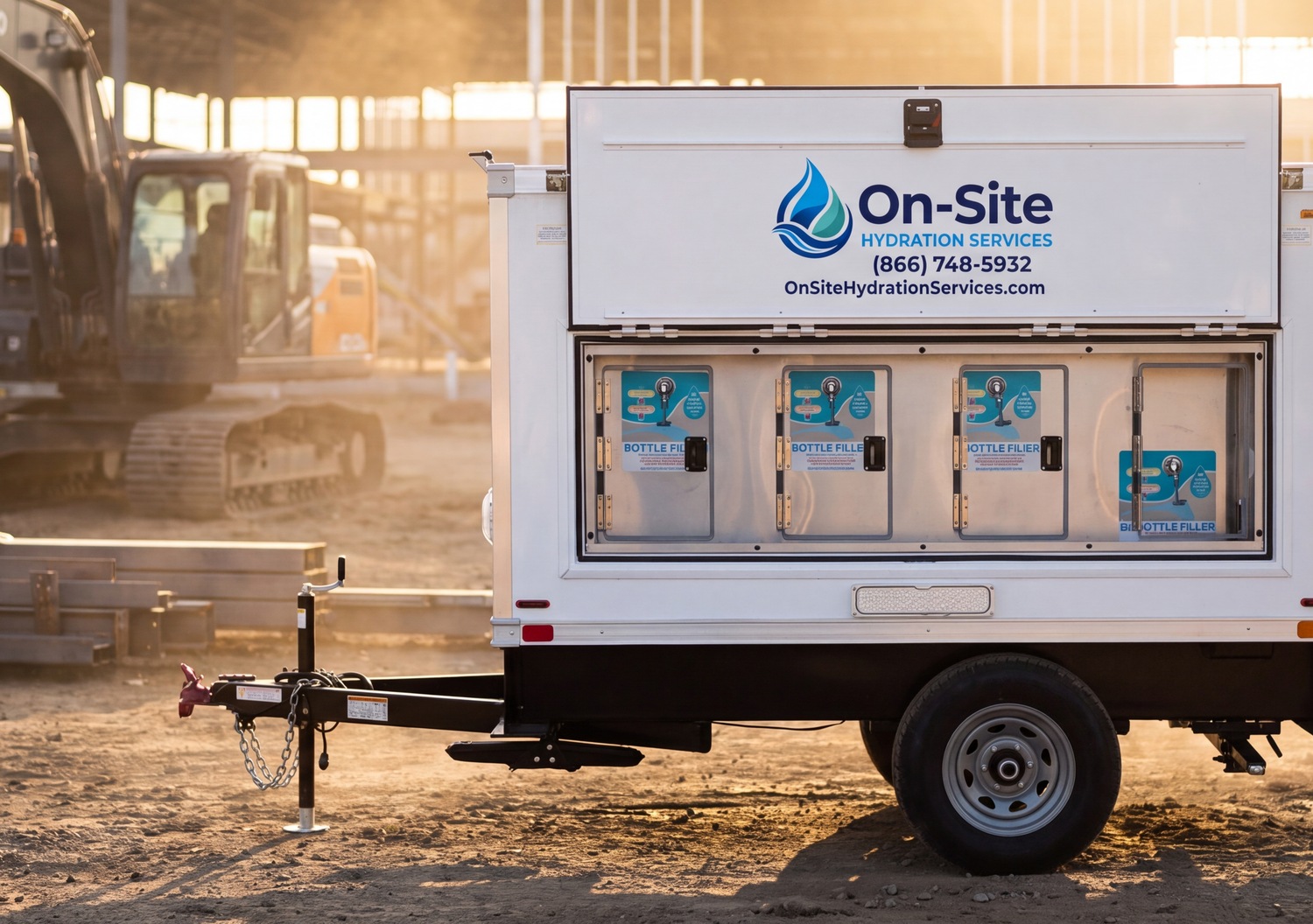
Every one of the four taps has a push bar that a bottle presses against, and the lowest sits where a person in a wheelchair can reach it, so no extra gear is needed for anyone in line. Landscaping and tree crews working the foothill yards can fill five gallon coolers and hydration packs at the large jug spout. Hose connection taps are there for rinsing, setup chores and topping off containers around the site. Food grade stainless lines carry the water from the tank to the spout, so what you drink in Millcreek tastes as clean and cold as it did leaving the filters.
A Signature trailer holds 300 gallons, about 2,400 sixteen ounce cups. On a busy evening at Millcreek Common, when families arrive after work, we refill it on demand so the tank is never the reason a line stalls.
Nothing on this trailer falls to you. We pick the spot, fill the tank and connect power, then show the crew lead or park volunteers the few basics before we leave.
Send over your head count, how many days you need, where the trailer will park and where the nearest power is. On a tight lot behind a restaurant or at a church, that is all we need to choose the right unit.
Since we answer every call 24/7 and do our best to deliver as quickly as possible, a heat advisory or a power shutoff after a windstorm like the one in 2020 gets round the clock emergency runs from us.
We set the trailer level, charge the 300 gallon tank and connect power. Power at a church or school lot here is often a few standard 120 volt circuits, and some sites offer a single 50 amp 240 volt drop.
How often a tanker comes back depends on how quickly people empty the tank, and a July remodel crew drinks far faster than a quiet afternoon at the park. We keep the unit maintained from the day it arrives until the day we pick it up.
Some teardown or building sites in the foothills have the meter pulled and nothing to plug into. We quote that situation from the start. The unit draws little electricity, our service fleet backs it up, and our stations have worked on ground with no permanent power, so let the yard know what the site offers.
Millcreek handles short stays on private property through Chapter 18.58 of its land use code, which was re-enacted in April 2025. A temporary use cannot run longer than 30 days, and uses not listed in the chapter’s table are not allowed as temporary uses. The Planning Director reviews each request, and review can involve UDOT, the Unified Fire Authority and the county health department. Placement depends on the property, the use and the length of stay, so your property owner or the city’s planning office makes the final call.
Events follow a different path. For an event, Millcreek’s Special Event Permit application has to be filed at least 30 calendar days ahead and no later than 21 days before, with a site plan attached. A mass gathering permit may be needed for an event that lasts more than two hours and draws more than 500 people. The water trailer is a normal part of that site plan, and our team can send the dimensions and hookup details your planner needs.
Food booths at an event need their own Salt Lake County temporary event permit, and those applications are filed on a different clock than the city’s. Water used only for drinking at a trailer falls outside those food permits, but organizers still list it on the site plan. For a quick check on how a trailer fits your project, our temporary water station rentals team will talk through your address and dates.
Behind every trailer we also provide fresh water delivery, an on site reserve and wastewater removal. You make one call instead of lining up three vendors, which suits a multi day market at Millcreek Common or a long home remodel.
At a holiday market on Millcreek Common, one drop off of water seldom lasts the day. Our potable water trucks carry drinking grade water in bulk and bring the 300 gallon tank back to full on an interval we set from your expected head count. Extra storage tanks on the grounds get filled the same way.
Bladder bags lay flat when empty and hold extra fresh water so the station has enough at the busiest times. On a job in the foothills below Mount Olympus, a bag keeps the station supplied while the tanker winds back up the road. Drains can be far away on those hillside sites, so the same bag can also collect used water until it is hauled off.
Our pump trucks can move water through long hoses to reach a trailer that sits far from the nearest water source. Cottonwood Regional Park covers a lot of ground, so the trailer may sit a long way from the fill point, and a pump truck can fill a holding tank or send water across the park so nobody has to carry jugs by hand.
Vacuum and waste trucks take greywater and wastewater away and haul it to permitted disposal, which closes the loop. For a market weekend on Millcreek Common, where the lawn and the walkways by city hall must be left tidy, we plan the pickup from the start, so you never track where the used water goes.
Every job gets its own mix. A house build in the foothills with no nearby fill point might need the trailer, a bladder bag reserve and a standing water truck visit. A packed evening at the Common might need a pump truck for supply and a waste run at teardown. Send over the job, we put the pieces together, and one team answers for all of it on a single invoice.
Need a station your written heat plan can point to? We can have one pouring cold within days.
Every Salt Lake Valley job is a little different, but most follow a few common patterns. Here is how a typical setup plays out:
Event director, a weekly concert series. When a series draws a crowd every Monday evening, we plan one station near the edge of the lawn and set the refill day for the morning of the show. The tank starts full, the line stays short, and nobody has to leave the lawn to find a drink.
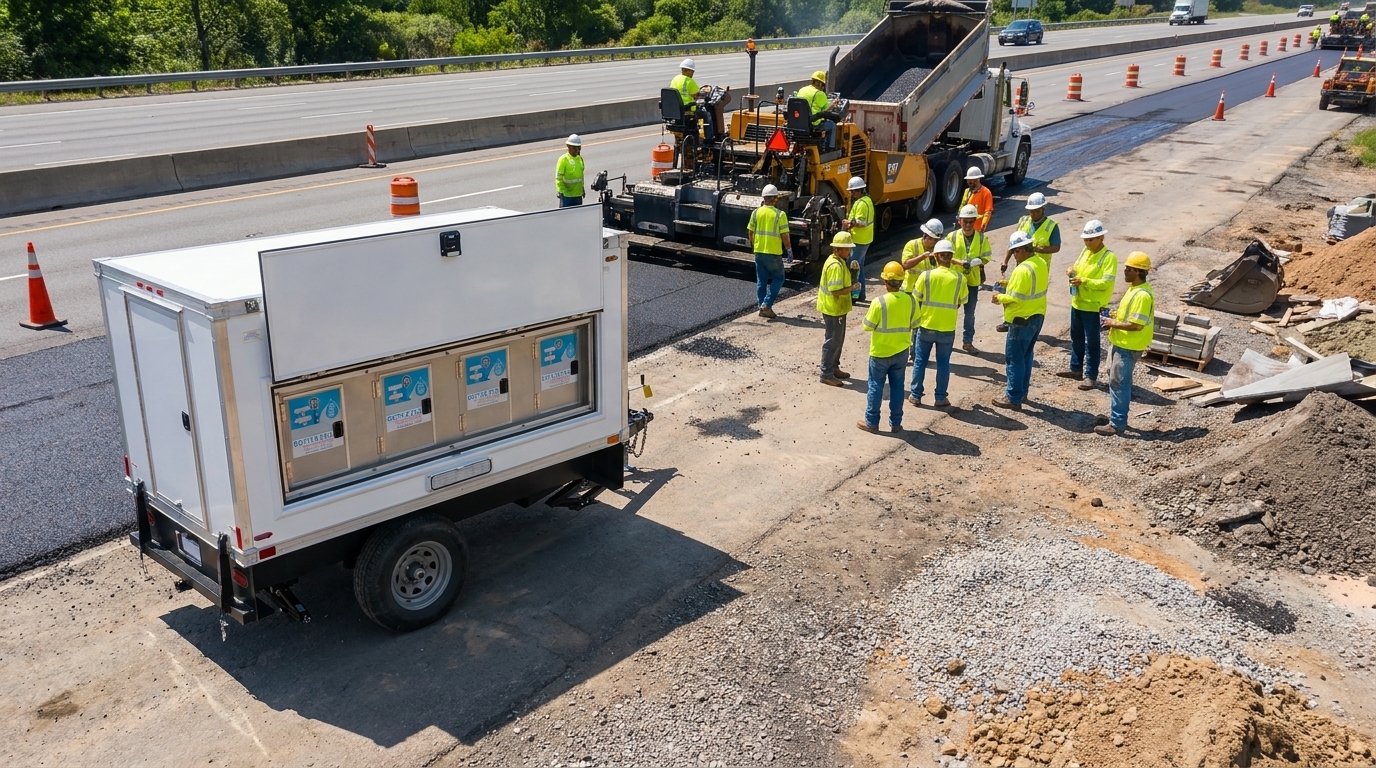
Superintendent, a summer park build. When a build site has no tap, we plan the trailer for the spot where the crew already takes breaks and set weekly refills to the head count. If a hot stretch arrives, we add a refill rather than waiting for the tank to run low.
Emergency coordinator, a neighborhood outage. When a windstorm leaves a neighborhood without power, we plan the station for generator use and a spot clear of debris and wires. The coordinator gets a single contact for refills so the water supply is one less thing to track.
Large campus builds sit on the open edges of the valley, not on Millcreek’s residential streets, but the managers who plan them often work from the East Bench and book from here. These sites cover many acres, and the nearest working tap can be a long walk from the far corner of a pad. Every extra minute of walking is a minute of lost work time.
The answer is more than one station, placed by work zone. One trailer near the main gate, one near the slab or structure crews, one by the laydown yard. Each gets its own refill day so a tank in one zone never waits on a tank in another.
From what we have seen on big commercial sites, the tank stays full when someone owns the schedule, so we name a site contact and a back-up at the start. Power usually comes from a temporary distribution panel, and the station’s circuit options make it easy for an electrician to assign a line.
Because the trailer is self-contained, it moves when the site moves. When a phase wraps and the crew shifts to a new pad, a call is all it takes to relocate the station.

Bottled water looks cheapest on a purchase order, yet the staff time spent moving pallets and coolers is the cost people miss, and dry summer sun on the East Bench makes that work harder. A trailer parked near Millcreek Common takes most of that work away.
Picture a remodel crew working on the East Bench, where most jobs are homes with narrow driveways. On a remodel job that means one person places the order, another unloads and ices the coolers before sunrise, and the restocking and cleanup go on until the end of the day. Those are paid hours, every day of the job. He added up the hours his crew spent on bottle runs, found they came to nearly a full day of pay each week, and told us the time he won back covered the cost of the unit. With a trailer, our tankers keep the tank topped off and the only thing the site supplies is a parking spot.
A cooler iced at 6 a.m. is warm by mid morning in July, and people skip water that has gone lukewarm. Drinking drops, and the risk of heat illness climbs, especially for roofers and landscapers working the sunny sides of homes below Mount Olympus. A chilled tank holds its temperature, so the last cup of the day tastes like the first. That counts most late in the afternoon, when tired crews and the crowd at a summer evening event at Millcreek Common need it.
Pallets of bottles need floor space, and that space is scarce behind restaurants in Millcreek Center or on the shared lots at Brickyard Plaza. Cases sit in the sun and empties stack up faster than anyone clears them. Instead of hundreds of plastic bottles that need floor space, a crew or a crowd gets its water from one trailer parked in a single stall.
Each bottle someone buys becomes trash, and a season of markets at Millcreek Common adds up to a large pile. Someone pays to haul it off, it works against any green goals a project has set, and plastic left in the ground outlasts the market stalls by centuries. A refill station means there are no bottles to count for the season, which gives an organizer or a builder a plain zero to put in a report.
Before you call, have your head count, dates, address and available power in front of you. We then price the real job, whether that is a neighborhood gathering at Hillview Detention Basin Park or a remodel in Olympus Hills, and never a canned number.
Our team delivers to every neighborhood on the East Bench and across the valley, and can arrange temporary water station rentals near Millcreek for events, job sites and emergency use.
Working a corridor instead of a single address? We follow the main routes across the Salt Lake Valley, so multi-site projects get the same fast turnaround as one stop.
Still weighing it? Call and ask. Most of these questions get settled in one short conversation. When plans stretch across more than one place, it helps to read about water station rentals in Utah.
Split crews between Millcreek and the next city? We also supply On-Site Hydration Services chilled water station trailers for rent in South Jordan.
Send the address, the dates and a photo or two, and our team will confirm placement before the truck leaves. The trailer needs firm, level ground and a clear path in, which on East Bench streets means checking overhead wires, low branches and parked cars. If the driveway is steep or tight, we suggest a flat spot nearby.
Spouts drip a little, and we place the trailer so that runoff does not collect under foot traffic. Waste water is handled on service visits rather than dumped on site. On a lawn, we favor a spot that drains away from the crowd.
It depends on how many people fill at the same time, not just the total head count. Four spouts serve a break rush well, but a large crew that breaks together may need a second trailer. Send over the shift length, the break times and the number of people, and we will size it.
Yes, with planning. A concert lawn like Canyon Rim Park gets its busiest minutes at set changes and the end of the night, so we spread stations to each side of the seating area. Several trailers split the crowd better than a bigger single one.
Before a trailer heads out to your Millcreek site, we sanitize its tanks. On longer stays, each service visit includes a look at the tank and the filters, so the water stays clean from the first day to the last.
Water passes through an opening filter, a chlorine removal stage and a fine filter before it reaches the spouts. If your safety plan calls for testing, your officer can draw a sample straight from a spout. We are happy to go through the filtration details before you book.
Whether the site sits on the East Bench or up near the foothills, set the trailer on firm ground, away from equipment lanes and overhead lines. Put it near where people already walk, such as the break area or the gate. Leave enough room for the refill truck to pull up, as well as for the people walking to the trailer.
The spouts are built for bottles, jugs and cups, and bottle fill is faster when many people line up at once. For a quick sip, a cup at the spout works. Reusable bottles fill up quickly at the spouts, so lines stay short at larger events.
The event may need a city permit, but the trailer itself is listed on your site plan. Special event applications are due 30 days out and no later than 21 days, so send over the dimensions early. Your planner can include them in the filing.
The station is generator-ready, so a power loss does not have to end water service. During the March 18, 2020 earthquake, about 55,000 Rocky Mountain Power customers lost electricity at one point. Check with the yard about pairing the trailer with a generator for outage planning.
Yes, the same way any customer can. Utah Food Bank has run mobile pantries in Millcreek church lots, and volunteers on those days work outside for hours. Send over the lot size and the day, and we will plan where the trailer sits.
Start with the head count and the length of the day. A two hour market and an all-day festival have very different water needs, even when the crowd size is the same. Write down the number of people, the hours and when the busiest stretches will be. That page is the base for every other choice.
Next, walk the grounds. At Canyon Rim Park, Evergreen Park or the lawn at Millcreek Common, the best spot for water is usually near seating, restrooms or food, and away from the main path so lines do not block traffic. Mark a spot with firm, level ground and a short run to power.
Ask each company what happens when something goes wrong on the day, and pay attention to how directly they answer, including us. These are the ones that save trouble later. Ask them of any company, including us.
How many spouts does the unit have, and does one meet ADA reach? A unit with four spouts and an accessible position serves more people with fewer lines. Ask to see the spec sheet and photos of the unit on real jobs.
Heat illness is easiest to prevent before a shift gets hard. In hot work, the guidance for outdoor crews is a cup of water every 15 to 20 minutes, and that holds even for people who say they are not thirsty. A site that makes that easy gets better results than one that relies on people to walk for it.
The first part of a good plan is distance. If water is a five minute walk from the work area, people skip it. A station at the edge of the work zone cuts that walk to seconds and gets used more often.
A quote for a portable water trailer is built from a short list of things, and knowing them helps you compare offers fairly. We never print a price in an article, because the number depends on your site, but the factors are the same every time.
The first factor is the number of trailers. A single trailer suits a modest group, while a large event or a spread-out site may need two or three. More trailers cost more, but they also shorten lines.
“We needed two stations on a big pad and the team figured out the zones before the delivery. Power hookup took my electrician ten minutes. No surprises.”

“Our venue sits on a steep drive and I worried about access. They checked it from photos first and picked a flat spot near the lawn. Guests loved it.”

“I count bottles per person per hour, and the station kept up all shift. The refill came on the day they said it would.”

“We stand outside for hours on distribution days. Having a clean water station by the line made it easier on everyone, including the older volunteers.”

“Great communication from the first call. They asked about headcount and shift length, and the trailer was sized right.”

“Field day brought a few hundred kids and parents to one lawn. The ADA spout was a nice touch, and cleanup was done the same afternoon.”

“We hold a lot of shift workers on one lot. The spouts handle the break rush better than the old jug setup ever did.”

“After the last windstorm our neighborhood group asked about backup water. They explained the generator option clearly and gave us a quote without any pressure.”

“We ran a long Saturday event and the station was still cold by closing. I would book again.”

Service information current as of October 2026.
Send over the headcount or the gate count, the rental dates, and where the trailer should park, and we’ll spec the right setup and roll one out to you anywhere in the Salt Lake Valley, and we answer every call 24/7 and do our best to deliver as quickly as possible.