On-Site Hydration Services is the team companies across the Tacoma area call first for temporary water station rentals. Every Signature Series unit lands filled, filtered and cold, ready the hour we set it, whether it is going to a Tideflats terminal yard, a highway crew on the SR 167 job, or a race start line at Point Defiance Park. We have been setting these units on Pierce County ground for years. Call us now to hold your dates, or request a free quote online and we will tell you today how fast a unit can reach your site.
See the Signature Series water station specs
The call that matters most here is the one nobody had on the calendar. A forecast can turn without much warning. A crew doubles for a push week, and coolers that were fine the day before stop being enough. We answer that call the same day, with trucks staged across the South Puget Sound, so a filled and chilled unit can be sitting at a Tideflats gate or a Frederickson pad while the heat is still climbing. That is why companies around Pierce County keep our number saved, and we back it with SAM.gov registration, full licensing and insurance, an A plus BBB rated network and a 99.9 percent incident free record. Call us or request a free quote and we will confirm your dates today.
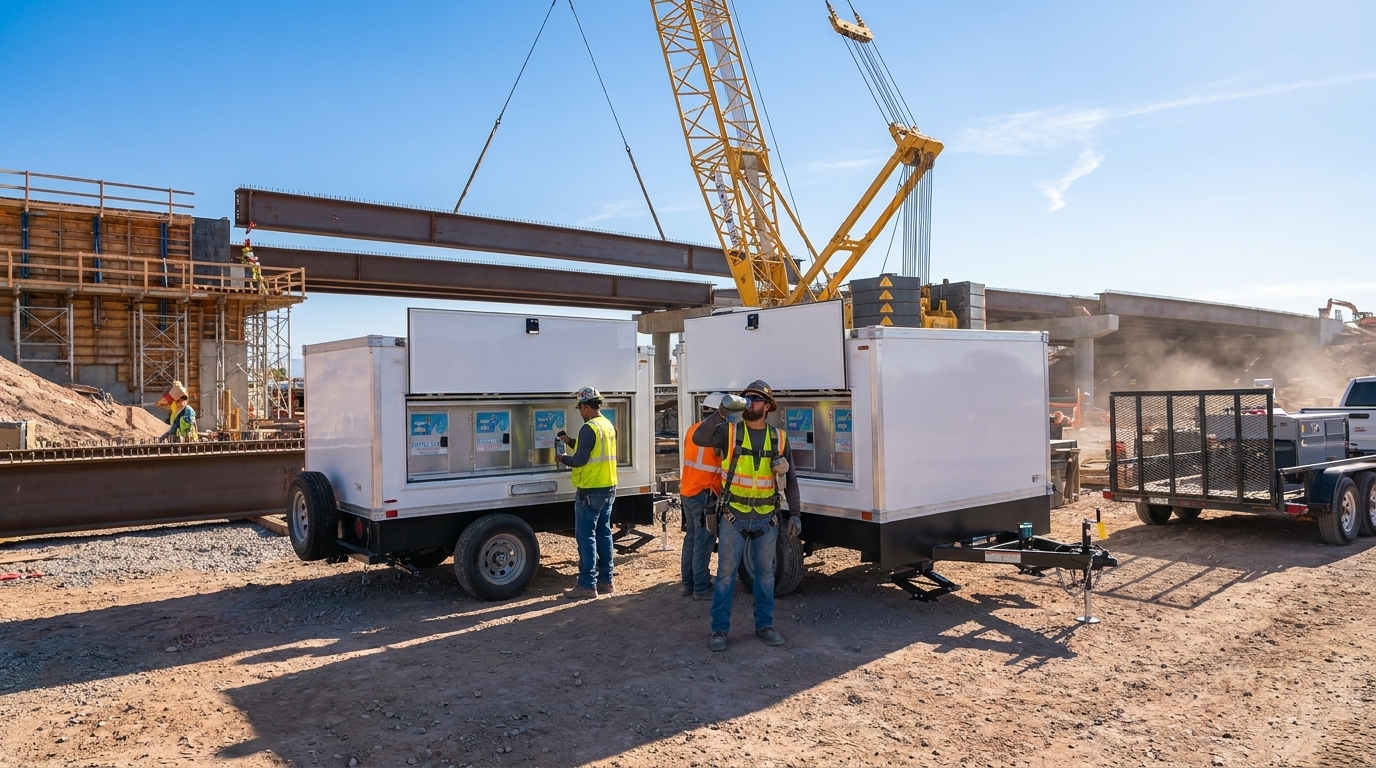
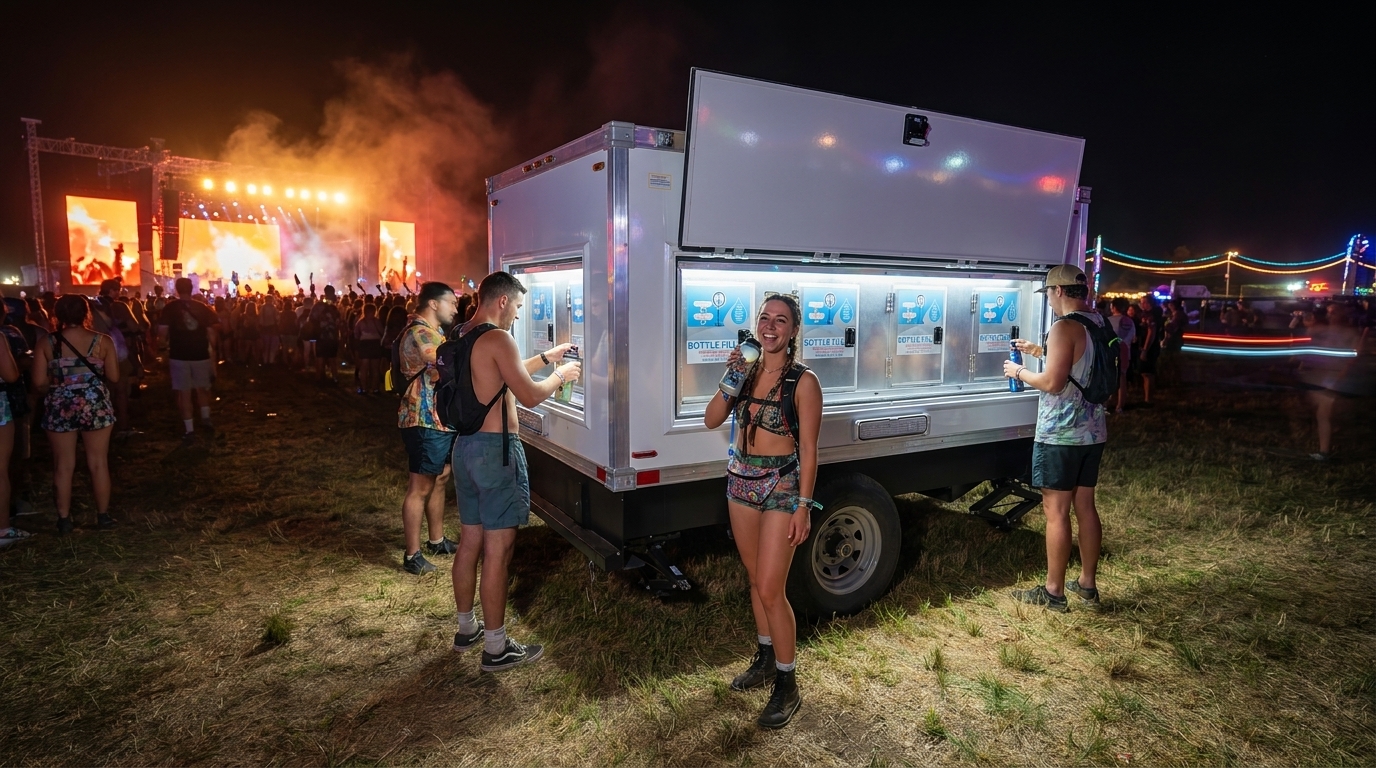
One Signature trailer can pour for a weekend concert and be working a slab pour a couple of days later. Hiring one company for your events and a separate one for your worksites makes no sense. Either way, the planning, the delivery, and the refills are ours.
The onboard cooling unit keeps the tank genuinely cold all the way through a Tacoma afternoon, and that single detail carries the whole thing. Warm water is water people abandon, and midsummer is exactly when a crew or a crowd is drinking the most. Cold water gets finished, and finishing it is what keeps heat illness off the site.
Typical Tacoma deliveries land in about 45 minutes, and we keep emergency runs going around the clock whenever a heat advisory or a power shutoff hits the South Puget Sound. The morning a foreman finds his 40-person crew stuck with one warm cooler, speed is the whole game.
One rule sits under every job we take: water that people walk past might as well not be there. We've stood on a bare Tacoma site and watched shrink-wrapped pallets cook next to the job-trailer while the crew baked thirty yards off. We've watched the opposite too, a chilled station ten steps off the work face run bone-dry twice inside one shift. Everything that matters lives in the distance between those two pictures. Which is why we don't drop a unit and disappear. We match it to your headcount or your gate count, set the refill rhythm to how hard you're really pulling on it, and treat a heat call the way you'd want your own treated, meaning right now, because out here one hot hour can swing the whole day.
We route around the Gateway work zones before you have to ask. I-5, SR 509 and SR 167 all carry active construction through at least 2026, and access to the Tideflats runs through Port of Tacoma Road, Taylor Way and East 11th Street. Our dispatch builds the closures into the delivery window instead of discovering them with a loaded trailer. A truck on the road is a bad place to find out a ramp closed.
“Set it at the gate on a Tuesday and I have not thought about drinking water since. Fills show up when they say they will. That is the whole review.”
“Our pick line gets brutal in August even with the dock doors open. Cold water at the end of the aisle changed how people take their breaks.”
“They brought plates for the jacks without me asking. Anybody who has set a trailer on fill ground knows why that matters.”
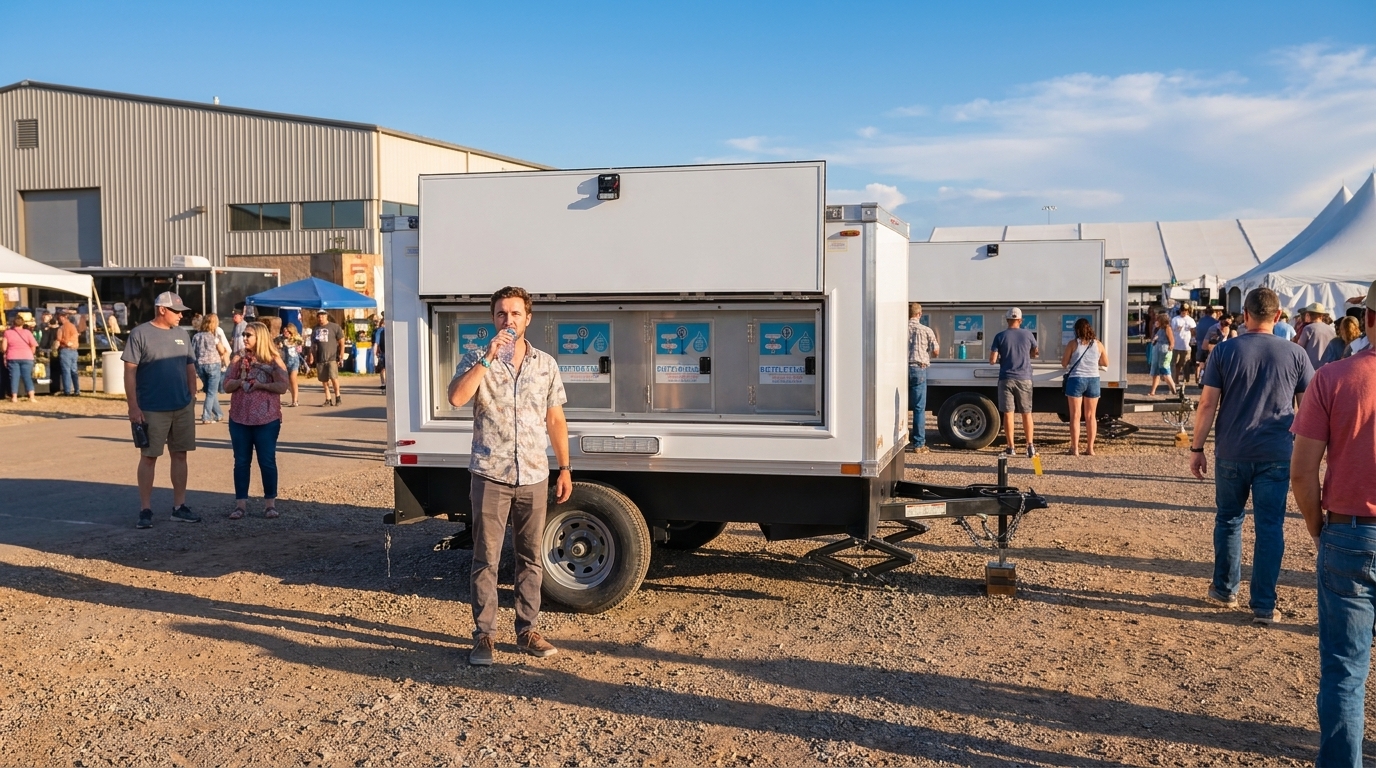
Home of the Washington State Fair and its 20 day September run, with a valley full of working farm ground on the way in. Fair season and harvest overlap, which makes September the busiest month on our south end board. We treat Puyallup as a standing route rather than a one off delivery.
Joint Base Lewis-McChord sits just past the city line, and Lakewood carries much of the contractor and support work that comes with a 70,000 acre installation. Agency paperwork matters more here than anywhere else we deliver. Our vendor registration is already in place before a quote goes out.
The north end of our route and the starting point for the Tacoma Dome Link Extension alignment. Light rail construction will keep crews on that corridor for years. We schedule deliveries around the corridor work rather than against it.
Across the Narrows Bridge, which means every delivery window includes the bridge. Marine, waterfront and residential construction make up most of the work over there. We book the crossing into the schedule instead of guessing at traffic.
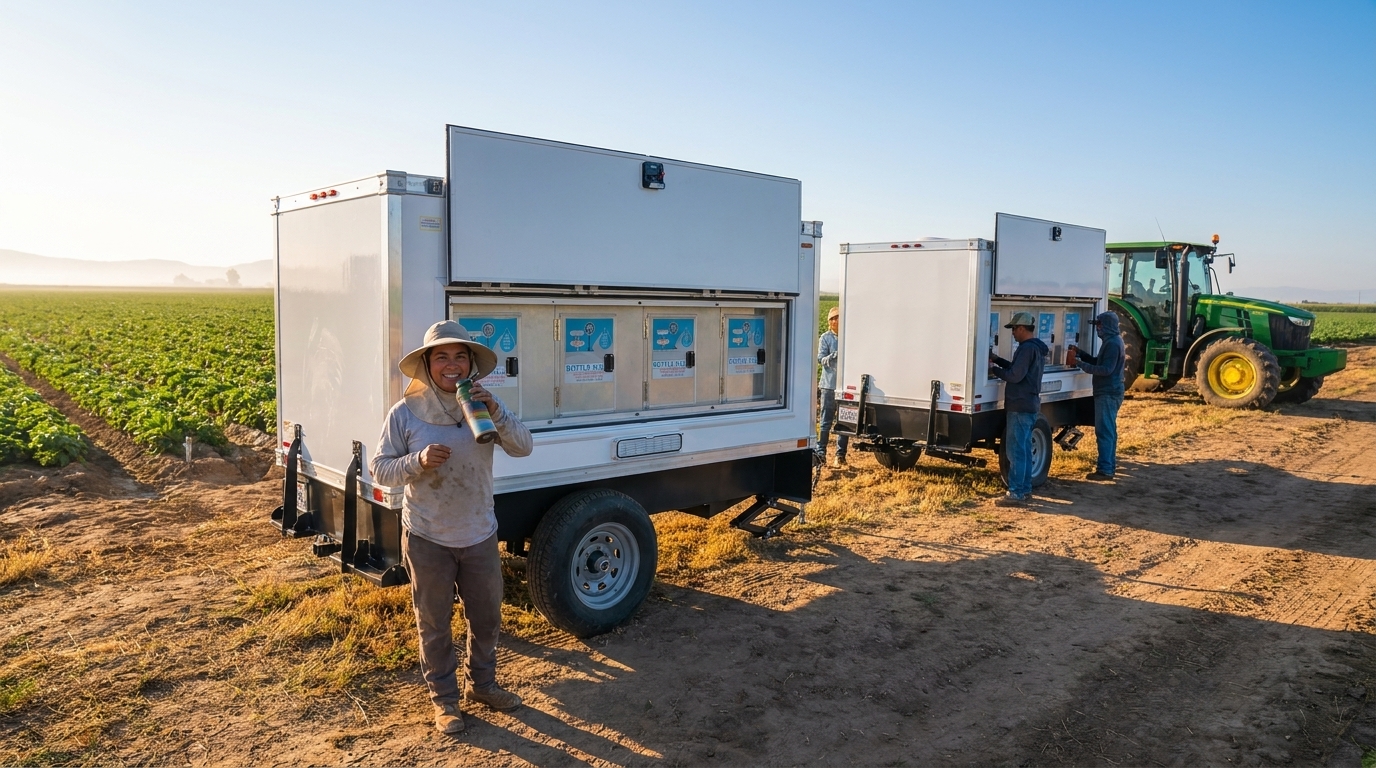
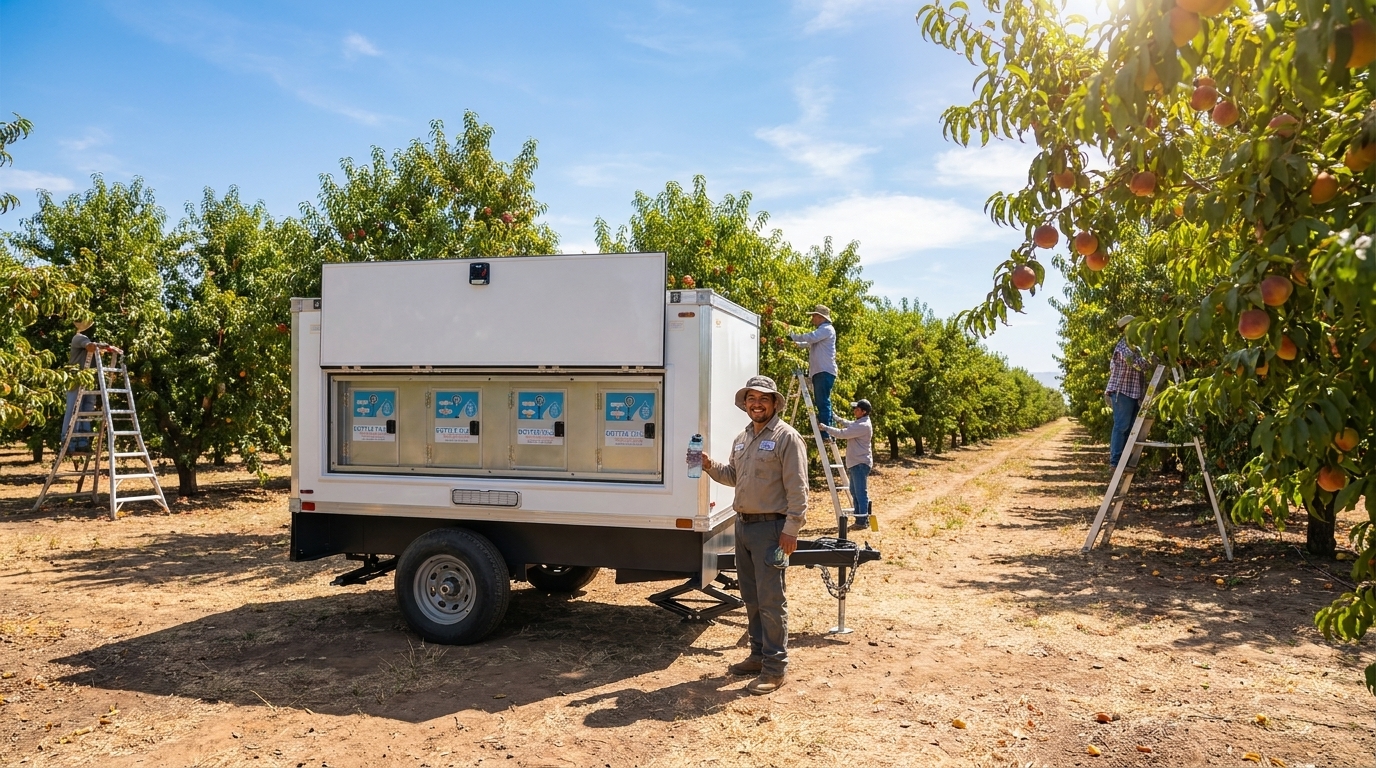
Valley farm towns south and east of Puyallup, with berry and nursery ground and the Carbon River running past. Field crews here work rows with no fixed water for a quarter mile. A towable unit follows the block as the picking moves.
Housing and light industrial construction on raw pads, most of them with no hose bib and no power until late in the job. That is the hardest setup to solve with a cooler program. It is the easiest one for a self contained station.
Data center construction never really slows down. Pads get graded through the worst of the summer, steel goes up in winter, and commissioning teams keep working after the shell closes in. We support the data center corridors growing across the South Puget Sound with site-ready stations, chilled filtered water at ADA height, and refill runs timed to trade headcounts that change week to week. If your build runs 24/7, so does our service.
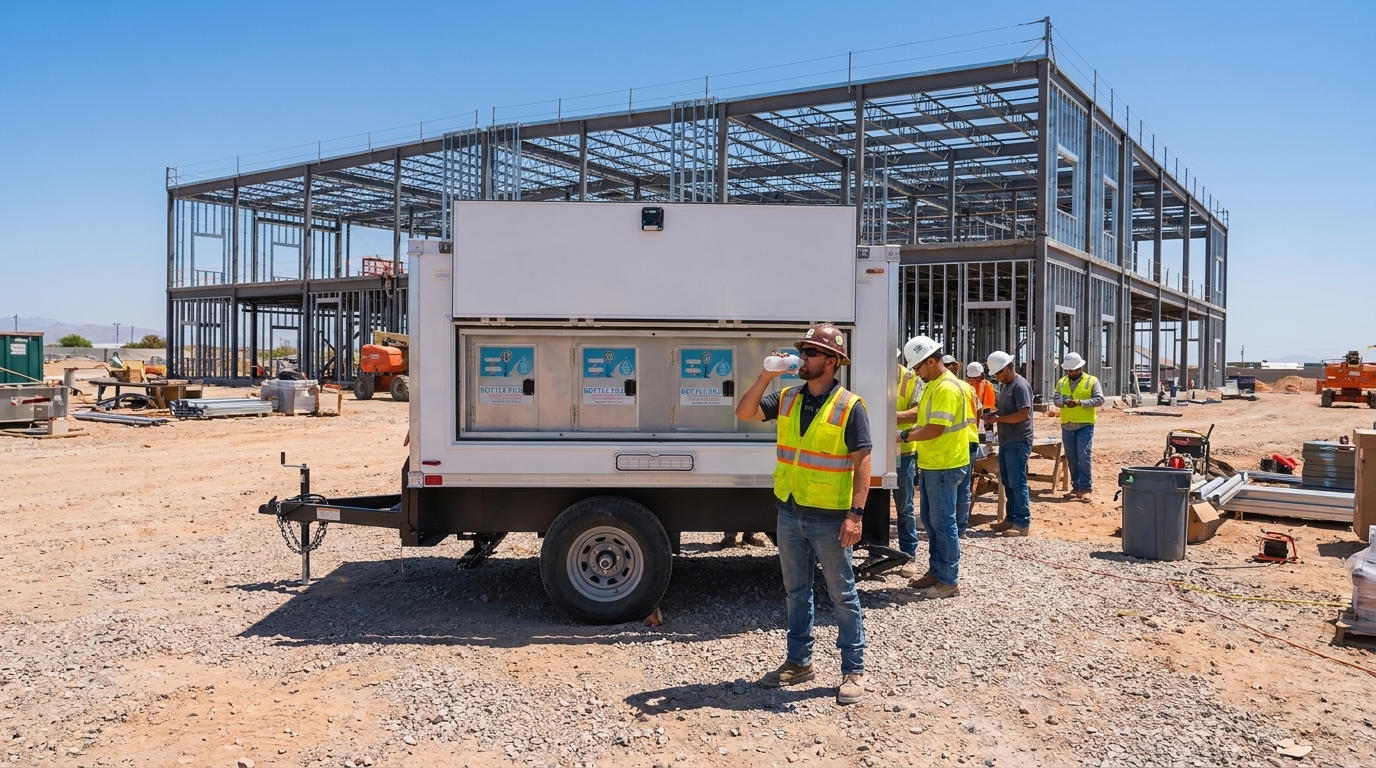
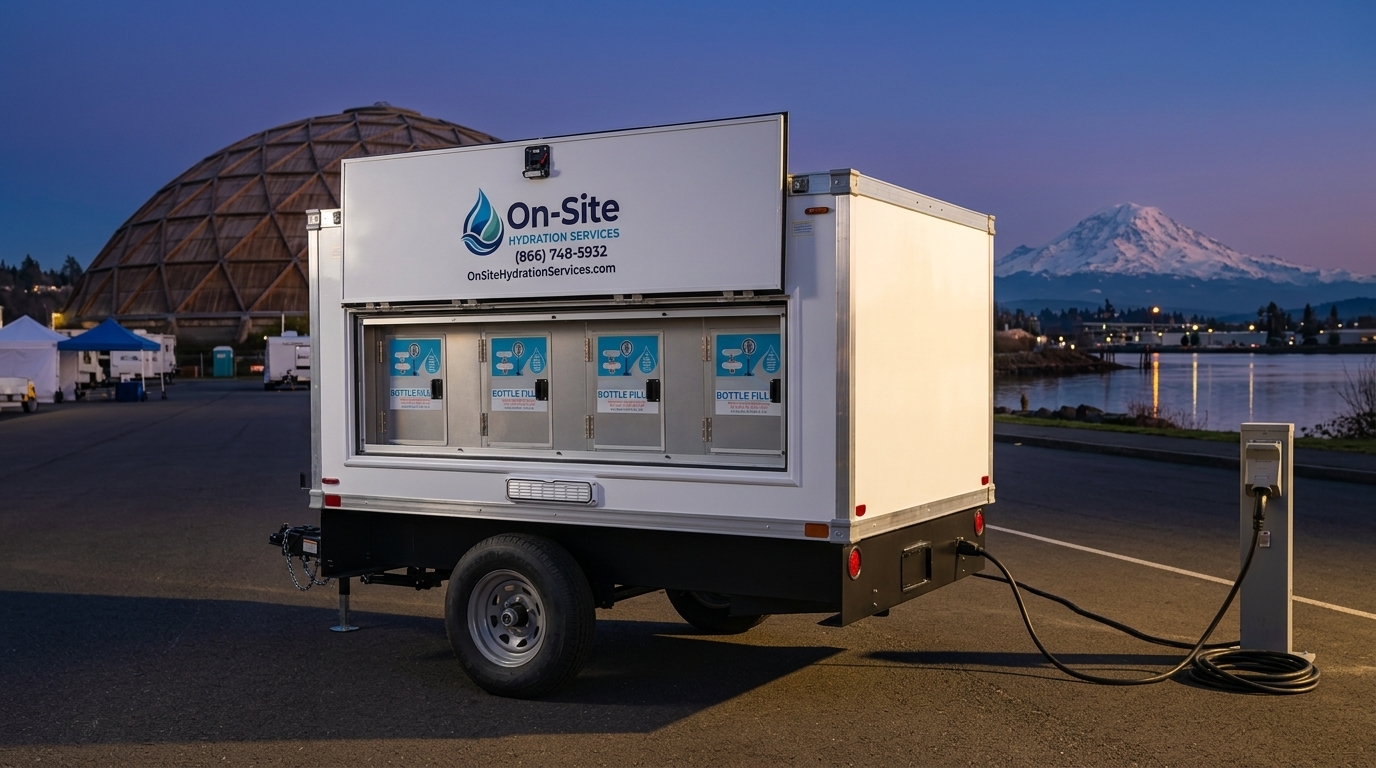
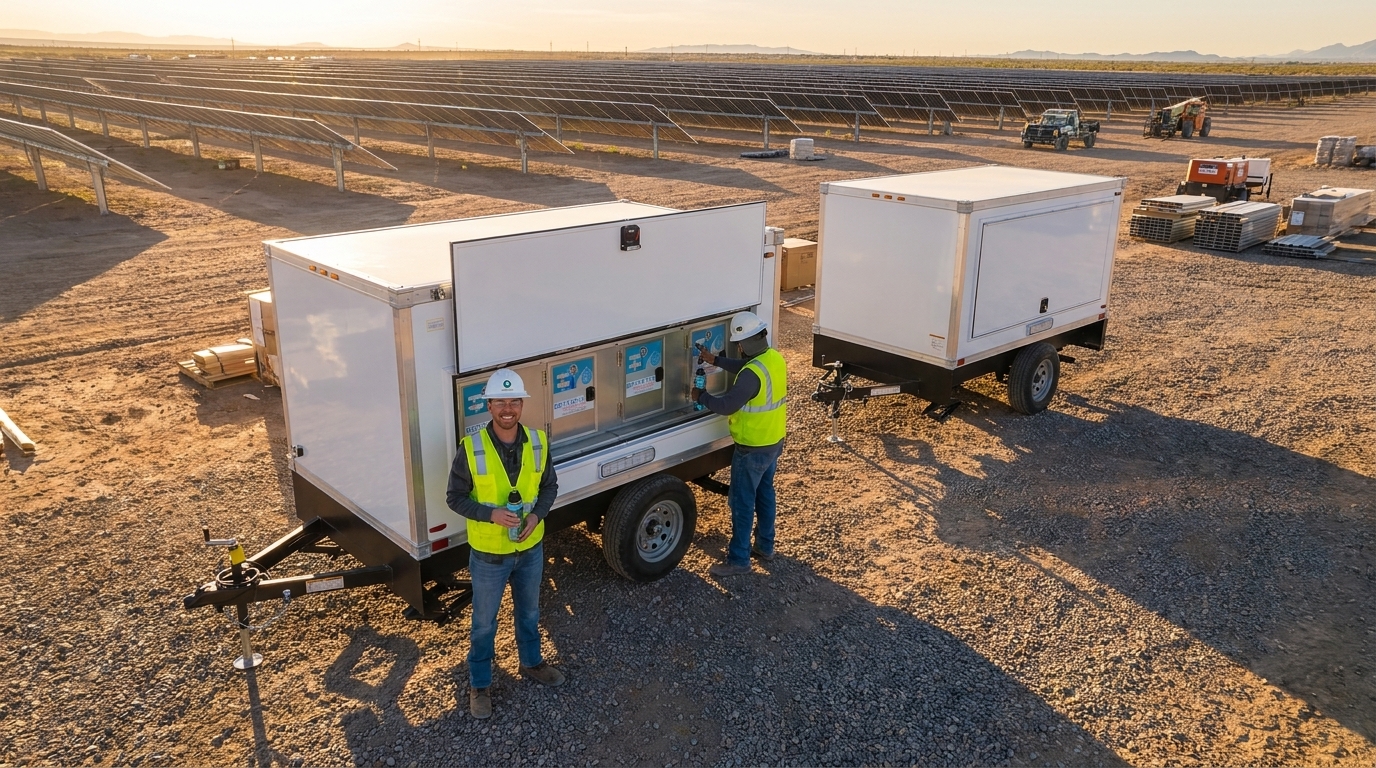
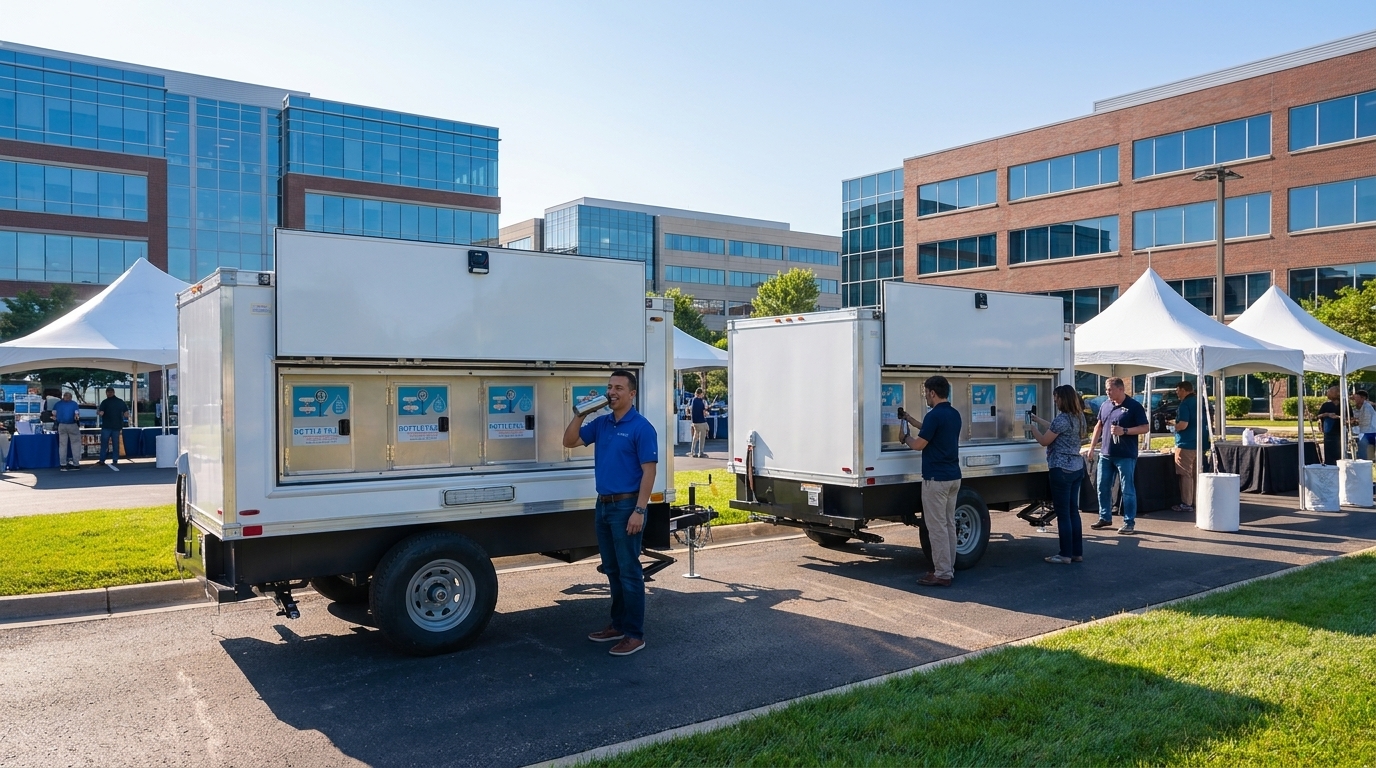
The Signature Series unit handles what Pierce County asks of a rental, from a paved Port of Tacoma laydown yard to a gravel pad in Frederickson with no tap for a mile. Same cold water at a 12 person night shift as at a race finish with a thousand runners coming through.
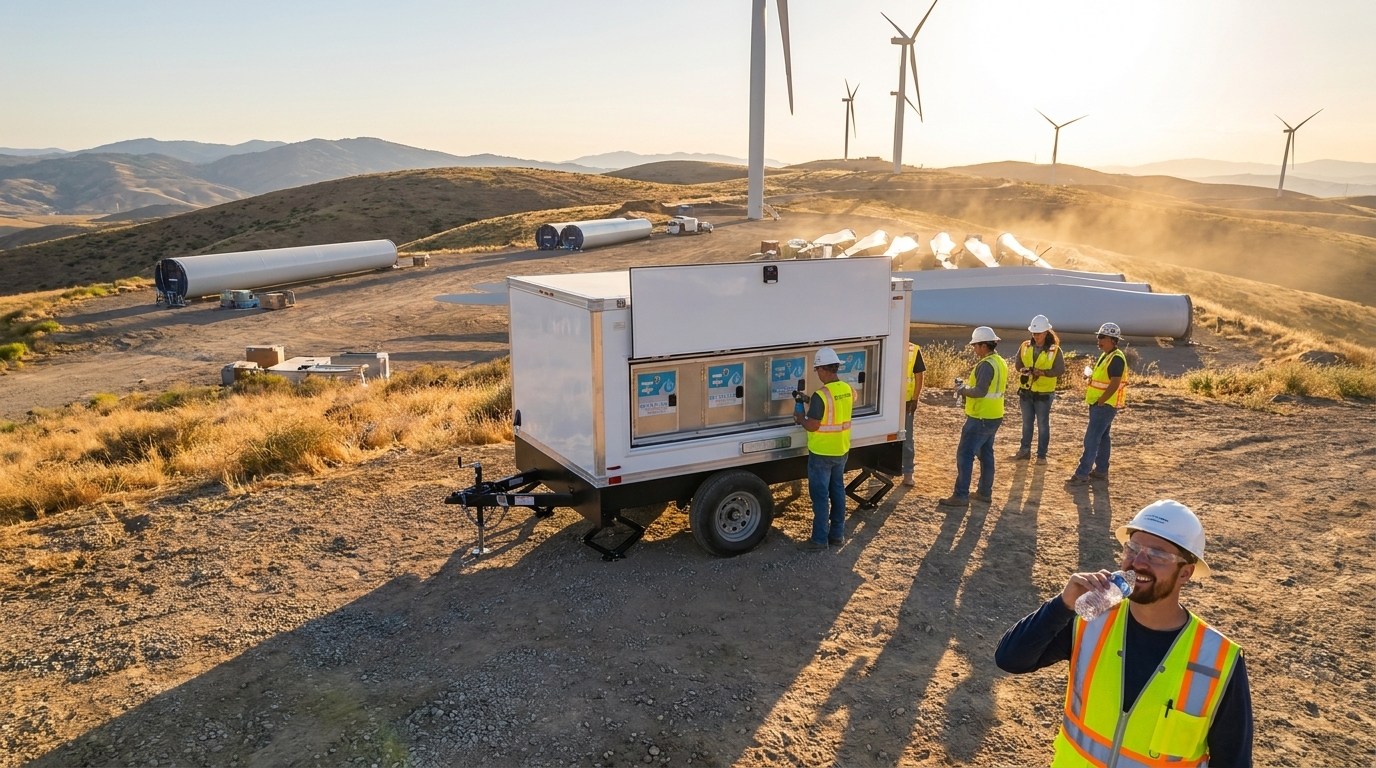
With a frame, a hitch, and tires under it, the unit hauls out to a remote build in the South Puget Sound, an event field, a working orchard, or a disaster staging yard with equal ease. Tacoma contractors and event planners request this exact rig by name. The whole design is built around backing in, leveling off, and pouring cold by the same afternoon.
| No. of stations | (4) Bottle Filling Stations |
| Length | 12' 3" |
| Weight | 3,100 lbs. |
| Height | 8' |
| Fresh water tank | 300 Gallons |
| Power requirements | 1 to 4 dedicated 20A/120V circuits OR 1 dedicated 50A/240V circuit |
| No. of AC units | 1 |
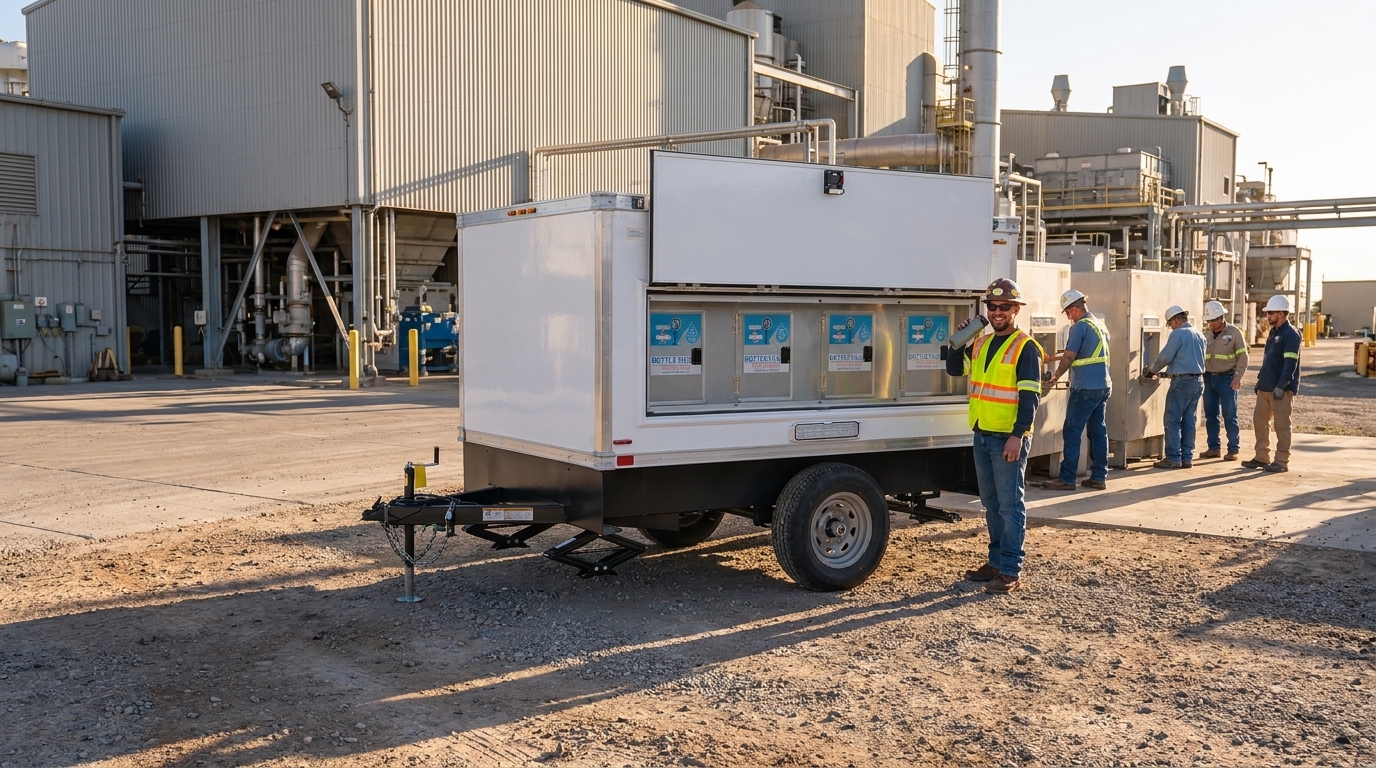
The Tideflats is the biggest working yard in this county, and most of it has no drinking fountain anywhere near the work. The district covers more than 5,000 acres and supports roughly 57,000 jobs once you count port operations, port dependent businesses and the work that hangs off them. Container yards, transload buildings and staging pads sit on filled tide flats at sea level. Flat and open. Nothing overhead for shade, and hot through July.
Washington United Terminals is pushing throughput from about 590,000 containers a year toward 880,000. Blair Waterway deepening, a new Maritime Center on the Foss Waterway, and an off dock container support facility on about 24.5 acres east of Thorne Road are all moving at the same time. Crews on those yards stand on concrete and gravel with no tree cover. We set a station at the gate or the break tent and put it on a fill schedule, so a forklift driver is not walking 600 feet for a warm bottle.
Indoor warehouse floors are their own problem. A metal covered building with the dock doors open on a 90 degree afternoon holds heat long after the sun drops. The sharper warehouse managers here treat an indoor pick line the way they treat a yard crew, because a picker on hour seven feels what a yard worker feels. Distribution crews look the same wherever the box gets loaded, and the warehouse teams we supply with water station rentals in San Antonio draw down a tank on that same afternoon curve.
Long placements out here get a standing schedule instead of a phone call every few days. We set the cadence at booking, service on that schedule, and adjust after the first hot week once we see the real draw. Access matters too. Port of Tacoma Road, Taylor Way and East 11th Street are the practical way in and out of most of these yards, and we route a delivery around shift change instead of into it.
Six bottles per person on a 100-degree day in the South Puget Sound, a 38-person crew, and you're already at roughly 228 plastic bottles to buy, cart in, ice down, and throw away. That's one day. The season is where it gets ugly.
Multiply across a 175-day build and the tally clears 39,000 bottles, with the larger commercial jobs running far past that. A single trailer makes the entire pile disappear, leaving cold water at the tap and nothing for the dumpster.
Sustainability is the easy part of the pitch. Roughly 60 million plastic bottles get thrown out daily in this country, only about a third are ever recycled, and one bottle can sit in a landfill for centuries. Worth reporting, sure. But the Tacoma project managers who actually switch usually do it to kill the daily hassle, not to pad a sustainability slide. A shared trailer means no recurring bottle order, no cooler going warm before first break, no wall of empty jugs baking by the job-trailer. The super runs the build, not the water program.
Because our own potable tankers cover the refills, the supply scales with the job rather than fighting it. Double the crew for a big pour and they still can't drink faster than the plan. And the tankers just swing back and bring the level up.
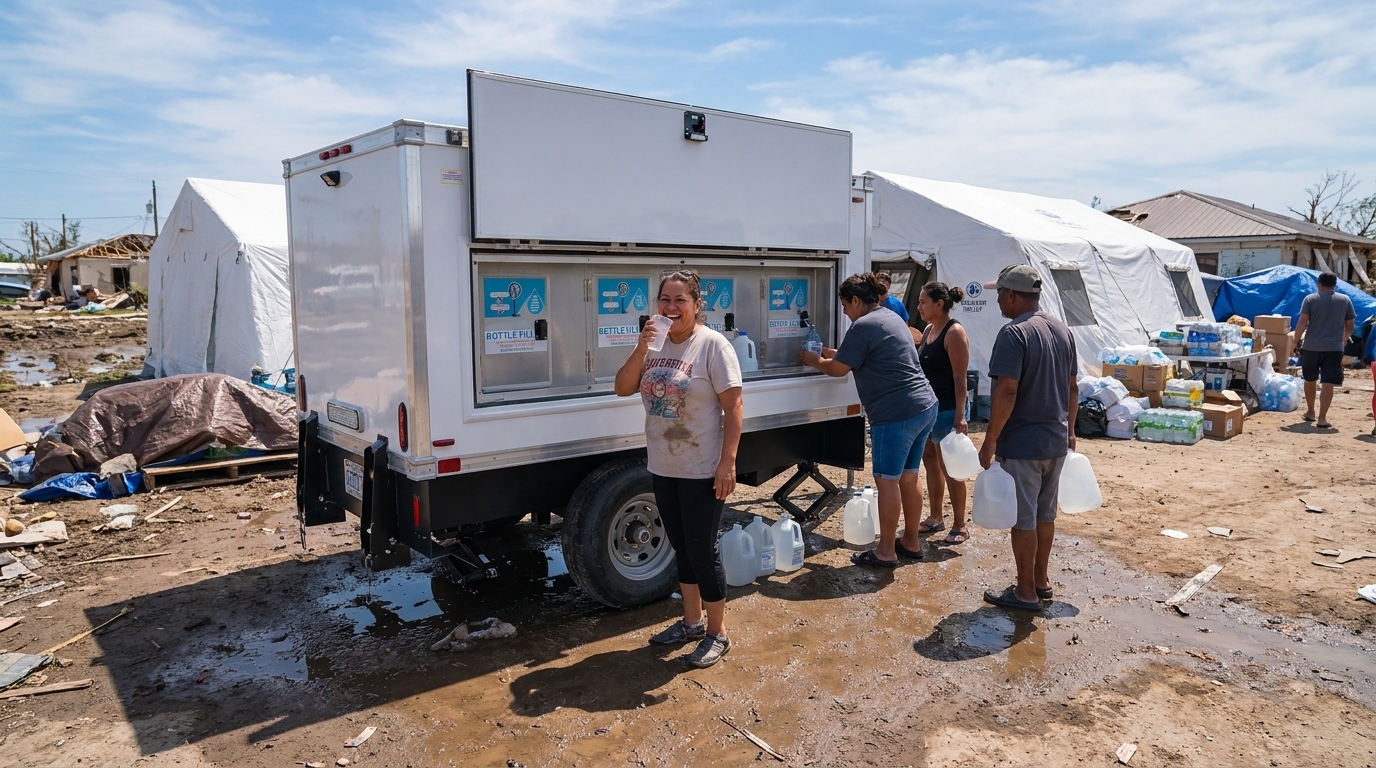
Want this math run for your own Tacoma job? Two minutes on the phone gets you a real number.
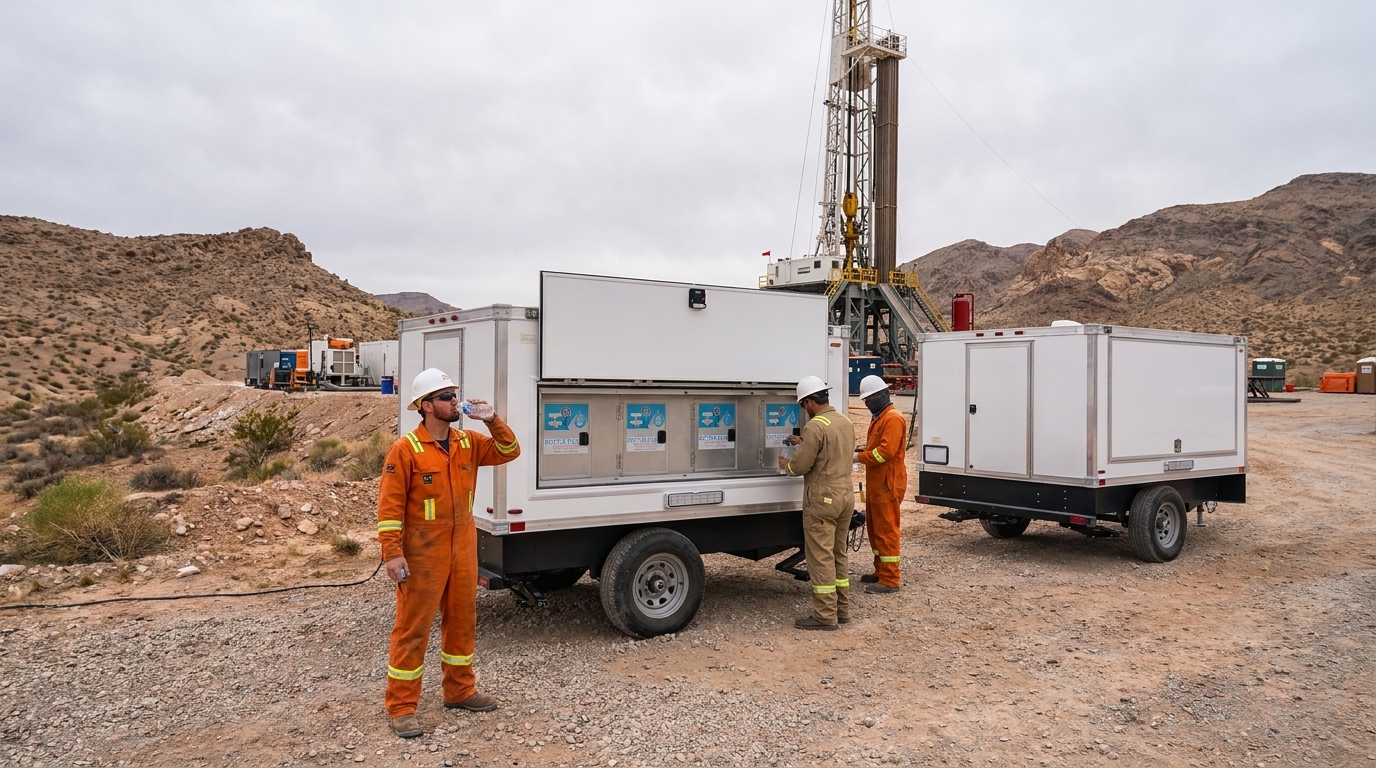
The 12K, 5K, 2K and Diaper Dash run on June 13, 2026, through Point Defiance and along the waterfront. A field that size needs water at the staging area before the first wave and again at the finish festival. We deliver the day before and top the tank at dawn.
Twenty two high school and college ceremonies are booked into the Dome in 2026, most of them stacked into a few June weekends. Families queue outside in full sun for an hour before doors open. A bottle fill station on the plaza takes pressure off the fountains inside.
Published 2026 alerts list day and night mortar, demolitions and artillery training from June 11 through 18, and demolitions again July 11 to 12. Those exercises run outdoors across a 70,000 acre training area in the hottest weeks of the year. Staging areas and range control points are where a unit earns its keep.
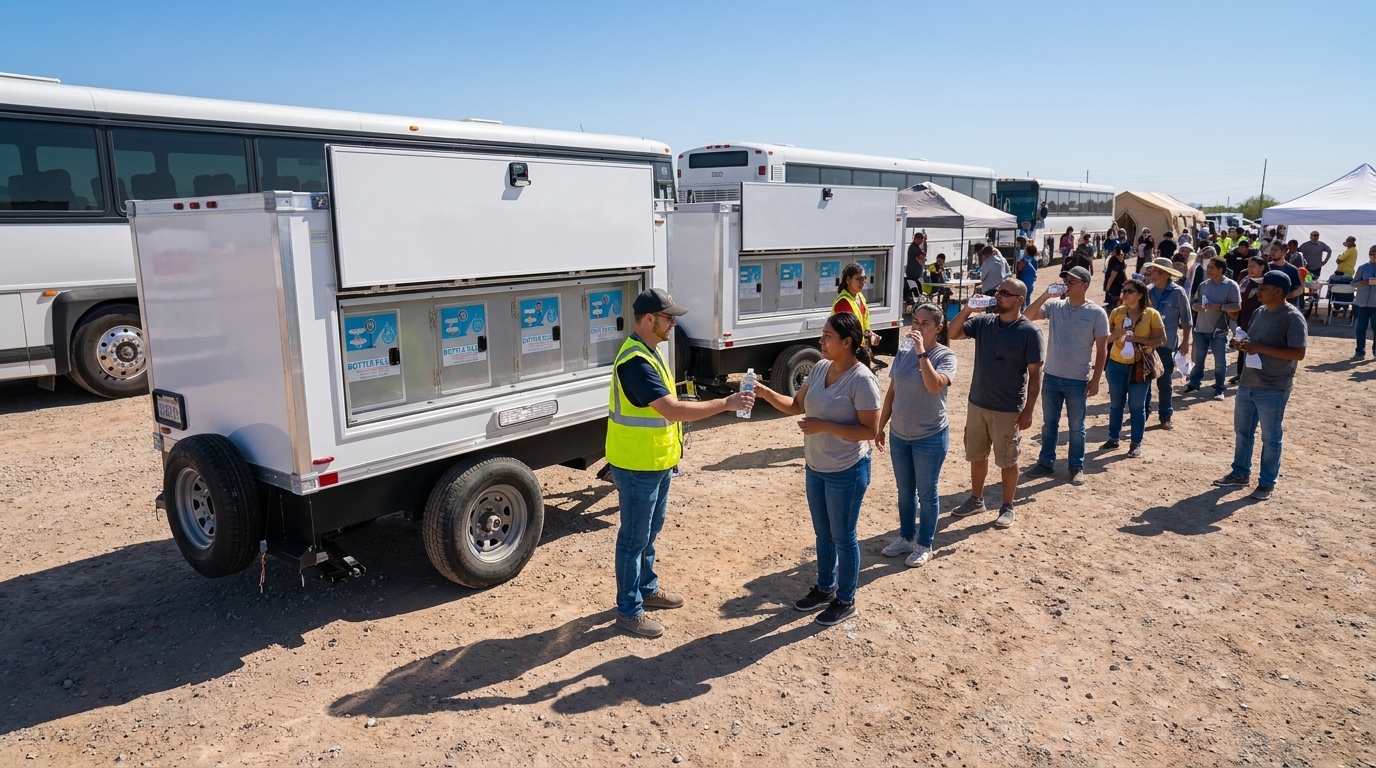
Pierce County runs a regional walk out drill with students and staff from the Puyallup, Sumner, Orting and Buckley districts covering marked evacuation routes on foot. The 2026 drill was April 23. Thousands of people outside on a route for an hour is a staging and rally point water need, separate from the drill's own purpose.
A water source people don't trust gets ignored, and an ignored station is rented money wasted. That's why municipal water doesn't reach the tap raw on our trailers. It passes through three filter stages and a UV chamber, then an onboard cooling unit drops the temperature. The result tastes clean and comes out cold, even on the worst Tacoma afternoon of the year.
The opening filter traps sand, scale, and the fine grit local mains occasionally push through. On a dusty Tacoma lot, that's what keeps a pour from tasting like the parcel it's parked on.
Activated carbon comes next, lifting the chlorine bite and the dull seasonal notes local tap can carry until the taste lands clean and neutral. When it's 100 out, that flavor decides whether a crew keeps drinking or walks past the tap dry.
A finer cartridge then catches the microscopic particles that slip past the first two, so what reaches the spout is clear rather than merely cold for the crews and crowds across Tacoma.
The last step is an ultraviolet chamber that wipes out bacteria and microbes without adding a single chemical. Even after a long tow to the far edge of the South Puget Sound, the water off the nozzle is clean.
Along the wall sit four adjustable push-back taps, press a bottle to the bar and it pours. One of them is set at ADA-reachable height, so a single trailer includes everybody at a Tacoma crew or crowd with no add-on gear. Out back, a large-jug spout services five-gallon coolers and hydration packs, while a bank of hose connection taps handles work-site chores, event support, and refills down the orchard rows. Stainless, food-grade plumbing the whole way through keeps the filtered, chilled water at quality right to the spout.
Every Signature trailer carries a 300-gallon load, roughly 2,400 cups at sixteen ounces each, and we recharge it on demand, so the unit doesn't turn into the choke point on a busy Tacoma shift or a packed show night.
There's nothing here for you to run. Placement, fresh-water load, hookup, that's all on us, and then we walk your Tacoma crew or event staff through the basics before our truck pulls away.
People count, number of days, where exactly it parks on your Tacoma site, and what power is there. Those four answers let us spec it correctly the first time around.
Reckon roughly 45 minutes from our yard to anywhere in Tacoma or the South Puget Sound, with round-the-clock emergency runs whenever a heat advisory or a power shutoff hits the area.
Once on site we set it level, charge the 300-gallon tank, and tie in power off one to four standard 120V circuits, or a single 50-amp 240V drop, depending on what the site gives us.
After that the tankers cycle back on a cadence matched to how fast your crew or crowd pulls it down, and we maintain the unit through the whole rental term.
No power on the parcel at all? We price that in. The unit draws very little, and with the service fleet backing it we've run Tacoma stations on lots that had no permanent power whatsoever. Lay out what the site offers and the rest is on us.
Washington's outdoor heat exposure rule, WAC 296-62-095, applies year round. It has since July 17, 2023, when the state replaced a May through September season with a standing rule. The triggers step up in three stages: 52 degrees for anyone in clothing that does not breathe, 80 degrees for everybody else working outdoors, and 90 degrees, which adds paid cool down breaks of at least 10 minutes every two hours. At 80 degrees an employer has to provide cool drinking water at one quart per hour per worker, and it has to be genuinely easy to reach rather than parked at the far end of the site. That per head number is the one we size a placement against.
Every employer with outdoor work also needs a written heat program covering how heat illness gets spotted, how it gets prevented, what training people get and what happens in an emergency. Workers and supervisors both take that training every year before outdoor work starts. Agriculture has its own companion chapter, 296-307 WAC, with the same water and shade requirements, which matters out in the valley where a grower and a general contractor are reading two different chapters to reach the same answer.
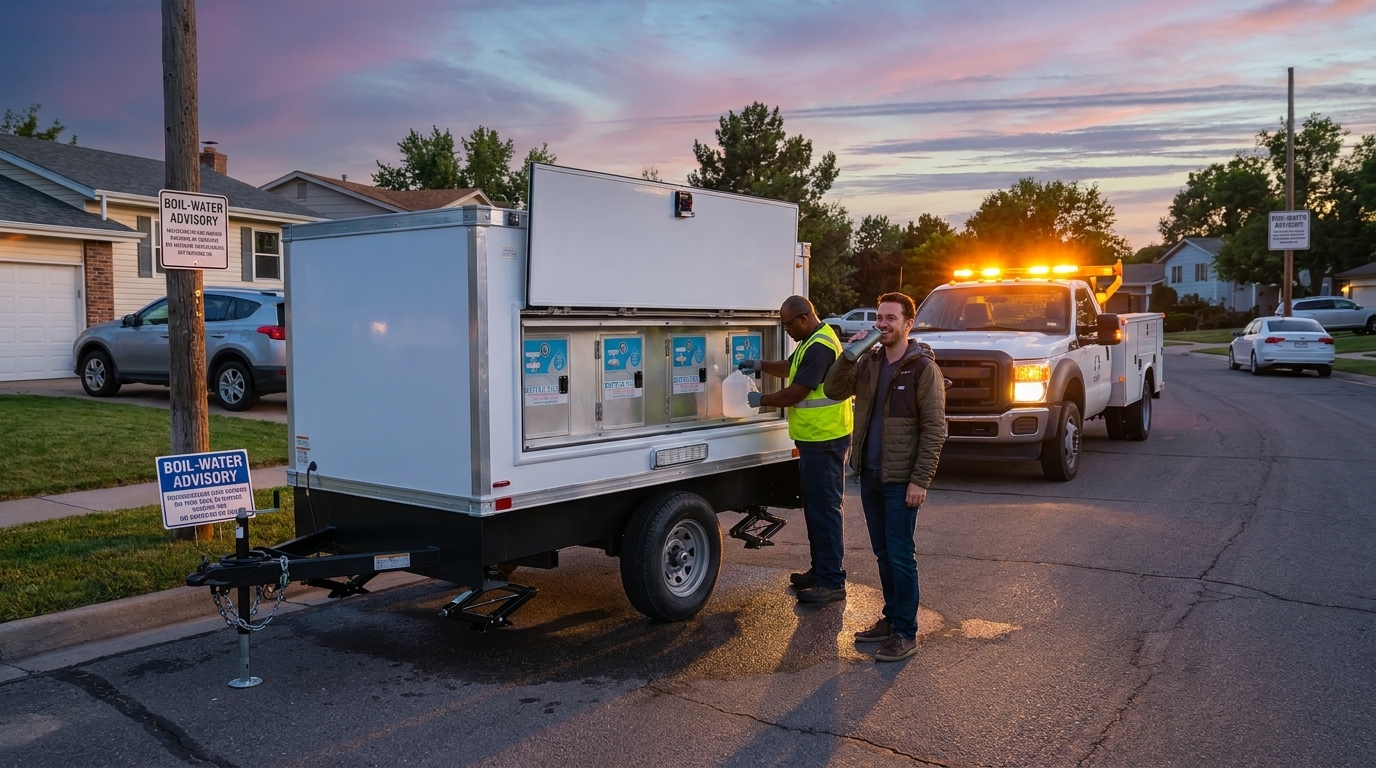
Source water is the other half of the question and it changes by site. A unit can fill from a hose bib on private property, from an event's own water truck, or from a city water hookup arrangement with the utility. A trailer parked in the public right of way needs an occupancy permit from the city, and we handle that paperwork when a placement calls for it. What a jobsite is usually missing is the last 500 feet between a good municipal main and the people doing the work. That is the gap a mobile water station rental closes, and it is the same gap the crews we serve with mobile water station rentals in Santa Fe deal with on high desert sites.
Need a station your written heat plan can point to? We can have one pouring cold within days.
A lot of the South Puget Sound jobs have shaped how we run the next one. A few that stuck with us:
A yard superintendent on a Tideflats transload pad. Forty people were working a container pad with the nearest fountain inside a building they were not checked in for. We set a unit at the gate on a Tuesday and put it on a twice weekly fill. Six weeks later the superintendent asked for a second one at the far end of the pad, because people down there were still walking too far.
A grower moving a picking crew twice in one week. A berry block out toward Sumner picked out faster than planned and the crew shifted twice in five days. The foreman towed the unit himself both times with the farm's own pickup. We came out once that week for a fill and timed it to the second move, so nothing sat empty in the rows.
A coordinator running four ceremonies in one Saturday. Families lined up outside a downtown venue in full sun between back to back June ceremonies. We staged two units on the plaza Friday night, filled both before the first doors opened, and topped them off between the second and third ceremony. Nobody had to leave the line to go looking for water.
The Puyallup Valley is still working farm ground. Berry rows, nursery stock, and the spring flower fields that still give the valley's Daffodil Parade its name. Field work is piece rate work in a lot of cases, which means a crew that has to walk to the truck for water will skip the walk and keep picking. Put the water where the rows are and they drink it.
Washington writes a separate heat rule for agriculture, chapter 296-307 WAC, and it carries the same water and shade requirements the general rule does. Growers here have worked under a version of it since 2018, and the current rule has applied year round since July 2023. A cooler of ice and a case of bottles will satisfy an inspector for about two hours on a hot day. A filtered station that holds temperature satisfies a crew for the whole shift.
Harvest crews move, and that is the part people underestimate. A block gets picked out and the whole operation shifts a quarter mile, and the water either follows or it gets left at the old landing. Our unit tows behind the same pickup a farm already owns, so a foreman can move it without calling us first. When a block change is big enough to need a refill anyway, we schedule the fill and the move together.
Smoke season overlaps harvest here. Statewide fires had burned about 425,000 acres by late August of 2026, and the state declared a public health emergency over smoke on August 7. What that does to a field crew is not obvious until you watch it. Breaks get longer and more frequent, and water use climbs even when the thermometer has not moved. A grower who planned the season off a clear day number comes up short in that week.
This is not a hot city on paper. Average July temperature sits at 67 degrees. Annual rainfall runs about 40.8 inches. But the record high is 105 degrees, and it was set in June. A place with a 67 degree July average and a 105 degree June record does not get a long hot season. It gets a sharp one, usually with a couple of days of warning.
Pierce County plans for that now. The county activates a named list of cooling sites when heat lands, including the Puyallup and Lakewood libraries, South Hill Mall and Cross Park, and Pierce Transit runs free rides out to them during 90 degree stretches. County guidance flags people over 60, people under 18 and people with chronic illness as the ones to check on first. A cooling center is shade and air conditioning. Pairing one with cold, filtered water costs very little and finishes the job.
A crew that works through a Tacoma winter without thinking about water gets caught by the first 90 degree week. It happens most years. We keep units staged from late May, and we take standing orders for June through September so the fleet is already committed where it needs to be.
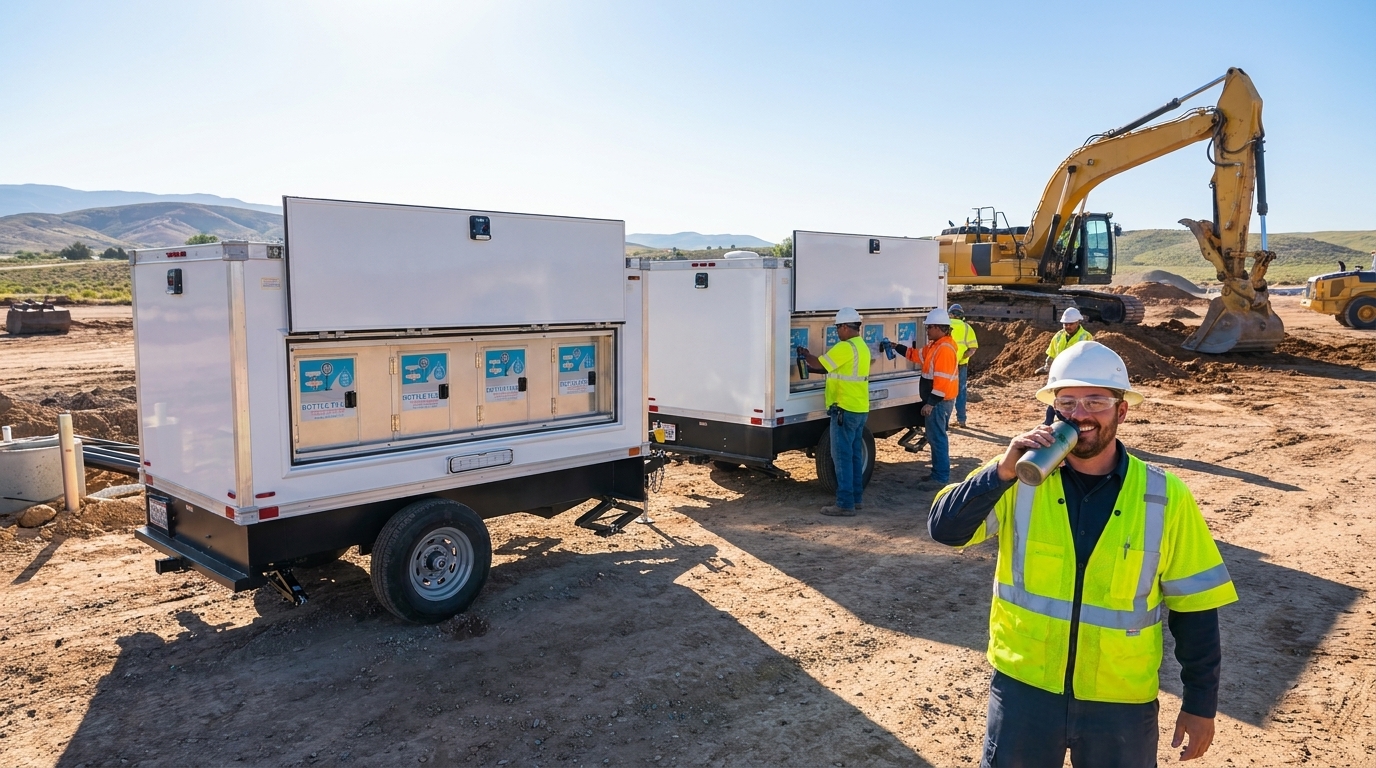
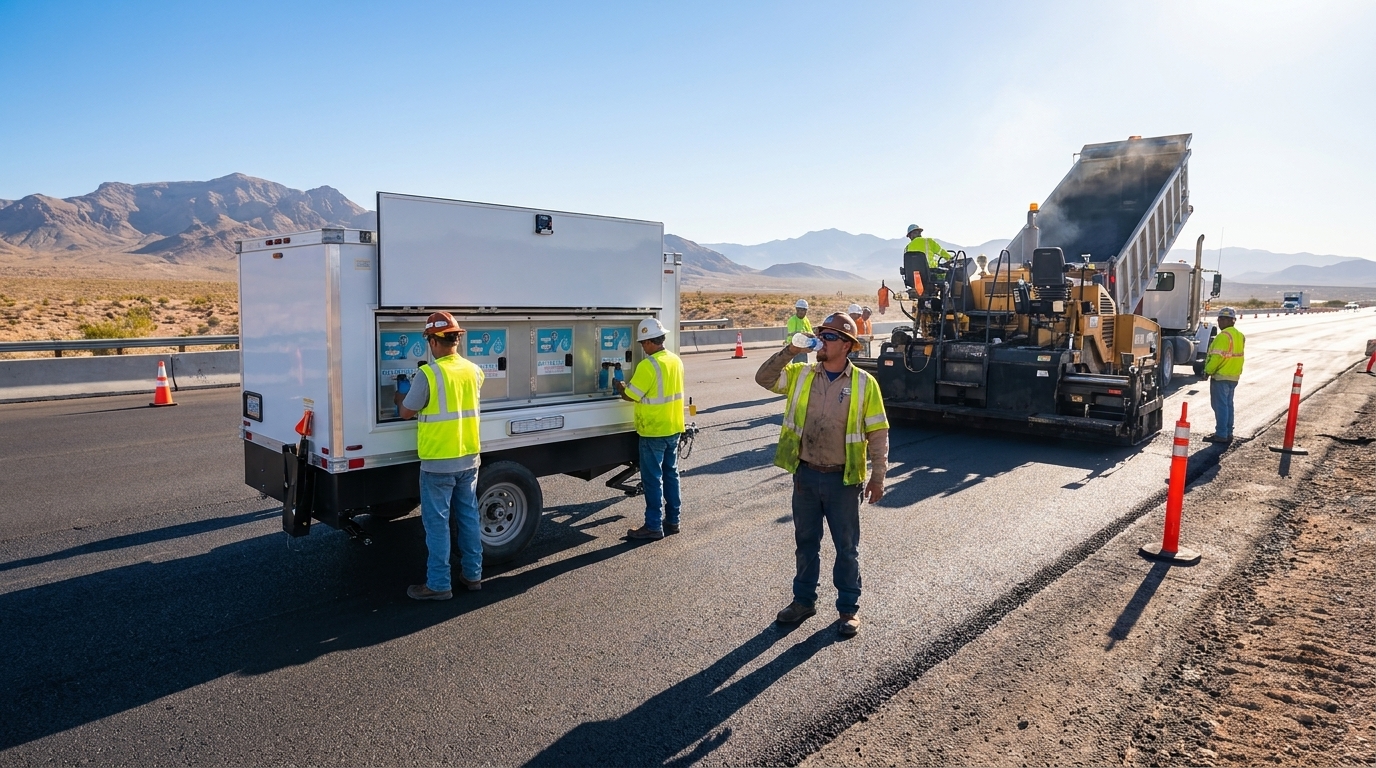
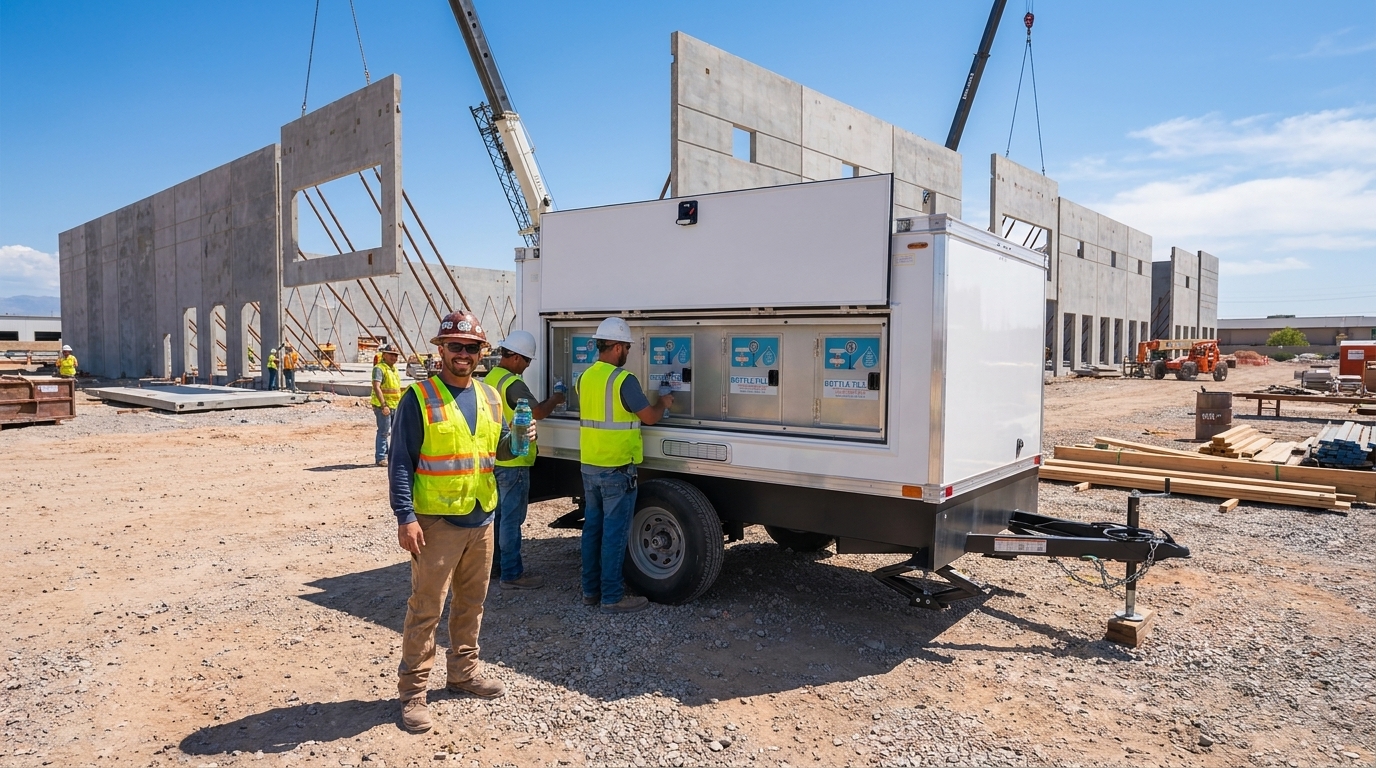
Construction is about 24,000 jobs in Pierce County, and a big share of that workforce spends the whole shift outside. The SR 167 Completion work is the clearest example. Stage 1B is building a new two mile expressway from I-5 to SR 509, with 20 bridge structures and roughly a million cubic yards of fill dirt, opening to traffic in mid to late 2026. There is no shade on a bridge deck. There is no tap on an embankment.
The Tacoma Dome Link Extension keeps crews out there too. Sound Transit's roughly ten mile light rail extension from Federal Way to the Dome District started construction in 2025 with Kiewit as contractor and is projected for service in 2030. Elevated track work keeps people up at height and out in the open for years at a time. Those jobs also move down the corridor as they go, which means the water has to move with them. We move a unit in an afternoon rather than asking a superintendent to plumb something permanent.
Housing work out in South Hill, Spanaway and Frederickson is the raw pad version of the same thing. No hose bib, and no fountain. Often no power at the pad until late in the job, which is why the tank arrives full and a small generator covers the chiller. Road crews in hot, dry markets hit the identical wall, and the highway teams we cover with portable water trailer rentals in El Paso solved it the same way we do here.
Delivery access is its own planning problem around Tacoma. I-5, SR 509 and SR 167 all carry active work zones through 2026, and a lane shift that moved last month will move again. So we check the corridor before the truck leaves the yard and give a superintendent a window we can actually hit. Nothing kills a Monday morning faster than a loaded trailer stuck behind a closure.
Everyone sees the trailer. What they don't see is the support fleet behind it, the trucks that deliver fresh water, hold reserve on site, and carry wastewater off, so a single call wraps the entire loop rather than stringing together three vendors.
Our tankers run drinking-grade water in bulk, recharging the 300-gallon tank on whatever interval the headcount demands. Those same trucks also top up storage tanks, holding tanks, and bladder bags whenever a single drop can't keep pace, like a big slab pour or a downtown night that packs the square.
When demand spikes we set out fold-flat bladders to bank extra fresh reserve, and on a drain-less lot they'll temporarily hold greywater too. It isn't fancy equipment, but it's what keeps a far-flung job in the South Puget Sound pouring between tanker runs.
Water that has to move across a job is a pump truck's job, whether that's charging holding tanks or hauling supply end to end. It earns its keep on the sprawling parcels where the trailer and the fill point can end up a fair hike apart.
At the tail end, a vacuum truck draws off greywater and wastewater and carries it to permitted disposal, closing the loop clean. Nobody on your Tacoma crew is left guessing where the used water ended up. That piece was built into the plan from day one.
Every job gets its own setup. A remote parcel might run a station plus a bladder bag for reserve and a recurring water-truck schedule. A heavy event night might call for a pump truck to move supply and a teardown waste run at the end. Describe the shape of your job and we'll put together the right combination, on one invoice, handled by one crew that already knows the ground.
A couple of minutes on the phone is enough to get you a real number. Here's what we'll want to know, handy to have ready before you call, and proof that we size every job to the work in front of us rather than reading off one canned quote.
Bottled water reads as the budget choice on a purchase order. Its actual price tag is buried somewhere else, in handling hours, staging footprint, water that warms up, and trash piling up afterward, and on a hot inland lot each of those costs more than it would by the coast.
Look at everything bottled water actually demands of a person: cutting the order, receiving and breaking down pallets, icing coolers before dawn, topping them up through the day, then flattening empty bottles for the bin. On a large Tacoma crew that's hours of paid time burned every single day, scraped right off the work that's supposed to be getting done. The trailer erases that loop entirely. A local contractor once let us pencil it out with him, and the recovered labor by itself paid for the unit. His words were that the bottle runs had been quietly costing him close to a day of payroll a week. Our trailer arrives full, the tankers keep it full, and your superintendent owes it nothing but a parking spot.
Ice a cooler at 6 a.m. and by mid-morning in July around the South Puget Sound it's as warm as a bath. Warm water is water people stop touching, and the slowdown that follows is precisely where heat illness gets its opening. A chilled station never rides that warm-up curve at all. Whatever pours at clock-out is as cold as the sunrise fill, which happens to be the moment a spent crew, or a crowd deep into a long concert, leans on it hardest.
Bottled-water pallets devour staging space, jam the lay-down area, and sit cooking in the sun until somebody finally cracks them open. Empties build up faster than anyone keeps up with, and on a tight commercial lot that pile turns into its own problem. Set a trailer in one parking stall instead and it serves a crew or crowd that would otherwise burn through hundreds of plastic bottles every day.
Every bottle bought is a bottle thrown out, and across a season a busy site or event generates a small mountain of them. That's a disposal line on the budget, a dent in the sustainability numbers, and, given that a single bottle can linger in the ground for centuries, a footprint that lasts longer than the project that made it. Move to a refill station and the line drops to zero, which finally gives your reporting a figure worth publishing.
On-Site Hydration Services runs portable water station rentals across Tacoma and the surrounding county, from the Tideflats and South Tacoma out to Puyallup, Sumner, Spanaway and Gig Harbor, and north to Federal Way, Auburn and Kent. Tell us the site and the headcount. Call us or request a free quote and we will tell you how a unit fits and how fast we can get it there.
Working a corridor instead of a single address? We follow the main routes across the South Puget Sound, so multi-site projects get the same fast turnaround as one stop.
Still weighing it? Call and ask. Most of these questions get settled in one short conversation.
Yes. Any unit we place from November through March goes out with a freeze package on the plumbing, and it is included rather than billed separately. Tacoma's record low is 5 degrees and the average January day sits near 43, so hard freezes here are short but real. We also set the unit where morning sun hits it when the site allows. If your job runs through winter, say so at booking and we will flag the date.
Long placements get simpler terms, not harder ones. A corridor job on SR 167 or a multi year transit alignment gets a standing service schedule set at booking, with the fill cadence adjusted after the first hot stretch once we see real usage. You are not rebooking every month. Give us the expected end date and we will build the winter window into the plan up front.
It changes site to site, and the drivers are usually the same four. How long the unit sits. How many people draw from it. How hard the site is to reach and refill. And whether the placement needs a generator because there is no power at the pad. A Tideflats yard with a straight fill route off Taylor Way is a different quote than a gravel landing out past Orting. Tell us those four things and we can be accurate the first time.
Yes. The trailer draws from 1 to 4 dedicated 20 amp, 120 volt circuits, or from a single 50 amp, 240 volt line, and a small generator covers a pad that has neither. The tank arrives full, so there is no water hookup to find either. Housing pads out in Spanaway and Frederickson often have no power and no water until late in the job, and that is a normal delivery for us.
Bottles and jugs. Every unit carries four bottle fill stations plus a rear jug fill point for the big 5 gallon coolers a crew hauls out to a bridge deck or a field row. One of the four is built to ADA height and reach. Fill stations move a line much faster than a fountain does, which is the whole point at a fair gate or a race finish.
Sanitizing happens between placements and on a set interval during a long one, not when somebody complains about a taste. Filters follow the same schedule. Every unit puts water through 3 stages of filtration and a UV pass before it reaches the chiller, and those stages get checked at each service visit along with the fill. Ask for the service record on your unit and we will send it over.
Level ground, firm enough to hold the jacks, and close enough to the work that nobody walks more than a couple hundred feet. That is most of it. On filled ground around the Tideflats we bring plates for the jacks. Keep it out of the forklift path and off the walking lane, and leave our truck a way in for the fill. We will walk the spot with you before delivery if the site is tight.
Every unit we own has one. It is built to ADA height and reach so somebody using a wheelchair can fill a bottle without help. The other half is the path to it, and that is a placement decision rather than an equipment one. Send us the site layout and we will face that station toward the accessible route.
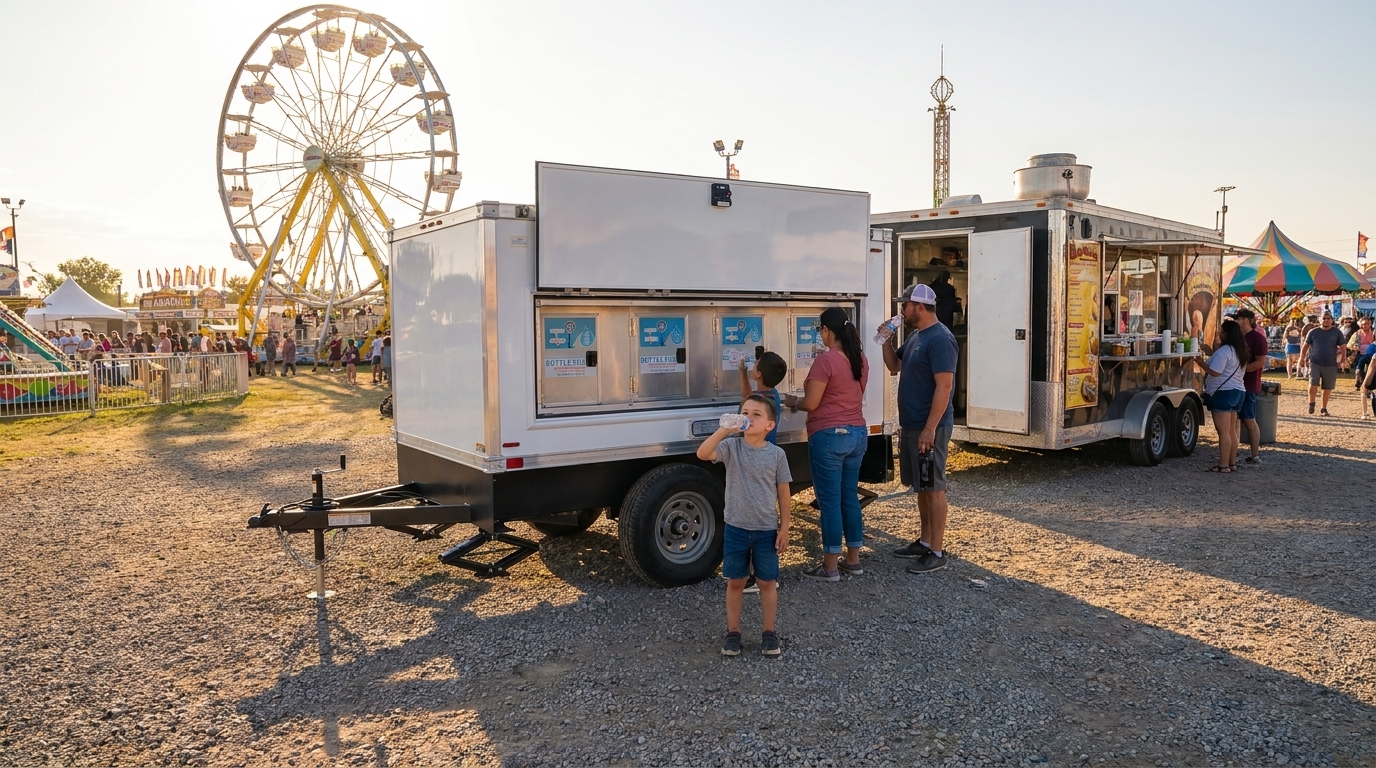
Yes, and September is the busiest month on our south end board because of it. The Fair runs 20 days, closed Tuesdays, and pulls crowds a fixed fountain line was never built to absorb at peak hour. Vendors book stations for their own booth traffic and grounds teams book them for the aisles. Reserve early, because those same weeks are full of valley harvest work.
We do, on the schedule we set at booking. Nobody on your crew has to track it or call it in. On a Tideflats or Port of Tacoma placement we route the fill truck in off Port of Tacoma Road or Taylor Way and time it away from shift change. If your draw turns out heavier than planned, the schedule moves up with it.
It does, more than people expect. Crews working a smoke week take more breaks and drink noticeably more even when the temperature has not moved, and western Washington gets at least a few of those weeks most summers. Plan your volume off the worst week rather than the average one. We would rather add a fill than have you rationing bottles on a Thursday afternoon.
Four to six weeks is comfortable, and earlier is better for the second Saturday in June or the last weekend in August, because Sound to Narrows and the Tacoma Narrows Half Marathon land on those weekends every year. Tell us the course, the wave count and where the finish festival sits. We will tell you whether one unit covers it or whether the start and the finish each need their own.
The worst week of a Pierce County summer is almost never the hottest one on record. It is the first warm stretch after a cool spring, when nobody on the crew has adjusted to it yet. Washington's safety rules single that window out on purpose. Employers are told to watch people closely after a new work assignment, after somebody has been off for seven days or more, and during a heat wave, because those are the moments a body has not caught up to the weather.
So plan the water before that week rather than during it. Once a forecast breaks, every supplier in the region is fielding the same phone calls, and the site that already has a station is the site that keeps working. The first item on your list is a date, not a product. Pick the week you want the unit standing and work backward from there.
Every 300 gallons on a jobsite came from somewhere, and on a long placement the refill plan matters more than the first delivery. People think hard about the drop off. Then week three arrives and nobody has decided who is calling for the next fill.
There are three normal ways to keep a tank full in this county. A hose bib on private property, when there is one and when the owner is fine with it. An event's own water truck, which is common at a fairground or a large festival build. Or our fill truck on a set schedule, which is what almost every construction and yard placement ends up using.
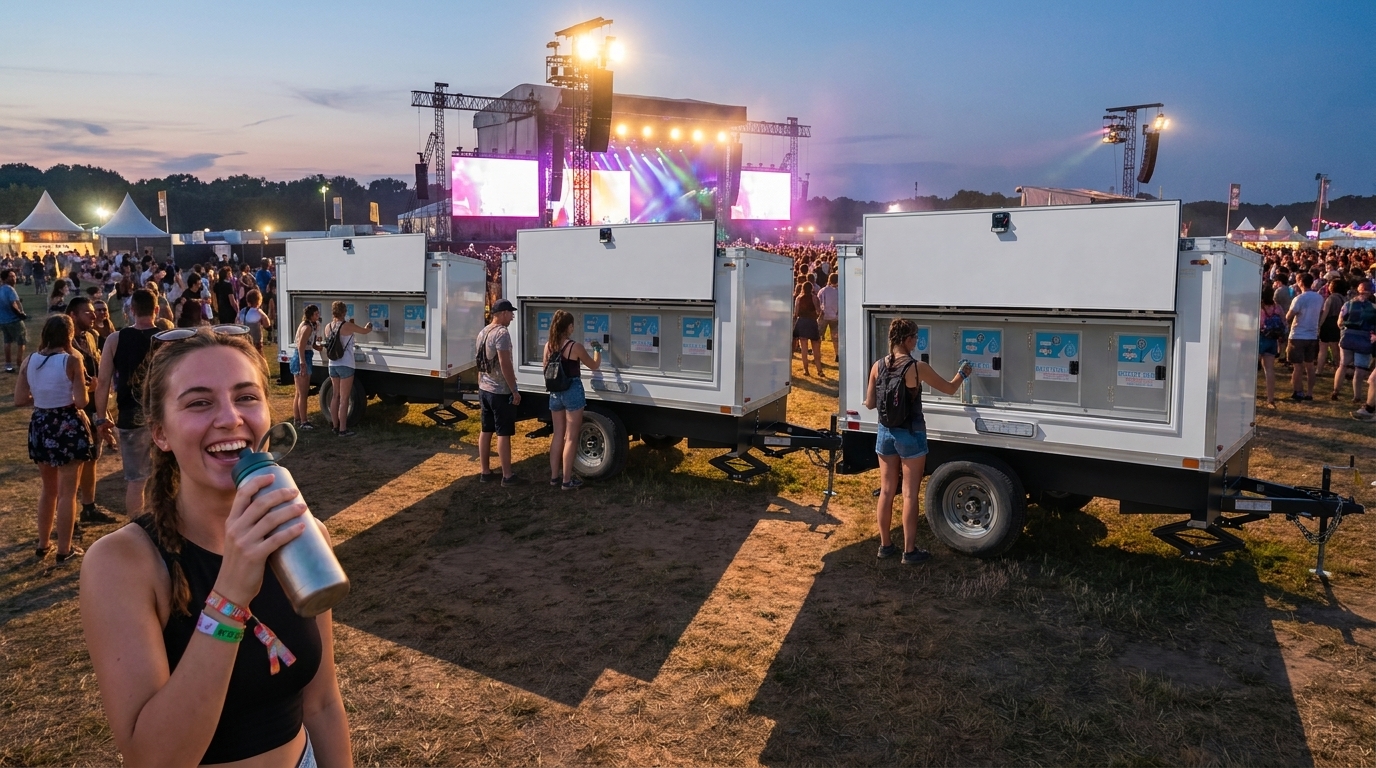
Event water is a different animal than jobsite water. A jobsite draws steadily for nine hours. An event does almost nothing for four hours and then everything in twenty minutes. If you plan an event off a jobsite number you will run short at exactly the wrong moment.
Ask how many fill points a unit actually has, not just how many gallons it holds. Tank size decides the day. Fill points decide the line. Four bottle fill stations plus a rear jug point move a crowd several times faster than a single spigot, and at a finish line the speed of that line is the entire experience.
A quote on a water station rental is not a mystery number. Five or six things move it, and they are the same things every time. Knowing which ones apply to your site is most of the work.
Duration is the biggest one. A single event day and a two year corridor placement are built on completely different logic, and the long one is better per day by a wide margin. If you already know the job runs through next summer, say so at booking. A standing placement gets a better structure than twelve separate short rentals ever will.
Most Pierce County sites start with pallets. It is the obvious move. Somebody runs to a warehouse club, a pallet lands in the connex, and for about two weeks it works fine.
Then the math shows up. A crew of 30 in real heat goes through a serious volume every shift, and at 16 ounces a bottle that is a lot of plastic arriving and a lot of plastic leaving. Somebody has to order it, receive it, stack it, ice it and haul the empties out. That somebody is usually a foreman with better things to do.
“We had forty people on an exposed corridor and a cooler program that was failing by ten in the morning. One delivery fixed it. Our safety folder got the paperwork the same week, which almost never happens with a vendor.”
“I moved it myself twice in one week with the farm truck. No call, no waiting on anybody.”
“Two units on the plaza for a graduation weekend and nobody left the line looking for water. We booked the same setup for next June before we even cleared the site.”
“The unit follows the work. That sounds small until you have watched a crew walk 600 feet each way for a warm bottle.”
“Delivered Friday, topped at six the next morning, and we never had to move it during the event. Clean and cold, and our volunteers could run the fill line themselves without any training.”
“No hose bib and no power, but the small generator covered it. The thing just worked from day one.”
“Summer weekends out by the beach get busy and the fountains were never enough. This holds up all day.”
“Best part is the fill schedule. I am not calling anybody, it just shows up. Second best part is the ADA station, because we actually needed it and nobody else offered one.”
“We use it for August practices and field days. Parents notice that it is filtered and cold instead of a hose and a cooler. Coaches notice that the kids drink more.”
Service information current as of September 2026.
Tell us the headcount or the gate count, the rental dates, and where the trailer should park, and we'll spec the right setup and roll one out to you anywhere in the South Puget Sound, usually inside about 45 minutes of dispatch.