
Refrigeration Trailer Rentals
NSF-approved refrigeration trailers that hold a precise 33°F to 50°F for fresh produce, dairy, floral, beverages, and pharmaceutical cold chain. Three sizes (6×8, 6×12, 6×16) with same-day delivery across California, Nevada, Arizona, Utah, and Hawaii.
Cold Storage Above Freezing, Delivered To You
Our refrigeration trailers hold a steady, precise temperature anywhere from 33°F to 50°F. That covers fresh produce, dairy, beverages, cut flowers, prepared meals, fresh meat, wine, and pharmaceutical cold chain. Same NSF-approved fleet that runs our freezer and hydration operations, same dispatch team, same same-day delivery window across California, Nevada, Arizona, Utah, and Hawaii.
Whether you need a 6×8 for a wedding’s floral and cake staging, a 6×12 to step in when a restaurant walk-in cooler fails on a Saturday morning, or a 6×16 for a multi-week grocery dairy section overflow, our refrigeration trailers plug into standard 110/120V 20-amp dedicated circuits and run quietly enough to sit at a reception or in a residential neighborhood.
Real people answer the phone. We show up when we say we will. And our 0% spoilage incident record exists because we maintain the units between rentals instead of after problems.
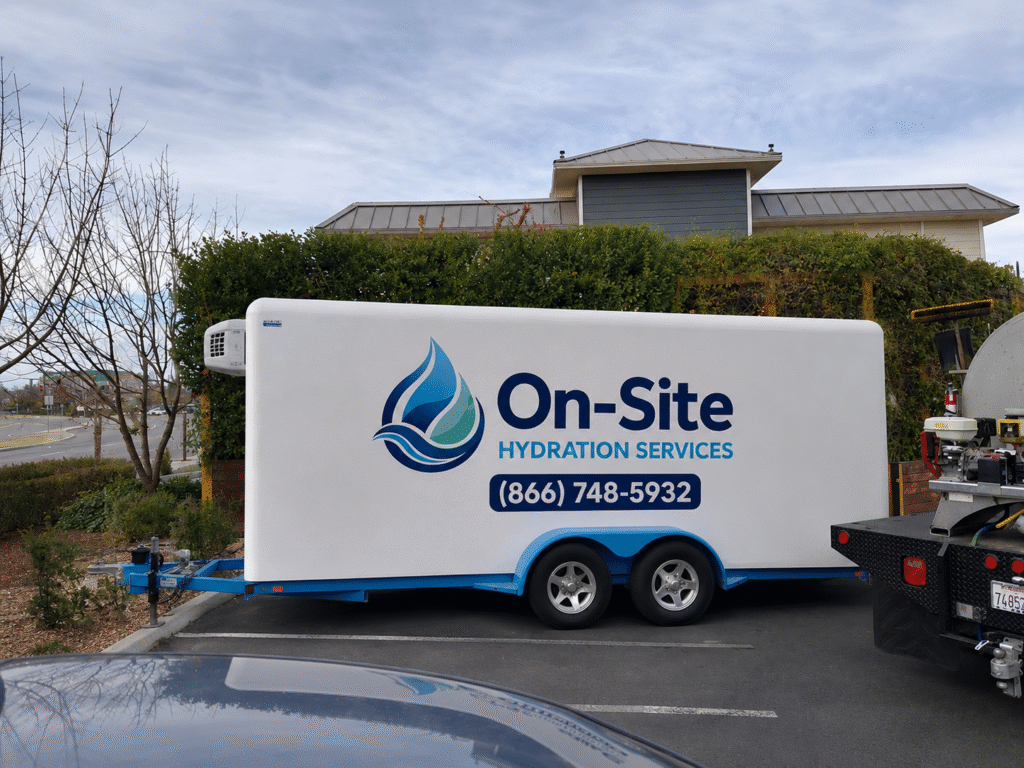
Our Refrigeration Trailer Fleet
Three trailer sizes covering every refrigeration rental scenario, from a single-day wedding to a multi-month grocery remodel. All NSF approved. All hold a precise temperature anywhere in the 33-50°F range, even at 110°F+ ambient. Same-day delivery across our service area.

6x8 Refrigeration Trailer
Compact
- Temperature range: 33°F to 50°F
- Dimensions: 6 ft × 8 ft
- Storage space: ~96 cu ft
- Payload: ~1,000 lbs
- Power: 120V 20-AMP dedicated circuit
- Best for: wedding floral & cake staging, small catering overflow, restaurant produce backup

6x12 Refrigeration Trailer
Mid-Size
- Temperature range: 33°F to 50°F
- Dimensions: 6 ft × 12 ft
- Storage space: ~144 cu ft
- Payload: ~2,000 lbs
- Power: 120V 20-AMP dedicated circuit
- Best for: restaurant walk-in cooler replacement, mid-size weddings, beverage staging

6x16 Refrigeration Trailer
Full-Size
- Temperature range: 33°F to 50°F
- Dimensions: 6 ft × 16 ft
- Storage space: ~192 cu ft
- Payload: ~6,600 lbs
- Power: 120V 20-AMP dedicated circuit
- Best for: grocery dairy/produce remodels, large weddings, multi-day festival beverage
What Makes Our Refrigeration Trailers Different
Precise 33-50°F Range
Digital thermostat with tight variance. Hold dairy at 38°F, floral at 36°F, wine at 50°F, all in the same fleet.
NSF Approved & Documented
Every trailer meets NSF/ANSI Standard 7. Temperature logs available on request for pharma, cannabis, and food-service compliance.
Same-Day Delivery
Walk-in cooler failures, last-minute wedding additions, festival ramp-ups. Dispatch mobilizes within 2-4 hours across the West Coast.
24/7 Live Dispatch
Real people answer the phone. Weekend brunch service walk-in failure? Saturday wedding emergency? We pick up.
When You Need a Refrigeration Trailer
Six scenarios our refrigeration trailers run every week across the West Coast.
Wedding Floral & Cake
Hold centerpieces, bouquets, and tiered cakes at the precise 36°F floral sweet spot. We coordinate delivery so the trailer arrives before your floral does.
Restaurant Walk-In Failures
Compressor goes down Friday morning. We’ve got a 6×12 on-site by lunch service, plugged in, pre-cooled, and keeping your produce and dairy in spec through the entire repair window.
Grocery Dairy & Produce Remodels
Multi-week cooler overhauls at Smith’s, Harmons, Macey’s, Lin’s, and regional chains. A 6×16 holds the dairy section while crews rebuild the walk-in.
Festival & Concert Beverage
Centralized beverage refrigeration for multi-day outdoor events. Pre-stage vendor inventory, replenish on rotation, breakdown after the last show.
Pharmaceutical Cold Chain
Vaccine clinics, biotech buildouts, and pharmacy buffer capacity. Continuous temperature logging, NSF-certified surfaces, and validation documentation included.
Winery & Dairy Industry
Harvest-season overflow at Paso Robles and Napa wineries. Equipment-maintenance buffer at dairy processors. Cheese cave expansion projects. 50°F holds at the upper end of our range.
The Complete Guide to Refrigeration Trailer Rentals: What Every Operator Should Know
A refrigeration trailer rental is one of those decisions that sounds simple until you find yourself comparing options at 4pm on a Friday with a walk-in cooler that just gave up. Temperature range matters. So does delivery speed, power compatibility, NSF documentation, and whether the vendor has run your specific scenario before. The companies that quote you a price in 27 seconds without asking those questions are usually the ones whose units arrive an hour late with the wrong cooling rating.
This guide covers what we wish every refrigeration trailer customer knew before they picked up the phone. It draws on thousands of deployments we’ve run across California, Nevada, Arizona, Utah, and Hawaii, ranging from single-day wedding florals to multi-month grocery cooler buildouts to emergency restaurant walk-in replacements during the worst possible service hours.
If you’re weighing a refrigeration trailer rental for a wedding, a corporate event, a restaurant cooler failure, a grocery remodel, a pharmaceutical cold chain need, or a multi-day festival beverage operation, this is what matters.
What a refrigeration trailer actually does
A refrigeration trailer holds product at temperatures above freezing, typically anywhere from 33°F to 50°F. That’s the sweet spot for fresh produce, dairy, cut flowers, beverages, prepared meals, fresh meat and seafood, vaccines, and wine. Our trailers use the same physical equipment as our freezer trailers, but the digital thermostat is dialed into refrigeration range rather than 0°F. You can shift modes mid-rental if your needs change, with a 2-hour pull-down time between settings.
We rent refrigeration trailers in three sizes: 6×8, 6×12, and 6×16. Each is NSF approved, fitted with antimicrobial gel coating, LED interior lighting, a 54-inch pallet-sized door, and a cool curtain that holds temperature during heavy in-and-out activity. They run on a standard 110/120V 20-amp dedicated circuit, which means almost any commercial site (or even most residential sites with a proper outdoor outlet) can support one without a permit or an electrician.
Most rentals fall into one of five categories. Wedding and event refrigeration for floral, cake, and beverage staging. Restaurant emergency walk-in cooler replacement. Grocery store remodel or seasonal overflow. Pharmaceutical and biotech cold-chain operations. Festival and concert beverage and produce staging at scale.
Each scenario has different implications for size, duration, delivery access, and documentation. The rest of this guide breaks those decisions down individually.
Why temperature range matters more than you think
Most customers ask about size first. Smart operators ask about temperature range first. Here’s why.
The 33°F to 50°F window covers a lot of ground, but different product categories need different precise targets within it. Fresh produce holds best at 34°F to 38°F. Cut flowers and floral arrangements want 35°F to 41°F, depending on the variety. Dairy needs 35°F to 40°F per FDA and California Department of Public Health guidance. Fresh meat ages best at 32°F to 36°F. Wine wants 50°F to 60°F (which is at the upper edge of our range). Pharmaceutical cold chain typically needs a tight 36°F to 46°F window with continuous logging.
Our trailers hold whatever you set within that range to within 2°F variance, even when the outside ambient is pushing 110°F. The digital thermostat is precise. The 4-inch insulated walls do the heavy lifting. We’ve held a steady 38°F at a Coachella-adjacent event when the outdoor ambient hit 113°F at 3pm, and we held that spec for the entire 4-day duration without compressor strain.
If your application needs documented temperature logging (pharma, wedding photography requirements for cake, certain regulated operations), tell us at quote time. We can deliver with continuous temperature monitoring already configured.
Sizing: how to pick between 6x8, 6x12, and 6x16
The right refrigeration trailer size depends on three things. How much product you’re holding, how long you need the trailer, and how much physical space you have at the delivery site.
The 6×8 trailer gives you roughly 96 cubic feet of refrigerated space. That’s enough for a 75-guest wedding’s floral and cake storage, a small catering operation’s beverage overflow for a single-day event, or a restaurant’s emergency produce backup. The 6×8 is also the right call when access is tight. Downtown urban venues, residential properties with narrow driveways, and city venues without dedicated truck access all work with the 6×8 when the larger units physically won’t fit.
The 6×12 is our most-rented refrigeration trailer. 144 cubic feet handles 100 to 285 guests at a wedding or corporate event, fully replaces a typical restaurant walk-in cooler during repair, covers a mid-size festival’s beverage staging, and supports a dairy or produce department during a grocery store remodel. If you’re picking between 6×8 and 6×12 and you can fit the 6×12, take the 6×12. The cost difference is modest. The capacity difference is meaningful.
The 6×16 is the full-size option. 192 cubic feet of refrigerated space handles 285+ guest events, full grocery department remodels, multi-day festival beverage operations serving dozens of vendors, and large-scale pharmaceutical or wedding floral deployments. If you’ve got the access and the budget, the 6×16 is rarely “too big.” Walk-in space is one of those things you never regret over-provisioning.
A floral designer in Sonoma I worked with last June walked me through her math the first time she ordered a 6×16. She’d been renting four reefer trucks for a 540-guest vineyard wedding to hold the centerpiece arrangements. “I switched to one 6×16 and it cost less than two of the trucks combined,” she told me. “Plus my crew didn’t have to coordinate four separate vehicles.”
Power, water, and delivery: what your venue needs to know
Every refrigeration trailer we deploy runs on a 110/120V 20-amp dedicated circuit. The word “dedicated” is critical. A dedicated circuit is one that no other equipment is sharing. If you plug the trailer into a circuit that’s also running a coffee maker, a printer, and the venue’s PA system, you’ll trip the breaker at the worst possible moment.
For outdoor weddings, festivals, and remote venues without dedicated power, we deploy with generator support. Generator rental, fuel, and noise dampening come quoted at the same time as the trailer. If a vendor doesn’t ask about your power before quoting, that’s a red flag.
The trailers don’t need water hookup for standard refrigeration operation. They’re sealed cooling units, not wash-down stations. Drainage is handled internally for condensation.
Delivery access is the third piece. Our standard delivery vehicle plus trailer needs about 25 feet of clearance for setup and a level pad to position the trailer (or jack pads if the surface isn’t level). For tight urban sites, the 6×8 fits where the larger units won’t. For mountain or remote venues, our drivers do pre-deployment site assessments on anything that looks borderline. We don’t show up and improvise.
Pricing: what drives the cost of a refrigeration trailer rental
Refrigeration trailer rental pricing in the western US generally falls between about $237 and $795 per day, depending on size, duration, delivery distance, and whether you need generator support. Multi-week and multi-month rentals get significantly better per-day rates. The cost drivers, in order of impact:
Trailer size. A 6×8 costs less than a 6×12, which costs less than a 6×16. The step between sizes is usually 25 to 35 percent per increment.
Rental duration. Event-rate pricing (1 to 3 days) is per-day higher than short-term (4 to 14 days), which is higher than extended-use (15+ days). A 30-day grocery remodel rental might cost less per day than a single-day wedding event.
Delivery distance. We charge for distance from our staging yards. Same-day deliveries inside our core service radius are quoted at one rate. Next-day deliveries to remote areas like Cambria, Mammoth, or Big Bear are quoted higher. Mountain and remote rural sites get site-specific quotes.
Generator support. If you don’t have grid power on-site, generator rental and fuel add a line item. A right-sized generator for a refrigeration trailer adds about $148 to $367 per day.
Attendant or service intervals. Most rentals don’t need this, but multi-day festivals, continuous emergency response, and pharmaceutical applications sometimes require scheduled on-site service intervals or attendant staff.
Seasonal demand. June through October is peak. January through March is the bottom of the market. Wedding season specifically (May through October) drives premium dates on weekends.
COIs (certificates of insurance), additional-insured naming for your venue, and standard temperature logging are included at no additional charge. If a vendor adds line items for those, you’re talking to someone who doesn’t run enough commercial work to know they’re standard.
Where refrigeration trailers actually deploy
The customer mix for our refrigeration trailers runs across these categories, and each one looks different on the dispatch end.
Wedding and event floral, cake, and beverage staging. This is one of our most-requested rentals. Floral designers, cake artists, and event producers all need product held at precise temperatures from delivery through service. A 6×12 staged at the venue the night before lets the floral team install fresh, pull from the trailer through the event, and break down without scrambling. Wedgewood at Black Forest, Napa Valley venues, Park City mountain venues, and Hawaii destination wedding circuits all see us regularly.
Restaurant walk-in cooler emergencies. Walk-in cooler compressor fails Friday morning before the busiest weekend of the year. We get the call. Most repair techs need 4 to 13 days for parts on older equipment. A 6×12 set up in the back lot the same day keeps the restaurant in service through the full repair cycle. We rolled a 6×12 to a Costa Mesa brunch spot in 2024 after their walk-in failed at 3am Friday morning. The owner messaged our dispatch at 5:47am: “We have 240 covers booked between brunch and dinner today, I need help in the next 4 hours.” We were on-site by 9:13am. They kept service open.
Grocery store fresh sections during remodels. Smith’s, Harmons, Macey’s, Lin’s, Reams, plus the regional chains across our service area book refrigeration trailers for dairy and produce overflow when walk-in coolers come offline for remodels or compressor replacement. A 6×16 typically holds an entire dairy section for a 27-to-42-day remodel window. A grocery dairy buyer in the Central Valley told me once, “Every hour my dairy walk-in is down is product I can’t sell and a hole in my cold chain compliance log.”
Festival and concert beverage staging. Multi-day outdoor festivals need centralized refrigeration for beer, wine, sodas, and prepared food vendor inventory. We’ve supported events at Indio venues, Bay Area festivals, and Las Vegas convention floors with multiple trailers per event. Pre-stage vendor inventory before gates open, replenish from our delivery rotation during the event, breakdown after the last show.
Pharmaceutical and biotech cold chain. Vaccine clinics during outbreak response, biotech buildouts in Lehi and San Diego, and pharmaceutical distribution warehouses all use refrigeration trailers for cold-chain overflow when permanent storage comes offline or capacity spikes. NSF certification, continuous temperature logging, and validation documentation are standard for these rentals.
Wine and dairy industry temporary cooling. Wineries during harvest, dairy processors during equipment maintenance, and cheese caves during expansion projects use refrigeration trailers for short-term cold storage. We’ve done a 47-day deployment at a Paso Robles winery during their cellar buildout, holding bottles at 56°F (right at the upper edge of our range) for the duration.
Catering scale-up operations. When a caterer signs a contract bigger than their existing walk-in capacity, a refrigeration trailer parked at the kitchen turns the operation into a 2x or 3x output for the prep window. The unit shows up two to three days before the event, holds prepared product through service, and goes back to our yard after breakdown.
NSF compliance and what it means for refrigerated cold chain
If you’re renting a refrigeration trailer for food service, biotech, pharmaceutical, dairy, or licensed cannabis operations, NSF/ANSI Standard 7 is the certification that matters. It specifies surface materials, drainage, insulation R-value, door seals, and cleanability requirements that walk-in coolers also have to meet.
Our trailers carry that certification because we ordered them that way from the factory. When a UDAF inspector walks up to a refrigeration trailer at a Utah grocery store, or a California Department of Public Health inspector reviews a dairy operation, or a biotech facility manager runs a vendor qualification for a lab buildout, NSF/ANSI Standard 7 is what they check for first.
For regulated industries, the documentation requirements get heavier. Pharmaceutical operations need continuous temperature logging with auditable records. Cannabis operators need METRC-compatible logging. Hospitals and vaccine clinics need validation runs proving the unit holds spec during the rental window. Pharmacies need COIs naming the specific location as additional insured. We’ve done all of these enough times that the paperwork lives in a shared template. Ask once, receive within the hour.
USDA requirements for prepared food, dairy, and meat operations follow similar standards but with category-specific rules. Tell us your specific category at quote time and we’ll make sure the trailer ships with the right documentation.
What to ask before you book a refrigeration trailer
Before you put down a deposit on any refrigeration trailer rental, these are the questions you should ask the vendor:
How many of these have you delivered to my type of event or facility? You want someone who has done your scenario before. Not just “rented trailers.”
Do you own the trailers or do you broker them? Direct-owner fleets respond faster when something goes wrong. Brokers depend on a third party to dispatch, which adds hours or days to a problem you need fixed in minutes.
What’s your same-day response window in my area? A specific time window matters more than “within hours.”
Will you issue a Certificate of Insurance with my venue listed as additionally insured? This should be a yes with zero friction.
What temperature can you hold and how tight is the variance? Real refrigeration vendors quote variance numbers. Cargo-trailer conversions don’t.
How do you handle a unit failure during my rental? A real answer involves a 24/7 dispatch line and a written replacement-unit policy. A vague answer means you’ll be the one on the phone at 11pm on a Saturday. Bad time to find out.
What’s your power requirement and do you offer generator support? Already covered above. The right vendor asks about your power before you ask about theirs.
For pharmaceutical or regulated applications, can you provide continuous temperature logging and validation documentation? If they hesitate, find a different vendor.
If you can’t get clear answers to those eight questions, you’re talking to the wrong vendor. The right vendor will treat each question as obvious and answer in 27 seconds without hedging.
Frequently asked questions
How much does a refrigeration trailer rental cost? Most West Coast rentals fall between about $237 and $795 per day depending on size, duration, delivery distance, and whether you need generator support. We quote within the hour once we have your details.
What temperature range can a refrigeration trailer hold? Anywhere from about 33°F to 50°F. The digital thermostat lets you set it precisely. For fresh produce, target 34°F to 38°F. For dairy, 35°F to 40°F. For floral, 35°F to 41°F. For pharmaceutical cold chain, typically 36°F to 46°F with continuous logging.
How fast can you deliver in an emergency? Same-day delivery is the norm across our core service area when units are in stock. Emergencies during business hours typically mobilize within 2 to 4 hours. Weekend and holiday coverage runs on the same dispatch model, so a Friday night walk-in failure gets the same response as a Tuesday morning one.
What’s the difference between a refrigeration trailer and a freezer trailer? Same physical equipment in our fleet. The digital thermostat sets temperature anywhere from 0°F (freezer mode) up to 50°F (refrigeration mode). You can shift mid-rental if your needs change, with roughly 2 hours of pull-down time between modes.
Can I use the trailer for pharmaceutical or vaccine storage? Yes. NSF approval, continuous temperature logging, antimicrobial gel-coated interiors, and tight temperature variance make the trailers suitable for licensed pharmaceutical operations, vaccine clinics, and biotech cold chain applications.
Can I use it for wedding floral storage? Yes. This is one of our most common wedding rentals. We hold a steady temperature in the 35°F to 41°F floral sweet spot, and our crews coordinate delivery timing with your florist so the trailer arrives before the flowers do.
Can I rent for one day, one week, or longer? All three. Event-rate, short-term, and extended-use pricing all available. Some grocery, biotech, and winery customers rent for 60 to 95 days during major projects.
Do you provide temperature logging for regulated applications? Yes. Continuous logging is available on request, with logs delivered as auditable records at end of rental. Standard for pharmaceutical, cannabis, and certain food service applications.
What happens if the trailer fails during my rental? We dispatch a service tech or replacement unit immediately. Our 0% spoilage incident rate exists because we treat that line seriously and we maintain equipment between rentals instead of after problems.
How far in advance should I book? For peak summer wedding dates and major event weekends, book 4 to 7 weeks ahead. For non-event rentals like restaurant walk-in coverage or grocery overflow, 9 to 13 days is usually enough. Emergencies handled same-day across our service area whenever inventory allows.
Where do you serve? California, Nevada, Arizona, Utah, and Hawaii, with same-day or next-day coverage depending on the specific zip code. If you’re not sure whether your location is in our window, call us. If it’s in our region, we can get there.
Ready to rent a refrigeration trailer
If you’ve got a refrigeration trailer rental coming up, the fastest path to a real quote is to call or fill out the quote form on our site. Tell us the dates, the temperature range, the size, and the delivery location. We’ll come back inside the hour with a written quote, a confirmation timeline, and any paperwork your venue needs before delivery. Cold-chain problems don’t wait. Neither do we.
Need a Refrigeration Trailer Today?
Tell us the size, the temperature you need, the dates, and the delivery address. We will have a written quote in your inbox within the hour.