Water Station Rentals Las Vegas
Las Vegas runs on our cold drinking water station rentals, dispatched same-day from our own North Las Vegas yard about 15 minutes from the Strip.
No American city bakes harder. Las Vegas logged 112 days above 100 degrees in 2024 and touched 120 for the first time on record, and a Mojave summer pulls fluid out of a crew before anyone even feels thirsty. That is the exact problem we solve every single day. Builders, event producers, and site managers across the valley call us first because our yard sits right here in North Las Vegas, our trailers stage close to the work, and chilled filtered water shows up fast, 24 hours a day. Forget the warm bottled-water pallets and the coolers that quit by 10 a.m.
Headquartered in North Las Vegas, Serving the Entire Valley
Our Nevada yard sits in North Las Vegas, roughly 10 to 15 miles from the center of the city, so the dispatcher who takes your call and the driver who rolls up to your site both work out of this valley. They know the Strip load-in gates, the Summerlin and Henderson build-outs, the Apex pads off US-93, and the back roads that get a trailer onto a jobsite during convention traffic. This is not a company covering Las Vegas from California on paper. We are physically based here, a same-day drop inside the metro routinely lands in about 45 minutes, and the map below is ground our crews cover every week.
Why Las Vegas Builders and Planners Pick Us First
Keeping a crew or a crowd supplied with cold water through a Mojave summer is not a side service for us. It is the whole job, and we have earned the spot as the valley’s first call by treating it that way. Every strength that made our company the name people trust in rentals carries straight over to Las Vegas, tuned for the specific challenge of pushing cold, clean water to people working and gathering in the hardest heat in the country.
A+ BBB Accredited
We carry an A+ rating with the Better Business Bureau and a long wall of 5-star reviews. Book a Las Vegas job with us and you are betting on a documented track record, not rolling the dice on an unknown vendor.
A Real Nevada Yard, Plus a Western Network
We run a North Las Vegas yard backed by sister yards across Nevada, California, Utah, and Arizona, so equipment is never far away. Inside the valley a same-day drop in about 45 minutes is routine, and we still reach Pahrump, Mesquite, and Laughlin the same week.
A Live Voice, 24 Hours a Day
Availability, dispatch, and support all run around the clock. Graveyard shift on a Strip tower or a 3 a.m. problem at the Apex data-center pad, you reach a real person who can move a unit or fix the issue, not a recording.
Two Generations in the Event-Rental Trade
Renting gear for events runs in the family and has for two generations. That depth means we read a Las Vegas job, and spot where it could fall apart, faster than anyone who just got into the space.
Big-Outfit Muscle, Local-Shop Attention
You get the fleet and reliability of a large operation paired with the responsiveness of a neighbor down the road. Scale up for a 5,000-worker megaproject, get treated like the only account that matters.
Our Trailers, Our People, Our Word
We are not a broker handing your job to a stranger. Every station belongs to us and every driver is on our payroll, so accountability lands squarely on the company you actually dialed.
Licensed, Insured, DOT-Compliant
Whatever the casino, GC, or convention venue requires, we have it covered. Full licensing and insurance, DOT-compliant hauling, and a Certificate of Insurance cut to your specs before the unit ships.
Trusted by the Toughest Buyers
Corporate America, federal agencies, municipalities, and school districts already choose us. When the buyers with the strictest vendor-approval gauntlets sign off, that screening is done on your behalf.
Built in America for Brutal Use
Every station is manufactured in the USA to survive hard service. No backyard builds, no parts shipped in from overseas, just rugged equipment made for the work a Las Vegas summer demands.
Meet the Signature Series, Our Premier Cold Water Bottle Filling Station
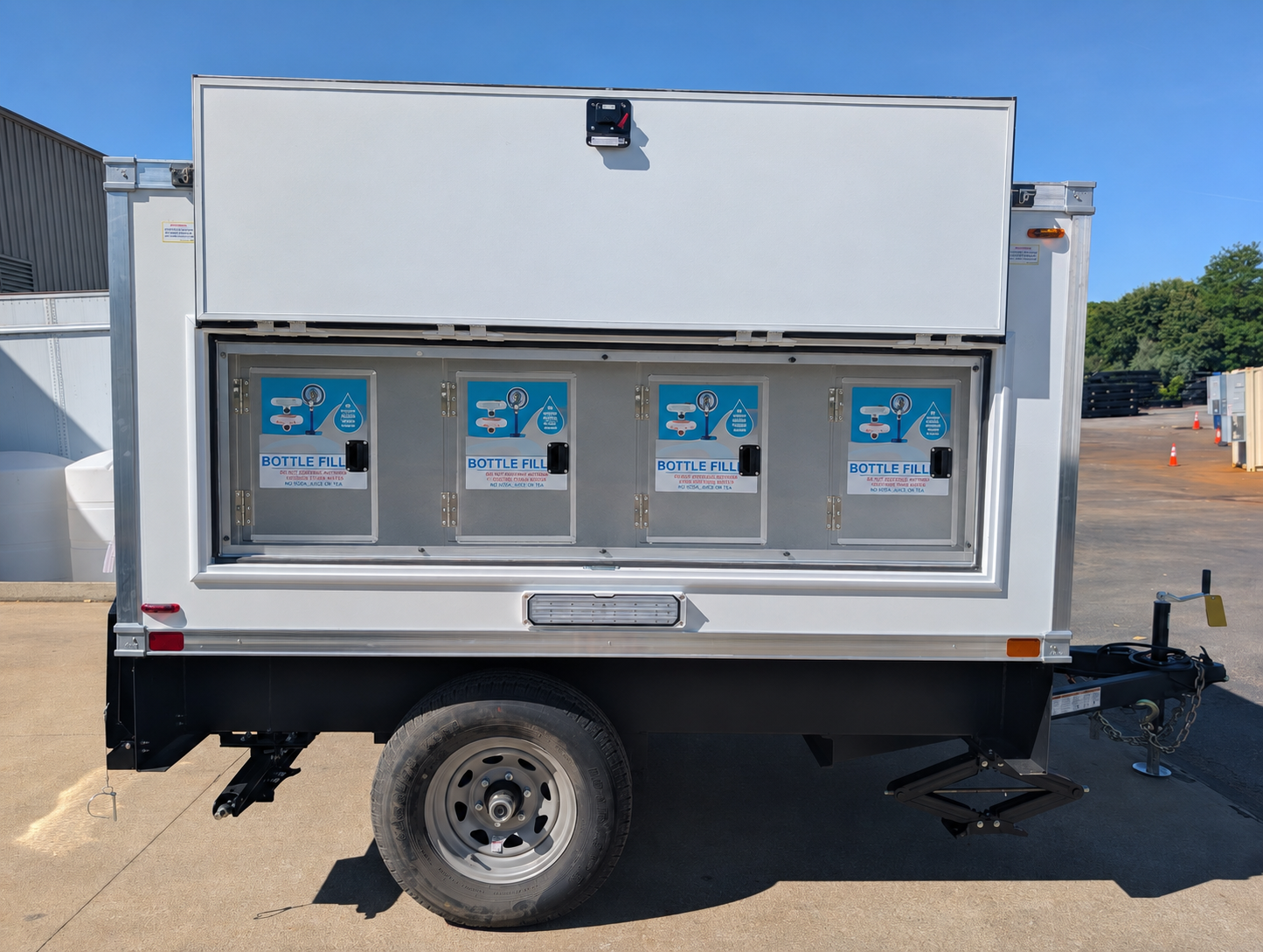
The Signature Series is our premier cold water bottle filling station, and it is the single product we put everything behind. One purpose-built rig handles the Mojave: four push-back taps, a 300-gallon insulated tank, an in-line chiller that holds water at drinking temperature even when the air outside is sitting at 100°F, and multi-stage filtration that pulls the hard-mineral taste out of Colorado River water. It tows in, levels on rough or unpaved ground, and runs self-contained on shore power or a small generator, which is what lets the same unit serve a Strip hotel tower, an Apex data-center pad, and a Lake Las Vegas wedding without missing a beat.
Setup is quick. We back the unit in, level it on whatever surface the site has, and either tie into a hose bib or run it straight off the onboard tank. Minutes later it is pouring. From there your people pull cold water from four taps all shift while we handle the refills and the haul-off, so water quietly drops off your worry list until the job wraps.
| Spec | Value |
|---|---|
| No. of Stations | (4) Bottle Filling Stations |
| Length | 12′ 3″ |
| Weight | 3,100 lbs. |
| Height | 8′ |
| Fresh Water Tank | 300 Gallons |
| Power Requirements | 1-4 dedicated 20A/120V circuits OR 1 dedicated 50A/240V circuit |
| No. of AC Units | 1 |
Who Relies on Our Las Vegas Hydration Stations
A graveyard crew pouring concrete on a Strip tower and a sold-out crowd at Allegiant Stadium have almost nothing in common, except a Mojave heat load and a hard need for cold water within arm’s reach. That single shared need is the entire business, and the same mobile drinking water station answers both. Here are thirteen of the situations the valley calls us for most, with what the unit actually does in each.
Strip Resort and Casino Construction
The Hard Rock conversion of the former Mirage brought 600-plus workers back to the site in early 2026, and new Strip towers stack trades onto exposed decks for years at a stretch. We position chilled water by elevation and zone so a tower crew never has to ride down for a drink.
Allegiant Stadium and the A's Ballpark
The $1.75 billion Athletics ballpark is a 1.2-million-square-foot steel build running right through the hot months, and Allegiant Stadium events spill tailgates and load-in into the open lots. We stage stations at the work fronts and the gates where the lines and the heat collect.
Apex Data Centers and Switch Campuses
Switch has bought more than 300 acres in the Apex Industrial Park and Novva picked up roughly 205, putting hundreds of trades on raw desert miles from any retail water. We stage chilled units per zone and refill on a route so a remote gigasite never runs dry.
Brightline West High-Speed Rail
Major construction on the $12 billion Brightline West line to Southern California ramps up in 2026, with crews strung along the I-15 corridor in open desert. A relocatable station follows the rail-grade work front where no water line exists for miles.
Warehouse and I-15 Logistics
Apex along US-93 already holds a Kroger warehouse and a Crocs distribution center, and the I-15 corridor keeps adding fulfillment space. Un-conditioned docks and high-bay floors trap heat all summer, the exact indoor exposure Nevada's heat rule now names. We stage at dock doors and pick lanes.
Summerlin and Henderson Build-Out
Master-planned growth across Summerlin, Henderson, and Enterprise keeps framing, roofing, and concrete crews on open slabs and rooftops through the season. Rooftop work is the worst heat exposure on any site, and a heat-down crew costs far more than a hydration station.
CES and Convention-Center Events
CES drew 148,000 people to the Las Vegas Convention Center in 2026 across 2.5 million square feet, and the load-in, outdoor activations, and badge queues all happen in open sun. We drop stations at load-in gates and registration checkpoints where the crowd actually stands.
Festivals and Music Events
EDC packs the Las Vegas Motor Speedway over three mid-May nights, and the valley's festival and pool-party calendar runs deep into summer. Distributed refill points keep the lines short and the crowd upright on exposed asphalt and open desert.
Marathons and Endurance Races
The Rock 'n' Roll Las Vegas Marathon takes over the Strip, and desert trail and ultra events run far from any tap. We stage cold water at aid stations, transition zones, and finish-line festivals where there is no plumbing to lean on.
Pool Parties, Dayclubs, and Hospitality
Dayclubs, sportsbook viewing parties, and outdoor hospitality activations run all summer in full sun. A clean station serves a crowd cold filtered water without the cooler restocking and the plastic-bottle pile that follows a busy weekend.
Desert and Resort Weddings
Red Rock Canyon overlooks, Lake Las Vegas terraces, and Valley of Fire ceremonies all put dressed-up guests in heat that hits harder than it looks. An elegant station at cocktail hour keeps a few hundred guests comfortable with no bottle clutter on the tables.
Film, TV, and Production
Nevada's film incentive keeps productions shooting across the valley and out into the surrounding desert, much of it well past the nearest water tap. A self-contained 300-gallon chilled tank stands up a base camp for catering, talent, and crew with zero hookup.
Disaster Response and Cooling Centers
Clark County opens cooling stations during extreme-heat events, and emergencies can surge a shelter past what its fixed plumbing handles. The self-contained tank backs up a center at capacity or supplies a wildfire and incident base camp when municipal water is stretched.
Government, Military, and Campuses
Nellis Air Force Base, Creech, and the surrounding ranges put field crews far from any tap, and UNLV runs move-in and gameday surges. We hold active SAM.gov registration, so we can bid federal solicitations the day they post.
Las Vegas Valley Coverage, District by District
The valley is not one job. The Strip corridor, the western foothills, the southern suburbs, and the open desert north of town each run a different heat profile, a different access headache, and a different drive time. We route every rental against the real conditions of where it is headed, because a Summerlin wedding and an Apex well-pad delivery are nowhere near the same dispatch. Here is how each one works and what it needs.
The Strip and Resort Corridor
The Las Vegas Strip · Paradise · Winchester · downtown Las Vegas
The Microclimate
Mojave valley floor near 2,030 feet, where July highs run around 104°F and the city posted a record 112 days over 100°F in 2024, including its first-ever 120°F reading. Acres of pavement and glass tower walls trap and re-radiate heat well after sundown, so an evening load-in can be nearly as punishing as midday.
Where It Is Needed
The densest demand in the metro: Strip resort and casino construction, the Hard Rock conversion, the new Athletics ballpark, Allegiant Stadium events, the Las Vegas Convention Center and CES, EDC and the festival calendar, and the Rock 'n' Roll Marathon down Las Vegas Boulevard.
How the Signature Series Fills the Need
We stage at load-in gates, distribute refill points across event footprints, position chilled units by zone on tower decks, and cover tailgate and entry queues. With our yard in North Las Vegas, most corridor jobs see a unit inside about 45 minutes.
Summerlin and the Western Foothills
Summerlin · Spring Valley · Red Rock · Mountain's Edge
The Microclimate
The same valley heat with a touch more elevation toward the Spring Mountains, still bone-dry at single-digit-to-20-percent summer humidity. Master-planned construction here works exposed slabs and rooftops with little shade, and the heat reflecting off light-colored desert hardscape adds to the load.
Where It Is Needed
Fast-moving residential and commercial build-out across Summerlin and Spring Valley, corporate and campus events, Red Rock Canyon overlook weddings and gatherings, and the steady stream of outdoor private events the west side hosts.
How the Signature Series Fills the Need
We stage chilled stations on greenfield pads before any plumbing is in, cover corporate and wedding crowds, and reposition with the framing and roofing fronts. Self-contained operation matters because so much of this work happens on raw lots.
Henderson and the Southern Suburbs
Henderson · Enterprise · Green Valley · Lake Las Vegas
The Microclimate
Valley-floor Mojave heat across Henderson and Enterprise, with the same dry air and 100°F-plus summer stretch as the core. Lake Las Vegas and the resort terraces add waterfront event demand, while the southern industrial and commercial corridors carry their own un-shaded construction.
Where It Is Needed
Henderson and Enterprise residential and commercial growth, Lake Las Vegas resort weddings and corporate retreats, Green Valley events, and the warehouse and light-industrial build-out along the southern edge of the valley.
How the Signature Series Fills the Need
We cover refined resort events with a clean station at cocktail hour and serve hot construction fronts on the same day from the same yard. The short drive south keeps response tight even in peak summer.
North Las Vegas and the Apex Corridor
North Las Vegas · Apex Industrial Park · the I-15 and US-93 corridor
The Microclimate
Open high-desert exposure north and east of town, hotter and more wind-scoured than the sheltered valley, with zero natural shade across the Apex pads. The 18,000-acre industrial park sits roughly five miles off the I-15 interchange along US-93, far from any retail water.
Where It Is Needed
The Switch and Novva data-center campuses at Apex, the Kroger warehouse and Crocs distribution center, the Brightline West rail corridor, and the heavy logistics and manufacturing pads spreading north along the highways.
How the Signature Series Fills the Need
This is the clearest case for delivered hydration that needs nothing from the site. Our yard is right here in North Las Vegas, so we bring the full tank, add a generator where there is no shore power, and refill on a schedule that keeps a remote pad covered through a 24-hour shift pattern.
What Years of Mojave Summers Have Taught Us
A lot of what makes a Las Vegas rental go right never shows up on a spec sheet. It is the stuff our dispatchers and drivers have learned running this valley through one record-breaking summer after another, and it is worth passing along because it should shape how you plan.
The dry air is the trap, not just the number
At the single-digit-to-20-percent humidity Las Vegas runs all summer, sweat evaporates the instant it surfaces, so a worker never feels wet and badly underestimates how much fluid is gone. We have watched crews start to fade at temperatures that did not look alarming on the thermometer, simply because nobody felt themselves sweating. We plan water volume for that hidden loss, not for how hot it feels.
On the Strip, placement beats unit count
The mistake we see most is one station parked at the gate of a vertical tower job. Our drivers stage a unit by elevation and active zone and move it as the pour climbs the building, because a crew that has to ride an elevator down for a drink simply drinks less. On a sprawling Apex pad we apply the same rule across the work front each morning.
We schedule around the convention calendar
Strip and convention work lives and dies by load-in windows, and CES week alone jams the corridor with traffic and tight gate access. We have learned to drop units the evening before a big load-in and to route refills around the worst congestion, so the water is in place before the crowd and the trucks arrive.
We refill against the shift, not the clock
On a 24-hour Strip tower pour or an Apex data-center rotation, a hot crew can pull a full 300-gallon tank well before a shift ends. We do not wait for a tank to run dry. We time a top-off into the rotation, usually mid-shift, so the graveyard crew has the same cold water the day crew did. The dangerous gap is always the one nobody scheduled for.
Apex and the open desert need their own playbook
Out past the I-15 interchange there is no shore power, no water line, and no shade for miles. We bring a right-sized generator with the unit, top the tank before the haul, and build a standing refill route so a remote Apex or Brightline West work front stays covered. The whole point of a self-contained station is that the site has to supply nothing.
We service the chiller before the heat exposes it
Mojave dust and 110-degree afternoons are hard on a chiller intake, and a clogged filter does not announce itself, it just quietly lets the output drift warm mid-contract. On longer Las Vegas deployments our drivers service the intake filter on a schedule so the water stays cold the last week of the job exactly like it did the first.
What Las Vegas Crews and Event Planners Tell Us
We had trades stacked on a tower deck during a July heat spike and our bottled-water plan was gone by mid-morning. I called and they had a Signature Series on site that afternoon, then added a second so we could keep one staged by elevation. It basically wrote the water half of our heat plan for us.

Our outdoor activation ran for days in full sun and the original water points were a bottleneck the first morning. They staged multiple stations across the footprint and the lines just vanished. Cold filtered water, no drama, and they picked up every call during build week.

Our pad is way out past the interchange with no water and no shade anywhere. They dropped a self-contained unit, brought a generator, and kept it filled on a route as we moved crews around the site. Honestly it is the only reason we kept everyone hydrated that far out.

For our outdoor move-in and gameday events they showed up clean, set up in minutes, and the cold water was a hit with students and staff. They are local, easy to deal with, and they clearly cared that it went right. We book them every season now.

Planning the full Las Vegas event or project? Add on-site cold storage with refrigeration and freezer trailer rentals in Las Vegas and upscale guest facilities with luxury portable restroom trailer rentals Las Vegas.
Get Cold Water on Your Las Vegas Site This Week
Whether you need water station rentals for an event, a hydration station for a Strip tower job, or a bottle filling station for a campus, send us the location, the dates, and the headcount. From our North Las Vegas yard we can usually confirm a same-week delivery, and your quote spells out the Nevada one-quart-per-worker-per-hour capacity math. We answer 24/7.
📞 Call Now (866) 748-5932Request a QuoteEverything Worth Knowing Before You Rent in Las Vegas
The deeper detail, organized so you can open only the part you need: the heat science, the Nevada compliance picture, the water itself, and the sustainability case. This is the knowledge base behind being the most informed water-station partner operating in the Las Vegas valley.
Las Vegas is the fastest-warming city in the country, and the numbers back it up. The valley logged a record 112 days at or above 100°F in 2024, blowing past the old mark of 100 days set back in 1947, and 36 of those days hit 110°F or hotter. That summer the city also reached 120°F for the first time in recorded history. July highs average around 104°F, and the valley floor sits low, near 2,030 feet, so there is no altitude relief from the heat.
The dry air is what makes it genuinely dangerous. Summer humidity in Las Vegas runs in the teens, often dropping to around 15 percent by mid-afternoon, so sweat evaporates the moment it forms and a worker never feels wet. That hides how fast the body is losing fluid. From there dehydration moves quickly, through fatigue and clouded judgment to heat exhaustion and, once a body stops sweating, heat stroke. Cold water that is genuinely within reach is the single most effective way to keep a crew or a crowd ahead of that curve. The federal water-rest-shade guidance treats accessible cool water as the front line of heat-illness prevention.
Nevada has a real, enforceable workplace heat rule, and it is no longer optional. The state adopted heat-illness prevention regulation R131-24AP on November 15, 2024, and Nevada OSHA, part of the Division of Industrial Relations, began enforcing it on April 29, 2025. It covers both indoor and outdoor work, so a Strip tower deck and an un-conditioned Apex warehouse both fall under it.
The water mandate is specific. Employers must give workers ready access to potable drinking water that is fresh, pure, and suitably cool, and when water is not continuously supplied they must provide enough at the start of each shift to cover one quart per employee per hour for the entire shift. Employers with more than ten workers also have to run a one-time job hazard analysis and, where heat exposure runs long, adopt a written heat-illness prevention plan with rest, cooling, monitoring, and emergency response. A chilled, filtered station staged right at the work zone is the cleanest way to satisfy the access-and-temperature side of the rule, and we run the headcount math into every quote.
We fill from tested, potable municipal sources, then run every drop through multi-stage on-board filtration, sediment, carbon, and a fine final stage, before it ever reaches a tap. Southern Nevada draws roughly 90 percent of its water from Lake Mead and the Colorado River, delivered by the Southern Nevada Water Authority and the Las Vegas Valley Water District. River water carries dissolved minerals that leave the hard taste a lot of people quietly avoid, and at an event or on a jobsite that taste is exactly what keeps crews and crowds from drinking enough. Our filtration strips it out and the chiller serves it cold, which is the combination that actually gets people to hydrate. You can see the regional picture at the Southern Nevada Water Authority.
Southern Nevada is operating on the tightest water budget in its history. Lake Mead supplies about 90 percent of the region’s water and has fallen roughly 160 feet since 2000, sitting near 1,062 feet in 2026, and the Colorado River is in the worst drought in its recorded history. The region entered 2026 under a Tier 1 shortage, capped at 279,000 acre-feet, a 7 percent cut from Nevada’s full allocation, which puts conservation and single-use-plastic reduction squarely inside the goals every event producer and public agency now answers for.
At event scale the disposable-bottle stream turns ugly fast: a large festival can push tens of thousands of plastic bottles toward a landfill across one weekend. A refillable chilled station flips that math, serving colder water with almost no waste. On the jobsite side, retiring the truck-in, truck-out bottled-water cycle on a remote Apex pad is a small, visible win that also leaves the crew better hydrated than the cases ever did.
Your Las Vegas Rental Questions, Answered
Those are the dates that book out first. CES week, the EDC nights at the Motor Speedway, the Rock ‘n’ Roll Marathon down the Boulevard, and the big summer build pushes all stack onto the same calendar, so the corridor gets tight fast. A smaller weekend activation or a same-week jobsite drop we can usually turn around quick from the North Las Vegas yard. Send us the dates and the venue and we will tell you what is open.
Yes, and that is how we run vertical Strip jobs. One station parked at the gate of a tower build is the mistake we see most, because a crew that has to drop ten floors for water simply drinks less. We position chilled units by elevation and active zone and move them as the pour climbs the building, the same way we handled the Hard Rock conversion crews and the new Strip towers stacking trades on exposed decks.
Yes, and it is enforced now. Nevada adopted heat-illness regulation R131-24AP, and Nevada OSHA started enforcing it on April 29, 2025. It requires ready access to cool, potable water at one quart per worker per hour, covers both indoor and outdoor work, so an un-conditioned Apex warehouse counts the same as an open tower deck, and it triggers a job hazard analysis and written plan once you pass ten workers. Every quote we send includes the capacity math so you can show the water side was covered.
That is exactly what the Signature Series is built for. Out past the I-15 interchange there is no water line, no shore power, and no shade for miles, so the 300-gallon tank shows up full and cold, runs self-contained, and we bring a right-sized generator to keep the chiller going. We cover the Switch and Novva data-center campuses, the Brightline West rail corridor, and desert base camps well past the end of any tap.
Cold, right at the tap. The in-line chiller and insulated tank are specified for Mojave summer, so the water stays at drinking temperature even after the trailer has sat in direct sun all afternoon at 110 degrees. That matters more here than people expect, because at the teens-percent humidity Las Vegas runs all summer sweat evaporates before anyone feels wet, so a crew underestimates how much fluid is gone. People drink cold water and walk straight past a warm cooler, and a crew that stops drinking is a heat call waiting to happen.
All the time. CES alone drew 148,000 people across 2.5 million square feet, and the load-in, outdoor activations, and badge queues all happen in open sun. We drop stations at the load-in gates and the registration checkpoints where the crowd actually stands, and we have learned to set them the evening before a big load-in and route refills around CES-week congestion so the water is in place before the trucks and the crowd arrive.
More than one. EDC packs the Motor Speedway for three mid-May nights, and we budget roughly half a liter to a liter of drinking water per attendee for a multi-hour outdoor event, which a single four-tap unit cannot move alone at festival scale. For a 1,000-person crowd we usually distribute two to four stations across the grounds so the lines vanish, then schedule refills against your run-of-show. We size the exact count from your peak crowd and footprint.
Yes, around the clock, and dispatch runs the same. Dayclubs, sportsbook viewing parties, and outdoor hospitality activations run all summer in full sun, and a graveyard pour on a Strip tower needs cold water at 3 a.m. just like the day crew. You reach a live person any hour who can move a unit or fix an issue, and on long pours we time a mid-shift top-off into the rotation so the night crew gets the same cold water the day crew did.
The entire valley and well beyond it. Our densest work is the Strip corridor, Summerlin, Henderson, and Enterprise, but we dispatch to North Las Vegas, the Apex Industrial Park, Boulder City, and out to Pahrump, Mesquite, and Laughlin where water access gets genuinely hard. The farther a site sits from a tap, the more reason there is to rent a self-contained station.
Fast, because the yard is right here in North Las Vegas, roughly 10 to 15 miles from the center of town. A same-day drop inside the valley routinely lands in about 45 minutes. The dispatcher who takes your call and the driver who rolls up both work out of this valley and know the Strip load-in gates and the back roads that get a trailer onto a site during convention traffic. This is not California covering Las Vegas on paper.
At least one quart of suitably cool water per worker per hour, which works out to roughly two gallons over an eight-hour shift and closer to three on a long construction shift in Mojave heat. A single 300-gallon tank covers a large crew through a shift at that rate, and on a 24-hour Strip tower pour or an Apex rotation a hot crew can pull a full tank before a shift ends, so we time refills into the rotation and run the headcount-times-hours math into every jobsite quote.
Yes, and it is one of our favorite jobs. Red Rock Canyon overlooks, Lake Las Vegas terraces, and Valley of Fire ceremonies put dressed-up guests in heat that hits harder than it looks. An elegant station at cocktail hour keeps a few hundred guests comfortable with cold filtered water and no bottle clutter on the tables, and the filtration strips the hard-mineral taste out of Colorado River water so people actually drink it.
Absolutely, and most of our construction and data-center work is exactly that. We rent by the week and by the month for multi-month GC schedules on Strip towers and Apex campuses, keep the same unit on site for the run, service the chiller intake against Mojave dust so the output never drifts warm late in the contract, and run a regular refill route. Running several valley sites at once? We put them on one contract with one point of contact.
It is built per event or project, never a flat sticker, because the number depends on how many people the unit serves, how long you need it, and where it is headed. A weekend wedding at Lake Las Vegas and a 90-day deployment on a remote Apex pad with a generator carry very different logistics. Give us those three details and we return a quote with the Nevada capacity math spelled out.
Yes. The push-back taps sit at a height that works from a seated position, and because we level the unit on delivery and can set it on firm, flat ground near an accessible path, it serves every guest and worker at a UNLV gameday, a convention floor, or a public activation. Tell us if a venue has specific accessibility requirements and we will set it up to meet them.
A water buffalo is a towable tank and an office cooler is a small dispenser, and neither holds up out here. The Signature Series pairs a 300-gallon tank with active in-line refrigeration, multi-stage filtration, and four push-back taps at once, so it serves a Strip crew or a festival crowd cold, clean, filtered water instead of warm tank water or one slow spout. It is purpose-built for high-throughput potable hydration in Mojave heat.
Las Vegas is home turf for us. From our North Las Vegas yard, backed by a Western U.S. network of yards across Nevada, California, Utah, and Arizona, we can usually confirm a same-week delivery, whether it is a Lake Las Vegas wedding, a 90-day Apex data-center deployment, or a Strip resort tower. Tell us where the job is, the rental window, and roughly how many people the unit needs to serve, and we will come back with a quote that includes the Nevada water-per-worker capacity math, the delivery schedule, and any generator or accessory recommendations for your site. Call (866) 748-5932 today, or use the form on this page.
Cal Fire certified · SAM.gov registered · A+ BBB accredited · fully licensed & insured