On-Site Hydration Services provides road-towable, chilled water station trailers built for multi-day music festivals, county fairs, outdoor concerts, and large cultural gatherings. One trailer fills more than 2,400 sixteen-ounce bottles per load and runs on standard site power or a generator, so your crowd drinks cold, filtered water all day without a single-use plastic bottle in sight. We cover California, Nevada, Utah, and Arizona with 24/7 dispatch and we'll have a unit on your site when you need it.
Why festivals fail at water The Crowd-Density Hydration Problem That Catches Organizers Off Guard
Nobody plans to run out of water. Every event organizer we've ever talked to had water on the checklist. The problem isn't intention, it's volume math. Take a 10,400-person single-day concert in July in California's Central Valley: outdoor space under direct sun, a headliner set at 8 p.m. that pulls roughly 78 percent of attendees into a single field, and a merch line that moves everyone past the one water zone already backed up thirteen people deep. That's where heat illness risk spikes, even for a well-run show.
We staged water for a county fair where the afternoon peak attendance came in 31 percent higher than the permit estimate. By 1:47 p.m. the original setup was overwhelmed, staff were handing out cups (paper, not even proper drinking cups) from a folding table, and two medical tent calls had already come in for heat-related symptoms. An additional Signature Series trailer repositioned to the main pedestrian corridor cut the station lines and there were no further medical calls that day. The lesson: plan for your peak hour, not your average hour, and build in surplus because outdoor crowd dynamics aren't linear.
-- OSHS dispatcher, festival staging logistics call
Multi-day camping festivals layer a second problem on top of the peak-surge issue: cumulative dehydration. Attendees who arrive Friday and camp through Sunday are exercising, sleeping in warm tents, consuming alcohol, and spending hours in direct sun. By Sunday morning, the hydration baseline of your crowd has shifted meaningfully downward compared to Friday. Your Sunday water demand is often higher per capita than your opening day, and it hits before noon (sometimes before gates officially open, if you've got a camping field).
Compliance is the other pressure point organizers sometimes underestimate. Under OSHA's heat-exposure guidance and California's Cal/OSHA Title 8 Section 3395 heat-illness prevention standard, every vendor, stage crew member, security guard, and food-court worker at your festival is a covered worker when ambient conditions meet the heat trigger thresholds. That means potable water, shade access, and rest periods are employer obligations, not optional perks. A Signature Series trailer positioned at the crew staging area handles your worker compliance piece while your public drinking water zones handle the crowd. But those are different planning problems and they need separate placement logic.
Nevada events carry an additional layer since November 2024, when the state adopted a formal heat-illness prevention rule (R131-24AP, enforced beginning April 2025) covering employers with ten or more workers. Outdoor festival producers in Las Vegas or Reno who also serve as employers for their event staff now carry explicit regulatory exposure if worker water access is inadequate. The CDC's extreme heat guidance recommends cool drinking water every 15 to 20 minutes during hot conditions regardless of thirst, a cadence that requires genuinely convenient water access, not a single station at the far edge of the grounds.
-- OSHS logistics coordinator, pre-event planning call
I watched a crew at a two-day arts festival in the Inland Empire spend most of Saturday afternoon managing a line at the single water station instead of doing their actual jobs. The event manager told me afterward that she'd assumed the venue's garden hose bibs would supplement the station (they did not, and the water pressure dropped around 2 p.m. anyway). So even when organizers do plan for water, the gap between "planned for" and "actually works at 4,200 people at 3 p.m." is where events get into trouble.
Events we supply Every Format We've Hydrated, Concert Field to Fairground
Our trailers have supplied water at every format listed below, including outdoor sporting events that share many of the same peak-surge challenges. The logistics differ. The equipment's the same. The same trailer also keeps cast and crew supplied on location, which we cover on our film and TV production water stations page.
Multi-Day Music Festivals
Three-day camping events with 5,000 to 50,000 attendees. We coordinate refill logistics across days so your crew's never managing a dry trailer mid-shift.
County Fairs and State Fairs
Week-long or weekend-run events with vendor rows and livestock areas. We position trailers near food courts and along main pedestrian corridors where foot traffic peaks.
Outdoor Amphitheater Concerts
Single-night or weekend concert series at hillside or lawn-seating venues where existing plumbing doesn't scale to full-capacity crowds (most permanent venues are designed for maybe 60 percent occupancy).
Cultural Festivals and Heritage Events
Community food festivals, cultural celebrations, and ethnic heritage events that run across entire city blocks or park spaces with high dwell time and a wide age range of attendees, along with private outdoor celebrations where organizers want the same water access without a full festival footprint.
VIP and Hospitality Zones
Premium lounge areas and backstage hospitality where event producers want filtered, chilled water available without generating single-use bottle waste or running dry during a busy evening set.
Temporary Outdoor Markets
Artisan markets, seasonal pop-up markets, and large swap meets that draw crowds into paved or hardscape areas with no nearby plumbing hookup and nowhere for attendees to get water without leaving.
Two priorities your attendees notice Sustainability Goals and Accessible Water Access
Zero-Waste and Green Festival Programs
More festivals are adopting plastic-free pledges and measuring their sustainability credentials for sponsors, permit agencies, and audience sentiment. A refillable water station trailer is one of the highest-volume plastic diversion tools available at an outdoor event. When 2,400 fills happen from a single trailer load instead of 2,400 single-use plastic bottles, the landfill and recycling math is visible and auditable, not just aspirational language in a press release.
We've seen event producers include free-water-station access as a headline feature in their sustainability report to local permitting agencies and use it to satisfy venue sustainability riders that larger touring acts now require. The trailer itself produces no direct emissions at the point of use. It runs on grid power or a shared generator, and our filtration system removes the taste and odor issues that make people reach for a bottle instead of a tap.
And if your festival has a "bring your own bottle" or reusable-cup program, the Signature Series trailer integrates naturally. Wide, open fill stations accommodate tumblers, CamelBak-style packs, wide-mouth bottles, and standard 16-to-32-ounce reusable containers without awkward overfill splashing. That design isn't accidental: it was built for the refillable-vessel crowd, not the cup-in-hand crowd.
ADA Compliance and Accessible Water Access
Accessible water access at outdoor events is both an ethical responsibility and a legal consideration. Attendees who use wheelchairs, walkers, or other mobility aids need fill stations at a reachable height, on a stable surface, with enough clear approach space for a chair or scooter. The Signature Series trailer is designed with fill station heights and approach clearances that work for most accessibility needs, and it can be placed on compacted gravel, asphalt, or hardpack surfaces that wheelchairs handle without sinking.
Placement matters as much as equipment. We work with your event map to identify accessible-route corridors, keeping the trailer away from soft grass, steep grades, and crowd choke points that a mobility-device user can't safely get through during peak attendance. A water station that exists on paper but requires crossing a muddy field to reach it isn't accessible in practice.
But the real win is dedicated placement. For festivals with a dedicated ADA viewing area or VIP accessibility section, we can position a trailer within that zone so covered attendees have nearby water access without pushing back through general admission crowds. That kind of placement coordination is part of our pre-event planning call, not a last-minute add-on.
Planning your water supply How to Size Water Capacity for a Festival Crowd
The formula event planners typically use is roughly 22 ounces of water per person per hour in mild conditions, scaling up in hot weather to 34 ounces or more during active periods. For a stationary festival crowd on a 97-degree day (and those days are routine in Central California), a reasonable planning number lands at 26 to 31 ounces per person per hour at peak. That math means a crowd of 6,200 people at peak attendance needs roughly 24,180 to 29,140 ounces of water per hour, or between 189 and 228 gallons per hour for the crowd alone. One Signature Series trailer holds 300 gallons per load, so at high peak you need refill logistics locked in from the start, or a second trailer on site.
We build a refill schedule into every multi-day event plan. Our drivers know the route, the schedule is printed into the event runsheet, and we coordinate timing with your ops team so the trailer's never fully dry during an active period. Our fast water fill service means the refill process takes roughly 43 minutes and we prefer to top off at around 27 percent remaining rather than waiting for empty, because that buffer is what protects you against an unexpected surge during a headliner changeover. We've learned not to cut that margin thin.
For larger festivals, we typically recommend positioning trailers at multiple locations rather than consolidating all capacity in one zone. A trailer near the main stage serves the general admission floor crowd. A second at the food court or vendor row serves the standing, spending audience. A third near crew staging handles your worker compliance piece under Cal/OSHA or Nevada's heat rules, which is a distinct obligation from your public-water setup and needs its own placement logic. When people have to walk 390 feet through a packed crowd to reach water, many of them simply don't bother, and that's exactly when heat illness risk rises.
-- OSHS field operations lead, post-event debrief notes
Power logistics are straightforward for most festival sites. The Signature Series runs on one to three dedicated 20-amp, 120-volt circuits or a single 50-amp, 240-volt circuit (standard on most event generator setups). If your festival uses a central generator plant with distro boxes, the trailer ties in cleanly. We bring our own power cable and confirm run distance during site walkthrough so there are no surprises on load day.
The equipment behind the operation Signature Series Water Station Trailer
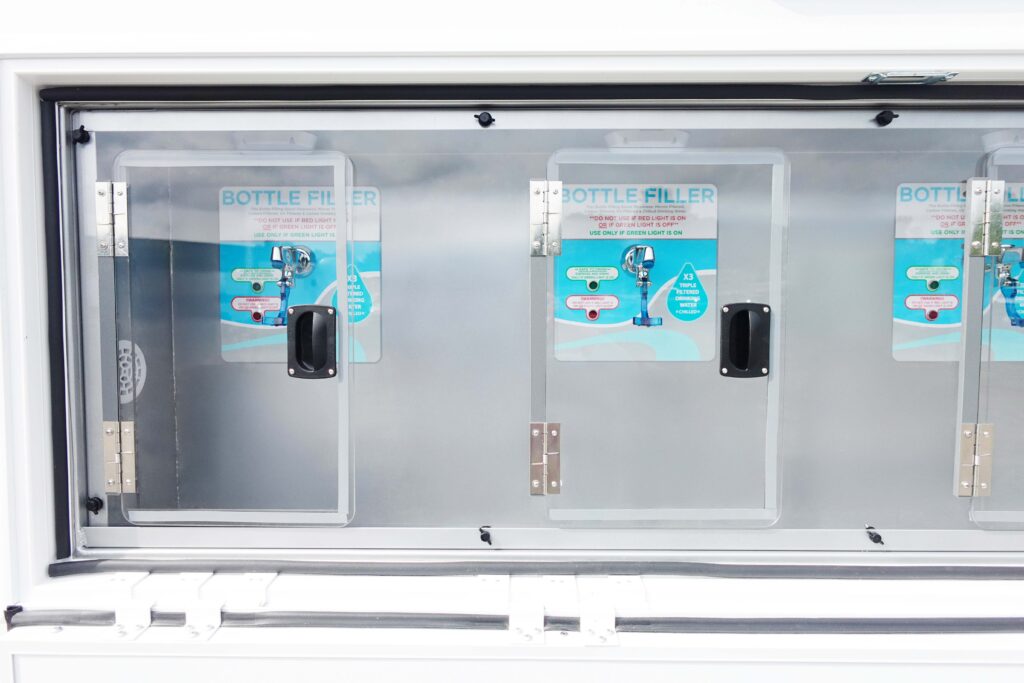
The Signature Series is purpose-built for the outdoor event environment: road-towable on its own chassis, powered by standard site circuits or a generator, and sized for high-volume public use without the reliability concerns that come with improvised setups.
- 300-gallon fresh-water tank (2,400-plus sixteen-ounce fills per load)
- Four push-back fill stations, four users simultaneously
- Electric chiller delivers genuinely cold water in hot conditions
- Multi-stage filtration removes taste, odor, and sediment
- Runs on 1-4 dedicated 20A/120V circuits or one 50A/240V circuit or site generator
- Road-towable on its own chassis, no forklift or special rigging needed
- Wide stations accept tumblers, CamelBaks, and wide-mouth bottles
For indoor hospitality tents, VIP lounges, or backstage production areas the trailer can't reach, the Legacy Series roll-in drinking water station fits through a standard door and operates inside a structure. A number of festival productions use both: the trailer for the public-facing outdoor space and a Legacy unit in the artist hospitality or production office building.
Common questions Festival and Concert Water Station FAQs
How many water station trailers does a festival of 8,000 people need?
For an 8,000-person outdoor event on a warm day, we typically recommend two Signature Series trailers as a baseline, placed at separate high-traffic zones rather than side by side. One trailer can serve a sustained flow of roughly 1,100 to 1,600 people per hour at the fill stations before line queuing becomes uncomfortable. At 8,000 attendees with a typical peak-hour concentration of 41 to 53 percent in one zone, a single trailer in that zone will be strained. Two trailers at two locations keeps lines short and cuts the distance any attendee has to cover. We factor in your event layout, expected peak timing, and whether you've got a crew and vendor water obligation on top of the public-facing supply before we finalize the number.
Can the trailer handle a headliner peak surge when thousands of people are in one area?
That's exactly the scenario that requires advance placement and a refill buffer. A single Signature Series trailer has four simultaneous fill stations, which can realistically handle roughly 237 fills in a 15-minute window at a brisk but manageable pace. A surge of 6,300 people concentrated in one zone will strain any single water point regardless of brand or capacity. Our recommendation for peak-surge events is to position a second trailer within that zone before the set begins, not after the crowd builds, and to have our driver pre-positioned so a top-off happens before the headliner rather than during it. We build that timing into your event runsheet during planning.
What power source does the trailer need at a festival site?
The Signature Series runs on one to three dedicated 20-amp, 120-volt circuits or a single 50-amp, 240-volt circuit. Most festival generator distro setups include both configurations. If your event uses a generator plant with distro boxes, we confirm circuit allocation with your power coordinator during pre-event planning. We've supplied water at events running entirely on rented generator power and at permanent amphitheaters with shore power panels. We bring our own power cable and confirm run distance during site walkthrough so there are no surprises on load day.
How does Cal/OSHA heat-illness law apply to festival workers and vendors?
California's Cal/OSHA Title 8 Section 3395 applies to all outdoor workers, which at a festival includes stage crew, security staff, food vendors, production workers, and anyone else employed in an outdoor setting when temperatures meet the trigger thresholds. The regulation requires employers to provide fresh, pure, and suitably cool drinking water at no cost to employees, at a rate of one quart per hour per employee during high-heat conditions. If you're the event producer and you have workers on your payroll or under a covered employment relationship, you carry that obligation. A Signature Series trailer positioned in the crew staging or vendor row area satisfies the water provision requirement. For the full regulatory text, see the Cal/OSHA Section 3395 regulation.
Can you deliver and set up on a site with limited vehicle access?
The trailer is road-towable on its own chassis, so it arrives like any other towed unit and doesn't require a forklift or special rigging. Most festival sites we serve have a vendor or production access route even when the public entrance is pedestrian-only. We confirm the access plan during a pre-event site review and, if needed, we coordinate load-in timing with your production manager so the trailer arrives during the vehicle access window. We've maneuvered trailers into tight fairground spots, through farm-access gates, and along narrow service roads. If there's a specific site constraint you're worried about, mention it during the quote call and we'll give you an honest answer about whether it's workable.
Do you handle refills across a multi-day festival, or is that on the client?
We handle it. For multi-day events, refill logistics are part of our service plan, not a client responsibility. We schedule refill runs based on the event's daily attendance pattern, build a buffer so the trailer's never hitting empty during a peak period, and coordinate timing with your ops team so refills happen during low-traffic windows (typically mid-morning before gates open or late-night after the last set). Our drivers track the trailer fill level throughout the event and can call for an unscheduled top-off if unexpected demand shifts the timeline. You shouldn't have to think about whether you've got water. That's our job.
Get Festival Water Station Pricing for Your Event
Tell us your dates, attendance estimate, and site location. We'll build a placement plan and quote within one business day. California, Nevada, Utah, and Arizona covered, 24/7 dispatch available.
(866) 748-5932 Request a Quote