The Indoor Heat ProblemInside Those Walls, It Gets Brutal
Walk onto a fulfillment floor in July and you feel it before you see it. The loading dock doors cycle open and closed, the conveyor lines radiate warmth, the roof soaks up hours of direct sun, and the concrete holds every degree it collects. There's no breeze. The building itself becomes a heat trap.
We once staged a Signature Series unit at a Central Valley cross-dock facility running three full shifts through a late-August heat wave. The ambient temperature outside peaked at 107 degrees. The floor supervisor told us the interior thermometer was reading 94 degrees by 1 p.m. on the pick floor. That's not an edge case. During summer months, large metal warehouses and fulfillment buildings across California, Nevada, Utah, and Arizona routinely climb well into the 90s inside, even when the outdoor temperature reads a number that sounds manageable.
The problem compounds fast when headcount surges. A distribution center running a baseline crew of 63 people might bring on 190-plus seasonal workers for Q4 peak. The fixed water fountains that were adequate in February aren't anywhere near sufficient in November when the building's packed and the pace is relentless. Workers skip water breaks because the one fountain on the north wall has a 12-person line. By mid-shift, pick rates drop and incident reports tick up.
California took action on this in 2024. Cal/OSHA added an indoor heat-illness prevention rule that now covers workplaces where temperatures can reach 82 degrees Fahrenheit or higher. The rule creates requirements for access to cool water, rest areas, and training once indoor temps cross that threshold, with a secondary set of requirements at 87 degrees. It applies directly to manufacturing and plant floors, distribution centers, and fulfillment operations statewide. Our service exists specifically to close the gap between what a building's fixed plumbing can deliver and what your crew actually needs when indoor temperatures spike and headcount is at its seasonal peak.
Where We DeployScenarios Across Your Operation
Distribution and fulfillment operations are not a single environment. Hydration needs shift depending on where in the building the work is happening, the pace of the shift, and the time of year. Here are the specific settings we cover.
Fulfillment Floor
Pick and pack crews covering thousands of square feet need water within reach of their work zones, not at a single fixed station across the building. We position the trailer at the nearest accessible exterior wall or loading bay and the 300-gallon tank supplies the floor for an entire shift without a refill.
Dock and Yard
Forklift operators, unloaders, and yard spotters working the receiving and shipping docks face direct sun exposure and heavy physical exertion. This is often the highest-risk zone in a DC for heat illness. Our trailer positions right at dock level so operators can hydrate without leaving the active work area.
Cold and Dry Storage
Workers cycling between a cold cooler and a warm staging area face thermal stress in both directions. During loading and unloading cycles, body temperature climbs quickly when moving heavy freight in and out of temperature-controlled zones. Keeping cold drinking water nearby supports recovery between cycles.
Peak Season Scale-Up
Q4 e-commerce volume can triple your active headcount in eight weeks. Temporary staffing agencies deliver bodies faster than facilities teams can add water access infrastructure. We deploy within hours of your call so your peak staffing and your hydration capacity grow at the same rate.
3PL and Multi-Tenant Sites
Third-party logistics facilities often house multiple clients with staggered shift schedules and overlapping crews. Facility managers cannot always control how clients run their operations. A portable water station serves every tenant on the floor without requiring coordination on plumbing or water access rights.
The EquipmentBuilt for High-Volume Industrial Sites
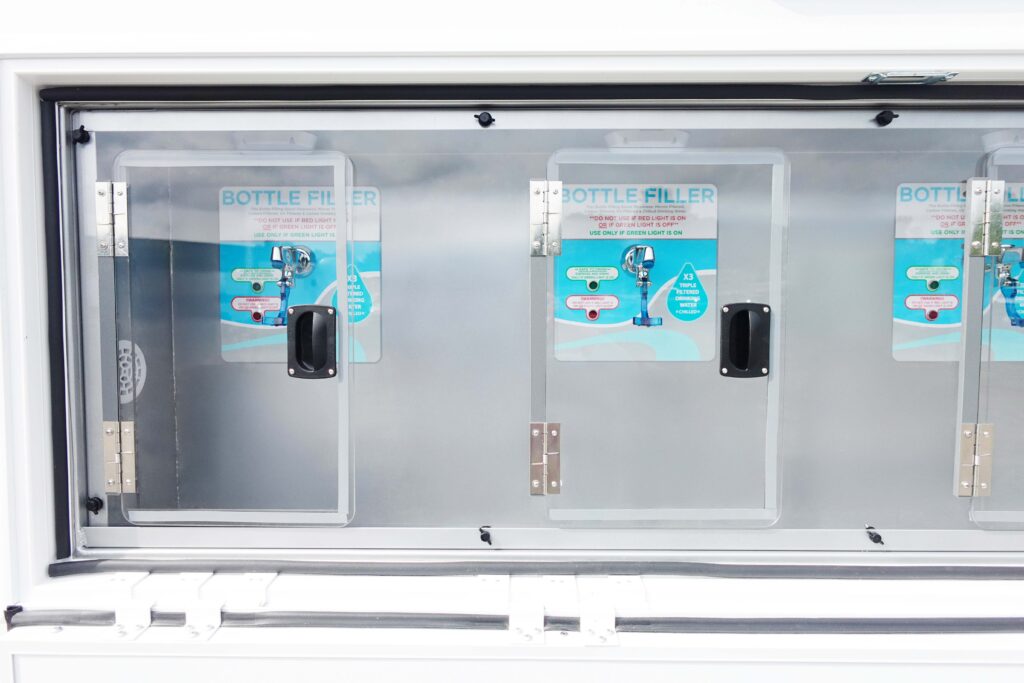
Signature Series Water Station Trailer
- 300-gallon fresh water tank, enough for a full 8-hour shift at a crew of 78 or more without a mid-shift refill
- Four push-back fill stations for simultaneous access, eliminating the queue problem that turns a 45-second water break into a 6-minute wait
- Electric chiller keeps water genuinely cold, not just room temperature in a tank. Workers actually drink it when it is cold
- Multi-stage filtration removes sediment, chlorine, and off-taste from local municipal supply
- Road-towable on its own chassis, positions at loading docks or exterior walls without special equipment
- Runs on one to three dedicated 20A/120V circuits, a single 50A/240V circuit, or a site generator
- Legacy Series roll-in option for facilities that need the station inside a conditioned building through a standard doorway
The four-station design matters more than most facility managers initially realize. I've watched a crew of 37 people backed up at a two-spout fountain during a line break, with the front of the line moving so slowly that workers at the back gave up and went back to their stations without drinking anything. That's not a hydration program. Four simultaneous fills changes the math so that a 10-minute break is actually a 10-minute break, with water.
And for facilities where running the trailer outside isn't practical (indoor-only sites, facilities in dense industrial parks without exterior access, or operations in cold-weather months), our Legacy Series rolls through a standard doorway and stations inside the building. Same cold-water and filtration capability, in a footprint that works inside a DC or fulfillment floor. Learn more about our full water station rental options for industrial sites.
Peak-Season Scaling: When Headcount Triples, Water Capacity Has to Follow
The Q4 ramp in e-commerce fulfillment is unlike almost any other workforce surge in American industry. A facility that employs 83 people in September may run 260-plus by the second week of November. That change happens across three weeks, often faster. Fixed infrastructure doesn't scale. Plumbing can't be added in three weeks. Water fountains are permitted and installed on a timeline that doesn't match a temporary surge.
Portable water stations are the only hydration infrastructure that scales with your headcount in real time. We've delivered to fulfillment sites on roughly 19-hour notice when a client's staffing firm placed 80-plus additional workers faster than the operations team expected. The unit's positioned, powered, and running before the next shift starts.
Sizing isn't complicated. OSHA guidance and common occupational health practice target roughly 8 to 10 ounces of water every 20 minutes for workers doing moderate-to-heavy physical labor in warm conditions. At that rate, a crew of 112 people on a 4-hour shift will go through approximately 1,800 ounces per 20-minute cycle, or around 225 gallons across a shift. Our 300-gallon tank handles that with margin. For very large crews or double shifts, we arrange scheduled refill runs at agreed intervals so your water supply never falls behind your headcount.
Indoor Heat Compliance: The 2024 Cal/OSHA Rule and What It Means for Your Facility
California's indoor heat-illness prevention standard took effect in 2024 and directly covers warehouses, distribution centers, and fulfillment operations statewide. The rule applies when indoor temperatures reach or are expected to reach 82 degrees Fahrenheit. At that threshold, employers must provide access to cool drinking water, ensure workers can reach shade or cool-down areas, and have a written Heat Illness Prevention Plan in place. When temperatures hit 87 degrees indoors, a second tier of requirements kicks in, including cool-down periods and additional controls.
The practical challenge in large distribution buildings is that 82 degrees happens frequently during summer months across California, even in facilities with dock doors and ceiling fans. A building that starts the morning at 74 degrees can reach 89 on the pick floor by early afternoon on a 103-degree day outside. The rule doesn't exempt facilities that are nominally "indoor" or that are cooled by passive ventilation rather than air conditioning.
Beyond California, federal OSHA's General Duty Clause requires employers in all states to provide a workplace free from recognized hazards, which includes heat illness risk. CDC occupational heat guidance and NIOSH both recommend cool water access as a primary prevention measure. Nevada adopted its own state heat-illness rule (R131-24AP) in late 2024 with enforcement beginning in April 2025, covering employers with 10 or more workers and carrying specific water-access requirements.
A rental water station is documented equipment. You can show it on a walk-through. You can point to it when an inspector asks where workers access cool water. For facilities under compliance pressure, having a positioned, operational, cold-water station is a concrete answer to a question that regulators are now actively asking.
OperationsHow Delivery and Refill Actually Work
Delivery logistics for warehouse and distribution sites are straightforward because most DCs already have the infrastructure we need: paved aprons, loading dock access, and 120V or 240V electrical service within extension cord range of the dock doors. Our dispatch team confirms power availability and approximate crew size before the delivery date, and we position the trailer at the spot that minimizes walking distance for the highest-volume work zone.
Setup takes about 23 minutes from the time our driver arrives. We connect power, run an initial flush of the filtration system, confirm water temperature at the fill stations, and walk your site contact through the daily check (water level, chiller temp, and ice levels if you're adding bagged ice). The unit's then hands-off for your team to use. Most facilities designate a break-room team lead or facilities staff member to check the water level each morning and alert us when a refill is needed.
We once had a DC supervisor call us at 6:47 a.m. on a Friday because his crew was three hours from their first break and the building was already at 86 degrees by 7 a.m. We had a unit rolling from the nearest yard by 8:15. That same response model covers Las Vegas warehouse and distribution sites just as well as our California yards. That's not a story we'd want to repeat, but it showed us how fast conditions can shift and why same-day dispatch capability matters.
Refill scheduling is flexible. For a crew of 95 or more on extended shifts, we plan scheduled refill runs so the tank never drops below a quarter capacity. For smaller operations or those with variable shift schedules, we work on an on-call basis where your contact texts or calls our dispatch line and we have a refill truck out within a few hours. Our multi-yard network across California, Nevada, Utah, and Arizona means most commercial facilities and industrial zones in those states are within a practical same-day refill radius.
At pickup, we use our on-site pumping service to drain the tank dry, sanitize the system, and leave the position clean. There's no plumbing work to undo and no permits to close out. The trailer leaves the same way it arrived, on its own wheels behind one of our service trucks.
Sustainability in the Distribution Context
Single-use plastic water bottles are the default response to an inadequate hydration setup in most warehouses. A fulfillment center running 140 workers through summer might go through 1,680 or more plastic bottles in a single week. That's direct cost (at $9 to $13 per case, it adds up fast), waste removal cost, and a visible sustainability liability for operations teams whose parent companies carry environmental commitments.
A 300-gallon filtered water station with reusable personal bottles or reusable cups eliminates that flow almost entirely. Workers bring a bottle or grab a reusable cup from the break room. But the math on plastic reduction is what really moves the needle at scale. Over a 13-week peak season, one station serving 140 workers can displace more than 22,000 single-use bottles. That's a concrete, measurable sustainability win that facilities managers can report internally and include in supplier ESG disclosures.
For operations that track sustainability metrics or face supplier requirements around waste reduction, we can provide a simple consumption log so you've got the data to back up your reported impact.
Common QuestionsFrequently Asked
How quickly can you deliver to a warehouse or distribution center?
For planned deployments tied to a peak-season start or a known project window, we prefer 48 to 72 hours of lead time to confirm logistics and dispatch the right unit. For urgent needs like an unexpected heat event or a compliance walk-through scheduled on short notice, we've made same-day deliveries to distribution and warehouse sites across California, Nevada, Utah, and Arizona. Call us at (866) 748-5932 and our dispatch team will give you an honest timeline based on current availability at the nearest yard.
Does the trailer need to go outside, or can it come inside the building?
The Signature Series trailer is road-towable and designed to position at exterior loading dock areas, aprons, and warehouse perimeters. It doesn't fit through a standard doorway. But for facilities that need a station inside the building, our Legacy Series is a roll-in unit that fits through standard doors and operates on a standard 120V outlet. Many distribution center clients run the Signature Series at the dock and a Legacy Series unit deeper inside the pick floor for crews who can't easily step outside during their shifts.
What power does the trailer require and can we use a generator?
The Signature Series runs on one to three dedicated 20A/120V circuits, a single 50A/240V circuit, or a site or event generator. Most commercial and industrial warehouse buildings have adequate electrical service at or near the loading docks. Our driver confirms power requirements before delivery and can advise on the best connection point for your specific setup. If your site has generator power only, we connect to that and the chiller and pump run normally.
How do we handle water refills during a long peak-season deployment?
For deployments lasting more than a few days, we establish a refill schedule with your operations team based on expected daily consumption. We calculate that using your confirmed crew size and shift length. For a 110-person crew on extended shifts during hot weather, we typically plan a refill every day to day-and-a-half. You can also call our dispatch line when the tank reaches the one-quarter level indicator and we'll dispatch a refill truck on a tight turnaround. We haven't had a site run dry on a scheduled deployment when the contact kept us informed of crew size changes.
Does a portable water station actually satisfy Cal/OSHA's indoor heat-illness water requirements?
Yes. Cal/OSHA's 2024 indoor heat rule requires that employers provide cool drinking water that's suitably cool in temperature, free from contamination, and accessible in sufficient quantity. A positioned, operating Signature Series or Legacy Series unit satisfies each of those criteria: filtered, electrically chilled water in a fixed accessible location with a 300-gallon capacity per fill. We recommend reviewing the current Cal/OSHA heat-illness standard with your safety officer and confirming that your written Heat Illness Prevention Plan documents the water station as a designated water access point. The station is the equipment. Your written program is the documentation.
We're a 3PL and our clients' crews use the same floor. Can one station serve multiple client operations?
Yes, and that's one of the more common setups we service at multi-tenant distribution facilities. The station is positioned in a shared break or transition area accessible to all crews on the floor, regardless of which client they're working for. The 300-gallon capacity and four simultaneous fill stations handle overlapping crew schedules without bottlenecking. The billing relationship is with the facility operator or the 3PL directly. Some of our 3PL clients pass the cost through to their clients as part of a facilities fee. Others carry it as operational overhead. Either way, our contract is with one point of contact and the station serves everyone on the floor.
Ready to Put Cold Water on the Floor?
Call our dispatch team or request a quote online. We serve distribution centers, fulfillment operations, 3PL sites, and cold storage facilities across California, Nevada, Utah, and Arizona. Same-day deployment available for urgent needs.
(866) 748-5932 Get a Quote