Energy work happens where pipelines go, not where water mains do. Drilling pads, right-of-way corridors, solar construction sites, and power plant shutdowns share one infrastructure fact: there is no tap nearby. On-Site Hydration Services puts a fully self-contained, chilled, filtered water station at your location within hours, powered by your existing site generator or a dedicated circuit, so your crew drinks well and your foreman stays OSHA-compliant regardless of how far off the grid the job sits, the same approach we use for remote and rural worksites across every region we cover.
The field realityWhy Energy Sites Have a Harder Hydration Problem Than Almost Any Other Industry
Most industries have hydration challenges during summer heat. But energy and extraction sites have hydration challenges every single day, compounded by factors that other worksites rarely face simultaneously: remote geography, rotating crew schedules that keep the headcount in flux, extreme desert heat across much of California, Nevada, Utah, and Arizona, and a safety culture where violations carry real regulatory teeth. The same pressures apply to mining and aggregate operations, which face nearly identical terrain and logistical constraints across the same desert regions.
A drilling pad in the San Joaquin Valley, including the Bakersfield oilfield corridor we regularly serve, might sit 14 miles from the nearest town, serviced by a dirt lease road that floods in winter and bakes in summer. A pipeline right-of-way crew moves four to eight miles per week, meaning whatever you set up Monday may need repositioning by Friday. A solar construction site running a 480-worker build will have laborers grading, trenching, and racking panels through 107-degree afternoons with no shade structure anywhere near the array field. A power plant forced-outage crew pulls a 72-hour turnaround with rotating shifts around the clock, meaning someone needs cold water at 3 a.m. too.
We have staged trailers at locations where our yard-to-site drive time exceeded the site's distance to the state line. That is not unusual in this industry. It is the baseline expectation. What matters is that the water arrives before the crew does, stays cold through a 110-degree afternoon, and can handle 43 workers refilling simultaneously during a stand-down.
Federal OSHA's heat-exposure guidance calls for cool, potable water close enough that workers can drink it frequently, not just when someone remembers to restock a cooler. California's Cal/OSHA Section 3395 heat-illness standard codifies that requirement: one quart per worker per hour during acclimatization and high-heat conditions. Nevada's new heat-illness prevention rule (R131-24AP, adopted November 2024, enforcement began April 2025) applies to any employer with 10 or more workers outdoors. A self-contained trailer on site is the most defensible compliance posture you can show an inspector.
The unitBuilt for Sites That Have No Infrastructure
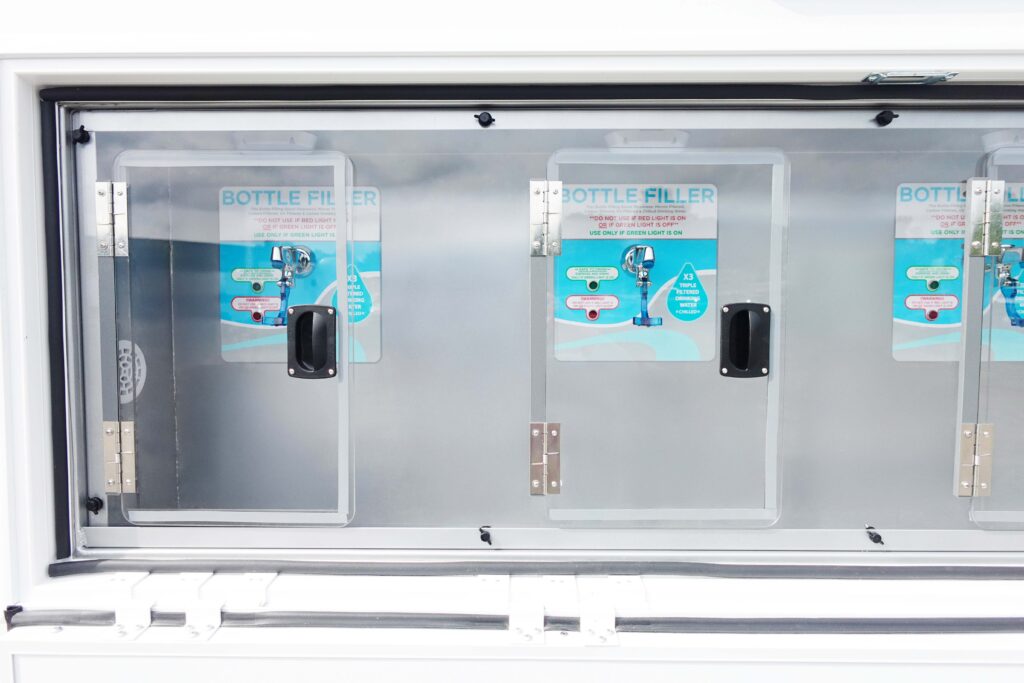
Signature Series Water Station Trailer
- Road-towable on its own chassis, no crane or lift required at the pad
- 300-gallon fresh tank, enough for roughly 2,400 sixteen-ounce fills per load
- Four push-back fill stations so four workers refill at the same time, no line backup
- Electric chiller keeps water genuinely cold even when ambient temperatures exceed 105 F
- Multi-stage filtration removes sediment, chlorine taste, and odor for clean water regardless of source quality
- Power options: 1-3 dedicated 20A/120V circuits, a single 50A/240V circuit, or a standard site generator
- No permanent hookup, no building permit, no utility tie-in required
The generator-compatible power spec matters in energy work more than any other industry. Drilling pads run generators continuously. Solar and wind construction sites rarely have utility power connected until commissioning is nearly complete. Pipeline corridors have nothing at all. And the Signature Series draws from whatever 120V or 240V power you have available, which means setup takes about 23 minutes once the trailer is spotted and the tank is filled from your water truck or nearest potable supply.
For control rooms, tool rooms, or compressor station buildings where crews rotate through indoor work, the Legacy Series roll-in station fits standard doorframes and connects to an existing cold-water line, putting chilled, filtered water exactly where indoor workers need it without hauling bottles across the floor.
Where we workEnergy and Extraction Scenarios We Serve
Drilling Pads and Well Sites
Active rigs and workover operations keep crews on location for 12-hour hitches across multi-week rotations. Potable water is typically trucked in anyway. We park the trailer near the doghouse or the laydown area, tie into your water supply or fill our own tank, and the crew has cold filtered water on demand through every shift change.
Pipeline Right-of-Way Crews
ROW work strings out across miles of open corridor with no fixed water source anywhere nearby. We position the trailer at the active spread, typically at the pipe-string staging point or the equipment park, and as the crew advances by four to eight miles per week we relocate it accordingly. Our dispatcher coordinates every move directly with your foreman, so cold water follows the work without the crew ever having to ask for it.
Solar and Wind Farm Construction
Utility-scale renewable builds are among the most physically demanding construction environments we serve. Array fields offer no shade. Panel racking and trenching crews grind through peak desert heat hours. We typically position at the laydown yard where crews stage at shift start and return at breaks, then move to satellite positions as different construction phases open. Projects spanning 640 to 1,400 acres often need two trailers positioned at opposite ends of the site.
Power Plant Shutdowns and Turnarounds
Forced outages and planned turnarounds pack 180 to 520 specialty contractors into a facility for 48 to 96 hours straight. Shifts run around the clock. Permanent cafeteria facilities are often locked or overwhelmed. We stage the trailer at the main contractor staging area and run a second unit near the turbine deck or boiler access points if the facility footprint is large. Water consumption on a turnaround typically runs 33 to 42 percent higher than a standard outdoor construction day because indoor confined-space work adds physiological heat load even when ambient temperatures are not extreme.
Energy Construction and Transmission
Substation builds, transmission tower erection, and high-voltage line work share the same open-terrain exposure as solar farms but often with smaller crews spread across a longer corridor. We work well with electrical utility contractors because our trailers need only a generator or a single 240V source, and most line crews already carry portable power. We have staged units at tower bases in the Mojave and at substation pads in the Bonneville corridor with nothing more than a flat spot and a generator lead.
Compressor Stations and Midstream Facilities
Compressor stations run continuous maintenance cycles with rotating crews doing valve work, filter changes, and instrumentation calibration in areas where the heat from the compressor skids amplifies ambient temperature by 11 to 22 degrees. We position the Signature Series outside the fenceline at the vehicle access point or inside the facility yard when clearances allow. For the control building or the instrument tech area, the Legacy Series roll-in station integrates with the building's existing water line and keeps a dedicated filtered supply exactly where the desk crew needs it.
Regulatory complianceWhat the Rules Actually Require in Energy-Sector Heat Work
Heat regulation in oil, gas, and energy construction has accelerated significantly in the last three years. Understanding the specific rules that apply to your work state matters before your next pre-job safety plan gets submitted. I've heard foremen say, "We've always just kept a cooler on the truck," and then watched that same crew get a stop-work notice in Kern County because the cooler was 600 feet from the work and the water wasn't cold enough to document.
California Cal/OSHA Section 3395
California's outdoor heat-illness standard requires that water be provided at no cost, that it be cool or cold, and that it be close enough to the work area that workers can access it frequently. During high-heat periods above 95 F, mandatory cool-down rest periods apply. The 2024 update added an indoor heat rule covering power plant and compressor station work when temperatures exceed 82 F. A filled trailer positioned at the site satisfies the water requirement. Pair it with shade tents and a written heat-illness prevention plan and you cover the rest of the standard.
Nevada R131-24AP (Effective April 2025)
Nevada's new heat-illness prevention rule applies to employers with 10 or more workers engaged in outdoor work, including pipeline construction, solar farm builds, and utility transmission work across the desert corridor stretching through Laughlin, Las Vegas, and up to Elko, all areas where we provide Nevada energy site hydration. It requires a written heat-illness prevention plan, access to cool drinking water, and mandatory acclimatization procedures. The rule took effect April 2025, so enforcement is active now. For any energy contractor working Nevada projects, a documented water station with a known flow rate and temperature belongs in your compliance file.
Beyond state-specific rules, OSHA's General Duty Clause covers all states and requires employers to protect workers from recognized hazards that could cause death or serious physical harm. Heat illness is a recognized hazard and has been the subject of federal enforcement actions in energy and construction. The proposed federal Heat Injury and Illness Prevention rule (HIIP) has not been finalized as of mid-2026, but its framework mirrors what California and Nevada already require, which means complying with those state standards puts you ahead of any eventual federal implementation.
NIOSH and the CDC's heat-health resources both emphasize that heat-related illness is preventable when three conditions are met: acclimatization schedules are followed for new crew members, cool water is consistently available, and supervisors know how to recognize early symptoms. Our trailer handles the second condition. Your safety team handles the other two. Together, those three elements are your best defense against a recordable incident or a regulatory citation.
Field logisticsHow Delivery, Positioning, and Refill Actually Work at Remote Sites
Energy projects have site-access requirements that differ significantly from standard construction deliveries. We account for this in every dispatch. As one of our dispatchers put it: "Give me the gate number, the escort contact, and the generator model. I'll handle everything else before the truck rolls."
Before your trailer arrives, our team confirms:
- Gate access, escort requirements, and any contractor orientation or H2S badge requirement for the pad
- Trailer spotting location: flat ground within extension-cord reach of generator or panel, preferably in shade or with a shade tent setup
- Potable water source for initial fill and each refill (your water truck, a certified potable hydrant, or we arrange bulk potable water delivery to the site)
- Power availability: 120V at 20A minimum, or 240V at 50A, or your site generator make and model so we arrive with the right adapter lead
- Crew size at peak shift so we can advise on refill frequency and whether a second trailer improves throughput
Refill scheduling on energy projects runs differently than on a standard event or a fixed construction site. Pipeline crews advance. Pad crews rotate in and out on 14-day hitches. Solar farm construction phases move across the acreage. We build a refill cadence into the rental agreement and adjust it as the project progresses. For a 57-person rotating hitch crew, refill intervals typically run every two to three days in summer heat. For a 190-person solar build at peak, we may refill the trailer daily and position a second unit at a different sector of the site.
We once staged two trailers at a solar construction site in Nevada's Amargosa Valley, a site so remote that the nearest town with a gas station was 31 miles out. The general contractor's safety plan called for cool water at three fixed points across a 940-acre array. We spotted one trailer at the laydown yard, one at the eastern racking zone, and coordinated the water truck refill schedule with the site super. No contractor had to think about water for the next six weeks. That is exactly the kind of setup we prefer to build: invisible to the crew, which means it is working perfectly.
Sizing your orderHow Much Water Does an Energy Crew Actually Need?
The standard planning figure for outdoor heavy work in hot weather is one quart per person per hour. In practice, energy work at 100-plus degrees with physical labor runs closer to one and a half quarts per person per hour for acclimatized workers and higher still during acclimatization week. The numbers below assume you are in high-heat summer conditions in the California, Nevada, Utah, or Arizona regions where we operate.
Small Pad or Workover Crew (15 to 25 workers)
A 300-gallon tank lasts a 22-person crew roughly three to four hours of heavy work in extreme heat. For a standard 10-hour shift, plan on two refills minimum or keep a filled water truck on site for top-off. A single trailer is sufficient. Position it at the doghouse end of the pad where crew transitions happen.
Midsized Spread or Turnaround (50 to 150 workers)
At 110 workers in high heat, a 300-gallon tank goes quickly, often within 85 minutes of peak activity. Daily refill plus a mid-shift top-off is the right cadence. And if the facility spans more than 400 feet between active work zones, two trailers at opposite access points eliminate the walk-time problem entirely. Walk time is the enemy of hydration compliance.
Large Solar or Pipeline Build (200 or more workers)
Large-scale energy construction needs a water plan as intentional as the lift plan or the erosion control plan. For a 280-worker solar build, two to three trailers at distributed positions is the standard recommendation. We can coordinate positioning and refill sequencing across all units so your safety officer has one point of contact and one schedule to track.
Night Shift and Rotation Crews
Power plant turnarounds and some drilling operations run 24-hour operations with crew changes at 6 a.m. and 6 p.m. or in 8-hour rotations. The trailer runs continuously. We set up the unit before first shift arrives and the chiller runs through the night. Cold water at 3 a.m. keeps fatigue-related incidents down the same way it does at 3 p.m. in the sun.
If you are unsure what configuration fits your project, call us at (866) 748-5932. Our dispatch team has sized water solutions for projects ranging from a two-man well workover to a 580-worker forced-outage turnaround at a natural gas plant. We will ask the right questions and tell you what we think you need, not what makes the largest rental. A safety manager on a recent Nevada solar project told us: "You were the first vendor who told me I only needed one trailer instead of two. That honesty is why we called you for the next phase."
Environmental postureLess Plastic, Better Optics for Energy Operators
Energy companies operating on federal leases, tribal lands, or near sensitive habitat face scrutiny over site waste. Bottled water generates significant plastic waste over a multi-week project. A 310-worker pipeline crew running 10-hour days through a California summer can generate roughly 3,200 to 4,100 plastic bottles per day, close to 93,000 bottles over a month. A single water station trailer with reusable bottles or a simple cup dispenser eliminates that stream entirely.
Operators who document reduced single-use plastic on job sites are in a stronger position with landowners, county planning departments, and environmental impact documentation. So the practical benefit runs in two directions: you stop paying for water deliveries by the pallet, and you stop paying someone to collect and haul the empties. The trailer rental cost is typically lower than what a crew of that size runs through in bottled water over the same period.
Common questionsWhat Energy Contractors Ask Us Before They Book
Can the trailer run off a site generator? What power specs does it need?
Yes, and this is one of the most common setups in energy work. The Signature Series accepts 1, 2, or 3 dedicated 20A/120V circuits, or a single 50A/240V circuit, and most site generators in the 25 kW to 100 kW range have 120V outlets or a distribution panel with the right breaker slots. We confirm your generator make and model during pre-delivery coordination and bring the correct adapter or cord set, so there is no scrambling at the site. If you are unsure what outlets your generator exposes, call us and we will sort it out before dispatch. No utility connection is required and there is no permanent hookup.
How do you handle delivery to remote sites with gate access control or H2S requirements?
We plan for this during the booking call. Our drivers can complete basic contractor orientations and carry current H2S awareness cards from their previous project exposure. For sites with escort requirements, we coordinate the arrival window with your gate security in advance so there is someone available to bring our driver in. We need a completed gate access authorization on file before dispatch, which your company safety officer typically provides. For federal land sites or tribal authority areas with additional permit requirements, we ask for lead time of 48 to 72 hours to get those cleared.
How often does the trailer need to be refilled, and who provides the water?
Refill frequency depends on crew size and temperature. A 300-gallon tank serves a 30-person crew for roughly four to six hours in moderate heat and closer to two to three hours at 105 F or above. We build a refill schedule into the rental agreement. You can provide the water from your on-site water truck, a certified potable hydrant within reach, or we can coordinate with a local water delivery service in most markets. The tank accepts a standard 2-inch cam-lock or garden hose fill fitting, so topping off from your truck is typically a 10-minute job. We train your site representative to handle refills between our scheduled visits if the project is in a high-consumption phase.
Can you reposition the trailer mid-project as a pipeline spread advances or a solar site phases in?
Repositioning is standard for ROW and large-acreage energy projects. We build a repositioning schedule into the rental agreement or handle moves on request with 24-hour notice. The trailer hitches to any standard ball or pintle hitch and tows behind a pickup or light service truck at highway speeds. Your foreman or safety coordinator can notify our dispatch team when a move is needed and we will either provide a driver or confirm your site truck driver can handle the move with a quick tow-vehicle check. Most pipeline contractors have a dedicated runner truck that handles this as part of the daily spread advance.
Does the water stay cold overnight or during long idle periods?
The electric chiller in the Signature Series maintains tank temperature as long as power is connected. On a continuous-operation site like a drilling pad or a turnaround where power never cuts, the water stays cold through overnight hours. If power is cut at end of shift, the insulated tank maintains cooler-than-ambient temperature for several hours depending on ambient heat. For night-shift operations or 24-hour work cycles, we recommend keeping the trailer plugged in continuously. If your generator shuts down during off hours, we can discuss supplemental ice arrangements for the overnight window as part of your rental package.
How does this trailer help us meet Cal/OSHA Section 3395 and Nevada's new heat-illness rule?
Both standards require employers to provide cool or cold potable water, close enough to the work area that workers can drink frequently, without cost to the employee. The Signature Series satisfies the water-provision requirement directly: it delivers chilled, filtered water at four simultaneous stations positioned wherever your crew is working. For Cal/OSHA documentation, we can provide a delivery record showing the trailer was on site, the tank capacity, and the service dates. For Nevada's R131-24AP, your written heat-illness prevention plan should reference the water station as the primary water source with its location and refill schedule. We can provide the specs your safety officer needs to complete that documentation.
Ready to Solve Hydration at Your Next Energy Project?
We serve California, Nevada, Utah, and Arizona with multi-yard dispatch and 24/7 availability. Call now for a same-day quote on drilling, pipeline, solar, and power plant water station rentals.
(866) 748-5932 Get a Quote Online