Why Productions Struggle With WaterThe Crew Hydration Problem on Set
Talk to any key grip or first assistant director who's spent a summer shooting exteriors in the Mojave or the Coachella Valley, and they'll describe the same slow-motion problem: the provisions cooler starts full at call time, the afternoon sun pushes ambient temperature past 102 degrees Fahrenheit, the crew doubles its water intake, and by hour nine the cooler holds nothing but warm, floating ice-water soup. Someone makes a run. That person is now 53 minutes away from set. The shoot loses momentum and the production loses money. I've watched this exact sequence unfold on a car commercial outside Palmdale, one of the many Los Angeles area film production shoots we've served, and the AD's face when the PA radio'd "we're out of water" at 2:17 in the afternoon is one I won't forget.
Under OSHA's heat-exposure guidance and Cal/OSHA's Title 8 Section 3395 heat-illness prevention standard, employers working outdoors in California are legally required to provide employees access to potable drinking water at no cost, positioned as close as practicable to where employees are working, at a rate of at least one quart per hour per person under heat conditions. That's not a suggestion. Productions are employers. Cast and crew are workers. The obligation applies to your grip, your PA, your locations coordinator running cable across a sun-baked tarmac. The CDC's extreme-heat resources document how rapidly dehydration degrades cognitive performance, which on a set translates directly to mistakes, injuries, and slowed turnarounds.
Most productions underestimate water demand for the same reason every time: they plan for shoot-day headcount, not for crew-plus-support headcount at peak conditions. A 40-person union crew on a stage-exterior day easily swells to 67 people once you count vendor representatives, the location owner's staff, the catering crew unloading at lunch, and production vehicles parked nearby. We've watched 72-person days consume 283 gallons of drinking water before 3 p.m. when temperatures exceeded 97 degrees. A pallet of 500-milliliter bottles provides roughly 237 liters, or just under 63 gallons. So do the math before your next desert shoot.
OSHS Dispatch
The Unit We DeploySignature Series Water Station Trailer
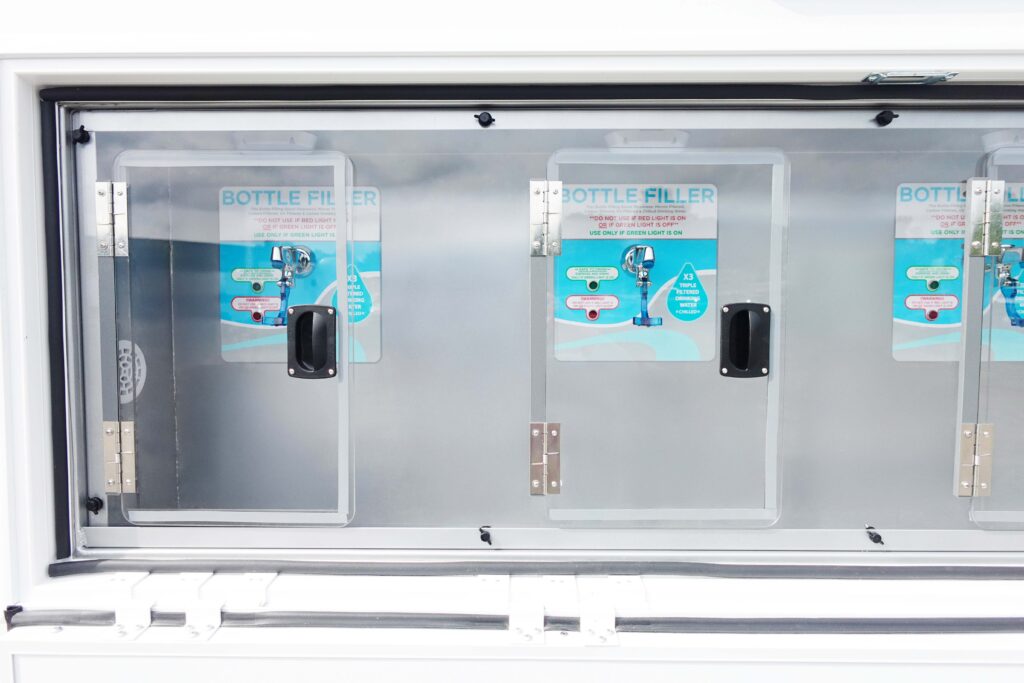
- 300-gallon fresh-water tank (approx. 2,400 sixteen-ounce fills per load)
- Four push-back fill stations so four people refill simultaneously, eliminating the single-spigot bottleneck at base camp
- Electric chiller delivers genuinely cold water, not ambient-temperature tap
- Multi-stage filtration removes sediment and odor from any potable source
- Road-towable on its own chassis, staged anywhere a trailer can reach: base camps, tarmac lots, backlots, ranch locations, desert exteriors
- Runs on one to three dedicated 20A/120V circuits, a single 50A/240V circuit, or a site generator, including your production generator if load's available
- Certificates of insurance issued on request, naming the studio or production company as additionally insured
The Signature Series is our road-towable flagship and the right fit for almost every production exterior. For enclosed sound stages or permanent production facilities, the Legacy Series roll-in station fits through a standard door and can remain on-site through a multi-week shoot without occupying trailer parking.
Where We WorkProduction Scenarios We Cover
Primary Shoot Days
Long exterior shooting days with 38 to 117 cast and crew. We stage at base camp before call time, run continuously through the day, and refill when the shoot extends past 10 hours. Four fill stations mean four people can refill at once, so you don't lose 14 minutes every time a department breaks at the same moment.
Backlot and Studio Lot
Permanent studio facilities often have sparse water access across sprawling backlots. We park the trailer at a central staging point, giving departments spread across multiple sets a shared hydration hub. This setup works equally well at facilities like the Long Beach production lots that host streaming series, automotive campaigns, and feature exteriors alike. Electrical tie-in to existing lot infrastructure is straightforward, and the trailer footprint fits easily within standard backlot lane clearances.
Remote and Desert Locations
Mojave shoots, high desert exteriors, dry lakebed commercials, or anything more than 45 minutes from a town with a reliable store: these are exactly the conditions the Signature Series was built for. We deliver a full tank before you arrive. If the shoot runs beyond a single day, we coordinate a midpoint refill without requiring you to break down or relocate the trailer.
Night Shoots
Night exteriors present the inverse problem: crews underestimate hydration needs in cooler overnight temps, then hit a wall around 3 a.m. Our trailer runs the same whether it's noon or midnight. The chiller keeps water cold even when overnight ambient temperatures are comfortable, and the lit fill stations are easy to locate in low-light base camps.
Catering and Food Station Zones
Many production catering coordinators ask us to park the trailer adjacent to the main food tent so water sits naturally inside the meal-and-break area. This keeps the crew from fragmenting across multiple areas and gives the catering team a predictable, always-stocked water source that doesn't require them to track bottle inventory or haul ice bins twice a day.
We operate across California, Nevada, Utah, and Arizona with a multi-yard network. Whether your production's shooting at a Southern California soundstage or a northern Nevada ranch exterior, we've got dispatch coverage that can reach you within a practical lead time. We also serve private outdoor event productions with the same fleet and turnaround expectations. Same-day deployment is possible for emergency or last-minute call-sheet changes.
Production-Ready LogisticsHow We Work Within Your Production
Certificates of Insurance and Quiet Operation
Productions working on studio lots, permitted city locations, or private property almost always require vendors to carry liability coverage and provide a COI naming the production company or studio as additionally insured. We carry the coverage and issue certificates the same day you request them, with no lengthy back-and-forth that eats into your pre-production window.
Sound is the other constraint most vendors never consider, and it's one we've thought about carefully. Our electric chiller operates on a compressor that produces a low ambient hum, and when we stage near an active recording environment our team positions the trailer at a distance that keeps that noise below any level registering on a production boom. I watched a sound mixer on an automotive commercial ask us to move the trailer another 31 feet away from the talent position. We rolled it there in under four minutes without interrupting the setup. That kind of flexibility matters when your AD is already counting seconds between setups and doesn't need a vendor argument added to the list.
Fast Turnaround and Green Production
Call sheets change on productions faster than almost any other industry we serve, including corporate and commercial productions that run on similarly compressed timelines. Locations shift, crew counts balloon overnight, and department heads make equipment requests at 11 p.m. for a 5 a.m. call. We've staged a trailer within 18 hours of the initial call and removed it the same afternoon wrap was called, sometimes driving 147 miles to make a window work. Our dispatch team is reachable by phone, not a ticketing system, and our fleet is owner-operated, which means we can commit to a schedule and actually keep it.
Green production initiatives at major studios now include water-waste targets alongside carbon metrics. A single 300-gallon load serving a 60-person crew for a 13-hour day eliminates roughly 728 single-use plastic bottles (based on a 16-oz average consumption of roughly two bottles per person per hour at moderate-heat conditions). Over a 10-day location shoot, that number approaches 7,280 bottles that never reach a landfill. Production sustainability coordinators have told us the refillable-station model is one of the most cost-effective green wins they can document for studio environmental reports, because the dollar-per-bottle savings more than offsets the rental fee.
Sizing the JobHow to Calculate Water Demand for Your Shoot
The most common mistake we see is under-requesting based on nominal headcount. Start with your largest anticipated crew size, not your average. We once had a production coordinator call us at noon to say "we planned for 48 people and there are 79 here right now and the cooler is gone." That's a refill call we've fielded more than once. Then apply a consumption multiplier based on conditions:
- Mild temps (under 75 F), covered or interior: 16 to 24 oz per person per hour. A 52-person crew over a 10-hour day consumes roughly 97 to 145 liters.
- Warm temps (75 to 90 F), mixed sun and shade: 24 to 32 oz per person per hour. A 68-person crew over 12 hours can reach 293 liters, or about 77 gallons.
- Hot conditions (90-plus F), full sun: 32 to 48 oz per person per hour. A 63-person crew under these conditions over a 12-hour day approaches 286 to 429 liters, or 76 to 113 gallons. A single 300-gallon tank covers this comfortably, with buffer if the shoot runs long.
Our standard approach for a 60-to-80 person shoot in California summer conditions is to arrive with a full 300-gallon tank and schedule a check-in at the midpoint of the day. If demand is tracking high, we arrange a bulk potable water delivery or bring a second trailer. We've staged two units simultaneously on a feature shoot in the Inland Empire that had 133 crew split across two second-unit locations about a quarter-mile apart. Both units ran off the production's primary generator tie-in, and the electrical coordinator told us "The tie-in was easy, about 11 minutes total. I was expecting a bigger deal." We hear that a lot, actually.
OSHS Field Operations
But sizing isn't just about gallons. It's also about access speed. If your 83-person crew has one spigot and everyone wants water at the same moment during a 10-minute break, you're losing two to three minutes per person in line. Four simultaneous fill stations keep that math reasonable even at the largest crew counts we typically serve. That break-time bottleneck is also when heat stress peaks, because people who've been working haven't had a chance to drink in the past hour. Getting water into hands quickly at those moments is exactly what the four-station design is built for.
Compliance on Your ProductionCal/OSHA, OSHA, and Nevada Heat Rules
California's heat-illness prevention standard under Cal/OSHA Title 8 Section 3395 applies to any employer with outdoor workers when heat risk is present. The standard requires that potable water be available at no cost to employees in quantities of at least one quart per employee per hour, that it be located as close as practicable to work areas, and that it be fresh, pure, and suitably cool. Productions shooting in California are bound by this standard whether or not the production company has historically treated it as a priority. A DOSH compliance officer who walks onto your location exterior is going to look for exactly these elements.
In Nevada, the Division of Industrial Relations adopted heat-illness prevention rules in November 2024 (R131-24AP), with enforcement beginning April 2025 for employers with 10 or more workers. Productions shooting in Nevada locations are now operating under a formal state rule that mirrors California's framework, including water-quantity and shade requirements. A locations manager we worked with on a Nevada exterior told us, "I didn't realize the state rule had gone into effect. We would have been completely exposed without the water trailer." Arizona and Utah fall under federal OSHA's General Duty Clause and the agency's heat-exposure guidance, which OSHA inspectors have used to cite employers for failing to provide adequate water and rest during heat conditions even without a formal state heat-illness standard.
Our trailer provides a straightforward, documentable water source. A production's safety coordinator can log fill events, tank readings, and crew access times. That documentation becomes part of your illness-prevention plan record in the event of an inspection or an incident. We're not a compliance vendor, but we make compliance simple: one trailer, one water log, one source on set that everyone can point to. One production safety manager told me directly, "When the inspector walks on and I can point to a dedicated water station with a fill log, the conversation is over in two minutes instead of twenty." That kind of administrative simplicity matters at the end of a 14-hour day.
And if you're shooting across state lines on a multi-location project, the same trailer that meets Cal/OSHA Section 3395 requirements on a Tuesday also satisfies the Nevada heat rule and federal General Duty Clause requirements when you move to Reno or Tucson on Thursday. We've coordinated multi-state production deployments before, and the logistics are more manageable than most production coordinators expect on the first call. But the compliance case isn't just about avoiding citations. One production supervisor put it plainly: "Dehydrated crew makes mistakes. That's a safety issue before it's a legal one." That framing is exactly right, and it's the one we operate from.
Common QuestionsFilm Production Hydration FAQ
Can you stage the trailer before our 5 a.m. call time, and who do we coordinate with?
Yes. We routinely deliver and stage before pre-dawn call times. Our driver arrives, positions the trailer at your designated base camp spot, confirms the electrical connection, verifies the tank is chilled and full, and clears before the crew starts arriving. Coordination is direct with our dispatch team by phone. We need a staging location, access instructions (gate codes, location contact number), and your electrical tie-in details. For remote locations with no utility access, we confirm generator compatibility in advance so there are no surprises at 4:30 in the morning.
Do you provide a certificate of insurance, and can you name the studio or production company as additionally insured?
Yes, we carry commercial general liability insurance and can issue a COI naming your production company, the studio, and any required parties as additionally insured. This is a routine request for us. Provide the required insured names and address when you book and we include the certificate with your confirmation. Most productions need this for studio lot access or city permit compliance, and we've processed it the same day for last-minute bookings on multiple occasions.
How loud is the chiller unit, and can we stage near a live recording setup?
The electric chiller compressor produces a low ambient hum. At 30 feet from the trailer, the sound level is generally below 45 decibels, comparable to a quiet office. We don't position the trailer close enough to a boom microphone or lavalier-heavy setup to register on your audio, and our field team has experience identifying placement that keeps noise out of the sensitive recording zone. If you have specific dBSPL limits in your sound department's requirements, let us know when you book and we'll discuss placement options before the day of.
We're shooting in the Nevada desert for three days. Can you refill without requiring us to break down camp?
Yes. For multi-day shoots at fixed locations, we schedule a refill delivery using a supply vehicle that connects directly to the trailer's fill port. The crew doesn't need to move or shut down the trailer during a refill. Typical refill time is under 23 minutes. We coordinate the refill window to land during a lunch break or a scene transition to minimize any operational disruption. For very remote locations, we confirm road access and drive time in advance so there are no surprises on day two.
What power source does the trailer require, and can it run off a production generator?
The trailer runs on one to three dedicated 20A/120V circuits, a single 50A/240V circuit, or a comparable generator supply. Production generators are a common power source for us. We need the electrical coordinator to confirm available load and designate a connection point. We bring our own appropriately rated extension and connector hardware. The unit doesn't require three-phase power and won't impose the kind of load that conflicts with camera or lighting rigs on a typical production generator spec.
How far in advance do we need to book, and can you handle last-minute call-sheet changes?
For planned shoots, one week of advance notice gives us the most scheduling flexibility. For emergency or last-minute deployments, we've staged trailers with less than 24 hours from the initial call, though availability depends on our current dispatch load. We run a multi-yard network across California, Nevada, Utah, and Arizona, which means we can often pull a unit that's geographically closer when the window is tight. Call us directly at (866) 748-5932 and describe the situation. We'll tell you immediately whether we can make it work rather than making you wait on a quote form reply.
Ready to Solve Water on Your Next Production?
Call our dispatch team or request a quote online. We serve productions across California, Nevada, Utah, and Arizona with same-day availability for emergency requests.
(866) 748-5932 Request a Production Quote