The challengeCrew Size, Route Work, and Full-Sun Economics
Most landscaping and grounds-maintenance companies run small crews, typically two to five people per truck. Those crews leave the yard before 6 a.m., hit three to seven different properties in a single shift, and work almost entirely on exposed surfaces: driveways, parking lot borders, retention ponds, street-facing turf, hardscape patios. Radiant heat bouncing off concrete and asphalt adds a significant temperature premium above the ambient air reading. An 87-degree morning in Sacramento or a 94-degree afternoon in Las Vegas plays out very differently on a crew doing a 3,200-square-foot hardscape install than it does on a worker inside an air-conditioned building, and the physical demands of operating equipment on pavement all day make that gap wider than most people expect.
The case-of-water math is straightforward and it almost never works in the company's favor. A case of 24 sixteen-ounce bottles costs somewhere between $13 and $19 depending on where you buy it. Four workers doing heavy labor in heat need roughly 32 ounces per person per hour. On a nine-hour shift in warm weather that's about nine bottles each, or 36 bottles for the crew. That's 1.5 cases per crew per day, times five working days, times however many trucks you run. A company with four crews can easily spend $618 to $790 a month just on bottled water, plus the logistics of restocking, the plastic waste, and the reality that warm bottles sitting in a truck bed after the first couple of hours aren't doing much for core temperature.
I watched a three-person tree-service crew work a canopy removal on a flat residential lot in August. By 9:40 a.m. the lead climber had already gone through his two bottles. His options were to walk two properties down to a gas station, drink from the garden hose, or wait. None of those are acceptable. That crew didn't have a hydration system. They had a cooler with ice that turned to lukewarm water by 11 a.m. and a pile of plastic bottles that took four garbage bags to haul off when the job finished. A compact, properly chilled station at their staging point would've changed the whole day.
-- A crew foreman, Central Valley landscaping operation
The compliance picture adds urgency. California's outdoor heat-illness standard, Cal/OSHA Section 3395, requires employers to provide one quart of water per employee per hour for strenuous outdoor work when temperatures exceed 80 degrees Fahrenheit. That requirement isn't aspirational. Failure to meet it is a citable violation. Nevada's heat-illness rule (R131-24AP, adopted November 2024 and enforced beginning April 2025) imposes similar water-access obligations on employers with ten or more workers. A mobile water station that keeps 300 gallons cold and accessible at the point of work is one of the most direct ways to demonstrate compliance on either side of that state line.
Who uses itLandscaping Scenarios Where Hydration Matters
Grounds Maintenance Crews
Multi-stop daily route work: mowing, edging, blowing, shrub trimming. The station parks at the yard and crews top off personal jugs and coolers each morning before the first property. Zero bottle cost per route day.
Hardscape and Paving Installers
Multi-day patio, driveway, or retaining-wall installs. The trailer stages on site for the duration. Workers pouring concrete, cutting pavers, or compacting base rock in afternoon heat need constant access to chilled water without leaving the work zone.
Tree Services and Arborists
Tree removal, stump grinding, and canopy work in direct sun with PPE on. Chainsaw operators and ground crew both run high core temperatures. A station at the staging truck means cold water is always 35 feet away, not a quarter-mile walk.
Irrigation Installation Crews
Trenching, pipe fitting, and valve work in open lawns or bare soil under full exposure. Irrigation crews often work the hottest mid-day hours when scheduling demands. Having chilled water at the truck beats relying on the homeowner's outdoor spigot.
Yard and Depot Morning Fill
The station lives at your operations yard. Crews pull in before dispatch, fill personal insulated bottles and a dedicated job-site cooler from the chilled four-station fill bar. They leave the yard properly hydrated instead of stopping at a gas station en route.
How it fits your operationTwo Patterns That Work in the Field
Staged at the Job Site for Multi-Day Work
For installs that run two days or longer, a production yard, a commercial grounds contract, a park renovation, or a construction jobsite, we deliver and position the trailer at the start of the job. It sits there for the duration. The 300-gallon tank handles roughly 2,400 sixteen-ounce fills before a refill is needed. A crew of eight doing a five-day install will draw maybe 940 to 1,100 fills total. One tank load typically covers the whole job. We can coordinate a mid-project refill if the schedule runs long. When the job wraps, we pull the unit.
The four simultaneous fill stations matter when an entire crew takes a break at the same time. Four people don't wait in a single-file line for a two-minute fill-up. Everyone refills in about 38 seconds and gets back to work. We've staged units at commercial park renovations in Sacramento and at hardscape projects running across a full city block in Reno where that throughput wasn't optional. It was the only way to keep the break short enough to matter.
Yard-Based Morning Dispatch Fill
For route-based operations, the station never leaves your yard. It sits in your lot, powered by a dedicated 20-amp circuit from your shop panel. Every morning, before trucks pull out, drivers and crew members fill their insulated bottles and whatever cooler they carry on the truck. The cost math becomes very clean: you pay a flat rental rate and a refill fee per load. There's no per-bottle cost, no emergency runs to the corner store mid-shift, and no plastic waste piling up at the yard.
One company with six route trucks told us their crew leads were each spending about $27 a week in personal money on drinks because the company-supplied water ran out by midday. That's $162 a week in informal compensation nobody was accounting for. The station rental paid for itself inside the first month. And the chiller is the piece people underestimate most: a bottle of genuinely cold water at 9 a.m. stays cooler in an insulated container through most of the morning, which means less intake is needed to feel hydrated and alert.
Sizing the tank for your crew: Cal/OSHA Section 3395 sets a baseline of one quart per worker per hour for strenuous outdoor work above 80 degrees. For a four-person crew on a nine-hour shift, that's roughly 36 quarts, or just under 9.5 gallons. The 300-gallon Signature Series tank covers more than 31 crew-days of full compliance at that rate before a single tank refill. Most operations find one load lasts one to two weeks of yard fills. Contact us and we'll run the exact math for your crew count and schedule before your first delivery.
The equipmentSignature Series Water Station Trailer
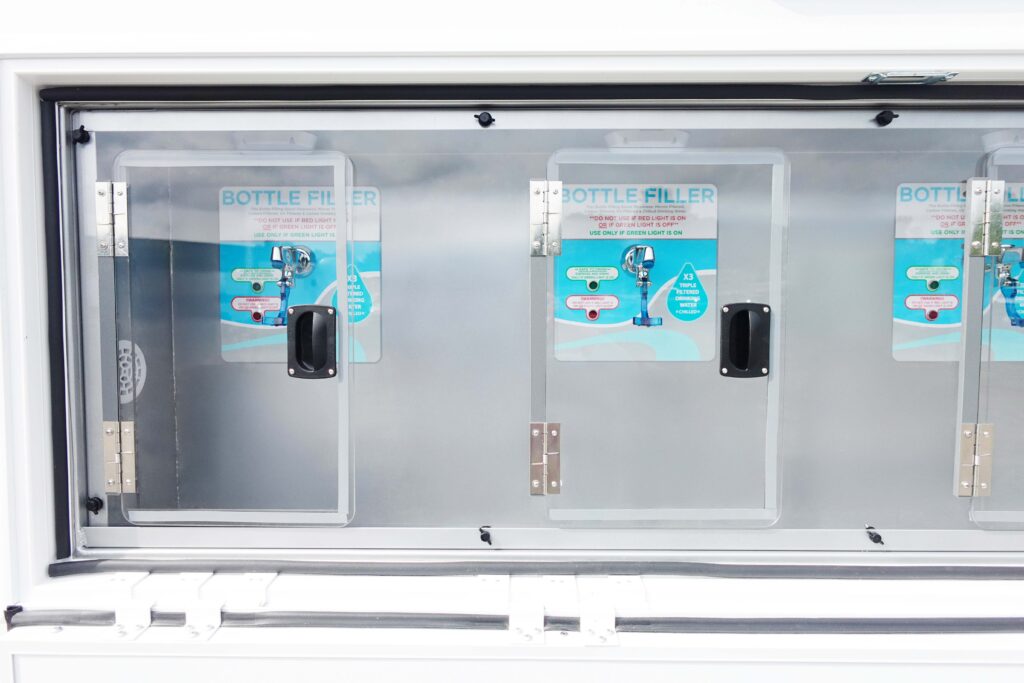
The Signature Series is a road-towable trailer built around a 300-gallon fresh water tank with an integrated electric chiller and multi-stage filtration. It doesn't need a water hookup on site. It arrives full and keeps the water cold. That matters on a hardscape install in Fresno in July where there's no tap and no shade structure for the equipment.
- 300-gallon fresh tank, approximately 2,400 sixteen-ounce fills per load
- Four simultaneous push-back fill stations, whole crew refills without a line
- Electric chiller delivers genuinely cold water through the full rental period
- Multi-stage filtration, no taste issues or sediment
- Power options: one to three dedicated 20A/120V circuits, a single 50A/240V circuit, or a site generator
- Road-towable on its own chassis, we deliver and recover, no forklift or loading dock needed
- Eliminates single-use plastic bottles at scale, reusable jugs and insulated containers only
Compliance and logisticsWhat the Rules Actually Require and How We Help You Meet Them
Outdoor heat-illness compliance isn't a new concept for landscaping companies, but the regulatory environment has tightened across the Southwest in recent years. California has had an outdoor heat-illness standard since 2005. The 2024 update added an indoor heat rule that can apply to warehouse-based yard facilities in some situations. Nevada's R131-24AP took effect in April 2025 and applies to private employers with ten or more employees statewide. Both rules require water, shade, and rest access in a specific and documented way. Arizona and Utah follow federal OSHA's General Duty Clause framework, which means the obligation exists even without a state-specific rule.
The CDC's heat-health resources note that workers who are new to a job or returning after a break are at higher risk during the first few days. Landscaping crews often have rotating day laborers or seasonal workers who join an established crew without acclimatization time — a risk profile shared with agriculture and farm crews working in the same regions under the same state heat rules. Having a reliable, accessible water source reduces that risk during the first days when workers are most vulnerable to heat illness.
We cover California, Nevada, Utah, and Arizona through a multi-yard network. Same-day emergency delivery is available in most of our coverage area, including Anaheim grounds crews managing commercial and HOA contracts across Southern California. For planned seasonal rentals, we can set up a standing refill schedule so you don't have to track tank levels or call in each time. A dispatcher coordinates the delivery window to match your crew's schedule, whether that's a morning fill before dispatch or a mid-project drop at the install site.
-- Dispatcher, commercial grounds maintenance company
On the plastic-waste side, the business case aligns with the environmental one. A mid-size landscaping company with four trucks and five workers each can easily go through 510 to 680 single-use bottles a week. Over a 38-week operating season that's roughly 19,400 to 25,800 bottles. A refillable station with reusable containers eliminates that volume entirely. Some commercial property managers and HOA contracts now ask vendors to document sustainability practices, a requirement that comes up regularly among Orange County grounds crews managing large residential and commercial accounts. A zero-bottle-waste hydration program is a concrete answer to that question.
-- Operations manager, tree service company, Central California
We own our units. We're not a broker. When you call (866) 748-5932 you're talking to the people who dispatch the actual equipment, and when something needs attention on a unit, our team handles it directly. That matters when you're running a job site in Nevada in June and need a fast answer about tank capacity or power requirements.
But the logistics piece matters as much as the equipment spec. Our hub at onsitehydrationservices.com/water-station-rentals/ covers the full rental process, service area details, and refill scheduling. If you run an operation with a fixed yard and want to explore a permanent indoor station for a break room or equipment storage building, the Legacy Series is designed for that application and rolls through a standard door.
So whether you're managing a tight three-truck maintenance company or coordinating multiple install crews across a metro area, the delivery and refill process is handled on our end. Your job is to tell us your crew count, your power situation, and when you need the unit. We take it from there.
Common questionsLandscaping Crew Hydration FAQ
How much water does a four-person landscaping crew actually need on a hot day?
Cal/OSHA Section 3395 sets the compliance baseline at one quart of water per worker per hour when temperatures are above 80 degrees Fahrenheit and the work is strenuous. For four people on a nine-hour shift that comes to 36 quarts total, or just under 9.5 gallons. In practice, workers doing physical labor in direct sun often drink more than the compliance minimum. The 300-gallon Signature Series tank holds enough for that same four-person crew to work 31 or more full days before the tank needs a refill. Most landscaping yards doing morning dispatch fills find one tank load lasts one to two weeks depending on crew count and how much each person drinks per shift.
Can the trailer stay at a job site for multiple days, or does it only work at a yard?
Both patterns work well and we service both regularly. For multi-day installs (hardscape, irrigation, commercial grounds buildouts), we deliver the trailer to the job site at the start of the project and pick it up when the crew wraps. For route-based maintenance companies, the trailer typically parks at the operations yard on a dedicated circuit and crews fill up each morning before dispatch. If your schedule mixes both, with some days at the yard and occasional long installs, we can discuss a flexible arrangement. The unit's road-towable and moves easily between locations.
What power is needed to run the chiller at a job site or yard?
The Signature Series runs on one to three dedicated 20-amp, 120-volt circuits, a single 50-amp, 240-volt circuit, or a standard site or event generator. At a yard with a shop panel, a dedicated 20-amp circuit is usually the simplest setup. At a job site without utility power, a generator works fine. We'll confirm the power configuration with you before delivery so there aren't any surprises on the day the unit arrives. The chiller is what keeps the water genuinely cold rather than just room temperature, so making sure the power situation is sorted in advance matters.
Does the unit need a water line connection, or does it arrive full?
It arrives full. The 300-gallon tank is filled at our yard and transported to your location. There's no water hookup required on site. This is one of the main reasons landscaping companies choose the Signature Series over a plumbed cooler: installs and route yards rarely have a clean water tap in the right spot, and even when they do, tank-filling on site takes time and requires someone to supervise. We handle the fill, deliver the unit ready to use, and coordinate refills on whatever schedule fits your operation.
How does Nevada's heat rule apply to a landscaping company based there?
Nevada's R131-24AP heat-illness prevention rule took effect for enforcement in April 2025 and applies to private employers with ten or more employees. It requires employers to provide cool drinking water (approximately one quart per employee per hour at temperatures above 90 degrees Fahrenheit), access to shade, and written heat-illness prevention procedures. A landscaping company operating multiple crews in the Las Vegas metro or Reno area falls under this rule if total headcount reaches ten. The Signature Series station addresses the water-access requirement directly. We recommend reviewing the full rule text and consulting your compliance advisor for documentation requirements specific to your operation.
What's the minimum rental period, and how do refills work?
Minimum rental periods and refill pricing are confirmed at the time of your quote because they depend on location, crew size, and whether you need yard-based or site-based service. Refills are coordinated through dispatch. For standing yard rentals, many customers set up a recurring refill on a set day each week, or we can schedule it based on a tank-level check. For job-site rentals, a refill mid-project is simple to arrange if the job runs longer than expected. Call (866) 748-5932 or use the quote form and we'll build out a schedule that fits your operation.
Get Cold Water to Your Crew Before the Heat Peaks
We cover California, Nevada, Utah, and Arizona. Same-day dispatch is available in most of our service area. Call or get a quote and we'll confirm availability, power requirements, and a delivery window that fits your yard schedule or job-site timeline.
(866) 748-5932 Get a Quote