
Where We Deploy Operational Scenarios We Support
Permanent Base Operations
High-traffic garrison environments: motor pools, range complexes, training bays, and induction processing lines that cycle hundreds of personnel per day. Supplement aging base infrastructure or cover during facility maintenance.
Field Training Exercises (FTX)
Austere terrain with zero water infrastructure. We stage trailers at assembly areas, patrol bases, and objective rally points so commanders do not have to burn convoy resources shuttling water cans. The 300-gallon onboard tank holds through extended rotations.
National Guard Drill Weekends
Monthly drills put 60 to 380 personnel on an armory ramp with little hydration infrastructure. We deliver Friday afternoon and recover Monday, giving S4 coordinators a single call instead of a supply chain puzzle.
Defense Contractors and Depot Work
Depot maintenance operations, propulsion test cells, and construction crews working under defense contracts face the same OSHA heat-illness exposure rules as civilian worksites, plus the additional scrutiny of contracting officer oversight. We provide documented water access that satisfies both.
Base Events and Family Days
Change-of-command ceremonies, Family Readiness Group picnics, recruit family days, and installation open-house events draw civilian attendees alongside uniformed personnel. A trailer stationed near the stage or vendor area cuts the water-bottle budget and eliminates single-use plastic waste.
Every scenario above sits in the same region we serve: California installations including those in the Inland Empire, the high desert, and San Diego base operations, Nevada (Nellis corridor, northern Nevada Guard units), Utah field training sites including Camp Williams and the Dugway corridor, and Arizona (Fort Huachuca area, Yuma proving ground region). Our multi-yard network means a trailer can roll from the closest dispatch point rather than deadheading 300 miles from a single depot.
Operational Reality Why Standard Water Logistics Break Down in Military Environments
Military training and operational environments stack multiple heat-risk factors simultaneously: physical exertion under load, body armor and gear that trap heat, hot pavement or desert terrain, and formations that cannot simply self-pace the way an individual civilian worker might. The OSHA heat-exposure guidance that governs civilian defense contractor work acknowledges that physical labor in direct sun at ambient temperatures above 91 degrees Fahrenheit creates high-risk conditions. Military doctrine applies WBGT (wet-bulb globe temperature) flag conditions, which factor in humidity and radiant heat on top of air temperature, producing a threshold that triggers mandatory water consumption rates of a quart or more per hour during moderate activity in hot conditions.
Run the arithmetic on a battalion formation of 583 personnel during a four-hour range day in a WBGT Yellow or Red flag condition. At one quart per hour per person, that's 583 quarts every hour, or roughly 145 gallons per hour across the formation. A single Signature Series trailer carries 300 gallons, enough to cover two hours of aggressive consumption before a refill. But two trailers staged at opposite ends of a long firing line solve the problem for a full range day without anyone running out, and nobody's burning a logistics vehicle to shuttle water cans mid-rotation.
The failure mode we've seen repeatedly, and one we've been called in to solve after the fact, is the assumption that cases of commercial water bottles will suffice. For a platoon-sized element, bottled water works. But for a battalion-scale FTX with personnel spread across multiple grid squares, the logistics chain for palletized water is expensive, produces enormous waste, and requires someone to police up thousands of plastic bottles after the exercise. A trailer parked at the administrative area handles the same volume with a single run and zero plastic footprint. For sites where a tanker is more practical, a scheduled bulk potable water delivery covers the same requirement without the bottle waste.
-- OSHS Dispatcher
Rapid Mobilization Logistics That Move at Military Tempo
Base access and credentialing: we've navigated COI (certificate of insurance) requirements, vehicle pass paperwork, and visitor access processes at multiple installations in California and Nevada. Ask us early: provide gate requirements at quote time and we coordinate driver documents and vehicle info in advance so there aren't any delays at the installation entrance on delivery morning.
Remote terrain delivery: the Signature Series trailer is road-towable on its own chassis, so it goes wherever a pickup truck can go. We've staged in dirt-road training areas, dry lake beds used for desert acclimatization exercises, and unpaved armory back lots. If the road is passable, the trailer gets there.
Power options in the field: the electric chiller runs on one to three dedicated 20A/120V circuits, a 50A/240V hookup, or a standard generator. Most field environments already have a generator running for communications or TOC equipment, and tapping a spare circuit is all we need. No dedicated power plant, no special hookup crew.
Refill logistics: we can coordinate refills for multi-day exercises, scheduling a run at the 48-hour mark for extended FTX operations based on reported consumption. The trailer tank connects to any standard potable water source, including a water buffalo on the objective or a municipal hydrant at the nearest road. Commanders brief their S4 contact once and we handle the rest.
Same-day and emergency dispatch: mission timelines slip. When a water source fails, a convoy gets delayed, or a unit gets tasked to an exercise they didn't plan for, call (866) 748-5932. We also support emergency response staging when activations happen on short notice. We work same-day when inventory is available in the region.
Desert and High-Heat Environments
The Mojave, the Great Basin, and the Sonoran Desert are in our service area. We understand what ambient temperatures above 110 degrees Fahrenheit do to consumption rates and to the units that are supposed to be keeping water cool. Our trailer's electric chiller is not a suggestion, it is mission-critical in those conditions. Defense personnel training in desert environments consume water at rates that dwarf standard occupational guidance, and chilled water replaces body fluids more effectively than warm water does.
Austere Sites With No Infrastructure
No water main, no power grid, no shade structure at the objective. The Signature Series carries everything it needs: a 300-gallon sealed tank, a self-contained filtration system, and the ability to run off a generator that is already on site. We bring the water to the training area, not the other way around. Personnel refill at four stations simultaneously, keeping throughput high during formation breaks that may last only 10 to 15 minutes.
For indoor facilities, including armory day rooms, battalion headquarters, and processing stations inside buildings, our Legacy Series roll-in drinking water station fits through standard doors and stays in place without requiring trailer access to the building. Many Guard units use a Signature trailer on the ramp and a Legacy unit inside the building for the same drill weekend.
-- Range Safety NCO, California National Guard unit (illustrative account)
The Unit Signature Series Water Station Trailer
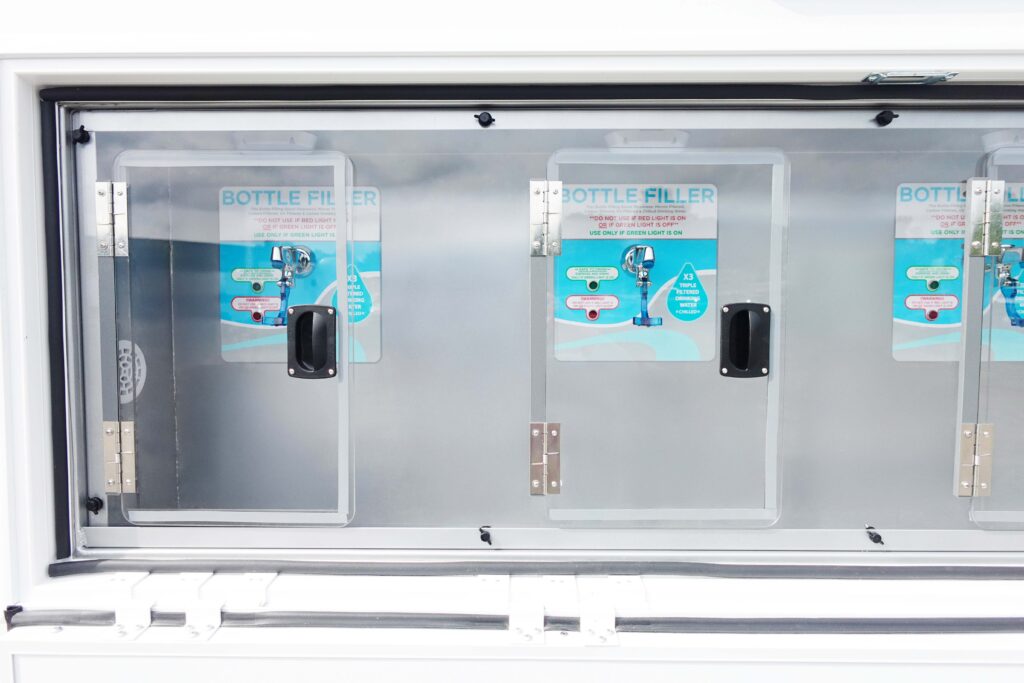
- 300-gallon sealed potable-water tank, refillable from any standard source
- Four push-back fill stations for simultaneous access (no bottleneck at breaks)
- Electric chiller keeps water genuinely cold, not just cool, critical in WBGT Red and Black conditions
- Multi-stage filtration: inlet screen, sediment filter, carbon stage, UV-treated output
- Road-towable on its own chassis, no special transport equipment needed
- Runs on generator, shore power (20A circuits), or 50A/240V service
- Eliminates single-use plastic bottles and their associated logistics and waste
- Rapid setup: typically on-line in under 45 minutes after positioning
Compliance and Standards Heat-Illness Rules That Apply to Defense Work
Uniformed military personnel operating under command authority fall under service branch heat-illness prevention programs that are distinct from OSHA jurisdiction. Defense contractors and civilian base employees are a different story. They're covered by OSHA's General Duty Clause, which requires employers to provide a workplace free from recognized hazards, and by state-level heat rules in our coverage states.
In California, defense contractors with outdoor workers and civilian base employees on covered work orders are subject to Cal/OSHA Title 8 Section 3395, the heat-illness prevention standard. It requires cool potable water (35 to 95 degrees Fahrenheit) at no cost to workers, placed close to the work area, with individual quantities of at least one quart per hour available. During acclimatization periods, close supervision is also required. A Signature Series trailer staged at or near the work area satisfies the water provision requirement cleanly, with chilled output well within the required temperature range.
Nevada's heat-illness rule (R131-24AP, adopted November 2024 and enforceable as of April 2025) applies to employers with 10 or more employees in outdoor settings above 90 degrees Fahrenheit. Defense contractors at Nellis-adjacent facilities, Nevada Test and Training Range support crews, and Guard contractors fall into this category during summer months. The CDC heat-health resources and OSHA's heat guidance both emphasize that water access must be close enough that workers can drink without significant disruption to the work cycle. A trailer positioned 50 to 100 feet from the work area achieves that standard better than a cooler at the end of a row of vehicles.
Beyond the regulatory angle, the operational risk calculus for commands is straightforward. Heat casualties pull medical personnel away from training objectives, generate line-of-duty determinations, and generate paperwork that leadership would rather avoid. Staged water at the right intervals is the cheapest mitigation a commander has, and the same logic applies to government and municipal operations that run alongside or in support of defense activities.
-- Safety officer, defense support contractor (illustrative account)
Sizing Your Rental How Many Trailers, How Often Does the Tank Refill?
We use a simple planning model when scoping a military rental. Start with headcount and flag condition. In WBGT Yellow (moderate exertion), plan for 16 to 24 ounces per person per hour. In WBGT Red or Black (high exertion, high heat), plan for 32 to 40 ounces per person per hour. Run that math and you'll have your daily consumption figure, which tells you how many refills the trailer needs or whether two units running in parallel is the right call.
Example: 200-person FTX, eight-hour training day, WBGT Yellow conditions
200 personnel x 20 oz/hr x 8 hours = 32,000 oz total consumption, or roughly 249 gallons. One Signature Series trailer (300 gallons) covers the full day with a 51-gallon buffer, no refill required. Add a refill run for a two-day exercise and you're set.
Example: 500-person range day, six hours, WBGT Red conditions (July, Inland Empire)
500 personnel x 36 oz/hr x 6 hours = 108,000 oz, approximately 844 gallons. Two trailers (combined 600 gallons) plus one planned mid-day refill on each unit covers this scenario. We position them at opposite ends of the firing line so personnel aren't walking more than 80 yards to reach water.
For base family-day events with mixed civilian and military populations, consumption is lower than field training but the event duration is longer. A single trailer for events under 340 attendees usually runs all day with one refill in the mid-afternoon. We recommend positioning near the main activity area rather than at the perimeter, where attendance density is highest.
Browse our water station rentals hub for general sizing guidance across all environments, then call us to refine based on your specific mission profile and installation requirements.
Common Questions Frequently Asked About Military and Defense Rentals
Can you get vehicles and drivers through base access control points?
Yes, with advance coordination. We need the installation's COI requirements, vehicle type and plate, and driver ID requirements as early as possible, ideally at quote time. Most installations require proof of insurance at specific coverage levels, and some require a visit request submitted through the installation's visitor control center several business days in advance. We've navigated this process at multiple California and Nevada installations. Give us the access requirements and we'll handle the documentation on our end.
How do you refill the trailer during a multi-day field exercise?
We coordinate a scheduled refill run at an agreed time, typically when tank level reaches 20 to 25 percent. The trailer has a standard fill inlet that connects to any potable water source, including water buffaloes (military water trailers), municipal hydrants at the nearest access point, or a tanker. Refill time is typically 31 to 47 minutes depending on source pressure. For exercises in areas with no nearby water source, we can bring a tanker in coordination with your S4 if that's operationally feasible. Discuss multi-day logistics at the quote stage and we'll build a plan that fits your exercise schedule.
What power source does the trailer need in a field environment?
The electric chiller and lighting require power: one to three dedicated 20A/120V circuits, a 50A/240V hookup, or a standard generator. If you've got a generator already running on site for communications or TOC equipment, we can usually tap into it. We recommend confirming available generator capacity at quote time so we can advise on a shared-load setup. In a true no-power environment, the trailer still functions as a water station (fill stations work without power), but chilling requires electrical input.
Can you support ROTC programs and university-affiliated military training?
Yes. ROTC lab days, field leadership assessment courses (FLAC), and cadet summer training events are exactly the kind of environment we support. Universities and ROTC programs typically operate on civilian property or use local parks and training areas that have no infrastructure. So the Signature Series trailer's self-contained, road-towable design is a natural fit: it reaches whatever site the program is using without requiring hookups or permanent access. Billing is straightforward: we invoice the program coordinator or department directly. Contact us to discuss the academic calendar cycle and volume discounts for multi-event agreements.
Do defense contractors need to document water access for OSHA compliance purposes?
Yes, and we can help. OSHA's General Duty Clause and Cal/OSHA Section 3395 (for California outdoor work) require employers to provide potable water in appropriate quantities. Documentation that water was available, positioned correctly, and at the required temperature range is part of a defensible heat-illness prevention program. When you rent from us, we'll provide a rental agreement that documents delivery time, unit capacity, and chiller operation for your safety file. Keep that record alongside your tailgate safety meeting logs as part of your written heat-illness prevention plan.
What is the difference between the Signature Series trailer and the Legacy Series indoor unit for armory environments?
The Signature Series is a road-towable trailer designed for outdoor deployment: a motor pool ramp, a firing line, a field training area, or a parade ground. It holds 300 gallons, chills via an electric unit, and offers four outdoor fill stations. The Legacy Series is a roll-in drinking water station sized to pass through a standard door and stay inside an armory day room, classroom, or processing area. Both units filter and chill water. Many Guard units rent both for the same drill weekend: the Signature Series handles outdoor personnel on the ramp while the Legacy Series covers personnel inside the building. Call us and we'll help you spec the right combination based on your armory layout and headcount split.
Ready to Stage Water for Your Next Operation?
Call our dispatch team now or request a quote for your installation, FTX, Guard drill, or base event. Same-day delivery possible when you need it.
(866) 748-5932 Request a Quote