Drinking Water Station Rentals in Elk Grove for Job Sites & Events, Open 24/7
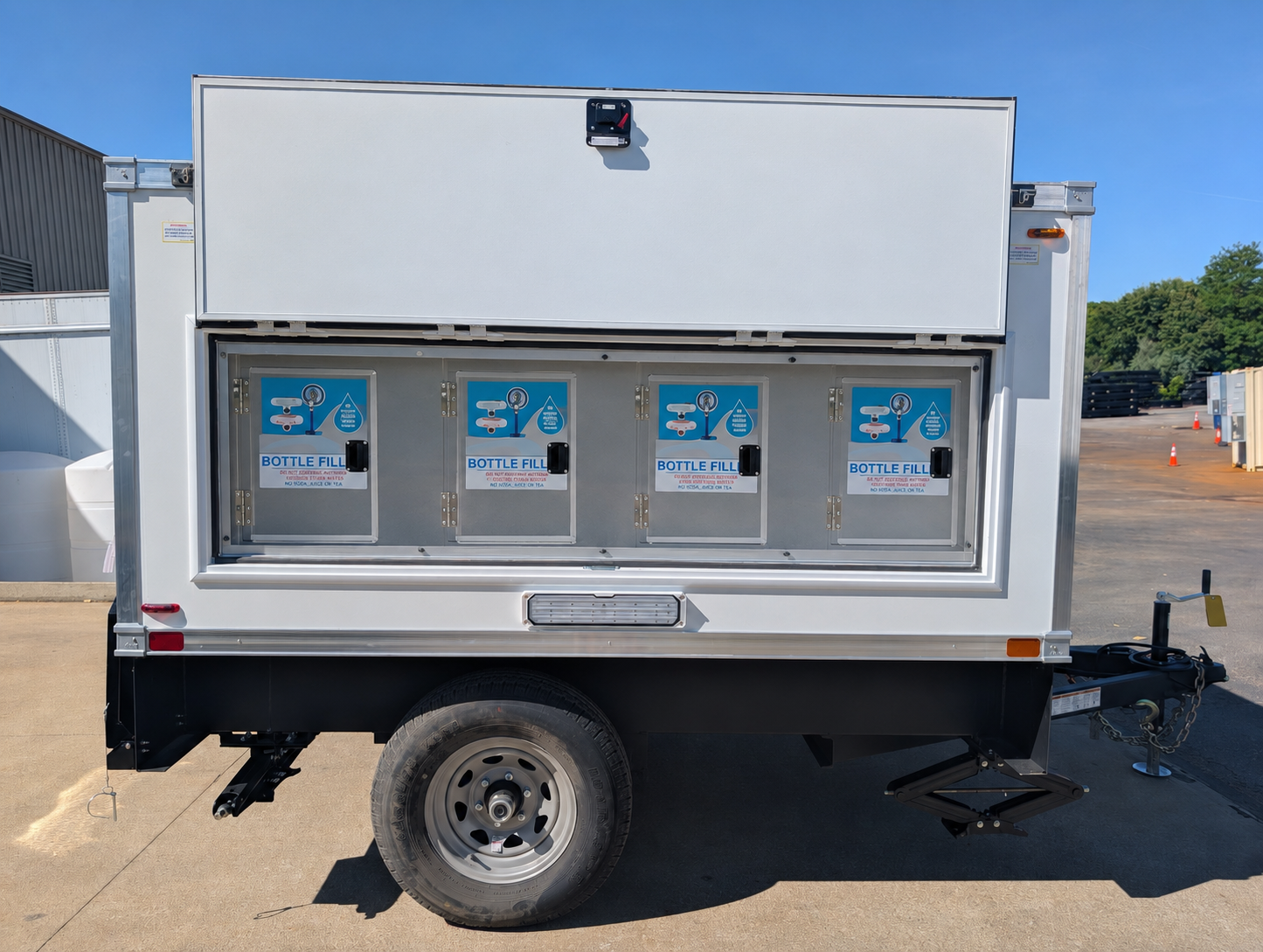
We rent out self-contained drinking water stations across Elk Grove and Sacramento County, for both outdoor events and working job sites. The trailer tows straight to your spot, pours cold, filtered water from four bottle-filling taps, and tops itself off all day. When the Central Valley sits at 100-plus degrees, warm bottled water won’t keep a wedding crowd or a build crew safe. Ours stays cold from the first pour to the last.
- ~45-minute Elk Grove delivery
- Cold, four-stage-filtered water
- ADA bottle filling
- Cal/OSHA heat-illness ready
- Licensed & insured
- 24/7 emergency dispatch
A local hydration partner that plans for events and job sites in the same week
Elk Grove keeps two calendars going at once, and we serve both. There’s the event side, the concerts and movie nights at District56, the Western Festival parade through Old Town, the youth tournaments filling the sports complexes off Bruceville and Big Horn. And there’s the work side, the rooftops and slabs going up in Laguna Ridge, the warehouse and commercial pads near Highway 99, the landscaping and ag crews working the edges out toward Sheldon and Wilton. Both face the same Valley problem: it gets hot, and people need cold water close at hand. So we stage a mobile water station, keep it cold and filtered, and refill it from our own trucks before anyone runs low.
One trailer for a crowd or a crew
The same Signature trailer that pours for a 5,000-person festival at District56 on Saturday can sit on a Laguna West framing job by Monday morning. You don’t need a different vendor for events and worksites. We handle the planning, the delivery, and the refills for either one.
Water that holds its chill past 3 p.m.
An onboard chiller keeps the supply cold straight through a Central Valley afternoon. That matters because warm water is water people stop drinking, and in July around here that’s exactly when a crew or a crowd needs it most. Cold water gets consumed. Consumed water prevents heat illness.
Dispatched close, delivered quick
Most Elk Grove deliveries land in about 45 minutes, and we run emergency drops around the clock during heat advisories. When a site lead realizes at 6 a.m. that a 40-person crew has nothing but a warm cooler, fast is the whole point.
Here’s the rule we open every job with: a water setup people walk past is the same as no setup at all. We’ve seen pallets of warm bottled water bake beside a Laguna job-trailer while the crew quietly wilted in the heat. We’ve also seen a chilled station set ten steps from the work face go bone-dry twice over a single shift. Everything rides on the distance between those two pictures. So our trucks don’t just park a unit and disappear. We scale it to your headcount or your gate count, set the refill cadence to how hard you’re actually pulling on it, and answer a heat call the way you’d want it answered, fast, because out here one hot hour can decide how the whole day lands.
One road-towable trailer built to work an open Elk Grove lot in full sun
One purpose-built rig covers the whole area for us: the Signature Series water station trailer. A full road chassis underneath means it tows directly to the job, a grading pad off Kammerer Road, an event lawn at District56, a vineyard row past Wilton. No plumbing to run, nothing to bolt together. Cold filtered water flows from the taps the same day the trailer arrives.
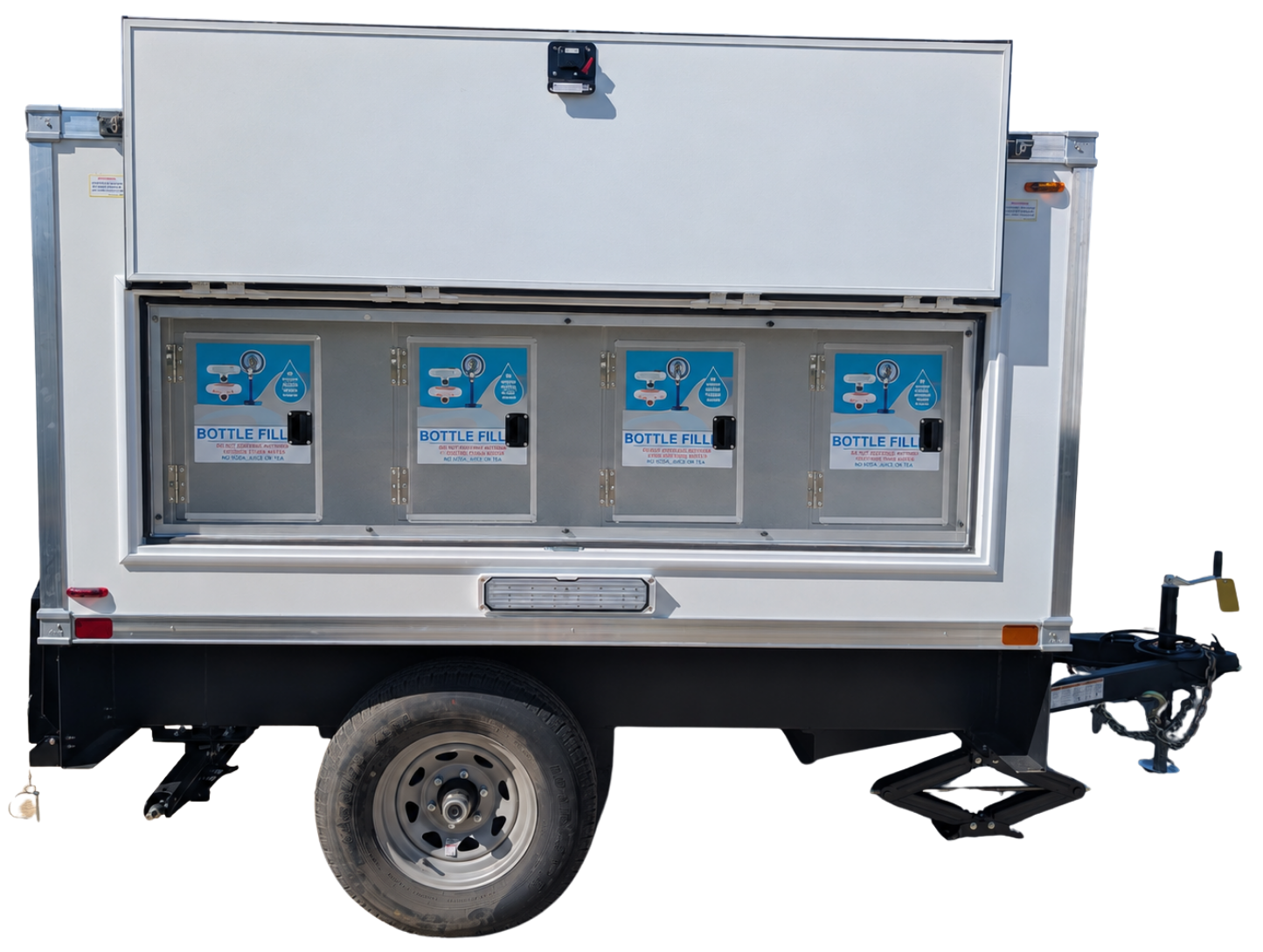
Signature Series specifications
Tires, a hitch, a real trailer frame underneath, it tows out to a far-flung job site, an event field, a working farm, or a disaster staging yard. Elk Grove planners and contractors ask for this one by name. It’s sized to back in, level off, and be pouring by that same afternoon.
| No. of stations | (4) Bottle Filling Stations |
| Length | 12′ 3″ |
| Weight | 3,100 lbs. |
| Height | 8′ |
| Fresh water tank | 300 Gallons |
| Power requirements | 1–4 dedicated 20A/120V circuits OR 1 dedicated 50A/240V circuit |
| No. of AC units | 1 |
Why this is the right rig for the Valley floor
Heat and distance are what the Signature is engineered for, start to finish. Four push-back spouts run along an outer wall beneath an awning, so a crew or a festival line clears through quickly rather than crowding one nozzle on a short break. The built-in AC and chillers hold the water cold even while the unit bakes on a bare Elk Grove pad under the full afternoon sun, which is exactly the moment a stack of coolers and a bottled-water plan come apart around here.
Three hundred gallons gets a good-sized crew or crowd through a long stretch, and because the whole thing rolls on a hitch, we can reposition it across a big parcel or move it to the next phase of a build with no permanent install to rip out. Its power draw spans a wide range, so one trailer covers a finished commercial pad off Laguna Boulevard just as easily as a bare lot toward Sheldon that we have to bring power to.
Those four marquee taps aren’t the whole story. The rear large-jug spout fills five-gallon coolers and personal packs, and a bank of hose-bib taps takes care of crew chores, wash-up, and field work. That makes a single trailer the complete hydration answer for an Elk Grove job or event. One unit has handled a Laguna Ridge framing crew and, on another day, the finish line of a Cosumnes River parkway run, no second piece of equipment required. We’ve taken the same rig from a Sheldon vineyard at dawn to a District56 concert by nightfall.
Run the numbers and one station beats a summer of bottled water
Cal/OSHA wants a quart per worker per hour available on a hot day. For a 50-person Laguna Ridge build, that’s roughly 100 gallons a shift, and covering it with half-liter bottles means moving something close to 750 of them onto the site, every working day, then hauling the empties back off.
Stretch that across a typical 150-day Valley building season and you’ve ordered, iced, and trashed well over 110,000 bottles for a single crew. The warehouse and distribution jobs up the 99 corridor run larger crews and push the count higher still. One trailer erases all of it, cold at the tap, none of it headed for a Sacramento County landfill.
It’s a logistics call first, a sustainability one second
The plastic-waste angle is real enough. The country throws away on the order of 60 million water bottles a day, only about a third ever gets recycled, and one bottle can outlast everyone on the crew in a Sacramento County landfill. Procurement teams in Elk Grove increasingly have to account for that waste line by line. Still, most Elk Grove project managers switch for a plainer reason: a shared trailer kills the daily scramble. No standing bottled-water order to manage. No cooler that’s gone lukewarm by mid-morning. No pile of empties cooking by the job-trailer. Your superintendent gets to run the build instead of minding the drinking water.
Because our own potable tankers handle the refills, the supply grows with the job rather than against it. Double the crew for a big concrete pour and they still can’t outpace the plan. The tankers just come back and bring the level up.
Hydration shaped to the way Elk Grove actually fills its days
Elk Grove doesn’t have one hydration problem, it has a handful. A youth soccer tournament off Bruceville needs one setup. A District56 summer concert needs another. A Laguna Ridge rooftop crew in late July needs a third, and a Sheldon vineyard harvest a fourth. Here’s where these trailers go to work, and why the same rig fits all of them.
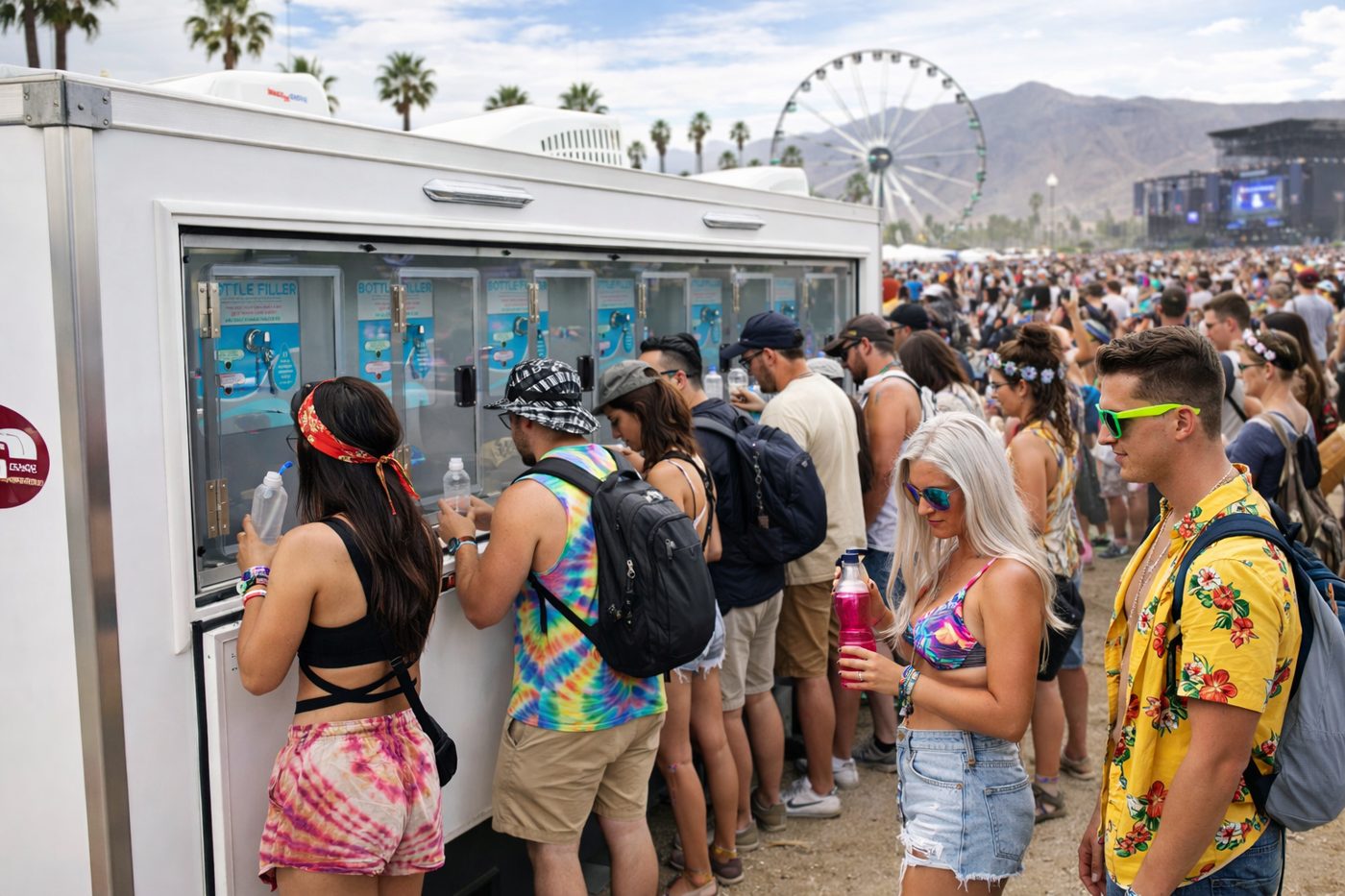
District56, Old Town & outdoor events
Elk Grove leans hard into outdoor gatherings, the concerts and movie nights at District56, the Western Festival parade and carnival through Old Town, the food-truck mania evenings, the Strauss Festival crowds nearby in Elk Grove Park. Put a summer crowd on the Valley floor and they go through water in a hurry. A trailer gives organizers a steady cold supply and tidy refill points, and drops the heap of single-use bottles you’d otherwise have to truck in and cart out again.
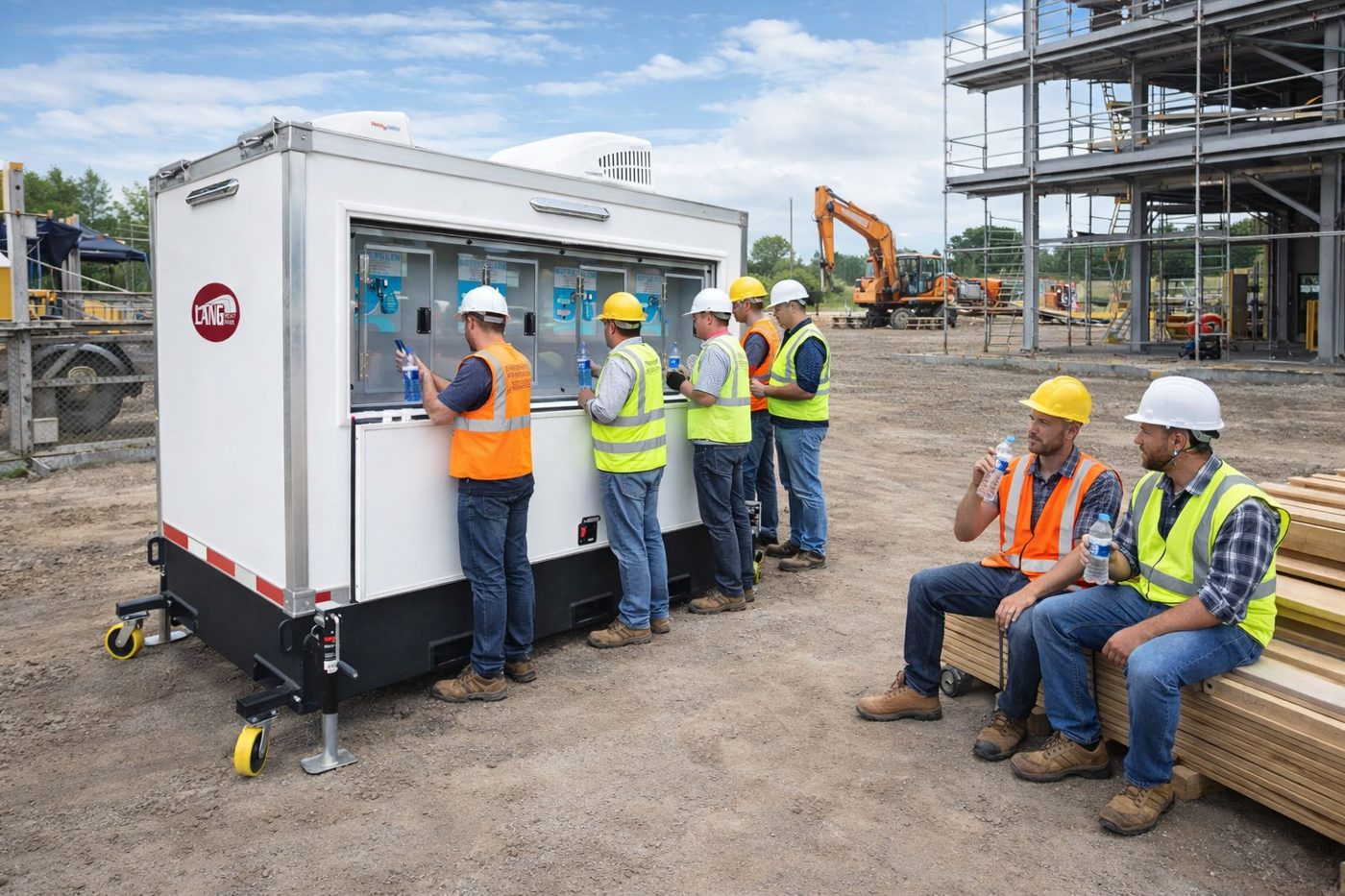
Residential & commercial construction
Elk Grove is one of California’s fastest-growing cities, and the build-out shows it: new rooftops across Laguna Ridge and the southeast growth area, commercial and retail pads near the Outlets and along Highway 99, the warehouse and distribution work toward Sacramento. We post stations on these jobs so general and specialty contractors get documented, charted cold hydration within a few steps of every work face, slab pours very much included.
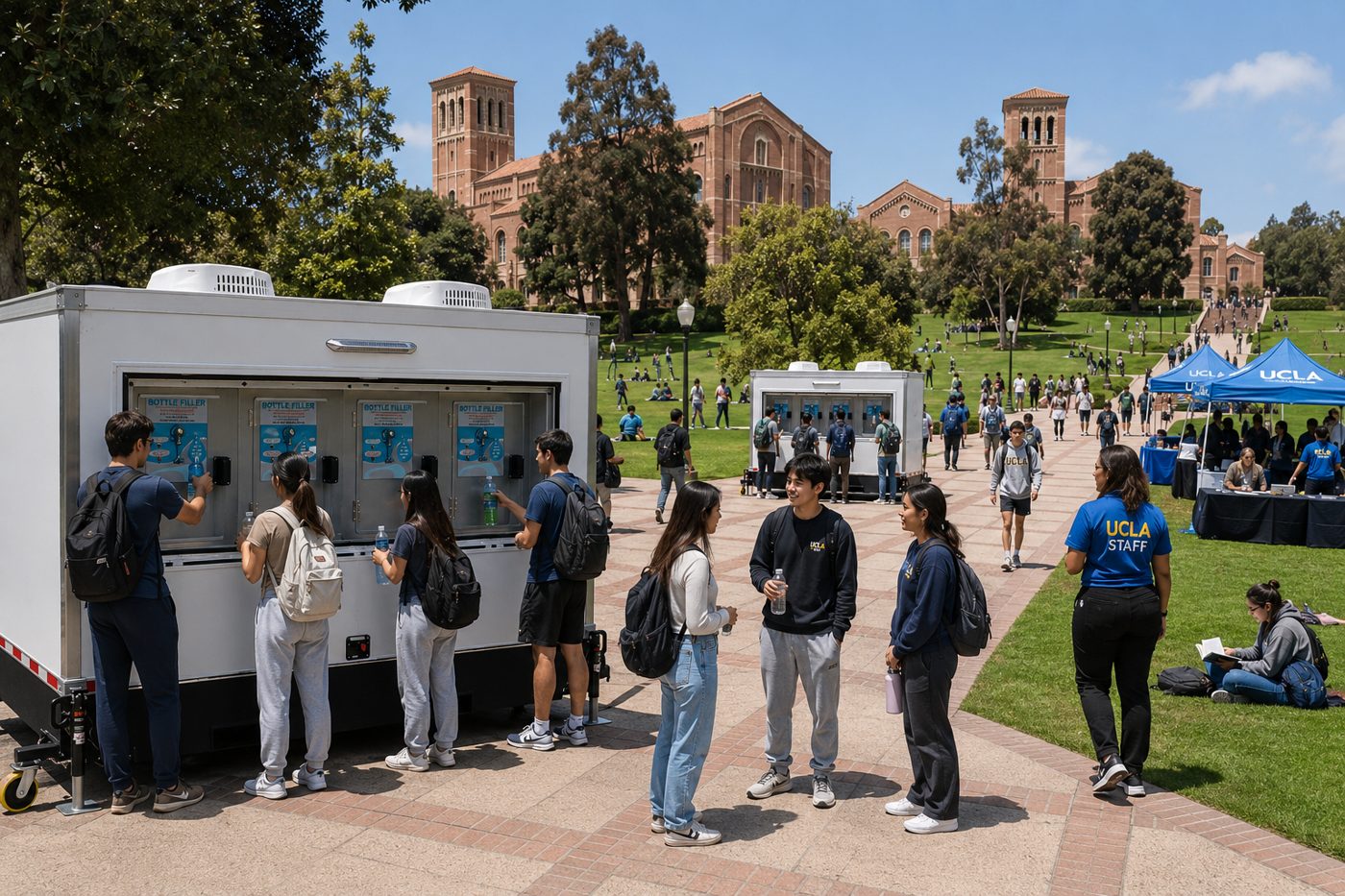
Sports complexes & youth tournaments
Elk Grove draws regional tournaments year-round, the soccer and baseball complexes off Big Horn and Bruceville, the District56 fields, the high-school stadiums across the Cosumnes district. Hundreds of kids, parents, and refs spend full Saturdays in open Valley sun. A station gives every field steady cold refills without somebody hauling cases of bottles cart by cart from the parking lot.
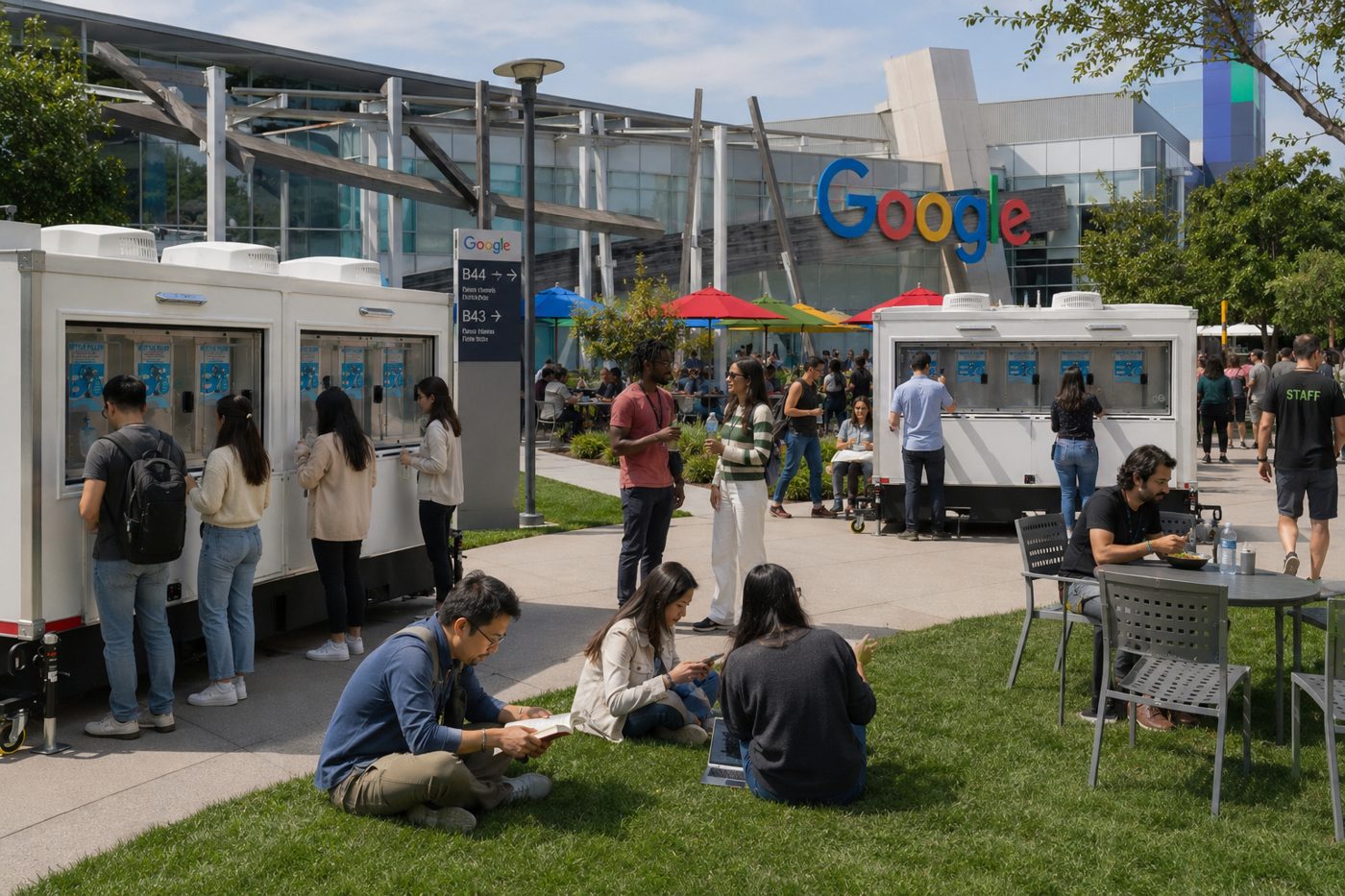
Agriculture, corporate & disaster response
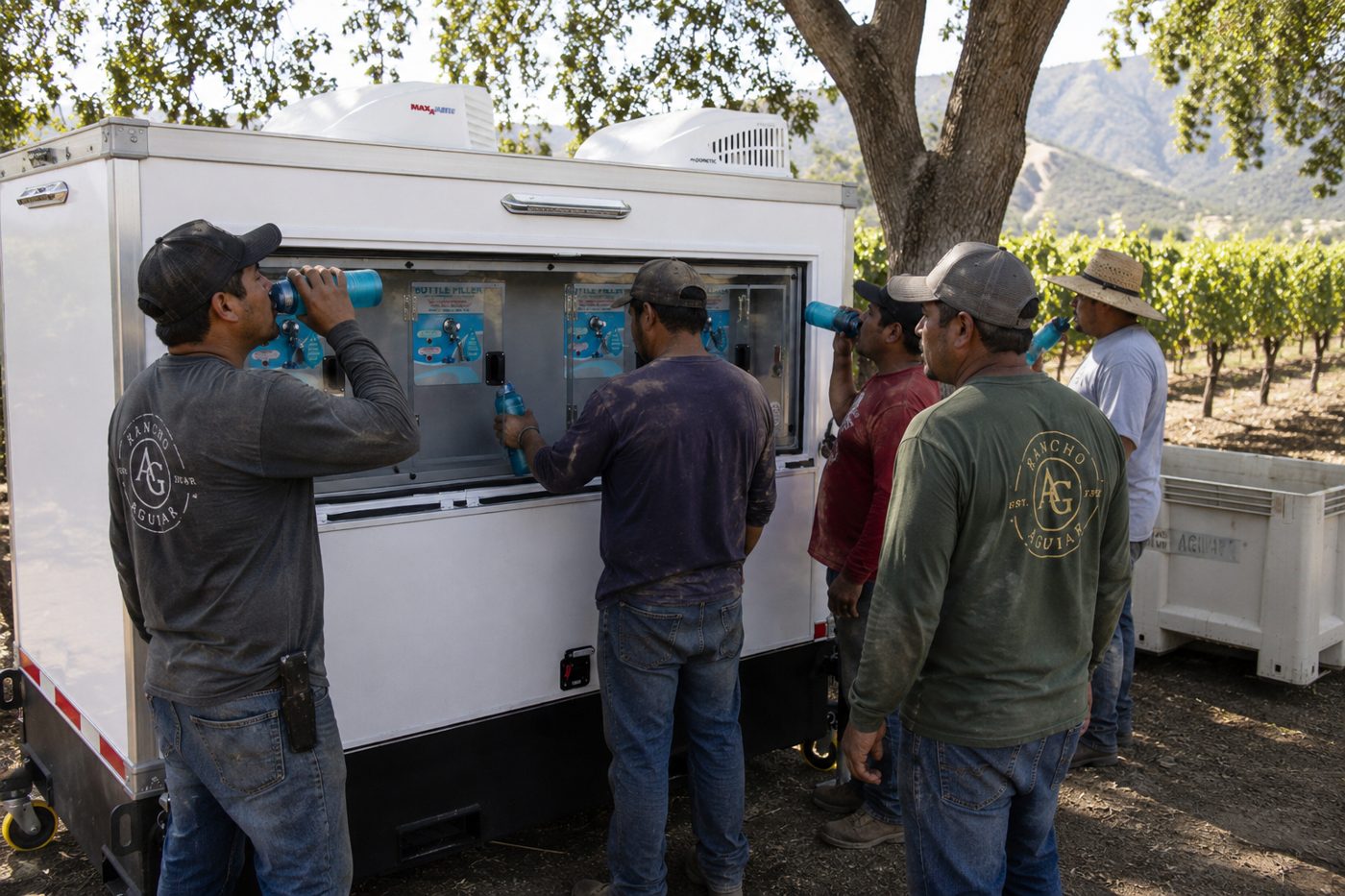
The farmland and vineyards ringing Elk Grove out toward Sheldon, Wilton, and the Cosumnes floodplain put crews in some of the most heat-exposed labor in the state, and jug-fill and hose-bib taps let them refill right at the row. We also set trailers for company field days and outdoor corporate events, and when a heat emergency or a broken water main strikes a Sacramento County neighborhood, we can move potable water to cooling centers and relief base camps fast.
City water, run through three stages and a UV chamber, then chilled
Most of Elk Grove drinks from groundwater that the Sacramento County Water Agency and SMUD-area utilities pull from the regional aquifer, and county-edge parcels near Sheldon and Wilton often run on private wells with their own mineral profile. Both are perfectly legal to drink, but neither pours the way crews and event crowds expect from a bottle. We take that incoming supply, send it through four treatment stages and a UV chamber, then hand it to an onboard chiller. What lands at the tap is cold and clean enough that people actually drink it through a long Valley afternoon.
Sediment stage
Valley groundwater and the older mains in parts of the south county carry sand, scale, and fine particulate that a bottle never shows. The first stage traps that grit before it reaches the spout, which matters most on a graded Laguna Ridge pad where dust is already in the air.
Carbon stage
Sacramento-region tap can run hard and mineral-heavy, and chlorination leaves a taste many crews quietly avoid. Activated carbon pulls the chlorine and the flat mineral edge out and evens the flavor. On a 100-degree Bilby Road slab day, taste is the deciding factor between a crew that drinks on schedule and one that rations.
Micro-particulate stage
Older service lines and well plumbing on the rural fringe can pick up grit and fine sediment on the way to the tap. A sub-micron cartridge catches those, so the pour is safe for a framing crew, a youth-tournament parent at the Big Horn complex, or a vineyard hand alike.
UV disinfection
A well-fed parcel out past Wilton or a long tow to a Cosumnes-floodplain job can introduce microbes that filtration alone won’t catch. The final UV chamber deactivates bacteria with no added chemicals, so the last pour of the day is as clean as the first.
Four ways to fill, one of them ADA
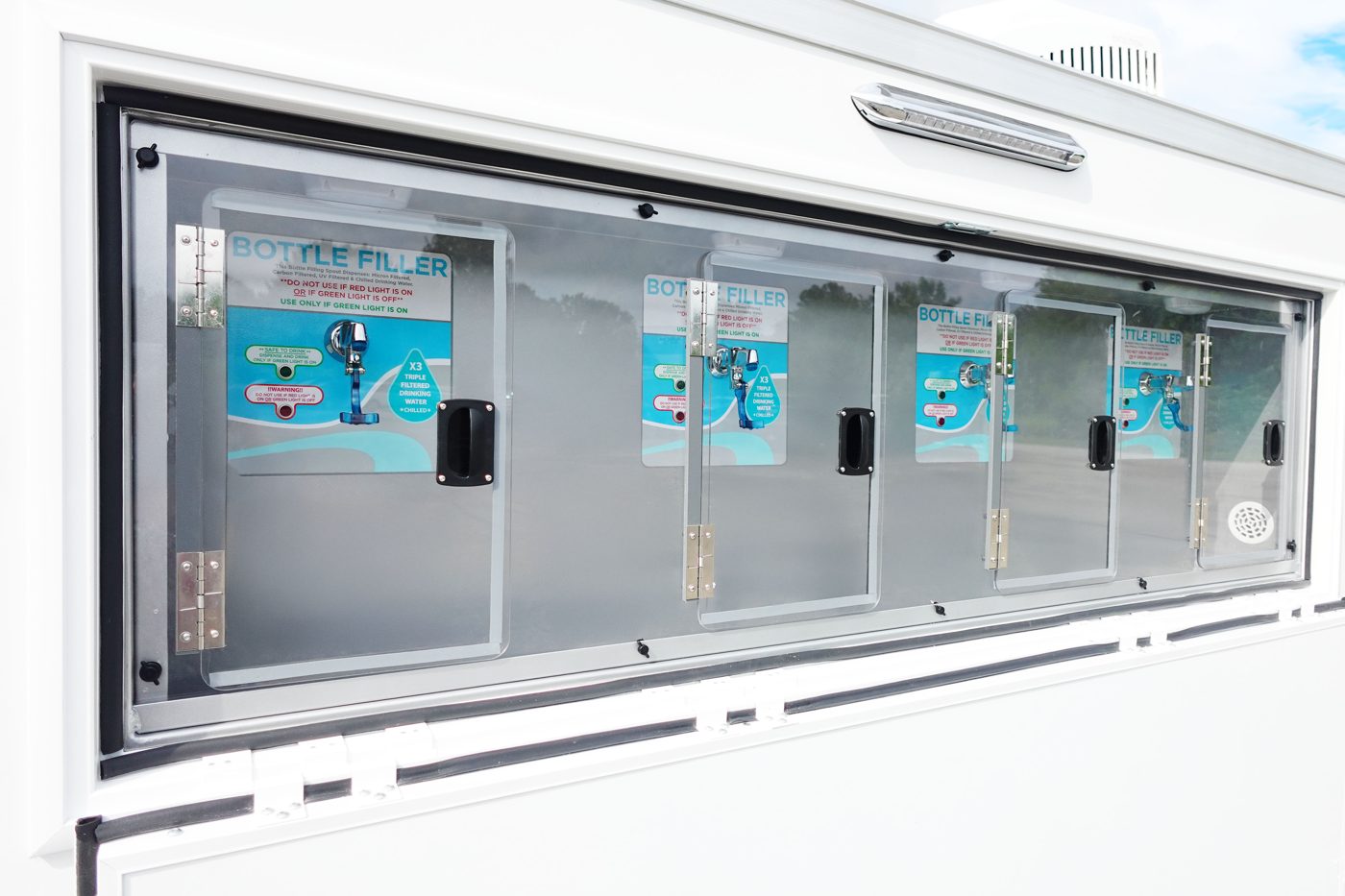
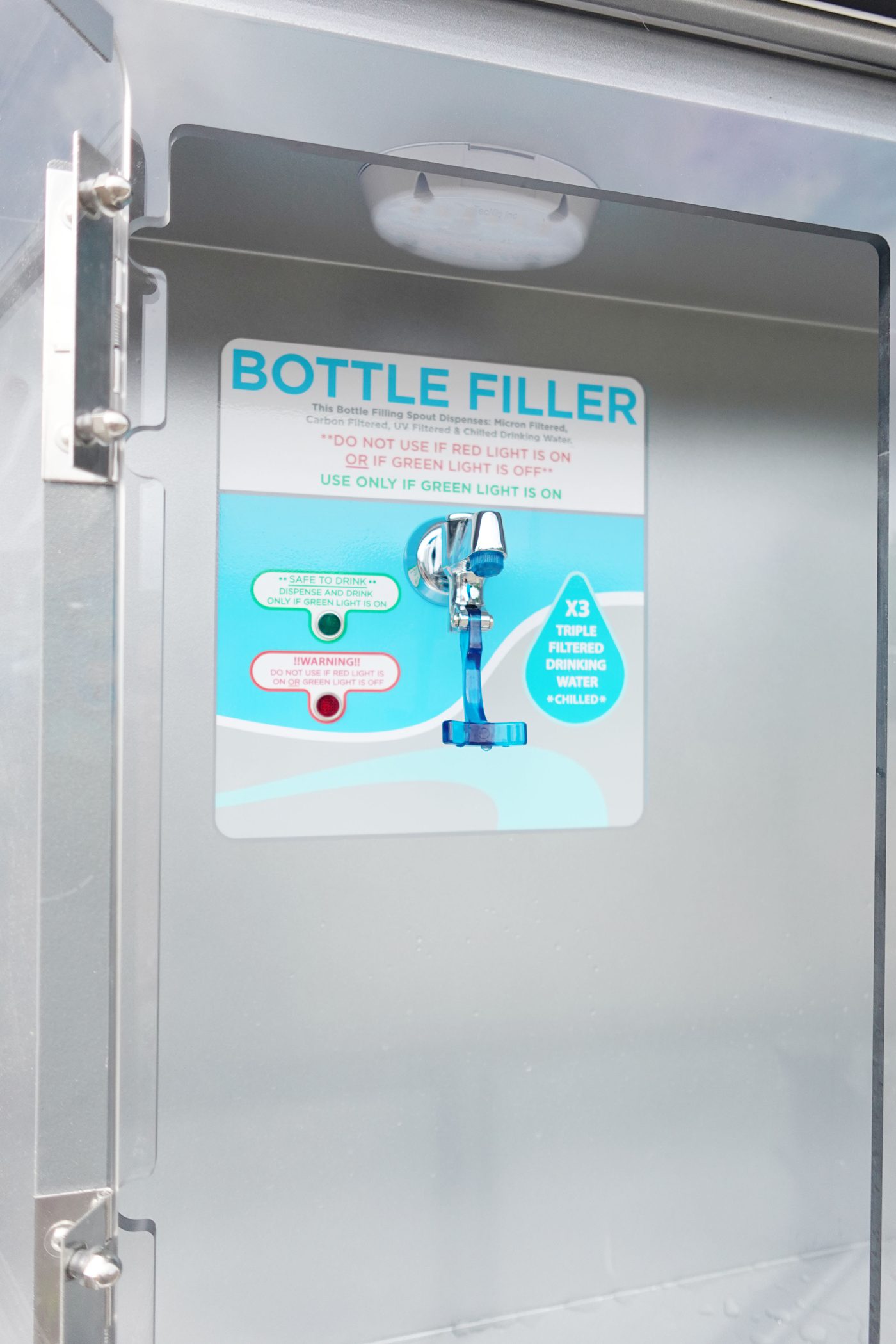
The four push-back spouts along the awning wall handle the bulk of the traffic, a bottle against the bar and the pour starts. One of the four sits at ADA-reachable height, which keeps a District56 crowd or a mixed jobsite crew on a single setup instead of a separate accessible unit. There are two more fill points people overlook: the rear large-jug spout charges five-gallon Igloo coolers and personal hydration packs for crews working the far rows of a Sheldon vineyard, and the side hose-bib taps draw water for wash-up, dust control, and field tasks. The plumbing between tank and tap is stainless and food-grade end to end, so the filtered, chilled water doesn’t pick anything back up before it reaches you.
One Signature tank holds 300 gallons, near 2,400 sixteen-ounce fills, and our tankers top it back up on demand. On a packed Old Town festival evening or a double-shift Highway 99 warehouse pour, that means the trailer keeps pace with the draw instead of becoming the thing everyone waits on.
We tow it in, fill it, and wire it up, usually pouring cold inside the hour
Your Elk Grove crew never has to run the unit. We place it, fill the fresh-water tank, make the hookup, and walk your staff through the basics, all before our truck pulls away.
Give us the rundown
How many people, how many days, the exact spot it parks on your Elk Grove site, and the power on hand. With those four, we size it correctly on the first pass.
We roll out to you
Figure roughly 45 minutes from dispatch to anywhere in Elk Grove or Sacramento County, and 24-hour emergency runs whenever a heat advisory settles over the Valley floor.
We get it pouring
On arrival we level it, fill the 300-gallon tank, and connect the power, drawing on one to three standard 120V circuits or a lone 50-amp 240V drop, whichever your site can give.
We keep it stocked
From there our tankers come back on a schedule paced to how fast your crew or crowd drinks it down, and we service the unit for the full length of the rental.
A remote parcel with no power on it? That goes in the quote. The trailer sips electricity, and with our service fleet behind it we’ve kept Elk Grove stations running on sites with zero permanent power. Just tell us what the lot offers and we’ll figure out the rest.
In a Central Valley summer, cold water access is the law, not a courtesy
California is one of the few states with a standing outdoor heat rule on the books, and it applies square in Elk Grove’s lap. The Cal/OSHA Heat Illness Prevention Standard, Title 8 §3395, kicks in at 80°F and tightens past 95°F, and it spells out three things an outdoor employer owes a crew: shade, rest, and water. On the water side, the rule is specific. Fresh, pure, suitably cool drinking water has to be available, free, and close enough that workers can reach it without a long walk, with enough on hand for one quart per worker per hour, roughly two gallons across an eight-hour shift.
A station turns that legal duty into something a reviewer can actually point at. It’s a fixed, mapped source of cold potable water on tap, the backbone of a working Heat Illness Prevention Plan and the kind of thing a Cal/OSHA inspector wants to find on a walk-through. Sacramento County routinely stacks dozens of days past 100°F across June, July, and August, with stretches where the overnight low barely cools, so the high-heat provisions of §3395 are in force here for months at a time, not a single week.
- Fresh, suitably cool, free potable water within easy reach of the work face
- Volume to cover one quart per worker per hour, the §3395 benchmark
- Centralized, documentable hydration points for your written HIPP records
- Supports acclimatization and the paid recovery breaks the standard requires
A few things staging water around Elk Grove has drilled into us
Years of dropping stations across Sacramento County have shaped how we run every job. A handful of lessons that stuck:
The single thing that decides whether a station works is how far it sits from where people sweat. On a Laguna Ridge tract build, the GC wanted it at the gate so the delivery truck could reach it easily, but the framers were three streets deep into the subdivision. By the second day half the tank was still full at quitting time and the crew was leaning on a warm cooler instead. We dragged it to the interior staging lane the framers actually walked past, and consumption jumped overnight. The lesson stuck: deliver-truck convenience and crew convenience are different problems, and the crew’s wins every time.
The second lesson is that the Valley forecast, not the calendar, sets the refill schedule. The hard days here aren’t evenly spaced. They come in stacked runs when the inversion traps heat for the better part of a week. We started reading the seven-day instead of refilling on a fixed loop, and pre-staging a spare tanker ahead of the bad stretches. The first time three south-county jobs and a Big Horn weekend tournament all peaked on the same Saturday, that spare truck is the only reason none of them ran dry.
The third lesson is that contractors don’t believe the chiller until they feel an August pour. A Highway 99 warehouse GC was sure no trailer could hold 300 gallons genuinely cold on an unshaded slab in late summer, so we set one up on a trial and let him check the tap himself at 3 p.m. on a 103-degree day. He added a second unit that same week. The selling point was never the spec sheet. It was a cold cup of water in his hand at the hottest hour, on his own lot.
Events rewrote the placement lesson at a different scale. At an early Old Town street fair we ran one station and watched the refill line back up against the food-truck row by late afternoon, because a few thousand people in Valley-floor heat empty a single point fast. The next year we split the same volume across three stations spread to the corners of the footprint, and the bottleneck disappeared. A crowd teaches the same thing a crew does, just louder: hydration on a hot Elk Grove day is something you actively manage, start to teardown.
When the crowd is outside and the Valley sun is full on
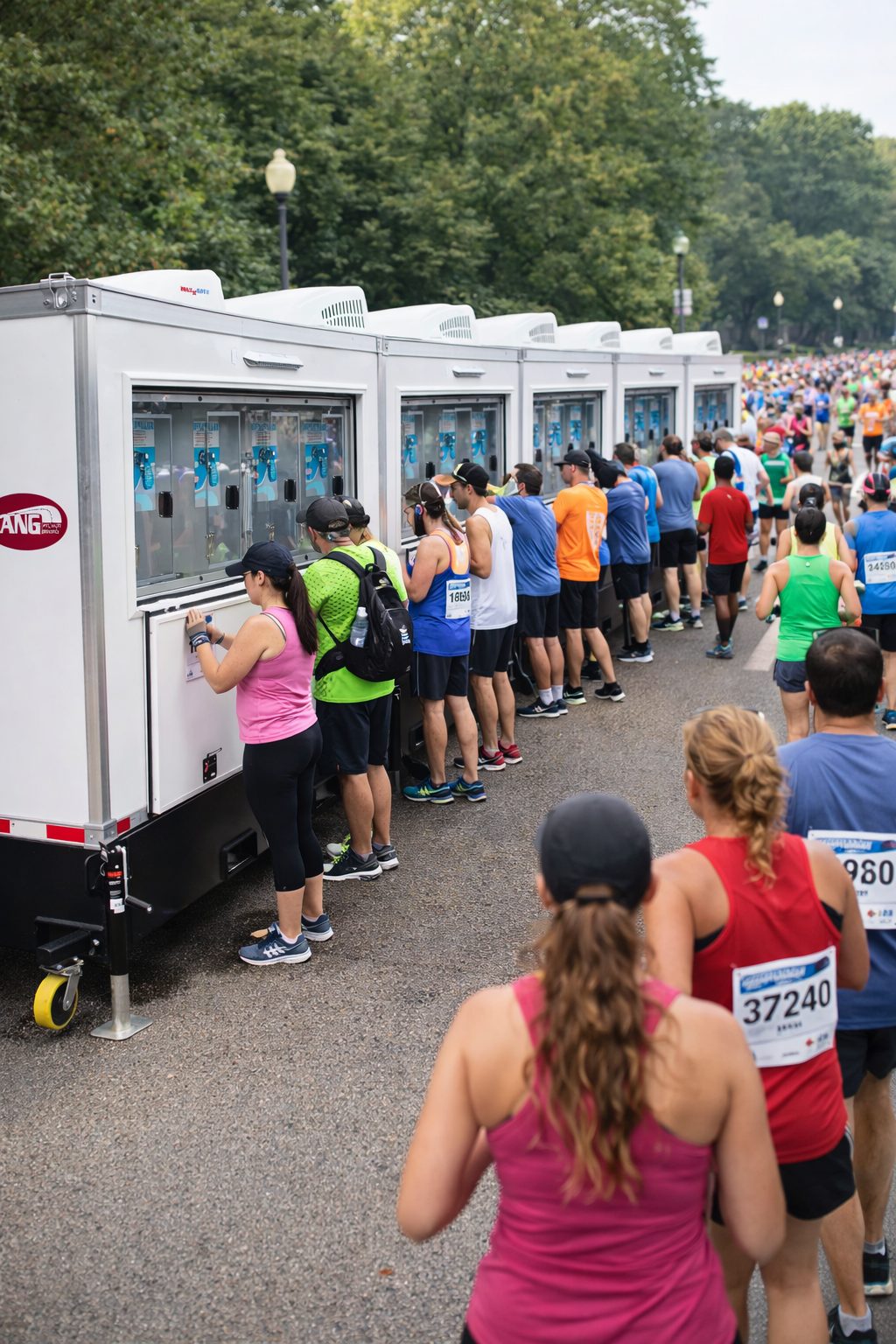
The way coastal towns build their plans around wind, Elk Grove organizers build theirs around heat. Whether it’s a District56 concert, an Old Town street fair, a charity 5K on the Laguna Creek trail, or a school-district fundraiser, the event gets its own self-contained trailer putting out a steady supply of cold water at clean refill points. Your team also dodges the whole circus of trucking in, icing down, and carting out a pile of single-use plastic, which on a packed show day is practically a second job.
On a sprawling footprint we’ll scatter several trailers so the water is never a long walk away, and we time the delivery and the pickup to your event hours rather than ours. Guests read it as hospitality. Your operations lead reads it as crowd safety. Both readings hold, and on a 100-degree Elk Grove Saturday, both are the point.
A fast-growing city on a hot valley floor is a real hydration challenge
Elk Grove sits where two trends collide: one of the fastest-growing populations in California and a Central Valley summer that doesn’t let up for months. The people building that growth, and the crowds enjoying it, are out in the worst of the heat.
Elk Grove went from a rural crossroads to a city of more than 170,000 in a couple of decades, and it keeps climbing. The southeast growth area, the Laguna Ridge and Laguna West neighborhoods, the commercial corridors along Highway 99 and Elk Grove Boulevard, all of it means crews in open sun for years at a stretch. Add the regional draws, the sports complexes pulling tournament traffic and the District56 event calendar pulling concert crowds, and you have a lot of people standing on hot asphalt and bare grass from late spring into October. A typical Elk Grove summer stacks dozens of days at or above 100°F, and the Valley’s inversion can hold the heat and haze in for days, so the danger window runs long rather than short.
The duration is what makes it genuinely hard to plan. A coastal contractor can wait out a short heat spike with a few extra coolers. An Elk Grove contractor on a build that runs May through October has no such luxury, and ice chests won’t carry that load. The draw is simply too large, water warms too quickly, and the daily grind of hauling, icing, and dumping bottled water never lets up. Only a centralized trailer that chills its own supply can hold steady across a full Central Valley summer without becoming a logistics headache in its own right.
The event side carries the same pressure on a compressed clock. A summer concert or a weekend tournament puts thousands of people outdoors for hours, and a hydration gap on a 105-degree Saturday isn’t a slow build, it shows up fast in the medical tent. Organizers who’ve run Elk Grove events through July know the difference between a crowd with easy cold water and one without, and they plan for it the way they plan for parking and shade.
We built our Elk Grove dispatch around exactly this pattern. We set refills by crew size and gate count instead of a fixed calendar, and we bolt on emergency drops during advisories. Because whether it’s a Laguna build or a District56 show, a hydration gap out here doesn’t just slow things down. It can stop a shift cold or send someone to Methodist or Kaiser South in an ambulance, and that’s the outcome the whole setup exists to prevent.
Past the station: the trucks that keep an Elk Grove site supplied
The station is the visible piece, but most jobs need water moving in and out around it. We run our own fleet for that, routed down the Highway 99 and I-5 corridors and across the Elk Grove Boulevard and Bruceville arteries, so a single contract covers fresh delivery, on-site reserve, transfer, and waste haul-off. One dispatcher, one set of trucks that already know the gate codes and the lay-down spots on your site.
Potable water trucks
Our tankers carry drinking-grade water out from the Elk Grove yard and refill the 300-gallon tank on a cadence matched to your draw. When a job outruns a single delivery, those same trucks charge holding tanks, cisterns, and bladders directly, a continuous Laguna Ridge concrete pour or a sold-out summer night at District56 being the usual reasons.
Bladder bags & buffer supply
Fold-flat bladders bank spare fresh water through the heaviest stretches, and they double as temporary greywater holding where a county-edge parcel has nowhere to drain. It’s plain gear, but it’s what bridges a rural Sheldon or Wilton site between tanker runs when the road in is long.
Pump trucks
When water has to move across a wide job rather than just arrive, a pump truck does it, charging tanks or relaying supply point to point. That earns its keep on the sprawling parcels in the southeast growth area and out toward the floodplain, where the trailer and the work face can sit a quarter-mile apart.
Vacuum & waste trucks
A vacuum truck draws off greywater and wastewater and carries it to a permitted Sacramento County disposal site, closing the loop cleanly. Nobody on your crew is left to sort out where used water goes. That haul-off is written into the job from day one rather than added later.
Most jobs use two or three of these, not all four. A remote ag parcel near Wilton usually pairs the station with a bladder for reserve and a standing tanker schedule. A big District56 event night tends to want a pump truck to spread supply across the grounds plus a single waste pickup at teardown. Tell us the shape of the job, and we build the combination around it, on one invoice, run by one local crew.
The handful of questions that turn a two-minute call into an accurate quote
A short conversation gets you a real number. These are the things we’ll ask, worth having on hand before you dial, and they show how we size each job to the work rather than quoting one default and walking away.
The four answers that shape the recommendation
- How many people? A 15-person framing crew on Bilby Road is a different animal from a 4,000-person District56 concert. The headcount, or the gate count, tells us how many trailers to stage and how aggressively to run the refill schedule.
- How long? A weekend tournament at the Big Horn complex, a three-week foundation pour, or a nine-month Laguna Ridge build each get their own service rhythm. A short event usually rides on buffer storage, while a long build runs on scheduled tanker fills.
- Where will it sit? Being towable, the Signature can settle into a yard, a raw parcel, an event lawn, or a tight staging lane. Pin down the precise spot, plus how our truck threads past the gate and any lay-down clutter to reach it, and we can place it where foot traffic naturally lands.
- What power is on site? Anywhere from one to three standard 120V circuits, or alternatively a single 50-amp 240V drop, will run the unit. Plenty of parcels past Kammerer and Sheldon have no permanent power, which is no obstacle at all, provided you give us the heads-up up front.
The smaller details that sharpen the plan
- The precise on-site spot for the station, and the route a delivery truck takes to it
- Whether your people sit clustered in one zone or fan out across the whole footprint
- Any §3395 heat-illness paperwork your safety program needs the station to back up
- Whether bulk water hauls, bladder reserve, or a waste pickup should ride on the same job
The line items a pallet of bottled water keeps off the invoice
Line-itemed on a purchase order, bottled water reads as the budget pick. Its real cost hides in the labor to haul it, the floor space to stage it, the cases that turn warm by noon, and the empties hauled to the curb afterward, and on the Valley floor every one of those runs steeper than it would near the coast.
The labor nobody budgets for
A bottled-water program is a daily chore for somebody on your payroll: cutting the order, taking the pallet off the truck, breaking it down, icing coolers before the gate opens, restocking through the day, then flattening empties for the dumpster. A foreman pulled off the work to babysit drinking water is the most expensive water you can buy. One Laguna-area builder we set up had a laborer making a mid-morning Costco-and-ice run on Bilby Road most days, close to ninety minutes round trip with traffic on 99. The station ended that run. It shows up full, our tankers keep it full, and the only thing it asks of your super is a place to park.
The warm-up problem
Ice that survives a coastal morning doesn’t survive an inland-valley one. A cooler stocked at 6 a.m. on a Sheldon ag block is lukewarm well before the Delta breeze even thinks about kicking in late afternoon, and the gap between is the hottest part of the shift. Warm water is water a crew leaves sitting, and a crew that stops drinking is a crew sliding toward heat illness right when the thermometer peaks. The station’s onboard chiller has no warm-up curve, so the 2 p.m. pour during the worst of a 105-degree Elk Grove afternoon is exactly as cold as the sunrise pour, which is the pour that actually keeps people upright.
The storage and footprint tax
On the infill jobs going up in Laguna Ridge and the southeast growth area, lay-down space is already tight, and a week’s worth of bottled-water pallets eats square footage you’d rather give to materials. The cases roast in full sun until someone opens them, and the empties stack up faster than anyone hauls them off, especially on a fenced commercial pad off Elk Grove Boulevard with one gate and no slack. The station takes a single parking stall and serves a crew that would otherwise plow through several cases a day, freeing the staging area for the actual build.
The waste that follows you
Every bottle bought is a bottle to landfill, and an Elk Grove summer job or a full District56 event season produces them by the truckload. California’s CalRecycle mandates and the city’s own diversion goals mean that waste is a line a procurement or sustainability lead now has to answer for, not just absorb. A refill station drops that count to effectively nothing, which turns a reporting liability into a number a project manager is glad to put on the closeout sheet.
Staging cold water across Elk Grove and south Sacramento County
We dispatch across all of Elk Grove and reach well into south Sacramento County, from the Laguna neighborhoods and Old Town out to the rural fringes near Sheldon, Wilton, and the Cosumnes floodplain. Land anywhere in that footprint and you’re inside our coverage. It applies the same to a District56 event, a Laguna Ridge rooftop, a Highway 99 commercial pad, or a vineyard row out past the city limits.
Laguna RidgeLaguna CreekFranklin
SheldonWiltonVineyard
Elk Grove ParkDistrict56Galt
FlorinSouth SacramentoRancho Cordova
Cosumnes
Working a corridor instead of a single address? We follow the routes the south county runs on, Highway 99, Elk Grove Boulevard, Bruceville and Power Inn, so multi-site projects get the same fast turnaround as one stop.
The questions south-county crews and event teams actually ask us
What’s the typical delivery time to an Elk Grove job site or event?
From our Sacramento-area dispatch, most Elk Grove and south-county runs are pouring within about 45 minutes, and we keep trucks rolling 24 hours a day through heat advisories. Call in on a triple-digit morning with nothing cold staged and a unit is usually on site before the lunch break. Two things shift that window: how a truck reaches the spot past the gate and lay-down clutter, and what power the site offers. Tell us both up front and we’ll slot the run accurately.
Does the water come out cold, or merely filtered?
Both, and the chill is the part that matters. The onboard chiller keeps the supply cold from the sunrise pour through the last one at clock-out. Come an Elk Grove July, lukewarm water just sits there untouched while a crew slowly dries out. People will drink cold water, and drinking is what keeps heat illness at bay, so on our books the chiller counts as safety equipment, not an extra.
What’s the tank capacity, and what happens if it runs low mid-shift?
With 300 gallons on board, the Signature is good for roughly 2,400 sixteen-ounce servings. Through a triple-digit afternoon on a large crew, or a sold-out District56 night, our own tankers keep it charged on a cadence set by how fast you draw it down, so the tank size never becomes the ceiling. Keeping track of refills falls on us, not on you.
Does a station help us meet Cal/OSHA heat-illness rules?
It backs them up directly. California’s Heat Illness Prevention Standard, Title 8 §3395, calls for fresh, suitably cool, free drinking water within easy reach of outdoor workers, sized to a quart per worker per hour. A station hands you a fixed, mapped cold-water source you can write into your Heat Illness Prevention Plan and walk a Cal/OSHA reviewer right up to. The safety program is yours to write; we just supply the hydration that program counts on being there.
Is the station accessible for people with disabilities?
Yes. Of the four push-back filling spouts on each trailer, one is mounted at an ADA-reachable height, so the unit serves everyone at an Elk Grove event or job site with no separate setup needed. The rear large-jug spout fills five-gallon coolers and hydration packs, and the hose-bib taps cover crew chores and event support.
Do you handle events too, or just job sites?
Both, and events run close to half our work in this area. For a District56 concert, a 5K, the Western Festival, or a corporate field day, we’ll set one trailer or several around the grounds and match the drop-off and teardown to when your event actually runs. Your guests get a steady cold supply at clean refill points, and you skip the expense and the litter of hauling in pallets of bottles.
What information do you need to get a station out to me?
Four basics: your headcount or gate count, the rental length, where on the Elk Grove site it parks, and what power is on hand. The Signature will run on anything from one to three standard 120V circuits up to a single 50-amp 240V drop. No power at all on a far-flung lot out toward Sheldon? Mention it and we’ll fold a solution into the quote.
Do you serve all of Elk Grove and the rural areas around it?
The whole area. Our dispatch runs Elk Grove proper plus Laguna, Laguna West, Laguna Ridge, Franklin, Vineyard, and out to the rural edges around Sheldon, Wilton, and Galt, along with neighboring Florin, south Sacramento, and Rancho Cordova. Multi-site work strung along Highway 99 and Elk Grove Boulevard is routine for our trucks.
How does the taste compare to a bottle of water?
Crisp and neutral, without the chlorine bite. The carbon stage strips out the chlorine and the seasonal off-notes Valley tap can pick up, so what comes out tastes fresh instead of like a garden hose left in the sun. It matters, because a station only works if people genuinely want to drink from it. We file taste under safety, not under nice-to-have.
How big a crew can one station actually serve?
A large one, because the real limit is the refill cadence, not the number of taps. Four positions clear a crew through quickly on a hot break, and a full 300-gallon tank covers about 2,400 sixteen-ounce pours before it needs a top-off. For very large Elk Grove crews or major events, we either tighten the tanker run or drop a second trailer, so the supply scales up with your numbers rather than capping them. Give us your peak count and we’ll build the volume to match.
The forecast just spiked, can you deploy on the same day?
That’s exactly what the 24-hour line is for, and it’s why a lot of south-county clients keep our number saved. We watch the Valley seven-day and pre-position spare tankers before the stacked-heat runs the inversion tends to produce, so we’re not starting from cold when the calls come. A crew or event team that wakes up to a sudden triple-digit Elk Grove day with dead hydration can usually have a unit pouring before the afternoon peak hits.
Trusted by the south-county teams that can’t let a crowd or a crew run dry
“We had thirty-five guys on a Laguna Ridge build in August and the bottled-water plan came apart by mid-morning. They got a station out to us that same afternoon, and the water stayed genuinely cold all day. We’ve run one on every summer job since.”
“Across our summer series at District56, the refill stations took our single-use bottle order down to nearly zero and kept the lines short. They ran the drop-off and the pickup on our timetable, not theirs. We rebooked without thinking twice.”
“Our safety review wanted documented §3395 water access for a heat-exposed ag crew out by Sheldon. A mapped station gave us exactly that for the HIPP, and the refills showed up before we ever ran short.”
Service information current as of June 2026.
Lock in cold, filtered water for your Elk Grove site or event before the next hot stretch
Give us your crew or gate count, the dates, and the spot on the site where the station should land. We’ll match the job to the right setup and have a trailer out to you anywhere in the county, generally about 45 minutes after dispatch.