Escondido Bottled Water Station Rentals for Job Sites & Events, Rapid Dispatch
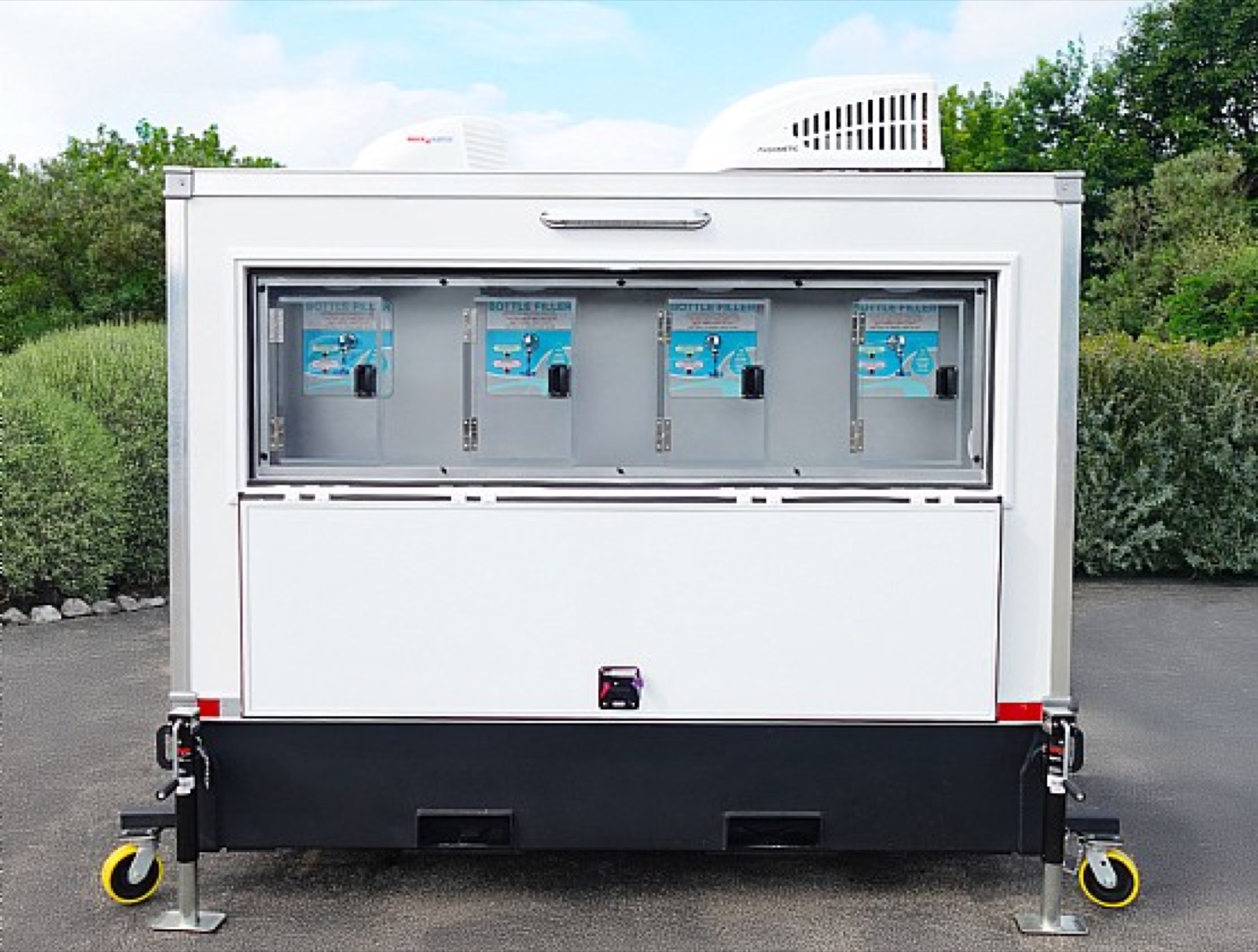
We deliver cold, filtered bottled-water stations across Escondido, then keep them refilling through the hottest part of the day. Need one for a Cruisin’ Grand weekend on Grand Avenue, a Hidden Meadows build, or a framing crew baking on a San Pasqual Valley pad in July? The trailer tows in, levels off, and pours chilled drinking water on tap. No warm pallets of plastic, no melted cooler ice, no crew walking back to a truck for a drink.
- Roughly 45 minutes across inland North County
- Cold, four-stage-filtered drinking water
- ADA-height fill point
- Built for Cal/OSHA §3395 heat rules
- Licensed & insured
- Rapid dispatch, day or night
Cold bottled-water stations for inland Escondido job sites and events, kept full all day
Escondido is the hot valley behind the coast. While Oceanside and Carlsbad coast through the seventies, the basin here regularly bakes in the high nineties and clears 100 from July into October, with the marine layer burning off by mid-morning if it shows at all. A paving crew on East Valley Parkway and a Saturday crowd on Grand Avenue feel the same dry heat radiating off pavement and stucco. Warm water is the first thing either group quits drinking, and a crew that stops drinking is a crew headed for trouble. That is the gap we close: a self-chilling trailer parked where the people actually stand, recharged from our own water trucks so the tap never runs dry.
Out to your site fast, day or night
An Escondido drop usually lands about 45 minutes after we roll, and we run rigs after hours when a build or an event gets caught short. When a site super finds out at dawn that a Santa Ana day is coming and the only water on hand is warm flats from the gas station, that turnaround is the whole morning.
The last fill is as cold as the first
Built-in refrigeration runs the whole time the trailer is on site, so a late-shift pour on a 102-degree day tastes every bit as cold as the one your crew took at clock-in. Workers reach for chilled water and walk past warm. A cooler nobody opens does zero good for someone on a Valley Center pad in afternoon sun, which is why we treat the chill as the entire value, not a perk.
Delivered, serviced, refilled, hauled off
No purchase order to cut, no morning ice runs, no flattening empties when the shift wraps. We place the trailer, recharge it off our own tankers, maintain it for as long as you have it, and haul it away when the job wraps. A single Escondido contact owns the whole water loop, beginning to end.
The line I give every new caller in the valley is simple: a tank of water nobody drinks from is worth about as much as the order you skipped. I have stood next to flats of warm bottled water baking by a Grand Avenue festival gate while forty people queued at one weak fountain. I have watched a cooler iced before sunrise go to bathwater before a grading crew’s first break on a bare inland pad. Setting the trailer down and pulling away is the easy half of this. The half that counts is sizing the rig to your crowd or crew, pacing refills to how hard you actually draw it down, and answering the late-night phone the way you’d want it answered the day a Santa Ana forecast goes sideways. Quickly.
One towable trailer made for Escondido heat, dust, and distance
We run a single purpose-built rig across inland North County: the Signature Series water station trailer. Because it rides on a full road chassis, it tows straight to wherever the day is happening, a dirt pad off Citracado Parkway, a vendor row on Grand Avenue, a graded build in Hidden Meadows, an avocado grove out past San Pasqual. Nothing to bolt down, no permanent plumbing. Filtered, chilled water flowing the same afternoon the trailer shows up.
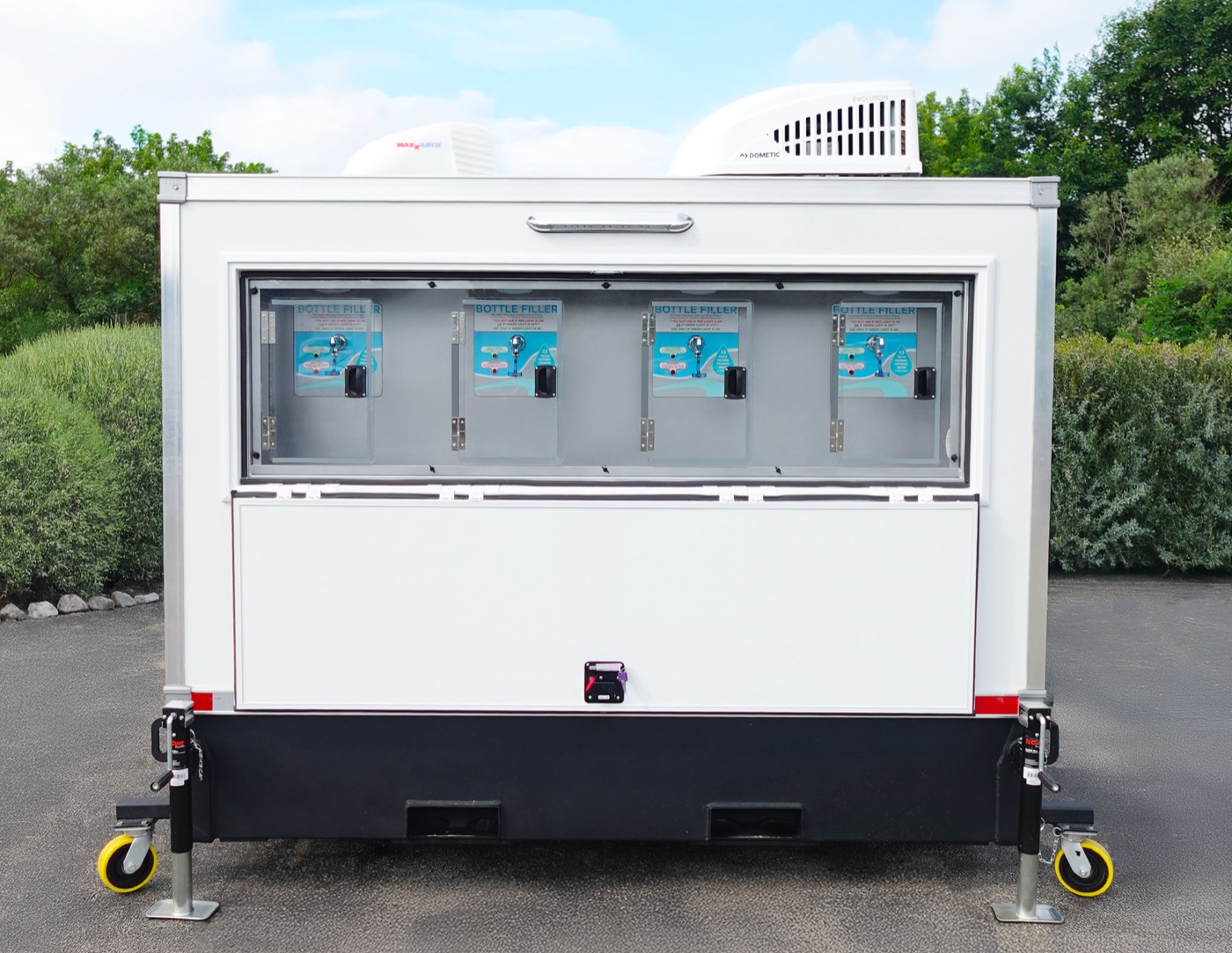
Signature Series specifications
On a full trailer chassis with road tires and a hitch, it hauls to a job site, a festival field, a fairgrounds event, or a wildfire staging area. Escondido contractors and event leads ask for this rig by name, built to roll in, level out, and start pouring the day it lands.
| No. of stations | (4) Bottle Filling Stations |
| Length | 12′ 3″ |
| Weight | 3,100 lbs. |
| Height | 8′ |
| Fresh water tank | 300 Gallons |
| Power requirements | 1–4 dedicated 20A/120V circuits OR 1 dedicated 50A/240V circuit |
| No. of AC units | 1 |
Why this trailer suits a hot inland valley
Sun and distance are what the Signature is designed to beat. Four push-back taps line an exterior wall beneath an awning, so a Cruisin’ Grand crowd or a concrete crew cycles through fast rather than crowding a lone nozzle. Built-in chilling and an onboard AC unit keep the pour cold while the rig itself sits in full afternoon glare on an open Escondido lot, the precise conditions under which a cooler or a stack of bottles gives up before noon.
A 300-gallon reservoir gets a good-sized crew or crowd through an entire shift, and because the rig rides on its own road chassis, we can reposition it across a wide event ground or shift it to the next phase of a build with nothing bolted down to remove. Its power input spans a broad range, which means the same trailer handles a finished venue by the California Center for the Arts as readily as a stripped pad out toward Valley Center that we energize off our own gear.
Those four taps are only part of the story. A large-jug outlet at the rear tops off five-gallon coolers and personal packs, while a row of hose-bib spigots takes care of crew chores, wash-up, and event logistics. The result is one rig handling the entire hydration job for an Escondido site or gathering. We have run a single trailer for a grading crew off Felicita Road through the morning and then a concert lawn at the Center for the Arts the same night, never hauling out a second piece of equipment.
Why one station beats trucking in bottled water all summer
Take a 50-worker Escondido crew on a single warm-season project and the numbers make their own case. When it’s triple-digits inland, each person goes through six or seven bottles in a shift, which leaves your team buying, lugging, chilling, and disposing of north of 320 plastic bottles a day, repeated week after week.
Stretch that over a 170-day build and the count sails past 54,000, and on the drawn-out multi-phase jobs up the I-15 and along SR-78 it runs far higher still. A lone trailer stands in for that whole mountain of plastic, pouring cold water on tap with nothing bound for a landfill.
It’s a logistics decision before it’s a green one
The plastic problem is genuine. As a country we throw away tens of millions of these bottles daily, roughly two-thirds never get recycled, and one bottle can outlast the structure it was emptied beside. Put that in your sustainability column by all means. Yet most Escondido project managers and event leads switch for a plainer payoff: a single shared trailer ends the daily fire drill. There’s no recurring water order to babysit, no cooler turning warm before the first break, no heap of empties cooking by the gate. Your super stays focused on building, and your event lead stays focused on the show, rather than minding water through a hot afternoon.
Since our tankers keep the unit charged, the available supply rises and falls with the day. If turnout doubles for a holiday weekend along Grand Avenue, you won’t blow past your plan. We simply come back, refill, and keep every tap cold.
Hydration sized for how inland North County actually runs
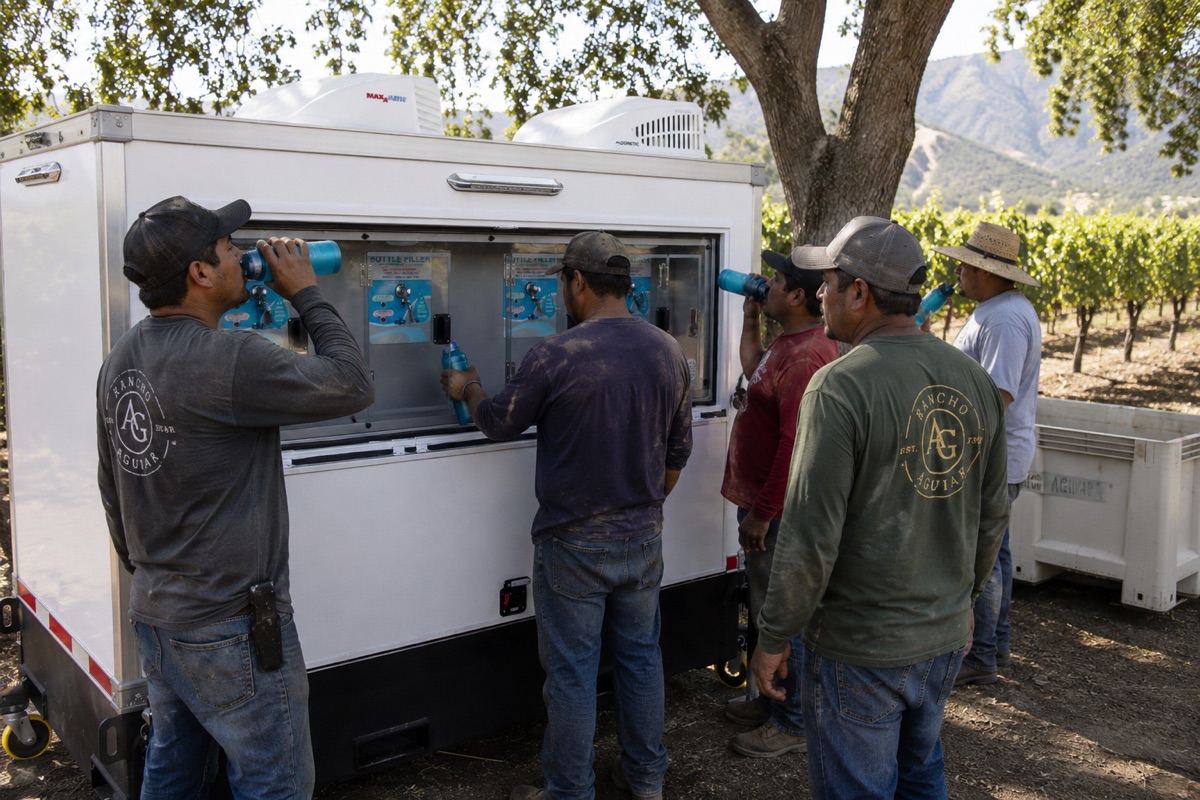
Escondido doesn’t have one hydration problem. It has several. A grading crew off Citracado needs one setup, a festival on Grand Avenue needs another, an avocado harvest out toward San Pasqual needs a third, and a wildfire staging camp needs something we can roll in overnight. Here is where these trailers earn their keep, from downtown and the Westfield North County area out the SR-78 toward San Marcos, up I-15 to Hidden Meadows and Deer Springs, and east into the groves and ranchland.
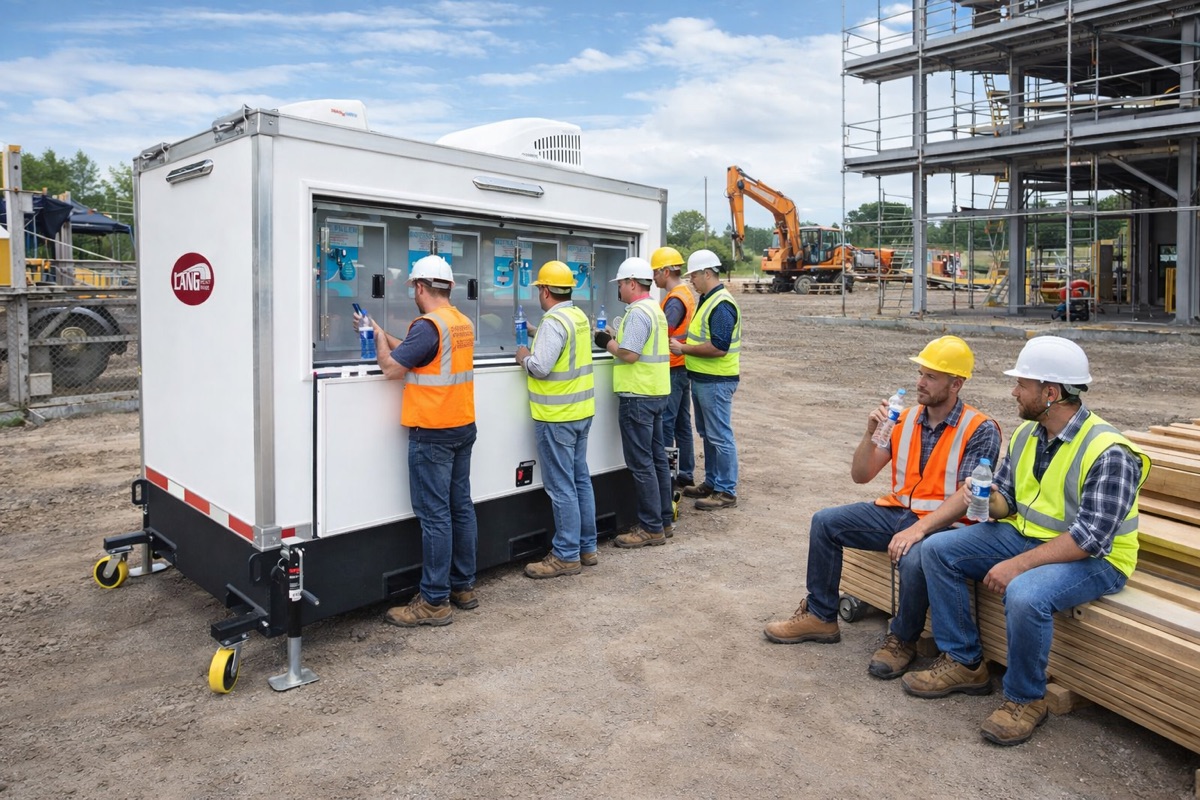
Construction & the I-15/SR-78 build corridor
The building never really stops out here. New housing and mixed-use keep filling in around downtown and South Escondido, road and utility work runs steadily along the SR-78 corridor toward San Marcos and Vista, and the I-15 climb up to Deer Springs and Hidden Meadows stays active. Those crews work dry, open sun for months on end. We set trailers right where the work is, a foundation pour off Citracado one week and a streetscape job near Grand the next, so generals and trades keep mapped, documented cold water within a short walk of every crew.
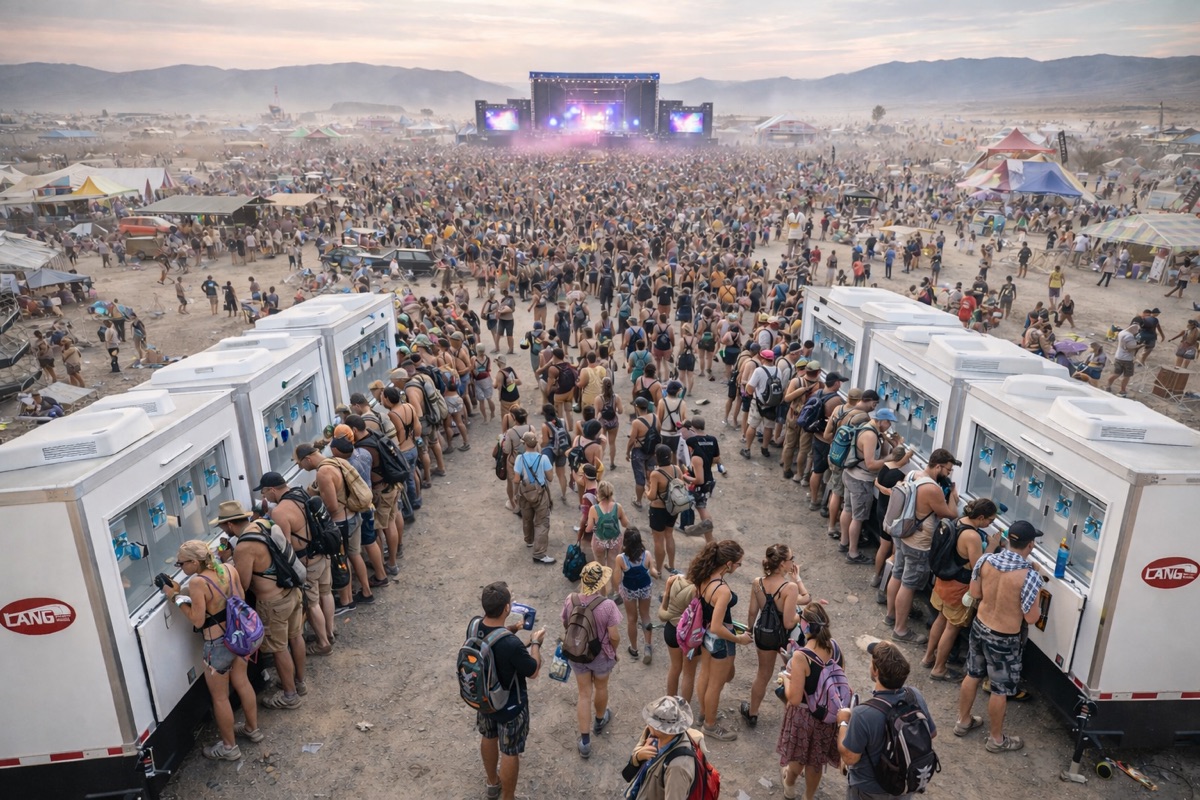
Grand Avenue events, fairs & concerts
Friday-night Cruisin’ Grand, the Escondido Street Faire, lawn concerts at the California Center for the Arts, beer events out at Stone Brewing’s World Bistro & Gardens, races that step off downtown at dawn. A crowd standing in dry valley sun burns through water quickly, and shade and public fountains are usually in short supply. A trailer gives organizers a dependable cold source and tidy refill points, sparing them the truckloads of single-use plastic that otherwise roll into downtown and have to roll back out.
Avocado, citrus & vineyard labor
Head east of town and the heat climbs while the shade thins out. Picture the avocado and citrus groves of San Pasqual Valley and Valley Center, the small vineyards and tasting rooms of the Escondido wine country, the landscaping and solar crews along the ranchland fringe. Few jobs in the county sit more exposed to the sun than these. Jug-fill and hose-bib taps put refills right at the row, so a field crew tops off coolers and personal packs without trekking a half-mile back to a truck on a dirt lane.
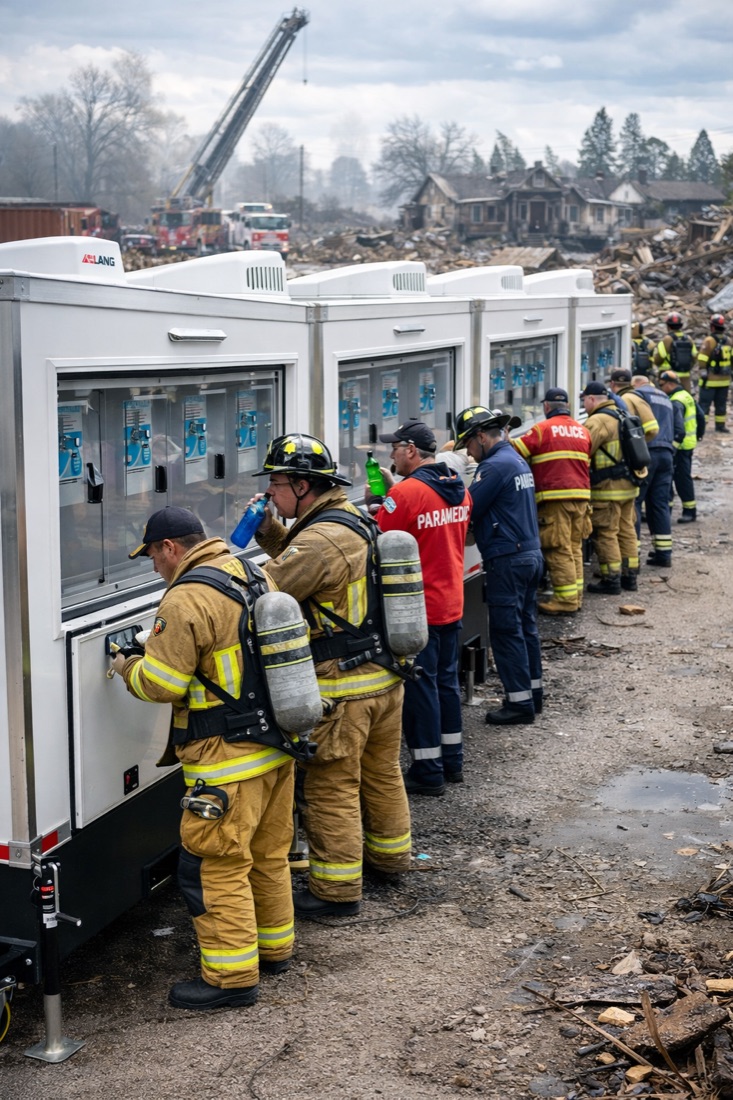
Wildfire response & emergency staging
Escondido sits in real fire country. The 2007 Witch Creek fire and the 2014 Cocos fire both pushed through this part of inland San Diego County, and Santa Ana season puts the whole valley on edge every fall. When a brush fire, a main break, or a planned shutoff hits, we can roll potable-water trailers to base camps, cooling centers, and evacuation sites fast. Crews fighting a fire in 100-degree wind need cold, clean water more than almost anyone, and keeping a fleet ready for that is part of the job.
Four filter stages, a UV pass, then chilled before it ever pours
No trailer is worth its rental fee unless people actually drink from it. Ours take municipal water through four filter stages and a UV chamber before handing it to an onboard chiller, so it tastes clean and pours genuinely cold even on the harshest, driest Escondido afternoon of the year.
Stage one: sediment
The first filter catches sand, scale, and the fine grit an inland supply line picks up, so nothing chalky ever reaches a tap set on a dusty valley pad.
Stage two: carbon
An activated-carbon bed lifts off the chlorine edge and the flat tap-water aftertaste, so the water reads crisp at the nozzle. Over a long, hot shift, that taste is exactly what brings a crew back to the station instead of wandering off to the truck.
Stage three: micro-particulate
A sub-micron filter takes out the fine particles the earlier stages cannot catch, keeping each fill safe for the workers, guests, and kids who top off at an Escondido site or gathering.
Stage four: UV
A final ultraviolet pass kills off bacteria and microbes without dosing the water with anything, so the pour stays clean even after the rig is towed clear across the valley.
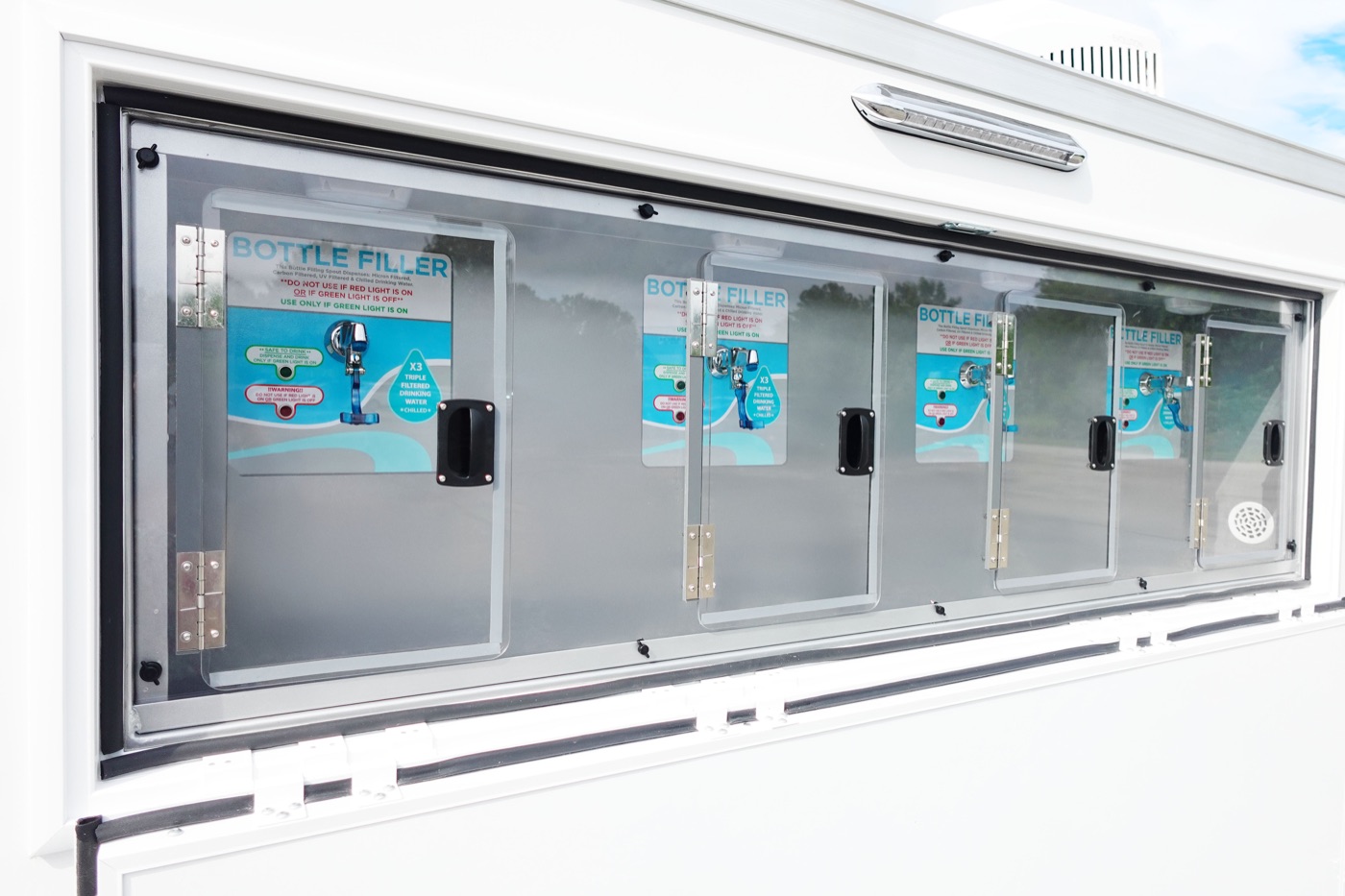
Three ways to fill, and one of them sits at ADA height
Each rig has four push-back fill points with adjustable nozzles. Press a bottle to the bar and water runs. One of those positions drops to an ADA-reachable height, which keeps an Escondido event or job site accessible to every guest and worker, no separate accessible unit needed. The rear large-jug outlet handles five-gallon coolers and personal hydration packs, while a row of hose-bib spigots covers crew chores, field work, and event logistics. The whole path out of the tank runs through food-grade line and stainless fittings, so the water reaches the tap with its filtered, chilled quality intact.
That 300-gallon onboard supply works out to around 2,400 sixteen-ounce pours per fill, and because our tankers top it back up as the day runs, the tank itself never chokes the flow on a hectic, hot Escondido afternoon.
We deliver it, fill it, wire it in, and usually have it pouring within the hour
None of it lands on you. We pick the placement, fill the fresh tank, and connect the power, then walk your Escondido crew or event team through the unit before our truck leaves the site.
Tell us the basics
Headcount for your crew or crowd, the length of the rental, where the trailer parks at your Escondido site, and the power on hand. Those four details let us size the job right on the very first pass.
We head your way
Plan on roughly 45 minutes of drive time to most addresses around Escondido and inland North County, plus quick after-hours runs any time a job or event gets caught short on short notice.
We make it pour
On arrival we level the chassis, charge the 300-gallon tank, and hook into whatever’s available, whether that’s a single 50-amp 240V drop or a handful of standard 120V outlets.
We keep it topped
From that point our tankers circle back to refill on a cadence matched to how fast you’re drawing, and the unit stays in our care for the full term, delivery through pickup.
No power on a raw grove pad or a remote staging lot? Flag it and we price the workaround into the quote. The trailer pulls little, and with our service fleet behind it we have kept Escondido sites pouring on lots with zero permanent power. Tell us what’s at the spot, and the rest is our problem to engineer.
In an inland valley like Escondido, cool drinking water is a written legal duty
If any climate is what the rule had in mind, it’s this one. The Escondido basin runs much hotter than the shoreline, posting high-nineties and triple-digit afternoons from late spring well into the fall, with Santa Ana winds wringing the moisture straight out of the air. The state hasn’t left worker hydration to goodwill. Title 8 Section 3395, the Cal/OSHA Heat Illness Prevention Standard, obligates any employer with outdoor crews to furnish fresh, pure, suitably cool drinking water at no cost, no less than one quart per worker each hour, positioned as near the crew as the site allows.
A station turns that requirement into a physical thing a reviewer can stand beside. You end up with a permanent, mapped supply of cold potable water positioned at the crew, the load-bearing piece of any real heat-illness plan and the first item an inspector looks for. Once the reading tops 80 degrees shade is required, and at 95 the added high-heat steps engage, a level Escondido sites hit on a routine summer afternoon. Past that line, keeping cool water close is no longer a kindness but a duty you have to document, and a self-refilling unit on site is one of the simplest ways to demonstrate you handled it.
- Fresh, suitably cool, potable water held near the crew, as Section 3395 demands
- A minimum quart per worker per hour, scaled up as the valley afternoon climbs
- One central, on-record hydration point you can log in your written HIPP
- Supports acclimatization and the high-heat steps that trigger at 95 degrees
What years of staging water in the Escondido heat have taught us
Working inland North County through one hot season after another shapes how we run each job. A few of the lessons that stuck:
Lesson one: shade dictates placement as much as the trailer does. At a downtown event one August we set the unit out in the open near the entrance, and it sat half-used while the crowd hugged the shade along the storefronts on Grand. We moved it under an awning line the next morning and the draw nearly doubled by noon. A vendor put it bluntly: in this heat people walk to the water that is in the shade, not the water across a sun-blasted lot.
Lesson two: in the valley you plan for the wind, not just the temperature. During one October Santa Ana run, the official high read 96, but the dry wind off the back country had crews east of town wilting like it was 110. We had pre-staged a spare tanker, and when two sites called the same afternoon we covered both without anyone running short. A safety lead texted that night: “You beat the wind.” That kind of margin is now built into every fire-season contract we write.
Lesson three: crews cling to the bottled-water habit right up until the moment they feel the difference. On a South Escondido grading job, the super openly doubted we could hold 300 gallons truly cold on an open dirt pad with no shade and 101 on the gauge. We staged the unit, tuned the refill timing, and a week on he phoned to add a second, noting only that the crew had stopped pestering him for ice. Cold water that stays cold is the whole pitch, and through an Escondido summer that pitch makes itself the day the trailer lands.
Each of those jobs taught us what the inland season teaches every year. Hydration out here isn’t a one-time checkbox you tick on the first morning and forget. It behaves more like a service we actively run day to day, from the first drop-off to the final pickup, for the whole length of the rental and the heat alike.
The coast cools off at five. The Escondido valley holds its heat into the night
Drive twenty minutes inland from the beach and the climate changes entirely. Escondido sits in a bowl ringed by hills, and on a July afternoon that basin can run fifteen to twenty-five degrees hotter than Oceanside or Carlsbad, with none of the marine layer that bails out the coast.
Summer highs here routinely sit in the high nineties and break 100, and the heat lingers. Pavement, stucco, and dirt soak it up all day and radiate it back well after sunset, so an evening Cruisin’ Grand crowd or a swing-shift crew is still working in real warmth long after the coast has cooled. Add the Santa Ana winds that rake the valley every fall, bone-dry air ripping the moisture off skin faster than anyone notices, and you get a place where dehydration and heat illness creep up quietly. The San Diego Zoo Safari Park out in San Pasqual Valley sits in some of the hottest ground in the region for exactly this reason. This is high-desert-adjacent country, not beach country.
That heat is also why demand keeps climbing. Escondido is in the middle of its own growth, with housing and mixed-use filling in around downtown and the South Escondido and Citracado corridors, steady road and utility work along SR-78 toward San Marcos, and the I-15 stretch up to Deer Springs and Hidden Meadows staying busy. Every one of those projects puts crews outdoors for months in a basin that holds heat the way the coast never does.

Our inland dispatch is shaped around precisely this pattern. Once we began placing trailers along Grand Avenue, out through San Pasqual, and up the I-15, we tied refills to how many people were actually on hand rather than a fixed schedule, and we held spare tankers in reserve for the Santa Ana days a thermometer alone won’t flag. On an Escondido build or at a downtown event, a gap in hydration is more than a slowdown. On a 102-degree afternoon it can put someone in a bed at Palomar Medical Center.
When the crowd fills Grand Avenue and the valley sun has nowhere to hide
Whether they say so or not, Escondido organizers build their events around the heat. A Cruisin’ Grand car night, a Street Faire weekend, a lawn concert at the California Center for the Arts, a Stone Brewing beer release, a charity 5K off downtown, each one earns a dedicated trailer keeping cold water moving at clean refill points. It also frees your team out of the routine of hauling cases in, icing them down, and then dragging out piles of single-use plastic that has no place piling up around downtown.
For a sprawling footprint we’ll spread several trailers around the grounds so no guest has to walk far to refill, and our crew runs setup and teardown on your event’s clock, not ours. That lesson cost us once at a downtown festival, where a single unit parked by the main stage built a thirty-deep line by mid-afternoon. (Several thousand people under a dry 99-degree valley sky add up fast.) We came back the following year with three positioned along the route, and the lines never formed. Attendees experience it as hospitality. Your operations lead reads it as managed risk.
Behind the trailer: the trucks that keep an Escondido job supplied
Everyone sees the trailer. What backs it is a support fleet that hauls in fresh water, banks reserve on site, and carries wastewater away, so a single call handles the entire cycle instead of three vendors trading voicemails.
Potable water trucks
Our potable tankers carry drinking-grade water throughout inland North County and refill the trailer’s 300-gallon reservoir on a cadence set by your headcount. Those same trucks also charge cisterns, on-site storage tanks, and bladder bags whenever a single delivery can’t keep up, think a concrete-pour day off Citracado or a packed Friday-night Cruisin’ Grand crowd.
Bladder bags & buffer supply
Collapsible bladders stash extra fresh reserve through the busiest stretches, or temporarily hold greywater when an Escondido grove pad or back-lot has no drain nearby. Unglamorous but dependable, they keep a far-flung site flowing in the gaps between tanker runs.
Pump trucks
A pump truck pushes water to wherever it has to land, filling storage tanks or relaying supply across a broad site. Its value shows on a sprawling fairgrounds event or an east-valley ranch lot where the trailer and the water source sit far apart.
Vacuum & waste trucks
If a site generates greywater, a vacuum truck collects it and carries it to permitted disposal, closing the loop with no loose ends. Nobody on your Escondido crew has to work out where the used water ends up. That collection step has been part of the package since day one.
These parts are designed to stack. A downtown event might run a station alongside a pump truck for supply relay plus a waste pickup at the end of the night. A months-long inland build might want a station, a bladder bag held in reserve, and a tanker on a standing route. Describe the shape of your Escondido project and we put together the right combination, on one invoice through one contact, crewed by people who already know how the valley moves.
The four answers that shape your quote, and why each one matters
Two minutes on the phone is usually all it takes to get you a real number. Below is what we’ll ask, both so you can have the answers ready and so you can see how each Escondido job gets tailored rather than dropped into a one-size template.
What steers our recommendation
- How many people? A 12-person framing crew off Felicita and a 4,000-person Street Faire on Grand are two different problems. Your headcount tells us how many trailers to stage and how hard to push the refill schedule.
- How long? A one-night car show, a three-week foundation pour, and a six-month SR-78 corridor build all run on different rhythms. Short events ride on buffer storage. Long builds run on a standing tanker route.
- Where will it sit? The towable Signature is happy on a dirt pad, a graded lot, a fairgrounds field, or a downtown staging zone. Nail down the exact placement, and the path our truck takes through valley traffic or event fencing to reach it, so we can set it where foot traffic actually flows.
- What power is on site? The rig will run off a single 50-amp 240V drop, or alternatively one to three ordinary 120V circuits. A lot of Escondido grove pads and raw lots carry no permanent power at all, which is a routine fix for us. Just say so when you call.
The extras that help us dial it in
- The exact placement, and which shade or awning line is nearby
- Is your crowd or crew spread out, or bunched at one work face
- Whatever heat-related Cal/OSHA records your safety program has to point to
- Are you adding bulk water delivery, bladder storage, or waste pickup to the job
What a pallet of bottled water really costs you off the invoice
On a purchase order, bottled water reads cheap. The actual cost is buried in labor, staging space, warm-up, and disposal, and on a busy Escondido event or job site every one of those lines runs longer than the budget assumes.
The labor nobody budgets
A paid employee has to order the water, sign for the pallets, break them apart, ice coolers before sunrise, restock through the afternoon, and crush the empties at day’s end. On a large Escondido crew or a multi-day downtown event, that adds up to hours of wage time daily, peeled straight off productive work. A trailer wipes the whole chore out. One Escondido GC ran the math beside us and discovered the labor savings on their own covered the rental; he admitted the bottle errands had been quietly eating the better part of a payroll day each week. The trailer arrives full, tops up off our tankers, and asks your super for nothing more than a parking spot.
The warm-up problem
Ice a cooler at 6 a.m. and it’s lukewarm by ten as a dry valley morning warms up. Once water turns warm people quit drinking it, and the moment they quit is the moment heat trouble begins to build. The Signature’s built-in chilling erases that curve entirely. Its quitting-time pour arrives just as cold as the clock-in one, and that final stretch of the day is exactly when a sun-cooked crew or a packed Grand Avenue crowd reaches for it hardest.
The space and footprint tax
Bottled-water pallets eat up staging room, jam a tight downtown lot, and bake in the sun until someone finally tears into them. Empties pile up faster than anyone hauls them off, and on a cramped event ground or a packed job site that heap becomes a problem all its own. A trailer occupies a single parking space and covers a crowd that would otherwise tear through hundreds of bottles in a day.
The trash that trails the job
Each bottle purchased is one more headed for the landfill, and a busy Escondido build or festival generates a small mountain of them. That’s a disposal bill, a black mark on any sustainability report, and a plastic heap that photographs badly in a downtown event recap. Moving to a refill station wipes that line off the ledger and gives your reporting a number worth showing off.
Staging cold water across Escondido and inland North County
We dispatch throughout Escondido and the wider inland North County, reaching from Grand Avenue and the downtown core out across San Pasqual Valley, north up the I-15 to Hidden Meadows and Deer Springs, and west on SR-78 toward San Marcos. Sit anywhere in or around Escondido and you’re inside our delivery range, be it a downtown Street Faire, a grading crew off Citracado, a grove harvest near Valley Center, or a fire camp tucked into the back country.
South EscondidoFelicitaCitracado
San Pasqual ValleyHidden MeadowsDeer Springs
Valley CenterSan MarcosRancho Bernardo
VistaRamonaBonsallFallbrook
Rancho Santa FePoway
Working a corridor instead of a single address? We follow the roads inland North County runs on, the I-15, SR-78, and SR-76, so multi-site projects get the same quick turnaround as one job site.
What inland North County crews and event leads ask us most
How fast can a water station get to my Escondido site?
For most addresses in the Escondido area, expect us roughly 45 minutes after dispatch, with around-the-clock drops for last-minute and emergency calls. If a build or an event shows up with nothing cold on site, we can frequently have a unit pouring ahead of the day’s worst heat. Access to the spot and the power available are the two things that move the timeline, so tell us both and we’ll plan the run to fit.
Is the water actually chilled, or only filtered?
Both, and out here the chilling is the part that pays for itself. The onboard chiller keeps the supply cold start to finish, so a teardown pour comes out as cold as the clock-in one. After an Escondido afternoon climbs into the high nineties, warm water just sits there while a crew or crowd quietly dehydrates. Cold water gets consumed, and consumption is what holds heat illness off, which is why we file the chiller under safety gear rather than features.
How many gallons does a station hold, and what if it empties?
The 300-gallon tank on a single Signature is good for roughly 2,400 sixteen-ounce pours. On a triple-digit afternoon with a big crowd drawing hard, our tankers come back and recharge it on a rhythm matched to that draw, so capacity never becomes the limiting factor. Refilling it is on us, not on your team.
Will a rented station support our Cal/OSHA heat-illness program?
Yes, and the connection is direct. Section 3395 of Title 8, California’s heat-illness rule, tells employers with outdoor crews to keep cool potable water within easy reach, at least a quart per worker hourly, plus shade once it passes 80 degrees and added high-heat steps at 95, which an Escondido site reaches on the majority of summer days. A station hands you a standing, mapped cold-water point you can write into your HIPP and point an inspector toward on the spot. The safety program stays yours to author; the hydration it relies on is what we bring.
Can people in wheelchairs use the station, and is it ADA compliant?
It is. Of the four push-back fill points on each trailer, one is set at an ADA-reachable height, so the unit works for everyone at an Escondido site or event with no add-on accessible station required. Behind the rig, the large-jug outlet fills five-gallon coolers and personal packs, and the hose-bib spigots handle crew tasks and field work.
Can you handle downtown events as well as job sites?
Absolutely, events make up a large slice of our inland calendar. For a Cruisin’ Grand night, a Street Faire, a Center for the Arts concert, or a downtown 5K, we’ll place a single trailer or several around the footprint and time setup and teardown to your window. Attendees get dependable cold water at clean refill points, and you shed both the cost and the litter of hauling bottle pallets into downtown.
Can you help during a wildfire or other emergency?
Yes, and it is one of the reasons inland clients keep our number handy. Escondido sits in real Santa Ana fire country, and we keep a fleet ready to roll potable-water trailers to base camps, cooling centers, and evacuation sites on short notice. Crews working a fire or a main break in 100-degree wind need cold, clean water more than almost anyone, and rapid dispatch for that is built into how we operate.
What do you need from me to set one up?
Really just four answers: how many people, how long you need it, where on the Escondido site it parks, and what power is there. For power, the Signature wants either a single 50-amp 240V drop or up to three regular 120V circuits. If your grove pad or raw lot offers no power whatsoever, flag it when you call and we fold the fix straight into your quote.
Do you only serve Escondido, or the wider inland North County?
The whole inland North County corner. Our dispatch covers Escondido proper plus San Marcos, Valley Center, Hidden Meadows, Deer Springs, Rancho Bernardo, Poway, Ramona, Bonsall, and Fallbrook. Multi-site work strung along the I-15, SR-78, and SR-76 is routine for our trucks.
Does the water taste as good as bottled?
Crisp and neutral, with the chlorine taste gone. The carbon stage strips out the chlorine and the flat municipal edge, so a pour reads fresh instead of like a hose left baking on a hot lot. Flavor isn’t a frill out here. A station only does its job when people actually want to drink from it, so we count taste as part of the safety case, not an upgrade.
Does Escondido really get hot enough to need this?
Easily. The valley runs far hotter than the coast, with summer afternoons in the high nineties and over 100, and Santa Ana winds that dry crews out faster than the thermometer shows. Pavement and stucco hold the heat into the evening, so even a night event downtown stays warm. Cold water close at hand is the dull, reliable fix for all of it.
Built for the crews and crowds that can’t afford to run dry in the heat
“Our South Escondido grading job hit a 103-degree week and the bottled-water plan fell apart before the first break. They had a unit dropped that same afternoon, and even on a bare dirt pad with no shade the water came out genuinely cold. The ice runs stopped that day.”
“At our Grand Avenue event the refill trailers cut our single-use bottle order down to near zero and kept the refill lines moving all through a hot evening. Setup and teardown ran on our timeline, not theirs. Booking them again for next season took about two seconds of thought.”
“A Cal/OSHA reviewer asked us to show documented cool-water access for a crew out toward Valley Center. The mapped station checked that box for our HIPP, and on a 101-degree Santa Ana afternoon the refill truck rolled in before we’d come anywhere close to empty.”
Service information current as of June 2026.
Cold, filtered water on your Escondido site before the next heat wave
Give us a headcount, your dates, and where the station will park. We’ll match the setup to the job and send a trailer out across inland North County, usually pouring within about 45 minutes of dispatch.