
Top-Rated Drinking Water Station Rentals Garden Grove for Job Sites & Events, 24/7 Dispatch
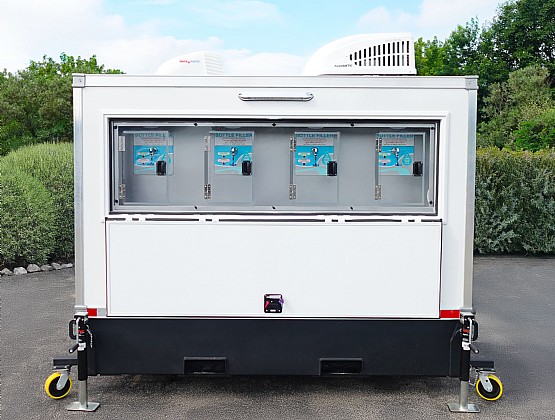
Here’s the plain version of what we do: we tow a self-contained drinking-water station to your spot anywhere in Garden Grove and hand you cold, filtered tap water that refills itself all day. That’s it. A grading crew off Garden Grove Boulevard, a Strawberry Festival weekend on Historic Main Street, a wedding banquet near Christ Cathedral, a Tet crowd in Little Saigon (some of the densest crowds in the county), they all get the same thing: chilled drinking water on demand and not one pallet of warm plastic bottles to babysit. We dispatch around the clock and our trucks reach every corner of the city, whether that’s the Korean Business District or the Harbor Boulevard hotel strip up north.
- 24/7 dispatch across Garden Grove
- Cold, four-stage-filtered water
- ADA bottle filling height
- Cal/OSHA §3395 heat-ready
- Licensed & insured
- Plastic-free hydration
Cold drinking water staged for a city that runs on festivals, faith and freeways
Garden Grove squeezes a lot of life into eighteen square miles. Little Saigon draws crowds to the Asian Garden Mall year-round, the Strawberry Festival packs Main Street every Memorial Day weekend, Christ Cathedral keeps a steady calendar of services and events, and the Harbor Boulevard hotels feed a constant stream of Disneyland-bound visitors a mile north of the parks. Each of those needs water staged a different way, and we run one local operation that covers all of it. Tell us where and when, and a station shows up cold and ready.
The 22 and the 5 are our daily routes
Our trucks live on the Garden Grove Freeway and the Santa Ana Freeway, with the 57 a short hop east, so a Main Street event and a build near Brookhurst both see roughly a 45-minute window from dispatch. No address in this city is “out of the way” for us.
Still icy when the 4 p.m. line forms
Every trailer chills its own supply, so the last pour of a Tet festival afternoon lands as cold as the first. Garden Grove sits far enough inland that the ocean breeze thins out by midday, and warm water just sits in the cooler untouched once that happens.
Delivered, refilled, serviced, hauled off
Skip the bottled-water vendor, the dawn ice run, and the empties pickup. We park the station, top it off our own tankers, keep it running through the rental, and pull it the moment your Garden Grove event or project wraps. One contact, one invoice.
I’ll tell first-time callers the thing nobody plans for in this part of Orange County: the morning lies to you. A Main Street festival kicks off at a pleasant 74 with a little marine air still hanging around, the organizer assumes water is a side issue, and then by early afternoon the inland heat settles over the flatlands, the gauge reads 93, and a few thousand people are suddenly drinking twice what anyone ordered. I’ve watched shrink-wrapped cases bake in a parking lot off Euclid while attendees walked right past the warm stack toward any shade they could find. And I’ve watched a chilled trailer set close to the crowd run empty and get topped off twice before the sun went down. The distance between those two days is the whole reason this business exists. So we don’t drop a unit and disappear. We size it to your actual crowd or crew, set the refill cadence to how fast you really draw it down, and answer the after-hours phone, because a hot Saturday on Main Street can turn into a medical problem fast.
The one road-towable rig we bring to every Garden Grove job
Whatever the work or the crowd looks like, we bring the same purpose-built rig every time: the Signature Series water station trailer. It rides on a full highway chassis, so it sets down wherever you need it, a barricaded block of Main Street, a graded pad off Lampson Avenue, a parking lot beside the Asian Garden Mall. Nothing to plumb, nothing to assemble. Cold filtered water on tap the same hour it arrives.
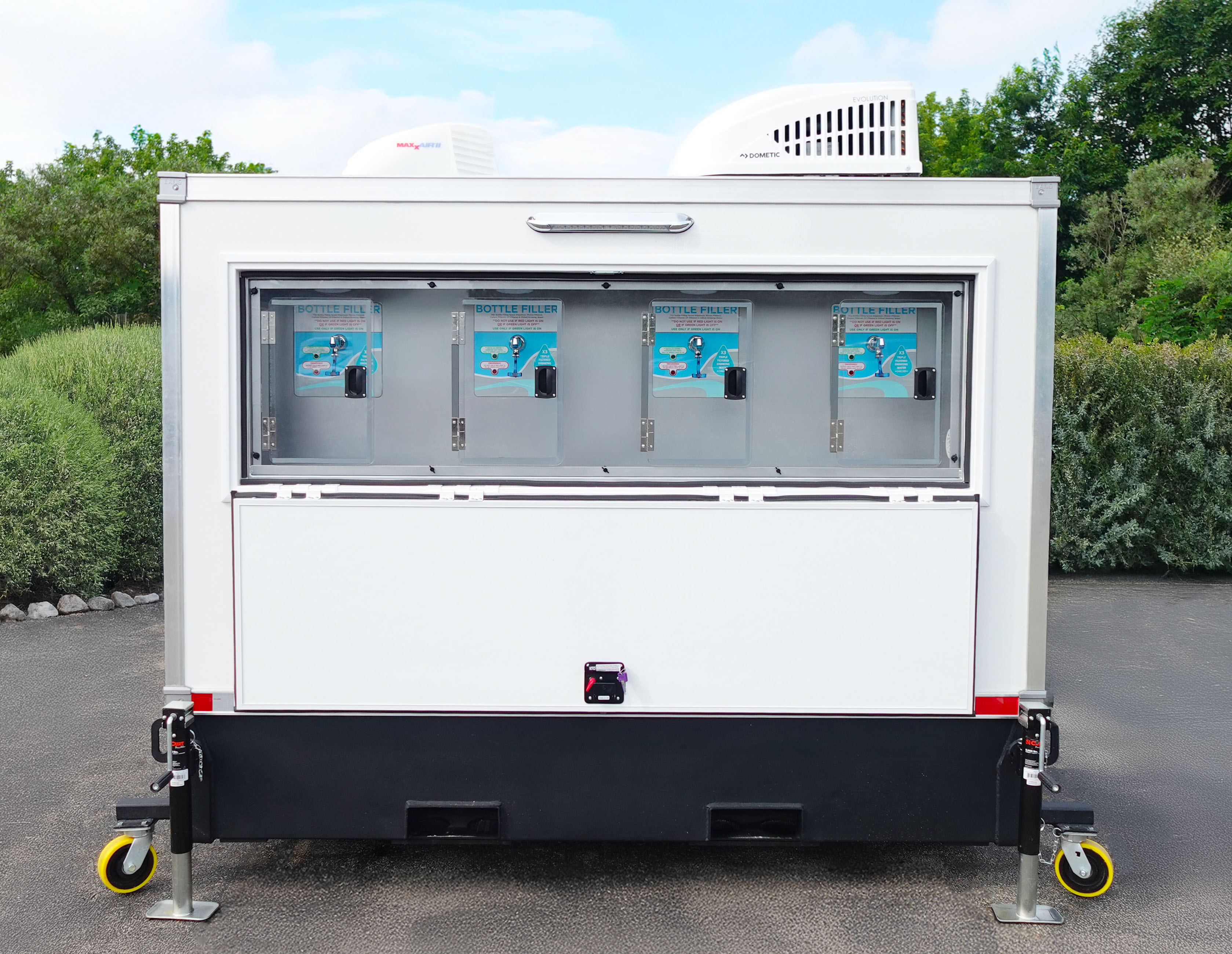
Signature Series specifications
It rides on highway-legal tires behind any tow vehicle, which is how it reaches a graded inland pad, a festival lawn, a closed downtown street, or an emergency staging yard without a crane or forklift. Contractors and event leads around town request this unit specifically. Set it down, level the jacks, prime the lines, and a crowd or crew is drinking inside the hour.
| No. of stations | (4) Bottle Filling Stations |
| Length | 12′ 3″ |
| Weight | 3,100 lbs. |
| Height | 8′ |
| Fresh water tank | 300 Gallons |
| Power requirements | 1–4 dedicated 20A/120V circuits OR 1 dedicated 50A/240V circuit |
| No. of AC units | 1 |
Why this trailer suits Garden Grove specifically
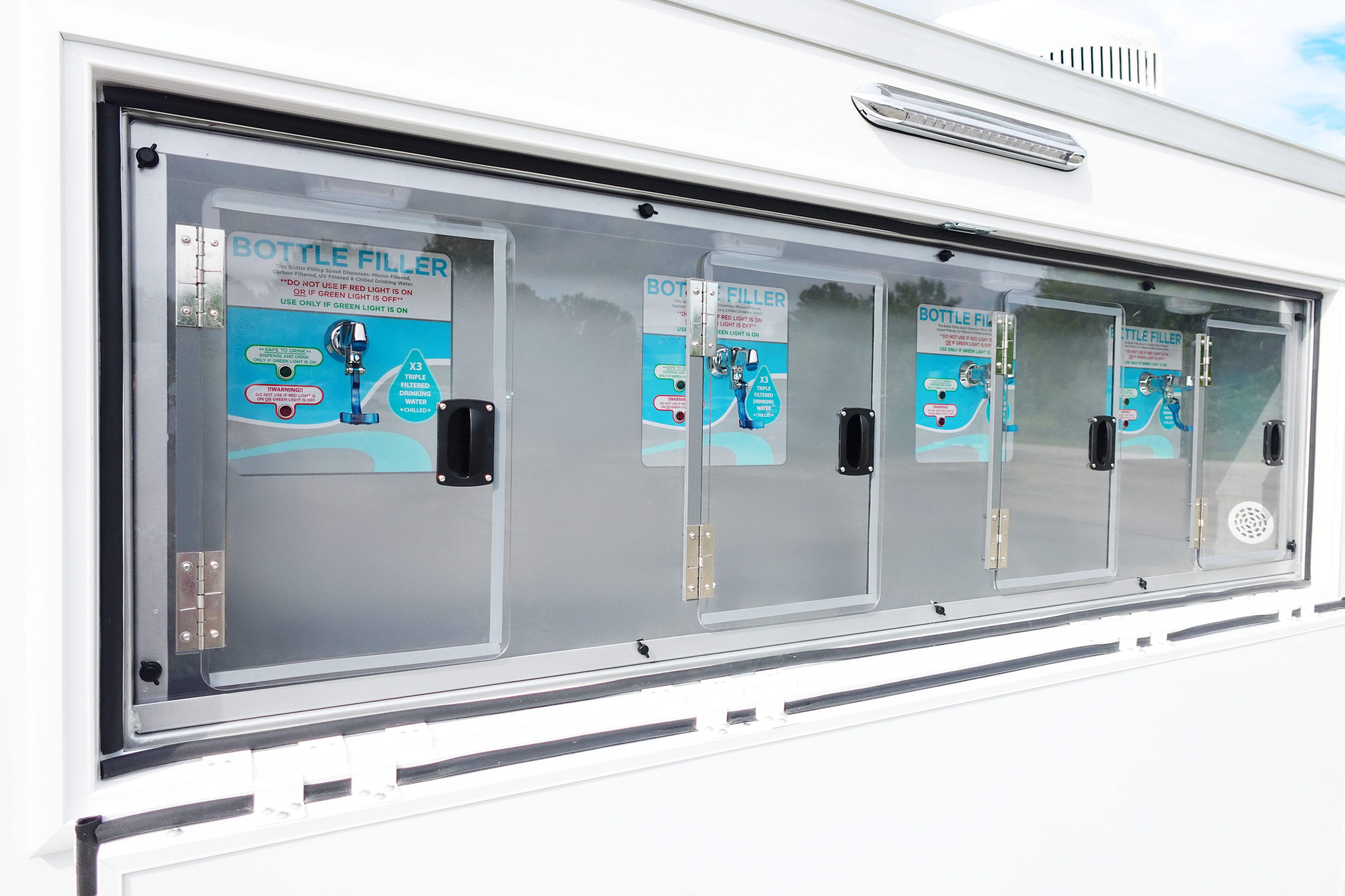
The Signature is built for crowds and for distance. Four push-back taps sit along an outside wall under an awning, so a festival line on Main Street or a hard-hat crew on break moves through fast instead of bunching at a single spout. Onboard AC and built-in chillers keep the water genuinely cold even when the trailer is parked on bare asphalt through a mid-summer afternoon, which is exactly where coolers and bottle pallets fall apart once the breeze dies down.
That 300-gallon tank carries a good-sized crowd or crew through a full day. And since the rig tows on the road, we can reposition it across a big footprint (think a multi-block festival) or move it to the next stage of a build with no fixed install to rip out. The unit accepts a wide span of everyday site power, so the same trailer works a finished plaza by the Asian Garden Mall or a bare pad along the 22 we power ourselves.
It does more than those four headline taps let on, too. A spout at the back loads up five-gallon jugs and personal containers, and a line of hose-bib outlets takes care of wash-up and field chores. One trailer answers the entire hydration question for a Garden Grove site. We’ve run a single unit through a morning on Historic Main Street and an evening at a Garden Grove sports field the same day, without dragging out a second piece of equipment.
The bottled-water bill nobody adds up until summer ends
Put a 55-person crew on a Garden Grove build through one warm season and the numbers do their own talking. At roughly six bottles a head on a 93-degree inland afternoon, you’re ordering, hauling, icing and trashing somewhere around 330 single-use bottles a day.
Carry that across a 175-day project and you’ve blown past 57,000 bottles, and on the bigger multi-phase work near the freeway interchanges it climbs well past 90,000. One trailer swallows the whole pile: cold water on tap, nothing rolling toward the Frank R. Bowerman landfill.
It’s a logistics decision first, a green one second
The waste angle is real and worth claiming. Roughly 60 million single-use water bottles get tossed in this country every day, only about a third are ever recycled, and one of them can outlast in a landfill most of the buildings standing in Garden Grove today. That number belongs in your sustainability report, and more clients ask for it each year. But most planners and PMs make the switch for a plainer reason: a shared trailer ends the daily scramble. No recurring bottled-water PO. No cooler going warm before lunch. No heap of empties cooking by the entrance. Your event lead or super runs the day rather than babysitting the water.
Our own potable tankers do the refilling, so the supply bends around whatever the day brings. Add a second shift for a slab pour, or watch a Saturday gate count sail past the estimate, and the water never gives out. The tanker just swings back and tops the tank off again.
Hydration fit to the way this city actually fills its calendar
Garden Grove doesn’t have one hydration problem, it has a stack of them, and they rarely overlap. A Little Saigon street celebration is one job. A wedding reception near Christ Cathedral is another. A warehouse build along the 22 is a third. Here’s where our trailers go to work, on the festival blocks of Historic Main Street and out at the logistics yards toward the Anaheim and Santa Ana lines.
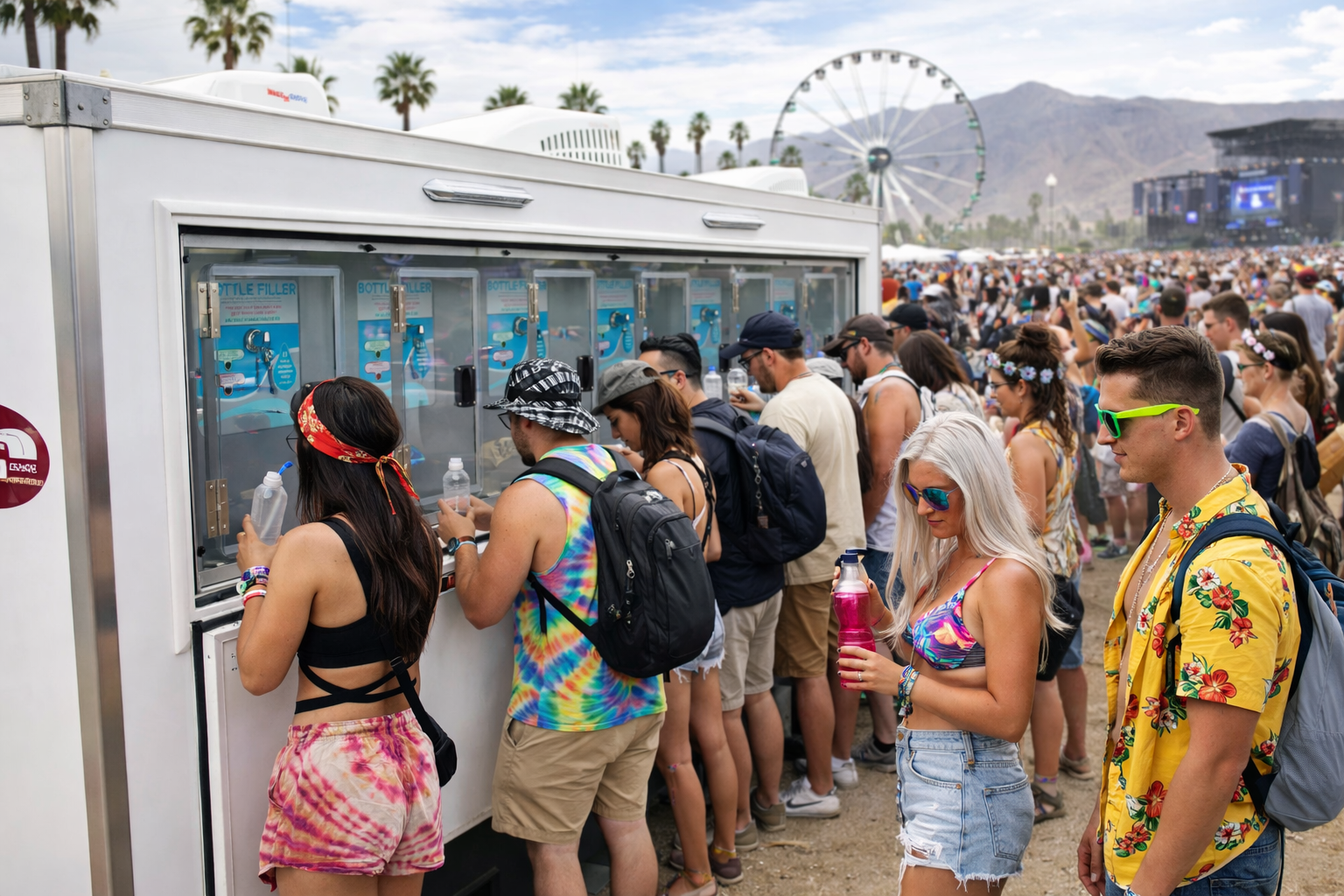
Strawberry Festival, Tet & Little Saigon crowds
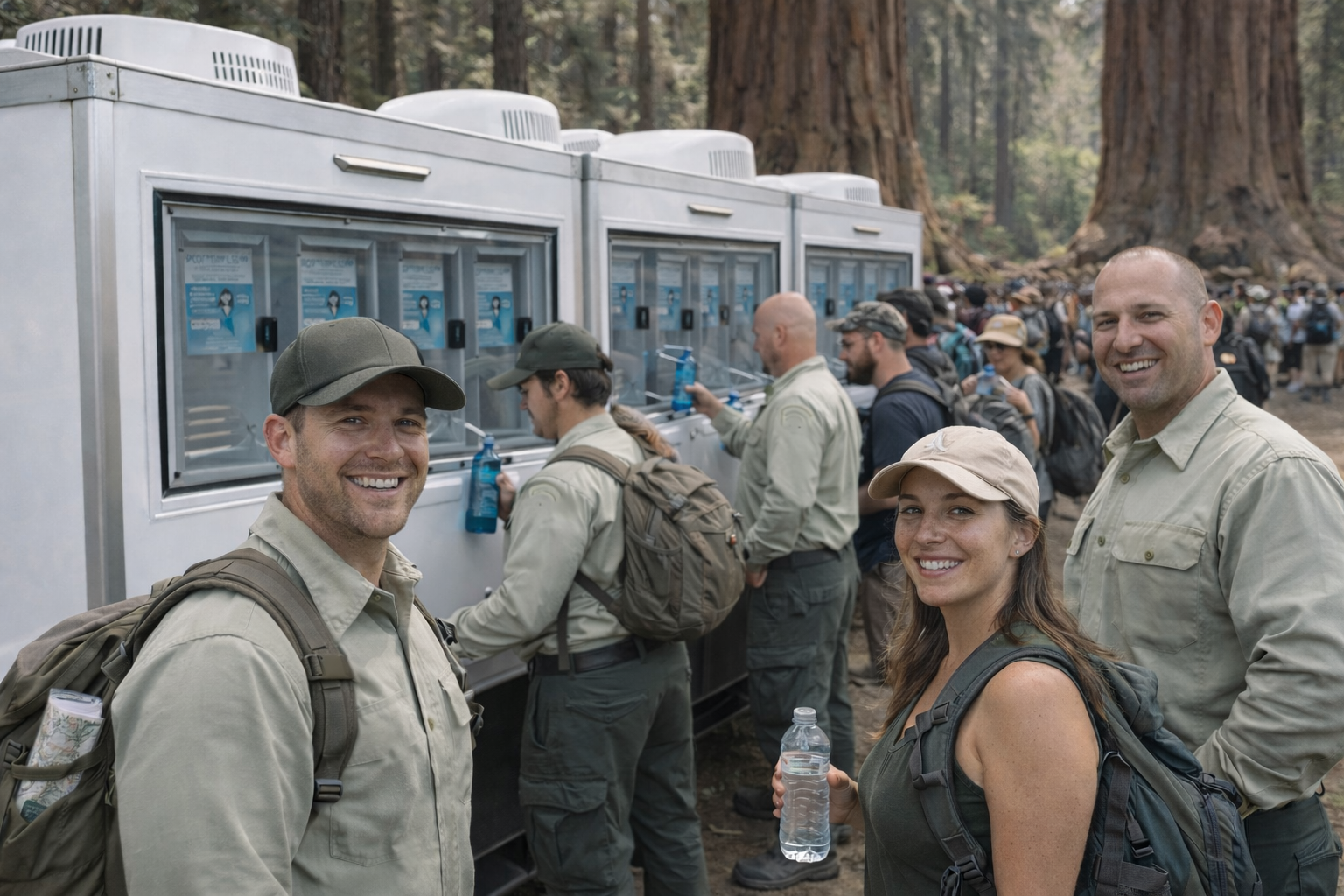
The Garden Grove Strawberry Festival has packed Main Street every Memorial Day weekend since 1958, and the Tet and Mid-Autumn celebrations in Little Saigon draw their own dense crowds to the Asian Garden Mall area. A SoCal crowd in the open drinks fast once the morning marine air thins out. We park trailers with reliable cold water and clean refill spots so organizers ditch the heap of single-use bottles trucked in and back out, and the queues keep moving between acts. One Strawberry Festival vendor lead put it to me last spring: “By two o’clock the heat does the selling for you, people just want something cold.” Cold water on tap is exactly that.
Builds, warehouses & outdoor labor
Garden Grove’s work runs inland and open: redevelopment along Garden Grove Boulevard and Brookhurst, warehouse and light-industrial space spreading toward the Santa Ana and Anaheim borders, and street, utility and landscaping crews working the flatlands through summer. We station trailers along these jobs so general and specialty contractors keep documented cold water within a short walk of every work face, which counts for a lot when an inland pad is already reading mid-90s before noon.
Christ Cathedral & the event-venue corridor
Christ Cathedral, the glass landmark that started life as the Crystal Cathedral, anchors a steady calendar of services, weddings and large gatherings, and Garden Grove’s banquet halls and Korean Business District venues run their own busy schedule. An outdoor reception or a courtyard service on a warm afternoon needs cold water that isn’t a card table of warm bottles. A trailer hands hosts reliable hydration and clean fill stations with no plastic to cart in or out.
Harbor Boulevard hotels, parks & cooling centers
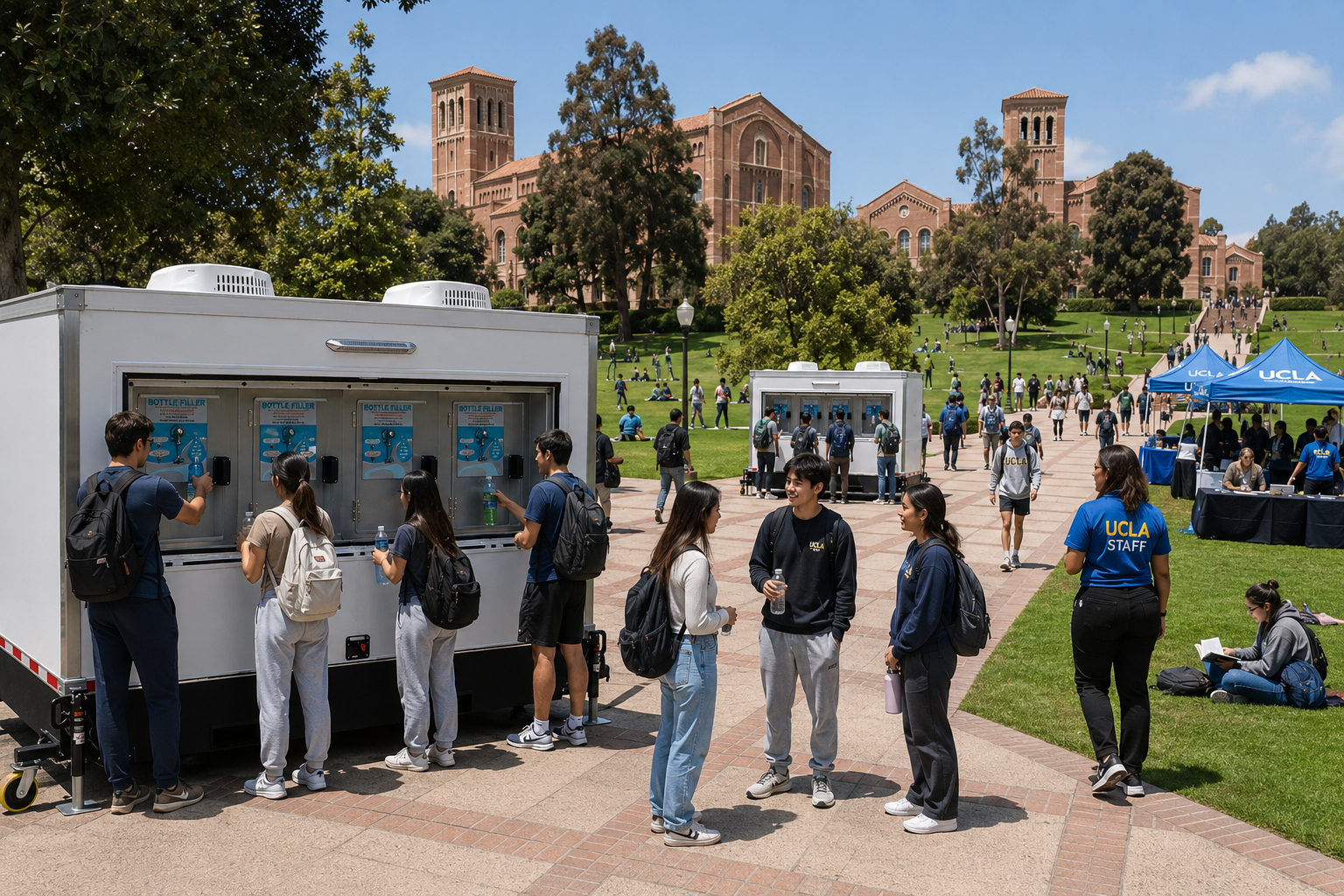
The Harbor Boulevard hotel strip serves a constant Disneyland-adjacent tourist flow a mile from the parks, and the city’s sports fields and parks host tournaments and league play all season. Throw in public-works crews and the city’s hot-weather cooling-center efforts, and one towable, self-contained trailer rolls right into whatever lot, field or plaza the people are using. And when a heat advisory or a broken water main hits a Garden Grove neighborhood, we can run potable trailers out to base camps fast.
Four treatment stages, a UV pass, then chilled before it pours
Nobody refills from a trailer they don’t trust, so every gallon gets treated. Municipal tap water moves through four filtration stages, gets a pass under a UV lamp, and lands in an onboard chiller before any of it hits a nozzle. What pours out tastes like nothing at all, in the best way, and holds its cold straight through the hottest Garden Grove afternoon of the year.
Sediment first
The first filter traps sand, flecks of rust and scale that the municipal lines collect down in the ground, so nobody gets a gritty swallow on a dusty pad off Lampson or a wind-blown festival block.
Then carbon
A bed of activated carbon strips out the chlorine edge and that flat tap-water aftertaste the city supply carries. On a 92-degree day, the clean flavor is what brings a Main Street line back for refills instead of giving up on the tap.
A micro-particulate stage
A sub-micron stage strains out the microscopic particles the first two stages leave behind, so a cup from this tap is one you’d hand a kid at a Strawberry Festival booth and not think twice.
UV to finish
A final ultraviolet pass kills bacteria and microbes with no added chemistry, so what leaves the spout is clean even after the tank has ridden across town in the heat.
Three ways to fill, ADA height included
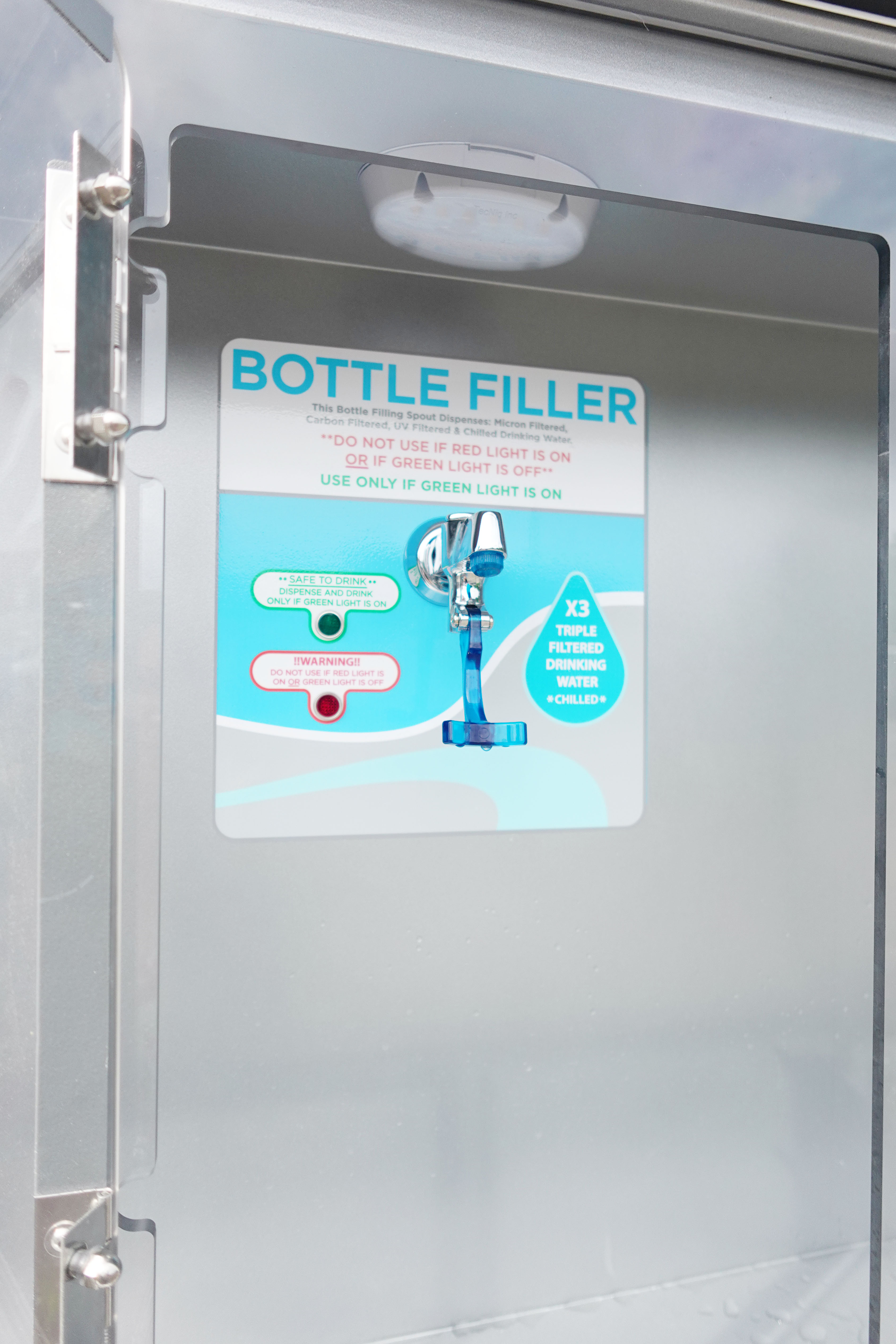
Four touch-bar fill positions line the front, each with an adjustable nozzle. Press your bottle against the bar and the water runs. One of those positions sits low enough for a wheelchair, so your Garden Grove event or job site meets ADA without tacking on a separate fixture. Toward the rear, the jug spout handles five-gallon containers and personal bottles, and a bank of hose-bib outlets covers wash-up, crew jobs and field work. And every part the water touches is food-grade or stainless (no garden-hose plastic in the line anywhere), so it arrives at the tap as clean and cold as it was leaving the chiller.
A filled Signature tank runs 300 gallons, roughly 2,400 sixteen-ounce pours, and the tankers recharge it whenever it needs it. So the trailer itself never turns into the bottleneck, whether you’re working a wall-to-wall festival Saturday or a long pour day on an inland build.
We tow it in, fill it, wire it up, then leave you pouring cold
Setup falls to us, not you. The crew positions the trailer, charges the tank, hooks up the power, and gives your event staff or foreman a quick two-minute rundown before the truck heads out. From there it runs on its own.
Answer four quick things
Your headcount, the number of days, the exact parking spot, and the power available there. Those four details let us size it correctly on the first pass, no guessing involved.
We roll out, day or night
From dispatch to your Garden Grove address runs roughly 45 minutes, and we add overnight and weekend runs whenever a heat advisory lands on the inland flatlands.
We level it and wire it
Jacks go down level, the 300-gallon tank fills, and we connect to whatever power the spot has, which can be one, two or three standard 120-volt circuits, or a lone 50-amp 240-volt drop.
We keep it full
Refills run on how fast you’re actually pulling water, not on a set timer, and we service the whole trailer for every single day it’s on your site.
Nothing to plug into on a far-back pad or a barricaded festival block? We flag it on the quote and solve it. The unit sips power, and with our support fleet behind it we’ve kept Garden Grove stations pouring with zero permanent hookup. Walk us through what’s at the spot and we design around it.
For a California crew, cool water on site is the law itself
People shrug off Garden Grove heat because Orange County reads “coastal” on paper. But drive a few miles back from the ocean and the flatlands across Garden Grove, Anaheim and Santa Ana climb well into the 90s all summer (with triple-digit stretches when the Santa Ana winds kick up in early fall). Any employer with crews outdoors here falls under Cal/OSHA’s Heat Illness Prevention standard, Title 8 §3395, which is about as strict as heat law gets in this country. Under it, outdoor workers must be given fresh, “suitably cool” potable water at no cost, no less than a quart each per hour. Spread across a shift, that’s something like two cups every quarter hour, per person.
The rule also requires accessible shade as soon as it hits 80°F and kicks in high-heat procedures at 95°F, exactly the kind of afternoon a Garden Grove build runs into all summer long. A Signature trailer turns the water half of that duty into something you can point at. It’s a set, mapped tap of cold potable water, the very thing a written Heat Illness Prevention Plan is built around and the first thing a Cal/OSHA inspector looks for during a site visit. After several scorching summers the state has leaned harder on heat enforcement around Southern California, and a mapped cold-water point on the job is among the easiest items to put in front of them.
- A quart an hour of fresh, suitably cool water for every worker, right where they’re working
- One documented hydration point that drops cleanly into your §3395 paperwork
- Supports the shade-at-80°F and high-heat-at-95°F steps the rule spells out
- Positioned for the tighter state and federal heat rules coming, not caught flat-footed
What staging water around Garden Grove has drilled into us
Years of setting up stations around this city have shaped the way we approach every job. A handful of lessons that stuck with us:
Lesson one: where you park it matters as much as what you park. At a Main Street festival a couple summers back we positioned it by the south entrance for opening day and saw it go barely touched, because the crowd gathered around the food row and the main stage two blocks up and nobody walked back for water. The next morning we moved it between the busiest food vendors and the usage nearly doubled before lunch. The grounds lead put it bluntly: “Set the water where people already are.” We’ve stuck to that rule on every job since (it sounds obvious, and it gets ignored all the time).
Lesson two: in Garden Grove you plan around the marine air, not the date on the calendar. On a July warehouse build off the 22, the super figured a coastal-county job would stay mild and ordered light. By 1 p.m. the breeze had thinned, the pad read 96, and the crew tore through a full day’s water in about three hours. Our dispatcher had pre-staged a tanker that afternoon (the forecast smelled wrong to him) and topped them off before anyone ran out. That night the super sent over a short message: “Figured it was overkill. It wasn’t.” Now we work that cushion into every summer contract, no exceptions.
Lesson three: people stick with the bottled-water habit right up until they feel the difference. At a youth tournament on a Garden Grove sports field, the director wasn’t convinced one trailer could stay cold through a two-day slate of back-to-back games. We set the unit, matched the refill timing to the bracket, and by Sunday afternoon he wanted us booked for fall. “Didn’t think it’d hold,” he admitted, “and it never even got close to warm.” Water that stays genuinely cold is the whole pitch, and in this climate (coastal in name, inland in fact) it sells itself the moment it’s on site.
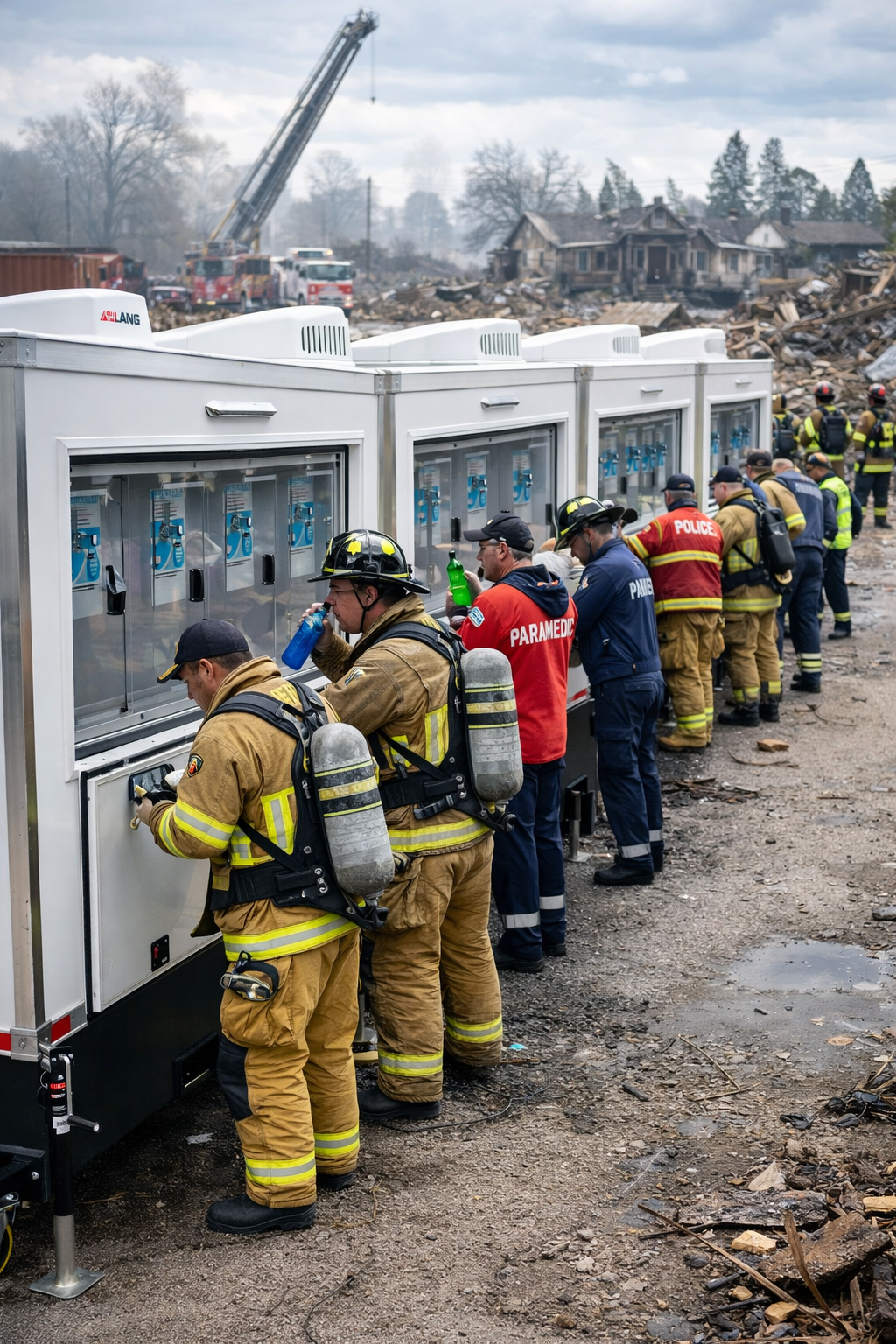
Each of those jobs hammered home what the weather here already proves: in Garden Grove, hydration isn’t something you set once and stop thinking about. The coast lulls you into complacency, the inland heat calls your bluff, and neither the Main Street crowds nor the flatland crews ease up for either one. So we run hydration like an operation, start to finish, for every day of the rental.
When the crowd is outside and the breeze finally quits
Hosts in this city quickly learn not to trust a mild morning. An opening hour that feels like a pleasant 73 with a hint of ocean air tips into a punishing 92 on the flatlands by early afternoon, and guests who waved off water at the entrance end up crowding around anything cold. A Strawberry Festival parade, a Tet gathering in Little Saigon, a neighborhood charity 5K, a courtyard reception by Christ Cathedral, each gets its own self-contained trailer pouring cold water steadily with tidy refill points. And the entire bottled-water headache leaves your plate: no ordering, no pre-dawn ice runs, no empties stacking up out back.
Across a large site we’ll position several units so no attendee has to hike to the far end for a sip, and our crew syncs delivery and teardown to your run-of-show. We learned that lesson the painful way at a Main Street event, where one station parked by a single gate had a thirty-person line by mid-afternoon. (A few thousand guests plus inland heat stacks up quick.) The following year we spread the units out along the blocks and the jam disappeared. The coordinator caught me during strike that second year and said, “Nobody complained about water once, that’s a first.” Guests just feel taken care of. Your operations lead feels a real risk lifted off the day.
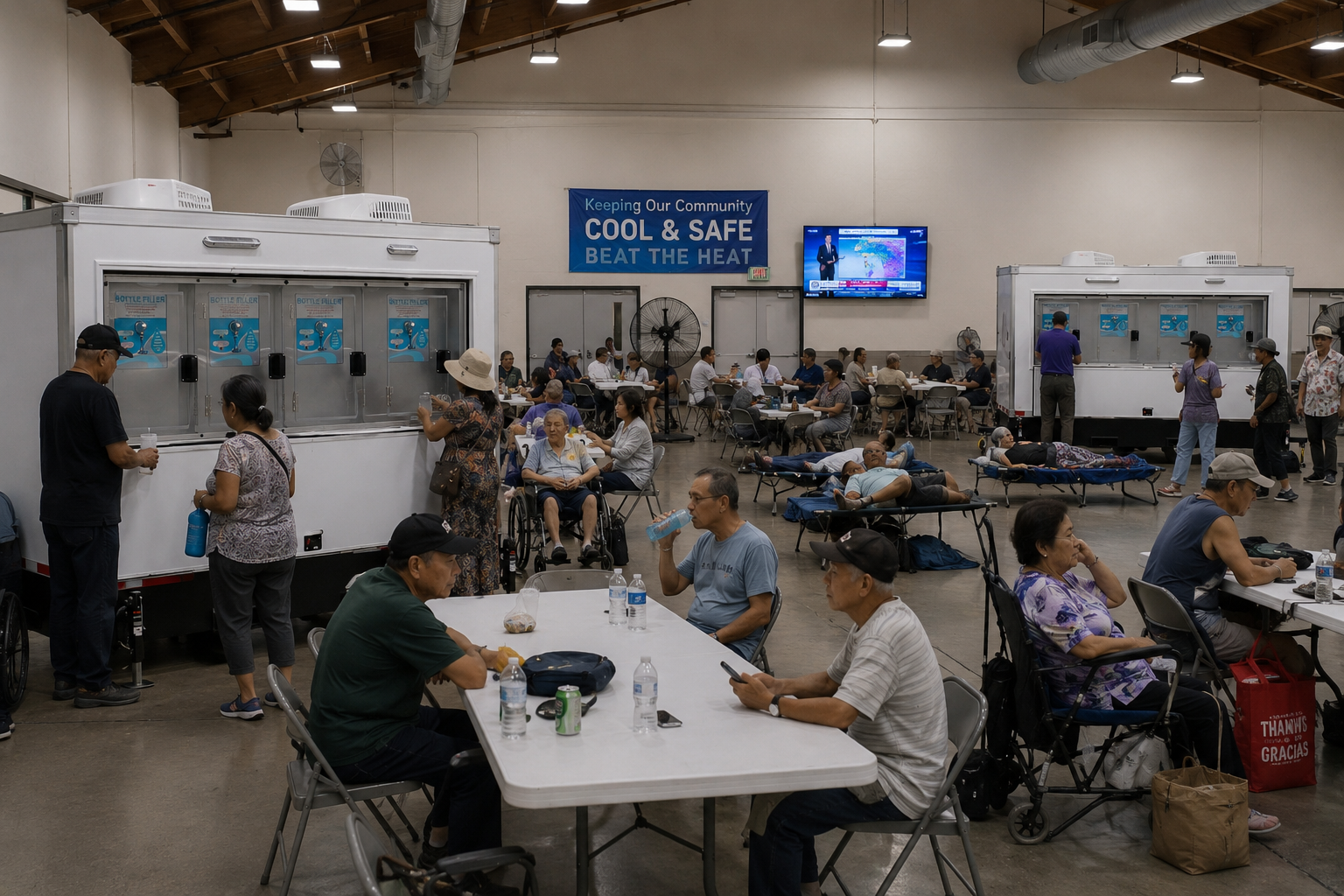
The “coastal” label hides how hot these flatlands really get
Most folks imagine Orange County as a steady 72 with an ocean breeze. Out on the blocks where the work gets done and the big crowds gather, the reality reads very differently.
Garden Grove sits roughly seven miles back from the sand, far enough that the marine layer thins out by late morning while summer afternoons settle into the low-to-mid 90s. A fall Santa Ana event can drive the whole inland basin past 100 with humidity down in the single digits, and it’s that same dry, gusty weather behind the region’s fire season, the sort that has shut roads and forced evacuations elsewhere in the county in recent autumns. Bare concrete and fresh asphalt soak up heat well beyond what the air thermometer shows, so a crew off Garden Grove Boulevard can hit genuine heat-illness territory before noon even while the official reading sits at a tame 91.
What makes planning tricky here is exactly that gap. An organizer who orders off a beach forecast for an inland venue almost always comes up short, and pays for it by mid-afternoon. A contractor who coasted through spring on a couple of coolers can’t cooler-and-ice his way through a six-month flatlands summer; there’s too much water to move and it warms up too quickly. A single self-chilling trailer is the one piece of gear that carries a whole Garden Grove season without turning into a logistics project of its own.
And demand keeps climbing, because the city keeps building and keeps drawing crowds. Redevelopment along Garden Grove Boulevard and the Brookhurst corridor adds mixed-use and commercial work by the quarter. Warehouse and light-industrial space keeps spreading toward the Santa Ana and Anaheim lines along the 22. The Harbor Boulevard hotel district reworks and expands to feed the Disneyland-adjacent tourist flow. Each of those projects puts crews out in open inland sun, usually clocking in early to get ahead of the afternoon peak.
On the event side, this city hardly gets a quiet weekend. The Strawberry Festival alone draws huge Memorial Day crowds to Main Street, Little Saigon runs Tet and Mid-Autumn celebrations plus a steady weekend market rhythm, and Christ Cathedral keeps its own packed schedule. Our local dispatch is built to handle both rhythms together, with refills keyed to how many people are on hand instead of a fixed calendar, plus rush drops when an advisory lands. A water shortfall at a jammed festival, or on an inland build sitting at 96 degrees, does more than slow things down. It can put someone in the back of an ambulance to UCI Medical Center or the nearest ER.
Past the trailer: the trucks that keep a Garden Grove site supplied
The trailer takes the spotlight. The reason it keeps working is the quieter fleet behind it: trucks bringing fresh water in, bladders holding a reserve on site, and tanks drawing wastewater back out. A single call to us handles every piece, rather than you juggling a water supplier, a hauler and a disposal outfit across three separate numbers.
Potable water trucks
Drinking-grade tankers run bulk water all over town and recharge the 300-gallon tank on a cadence we set to your draw. Those same trucks fill cisterns, holding tanks and bladder bags whenever a single drop won’t hold the job, say a deep footing pour off Brookhurst or a wall-to-wall festival Saturday on Main Street.
Bladder bags & buffer supply
Collapsible bladders stash extra fresh water for the busiest runs, and pull double duty as temporary holding when a Garden Grove footprint has no place to drain. They’re the unsexy piece of kit that keeps a far-out pad pouring in between tanker stops.
Pump trucks
When the water has to move across a job, a pump truck fills storage tanks or pushes supply from one side of the site to the other where the fill point and the trailer are far apart. So on a stretched-out festival, or a warehouse yard where the hookup sits well away from where people drink, it pays for itself in a day.
Vacuum & waste trucks
At the tail end, a vacuum truck draws off greywater and wastewater and carts it to permitted disposal, which closes the loop for good. Nobody on your Garden Grove crew has to wonder where the used water ends up. That piece has been part of our service since day one.
Every piece bolts together around the job in front of us. A remote industrial pad might call for a trailer, a bladder for backup, and a recurring tanker run. A packed Main Street festival might call for a pump truck to push supply around and a waste pickup at teardown. Talk us through the project and we assemble the precise combination, with one contact, one invoice, and one crew that already knows your Garden Grove layout.
The four answers that decide what we send, and why each one matters
Two minutes on the phone gets you an actual quote instead of a vague ballpark. These are the things we’ll ask, listed here so you can have the answers ready, and so you can see we shape every Garden Grove job to the site rather than handing everyone the same stock package.
The four answers that steer our pick
- What’s the headcount? A 20-person framing crew off Lampson is nothing like a packed Saturday on Main Street. The number tells us how many trailers to send and how aggressively to run the tanker route behind them.
- For how long? A three-day festival, a three-week footing pour, and a nine-month commercial build each need a different service rhythm. Short jobs ride on bladder buffer; long builds get a standing tanker route.
- Where’s it going to sit? The towable unit drops into a fenced yard, a rough graded pad, a parking lot, or a closed-off festival street just fine. Once we have the exact location, plus how our truck gets past gate shacks, vendor booths and material stacks, we can set it right where the foot traffic runs.
- What’s the power situation? The trailer takes one, two or three standard 120-volt circuits, or a single 50-amp 240-volt feed. Far-back pads with no service and barricaded downtown blocks turn up constantly, and we handle either, provided you tell us before delivery day.
The extras that help us nail it
- The precise spot you’re picturing, and the route our delivery truck uses to reach it
- Whether your group bunches up in one area or scatters across the entire site
- What documentation your safety program needs from the station for a §3395 record
- Whether bulk tanker refills, bladder storage or a waste pickup belong on the same order
The costs a pallet of bottled water never prints on the invoice
Written on a purchase order, bottled water reads like the budget pick. The costly parts never land on that PO: the hours spent managing it, the floor space it eats, the heat that ruins it, and the waste it piles up. Across a Garden Grove summer, each of those runs higher than the “coastal” reputation would lead you to expect.
The payroll line nobody writes down
Count up everyone who lays a hand on a bottled-water pallet. One person places the order, another signs for the drop, somebody breaks it down, ices the coolers before dawn, tops them off all day, then flattens the empties for the dumpster. On a large Garden Grove crew that’s billable time bleeding off every shift, pulled straight out of the work that actually pays. A station wipes that chore off the board. A local GC sat down and did the math with me once, and the wages he quit spending outweighed what the rental cost. “I was paying a guy to babysit a water cooler,” he said, half laughing. He’d never tallied how the bottle runs were eating most of a payroll day a week. The unit shows up full, recharges off our tankers, and needs nothing from his super except a spot to park.
Why warm water loses
Chill a cooler at six in the morning and by eleven on an inland afternoon it’s lukewarm and flat. Crews stop reaching for warm water, and the moment they stop is exactly when heat illness finds an opening. A chilled trailer never rides that curve. The cup poured at quitting time is just as cold as the first cup at sunup, which is precisely when a worn-out, overheated crew or crowd needs it the most.
The space it quietly steals
Pallets swallow staging room, choke lay-down areas, crowd event back-of-house, and sit cooking in the sun until somebody finally cuts the shrink-wrap. The empties multiply faster than anyone can haul them off, and on a cramped downtown lot or a wall-to-wall festival block that growing pile turns into its own problem. One trailer occupies a single parking stall and outlasts a crowd that would otherwise burn through hundreds of bottles in a day.
The waste that follows you
Every bottle you buy is a piece of trash you’ve also bought, and a busy Garden Grove site builds a mountain of them over a season. That’s disposal coming out of your budget, a black mark on any sustainability write-up, and in a city that throws its biggest events on a much-loved Main Street, it’s a look nobody wants attached to their festival. A refill station zeroes out that line and gives your reporting a number actually worth printing.
Cold water staged across Garden Grove and the neighboring cities
Our dispatch runs the whole city corner to corner: Little Saigon and the Korean Business District, Historic Main Street, and the redevelopment corridors along Brookhurst and the 22. If you sit inside Garden Grove, or just over the line in a neighboring city, you sit inside our delivery range, whether that’s a festival downtown, a hotel project on Harbor Boulevard, or a warehouse pour toward the Santa Ana side.
Garden Grove BlvdHarbor Blvd corridorBrookhurst
West Garden GroveWestminsterStanton
Santa AnaAnaheimFountain Valley
CypressOrangeMidway City
Working a corridor instead of a single address? We work the freeways the area runs on, the 22, the 5, the 57 and the 405, so corridor and multi-site jobs see the same quick turnaround a single address would. Near a city line and not sure if you’re in our range? Call and ask, the answer is almost always yes.
The questions Garden Grove planners and crews actually ask us
What’s a realistic delivery window to my spot in Garden Grove?
Figure on about 45 minutes once we dispatch, anywhere inside the city limits, with overnight runs added during advisories. If your crew lands on a 95-degree pad off Brookhurst with nothing cold, we can usually have a unit pouring before the first break. The two things that swing that timing are how the gate is set up and what power’s waiting at the spot, so tell us both and we plan the route around them.
Is this meant for parties and festivals, for worksites, or for everything?
Everything, and that’s the point of running one local outfit. Our trailers turn up at Main Street festivals, Little Saigon celebrations, courtyard weddings near Christ Cathedral and weekend tournaments, and they turn up on framing crews, warehouse builds and landscaping jobs. The identical Signature unit covers a downtown crowd or a dusty inland pour. Just give us the headcount and we scale it.
Does the water come out cold, or is it only filtered?
It comes out both, and the “coastal” reputation makes people forget the cold part. A built-in chiller keeps the whole tank cold from the first pour to the last. The minute that morning ocean air burns off inland, warm water gets ignored and people quietly fall behind on fluids. People drink cold water, and drinking is what heads off heat illness, so we count the chiller as safety equipment, not a perk.
In plain terms, how does a station support our §3395 heat plan?
California’s Title 8 §3395 calls for fresh, suitably cool, free potable water for outdoor workers at no less than a quart per person per hour, with shade required at 80°F and high-heat steps at 95°F. A trailer hands you a fixed, mapped cold-water point you can write into your Heat Illness Prevention Plan and show a Cal/OSHA inspector on the spot. The safety program is yours to write; the hydration it leans on is what we bring.
What’s the tank capacity, and what happens when it gets low?
Each Signature holds 300 gallons, roughly 2,400 sixteen-ounce pours. When a big crew or a packed festival day pulls hard on it, our tankers recharge the unit on a cadence set by that draw, so the tank itself never becomes the ceiling. Keeping an eye on the refill schedule is our job, not something you have to track.
Is the unit usable by someone in a wheelchair?
Yes. Every trailer carries four touch-bar fill points, with one mounted low enough to reach from a wheelchair, so your Garden Grove event or site covers everyone without a bolt-on second fixture. Out back, the large-jug spout loads five-gallon coolers and personal packs, while the hose-bib taps handle field chores.
What if my site has no power, like a barricaded block downtown or a far-back pad?
Common situation, especially with Main Street festivals and inland builds. A Signature draws off one to three standard 120V circuits or a lone 50-amp 240V drop, and thanks to the unit’s light power draw plus our support fleet, we’ve kept stations pouring with no fixed hookup whatsoever. Mention it up front and the workaround goes into the quote.
How’s the taste compared to a case of bottled water?
Clean and flat in flavor, minus the chlorine edge tap water sometimes has. That carbon stage scrubs out the chlorine and the seasonal off-notes the city supply occasionally carries, so a cup tastes fresh rather than like a garden hose baking in the driveway. Flavor counts more than people expect, because nobody refills from a tap they dislike, which is why we treat taste as part of the safety equation.
Can you roll out fast during a heat wave or wildfire situation?
Yes, and it’s a big reason local clients hang onto our number. Through heat advisories and Santa Ana wind events we run overnight and weekend drops and pre-stage backup tankers the instant a forecast sours. When a crew or a neighborhood cooling center suddenly needs potable water, a single call usually puts a trailer pouring cold before the afternoon peak hits.
Built for the operations that can’t risk a warm-water afternoon
“Our Main Street festival weekend used to mean pallets of bottled water and a mountain of empties by Sunday night. They dropped stations across the blocks and the plastic almost disappeared. Lines moved, water stayed cold, and pickup ran on our schedule. Already booked for next year.”
“A safety review of our Garden Grove Boulevard crew asked us to show §3395-compliant cold water on record. The mapped station handled that line in our plan, the tanker showed up before we ran low, and the inspector’s walk-through wrapped in about five minutes.”
“We doubted one trailer could keep cold water flowing across a two-day youth tournament. It did, all weekend, with no warm cooler and no empties to chase. The kids and parents went straight to it. We’re keeping it on the schedule for the next season.”
Service information current as of June 2026.
Get cold, filtered water on your Garden Grove site or event this week
Tell us how many people, which dates, and where you want the trailer parked. We’ll get the sizing right and run a station out to any Garden Grove address, typically inside about 45 minutes once we dispatch.