Huntington Beach Bottled Water Station Rentals for Events & Job Sites
We rent self-contained drinking-water stations across Huntington Beach, the kind that pour cold, filtered water all day and refill themselves while they do it. Book one for a Pier-front festival or a 5K on the sand, or park one at an inland build off Gothard. Either way you skip the pallets of single-use bottles and keep guests and crews drinking without anyone babysitting a melting cooler.
- Chilled, four-stage-treated drinking water
- ADA-height bottle fillers
- Built around Cal/OSHA §3395
- ~45-min runs across coastal OC
- Fully licensed & insured
- Emergency dispatch, day or night
Filtered drinking water for Huntington Beach events and job sites, delivered and kept full
Our trailers pour cold, filtered drinking water at events and work sites all over Huntington Beach and the coastal Orange County corner, and we keep them topped off from gates-open to load-out. The coast reads mild on a thermometer, but that’s the trap: a marine-layer morning burns off by noon and an exposed crowd on the sand or a roofing crew off Beach Boulevard takes the full sun for hours with zero shade. People assume HB never needs a hydration plan because it isn’t Palm Springs. Then the airshow draws a million-plus onto open sand in October, or a slab pour runs through a 90-degree inland afternoon in Westminster, and the cooler plan falls apart by lunch. Organizers and superintendents ask us the same things every time: how fast can you reach the coast, will the water still be cold by mid-afternoon, and who refills it when 300 gallons runs low on a Saturday. We’ve got straight answers for all three.
Quick runs to the coast
Most drops across the coastal-OC corner reach you inside roughly three quarters of an hour, and we run emergency deliveries at any hour when a heat advisory or a sold-out event day lands. When an ops lead figures out at 7 a.m. that a beachfront crowd has nothing but a warm flat of bottles, speed is the entire job.
Water that’s still cold at 3 p.m.
Each trailer flash-chills its own supply, so the festival’s final pour comes out just as cold as the first cup at sunrise. Nobody drinks warm water, and water that goes undrunk does nothing to head off heat illness. On full-sun sand, that gap counts for more than the air temperature ever admits.
Dropped, serviced, refilled, hauled
No bouncing between a bottled-water supplier, an ice run, and a waste hauler on three separate invoices. We place the station, keep it filled from our own trucks, maintain it for the length of the rental, and tow it off when you wrap. A single point of contact handles the entire hydration loop on your HB site.
Here’s the line I lead with on every first call: a hydration setup the crowd or crew walks past is the same as having none at all. I’ve watched shrink-wrapped pallets of warm water bake by a beach access gate while people drifted toward woozy and lightheaded, and I’ve watched a chilled trailer parked twenty steps off the main stage get drained twice in an afternoon. The space between those two is the entire reason we exist. Which is why our trucks never just park a unit and leave. We size it to your headcount, tune the refill rhythm to how fast you actually draw it down, and answer an emergency call the way you’d want it answered, fast, because on a packed Surf City weekend a single hour decides whether the day ends clean or ends with a medical tent overrun.
One road-towable trailer built for the coast and the inland build alike
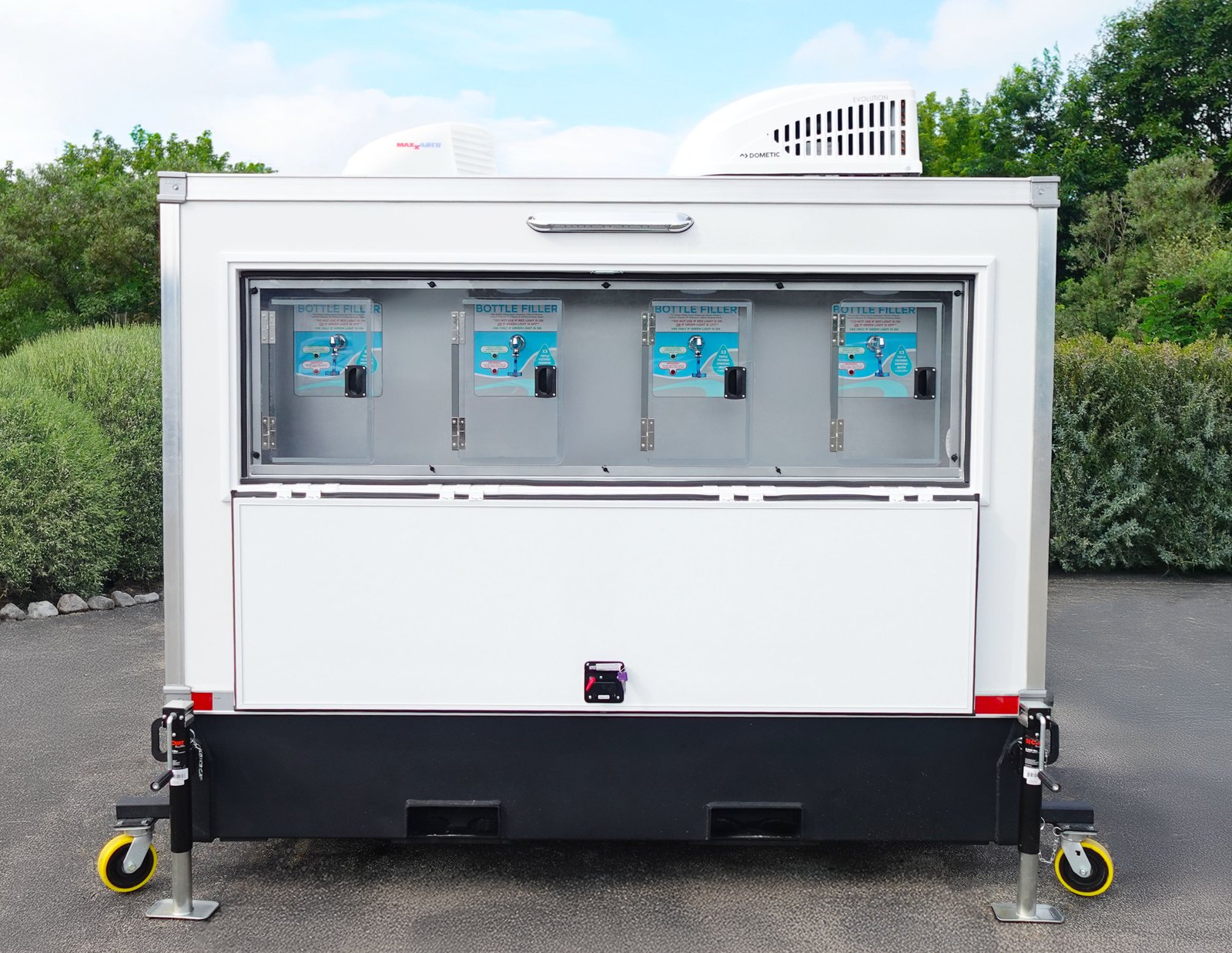
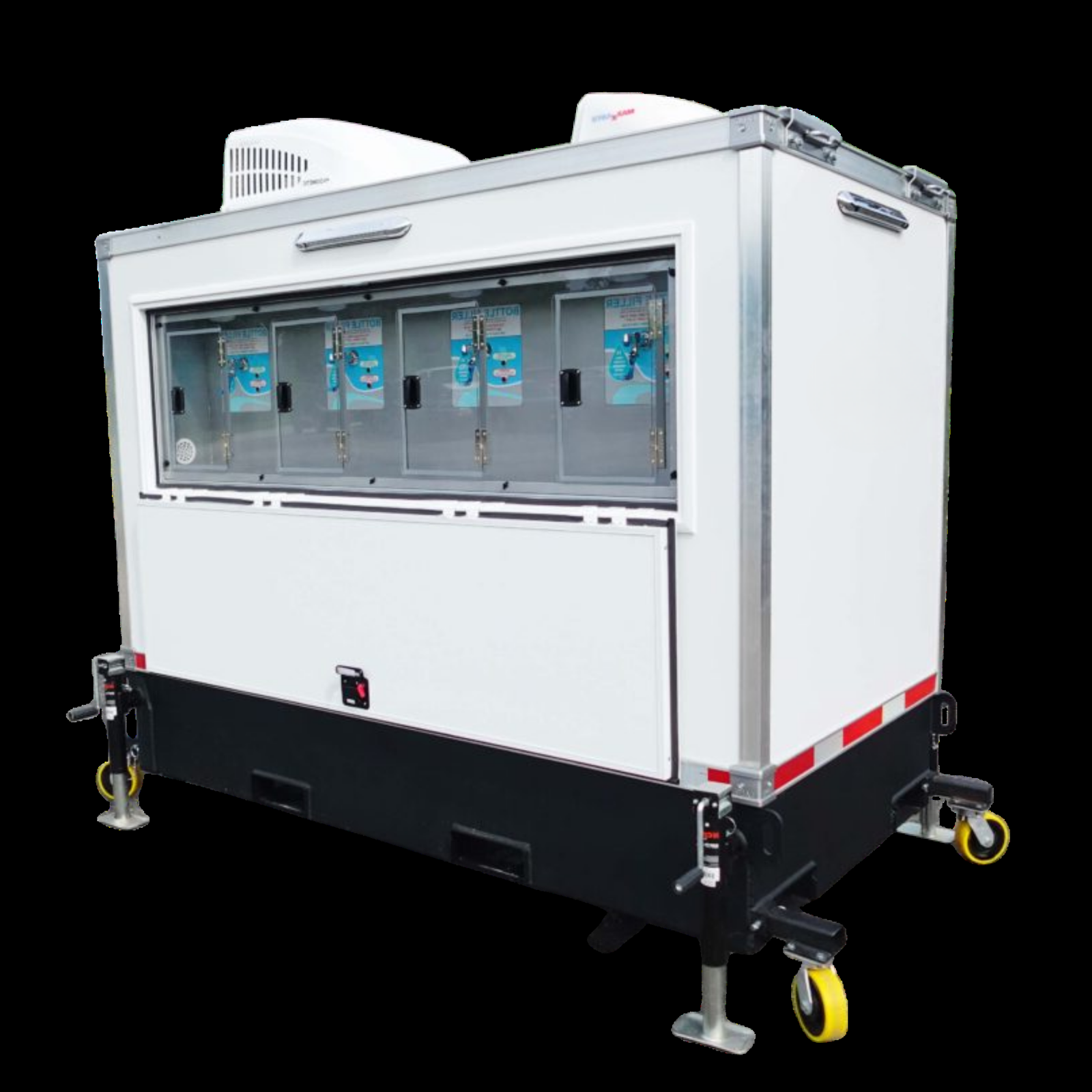
One purpose-built rig covers all of HB: the Signature Series water station trailer. Its road chassis tows it right up to wherever the crowd or the work is, a soft-sand spot near the Pier, a festival lawn at Central Park, a yard up Gothard. There’s nothing to assemble and no fixed plumbing to permit, so you get chilled filtered water flowing the same day it shows up.
Signature Series specifications
Riding on a full chassis with road tires and a hitch, it tows out to a beachfront staging zone, an event field, an inland jobsite, or an emergency base camp. HB event planners and OC contractors ask for this unit by name, because it’s compact enough to spot, level, and have pouring within the same afternoon it lands.
| No. of stations | (4) Bottle Filling Stations |
| Length | 12′ 3″ |
| Weight | 3,100 lbs. |
| Height | 8′ |
| Fresh water tank | 300 Gallons |
| Power requirements | 1–4 dedicated 20A/120V circuits OR 1 dedicated 50A/240V circuit |
| No. of AC units | 1 |
Why this trailer fits Huntington Beach work
Every part of the Signature is built for sun and for distance. The four push-back taps sit along an exterior wall beneath an awning, so a full crowd or crew cycles through quickly on a hot break rather than stacking up at a single nozzle. Onboard AC and built-in chillers keep the supply cold even while the trailer bakes all day in open coastal glare off the sand, which is precisely where pallets and ice chests fall apart out here once the fog has burned off.
That 300-gallon tank sees a sizeable crew or a steady event line through the day. Because it rolls on the road, we can reposition it across a sprawling beach footprint or move it to the next phase of a build with no permanent install to rip out. Its power needs are modest and flexible, so the one trailer works at a wired event compound near Pacific City or on a bare graded lot inland that we power around.
And those four taps are just the headline. The rear large-jug spout fills five-gallon coolers and personal packs, while the hose-bib taps cover crew wash-up, cleanup, and outdoor labor. A single trailer covers the entire hydration picture for an HB event or jobsite. A single rig has covered a Bolsa Chica trail race one weekend and a Bella Terra construction phase the next, without us hauling out a second piece of equipment. We’ve run the same unit through a morning corporate setup in Costa Mesa and an evening street fair on Main Street that same day.
The bottle count a single Surf City build piles up in a season
Put a 40-person crew on an inland HB build for one summer and the arithmetic makes the call for you. Figure six bottles a worker on a sticky, marine-layer-gone afternoon and you’re cutting orders for, receiving, icing, and binning about 240 single-use bottles every single workday.
Carry that across a 180-day job and you’re north of 43,000 bottles, and a phased redevelopment off Beach Boulevard, or a run of back-to-back strand events through the summer, pushes that figure much higher. One trailer replaces the whole stack, cold water at the tap with nothing rolling toward the dumpster behind it.
It’s a logistics call before it’s a green one
The plastic-waste angle is real, and at the coast it lands harder than most places. HB is a beach town that markets itself on clean water and a healthy shoreline, so a mountain of empties blowing off a festival lawn toward the surf is a genuinely bad look, and a real problem for the volunteers who chase it down. One bottle can sit in a landfill for centuries, and the ones that don’t make the bin end up exactly where this city least wants them. Most HB planners and PMs now have to account for that waste on paper. Still, the swap usually happens for a plainer reason: one shared trailer ends the daily scramble. No recurring water order on the books. No pallet gone tepid before mid-morning. No heap of empties cooking at the gate. Your event lead works the show, your super works the build, and the water just takes care of itself.
And because we keep the station charged off our own potable water trucks, supply scales with the day. A crowd that doubles on the airshow’s Sunday peak, or a crew that surges for a concrete pour, doesn’t out-drink the plan. We just top the tank.
Hydration sized for how Surf City actually runs
Huntington Beach doesn’t have one hydration problem, it has a stack of them. A million-person airshow weekend asks for one setup, a February marathon along PCH asks for another, and an inland tilt-up build off the 405 asks for a third. Here’s where these trailers earn their keep: down on the soft sand below the Pier, and up in the warehouse corridors around Gothard and the Edinger commercial strip.
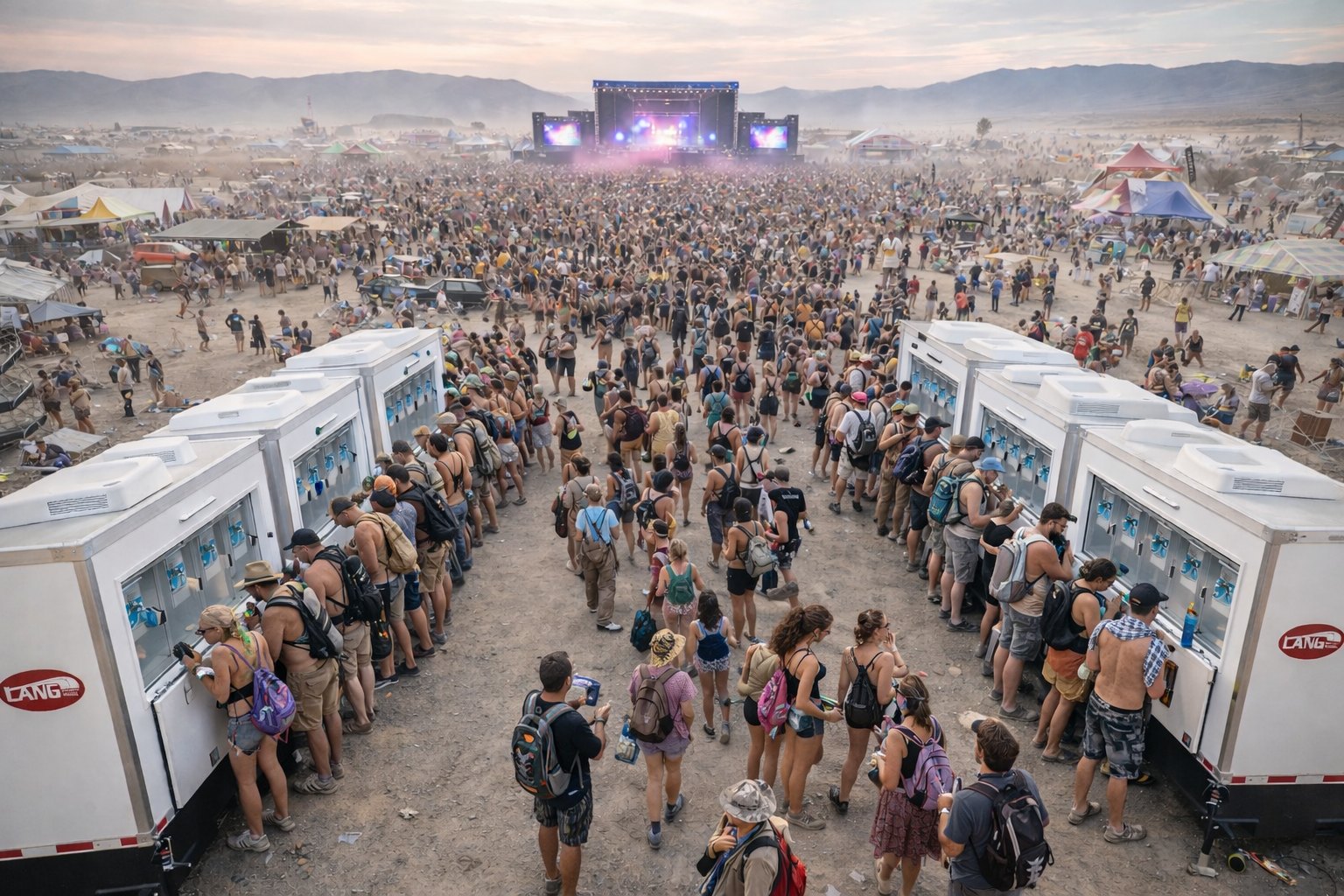
Beach festivals, the airshow & the US Open of Surfing
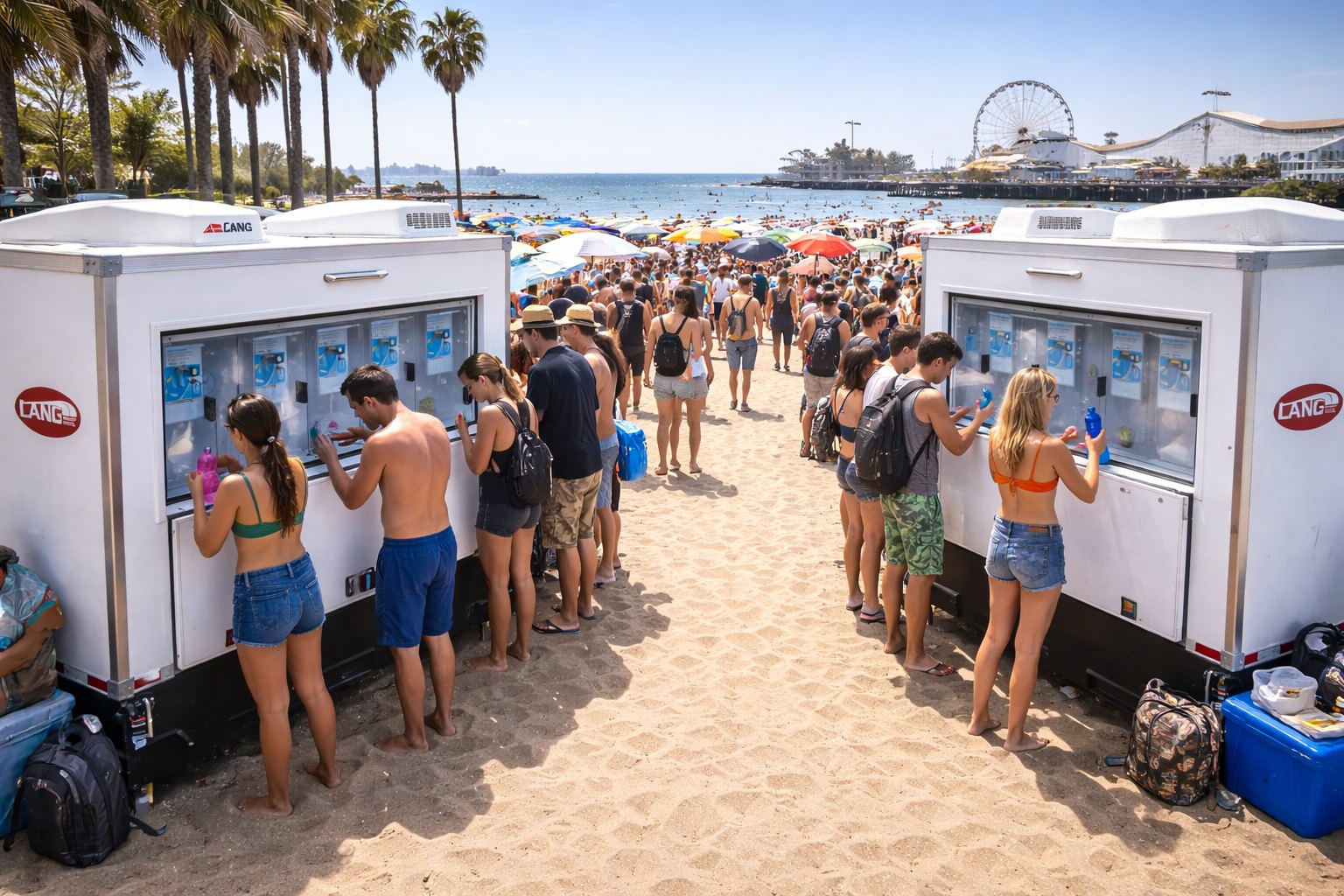
HB’s signature draws pack open sand under full sun: the Pacific Airshow each October pulling well over a million people across three days, the Vans US Open of Surfing taking over the Pier in late summer, the Surf City Nights street fair on Main Street every Tuesday, beach concerts, and a packed calendar of charity walks. An outdoor crowd here goes through water fast, and there’s no shade anywhere to duck into. A trailer gives organizers a steady cold supply and clean refill points, without a wall of single-use bottles to truck in and truck back out again.
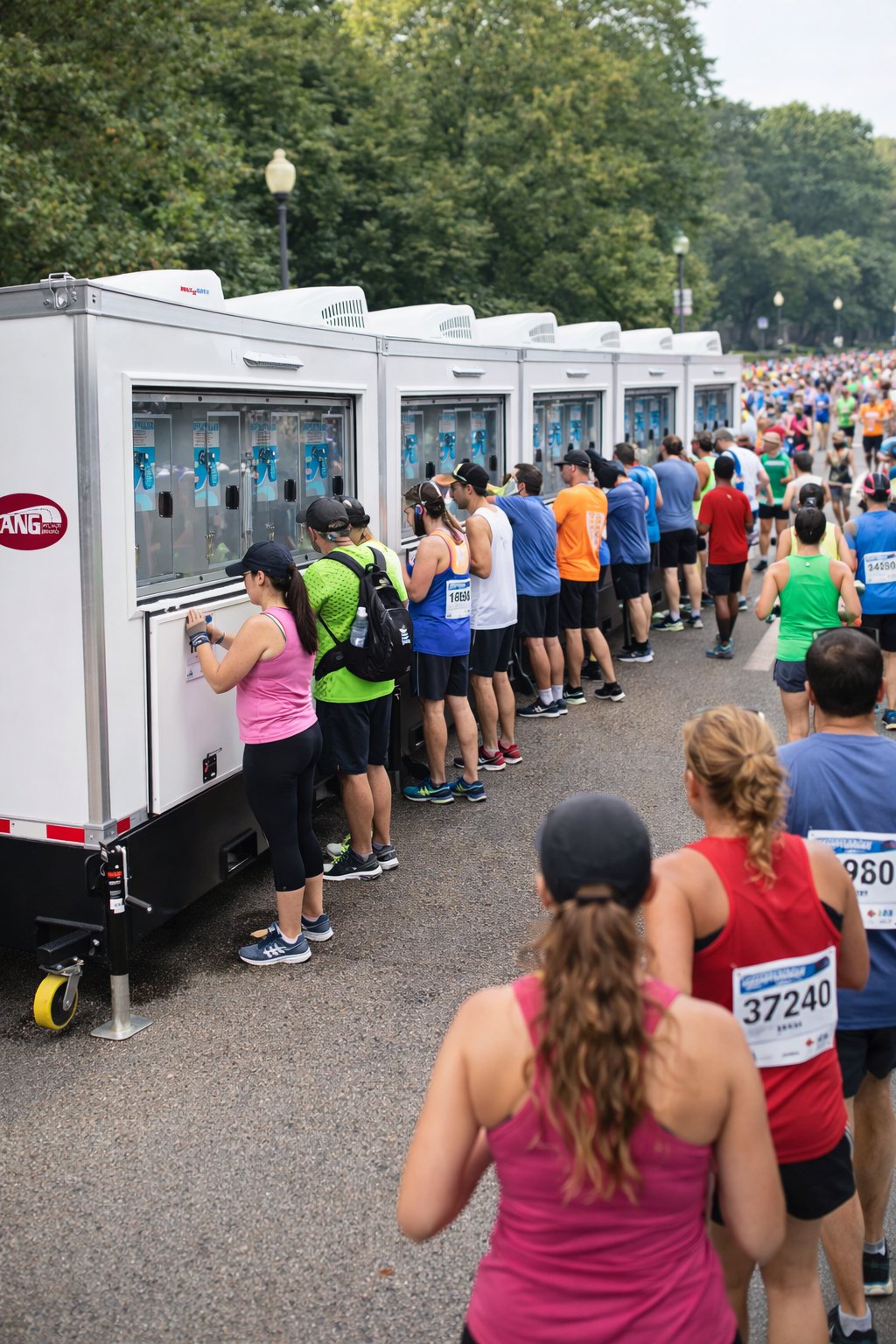
Marathons, 5Ks & beach sports
The Surf City Marathon sends seventeen-thousand-plus runners down PCH on Super Bowl weekend, and that’s just the headliner. There are beach volleyball tournaments at the Pier courts, junior lifeguard programs through summer, triathlons, and youth sports across Central Park and Edison fields. Aid stations and finish-line corrals need real cold-water capacity, not a few folding tables of cups, and our jug-fill and hose taps load coolers fast between waves.
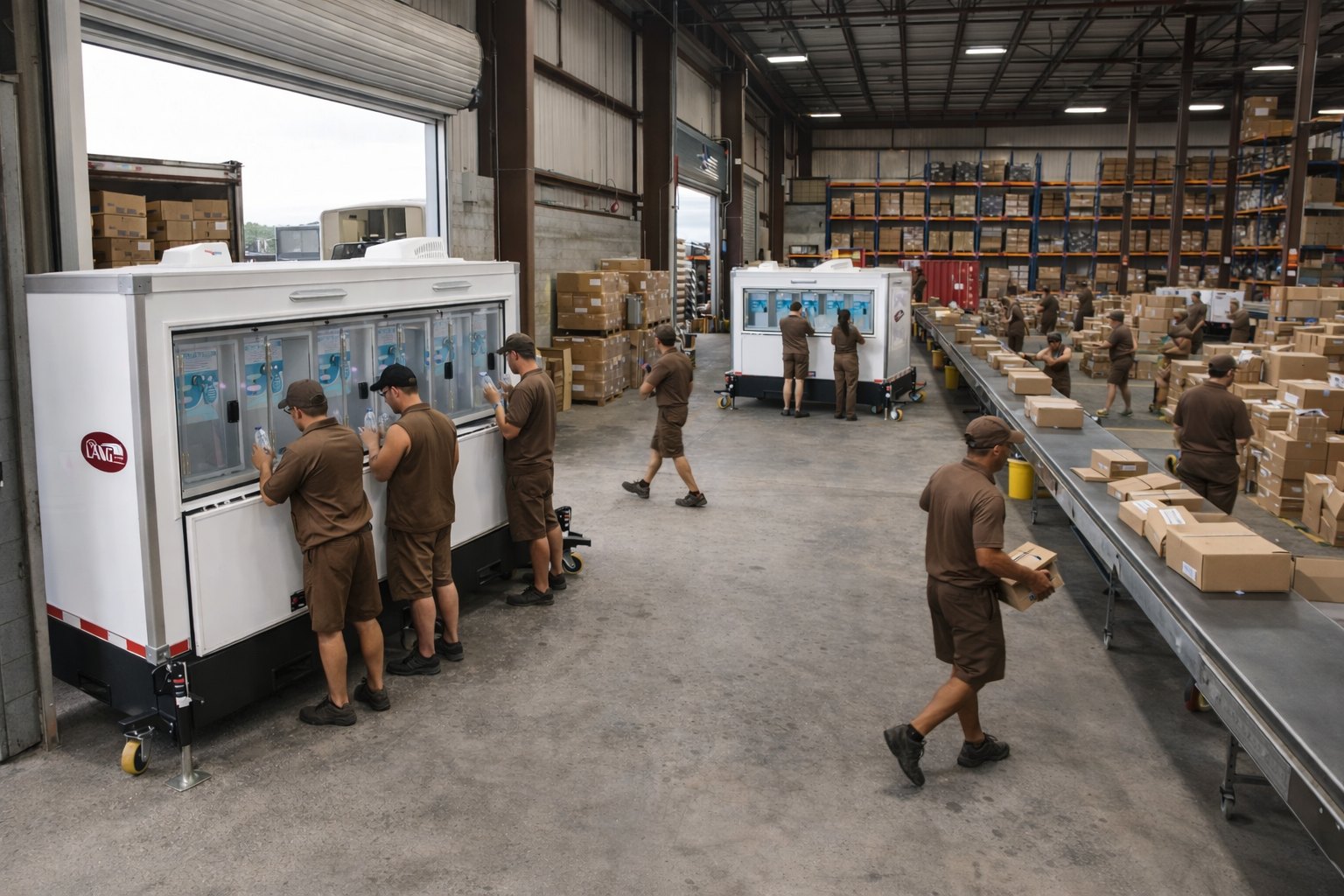
Construction, aerospace & commercial build-out
HB’s working backbone runs inland: the long-running Boeing aerospace footprint near Bolsa Chica and Springdale, the warehouse and light-industrial corridors along Gothard and Graham, mixed-use redevelopment around Bella Terra and Beach Boulevard, and the steady OC tract and tilt-up work in Fountain Valley and Westminster. Those crews work full inland afternoons with no marine breeze. We park trailers on these jobs so a GC or a specialty sub keeps documented, on-record cold hydration within easy reach of every work face.
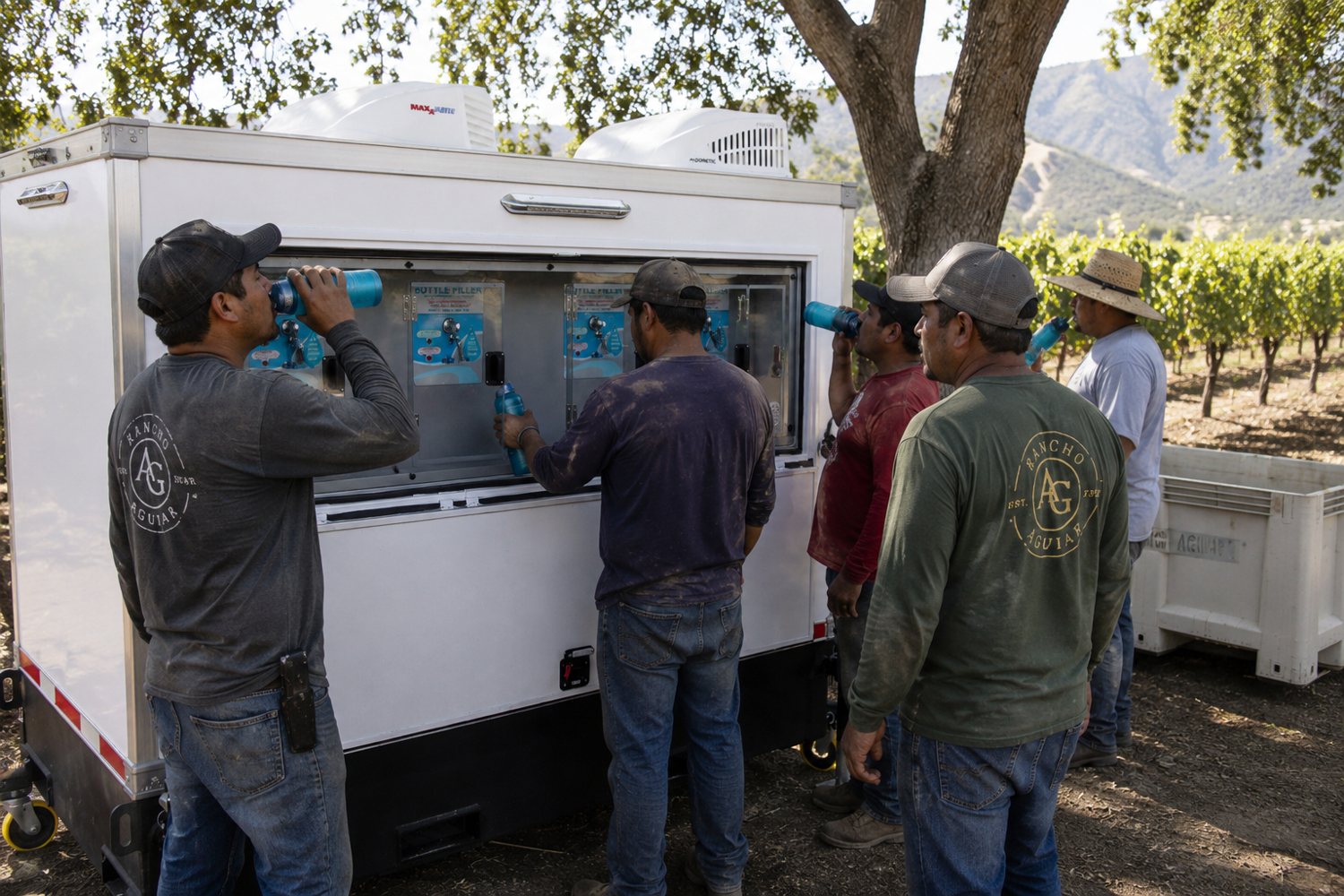
Outdoor labor, municipal & emergency response
Landscaping crews, the wetlands restoration work at Bolsa Chica, city public-works teams, and harbor and pier maintenance all put people in the sun for full shifts. A towable trailer drops straight into the yard or trailhead where they work. And when a heat event, a power outage, or a water-main break hits a coastal OC neighborhood, we push potable water trailers out to cooling centers and staging areas on short notice.
City water in, four filters and a UV pass, then chilled at the tap
Nobody refills a reusable bottle from a station they distrust the taste of. We feed each trailer from the municipal supply and route it through four filter stages and a UV step before it ever reaches the chiller, so a guest topping off on the strand or a sub on an inland slab gets water that’s clean, neutral, and cold rather than warm and flat by the second hour.
Sediment knockout
The first filter traps the rust flecks, scale, and grit that older OC distribution lines shed, so the pour never comes out cloudy at a soft-sand setup below the bluff.
Carbon polish
An activated-carbon bed scrubs the chlorine taste and the stale-pipe notes that can ride along in summer supply. On a clear afternoon at the Pier, a neutral pour is what keeps a line moving instead of people drifting off thirsty.
Metals reduction
A final polishing stage captures microscopic particulate down to sub-micron size, so every fill stays safe whether it’s a junior-lifeguard kid or a tradesperson off Graham Place.
UV finish
One last ultraviolet chamber knocks out bacteria and microbes with no chemicals added, holding the water clean all the way out to the nozzle even on a long coastal run from the yard.
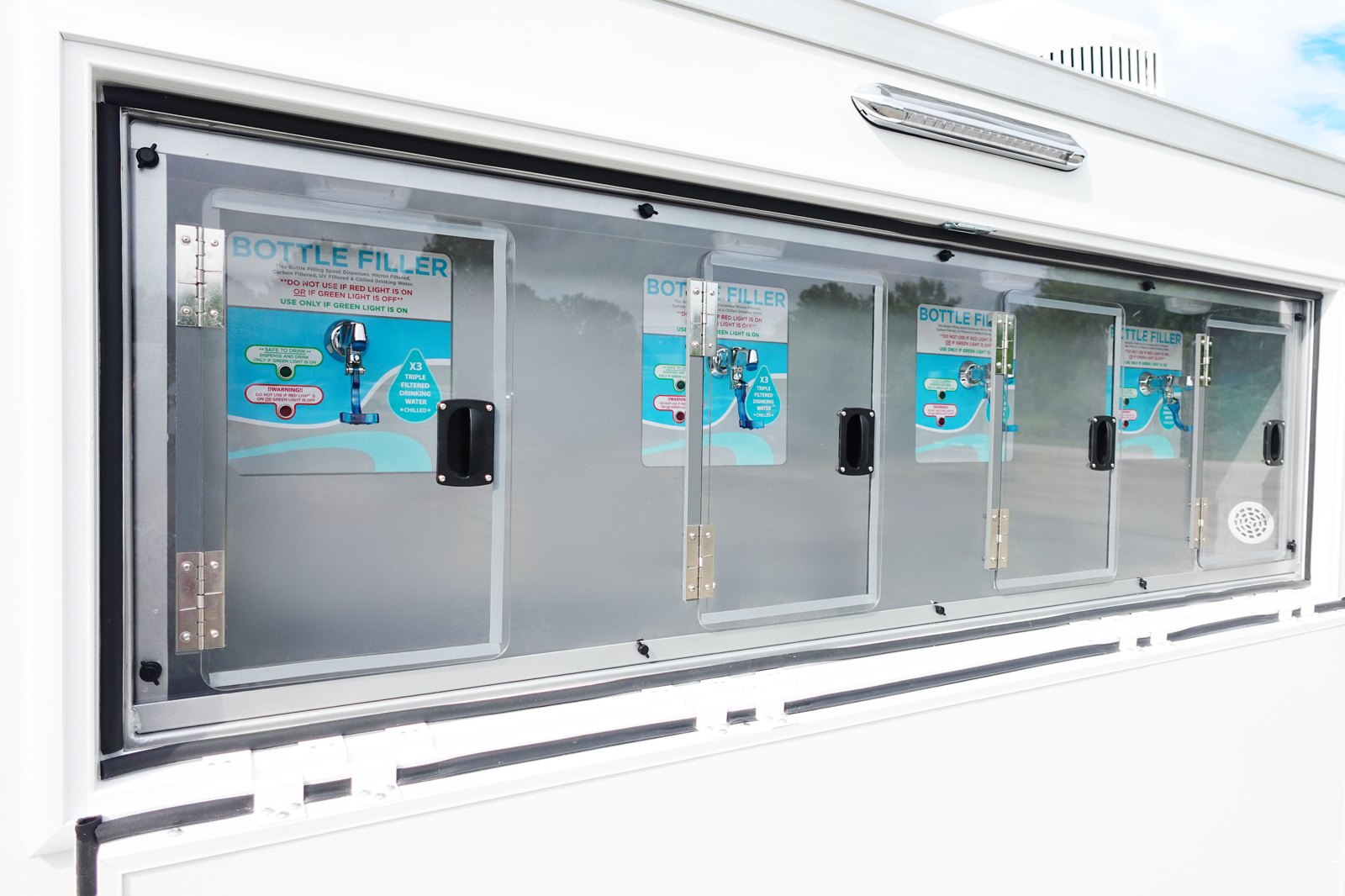
Four taps, a jug spout, and a wheelchair-height fill on one panel
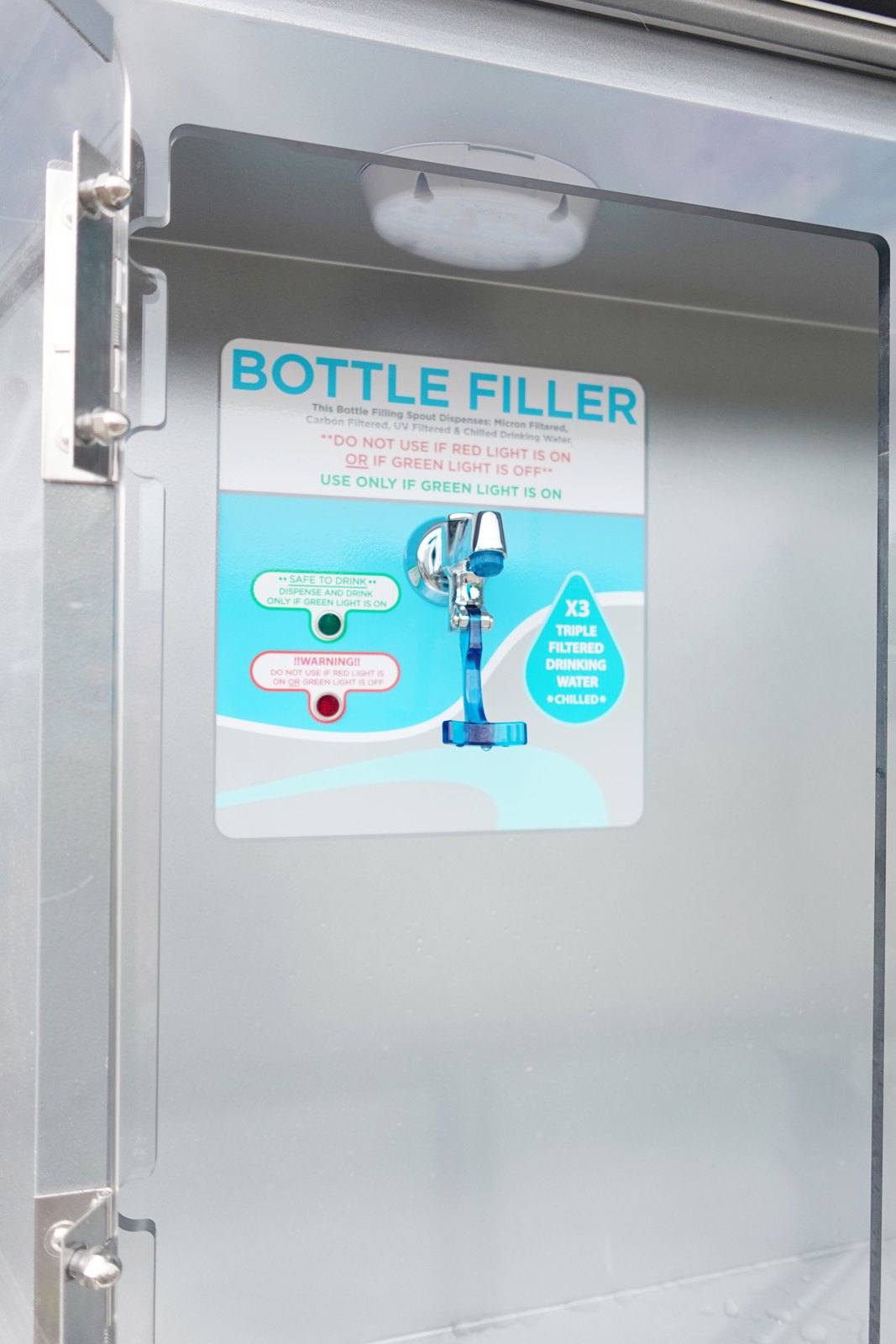
The fill panel runs four push-back positions with adjustable nozzles; press a bottle to the bar and it pours on its own, no handle to crank in a crowd. One of the four is set at wheelchair-reach height, which means an HB festival or jobsite meets its accessibility need from this single rig rather than booking a separate ADA unit. The rear large-jug spout loads five-gallon coolers and personal packs, and the hose-bib taps handle washdown, cleanup, and general crew work. Food-grade stainless throughout keeps the filtered, chilled quality intact across every surface the water crosses on the way out.
Each Signature carries 300 gallons, which works out to roughly 2,400 sixteen-ounce fills before a top-off, and because our tankers recharge on demand the trailer never becomes the choke point during a sold-out Surf City Saturday or a doubled-up inland crew day.
We deliver, fill, and hook it up, usually pouring cold water inside an hour
There’s nothing here for you to operate. We pick the placement, fill the fresh tank, and make the hookup, then walk your HB crew or event team through the unit before we pull off the site.
Give us the basics
Your headcount or crowd size, how long you need it, the exact parking spot at the HB site, and the power on hand. That’s all it takes for us to nail the sizing on the first try.
We roll down the coast
Reaching any point in coastal OC typically takes about 45 minutes once we’re dispatched, plus around-the-clock emergency runs whenever a heat event or a packed beach weekend lands.
We stage and connect it
On site we get the trailer level, charge the 300-gallon fresh tank, and tie into power, whether that’s a single 50-amp 240V drop or one to three ordinary 120V circuits the HB spot has available.
We keep it flowing
Our tankers come back to refill on a cadence pegged to how fast people are actually drinking it, and we service the unit end to end for the full rental.
Nothing but a soft-sand setup or a raw graded lot with no power? We flag it on the quote and solve it. The trailer pulls little enough, and our service fleet covers enough, that we’ve kept stations pouring on HB sites and beachfront footprints that had no permanent power whatsoever. Tell us what’s there and we build around it.
In California, hydration access on an outdoor site is the law, not a courtesy
People hear “Huntington Beach” and picture a cool ocean breeze, so they assume the heat rules don’t bite here. They do. California’s Heat Illness Prevention Standard, Title 8, Section 3395, applies to all outdoor places of employment statewide, the coast included. It requires employers to provide fresh, pure, suitably cool drinking water, free and close to the crew, enough for at least one quart per worker per hour, a full gallon across an eight-hour shift. Once the temperature hits 80°F it adds shade requirements, and at 95°F it triggers high-heat procedures. None of that has a coastal exemption.
A trailer makes that obligation tangible. It’s a fixed, mapped feed of cool, potable water on the work face, the anchor of a real Heat Illness Prevention Plan and exactly what a Cal/OSHA inspector expects to see when they walk an HB jobsite. Cal/OSHA has stepped up outdoor heat enforcement across Southern California, and an inland OC crew working a 90-degree afternoon with no marine breeze faces the same rule as a crew in the Inland Empire. A documented, on-site cold-water station is one of the cleanest line items to put in front of a reviewer.
- One quart per worker per hour of suitably cool, potable water, close at hand
- Centralized, documentable hydration points for your §3395 plan records
- Supports acclimatization, water breaks, and high-heat procedures above 95°F
- Ready for tightening state and federal heat rules instead of scrambling after them
Three things running water at the beach drilled into us
Seasons of dropping stations along the strand, the Pier, and the inland yards rewired how we run a job. Three lessons stuck hardest:
Where the trailer sits decides whether anyone uses it. We parked one off the access lot at a charity walk on the strand and watched it go barely touched, because the route ran along the sand a couple hundred yards out and nobody was going to backtrack across hot blacktop for a drink. The next morning we wheeled it down onto the sand-edge ramp and the draw doubled by 11. The volunteer coordinator said the rule out loud: if the water’s closer than the porta-johns, people find it without being told.
Don’t trust the zip code to tell you the heat. A Westminster tilt-up super waved us off a heavy refill plan because, in his words, the site was “practically beachfront.” By early afternoon the gray was burned off, the fresh slab was radiating heat back up at the crew, and they were emptying the tank faster than a Pier crowd had the Saturday before. His text that day: “Skip the breeze talk, just send the truck.” Now we scope inland-OC refills off the actual work face, never the address.
An October airshow weekend taught us about scale. We staged extra tankers expecting a crush and still almost lost the race, a million-plus people spread across open sand with the sun out three days running. The single unit by the main viewing zone pulled a constant line from the first hour. The following year we strung several trailers down the strand and the pinch point vanished; a safety coordinator told us afterward the first-aid tent had a markedly quieter weekend. That quieter tent is the entire reason we do this.
Each of those calls hammered home the thing the coast works hard to disguise: in Huntington Beach you can’t treat hydration as a set-and-forget line item just because it “doesn’t feel that hot.” It’s an operation, and we run it like one start to finish on every rental.
Thousands on the sand, zero shade, and a long afternoon to get through
Organizers here build around sun exposure the way a ski town builds around snowfall. Drop a self-contained trailer at a Main Street festival, a beachfront concert, a charity walk on the strand, or a corporate day at Pacific City, and the crowd gets steady cold water and clean refill points all day. Your team also dodges the whole bottled-water circus, the ordering, the icing, the hauling of empties back off the sand, which is the last thing a city built on a clean shoreline wants drifting toward the waterline.
On a big footprint we’ll position several units so no one has to cross baking sand or pavement to drink, and our crew times the drop-off and pickup to your event window. The lesson stuck after a packed beach concert: one trailer by the stage had a line thirty deep by mid-afternoon (a few thousand people in the sun outruns a single unit fast, ocean breeze or not). We came back the following year with four spread across the grounds, and the lines simply went away. To a guest it feels like hospitality. To your ops lead it’s plain risk management.
Why the coast is sneakier to plan for than the desert
Inland cities get an obvious, blistering heat season everyone plans for. Huntington Beach gets a deceptive one, mild on paper, brutal in practice once the sun is full out and a crowd has no shade. That’s exactly what trips people up.
A typical HB summer afternoon runs in the upper 70s to mid-80s, which sounds harmless next to a triple-digit Inland Empire day. But air temperature is the wrong number on the sand. Reflected glare off light beach sand and bare pavement drives the effective heat load far higher, and there’s no canopy anywhere on an open shoreline. UV exposure peaks midday regardless of the air reading, and a sunny dehydrated crowd standing on hot sand for six hours at a festival is in real heat-illness territory while the gauge still reads a comfortable 82. The marine layer makes it worse by lulling everyone, the morning is gray and cool, so nobody packs water, and then it burns off and the same crowd is baking by 1 p.m. with nothing on hand.
Inland HB and its neighbors lose the ocean’s help entirely. A few miles back from the water, Westminster, Fountain Valley, and the Gothard industrial belt run hotter and stiller than the strand, and a crew there can’t count on any sea breeze to take the edge off. So the planning problem isn’t a single scorching week. It’s a long stretch of deceptive afternoons where the danger is easy to underestimate, which is precisely when a centralized, self-chilling trailer earns its rental, because it removes the judgment call entirely. The cold water’s just there.
And the demand keeps climbing, because HB and coastal OC stay busy year-round. The event calendar alone is relentless: the Pacific Airshow, the US Open of Surfing, the Surf City Marathon, the Fourth of July parade that draws hundreds of thousands, Surf City Nights every week, and a steady run of beach volleyball, triathlons, and charity events through the warm months. Layer on the inland construction, the Bella Terra and Beach Boulevard redevelopment, the aerospace and warehouse work, plus the routine public-works and wetlands jobs, and there’s almost always a crowd or a crew somewhere in the sun.
We built our coastal-OC dispatch around exactly that rhythm. When we first started staging trailers for beach events and inland sites, we set refills by real draw instead of a fixed schedule, and we bolted on emergency drops for heat advisories and sold-out weekends. Because on a packed HB Saturday a hydration gap doesn’t just slow things down, it can put someone in the medical tent or send an ambulance crawling through Pier traffic that’s already at a standstill.
The support trucks that keep a coastal OC station full and the greywater gone
The trailer is what your crowd sees. Behind it runs a fleet that brings drinking water in, banks reserve on site, and carries used water back out. Booking all of it through one provider matters more at the coast than most places, because beach access windows, Pier-area gridlock, and tight festival load-in slots are hard enough to coordinate with a single crew, let alone three vendors who’ve never worked the strand.
Potable water tankers
Drinking-grade tankers run bulk water out from the yard and refill the 300-gallon tank on a cadence set to your draw. They also charge cisterns, on-site holding tanks, and bladders when one drop won’t cover the day, like a multi-yard concrete pour off Gothard or the airshow’s Sunday crest along the strand.
Bladders & reserve buffer
Fold-flat bladders stash spare fresh reserve through the heaviest hours and can hold greywater for a stretch when a beachfront spot has no drain anywhere near it. It’s the quiet piece that keeps a far-out coastal setup pouring between tanker visits when truck access down PCH is slow.
Pump trucks
When the fill source and the station can’t sit side by side, a pump truck moves the water, charging tanks or relaying supply over a wide footprint. On a strand layout where the trailer parks on the sand-edge and the truck can’t get past the beach barriers, it bridges that last few hundred yards.
Vacuum & waste trucks
At teardown a vacuum truck draws off greywater and wastewater and hauls it to permitted disposal. At the shoreline that step earns its keep twice over, since a town that sells itself on a clean surf line can’t have used water finding the storm drains. Your crew never has to track where it went.
These pieces fit together to match the job. A far-out beachfront drop might pair the station with a bladder for buffer and a standing tanker fill. A big strand festival might want a pump truck to relay supply plus a waste pickup once the grounds clear. Tell us the shape of your HB job, and we put the right mix together, one invoice, one crew that already knows which gates the trucks can and can’t get through.
The handful of questions that size your HB job correctly
Two minutes on the phone is usually enough to quote you accurately. These are the answers we’ll be after, both so you can have them handy and so you can watch us tailor the job to your HB site rather than reaching for a one-size default.
Four answers that steer the recommendation
- How many people? A 12-person framing crew off Gothard is a world away from a 30,000-person beach concert. That count drives how many units we send out and how tightly we space the tanker refills.
- For how long? A weekend on Main Street, a three-week inland foundation pour, and a half-year commercial build each call for a different service rhythm. The short jobs ride on buffer reserve, the long ones on a recurring fill schedule.
- Where does it go? The towable Signature settles onto sand-edge access, a graded pad, an event lawn, or a working yard. Once we know the exact spot, and how our truck threads past beach barriers, permit zones, and Pier-area gridlock, we can place it where the foot traffic actually is.
- What’s the power? A single 50-amp 240V drop runs the trailer, or one to three ordinary 120V circuits. Soft-sand spots and raw lots with no permanent power show up constantly at the coast, and every one is workable, as long as you flag it early.
The extras that let us dial it in exactly
- The precise placement on site, plus the route a delivery truck takes to reach it
- Whether your people cluster at one spot or spread across the whole footprint
- Any §3395 paperwork your safety program needs the station to back up
- Whether bulk delivery, bladder reserve, or waste pickup should ride along on the same job
Four bottled-water costs that never make it onto the purchase order
A case of water reads cheap on the PO line. What it doesn’t show is the crew time, the staging footprint, the mid-day warm-up, and the haul-away, and at a strand event or a shadeless inland lot each of those runs steeper than the sticker price ever lets on.
Payroll spent on water runs
Somebody on the clock places the order, signs for the pallets, splits them, ices coolers before the gray burns off, restocks all day, and flattens empties at quitting time. On a sizable HB crew or a three-day festival that’s hours of paid labor a day pulled straight off the real work. A trailer takes the whole chore off the board. We once walked through the figures with a Fountain Valley GC, and the wages he stopped spending on water runs paid the rental by themselves; he reckoned it had been eating close to a half-day of payroll a week. The trailer shows up loaded, refills off our tankers, and needs nothing from the super but a parking spot.
The mid-day warm-up
The cooler that was iced at 6 a.m. is lukewarm by 11 once the marine layer lifts and the sun’s full on it. Warm water is water people stop reaching for, and the moment they stop is when heat illness starts working on them, even at a deceptively mild 84 on bright sand. A trailer with onboard chilling never climbs that warm-up curve. The pour at load-out is as cold as the first one at sunrise, which is exactly when a worn-down crowd or crew most needs it.
The space the pallets eat
Bottled-water pallets swallow staging room, crowd a tight festival compound, and roast in the sun until someone cracks them open. Empties stack up faster than anybody clears them, and on a jammed beachfront layout or a narrow inland lot that pile turns into its own problem, and a liability the second an onshore gust sends caps and labels skittering toward the tide line. One trailer takes a single parking space and serves a crowd that would otherwise tear through hundreds of bottles a day.
The pile you still have to haul
Each bottle you bring in is a bottle you later cart out, and a busy crew or a weekend festival builds a heap of them fast. That’s a disposal bill, a sour note on the after-action report, and in a town that markets a clean surf line it’s a footprint nobody wants on camera. Move to a refill station and that whole line item drops to nothing, which gives your sustainability write-up a figure actually worth printing.
Staging cold water across Surf City and coastal Orange County
Our dispatch runs Huntington Beach end to end and out across the coastal OC corner, covering the Pier and Pacific City, Downtown and Huntington Harbour, and the inland industrial and commercial belts. If you sit inside the coastal-OC range, you sit inside our delivery window. That holds whether the job is a beachfront festival on the strand, a Bella Terra construction phase, a Bolsa Chica trail event, or a tilt-up build a few miles inland.
Huntington HarbourBolsa ChicaSunset Beach
Bella Terra / EdingerGoldenwestGothard corridor
Fountain ValleyWestminsterCosta Mesa
Newport BeachSeal BeachGarden Grove
Working a corridor rather than one address? We follow the routes the coast runs on, PCH and Beach Boulevard, the I-405 and the 22, and the 55 down to Newport, so multi-site and event projects get the same fast turnaround as a single drop.
The questions HB crews and event planners actually ask
How quickly can a station reach my Surf City event or worksite?
Across coastal OC our trucks usually roll up within about three quarters of an hour of dispatch, and we’ll run a drop at any hour during a heat advisory or a packed beach weekend. If a crew or an event team shows up to a shadeless site with nothing cold staged, we can generally have a unit pouring before the midday rush. The wild cards are beach access, permit zones, and what power’s on site, so tell us what the spot has and we plan the run around it.
Does Cal/OSHA’s heat rule really apply at the beach?
Yes. Title 8 Section 3395 covers every outdoor place of employment in California, coast included. It requires fresh, suitably cool drinking water, at least one quart per worker per hour, plus shade above 80°F and high-heat procedures at 95°F. The ocean breeze doesn’t earn an exemption, and an inland OC crew loses the breeze entirely. A mapped, documented cold-water station is one of the cleanest ways to show a reviewer you’ve met the water requirement.
Will the water still be genuinely cold, or only filtered?
Both, and at the coast that’s the entire point. The built-in chiller holds the supply cold straight through, sunrise pour to load-out pour. Once the fog lifts, lukewarm water just sits there untouched while a crowd slowly dehydrates on the sand. Cold water is the water people actually drink, and drinking is what fends off heat illness, so we count the chiller as safety equipment rather than a nicety.
Can you handle the airshow, the US Open of Surfing, and other big beach draws?
That’s a big slice of our work on the coast. Whether it’s a festival, a marathon, an airshow weekend, or a beach concert, we’ll set one trailer or fan several out across the grounds so nobody hikes across hot sand for a drink, and we schedule the drop and the teardown to your event window. Attendees get steady cold water at clean refill points, and you cut both the cost and the litter of dragging pallets out onto the beach.
What’s the tank capacity, and who handles it when the trailer runs low?
A Signature carries 300 gallons on board, in the neighborhood of 2,400 sixteen-ounce pours. Through a packed crowd or a large crew on a sunny afternoon, our tankers recharge it on a rhythm set by how fast you draw it down, so the tank size is never the thing that caps you. Watching the levels and timing the refills is on us, not on you.
Are the stations ADA accessible?
They are. The panel has four push-back fill positions, and one of them sits low enough for a wheelchair user, so the unit serves everyone on an HB site without a second accessible rig brought alongside. The rear large-jug spout fills five-gallon coolers and personal packs, and the hose-bib outlets cover event support and crew tasks.
What do you need from me to set one up?
Four basics get us there: your headcount or crowd size, the rental length, the parking spot on the HB site, and the power available. A single 50-amp 240V drop powers the trailer, or one to three regular 120V circuits will do it. If a soft-sand setup or a raw lot has no power at all, just say so up front and we engineer the workaround into your quote.
Do you only serve Huntington Beach, or the wider coastal OC area?
The whole coastal corner. Our dispatch covers HB proper, the Pier and Pacific City, Huntington Harbour, and the inland Gothard belt, plus Fountain Valley, Westminster, Costa Mesa, Newport Beach, Seal Beach, and Garden Grove. Multi-site work strung along PCH, Beach Boulevard, the 405, the 22, and the 55 is routine for our trucks.
How does the taste hold up next to a bottle of water?
Crisp and neutral, without the chlorine bite tap water usually carries. The carbon stage pulls out the chlorine and the seasonal off-notes coastal-OC supply can pick up, so what comes out reads fresh instead of like a garden hose left in the sun. And it counts: people only drink from a trailer they actually like the taste of, which is why we file taste under safety, not under perks.
How many people can a single station support?
A lot of them, because what limits you is how often we refill, not the number of taps. The four positions clear a crowd or crew quickly, and 300 gallons runs to roughly 2,400 sixteen-ounce pours between top-offs. When an HB event or crew gets very large, we just shorten the gap between tanker runs or add a second trailer, so the supply scales up with your headcount rather than capping it. Hand us your peak number and we build the volume to match.
What about a last-minute drop during a heat advisory or emergency?
Yes, and those short-notice calls are exactly why a lot of clients keep our number in their phone. We run drops at all hours during advisories and pre-position spare tankers when the forecast or the event calendar reads heavy. If a crowd or a crew gets caught on a bright HB afternoon with no working hydration, one quick call usually has a trailer pouring cold before the day peaks.
Built for the people who can’t afford a hydration gap on a packed weekend
“We ran a beachfront event near the Pier and the bottled-water plan was falling apart by noon, warm and half-gone. By that afternoon they had a station out there pouring cold water, and it stayed cold the whole day. We’ve booked them for every event since.”
“Our crew swore the coast wouldn’t get hot enough to matter. The marine layer burned off and the slab was throwing heat by one. A mapped cold-water station kept everyone drinking, and it checked the §3395 box for our safety file.”
“For a marathon finish along PCH we needed real cold-water capacity, not a few tables of cups. They staged trailers at the corrals and handled refills before we ever ran low. Cleanest hydration setup we’ve had at a race.”
Service information current as of June 2026.
Get cold, filtered water on your Huntington Beach site before the next big weekend
Give us the crowd or crew count, your dates, and the spot you want the station parked. We’ll size the job to match and run a trailer down the coast to you, usually within about three quarters of an hour of dispatch.