Cold Water Station Rentals Across the Inland Empire for Job Sites & Events, Dispatched Fast
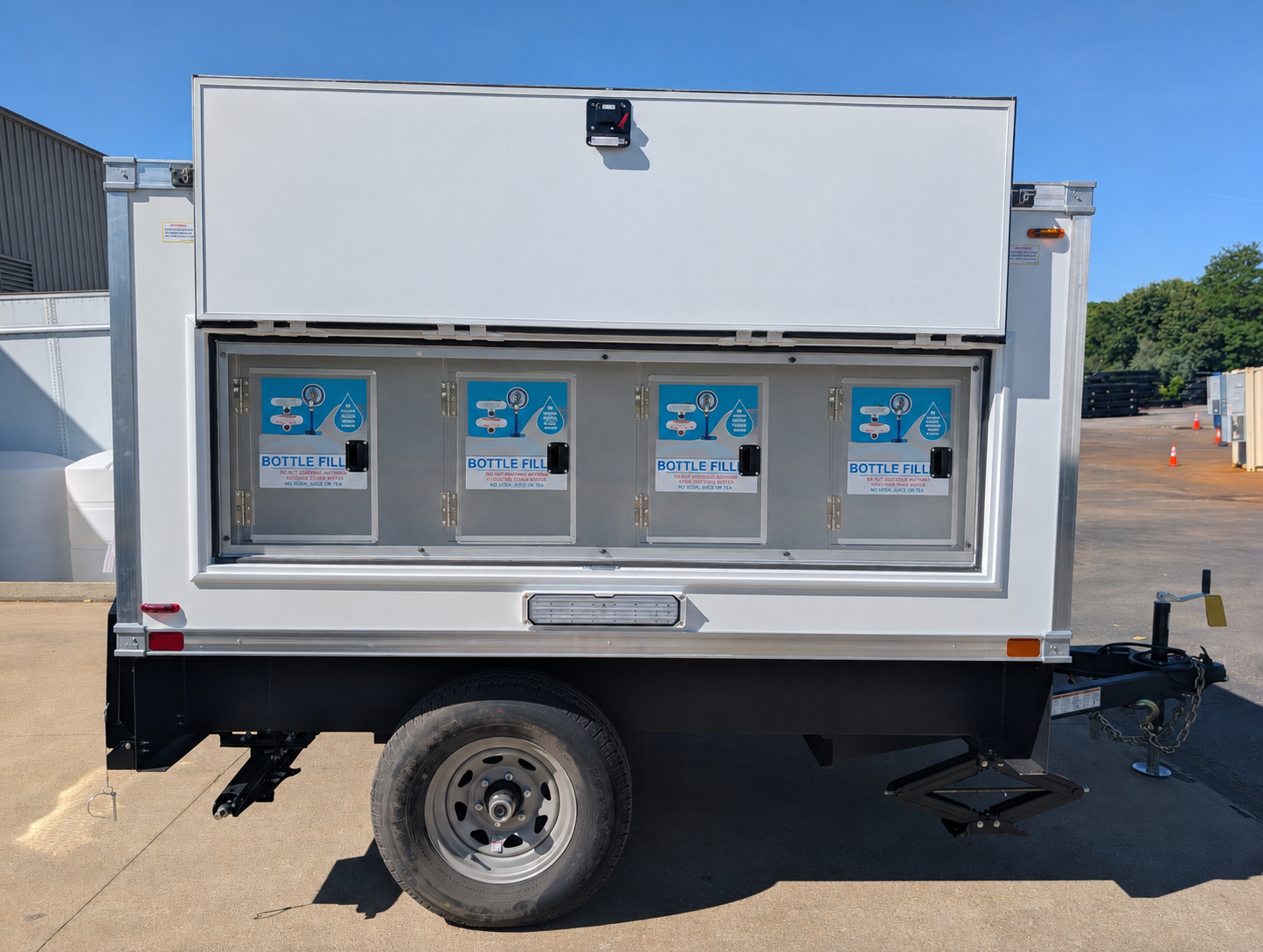
We deliver chilled, filtered drinking water to job sites and events all over the Inland Empire, the warehouse build-outs in Fontana and Jurupa Valley, the festivals out toward the desert, the harvest crews in the far west of Riverside County. One self-contained trailer rolls in, pours cold water all day, and refills itself, so your crew stays safe and your event keeps moving when the valley floor hits 105.
- Rapid two-county delivery
- Cold, four-stage-filtered water
- ADA bottle filling
- Cal/OSHA §3395 heat-ready
- Licensed & insured
- 24/7 emergency dispatch
Chilled drinking water for Inland Empire warehouses, builds and events, delivered and kept full
No place in the western United States moves more freight than the Inland Empire, and nearly all of it gets built and handled outdoors in punishing heat. The people doing that work are who we stage water stations for: the tilt-up and framing crews putting up another distribution center off the I-10 in Fontana, the grading contractors scraping pads near March Air Reserve Base, the solar and landscape crews on the clock before dawn to get ahead of the afternoon. The first phone call almost always lands on three questions. How soon can you be here. Is the water still going to be cold by two o’clock. And if a 300-gallon tank runs dry on a Friday with a pour on the books, then what. We have a real answer for each one.
Quick to both counties
Fast turnaround across Riverside and San Bernardino, plus overnight emergency runs when a heat wave lands. The morning a safety lead discovers a 70-worker crew has nothing but a baking pallet, the only thing that matters is a trailer on the lot before the lunch whistle.
Stays cold from dawn to clock-out
The onboard chiller means the quitting-time pour is every bit as cold as the first one at sunrise. Lukewarm water goes undrunk, and undrunk water stops nothing. On a Jurupa Valley pad in July, that’s the line separating a clean shift from a 911 call.
One number for the whole loop
No separate bottled-water rep, ice run, and waste hauler to coordinate. We set the unit, refill it off our own tankers, service it, and tow it out at the end. A single point of contact for every drop of water on your inland site.
What we have learned running these two counties is that the trailer is the easy part. The hard part is whether anyone actually uses it. A bottled-water pallet that nobody iced is warm by mid-morning, and warm water on a Fontana dock just sits there while a crew quietly pushes past the point where they should have been drinking. So when we spec a job we are really solving for one thing: getting cold water close enough, and reliably enough, that reaching for it becomes automatic instead of a chore. That means matching the unit to your real headcount, not a round number, and tuning the tanker visits to how fast your crew empties the tank in inland heat rather than to a fixed weekly slot. It also means we pick up the phone when a heat morning goes sideways. Out here the margin between a finished shift and a 911 call is often a single degree and a single hour, and that is the margin we build the whole service around.
One road-towable trailer built for I.E. work in the open sun
One rig does it all across the region: the Signature Series water station trailer. It sits on a road chassis, so we tow it right to the job, whether that’s a stripped warehouse pad in Perris, a fairground lawn out toward the desert, or a solar array on the high-desert edge. There’s nothing to assemble and no plumbing to run. Cold, filtered water flows the same day the trailer shows up.
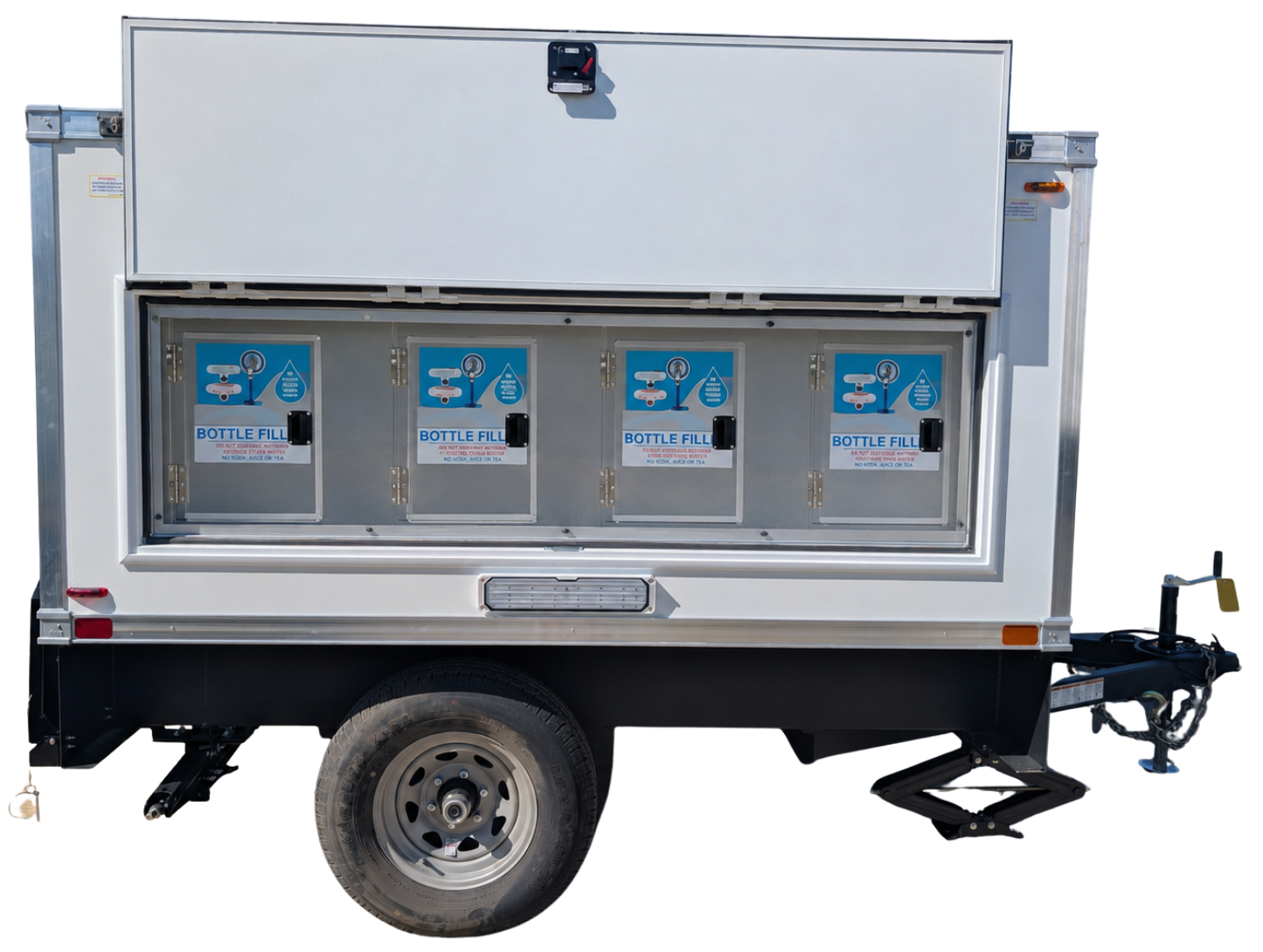
Signature Series specifications
It rides on a full chassis with tires and a hitch, so it tows out to a far-flung jobsite, an event field, a farm, or a disaster staging area. Inland warehouse and event clients request this unit by name. It’s built to back in, level up, and start pouring the same afternoon it lands.
| No. of stations | (4) Bottle Filling Stations |
| Length | 12′ 3″ |
| Weight | 3,100 lbs. |
| Height | 8′ |
| Fresh water tank | 300 Gallons |
| Power requirements | 1–4 dedicated 20A/120V circuits OR 1 dedicated 50A/240V circuit |
| No. of AC units | 1 |
Why it’s the right rig for the inland valleys
Two things define this trailer: it shrugs off heat and it travels. The four awning-shaded taps run along an outside wall, which spreads a crew out and keeps people from stacking up at a single spout during a short break. Inside, an AC unit and dedicated chillers keep the supply cold while the body of the trailer roasts on a shadeless pad all afternoon. That last part is exactly what a stack of coolers or a bottled-water plan can’t pull off out here.
Three hundred gallons gets a good-sized crew through the day, and since it tows, we can reposition it across a half-mile logistics site or move it to the next phase of a build without dismantling anything. The power draw is flexible enough that one rig works at a finished fulfillment center near the Ontario airport or on a stripped dirt lot in Beaumont we set up off-grid.
The four front taps are only part of it. A jug spout on the back fills five-gallon coolers and personal bottles, and a bank of hose-bib outlets covers dust control, wash-up and field work. So a single unit answers the entire water question for an inland site or event. One trailer has handled a Rancho Cucamonga framing crew and a Riverside 10K finish line without us trucking out a second piece of gear, and we’ve sent the same rig to a Redlands distribution build at dawn and a Temecula winery party that night.
One trailer replaces a summer of bottled-water orders
Put an 80-worker warehouse crew on an inland pad for a season and the numbers settle the argument. Figure six bottles a person on a triple-digit day and you’re purchasing, trucking, icing and discarding nearly 480 plastic bottles every hot day, start to finish.
Carry that across a 220-day fulfillment-center job and you’re past 100,000 bottles, and the multi-building campuses near Moreno Valley blow well past that. One trailer absorbs the entire stack, cold water on tap with nothing rolling to the dumpster.
The case is operational first, green second
The waste story is true enough. Americans throw out something like 60 million water bottles a day, only about a third get recycled, and a single bottle can outlast everyone reading this in a San Bernardino County landfill. Worth a line in your sustainability report. But the inland project managers who switch usually do it for a plainer reason: one shared trailer kills the daily grind. No standing pallet order. No cooler turned warm by 10 a.m. No heap of empties cooking at the gate. The superintendent gets to run the build instead of babysitting the water.
And since our own tankers keep the unit charged, the supply grows with the job. Double the crew for a slab pour and they still won’t out-drink it. We just bring the tank back up.
Where a water trailer earns its keep across Riverside and San Bernardino
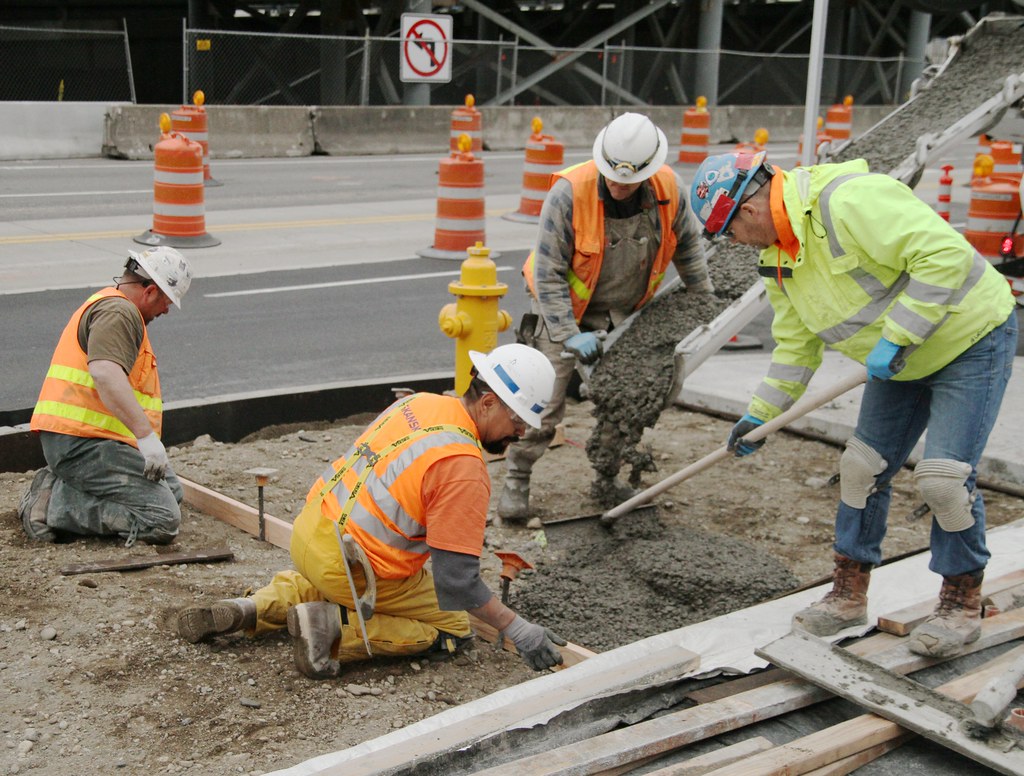
There isn’t one inland hydration problem. There’s a whole stack of them. A million-square-foot fulfillment-center build needs one answer, a spring fair out east needs another, and a citrus or melon harvest in west Riverside County needs a third. These trailers cover all of it, from the Fontana and Jurupa Valley logistics corridors through the Beaumont and Banning pass and down into the Temecula valley.
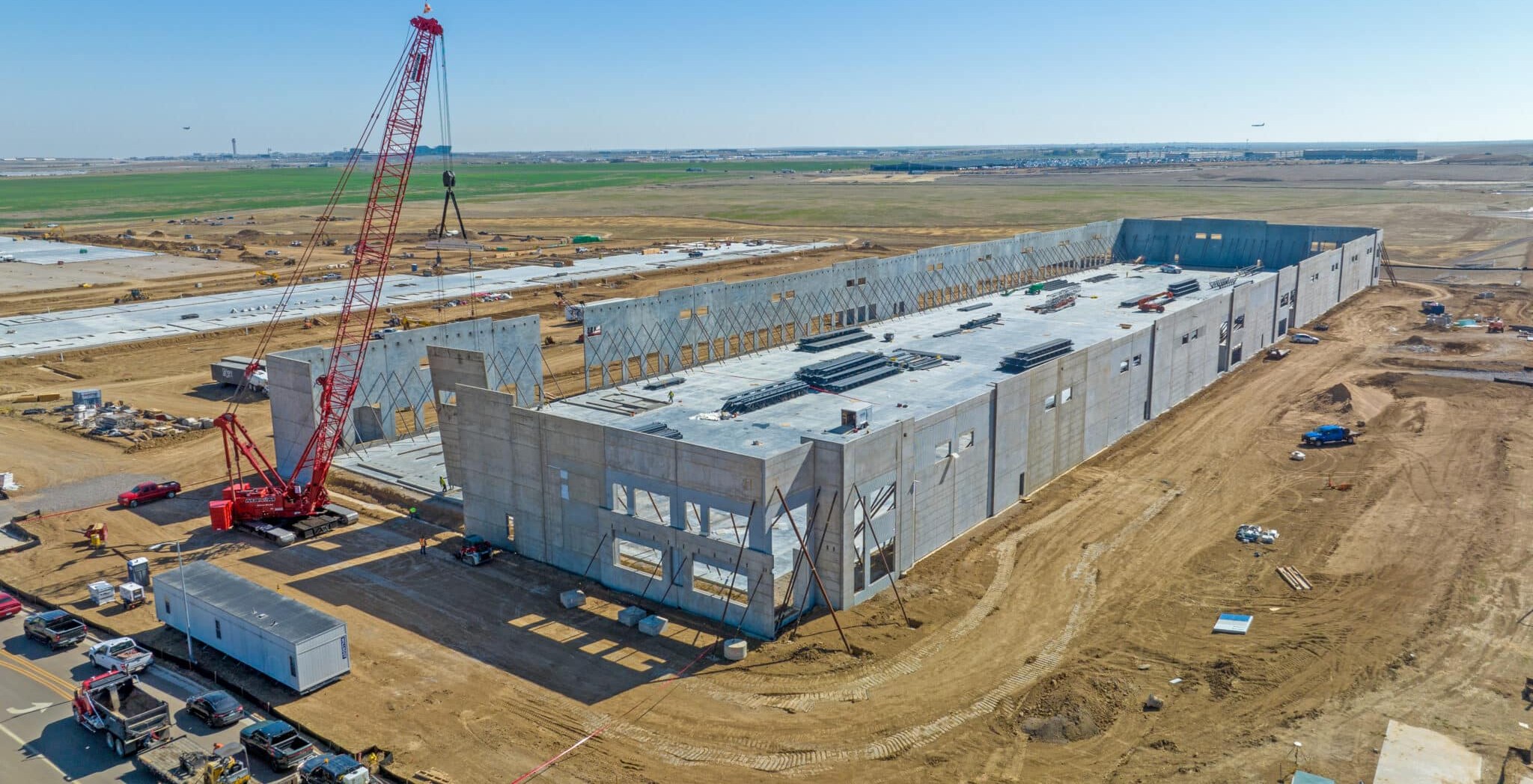
Warehouse & logistics construction
This region is the nation’s distribution backbone, and the building genuinely never lets up. Tilt-up panels keep going up across Fontana, Perris, Jurupa Valley and Moreno Valley, where the World Logistics Center and an Aldi campus already anchor a corridor that proposed projects would push toward the biggest warehouse footprints in the country. We park trailers along those corridors so general and trade contractors always have mapped, documented cold water within a short walk of the work, from the first grading pass to the final panel set.
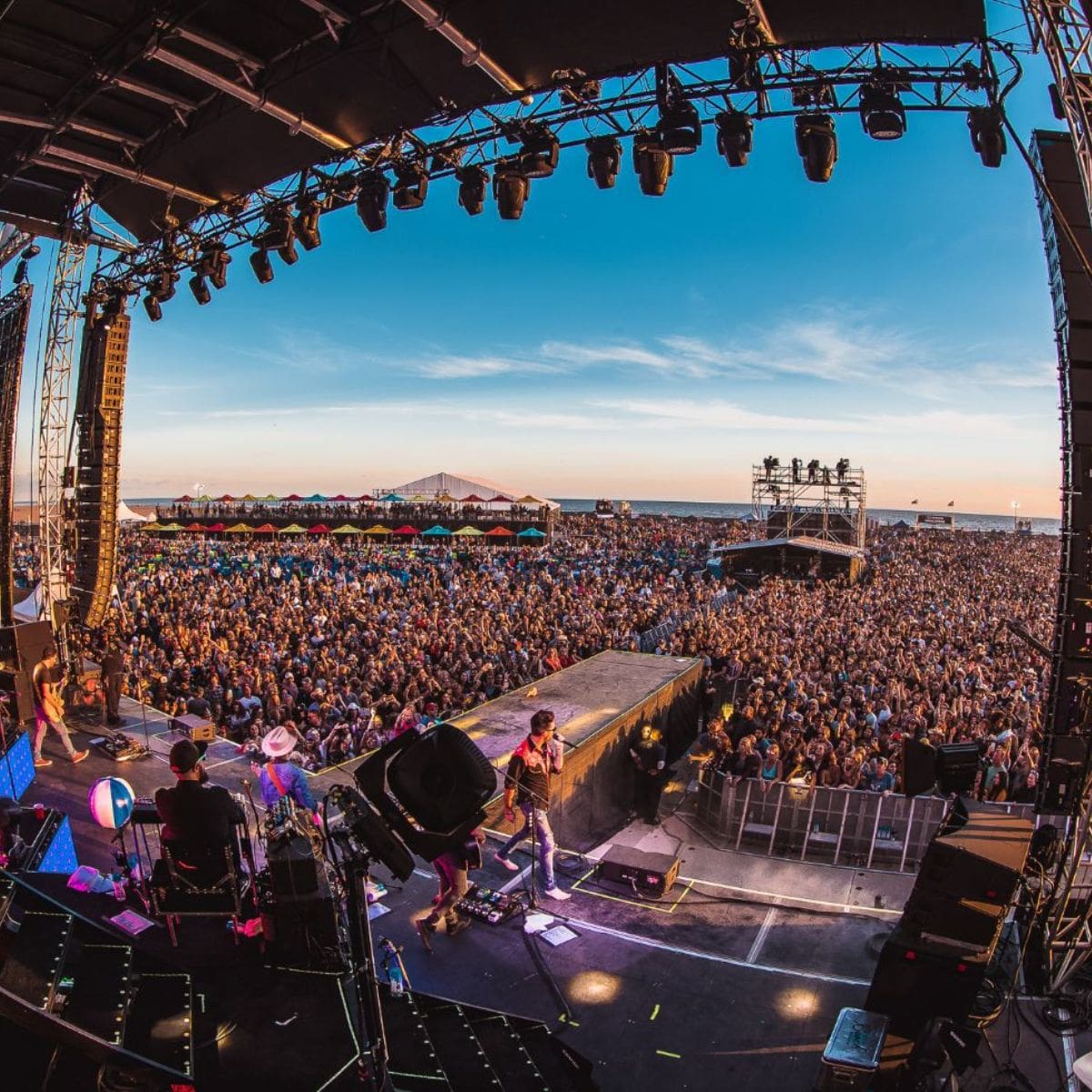
Outdoor events, fairs & concerts
A crowd standing in inland sun goes through water in a hurry, whether it’s the Southern California Fair in Perris, a Glen Helen Amphitheater show in Devore, the National Date Festival in Indio, or a rodeo or car show somewhere in between. One or more trailers give the organizer a steady cold supply and clean refill points, and skip the whole circus of trucking pallets in and dragging the empties back out.
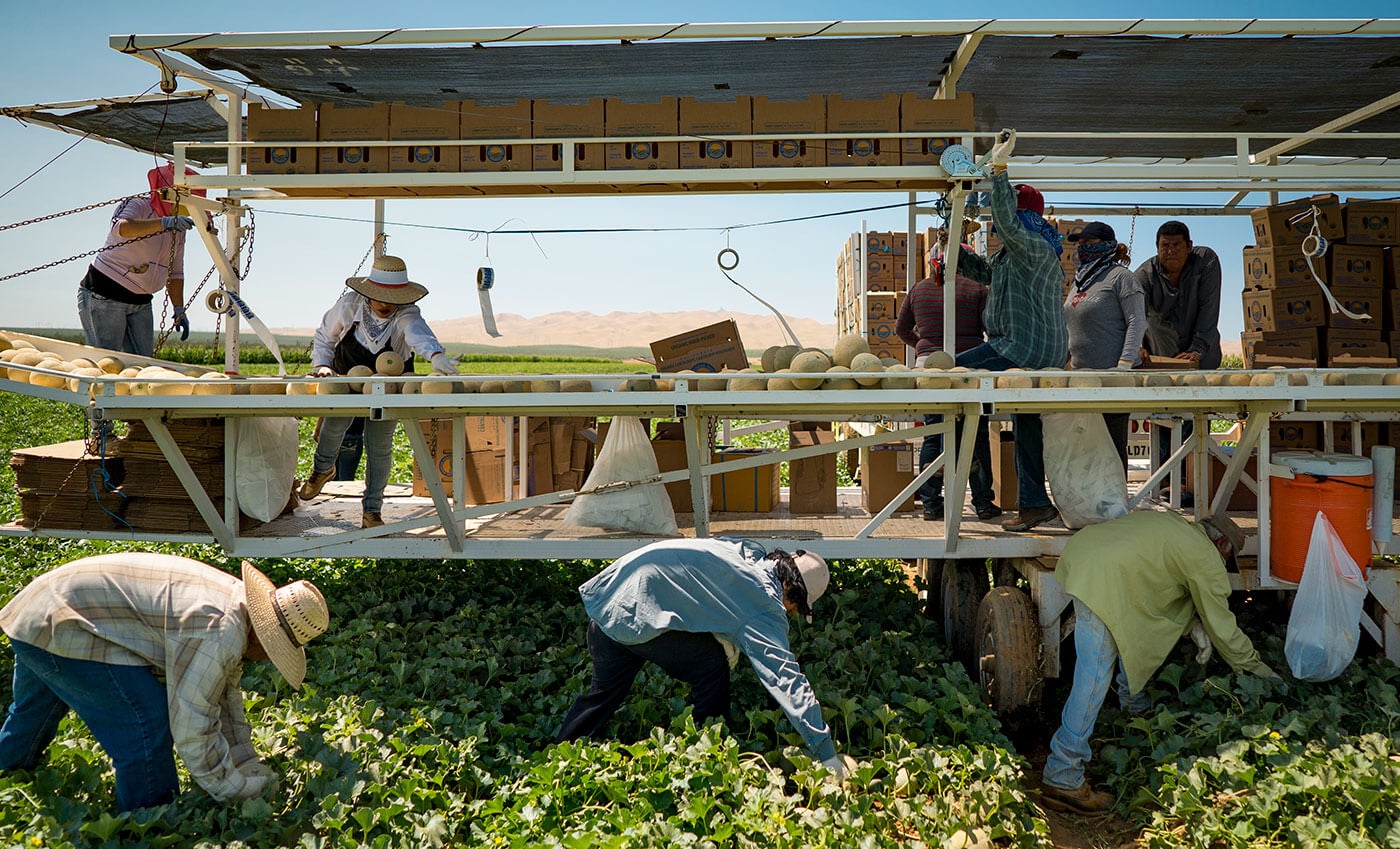
Agriculture, solar & outdoor labor
Citrus and produce ground around Riverside and Hemet, the dairies near Chino, the big solar farms running toward the high desert and the Coachella line, the landscape crews working every new tract: this is about the most heat-exposed labor California has. With the jug spout and hose-bib taps, field hands top off coolers and personal packs right where they’re standing, at the row or the panel, instead of walking all the way back to the truck.
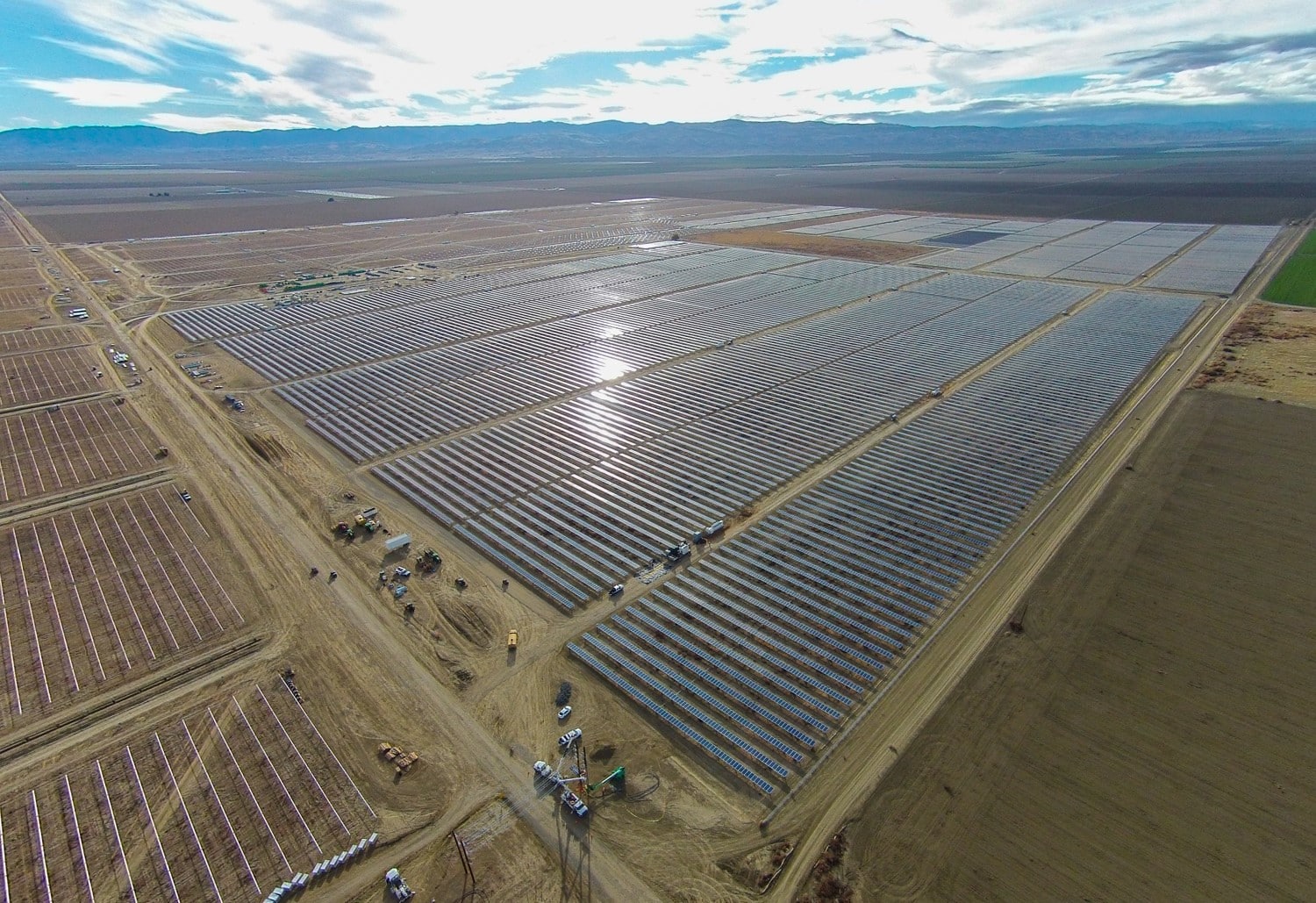
Industrial yards & disaster response
The rail yards, equipment lots and laydown areas around Colton, Bloomington and the Ontario cargo district bake their crews just as hard as any construction pad, and a towable unit rolls right into the yard alongside them. And when a wildfire flares in the San Bernardino foothills or a main breaks in a neighborhood, we can send potable water trailers to cooling centers and base camps fast.
Filtered through three stages, UV-treated, and chilled before it pours
Nobody drinks from a trailer they don’t trust, and a station crews avoid is wasted money. So every gallon we pour runs through a full three-stage filter train plus a UV chamber, then drops into an onboard chiller before it ever reaches a tap. The result is water that reads clean and lands cold, even when the trailer has been baking on a bare Perris pad since sunrise.
Sediment
The opening filter traps sand, scale and the fine grit inland mains kick up, so nothing chalky ends up at a nozzle on a dusty Perris lot.
Carbon
An activated-carbon pass pulls out the chlorine sharpness and the summer flatness valley tap tends to carry. At 105 degrees, a clean-tasting pour is what keeps a worker coming back to the tap instead of skipping it.
Micro-particulate stage
A sub-micron stage strains out the microscopic particles the first two stages leave behind, keeping the water safe for every worker and every guest who tops off on an inland site.
UV finish
A UV chamber kills bacteria and microbes as the last step, with zero added chemicals, so what comes out of the spout stays clean even after the trailer has crossed both counties to get there.
Three ways to fill, ADA included
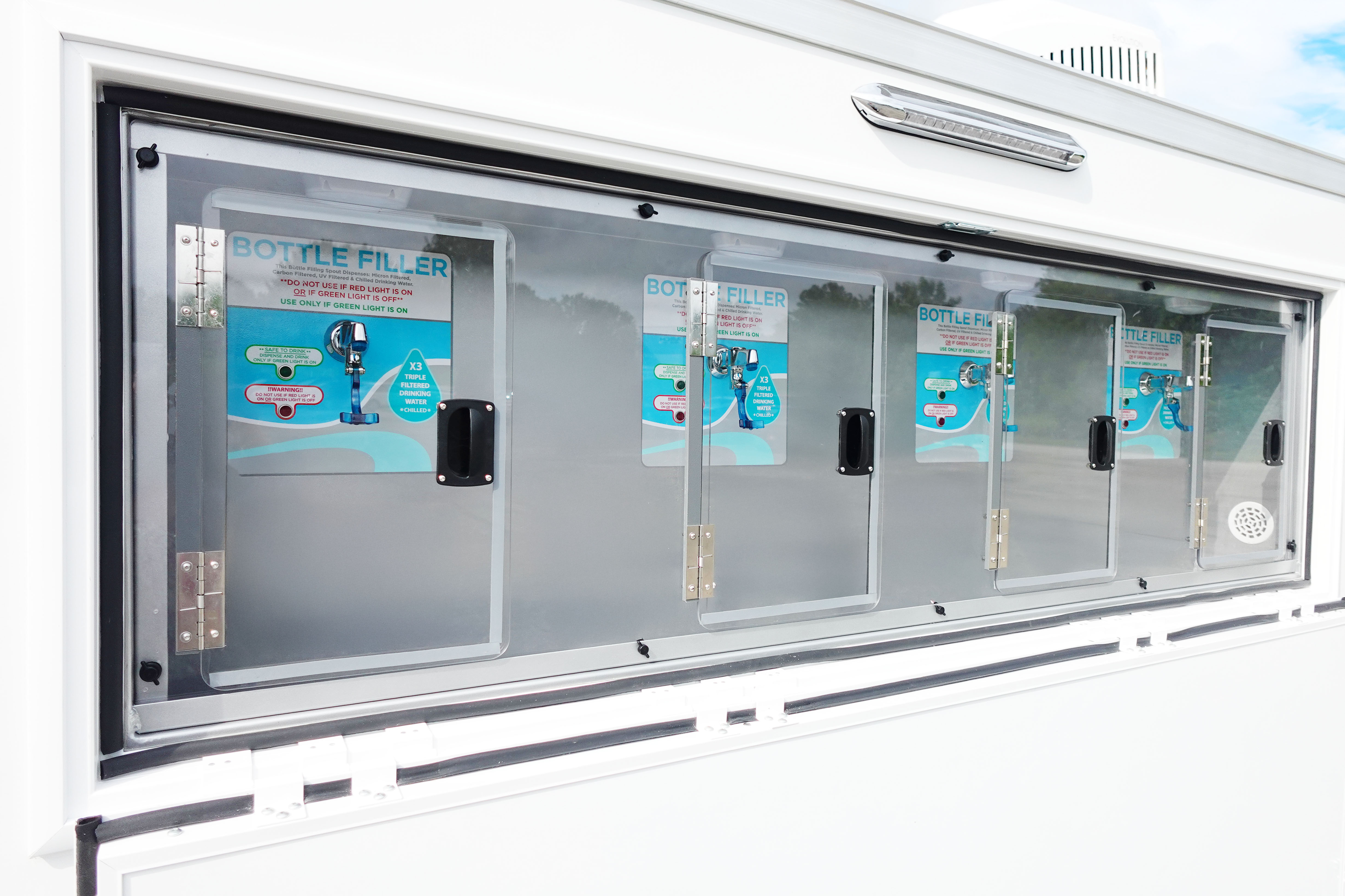
The four exterior taps are push-back nozzles. Set a bottle against the bar and the water runs, no buttons, no waiting. We mount one at an ADA-reachable height by default, so an inland crew or a fair crowd is covered without bolting on a side rig. Around back, a large-jug spout charges five-gallon coolers and personal packs, and a row of hose-bib taps handles wash-up, dust control and farm work. Everything the water touches on the way out is food-grade and stainless, which is how that chilled, filtered quality survives all the way to the nozzle.
Each trailer banks 300 gallons, somewhere around 2,400 sixteen-ounce pours, and our tankers top it back up while crews work, so the tank itself never turns into the bottleneck on a hard inland shift.
Delivered, filled, hooked up, and usually pouring cold inside the hour
You don’t run any part of this. Our crew picks the spot, loads the fresh tank, makes the power connection, and walks your inland team through the unit before the truck leaves. By the time we pull off your site, cold water is already moving.
Give us four numbers
Crew or crowd size, how many days, the parking spot on your site, and the power you have. That’s enough for us to spec the right setup on the first pass.
We roll out to you
Fast turnaround anywhere in Riverside or San Bernardino county, and overnight emergency runs the moment an inland heat advisory drops.
We stage and connect it
Trailer leveled, 300-gallon tank filled, power wired in. It takes one to three regular 120V circuits or a single 50-amp 240V line, depending on what the lot gives us.
We keep it topped off
Tankers come back on a cadence matched to how hard your crew draws the tank down, and we service the unit for the full length of the rental.
Far-out lot with no generator? Raise it on the call and we price the fix in. The trailer pulls light power, and between that and our service fleet we’ve kept stations pouring on inland pads that had no permanent power on them at all. Whatever the lot is missing, we build around it.
In an inland summer, hydration access is a documented legal obligation
Unlike most of the country, California regulates jobsite heat by statute, and the Inland Empire is where that statute does its heaviest lifting. Cal/OSHA’s Heat Illness Prevention Standard, Title 8 §3395, obligates an employer to keep fresh, pure, suitably cool drinking water on site, at least one quart per worker every hour and at no cost to the worker, alongside shade and a written prevention plan once it hits 80°F. In Riverside and San Bernardino counties that trigger temperature is a given for much of the year, often before the morning break. On top of that, the indoor heat regulation that took effect in 2024 sets its own requirements at 82°F indoors, and an inland warehouse interior in July clears that with room to spare, so a distribution operation is now answering to the rule on both sides of the dock door.
What a station does is turn that obligation into something an inspector can stand in front of. It is a permanent, mapped point of cold potable water you can name and locate in your written plan, which is exactly the kind of concrete evidence a Cal/OSHA reviewer wants to see during a walk-through rather than a vague promise that water is around somewhere. And the scrutiny here is real. Heat complaints from warehouse workers have drawn investigations and corrective orders against major inland operators, so a documented, fixed cold-water feed is one of the simplest boxes you can have already checked when an inspector arrives.
- Suitably cool, potable water on the work face at one quart per worker per hour
- Centralized, documentable hydration points for your §3395 written plan
- Supports acclimatization and the high-heat procedures the standard requires
- Ready for tightening indoor and federal heat rules instead of scrambling after them
What an Inland Empire summer has taught us about staging water
Dropping stations across both counties for years has shaped the way we run every inland job. Here are a few things the work beat into us:
Placement beats hardware. On a big Fontana warehouse shell we set the unit by the gate the first day and it barely got touched, because the actual work was deep inside the building footprint and nobody was going to spend a hot break hiking out to the fence for a drink. Next morning we rolled it to the slab edge and the draw doubled before lunch. The super said it best: keep the water closer than the shade and the crew will use it.
Refills track the forecast, not a fixed calendar. During a late-August advisory we’d staged extra tankers ahead of time, so when a Perris site and two Moreno Valley sites all called the same afternoon, every one of them stayed wet. The safety lead messaged us that night to say we’d refilled before his own people knew they were short. We now write that kind of cushion into every hot-season agreement.
And the bottled-water habit dies only once a crew feels the difference. On a Jurupa Valley solar job the foreman flat-out doubted we could hold 300 gallons cold on an open lot with the Santa Anas blowing across it. We set the unit, dialed in the refill timing, and a week later he called to add a second, saying just that his crew had stopped asking for ice. In this climate, cold water that stays cold sells itself the moment it’s on the dirt.
Every one of those jobs taught us what the heat already had: inland hydration isn’t a box you check and forget. It’s an operation, and we run it like one for the entire rental.
When the crowd is outdoors and the sun is relentless
Out here, event planners design around heat the way coastal ones design around parking. A Temecula winery wedding, a street fair in downtown Riverside, a charity 5K through Redlands, a corporate field day on a Rancho Cucamonga campus: each gets a self-contained trailer holding cold water steady with clean refill spots. Your team also drops the whole chore of hauling plastic in, icing it down, and carting the empties away.
Across a large footprint we spread out several units so nobody has a long walk for a drink, and our crew times delivery and pickup to your event window. A valley music event taught us that one: a single station near the main stage drew a line thirty people deep by mid-afternoon, because heat multiplied by a few thousand attendees stacks up fast. The following year we placed four across the grounds and the lines disappeared. Guests read it as hospitality. Your operations lead reads it as risk control.
The I.E. is one of the hardest places in California to plan hydration
The coast gets ocean air. The Inland Empire gets the heat that air leaves behind, trapped against the mountains. And the people building the region’s warehouses are out in the worst of it.
A normal inland season piles up dozens of 100-plus days on the valley floor, and Riverside and San Bernardino routinely run 10 to 15 degrees above Los Angeles on the very same afternoon, because the ocean’s marine layer burns off long before it reaches them. Bare warehouse pads and fresh asphalt read far hotter than the official air temperature, so a crew can slide into real heat-illness territory by mid-morning while the thermometer still says a misleading 98. In that climate, cold water isn’t a comfort item. It’s the cheapest safety gear on the lot. In the first half of one recent year Riverside County alone counted 627 heat-related ER visits, and outdoor workers fill a big share of that pool from late spring clear into October.
What makes inland hydration a planning problem rather than a packing problem is the sheer length of the exposure. A building goes vertical over many months, and a fulfillment-center shell off Cactus Avenue in Moreno Valley or a grading job in Beaumont can keep a crew in open sun from spring through Halloween. Coolers and ice work for a weekend. They do not survive a schedule like that. Someone has to keep buying, someone has to keep icing, and by the time the August stretch arrives that side job is eating real hours off a build that is already tight. The crews who run a centralized trailer instead are not chasing a greener footprint first. They are getting one daily chore off the superintendent’s desk for the whole run of the job, which on an inland warehouse build is the difference between water you manage and water that manages itself.
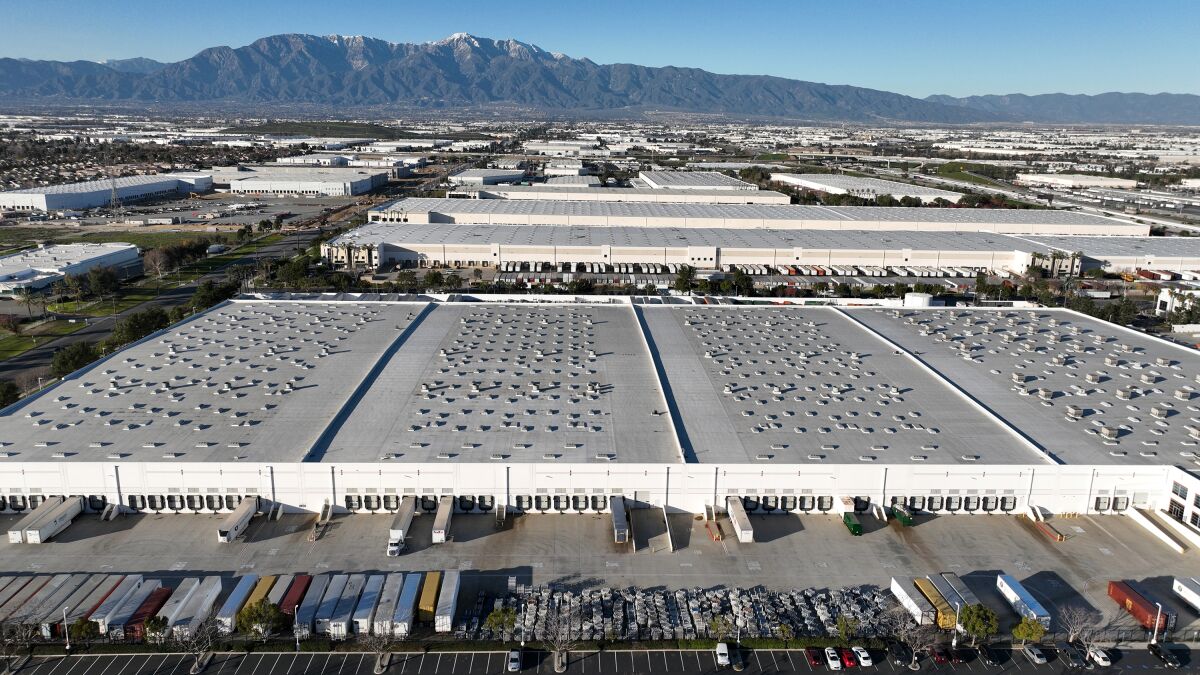
The work keeps multiplying, too, because the two counties have spent two decades turning themselves into the nation’s loading dock. Cargo offloaded at the ports of Los Angeles and Long Beach gets trucked inland to be sorted, stored and reshipped here, which is why the region holds more warehouse square footage than anywhere else in the western United States. The tilt-up panels keep going up: distribution shells across Fontana, Rialto and Perris, the sprawling approved-but-fought World Logistics Center plan in Moreno Valley, the data-center and last-mile projects filling in around Ontario and Jurupa Valley. Riverside County’s 2022 warehouse ordinance and the state’s AB 98 freight rules have changed where these buildings can be set and how their truck routes run, but neither has slowed the pace of the pours. Each new shell is another few hundred workers on a bare pad in inland heat.
Our dispatch grew up inside that reality. We learned early that an inland warehouse job does not run on a tidy refill calendar, so we set our top-off schedule against the actual headcount and the draw rate of each crew, then hold reserve tankers ready to roll the moment a heat advisory posts. On a corridor job the geography itself dictates the routing: a site can sit anywhere along the I-10 through Fontana, the I-15 spine up toward the Cajon Pass, the 60 across Moreno Valley, or the 215 between Riverside and San Bernardino, and our trucks plan around that grid. The reason we run it this hard is simple. On a logistics megaproject a dry tank is not an inconvenience, it is a work stoppage, and at 105 degrees it is how a worker ends up in the back of an ambulance.
Beyond the station: the trucks that keep an I.E. site supplied
The station is the visible piece. Behind it sits a fleet that hauls fresh water in, parks reserve supply on the lot, and carries wastewater back out. One call covers all of it, so you’re not chasing a bulk-water vendor, a storage rental and a waste hauler separately.
Potable water trucks
Drinking-grade tankers move bulk water across both counties and recharge the 300-gallon tank on a schedule tied to your headcount. When the draw outruns a single fill, like a big slab pour in Perris or a packed fair day in Indio, the same trucks load cisterns, on-lot tanks and bladders too.
Bladder bags & reserve supply
Fold-flat bladders bank extra fresh water for the hardest stretches, or hold greywater for a while when an inland lot has no drain. They’re the unglamorous piece that keeps a remote desert-edge site running between tanker visits.
Pump trucks
When water has to travel, a pump truck charges storage tanks or shuttles supply from one end of a site to the other. On the giant logistics lots where the fill point and the work face sit a quarter-mile apart, it earns its place fast.
Vacuum & waste trucks
A vacuum truck pulls greywater and wastewater off the lot and hauls it to permitted disposal, closing the loop. Your inland crew never has to figure out where the used water goes. We’ve handled that end since the first job.
The pieces stack however the job needs them. A remote pad might run a station, a bladder for reserve, and a standing tanker fill. A large fair might add a pump truck to move supply plus a waste pickup at teardown. Tell us the shape of the project and we assemble the mix, billed on one invoice, run by one crew that already knows your inland site.
The questions that let us size your rental correctly
Give us a couple of minutes on the phone and you’ll get a quote that actually fits. Here’s what we’ll ask, so you can have the answers handy and watch how we tailor each job rather than dropping one stock setup on everybody.
Four answers shape the whole recommendation
- How many people? A 20-worker framing crew in Beaumont and a 6,000-guest fair in Perris pull water at completely different rates. Your peak number decides how many trailers go out and how tight we run the refills.
- For how long? A weekend Temecula wedding, a three-week foundation pour, and a nine-month Moreno Valley warehouse build each get a different service rhythm. We carry short events on reserve storage and feed long builds with scheduled tanker runs.
- Where does it park? The towable Signature slots into a yard, a raw pad, an open field, or a corridor staging area. Once we know the exact spot, and how our truck threads past gate guards and laydown clutter to reach it, we can drop it where crews actually walk.
- What power is there? A trailer runs on one to three regular 120V circuits or a single 50-amp 240V line. Power-free lots are routine out toward Beaumont and the high desert, and we solve them every week. Just flag it early so we plan for it.
The extras that help us nail the details
- The exact parking spot and the route a delivery truck takes to reach it
- Whether your people are scattered across the site or grouped at one face
- Anything your §3395 plan needs the station to document for a heat inspection
- Whether bulk water delivery, reserve bladders or waste pickup belong on the same order
What a bottled-water pallet really costs once it hits a hot inland pad
On the purchase order, bottled water looks like the cheap option. The real bill shows up later, in payroll hours, in staging space, in water nobody will drink by noon, and in a summer’s worth of trash, and out here every one of those runs hotter than it does near the coast.
The payroll nobody lines out
Somebody on your team orders the pallets, signs for them, breaks them down, ices coolers before sunrise, restocks through the day, and crushes the empties at quitting time. Across a large warehouse crew that adds up to hours of paid labor a day, scraped straight off the schedule. A trailer erases the whole routine. We sat down with a Rancho Cucamonga GC once and the saved labor by itself covered the rental, after which he admitted the bottle runs had been quietly burning roughly half a day of payroll a week. Our unit shows up full, refills off our own tankers, and asks your superintendent for nothing but a parking spot.
The mid-morning warm-up
A cooler that’s iced at 6 a.m. is lukewarm by 10 on an inland July morning, and lukewarm water is water a crew stops reaching for. The second they stop drinking is the second heat illness starts working on them. Our chiller never lets that curve happen. The pour at clock-out is just as cold as the pour at sunrise, which is precisely when a tired, overheated crew needs it. On the valley floor by mid-afternoon, that’s the line between a crew that keeps drinking and one drifting toward the shade tent.
The space and footprint tax
Pallets swallow staging room, clog laydown areas, and cook in the sun until someone tears the wrap off. Empties pile up faster than anyone carts them away, and on a tight infill warehouse lot that heap becomes its own headache. A single trailer takes one parking space and outserves a crew that would otherwise rip through hundreds of bottles a day.
The trash that outlasts the build
Each bottle you buy is a bottle you throw out, and a busy site piles up a mountain of them over a season. That’s a disposal line, a dent in the project’s sustainability numbers, and in a county where a tossed bottle can sit for centuries, a footprint that outlives the warehouse it was drunk on. A refill station deletes that line entirely and hands your reporting a figure you’d actually want to publish.
Staging cold water across both Inland Empire counties
Our dispatch runs the whole Inland Empire, from the western logistics corridors through the central valley out to the desert-edge passes. If you sit inside Riverside or San Bernardino county, you sit inside our delivery range. That holds whether the job is an Ontario airport-area cargo project, a downtown Riverside street event, a Redlands warehouse shell, or a solar field on the Beaumont fringe. Several of these cities also have their own dedicated water-station page, this is the regional hub that ties the whole two-county service area together.
Rancho CucamongaFontanaMoreno Valley
CoronaJurupa ValleyPerris
HemetTemeculaMurrieta
RedlandsRialtoColton
ChinoBeaumontBanning
Working a corridor more than a city? We follow the freeways the region is built on, the I-10, the I-15, the 60 and the 215, so corridor and multi-site projects get the same fast turnaround as a single address.
The questions I.E. crews and organizers actually ask
How quickly can a water station reach my Inland Empire site?
Turnaround is quick anywhere in Riverside or San Bernardino county, and once an advisory hits we run overnight. A crew that shows up to a 105-degree pad with nothing cold can usually have a unit pouring before lunch. What moves the timeline is gate access and the power situation, so spell out what the lot has and we’ll route the run accordingly.
Is it genuinely chilled, or only filtered?
Both. The chiller holds the supply cold from the sunrise pour to the last one at clock-out. On an inland July afternoon a lukewarm cooler just sits there while the crew slowly dries out. Cold is what gets a worker to drink, and drinking is what keeps heat illness off them, which is why we treat the chiller as safety equipment rather than a feature.
What’s the tank capacity, and who handles refills on a long warehouse job?
Each trailer carries 300 gallons, which works out to around 2,400 sixteen-ounce fills. On a busy distribution build pulling water all day in triple digits, the tank would empty, so we run our own potable tankers back to it on a schedule keyed to your draw rate. You never have to watch a gauge or place an order. Monitoring the level and timing the top-offs is part of what we run, for the full length of the rental.
Will a station support our Cal/OSHA heat-illness plan?
Directly. The §3395 standard calls for suitably cool, fresh drinking water at a quart per worker per hour plus a written prevention plan, and the 2024 indoor rule layers on requirements at 82°F. A station gives you a fixed, mapped cold-water point you can name in that plan and lead a Cal/OSHA inspector straight over to. We don’t write your safety program, but we provide the hydration piece it leans on.
Are the stations ADA accessible?
Yes. Four push-back fill points per trailer, one mounted at an ADA-reachable height, so the unit serves everyone on an inland site without a separate rig. The rear large-jug spout charges five-gallon coolers and hydration packs, and the hose-bib taps cover crew tasks.
Do you serve public events too, or only construction and warehouse sites?
Both, and events are a big part of what we do inland. A county fair in Perris, a festival out at Glen Helen, a charity run through Redlands, a Temecula winery wedding: any of them gets either a single trailer or several spread across the grounds, with our delivery and teardown timed to your run-of-show. The crowd gets dependable cold water and clean refill points, and your team is spared the bill and the litter that come with trucking in pallets and dragging out the empties.
What do you need from me to set one up?
Four things: headcount, how long, where on the site it parks, and the available power. A trailer needs anywhere from one to three regular 120V circuits, or just one 50-amp 240V line. Lot with no power? Mention it up front and we price the workaround into the quote.
Do you only serve the western I.E., or both whole counties?
Both counties, end to end. The western logistics belt of Ontario, Fontana, Rancho Cucamonga and Jurupa Valley, and on through Riverside, San Bernardino, Moreno Valley, Corona, Perris, Hemet, Temecula, Murrieta, Redlands and the pass towns out to Beaumont and Banning. Multi-site jobs running the I-10, I-15, 60 and 215 are everyday work for our trucks.
How does the taste stack up against bottled?
Clean, neutral, no chlorine bite. The carbon stage pulls the chlorine and the seasonal off-flavors inland tap can carry, so it tastes fresh instead of like a garden hose. That’s the whole game: people only use a station they like the taste of, so we count flavor as part of the safety story, not a bonus.
How big a crew can one station serve?
A lot, because the limit is refill timing, not the number of taps. Four positions clear a crew quickly on a hot break, and 300 gallons runs about 2,400 sixteen-ounce fills before a top-off. For very large inland crews we either tighten the tanker schedule or add a second trailer, so the supply scales up with you. Give us the peak figure and we build to it.
Can you deliver on short notice in a heat emergency?
Yes, and it’s why a lot of clients keep our number close. We run overnight during advisories and stage spare tankers when the forecast turns ugly. When a crew hits a triple-digit inland morning with no working water, one call usually has a trailer pouring cold before the worst of the day arrives.
Trusted by the inland crews and organizers who can’t run dry
“Sixty guys on a Fontana warehouse shell in August, and our bottled-water plan collapsed by 10 a.m. They had a unit on the lot by that afternoon, pouring cold. Pallets never came back.”
“At our spring fair in Perris the refill stations dropped our single-use bottle order to almost zero, and the lines stayed quick. They worked our timeline for drop-off and pickup, not the other way around. We rebooked on the spot.”
“Our §3395 plan needed documented cold-water access for a heat-exposed Jurupa Valley solar crew. A mapped station gave us exactly that. Refills showed up before we ever ran low.”
Service information current as of June 2026.
Lock in chilled, filtered water for your inland site ahead of the next heat spike
Hand us your crew or crowd size, your dates, and the parking spot on site. We’ll spec the job and run a trailer out across Riverside or San Bernardino county, fast.