
Oceanside Drinking Water Station Rentals for Events & Job Sites, Open 24/7
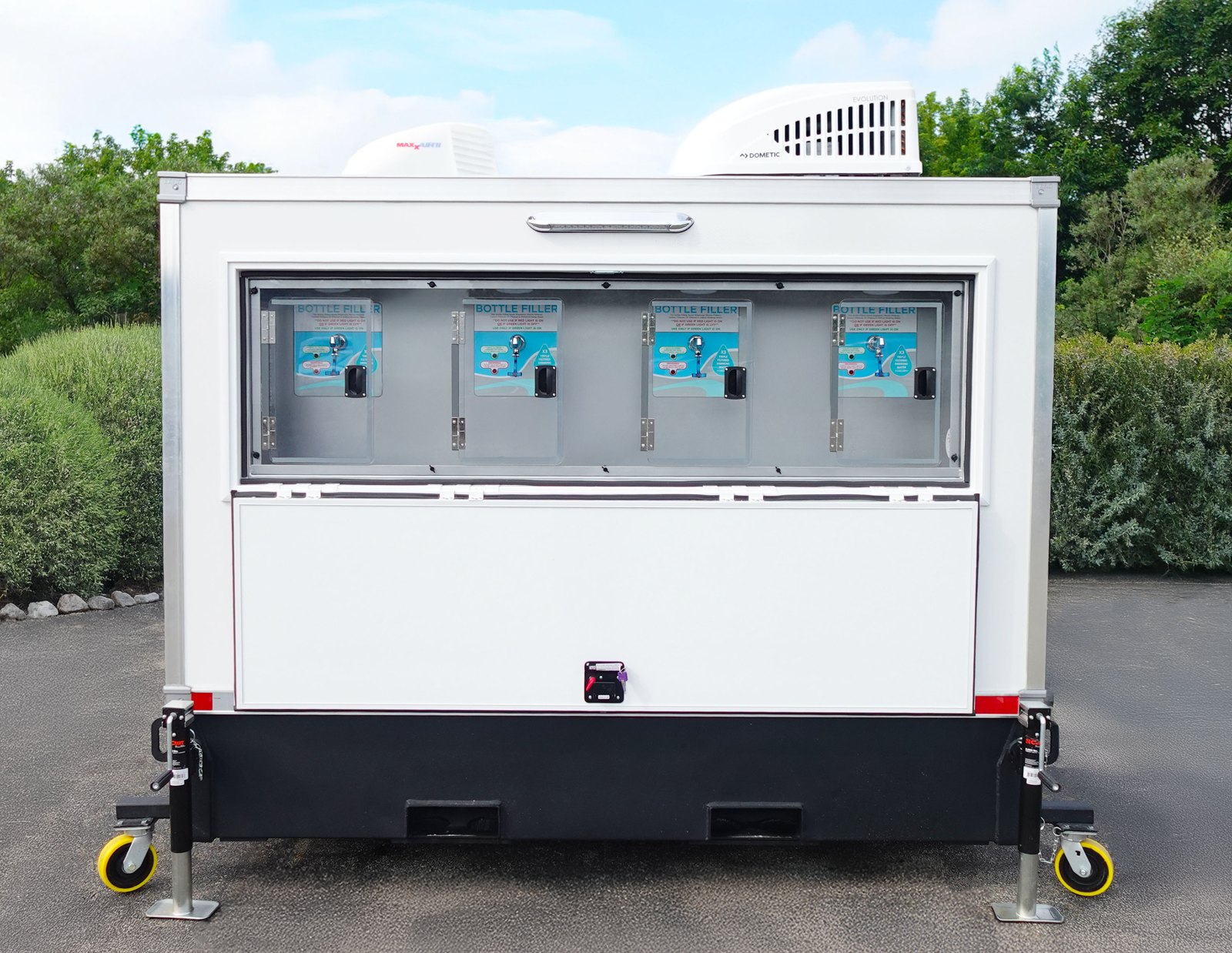
We rent mobile drinking-water stations across Oceanside, cold, filtered, and refilling all day. Book one for a beach festival down by the Pier or a build crew working through a sun-baked afternoon off the SR-76. The trailer rolls in, levels out, and pours chilled water on tap, so a crowd or a crew never gets stuck with warm bottled water or an empty cooler.
- About 45 minutes to most of North County
- Chilled, four-stage-treated drinking water
- ADA-height filling point
- Ready for Cal/OSHA §3395
- Fully licensed & insured
- Open 24/7 for last-minute drops
Chilled, filtered water for Oceanside events and job sites, dropped off and kept full
We stage drinking-water stations all over Oceanside and the North County coast, then keep the tank topped off from the first guest to the last truck out. The coast here stays mild most days, but the sun does not. A Sunday crowd on the Strand bakes the same as a framing crew off College Boulevard, and warm bottled water is the first thing either group quits drinking. So we drop a self-chilling trailer where the people actually are and refill it off our own water trucks. Clients tend to ask the same three questions on the first call: how fast can you get to Oside, will the water still be cold by 3 in the afternoon, and what do you do when 300 gallons drains down on a packed Saturday. All three are answered below.
Quick to almost anywhere in North County
A typical Oceanside drop arrives roughly 45 minutes after we dispatch it, and we keep trucks rolling after hours for last-minute needs. When an event lead discovers at 7 a.m. that a Harbor 5K is stocked with nothing but warm flats of plastic, that response time decides the morning.
A pour that stays cold to the last drop
Every unit refrigerates its own water, so the afternoon’s final fill comes out just as cold as the dawn one. People reach for cold water. They skip warm water, and water that goes untouched protects nobody standing in coastal sun all day.
Dropped, maintained, refilled, removed
Forget the bottled-water PO, the ice runs, and the empties haul. We place the station, recharge it from our own potable tankers, keep it serviced for the full rental, and tow it off when you finish. A single point of contact covers the entire Oceanside water loop.
Here is what I tell every first-time caller in town: water nobody touches is no better than water you never brought. I have seen flats of warm bottled water bake by a Harbor festival gate while a forty-deep line backed up at one little drinking fountain, and I have seen a cold trailer set a few paces off a downtown build face go dry twice before lunch. Closing that gap is the whole job. Our trucks do more than drop a unit and leave. We match it to your crowd or crew, time the refills to how fast you actually pull water out of it, and pick up a last-minute call the way you would want it picked up. Fast.
One road-towable trailer built for Oceanside crowds and coastal work sites
We run one purpose-built rig along the North County coast: the Signature Series water station trailer. A full road chassis means it tows straight to wherever the day happens, a grass lot off Pier View Way, a parking apron at the Harbor, a graded pad on a 76-corridor build past San Luis Rey. Nothing to assemble, no permanent plumbing. Cold filtered water flowing the same afternoon it arrives.
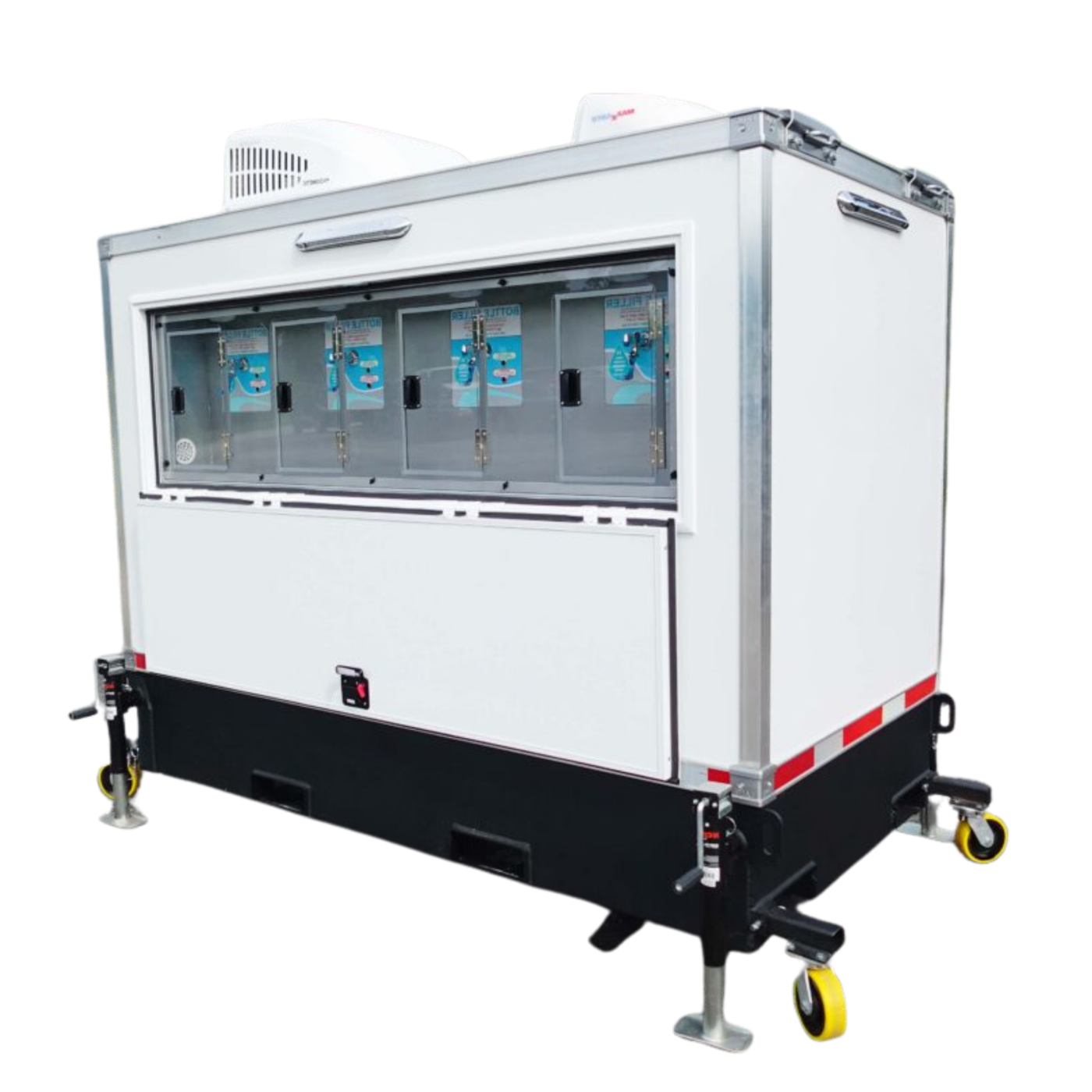
Signature Series specifications
Riding on a full trailer chassis with road tires and a hitch, it tows to a festival field, a downtown work site, a Harbor event, or an emergency staging area. Oceanside organizers and contractors request this rig specifically, built to roll in, level out, and begin pouring the same day it shows up.
| No. of stations | (4) Bottle Filling Stations |
| Length | 12′ 3″ |
| Weight | 3,100 lbs. |
| Height | 8′ |
| Fresh water tank | 300 Gallons |
| Power requirements | 1–4 dedicated 20A/120V circuits OR 1 dedicated 50A/240V circuit |
| No. of AC units | 1 |
Why this is the right trailer for the coast
The Signature is built end to end for sun and distance. Four push-back taps mount on an exterior wall under an awning, so a beach crowd or a work crew moves through fast instead of crowding one nozzle. Onboard AC and built-in chilling keep the pour cold even while the trailer itself sits in full afternoon sun on an open Oceanside lot, the exact thing a cooler or a pallet of bottles gets wrong out here by midday.
The 300-gallon tank carries a sizeable crowd or crew through the day, and since the rig tows on the road, we can shift it across a sprawling event footprint or roll it to the next phase of a build with no fixed install to tear out. It accepts ordinary site power over a broad range, so one trailer covers a finished downtown venue near Mission Avenue just as easily as a bare lot toward Bonsall that we power around.
It handles more than the four taps imply. Out back, a large-jug spout fills five-gallon coolers and personal packs, while a set of hose-bib taps take care of crew chores, event support, and wash-up. One trailer handles the whole hydration picture for an Oceanside job or gathering. A single rig has covered a framing crew near El Corazon in the morning and a sunset event at the Junior Seau Pier Amphitheatre that same evening, with no second piece of equipment hauled out.
Why one station beats buying bottled water all season
Run a 50-person Oceanside crew through one warm-season job and the math sorts itself out. At roughly five or six bottles a head on a sunny coastal day, you are ordering, hauling, icing, and trashing somewhere around 280 plastic bottles a day, day after day.
Stretch that across a 160-day build and you clear better than 44,000 bottles, and on the longer multi-phase work along the 76 it runs well past that. A single trailer stands in for the entire pile, cold water on tap and nothing headed for the bin.
It’s a logistics call first, a sustainability one second
The plastic problem is real enough. The country throws out tens of millions of water bottles a day, barely a third get recycled, and a single bottle can outlast the building it was drunk on. Procurement has to log that waste these days, and a coastal town like Oceanside takes its beaches seriously. Still, most local PMs and event leads switch for a plainer reason: one shared trailer kills the daily scramble. No recurring bottled-water order to manage. No cooler gone tepid before lunch. No pile of empties baking by the entrance. Your super keeps building, and your event lead keeps running the show, instead of minding the water all day.
And since our own potable tankers keep the station charged, supply grows with the day. A crowd that doubles for a Sunday market on Coast Highway will not drain you past the plan. We simply refill the tank.
Hydration sized for the way the coast really runs
Oceanside doesn’t have one hydration problem, it has a handful. A beach festival on the Strand needs one setup, a downtown hotel build needs another, and a motocross weekend at the stadium-area grounds needs a third. Here is where these trailers earn their keep, from the Pier and the Harbor through the downtown blocks off Mission Avenue, out the SR-76 corridor toward San Luis Rey, and inland where the afternoons turn hotter toward the I-15.
Construction & the downtown build-out
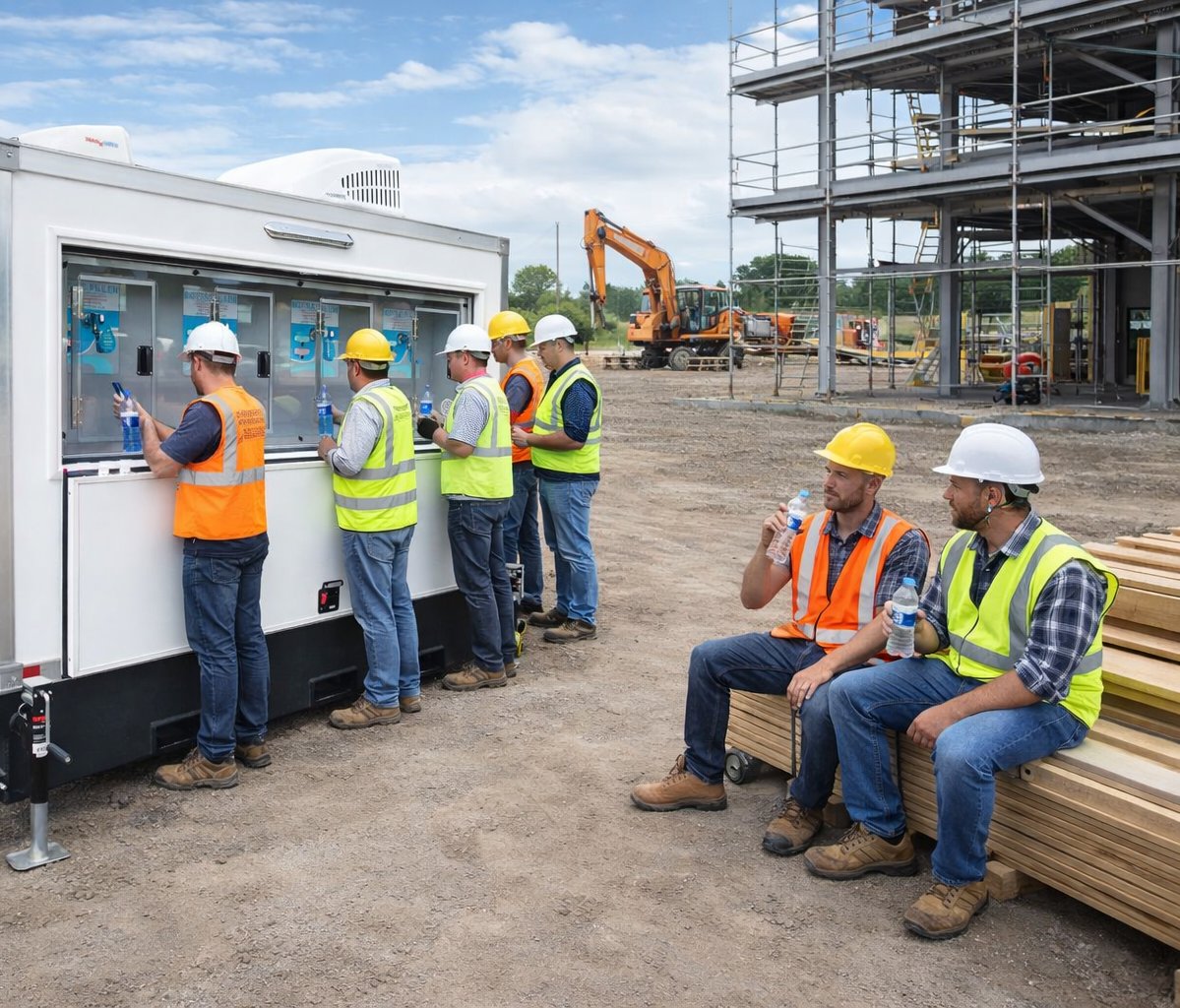
Oceanside’s downtown has been remaking itself for years. The Mission Pacific and Seabird resort blocks reset the beachfront, and the build keeps moving inland with apartments, hotels, and the steady road and utility work along Coast Highway, College Boulevard, and the SR-76 widening. Those crews stand in open sun all day. We park trailers right alongside the work, a foundation pour near El Corazon one week, a streetscape job off Pier View Way the next, so general and trade contractors keep documented, on-the-map cold water within a short walk of every crew.
Beach festivals, markets & races
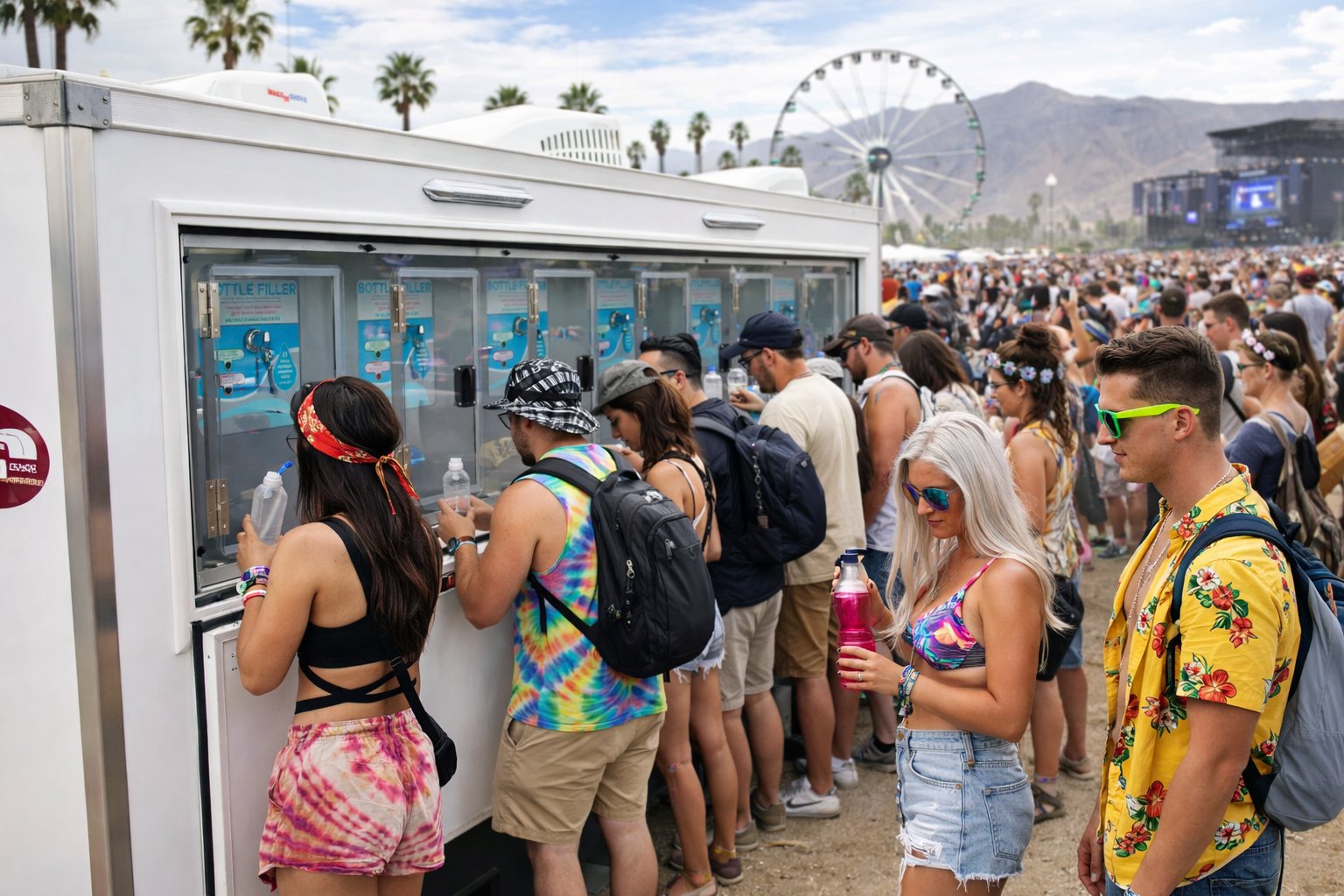
Think the Thursday Sunset Market on Coast Highway, the Supergirl Pro contest weekends below the Pier, the Independence Day parade and fireworks, the harbor-side triathlons and beach 5Ks, the summer concert nights at the Junior Seau amphitheatre. Tens of thousands of people end up on open sand with two drinking fountains and a stiff offshore breeze that hides how much sun they are taking. Park a station at the gate and another at the main stage (the two spots a crowd always clusters) and the refill problem disappears. And so does the pallet-and-dumpster routine of carting bottled water down onto the beach and hauling the empties back up.
Agriculture, landscaping & outdoor labor
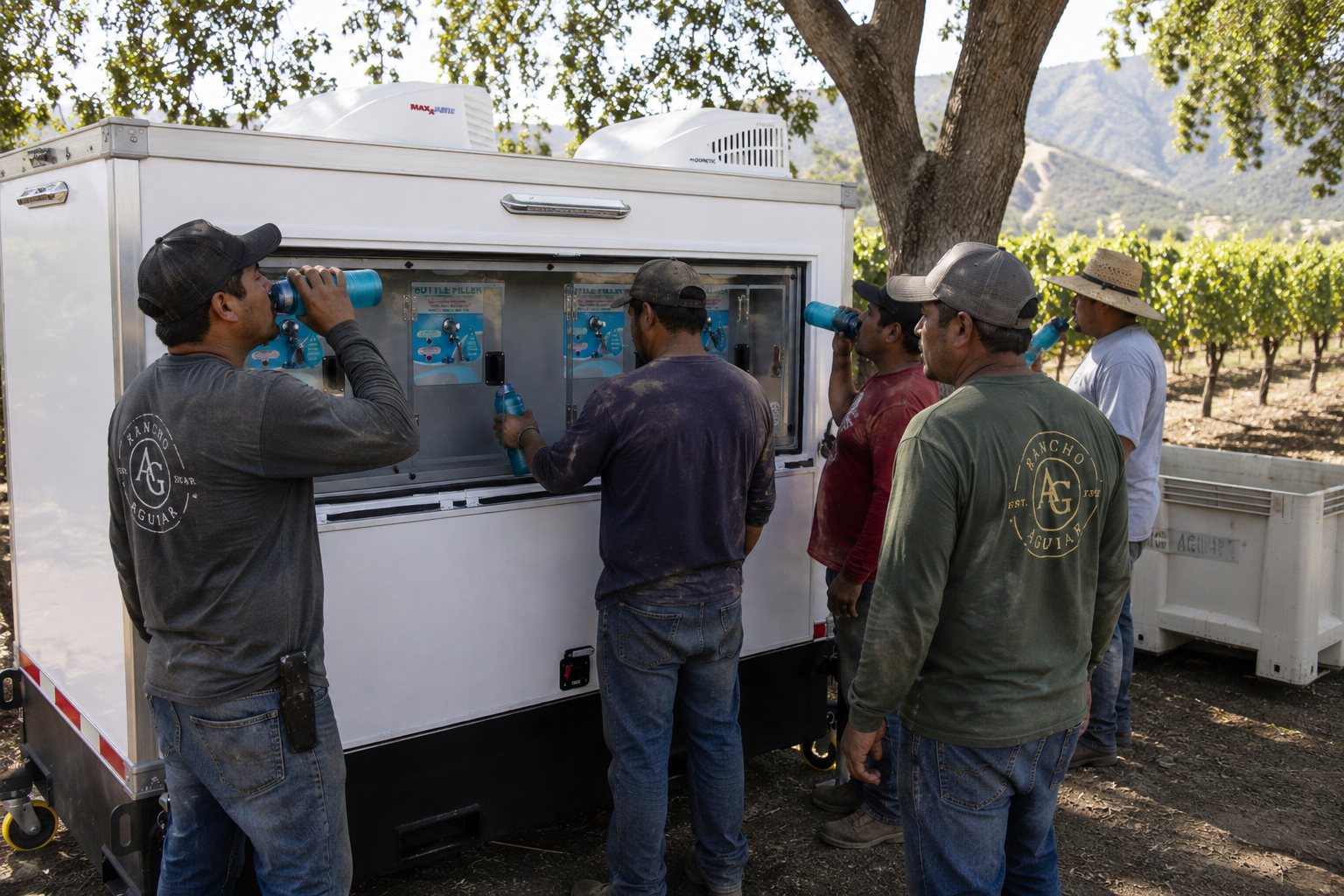
Drive east off the 5 and the temperature climbs fast. Oceanside has deep ag roots, the flower and nursery fields up the San Luis Rey River valley, the strawberry rows, the growers and packing crews out toward Bonsall and Fallbrook, plus the landscaping and grading outfits working the inland edge of town. Past the marine layer this is some of the most sun-exposed labor in the county. We set the rig at the field edge and the rear jug spout and hose taps let pickers and equipment operators refill a cooler or a pack right where they stand, instead of walking the length of a block back to the truck every break.
Camp Pendleton-adjacent & emergency response
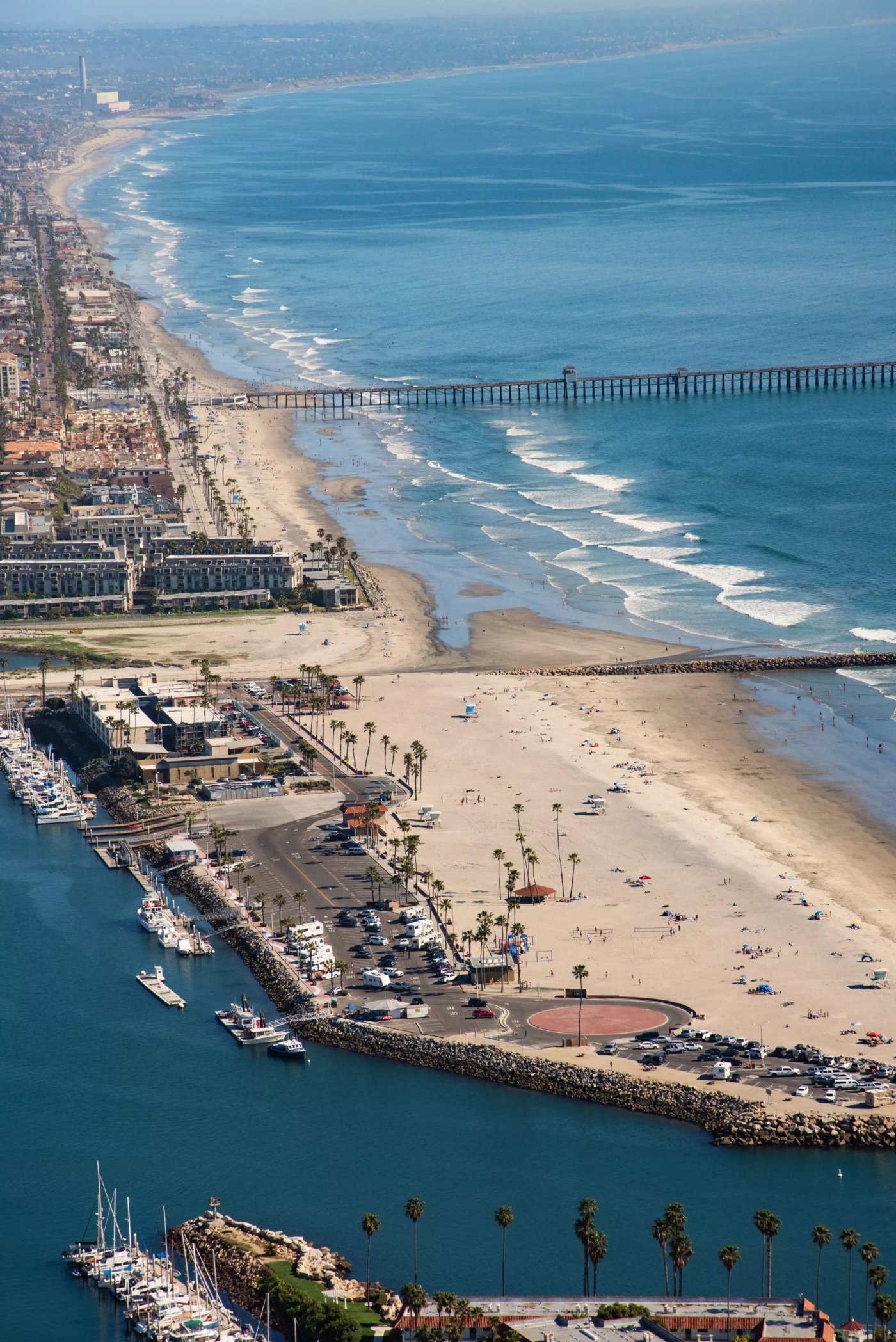
Oceanside sits right against Camp Pendleton, the largest Marine base on the West Coast, and the events, civilian contractor work, and staging that ring it put people outdoors in the same coastal sun as any build site. If a brush fire, a water-main break, or a scheduled outage hits a North County neighborhood, we can roll potable water trailers to cooling centers and base camps fast. Standing by for disaster and emergency hydration is part of why we keep a fleet ready.
Filtered through four stages, disinfected, chilled, then served
Taste decides whether a station gets used or ignored, so we treat the water the same on every job. The supply runs through four filtration stages and a UV chamber on the way to an onboard chiller, which is why it pours clean and genuinely cold whether it is feeding a Pier festival or a crew off the 76 in October.
First: sediment
A front-end filter pulls out sand, rust flakes, and the fine grit that any municipal line carries, so nothing scratchy ever makes it to the bottle bar, even with the trailer parked on a windy sand lot.
Next: carbon
Carbon strips the chlorine bite and the dull tap aftertaste. That step is what turns “I’ll just grab my own bottle” into a crew that keeps walking back for refills through a long shift.
Then: micro-particulate
A sub-micron filter takes out the fine particles the earlier stages cannot catch, so every pour is safe for the framers, the festival-goers, and the kids tagging along at a beach event.
Last: UV
A UV light finishes the job, killing bacteria and microbes with no chemicals added, so the water that leaves the nozzle stays clean even after a long haul across town.
Several fill options, plus a wheelchair-height one
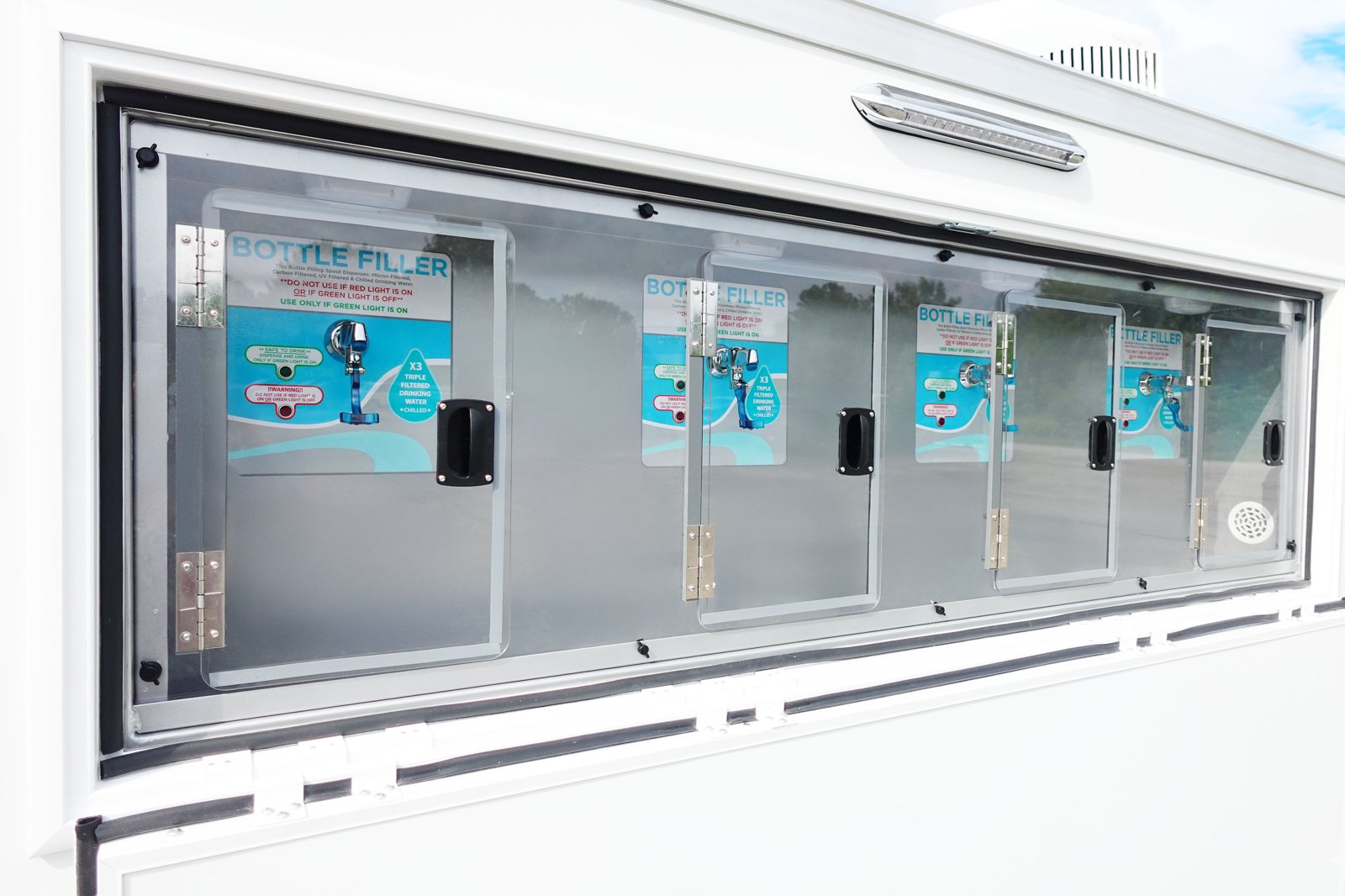
Four bottle bars line one wall of the trailer. Press a bottle against the paddle and chilled water flows, no buttons, no waiting in a single-file queue. We drop one of those bars to wheelchair height on purpose, so a Strand festival or a College Boulevard pour stays usable for every guest and every worker without us trucking out a second accessibility unit. Tucked at the rear is a wide spout sized for five-gallon Igloos and the hydration bladders trail-runners and surf crews carry, and a row of garden-hose taps that handle wash-downs, dust control, and the odd cooler rinse. Everything the water touches between tank and tap is food-grade and stainless, so the filtered taste survives the trip out the nozzle.
A loaded Signature holds 300 gallons. Figure on the order of 2,400 standard sixteen-ounce pulls before it needs a top-off, and our tankers handle those top-offs on a schedule we set to your draw, so a sold-out Sunset Market night never outruns the tank.
Delivered, filled, and connected, usually pouring cold inside the hour
None of the work falls to you. We choose the placement, fill the fresh tank, and wire it in, then run your Oceanside crew or event team through it before our truck pulls away.
Give us the details
Crew or crowd size, how long you need it, the parking spot at your Oceanside site, and what power is there. With that, we size the job correctly on the first pass.
We roll out to you
Generally about 45 minutes from dispatch to anywhere around Oceanside, plus around-the-clock runs whenever a last-minute or emergency need pops up.
We get it pouring
We chock and level the rig, load the 300-gallon tank off our tanker, and tie into your site power. A standard event-grade hookup runs it fine; bare lots get a quieter solution we sort out with you ahead of time.
We keep it stocked
Our tankers come back to refill on a rhythm built around how fast your crowd or crew actually pulls water, and we service the unit the entire time it is on your site.
Plenty of the spots we serve around here have nothing to plug into, a sand lot below the Pier, a fresh-graded pad off the 76, a beach-cleanup staging area before the city sets up shore power. That is routine. The unit sips very little, and our service trucks carry what it needs, so we have kept stations pouring on Oceanside lots that never saw an outlet. Just tell us on the call whether there is power on site, and if not, we fold the answer straight into the quote.
In California, cold drinking-water access is a written safety obligation
The coast in Oceanside reads mild, but that lulls people. The marine layer burns off by midday, the sand and pavement throw heat back up, and crews working inland toward Bonsall, Fallbrook, and the I-15 see real triple-digit afternoons through summer and fall. California does not leave this to chance. The Cal/OSHA Heat Illness Prevention Standard, Title 8 Section 3395, requires employers with outdoor workers to provide fresh, pure, suitably cool drinking water, free of charge, in amounts of at least one quart per worker per hour, kept as close as practicable to the crew.
This is where a station earns its keep on paper, not just in the field. A fixed unit sitting at the work face gives your safety lead one cold-water location to name, sign, and mark on the site plan, which is exactly the kind of concrete detail a Cal/OSHA reviewer wants to see written into a Heat Illness Prevention Plan rather than promised in the abstract. When the §3395 high-heat procedures kick in at 95 degrees, and they do every summer on the inland jobs toward Bonsall and Fallbrook, “we keep water around” stops being good enough and you need something you can prove you provided. A self-refilling station that never runs dry is one of the simplest things to put in that record.
- Fresh, suitably cool, potable water held near the crew, as Section 3395 requires
- A minimum quart per worker per hour, bumped up as the afternoon climbs
- One central, on-record hydration point you can log in your HIPP
- Backs acclimatization and the inland high-heat steps the standard spells out
What working the Oceanside coast has taught us about staging water
Years of staging stations up and down the North County coast shape how we approach each job. A handful of the lessons that stuck with us:
Where the unit sits matters more than people expect. A Supergirl Pro weekend taught us that the hard way. We dropped a station up by the registration tent, then watched the whole crowd stay packed down on the sand by the contest, ignoring it. The next morning we walked it right out to the beach access at the foot of the Pier, and it was busy by nine. Surf-event crowds will not climb back up to a parking lot for water. So now we set stations where the bodies actually are (down on the sand, every time), not where the trucks like to park.
Reading the inland forecast separately from the beach one is the other habit this coast forced on us. One September the sand stayed pleasant while a grading crew off the 76 past San Luis Rey was baking in the nineties. We had a spare tanker pre-staged for exactly that split, so when a second inland site called the same afternoon we covered both and nobody ran dry. A safety lead texted that night: “You showed up before we knew we were short.” We now build that extra inland margin into every warm-season contract.
Crews stay loyal to bottled water until the day they feel the swap. On a Mission Avenue mixed-use build, the super openly bet we could not keep 300 gallons cold on an exposed pad with the sun coming straight off the water. We parked the unit, tuned the refill timing to his crew, and eight days later he called to add a second one, saying only that the framers had quit asking for ice. Cold water that actually stays cold is the whole pitch, and on a sunny Oceanside pad it sells itself the moment it is running.
The thread running through all of it is the same one the coastal season keeps teaching: hydration here is not a one-time box you tick. We run it as a service we manage day by day, refill by refill, for the full length of your rental.
When the crowd is on the sand and the glare comes off the surf
Oceanside organizers build around the sun even when the air feels gentle. A Strand festival, a Sunset Market evening on Coast Highway, a charity run starting at the Harbor, a surf-contest weekend at the Pier, every one of them gets a stand-alone trailer pouring steady cold water at clean refill points. And it saves your team from trucking in, icing down, and carting out a heap of single-use plastic that has no place near the sand.
For a big footprint we spread several trailers so nobody hikes the length of the beach for a refill, and our crew runs delivery and teardown on your clock, not ours. A harbor-side triathlon showed us why that matters: we staged a single unit near the finish chute and by the time the mid-pack runners came through it had a wall of people around it, drinking it down faster than one tank could keep pace. The next year we set one at the swim exit, one mid-course, and one at the finish, and the crush never formed. Athletes and guests just read it as a well-run event. Your ops lead reads it as one fewer way for the day to go sideways.
The mild beach weather is the reason crews and organizers under-plan water here
Oceanside fools people two ways at once. The beach feels comfortable enough that nobody packs for heat, while a few miles inland the same day turns genuinely hot. Plan for the gentle number and you are short on water by mid-afternoon in both places.
Right on the beach, Oceanside summers usually sit in the seventies and low eighties, breezy, with the marine layer gone by lunch. That feels safe, and it fools people. Stand a crowd of a few thousand on the sand at the Pier through a midday surf heat, or put a paving crew on black asphalt off Coast Highway, and the radiant load off the sun, the sand, and the pavement runs far hotter than the air number. Sunburn and dehydration sneak up on a coastal crowd precisely because nobody felt it building. The same beach day that reads as 78 on a phone can have people genuinely overheated by mid-afternoon, and the fix is dull and reliable: cold water, close, all day.
Push a few miles inland and the comfort drops away. Bonsall, Fallbrook, the San Luis Rey valley, and the stretch toward the I-15 leave the marine layer behind and post real summer highs in the nineties and past 100. A crew that started the morning in coastal calm can be in genuine heat-illness range by early afternoon on the same job. That split is what makes Oceanside-area hydration a planning problem: one company, two climates, and a forecast that depends on whether you are east or west of the 5.
And the demand keeps climbing, because Oceanside is in the middle of its own build-out. The beachfront reset around the Mission Pacific Hotel and The Seabird brought new resort, restaurant, and residential construction downtown, and it has not stopped. Apartments and mixed-use blocks keep filling in off Mission Avenue and Coast Highway, the SR-76 corridor carries ongoing road and utility work, and the El Corazon area continues to develop. Every one of those sites means crews outdoors for months, on a coast that hides its sun behind a pleasant breeze.
We built our North County dispatch around exactly that pattern. When we started staging trailers from the Harbor through the downtown blocks and out the 76, we set refills by crowd and crew size instead of a fixed calendar, and we kept spare tankers ready for the inland heat days the coast forecast never shows. Because at an Oceanside event or on a North County build, a hydration gap does not just slow things down. On a hot inland afternoon it can send someone to Tri-City Medical Center.
Past the station: the trucks that keep an Oceanside job stocked
Everyone notices the trailer. What stands behind it is a support fleet that delivers fresh water, banks reserve on site, and carries wastewater away, so one call handles the whole cycle rather than three vendors playing phone tag.
Potable water trucks
Our tankers carry drinking-grade water all over North County and come back to refill the trailer’s 300-gallon tank as your draw dictates. When one delivery won’t cover the day, those same trucks also fill cisterns, on-site tanks, and bladder bags, the kind of volume a concrete pour off College Boulevard or a sold-out Sunset Market night runs through.
Bladder bags & buffer supply
A fold-flat bladder gives a site its own reserve, extra fresh water for a peak weekend, or a holding spot for greywater on a beach lot with no drain in reach. It is the unglamorous piece that keeps an out-of-the-way pad or a fenced festival ground pouring in the stretch between tanker runs.
Pump trucks
Some sites won’t let a tanker get close to the unit, a fenced festival field, a beach access with a vehicle limit, an inland parcel where the only water source is a hydrant two lots over. A pump truck bridges that gap, charging the tank or running line across the footprint so the trailer keeps pouring even when the fill point is nowhere near it.
Vacuum & waste trucks
If a job throws off greywater, a vacuum truck collects it and runs it to permitted disposal, which matters double on a coast where nothing is supposed to reach the storm drains or the sand. Your crew never has to work out where the used water goes. That pickup has been part of what we do from day one.
These pieces work together. A beach event might pair a station with a pump truck to relay supply and a waste pickup at teardown. A long inland build might want a station, a bladder bag for buffer, and a standing tanker fill. Lay out the shape of your Oceanside project and we assemble the right combination, billed on one invoice through one contact, run by a crew that already knows your site.
The questions that shape your quote, and why each answer matters
Give us two minutes on the phone and you walk away with an accurate quote. Here is what we’ll ask, so you can have the answers handy, and so you can see how we tailor each Oceanside job rather than handing everyone the same default.
Four answers that steer what we recommend
- How many people? A 12-person framing crew off Oceanside Boulevard and a 3,000-person festival on the Strand are two different problems. Your numbers tell us how many trailers to stage and how aggressively to schedule the refills.
- How long? A weekend Harbor event, a three-week downtown foundation pour, and a six-month Coast Highway mixed-use build all run on different service rhythms. Brief events ride on buffer storage. Extended builds run on a standing tanker route.
- Where will it sit? The towable Signature settles onto a beach lot, a graded pad, an open field, or a downtown staging zone. Pinning down the exact location, and the route our truck takes through coastal traffic and event fencing to get there, lets us set it where people actually walk.
- What power is on site? A normal event hookup or a heavier single drop will both run the unit; the spec table above has the exact electrical. The bigger question is whether there is any power at all, because a sand lot under the Pier or a raw pad off the 76 often has none. We deal with that constantly. But the one thing that trips us up is finding out at delivery (truck on site, crowd waiting) instead of on the call.
The extras that help us dial it in
- The exact placement, plus how our truck gets to that spot
- Is your crowd or crew spread wide, or bunched at one work face
- Whatever Cal/OSHA heat documentation your safety program needs to lean on
- Are you adding bulk water delivery, bladder storage, or a waste pickup to the same job
What a pallet of bottled water actually costs you off the invoice
Bottled water prices out cheap on a PO. The real bill hides in labor, storage, warm-up, and waste, and at a busy Oceanside event or job site each of those lines runs longer than anyone budgets.
The labor nobody budgets for
Somebody has to cut the bottled-water order, take in the pallets, split them up, ice the coolers before sunrise, keep restocking through the day, and crush the empties for the bin. On a big Oceanside crew or a multi-day event, that is hours of paid time every day, hours pulled straight off the real work. A trailer erases the whole routine. We worked the numbers with a downtown GC once and the labor savings by themselves covered the rental. He admitted the bottle runs had been quietly burning a half-day of payroll every week. The trailer arrives full, refills off our tankers, and asks nothing of your super beyond a place to park.
The warm-up problem
A cooler iced down at 6 a.m. turns lukewarm by noon as soon as the marine layer lifts off the coast. Tepid water is water people stop drinking, and the moment they stop is the moment heat trouble starts to build. The Signature’s onboard chilling means there is no warm-up curve at all. Its last pour of the day lands as cold as its first, which is precisely when a sun-tired crew or a packed Pier crowd needs it most.
The space and footprint tax
Pallets of bottled water swallow staging room, clog a tight downtown lot, and cook in the sun until someone finally breaks them open. The empties stack up quicker than anyone clears them, and on a cramped beachfront site or a fenced festival ground that pile becomes its own problem. A trailer takes one parking spot and covers a crowd that would otherwise chew through hundreds of bottles daily.
The trash that trails the job
Each bottle you buy is a bottle headed for the bin, and a busy Oceanside event or build piles up a small mountain of them. That means disposal cost, a ding on any sustainability report, and on a coast this town fights to keep clean, plastic on the sand is the last image an organizer wants in a recap. Moving to a refill station erases that line and hands your reporting a figure worth showing off.
Staging cold water across Oceanside and the North County coast
Our dispatch runs Oceanside and the broader North County corner, from the beachfront and Harbor through downtown out to the inland edge along the 76 and toward the I-15. If you sit in or near Oceanside, you sit inside our delivery range, whether the job is a Pier-side festival, a Coast Highway streetscape, an El Corazon build, or an inland crew working toward Bonsall.
Oceanside HarborSouth OceansideFire Mountain
Rancho Del OroMission AvenueEl Corazon
San Luis ReyCamp Pendleton areaCarlsbad
VistaSan MarcosBonsallFallbrook
EncinitasEscondido
Working a corridor more than a single address? We follow the roads North County is built on, the I-5, the SR-76, and the SR-78 through Vista and San Marcos, so multi-site projects get the same fast turnaround as one job site.
What North County crews and event leads ask us most
How quickly can a water station reach my Oceanside site?
Around the Oceanside area we typically arrive within roughly 45 minutes of dispatch, and we run drops at any hour for last-minute or emergency calls. If a crew or event turns up with nothing cold on hand, we can usually have one pouring before the crowd hits its peak. The main wildcards are site access and on-site power, so let us know what you have and we plan the run accordingly.
Is the water genuinely chilled, or only filtered?
It is both, and the chilling is the part that earns its keep. An onboard chiller holds the trailer’s supply cold from the first sunrise pour to the last one at teardown. Once the marine layer clears over Oceanside, lukewarm water sits untouched while a crowd or crew slowly dries out. People drink cold water, and drinking is what fends off heat illness, so we treat the chiller as safety equipment rather than a bonus feature.
How many gallons does a station carry, and what if it empties out?
One Signature carries 300 gallons, somewhere near 2,400 sixteen-ounce fills. When a big crowd works through a bright afternoon, our own tankers recharge it on a rhythm set by your draw, so the tank size never turns into the limit. Keeping it full is on us, not on you.
Does renting a station help with Cal/OSHA heat-illness compliance?
It supports it directly. California’s Heat Illness Prevention Standard, Title 8 Section 3395, calls for fresh, suitably cool, potable water kept close to outdoor workers, a minimum of one quart per person per hour, with high-heat procedures that start at 95 degrees, a threshold the inland North County jobs cross routinely each summer. A station gives your safety lead a single cold-water point to log on the site plan and show a reviewer, instead of relying on coolers somebody has to keep icing. We don’t write your HIP plan, but we supply the hydration piece it leans on.
Is the station wheelchair and ADA accessible?
Yes. Each trailer has four push-back fill points, and one of them sits at an ADA-reachable height, so the station serves everyone at an Oceanside event or site without bolting on a separate rig. The rear large-jug spout tops off five-gallon coolers and personal packs, while the hose-bib taps cover crew tasks.
Can you handle beach events as well as job sites?
Definitely, events make up about half our coastal work. A Strand festival, a Harbor 5K, the Sunset Market, a Pier surf weekend, we can set a single trailer or several around the grounds and schedule both delivery and teardown to your window. Your guests get reliable cold water at clean refill points, and you shed the expense and litter of trucking pallets of bottles down onto a beach.
What information do you need to get one delivered?
Four things: your crew or crowd size, how long you need it, where on the Oceanside site it should park, and whether the spot has power. The electrical it needs is listed in the spec table on this page, and an ordinary event hookup covers it. The thing we really need to know is if the lot has nothing to plug into, common on the sand and on inland pads, because that changes how we set up. Flag it and we build the fix into the quote.
Do you only serve Oceanside, or the wider North County?
The whole North County coast and inland edge. Our dispatch runs Oceanside proper plus Carlsbad, Vista, San Marcos, Encinitas, Escondido, Bonsall, Fallbrook, and the Camp Pendleton area. Multi-site work strung along the I-5, SR-76, and SR-78 is routine for our trucks.
How does the taste compare to bottled water?
Clean and neutral, without the chlorine bite. Our carbon stage pulls out the chlorine and the flat municipal aftertaste, so what comes out reads fresh instead of like a garden hose left baking in the sun. Taste is not a frill here. A station only works if people genuinely want to drink from it, which is why we file flavor under safety, not under extras.
Can the coast really get hot enough to need this?
The beach itself rarely roasts, but that is exactly the trap. Radiant heat off the sand and pavement, plus a crowd standing in full midday sun at the Pier, overheats people who never felt the air get hot. And a few miles inland toward Bonsall and the I-15, summer afternoons hit the nineties and past 100 for real. Either way, cold water close at hand is the dull, reliable fix.
Can you deliver on short notice for a last-minute event or emergency?
Absolutely, and it is one of the main reasons clients keep our number handy. We make drops around the clock and stage spare tankers ahead of a packed weekend or a forecast inland heat day. When an Oceanside crowd or crew shows up with no working hydration, a single call usually gets a trailer pouring cold before the harshest part of the afternoon hits.
Made for the crews and crowds that can’t run dry
“Our downtown Oceanside build hit a hot September and the bottled-water plan collapsed before mid-morning. They had a unit dropped that same afternoon, and even on an open beachfront pad the water came out genuinely cold. Pallets never came back.”
“At our Strand festival, the refill trailers dropped our single-use bottle order to almost zero and held the lines short all day. They worked delivery and teardown around our schedule, not the other way around. Rebooking for next summer was an easy yes.”
“Our Cal/OSHA review needed written proof of cool-water access for a crew out toward Bonsall. Having one fixed station to point to and log made that section of the HIP plan simple, and on a 99-degree afternoon the refill truck showed up before we were anywhere close to empty.”
Service information current as of June 2026.
Cold, filtered water on your Oceanside site before the next hot weekend
Send us your crowd or crew count, the dates, and the parking spot for the station. We’ll size the job to fit and run a trailer out across North County, generally about 45 minutes after we dispatch it.