Pomona Cold Water Station Rentals for Job Sites & Events, Call Now
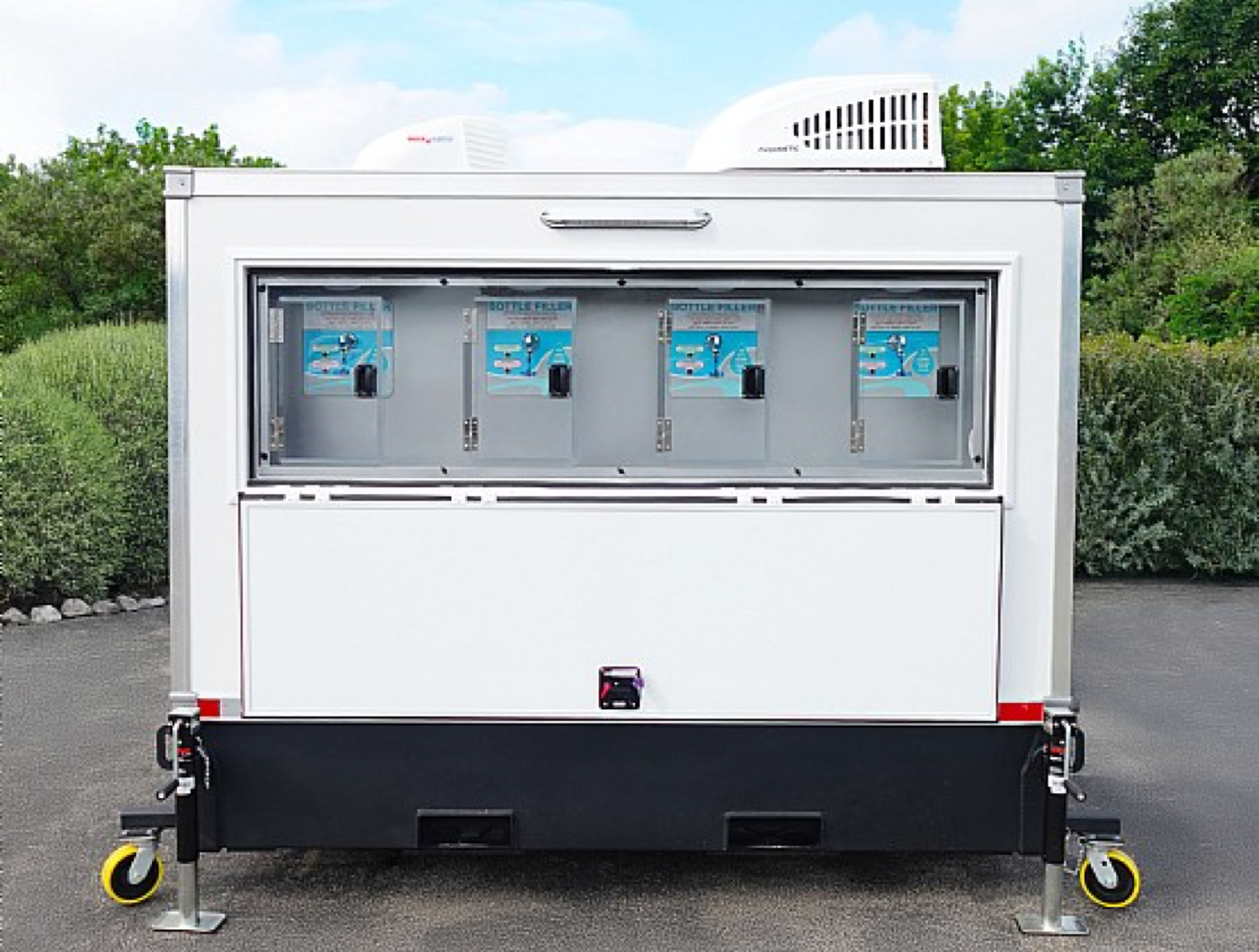
Need cold drinking water on a Pomona job site or at an outdoor event? We tow in a self-contained station that filters and chills its own supply, then keeps refilling all day. One trailer covers a framing crew off the SR-60, a wedding at the Fairplex, or a 5K through Ganesha Park. The Inland Valley runs hotter than the coast, and warm bottled water is the first thing crews and guests stop drinking.
- ~45-minute Inland Valley delivery
- Cold, four-stage-filtered water
- ADA bottle filling
- Cal/OSHA heat-illness ready
- Licensed & insured
- 24/7 emergency dispatch
Cold, filtered drinking water delivered to Pomona events and job sites, kept topped off all day
We stage chilled, filtered water stations across Pomona and the surrounding Inland Valley, and we keep the tank full from the first pour to the last. Out here the summer doesn’t quit, and a build crew or an event that runs dry doesn’t just lose comfort, it loses the day. So our trailers serve the people who can’t pause when the asphalt off Holt Avenue gets too hot to touch: concrete crews on the SR-60 warehouse pads, framers on the Phillips Ranch and Westmont infill, landscapers and utility teams who clock in at dawn to beat the worst of it. Three questions come up on nearly every call: how soon can you be here, will the water still be cold by mid-afternoon, and who handles the refill when the tank runs low on a Friday. We have a straight answer for each one.
Quick drops across the valley
Most Pomona-area deliveries land inside roughly 45 minutes of dispatch, and we run emergency drops around the clock when a heat advisory hits the basin. When a super realizes at 6 a.m. that a 50-person crew has nothing but a warm cooler, getting there fast is the whole job.
Water that’s still cold at quitting time
The onboard chiller runs all shift, so the 3 p.m. pour comes out as cold as the 6 a.m. one. That matters because a Pomona crew that finds lukewarm water at the tap simply stops going back for it, and a worker who isn’t drinking has lost the protection the whole rule is built on. When the valley sits five or six degrees above the coast on the same day, that last hour of cold is exactly the hour that prevents a heat case.
Dropped, filled, serviced, hauled
No chasing a separate bottled-water supplier, a morning ice run, and a waste hauler. We bring the station, keep it filled from our own water trucks, service it through the rental, and haul it off when you’re done, a single contact handling the whole hydration loop on your Pomona site.
I open every first call the same way: hydration the crew won’t touch is worth exactly as much as no hydration at all. I’ve seen shrink-wrapped pallets of warm bottled water bake at a Pomona gate while the guys quietly slid toward heat trouble, and I’ve seen a chilled unit set ten steps from the work get emptied twice in one shift. The gap between those two mornings is the entire job. Which is why our trucks don’t just drop a trailer and roll off. We match it to your headcount, pace the refills to how fast you really pull it down, and answer an emergency heat call the way you’d want yours answered. In Pomona, sixty minutes and a handful of degrees can decide whether a shift ends clean or somebody headed to Pomona Valley Hospital.
A single road-towable trailer, made for Pomona work under full inland sun
One rig handles the whole valley for us: the Signature Series water station trailer. It rides on a road chassis, so a single tow puts it wherever the work is, a grading pad along the 60, an event lawn at the Fairplex, a tournament field at Cal Poly Pomona. You don’t build anything and you don’t plumb anything into the lot. The crew backs it in, levels it, and water is pouring filtered and cold the same afternoon.
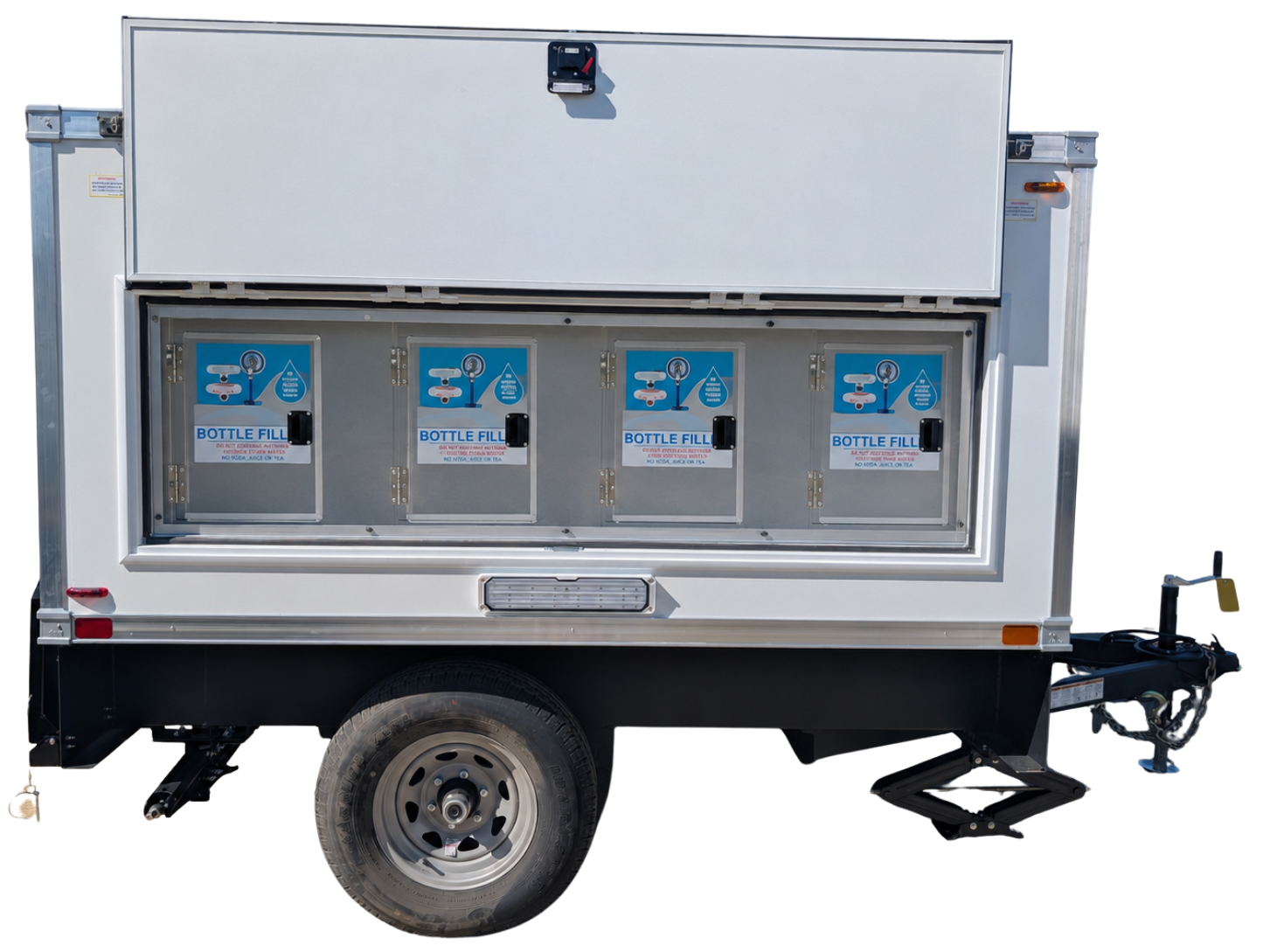
Signature Series specifications
With its own tires and hitch on a road-rated frame, it hauls out to a remote build, an event field, a citrus grove, or a disaster staging yard. Pomona contractors and event planners request this unit by name, and it’s built to back in, level off, and start pouring the very afternoon it lands.
| No. of stations | (4) Bottle Filling Stations |
| Length | 12′ 3″ |
| Weight | 3,100 lbs. |
| Height | 8′ |
| Fresh water tank | 300 Gallons |
| Power requirements | 1–4 dedicated 20A/120V circuits OR 1 dedicated 50A/240V circuit |
| No. of AC units | 1 |
Why this rig suits the Inland Valley
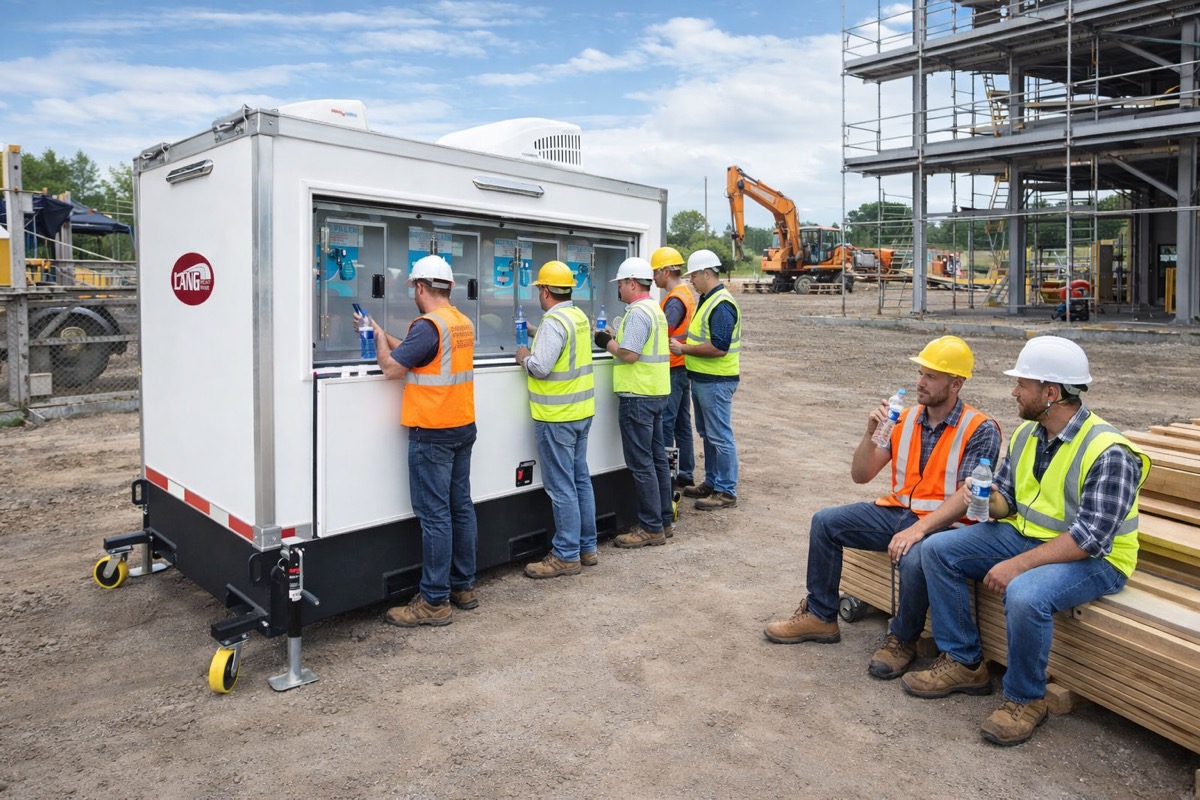
From chassis to chiller, the Signature is engineered for heat and for distance. The four push-back taps sit along the exterior wall beneath an awning, letting a full crew rotate through quickly on a hot break rather than crowding one nozzle. Its AC unit and built-in chillers hold the water cold even as the trailer sits roasting in full Pomona afternoon sun, which is exactly where coolers and pallet plans fall apart out here.
Three hundred gallons takes a good-sized crew through a shift, and since the rig tows, we can reposition it across a sprawling SR-60 logistics lot or move it to the next build phase with no fixed plumbing to dismantle. It accepts a wide band of ordinary site power, so one trailer covers both a finished address near downtown Pomona and a raw lot toward Chino where we arrange the power ourselves.
The four headline taps aren’t the whole story. A rear large-jug spout loads five-gallon coolers and personal packs, and a bank of hose-bib taps handles wash-up, crew chores, and grove work, so one trailer answers every water need a Pomona job or event throws at it. We’ve run a single rig from a Westmont framing crew at sunrise to a finish line at Frank G. Bonelli Regional Park the same evening, and pulled one off a La Verne campus build at noon to make a Fairplex concert load-in by dusk.
One station versus a summer of trucked-in bottled water
Run a 50-person Pomona crew through a season and the numbers settle the argument. Figure six bottles per head on a 95-degree day, and you’re buying, lugging, icing, and discarding roughly 300 plastic bottles a day, day after day after day.
Run that 200 working days and you’ve cleared 60,000 bottles. On the multi-phase warehouse and campus builds along the 60, where the same crew works the site for a year or more, the count blows past 100,000. The trailer replaces every one of those bottles, cold water at the tap and not a single empty for someone to bag and haul to the dumpster.
A logistics call first, a green one second
The waste angle holds up. Americans toss roughly 60 million plastic water bottles a day, only about one in three is recycled, and the rest sits in a landfill far longer than the career of the worker who drank it. Put that in the sustainability report. But that’s rarely why a Pomona PM makes the switch. The real driver is operational: a shared trailer kills the daily scramble. There’s no standing bottled-water order to reissue, no cooler gone warm by 9 a.m., no pile of empties cooking at the gate. The super gets to run the build instead of babysitting the water.
And because our own potable water trucks keep the station charged, the supply tracks the work. When a crew doubles up for a slab pour off Mission Boulevard, it can’t out-drink the plan, our tanker just runs the tank back up.
Hydration matched to how the Inland Valley really operates
Pomona doesn’t pose one hydration problem. It poses a whole set of them. A fair weekend at the Fairplex wants one configuration, a winter drag meet at the dragstrip wants another, and a summer warehouse build along the 60 wants a third. This is where the trailers pay for themselves. The same need turns up at the SR-57/SR-60 interchange logistics parks, in the downtown Arts Colony, and out at the campus edges of Cal Poly Pomona and Western University.
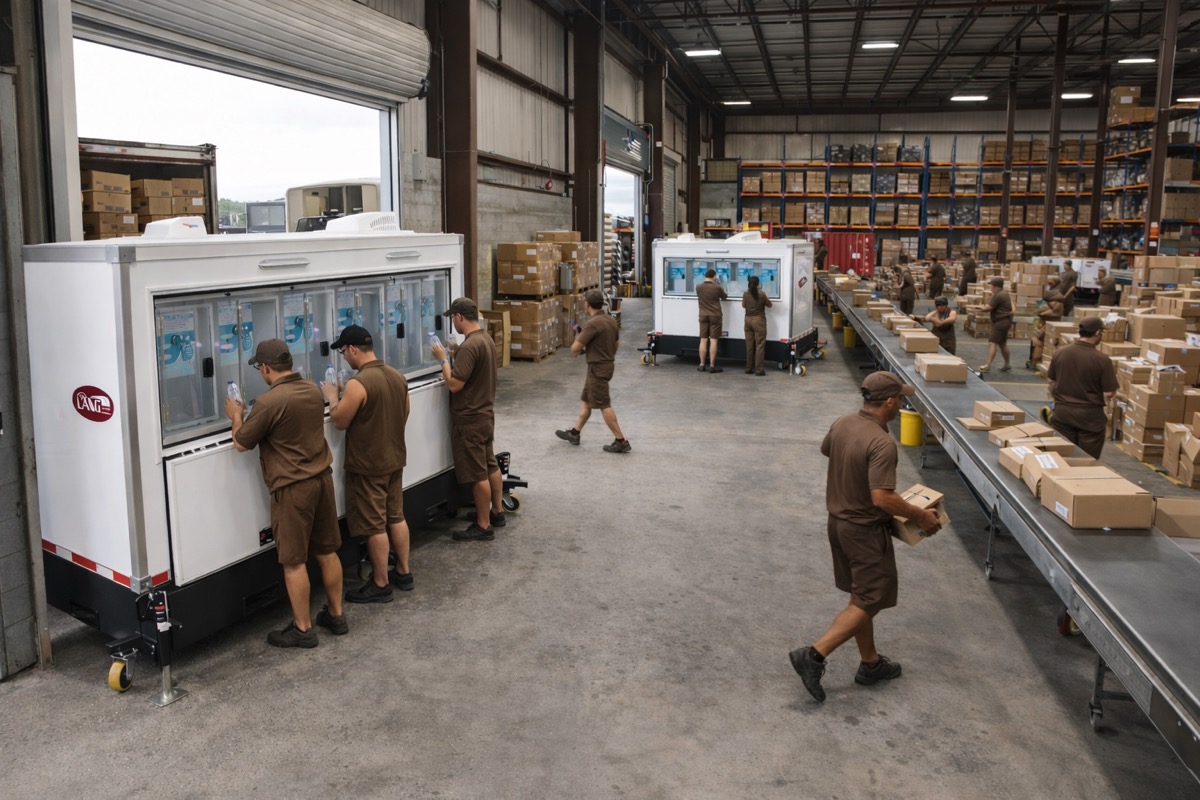
Warehouse, logistics & construction corridors
Pomona sits where the I-10, SR-57, SR-60, and 210 all meet, which is precisely why warehouses and distribution centers keep multiplying across the valley toward Chino, Ontario, and the Inland Empire line. Those builds, and the yards they turn into, run on crews working in open sun. We stage trailers down the corridors, from the Mission Boulevard industrial belt to the Reservoir Street lots, which keeps logged, on-the-record cold hydration a short walk from wherever the crew happens to be working.
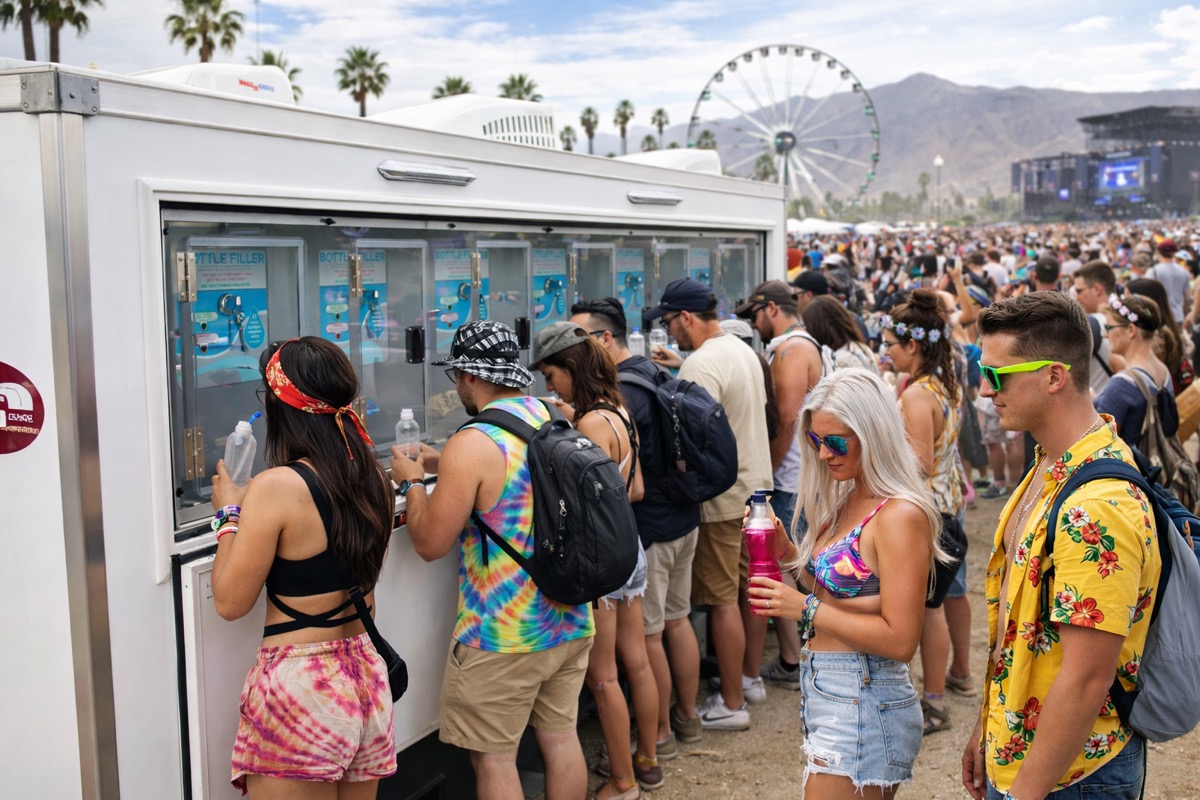
The Fairplex, fairs, festivals & races
The LA County Fair ranks among the biggest fairs in the nation, and the Fairplex runs concerts, expos, and car shows year-round. Throw in the NHRA Winternationals and the seasonal meets at the Pomona dragstrip, plus 5Ks and bike rides through Ganesha Park and Bonelli. A valley crowd in the heat goes through water in a hurry. One trailer hands the organizer reliable cold water and clean fill points, and skips the heap of single-use plastic that otherwise has to be carted in and carted back out.
Agriculture, groves & outdoor labor
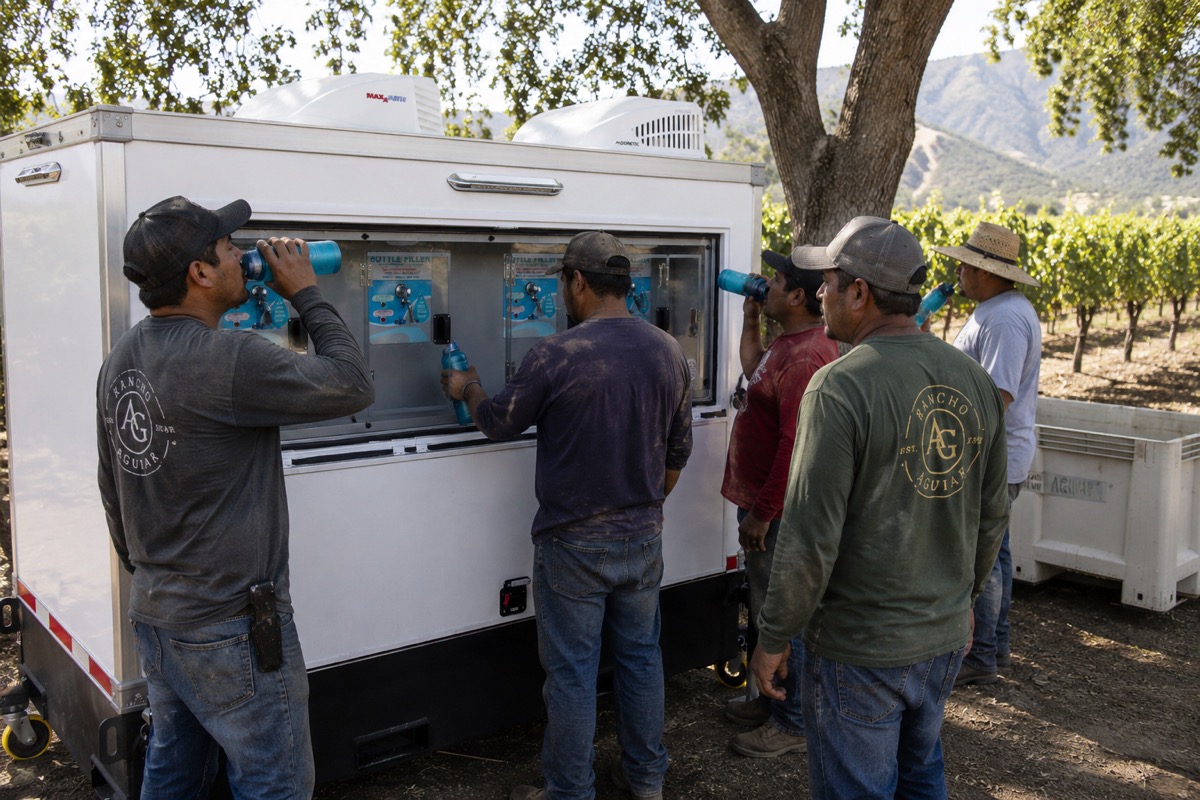
The valley still holds a working agricultural side, the AgriScapes farm at Cal Poly Pomona, citrus and nursery operations toward Chino and up against the foothills, plus landscaping and tree crews in every neighborhood. That’s about as heat-exposed as outdoor labor gets. With the large-jug spout and hose-bib taps, field crews top off coolers and personal packs right where they’re standing, at the row or the lot, instead of walking all the way back to the truck.
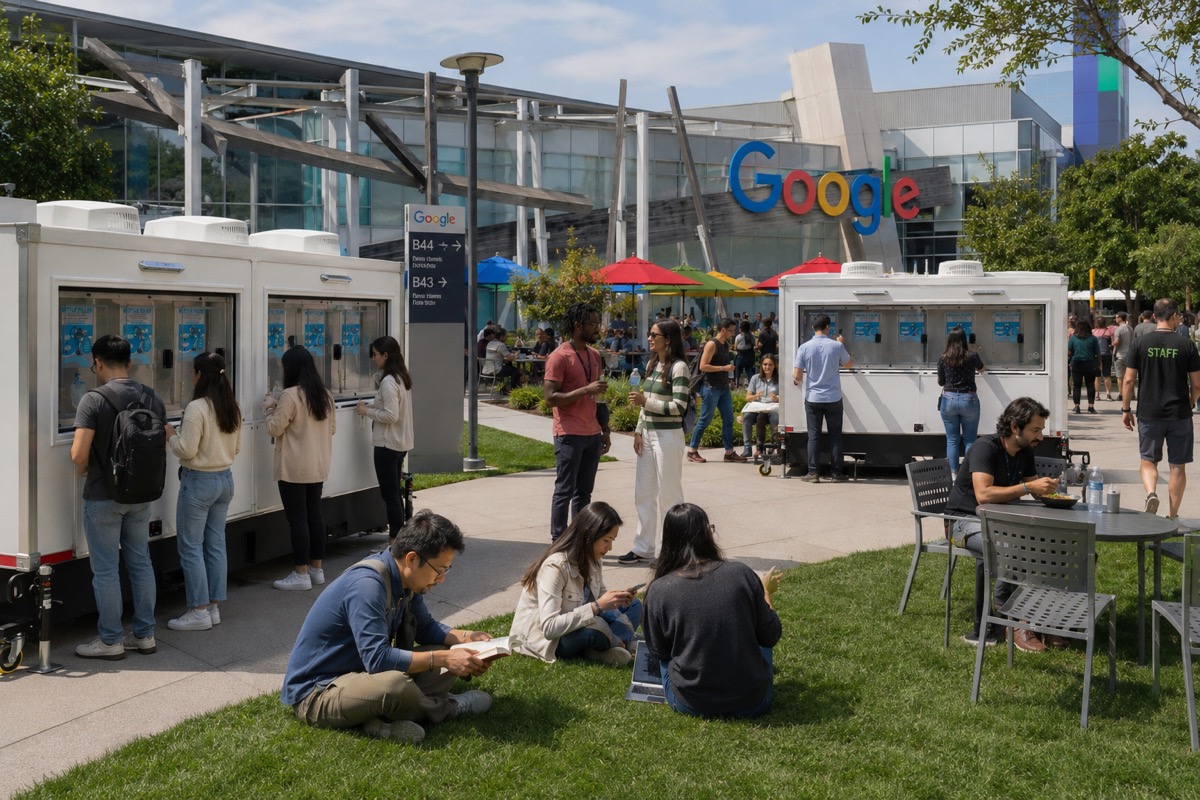
Campuses, corporate & municipal
Cal Poly Pomona and Western University of Health Sciences hold move-in days, commencements, athletics, and outdoor events that pull big crowds into the heat. City public works, the parks crews, and LA County teams work under the same sun. A towable trailer settles onto a quad, a plaza, or a maintenance yard and keeps pouring from open to close, and when a heat emergency or a water-main break hits a neighborhood, we can have potable trailers at cooling sites and base camps fast.
Treated through four stages, disinfected, then chilled for the pour
If the crew won’t drink from it, the rental was pointless. So every unit takes municipal water through a complete three-stage train plus a UV chamber, then runs it past an onboard chiller. The result tastes the way water should and comes out genuinely cold even on the hottest Pomona afternoon of the season.
Sediment stage
The opening filter catches sand, scale, and fine grit that Inland Valley mains tend to carry, keeping anything gritty out of the pour on a dusty Pomona lot.
Carbon stage
An activated-carbon pass removes the chlorine taste and the musty summer notes valley tap can develop, leaving water that’s clean and neutral. At 95 degrees, that taste decides whether a crew drinks or skips the tap.
Micro-particulate stage
A dedicated polishing cartridge traps the microscopic particles still riding the water, keeping the water safe for every worker and every guest filling up on a Pomona site.
UV disinfection
At the last step, ultraviolet light knocks out bacteria and microbes without a drop of added chemistry, so what leaves the nozzle is clean even after a long valley haul.
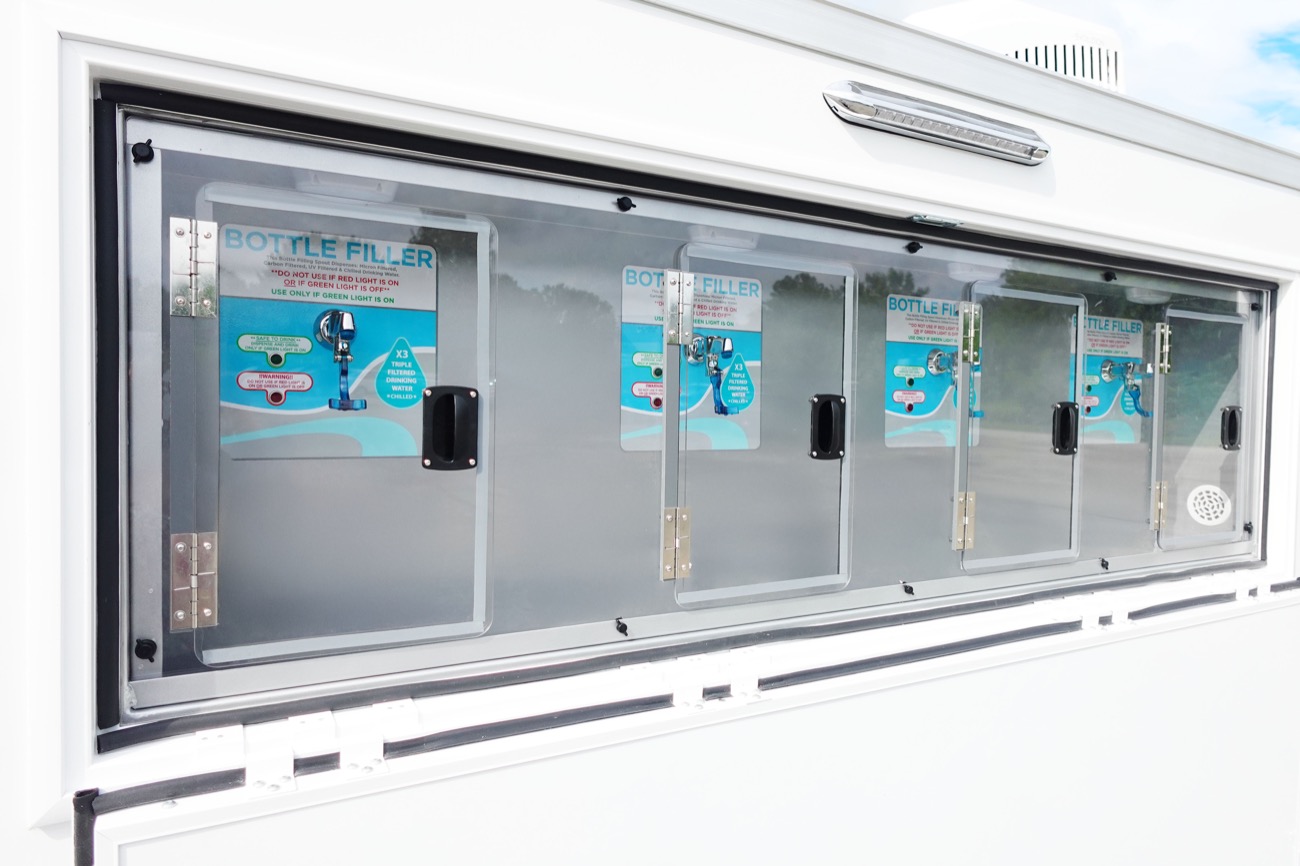
Three fill options, ADA built in
The exterior wall holds four push-back positions with adjustable nozzles, press the bottle to the bar and it pours. One of the four is mounted low enough to meet ADA reach, so a Pomona site needs no separate accessibility setup. Out back, a large-jug spout fills bulk coolers and personal hydration packs, while a row of hose-bib taps covers wash-up, event support, and grove work. Food-grade and stainless components keep that filtered, chilled water clean across every surface it crosses on the way out.
The 300-gallon tank works out to roughly 2,400 sixteen-ounce fills before it needs a top-off, and our tankers recharge it on demand. So on a packed Pomona shift the supply keeps pace with the crew, the tap is the part that scales, never the limit.
Delivered, filled, and connected by us, with cold water flowing in about an hour
There’s nothing here for your team to operate. Our crew picks the placement, fills the fresh tank, and makes the electrical connection, then shows your Pomona people how it works before heading off.
Share the particulars
How many people, how long the rental runs, the exact spot on the Pomona site, and what power is on hand. Those four facts let us spec it correctly on the first pass.
We roll out to you
Typically about 45 minutes from dispatch to any point in the Inland Valley, plus round-the-clock emergency runs whenever an advisory settles over the basin.
We get it running
The trailer gets leveled, the 300-gallon tank gets loaded, and we tie it into whatever the site provides, anywhere from one to three regular 120V circuits, or a lone 50-amp 240V drop.
We keep it supplied
Our tankers top the tank off on a cadence matched to your crew’s draw, and we service the unit from delivery through teardown for the entire rental.
A remote lot with no generator? We call it out in the quote. Thanks to the trailer’s modest power draw and our backing service fleet, we’ve kept stations pouring on Pomona-area sites that had no permanent power whatsoever. Let us know what the lot offers and we build the plan around it.
In the Inland Valley, cool water on the work face is the law, not a perk
California is among the handful of states that keep a year-round outdoor heat rule on the books, and Pomona employers answer to it. Cal/OSHA Title 8 Section 3395, the Heat Illness Prevention standard, kicks in at 80 degrees and requires fresh, suitably cool drinking water kept close enough that crews can drink small amounts often, plus shade, rest, and a written plan once the heat climbs. The Inland Valley clears 80 for months at a stretch and runs hotter than the LA basin, since the marine layer rarely reaches this far east, so the standard is in force across most of a Pomona build season.
A trailer makes that obligation visible and inspectable on site. It stands as a fixed, mapped source of cool potable water right at the work face, the backbone of a credible Heat Illness Prevention Plan (HIPP) and precisely what a Cal/OSHA reviewer wants to find on a walk-through. Since the recent record-heat summers, inspectors have pressed harder on heat documentation, and a mapped on-site cold-water source is among the easiest line items to put in front of them.
- Steady access to fresh, suitably cool potable water right where the crew works
- One documentable, mapped hydration point feeding your §3395 HIPP records
- Backs acclimatization and the small, frequent water breaks the rule calls for
- Built for tighter state and federal heat rules ahead, not a last-minute scramble
Lessons a few hundred Pomona deliveries have hammered in
Running stations across the Inland Valley for years has shaped how we approach every job. A handful of things we no longer have to relearn:
Placement beats everything. On a Phillips Ranch mid-rise we set the unit by the gate on day one, and it went barely touched, the work was four floors up and nobody spent a hot break hiking down for a drink. Next morning we wheeled it onto the hoist landing and the draw doubled before noon. “Put the water closer than the shade and the crew drinks it,” the foreman said, and I’ve quoted him on every walk-through since.
Refills follow the forecast, not the calendar. One September, with a heat run coming, we’d already pre-positioned spare tankers, so when three SR-60 warehouse sites all called the same afternoon we covered every one without a crew going dry. “You showed up before we knew we were low,” a safety lead texted that night. We now write that kind of buffer into every hot-season contract.
The bottled-water habit dies only when a crew feels the swap firsthand. On a logistics build out near Chino, the super flat-out doubted we’d keep 300 gallons cold on an exposed lot. We staged the trailer, tuned the refill timing, and a week on he called back to add a second. “My crew quit asking for ice,” he told me, which was the entire review. Around Pomona, once a station is on site and the water is still cold at quitting time, it makes the case on its own.
The common thread through all of it is the same point the climate keeps making: out here, hydration isn’t something you arrange once and stop thinking about. It’s a moving operation, and we manage it that way every day a trailer is on your site.
Outdoor crowds, and a valley sun that doesn’t let up
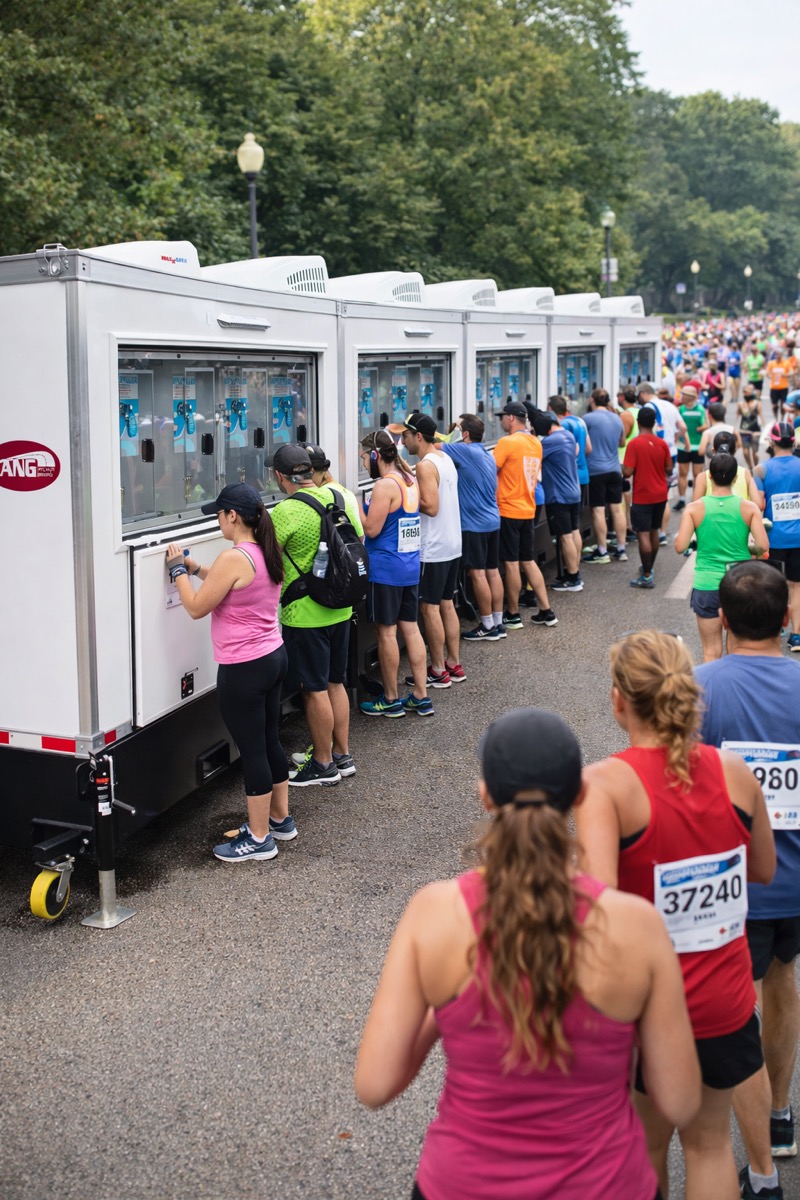
Pomona event organizers build around heat the way beach towns build around parking. A Fairplex concert, a Second Street Art Walk downtown, a charity 5K at Ganesha Park, a campus graduation, each gets its own self-contained trailer pouring steady cold water at tidy refill points. And it lifts the whole cycle of trucking, icing, and disposing of single-use plastic off your team entirely.
Across a large site we’ll spread several trailers so nobody treks far for a drink, with our crew timing the drop and the pickup to your run-of-show. One valley music festival drove the lesson home: a lone unit beside the main stage backed up forty deep by mid-afternoon, since heat times a few thousand attendees adds up quickly. We came back the next year with four units placed around the site, and the bottleneck was gone. For the guest it feels like hospitality. For your ops lead it’s plain risk management.
Pomona sits in the hottest corner of LA County, and the work doesn’t stop for it
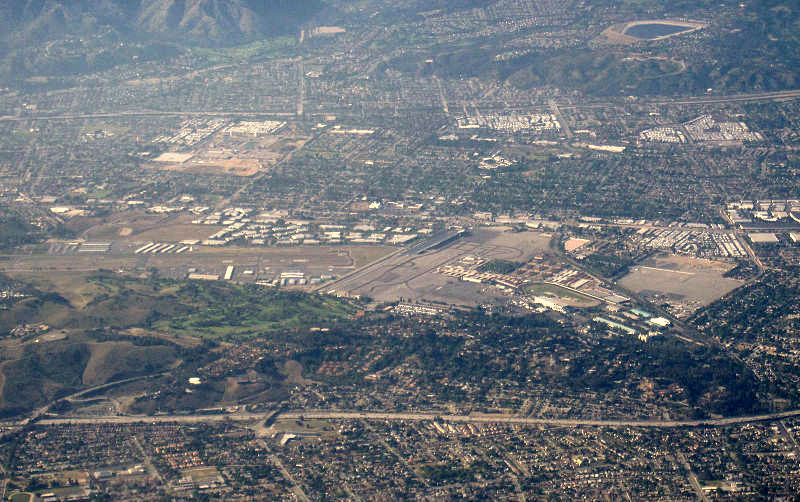
The coast has its marine layer and sea breeze. For most of the summer Pomona has neither. And the people building the valley out are stuck in the thick of it from late spring clear into October.
Summers in Pomona arrive hot, dry, and cloudless, August highs averaging near 91, with frequent runs into the upper 90s and over 100 whenever a ridge plants itself over Southern California. Tucked inland against the San Gabriel foothills, the city regularly reads several degrees warmer than Long Beach or Santa Monica on an identical day, since the cooling marine layer fizzles out well east of the 71 freeway. On fresh asphalt and bare concrete, surface readings rocket past the air figure, so a crew can hit genuine heat-illness territory by mid-morning while the thermometer still shows a misleadingly mild 94. In a place like this, cold water stops being a comfort. It’s the least expensive safety gear on the entire site.
The hard part of planning is how long the danger window stays open. A coastal builder can absorb a one-off heat spike with a few more coolers. A Pomona builder grinding from April into October cannot ice-and-cooler their way through, the volume’s too big, the warm-up too quick, and the daily slog of hauling, icing, and dumping bottled water mounts up shift after shift. Only a centralized, self-chilling trailer holds the line across a whole valley summer without becoming a logistics project of its own.
And the need keeps growing, because the valley is in a long build-out. Sitting where the I-10, SR-57, SR-60, and 210 converge, Pomona has become a pivot point for Southern California logistics, and warehouses, distribution hubs, and last-mile depots keep going up across the valley and toward the Inland Empire line. Cal Poly Pomona and Western University are growing their campuses, and infill housing keeps slotting in around Phillips Ranch, Westmont, and the historic Lincoln Park district. Each of those sites puts dozens or hundreds of workers in open inland sun, often clocking in before dawn just to stay ahead of the afternoon.
Our valley dispatch was built around that exact rhythm. Early on, staging trailers along the SR-60 warehouse belt and down the Mission Boulevard corridor, we pegged refills to crew size rather than a set calendar and folded in emergency drops during advisories. Because on a valley megaproject, a hydration gap doesn’t merely slow the work, it can shut it down and load somebody into an ambulance bound for the ER.
Behind the station: the fleet that keeps a Pomona job supplied
The trailer is the part the crew sees. Behind it runs a fleet that trucks fresh water onto the lot, banks a reserve there, and carts the wastewater off again. Booking all of it through us means one number and one invoice instead of chasing a water supplier, a hauler, and a pump vendor separately.
Potable water trucks
Drinking-grade water moves across the valley by tanker, recharging the 300-gallon tank on a schedule tied to your crew count. The same trucks load cisterns, on-lot tanks, and bladder bags any time demand outruns one delivery, say a slab pour off Mission or a packed Fairplex weekend.
Bladder bags & buffer supply
Collapsible water bladders bank extra fresh reserve through peak stretches, and they’ll hold greywater for a while when a Pomona lot has no drain. Unglamorous, but they’re what keeps a far-out valley site flowing between tanker visits.
Pump trucks
Need water moved? A pump truck does it, charging storage tanks or relaying supply clear across a site. Out on the big logistics lots, where the trailer ends up parked well away from the fill source, it earns back its cost inside one shift.
Vacuum & waste trucks
Greywater and wastewater get pulled by a vacuum truck and carried to permitted disposal, closing the loop cleanly. Your Pomona crew never has to ask where the used water ended up. We’ve packaged it that way from the start.
The pieces are built to work together. A far-out lot toward Chino might pair the station with a bladder bag for buffer and a standing water-truck route. A big Fairplex weekend might want a pump truck relaying supply during the show and a vacuum pickup once the crews strike the site. Tell us how the job is shaped and we’ll size the combination to match, all of it on one contact, one invoice, and a crew that already knows the way into your Pomona lot.
The questions we’ll ask, and how each one bends the plan
An accurate Pomona quote usually takes about two minutes on the phone. These are the four things we’ll ask, both so you can have them handy and so you can see that we spec each job to the site instead of dropping the same package on everyone.
Four answers that steer the whole recommendation
- How many people? A 15-person framing crew off Garey Avenue is a different job than a 5,000-seat Fairplex concert. That headcount drives how many trailers we stage and how often the refill truck comes back around.
- How long? A weekend fair, a three-week foundation pour, and a nine-month campus build each call for their own service rhythm. Brief events ride on buffer storage. Extended builds ride on scheduled tanker runs.
- Where will it sit? Since it tows, the Signature parks fine in a fenced yard, a bare dirt lot, an open event field, or a tight staging zone wedged along a freeway corridor. Once you tell us the exact spot, and how our truck reaches it past the gate guard and the lay-down stacks common on valley sites, we set it down within steps of where the crew actually works.
- What power is on site? The trailer will run off as few as one or as many as three ordinary 120V circuits, or off one 50-amp 240V hookup. The bare warehouse pads toward Chino often have no permanent power, which is no obstacle, we just want to hear about it early.
The extras that help us nail the fit
- The station’s ideal spot on the lot, and the route a delivery truck takes to reach it
- Whether the crew is fanned across a footprint or clustered at one work face
- Any §3395 heat-illness records your safety program needs the station to back up
- Whether the same visit should also cover bulk water delivery, bladder storage, or waste pickup
The hidden costs a pallet of bottled water never prints on the invoice
On the purchase order, bottled water reads cheap. The real expense is buried in the handling, the staging space, the warm-up, and the disposal, and in Pomona each of those lines runs steeper than it would on the coast.
The labor nobody budgets for
Somebody has to order the bottled water, receive the pallets, break them down, ice the coolers before sunrise, restock through the day, and crush the empties for the dumpster. Across a large valley crew that adds up to hours of paid time every day, all of it pulled off the actual build. A station erases that work. We sat down with a Pomona GC once and the labor savings by themselves paid for the rental, and he admitted the bottle runs had quietly cost him a half-day of payroll a week. A trailer arrives full, tops off from our tankers, and needs nothing from your superintendent beyond a parking spot.
The warm-up problem
Pack a cooler with ice at 6 a.m. and by 10 on a Pomona July morning it’s the temperature of a warm bath. The trouble is what happens next: crews stop reaching for warm water, and the hour drinking falls off is the hour a heat case starts building. A chiller that runs all day has no warm-up curve, so the quitting-time pour matches the sunrise pour, cold right when a spent, overheated crew needs it most. Through the middle of an inland afternoon, that single difference is what keeps a crew drinking steadily instead of drifting one by one toward the shade tent.
The storage and footprint tax
Pallets of bottled water swallow staging space, clog lay-down areas, and sit cooking in the sun until someone breaks them open. The empties accumulate faster than anybody clears them, and on a cramped downtown Pomona lot that pile becomes a problem of its own. A trailer occupies one parking space and serves a crew that would otherwise chew through hundreds of bottles daily.
The waste that trails the job
Buy a bottle, throw a bottle away, and a busy site builds a small mountain of them over a summer. There’s the disposal bill, the sustainability ding on the project report, and in a county where a tossed bottle can sit for centuries, a footprint that outlasts the structure you built. Move to a refill station and that line disappears, leaving your ESG reporting a figure actually worth printing.
Staging cold water across Pomona and the Inland Valley
We dispatch across Pomona and the whole Inland Valley, foothill towns off the 210, through the downtown core, out to the warehouse corridors toward Chino and the Inland Empire line. Sit anywhere in the valley and you’re inside our range. That’s true for a downtown Arts Colony block party, a quad event at Cal Poly Pomona, a Phillips Ranch streetscape, or a logistics build on a bare SR-60 pad alike.
Lincoln ParkDiamond BarWalnutSan Dimas
La VerneClaremontMontclairChino
Chino HillsOntarioGlendoraCovina
West CovinaFairplex areaCal Poly Pomona
Working a corridor instead of one address? We follow the freeways the valley runs on, the I-10, the SR-57, the SR-60, and the 210, so a job spread across several addresses gets served just as quickly as one stationary lot.
The questions Inland Valley crews and organizers actually ask
How fast can you get a water station to my Pomona job site?
For most Pomona-area addresses we roll up inside about 45 minutes of dispatch, and when the county posts a heat advisory we dispatch around the clock. If a super finds the lot dry at a 100-degree start, we can usually have the station leveled and pouring before the crew breaks for lunch. The two things that swing the clock are how easily our truck clears the gate and whether power is already on site, so tell us both and we’ll route the run to fit.
Will the water still be cold by mid-afternoon, not just filtered?
You get both. The built-in chiller runs from the first pour to the last, so the trailer’s water reads cold at clock-out, not just at dawn. That’s the point that matters here: on an inland July afternoon nobody drinks lukewarm water, and a crew that stops drinking loses every bit of heat protection the station was there to provide. That’s why we count the chiller as safety gear rather than a creature comfort.
What’s the tank capacity, and who handles it when the water runs down?
Each Signature trailer carries 300 gallons, roughly 2,400 sixteen-ounce pours. When a large crew draws that down on a hot day, our tankers recharge it on a schedule tied to your usage, so capacity is never the bottleneck. Keeping track of the refills falls to us, not to your team.
Does a rental count toward Cal/OSHA heat-illness compliance?
It backs it up directly. Title 8 Section 3395 in California calls for fresh, suitably cool drinking water within easy reach of outdoor crews from 80 degrees up, alongside shade, rest, and a written plan as the day heats up. A trailer hands you a fixed, mapped, cool-water point you can list in your Heat Illness Prevention Plan and walk an inspector straight to. The safety program is yours to author. The hydration that anchors it is ours to deliver.
Is the station ADA accessible?
It is. The four push-back fill positions include one mounted at an ADA-reachable height, so everyone on the Pomona site is covered without a second setup. The rear large-jug outlet loads five-gallon coolers and personal packs, and the hose-bib taps cover wash-up and crew tasks.
Can you cover Fairplex events on top of construction work?
Absolutely, events make up about half our valley calendar. For a Fairplex concert, a fair weekend, a charity 5K, or a campus graduation, we’ll place one trailer or fan several across the site and schedule delivery and teardown to your run-of-show. Attendees get reliable cold water and tidy refill points, and you skip the expense and trash of bottle pallets.
What information do you need to get a station set up?
Just four things: crew or crowd size, how long you need it, the parking spot on the Pomona site, and the available power. A Signature draws one to three everyday 120V circuits, or alternatively a single 50-amp 240V line. If a remote lot has no power, just say so up front and we work the fix into the quote.
Do you only serve Pomona, or the whole Inland Valley?
The whole valley. Our dispatch runs Pomona proper plus Diamond Bar, Walnut, San Dimas, La Verne, Claremont, Montclair, Chino, Chino Hills, Ontario, and the foothill and West Covina communities. Multi-site work strung along the I-10, SR-57, SR-60, and 210 is routine for our trucks.
How does the water taste next to bottled?
Clean, with no chlorine bite. The carbon pass pulls the chlorine and the seasonal musty notes that valley tap sometimes carries, so the pour tastes fresh instead of like a garden hose baked in the sun. It’s not a minor detail. A station only does its job when crews want to drink from it, which is why taste sits in the safety column for us rather than the extras.
How big a crew can one station carry?
A large one, since the limit is the refill rhythm, not the number of taps. Four fill positions clear a crew quickly on a break, and 300 gallons runs about 2,400 sixteen-ounce fills between top-offs. For very large Pomona crews we shorten the tanker interval or add a second trailer, so the supply scales up with your headcount rather than capping it. Tell us your busiest count and we build around that.
Can you roll out fast during a heat emergency?
Yes, and it’s a big part of why valley clients keep our line saved. When an advisory hits we dispatch through the night, and once the forecast shows a multi-day ridge building over Southern California, we pre-position extra tankers before the calls start. So when a crew shows up to a triple-digit Pomona morning and the water situation has fallen apart, one call generally puts a cold trailer on the lot before the afternoon high lands.
Built for the people who can’t absorb a hydration gap
“Forty guys on a warehouse pad off the 60 in August, and our bottled-water plan was done by 10 a.m. By that afternoon a station was on the lot pouring genuinely cold water. Pallets never came back after that.”
“At our Fairplex weekend the refill stations dropped our single-use bottle order to almost nothing, and the lines kept moving. They worked our schedule for drop-off and pickup, not the other way around. Rebooking for next year was a no-brainer.”
“Our safety audit needed documented cool-water access under §3395 for a heat-exposed Pomona crew. The mapped station checked that box for the HIPP cleanly. And the refills always arrived before we got close to empty.”
Service information current as of June 2026.
Get cold, filtered water onto your Pomona site ahead of the next heat wave
Give us the crew size, the dates, and the parking spot, and we’ll spec the job and run a trailer out across the Inland Valley, usually within about 45 minutes of dispatch.