Sunnyvale Cold Water Station Rentals for Events & Job Sites, Call 24/7
Anywhere in Sunnyvale, we can stage a self-contained drinking-water rig that pours chilled, filtered water from morning until the work wraps. Picture a product launch out on a Moffett Park lawn, a slab pour beside Lawrence Expressway, or an evacuation staging zone during a red-flag stretch. Each one comes down to a single thing: water crews and crowds will actually reach for. Our job is to haul it out, charge the tank, and hold the temperature down from the opening fill to the final cup.
- ~45-minute South Bay delivery
- Chilled, four-stage filtered water
- ADA bottle filling
- Cal/OSHA §3395 heat-ready
- Licensed & insured
- 24/7 emergency dispatch
Chilled, filtered water for Sunnyvale events and crews, dropped off and tended all day
Across Sunnyvale and the broader South Bay, our trailers put cold, filtered drinking water in front of work sites and gatherings, with the tank kept charged from the minute the unit is leveled to the last bottle filled at teardown. Almost every first call circles three worries. The first: can a unit reach the site today. The second: does the water hold its chill once the swing shift clocks in. The third: what happens once 300 gallons starts drawing down mid-launch or mid-pour. Our answer to all three is a rig that recharges itself plus a service team tracking the draw, which takes the worry off your plate entirely.
On site fast, across the valley floor
A typical South Bay drop arrives about 45 minutes from the moment we dispatch, and emergency and after-hours routes run 365 days a year. Say a campus coordinator near Mathilda finds the day-of plan came up short, or a crew pulls into a Moffett Park staging zone before sunup. In both of those situations the turnaround is the whole ballgame.
A pour that’s still cold at clock-out
Because every trailer chills the water it carries, a graveyard fab tech filling up at 2 a.m. gets a pour as cold as the one handed to a wedding guest at midday. Nobody drinks warm water, and water left untouched does zero good for a worker grinding through a hot Sunnyvale afternoon. Keeping it cold is precisely what keeps people circling back to refill.
Set, filled, serviced, hauled out
Skip the bottled-water vendor, skip the ice runs, skip chasing down a separate hauler. We stage the rig, top it off from our own potable trucks, keep it maintained, and tow it out at wrap. From the drop to the pickup, one point of contact manages the full water loop on your Sunnyvale site.
The benchmark behind every job is simple: if a crew walks right past the water, you may as well not have brought any. On one site we watched shrink-wrapped pallets of warm bottled water bake by a job-trailer step while the guys quietly let their breaks slide; on another, a chilled rig sitting ten feet off the work face got pulled dry twice before noon. That gap is the reason this company exists. Which is why dropping a unit and pulling away isn’t the service. We match it to your headcount, pace the refills to your real draw-down rate, and jump a late-night heat call or an unexpected PSPS shutoff fast, because around here a single scorching week or one grid event can reshape a crew’s needs hour by hour.
A single road-towable rig built for how Sunnyvale works outdoors
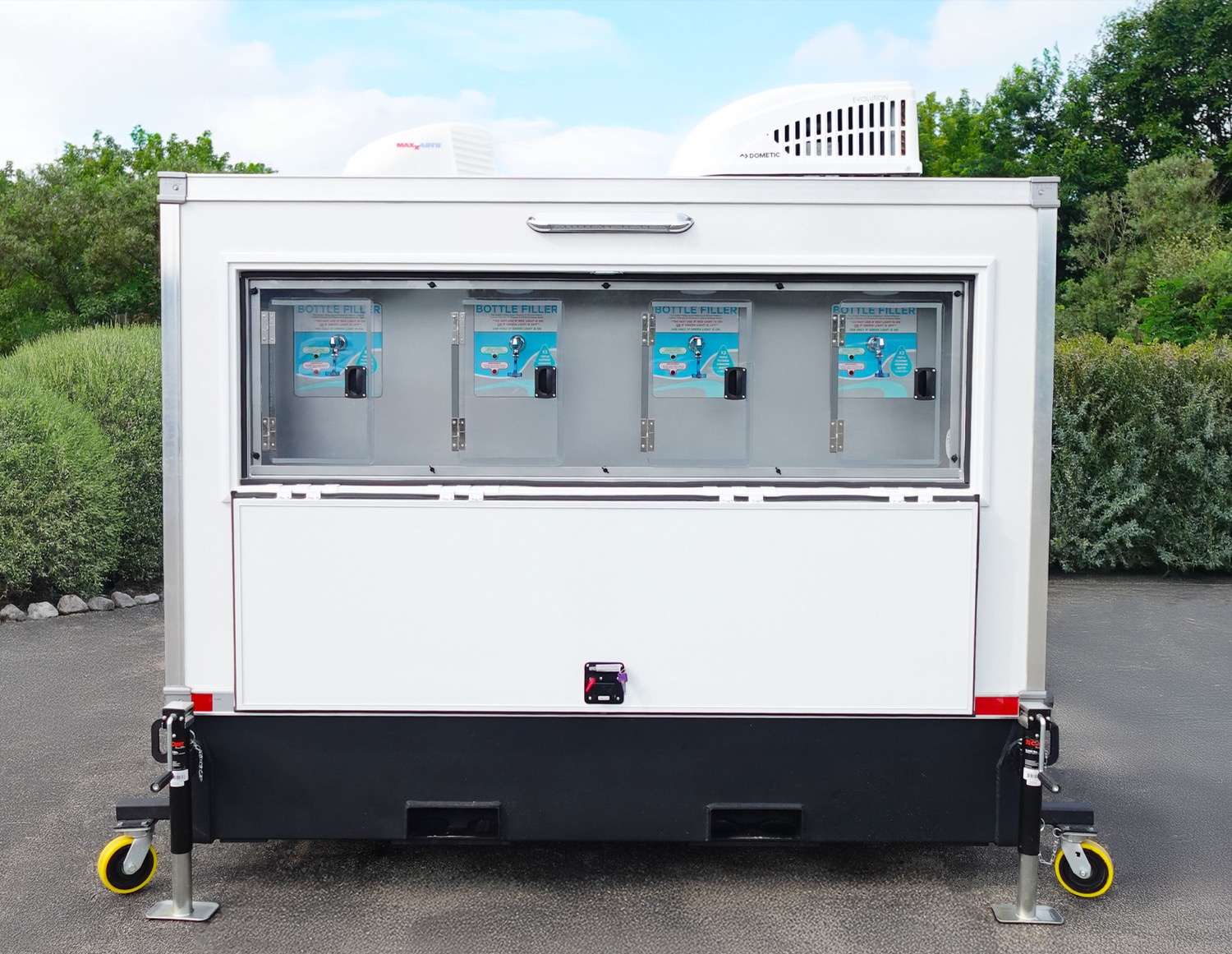
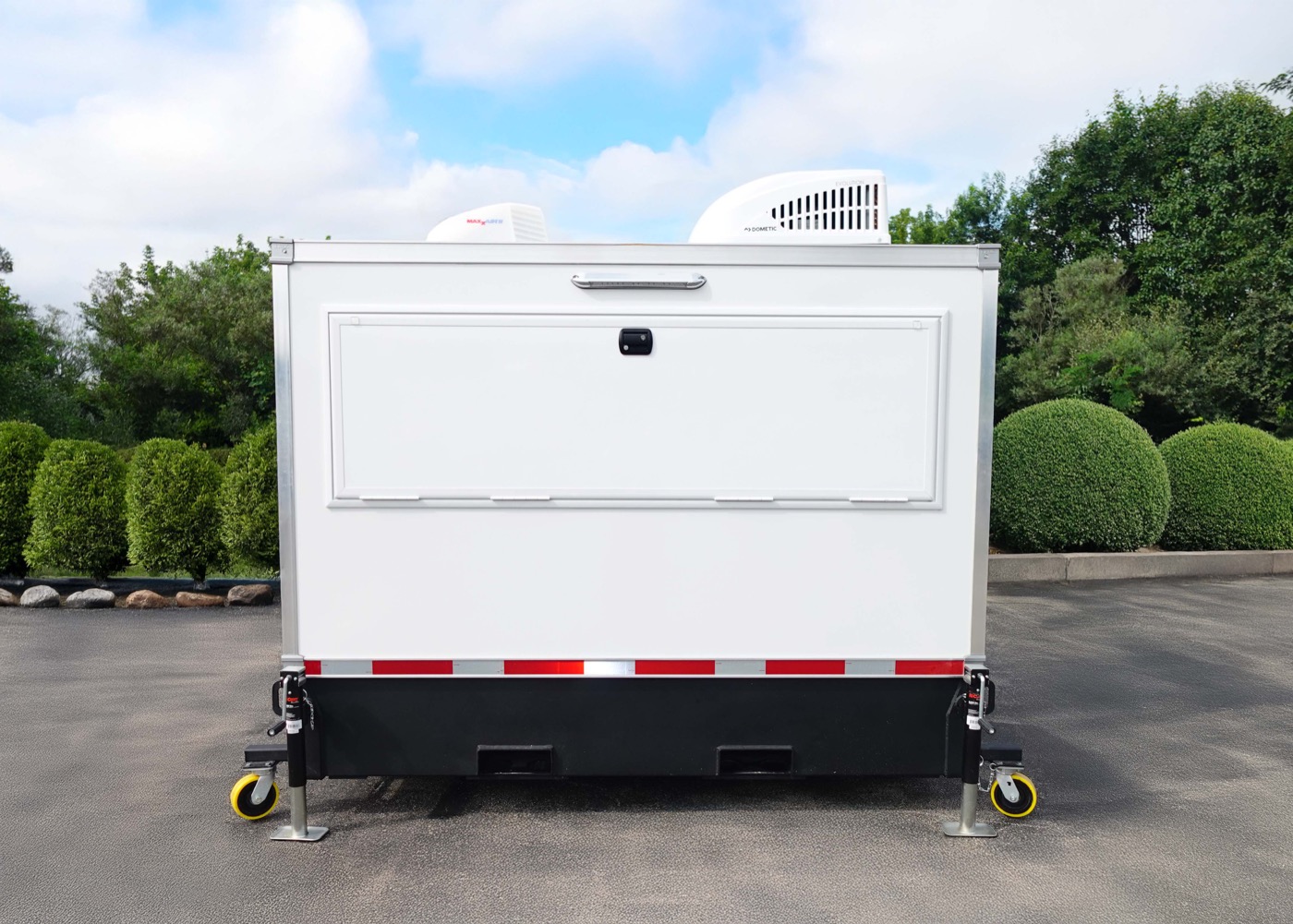
One purpose-built rig handles the entire South Bay for us: the Signature Series water station trailer. Riding on a full road chassis, it heads directly to where the crowd or the work happens, whether that’s a campus quad off Java Drive, the festival lots strung along Murphy Avenue, or a graded data-center pad near the airport in north Santa Clara. No assembly, no permanent plumbing. You get filtered cold water on tap the very day it shows up.
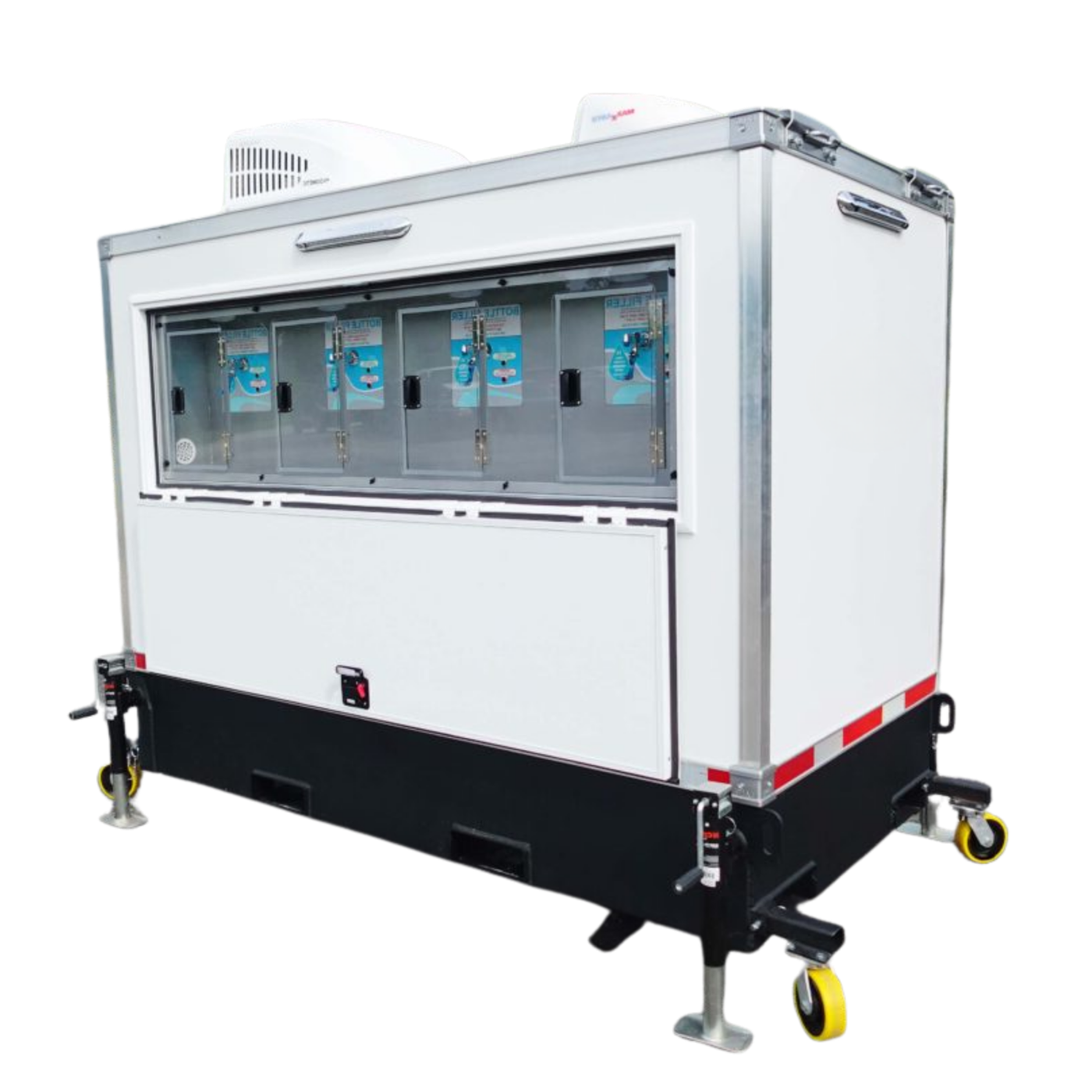
Signature Series specifications
Road tires, a hitch, and a full trailer chassis mean it tows straight to a corporate quad, an event field, an industrial yard, or an emergency staging zone, with no crane and no flatbed in the picture. Sunnyvale facilities teams and contractors request this rig by name. It’s made to arrive, level out, and pour cold the same afternoon it lands.
| No. of stations | (4) Bottle Filling Stations |
| Length | 12′ 3″ |
| Weight | 3,100 lbs. |
| Height | 8′ |
| Fresh water tank | 300 Gallons |
| Power requirements | 1–4 dedicated 20A/120V circuits OR 1 dedicated 50A/240V circuit |
| No. of AC units | 1 |
What makes it right for Silicon Valley
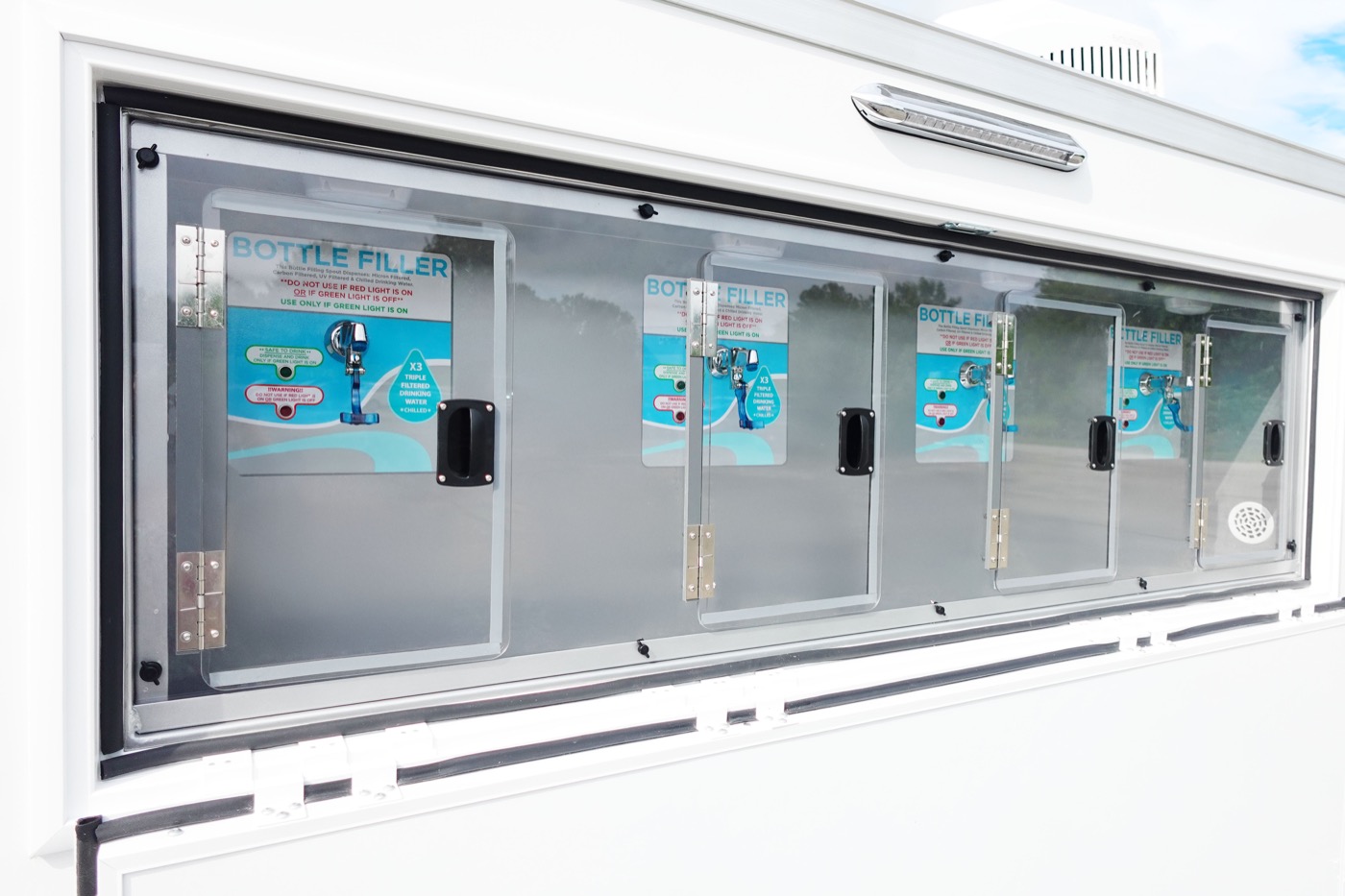
Two headaches get handled at once here: the miles and the heat. Four push-back taps run along an awning-shaded outside wall, letting a swing crew on break or a launch-day crowd flow through quickly rather than clumping at a single spout. Even as the trailer roasts in full sun on a Borregas Avenue lot, the built-in cooling and onboard AC keep the water cold. That is exactly where a tray of coolers or a bottled-water order falls apart once the mercury hits 95.
A sizable crew gets through a full shift on 300 gallons. And since the unit rides on its own axles, we can reposition it across a wide campus quad or roll it to the next build phase, with no fixed plumbing to rip out. Because its power needs span a broad range of everyday site juice, the same rig works at a finished downtown plaza or on a bare graded parcel where we improvise the power.
Those four marquee taps aren’t the whole story, either. Five-gallon coolers and personal packs fill at a rear jug spout, and a row of hose-bib taps takes on wash-up, crew tasks, and cleanup. One piece of equipment, and the entire Sunnyvale hydration picture is covered. We once ran a single rig from a Wolfe Road framing job in the morning to an evening load-in for a corporate party on a Moffett Park campus, with no second trailer in play.
The bottled-water math stops adding up by the second week
Send a 50-person Sunnyvale crew through a long warm stretch and the math works itself out. At five or six bottles per worker on a hot valley day, that’s somewhere near 300 plastic bottles to order, haul, ice, and throw away each day, then do it over again the next shift.
Run that out over a 200-day data-center build and the count clears 60,000, with a multi-phase tech-campus job pushing higher still. A single trailer replaces that entire heap: cold water on tap, and not one empty headed to the landfill.
This is a logistics decision dressed up as a green one
The environmental angle is genuine and worth stating outright: tens of millions of these bottles get tossed by Americans daily, recycling rates stay stubbornly low, and the plastic sticks around in a landfill longer than most of us will. That number belongs in your ESG report, since in a valley packed with carbon-neutral and zero-waste pledges, someone on the sustainability team is going to read it. Even so, what actually pushes most Sunnyvale supers and event leads to switch is far less glamorous than the green pitch: one shared trailer ends the daily grind. There’s no standing water order to place. There’s no cooler going tepid by mid-morning. There’s no pile of empties cooking by the gate. Whoever runs your job gets to focus on the job, with the water supply lifted clean off their list.
With our potable trucks keeping the tank charged, the supply flexes to match the day rather than forcing the day to match it. Throw a second crew at a pour, or watch an after-work festival turnout beat the forecast, and nothing falls apart. We just roll out another fill and the taps stay cold.
Hydration sorted by the way this valley actually fills its week
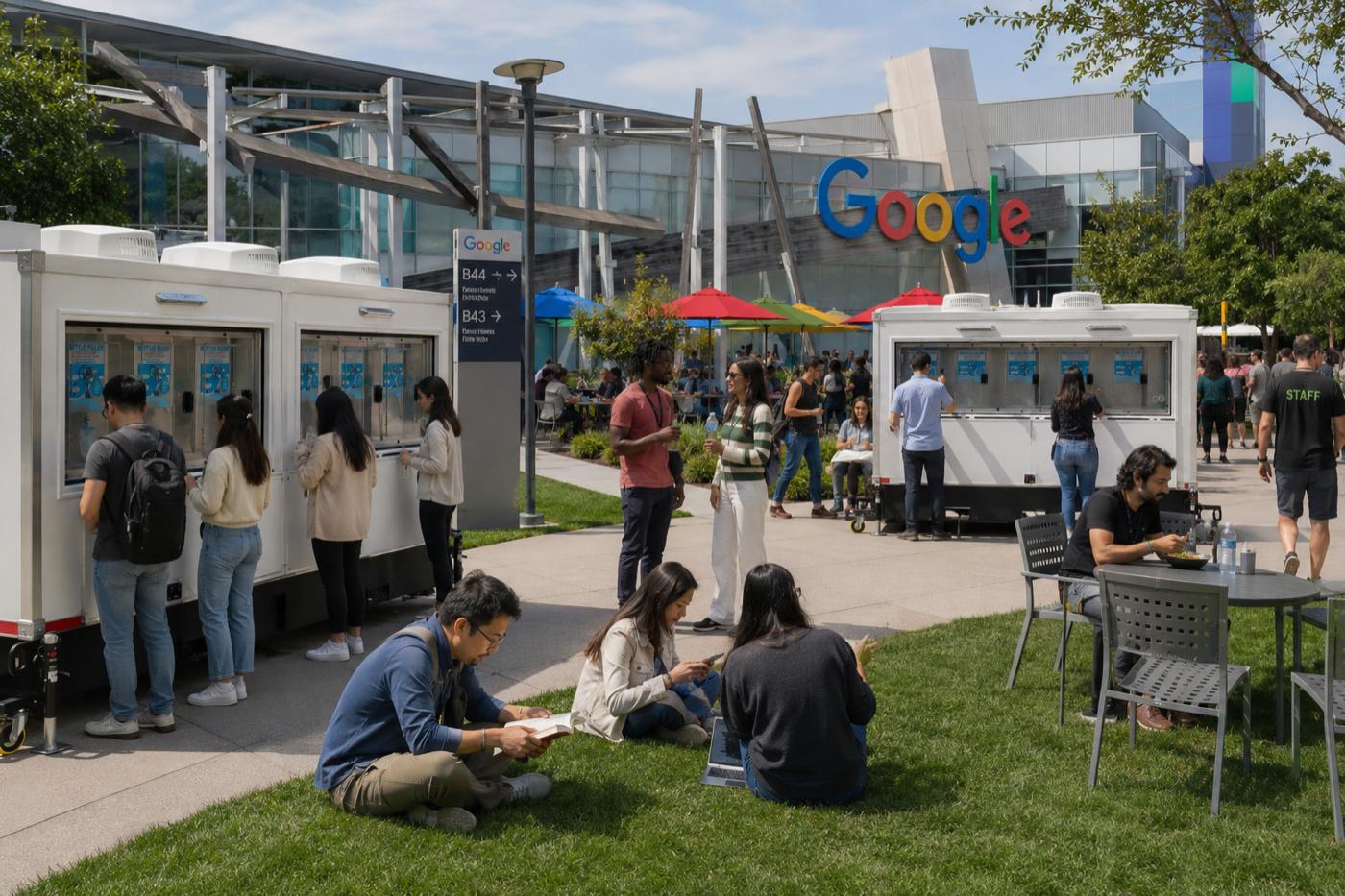
Sunnyvale doesn’t have one hydration problem, it has several that look nothing alike. A 5,000-person all-hands on a Moffett Park lawn needs one setup, a cleanroom-shell build off Kifer Road needs another, and an emergency cooling center during a smoke-and-heat week needs a third. Here’s where these trailers go to work, from the historic core around Murphy Avenue and the Caltrain depot out to the office parks lining Lawrence Expressway and the airport-edge yards in north Santa Clara.
Tech campuses, all-hands & company events
Moffett Park alone packs in Apple, LinkedIn, Google, and Juniper offices, and the campuses keep spilling outdoors for launches, hack days, summer field days, and town-hall gatherings on the quads. When a few thousand employees pour onto a lawn off Java Drive or Crossman Avenue in July, a couple of trailers keep clean cold water flowing at tidy refill points, and the facilities team skips the pallet-and-cooler circus entirely.
Downtown festivals & public events
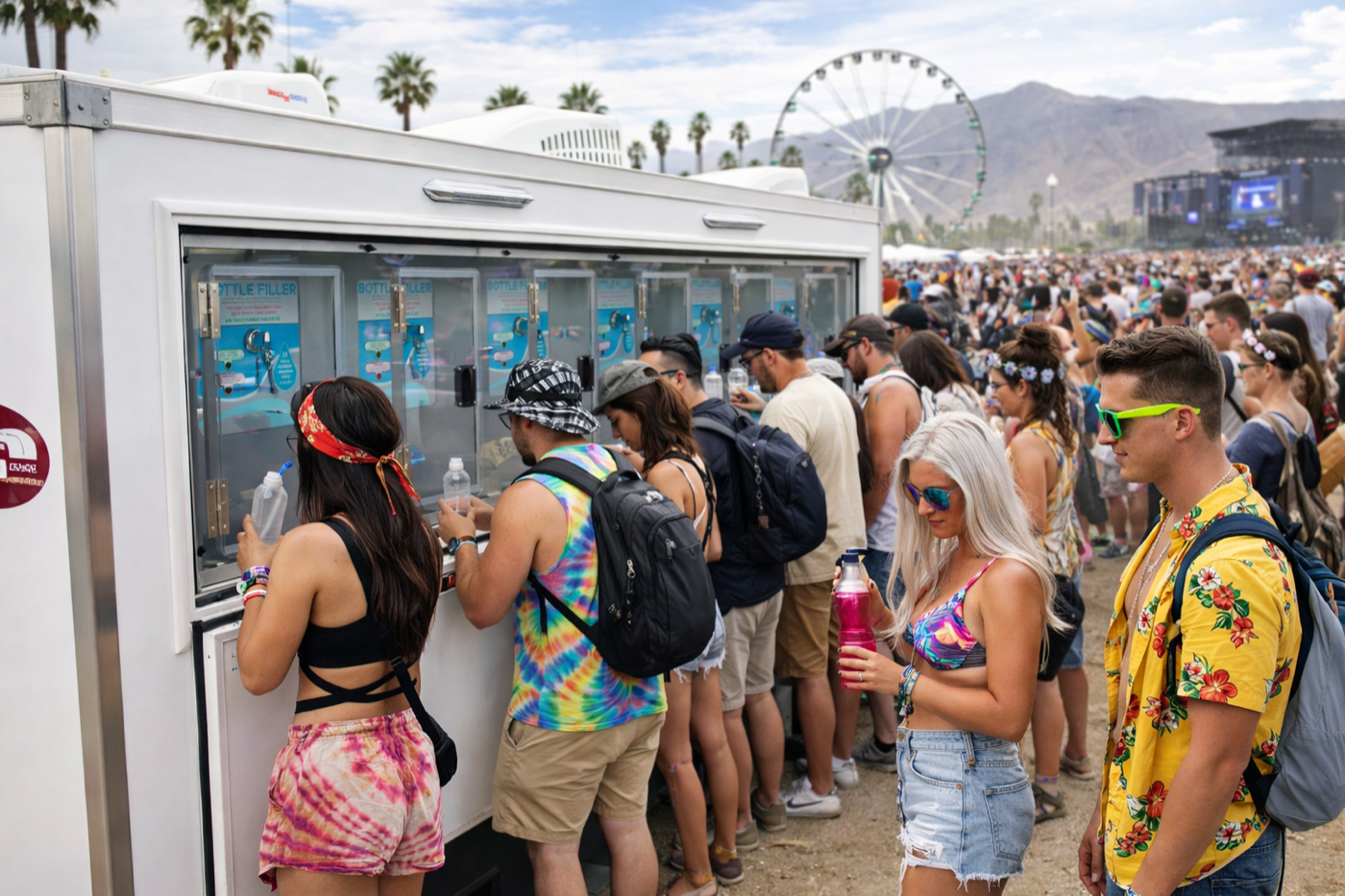
Every summer the Sunnyvale Art & Wine Festival fills Murphy Avenue and Historic Downtown, while the Tuesday farmers market, the summer concert nights, and the street fairs pull their own warm-weather turnouts. A crowd outdoors goes through water quickly. A trailer gives organizers a steady cold supply and tidy fill points, sparing them the pallets of single-use bottles to truck in and truck back out. On the larger footprints near Levi’s Stadium over in neighboring Santa Clara, we’ll spread several units around so no one has to hike for a refill.
Data-center, semiconductor & office builds
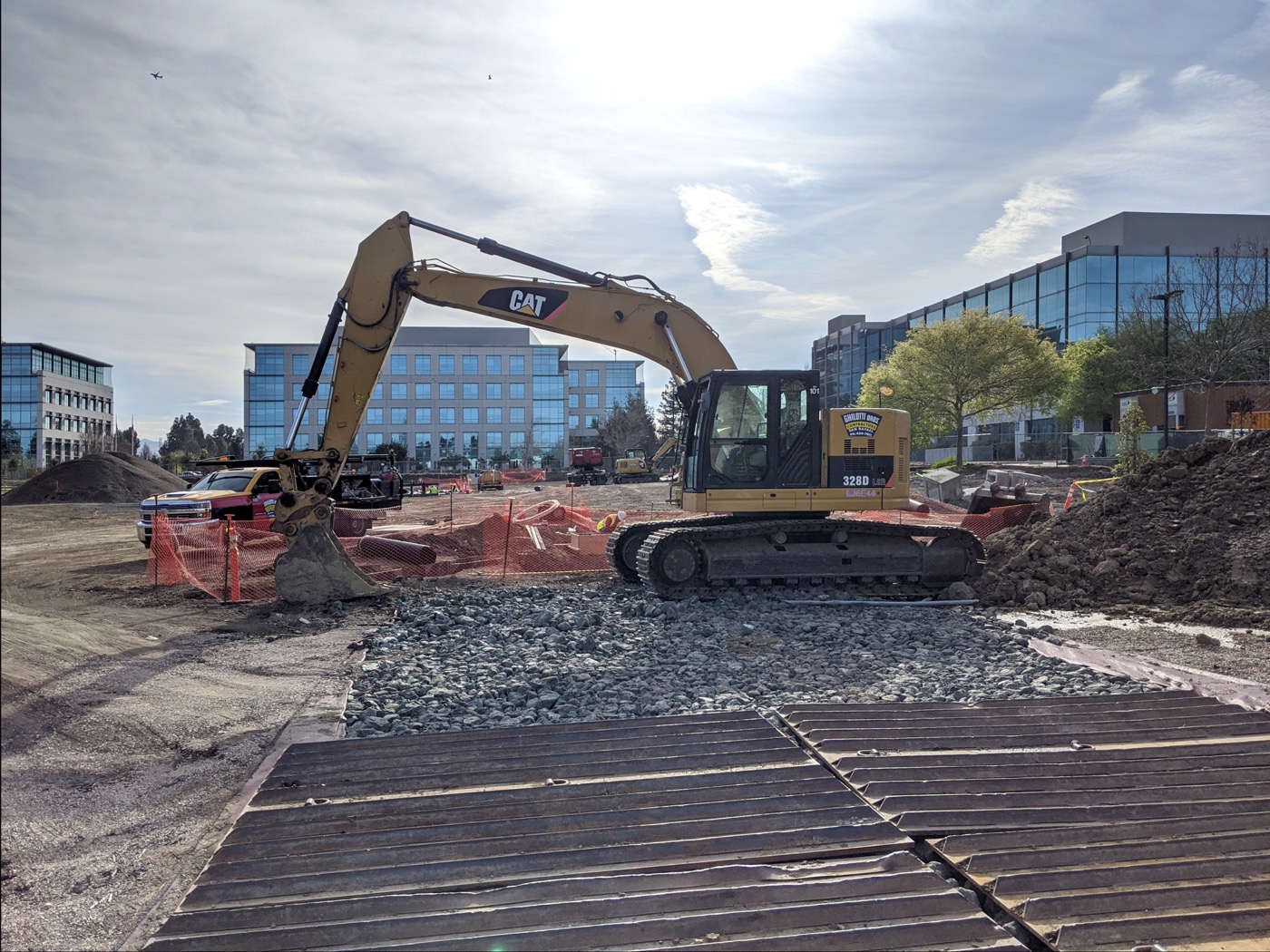
The valley is in a near-permanent build cycle, data centers, chip-fab shells, and ground-up office campuses rising along Kifer Road, Borregas Avenue, and the airport corridor in north Santa Clara. Those crews work long days in the open before the building is even closed in, and a towable trailer drops straight onto the graded pad where they pour concrete, set steel, and trench utilities.
Municipal, emergency & cooling-center use
Whether it’s public works crews, a parks-and-rec event, or the city’s response to a heat wave or wildfire smoke, all of it leaves people out in the sun or breathing bad air. Should a PSPS shutoff cut pump-fed water, or a smoke event stand up a cooling center inside a community building, we can roll potable-water trailers to shelters and staging zones on short notice. That keeps responders and neighbors from scraping by on a thin pallet of bottles.
City water, sent through three stages and a UV chamber, then chilled
Taste decides whether a station gets used or ignored, and an ignored station is just expensive yard furniture. That’s the reason we don’t pour straight tap water. The supply moves through four treatment steps and a UV chamber, then an onboard chiller takes the temperature down, so even on the hottest valley afternoon the pour reads clean and genuinely cold.
Sediment first
Step one catches grit, scale, and suspended solids early, before they reach the rest of the system. The payoff is water that looks clear at the nozzle even when the rig is sitting on a dust-blown graded pad off Kifer Road.
Activated carbon
A carbon bed comes next, pulling the chlorine edge and any stale taste out of the water for a clean, neutral pour. On a sweltering launch day, flavor is exactly what decides whether an employee keeps refilling or quietly skips it.
Micro-particulate
A dedicated polishing cartridge traps the microscopic particles still riding the water, so every fill stays safe for a fab tech mid-shift, a festival guest, or a neighbor topping off a jug during an outage.
UV finish
A UV lamp closes it out, knocking down bacteria and microbes with nothing chemical added, which keeps the water trustworthy through a long stretch parked at a far-flung staging area.
Three ways to fill, with ADA built into the panel
Adjustable nozzles drive the four push-back positions: press your bottle against the bar and water runs, with your hands mostly free. We mount one of those positions at a height a wheelchair user can reach, so accessibility is part of the design rather than an add-on. A large-jug outlet sits at the back for five-gallon coolers and hydration packs, with a row of hose-bib taps for wash water, event needs, and cleanup. Food-grade stainless lines the whole water path, so whatever got filtered and chilled is what reaches the cup.
Every Signature trailer banks 300 gallons, roughly 2,400 sixteen-ounce pours, and our crews top it off on demand as the draw climbs. That stops the rig from becoming the choke point even on a flat-out shift or a packed Saturday festival along Murphy Avenue.
We haul it in, charge the tank, and wire it up, usually pouring cold inside the hour
You carry none of this. Placement, the fresh-water load, the hookup, all of it is on us, and we run your Sunnyvale crew or event staff through the unit before the truck leaves the site.
Send four quick details
Your crowd or crew size, the rental window, the precise parking spot, and the power on hand. With that, we size the rig right on the first pass.
We dispatch to your site
Figure roughly 45 minutes from dispatch to anywhere in the South Bay, and count on round-the-clock routes whenever a heat stretch, smoke event, or shutoff lands.
We level and connect
The trailer gets leveled, its 300-gallon tank loaded, and the power tied into whatever the site offers, be it standard 120-volt circuits or a single 50-amp 240-volt drop.
We keep the tank charged
Refills run on a cadence set by your draw-down speed, and we service the unit straight through the rental from first day to last.
A raw data-center pad or a sealed-off festival lot with no power? We note it right in the quote. The rig pulls little power, and paired with our service fleet, we’ve kept stations flowing at Santa Clara County sites that had no permanent hookup at all. Tell us what the lot gives you and the plan gets shaped around it.
For a California outdoor crew, cool drinking water on site is a written legal duty
On Sunnyvale’s inland valley floor, summer afternoons run through the 80s and 90s and crack 100 in a heat wave, hotter than the cooler coast just over the hills. One of the few binding outdoor-heat rules in the nation is California’s, the Cal/OSHA Heat Illness Prevention standard, codified at Title 8 Section 3395. It obligates an employer to provide outdoor workers fresh, pure, suitably cool drinking water at no charge, kept in enough volume for a quart per worker each hour over an eight-hour shift. Work that out against a long slab pour or a day setting steel and the volume you have to stage gets serious fast.
Set temperatures sharpen the rule, and any Sunnyvale super should have them memorized. At 80°F shade becomes mandatory, and at 95°F the high-heat procedures take effect, a line valley builds cross again and again through July and August. On the water side, a trailer turns that duty into something concrete. Think of it as a charted, fixed cold-water feed on tap, the backbone of any workable Heat Illness Prevention Plan and the very thing a Cal/OSHA reviewer hunts for on a site walk.
- Cool, potable, fresh water kept within an easy walk of the work face
- A quart per worker each hour at the floor, matching the §3395 benchmark
- Shade triggered at 80°F, high-heat steps at 95°F, routine numbers on a valley build
- One charted hydration point you can document straight into the prevention plan
A city where the launch calendar and the build clock both run hot
For most towns, hydration is a question of summer comfort. Sunnyvale runs a busier version of the problem, and it colors the way we approach every job in the valley.
This city’s water demand stays unpredictable for two reasons. Reason one is the events calendar: an outdoor company all-hands on a Moffett Park campus can drop thousands of people onto a lawn with a week’s warning, and on summer weekends the city’s own festivals crowd Murphy Avenue. Reason two is the build cycle, which hardly ever lets up. Along Kifer Road, Borregas Avenue, and the airport corridor in north Santa Clara, data centers, semiconductor fab shells, and ground-up office campuses keep rising, and those crews labor in open sun well before a wall exists to duck behind. Should a heat advisory hit mid-pour, the water plan has to grow that same day, not the next week.
Layered on top is the wildfire-smoke and PSPS reality California has added over the past decade. Most autumns now bring public-safety power shutoffs, and when the grid drops, pump-fed water systems can drop with it. Smoke drifting in from fires far outside the county still upends schedules and triggers cooling centers. For precisely that gap, the day the usual supply has vanished, a self-contained trailer hauling its own 300 gallons and recharging off our trucks is the right tool.
The hard part of planning here is that demand is scattered and seldom scheduled. You can forecast a July heat day on a build pad. You cannot forecast a power shutoff that kills a campus’s water at 7 p.m. That’s why our dispatch stays loose, ready to stage trailers at event grounds, cooling centers, and staging zones with little warning, and to pre-position spare water trucks once red-flag conditions get called for the hills overlooking the valley.
From the start of running event and jobsite hydration across the South Bay, we pegged refill schedules to real draw instead of a fixed calendar, and emergency drops got baked into how we operate. In a valley this packed, a hydration gap during a heat wave or smoke event is no mere slow-down. It separates a crew that finishes the pour safely from an overheated worker bound for urgent care, or a cooling center with enough water from one that runs dry on the neighbors counting on it.
Outdoor crowds under a hot valley sky
Sunnyvale organizers treat heat the way coastal towns treat fog, as the thing you plan around. A wedding on a Sunnyvale Community Center lawn, a Murphy Avenue street fair, a charity run looping Las Palmas Park, a corporate retreat at a Moffett Park campus: for each one we set a self-contained rig that pours steady cold water at tidy refill points. The single-use-plastic routine drops away too, so there’s nothing to truck in by the pallet, no coolers to ice, no empties to clear at strike.
On a sprawling footprint we’ll spread a handful of units so nobody hikes for a fill, and the drop-off and pickup get timed to your run-of-show. We learned this the hard way at a South Bay tech-campus field day: by early afternoon a single trailer by the main tent had a line twenty-plus deep, because heat plus a few thousand badges stacks up fast. The next year we positioned three across the grounds and the bottlenecks were gone. The guest leaves feeling taken care of. Your operations lead, meanwhile, gets to scratch one liability off the day.
Behind the station: the trucks keeping a Sunnyvale site stocked
The trailer draws all the attention. Easy to miss is the fleet propping it up: tankers running fresh supply out, reserve held on the property, and wastewater carried off. Because one number governs all of it, the full cycle closes without you chasing three vendors across three invoices.
Potable water trucks
Our tankers haul drinking-grade water to the job and refill that 300-gallon tank as fast as the draw burns it down. Those same trucks charge cisterns, on-site tanks, and bladders any time one drop won’t keep pace, picture a festival gate slammed on Murphy Avenue or a foundation pour near the airport.
Bladder bags & buffer
For the peak hours, collapsible bladders hold a reserve of fresh water, which earns its keep on a remote data-center pad or a sealed-off event lot a tanker can’t reach every hour. Plain gear, but it’s what bridges the gap between scheduled fills on a far-out Santa Clara County site.
Pump trucks
Need water to climb to a difficult spot? A pump truck charges storage tanks and moves supply across a wide footprint. On a sprawling campus or a fenced build where the unit parks well off the source, it pays for itself fast.
Vacuum & waste trucks
Should greywater or wastewater build up, a vacuum truck draws it off and runs it to a permitted facility, closing the cycle the proper way. The destination of that used water is our problem to manage, not your Sunnyvale crew’s. It has been bundled into the package from the very start.
It all locks together. A bare build pad might want a station, a buffer bladder, and scheduled fills; a busy Murphy Avenue weekend might want a pump truck running through the festival plus a waste pull at teardown. Lay out what your project looks like and we build the right combination for it, all under one contact, one invoice, and a crew that’s already familiar with the property.
The handful of answers that let us size your rental right
Two minutes on the phone is enough to get you an accurate quote. The questions we’ll run through are listed below, so you can have the answers ready and see how each job gets tailored rather than everyone getting the same default rig.
The four answers that shape what we send
- How many people? A 15-person trenching crew off Kifer Road is nothing like a 4,000-badge campus all-hands. That headcount sets how many trailers go out and how aggressively the refill cadence runs.
- For how long? Servicing differs across a two-day festival, a three-week concrete sequence, and a data-center build stretching most of a year. Brief gigs lean on buffered reserve; long ones lean on tanker visits we schedule.
- Where does it park? A campus quad, a graded pad, a fenced yard, or a downtown plaza all suit the towable Signature. Give us the exact placement, plus how our truck slips past gates and tight valley side streets, and we’ll set it where the foot traffic really is.
- What’s the power? A few ordinary 120-volt circuits run the unit, or a single 50-amp 240-volt drop does it. Bare build pads and fenced event lots routinely have no permanent power, which is completely workable. Just flag it up front so we can plan for it.
The extras that help us dial it in
- Where you’d like the unit, and the route a truck takes to reach it
- Whether your people sit spread across the property or bunched at one face
- Any heat-illness documentation your safety plan needs this station to support
- Whether the order should fold in bulk delivery, bladder reserve, or a waste pull
The costs a pallet of bottled water keeps off the invoice
On paper, bottled water reads cheap. The expense actually lives in four places the case price never shows, labor, storage, warm-up, and disposal, and on a hot inland Sunnyvale job each one runs heavier than you’d guess.
The labor that never makes the budget
Trace the chain end to end. A person places the case order, signs for the pallets, breaks them down, ices the coolers before dawn, refills them all day, then sacks the empties at quitting time. Across a sizable crew, that’s paid time quietly leaking out of the schedule, day after day. The trailer wipes out the chore. A Sunnyvale GC penciled it out with us and the hours he’d recover paid for the rig on their own; he hadn’t realized the bottle handling was eating close to a full day of somebody’s week. Ours arrives full, recharges off our own trucks, and asks nothing of your super but a place to park.
The warm-up problem
Ice a cooler at dawn and a 97-degree Sunnyvale afternoon turns it lukewarm well before the lunch break. Crews then stop drinking right as heat strain climbs, which is the worst possible moment to lose them. The trailer’s chiller never lets that happen. A 5 p.m. fill pours as cold as the 6 a.m. one, and a tired crew leans on that cold water hardest at clock-out, not at the morning huddle.
The footprint and storage hit
Where do hundreds of cases even go? They swallow your staging room, jam the laydown areas, and cook in the sun until somebody finally rips into them. Empties then collect faster than anyone hauls them off, and on a squeezed downtown Sunnyvale parcel or a wall-to-wall festival field, that clutter becomes its own problem. The trailer settles into a single parking space and quietly carries a crowd that would have torn through case after case.
The disposal that follows you home
Each bottle you buy is one more thing to dispose of, and a busy season racks up a startling heap. Factor in the haul-away charge, the ding to a project’s sustainability scorecard, and the reality that in a valley full of zero-waste pledges this is exactly the footprint a review will flag. Move that crew onto a refill station and the line item disappears, leaving a sustainability number you’d actually want on the page.
Cold water staged across Sunnyvale and the wider South Bay
Beyond Sunnyvale itself, our dispatch reaches the cities crowded around it, north to Mountain View and Moffett Park, east to Santa Clara and Levi’s Stadium, south to Cupertino and the De Anza corridor, and across the rest of Santa Clara County. Anywhere in the South Bay falls within our delivery range. The same goes whether you’re running a Historic Downtown event near Murphy Avenue, an office build off Lawrence Expressway, a campus all-hands at Moffett Park, or a graded pad by the airport.
Lawrence ExpresswayLas PalmasOrtega
Heritage DistrictBirdlandCherry Chase
Mountain ViewSanta ClaraCupertino
Los AltosMilpitasCampbell
San JosePalo AltoSaratoga
Working a corridor rather than one address? We run the arteries the valley moves on, Highway 101, Highway 237, Lawrence Expressway, and the Central and Mary corridors, so campus-wide and multi-site projects see the same quick turnaround as a downtown job.
The questions South Bay crews and event teams actually put to us
How soon can a water station reach my Sunnyvale site?
Figure about 45 minutes from dispatch on a typical South Bay run, and through heat advisories, smoke events, or shutoffs we deliver any hour, day or night. Hit a blistering morning with no cold water and a crew can usually be pouring by midday. Gate access, valley traffic on the 101 and 237, and the power on hand are what shift the timing, so pass along the site details and we’ll route around them.
Is the water chilled, or just filtered?
Both, which is the entire point. The onboard chiller keeps the supply cold start to finish, opening pour to closing fill, even as the trailer bakes in open valley sun. People walk past warm water, and water nobody touches does nothing to ward off heat illness, so we treat that chiller as safety gear rather than a perk.
Can you cover a power shutoff or a smoke event?
Yes, and it’s a major reason South Bay clients keep our number close. On short notice we can position potable-water trailers at staging areas, cooling centers, and shelters, and stage spare water trucks ahead of red-flag conditions in the hills. Once a PSPS event knocks out the grid, having drinking water that runs without leaning on local pumps makes a real difference.
How much does the tank hold, and what if it empties?
Each Signature banks 300 gallons, about 2,400 sixteen-ounce fills. On a heavy crew or a packed festival day, the trucks top it off at a cadence matched to your draw, so the tank size never caps you. Watching the refill schedule falls to us, not you.
Will a station back our Cal/OSHA heat-illness requirement?
Directly. Under the Cal/OSHA Heat Illness Prevention standard, Title 8 §3395, outdoor workers must get fresh, suitably cool, free drinking water, a quart per person every hour at minimum, plus shade by 80°F and high-heat steps once it hits 95°F. With a trailer, your plan gains a charted, fixed cold-water source an inspector can be walked right up to. Authoring the safety program stays on your side; providing the hydration underneath it stays on ours.
Is the station ADA accessible?
Yes. Every trailer carries four push-back filling points, with one positioned at an ADA-reachable height, so a single station serves everyone on a Sunnyvale site and no second rig is needed. A rear large-jug spout handles five-gallon coolers and personal packs; hose-bib outlets take wash-up and crew tasks.
Can you cover tech-campus events along with construction sites?
Both, with events making up roughly half our valley work. Whether the day is a Moffett Park all-hands, a Murphy Avenue festival, a 5K, or a slab pour off Kifer Road, we position one unit or several over the footprint and match delivery and strike to your timeline. People draw reliable cold water at neat fill points, and the cost and trash of trucking in endless pallets goes away.
What do you need from us to set it up?
Four answers handle it: headcount, the rental length, the parking spot on site, and the power available. The Signature connects to one-to-three standard 120-volt circuits, or a lone 50-amp 240-volt drop. Bare pad or fenced lot with no power? Mention it on the call and a workaround goes into the quote.
Is it Sunnyvale only, or the whole South Bay?
The full region. Dispatch reaches Sunnyvale along with Mountain View, Santa Clara, Cupertino, Los Altos, Milpitas, Campbell, San Jose, and the rest of Santa Clara County. Corridor jobs strung along Highway 101, Highway 237, and Lawrence Expressway are everyday work for our trucks.
Is the taste on par with bottled?
Crisp and neutral, without the chlorine bite you can catch off a Bay Area tap. The carbon stage pulls out chlorine and any off-flavors, so each fill reads fresh rather than warm and hose-like. It’s no minor detail: a station gets used only when people enjoy how it tastes, which is exactly why flavor lives inside our safety equation.
How big a crowd can one station handle?
More than you’d expect, since the genuine limit is how often we refill, not the count of taps. With four fill points moving a crew or a crowd along, the 300-gallon tank covers roughly 2,400 sixteen-ounce pours before a top-off. As the draw spikes, the tanker comes more often or a second trailer joins, so capacity grows with your numbers rather than capping them. Name your peak hour and the volume gets planned to it.
Trusted by the valley teams that can’t let a crowd or a crew go dry
“We had a slab pour scheduled the same week a heat advisory hit, and our cooler plan was hopeless by 9 a.m. They had a chilled station on the pad that afternoon, water cold through the swing shift. It’s on every pour schedule now.”
“For our summer all-hands on the campus lawn, the refill stations cut our bottled-water order to almost nothing and the lines stayed short in the heat. Delivery and pickup worked around our run-of-show. We rebooked for the fall event on the spot.”
“When a power shutoff cut water at our staging site for two days, they had a trailer on the property within hours and kept the tank charged the whole time. For a crew pushing through an outage, that isn’t a nicety, it’s the job itself.”
Service information current as of June 2026.
Lock in cold, filtered water for your Sunnyvale event or job site, or your next emergency
Send over your headcount or crowd estimate, the dates, and the parking spot. We’ll pair the job with the right setup and dispatch a trailer to anywhere in the South Bay, usually about 45 minutes after we’re rolling.