Temecula Cold Water Station Rentals for Events & Job Sites, Rapid Dispatch
A vineyard wedding off De Portola Road or a framing crew on a Murrieta Hot Springs subdivision both run into the same wall by mid-afternoon: warm bottled water that nobody wants to drink. We tow in a self-contained drinking-water station that pours cold, filtered water and refills itself all day long, so a Wine Country crowd stays comfortable and an inland-valley crew stays safe while your day keeps moving.
- ~45-minute valley-wide delivery
- Cold, four-stage-filtered water
- ADA bottle filling
- Cal/OSHA heat-illness ready
- Licensed & insured
- Rapid emergency dispatch
Chilled, filtered drinking water for Temecula events and worksites, kept full all day
We stage mobile water stations across Temecula and the southwest corner of Riverside County, covering both the Saturday winery wedding and the six-month tract build off Winchester Road, and we keep the trailer topped off the whole rental. Temecula is a two-market town. Half of what we run is events, because Wine Country has become one of Southern California’s busiest wedding and festival destinations. The other half is the construction boom that keeps spreading north and east off the I-15. Both markets ask us the same questions on the first call: how soon can a unit get here, will the water still be cold when guests or crews need it most, and who handles refills when 300 gallons starts running low on a hot June afternoon. We answer all three the same way every time.
Quick delivery across the valley
Most Temecula-area drops land inside roughly 45 minutes from dispatch, and we run emergency runs day or night through a heat spell. When a wedding planner realizes the day before that 220 guests have nothing but a few cases of warm water, quick turnaround is the whole job.
Water that stays genuinely cold
Each unit chills its own water on board, which means the final pour at a sunset reception comes out just as cold as the one served back at the ceremony hours earlier. Lukewarm water is water people leave sitting, and water nobody drinks does nothing for comfort or for a heat-exposed crew. In a dry 100-degree valley that gap matters.
Dropped, serviced, refilled, hauled
No separate bottled-water vendor, ice supplier, and hauler to coordinate. We set the station, refill it off our own trucks, service it through the rental, and tow it away when you’re finished. A single point of contact runs the entire hydration loop on your Temecula site.
This is what I tell every first-time caller. A hydration setup that guests or crews skip is the same as having none at all. I’ve watched a stack of warm bottled cases sweat by a vineyard gate while wedding guests drifted off to find shade, and I’ve watched a chilled station parked ten steps from a Temecula framing crew get drained twice before lunch. The distance between those two scenes is the entire reason we exist. So our trucks don’t just spot a trailer and leave. We size it to your headcount, set the refill rhythm to how fast you actually pull water, and treat an emergency heat call the way you’d want it treated. Out here, one bad afternoon decides whether an event ends in good reviews or a crew shift ends at the Temecula Valley Hospital ER.
One road-towable trailer that handles a Wine Country wedding and a hot tract build alike
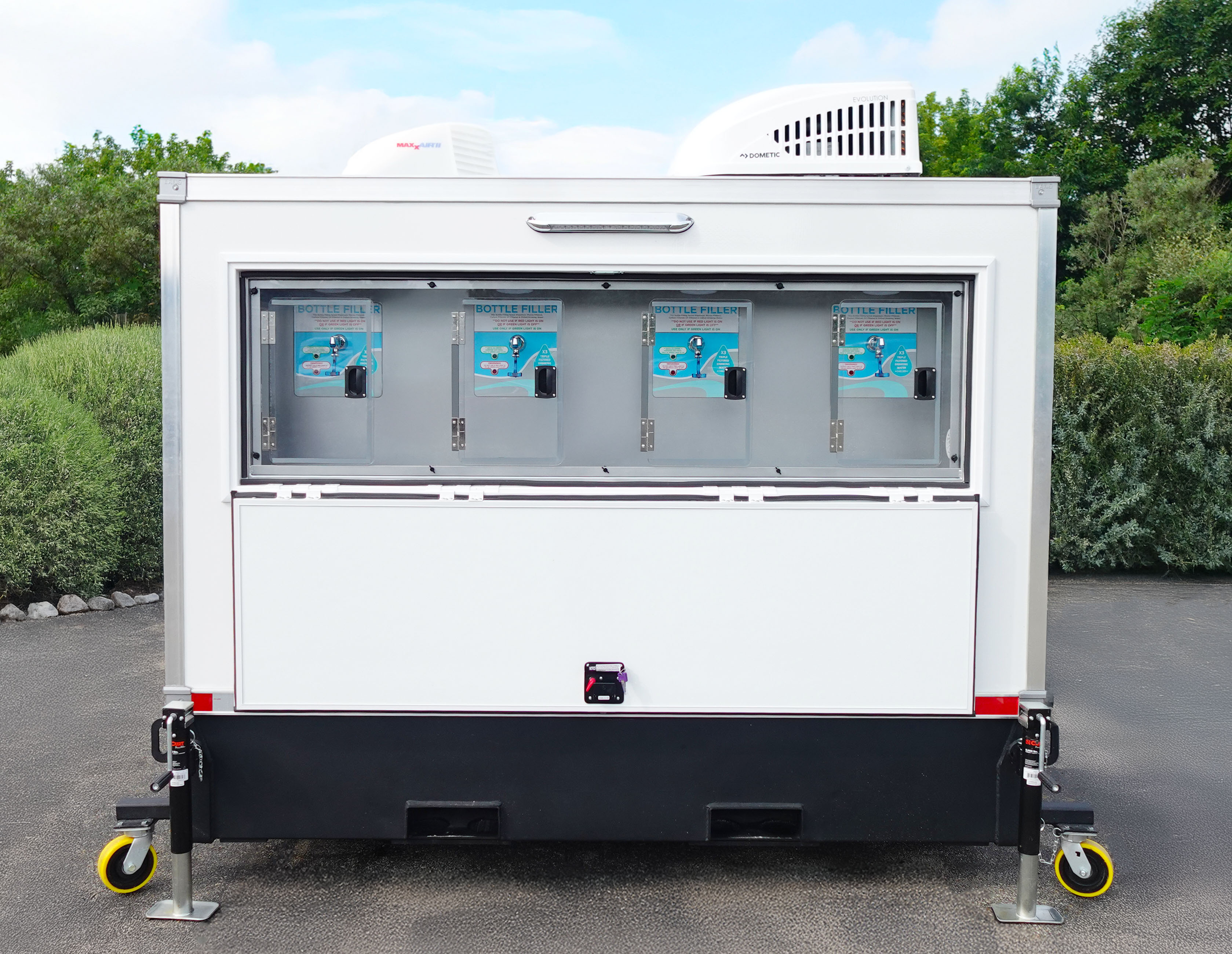
One purpose-built rig handles the whole valley for us: the Signature Series water station trailer. Because it rides on a full road chassis, we tow it right to wherever the day is happening, a vineyard lawn on Rancho California Road, a graded pad off French Valley, a festival field at Lake Skinner. Nothing to assemble, no fixed plumbing to lay, just cold filtered water on tap the same afternoon it arrives.
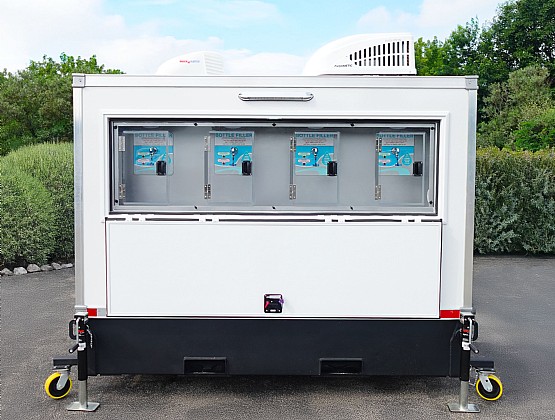
Signature Series specifications
It sits on a genuine highway-rated chassis, tires and hitch and all, which means we can back it onto a graded pad, into a vineyard, alongside an event field, or into an emergency staging yard. Planners and contractors around Temecula ask for this exact rig by name. We can spot it, level the jacks, and have it pouring the day it arrives.
| No. of stations | (4) Bottle Filling Stations |
| Length | 12′ 3″ |
| Weight | 3,100 lbs. |
| Height | 8′ |
| Fresh water tank | 300 Gallons |
| Power requirements | 1–4 dedicated 20A/120V circuits OR 1 dedicated 50A/240V circuit |
| No. of AC units | 1 |
Why this rig fits the Temecula Valley
This rig was built around two Temecula realities: long hot afternoons and sites that sprawl. Four push-back taps line one exterior wall under a shade awning, so 200 wedding guests at a cocktail hour or a full grading crew at a water break move through quickly rather than queuing at a single nozzle. The onboard AC and chillers keep pulling the supply cold while the trailer itself sits in direct valley sun all afternoon, which is precisely the step coolers and pallet plans fall down on once the bench warms up past 100.
That 300-gallon reservoir keeps a sizeable group served for hours, and since the whole rig tows, we can shift it across a wide site or move it to the next phase with nothing to demolish. Its power appetite is flexible enough that one trailer handles a finished venue on the De Portola Wine Trail just as readily as a raw graded lot toward French Valley, where we arrange the power ourselves.
The four front taps are only the headline. There’s also a rear spout for five-gallon coolers and personal packs, plus several hose-bib outlets that handle crew chores, vineyard work, and event support. A single trailer ends up covering the whole hydration picture for a Temecula event or jobsite. A single rig has covered a morning vineyard wedding setup near Glen Oak and an evening grading crew on the same day without us trailering a second piece of equipment out. We have also run one unit through a Pechanga-area event load-in and a Murrieta subdivision pour in the same week.
Why one station outruns ordering bottled water all season
Take a 220-guest Temecula winery wedding on a 98-degree June Saturday. At four or five drinks a head across the afternoon and evening, you’re buying, hauling, icing, and trashing close to a thousand single-use bottles for one event, and your caterer’s crew spends the night chasing empties instead of clearing tables.
Now flip to the build side: a 40-person crew on a 200-day French Valley tract. At roughly five bottles a head on a hot day, that’s around 200 daily, north of 40,000 across the job, and the larger multi-phase tracts climbing toward Menifee run well past 70,000. A single station replaces that entire flow, cold water straight from the tap, zero cases to truck in and zero empties to truck out.
It’s a logistics call before it’s a green one
The waste angle is real. The country throws away tens of millions of water bottles a day, only a sliver gets recycled, and a single bottle can sit in a Riverside County landfill for generations. That belongs in your venue’s sustainability story or your project’s ESG report. But most Temecula clients switch for a plainer reason: a shared trailer wipes out the daily scramble. No standing bottled-water order. No cooler gone warm by 11 a.m. No wall of empties cooking by the gate. Your event captain runs the floor and your superintendent runs the build, instead of both babysitting water.
Supply grows with the day too, since our own potable tankers keep the station charged. If the RSVP list jumps or a crew doubles up for a slab pour, demand can’t outrun us. Another truck rolls out and the tank goes back to full.
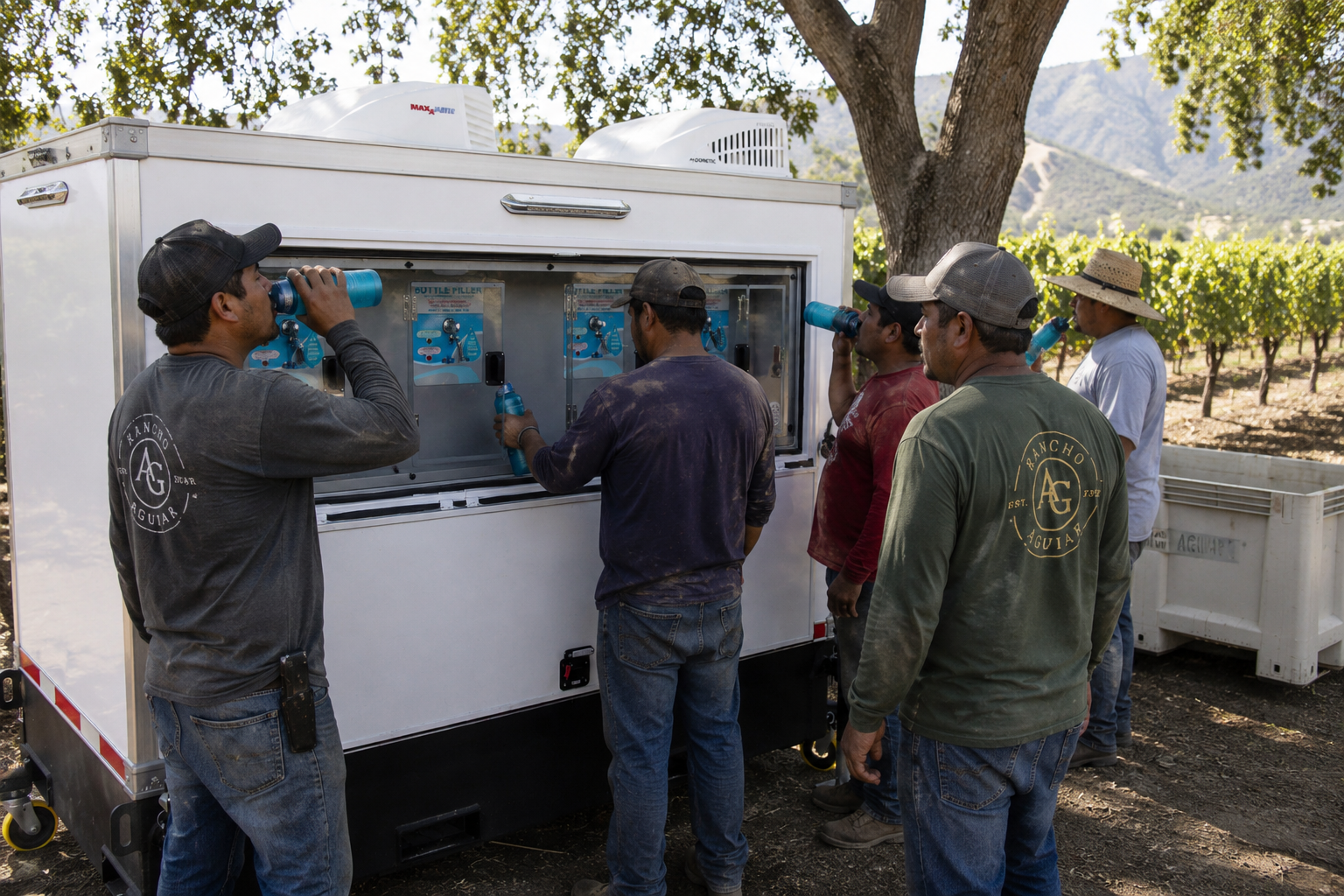
Hydration built around the way Temecula actually fills its calendar
Temecula doesn’t have one hydration job, it has several at once. A 250-guest vineyard wedding needs one setup, the Balloon & Wine Festival crowd at Lake Skinner needs another, and a summer grading crew off Date Street needs a third. Here’s where these trailers go to work, from the Rancho California Road wineries through Old Town and the Promenade out to the new tracts climbing toward French Valley and Menifee.
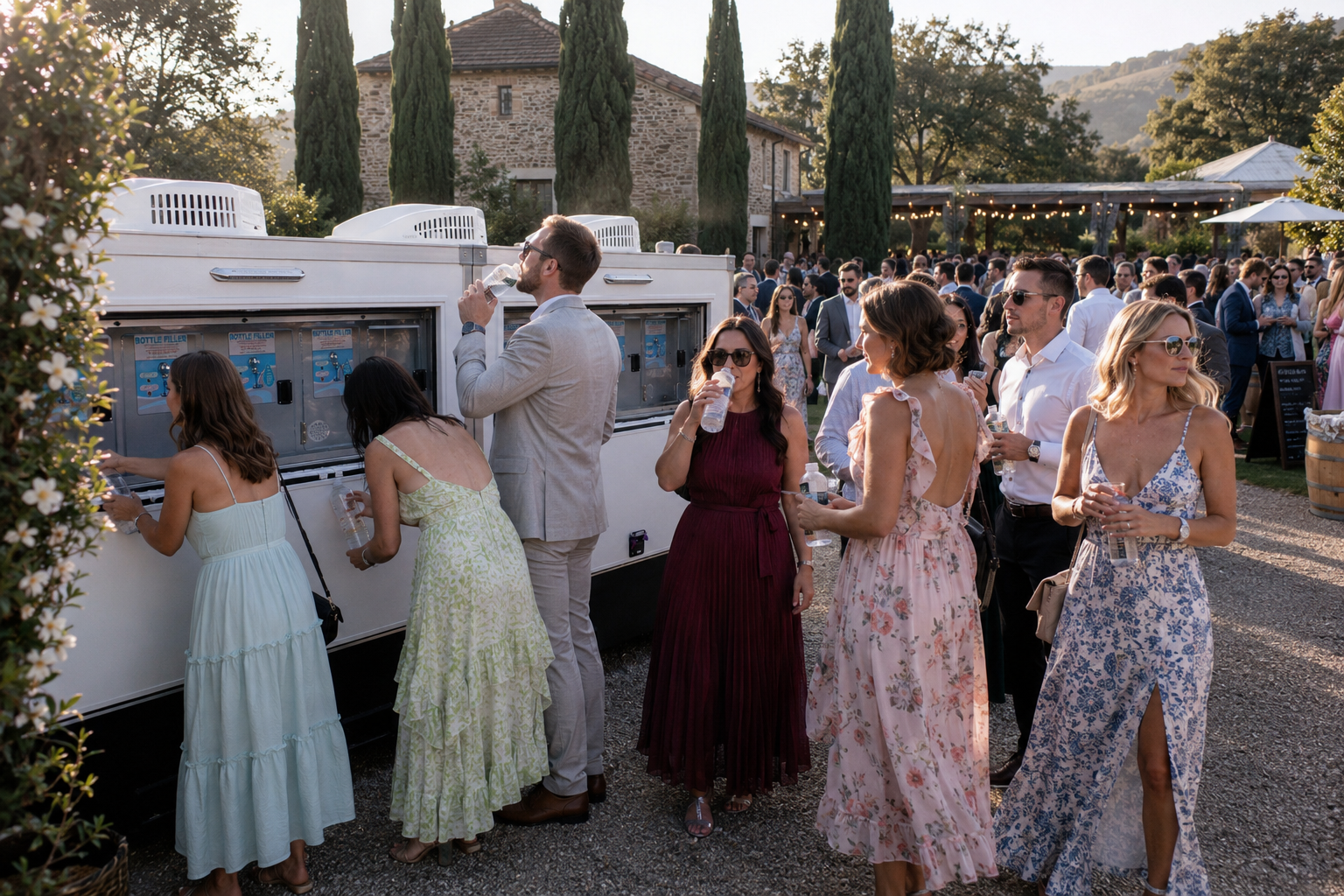
Weddings & winery events
Temecula Wine Country hosts hundreds of weddings a year across venues like Ponte, Wilson Creek, Mount Palomar, and the estates along De Portola and Rancho California Road. A cold-water station gives a sun-exposed ceremony lawn and a long reception steady, good-tasting water without a folding table of warm bottles. Planners love that it reads as hospitality to guests while quietly handling the heat side of the day for the venue.
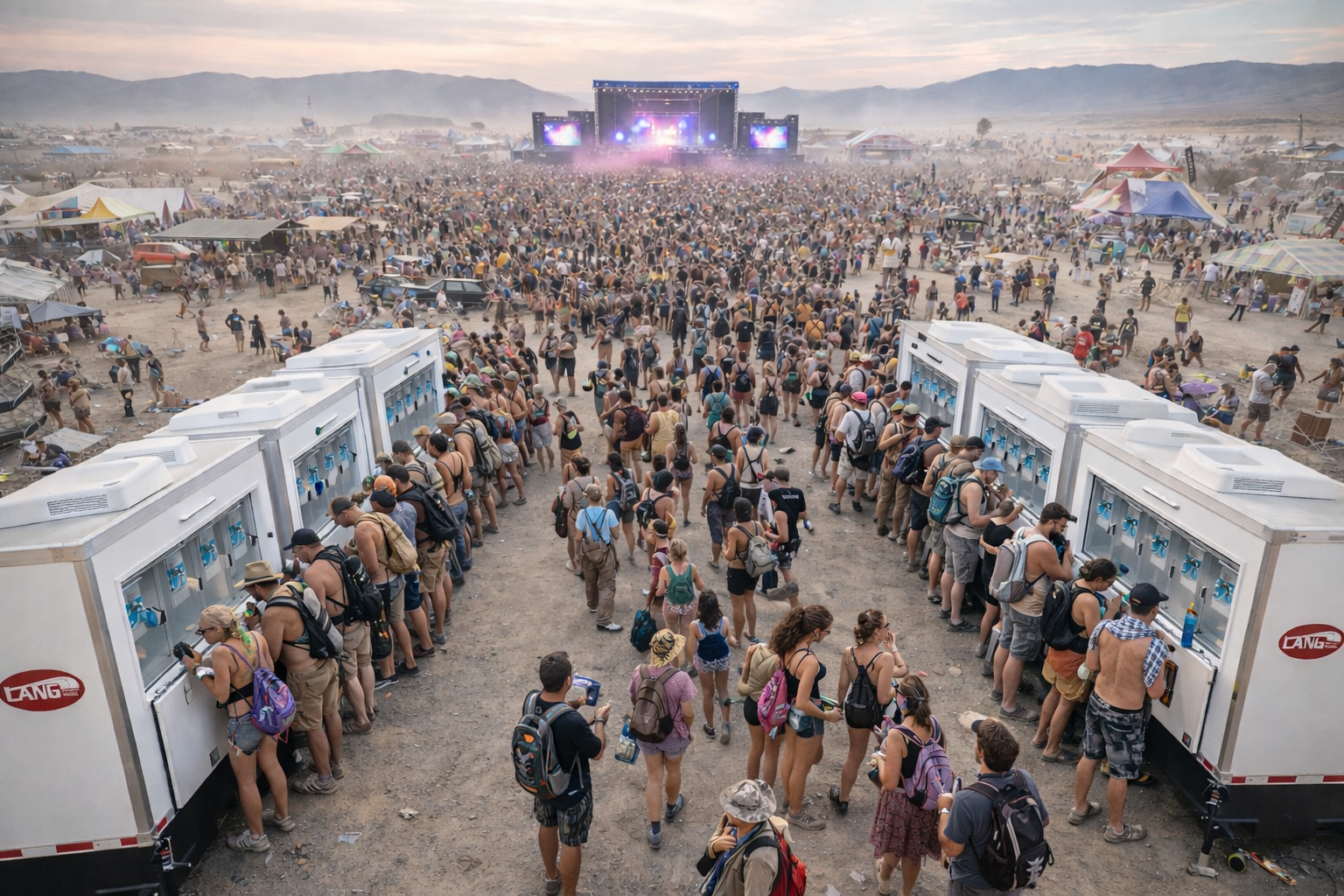
Festivals, fairs & outdoor shows
The Temecula Valley Balloon & Wine Festival at Lake Skinner, the harvest and crush events each fall, Old Town street fairs and car shows, and the concert and rodeo dates out at Galway Downs all pull big crowds into open valley heat. We stage one trailer or several across the grounds so nobody walks far for water, with delivery and teardown timed to the event window and no mountain of single-use plastic to cart in and out.
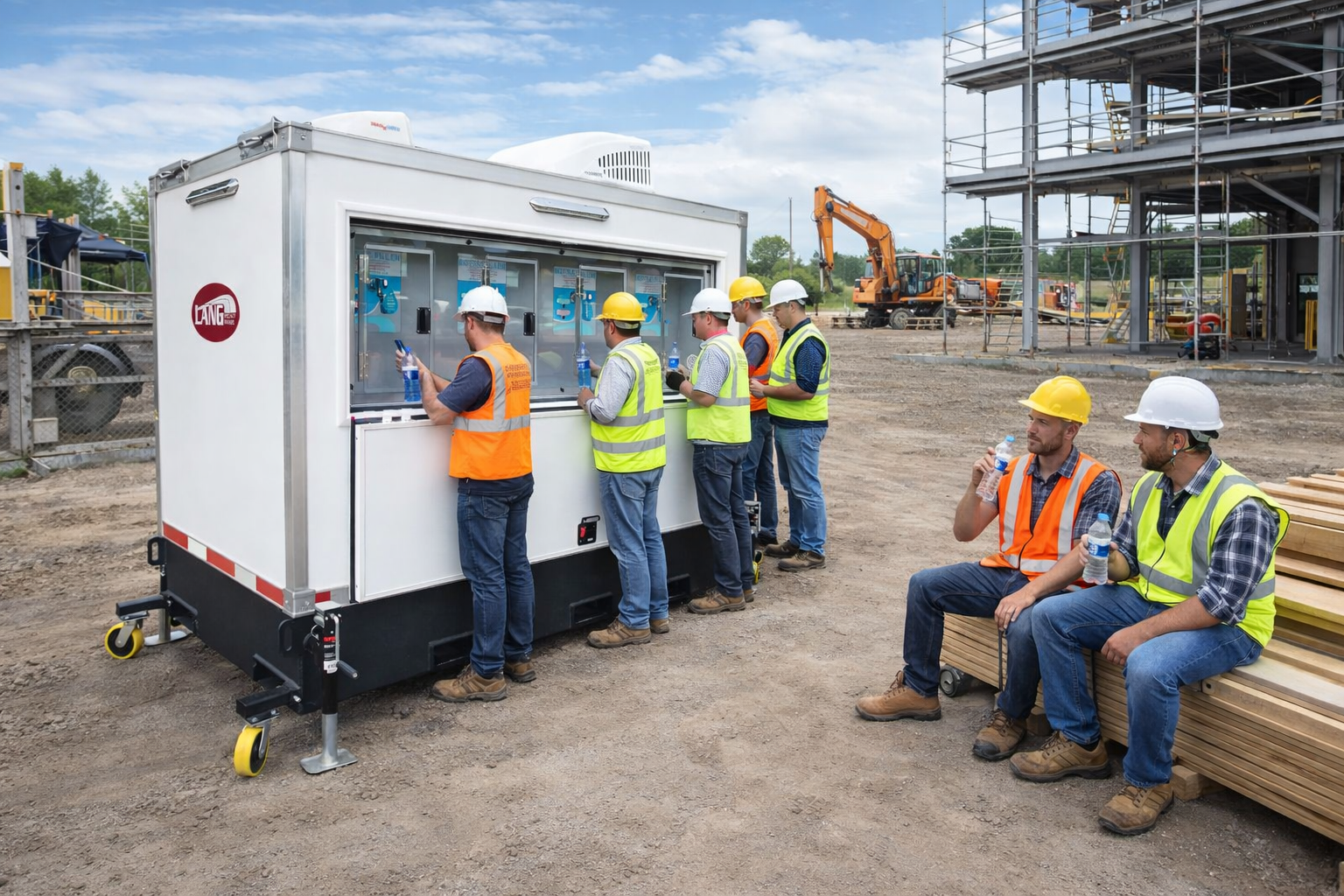
Construction along the I-15 corridor
Southwest Riverside County keeps showing up near the top of California’s homebuilding charts. Rooftops march north through French Valley, Winchester, and the Menifee edge, retail and pad development fills in around Temecula Parkway and the Promenade, and Caltrans and utility crews work the I-15 and I-215 interchanges that knit the valley together. We place stations across those sites so a GC and every framing, grading, or concrete sub on the job has cold water they can point an inspector to, sitting a short walk from the work face instead of back at the gate. On the big tracts that means more than one trailer, spotted as the build moves from grading to vertical.
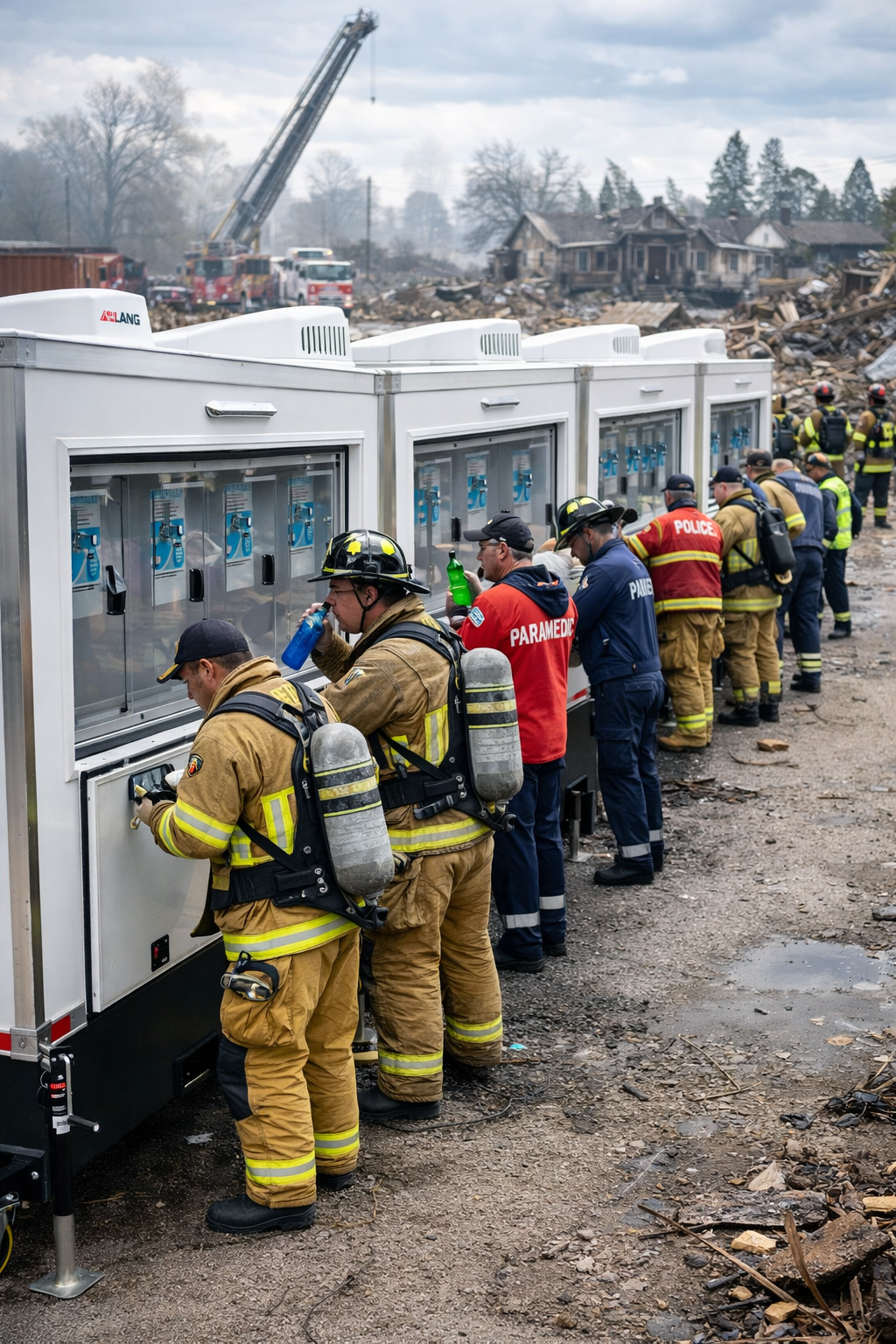
Agriculture, races & emergency response
Vineyard and grove crews on the valley floor, landscaping and solar crews across Murrieta and Wildomar, and the runners at events like the Temecula half marathon all need refill points right where they work. And southwest Riverside County sits in real fire country: when a wildfire or a water-main break hits a Temecula or Murrieta neighborhood, we push potable-water trailers out to base camps, cooling sites, and staging areas on short notice.
Treated through four stages, disinfected, then chilled before it pours
People have to want to drink from the thing, or the rental is wasted. So municipal water goes through four treatment stages and a UV chamber before an onboard chiller takes over. What reaches the tap is clean-tasting and genuinely cold, even on the driest, ugliest Temecula afternoon the year throws at us.
Sediment stage
The first filter catches sand, scale, and fine grit the valley mains can carry, which keeps anything chalky from ever reaching the tap out on a dusty French Valley pad or a vineyard access road.
Carbon stage
Activated carbon strips the chlorine bite and any flat, treated notes the local supply can pick up in summer, leaving a neutral taste. At a wedding that’s the difference between guests refilling and guests reaching for something else.
Micro-particulate stage
A sub-micron filter takes out the fine particles the earlier stages cannot catch, keeping every pour safe whether it’s a wedding guest, a kid at a festival, or a worker refilling on a Temecula site.
UV disinfection
A UV chamber is the last gate, knocking out bacteria and microbes with light rather than chemicals. Even after a long tow out to a back vineyard parcel, what comes through the nozzle is still clean.
Three ways to fill, ADA included
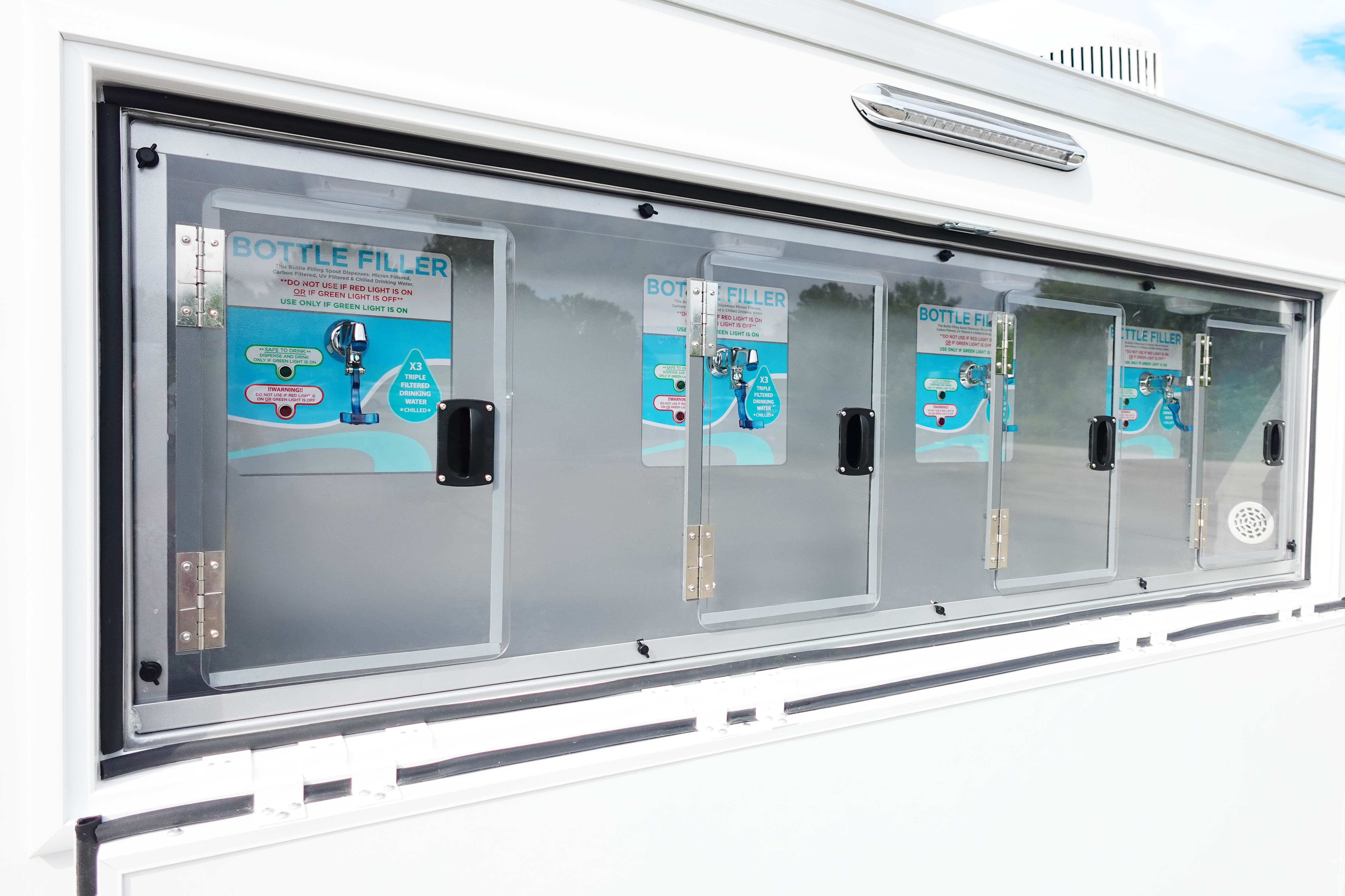
The front panel carries four push-back fill points, each on an adjustable nozzle that starts pouring the instant a bottle presses the bar. One sits at a wheelchair-reachable height, so a Temecula reception or jobsite stays accessible to every guest and worker without a second ADA unit towed out alongside. A separate spout at the rear loads five-gallon coolers and personal hydration packs for catering tables and crew gang boxes, and a set of hose-bib outlets handles the side jobs, rinsing glassware behind a bar, filling a misting line on a ceremony lawn, topping a sprayer for vineyard or landscape work. Everything the water touches on the way out is food-grade or stainless, so the filtered, chilled quality survives all the way to the cup.
A single Signature holds 300 gallons, good for about 2,400 sixteen-ounce pours, and since we refill it on demand, the trailer itself never turns into the bottleneck at a packed reception or a sweltering afternoon shift.
We deliver, fill, and connect it, usually pouring cold water within the hour
You don’t manage any of this. We pick the placement, load the fresh water, and handle the power hookup, then give your Temecula crew or event staff a quick walk-through before we pull off the site.
Tell us the basics
Your guest count or crew size, the rental length, where the trailer should sit on the Temecula site, and the power on hand. With those few details we can spec the right unit on the first pass.
We tow it out
Usually around 45 minutes after dispatch, reaching anywhere in southwest Riverside County, with rapid runs available when a heat advisory hits the valley or an event date moves up.
We set it up
Jacks down, fresh tank filled to its 300 gallons, power wired in off whatever your Temecula venue or lot provides, anywhere from a single 120V circuit up to three of them, or one 50-amp 240V drop.
We keep it pouring
How often our tankers come back to refill depends on how fast your group actually pulls water, and we service the unit for the full length of the rental so it never sits idle or runs dry.
A raw lot or a back vineyard parcel with no power source? That gets called out in the quote. The trailer’s modest draw plus our service fleet has let us keep stations pouring on Temecula sites that had no permanent power whatsoever. Tell us what’s available at the spot and we’ll build the rest around it.
In a Temecula summer, cool water access is a written legal duty, not a courtesy
Temecula sits in an inland valley that regularly stacks 100-degree-plus days through July, August, and September, with low humidity that fools people into underdrinking until they’re already in trouble. The valley floor and the new tracts pushing into open ground run hotter still than the leafy Wine Country bench, so a French Valley grading crew and a shaded vineyard ceremony can face very different afternoons on the same date. Employers here answer to California’s own heat standard, which goes further than the federal rule: Cal/OSHA Title 8 Section 3395, the Heat Illness Prevention standard, requires fresh, pure, suitably cool drinking water provided free and kept as close as practicable to where crews work.
A trailer makes that obligation physical and inspectable. It stands on site as a permanent, mapped source of cold potable water, the kind of anchor a real Heat Illness Prevention Plan is built around, and precisely what a Cal/OSHA inspector or a GC’s safety lead looks for during a Temecula walk-through. With Riverside County among the hotter inland counties in the state, heat documentation gets scrutinized, and a mapped on-site cold-water feed is one of the cleanest line items you can show.
- Continuous access to fresh, suitably cool, potable water near the work face
- Centralized, documentable hydration points for your §3395 records
- Backs up acclimatization schedules and timed water breaks for heat-exposed crews
- Built to meet California’s heat rule today, not scramble after an inspection
What Temecula’s two seasons have taught us about staging water
How we run a job today comes straight out of years spent staging stations at Wine Country venues and valley build sites. A handful of those lessons stuck hard:
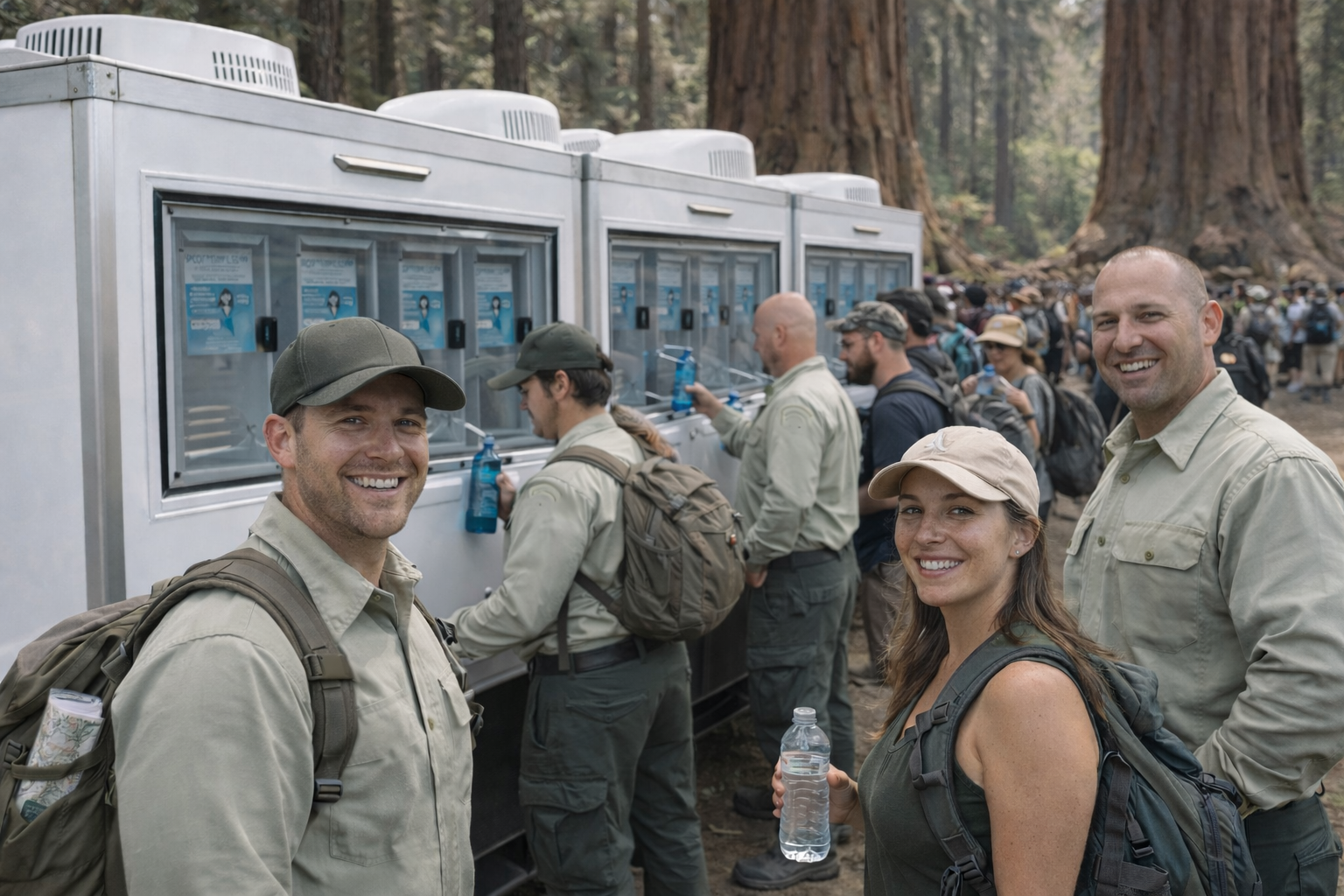
Placement is the lesson Wine Country taught us first. At a Rancho California Road vineyard wedding we tucked the trailer by the catering tent, neat and out of sightlines, and it barely got used, because the ceremony lawn sat a few hundred feet up a slope and guests in heels weren’t walking down for water in 96-degree sun. For the next morning’s event we parked it right at the lawn’s edge near the bar, and consumption doubled before the toasts. Guests will drink when the water is closer than the shade tent and skip it when it isn’t, every single time.
The valley’s diurnal swing also taught us to schedule refills off the forecast, not a fixed calendar. The bench can read a pleasant 78 at 9 a.m. and a brutal 104 by 3 p.m., so a fill cadence set in the cool morning runs short by mid-afternoon. On a late-August stretch we’d pre-staged extra tankers reading the heat curve, so when two Murrieta tracts and a Lake Skinner event all called in the same afternoon, all three stayed full. The safety lead on the bigger build texted that night that we’d topped them off before they ever radioed in. That kind of margin is now baked into every hot-season contract we write in this valley.
And the swap sells itself only once a crew lives it. A French Valley tract super flat out doubted 300 gallons could hold real cold on an exposed dirt pad through a September afternoon, so he kept his bottled-water order running alongside ours as insurance the first week. By the second week he’d cancelled the bottles and added a second trailer for the next phase, telling us the crew had simply stopped asking him for ice runs. In this climate, cold water that genuinely stays cold is the whole pitch, and the rig closes the deal on its own once it’s sitting on the ground.
Each of those jobs drove home the lesson the valley heat already teaches. Hydration in Temecula isn’t a checkbox you tick and walk away from. Whether the people drinking are wedding guests or a grading crew, it’s an ongoing operation, and we treat it that way for every day of the rental.
When the crowd is outdoors and the valley sun won’t quit
Planners here treat heat the way coastal towns treat the marine layer, as the thing the whole day plans around. Whatever the occasion, a Wine Country wedding, an Old Town festival, a charity 5K winding through the vineyards, a corporate retreat at a resort, it gets a self-contained trailer running steady cold water with clean refill points. Your team also skips the truck-in, the ice-down, and the haul-out of a pile of single-use plastic the venue would have to dispose of anyway.
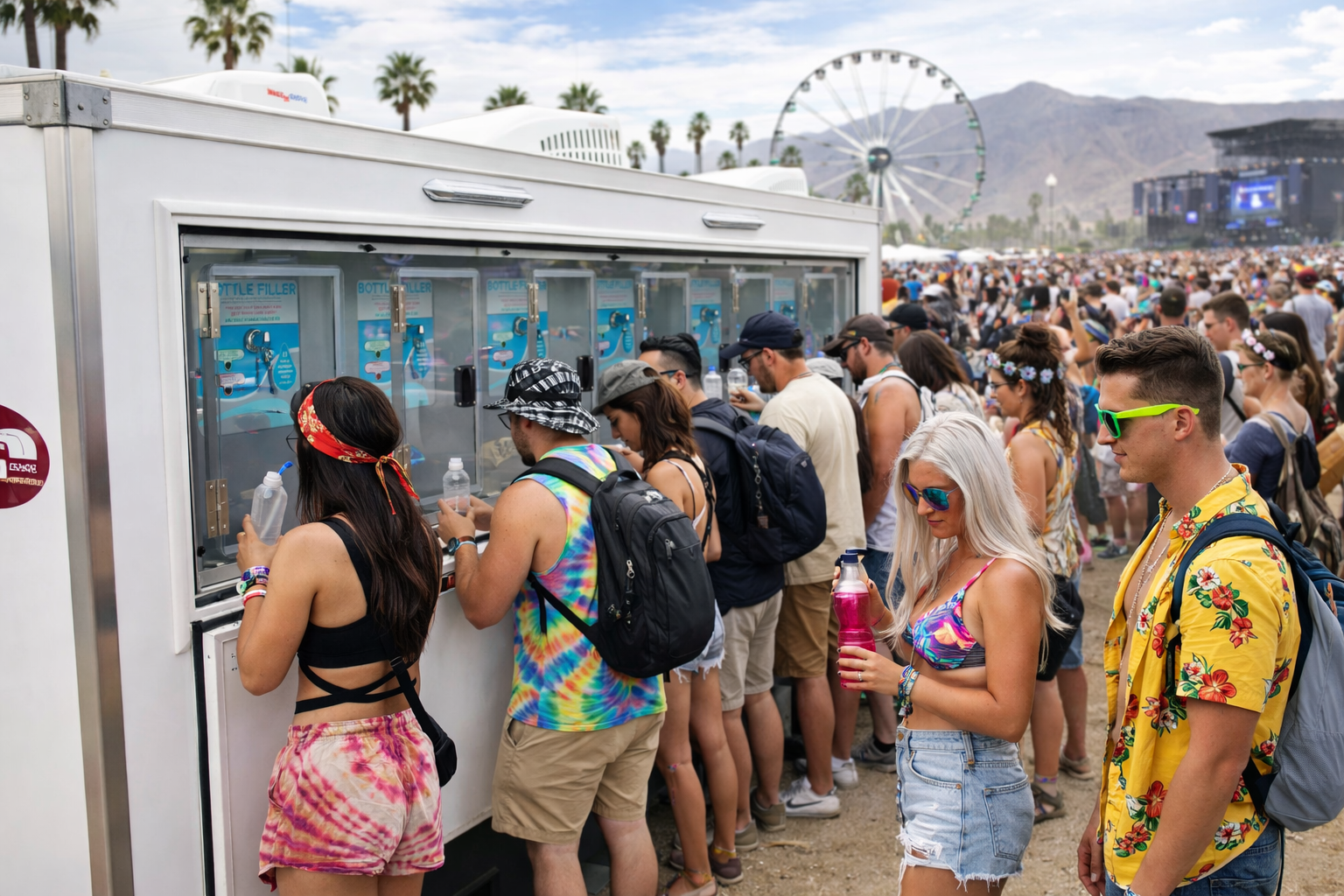
For a sprawling footprint like the Balloon & Wine Festival grounds at Lake Skinner, we’ll position several trailers so nobody hikes across the field for a drink, and we time delivery and pickup to your event window. A valley music event taught us why. We set one unit by the main stage and watched the line hit thirty deep by mid-afternoon (a few thousand people times real heat adds up quick). Next time around we put four across the grounds and the waiting disappeared. Guests read it as hospitality. Your event captain reads it as risk control.
An inland valley that’s hot, dry, and building fast all at once
Coastal Riverside County gets a temperate week. Temecula gets a long, dry inland-valley summer, and both the people getting married here and the people building the place are out in the worst of it.
A typical Temecula year runs dozens of days at or above 100, with stretches in July and August where the valley floor pushes past 105 and the low humidity pulls water out of people faster than they notice. Inland Riverside County is one of the hotter parts of the state, and the dry-heat trap is the dangerous part: a guest or a worker can feel “fine” right up to the moment they don’t, because the sweat evaporates instantly and never registers as thirst. Cold water isn’t a nicety in that climate. For a heat-exposed crew it’s the cheapest safety equipment on the whole site, and for a packed wedding lawn it’s the difference between guests staying and guests leaving early. The state has tightened heat enforcement across these inland counties, and outdoor crews here sit squarely in the risk pool from late spring into October.
The trouble isn’t a single bad day, it’s how many of them line up in a row. Drop down to San Diego an hour west and a contractor can absorb a heat spike with a couple more coolers. Try that across a six-month Temecula summer and it falls apart: too much volume, water warming up too fast, and the grind of ordering, icing, and trashing bottles repeating every workday. Only a centralized, self-chilling trailer holds up across a full inland-valley season without becoming a logistics headache in its own right.
And demand keeps climbing, because southwest Riverside County is in the middle of a sustained build-out. New residential tracts keep filling French Valley, Winchester, and the Menifee and Wildomar edges, much of it on schedules that start at dawn to beat the afternoon. Commercial and retail keep going up around the Promenade Temecula and along Temecula Parkway, Pechanga keeps expanding its resort and event footprint, and road and utility crews work the I-15 and I-215 interchanges that tie the whole region together. Every one of those sites means crews in open inland sun, often for months.
We built our local dispatch around exactly that pattern, plus the event calendar layered on top of it. When we first started staging trailers between the Wine Country venues and the tract builds off Winchester Road, we set refills by group size rather than a fixed calendar and added rapid drops during advisories. Because in this valley a hydration gap doesn’t just slow a build or sour an event, it can send someone to Temecula Valley Hospital, and that’s a line nobody wants on the day.
Past the station: the trucks that keep a Temecula site supplied
The station is the part guests and crews actually see. Behind it runs a support fleet that hauls fresh water in, banks reserve on site, and pulls wastewater back out, which is why one number covers the whole job rather than a winery coordinator or a tract super chasing three separate vendors and three separate invoices.
Potable water trucks
Bulk drinking-grade water moves across the valley on our tankers, which recharge the trailer’s 300-gallon tank as often as your guest count or crew size calls for. When the draw outpaces a single delivery, like a sold-out festival day at Lake Skinner or a slab pour off Date Street, the same trucks also fill cisterns, on-site tanks, and bladder bags.
Bladder bags & buffer supply
When the busy stretches hit, fold-flat bladders bank extra fresh reserve, and they’ll also hold greywater for a while if a Temecula venue or lot has nowhere to drain. They’re the unglamorous piece that keeps a back-vineyard parcel or a distant tract pouring in between tanker runs.
Pump trucks
Got water that has to travel? A pump truck drives it where it needs to be, topping off storage tanks or relaying supply over a wide site. Its value shows on the big French Valley lots and large event grounds where the trailer and the fill point can end up a quarter-mile apart.
Vacuum & waste trucks
A vacuum truck draws greywater and wastewater off the site and runs it to permitted disposal, which matters at a vineyard wedding where there’s often nowhere to legally drain, and on a graded lot with no sewer stub yet. Nobody on a Temecula event or build crew has to figure out where the used water ends up. We’ve run the waste side ourselves from the first job rather than handing it to a third party.
These pieces are meant to combine. A wedding on a remote De Portola estate parcel might take a station, a bladder bag for buffer reserve, a scheduled tanker fill, and a vacuum pickup at the end of the night. A weekend at the Balloon & Wine Festival grounds might want a pump truck relaying supply across the field and a waste run once teardown begins. Describe the shape of your Temecula job, whatever the mix, and we assemble it on one contract, one invoice, and one crew that already knows your gate, your power, and your parking.
What we’ll ask, and how each answer reshapes the plan
Give us two minutes on the phone and we can quote it accurately. Here are the things we’ll ask, so you can have them handy, and so you can see how we tailor every Temecula job rather than pushing one default setup.
The four answers that shape the recommendation
- How many people? A 250-guest vineyard reception and a 15-person framing crew off Winchester Road are different problems. Your numbers tell us how many trailers to stage and how aggressively to run the tanker refills.
- How long? A one-day Old Town festival, a weekend Wine Country wedding, and an eight-month French Valley tract all run on different service rhythms. Short events ride on buffer storage. Long builds ride on a standing tanker schedule.
- Where will it sit? Being towable, the Signature can land on a vineyard lawn, a graded pad, a festival field, or a corridor staging area. Once we know the precise spot and how our truck gets to it past venue gates or jobsite clutter, we can place it where guests or crews actually end up walking.
- What power is on site? A trailer will run on as little as a single 120V circuit, up to three of them, or off one 50-amp 240V drop. Back vineyard parcels and raw tract lots with no permanent power are common around French Valley, and fully solvable. We just need an early heads-up.
The details that help us nail it
- The exact parking spot, plus whether a delivery truck can actually reach it past gates or lay-down clutter
- Whether your guests or crew are scattered across the grounds or clustered in one area
- Anything your §3395 records need the station to help document
- Whether bulk water hauling, bladder storage, or waste pickup should ride along on the same job
The hidden costs a pallet of bottled water never lists on the invoice
On paper a pallet of bottled water is the cheap option. The true bill shows up elsewhere: in payroll for handling it, in space to store it, in the warm-up that ruins it, and in the waste it leaves behind. A dry Temecula summer inflates every one of those lines past what the coast ever sees.
The labor nobody budgets for
Someone on payroll has to place the bottled-water order, sign for the pallets, break them down, ice the coolers before sunrise, restock through the day, and flatten the empties for the dumpster. On a large valley build that adds up to hours of paid time every day, pulled straight off the schedule, and at a winery wedding it’s banquet staff hauling cases instead of running the floor. A trailer takes the chore off the table. The clearest case we ever saw was a Wilson Creek-area wedding venue that was buying bottled water by the pallet for back-to-back Saturday events all through harvest season. Their event coordinator told us she’d been losing most of a setup crew’s morning every weekend just to ice, stage, and restock water tables. After they switched to a standing station rental, that crew went back to flipping the room between ceremonies. The trailer arrives loaded, recharges off our tankers, and needs nothing from a coordinator or a super beyond a spot to park.
The warm-up problem
Temecula’s diurnal swing is great for grapes and terrible for a cooler. Mornings on the Wine Country bench can start in the low 60s, so the ice you packed at sunrise looks generous, then the valley floor climbs 40-plus degrees by early afternoon and that same cooler is lukewarm by the time a reception or a swing shift hits its stretch. Built-in refrigeration ignores the swing entirely. A Signature pours the same temperature at a 9 p.m. send-off under the string lights as it did during the noon ceremony, which lines up with when an all-day vineyard crowd or a Winchester Road framing crew has lost the most fluid and is least likely to notice.
The storage and footprint tax
Where do you stash the pallets at a winery? A vineyard back-of-house already runs tight on space during crush, when tanks, bins, and pickers crowd every flat surface, and a wedding setup is competing with rentals, catering, and the band’s load-in for the same corners. Old Town festival footprints are worse still, with vendor booths packed shoulder to shoulder along Front Street and almost nowhere to park a pallet of water out of the sun. Stack the full cases somewhere and they bake. Stack the empties and they multiply faster than anyone breaks them down. A single trailer slots into one parking space and quietly outserves a heap of bottles a sprawling event or a 40-person crew would otherwise burn through.
The waste that follows you
Every bottle handed out is a bottle headed for the bin, and a long harvest-season event calendar or a multi-year tract build leaves a real pile of plastic behind. That’s hauling and disposal you pay for, a black mark on a winery’s sustainability pitch to wedding clients who increasingly ask about it, and a line on a builder’s project report. With the county pushing single-use reduction and a discarded bottle outlasting the wedding it was poured at by generations, a refill station simply deletes that line and gives a venue or a GC a number worth putting in writing.
Staging cold water across Temecula and the southwest valley
Our dispatch runs Temecula and the southwest corner of Riverside County corner to corner, from the Wine Country bench east of town through Old Town and the Promenade out to the fast-growing tracts in French Valley and beyond. If you sit in this valley, you sit in our delivery range, whether the job is a vineyard wedding off De Portola Road, a Pechanga-area event load-in, a Murrieta subdivision pour, or a road crew on the I-15 interchange.
De Portola TrailMurrietaWildomar
Lake ElsinoreMenifeeFrench Valley
WinchesterPechanga areaLake Skinner
Fallbrook edgeHemet/San Jacinto edgeSun City
Canyon LakePromenade TemeculaVail Ranch
Working a corridor more than a single address? We follow the freeways the valley runs on, the I-15 and the I-215, so multi-site builds and touring event setups get the same quick turnaround as one location.
The questions valley planners and crews actually ask us
How fast can you get a water station to my Temecula site?
Across Temecula and the surrounding southwest valley, figure on a unit arriving in roughly 45 minutes once we dispatch, and we run drops day or night when a heat advisory is up. A panicked Friday call before a Saturday winery wedding, or a crew that showed up to a job with nothing cold, can usually be pouring within a couple of hours. The two things that swing the clock are getting our truck through a venue’s gate or down a vineyard access road, and what power waits at the spot, so tell us those up front and we’ll route the run accordingly.
Is it actually cold, or just filtered tap water?
Both, and that’s exactly the point. An onboard chiller keeps the supply cold all the way through the day, opening pour to closing one. On a dry Temecula afternoon, room-temperature water just sits there ignored while guests and crews quietly underdrink. Cold water actually gets consumed, and drinking is what keeps people comfortable and crews safe, so we count the chiller as core equipment, not an extra.
Can you cover a Wine Country wedding, not just construction?
Absolutely, weddings and winery events are about half of what we run in this valley. We’ll stage a station right at the ceremony lawn or reception, time delivery and teardown to your event window, and keep cold, good-tasting water flowing all day. It reads as hospitality to guests and quietly handles the venue’s heat and waste side at the same time.
How much water does one station hold, and what if it runs low?
Each Signature carries 300 gallons on board, roughly 2,400 sixteen-ounce fills. That’s plenty for most single events, but a 250-guest reception or a big crew on a triple-digit afternoon can move real volume, so our potable tankers swing back and recharge the tank on a cadence matched to how fast you’re actually drawing. The 300-gallon figure is a refill interval, not a ceiling. Tracking the level and timing the top-offs is our job, not the coordinator’s or the super’s.
Does renting a station help with California heat-illness rules?
It does, and California’s rule is stricter than the federal one, so it matters here. Cal/OSHA Title 8 Section 3395 requires employers to supply fresh, suitably cool, potable water free of charge and keep it as close to the crew as practicable, with documentation to back it up. A station gives a Temecula or Murrieta jobsite one fixed, mapped cold-water point you can write into the Heat Illness Prevention Plan and walk a Cal/OSHA inspector or a GC’s safety lead straight to. We don’t write your safety program, but we supply the hydration anchor the whole §3395 side of it rests on.
Are the stations ADA accessible?
Yes. Every trailer ships with four push-back filling points, one set at a wheelchair-reachable height, so a guest using a chair at a Wine Country reception or a worker on a French Valley pad fills up at the same station as everyone else, no separate accessible unit required. The rear spout handles five-gallon coolers and personal packs for catering and crew, and the hose-bib outlets take care of the side tasks like bar rinsing and topping off a vineyard sprayer.
What do you need from me to set one up?
Just four things to start: how many people, how long, where on the Temecula site the trailer parks, and what power you’ve got. The Signature will run on as little as one 120V circuit, up to three, or a single 50-amp 240V drop. No power at all on a back parcel or raw lot? Say so early and we’ll engineer a workaround into the quote.
Do you only serve Temecula, or the whole southwest valley?
The whole area. Our dispatch runs Temecula plus Murrieta, Wildomar, Lake Elsinore, Menifee, French Valley, Winchester, and the surrounding southwest Riverside County communities, including the Wine Country venues and Lake Skinner event grounds. Multi-site work along the I-15 and I-215 is routine for our trucks.
How does the water taste next to bottled?
Fresh-tasting and smooth, with no chlorine sharpness to it. Our carbon stage takes out the chlorine along with the flat, treated notes the local supply picks up in summer, so a pour tastes fresh. That counts for more than it might seem, because a station is only useful if guests and crews genuinely want to drink from it. We file taste under must-have, not nice-to-have.
Can you handle a big festival with thousands of people?
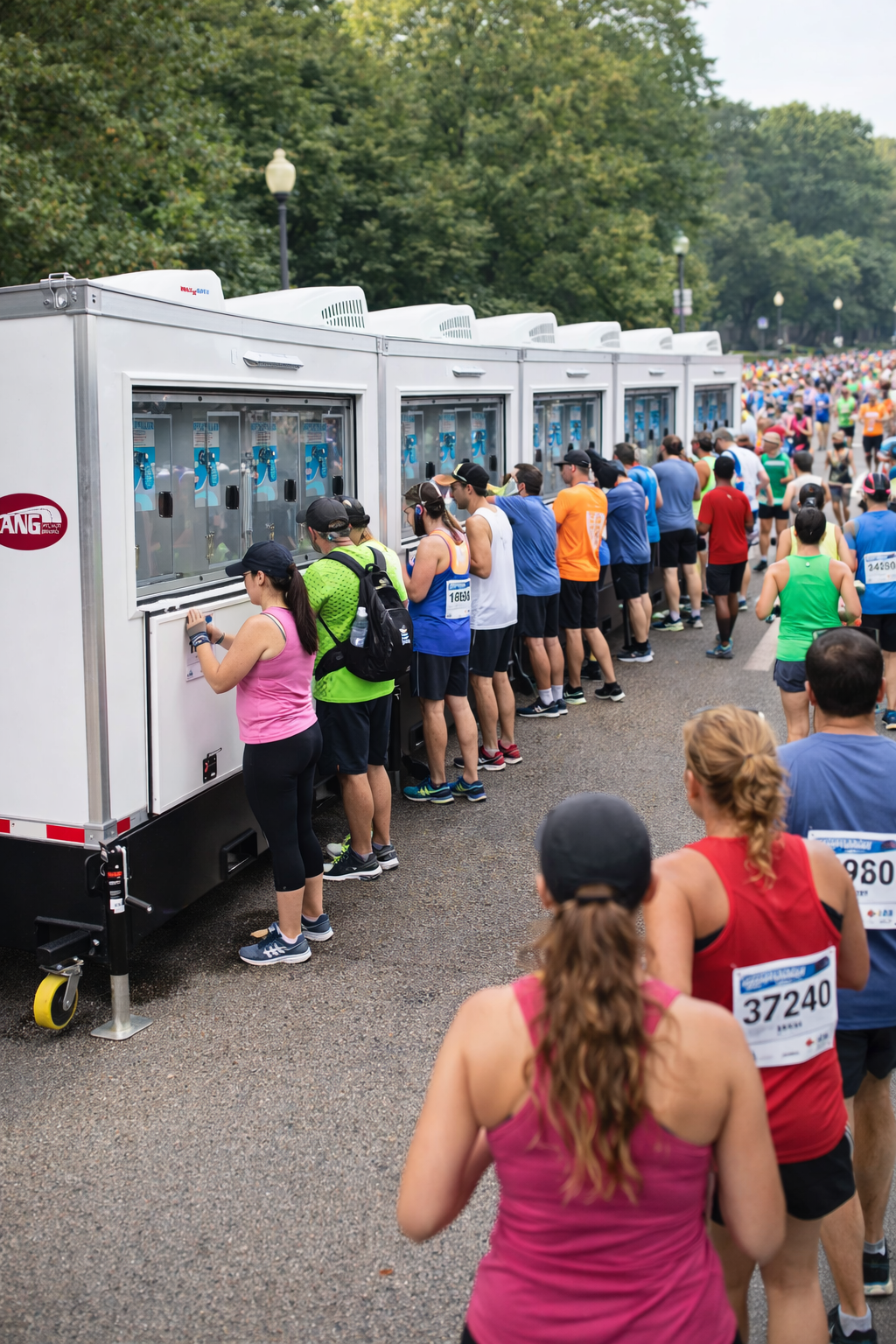
Yes, large events are part of our regular work. For something the size of the Balloon & Wine Festival grounds at Lake Skinner, we’ll spread several trailers across the footprint so nobody walks far for water, back them with tankers and buffer storage, and run delivery and pickup around your schedule. Hand us your peak headcount and grounds map and we build the volume and placement around it.
Can you deliver during a heat wave or emergency on short notice?
Yes, and it’s one of the main reasons valley clients keep our number handy. When the National Weather Service posts an excessive-heat warning over the inland valley we move to rapid drops and start pre-positioning spare tankers off the forecast. Southwest Riverside County also sits in genuine fire country, so we stage potable water for wildfire base camps and cooling sites and roll trailers to neighborhoods hit by water-main breaks. If an event or a crew lands on a 105-degree afternoon with no working hydration, one call generally gets a station pouring cold before the day peaks.
Made for the people who can’t risk a hydration gap on the day
“We had 240 guests at a June vineyard wedding and it hit 97. The station sat right by the lawn, the water stayed cold through the whole reception, and not one person was hunting for water. Our caterer asked who we used so they could book it again.”
“Our bottled-water setup on a French Valley tract collapsed by mid-morning one August. By that afternoon they’d dropped a station and the water was actually cold. The super tacked on a second unit the next week. No more pallets for us.”
“Our safety review needed proof of cool-water access under §3395 for a heat-exposed Murrieta crew. A mapped station checked that box for the plan, and the refills always landed before we got low.”
Service information current as of June 2026.
Get cold, filtered water on your Temecula event or site before the next hot stretch
Give us your guest count or crew size, the dates, and the spot the station should sit. We’ll size the job correctly and have a trailer towed out across the valley, usually within roughly 45 minutes of dispatch.