Water Station Rentals Provo
Cold drinking water station rentals for Provo and Utah County, dispatched fast up the I-15 corridor from our Salt Lake City-area yard for same-day or next-day service.
Provo sits at 4,540 feet and runs dry. The June and July air drops to about 40 percent humidity, so the sweat off a Lehi framing crew or a Stadium of Fire crowd evaporates before anyone notices the loss. That is the quiet danger this service exists to fix. We put cold, filtered water within arm’s reach of the people doing the work, then own the refills and the haul-off. No warm bottle pallets baking on a pad, no cooler that’s tepid by lunch, no 5 a.m. supply run before the crew clocks in.
Fast Provo Service from Our Salt Lake City-Area Yard
Our Utah yard sits about 45 miles north of Provo near Salt Lake City, a straight shot down I-15, which puts Provo and the rest of Utah County squarely inside our same-day and next-day delivery window. Lehi, Orem, American Fork, Eagle Mountain, Spanish Fork, every one of them is a routine run for our drivers. We know the corridor cold: which exits back up at rush hour, how to reach a raw Eagle Mountain pad before it has an address, where to stage at LaVell Edwards on a gameday Saturday. The map below is ground we cover every week, not a territory we service on paper from out of state.
Why Provo Picks Us for Water Station Rentals
Keeping a Utah County crew or crowd supplied with cold water through a 95-degree afternoon is the whole job, and it’s one we’ve built the company to do better than anyone else on the Wasatch Front. Everything below is why builders, event planners, and facilities managers across Provo, Orem, and Lehi hand us the water and stop thinking about it.
A+ BBB Accredited
We carry an A+ rating with the Better Business Bureau and a long run of 5-star reviews behind it. Put a Provo job in our hands and you're betting on a record that's already written down, not on a vendor you have to hope works out.
Yards Across the West, Including Utah
Our yard network reaches across Utah, Nevada, California, and Arizona, with our Utah hub a short I-15 run north of Provo. Most Utah County drops land same-day or next-day, and we still reach the far corners of the state on a scheduled route.
We Answer, Around the Clock
Dispatch, support, and availability run 24/7. When a unit has to move at midnight on a multi-night Stadium of Fire build, or a chiller hiccups at 3 a.m. on a data-center pad, a real person picks up and fixes it.
A Family Event-Rental Trade, Two Generations Deep
Renting equipment for events is the family business, and it has been for two generations. That depth means we spot where a Utah County job can go sideways, the access road, the power, the refill timing, long before it does.
Big Enough to Deliver, Small Enough to Care
You get the fleet and reliability of a large operation paired with the attention of a local crew. Scale up for a 50,000-person stadium night, get a neighbor's accountability when one thing has to go right.
Our Units, Our Crews, Our Accountability
No reseller, no broker handing your Provo job to a stranger. The trailers belong to us and the drivers are on our payroll, so the company you called is the company standing behind the work.
Licensed, Insured, and DOT-Compliant
Whatever the day at the site throws at you, you're covered. We hold full licensing and insurance, run DOT-compliant on the road, and issue a Certificate of Insurance for any BYU venue, city permit, or general contractor that needs one.
Chosen by the Strictest Buyers
Corporate campuses, government agencies, municipalities, and school districts already make us their first call. When the buyers with the hardest approval bars sign off, your vetting is mostly done.
American-Built to Take a Beating
Every station is made in the USA to run hard for years. No DIY rigs, no plans pulled off YouTube, nothing imported on the cheap, just equipment engineered to hold up to Utah County summers.
Meet the Signature Series, Our Cold Water Bottle Filling Station
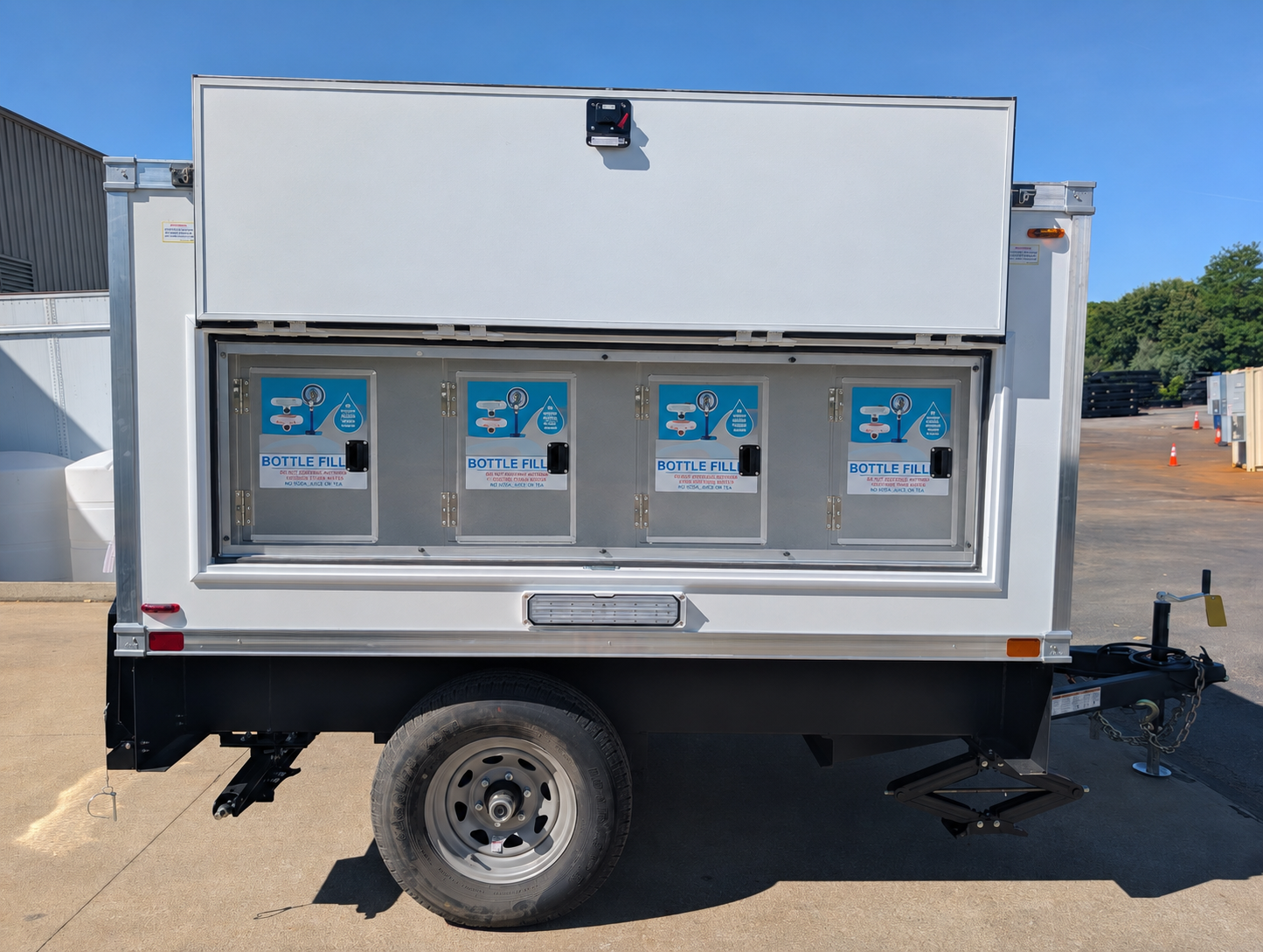
The Signature Series is our cold water bottle filling station, and it’s the only thing we rent, on purpose. One rig, built for exactly the dry high-desert heat Provo throws at it: four push-back taps, a 300-gallon insulated tank, an in-line chiller that holds drinking temperature when the ambient air is 100°F, and multi-stage filtration that cuts the mineral taste Utah County tap water carries. It tows to the site, levels on raw or unpaved ground, and runs self-contained off shore power or a small generator. That’s what lets the same unit work an Eagle Mountain data-center deck, a Spanish Fork ballfield, and a Provo Canyon wedding without missing a beat.
Setup is quick. We back it in, level it on whatever surface the site has, and either tie it to a hose bib or let it run off the onboard tank. Minutes later it’s pouring. Your people pull cold water from four taps all shift while we handle the refills and the pickup, so the water side of the job stops being yours until the work wraps.
| Spec | Value |
|---|---|
| No. of Stations | (4) Bottle Filling Stations |
| Length | 12′ 3″ |
| Weight | 3,100 lbs. |
| Height | 8′ |
| Fresh Water Tank | 300 Gallons |
| Power Requirements | 1-4 dedicated 20A/120V circuits OR 1 dedicated 50A/240V circuit |
| No. of AC Units | 1 |
Provo and Utah County Jobs We stay hydrated
A Silicon Slopes data-center pour and a Stadium of Fire night share almost nothing except the heat, the altitude, and the need for cold water people can actually reach. That single shared need is what the Signature Series answers, whether it’s parked on a raw Eagle Mountain pad or staged behind the LaVell Edwards tailgate lots. Here are the Utah County situations we get called for most, and what the unit does in each.
Silicon Slopes Data Centers
Meta's Eagle Mountain campus runs seven data centers across 4.5 million square feet, and QTS is building a $6 billion campus nearby with three buildings near 580,000 square feet each. Those exurban pads put hundreds of trades in open sun for months with no retail water for miles. We stage chilled units per zone and refill on a route so a packed shift never runs dry.
Utah County Housing Boom
Utah County is on track to add nearly 800,000 residents by 2065, and Lehi, American Fork, and Eagle Mountain are among the fastest-growing cities in the state. Framing, roofing, and concrete crews work open slabs and rooftops through the whole summer, and rooftop work is the hottest exposure on any site. A heat shutdown costs more than the water ever would.
BYU Football & Gameday
LaVell Edwards Stadium seats 62,073, and the tailgate lots fill hours before an early-fall kickoff while the sun's still high. We cover tailgate rows, entry queues, and the plazas where the heat pools, so fans hit the gates hydrated instead of waiting on a single overworked fountain.
Stadium of Fire & Freedom Festival
America's Freedom Festival packs more than 50,000 people into LaVell Edwards Stadium every July 4 for the Stadium of Fire, plus weeks of parades and outdoor events leading up to it. Peak Provo heat and a stadium-sized crowd is exactly the load distributed refill stations are built for.
UVU & Campus Events
Utah Valley University fills the 8,000-seat UCCU Center in Orem and runs move-in, orientation, and outdoor events through the hot months, and BYU's Marriott Center seats nearly 18,000. We stage water at move-in zones, registration lines, and outdoor activations where the crowd stacks up in the sun.
Eagle Mountain Solar & Utility Work
The Faraday Solar plant west of Eagle Mountain spreads 1.2 million panels across open desert to feed the data centers, and that scale of fieldwork means crews strung out across acres with zero shade. A relocatable chilled station follows the work front where trucking warm cases would be the only other option.
Warehouse & Distribution
The I-15 corridor through Lehi, Spanish Fork, and Springville keeps filling with distribution and light-industrial space, and un-conditioned docks and high-bay floors bake all summer, the indoor heat the coming federal rule specifically names. We stage at dock doors and pick-pack lanes where the heat actually sits.
Road & Infrastructure Crews
The growth pushing Utah County toward 1.5 million people drives constant UDOT and municipal roadwork up and down I-15 and the Pleasant Grove and American Fork interchanges. Crews on hot asphalt move with the work zone all day, and a station that relocates with them keeps water where the shovels are.
Festivals & Summer Concerts
Provo's downtown summer concert series, the Utah County Fair in Spanish Fork, and outdoor amphitheater shows pull crowds onto open hardscape and lawns through the hottest weeks of the year. Spread refill points across the footprint and the water lines stop being a bottleneck.
Tech-Campus Corporate Events
The Lehi-to-Provo tech corridor throws big outdoor company events, all-hands gatherings, and customer days on exposed campus grounds in midsummer. An elegant station serves a few hundred people cold filtered water without a wall of plastic bottles or a melting cooler line.
Mountain & Canyon Weddings
Provo Canyon, Sundance, and the benches above Orem host outdoor weddings all season, and dressed-up guests at altitude dehydrate faster than the mild mountain air suggests. A clean station at cocktail hour keeps a hundred-plus guests comfortable with no bottle clutter on the tables.
Film & Media Production
Utah's film incentive keeps productions shooting Utah County canyons, BYU facilities, and the surrounding desert, much of it well off any water tap. A self-contained 300-gallon chilled tank stands up a base camp for catering, talent, and crew with zero site hookup.
Cooling Centers & Emergency Response
Utah County opens cooling locations during extreme-heat stretches, and a self-contained station backs up a center that's past what its fixed plumbing handles or supplies a wildfire staging area in the Wasatch foothills where municipal water is out of reach.
Government & Institutional
From Utah County facilities to BYU and UVU operations, public buyers need a vendor that can pass procurement and show up on time. We hold active SAM.gov registration, so we can bid federal and institutional work the day a solicitation posts.
How We Cover Provo and Utah County
Utah County isn’t one job. A downtown Provo event, a raw Eagle Mountain data-center pad, and a Spanish Fork ballfield each drink differently because the heat, the access, and the power situation aren’t the same. So we route every rental against the real conditions where it’s headed. Here’s how the county breaks down and what each area needs.
Provo & Orem Core
Provo · Orem · Springville
The Microclimate
High-desert valley at 4,540 feet, where July highs average near 95°F and June and July humidity drops to about 40 percent. The dry air at that altitude pulls water out of every breath, so a crew loses fluid fast and feels it late, well after the damage starts.
Where It Is Needed
The densest demand in the county: BYU's LaVell Edwards Stadium and Marriott Center, UVU's UCCU Center in Orem, the Stadium of Fire and Freedom Festival, downtown summer concerts, and the steady run of campus and city events through the hot months.
How the Signature Series Fills the Need
We stage at tailgate lots and entry queues for gamedays, distribute refill points across festival and concert footprints, and cover campus move-in and activation crowds along with other schools and universities throughout the region. With our yard a short I-15 run north toward Salt Lake City hydration coverage, most core jobs land same-day or next-day.
Lehi & Silicon Slopes North
Lehi · American Fork · Pleasant Grove · Draper
The Microclimate
The same dry valley heat as Provo, concentrated on a tech corridor that packs major construction and big outdoor company events into the worst of the summer window. Much of the work happens on raw exurban ground with no shade and no plumbing yet.
Where It Is Needed
The Lehi-to-Draper tech-campus build-out and corporate-event calendar, fast-rising housing across American Fork and Pleasant Grove, and the I-15 interchange and infrastructure projects feeding the growth.
How the Signature Series Fills the Need
We stage chilled stations on exposed greenfield pads and run a refill route across multi-zone sites. Self-contained operation matters here because so much of the work lands on bare land before any water line exists — the same reason construction jobsites across our Utah coverage area rely on delivered hydration, and this is the closest stretch to our yard.
Eagle Mountain & the West Desert Pads
Eagle Mountain · Saratoga Springs · the data-center corridor
The Microclimate
Open high-desert ground west of Utah Lake, hotter and more exposed than the valley floor, with sites that often have no address yet. This is the data-center and utility-solar belt, where crews spread across acres of bare pad with zero shade.
Where It Is Needed
Meta's seven-building Eagle Mountain campus, the QTS $6 billion build, the Faraday Solar field and its 1.2 million panels, and the housing exploding around Eagle Mountain and Saratoga Springs as the corridor fills in.
How the Signature Series Fills the Need
This is the clearest case for delivered hydration that needs nothing from the site. We bring the tank full, bring a generator when there's no shore power, stage a unit per active zone, and move with the pour so a 500-worker pad never has water more than a short walk away.
South Utah County
Spanish Fork · Springville · Payson · Mapleton
The Microclimate
Valley-floor heat similar to Provo, with more agricultural and open-ground work and the Utah County Fair drawing crowds to Spanish Fork. Sites here run from ballfields and fairgrounds to new subdivisions pushing south toward Payson.
Where It Is Needed
The Utah County Fair and Spanish Fork events, youth and rec tournaments on open ballfields, the southern wave of new-home construction, and roadwork along the I-15 corridor as it stretches south.
How the Signature Series Fills the Need
We drop stations at fairgrounds and tournament fields where the crowd and the players both need water, and cover the new-build crews working open slabs through the summer. It's a straightforward I-15 run, so even the southern end of the county stays inside our fast-dispatch window.
What We've Learned Running Utah County
A lot of what makes a Provo-area rental go right never shows up on a spec sheet. It's what our drivers and dispatchers have picked up running this county and the I-15 corridor, and it's worth sharing because it changes how you should plan a job.
Raw pads need everything brought to them
On the Eagle Mountain and Lehi data-center builds, a site often has no address, no water line, and no permanent power when the first trades show up. So we treat those jobs as fully self-contained from day one. We bring the tank full, bring a generator sized for the chiller, and stage a unit per active zone instead of one at the gate. We learned the hard way that a crew working the far side of a 4-million-square-foot pad won't walk back to a single station, they just stop drinking, and that's how a hot afternoon turns into a heat call.
Gameday and the Fourth are their own logistics
A BYU Saturday and the Stadium of Fire don't behave like a normal delivery. The lots fill hours before kickoff and the July 4 crowd tops 50,000, so we stage units the night before and pre-position the refill route around the crowd flow, not the clock. The dangerous stretch at LaVell Edwards is the open tailgate lots and entry queues in full sun, well before anyone's inside, so that's where the water goes first.
I-15 timing is half the job
Our yard is about 45 miles north, which is nothing, until you hit the corridor at the wrong hour. We've learned to schedule Provo and Lehi drops around the I-15 rush windows and the gameday and festival closures, so a unit that has to be on a Provo site by 6 a.m. moves the evening before. The drive is easy. The timing is what you plan around.
Altitude makes 95 feel worse than it reads
Provo sits at 4,540 feet, and at that elevation the dry air pulls extra water out through breathing before anyone's broken a sweat. We've watched crews go down at 'only' 92 degrees because they hydrated for the thermometer and ignored the altitude stacked on top of it. So we size the water for both the heat and the elevation, every time, and that usually means more capacity staged closer than a client first expects.
We refill against the shift, not the clock
On a long data-center or solar rotation, a hot Utah County crew can pull a full 300-gallon tank well inside a single shift. So we don't wait for empty. We time a mid-shift top-off into the route so the swing and graveyard crews get the same cold water the day crew did. The gap that hurts somebody is always the one nobody scheduled.
We walk the access before we promise the trailer
Not every Utah County job is a paved lot. A new Eagle Mountain pad, a canyon wedding venue above Provo, a fairgrounds gate in Spanish Fork, the turnaround and the surface decide whether a loaded trailer gets in and back out. Before we commit, our driver checks the road, the pad, and the power. We've routed around soft shoulders and tight gates that would've stranded a unit right when the crew needed it most.
What Provo Crews and Planners Tell Us
We had trades spread across a data-center pad in Eagle Mountain through a July heat stretch and our bottled-water plan was gone by mid-morning. I called and they had a Signature Series on the pad that afternoon, then staged more per zone. Their setup basically wrote the water half of our heat plan for us.

Our Fourth of July event had tens of thousands of people on open ground and the old water points couldn't keep up. They distributed stations across the footprint and the lines just disappeared. Cold water, no drama, and they answered every call during the build.

We're framing through the summer on bare ground in Lehi with no water hooked up yet. They dropped a self-contained unit, ran it off a generator, and kept it on a refill route for the whole job. The crew stayed hydrated and I stopped thinking about it.

For our outdoor move-in and summer events in Orem they showed up clean, set up in minutes, and the cold filtered water was a hit with students and staff. Easy to work with, genuinely local, and they cared that it went right. We book them every season now.

Planning the full Provo event or project? Add on-site cold storage with Provo portable freezer trailer rentals and upscale guest facilities with VIP restroom trailer rentals Provo.
Get Cold Water on Your Provo Site This Week
Whether you need water station rentals for an event, a hydration station for a Utah County jobsite, or a bottle filling station for a campus, send us the location, the dates, and the headcount. We dispatch Provo and the rest of the county fast from our Salt Lake City-area yard, usually same-day or next-day, and your quote includes the federal water-per-worker capacity math. We answer 24/7.
📞 Call Now (866) 748-5932Request a QuoteWhat to Know Before You Rent in Provo
The deeper detail, sorted so you can open only what you need: the heat-and-altitude science, the Utah compliance picture, where the water comes from, and the sustainability case. This is the knowledge base behind being the most informed water-station partner working Utah County.
Provo sits at 4,540 feet, and that elevation is the part people underestimate. July highs in Provo average near 95°F, and in June and July the relative humidity drops to roughly 40 percent. At that altitude and dryness, sweat evaporates almost the instant it surfaces, so a worker never feels wet and badly misjudges how much fluid they’re losing.
The thin, dry air does something else: it roughly doubles the water the body loses through breathing before anyone breaks a real sweat. That’s why crews in Utah County go down at temperatures that don’t sound dangerous. From there dehydration moves quickly, through fatigue and clouded judgment to heat exhaustion, and once a body stops sweating, to heat stroke. Utah recorded dozens of heat-related deaths between 2019 and 2024. Cold water that’s genuinely within reach is the single most effective way to keep a Provo crew ahead of that curve.
Here’s the honest version. Utah has no state-specific heat-illness standard. Utah workplaces fall under UOSH, the state OSHA plan, which adopts the federal standards, and federal OSHA’s General Duty Clause already requires every employer to keep a workplace free of recognized hazards that could cause serious harm. Excessive heat is a recognized hazard, and the Utah Labor Commission publishes outdoor-heat guidance, so the obligation on a Provo or Lehi jobsite exists today even without a dedicated rule.
What’s coming sharpens it. In 2024 federal OSHA proposed a Heat Injury and Illness Prevention rule covering indoor and outdoor work, with an initial trigger at a heat index of 80°F (cool water at one quart per worker per hour, plus rest and shade) and a high-heat trigger at 90°F. The water has to be suitably cool and as close as practicable to the work. The federal water-rest-shade benchmark already sets that quart-per-worker-per-hour expectation. A chilled, filtered station staged right at the work zone is the cleanest way to meet today’s duty and get out ahead of the coming standard.
We fill from tested, potable municipal sources, then run every drop through multi-stage on-board filtration, sediment, carbon, and a fine final filter, before it reaches the tap. Provo’s own supply draws on roughly 160 springs and 15 wells, backed by the Provo River and Deer Creek Reservoir through the Central Utah Water Conservancy District. That groundwater-heavy mix runs hard and mineral-forward, which is exactly the taste that keeps people from drinking enough on a hot jobsite or at an event. The on-board filtration strips that out and the chiller serves it cold, and that combination is what actually gets a crew or a crowd to keep drinking.
Utah runs on one of the tightest water budgets in the country, with the Great Salt Lake near record lows and the Southwest in its driest stretch in twelve centuries. So single-use-plastic reduction and conservation sit right inside the sustainability goals Utah County cities, BYU, UVU, and public agencies are now measured against.
At event scale the disposable-bottle stream gets ugly fast. A Stadium of Fire crowd or the Utah County Fair can push tens of thousands of plastic bottles toward a landfill in a single weekend. A refillable chilled station flips that, serving colder water and almost no waste at the same time. On the jobsite side, killing the truck-in, truck-out cycle of bottled water on a remote Eagle Mountain pad is a small, visible win that also leaves the crew better hydrated than the cases ever did.
Provo Water Station Rental Questions, Answered
That’s the job the Signature Series was built for. On the Meta and QTS pads west of Utah Lake, the first trades often show up before the site has an address, a hose bib, or permanent power. We roll in with the 300-gallon tank already full and cold, drop a right-sized generator to keep the chiller running, and stage a unit per active zone so a crew working the far side of a million-square-foot deck never has to walk back to one station. Nothing on the pad has to exist yet.
Our Utah yard is about 45 miles north of Provo, a straight shot down I-15, which keeps Provo and Utah County inside our same-day and next-day window. The drive itself is easy. The thing we plan around is timing, so for a unit that has to be on a Provo or Lehi site by 6 a.m. we move it the evening before to beat the corridor rush and any gameday or festival closures. Send the date and the site and we’ll confirm the window.
At 4,540 feet the dry air roughly doubles the water your body loses through breathing before anyone breaks a real sweat, and with midsummer humidity down near 40 percent that sweat evaporates the instant it surfaces, so a crew badly underestimates the loss. We’ve watched people go down at ‘only’ 92 because they hydrated for the thermometer and ignored the elevation stacked on top of it. We size the water for both the heat and the altitude, which usually means more cold capacity staged closer than a client first expects.
Yes, and stadium-scale crowds are core to what we do. LaVell Edwards seats 62,073 and the Stadium of Fire packs more than 50,000 onto open ground every July 4. The dangerous stretch is the tailgate lots and entry queues in full sun hours before kickoff, so we stage units the night before and pre-position the refill route around the crowd flow instead of the clock. That’s where the water goes first, before anyone’s even inside.
We run the whole Lehi-to-Provo tech corridor directly. Lehi, Orem, American Fork, Pleasant Grove, Eagle Mountain, Saratoga Springs, Spanish Fork, and Springville are routine I-15 runs for our drivers, not occasional trips. We know which exits back up at rush hour and how to reach a greenfield Silicon Slopes pad before it has an address.
Not a state-specific one. Utah falls under UOSH, the state OSHA plan, which adopts the federal standards, so OSHA’s General Duty Clause already makes excessive heat a citable recognized hazard on any Provo or Lehi site today. A federal Heat Injury and Illness Prevention rule with a hard quart-per-worker-per-hour water mandate is in rulemaking now. Providing cool, accessible water is how you meet the present duty, and our quotes include the capacity math.
At least one quart of suitably cool water per worker per hour, which is roughly two gallons over an eight-hour shift and closer to three on a long data-center or solar rotation in Utah County heat. Our 300-gallon tank covers a large crew through a shift at that rate, and we run the headcount-times-hours math when we quote a Provo-area job.
A single four-tap, 300-gallon unit handles a large crew or a steady crowd between refills. For crews on the clock, budget about a quart of cool water per person per hour. For a fast-growth housing build or a Lehi tech campus we work the station count back from your headcount and shift length, then schedule refills against the shift, not the clock.
All the time. The Stadium of Fire, the Utah County Fair in Spanish Fork, or an Eagle Mountain megasite often run multiple units at once. It’s the same equipment and the same terms multiplied by the count, with a refill route built around your crowd flow or jobsite headcount so no part of the footprint runs dry.
As a planning figure we budget roughly half a liter to a liter of drinking water per attendee for a multi-hour outdoor event, and at 1,000 people one four-tap unit can’t move that volume alone, especially in dry high-desert heat. We usually distribute two to four stations across the grounds so nobody waits in a sun line, then schedule refills against your run-of-show. We size the exact count from your peak crowd and footprint.
Send the dates, the location, and the headcount. We back the unit in, level it on whatever ground you’ve got, raw pad, ballfield, or canyon venue, and either tie it to a hose bib or run it off the onboard tank with refills on a schedule. It’s pouring within minutes. At the end we come get it. Your team never touches the equipment.
Pricing is built per event or project, not a flat rate, because the right number depends on how many people the unit serves, how long you need it, and where it’s going. A weekend wedding in Provo Canyon and a 90-day Eagle Mountain data-center deployment carry very different logistics. Give us those three details and we’ll return a quote with the capacity math.
Absolutely, and most of our Utah County construction work is exactly that. We rent by the week and by the month for multi-month general-contractor schedules, keep the same unit on site for the duration, and run a regular service and refill route. Running concurrent Silicon Slopes sites? We’ll put them on one contract with one point of contact.
A water buffalo is a towable tank and an office cooler is a small dispenser, and neither holds up to high-desert heat. The Signature Series pairs tank capacity with active in-line refrigeration that holds drinking temperature when the ambient air is 100°F, multi-stage filtration that cuts the mineral taste Utah County tap water carries, and four push-back taps at once. It’s purpose-built for high-throughput potable hydration on a Provo jobsite, not warm tank water or one slow spout.
Yes. The push-back taps sit at a height that works from a seated position, and because we level the unit on delivery and can set it on firm, flat ground near an accessible path, it serves every guest or worker. Tell us the BYU venue or city event’s accessibility requirements and we’ll set it up to meet them, plus issue a Certificate of Insurance if the venue needs one.
Yes. We fill from tested, potable municipal sources, then run every drop through multi-stage on-board filtration before it reaches the tap. Provo’s supply leans on groundwater from springs and wells backed by the Provo River and Deer Creek, which runs hard and mineral-forward, exactly the taste that keeps people from drinking enough on a hot day. The filtration strips that out and the chiller serves it cold. The full detail is in the reference library above.
Provo and Utah County are core service territory for us. From our Salt Lake City-area yard, about 45 miles north on I-15, plus a Western U.S. network of yards across California, Nevada, Utah, and Arizona, we can usually confirm same-day or next-day delivery, whether it's a Provo Canyon wedding, a 90-day Eagle Mountain data-center deployment, or a Stadium of Fire crowd. Tell us where the job is, the rental window, and roughly how many people the unit needs to serve, and we'll come back with a quote that includes the water-per-worker capacity math, the delivery schedule, and any generator or accessory recommendations for your site. Call (866) 748-5932 today, or use the form on this page.
Cal Fire certified · SAM.gov registered · A+ BBB accredited · fully licensed & insured