Water Station Rentals Reno
Cold drinking water station rentals for Reno and northern Nevada, delivered on scheduled routes across the high desert from our Western U.S. yard network.
Reno runs hot, dry, and a mile high. The Truckee Meadows can sit at 90-plus through a July afternoon and shed it back to the 50s overnight, and that swing fools crews into hydrating for the wrong number. We bring cold filtered water to the jobsite or the event so your people drink before the heat catches them. Book a window, lock the dates, and a unit rolls to your Reno site on a planned northern-Nevada route. No bottle pallets, no warm coolers by noon, no scramble at the gate.
Reno and Northern Nevada, Served on Scheduled Routes
Northern Nevada is real territory for us, and we cover it honestly. Our nearest staffed yard isn’t in Reno, so we serve the Truckee Meadows on planned routes through our Western U.S. network, supported out of our northern-California operation a couple of hours over Donner Summit. What that means for you is simple. Give us a little lead time and we’ll put a cold, filtered station on your Reno, Sparks, or TRIC site on a confirmed date, with refills scheduled against your headcount. We won’t promise a same-hour scramble we can’t keep. We will promise a unit that shows up when we said, full and cold, every time. The map below is the ground these routes cover.
Why Reno Crews and Planners Book Us for Water Stations
Plenty of vendors will sell you bottled water by the pallet. Far fewer will roll a chilled, filtered bottle filling station onto a high-desert jobsite and own the refills until the work is done. That’s the gap we fill for Reno, and the same standards that built our reputation across the West carry straight into northern Nevada.
A+ BBB Accredited
We hold an A+ with the Better Business Bureau and a long shelf of 5-star reviews. Put a Reno job in our hands and you're hiring a track record that's already on the books, not a gamble on a first impression.
A Western Yard Network That Reaches Reno
Our yards run through California, Nevada, Utah, Arizona and beyond, and that network is what lets us serve Reno reliably on a scheduled northern-Nevada route. We don't claim a Reno yard we don't have. We claim coverage we actually deliver, on a date we confirm.
We Answer, Around the Clock
Dispatch, availability, and support run 24/7. If a unit needs to move or something goes sideways at 5 a.m. on a TRIC pad, a live person picks up and solves it, not a voicemail box you'll hear from Monday.
A Family Event-Rental Trade, Two Generations Deep
Renting gear for events and jobsites is the family trade, and has been for two generations. That history means we read a Reno job, and the spots it can go wrong, faster than an outfit new to the work.
Big Enough to Deliver, Small Enough to Care
You get a real fleet and the planning muscle to route across the Sierra, paired with the hands-on attention of an outfit that answers to you. Scale when the headcount jumps, accountability when a detail matters.
Our Units, Our Crews, Our Accountability
We're not a broker handing your Reno job to a stranger. The stations are ours and the drivers who deliver them are on our payroll, so responsibility lands on the company you actually called.
Licensed, Insured, and DOT-Compliant
You're covered whatever the day throws at the site. Full licensing and insurance, DOT-compliant hauling, and a Certificate of Insurance cut to whatever a Reno venue or general contractor asks for.
Chosen by the Strictest Buyers
Corporate America, government agencies, municipalities, and school districts already pick us first. When the buyers with the toughest approval bars say yes, that vetting work is already done for you.
American-Built to Take a Beating
Every station is made in the USA to last. No DIY rigs, no parts-bin builds off a video, nothing shipped in from overseas. Just durable equipment engineered for high-desert work.
Introducing the Signature Series, Our Premier Cold Water Bottle Filling Station
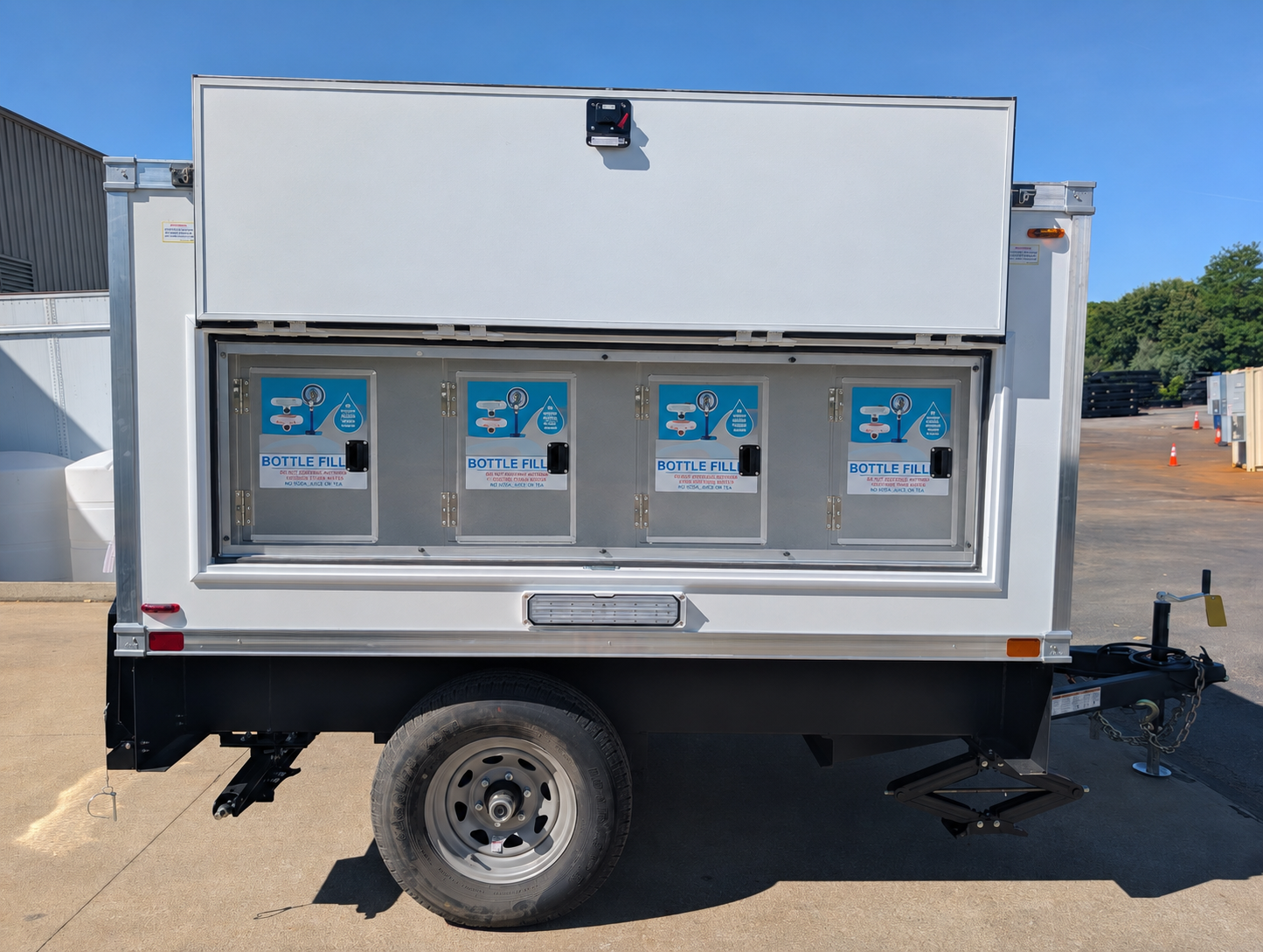
The Signature Series is our premier cold water bottle filling station, and it’s the entire focus of what we rent. One purpose-built rig, dialed in for Reno’s dry high-desert heat: four push-back taps, a 300-gallon insulated tank, an in-line chiller that holds water at drinking temperature when ambient hits 100°F, and multi-stage filtration that strips taste so people actually drink. It tows in, levels on uneven or unpaved ground, and runs self-contained on shore power or a small generator. That’s what lets it work a TRIC data-center pad, a Greater Nevada Field event, or a remote Washoe County site with the same ease.
Setup is quick. We back it in, level it on whatever surface the site has, and either tie it to a hose bib or run it straight off the onboard tank. A few minutes and it’s pouring. Your crew draws cold water from four taps through the shift while we handle the refills and the haul-off on the route schedule, so water stops being a thing you manage until the job wraps.
| Spec | Value |
|---|---|
| No. of Stations | (4) Bottle Filling Stations |
| Length | 12′ 3″ |
| Weight | 3,100 lbs. |
| Height | 8′ |
| Fresh Water Tank | 300 Gallons |
| Power Requirements | 1-4 dedicated 20A/120V circuits OR 1 dedicated 50A/240V circuit |
| No. of AC Units | 1 |
Reno Jobsites and Events That Count on Cold Water
The same mobile drinking water station answers wildly different jobs around Reno. A graveyard shift on a Storey County data-center shell and a Saturday at the Great Reno Balloon Race share almost nothing except the altitude, the dry heat, and a crew or a crowd that has to keep drinking. That one shared need is the whole business. Here are the situations northern Nevada calls us for most, and what the unit does in each.
Tahoe-Reno Industrial Center Data Centers
Switch's SUPERNAP, plus Google, Microsoft, and the new Tract and PowerHouse builds, are turning Storey County into one of the country's biggest data-center hubs on raw exurban land far from any retail water. We stage chilled stations per active zone and refill on the route so a multi-hundred-worker shell build never runs dry.
Tesla Gigafactory & Advanced Manufacturing
Tesla's Gigafactory at TRIC runs roughly 11,000 people across 5.8 million square feet, and the surrounding manufacturing corridor keeps trades on site through summer. Indoor process heat and exposed exterior work both fall under Nevada's heat rule, and a chilled station at the work area answers both.
Warehouse & Distribution
Amazon, Walmart, and PetSmart run major distribution centers off the I-80 corridor, and un-conditioned docks and high-bay space bake through a Truckee Meadows summer. We position stations at dock faces and pick lanes where the heat actually sits and the forklift crews work.
Sparks & Spanish Springs Housing
Sparks has pushed past 112,000 residents and Spanish Springs near 19,000, and the build-out keeps framing, roofing, and concrete crews on open slabs and rooftops all summer. Rooftop work is the hottest exposure on any site. A cold station beats the downtime a heat call costs.
Hot August Nights
The world's largest classic-car event packs 6,000-plus vehicles and huge crowds across Reno and Sparks in peak-August heat. We stage distributed refill points along the cruise routes and show fields so spectators and staff aren't hunting for water in the sun.
Great Reno Balloon Race
Up to 100 balloons and tens of thousands of pre-dawn-to-midday spectators fill Rancho San Rafael Regional Park each September. We set chilled stations near the launch field and vendor rows where the crowd clusters once the sun comes up over the valley.
Street Vibrations
The fall motorcycle rally draws over 35,000 riders to downtown Reno and Virginia Street for days of music, metal, and heat on hardscape. Distributed hydration points keep the crowd watered without a single bottleneck at one tap.
Reno-Sparks Convention Center Events
The 600,000-plus-square-foot convention center spills load-in, registration queues, and sponsor activations into open sun on the Virginia Street lot before doors open. We stage at load-in gates and badge checkpoints where the lines form first.
Greater Nevada Field & Sports
The 9,534-seat home of the Reno Aces and its event calendar pull crowds into open-air concourses and plaza space through the summer season. We cover entry queues, tailgate and plaza areas, and staff zones where the afternoon heat pools.
Endurance & Desert Events
Trail runs, gravel races, and off-road events string participants across high-desert terrain north and east of Reno where no tap exists for miles. We stage cold water at aid points, transitions, and finish areas the self-contained tank can reach.
Film & Production
Productions shoot the Black Rock Desert, the Virginia City high country, and the basin and range east of Reno, much of it well past the last water line. A self-contained 300-gallon chilled tank stands up a base camp with zero hookup for catering, talent, and crew.
Weddings & Outdoor Events
Lake Tahoe-area and high-desert ranch weddings put dressed-up guests in thin, dry mountain air that pulls fluid faster than it feels. An elegant station at cocktail hour serves a few hundred guests cold filtered water without a wall of plastic bottles.
Disaster Response & Cooling
Washoe County opens cooling centers in extreme heat and wildfire smoke seasons, and a self-contained tank backs up a center at capacity or supplies a fire base camp where municipal water is strained. The unit shows up full and runs on its own power.
Government, Campus & Public Works
The University of Nevada, Reno runs roughly 21,000 students through move-in and gameday surges, and city and county public-works crews work hot asphalt across the metro. We hold active SAM.gov registration, so we can bid federal and public work the day a solicitation posts.
How We Cover the Reno-Sparks Region
Greater Reno isn’t one climate or one drive. The valley floor, the industrial flats east of town, the Sparks and Spanish Springs build-out, and the south-Reno growth edge each pull a different heat load and a different route. We plan every rental against the real elevation, temperature, and drive time of where it’s headed. Here’s how the main areas break down and what each one needs.
Downtown Reno & Midtown
Downtown · Midtown · University District · Wells Avenue
The Microclimate
High-desert valley at roughly 4,500 feet. July highs average around 90°F and the city ran four straight days over 105°F in July 2024, yet the air is so dry that humidity sits near zero and crews badly underestimate the loss. Nights drop back to the 50s, a swing of more than 30 degrees in a single day.
Where It Is Needed
The densest event demand in the region: Artown's 500-plus July events, Street Vibrations on Virginia Street, the casino-corridor crowds, UNR move-in and gamedays, and the Riverwalk and downtown festival footprint along the Truckee.
How the Signature Series Fills the Need
We distribute refill points across festival hardscape, stage at venue load-in gates, and position chilled water where downtown crowds and campus crews cluster. Book the date and we route a unit in on the schedule, set and pouring before the crowd builds.
Tahoe-Reno Industrial Center & Storey County
TRIC · McCarran · Patrick · Storey County flats · the USA Parkway corridor
The Microclimate
Open high-desert flats east of the valley, hotter and more exposed than downtown with zero shade and re-radiating ground. This is raw industrial land where the Tesla Gigafactory, Switch, and the new data-center shells sit miles from any retail water, and the surface heat off bare pads and asphalt runs well above the air temperature.
Where It Is Needed
The Switch SUPERNAP and Google and Microsoft campuses, the Tract 2,200-acre and PowerHouse 900,000-square-foot data-center builds, the Tesla Gigafactory, and the warehouse and logistics tenants spread along USA Parkway.
How the Signature Series Fills the Need
This is the clearest case in the region for delivered hydration that needs nothing from the site. We stage a station per active zone, bring a generator where there's no shore power, and refill on the route, so a shell-build crew on a remote pad still has cold water within reach. See our full Nevada water station rentals coverage for service details across the state.
Sparks & Spanish Springs
Sparks · Spanish Springs · Sun Valley · the Pyramid Highway corridor
The Microclimate
The valley's fastest-growing residential edge, same high-desert heat as Reno but with more open construction exposure. Sparks has crossed 112,000 residents and Spanish Springs keeps climbing, which concentrates framing, roofing, and concrete crews on sun-baked slabs and rooftops through the summer.
Where It Is Needed
Greater Nevada Field and the Sparks Marina event calendar, the Victorian Square footprint, rapid housing and infrastructure construction up the Pyramid Highway, and the warehouse build-out along the I-80 east corridor.
How the Signature Series Fills the Need
We position stations on exposed greenfield pads where plumbing doesn't exist yet, cover event crowds at the Marina and Victorian Square, and run refills against the crew size. Self-contained operation matters here because so much of the work happens on raw land.
South Reno & the Growth Edge
South Meadows · Damonte Ranch · Mount Rose corridor · rural Washoe County
The Microclimate
South Reno climbs out of the valley floor toward the Mount Rose foothills, so elevation rises and the air thins further, which speeds fluid loss even when the thermometer reads the same as downtown. The growth edge keeps commercial and residential construction pushing into open, unserviced ground.
Where It Is Needed
South-valley commercial and tech-office construction, Damonte Ranch and South Meadows housing, foothill and ranch weddings toward Mount Rose, and rural Washoe County sites where municipal water access thins out — the same remote reach that serves wildfire and emergency response operations across the region.
How the Signature Series Fills the Need
We plan for the altitude on top of the heat in this corridor, stage on raw construction ground, and reach the remote foothill and ranch sites the self-contained tank is built for. Lead time matters most out here, so we lock the date early and route accordingly.
What We've Learned Running Water to Northern Nevada
A lot of what makes a Reno rental go right never shows up on a spec sheet. It's the stuff our dispatchers and drivers have picked up routing the high desert and the Sierra crossing, and it's worth sharing because it changes how you should plan a northern-Nevada job.
Lead time is the whole game up here
Reno isn't a yard town for us, and we won't pretend it is. We serve it on scheduled northern-Nevada routes, which means the single best thing you can do is book the date a little early. Give us the window and we lock a confirmed delivery, full and cold, instead of you rolling the dice on a same-day scramble nobody can honestly promise from 400-plus miles out. The planners who call ahead get exactly what they asked for, on the day they asked for it.
Altitude does damage the thermometer hides
Reno sits near 4,500 feet and south Reno climbs higher, so the body sheds water through breathing before anyone breaks a sweat. We've watched crews go down at 'only' 91 degrees because they drank for the number on the gauge and ignored the mile-high air on top of it. So we size hydration for the elevation, not just the high. Every Reno job, the same way.
The day-night swing fools people
A Truckee Meadows July day can run 90-plus by afternoon and fall back into the 50s overnight, more than a 30-degree swing. Crews feel that cool morning and underdrink, then the dry afternoon heat catches up fast. We brief sites on it and we stage the cold water early, because the dangerous window opens before the crew thinks it has.
TRIC pads have no water and no shade
Out on the Storey County flats, the data-center shells and the warehouse pads sit miles from any tap on bare ground that throws heat back up at the crew. Our drivers stage a unit per active zone and reposition with the work front, and we bring a generator when there's no shore power yet. A crew that has to walk a quarter mile for water just drinks less, and out there that's a real risk.
We schedule refills against the shift, not the clock
On a busy data-center build or a hot event, a thirsty crowd can pull a 300-gallon tank down well inside a shift, so we don't wait for it to run dry. We time a top-off into the route, usually mid-shift, so a swing or graveyard crew gets the same cold water the day crew did. The gap that bites is always the one nobody planned.
We check the Sierra crossing and the access road
Two things can complicate a Reno delivery, and neither is heat. One is the Donner Summit crossing on I-80, which shapes how we route and time a unit coming over from the California side. The other is the last mile into a remote Washoe or Storey County site. Before we commit, a driver confirms the road, the turnaround, and the pad, so the unit gets in and back out clean when the crew needs it most.
What Reno Crews and Event Planners Say
We had a shell build out at the industrial center with crews spread across bare pads and no water for miles. They mapped out a route, dropped chilled stations per zone, and kept them refilled on schedule through an August heat run. Booking a week ahead was all it took. They never once left us short.

Our downtown festival had thousands of people on Virginia Street hardscape and the old water points couldn't keep up. They staged multiple stations across the footprint and the lines just disappeared. Cold filtered water, zero drama, and they confirmed every detail before load-in.

Roofing and framing crews on open slabs through July, that's the worst exposure there is. We told them our dates up front, they routed a unit in on the day they promised, and refills showed up like clockwork. No more hauling cases of warm water out to the site every morning.

For our outdoor move-in and gameday events, they planned around our schedule, showed up clean and early, and set up in minutes. The cold filtered water was a hit with students and staff. We give them lead time and they deliver every single season.

Planning the full Reno event or project? Add on-site cold storage with Reno portable freezer trailer rentals and upscale guest facilities with VIP restroom trailer rentals in Reno.
Lock In Cold Water for Your Reno Site
Whether you need water station rentals for an event, a hydration station for a TRIC build, or a bottle filling station for a Sparks jobsite, send us the location, the dates, and the headcount. We serve Reno on scheduled northern-Nevada routes, so a little lead time gets you a confirmed delivery date, and your quote includes the Nevada and federal water-per-worker capacity math. We answer 24/7.
📞 Call Now (866) 748-5932Request a QuoteEverything to Know Before You Rent in Reno
The deeper detail, sorted so you can open only what you need: the heat-and-altitude science, Nevada’s heat rule and what it requires, where the water comes from, and the sustainability case. This is the knowledge base behind being the most informed water-station partner serving northern Nevada.
Reno sits at roughly 4,505 feet in the Great Basin high desert, in the rain shadow of the Sierra Nevada. July is the hottest month, with average highs around 90°F and the warmest stretches well past that. In July 2024 the city ran four straight days at 105°F or hotter, and its all-time record is 108°F. Daytime highs in the 90s collapse to overnight lows near 56°F, a swing of more than 30 degrees that hides how much fluid a crew is losing.
Two things the thermometer doesn’t show make it worse. First, humidity: Reno’s air sits near zero percent muggy, so sweat evaporates the instant it surfaces and a worker never feels wet enough to worry. Second, elevation: at a mile up, thinner and drier air pulls extra water out of every breath before anyone sweats, and south Reno toward Mount Rose climbs higher still. From there dehydration moves fast, through fatigue and clouded judgment to heat exhaustion and, once sweating stops, heat stroke. Cold water genuinely within reach is the most effective way to keep a high-desert crew ahead of that curve.
Nevada is no longer a state without a heat standard. On November 15, 2024 the Legislative Commission approved heat-illness prevention regulation R131-24AP, and Nevada OSHA, under the Division of Industrial Relations, began enforcing it on April 29, 2025. It covers both indoor and outdoor work and applies to employers with more than 10 employees. Climate-controlled indoor spaces are generally exempt, until the climate control fails.
The rule requires a one-time job-hazard analysis for any role exposed to heat more than 30 minutes in a 60-minute period, and a written safety program that provides potable water, rest breaks at the first signs of heat illness, a means of cooling, monitoring, training, and an emergency plan. The federal benchmark layered underneath it, OSHA’s water-rest-shade guidance, sets the quart-of-cool-water-per-worker-per-hour expectation, and federal OSHA’s proposed Heat Injury and Illness Prevention rule would harden it further. A chilled, filtered station staged at the work zone is the cleanest way to meet the Nevada standard and the federal duty at once, and our quotes include the capacity math.
Reno’s tap water is some of the better source water in the West. The Truckee Meadows Water Authority draws about 85 percent of its supply from the Truckee River, fed by Sierra snowmelt out of Lake Tahoe, and the other 15 percent from deep groundwater wells, treated at the Chalk Bluff and Glendale plants and reported well under EPA contaminant limits. We fill from tested, potable municipal sources like these, then run every drop through multi-stage on-board filtration, sediment, carbon, and a fine final filter, before it reaches the tap. The filtration polishes taste and the chiller serves it cold, which is the combination that actually gets crews and crowds to drink enough.
Northern Nevada runs on a tight, snow-fed water budget, and the Truckee River basin and Lake Tahoe sit at the center of it. Conservation and single-use-plastic reduction are squarely inside the sustainability goals Reno-area events, agencies, and corporate campuses are measured against, which is exactly the audience renting water stations.
At event scale the disposable-bottle stream gets ugly fast. A weekend like Hot August Nights or Street Vibrations can push tens of thousands of plastic bottles toward a landfill, and a refillable chilled station flips that to colder water and almost no waste. On the jobsite side, retiring the truck-in, truck-out cycle of bottled cases to a remote TRIC pad is a small, visible win that also leaves the crew better hydrated than the pallets ever did.
Your Reno Water Station Questions, Answered
We don’t run a staffed yard in Reno and we won’t pretend otherwise. The Truckee Meadows sits more than 400 miles from our North Las Vegas yard, so we cover it on planned northern-Nevada routes supported out of our northern-California operation, a couple of hours over Donner Summit. The honest trade: give us a little lead time and you get a confirmed delivery date, full and cold, not a 45-minute same-day drop. Straight answers, every time.
More than you’d give a city where we park trucks overnight. Because Reno rides a planned route across the high desert, the booking date is what locks your delivery in. Hot August Nights week, the Balloon Race in September, and the big TRIC shell builds claim the route windows first. Send the dates and the site and we’ll name the earliest slot we can hold for you.
That’s exactly what the rig is built for. Out on the Storey County flats, the data-center shells and Gigafactory-adjacent pads sit miles from any tap on bare ground. The 300-gallon tank rolls in full and cold and runs self-contained, and where there’s no shore power yet we bring a right-sized generator to keep the chiller going. We stage a unit per active zone and move it with the work front.
It does, and it’s the part people miss. At roughly 4,500 feet the thin, dry air pulls water out of every breath before anyone breaks a sweat, and south Reno toward Mount Rose climbs higher still. We’ve watched crews go down at ‘only’ 91 degrees because they drank for the gauge and ignored the elevation stacked on top of it. We size hydration for the altitude, not just the high. Every Reno job, same way.
A Truckee Meadows July day can run 90-plus by afternoon and fall back into the 50s overnight, a swing past 30 degrees. Crews feel that cool morning, underdrink, and the dry afternoon heat catches them fast. We brief the site on it and stage the cold water early, because the dangerous window opens before the crew thinks it has. Tell us your shift start and we plan the first refill against it.
Yes, and that distributed event work is a big part of what we do up here. For a footprint like Hot August Nights across Reno and Sparks, or the pre-dawn-to-midday crowd at the Great Reno Balloon Race in Rancho San Rafael, we stage multiple chilled stations across the grounds and run refills against your run-of-show so nobody hunts for water in the sun. Book the date early, though. Those weekends fill the route first.
Yes. Nevada’s heat-illness regulation R131-24AP took effect with enforcement starting April 29, 2025, and it covers indoor and outdoor work for employers with more than 10 people. It requires potable water, rest, a means of cooling, and a written plan for any role exposed to heat over 30 minutes in an hour. A chilled, accessible station is a clean way to meet it, and our quotes include the water-per-worker math.
The federal benchmark under R131-24AP’s written-plan duty is at least one quart of suitably cool water per worker per hour, roughly two gallons over an eight-hour shift and closer to three on a long, hot data-center or warehouse shift. Our 300-gallon tank carries a large crew through a shift at that rate, and we run the headcount-times-hours math into every Reno quote.
It does. The in-line chiller and insulated tank are specified for desert summer, so water pours at drinking temperature even after the unit has sat in direct Truckee Meadows sun since morning. That matters because cold water gets drunk and warm water gets ignored, and at 4,500 feet in July that difference is the whole job.
All of it. The Reno-Sparks metro, Spanish Springs and the Pyramid Highway corridor, the Tahoe-Reno Industrial Center in Storey County, south Reno toward Mount Rose, and the rural Washoe County sites all ride the same northern-Nevada routes. The remote industrial and high-desert work out here is one of the main reasons to rent a self-contained station in the first place.
Send the dates, the location, and the headcount. We route a unit in on a confirmed day, level it on whatever ground the site has, tie it to a hose bib or run it off the onboard tank, and it’s pouring within minutes. Refills are timed into the route against your shift. When the window closes we come haul it off. Your team never touches the equipment.
Often, yes. A TRIC data-center build, a distributed downtown festival, or a multi-day rally like Street Vibrations can run several stations at once. It’s the same equipment and terms multiplied by the count, with a refill route built around your headcount and the drive distances the high desert puts between zones.
As a planning figure we budget roughly half a liter to a liter of drinking water per attendee for a multi-hour outdoor event, and the dry mile-high air pushes people toward the high end of that. One four-tap unit can’t move that volume alone at that size, so for 1,000 people we usually distribute two to four stations across the grounds and schedule refills against your run-of-show. We size the exact count from your peak crowd and footprint.
Yes. Reno’s shoulder seasons and winter run well below freezing overnight, so for cold-weather sites we winterize the unit with insulated jacketing and heat tape to keep it pouring. Tell us the season and we set it up for it before it ever leaves on the route.
Yes. The push-back taps sit at a height that works from a seated position, and because we level the unit on delivery and can set it on firm, flat ground near an accessible path, it serves every guest or worker. Tell us any specific accessibility requirement for your Reno venue and we’ll set it up to meet it.
Absolutely, and most of our industrial work out here is exactly that. We rent by the week and by the month for the long data-center and manufacturing schedules, keep the same unit on site for the duration, and run a standing service and refill route. Running concurrent northern-Nevada sites? We put them on one contract with one point of contact.
Northern Nevada is real service territory for us, covered on scheduled routes across the high desert from our Western U.S. yard network. Give us a little lead time and we'll confirm a delivery date, whether it's a Mount Rose wedding, a 90-day Tahoe-Reno Industrial Center deployment, or a downtown Reno festival. Tell us where the job is, the rental window, and roughly how many people the unit needs to serve, and we'll come back with a quote that includes the water-per-worker capacity math, the delivery schedule, and any generator or accessory recommendations for your site. Call (866) 748-5932 today, or use the form on this page.
Cal Fire certified · SAM.gov registered · A+ BBB accredited · fully licensed & insured