Mining and aggregate operations run in some of the most water-deprived environments on the West Coast. Pits cut miles from the nearest tap, haul roads that stretch across dry desert flats, crusher platforms blanketed in silica dust, rotating shifts that don't stop. Getting clean, cold drinking water to every operator every day isn't a secondary concern. It's a safety-critical logistics problem, and it deserves the same rigor the site gives to blast planning or machine maintenance.
The On-Site Challenge Why Remote Pits and Quarry Floors Create a Hydration Crisis
Picture a sand-and-gravel operation along a Central Valley riverbed in late July. Ambient air temperature is pushing 107 degrees Fahrenheit. A haul-truck driver completes 43 round trips between the crusher and the load-out across a 10-hour shift, the cab hot enough by 9 a.m. that the ice in a personal cooler (the kind rated for 24 hours) has long since melted. The crusher operator walks the platform twice an hour to check feed and clear blockages. A loader operator works ground-level where radiant heat rising off the gravel stockpile adds 11 to 14 degrees to whatever the thermometer says. None of them are near a water line. The closest gas station is 23 miles down a private access road that a delivery driver can't reach without a call to the gate shack first.
That's not an unusual scene. It's Tuesday at most aggregate yards from April through October. The hydration gap in extraction industries is structural: water isn't piped to most active pit faces because the pit moves. A crusher platform has no permanent supply because the layout shifts as the bench advances. Temporary coolers get forgotten, run dry, or spend the afternoon baking in direct sun because nobody designated a spot to protect them. By the time thirst is noticeable, a worker's already in the early stages of dehydration, and heavy labor in high-heat environments compresses that timeline faster than most supervisors expect.
Dust compounds the problem in ways that indoor workers rarely appreciate. A silica-rich environment creates constant particle exposure. Operators instinctively avoid water that tastes of the powdery air around them, and on a quarry floor that's a real deterrent. I watched a crusher operator at a limestone pit in the Tehachapis dump out nearly a full jug in the first hour of a shift because it tasted like the dust cloud that had settled into the spout during setup. He wasn't being dramatic. The water genuinely tasted wrong. So he stopped drinking it, worked another four hours in 103-degree heat, and ended up sent home early by the safety supervisor with early heat-illness symptoms. We staged a filtration-equipped trailer the following week. Consumption (measured by refill frequency) climbed 37 percent across that same shift pattern within the first week.
The fix isn't distributing more coolers. It's a properly chilled, filtered, covered water station placed where operators actually gather during breaks, with enough capacity to serve rotating shifts without running dry. That's the gap our Signature Series Water Station Trailer was built to close.
-- OSHS dispatcher, Fresno yard
Sizing the right number of stations starts with a head count by shift, not by total workforce. Consider a 58-person hard-rock quarry running three rotating shifts: if workers converge on a central point, a single 300-gallon trailer at the staging area handles the load comfortably. But spread those same operators across 430 acres of pit floor, and one central unit fails them fast. Two or three stations placed at the crusher, the load-out, and the explosive-prep area will always outperform a single unit that requires operators to walk 1,300 feet or more to reach it. Walking adds heat exposure, adds time, and feeds the very human tendency to skip the trip and tell yourself you'll drink water at the next break instead.
Refill logistics matter as much as placement. Our multi-yard network covers California, Nevada, Utah, and Arizona, the same network that handles oil, gas and energy crews working equally remote off-grid conditions. Dispatch can schedule a top-off run timed to arrive before your shift change, before a blast window locks the access road, or before a haul schedule makes the delivery route impossible. The trailer's towable chassis means it repositions when the pit layout changes. No crane, no flatbed, no production stop required.
The Equipment Signature Series Water Station Trailer: Built for the Pit
What We Bring to Your Site
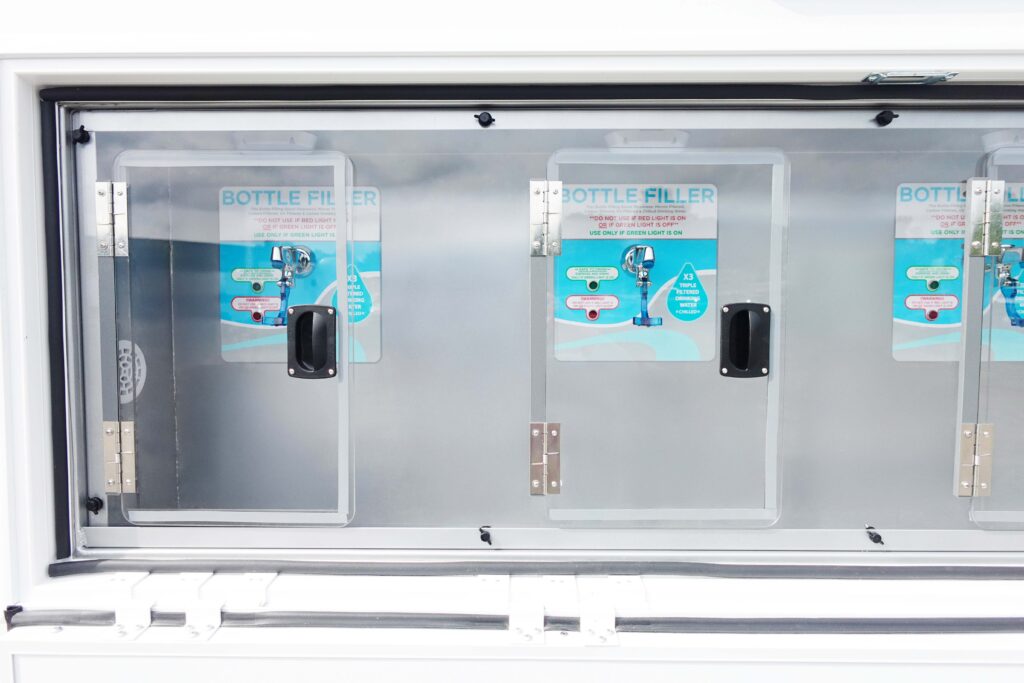
- 300-gallon fresh tank. Roughly 2,400 sixteen-ounce fills per load before a top-off is needed.
- Four simultaneous push-back fill stations. No queue at shift change when 17 operators arrive at the same time.
- Electric chiller delivers genuinely cold water, not room-temperature water with ice that melted by 10 a.m. Operators actually drink more when it's cold.
- Multi-stage filtration removes sediment, chlorine taste, and odor. Water arrives tasting clean at the dispense point regardless of the source.
- Road-towable on its own chassis. A standard pickup repositions it to a new bench, a new processing platform, or a second site entirely.
- Runs on one to three 20A/120V circuits, a single 50A/240V circuit, or a site generator. No permanent power connection required.
- Zero single-use plastic bottles. Operators fill personal bottles and reusable cups directly, cutting waste that accumulates fast on a pit site.
For permanent structures like a mine's dry-facility locker room or an aggregate plant's break room, the Legacy Series roll-in drinking water station fits through a standard doorway and plugs into existing power without any wiring modifications. Workers gathering indoors for safety meetings or pre-shift briefings get the same cold, filtered water as the crews outside. The two products pair cleanly on larger sites (outdoor Signature at the crusher, Legacy indoors at the dry) with no overlap in coverage or refill logistics. See the full inventory at our water station rental hub.
Regulatory Compliance MSHA, Cal/OSHA, and Nevada Heat Rules That Apply to Your Operation
MSHA Context and Federal OSHA Heat Guidance
The Mine Safety and Health Administration enforces the Federal Mine Safety and Health Act independently of OSHA, but federal OSHA's heat-exposure guidance and the General Duty Clause apply to surface mining operations where both agencies' jurisdictions interact. MSHA Part 56 (surface metal and nonmetal mines) and Part 77 (surface coal) both require employers to maintain safe working conditions. Inspectors and enforcement attorneys have consistently interpreted that requirement to include adequate hydration resources during high-temperature operations, and citations under the General Duty Clause for water-access failures are no longer rare.
NIOSH recommends one cup (roughly eight ounces) of cool water every 20 minutes for workers doing moderate to heavy physical labor in heat. For a haul-truck driver completing 43 round trips across a shift, that adds up to a daily consumption target that most single-cooler setups can't realistically reach. The federal Heat Injury and Illness Prevention rule (HIIP, not yet final as of mid-2026) signals where enforcement is headed. But auditors already cite inadequate water access under existing authority. And a documented refill log from a dedicated station is far more defensible than "we had a cooler somewhere near the stockpile."
Cal/OSHA Section 3395 and Nevada R131-24AP
California's Title 8, Section 3395 outdoor heat-illness standard is among the most prescriptive in the country. It requires one quart of fresh, cool potable water per employee per hour during high-heat procedures (temperatures at or above 95 degrees Fahrenheit), shade at specified ratios, a written prevention plan, and documented cool-down rest periods. Quarry and aggregate operations in the San Joaquin Valley, the Inland Empire, and the Sierra foothills face active inspection during summer months. A filtration-equipped, chilled 300-gallon trailer with a daily consumption log satisfies the documented-water-provision element in a way that an unmarked 5-gallon cooler doesn't.
Nevada adopted its own heat-illness prevention rule, R131-24AP, in November 2024, with enforcement kicking in April 2025. Employers with 10 or more workers must provide one quart of cool water per worker per hour, shaded rest areas, and a written acclimatization plan. Nevada's aggregate and cement operations along the I-15 corridor, in Clark County, Washoe County, and Elko County are all directly in scope. Our Nevada mining water stations deploy out of our Southwest network (shorter lead times than you'd expect). See CDC heat-health resources for supplemental acclimatization guidance your supervisors can act on before the season starts.
A detail that rarely appears in compliance checklists, but matters enormously on aggregate and cement raw-material sites, is the quality of water at the point of consumption. Silica dust, limestone fines, and diesel particulate settle on every surface in a quarry. An open cooler spigot, a shared ladle, or a jug left uncapped near a crusher picks up contamination that operators can taste. Once taste deteriorates, consumption drops, regardless of whether the water was technically potable when it left the fill point.
The Signature Series addresses this structurally. Push-back fill stations are covered by design. Multi-stage filtration removes chlorine and sediment so the water itself has no off flavors. The tank is a closed system, not an open tub sitting in ambient air. We staged trailers at a limestone quarry in the Mojave where the dust load was visible as a sustained haze roughly 190 feet above the crusher deck. The stations filled clean on every cycle because the dispense path stays protected throughout. So on a site where silica dust is a primary respiratory hazard requiring PPE controls, there's no reason to let the same dust compromise the hydration station.
Generator compatibility matters just as much at remote pits, and it's where a lot of hydration equipment falls short. Our trailer connects to a standard site generator without additional wiring, without a licensed electrician, and without a dedicated panel installation. We've powered units off portable generators at mine portals where the nearest utility line was 14 miles away. The setup's intentionally forgiving, because extraction sites carry none of the electrical infrastructure convenience of a suburban construction project, and the water supply can't wait for an electrician's availability. For pits that also need site water pumping and removal, our services team can coordinate both through a single dispatch call.
-- Quarry safety supervisor, Inland Empire operation
Where We Serve Mining and Aggregate Operations We Support Across the West
Hard-Rock Mines
Copper, gold, silver, and industrial-mineral mines at elevation or in desert basins where blast-window scheduling clusters crews during breaks. We time deliveries around shot schedules and place stations at the portal, the assay prep area, and the concentrate load-out so water's available during every authorized access window.
Sand and Gravel Yards
River-run and pit-run aggregate operations often run year-round with wash plants that create a perpetually damp, dusty perimeter. Loader operators and wash-plant attendants rotate through breaks at irregular intervals. A high-capacity trailer at the plant staging area handles the full crew without anyone waiting in line. We regularly serve yards in Northern Nevada, including Sparks aggregate yard hydration where several large material operations run concurrent day and swing shifts.
Cement and Raw-Material Plants
Limestone and shale quarries feeding cement kilns run in some of the most punishing dust and heat conditions in the extractive sector. Fine calcite and silica particles penetrate every gap in standard equipment, which is exactly why the Signature Series uses a closed filtration path rather than an open tank. We've kept units running continuously across 6-day operations in the Mojave, holding dispense quality consistent even when sustained ambient temperatures hit 109 degrees and stayed there for days.
Haul Roads and Remote Benches
When active digging advances to a new bench, the water station advances with it. A standard pickup handles the repositioning without a crane, a permit, or a production pause. For haul-road rest checkpoints where drivers take mandated breaks at fixed intervals, a single 300-gallon trailer positioned at the primary stop covers a full fleet across an 11-hour shift without running dry. We've mapped refill routes around haul-road traffic patterns on large open-pit operations where delivery timing is as critical as the water itself.
Processing and Screening Plants
Screen decks, jaw crushers, and conveyors create sustained high-dust, high-noise environments where operators communicate by hand signal and rarely leave the platform for more than a few minutes. Placing the trailer at platform access points rather than in a central yard cuts walking distance and means workers actually hydrate during the window they have.
Multi-Shift and 24-Hour Operations
Night-shift crews at open-pit mines and round-the-clock aggregate operations need the same water access as day crews. Temperatures drop overnight but physical demand doesn't. Our 24/7 dispatch schedules pre-dawn top-offs so the tank's full when the day shift arrives and verified again before the swing crew starts.
-- OSHS field coordinator, Southern California region
Sizing guidance for extraction sites follows a calculation that's more specific than it looks. Take your peak-shift head count, multiply by one quart per hour for high-heat work, and project across the hours between top-off runs. A 19-person shift working 10 hours above 95 degrees Fahrenheit needs roughly 47.5 gallons as a hard floor before you account for spillage. In practice, high-exertion roles routinely push consumption 28 to 43 percent above that baseline, and access-road constraints can delay a scheduled refill by 2 to 3 hours without warning — a dynamic we see at construction jobsites just as often as at mine sites. The 300-gallon capacity is the feature that keeps you out of an emergency on exactly those days. A safety director we work with in Nevada put it plainly: "The one time you cut the buffer is the one time you need it." For operations where road restrictions limit delivery frequency, that margin isn't a luxury.
We've staged paired trailers on large aggregate operations, one at the quarry face and one at the processing plant, with a shift-change refill run that keeps both tanks above 42 percent capacity at all times. For sites running through a stretch without a delivery window, our team builds a tank-management plan before the contract starts. You know exactly when each top-off arrives and what the buffer looks like if a shift runs long or consumption spikes during a heat event. But even outside formal plans, our 24/7 dispatch line is staffed by people who pick up the phone, not a voicemail system that routes you to a queue.
Common Questions Mining and Quarry Water Station FAQ
Can the trailer reach an active pit face or a bench that's not on a paved road?
Yes. The Signature Series rides on its own road-legal chassis and tows behind a standard pickup. We've delivered to unimproved haul roads, gravel access cuts, and dry-wash access routes in California, Nevada, and Utah. If your access road has a significant grade or a tight turning radius, let us know when you request a quote and our dispatch team will confirm fit before the truck leaves our yard. In cases where we can't reach the exact placement point, we'll stage the trailer at the closest safe access location and your site crew can reposition it with an on-site vehicle.
How does the chiller perform in extreme heat? Will it still deliver cold water at 110 degrees ambient?
The electric chiller is designed for outdoor deployment in high-heat environments and maintains water temperature well below ambient even in direct sun. At 110 degrees Fahrenheit ambient, the chiller keeps dispense temperature in a range operators consistently describe as genuinely cold, not merely cool. Performance improves when the trailer's parked in partial shade, but the unit functions in full-sun placement. It runs off one to three 20A/120V circuits or a single 50A/240V circuit and it's fully compatible with the portable generators common at off-grid mining and quarry operations.
What's the top-off schedule and how do I avoid running dry between deliveries?
We build the refill calendar around your operational schedule, including blast windows, restricted-access periods, and shift-change timing. Our dispatch team sets a plan that keeps your tank above 38 percent at all times. We also stay in real-time contact with your site point-of-contact so that if a shift runs long or consumption runs higher than projected, we can dispatch an emergency top-off without you having to wait for a callback. Our 24/7 dispatch line is staffed by coordinators who understand the operational realities of mine sites, not a call center reading from a script.
How does your filtration handle water from a rural ag well or a haul truck that supplies the site?
The multi-stage filtration system processes water from any potable source, including rural agricultural wells, municipal-hauled water, and tank-truck deliveries. It removes sediment, chlorine taste, and odor so that water arriving with an agricultural well's characteristic mineral taste leaves the dispense station tasting clean and neutral. We don't recommend filling from untreated surface water or irrigation ditches, but any water classified as potable at its source is appropriate. If you're unsure about a specific supply, call our dispatch team and we'll give you a straight answer based on what we've seen at comparable sites in your region.
Does renting a water station trailer help with a Cal/OSHA Section 3395 or Nevada R131-24AP inspection?
It directly addresses the documented-water-provision requirement. Both standards require fresh, cool, potable water available to workers at no cost, in sufficient quantity, accessible without a significant delay. A 300-gallon trailer with a known capacity, a daily refill log, and an on-site inspection record demonstrates that compliance in a way a cooler with an unknown fill date and a cloudy spigot can't. We recommend a simple daily log covering tank level, water temperature, and any cleaning actions taken. If you call before your season starts, our team will walk you through what an inspection-ready record looks like for your specific state and operation type.
Can we rent multiple trailers for a large operation spread across different work zones?
Absolutely. We regularly supply paired and triple configurations for large aggregate and cement-material operations where workers are spread across a quarry face, a processing plant, and a load-out simultaneously. Each trailer operates independently on its own refill schedule. We coordinate all top-off runs through a single point of contact on your side, so you're not managing three separate vendor relationships. Multi-unit rentals qualify for volume pricing. Call (866) 748-5932, walk us through your site layout, and we'll recommend a configuration based on your shift structure and access constraints.
Ready to Solve Hydration at Your Mine or Quarry?
Same-day emergency dispatch available. We cover California, Nevada, Utah, and Arizona. Tell us your pit location, shift count, and access constraints, and we'll build a plan that keeps your crew supplied with cold water and your site inspection-ready all season.
(866) 748-5932 Get a Quote