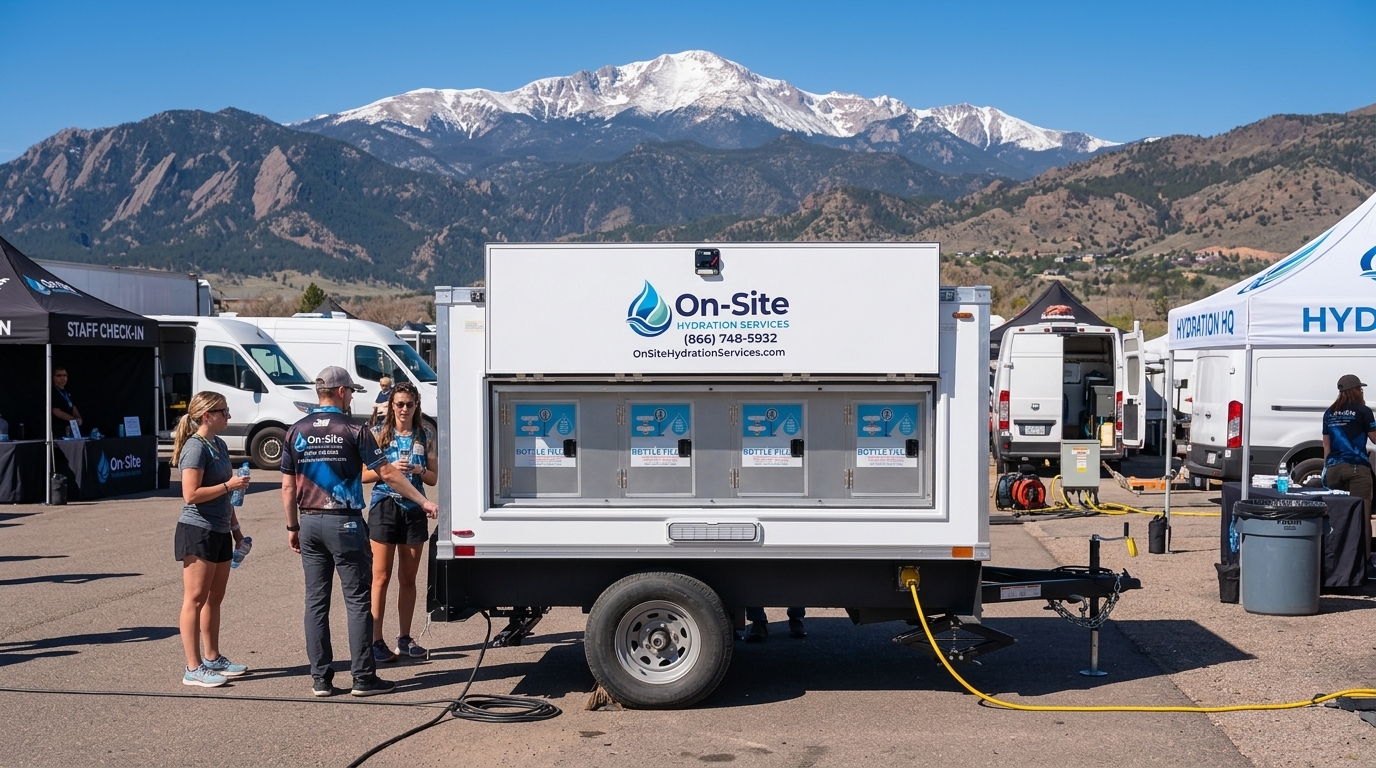
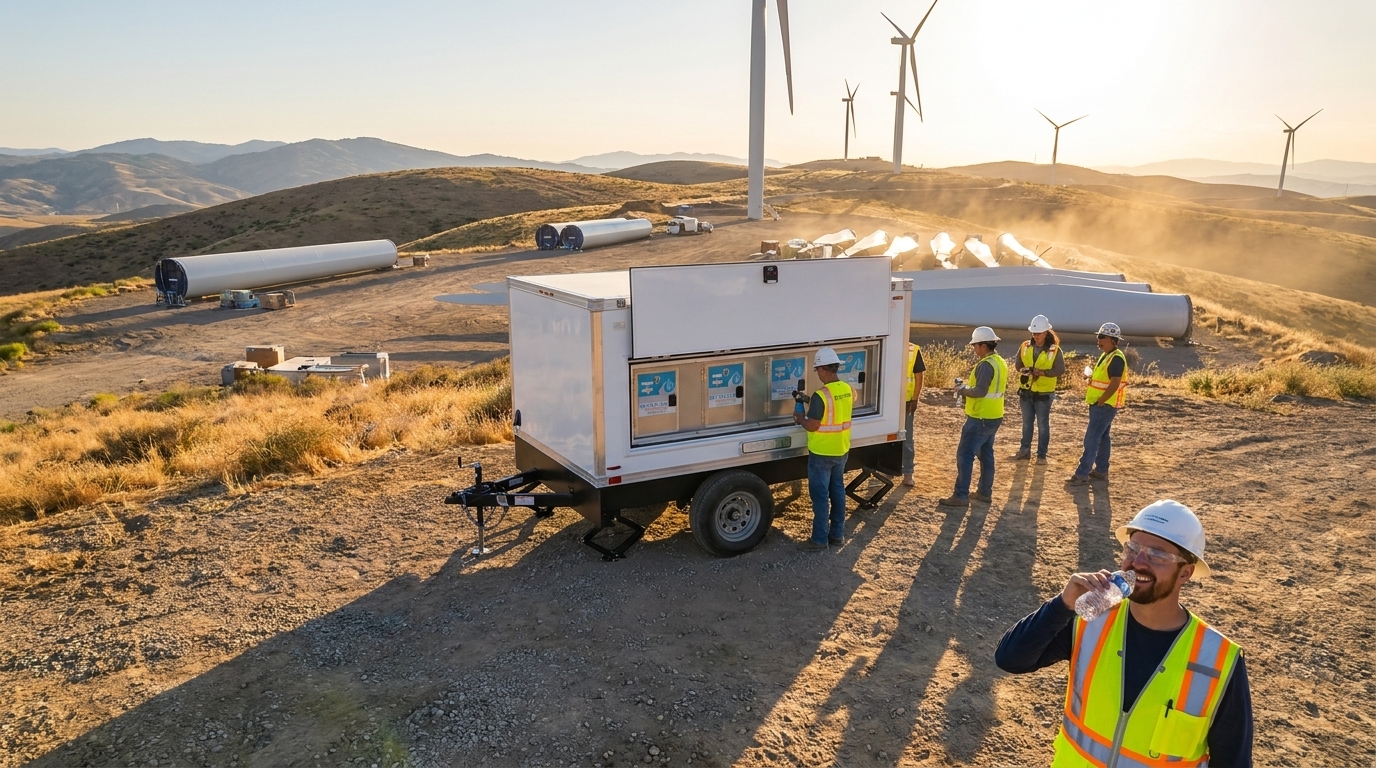
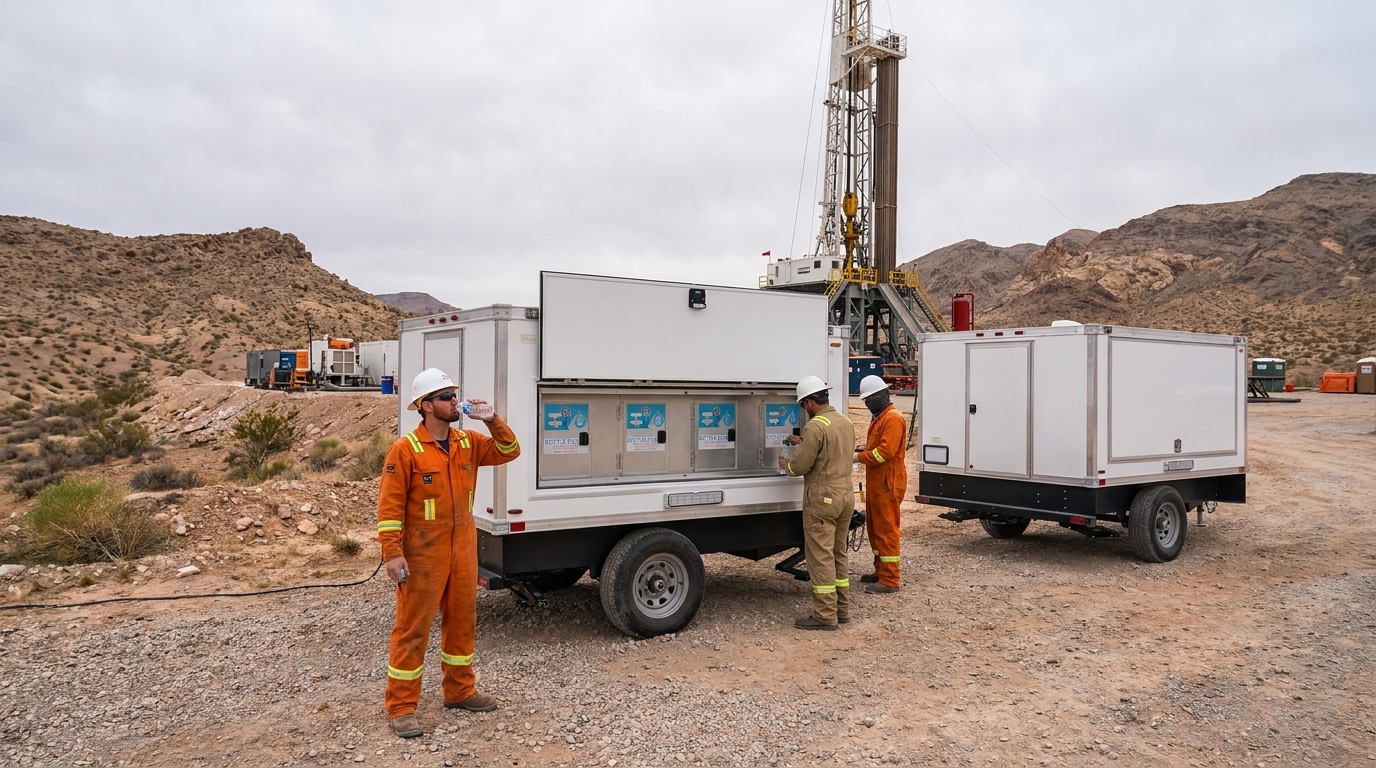
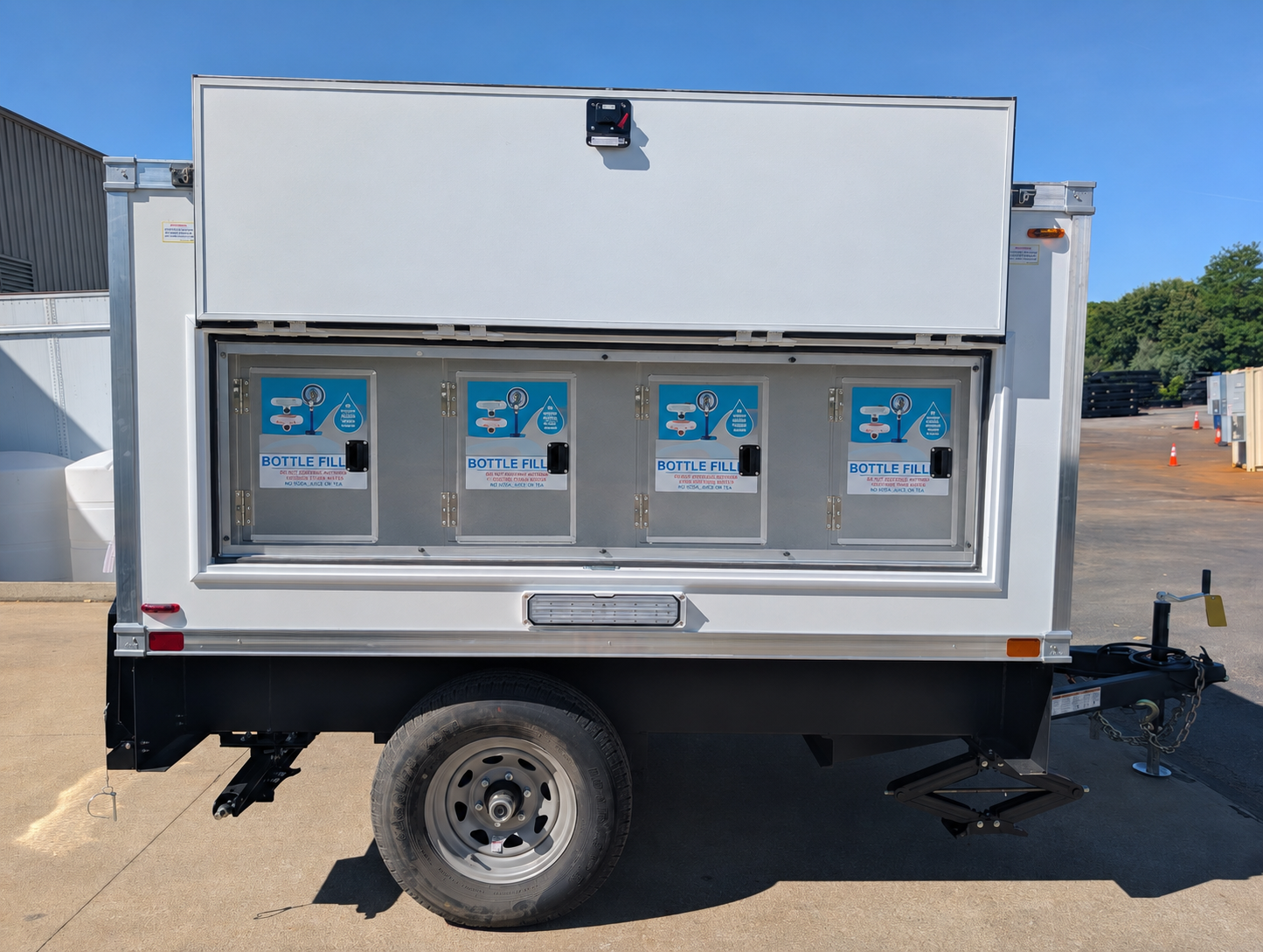
On-Site Hydration Services delivers chilled, filtered drinking water stations anywhere in Colorado, from a downtown Denver concrete pour to a potato harvest on the floor of the San Luis Valley. We tow in the Signature Series trailer, level it, connect the power, and leave it pouring cold water the same day, whether the job is a highway crew on I-25, a festival field in the mountains, or a fire staging yard on the Western Slope. Each trailer carries 300 gallons and feeds four bottle filling stations at once, so nobody walks off the work face to find a drink. Call us now and we will hold a unit for your dates, or request a free quote and we will size the job with you today.
See the Signature Series water station specs
“We had the trailer on the pad before the temporary tap was even scheduled. Crew of forty, no cooler runs, no pallets in the conex, and nobody walking a quarter mile for a drink in August.”
“Eleven days on open fairground, four fill points, and the only thing I had to think about was where to park it. They kept it full through load in and load out and we cut the bottled water order to almost nothing.”
“At 80 degrees the rule says 32 ounces an hour per person and I have to be able to show it. The station is right at the end of the rows, it is cold, and the crew actually uses it. That is the whole compliance conversation now.”
Service information current as of September 2026.
Look at the jobs that keep our number in the truck. A stadium pour on a locked schedule. A runway job inside an airport fence. A sixteen hour festival build with the gates already announced. A harvest crew on ground where the nearest store is 40 minutes of gravel away. None of those crews can send somebody out for water at two in the afternoon, and none of them can eat a lost shift. So we built this fleet around exactly that kind of site, and we run the same playbook from the Front Range to Grand Junction. We are SAM.gov registered, licensed and insured, part of an A plus BBB rated network with a 99.9 percent incident free record. Call us now, or request a free quote and we will confirm your dates today.
One Signature trailer can pour for a weekend concert and be working a slab pour a couple of days later. Hiring one company for your events and a separate one for your worksites makes no sense. Either way, the planning, the delivery, and the refills are ours.
The onboard cooling unit keeps the tank genuinely cold all the way through a Colorado afternoon, and that single detail carries the whole thing. Warm water is water people abandon, and midsummer is exactly when a crew or a crowd is drinking the most. Cold water gets finished, and finishing it is what keeps heat illness off the site.
Typical metro deliveries across Colorado land in about 45 minutes, longer out on the rural routes, and we keep emergency runs going around the clock whenever a heat advisory or a power shutoff hits Colorado. The morning a foreman finds his 40-person crew stuck with one warm cooler, speed is the whole game.
One rule sits under every job we take: water that people walk past might as well not be there. We've stood on a bare Colorado site and watched shrink-wrapped pallets cook next to the job-trailer while the crew baked thirty yards off. We've watched the opposite too, a chilled station ten steps off the work face run bone-dry twice inside one shift. Everything that matters lives in the distance between those two pictures. Which is why we don't drop a unit and disappear. We match it to your headcount or your gate count, set the refill rhythm to how hard you're really pulling on it, and treat a heat call the way you'd want your own treated, meaning right now, because out here one hot hour can swing the whole day.
One trailer covers this entire state because Colorado makes you work at both ends of it. The same Signature Series unit that backs into a fenced lot in downtown Denver will sit on gravel at 7,600 feet in the San Luis Valley, run off a single dedicated circuit, and pour the same cold, filtered water through the hottest part of the afternoon.
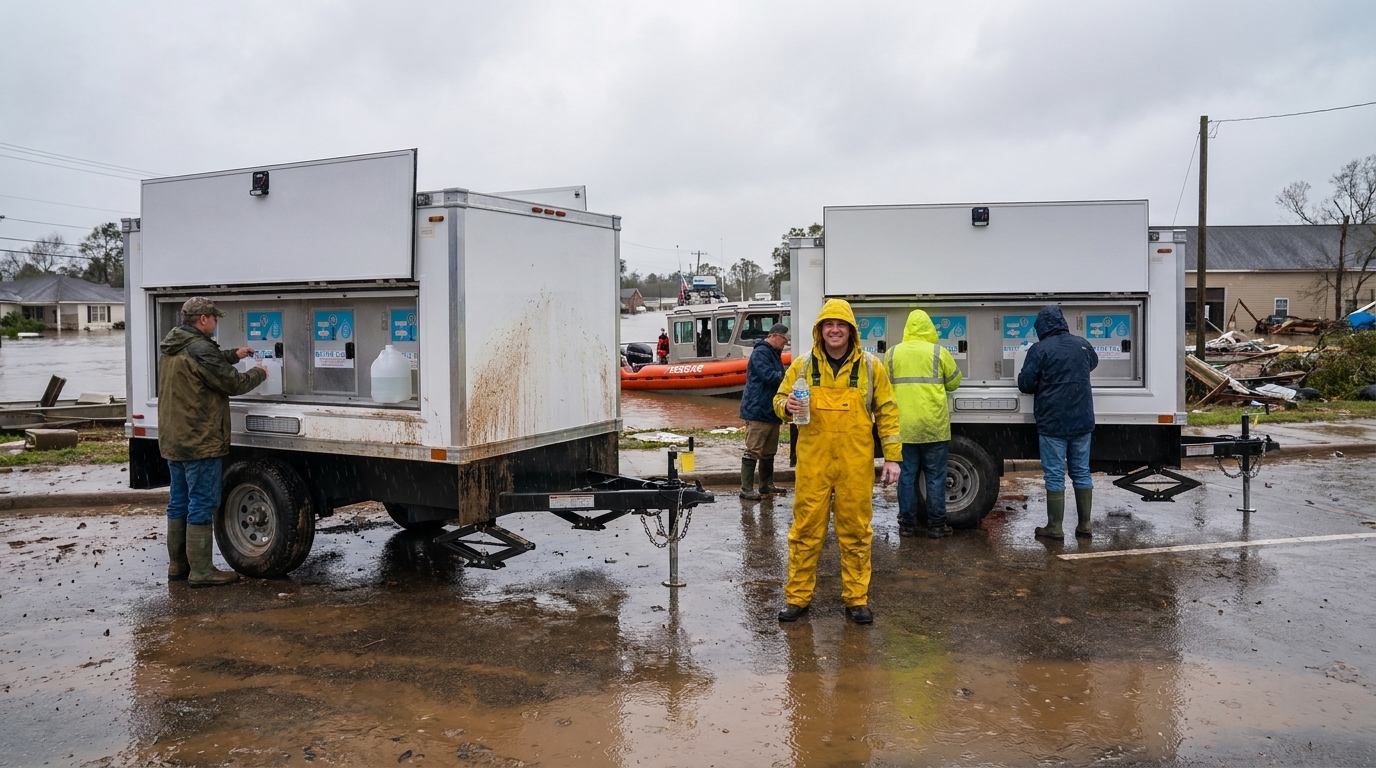
With a frame, a hitch, and tires under it, the unit hauls out to a remote build in Colorado, an event field, a working orchard, or a disaster staging yard with equal ease. Colorado contractors and event planners request this exact rig by name. The whole design is built around backing in, leveling off, and pouring cold by the same afternoon.
| No. of stations | (4) Bottle Filling Stations |
| Length | 12' 3" |
| Weight | 3,100 lbs. |
| Height | 8' |
| Fresh water tank | 300 Gallons |
| Power requirements | 1 to 4 dedicated 20A/120V circuits OR 1 dedicated 50A/240V circuit |
| No. of AC units | 1 |
Colorado mornings start cool enough to fool a crew and then run into 90 degree afternoons with humidity in the teens, so sweat dries before anyone notices they are losing it. Add a mile or more of elevation and the same body loses water through plain breathing faster than it would at sea level on the same thermometer reading.
Statewide mountain snow hit 22 percent of the historic median on April 9, 2026, the lowest reading ever recorded in Colorado, with 97 percent of the state in moderate or severe drought.
The work that keeps our stations moving across Colorado right now: construction and heavy civil along the I-25 and I-70 corridors; aerospace and defense in the Denver to Colorado Springs corridor; oil and gas in the Weld County DJ Basin. Crews also called us during the 2026 Colorado wildfire season, led by the 102,004 acre Aspen Acres Fire across Custer, Pueblo and Huerfano counties.
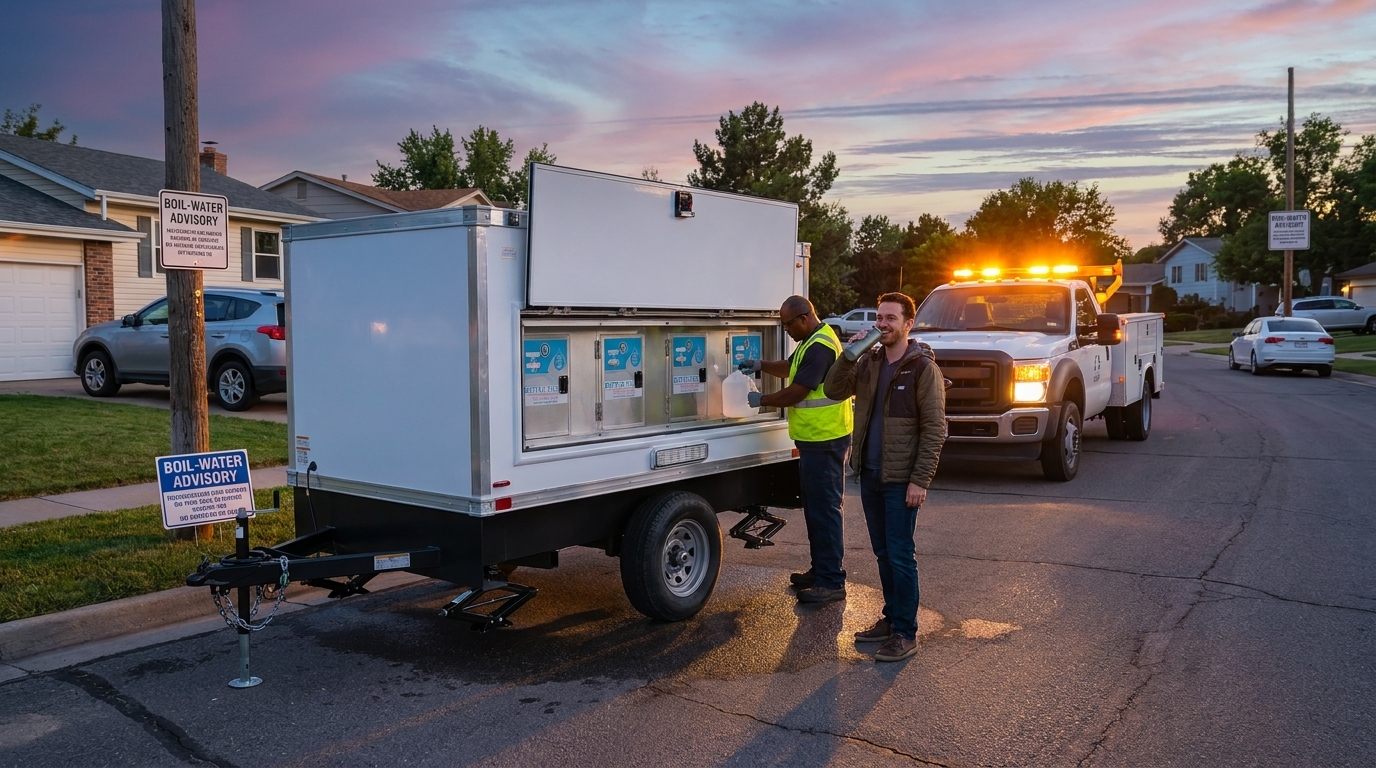
Colorado is building on open ground in every direction right now, and open ground means no fixed tap. Greeley approved a 300 acre entertainment district off Highway 34, anchored by a three sheet hockey arena and an indoor water park. A hotel and conference center round out the district, and construction started in January 2026, putting crews on that site for years. Pueblo's new long rail steel mill runs more than 1,000 direct employees on hot production floors and outdoor material handling yards. Grand Junction has the Salt Flats housing project starting this year, a 72 unit workforce housing build already out of the ground, and a new Costco location coming, all of it crew work on parcels with no permanent connection yet.
Those sites share one problem. The water hookup is the last thing to arrive and the first thing everybody needs. A city water hookup meter is a permit process, a temporary tap is a scheduled connection, and neither one shows up on day one of earthwork. We back a station in where the crew actually stands, level it, plug it into 1 to 4 dedicated 20A/120V circuits or a single 50A/240V circuit, and keep it filled on a schedule we set to your headcount. The superintendent stops thinking about water, which is the entire point.

The Colorado State Fair in Pueblo drew 507,970 people across eleven days in 2026, its highest attendance since 2015 and an 18 percent jump over the prior year. That is a larger single gathering than anything on the Front Range calendar, held on open fairgrounds at the end of August. West of the Divide, the GoPro Mountain Games in Vail runs more than 35 competitions across 11 outdoor disciplines in early June, the Aspen Music Festival and School spreads hundreds of events across eight weeks of tent-covered and outdoor venues, and the Palisade Peach Festival puts a riverside crowd in Grand Valley heat in late August.
Event producers know the math. Pallets of bottled water need a delivery window, a storage footprint, ice, a volunteer to keep restocking, and a plan for the empty coolers, and at the end of the weekend the crowd is still stepping over crushed plastic. One station replaces all of that with four fill points people can walk up to, refill a bottle at, and walk away from. We stage it where your site plan says it belongs, keep it supplied through load in, show days and load out, and handle the pickup when the field clears.
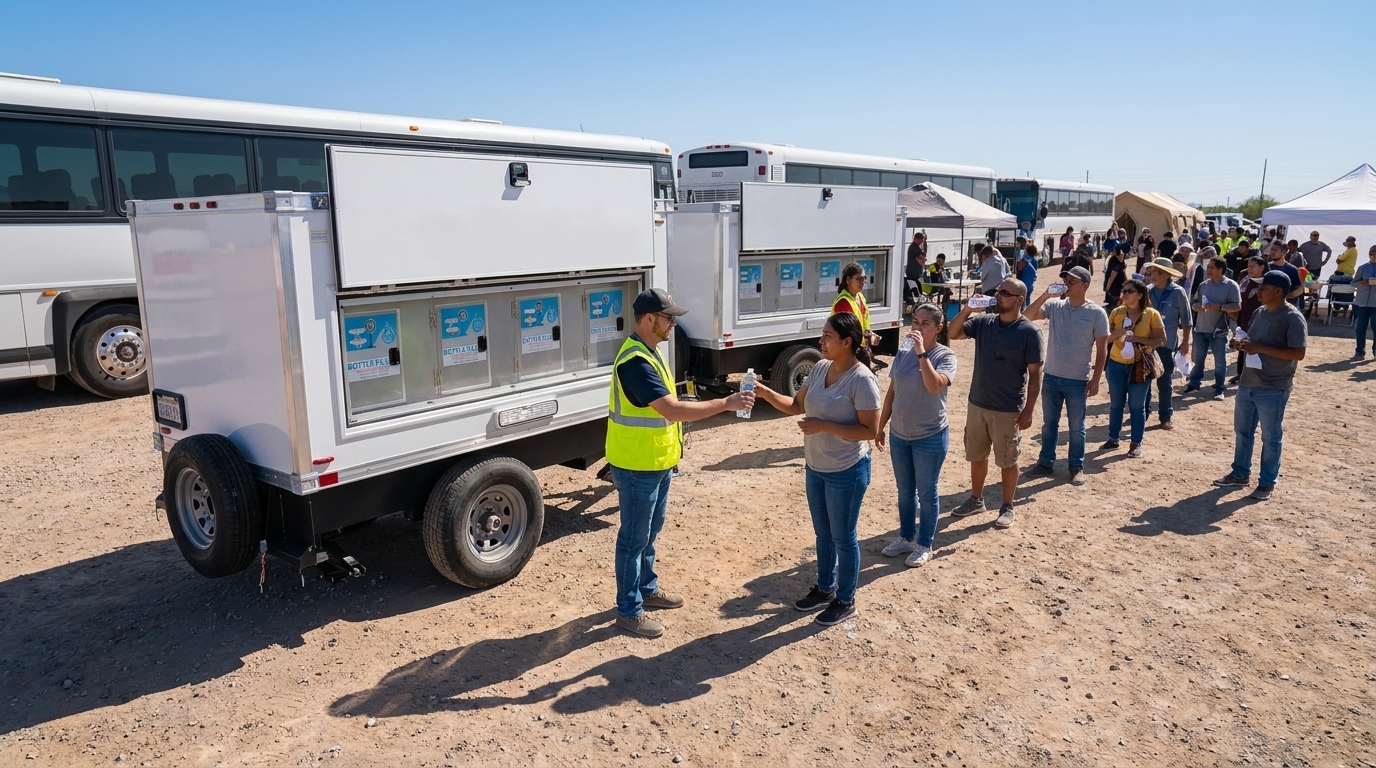
The San Luis Valley is the second largest fresh potato producing region in the country, and it is the single place in Colorado where the law already puts a number on drinking water. At 80 degrees, an agricultural employer owes each worker 32 ounces an hour, plus shade within a quarter mile and cool down periods, and once it hits 95 degrees a 10 minute break is required for every two hours worked. A station parked at the end of the row is the most direct way to answer that requirement, and it answers it the same way every day without anyone hauling coolers.
North of Denver the profile flips from crops to pads. Weld County produces roughly 83 percent of Colorado's crude oil and 56 percent of its natural gas, more than 120 million barrels a year, on flat, shadeless sites and pipeline right of way where the nearest building is a drive. Those crews already work around generators and temporary power, so a trailer that runs on a dedicated circuit and needs no plumbing fits the way the site is already wired. We deliver, fill, and come back before it runs low.
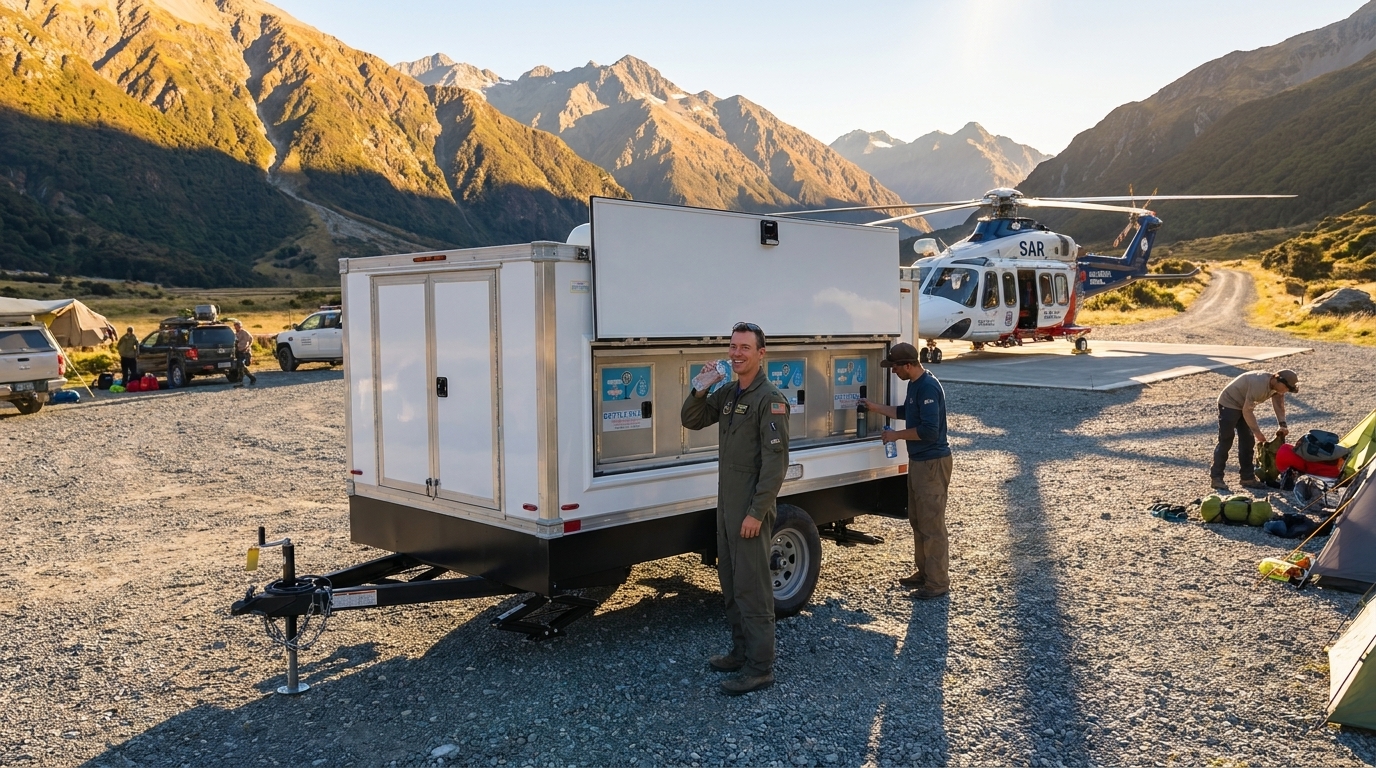
The 2026 Colorado fire season burned roughly 235,000 acres statewide, took three lives, and destroyed 850 structures, and it did not stay on the Front Range. The Aspen Acres Fire crossed Custer, Pueblo and Huerfano counties at 102,004 acres and took more than 850 structures including 319 homes. The Ferris Fire burned 64,881 acres in Montezuma and Dolores counties, the Gold Mountain Fire 39,718 acres north of Ouray, the Snyder Fire 28,264 acres near the Utah line, and grass fires ran the eastern plains in February. Every one of those incidents needed a staging area with people standing in smoke and heat.
Heat events pull the same response. Denver opened close to 50 cooling centers during the 2026 heat waves and sent outreach teams out with water by hand, and state surveillance counted 1,124 people treated for heat stroke or heat exhaustion between May 3 and August 8 of that year across just the 18 most populated counties. Cooling centers are indoor and fixed. The staging lot, the shelter parking, the block an outreach van works out of, none of those have a tap. We take emergency calls around the clock and we roll units to incident command the same day.
Six bottles per person on a 90-degree day in Colorado, a 38-person crew, and you're already at roughly 228 plastic bottles to buy, cart in, ice down, and throw away. That's one day. The season is where it gets ugly.
Multiply across a 175-day build and the tally clears 39,000 bottles, with the larger commercial jobs running far past that. A single trailer makes the entire pile disappear, leaving cold water at the tap and nothing for the dumpster.
Sustainability is the easy part of the pitch. Roughly 60 million plastic bottles get thrown out daily in this country, only about a third are ever recycled, and one bottle can sit in a landfill for centuries. Worth reporting, sure. But the Colorado project managers who actually switch usually do it to kill the daily hassle, not to pad a sustainability slide. A shared trailer means no recurring bottle order, no cooler going warm before first break, no wall of empty jugs baking by the job-trailer. The super runs the build, not the water program.
Because our own potable tankers cover the refills, the supply scales with the job rather than fighting it. Double the crew for a big pour and they still can't drink faster than the plan. And the tankers just swing back and bring the level up.
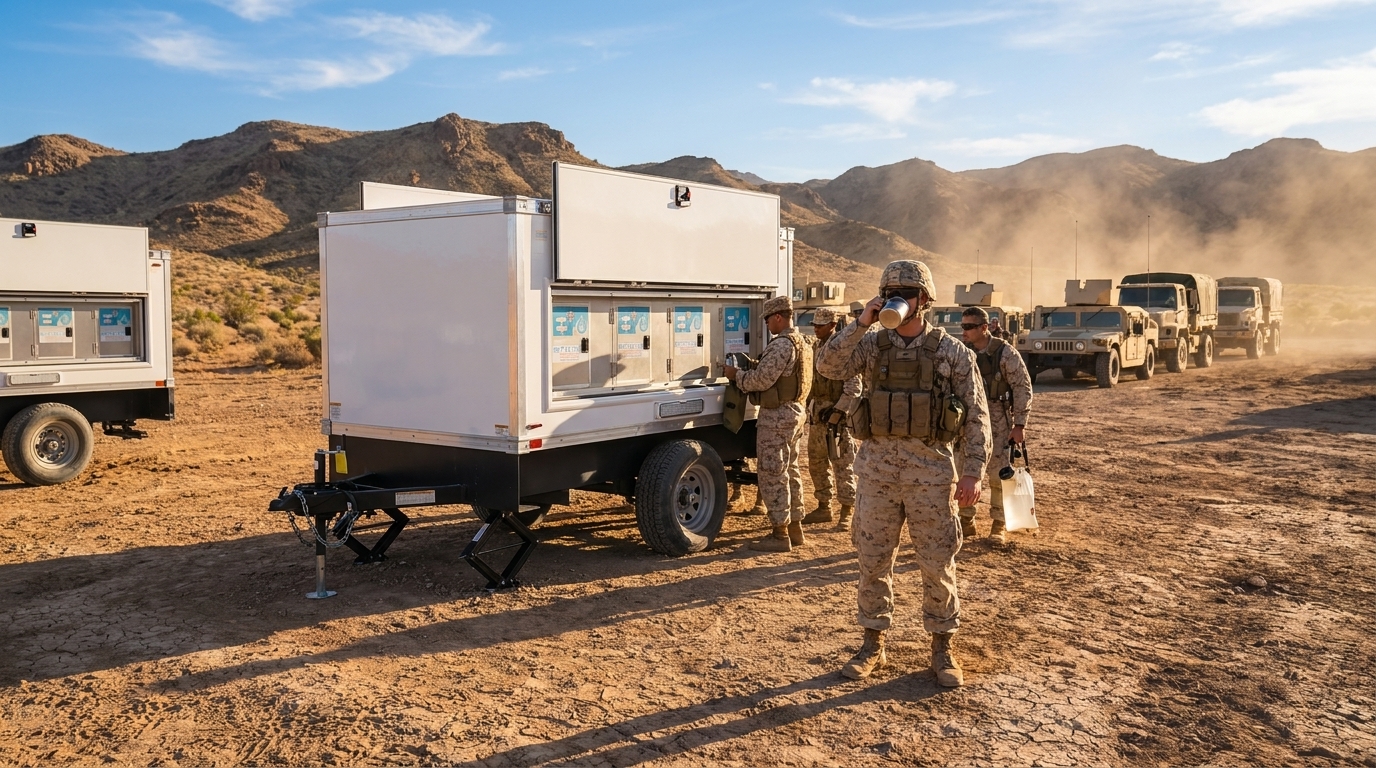
A water source people do not trust gets ignored, and an ignored station is rented money wasted. Colorado water arrives hard, mineral heavy off the Front Range and the Western Slope alike, and hard water tastes like something even when it is perfectly safe. So nothing reaches the tap raw on our trailers. City water passes through three filter stages and a UV chamber, then an onboard cooling unit drops the temperature, and what comes out tastes clean and comes out cold at 5,280 feet or at 9,000. That matters more here than it does at sea level, because dry high altitude air pulls moisture out of a crew through plain breathing before the first bead of sweat shows up, and a crew that likes the taste drinks on their own without anybody reminding them.
The opening filter traps sand, scale, and the fine grit local mains occasionally push through. On a dusty Colorado lot, that's what keeps a pour from tasting like the parcel it's parked on.
Activated carbon comes next, lifting the chlorine bite and the dull seasonal notes local tap can carry until the taste lands clean and neutral. When it's 90 out, that flavor decides whether a crew keeps drinking or walks past the tap dry.
A finer cartridge then catches the microscopic particles that slip past the first two, so what reaches the spout is clear rather than merely cold for the crews and crowds across Colorado.
The last step is an ultraviolet chamber that wipes out bacteria and microbes without adding a single chemical. Even after a long tow to the far edge of Colorado, the water off the nozzle is clean.

Along the wall sit four adjustable push-back taps, press a bottle to the bar and it pours. One of them is set at ADA-reachable height, so a single trailer includes everybody at a Colorado crew or crowd with no add-on gear. Out back, a large-jug spout services five-gallon coolers and hydration packs, while a bank of hose connection taps handles work-site chores, event support, and refills down the orchard rows. Stainless, food-grade plumbing the whole way through keeps the filtered, chilled water at quality right to the spout.
Every Signature trailer carries a 300-gallon load, roughly 2,400 cups at sixteen ounces each, and we recharge it on demand, so the unit doesn't turn into the choke point on a busy Colorado shift or a packed show night.
Federal OSHA state, with one Colorado heat rule of its own. Colorado does not run an OSHA approved state plan, so federal OSHA has jurisdiction over private employers here, and the federal sanitation standard for construction, 29 CFR 1926.51, already requires an adequate supply of potable water on every site, poured sanitarily from covered containers with spigots or fountains and never a shared cup. OSHA also issued again its national Heat Related Hazards Emphasis Program on April 10, 2026 for a five year term, targeting 55 high risk industries with construction and agriculture near the top of the list, which means a heat advisory day in Colorado is also an inspection day. Anyone who tells you Colorado runs its own state OSHA plan is repeating a common mistake, and it matters, because the rule your safety manager is actually judged against here is the federal one.
Colorado is still one of only a handful of states with any heat protection law of its own, and the one on the books today is narrow but exact. Under 7 CCR 1103-15, amended in December 2025 and effective February 1, 2026, an agricultural employer working crews at 80 degrees or hotter must supply at least 32 ounces of clean drinking water per worker per hour, shade within a quarter mile of the work, and preventative cool down periods, with a 10 minute rest break required for every two hours worked once the reading passes 95 degrees. That is the only place in Colorado law where enough water carries a number. Every other industry is now on a clock toward the same kind of paperwork: HB26-1272, signed June 4, 2026 and effective August 12, 2026, puts state data collection in place by January 15, 2027, a state model prevention plan by July 1, 2028, and each covered employer's own written plan in front of the state by September 1, 2028. A rented station is the simplest way to answer the water half of that plan before anybody asks for it.
Federal OSHA heat illness prevention guidance and the CDC/NIOSH heat stress program both point to the same baseline: cool water, close to the work, documented.
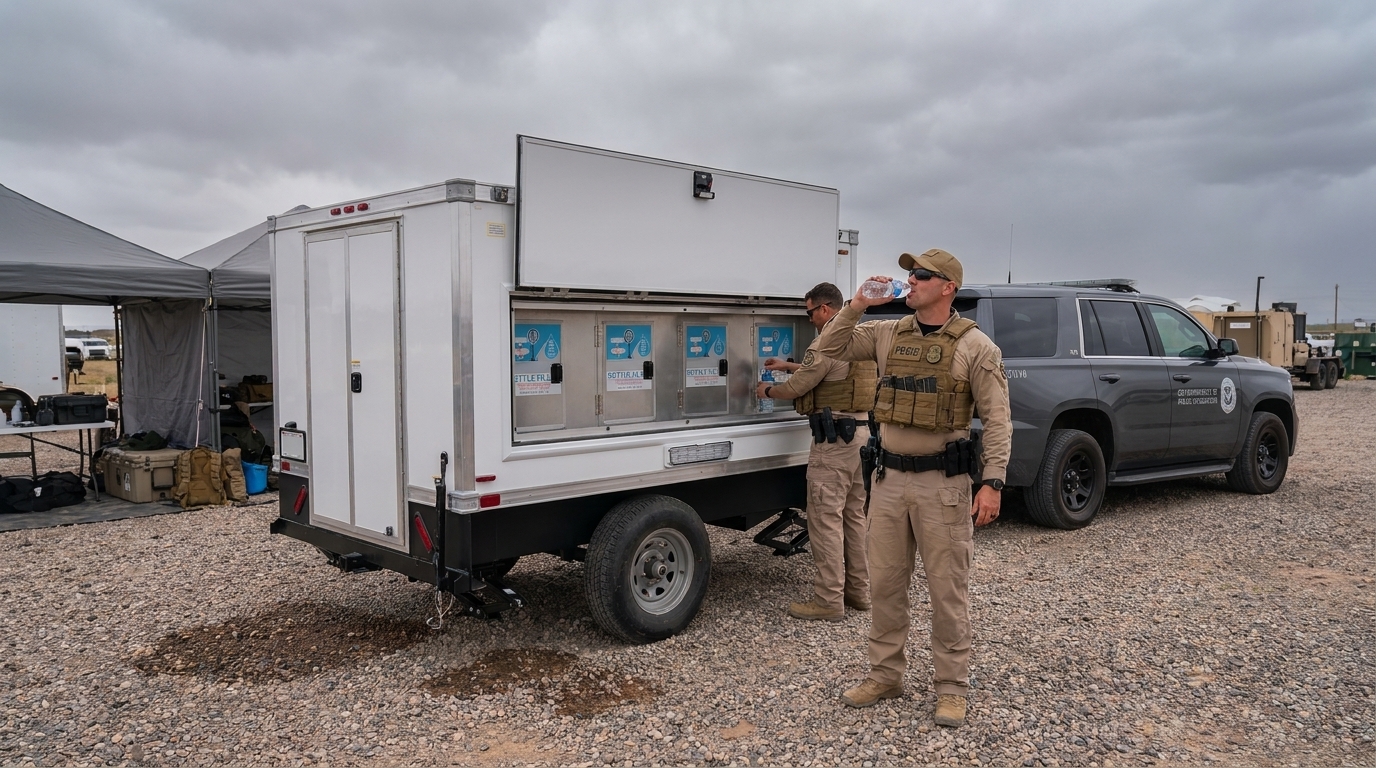
Need a station your written heat plan can point to? We can have one pouring cold within days.
Start with the year itself. Statewide mountain snow hit 22 percent of the historic median on April 9, 2026, the lowest level ever recorded in Colorado, with 95 percent of SNOTEL monitoring stations sitting at or near their own record lows and 97 percent of the state in moderate or severe drought. That same dry winter kept crews from running prescribed burns and set up the fire season that followed. It is not a soft climate claim. It is the measured condition of the ground everyone in this state worked on all summer.
Then the heat landed on top of it. Denver ran 90 degrees or hotter on 28 days in July alone, a record, and logged its first 100 degree readings of the year in the same stretch. Colorado Springs posted its third warmest and seventh driest summer on record with 33 days at 90 plus. Late July brought a four day statewide heat wave that pushed the average temperature across all of Colorado to 78.75 degrees on July 27, with a 113 degree high out at Burlington on the eastern plains.
The part that fools people is elevation. Denver sits at 5,280 feet, Colorado Springs at 6,035, San Luis Valley farm ground above 7,500, and the mountain resort towns above 8,000. Thin, dry air strips moisture out of a person through breathing alone, and low humidity dries sweat so fast a crew never sees it on their shirts. The same 88 degree afternoon that reads as mild in a humid state is quietly working a Colorado crew much harder, which is why race organizers on Pikes Peak warn runners about fluid and electrolyte loss on days that never crack 80.
Now put the state's workload in that climate. Aerospace and defense runs a large contractor base through the Denver to Colorado Springs corridor. Heavy civil and vertical construction is active from the Front Range stadium and airport pipeline through Pueblo's steel expansion to Greeley's 300 acre entertainment district and Grand Junction's housing and retail build out. Weld County pumps more than 120 million barrels of oil a year off open pads. The San Luis Valley farms potatoes at altitude under the one heat rule in this state that already carries a number. Every one of those sectors puts people outdoors, on ground with no building attached to it.
The events calendar fills in the rest of the year. Colorado's outdoor season effectively runs from the Monte Vista Crane Festival in early March through the Colorado State Fair and the Labor Day weekend festivals in Aspen, and the mountain towns lean on it harder every year. The 2025 to 2026 ski season fell to 10.5 million skier visits, down 24 percent and the lowest total since 1991 to 1992, with the state's 26 ski areas averaging only 129 open days against a 20 year average of 144. When winter shrinks, summer visitation carries more of the weight, and summer visitation happens outside.
That is the backdrop the 2026 fire season wrote itself against. Roughly 235,000 acres burned across four regions of the state, with the Aspen Acres Fire alone taking 102,004 acres and more than 850 structures across Custer, Pueblo and Huerfano counties, and fires running the Western Slope, the eastern plains and the far southeast in the same calendar. Emergency water demand in Colorado is not a Front Range pattern, it is a statewide one, and a trailer that can be towed to a staging yard in any of those regions is worth more here than a vendor list that only covers one metro.
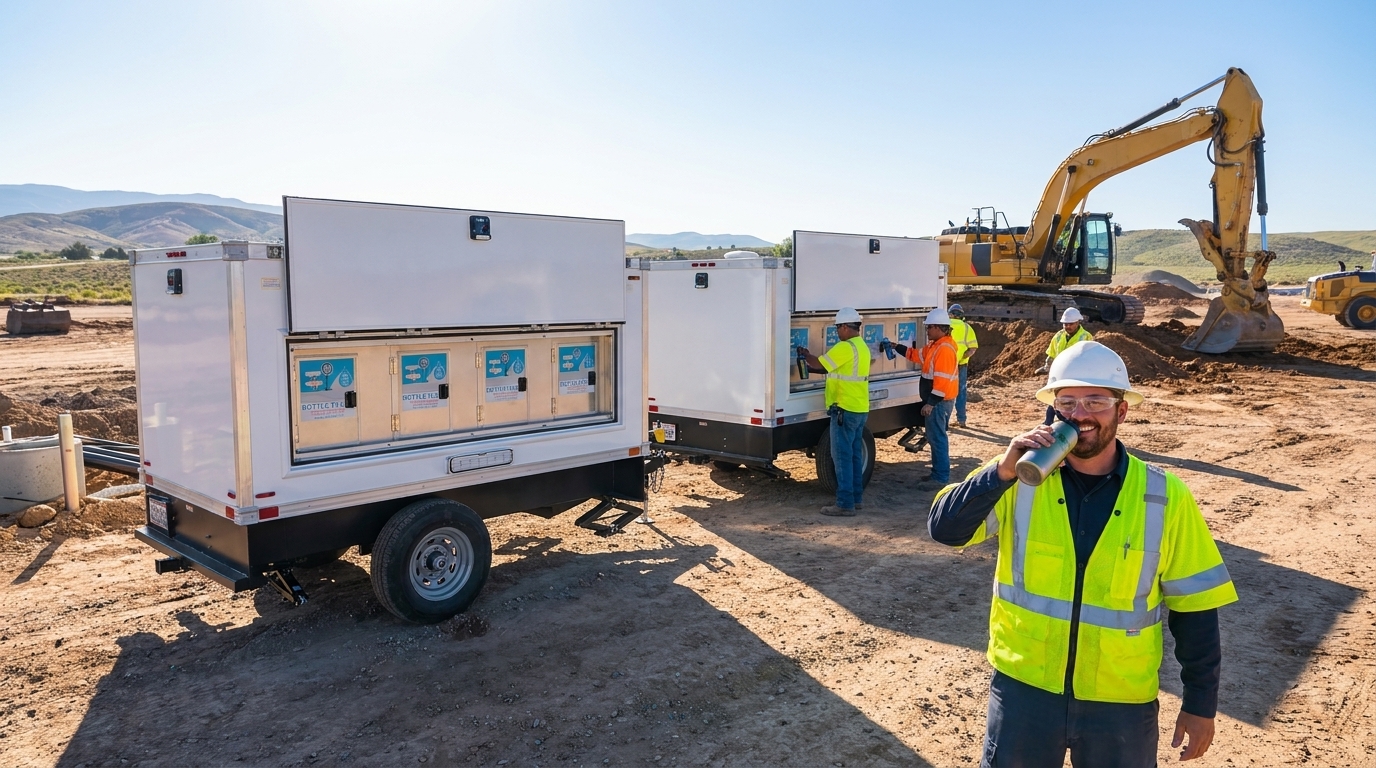
You don't have to run anything on your end. We handle placement, the fresh-water fill, and the power hookup, then walk your team through the unit before we leave the site.
People count, number of days, where exactly it parks on your Colorado site, and what power is there. Those four answers let us spec it correctly the first time around.
Reckon roughly 45 minutes from our nearest yard across the Colorado metros, longer on the outer routes, with round-the-clock emergency runs whenever a heat advisory or a power shutoff hits the area.
Once on site we set it level, charge the 300-gallon tank, and tie in power off one to four standard 120V circuits, or a single 50-amp 240V drop, depending on what the site gives us.
After that the tankers cycle back on a cadence matched to how fast your crew or crowd pulls it down, and we maintain the unit through the whole rental term.
Everyone sees the trailer. What they don't see is the support fleet behind it, the trucks that deliver fresh water, hold reserve on site, and carry wastewater off, so a single call wraps the entire loop rather than stringing together three vendors.
Our tankers run drinking-grade water in bulk, recharging the 300-gallon tank on whatever interval the headcount demands. Those same trucks also top up storage tanks, holding tanks, and bladder bags whenever a single drop can't keep pace, like a big slab pour or a downtown night that packs the square.
When demand spikes we set out fold-flat bladders to bank extra fresh reserve, and on a drain-less lot they'll temporarily hold greywater too. It isn't fancy equipment, but it's what keeps a far-flung job in Colorado pouring between tanker runs.
Water that has to move across a job is a pump truck's job, whether that's charging holding tanks or hauling supply end to end. It earns its keep on the sprawling parcels where the trailer and the fill point can end up a fair hike apart.
At the tail end, a vacuum truck draws off greywater and wastewater and carries it to permitted disposal, closing the loop clean. Nobody on your Colorado crew is left guessing where the used water ended up. That piece was built into the plan from day one.
Every job gets its own setup. A remote parcel might run a station plus a bladder bag for reserve and a recurring water-truck schedule. A heavy event night might call for a pump truck to move supply and a teardown waste run at the end. Describe the shape of your job and we'll put together the right combination, on one invoice, handled by one crew that already knows the ground.
A couple of minutes on the phone is enough for a real quote. Here's what we'll ask, so you can have it ready, and so you can see us tailor your Colorado job instead of giving one stock answer.
We deliver cold water across Colorado, with local crews who know the ground. Pick your metro below, or call and we'll route a trailer to wherever in Colorado the job is.
We run dedicated coverage for water station rentals in Denver, mobile water stations serving Colorado Springs and Aurora drinking water station rentals across Colorado, with local crews who know the ground on every one of those routes.
Denver Metro
→
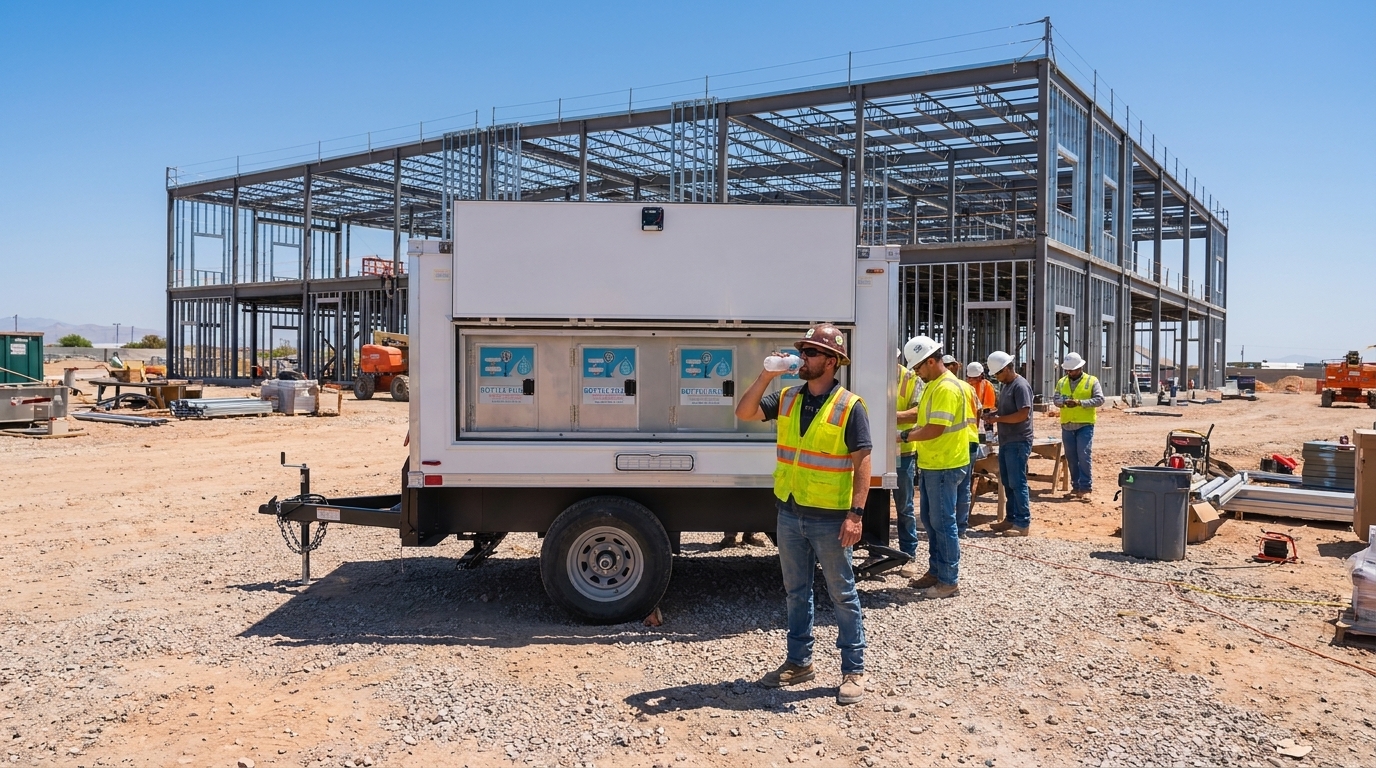
A mile up, with a record 28 days of 90 degree heat last July and a construction pipeline running from the airport fence to the stadium districts. We stage units for jobsites, festivals at Civic Center Park, race courses and city heat response.
 Pikes Peak Region
→
At 6,035 feet with roughly 300 sunny days a year, a military and aerospace contractor base, and summer tournaments and mountain races that push crowds and athletes well above the city. Third warmest summer on record in 2026 with 33 days at 90 plus.
 Denver Metro East
→
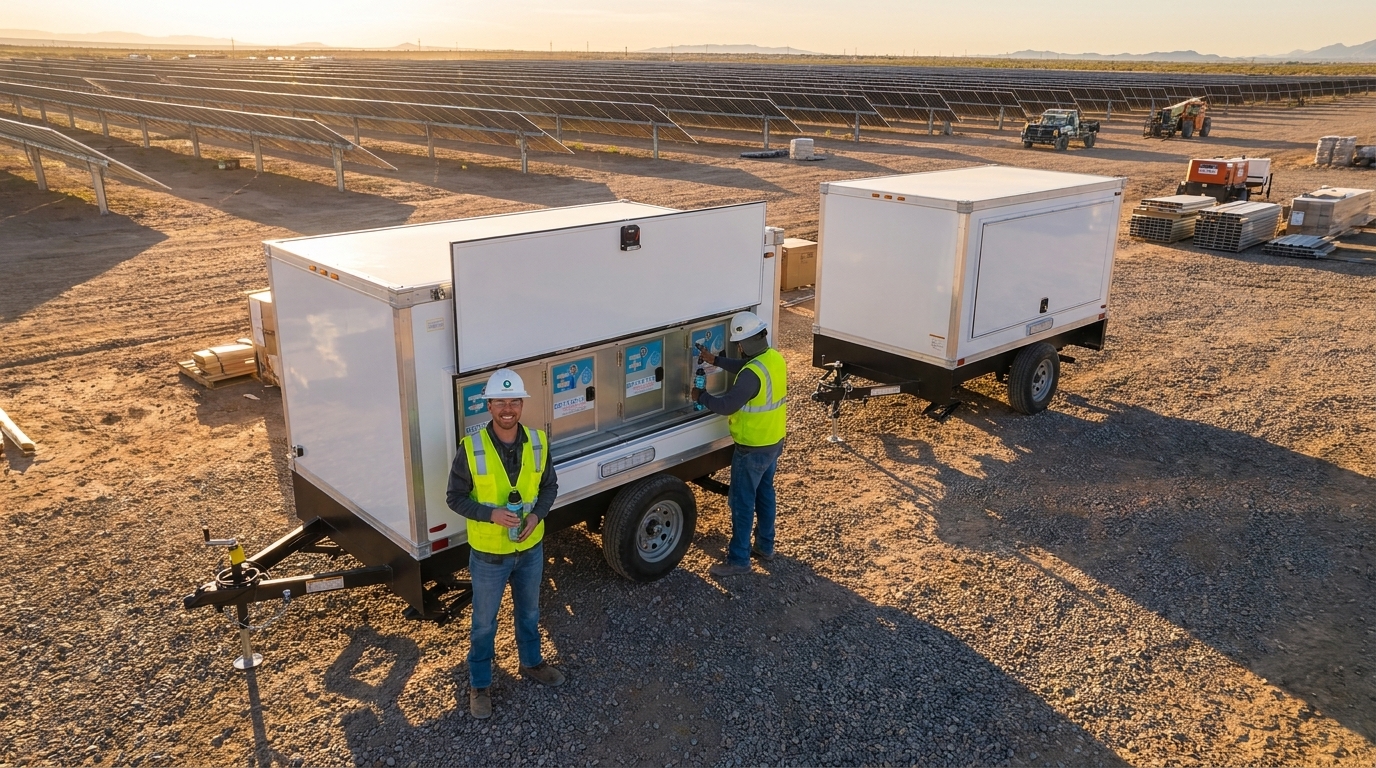
Raw ground and a Stage 1 drought at the same time. The aerotropolis build out and the largest school bond in Colorado history put crews on parcels with no permanent water connection, and a rented station sidesteps the city water hookup meter program entirely.
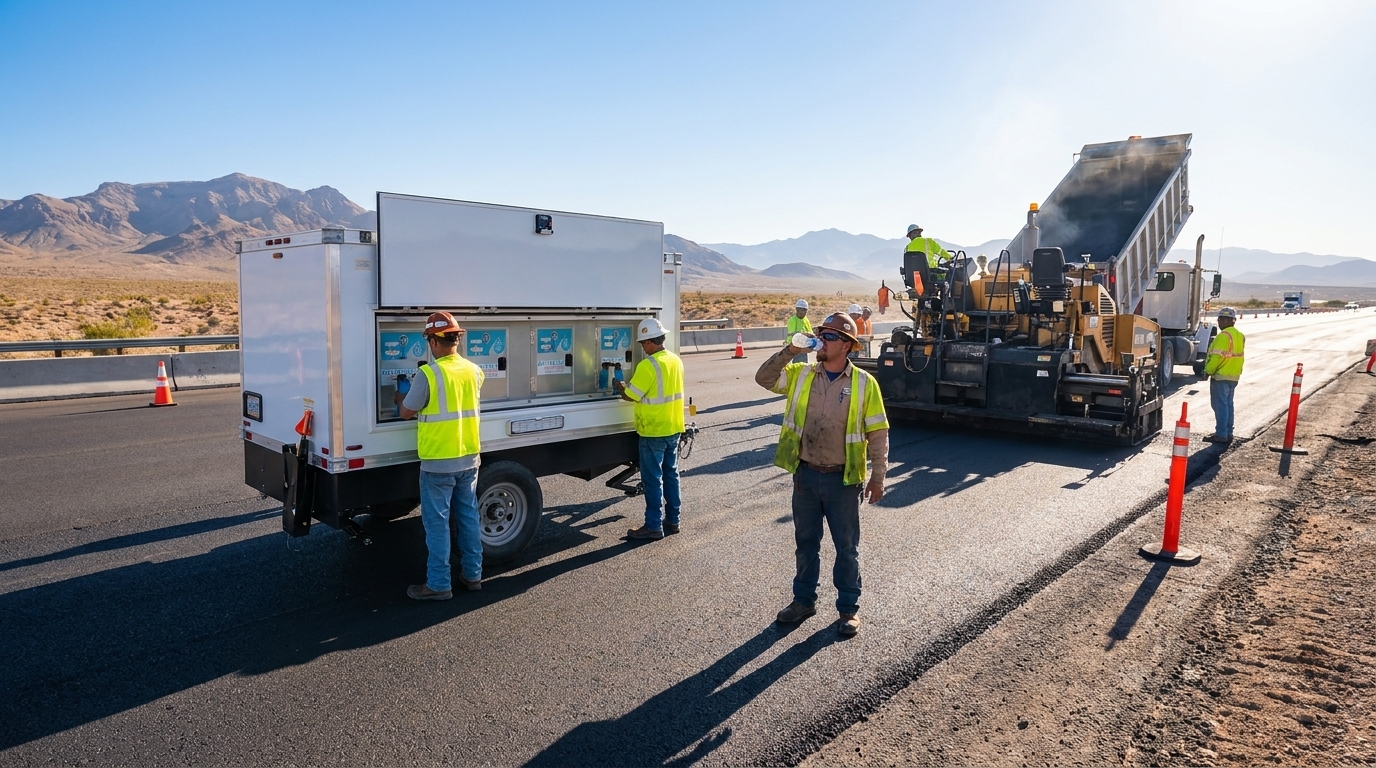
We also route stations to these Colorado markets, even where we don't yet keep a dedicated city page:
Still weighing it? Call and ask. Most of these questions get settled in one short conversation. See also: Denver water station trailer rentals, Colorado Springs drinking water station rentals and Aurora water station and hydration rentals.
Same day or next day for most of the state, and we take emergency calls around the clock. The I-25 corridor from Fort Collins through Denver, Colorado Springs and Pueblo is our fastest run, and I-70 carries us west to Grand Junction and out to the mountain resort towns. A Western Slope or San Luis Valley delivery is a longer single corridor haul, so give us as much notice as you can and we will hold a unit for your dates. Call with the date and the drop point and we will tell you on that call what we can do.
Anywhere in the state. We run dedicated coverage for Denver, Colorado Springs and Aurora, and we route units well past those metros: Fort Collins and Greeley and the Weld County oil fields, Pueblo and the steel and fairgrounds work there, Grand Junction and Mesa County, the mountain towns off I-70 and Highway 82, the San Luis Valley down US-285 and CO-17, and the eastern plains. If a truck can reach the site, we can put a station on it.
Both, and the cold is the part people actually notice. City water goes through three filter stages and a UV chamber on board, then an onboard cooling unit drops the temperature before it ever reaches the spout. Warm water in a Colorado August gets walked past, and a station people walk past is money you spent for nothing. Cold water with no mineral taste gets used without anybody having to remind the crew.
Each Signature Series trailer carries a 300 gallon fresh water tank and feeds four bottle filling stations, so several people can fill at once instead of queuing. We set the refill schedule before the unit leaves our yard, based on your headcount or gate count and how hard the job will pull on it, and Colorado's dry air means we plan a tighter rhythm here than the same trailer would need at sea level. Our own trucks bring the refills, so you are not chasing a second vendor.
It covers the water half of it cleanly. Colorado does not run its own OSHA approved state plan, so federal OSHA has jurisdiction over private employers here, and 29 CFR 1926.51 already requires an adequate supply of potable water on every construction site, poured sanitarily and never from a shared cup. OSHA's national Heat Related Hazards Emphasis Program was issued again on April 10, 2026 for five years and targets construction and agriculture among 55 high risk industries. Colorado's own heat rule, 7 CCR 1103-15, applies to agricultural employers and sets a hard number, 32 ounces per worker per hour at 80 degrees, with a 10 minute break every two hours once it passes 95. HB26-1272 then puts every other Colorado industry on a path toward a written temperature injury prevention plan filed with the state by September 1, 2028. A delivered, documented, mappable station is the simplest way to have the water piece already answered.
Yes. The unit includes an accessible fill point reachable from a seated position, so a worker or an attendee using a wheelchair fills a bottle at the same station as everyone else rather than being sent somewhere separate. Tell us about the ground you are parking us on and we will place the trailer so the approach is level and the path stays clear.
Both are our normal week. On the event side we stage through load in, show days and load out, and we size the unit count to the gate rather than to the acreage, because 500,000 people across eleven days at a fairground is a different problem than 4,000 spectators at a mountain race. On the jobsite and pad side we work around temporary power, gravel access and a crew that moves as the work moves. Same trailer, different placement plan, and we build that plan with you on the quote call.
Four answers get you a real quote in a couple of minutes. How many people will be drinking from it, how long you need it, where exactly it will park, and what power is available at that spot. If you already know you have 1 to 4 dedicated 20A/120V circuits or a single 50A/240V circuit, say so and we will confirm the hookup on the call. If you do not know yet, describe what is on site and we will work it out with you.
Yes, and it is a large part of what we do in this state. The 2026 season burned roughly 235,000 acres across four regions of Colorado, with the Aspen Acres Fire alone at 102,004 acres across Custer, Pueblo and Huerfano counties, and heat waves that same summer sent Denver into a near 50 site cooling center activation. Staging lots, shelter parking and outreach blocks do not come with a tap. Call our emergency line with the incident location and we will roll a unit to command.
Give us the headcount or crowd, the dates, and the spot it'll park. We'll match the job and roll a trailer out anywhere in Colorado.
We added these Colorado cities to the delivery map. The stations, the filtration and the crew on the phone are the same ones the rest of the state already relies on.
We added this Colorado city to the delivery map. The stations, the filtration and the crew on the phone are the same ones the rest of the state already relies on.
We added this Colorado city to the delivery map. The stations, the filtration and the crew on the phone are the same ones the rest of the state already relies on.
These Colorado cities joined the route this season. Each page covers local delivery, water hookups on site and the venues and jobsites we serve there.
These Colorado cities joined the route this season. Each page covers local delivery, water hookups on site and the venues and jobsites we serve there.
These Colorado cities joined the route this season. Each page covers local delivery, water hookups on site and the venues and jobsites we serve there.
Our Colorado routes keep growing. Alongside the metros above, our drivers now set up chilled, filtered water stations in the cities below, with the same trailers, the same filtration and the same dispatch line.