We deliver chilled, filtered water stations to fairgrounds, carnival lots and rodeo arenas, set level and pouring cold before the first gate opens. One Signature Series trailer covers a midway, a grandstand concourse or a barn aisle, with four push-back bottle taps, one at ADA-reachable height, and a rear spout that fills five-gallon coolers for vendor rows and crew camps. Fair boards, carnival companies and rodeo committees book us for single weekends and for runs that go seventeen days straight. Call us with your dates and gate count, or ask for a free quote, and we will hold the truck.
Licensed and insured | A+ BBB rated | 24/7 dispatch
See the Signature Series water station specs
“Our fair runs eleven days and the midway is the hottest ground we have. Putting a cold water station right at the ride line meant our first aid tent stopped being where people went for a drink. They set it the morning before gates and we never thought about it again.”
“We book lots with no water and no power, so I ask one question first. Can you bring all of it. They showed up full, tied into our generator and kept it filled all week. My ride crews stopped vanishing on store runs.”
“Barns close at ten and open at six, and the kids still have to water their animals on schedule. A station at the wash rack end of the aisle saved our families a long walk with buckets in August. Our superintendents noticed the first morning.”
References for this kind of booking are available on request.
We have put chilled water stations on fairgrounds long enough to know the ground changes every hundred feet. The midway is gravel and open sun. The barns are busy at six in the morning and still busy at ten at night. The grandstand fills and empties in about twenty minutes around a rodeo performance. So we plan a fair the way a fair board plans it, zone by zone, instead of dropping one trailer by the front gate and calling the grounds covered. That is how we run Portland Oregon water trailer rentals and every other market our trucks work. Call us and we will walk your site map with you, or send the run dates and the gate count and we will have a free quote back the same day.
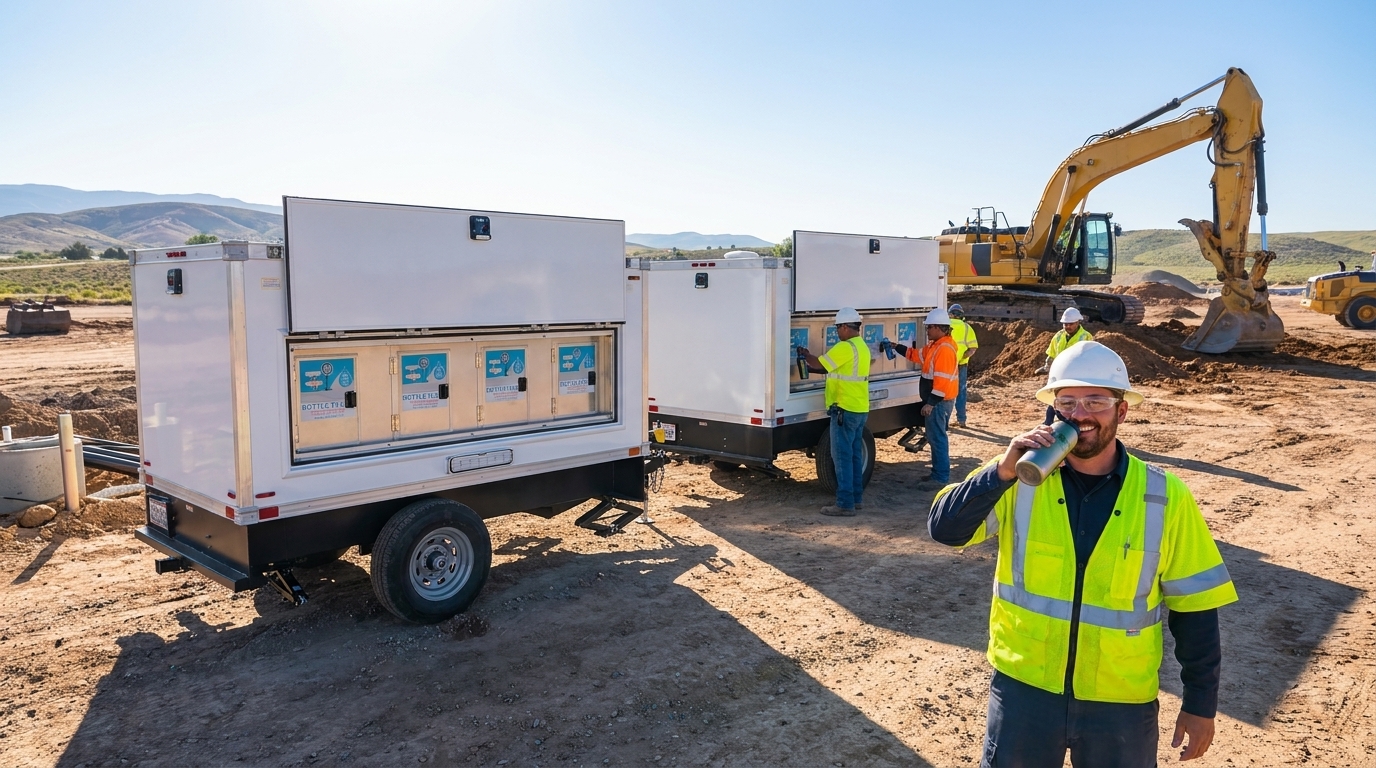
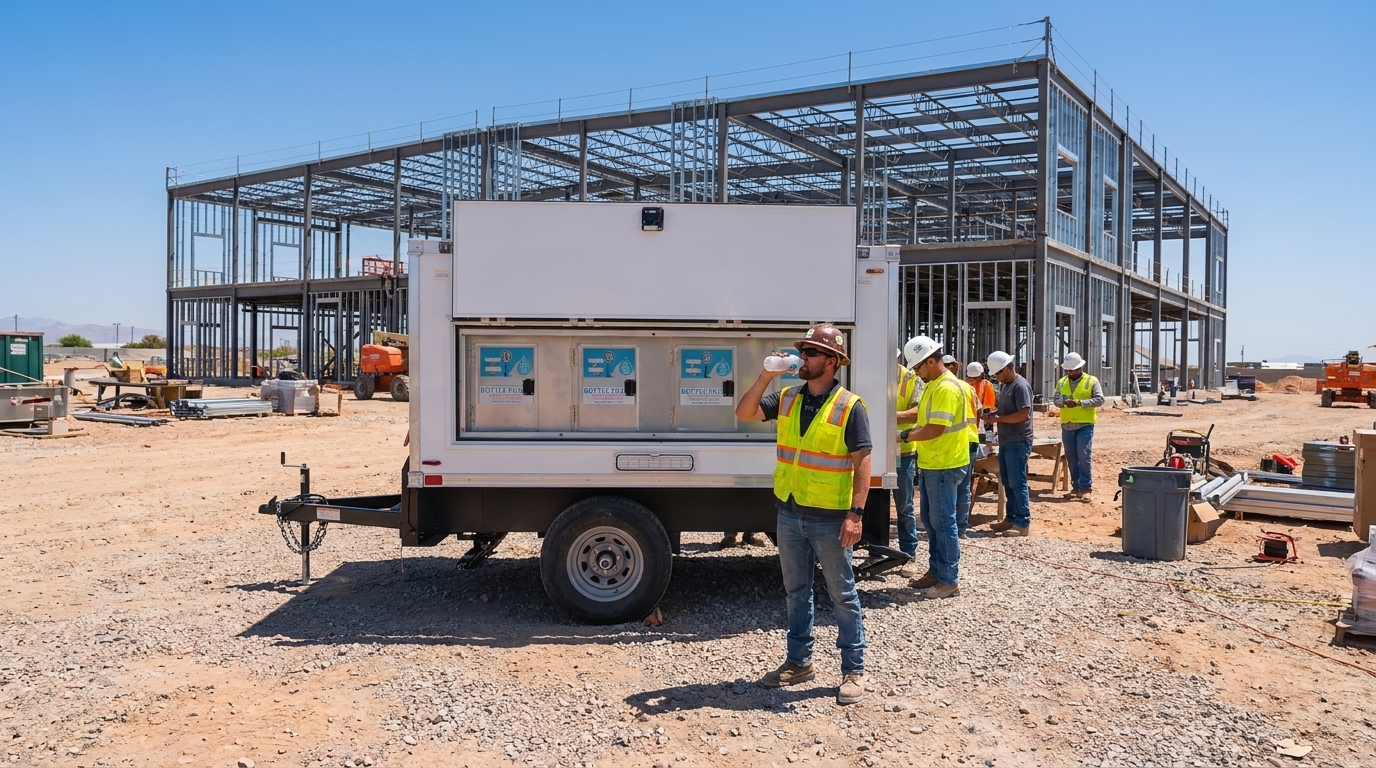
One Signature trailer can pour for a weekend concert and be working a slab pour a couple of days later. Hiring one company for your events and a separate one for your worksites makes no sense. Either way, the planning, the delivery, and the refills are ours.
The onboard cooling unit keeps the tank genuinely cold all the way through a long afternoon outdoors, and that single detail carries the whole thing. Warm water is water people abandon, and midsummer is exactly when a crew or a crowd is drinking the most. Cold water gets finished, and finishing it is what keeps heat illness off the site.
Typical deliveries land in about 45 minutes once a truck is rolling in your metro, longer out on the rural routes, and we keep emergency runs going around the clock whenever a heat advisory or a power shutoff hits. The morning a foreman finds his 40-person crew stuck with one warm cooler, speed is the whole game.
One rule sits under every job we take: water that people walk past might as well not be there. We've stood on a bare site and watched shrink-wrapped pallets cook next to the job-trailer while the crew baked thirty yards off. We've watched the opposite too, a chilled station ten steps off the work face run bone-dry twice inside one shift. Everything that matters lives in the distance between those two pictures. Which is why we don't drop a unit and disappear. We match it to your headcount or your gate count, set the refill rhythm to how hard you're really pulling on it, and treat a heat call the way you'd want your own treated, meaning right now, because out here one hot hour can swing the whole day.
We deliver water stations to job sites, venues and event grounds in all 50 states, with the heaviest route coverage across the West.
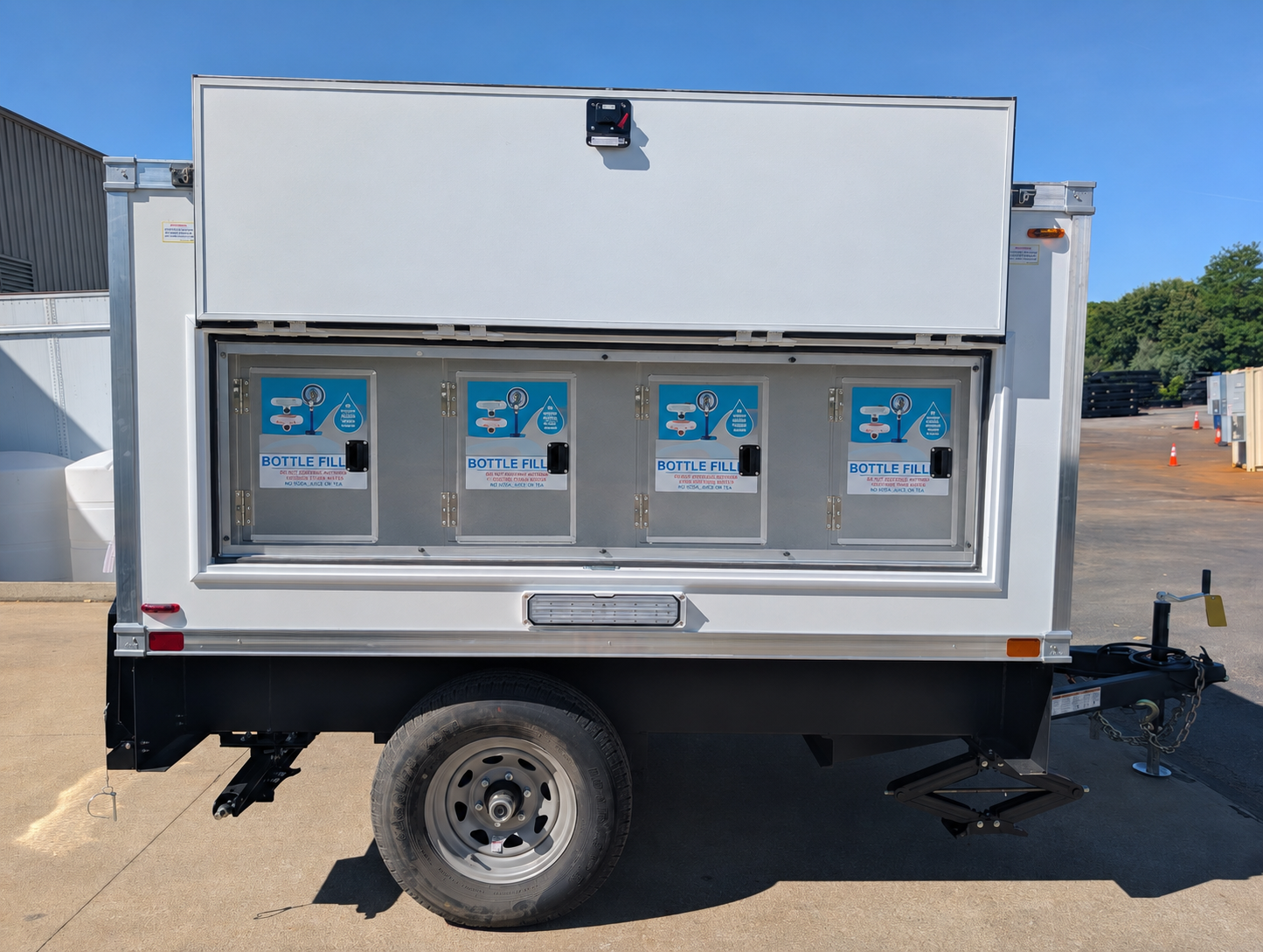
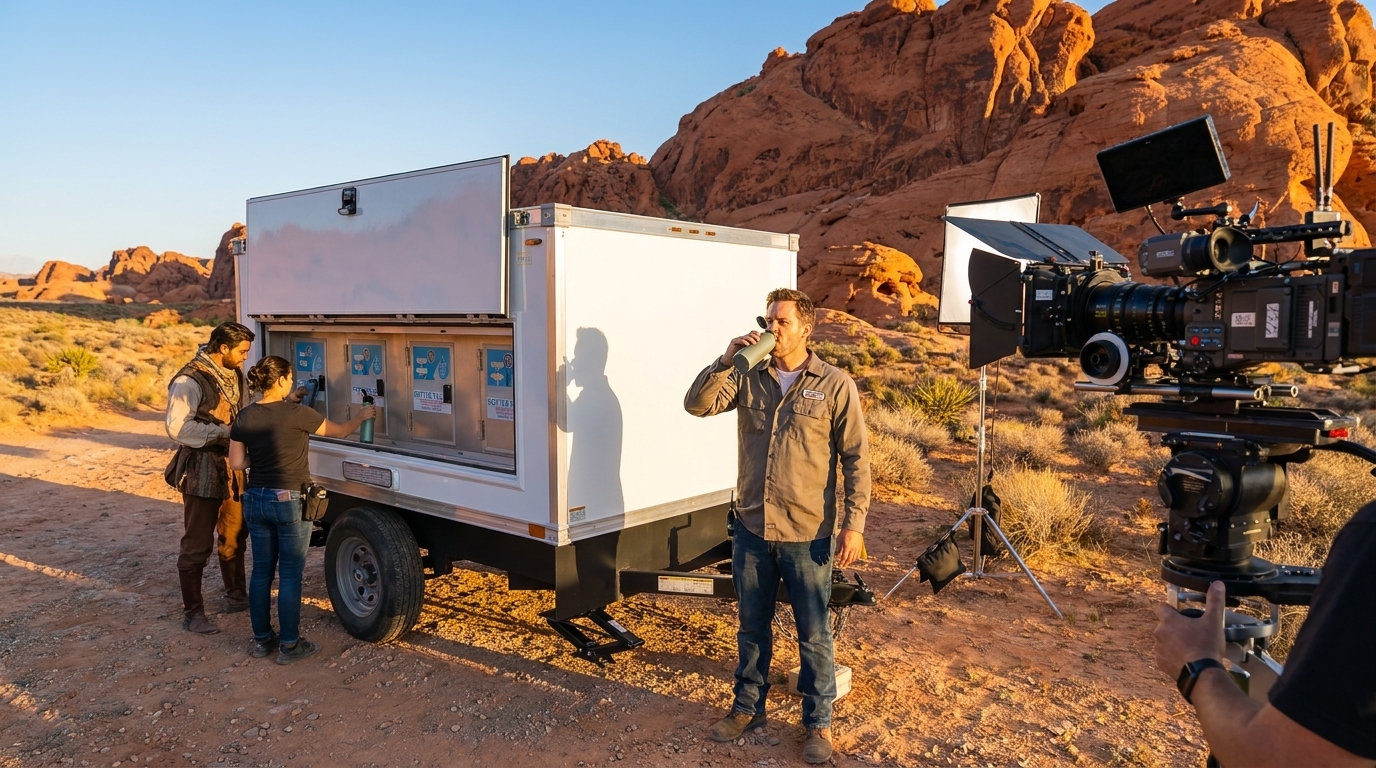
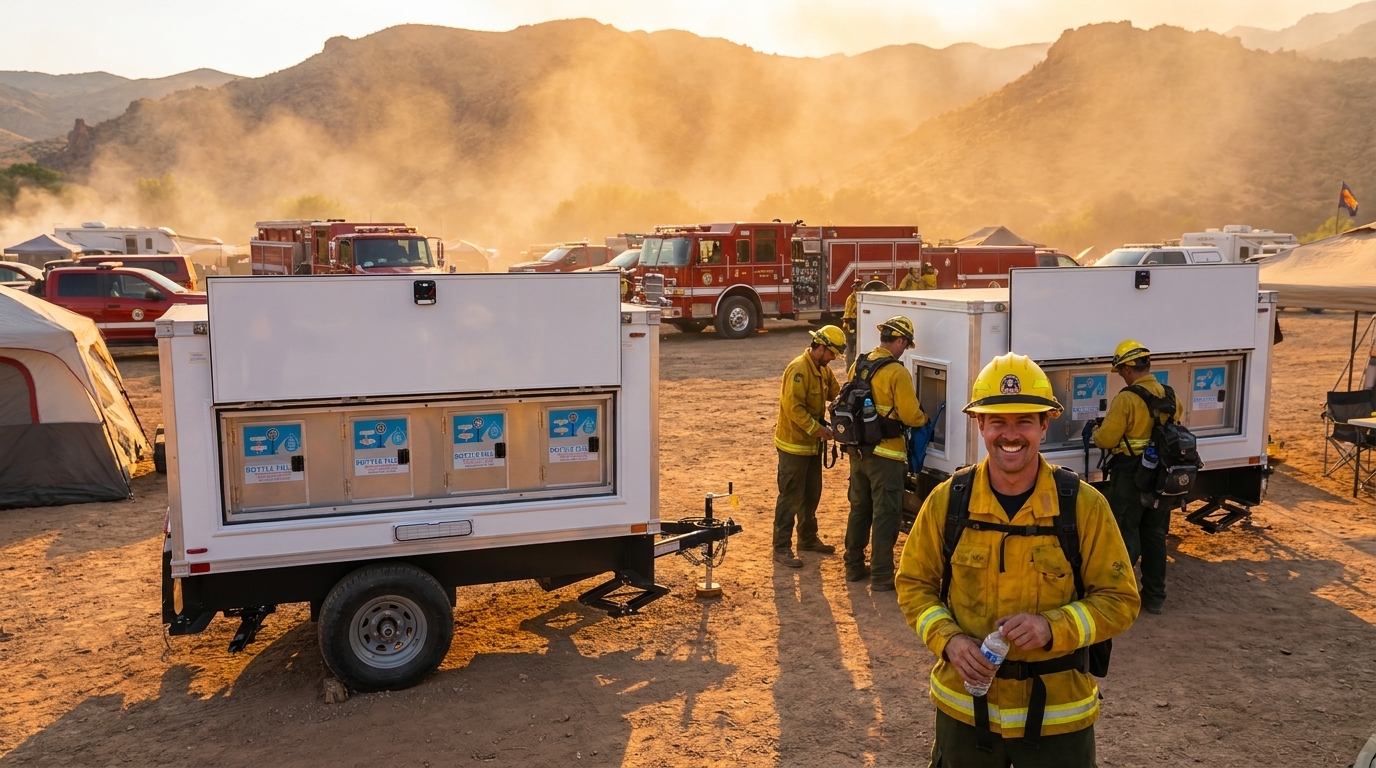
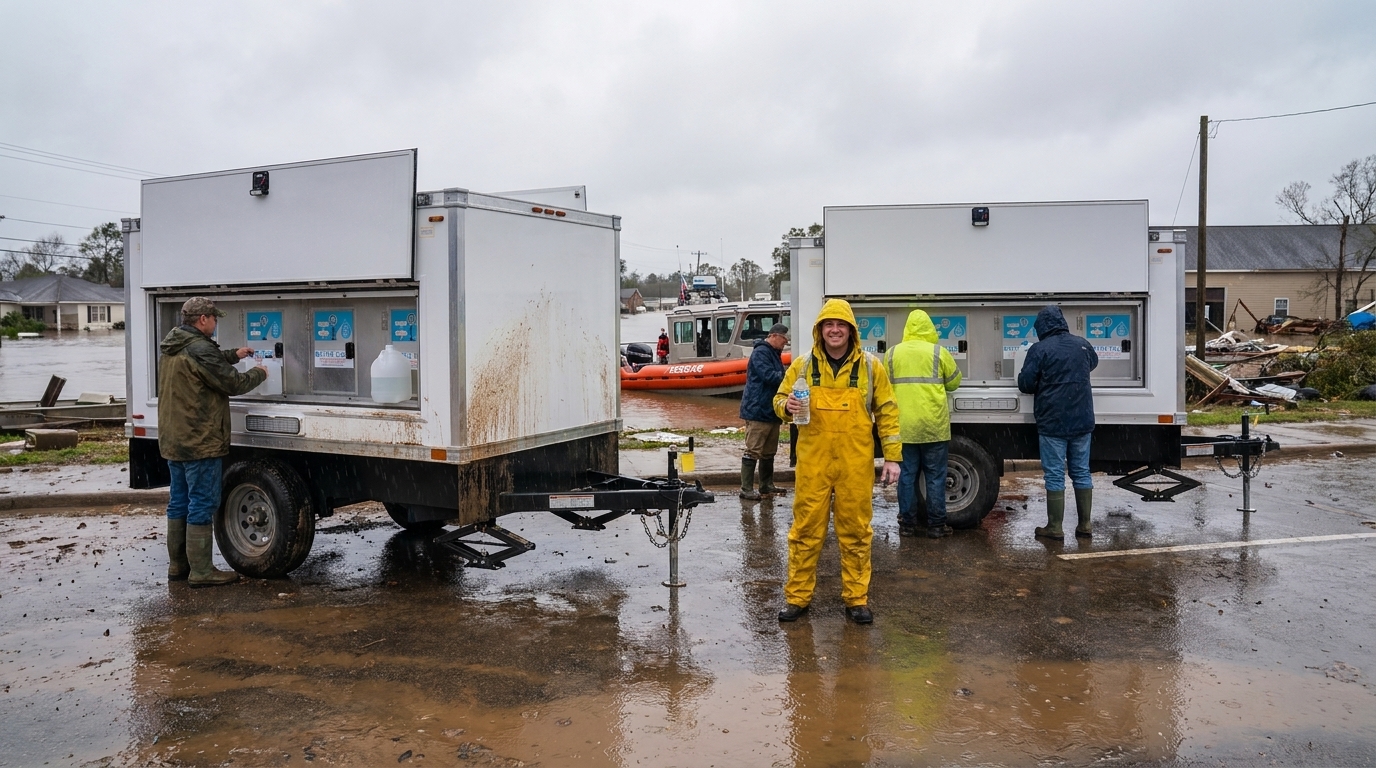
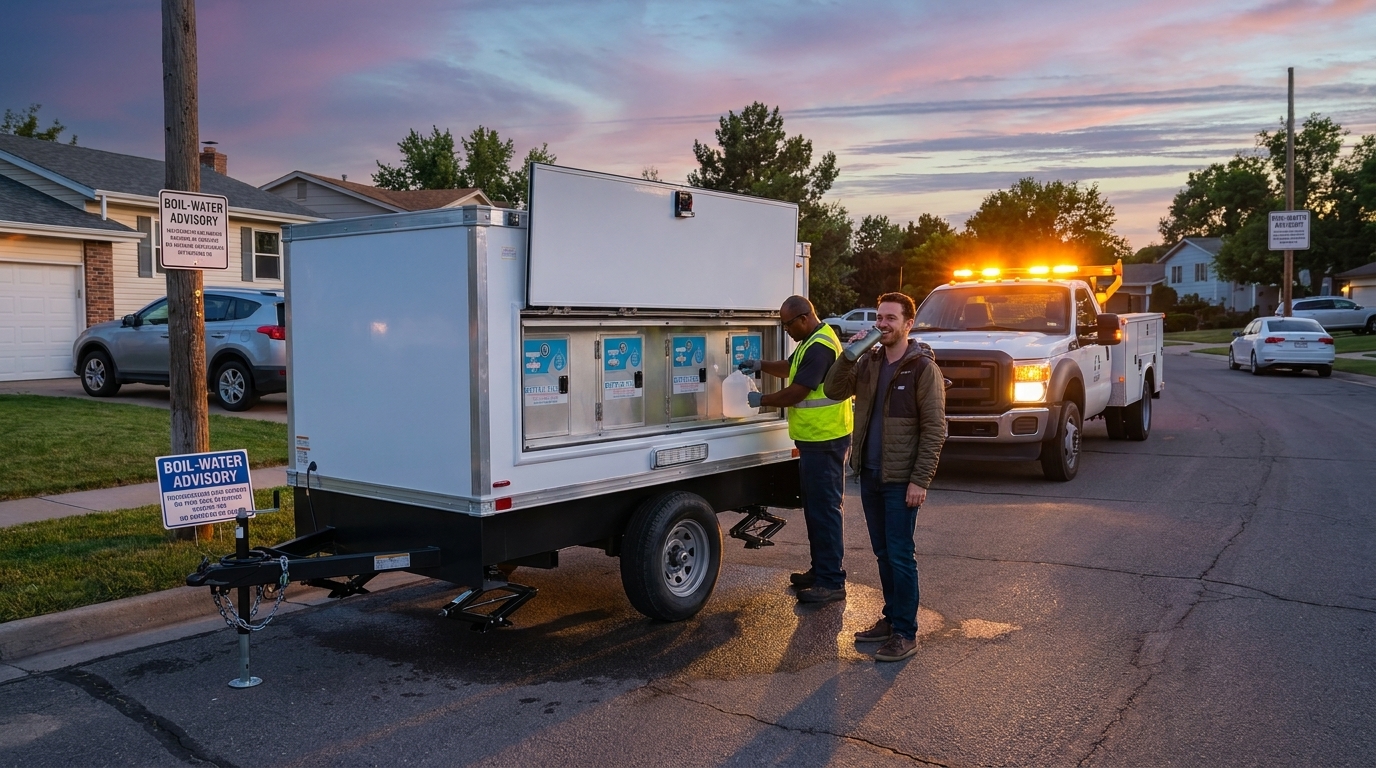
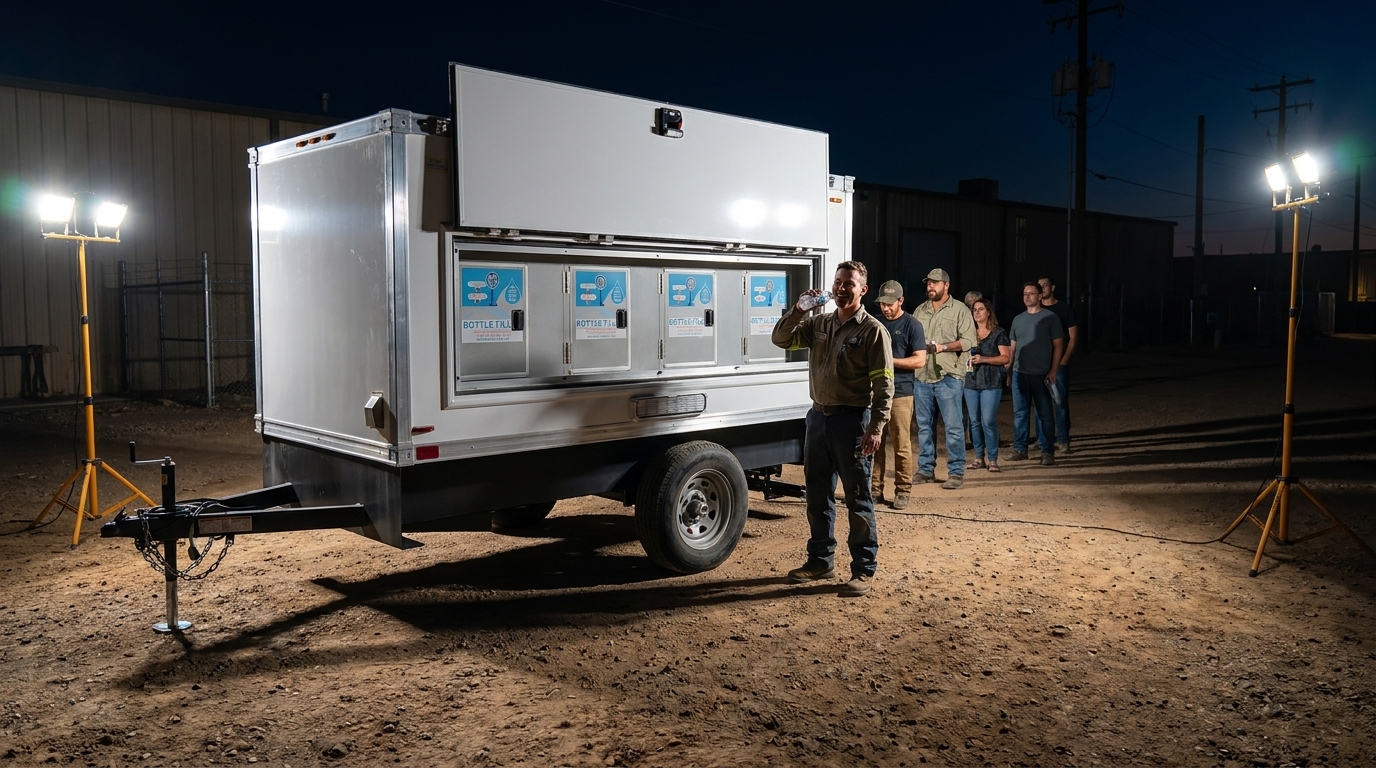
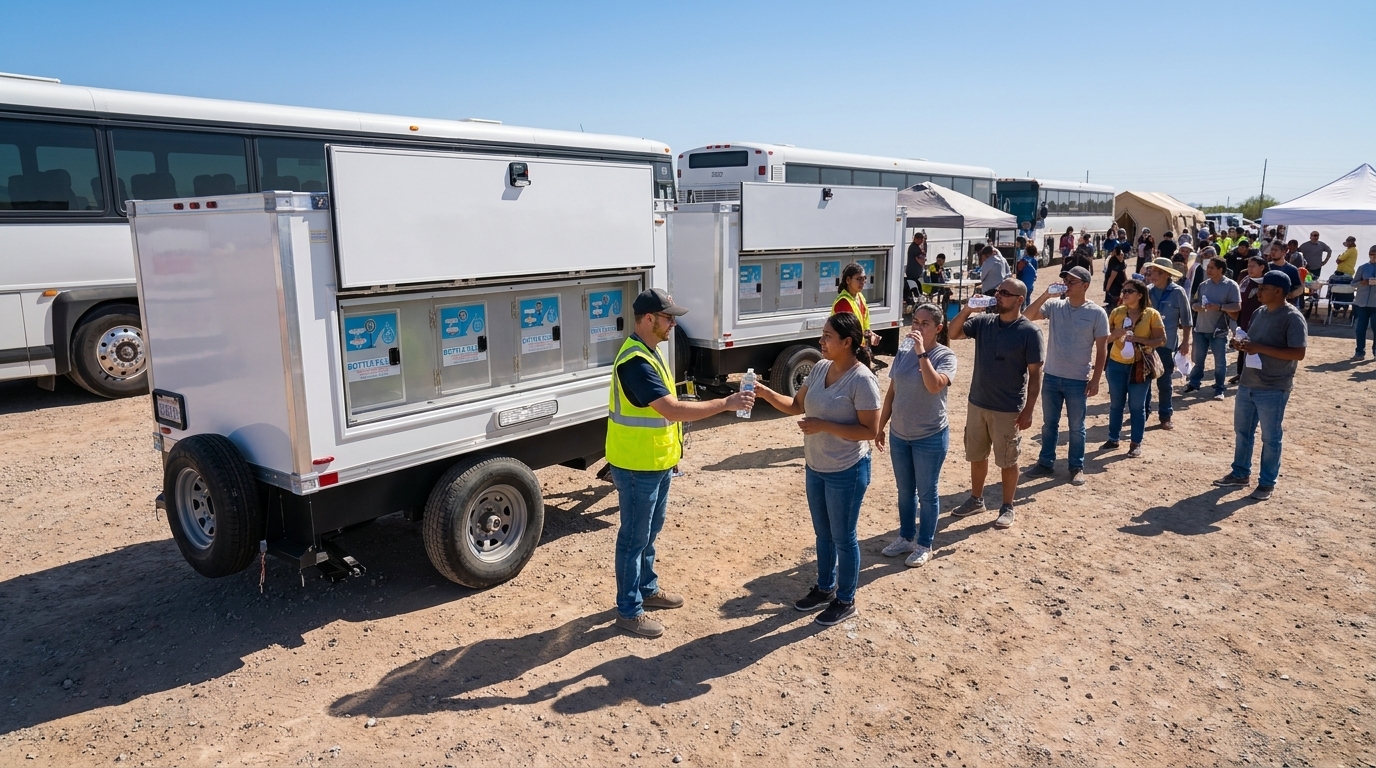
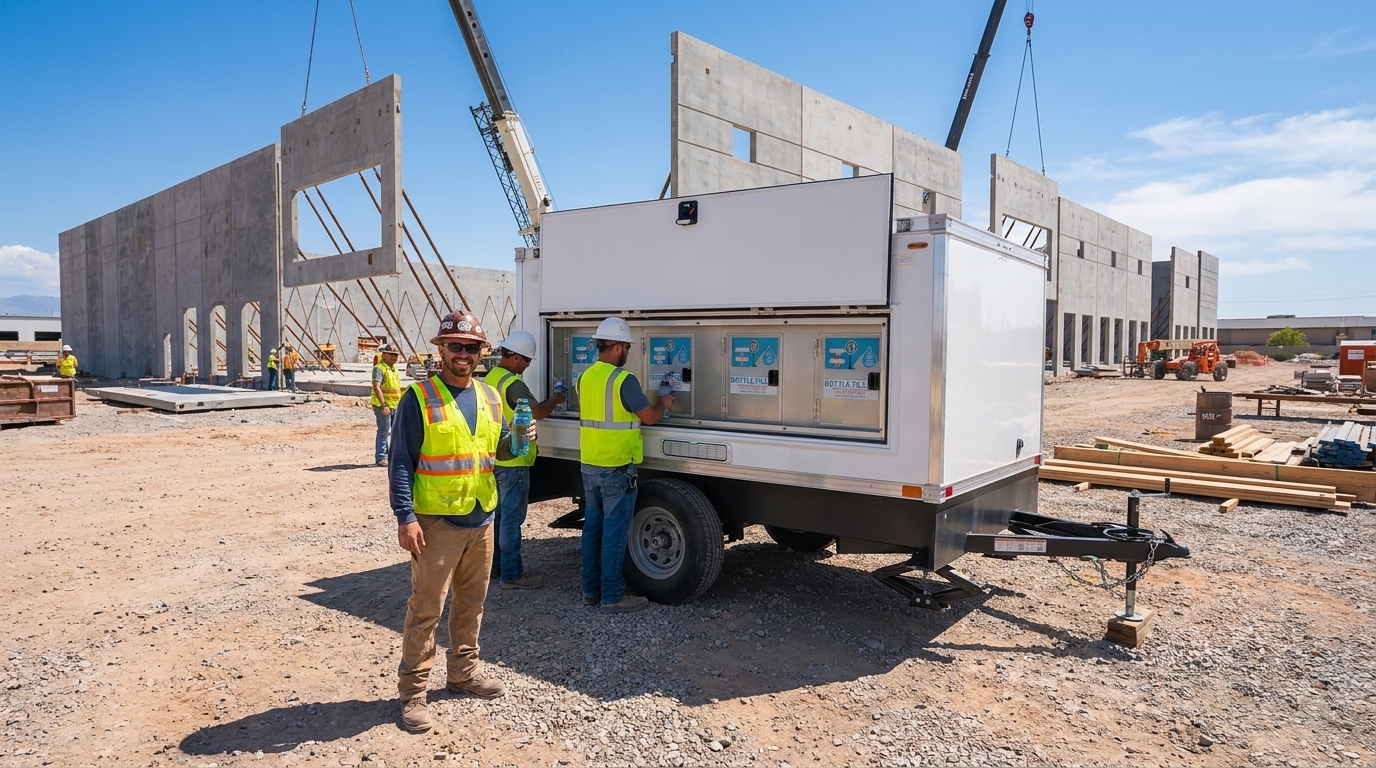
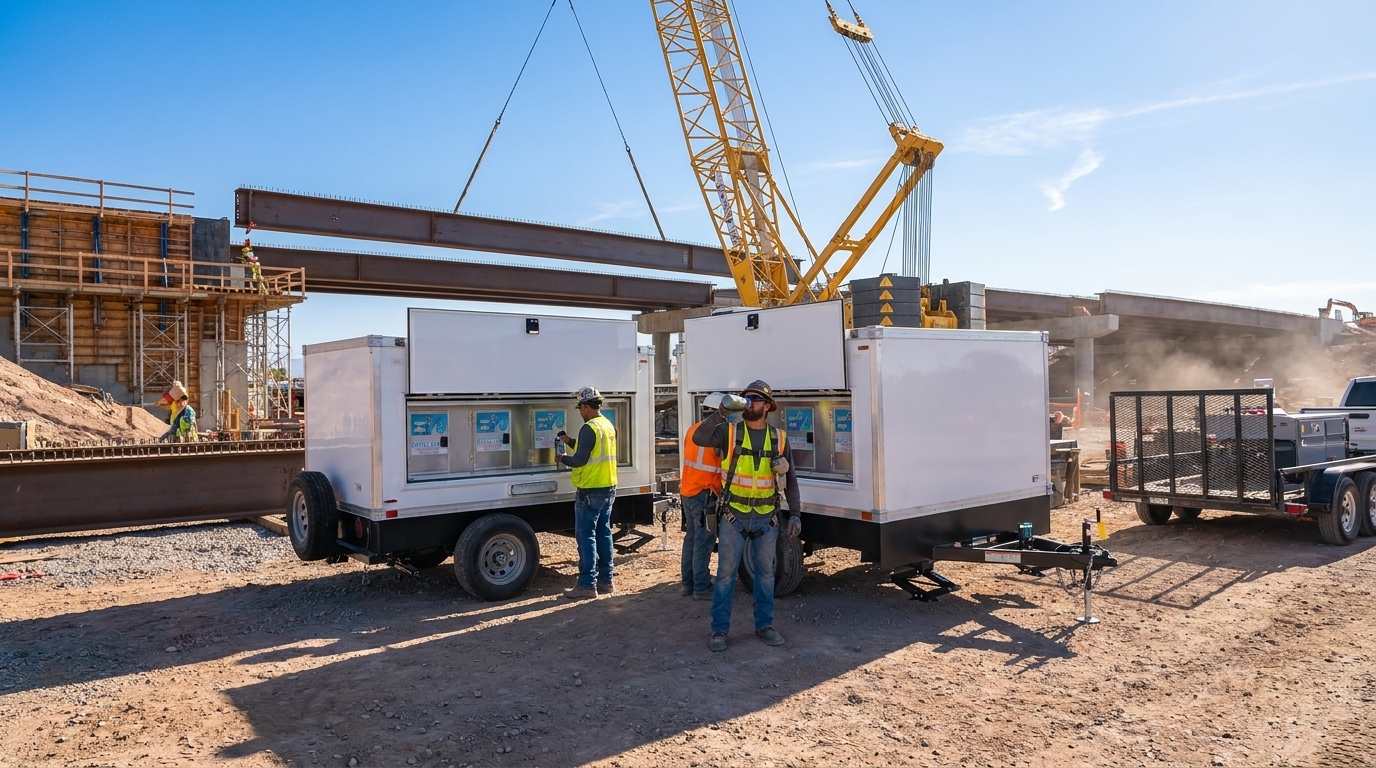
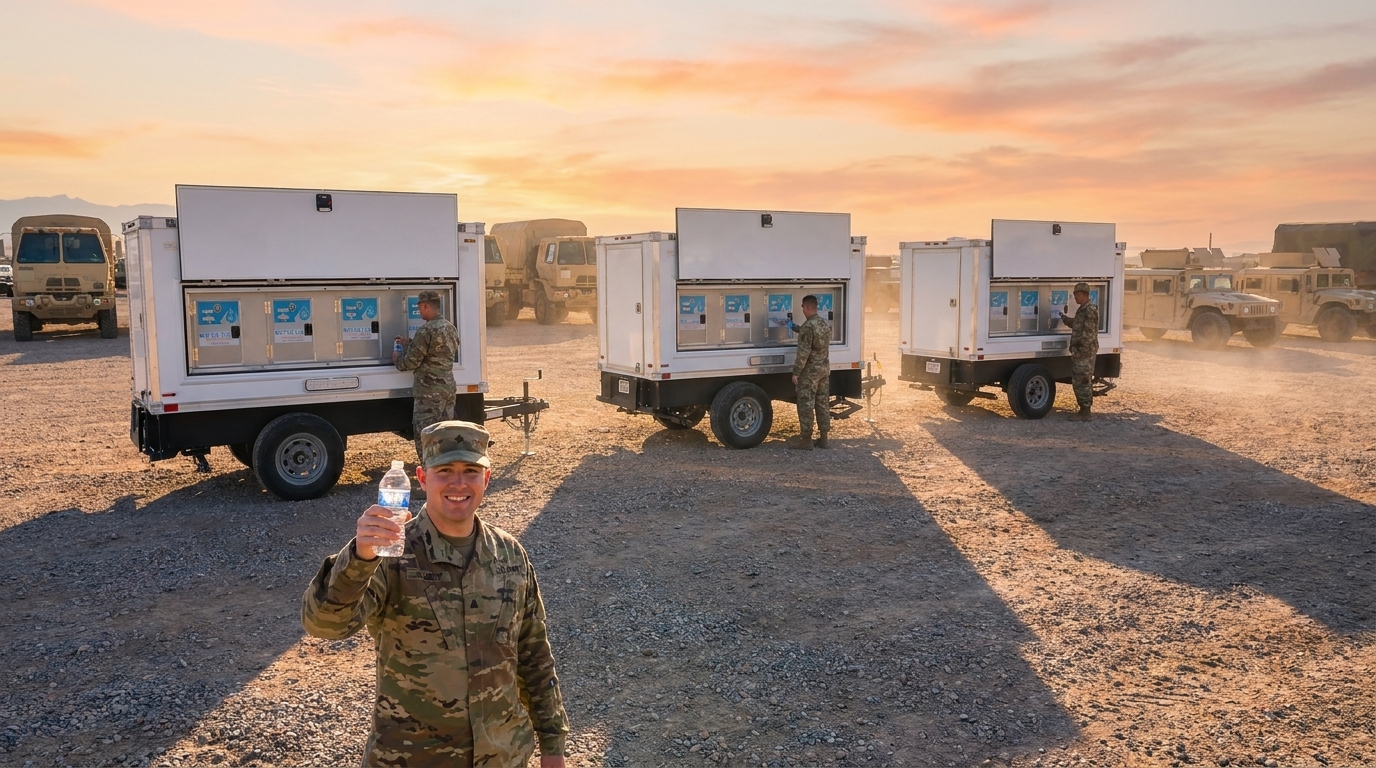
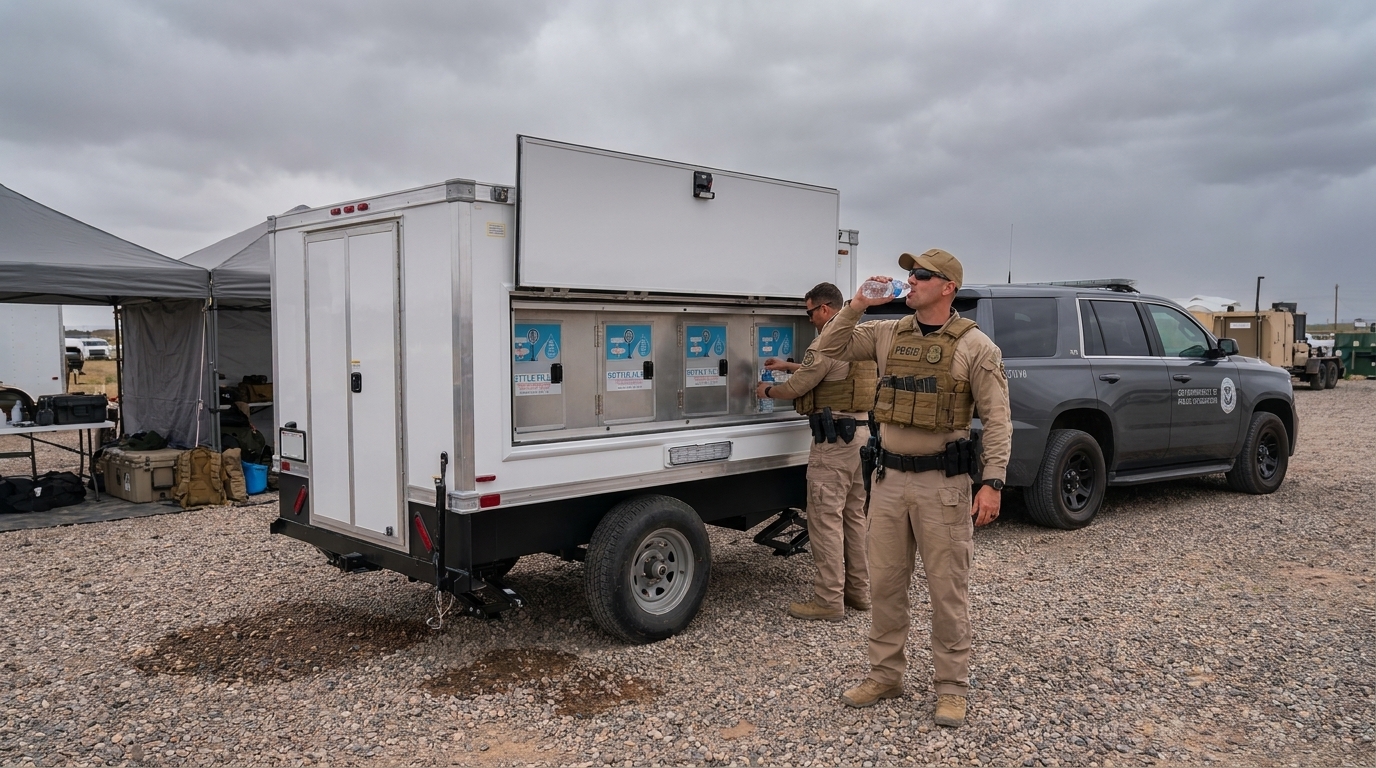
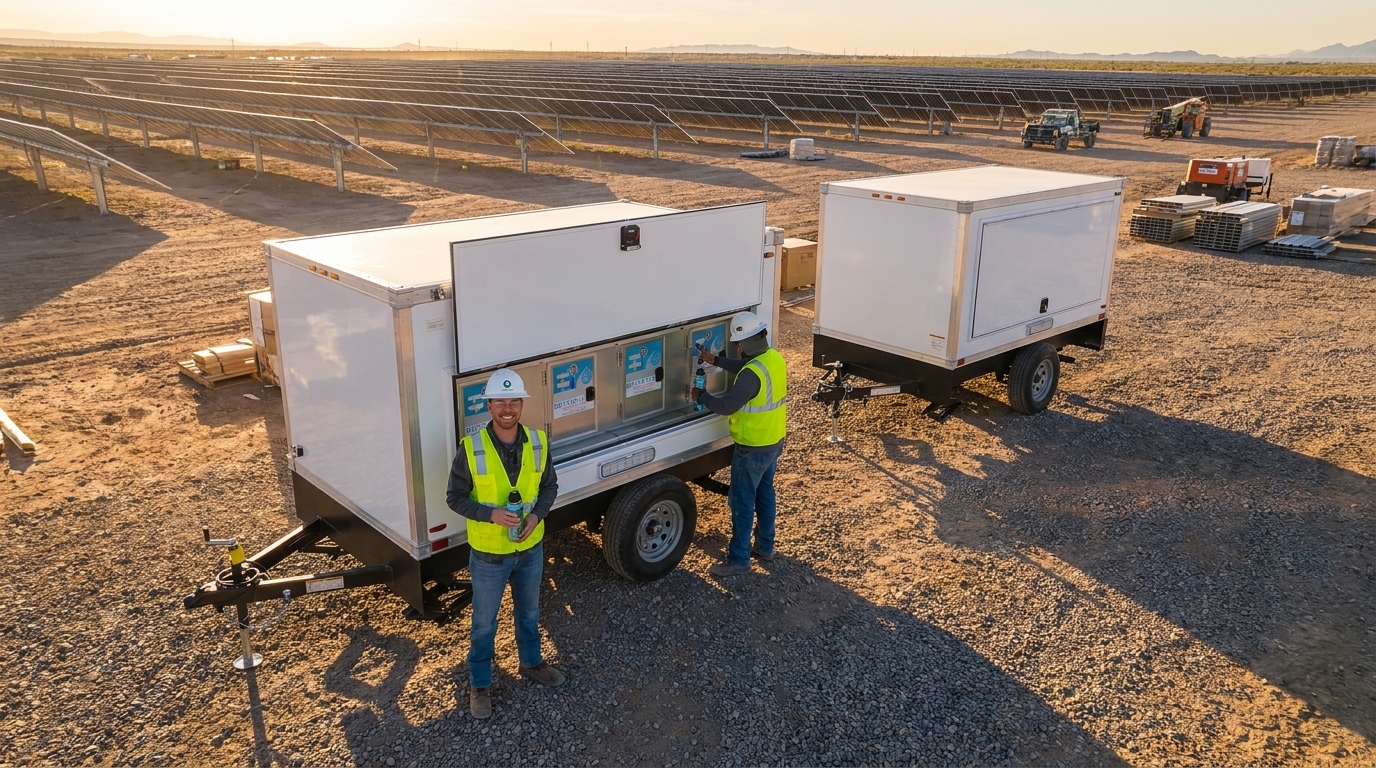
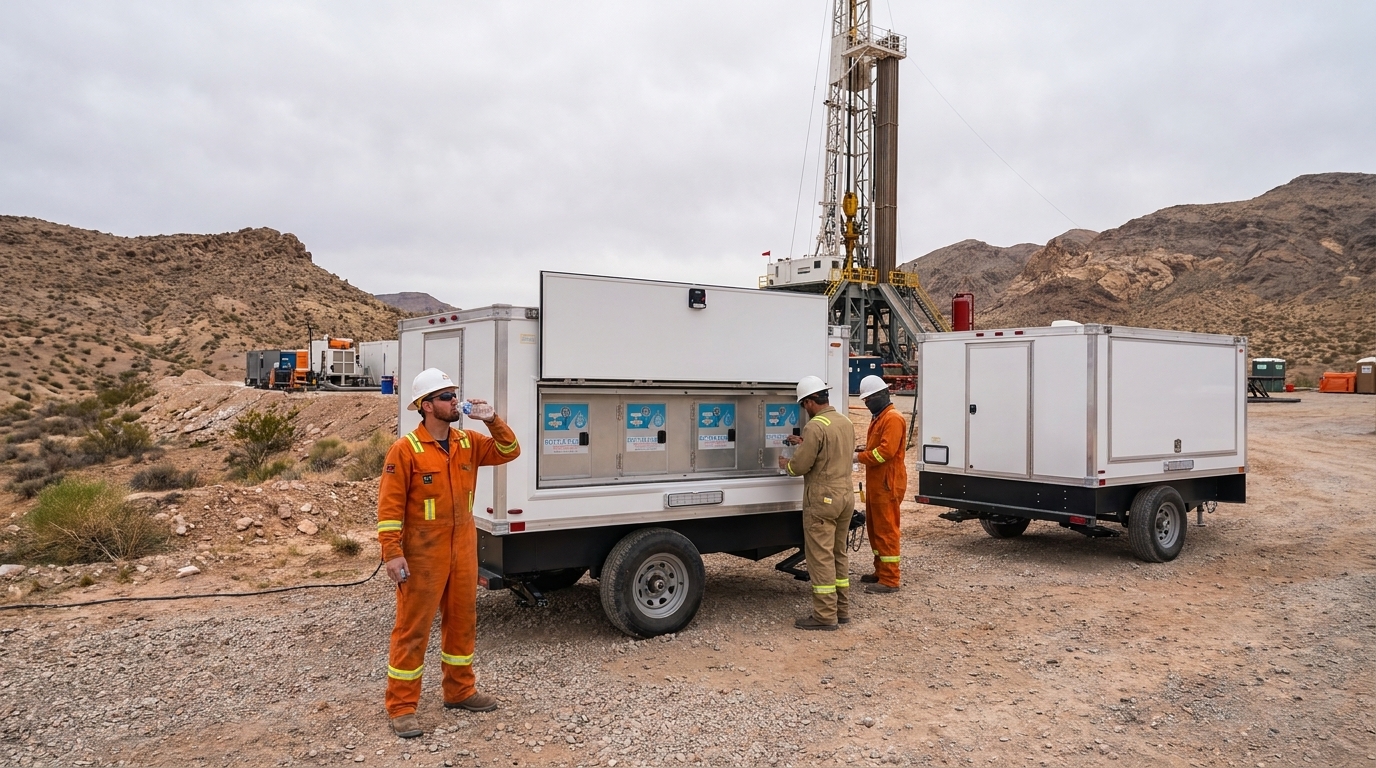
The Signature Series tows behind a pickup truck, which is exactly what a fairground needs, because the spot you want it in is rarely the spot a truck reaches on the first try. It tows in, levels on gravel or turf, and pours cold from four taps.
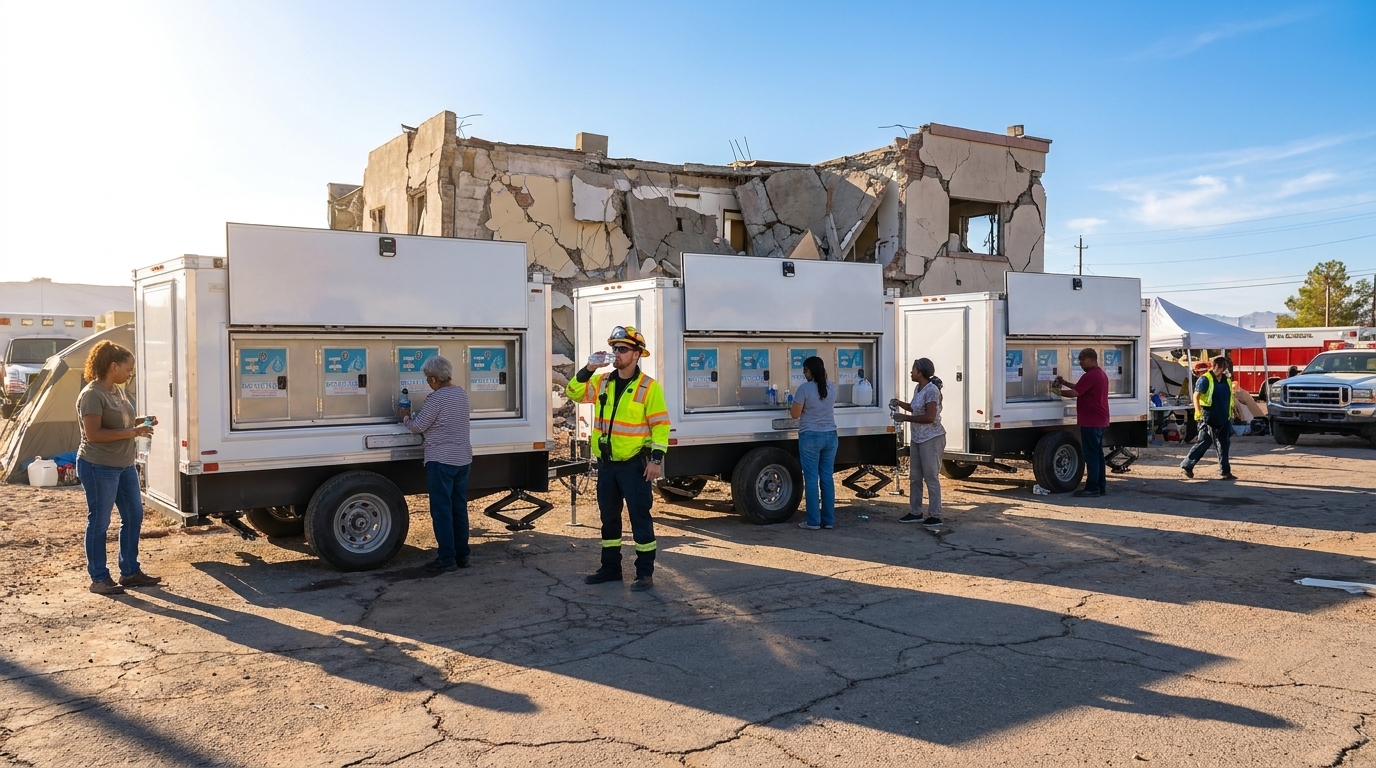
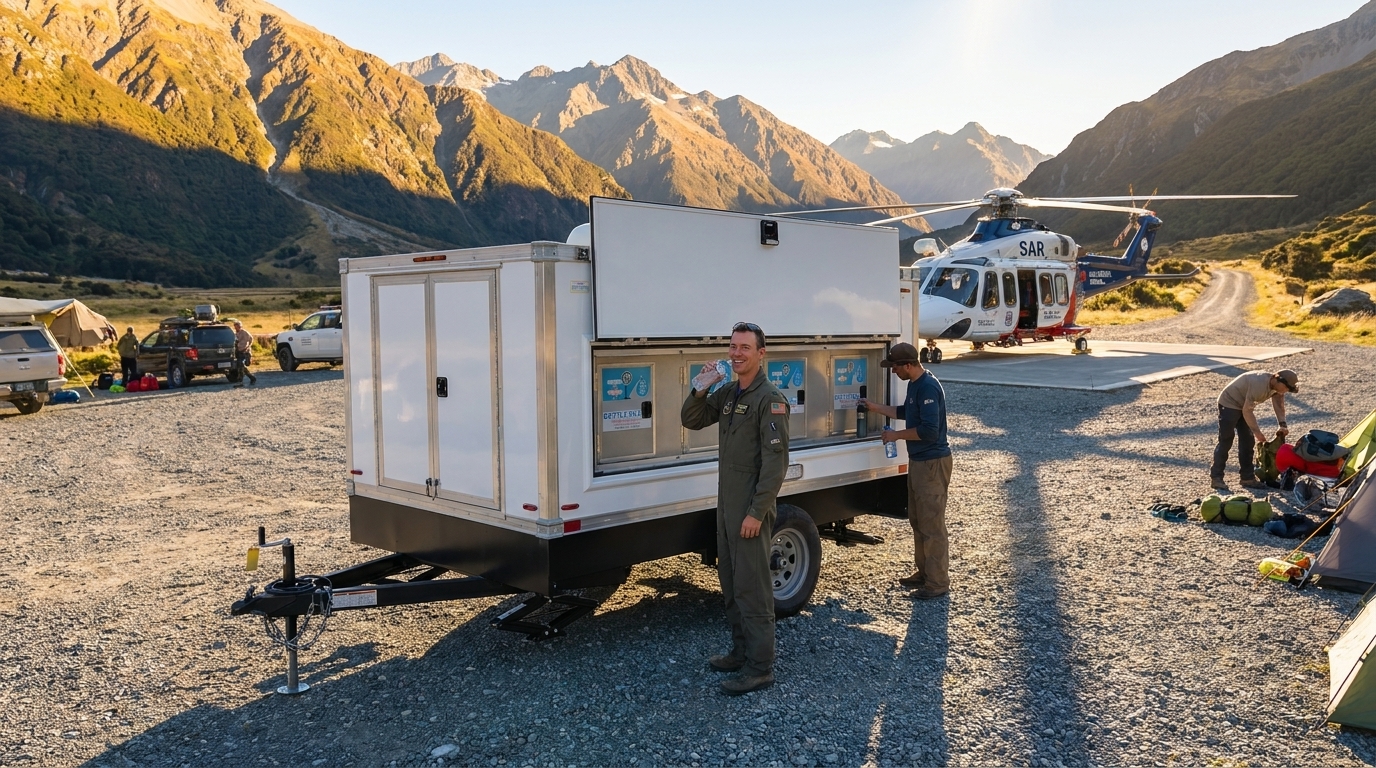
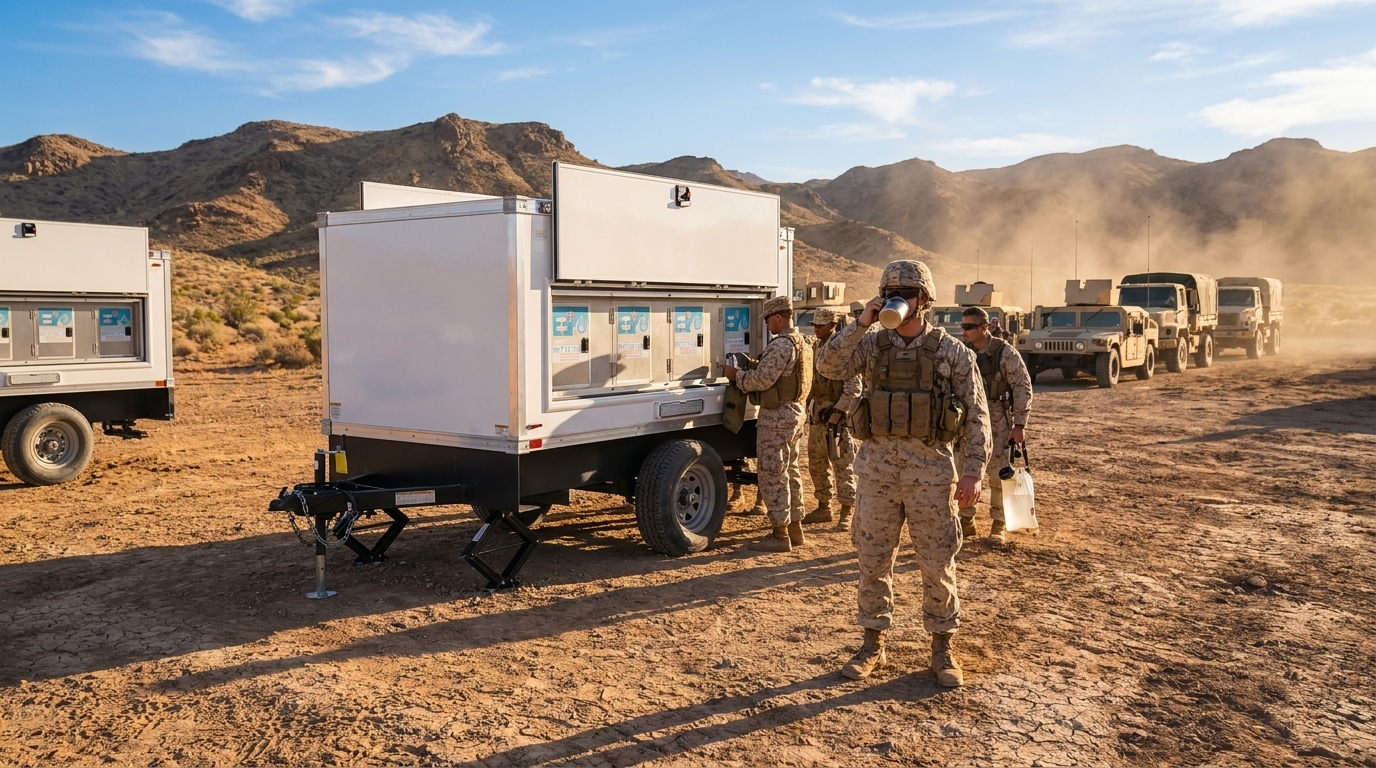
With a frame, a hitch, and tires under it, the unit hauls out to a remote build, an event field, a working orchard, or a disaster staging yard with equal ease. Contractors and event planners request this exact rig by name. The whole design is built around backing in, leveling off, and pouring cold by the same afternoon.
| No. of stations | (4) Bottle Filling Stations |
| Length | 12' 3" |
| Weight | 3,100 lbs. |
| Height | 8' |
| Fresh water tank | 300 Gallons |
| Power requirements | 1 to 4 dedicated 20A/120V circuits OR 1 dedicated 50A/240V circuit |
| No. of AC units | 1 |
On a fair site the trailer does three jobs at once. The four push-back taps handle the walk-up crowd one bottle at a time, which is what a midway generates from open to close. The rear jug spout fills the five-gallon coolers that food booths, first aid tents and ride crews carry back to their own stations. The hose taps cover the chores nobody puts on a site map, washing out a wash rack bucket, topping a mister line, filling a stock tank at the end of a barn.
It is quiet, which matters more at a fair than people expect. A grandstand announcer and a midway sound system are already fighting each other and nobody wants a third noise. The cooling unit runs about as loud as a household refrigerator, and the trailer sits low and white, so it reads as event infrastructure rather than equipment. We have parked one between a funnel cake stand and a ticket booth and watched families line up without being told what it was. It is the same unit we send out on Sacramento water station rentals through the Central Valley fair season.
Getting it there is the part fairgrounds underestimate. A permanent fairground usually has a service gate wide enough for a tow vehicle and trailer, but the last hundred feet is the problem. A tight turn waits behind the barns. A light pole sits in the wrong place. A vendor parks where the drawings said the lane was. A temporary carnival lot has the opposite problem, wide open asphalt and nothing to tie into. So we ask about the approach before anything else.
A water source people don't trust gets ignored, and an ignored station is rented money wasted. That's why municipal water doesn't reach the tap raw on our trailers. It passes through three filter stages and a UV chamber, then an onboard cooling unit drops the temperature. The result tastes clean and comes out cold, even on the worst afternoon of the year.
The opening filter traps sand, scale, and the fine grit local mains occasionally push through. On a dusty lot, that's what keeps a pour from tasting like the parcel it's parked on.
Activated carbon comes next, lifting the chlorine bite and the dull seasonal notes local tap can carry until the taste lands clean and neutral. When it's 100 out, that flavor decides whether a crew keeps drinking or walks past the tap dry.
A finer cartridge then catches the microscopic particles that slip past the first two, so what reaches the spout is clear rather than merely cold for the crews and crowds drawing off it.
The last step is an ultraviolet chamber that wipes out bacteria and microbes without adding a single chemical. Even after a long tow out to a remote site, the water off the nozzle is clean.
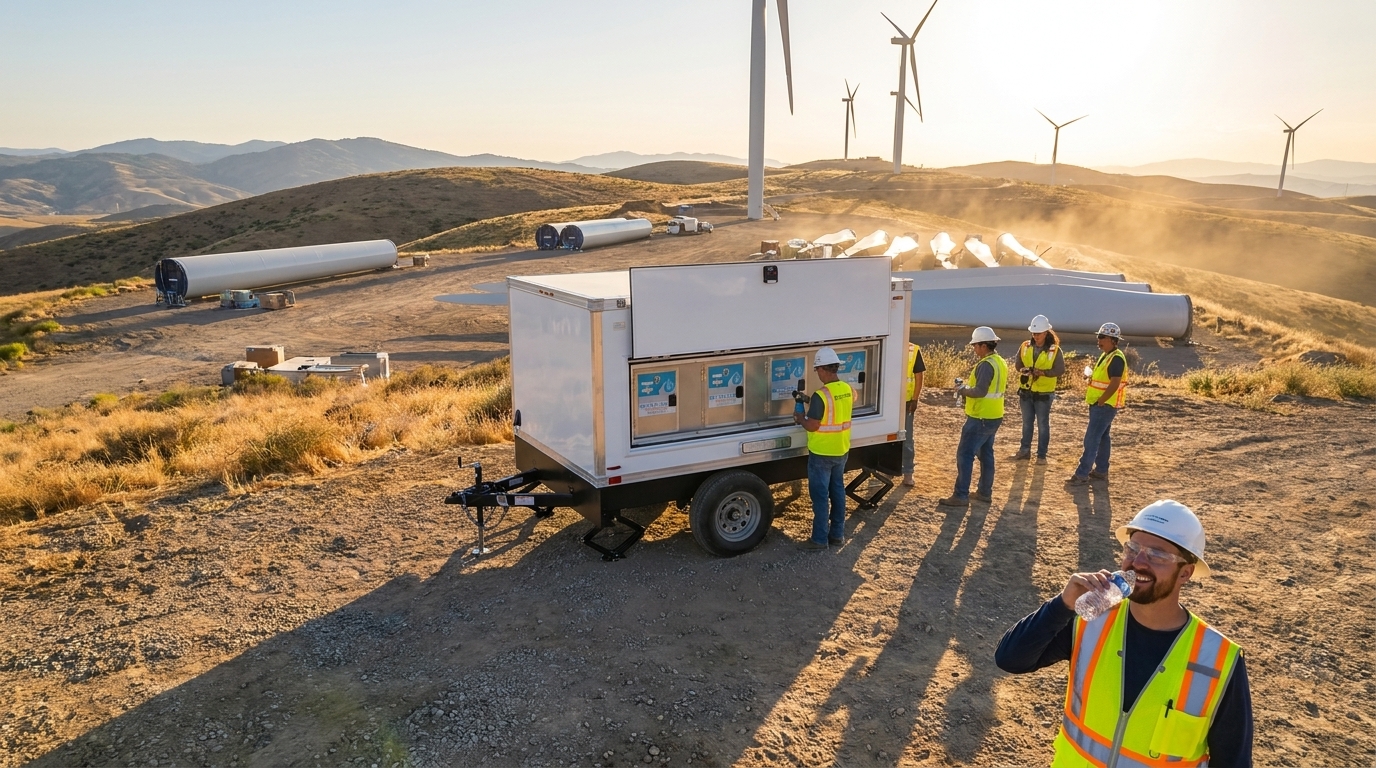
Along the wall sit four adjustable push-back taps, press a bottle to the bar and it pours. One of them is set at ADA-reachable height, so a single trailer includes everybody in a crew or crowd with no add-on gear. Out back, a large-jug spout services five-gallon coolers and hydration packs, while a bank of hose connection taps handles work-site chores, event support, and refills down the orchard rows. Stainless, food-grade plumbing the whole way through keeps the filtered, chilled water at quality right to the spout.
Every Signature trailer carries a 300-gallon load, roughly 2,400 cups at sixteen ounces each, and we recharge it on demand, so the unit doesn't turn into the choke point on a busy shift or a packed show night.
A fairground is not one site. It is a midway, a row of barns, an arena and a vendor row, and each of those pulls water on a different schedule. Here is how we plan each one.
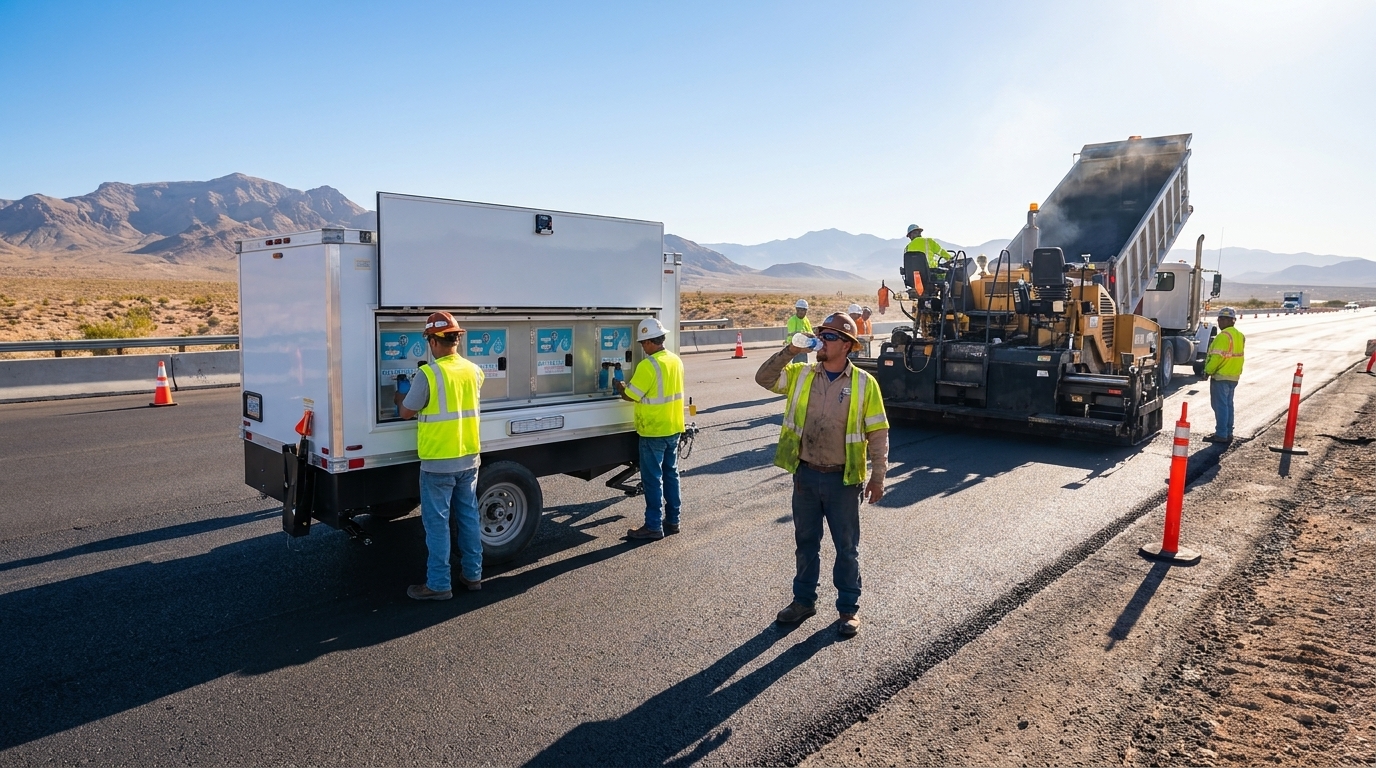
The midway is the hottest ground on a fairground and the ground people stand on longest. At the 2026 Missouri State Fair in Sedalia, reporters clocked a 115-degree heat index in the carnival area and 110 near the grandstand while the airport nearby read past 105. That gap is not a measurement error. It is open pavement and gravel, ride machinery throwing heat, no shade, and a crowd standing still in a ticket line. Emergency crews logged 41 calls in a single day at that fair and treated more than 85 people across the eleven day run.
A traveling carnival lot is a different problem with the same heat. A vacant lot or a shopping center pad has no water hookup, no hose tap and usually no power the show can count on, so everything gets hauled in and permitted as temporary infrastructure. Fire marshals already treat power that way. Generators sit at least 20 feet off any tent, stored flammable liquids at least 50 feet, and exhaust venting toward a tent is an immediate fail. Water has never had that bring-it-in-and-inspect-it default, and that gap is the one we fill.
Dust is the second thing a midway does to people. Bare ground under constant foot traffic and ride mechanisms puts fine particles in the air all day. In the San Joaquin Valley and other parts of the West where it lives in the soil, that matters more, because blowing dust is how Valley Fever moves. California public health investigators tied at least five confirmed cases, three of them hospitalized, to one large multi-day outdoor event in Kern County. Our Fresno Central Valley hydration station rentals get booked for exactly that reason.
So we place midway stations against the crowd flow, not against the fence. Ten steps off a ride queue or between two concession rows beats a tidy spot behind the ticket booth every time. We have watched a station forty yards off the traffic line sit untouched while first aid handed out bottles by the case. We set the refill cadence to the crowd, which on a hot Saturday means a tanker on the grounds before the afternoon peak instead of after it. And we ask the carnival company where the ride queues will actually form.
A rodeo does not pull water the way a midway does. It comes in bursts. The grandstand fills, a performance runs, and then a few thousand people move at once toward the concourse, the restrooms and whatever water there is. Cheyenne Frontier Days ran ten straight days of professional rodeo performances in 2026 and drew 113,787 fans to those performances alone, inside a festival that saw roughly a quarter million people. Most rodeos are nothing like that size. A local weekend rodeo runs two to four performance days, and the crowd still spikes at the same moments.
Behind the gates the schedule belongs to the animals. PRCA rules require livestock to have constant access to clean water, and they require water immediately after each category of livestock finishes competing, which tells you what the rule was written to prevent. The same rule book requires a veterinarian on site for every performance and every section of slack, and a vehicle able to remove an injured horse or bull at all times. Those are the operating conditions of the event, and water sits inside them.
Where this breaks is timing. Slack runs early, often before the grounds crew is fully staffed, and the hose serving the back pens is usually one hose feeding a lot of animals and a lot of people. We have shown up to arenas where the only water within reach of the gates was a spigot on the far side of a parking area, and contestants were filling buckets out of a truck bed. Stage a station on the stock side with the jug spout and hose taps facing the pens, and nobody crosses an alley carrying a full bucket while roughstock is moving.
So we plan a rodeo as two water problems that share a trailer. Public side, cold and visible, near where the crowd backs up after a performance. Stock side, hose and jug access, staged where the crew works instead of where the public walks. On a compact two day rodeo one trailer usually covers both. On a fair-attached rodeo we treat the arena as its own zone and size it separately from the midway.
Barn water runs on a clock the public never sees. Barns commonly close at 10 p.m., or an hour after the last livestock show, whichever is later, and reopen at 6 a.m. Exhibitor rule books require animals checked and watered two hours before barns close, and they restrict leaving open feeders or large tubs and barrels in pens all day as a sanitation control. So watering is a scheduled, checked event across a multi-day fair, with an overnight gap on either side that no fairground service is staffed to cover.
The people doing that work are mostly kids and their families. Rule books tell exhibitors to bring their own tubs, buckets and equipment, properly identified, and enough feed for the full run. The fairground supplies a water source at best. And the enforcement is real. A superintendent who finds a dirty pen, or water that is dirty or empty, issues one verbal warning, and continued problems can mean the exhibitor's premium check is withheld. A fourteen year old hauling buckets across a barn in August is the actual staffing model.
There is a newer reason fair boards are looking hard at barn water. Since March 2024, USDA, FDA, CDC and state veterinary and public health officials have run coordinated guidance for dairy cattle at exhibitions after avian influenza turned up in dairy herds, and that guidance says plainly that fairs and exhibitions give illness an opportunity to spread among animals from multiple herds. A controlled source at the end of the aisle, filled and maintained by us, is a cleaner answer than a hose handed down the row.
So we put barn stations where the aisle meets the wash rack, not at the barn's public entrance. Exhibitors walk shorter, the hose taps sit where buckets actually get filled, and the bottle taps still serve the families living in that barn for four days. We also ask what time the first show goes. Barn demand peaks before 8 a.m. and again after the evening classes, the opposite of the midway curve.
We deliver the drinking water station before the grounds get busy and we pick up after the last trailer rolls out. In between, the only thing your crew owns is the parking spot.
We aim to be on the grounds during load-in, which on a fair is the day or two before gates open and on a carnival lot is the morning the rides go up. There is a reason beyond simple courtesy. Once vendors park, the lanes you were promised stop existing. Get in early and the trailer goes exactly where the site map says. Get in late and we are negotiating with a generator, a box truck and a fence line.
Placement is where most of our judgment goes. We want firm level ground, a path the public can reach, and enough clearance to bring a tanker back without squeezing it through a crowd. Permanent fairgrounds usually carry water hookups and power drops built up over decades of hosting the same event, so the question is which drop is still free. A temporary lot has neither. We run Tacoma Washington mobile water station rentals into fairground and arena sites on both patterns, and the approach question comes first either way.
What goes wrong on these sites is almost never the equipment. It is access. A vendor parks in the refill lane. The service gate that was open at 7 a.m. is chained at noon. Somebody moves a fence panel and now the tanker has a 90-degree turn it cannot make. So we ask for one name and one cell number for the grounds, and the gate schedule in writing, because a fair has too many people making small decisions for a verbal answer to survive four days.
Pickup is the easy end if the plan held. We come back after the public is out, usually the morning after close while teardown is running, and we are gone before the barns are swept. If your run ends on a Sunday night we will normally schedule Monday, because pulling a trailer through teardown traffic at 11 p.m. helps nobody.
People count, number of days, where exactly it parks on your site, and what power is there. Those four answers let us spec it correctly the first time around.
Reckon roughly 45 minutes from the nearest yard once we are in your metro, longer on the outer routes, with round-the-clock emergency runs whenever a heat advisory or a power shutoff hits.
Once on site we set it level, charge the 300-gallon tank, and tie in power off one to four standard 120V circuits, or a single 50-amp 240V drop, depending on what the site gives us.
After that the tankers cycle back on a cadence matched to how fast your crew or crowd pulls it down, and we maintain the unit through the whole rental term.
No power on the parcel at all? We price that in. The unit draws very little, and with the service fleet backing it we've run stations on lots that had no permanent power whatsoever. Lay out what the site offers and the rest is on us.
Want this math run for your own booking? Two minutes on the phone gets you a real number.
Start with the crowd, then correct for heat, distance and how many hours people stay on the grounds. Here is the arithmetic we use.
| Single day county or ranch rodeo (up to 1,500 attendees) | 1 station |
| Weekend rodeo with slack and stock pens (1,500 to 4,000 across two to four days) | 1 public side, 1 stock side |
| Small county fair, one midway (up to 10,000 per day) | 2 stations |
| County fair with midway, barns and grandstand (10,000 to 25,000 per day) | 3 to 4 stations, one per zone |
| Traveling carnival on a lot with no hookups (3,000 to 8,000 per day) | 1 to 2 stations plus scheduled refills |
| State fair midway zone on its own (30,000 or more per day) | 4 or more, placed by zone |
| Junior livestock show and barn row (200 to 600 exhibitors and family) | 1 station at the wash rack end |
The occupational guidance is the easiest place to start, because it is the only figure anybody has written down. Roughly 8 ounces every 15 to 20 minutes works out to about a quart an hour for someone working outdoors in heat, and the body can lose more than that through sweat. NIOSH caps the recommendation at 48 ounces an hour so nobody overdrinks. Fair crowds are not work crews, so we size crews, vendors and handlers at the full quart, the walking public at a fraction of it, and let the hours on the grounds do the rest.
Three things move the number more than head count does. Heat is the obvious one. Distance is the one people forget, because a station 200 feet off the traffic line serves a small share of the people a station 20 feet off it serves. And dwell time decides everything at a fair, where families arrive at 4 p.m. and stay past dark. A rodeo crowd that shows up an hour before a performance needs less total volume than a fair crowd half its size that stays six hours.
The honest default is one station per active zone, not one per thousand people. A fairground with a midway, a barn row and a grandstand is three zones with three peaks, and one centrally parked trailer serves none of them well. If the budget allows one, we put it on the midway, the hottest ground with the longest dwell time, and run a heavier refill cadence to compensate. Give us the gate count and the footprint and we will tell you where we would put two.
Start with the food booths, because that is where a health inspector starts. A temporary food facility, generally one operating no more than 30 consecutive days in connection with a fair, carnival or public exhibition, has to have an adequate supply of water from an approved source. Some counties require at least ten gallons kept at each stand, in a covered container of approved material, poured from a spout, with applications due at least two weeks before the event. A rented station gives a fair board one approved source to point at instead of forty separate answers.
Then there is the material standard. NSF and ANSI Standard 61 is the national consensus standard for the human health effects of anything that touches drinking water, covering pipes, hoses, fittings, seals, valves and filters, and it is written into state drinking water rules across the country. Our stations run food-grade stainless from the tank to the spout, which is a boring sentence right up until an inspector asks what the water passed through on its way into a child's bottle. We give the same answer on our Bakersfield water bottle filling station rentals as we do on a state fair midway.
Accessibility is the one that gets missed on temporary ground. The 2010 ADA Standards apply to a fairground the way they apply to a building. An accessible route has to be at least 36 inches wide, with 80 inches of vertical clearance, rising no more than 1 foot for every 20 feet unless you build a ramp with rails and edge protection, on a surface that is stable, firm, slip resistant and compact. Compacted crushed stone works. Tall grass does not. Drinking water points are named among the amenities that have to sit on that route.
Your crews are covered too. California requires one quart of fresh, pure, suitably cool drinking water per outdoor worker per hour, as close as practicable to the work, and Washington sets the same quart with its rule switching on at 89 degrees. Cal/OSHA circulated a revised draft in August 2026 that would remove the exception letting industries outside agriculture, construction, landscaping and a few others skip high heat procedures, add rhabdomyolysis to the recognized heat illness conditions, and tighten acclimatization. Public comment closed September 21, 2026.
Federal OSHA heat illness prevention guidance and the CDC and NIOSH heat stress program point at the same baseline: cool drinking water, close to the people doing the work, and documented.
Need a station your written heat plan can point to? We can have one pouring cold within days.
Right now the work is spread across people who were hired to do something else. Grounds crews maintain whatever water hookups and hose taps the fairground already has, in the spots decades of past fairs put them. Food booth staff keep their own covered container filled. Carnival crews haul cases back from a store run. Exhibitor families carry buckets from the wash rack. Nobody owns the water plan, which is why nobody notices it failing until somebody is already down.
The time is real even though nobody bills it. Count the store run for cases, breaking down pallets, icing coolers before gates, topping them through the day, then flattening empties for the bin. On a multi-day fair that loop repeats every morning, for every booth, for the whole run. At one 2026 state fair the backup plan under real heat load was worse. The fair's own fire department and its disaster medical team ended up handing water and cooling towels to the public, pulling responders off their actual job.
And it looks like what it is. Shrink-wrapped pallets cooking in the sun behind a booth. A cooler nobody has touched since noon, warm and half empty. A wall of flattened bottles by the dumpster at 11 p.m. Meanwhile the first aid tent quietly becomes where people go for a drink, which is fine until the afternoon a heat advisory lands and that tent needs to be doing something else.
Look at everything bottled water actually demands of a person: cutting the order, receiving and breaking down pallets, icing coolers before dawn, topping them up through the day, then flattening empty bottles for the bin. On a large crew that's hours of paid time burned every single day, scraped right off the work that's supposed to be getting done. The trailer erases that loop entirely. A local contractor once let us pencil it out with him, and the recovered labor by itself paid for the unit. His words were that the bottle runs had been quietly costing him close to a day of payroll a week. Our trailer arrives full, the tankers keep it full, and your superintendent owes it nothing but a parking spot.
Ice a cooler at 6 a.m. and by mid-morning in July it's as warm as a bath. Warm water is water people stop touching, and the slowdown that follows is precisely where heat illness gets its opening. A chilled station never rides that warm-up curve at all. Whatever pours at clock-out is as cold as the sunrise fill, which happens to be the moment a spent crew, or a crowd deep into a long concert, leans on it hardest.
Bottled-water pallets devour staging space, jam the lay-down area, and sit cooking in the sun until somebody finally cracks them open. Empties build up faster than anyone keeps up with, and on a tight commercial lot that pile turns into its own problem. Set a trailer in one parking stall instead and it serves a crew or crowd that would otherwise burn through hundreds of plastic bottles every day.
Every bottle bought is a bottle thrown out, and across a season a busy site or event generates a small mountain of them. That's a disposal line on the budget, a dent in the sustainability numbers, and, given that a single bottle can linger in the ground for centuries, a footprint that lasts longer than the project that made it. Move to a refill station and the line drops to zero, which finally gives your reporting a figure worth publishing.
Three bookings of this kind, and what we planned around on each one. Names and details are kept generic on purpose.
County fair midway, eleven day run, first week of August. The board called us in late June, a year after a heat advisory landed in the middle of their run. Their midway sat on gravel with no shade and the nearest hose bib was behind the livestock barns, a four minute walk. We staged one station between the ride queue and the game row, a second at the barn end, and set the tanker to come through before 1 p.m. What they told us afterward was that first aid stopped being the water tent.
Traveling carnival, shopping center lot, no water and no power. Six day run on asphalt, rides up on a Tuesday, gates open Thursday. The show had a generator plan because the fire marshal requires one, and no water plan at all, because nobody requires that. We delivered full, tied into the show's power, and ran refills on a cadence the ride crews never had to think about. The manager said what he noticed was his crews no longer disappearing on store runs mid-set.
Fair attached rodeo, three grandstand performances plus slack. The arena sat across a parking area from the fair's main water line, and slack ran at seven in the morning before most of the grounds crew was on site. We put one trailer on the stock side with the hose and jug taps facing the back pens, and one on the concourse where the crowd backs up after a performance. The committee had been filling buckets out of a truck bed the year before.
Service information current as of September 2026.
Still weighing it? Call and ask. Most of these questions get settled in one short conversation.
The station itself is usually not what gets permitted. Your food booths are, under the county's temporary food facility rules, and those require an adequate supply of water from an approved source. Some counties set a floor of about ten gallons per stand. Raise it with your county health department when you file the event's temporary food permits.
It depends on the county, but some publish a hard floor of at least ten gallons per stand, in a covered container of approved material, poured from a spout. That is a minimum, not a plan. A booth doing prep and cleanup through a midday rush burns ten gallons faster than the rule imagines, which is why a refill point on the grounds beats a store run.
Everything gets hauled in. A vacant lot or pad site typically has no water hookup, no hose tap and no power the show can count on, so water gets planned the way generators do. We deliver full, with 300 gallons on board, and schedule refills against the run. Give us the daily gate estimate, the number of days and whether you will have a generator.
The standard that matters for the equipment is NSF and ANSI Standard 61, which covers the health effects of materials that contact drinking water. Our stations run food-grade stainless from the tank to the spout, and the water passes three filter stages and a UV chamber before it is chilled. That gives a fair board one approved source to point at.
The occupational guidance is about 8 ounces every 15 to 20 minutes, roughly a quart an hour in heat. California and Washington both write that quart per outdoor worker per hour into their heat rules, and Washington's switches on at 89 degrees. NIOSH caps the recommendation at 48 ounces an hour. The practical version is short. Cold water within a short walk, or people stop drinking it.
Barns commonly close around 10 p.m. and reopen at 6 a.m., and exhibitor rules require animals checked and watered two hours before close. We place barn stations at the wash rack end of the aisle, where buckets actually get filled, and set refills for early morning ahead of the first show. Nobody should start the day with an empty source.
Rule books generally give the barn superintendent a verbal warning first, and continued problems can mean the exhibitor's premium check is withheld. That is a financial penalty on a family, which is why barn water is not a comfort question at a junior show. Exhibitors bring their own tubs and buckets, so the fairground supplies the source they draw from.
Drinking water points are named among the amenities that have to sit on an accessible route under the temporary event guidance built on the 2010 ADA Standards. That route needs to be at least 36 inches wide, with 80 inches of vertical clearance, on a stable, firm, slip resistant surface. Compacted crushed stone usually qualifies and tall grass usually does not. Every Signature Series trailer includes a tap at ADA-reachable height.
Vendor space at a big fair gets locked a year out, but event support like this moves on a much shorter clock, usually weeks. Most calls we take are driven by the season's heat outlook, something that happened last year, or a gap somebody found on a walkthrough. Earlier is better in peak season, and we still take short notice calls.
They peak at opposite times. The midway is a steady all-day public draw on the hottest ground on the property, thick with dust, heaviest through the afternoon and evening. The barns run on a 24-hour animal care cycle, heaviest before 8 a.m. and again after the evening classes, and that demand is buckets and hoses more than bottles. One centrally parked trailer serves neither well.
Work backwards from load-in, not from gates. On a county fair the real deadline is the day vendors park, because after that the lanes on your site map stop being lanes. Six weeks out is the time to walk the grounds with the map in hand and mark the three things that decide a water plan: where the crowd will actually stand, where a tanker can reach, and which power drops are already spoken for.
Four weeks out, count zones instead of people. Midway, barns, grandstand, vendor row, crew camp. Each has its own peak, and writing those peaks down in order is most of the work. A midway peaks in the afternoon and holds into the evening. Barns peak before 8 a.m. Grandstands peak in twenty minute bursts. Crew camp starts during load-in and does not stop.
Three weeks out, file the paperwork that carries a deadline. Temporary food facility applications are commonly due at least two weeks before the event, and each vendor carries an obligation to show an approved water source. If you are changing the layout from last year, call the fire marshal too, since many fairgrounds operate under an already approved layout and anything outside it triggers a fresh review.
Heat is changing fair calendars now, not just fair days. The California State Fair ran July 17 through August 2 in 2026 and drew more than 650,000 visitors across 17 days, with triple digit heat cutting into attendance on what is normally the busiest final weekend. Organizers have announced a move to September 17 through October 3 for 2027, so visitors avoid Sacramento's summer.
The number to watch is not the forecast high. It is the heat index on your hottest ground. At one 2026 state fair the carnival area read fifteen degrees hotter than the nearby airport. Midways run hotter because of open pavement, ride machinery, no shade and dense standing crowds. Plan off the phone forecast and you are planning for a cooler fair than the one you are running.
Dwell time is the multiplier. A fair crowd arrives in the late afternoon and stays past dark, a longer exposure than most outdoor events produce. A rodeo crowd that shows up an hour before a performance needs less total volume than a fair crowd half its size that stays six hours. Build the plan on hours spent on the grounds, not on the gate count.
Ask what the water passes through before it reaches the tap. The honest answer is specific: filter stages, then a UV treatment step, then chilling. Ours is three filter stages for sediment, chlorine and microscopic particles, then a UV chamber, then an onboard cooling unit. Vague answers about filtered water are how a fair ends up with a station nobody drinks from.
Ask what the components are made of. NSF and ANSI Standard 61 is the standard for materials that contact drinking water, and it exists because plumbing is not neutral. Food-grade and stainless from the tank to the spout is the answer you want, and the one an inspector wants.
Ask how it fills and who it can serve. Four push-back bottle taps, one at ADA-reachable height, a rear spout for five gallon coolers, and hose taps for chores are four different jobs. A fairground needs all four. A station that only does the first sends your vendors back to the store.
→
Multi-day music and arts events with the same crowd density and dust load as a midway.
→
Tournaments and grandstand events where crowds arrive and leave in bursts.
→
Start lines, finish areas and course points that need volume in a short window.
→
Parking lot carnivals, festivals and fundraisers on sites with no outdoor tap.
→
Field and ranch crews working the same summer months as the fair season.
→
Open ground gatherings with no permanent water point anywhere near the crowd.
We run water station rentals nationwide, and we keep dedicated local pages for the metros our trucks work hardest. Start with the closest one.
Booking this kind of work in a metro we already run? Start with mobile water stations serving Sacramento, water station rentals in Fresno, mobile water stations serving Bakersfield, water station delivery around Tacoma, mobile water stations serving Portland, Salt Lake City drinking water station rentals, Denver drinking water station rentals and mobile water stations serving Amarillo, and call us for anywhere else in the country.
 Sacramento Valley
→
State fair grounds, county fairs and rodeo weekends in the hottest weeks.
 Central Valley
→
Valley fairgrounds where dust and heat arrive on the same afternoon.
 Southern San Joaquin
→
Kern County fair and rodeo grounds and the carnival lots around them.
 South Puget Sound
→
Fairgrounds work that runs deep into September, past the summer peak.
 Willamette Valley
→
County fairs and rodeo weekends on a late August calendar.
 Wasatch Front
→
Stock shows, rodeo arenas and fairgrounds on dry high desert ground.
 Front Range
→
Stock show and county fair grounds where altitude adds to the heat.
 Texas Panhandle
→
Ranch rodeo and livestock show country with long outdoor run days.
Give us the head count or the guest count, the date, and the spot it will park. We will spec the right setup, confirm the delivery window, and have cold filtered water pouring before the day starts.