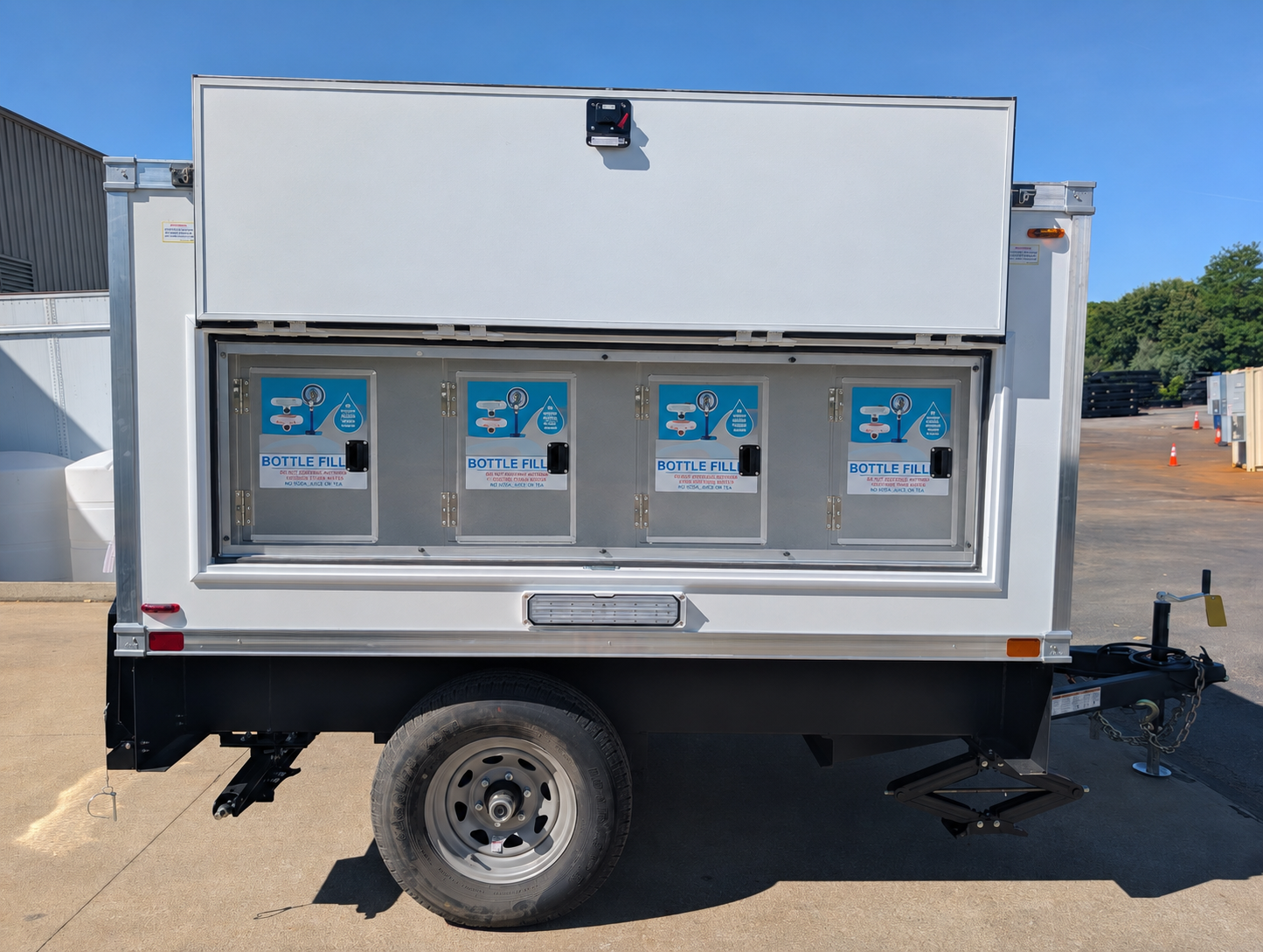
We deliver chilled, filtered water stations to church grounds and community event sites, set level and pouring cold before the first volunteer shift starts. One Signature Series trailer runs four push back bottle taps, one of them at a height a person in a wheelchair can reach, plus a rear spout that fills five gallon coolers for the food tent. It carries 300 gallons on board, so a parking lot with no outdoor faucet stops being a problem. Call us or ask for a quote, and we will size your head count on that same call.
Licensed and insured | A+ BBB rated | 24/7 dispatch
See the Signature Series water station specs
“We had always done coolers and donated cases, and by two in the afternoon somebody was making a store run. The trailer was in place before we set the tables and nobody touched it again. Kids filled their own bottles all day.”
“Our permit map had to show where every piece of equipment sat, and the delivery crew put the station on the exact spot we marked. Second day, same cold water, no ice runs. Our food vendors used the rear spout for their own jugs.”
“We put one at the finish and one near the halfway point, which is where our walkers always bunch up. No cases to carry and no empties in the grass afterward. Our volunteers spent the morning with the walkers instead of restocking a folding table.”
References for this kind of booking are available on request.
Most of the people who book us for this work do not run water for a living. They are the volunteer who raised a hand at the planning meeting and now owns the tent crew and the water plan at the same time. So we built our side to need nothing from you. We tow the station in and level it, then fill it and leave it pouring cold. We have set these units on church lawns in July and on closed streets where the nearest faucet is inside somebody's kitchen. Teams booking Sacramento community event water station rentals get the same delivery window and the same setup a crew four states away gets, because the truck and the trailer do not change. Call us with your head count and the hours your gates are open, and you can have a quote before you hang up.
One Signature trailer can pour for a weekend concert and be working a slab pour a couple of days later. Hiring one company for your events and a separate one for your worksites makes no sense. Either way, the planning, the delivery, and the refills are ours.
The onboard cooling unit keeps the tank genuinely cold all the way through a long afternoon outdoors, and that single detail carries the whole thing. Warm water is water people abandon, and midsummer is exactly when a crew or a crowd is drinking the most. Cold water gets finished, and finishing it is what keeps heat illness off the site.
Typical deliveries land in about 45 minutes once a truck is rolling in your metro, longer out on the rural routes, and we keep emergency runs going around the clock whenever a heat advisory or a power shutoff hits. The morning a foreman finds his 40-person crew stuck with one warm cooler, speed is the whole game.
One rule sits under every job we take: water that people walk past might as well not be there. We've stood on a bare site and watched shrink-wrapped pallets cook next to the job-trailer while the crew baked thirty yards off. We've watched the opposite too, a chilled station ten steps off the work face run bone-dry twice inside one shift. Everything that matters lives in the distance between those two pictures. Which is why we don't drop a unit and disappear. We match it to your headcount or your gate count, set the refill rhythm to how hard you're really pulling on it, and treat a heat call the way you'd want your own treated, meaning right now, because out here one hot hour can swing the whole day.
We deliver water stations to job sites, venues and event grounds in all 50 states, with the heaviest route coverage across the West.
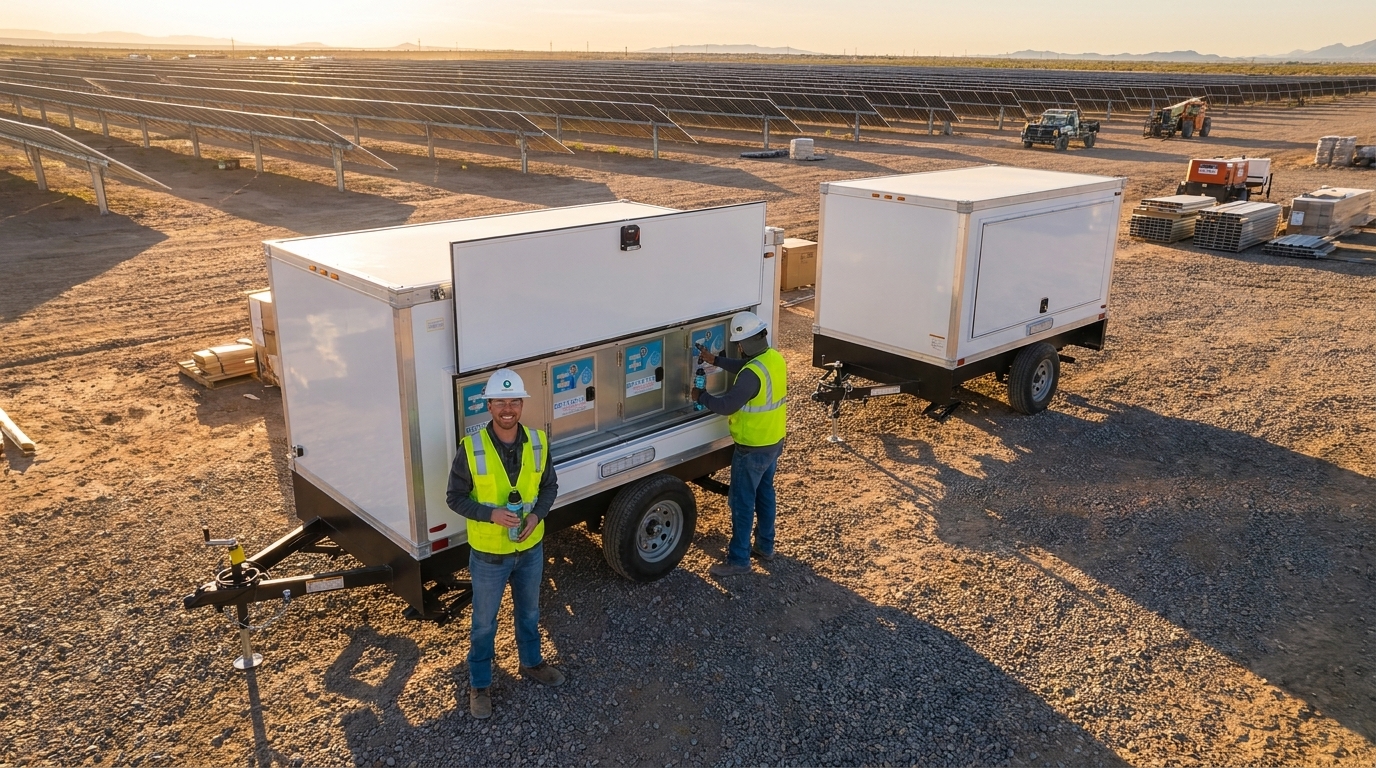
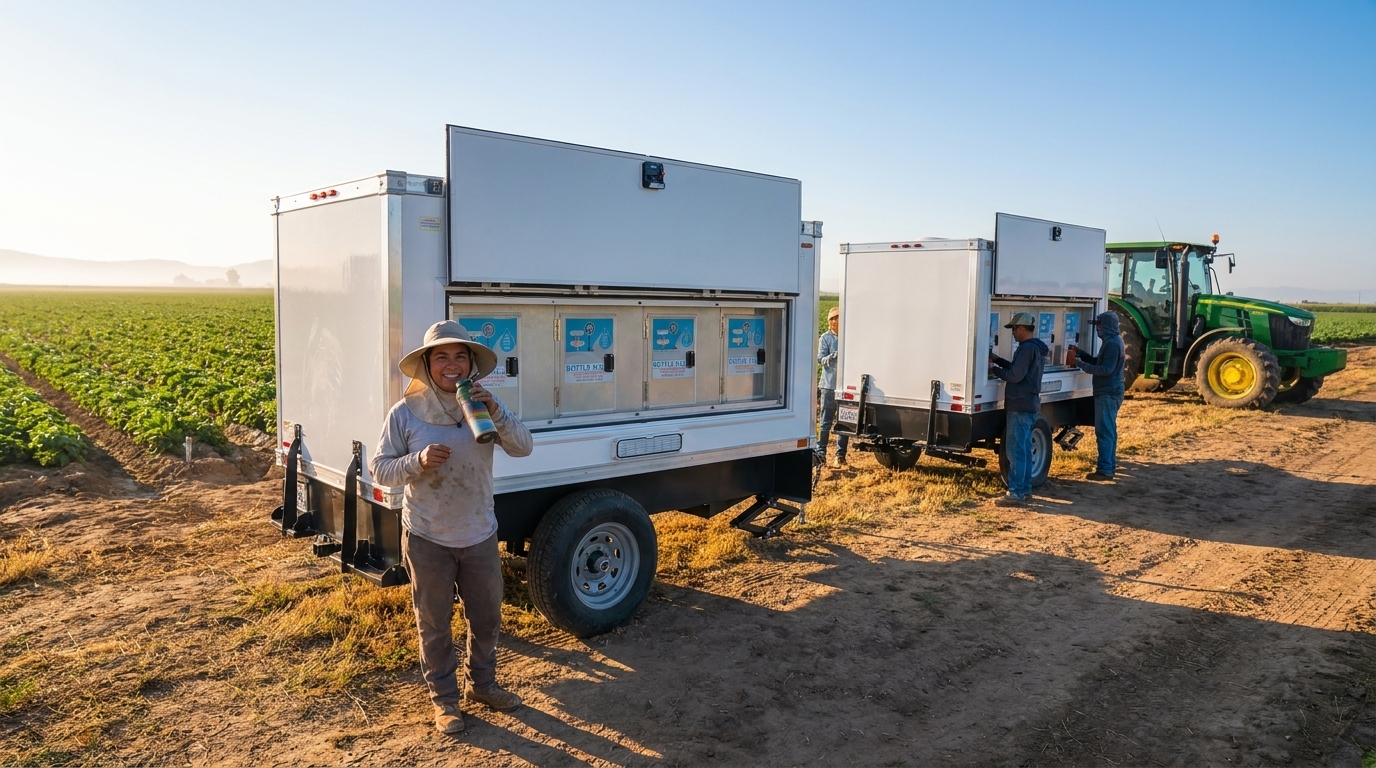
The Signature Series is the towable water station we send to church and community work, and it is built to sit on a lawn or a lot for a whole weekend without asking anything of the site but power. Everything a volunteer team would otherwise carry by hand is already on board.
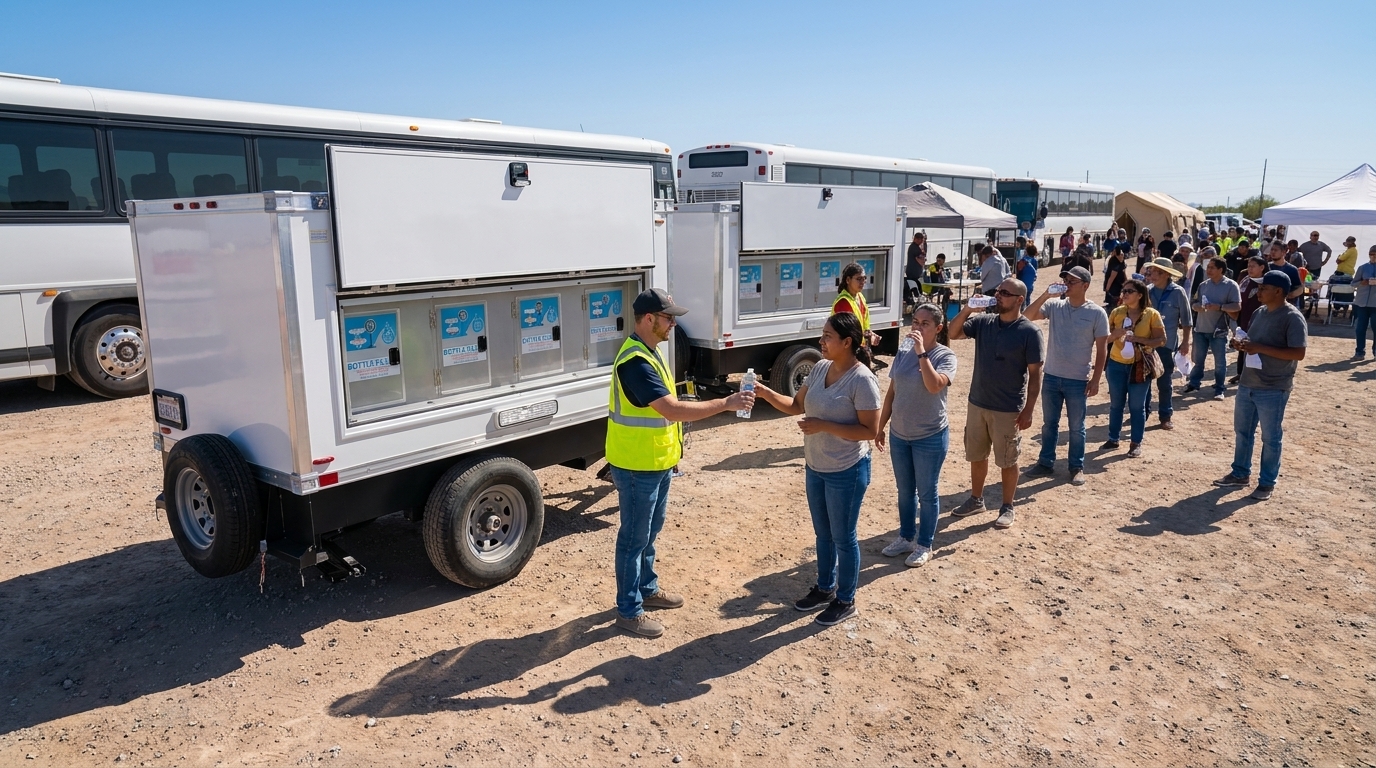
With a frame, a hitch, and tires under it, the unit hauls out to a remote build, an event field, a working orchard, or a disaster staging yard with equal ease. Contractors and event planners request this exact rig by name. The whole design is built around backing in, leveling off, and pouring cold by the same afternoon.
| No. of stations | (4) Bottle Filling Stations |
| Length | 12' 3" |
| Weight | 3,100 lbs. |
| Height | 8' |
| Fresh water tank | 300 Gallons |
| Power requirements | 1 to 4 dedicated 20A/120V circuits OR 1 dedicated 50A/240V circuit |
| No. of AC units | 1 |
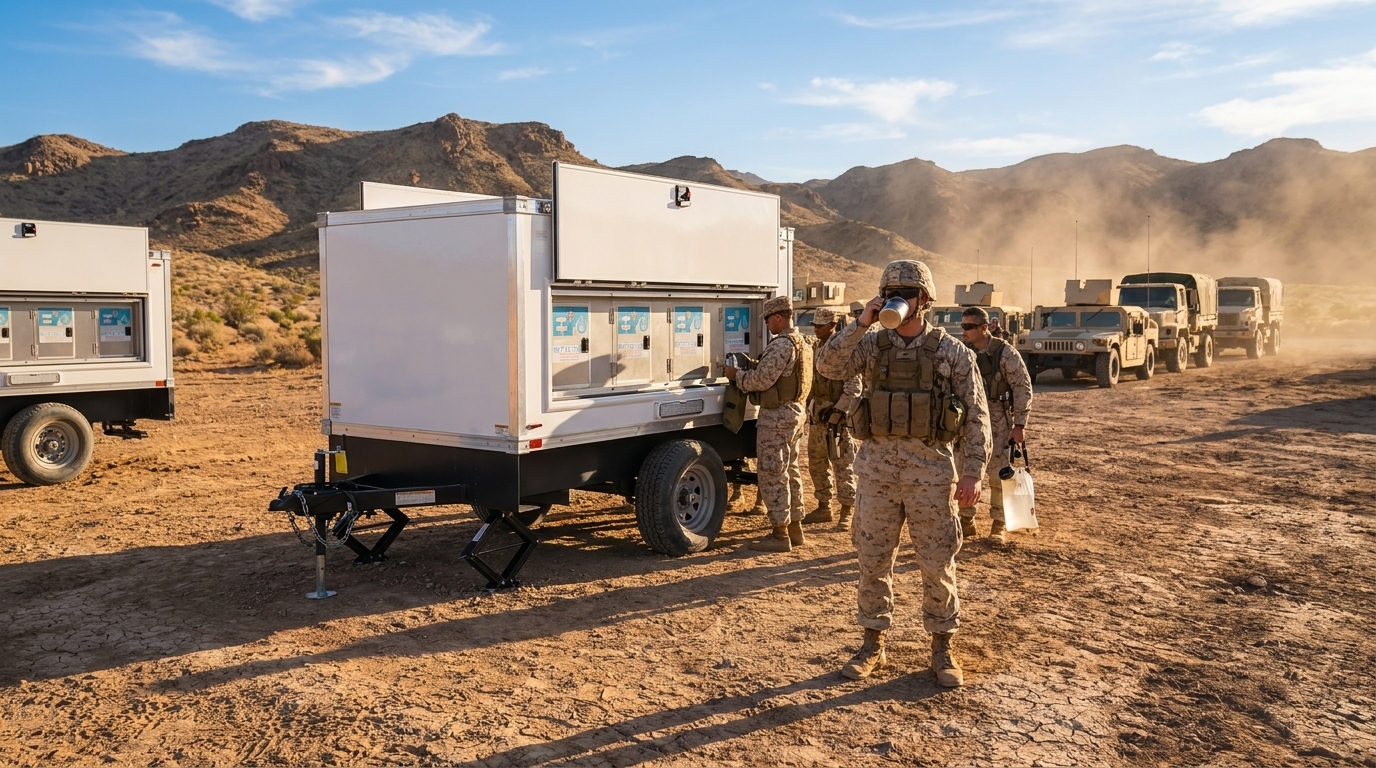
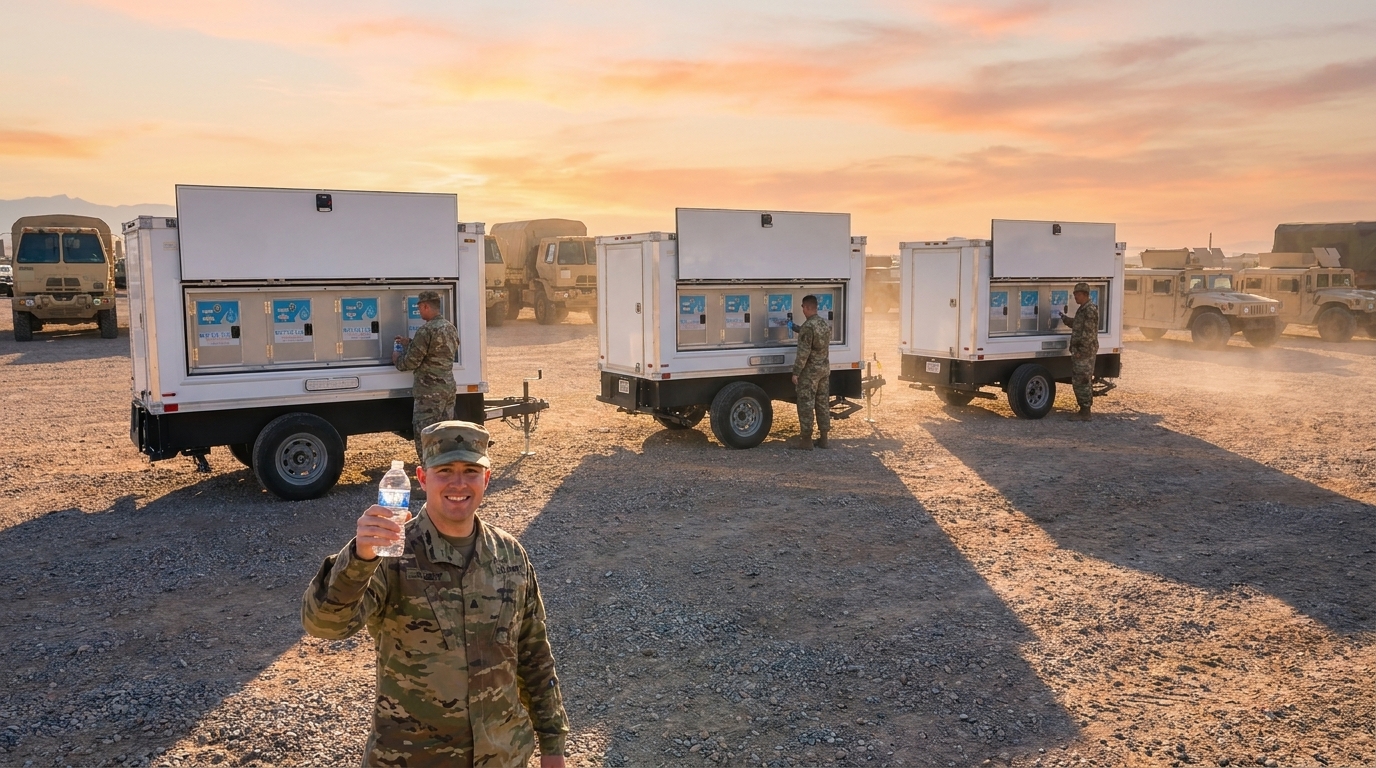
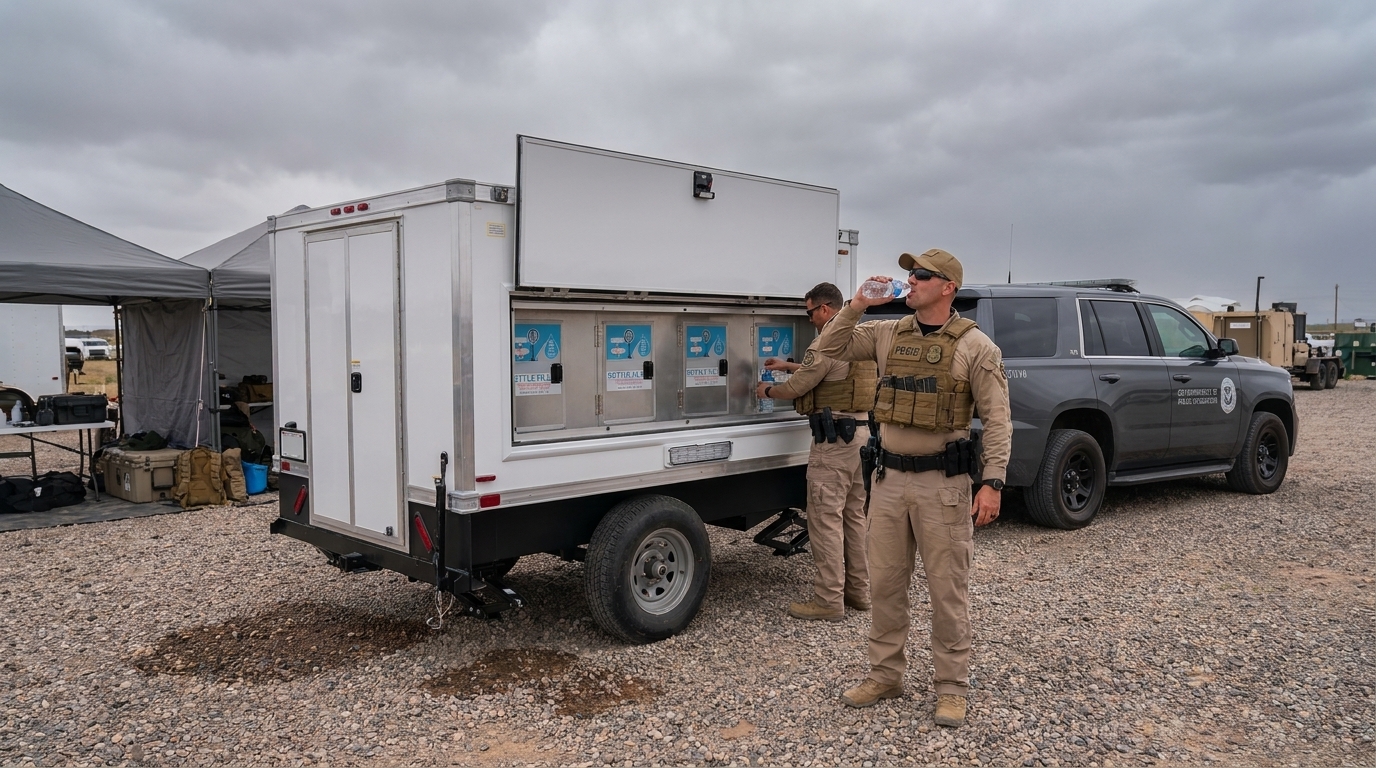
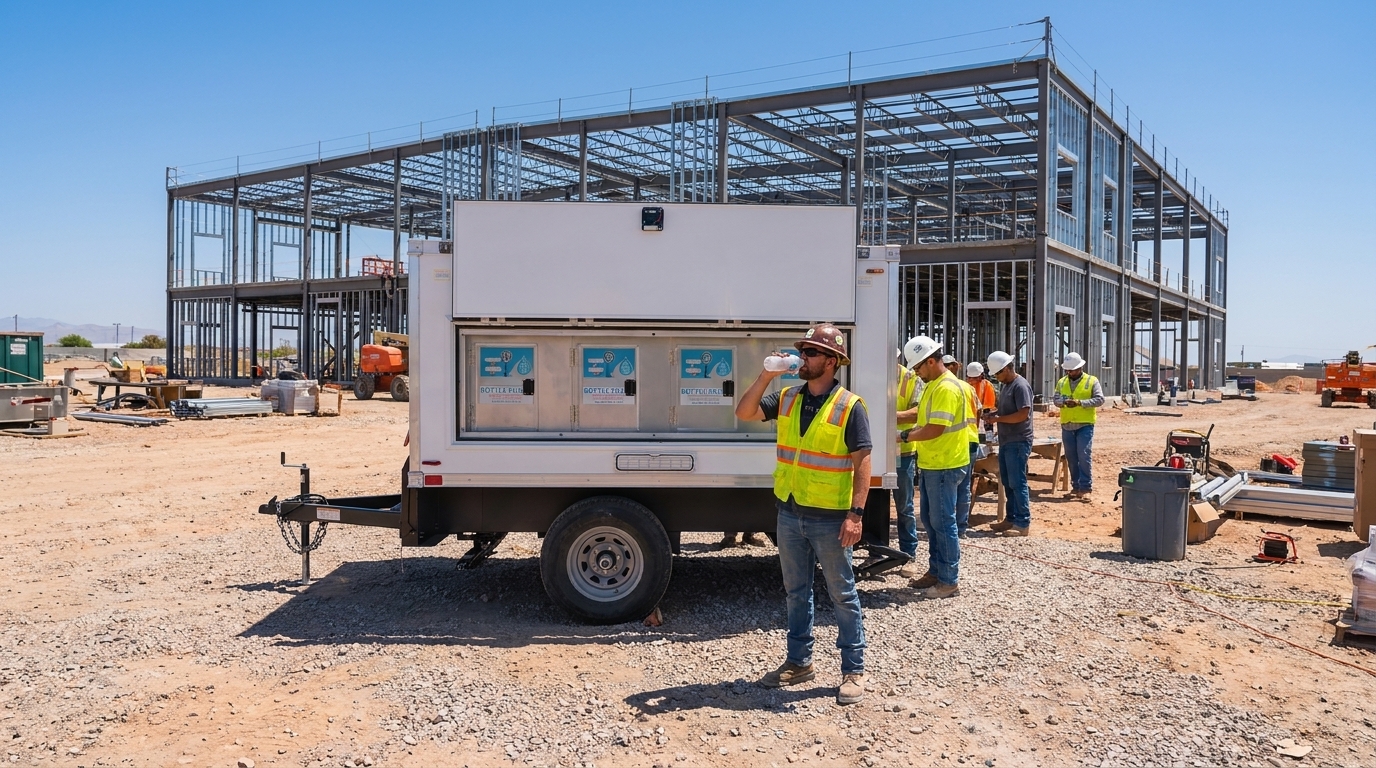
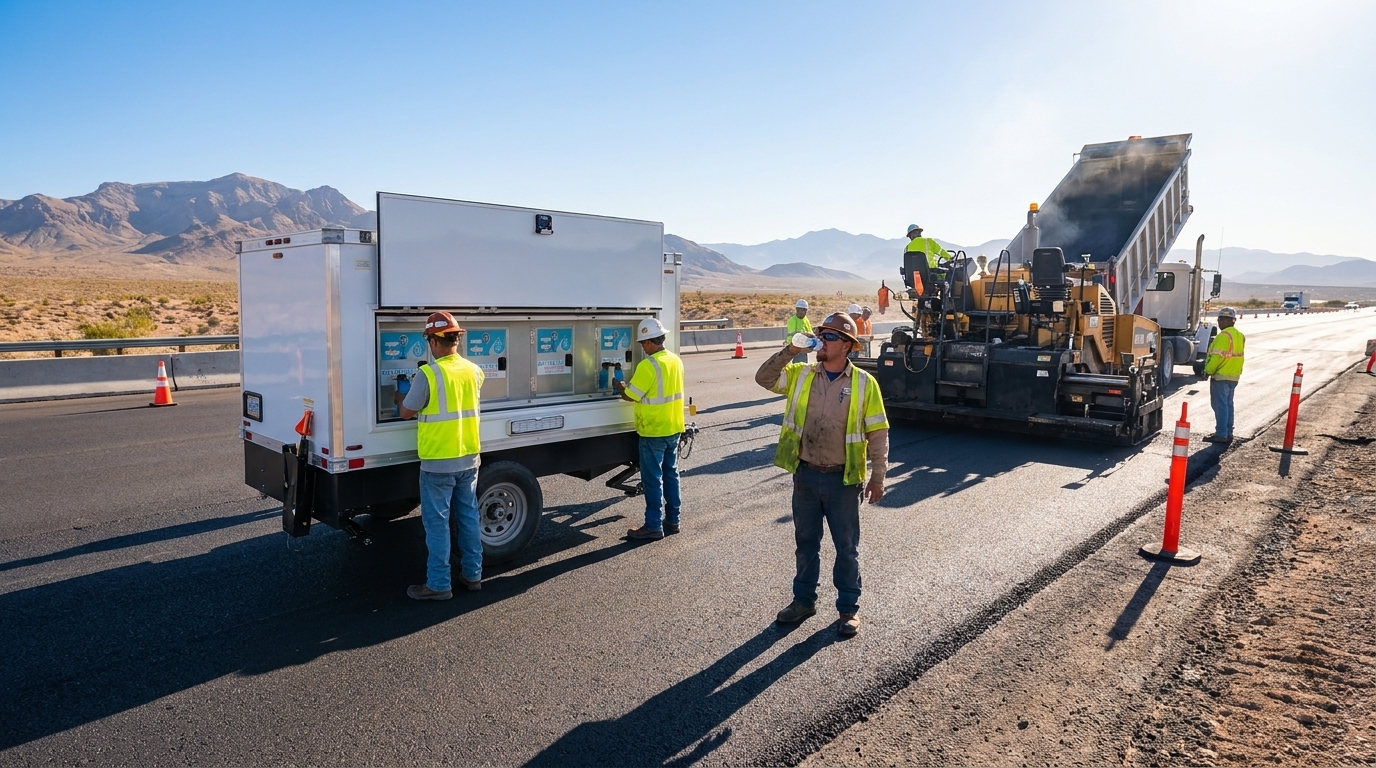
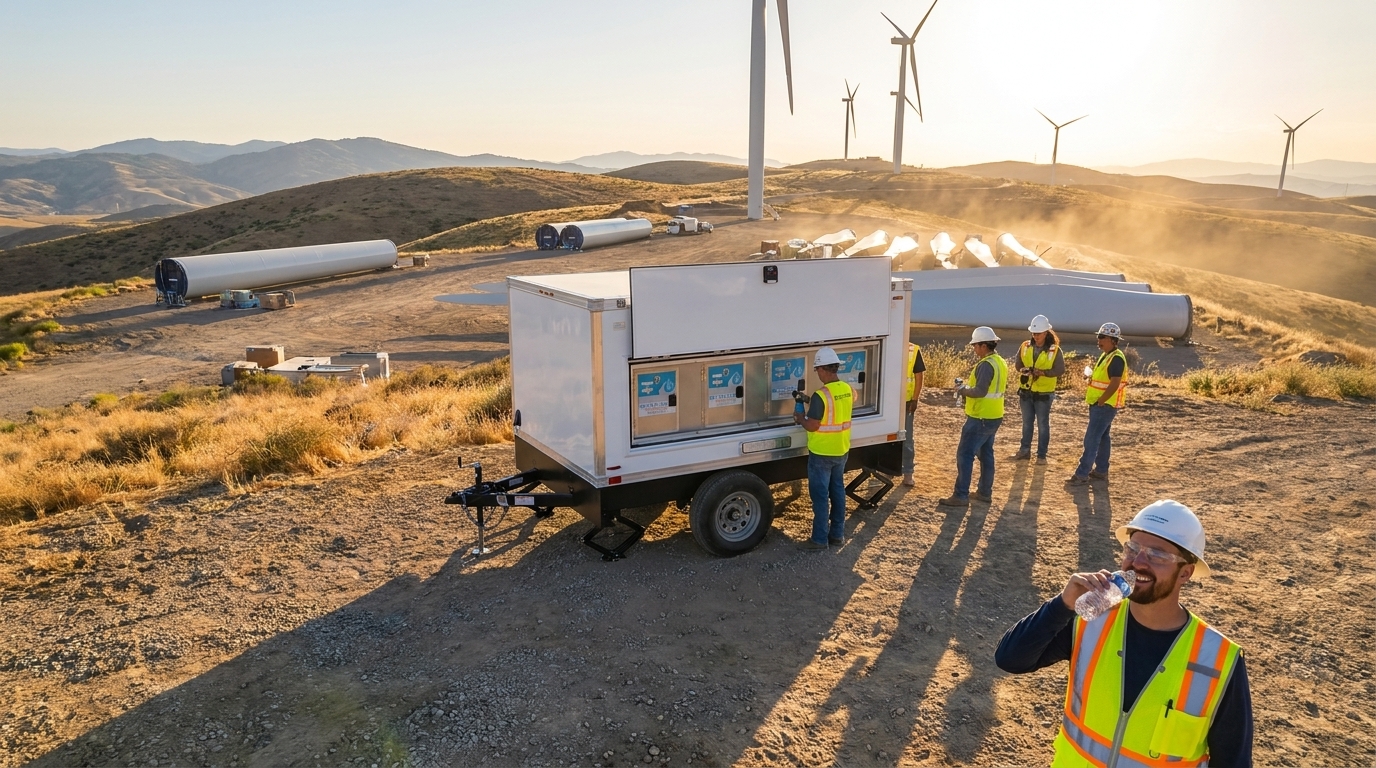
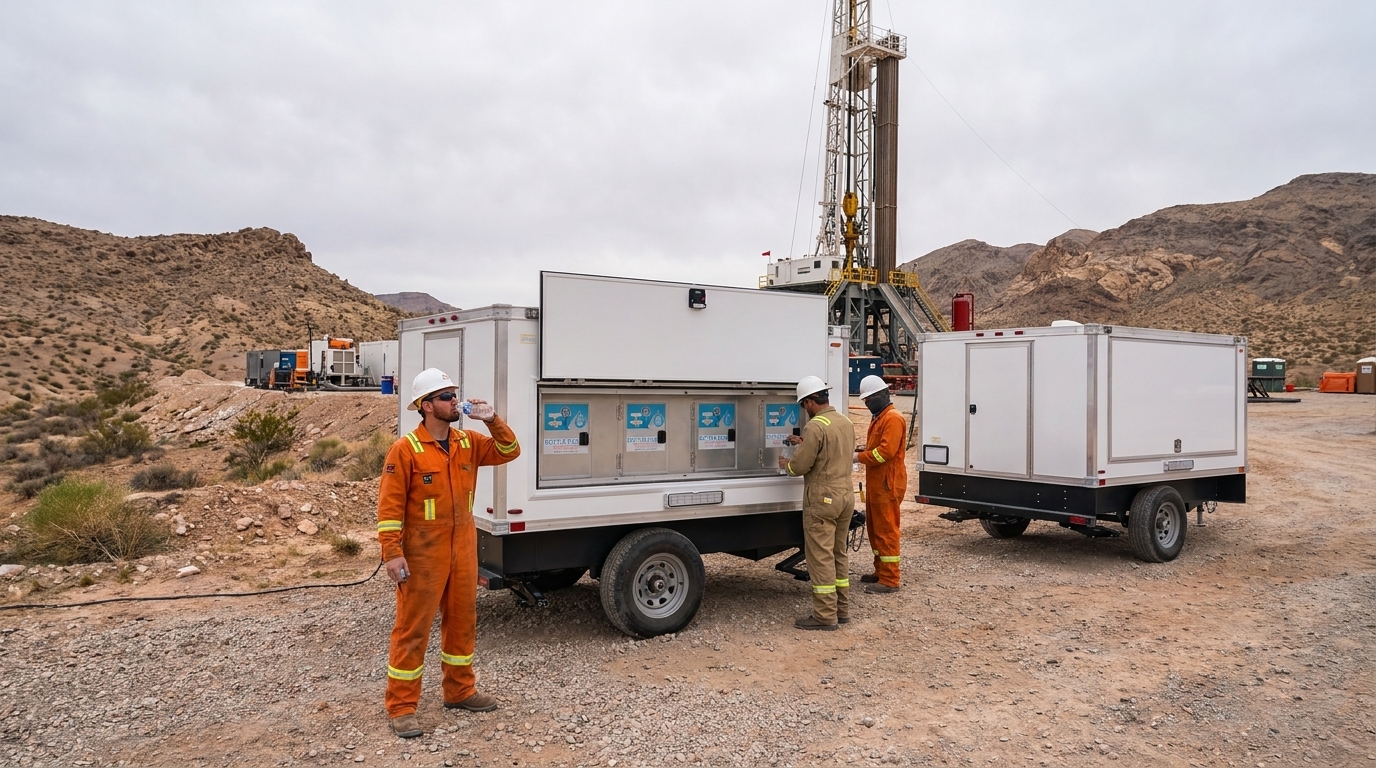
It holds 300 gallons of fresh drinking water, which is about 2,400 sixteen ounce bottles worth before anyone has to think about a refill. Four push back bottle filling stations sit along the side with adjustable taps, so a child's water bottle and a five gallon cooler jug both work at the same tap. The water runs through three filter stages that take out sediment and chlorine along with microscopic particles. After that it passes a UV treatment step and a built in cooling unit. Everything the water touches is food grade, with stainless steel at the dispensing end.
On site it reads as part of the event rather than a work truck parked at the edge of it. The trailer is 12 feet 3 inches long, 7 feet 6 inches wide and 8 feet tall. It is white and clean, with a single rooftop air conditioning unit about as loud as a window unit. People walk up, push a bottle against the tap and walk away. Nobody needs a briefing. That matters at a picnic where half the crowd is under twelve. The same unit we send out for water bottle filling station rentals shows up here.
It tows behind a three quarter ton pickup at 3,100 pounds, which is how it gets through a park service gate, down a residential street between parked cars and onto grass that a box truck would tear up. Power is 1 to 4 dedicated 20A/120V circuits or one dedicated 50A/240V circuit. A church lot with exterior outlets usually has enough on its own. Where an open field has nothing, a generator covers it, and we tell you which one you are dealing with before delivery day.
A water source people don't trust gets ignored, and an ignored station is rented money wasted. That's why municipal water doesn't reach the tap raw on our trailers. It passes through three filter stages and a UV chamber, then an onboard cooling unit drops the temperature. The result tastes clean and comes out cold, even on the worst afternoon of the year.
The opening filter traps sand, scale, and the fine grit local mains occasionally push through. On a dusty lot, that's what keeps a pour from tasting like the parcel it's parked on.
Activated carbon comes next, lifting the chlorine bite and the dull seasonal notes local tap can carry until the taste lands clean and neutral. When it's 95 out, that flavor decides whether a crew keeps drinking or walks past the tap dry.
A finer cartridge then catches the microscopic particles that slip past the first two, so what reaches the spout is clear rather than merely cold for the crews and crowds drawing off it.
The last step is an ultraviolet chamber that wipes out bacteria and microbes without adding a single chemical. Even after a long tow out to a remote site, the water off the nozzle is clean.
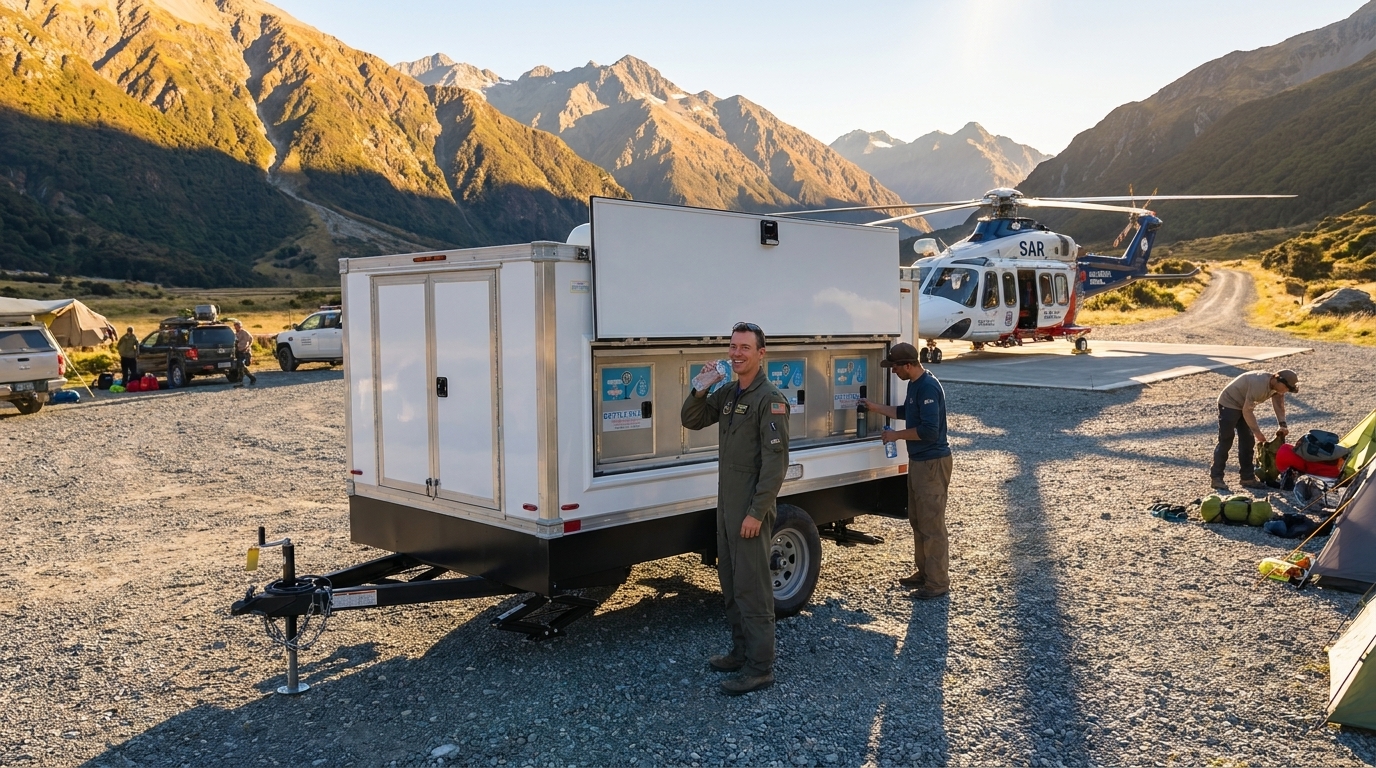
Along the wall sit four adjustable push-back taps, press a bottle to the bar and it pours. One of them is set at ADA-reachable height, so a single trailer includes everybody in a crew or crowd with no add-on gear. Out back, a large-jug spout services five-gallon coolers and hydration packs, while a bank of hose connection taps handles work-site chores, event support, and refills down the orchard rows. Stainless, food-grade plumbing the whole way through keeps the filtered, chilled water at quality right to the spout.
Every Signature trailer carries a 300-gallon load, roughly 2,400 cups at sixteen ounces each, and we recharge it on demand, so the unit doesn't turn into the choke point on a busy shift or a packed show night.
A church lawn breaks differently than a closed street, and a walk course breaks differently than both. The water plan that fits one of them does not fit the others. Here is how each one actually runs.
The summer picnic is the anchor event on most church calendars, and it lands on ground that was never built for a crowd: a parking lot, a side lawn, a ball field behind the building. One format we see constantly is the passport picnic, where guests move through six to eight stations and get a stamp at each one. A drinking water stop is usually one of those, so it has to sit where a line can form without cutting the path between the other stops. We place for that first and the truck second.
Asphalt is the hard version of this site. A lot in direct sun runs hotter than the grass twenty feet away, and a three hour picnic on pavement puts older guests and small children in that heat with no shade of their own. So we ask one question early: where does the shade fall at two in the afternoon, not at nine when you are setting up. We aim the station so a building shadow covers the line. Teams booking Portland water station rentals for church grounds get the same placement walkthrough before the truck leaves.
Outdoor tent services put different problems on the same property. A large tent raise takes roughly 10 to 15 volunteers with hammers, and most cities require a temporary structure permit for any tent over 400 square feet. Grass lets a crew drive steel stakes for wind. Asphalt does not, so the tent goes up on weights instead. Either way a tent with no air moving through it is the hottest spot on the property by the second hour of an evening service. We stage the station outside near the entrance rather than inside, where a line would block a row.
Vacation Bible School and youth camp weeks are the quiet heavy user. A program runs three outdoor hours a day for five straight days in midsummer, with elementary age children who are the worst in the world at noticing they are thirsty. Volunteer leaders are running crafts and crowd control at the same time. A station a seven year old can work without help takes a whole job off that list, and plenty of programs close the week with a family barbecue that pulls the adults onto the same lot.
Public festivals are where head counts stop being small. A Cinco de Mayo weekend in Stockton drew an expected 60,000 people across three days, and Portland's waterfront version has run between 30,000 and 60,000 depending mostly on the weather. Mid size civic events sit lower: Mount Pleasant, Texas draws up to 10,000 to Fair Park. Juneteenth programs run city by city from Henderson, Nevada to Lake Charles, Louisiana. What they share is a crowd spread across open ground for six hours or more with no drinking tap within two hundred feet of most of it.
Block parties are the small end of the same thing and the most rule bound. Every city we have worked in wants a closure permit and a site map showing where the barricades go, and the filing windows are not alike. Miami-Dade wants the application at least four weeks out, Milwaukee at least two weeks, and Chicago accepts them within three business days of the event. That map is the reason to call before you file rather than after. A water station has a footprint, and it cannot sit on a water hookup or a driveway a neighbor agreed to keep clear. Better to be drawn onto your map in advance than moved on the morning of.
City parks and town squares usually have something already, often a single drinking fountain near the playground. That fountain was sized for a Tuesday afternoon, not for two thousand people at a festival, and it becomes a bottleneck within the first hour. We treat park water as an extra and plan the real supply separately. The same logic behind fair and carnival water station rentals applies here at smaller scale: spread the water points so no single line owns the crowd.
The placement talk on a closed street is short. Mid block beats the corner, because corners are where barricades and emergency access live. A spot the delivery truck likes is often the worst spot for the accessible route the event already has to keep open. Cities that ask for at least 10 percent of portable restroom units to be accessible are telling you how they think about everything else on that street. We place the station on that same path.
A fundraiser walk is a linear site rather than a fixed one, so it gets sized by spacing instead of square footage. The convention across nonprofit planning guidance is steady: water points every half mile to a mile, with at least one aid station carrying water and electrolyte drinks at roughly the halfway mark, plus water at the finish. That spacing is built around how long a walker goes between drinks, which is why a 300 person neighborhood 5K and a much larger field use the same pattern.
The finish is where the crowd math turns sharp. Walkers cross in waves, then stand around for results and photos, so demand peaks after the event is technically over and runs another forty minutes. A folding table with a cooler cannot move that many people. Four taps can. If the course loops back through the start, one unit placed where the paths meet covers the halfway point and the finish at once.
Volunteer staffing is the other half. Nonprofit event guidance lists water station duty right alongside registration and route monitoring, which means every water point you staff costs a volunteer you could have put on the course. A station that needs nobody behind it gives that person back. We have watched a walk coordinator move two people off the water table ten minutes after seeing the unit run on its own.
Spring is the heavy season here. Walk fundraisers stack up March through June, before the worst of the heat but past the point where a 9 a.m. start stays cool by 10:30. Start areas are often a trail parking area or a school lot with no outdoor spigot. Where we run hydration station rentals in Tacoma, most bookings come from the same handful of park loops.
Nobody on your team has a loading dock or a forklift, and everything else is happening the same morning. We build the delivery around that.
We deliver ahead of your setup window, not into the middle of it. On a Saturday event that usually means Friday afternoon, while the tent crew still has the lot to itself and before the sound company runs cable across the grass. On a multi day festival we come in the day before load in. A 3,100 pound trailer backing across a lawn is much easier when there are no chairs and no children on it yet.
Placement gets decided before the truck arrives, on a phone call or from the site map you filed for your permit. We want a level enough spot with a power run under a hundred feet, and a line that can form without crossing a fire lane. After enough of these the first thing we ask about is the last hundred feet of the approach, because a gate post or a low branch decides more deliveries than the lot layout does. The crews running Tacoma mobile water station rentals walk the same checks.
The failure we see most is not equipment. It is a water point placed where the truck found it easy at eight in the morning, then found at two in the afternoon to be in full sun at the far end of the grounds from where everyone stands. A station nobody walks past does not get used, and the volunteer team goes back to running cases from a cooler. So we ask where the crowd will be at the hottest hour and place for that, even when it means a longer cord.
Pickup runs the same way in reverse and it does not need you. We come after the event closes or the next business morning, and nobody on your team has to stage anything or be there. That is the part coordinators notice most, because the breakdown crew on the last day of a five day festival is the same tired group that set it up on day one.
People count, number of days, where exactly it parks on your site, and what power is there. Those four answers let us spec it correctly the first time around.
Reckon roughly 45 minutes from the nearest yard once we are in your metro, longer on the outer routes, with round-the-clock emergency runs whenever a heat advisory or a power shutoff hits.
Once on site we set it level, charge the 300-gallon tank, and tie in power off one to four standard 120V circuits, or a single 50-amp 240V drop, depending on what the site gives us.
After that the tankers cycle back on a cadence matched to how fast your crew or crowd pulls it down, and we maintain the unit through the whole rental term.
No power on the parcel at all? We price that in. The unit draws very little, and with the service fleet backing it we've run stations on lots that had no permanent power whatsoever. Lay out what the site offers and the rest is on us.
Want this math run for your own booking? Two minutes on the phone gets you a real number.
Two numbers drive this: how many people, and how many hours they are outside. Heat moves the answer more than anything else.
| Church picnic on the campus lawn (up to 250 guests, three hours) | 1 station |
| Vacation Bible School week (100 children plus 20 helpers, three hours a day) | 1 station for the week |
| Tent revival, evening services (300 to 500 per night) | 1 station at the tent entrance |
| Block party on a closed street (up to 400 neighbors, six hours) | 1 station mid block |
| Community festival in a city park (2,000 to 5,000 across a day) | 2 to 3 stations spread across the grounds |
| Multi day cultural festival (10,000 or more over a weekend) | 3 to 4 stations, refilled between days |
| Charity 5K and walk (500 walkers on a looped course) | 1 at the finish, 1 at the halfway point |
Start with the published heat guidance, because every number on this page comes out of it. The CDC's figure is 8 ounces every 15 to 20 minutes during heat exposure, which is 24 to 32 ounces per person per hour, with a stated ceiling of 48 ounces an hour. Take the midpoint, about 28 ounces, and a 500 guest festival running three hours needs roughly 42,000 ounces of drinking water. That is about 328 gallons, slightly more than one full tank, before you count a single vendor. Outdoor planning guidance also says to roughly double what you would have planned for the same gathering held indoors.
Heat moves the whole curve, and it moves it in steps. Scouting's field guidance is a useful cross check because it is written as a ladder: a quarter to a half quart per hour between 82 and 85 degrees, three quarters to a full quart between 88 and 90, and a full quart or more above 90. Same crowd, same event, double the water. So a July picnic and an October harvest festival with identical guest lists are not the same booking. The spacing logic behind marathon and race hydration station rentals carries over to any course style event here.
The honest default is one station for a gathering up to a few hundred people over an afternoon, and a second unit once the crowd passes about a thousand or the site spreads past a couple hundred yards. A five day camp week with 100 children and 20 helpers outside three hours a day works out near 390 gallons, comfortably inside what one unit handles with a mid week refill. A county fair crowd in the hundreds of thousands, the range the LA County Fair and the San Diego County Fair run at, gets solved with points spread across the grounds instead of one big one.
County and city health departments own the water side of these events, and the line they draw is about the public, not your tax status. A gathering for members and invited guests that is not advertised publicly and runs three days or fewer in a 90 day window sits inside a carve out in every county we have worked in. Open the same picnic to the neighborhood with flyers and the full permit process applies. Los Angeles County's health code is specific: any temporary food facility with a dishwashing sink must have 25 gallons of potable water on hand, and the event coordinator carries responsibility for every vendor having an adequate supply.
Accessibility is the rule most often missed on borrowed ground, and the numbers are public. The 2010 ADA Standards set the wheelchair accessible spout at 36 inches maximum above the ground. A standing user's unit sits at 38 to 43 inches. A children's unit tops out at 30 inches maximum. Where fountains are provided, half must serve wheelchair users and half must serve standing users. Knee clearance runs a minimum 27 inches high with a depth between 17 and 25 inches, and bottle fillers meet the operable parts rule: one hand, no tight grasping, no more than 5 pounds of force. In new construction or alterations a cooler or bottle filler does not substitute for either required fountain.
What separates real drinking water equipment from a tank with a spigot on it is NSF and ANSI. NSF/ANSI/CAN 61 covers the health effects of every component that touches drinking water, and it was developed at the EPA's request in the late 1980s. Its scope runs from pipe and fittings through coolers and tanks. Bottle filling equipment also certifies to NSF/ANSI 372 for lead content by weight. That pair is checkable on a certification database rather than taken on somebody's word.
Heat rules reach your paid people even when your attendees are volunteers. California's Cal/OSHA standard is in force today and requires potable water that is fresh and suitably cool, provided free of charge and kept as close as possible to where crews are working. Shade is required once the outdoor temperature passes 80 degrees, and a high heat tier kicks in at 95 degrees for named industries. At the federal level, OSHA's proposed heat rule, published August 30 of 2024, would require drinking water at a minimum of one quart per worker per hour once the heat index holds at 80 degrees for 15 minutes in an hour. Anyone booking Denver water station rentals for a civic event is planning against that same direction of travel. The federal Volunteer Protection Act, worth naming because organizers ask about it, shields an individual volunteer's personal liability, but it is a liability shield and not a water plan.
Federal OSHA heat illness prevention guidance and the CDC and NIOSH heat stress program point at the same baseline: cool drinking water, close to the people doing the work, and documented.
Need a station your written heat plan can point to? We can have one pouring cold within days.
The default here is not a competitor's trailer. It is a pallet of donated cases. Grocery chains and beverage companies come up again and again in fundraising guidance as in kind donors, and some retailers hold a standing quarterly budget for community requests like these. So the water often arrives free, which makes it feel like the problem is solved. It is not solved. It is moved onto the same volunteers already running the event.
Walk through what those cases actually require. Somebody meets the delivery, stacks the pallet somewhere shaded, breaks it down, ices the coolers, restocks the table every twenty minutes through the hottest part of the afternoon, then collects the empties. A 500 guest three hour festival needs about 2,600 sixteen ounce bottles to meet the same CDC rate one tank covers. That is roughly 110 cases to carry in and a comparable pile to carry back out at nine at night, and on a multi day event the cycle repeats every morning.
There is a second gap cases cannot close. A folding table with coolers has no accessible height design in it and no NSF or ANSI certification behind it, and it moves people only as fast as one volunteer can hand things across a table. A garden hose from the nearest building solves supply and none of the rest. A rented station adds chilled filtered water across a full day, a tap at a reachable height that was designed to be one, and nothing for your crew to haul away when the lights go off.
Look at everything bottled water actually demands of a person: cutting the order, receiving and breaking down pallets, icing coolers before dawn, topping them up through the day, then flattening empty bottles for the bin. On a large crew that's hours of paid time burned every single day, scraped right off the work that's supposed to be getting done. The trailer erases that loop entirely. A local contractor once let us pencil it out with him, and the recovered labor by itself paid for the unit. His words were that the bottle runs had been quietly costing him close to a day of payroll a week. Our trailer arrives full, the tankers keep it full, and your superintendent owes it nothing but a parking spot.
Ice a cooler at 6 a.m. and by mid-morning in July it's as warm as a bath. Warm water is water people stop touching, and the slowdown that follows is precisely where heat illness gets its opening. A chilled station never rides that warm-up curve at all. Whatever pours at clock-out is as cold as the sunrise fill, which happens to be the moment a spent crew, or a crowd deep into a long concert, leans on it hardest.
Bottled-water pallets devour staging space, jam the lay-down area, and sit cooking in the sun until somebody finally cracks them open. Empties build up faster than anyone keeps up with, and on a tight commercial lot that pile turns into its own problem. Set a trailer in one parking stall instead and it serves a crew or crowd that would otherwise burn through hundreds of plastic bottles every day.
Every bottle bought is a bottle thrown out, and across a season a busy site or event generates a small mountain of them. That's a disposal line on the budget, a dent in the sustainability numbers, and, given that a single bottle can linger in the ground for centuries, a footprint that lasts longer than the project that made it. Move to a refill station and the line drops to zero, which finally gives your reporting a figure worth publishing.
Three bookings of this kind, and what we planned around on each one. Names and details are kept generic on purpose.
Church picnic on an asphalt campus lot, 300 guests, second Saturday in July. This picnic had run for years on donated cases and four coolers, and every year two volunteers spent the afternoon on ice runs. The lot had exterior outlets on the fellowship hall wall, so power was never the question. Placement was. We walked the shade line with the coordinator and put the station on the north side of the building, where the shadow reached the queue by one in the afternoon instead of the open middle of the lot where the truck wanted to sit. At four o'clock nobody had left the property for water.
Block party on a closed residential street, 250 neighbors, Labor Day weekend. The permit map was already filed when the coordinator called, which meant the station had to fit a footprint nobody had drawn for it. We found a mid block spot clear of the hydrant and of the two driveways neighbors had asked to keep open, and the city accepted the amended map. Power came off a garage circuit on a hundred foot run. What the coordinator mentioned afterward was not the water. It was that the food vendor filled his own jugs off the rear spout twice and stopped asking to use a kitchen.
Charity walk on a city park loop, 600 walkers, first Saturday in June. An 8 a.m. start on a 3.1 mile loop put the field across the finish between 8:45 and 9:30, then standing in the sun for results. The course came back through the start area, so one unit placed where the two paths met covered the halfway point and the finish at once. The development director had budgeted two volunteers for the water table and moved both to course marshal duty that morning. Last year's photos showed a lawn dotted with empties. This year's did not.
Service information current as of September 2026.
Still weighing it? Call and ask. Most of these questions get settled in one short conversation.
No hookup is needed for the water itself. The trailer arrives with 300 gallons of filtered drinking water already on board, which is why it works on a church lawn or a closed street. What it does need is power: 1 to 4 dedicated 20A/120V circuits or one 50A/240V circuit, within about a hundred feet. Where a site has neither, a generator covers it.
One unit covers a gathering up to a few hundred people across an afternoon. Run your head count against the CDC rate in the sizing table above and a mid size event lands close to one full tank. Past about a thousand people, or once the site spreads past a couple hundred yards, a second station stops being optional because the walk to the first one gets too long.
Yes. One of the four bottle filling stations sits at a reachable height and works the way an operable part should: one hand, with no wrist twisting and no tight grasping. The 2010 ADA Standards put a wheelchair accessible spout at 36 inches maximum and a standing user's at 38 to 43 inches. If your venue already has permanent fountains, talk to us about how the rental fits alongside them.
It turns on two things, and neither is your tax status. In every county we have worked in, a gathering for members and invited guests that is not advertised publicly sits inside a carve out as long as it runs three days or fewer in a 90 day period. Advertise it to the neighborhood or run it longer, and the full event organizer process applies. Call your county health department with those two facts.
For a summer weekend, four to six weeks is comfortable, and it matches the window most cities want for a street closure application anyway. Short notice happens more often than people expect, usually when a forecast turns. Call us anyway, because what we can do depends on where our trucks already are that week.
We do, both ends. Our crew tows it in and levels it, then fills and tests it before leaving it pouring. Nobody on your team needs a forklift or a technical brief. Pickup runs after the event closes or the next business morning, and you do not need to be there.
Usually not well. The Signature Series is a towable outdoor unit at 12 feet 3 inches long, so it lives outside, and a crowd split across two areas will use whichever water point is closer and ignore the other. If your fellowship hall already has fountains inside, one outdoor station for the lot is normally right. If neither area has water, plan on two placements.
We build a refill into the schedule rather than a bigger tank, because there is no tank big enough for a three day crowd. On a weekend festival that usually means an early morning refill before gates open, on a day we agree on when you book. You know the plan in advance instead of finding out at four in the afternoon on Saturday.
Continuous chilled filtered water for a full day instead of whatever survived the ice, a tap at an accessible height that was designed to be one, and no empties for your crew to collect at the end of the night. The donated pallet still helps, and plenty of our customers keep it for the volunteer coolers while the station handles the crowd.
Four weeks out is the moment to make the water decision, because it is also when most cities want a street closure application in hand. Put the water point on that first site map. Amending it later is possible and annoying.
Three weeks out, settle your head count and your hours. Those two numbers are the whole sizing conversation. Multiply people by hours by the CDC's midpoint of about 28 ounces, divide by 128, and you have gallons. A 400 person picnic running four hours is about 350 gallons. Hand a rental company that number instead of asking them to guess.
Two weeks out, walk the site at the hour your event will actually run. Not at nine in the morning when it is pleasant and you have the lot to yourself. Look at where the shade falls and where the fire lane is. A station placed against the far fence because the truck fits there goes unused while your volunteers run coolers to the middle of the lawn.
Heat is the one variable that changes the water plan after it is already made, and the change is not small. The CDC's range runs 24 to 32 ounces per person per hour with a ceiling of 48, so the same crowd at the same event can need close to double what you planned if the afternoon runs hot. A plan built on the low end fails on the day it matters.
Scouting's field guidance is the clearest ladder we have seen, and it maps to event planning well even though it was written for backcountry travel. Between 82 and 85 degrees it calls for a quarter to a half quart an hour. Between 88 and 90 it is three quarters to a full quart. Above 90 it goes past a quart. The top step is four times the bottom.
The people who run the largest events treat this as a scheduling problem. The California State Fair drew more than 650,000 visitors in its 2026 summer run, and organizers confirmed triple digit heat cut into attendance on the final weekend, traditionally its busiest. The fair is moving its entire 2027 run to September 17 through October 3 for that reason.
Start with certification, because it is the one answer that is checkable rather than persuasive. Ask whether the components that touch the drinking water meet NSF/ANSI/CAN 61 and whether the bottle filling equipment meets NSF/ANSI 372 for lead content. Those are database lookups. A company that answers with adjectives instead of standard numbers is telling you something.
Ask about accessible height next, and ask it specifically. Not whether the unit is accessible, but what height the accessible tap sits at and whether it works with one hand under five pounds of force. The 2010 ADA Standards put those numbers in writing, and a rental company that works public events should be able to recite them.
Ask what happens on a refill. For anything longer than one day, the answer should be a scheduled morning visit you agreed to when you booked, not a phone call when the tank gets low. Ask who does it, because that decides whether your volunteers are involved on day two.
→
Midways and grandstands with the same crowd density and the same heat window.
→
Course points and finish areas that need volume in a short burst.
→
Outdoor ceremony sites with no tap anywhere near the guests.
→
Public sites opened during a heat wave where free water is the point.
→
The unit itself, and where else it gets booked.
We run water station rentals nationwide, and we keep dedicated local pages for the metros our trucks work hardest. Start with the closest one.
Booking this kind of work in a metro we already run? Start with Sacramento hydration station rentals, Portland hydration station rentals, water station delivery around Denver, water station rentals in Seattle and Austin hydration station rentals, and call us for anywhere else in the country.
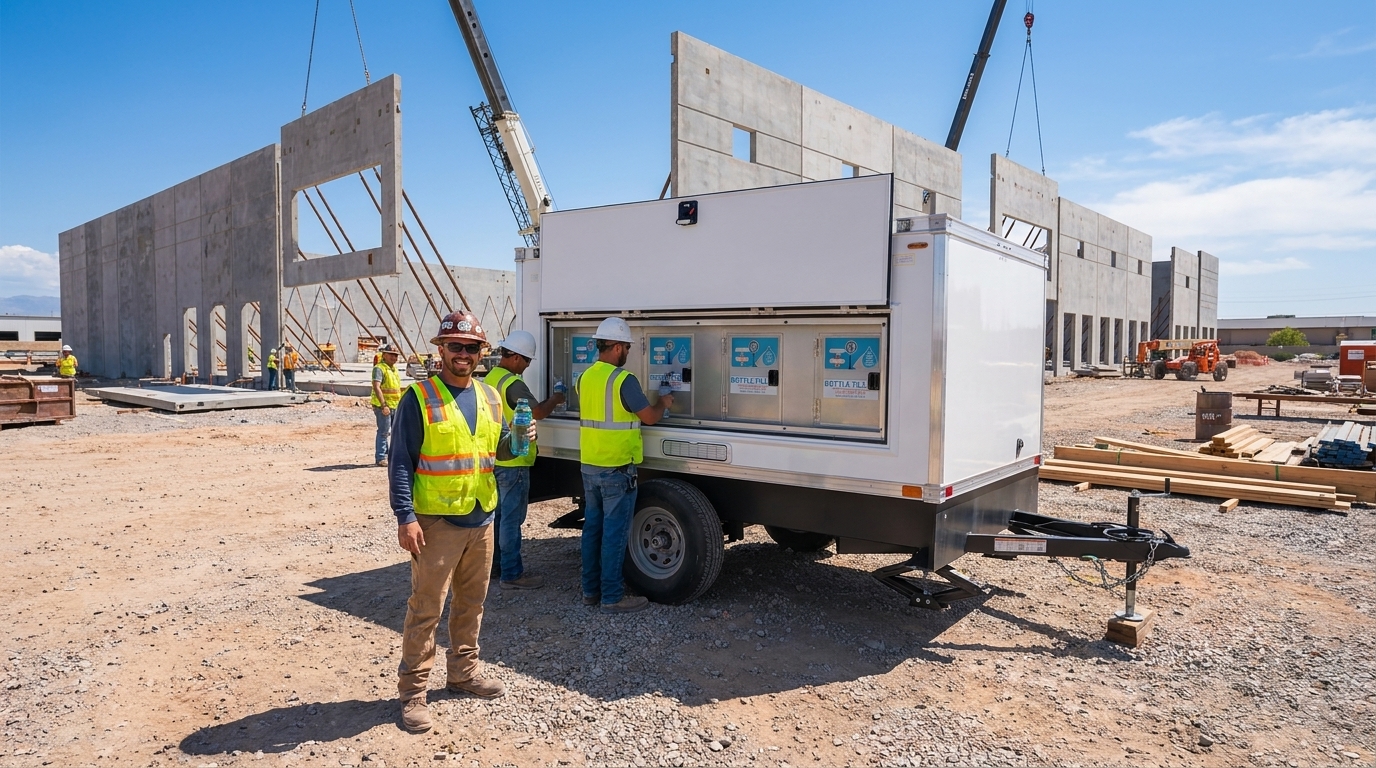 Sacramento Valley
→
Civic festivals and church picnics through a long triple digit summer.
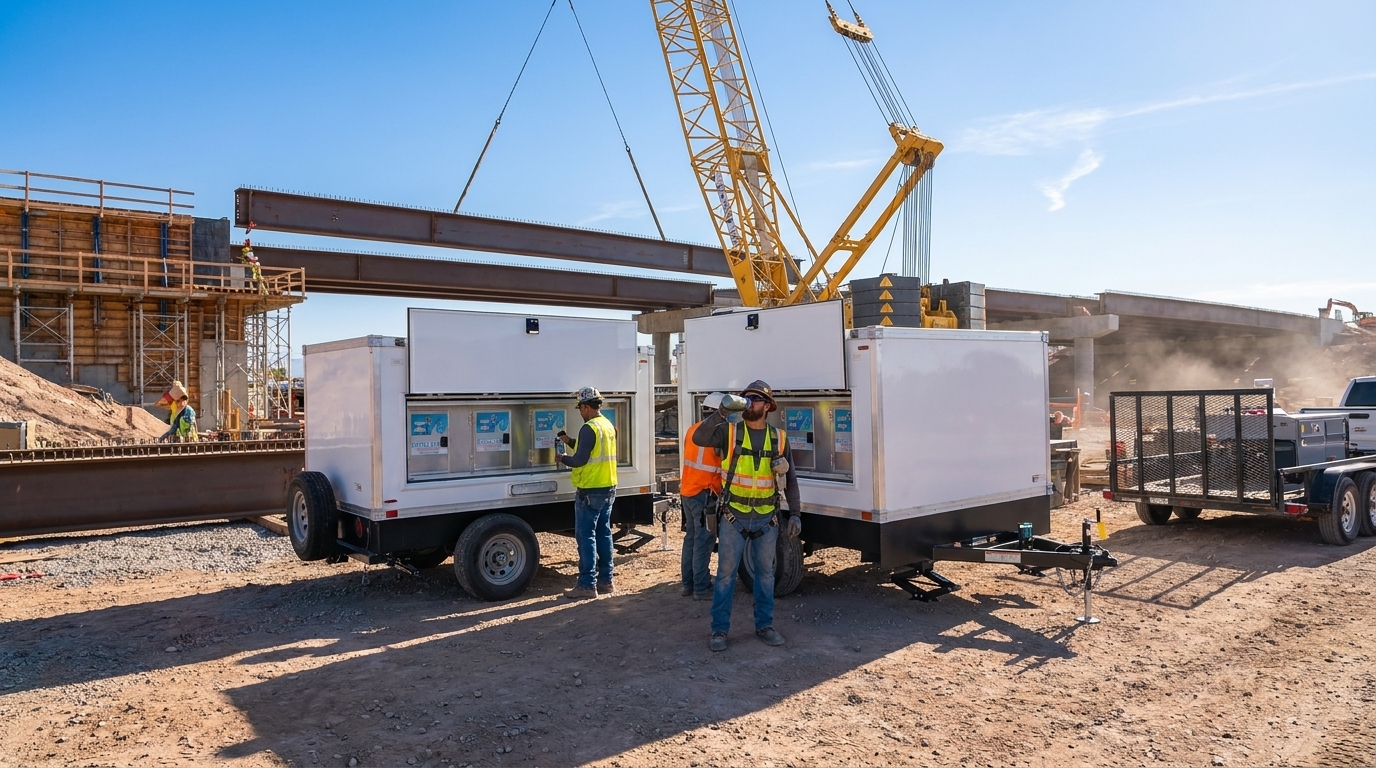 Willamette Valley
→
Waterfront cultural festivals and neighborhood street closures.
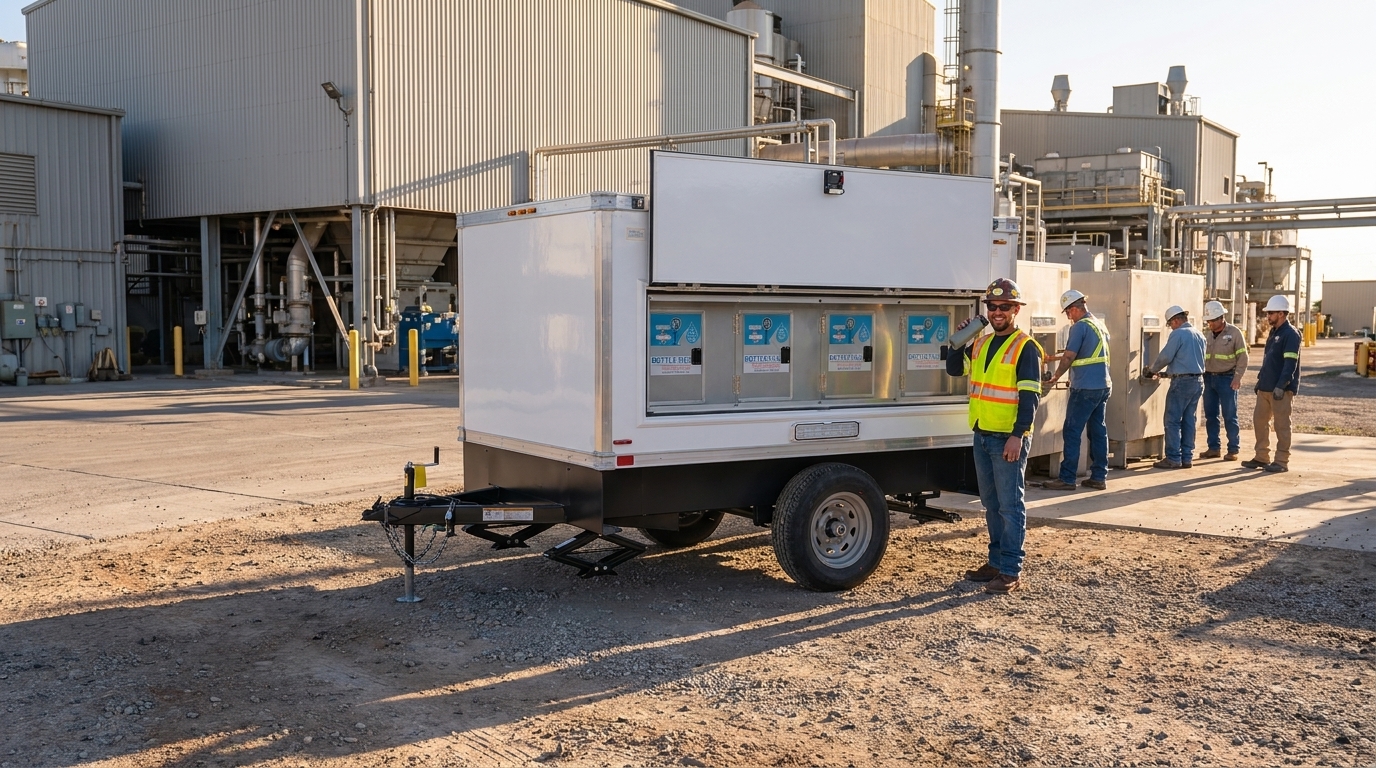 Front Range
→
Park festivals and charity walks at altitude, where thirst arrives late.
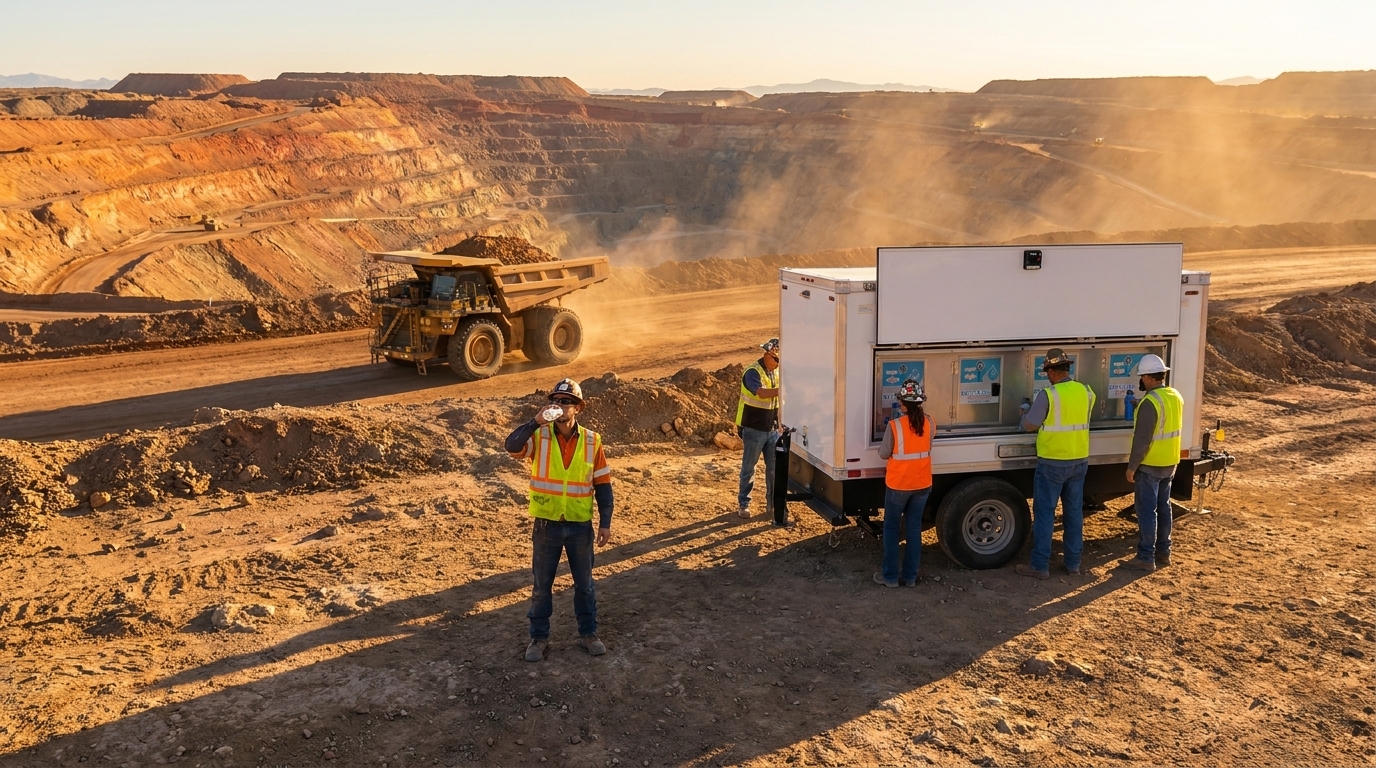 Puget Sound
→
Community fairs and block parties in a short, intense event season.
 Central Texas
→
Church campuses and closed downtown blocks through a long hot calendar.
Give us the head count or the guest count, the date, and the spot it will park. We will spec the right setup, confirm the delivery window, and have cold filtered water pouring before the day starts.