On-Site Hydration Services delivers cooling center water station rentals to libraries, recreation centers, senior centers and the City buildings a county converts when a heat emergency moves fast. Every Signature Series trailer rolls in with 300 gallons of filtered, chilled drinking water on board and four push back taps, one set low enough to reach from a wheelchair, so a site opens without a plumber and without a pallet of cases in the lobby. Call us with the building, the date and the visitor estimate and we will tell you what fits. Ask for a quote and your heat plan has a real number in it this week.
Licensed and insured | A+ BBB rated | 24/7 dispatch
See the Signature Series water station specs
“We went to augmented hours on a Thursday and the branch fountain had a line by ten. The trailer was set by the side entrance the next day and the line was gone. Staff stopped running to the store for cases, which is the part I noticed most.”
“Our heat plan sizes volunteers against a visitor estimate and had nothing that sized water the same way. Now the same 300 person number drives both, and day three stopped being a guess.”
“The rec center runs a splash pad and an indoor gym on one activation, so people come in already down a quart. Cold water at the door instead of a warm cooler in the hallway changed how long families stayed.”
References for this kind of booking are available on request.
We have delivered chilled drinking water stations into heat relief work long enough to know the call never comes early. By the time a county phones us the forecast trigger already fired, the sites are named in the plan, and somebody has already promised the public a place to go. What they need is a station that arrives full, pours cold, and needs nothing from a facilities crew that is not available that week. Our trucks run nationwide and we keep local pages for the metros we serve most, including Portland water station rentals, where the 2021 heat dome changed how every jurisdiction on that coast plans for this. Call us the hour the warning posts and we will tell you what we can put on the ground and when. Ask for a quote before the season starts if you would rather have the number sitting in the plan, which is the smarter way to buy this.
One Signature trailer can pour for a weekend concert and be working a slab pour a couple of days later. Hiring one company for your events and a separate one for your worksites makes no sense. Either way, the planning, the delivery, and the refills are ours.
The onboard cooling unit keeps the tank genuinely cold all the way through a long afternoon outdoors, and that single detail carries the whole thing. Warm water is water people abandon, and midsummer is exactly when a crew or a crowd is drinking the most. Cold water gets finished, and finishing it is what keeps heat illness off the site.
Typical deliveries land in about 45 minutes once a truck is rolling in your metro, longer out on the rural routes, and we keep emergency runs going around the clock whenever a heat advisory or a power shutoff hits. The morning a foreman finds his 40-person crew stuck with one warm cooler, speed is the whole game.
One rule sits under every job we take: water that people walk past might as well not be there. We've stood on a bare site and watched shrink-wrapped pallets cook next to the job-trailer while the crew baked thirty yards off. We've watched the opposite too, a chilled station ten steps off the work face run bone-dry twice inside one shift. Everything that matters lives in the distance between those two pictures. Which is why we don't drop a unit and disappear. We match it to your headcount or your gate count, set the refill rhythm to how hard you're really pulling on it, and treat a heat call the way you'd want your own treated, meaning right now, because out here one hot hour can swing the whole day.
We deliver water stations to job sites, venues and event grounds in all 50 states, with the heaviest route coverage across the West.
We plan for day three, not day one. Attendance at a relief site climbs every night a warning runs, because homes without air conditioning stop cooling off overnight. We set the refill cadence against that curve instead of the opening day crowd, and we check in on a multi day activation without waiting for the call.
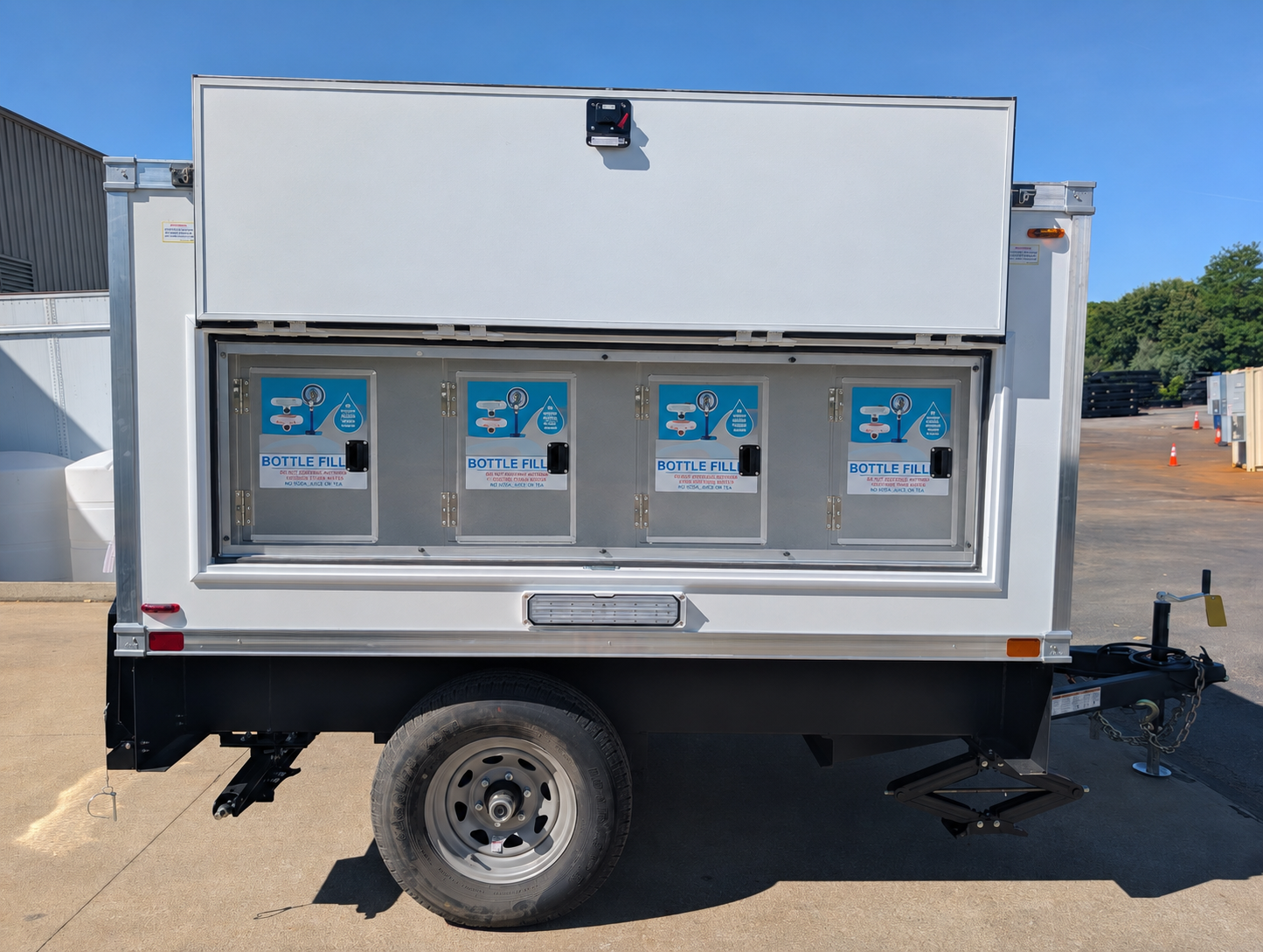
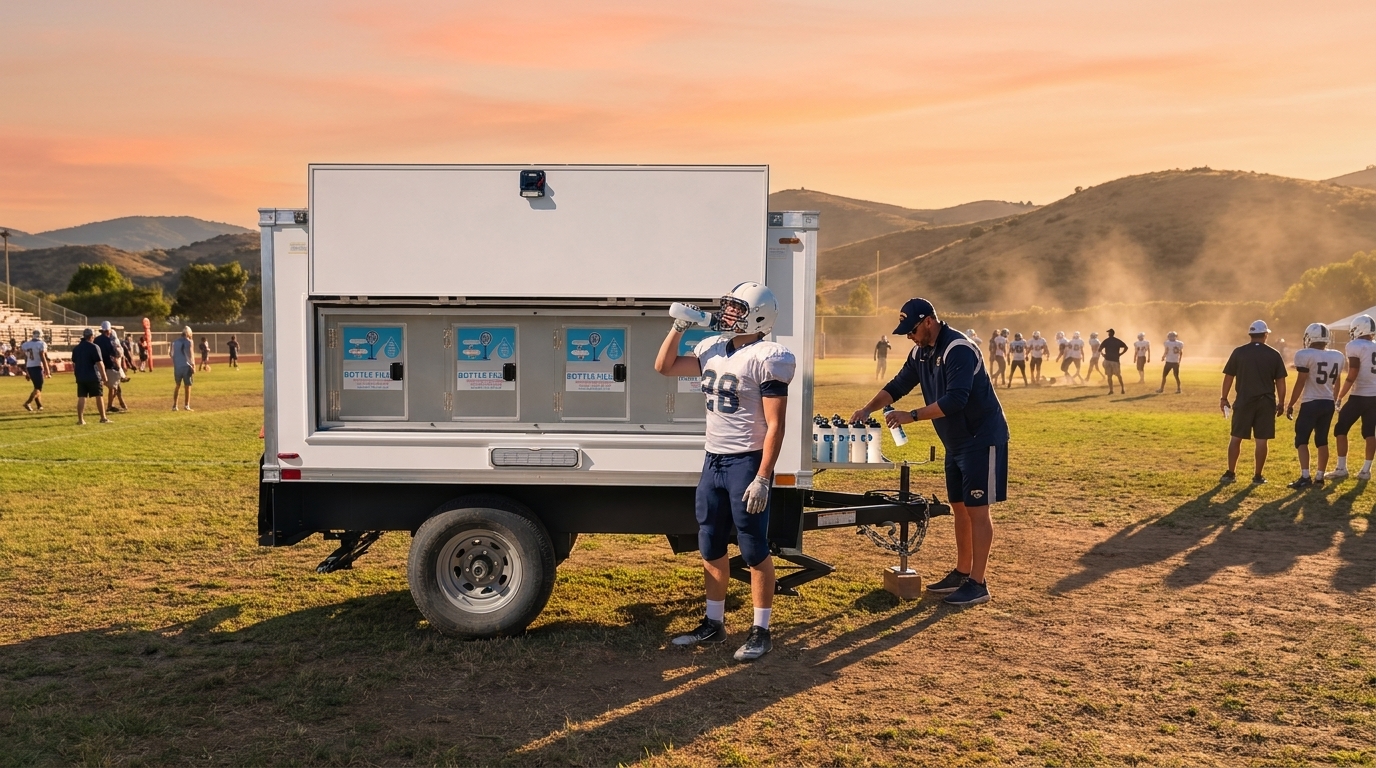
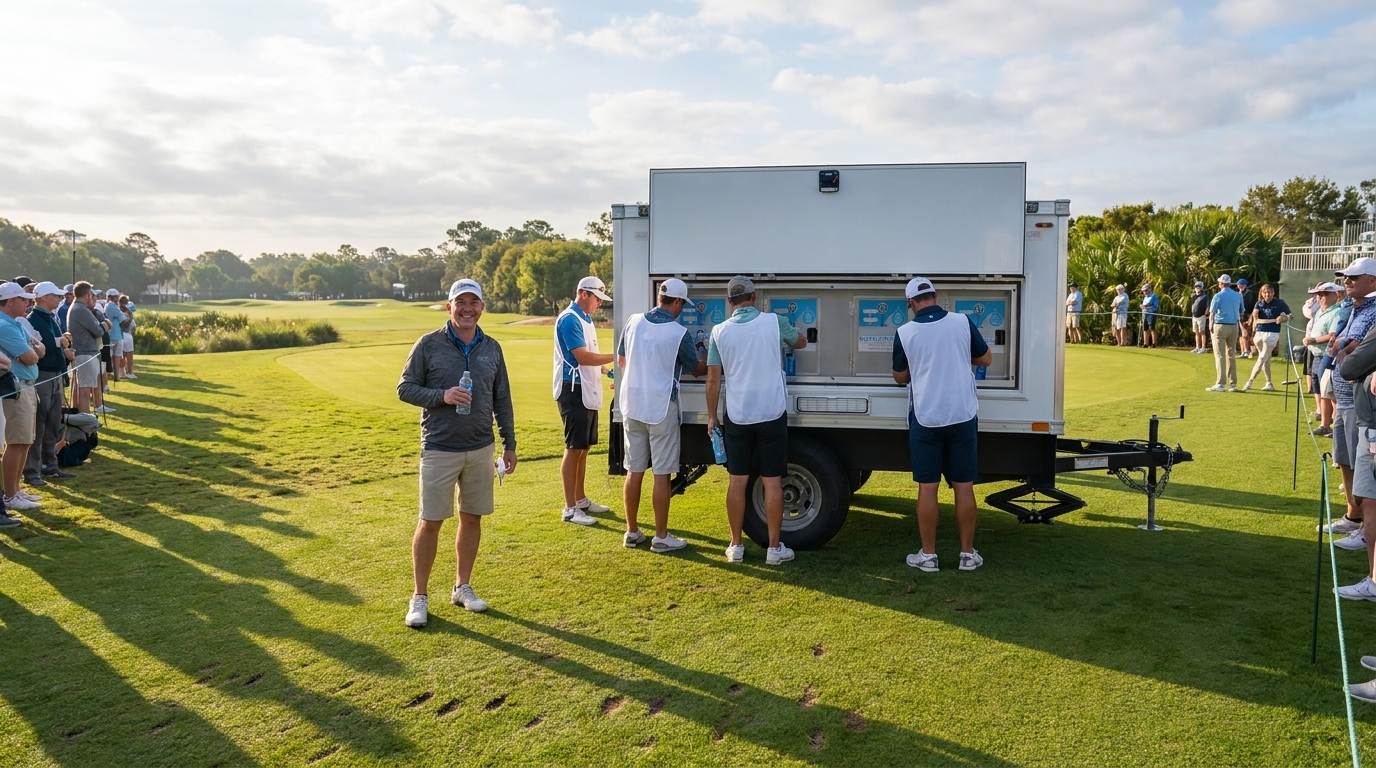
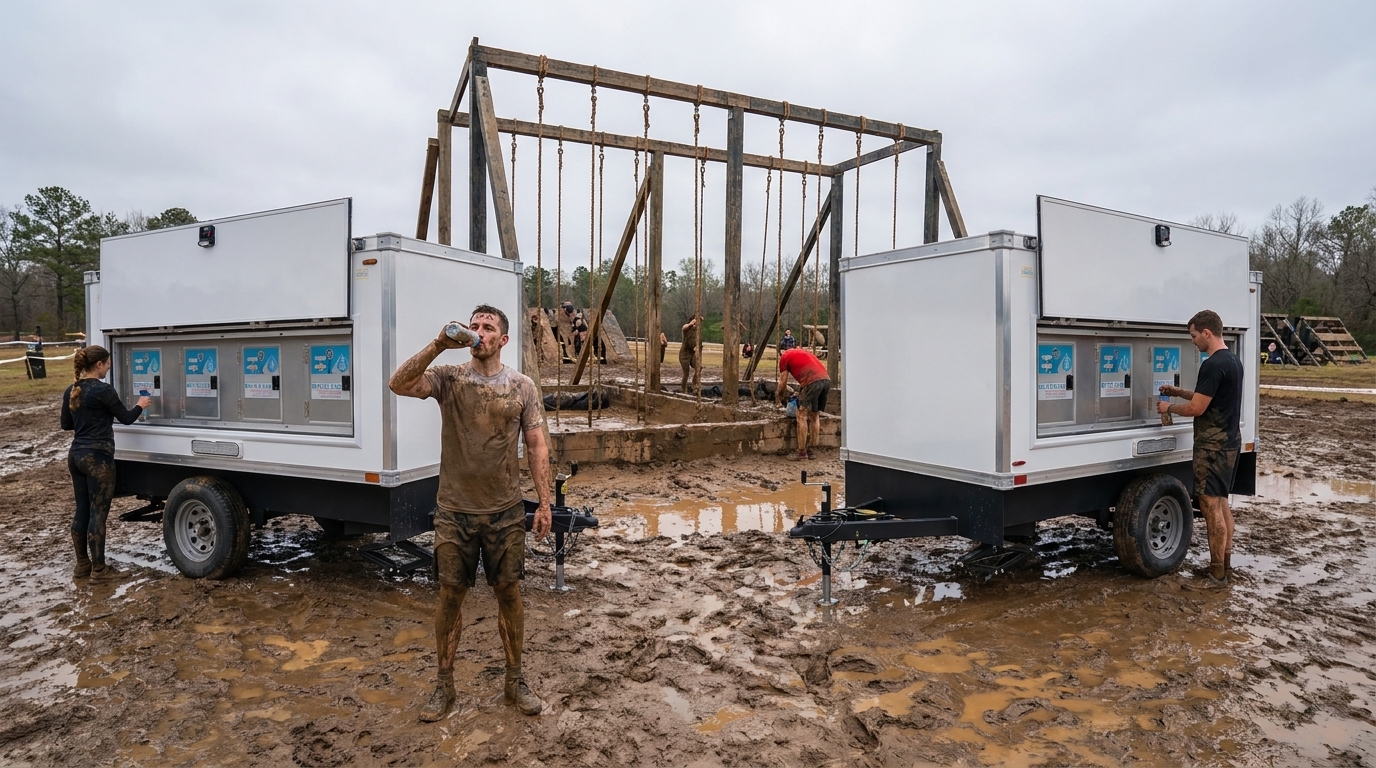
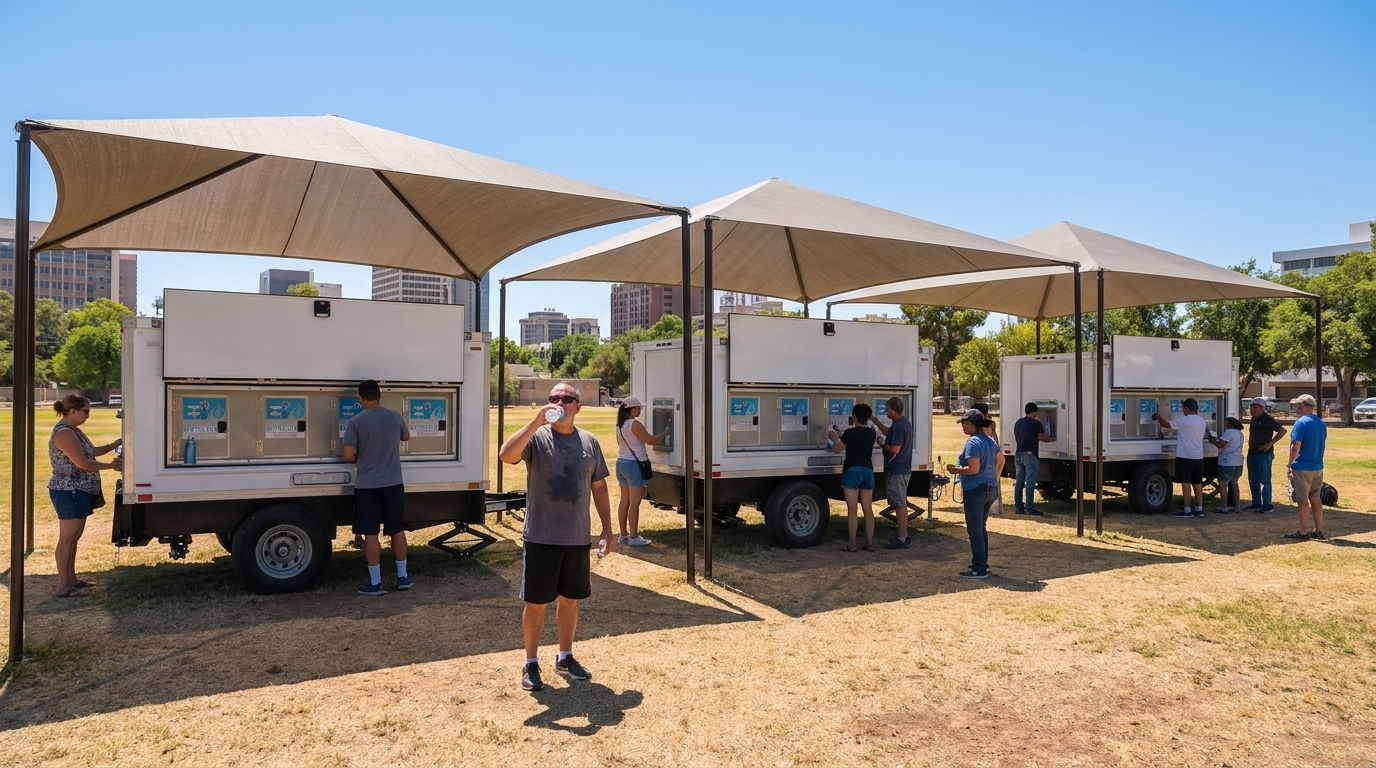
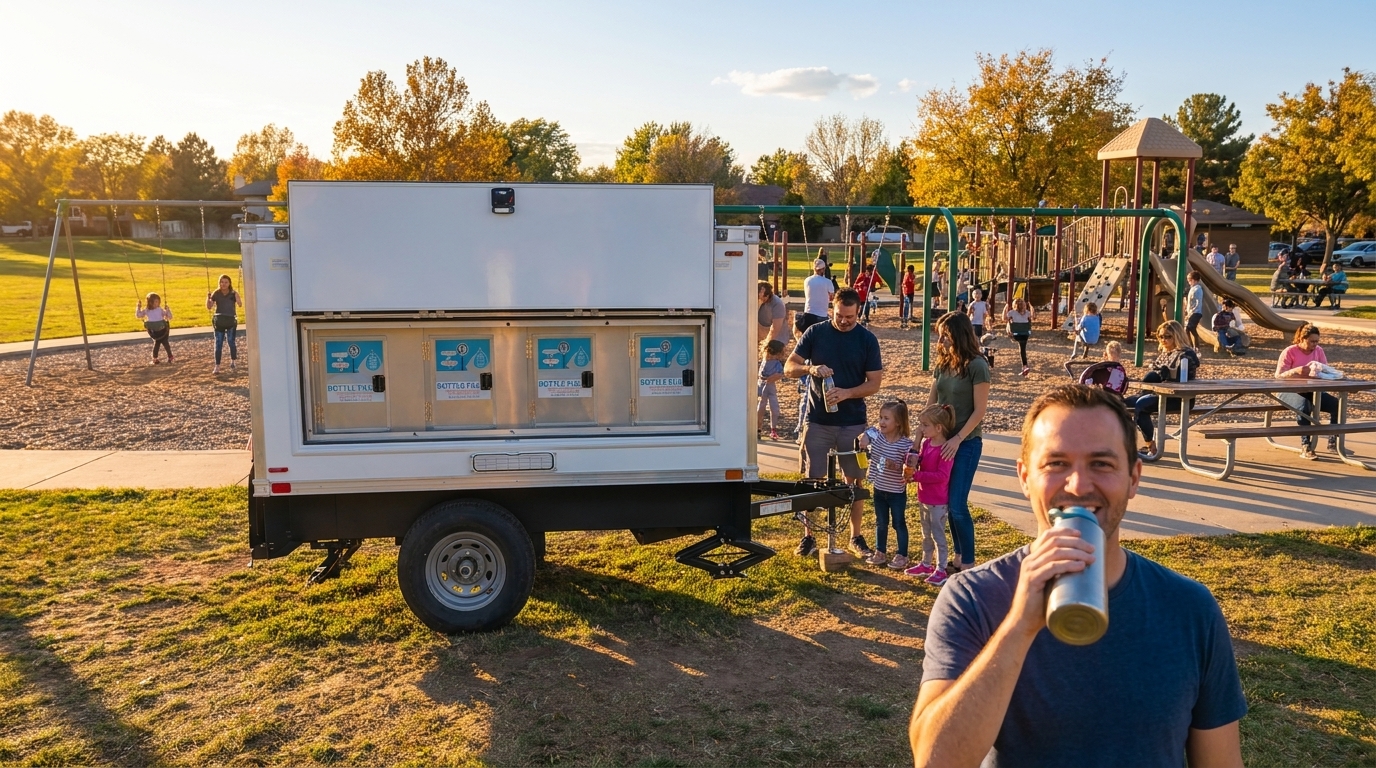
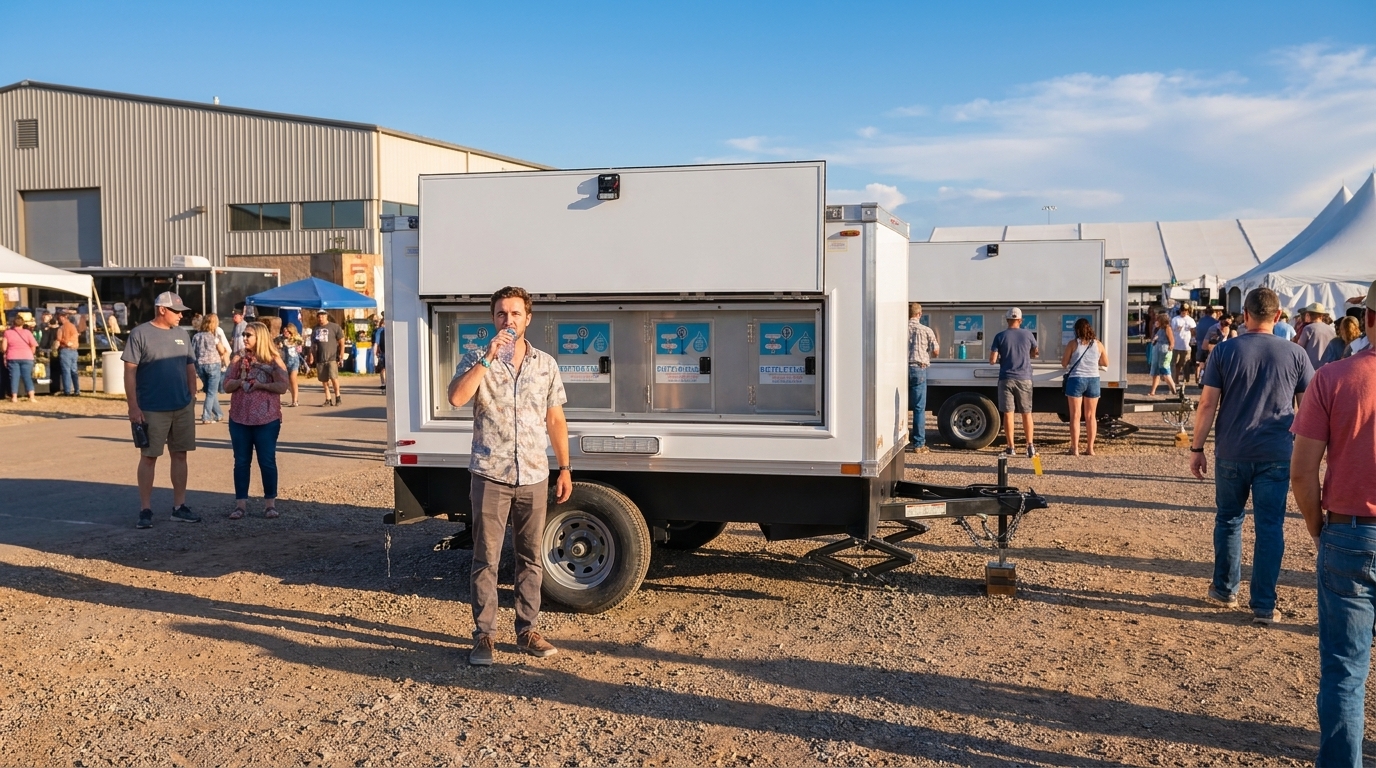
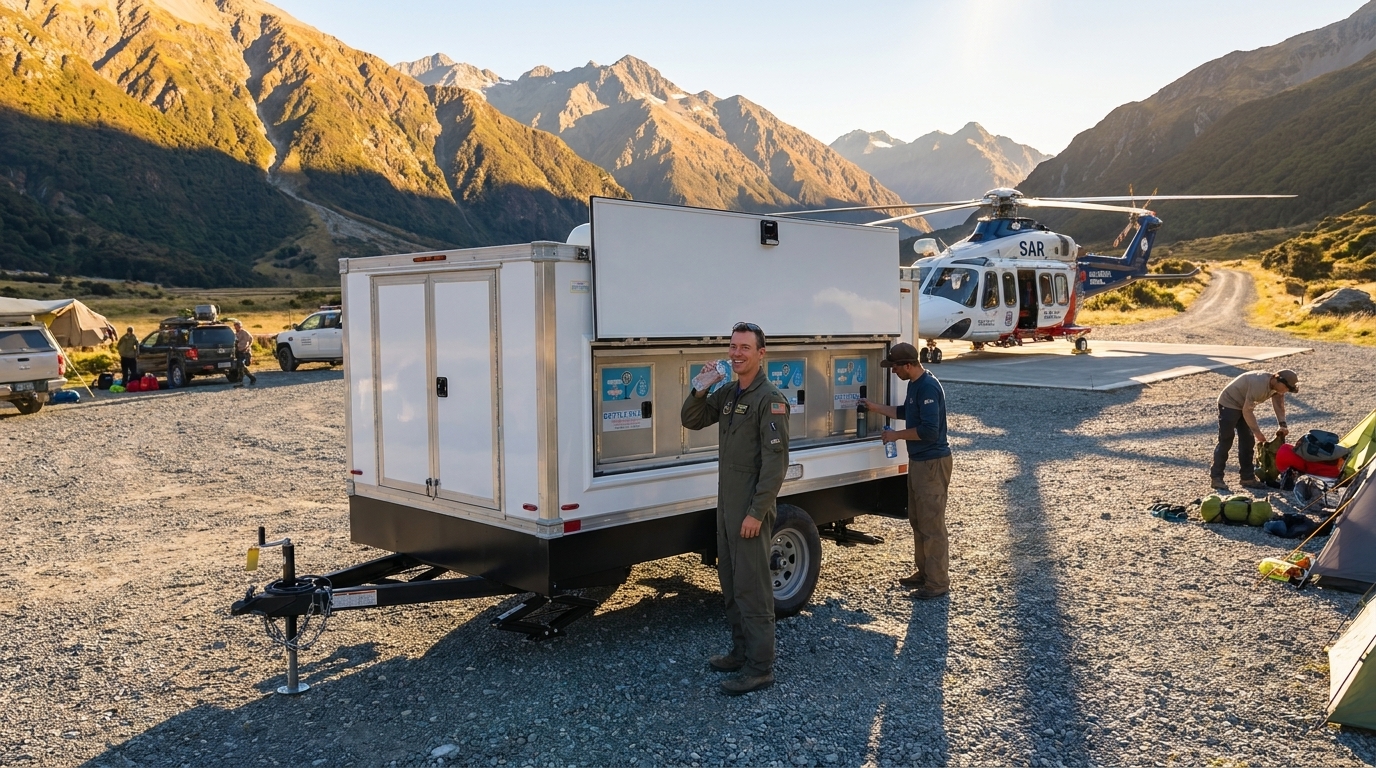
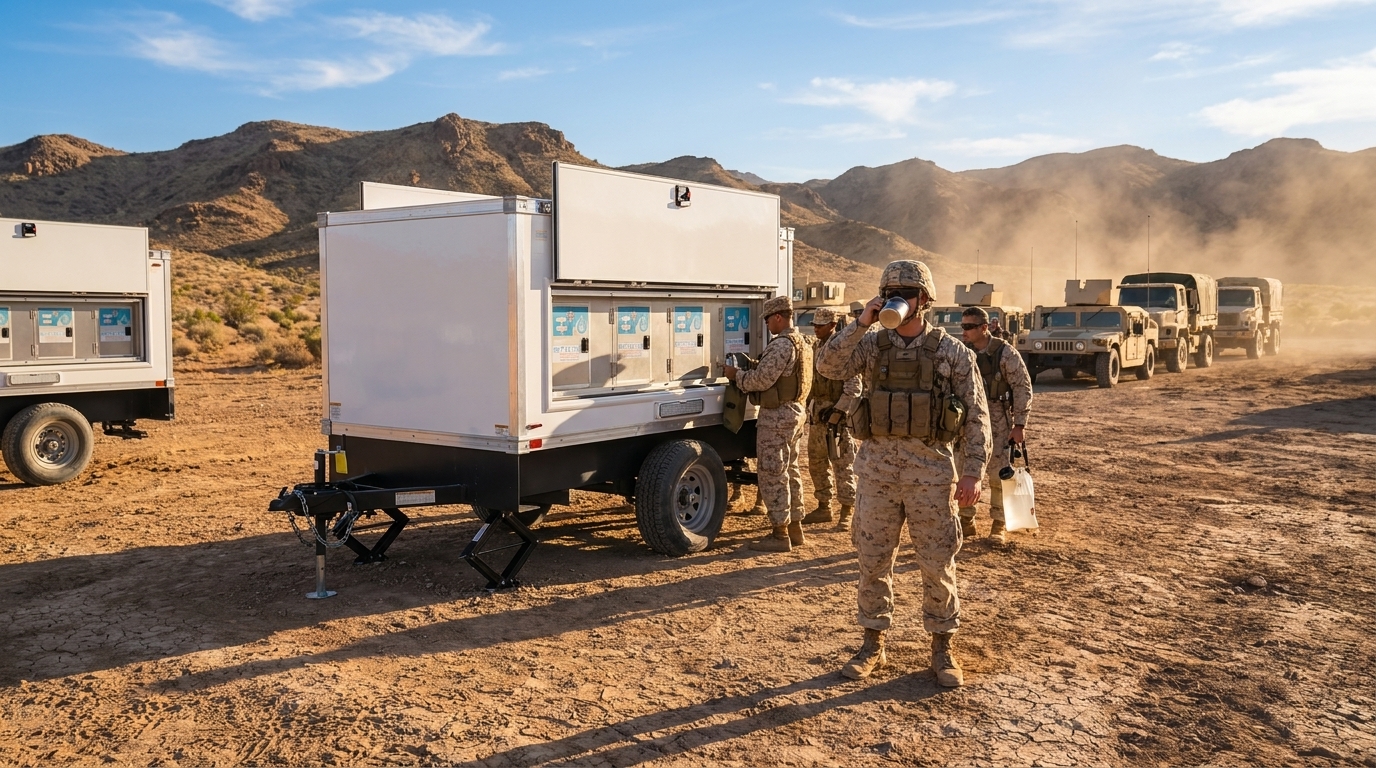
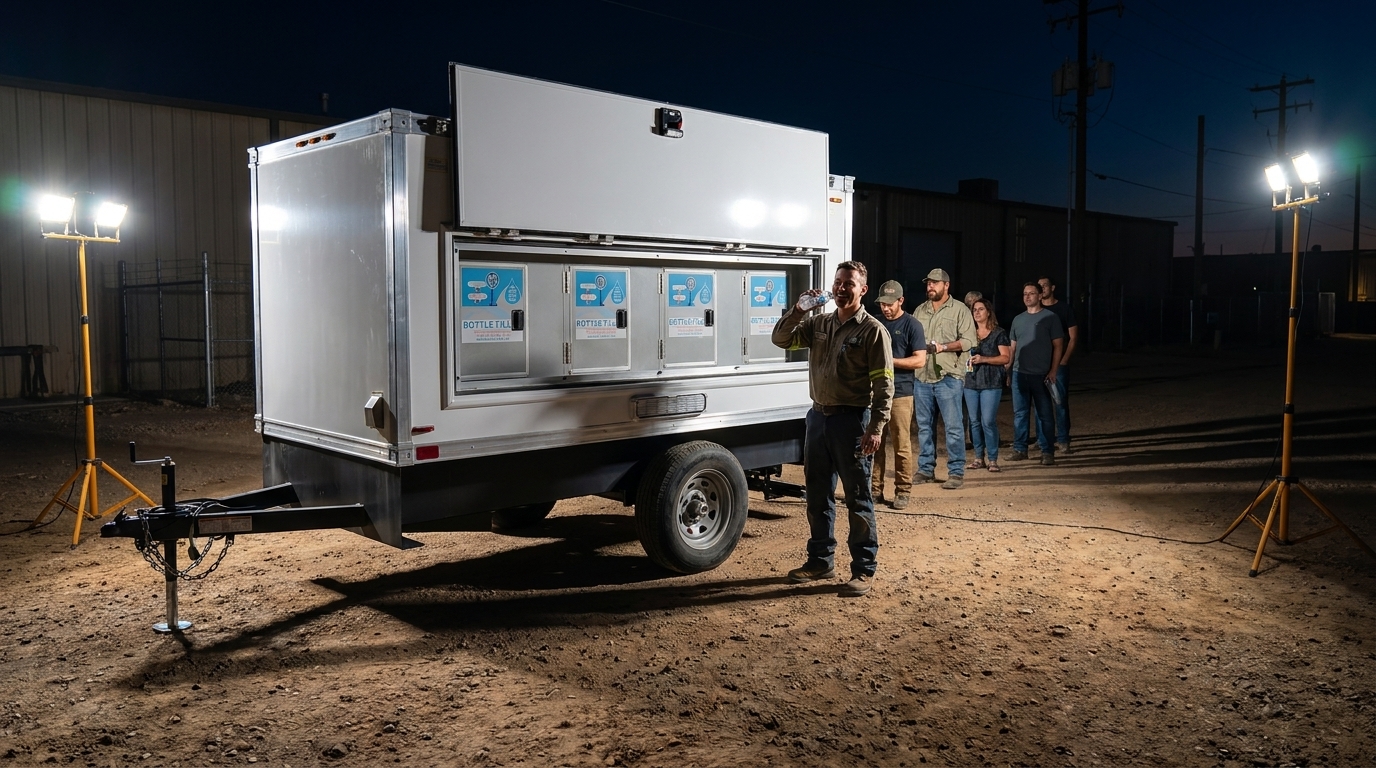
The Signature Series is a road towable station built for places with no spare water connection, which describes almost every building a county presses into cooling center duty.
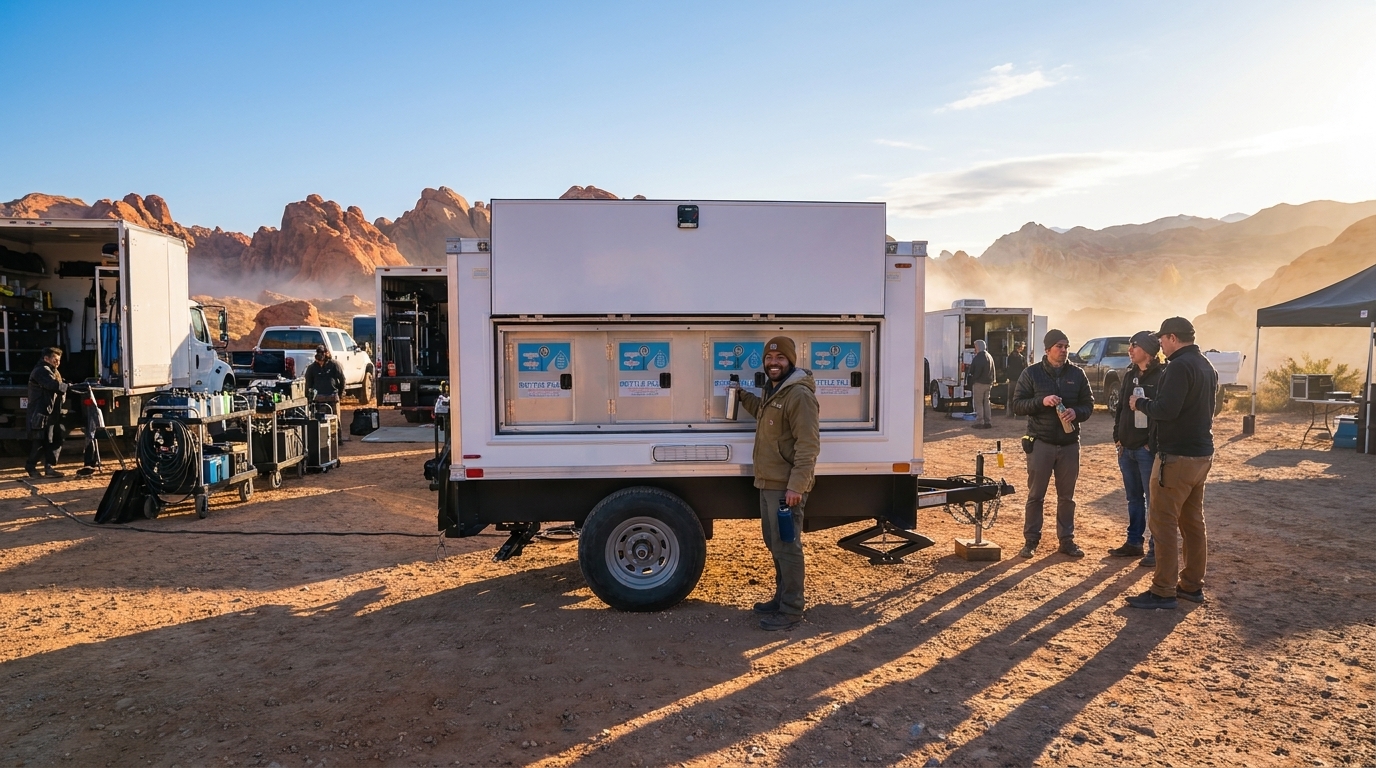
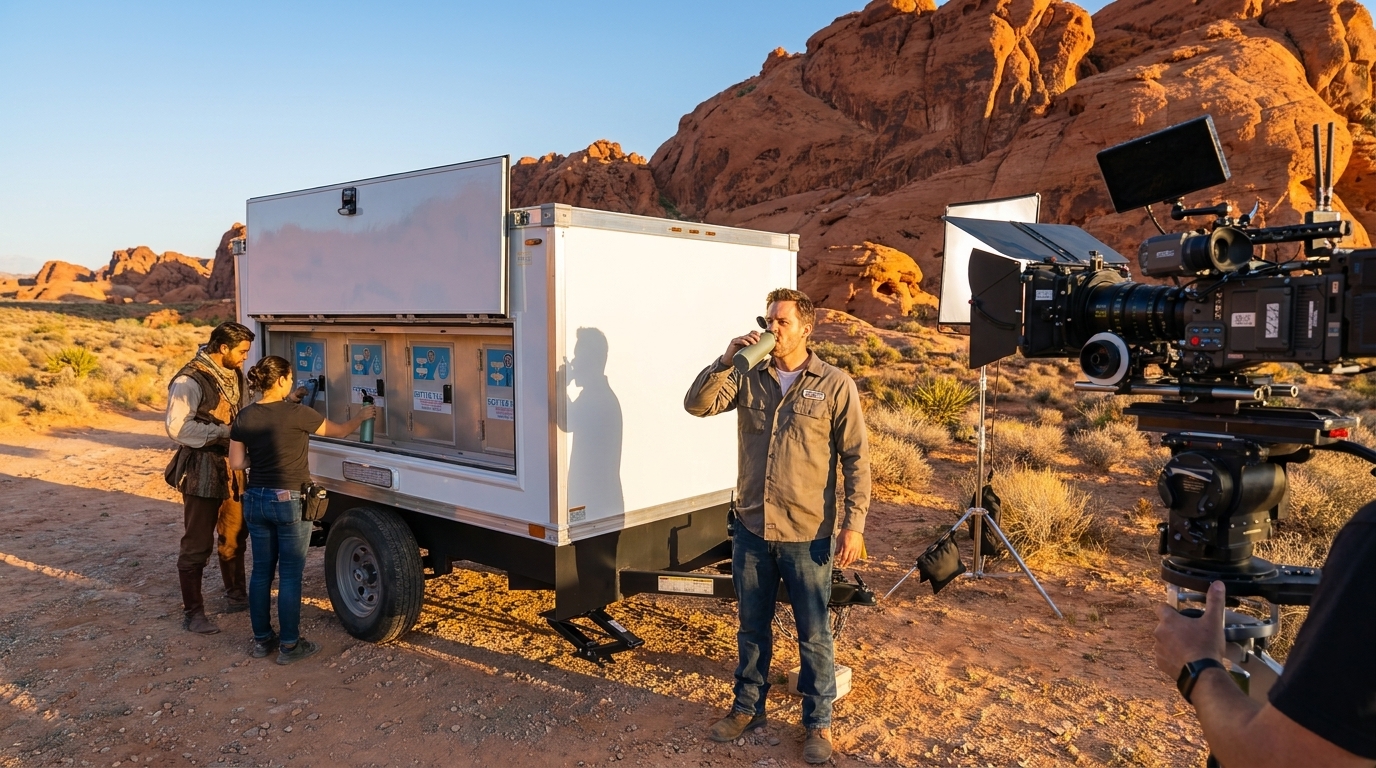
With a frame, a hitch, and tires under it, the unit hauls out to a remote build, an event field, a working orchard, or a disaster staging yard with equal ease. Contractors and event planners request this exact rig by name. The whole design is built around backing in, leveling off, and pouring cold by the same afternoon.
| No. of stations | (4) Bottle Filling Stations |
| Length | 12' 3" |
| Weight | 3,100 lbs. |
| Height | 8' |
| Fresh water tank | 300 Gallons |
| Power requirements | 1 to 4 dedicated 20A/120V circuits OR 1 dedicated 50A/240V circuit |
| No. of AC units | 1 |
At a relief site the trailer is public facing equipment, so we treat it that way. Four push back taps run along the side wall, and one sits low enough for someone in a wheelchair or using a walker to fill a bottle without asking a volunteer for help. Cal OES guidance tells jurisdictions never to ask a visitor for proof of disability, and a water point only a standing adult can work quietly undermines that. Around back there is a large jug spout for five gallon coolers and a bank of hose taps, which is what outreach teams use when they are loading a van rather than filling a cup.
The tank holds 300 gallons and the cooling unit keeps it genuinely cold, not room temperature, which is the detail people often miss. Heat illness prevention is about bringing core temperature down, so cold water does two jobs where warm water does one. We have watched a warm cooler sit untouched in a hallway while people walked past it to the parking lot. Cold water gets finished. Water nobody drinks is the same as no water at all.
It travels like a trailer because it is one, 12 feet 3 inches long, 7 feet 6 inches wide, 3,100 pounds, which backs into a library service drive or a mall loading zone without a crane. Power is one to four dedicated 20A 120V circuits or a single 50A 240V circuit, and a building engineer can usually point at the right outlet in a minute. When a county upgrades a site to augmented hours inside a 72 hour lead time, the parts that normally take weeks are the parts we removed.
A relief site gets one shot at a visitor's trust, and water that tastes like a warm hose loses it. Municipal water never reaches our taps raw. Three filter stages and an ultraviolet chamber treat it, then the onboard cooling unit drops the temperature, which is why people finish what they pour instead of setting it down.
The opening filter traps sand, scale, and the fine grit local mains occasionally push through. On a dusty lot, that's what keeps a pour from tasting like the parcel it's parked on.
Activated carbon comes next, lifting the chlorine bite and the dull seasonal notes local tap can carry until the taste lands clean and neutral. When it's 100 out, that flavor decides whether a crew keeps drinking or walks past the tap dry.
A finer cartridge then catches the microscopic particles that slip past the first two, so what reaches the spout is clear rather than merely cold for the crews and crowds drawing off it.
The last step is an ultraviolet chamber that wipes out bacteria and microbes without adding a single chemical. Even after a long tow out to a remote site, the water off the nozzle is clean.
Along the wall sit four adjustable push-back taps, press a bottle to the bar and it pours. One of them is set at ADA-reachable height, so a single trailer includes everybody in a crew or crowd with no add-on gear. Out back, a large-jug spout services five-gallon coolers and hydration packs, while a bank of hose connection taps handles work-site chores, event support, and refills down the orchard rows. Stainless, food-grade plumbing the whole way through keeps the filtered, chilled water at quality right to the spout.
Every Signature trailer carries a 300-gallon load, roughly 2,400 cups at sixteen ounces each, and we recharge it on demand, so the unit doesn't turn into the choke point on a busy shift or a packed show night.
A cooling center network is not one building type. Look at three examples. A branch library keeps standing hours. A City office floor gets converted over a weekend. A transit plaza has no walls at all. Each one fails in a different place. The unit is the same. What changes is where it parks and how fast it has to get there.
Public libraries are the most common cooling center venue in the country, and most counties do not activate anything for them to count. Los Angeles County Library states that every branch is open to the public to escape the heat during normal hours, and the City of Los Angeles lists cooling services at 50 branches. That holds on an ordinary July afternoon. It breaks the day a branch that normally sees 150 people sees 400, because the building has one fountain and it was specified for a reading room.
Senior centers carry a sharper version of the problem. Federal heat guidance flags older adults and young children as the two groups needing extra protection, and a senior center on an activation holds the higher risk half of that pair for hours. The people who need to drink most are the least likely to stand in a fountain line or lift a case off a pallet.
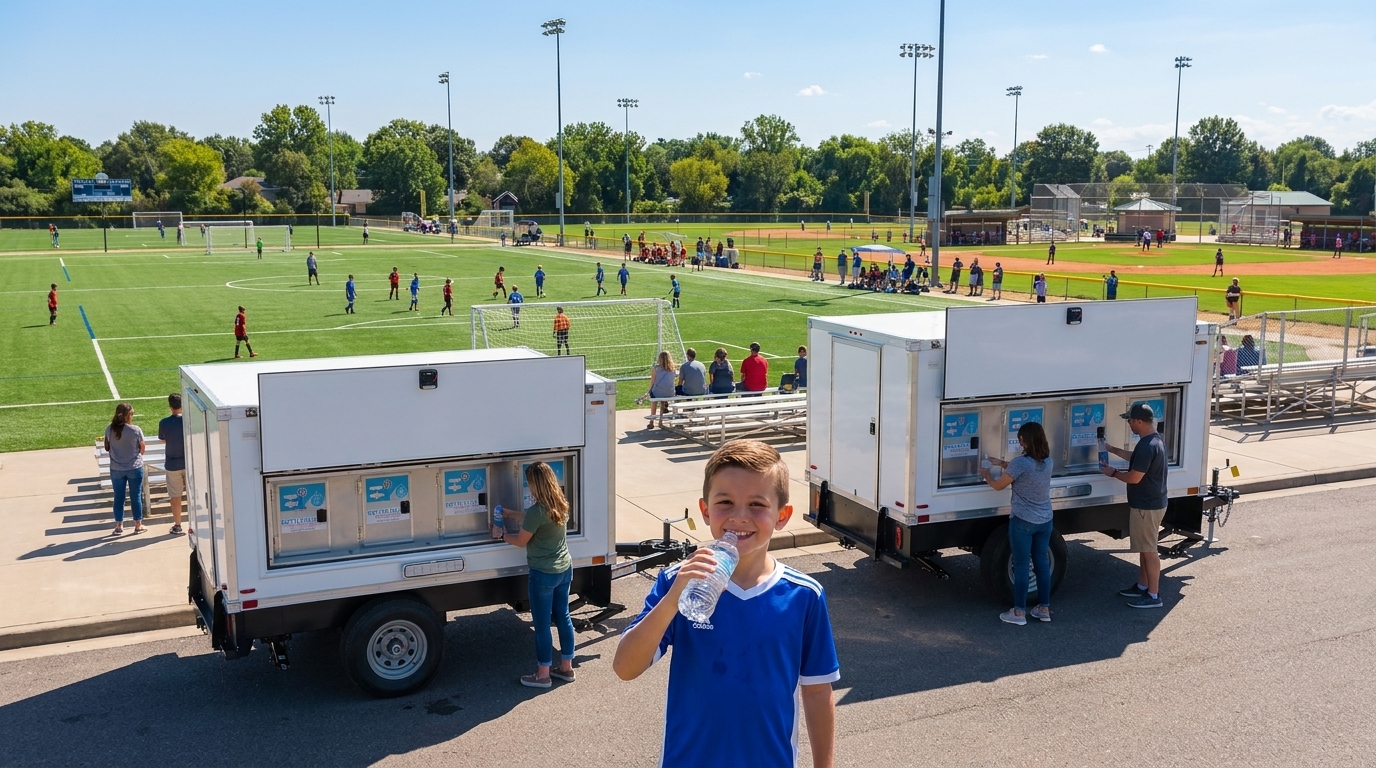
Recreation centers change the math again. Los Angeles keeps pools, splash pads and rec centers open through normal hours as heat relief, which puts relief seekers in a building where people are swimming and children are running. Fluid loss at a splash pad is nothing like fluid loss in a reading room, and families stay longer here than anywhere else on the network. Sizing mobile water station rentals in Seattle or anywhere else for a rec center, we plan a longer stay and a heavier pull per person.
Placement is the lesson these sites taught us. The trailer belongs at the door the public actually uses, not the one on the site map. A shaded service drive looks ideal on paper and gets no traffic.
This is the half of the program nobody budgets for. New York City opened eight additional City buildings as cooling centers from noon through midnight during its July 2026 heat event, plus ten more library branches, inside the same holiday weekend the heat arrived. Bergen County in New Jersey stood up five regional cooling centers running 9 a.m. to 6 p.m. during the event itself. Neither is a planning failure. A National Weather Service warning gives days of lead, not weeks.
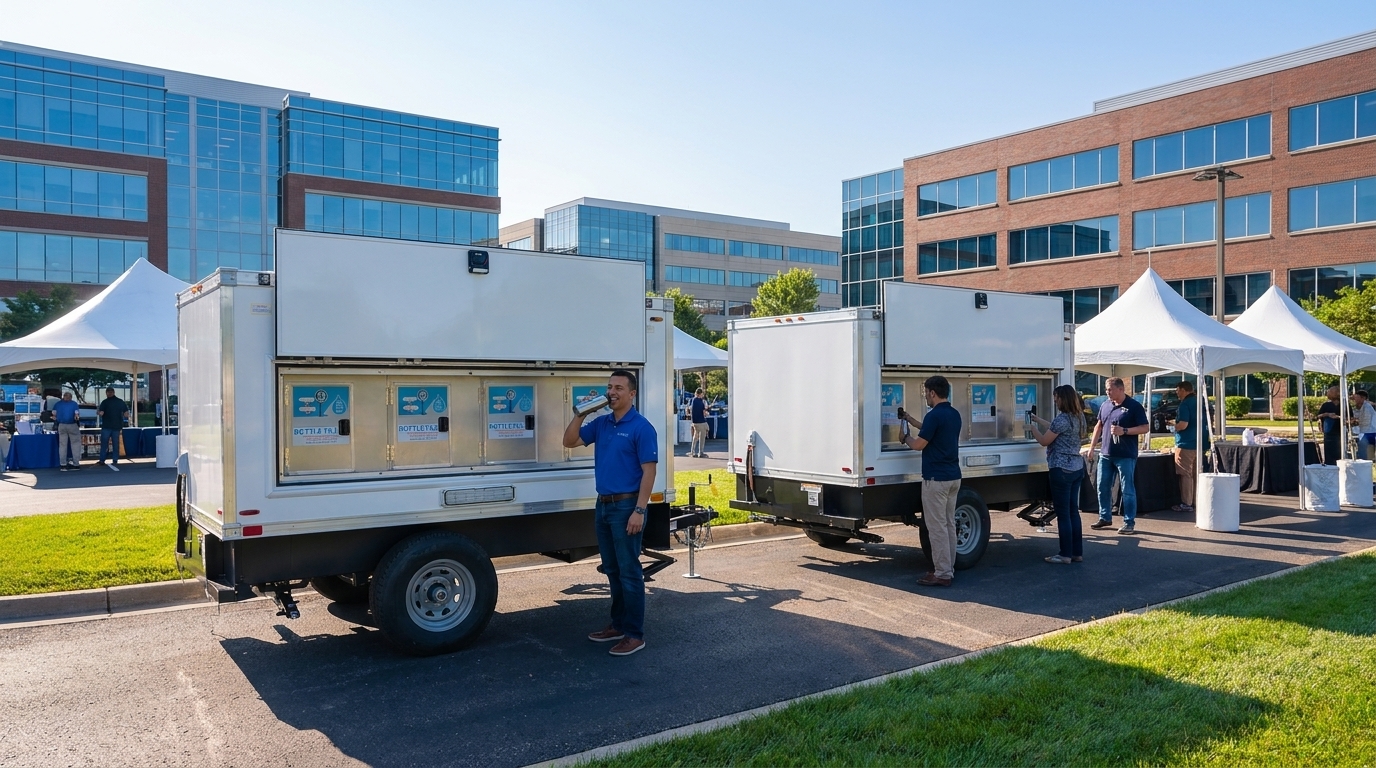
A converted building has air conditioning, restrooms and a parking lot, which is why it got picked. What it does not have is a water point sized for the public. A City office floor has a staff break room. A mall wing has a food court counter. A church hall has a sink behind a door most visitors will not walk through. The fastest honest answer in all three is a self contained trailer at the entrance, because the alternative is a plumber on a three day clock during the week every plumber in the metro is busy.
Homeless day centers belong here even when they run year round, because demand spikes the same way. Austin runs daytime cooling downtown with an outreach nonprofit, open 8 a.m. to 7 p.m. daily, and lists drinking water, phone charging and restrooms as its three core services in that order. Water is first for a reason. The rear jug spout matters as much as the front taps there, because staff fill coolers for the van while visitors fill bottles at the wall.
Our clock has to match the county's. Named Wednesday, open Friday, unit there Thursday. We would rather stage against a forecast that breaks than explain why a listed building has one break room sink behind it.
A transit hub cannot turn on air conditioning, and the fixes agencies have tried do not touch drinking water at all. LA Metro points riders to a city-wide map of cooling centers and hydration stations, puts ambassadors at key stops during heat emergencies, and tells people to avoid the 10 a.m. to 4 p.m. window and wait in shade. Every piece of that is shade, information and staffing. A rider standing 20 minutes on a 100 degree platform needs the same fluid intake whether the shelter overhead works or not.
And some shelters make it worse. UTHealth Houston researchers found certain enclosed designs raise heat stress by as much as 5.2 degrees compared with standing in the open, while tree shade cut wet bulb globe temperature by 5.9 degrees. Houston is piloting perforated panels and Phoenix sprays its stops directly. All worth doing, and all a reminder that a built structure does not automatically equal relief.
The outreach angle is quieter, and it is where the rear spout earns its place. Nashville runs outreach and heat patrols from 8 a.m. to noon on an activated response, carrying water to people who will not come to a building. New Orleans teams distribute in known corridors, and in Augusta a ministry works with the sheriff's outreach team on back road locations. Every one of those runs ends when the vehicle runs empty rather than when the route does. A refill point at a hub the route already passes cuts the loop short.
We size these on flow, not visitor count, and the pull is steady rather than peaked. What we watch is the path of travel: within reach inside the wait, on a surface a wheelchair crosses clean, well back from the bus apron.
A heat activation gives you days, not weeks. We plan our arrival backward from the hour your site opens to the public.
The best version is a standing order placed before the season, with a named site list and a trigger written into the county plan, so one call moves the unit. The version we run most often is a call the day the forecast turns. Then we want three things in the first two minutes: which building, what the visitor estimate is, and what power sits at the placement spot.
Placement gets decided on site, not on a map. We want firm level ground about the size of one parking stall, a clean path of travel from the public door that a wheelchair crosses without a lip or a gravel patch, and a spot clear of the fire lane and the accessible parking aisle. Cal OES guidance pushes jurisdictions to site relief locations within reach of transit, so we also ask which door riders walk in from.
What goes wrong is rarely the equipment. It is the handoff. A site opens with a volunteer crew that changes every shift, nobody knows where the refill number lives, and a trailer that could have been topped off at two runs low by five. So we leave a card at the tap wall with the direct line, walk the shift lead through the taps before the truck leaves, and set the refill cadence off your visitor estimate.
Pickup is the mirror image. The same building can be a normal library Monday, an augmented cooling center Wednesday through Sunday, and a library again the next week. We hold through the tail of an event rather than pulling the morning the warning drops, because a heat wave that breaks on paper is still a hot building full of people who came in yesterday. If the county is running emergency drinking water distribution somewhere else that week, the unit usually goes straight there.
People count, number of days, where exactly it parks on your site, and what power is there. Those four answers let us spec it correctly the first time around.
Reckon roughly 45 minutes from the nearest yard once we are in your metro, longer on the outer routes, with round-the-clock emergency runs whenever a heat advisory or a power shutoff hits.
Once on site we set it level, charge the 300-gallon tank, and tie in power off one to four standard 120V circuits, or a single 50-amp 240V drop, depending on what the site gives us.
After that the tankers cycle back on a cadence matched to how fast your crew or crowd pulls it down, and we maintain the unit through the whole rental term.
No power on the parcel at all? We price that in. The unit draws very little, and with the service fleet backing it we've run stations on lots that had no permanent power whatsoever. Lay out what the site offers and the rest is on us.
Want this math run for your own booking? Two minutes on the phone gets you a real number.
One station covers most single building sites. What moves the number is how long people stay and how many doors the building has.
| Branch library, standing hours (up to 150 visitors a day) | 1 station |
| Library or rec center at augmented hours (300 visitors over 8 hours) | 1 station, midday top off |
| Regional cooling center, extended hours (400 to 600 visitors) | 2 stations |
| Converted City building or mall wing, two public entrances (up to 500 visitors, 12 hour day) | 2 stations, one per entrance |
| Overnight relief site with cots (roughly 100 people staying through the night) | 1 station, evening refill |
| Transit hub relief point (steady rider flow, 10 a.m. to 6 p.m.) | 1 station near the platform |
| Outreach supply hub (6 to 10 outreach teams cycling through) | 1 station, rear jug spout |
Here is the arithmetic we run, and it starts with CDC guidance rather than a rule of thumb. In heat the recommendation is one cup, 8 ounces, every 15 to 20 minutes, which is 24 to 32 ounces an hour, with a ceiling of 48 ounces an hour because drinking past that drops blood sodium dangerously. Above 85 degrees the emergency planning baseline is 2 gallons per person per day. Those numbers already sit in your heat plan.
Now put a building under them. Three hundred visitors across an eight hour activation, each staying about two hours and drinking at the low end of 24 ounces an hour, comes to 14,400 ounces, roughly 113 gallons. That is a third of one tank. Hold the same 300 people all eight hours, which is what day three looks like when going home is not an option, and you are at 57,600 ounces, about 450 gallons. Two doors and two crowds is when a second unit stops being optional, and it is why water bottle filling station rentals get quoted per entrance.
Staff are the number everybody forgets. A site on augmented hours has volunteers and city employees working the same heat the public came in from, and in California the outdoor heat illness standard puts a quart an hour per person on their employer. Ten staff on a twelve hour shift is 30 gallons before a visitor walks in. Enough to move your refill from five in the afternoon to two.
Drinking water is not an extra at these sites. It is part of what makes a building qualify. Los Angeles publishes the criteria plainly: unless a listing says otherwise, each cooling center is open during listed hours, has working air conditioning, bathrooms and drinking water, and is accessible. Read that as a supply obligation. A listed site that runs out mid afternoon has stopped meeting the standard its own jurisdiction set, in public, with a 211 line still sending people to the door.
Accessibility is where the written guidance has the most to say. The Cal OES accessible cooling centers guidance tells jurisdictions to bring disability and access and functional needs organizations into planning rather than consulting them afterward, to name one staff member per site who owns physical and communication accessibility, to train every volunteer on handling an accommodation request, to site centers where transit reaches them, and never to ask a visitor for proof of disability. The California Department of Public Health carries a parallel document for local health jurisdictions.
For a water vendor that is not background reading. The 2010 ADA Standards for Accessible Design govern reach ranges and clear floor space at any fixed public point of use, and a dispensing point is one. A jurisdiction that has committed in writing to never questioning a visitor will not accept a tap only a standing adult can work. So we ask about the transit stop and the path of travel on the site walk, the same conversation we have setting up church and community event water station rentals at a hall never built for public crowds.
One more set lands on the staff side, because a site on augmented hours is a workplace. In California the outdoor heat illness prevention standard requires fresh, suitably cool water at a quart per person per hour free of charge, shade once the work area passes 80 degrees, a cool down rest of at least five minutes, and written high heat procedures at 95 degrees. Federally, a proposed heat injury and illness prevention standard published August 30, 2024 sets an initial trigger at a heat index of 80 degrees and a high heat trigger at 90, and it is still in the pipeline. One unit serving the public line at the front and staff at the rear spout answers both sides.
Federal OSHA heat illness prevention guidance and the CDC and NIOSH heat stress program point at the same baseline: cool drinking water, close to the people doing the work, and documented.
Need a station your written heat plan can point to? We can have one pouring cold within days.
Somebody is already doing this job at every cooling center in the country, usually a staff member or a volunteer with a car. The default is cases bought on a purchase card, a building fountain sized for ordinary foot traffic that in older branches was shut off years ago and never fully turned back on, and an office water cooler quietly promoted into public facing infrastructure.
Run one day and the labor shows up fast. A 300 visitor activation with a two hour average stay draws about 113 gallons. In half liter bottles that is roughly 850 of them, which is 36 cases somebody buys, loads, carries in, ices down, restocks and breaks the cardboard from at closing. Hold the same crowd a full eight hours and you are past 3,400 bottles. What happens instead is the site runs short at four in the afternoon and a staff member leaves during the busiest hour to buy more.
The space cost is the quiet one. Thirty six cases is a pallet footprint in a lobby already holding cots, a check in table and a line. The outreach version is worse, because every case an outreach team carries is volume the vehicle does not have for anything else. A rental replaces the buying, the carrying, the ice and the empty bottles with a tap on a wall and a refill schedule, and our tankers handle the refill.
Look at everything bottled water actually demands of a person: cutting the order, receiving and breaking down pallets, icing coolers before dawn, topping them up through the day, then flattening empty bottles for the bin. On a large crew that's hours of paid time burned every single day, scraped right off the work that's supposed to be getting done. The trailer erases that loop entirely. A local contractor once let us pencil it out with him, and the recovered labor by itself paid for the unit. His words were that the bottle runs had been quietly costing him close to a day of payroll a week. Our trailer arrives full, the tankers keep it full, and your superintendent owes it nothing but a parking spot.
Ice a cooler at 6 a.m. and by mid-morning in July it's as warm as a bath. Warm water is water people stop touching, and the slowdown that follows is precisely where heat illness gets its opening. A chilled station never rides that warm-up curve at all. Whatever pours at clock-out is as cold as the sunrise fill, which happens to be the moment a spent crew, or a crowd deep into a long concert, leans on it hardest.
Bottled-water pallets devour staging space, jam the lay-down area, and sit cooking in the sun until somebody finally cracks them open. Empties build up faster than anyone keeps up with, and on a tight commercial lot that pile turns into its own problem. Set a trailer in one parking stall instead and it serves a crew or crowd that would otherwise burn through hundreds of plastic bottles every day.
Every bottle bought is a bottle thrown out, and across a season a busy site or event generates a small mountain of them. That's a disposal line on the budget, a dent in the sustainability numbers, and, given that a single bottle can linger in the ground for centuries, a footprint that lasts longer than the project that made it. Move to a refill station and the line drops to zero, which finally gives your reporting a figure worth publishing.
Three bookings of this kind, and what we planned around on each one. Names and details are kept generic on purpose.
County branch library, augmented hours, day three of an excessive heat warning. The branch had sat on the county list for years without needing anything, because a normal July day brought about 150 people past one fountain by the restrooms. The county went to augmented hours Thursday and attendance roughly tripled by Saturday, the pattern once homes without air conditioning stop cooling off overnight. We set the trailer at the parking lot entrance instead of the shaded service drive, because that is where the public walks in, and put the low tap nearest the seating. We topped it off at two on both weekend days without waiting for a call.
Converted City office floor, 12 hour days, transit accessible site. The building had been named in the plan as an overflow option and never opened to the public. Air conditioning, restrooms, a parking structure, and a staff break room with one sink behind a badge reader. It got named Wednesday and opened Friday at noon. We delivered Thursday morning, set the unit inside the lobby doors on the side the bus stop feeds, and ran power off a standard 20 amp circuit the building engineer pointed at in about a minute. Both public entrances were open, so a second unit went to the garage side on day two.
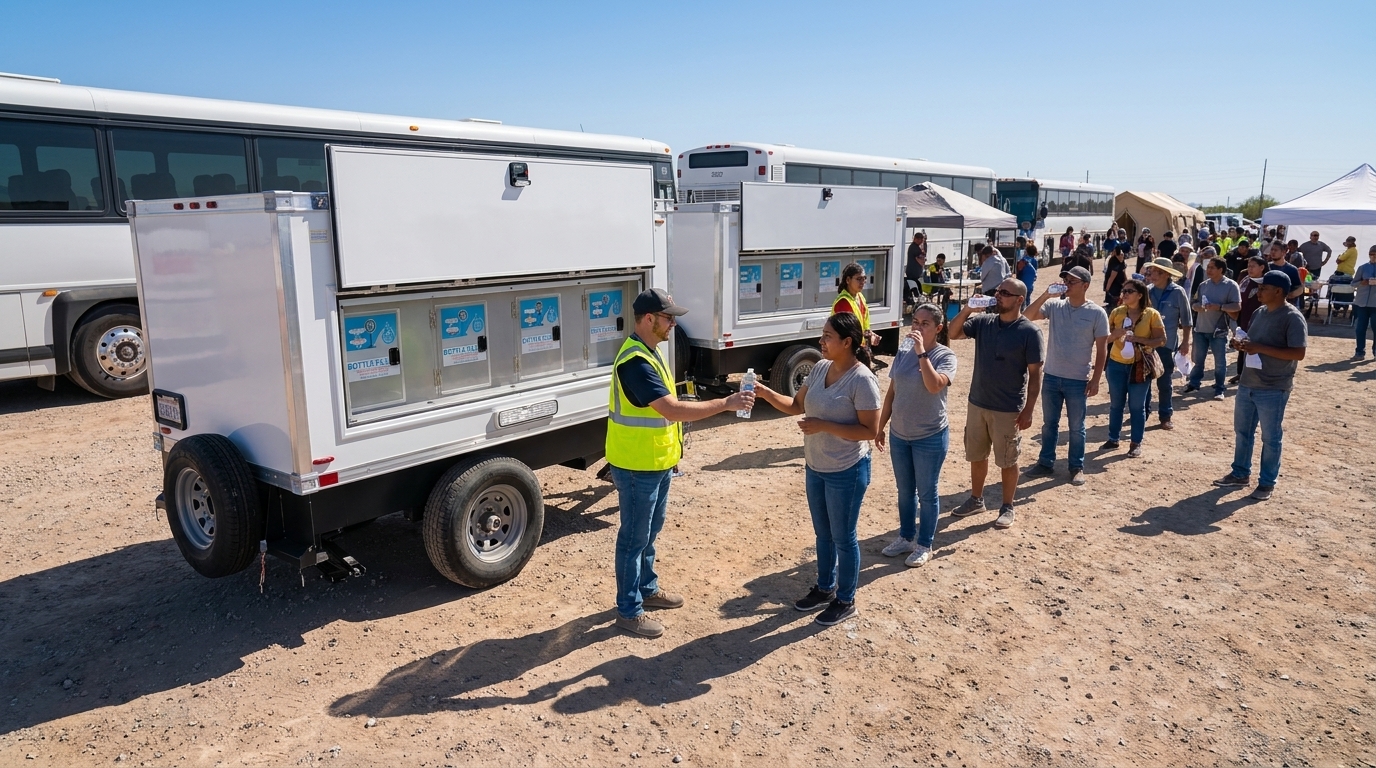
Transit plaza relief point and an outreach supply run. The agency had done the shade work already, new panels and moved benches, and still had nothing to drink at the platform. We set a unit at the plaza edge where riders could reach it inside a wait without giving up their spot, on paving a wheelchair crossed clean and well back from the bus apron. The surprise was the outreach van. Two teams working the corridor began filling coolers off the rear jug spout between runs instead of driving back to the depot.
Service information current as of September 2026.
Still weighing it? Call and ask. Most of these questions get settled in one short conversation.
Jurisdictions set their own criteria and the published ones look alike. Los Angeles states that unless a listing says otherwise, each cooling center is open during listed hours, has working air conditioning, bathrooms and drinking water, and is accessible. Water is a baseline condition there, not an extra. If a 211 line is sending people to your address, plan the water the way you plan the air conditioning.
CDC guidance in heat is 8 ounces every 15 to 20 minutes, so 24 to 32 ounces an hour, and never more than 48 because drinking too much water lowers blood sodium dangerously. Above 85 degrees the emergency planning baseline is 2 gallons per person per day. Average length of stay drives your total more than headcount does, so ask your staffing lead how long people sit before sizing anything.
Fast enough to match the county's own clock. Most openings run inside a 72 hour National Weather Service lead time, and cities routinely convert buildings in a single weekend. Give us the building, the visitor estimate and the power at the spot, and we will name the delivery window on that call. Emergency dispatch runs around the clock during an active warning.
No. The trailer arrives with 300 gallons of filtered, chilled drinking water on board and our tankers handle refills on a schedule set to your visitor estimate. A building picked for cooling duty was picked for its air conditioning and its restrooms, and getting a plumber inside a three day window during a regional heat event is not a plan.
Yes. One of the four push back taps is set at a reach height a seated visitor can work, and the taps operate with a light push rather than a grip or a twist. We also look at the path of travel from the public door during placement, because a tap across a gravel strip is not within reach, no matter how the tap itself is set.
They refill off it. Outreach programs run heat patrols carrying water to homeless camps and known corridors, and a run ends when the vehicle runs empty. Parking a unit at a hub the route already passes lets a team top off coolers between runs instead of driving back to a central depot. It does not replace outreach. It cuts the loop short.
Generally one per public entrance once both are open, because people do not cross a full room to reach water they cannot see. For a single entrance site up to about 300 visitors across eight hours, one unit with a scheduled midday top off is the honest answer. Past 400 visitors or twelve hour days, plan on two.
That is the normal shape of this work. Counties tier sites up for an event and back down afterward, which is why renting beats plumbing fixed equipment into a building that might not be the chosen site next summer. We deliver against the activation, hold through the tail of the warning, and pick up when the site stands down.
It is treated on board. Water passes through three filter stages for sediment, chlorine taste and microscopic particles, then a separate ultraviolet treatment step, and the cooling unit drops the temperature before it reaches the tap. Food grade components and stainless plumbing run source to spout.
The mistake is treating drinking water as an opening day item. It is a plan item, and the plan is written in the spring. Every county we work with that never rushes at the last minute has done the same plain thing: named the sites, named the trigger, and named the vendor before the first warning of the season. What follows assumes you did not.
Day one, the forecast turns. Pull three facts before you call anyone: which building, what your visitor estimate is for the peak day, and what power exists at a spot a truck can reach. Those three let a vendor commit to a window instead of a maybe. If the building has two public entrances, say so on that first call.
Day two, walk the placement. Stand at the door the public will use, not the one on the site map, and walk to where you think the unit goes. Check the path for a lip or loose gravel. If it crosses the accessible parking aisle, move the spot. Check the fire lane. Then confirm the circuit with whoever holds the keys and get their after hours number.
Two federal forecast products, and in California a third state one, decide when this work starts. Knowing what they mean is worth an afternoon, because they separate staging equipment early from calling a vendor on the worst possible morning.
A Heat Advisory is the lower tier alert, issued when dangerous heat is expected but has not reached warning criteria, and its trigger moves by region because people who are used to heat can handle more of it before conditions turn dangerous. A heat index that is a normal Tuesday in one metro is an emergency where the housing stock has no air conditioning. An Excessive Heat Warning is the escalation: a heat index of 113 degrees or higher, or 105 degrees sustained three hours or more.
HeatRisk sits on top of both and is the better planning tool. It forecasts heat health impact risk 24 hours out on a 0 to 4 scale, from green at little to none through yellow, orange and red to magenta at extreme, meaning long duration heat with little to no overnight relief for the whole population. It carries CDC heat health outcome data, so a jurisdiction activating against it is working from health data rather than a thermometer. Magenta drives day three attendance.
Every question below is one we have been asked mid emergency by somebody who would have had a much better week asking it in April. None take long to answer, and all get harder while a warning is running.
Ask what the delivery window looks like once a warning posts, and what happens when three sites in the same metro call on the same morning, because during a regional event they will. Ask whether the vendor stages against a forecast or waits for a confirmed order. A vendor who has never been asked that has never been through a real activation.
Ask about power specifically. The honest answer for our trailers is one to four dedicated 20A 120V circuits or one 50A 240V circuit, and the reason to nail it down early is that a building engineer can confirm an outlet in a minute in April and may be hard to reach in August. Ask what happens at a site with no usable power at all, because converted buildings produce that more often than anyone expects.
→
Outages, main breaks and disaster staging, where the water itself is the emergency.
→
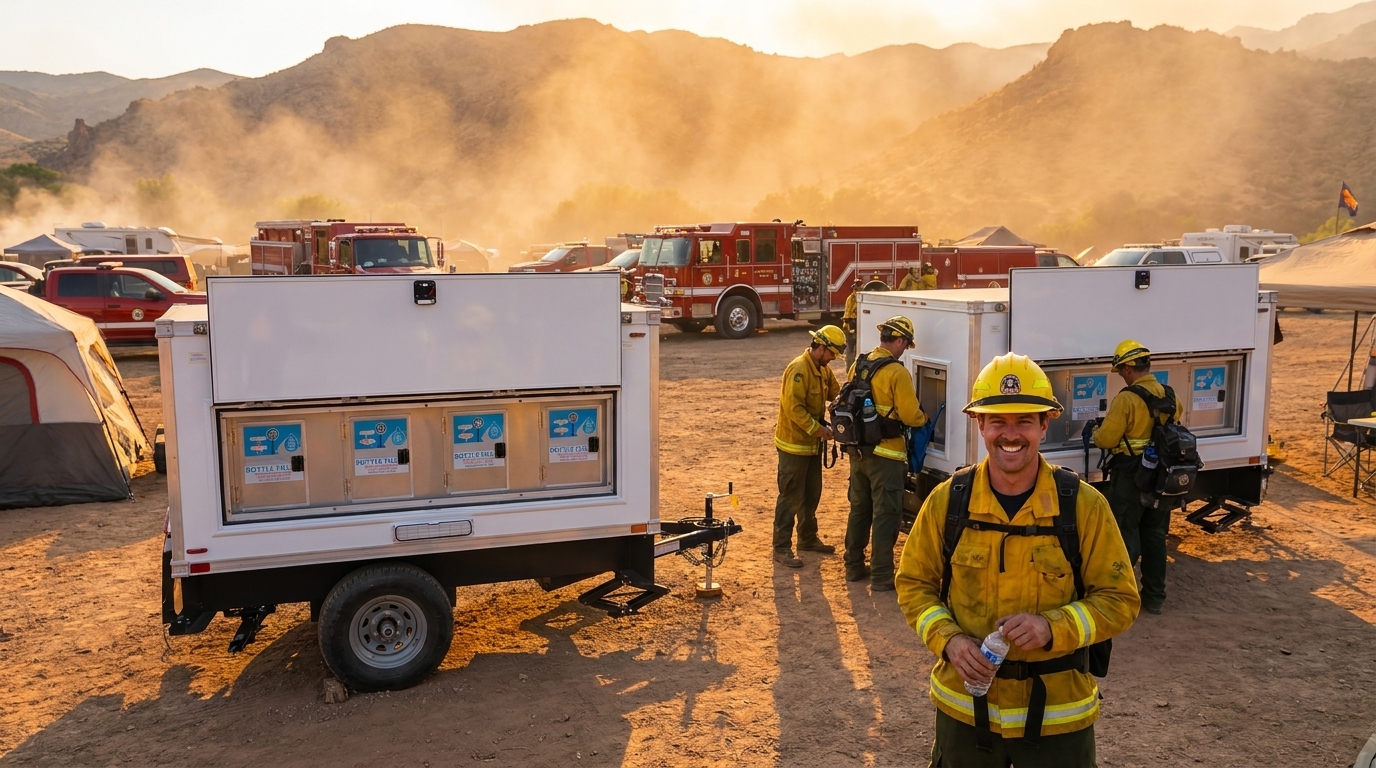
Base camps and staging areas running crews through long shifts in smoke and heat.
→
Halls, parking lot events and outreach days at buildings never designed for public crowds.
→
The refill station itself, for any site replacing a standing bottled water order.
→
Public facing fountains for parks, town squares and grounds with no fixed water point.
We run water station rentals nationwide, and we keep dedicated local pages for the metros our trucks work hardest. Start with the closest one.
Booking this kind of work in a metro we already run? Start with water station rentals in Portland, water station delivery around Seattle, water station rentals in Tacoma, Denver hydration station rentals, mobile water stations serving Manteca, Tracy drinking water station rentals, water station rentals in El Paso and water station delivery around Yuma, and call us for anywhere else in the country.
 Pacific Northwest
→
The 2021 heat dome pushed 116 degrees here and reset how the metro plans relief sites.
 Puget Sound
→
A housing stock built for mild summers, which is exactly why cooling sites fill fast.
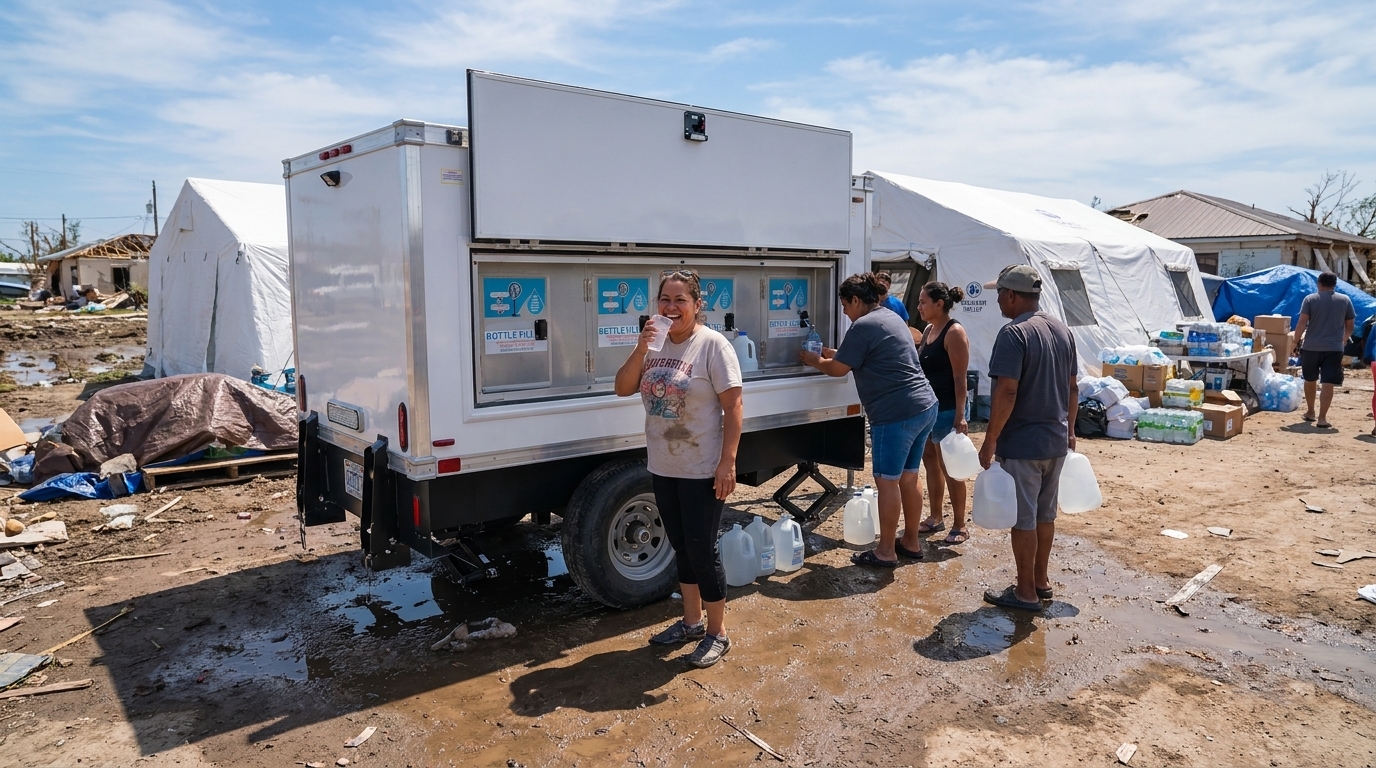 South Sound
→
Library and community center relief sites across a metro with low air conditioning coverage.
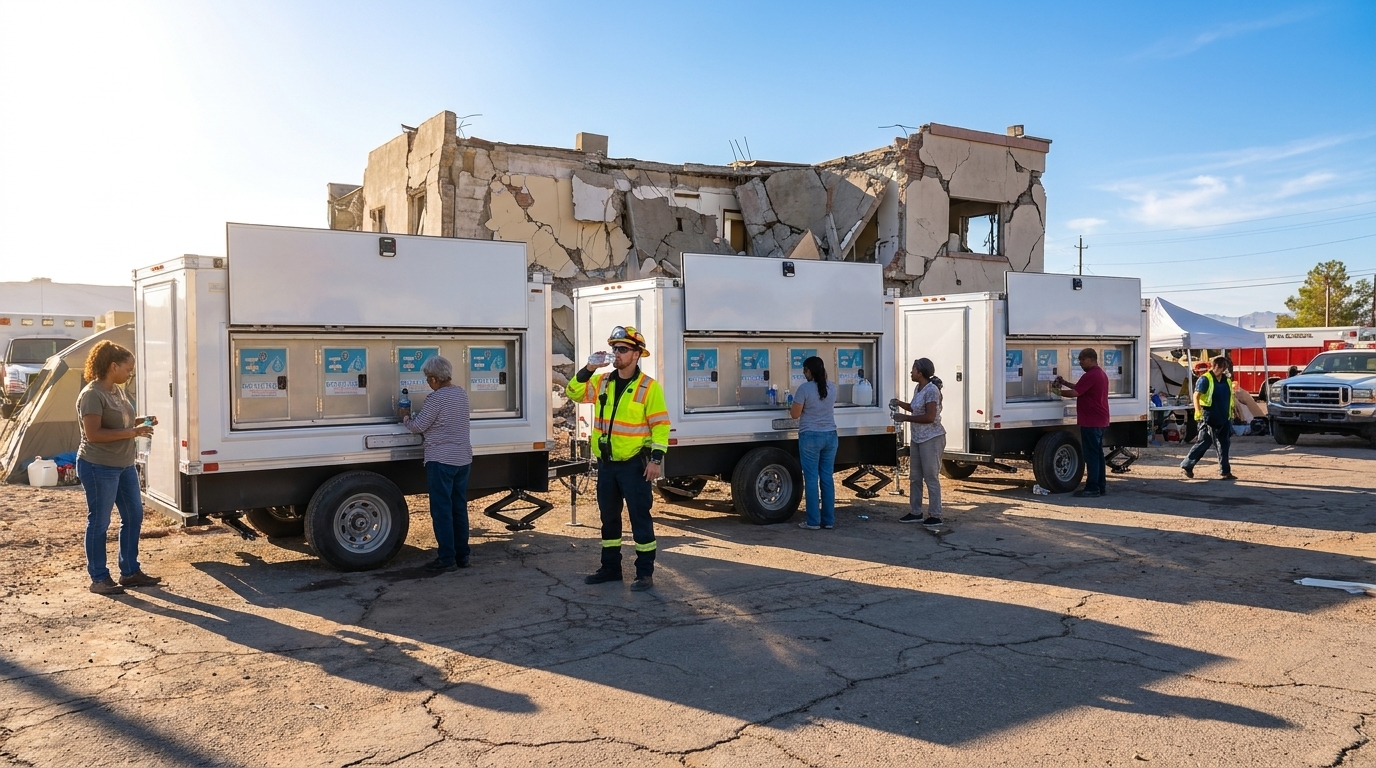 Front Range
→
Rec centers and libraries carry the network through the Front Range heat stretches.
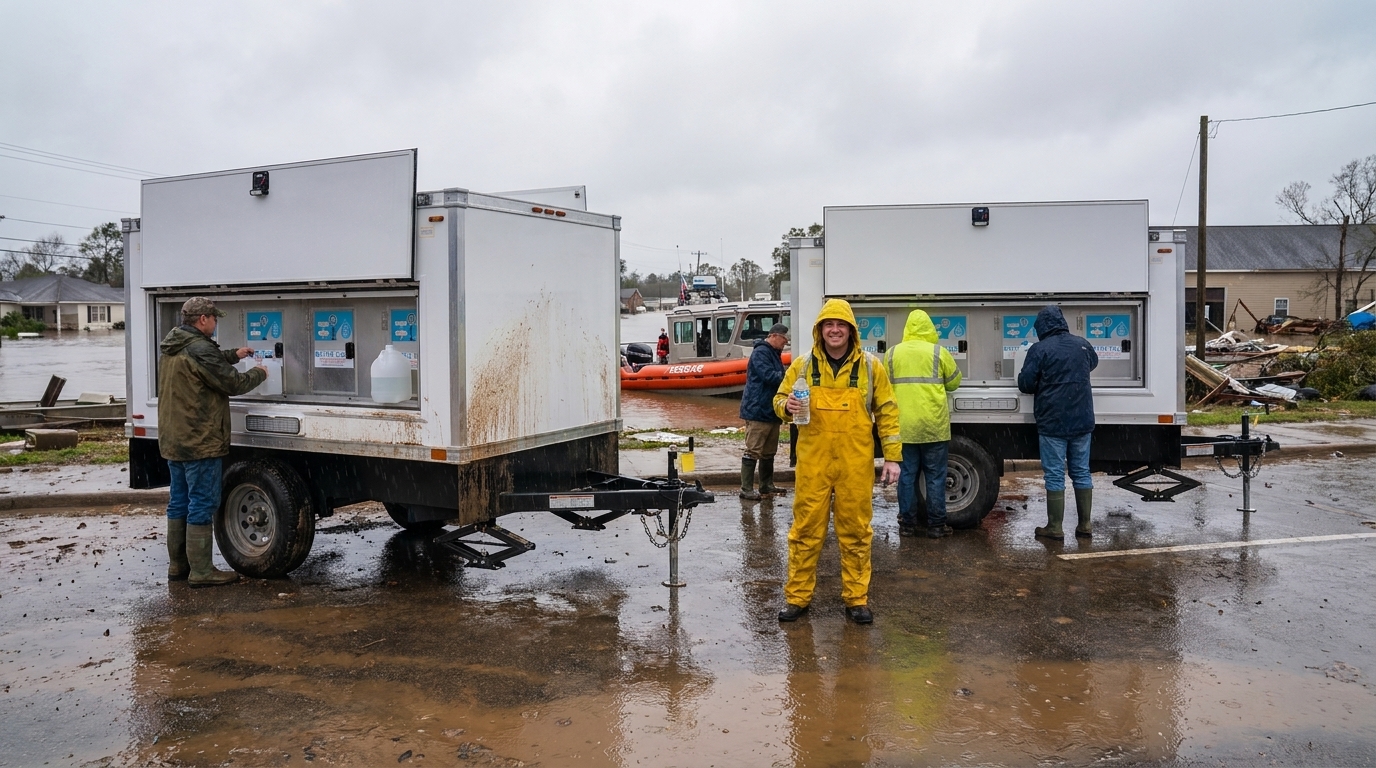 Northern San Joaquin Valley
→
Valley heat runs long and county sites open several times a summer.
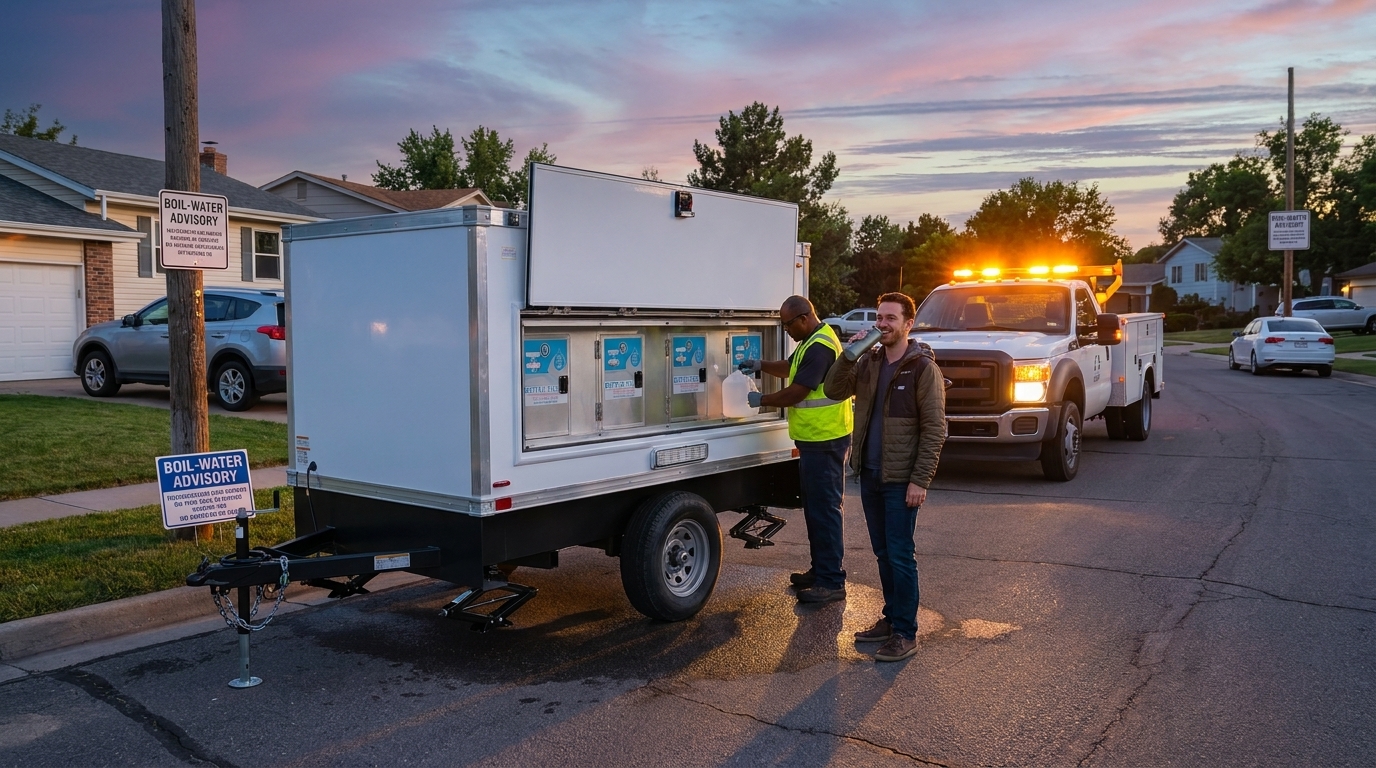 Central Valley
→
Triple digit stretches with a large outdoor workforce living around the relief network.
 Far West Texas
→
Desert heat with a long season and city sites that stay open on extended hours.
 Lower Colorado River
→
One of the hottest metros in the country, where relief sites are a summer fixture.
Give us the head count or the guest count, the date, and the spot it will park. We will spec the right setup, confirm the delivery window, and have cold filtered water pouring before the day starts.