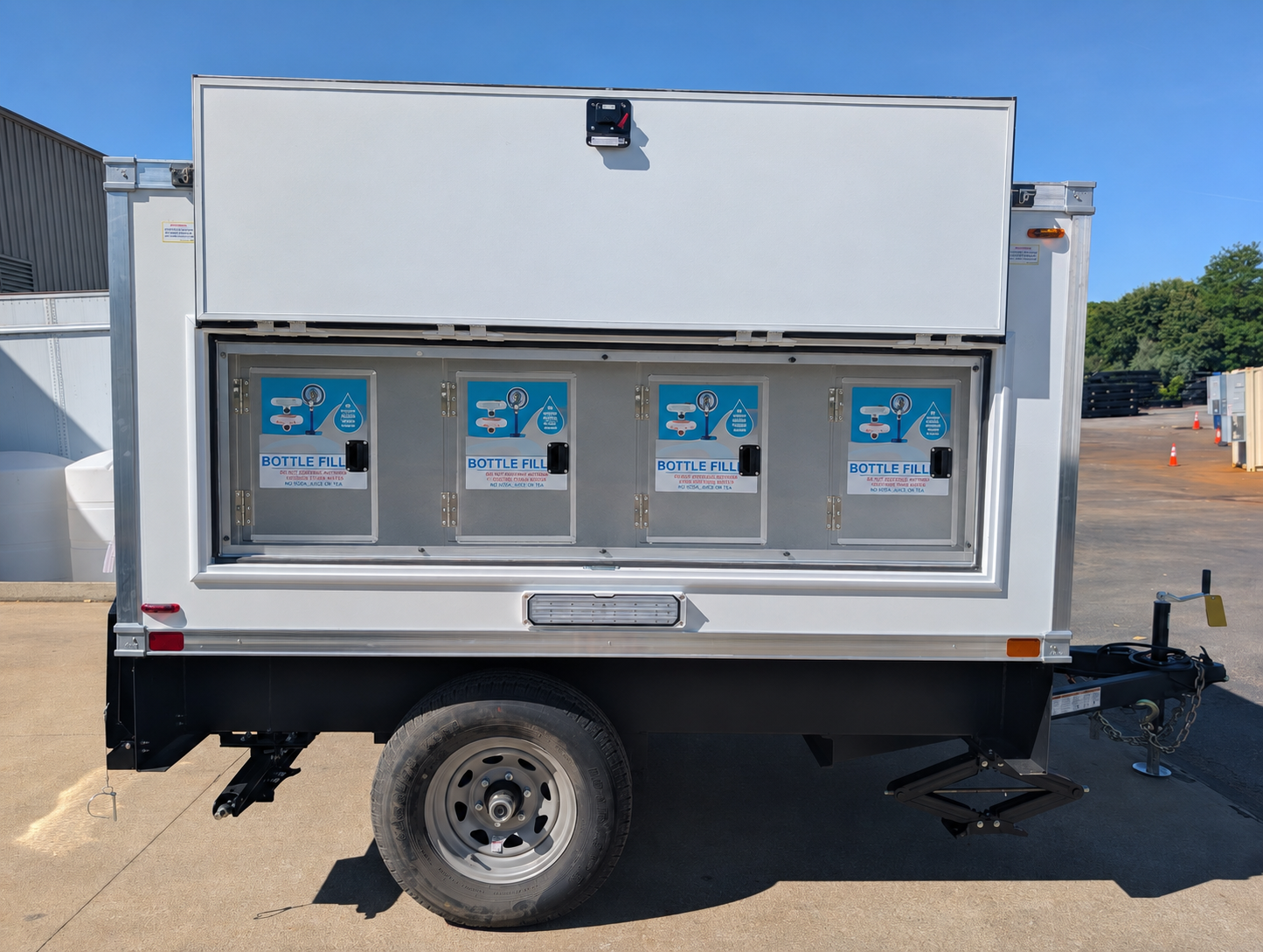
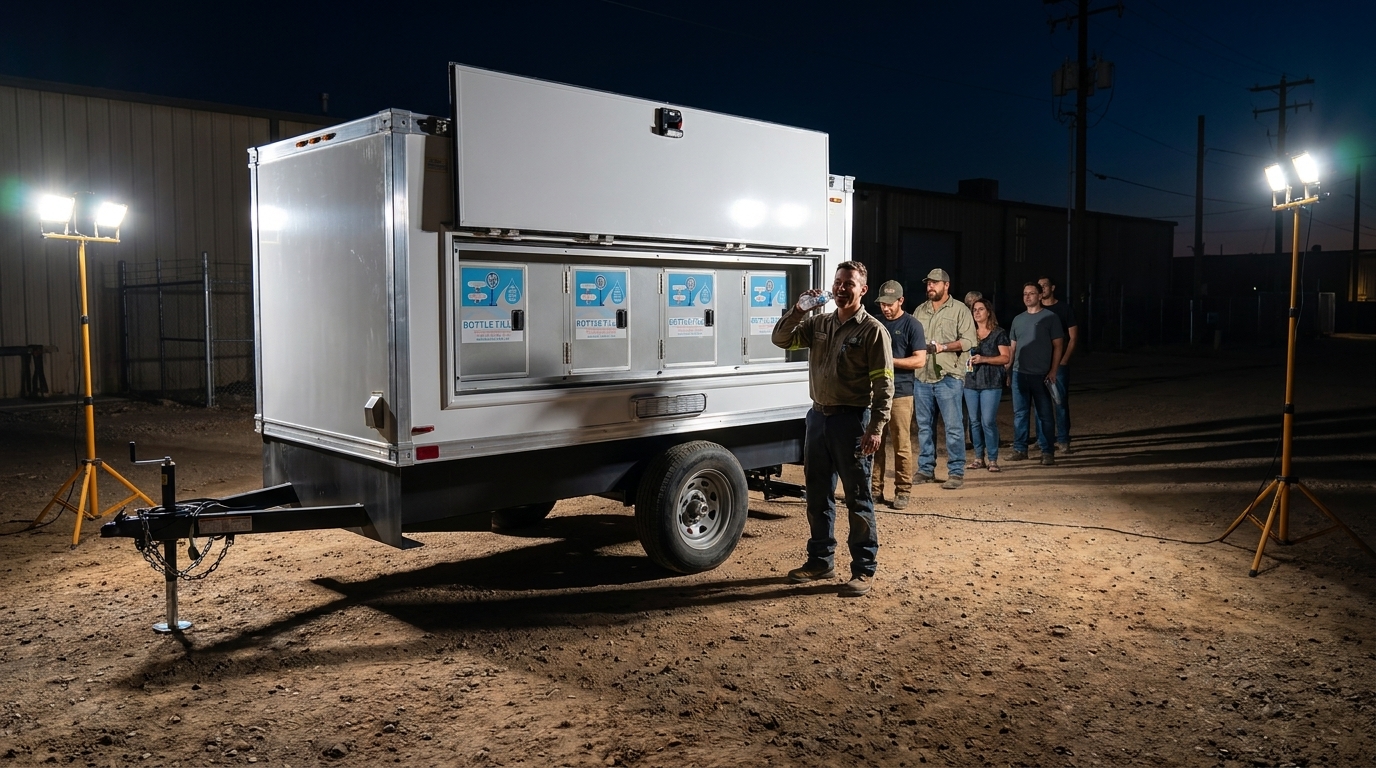
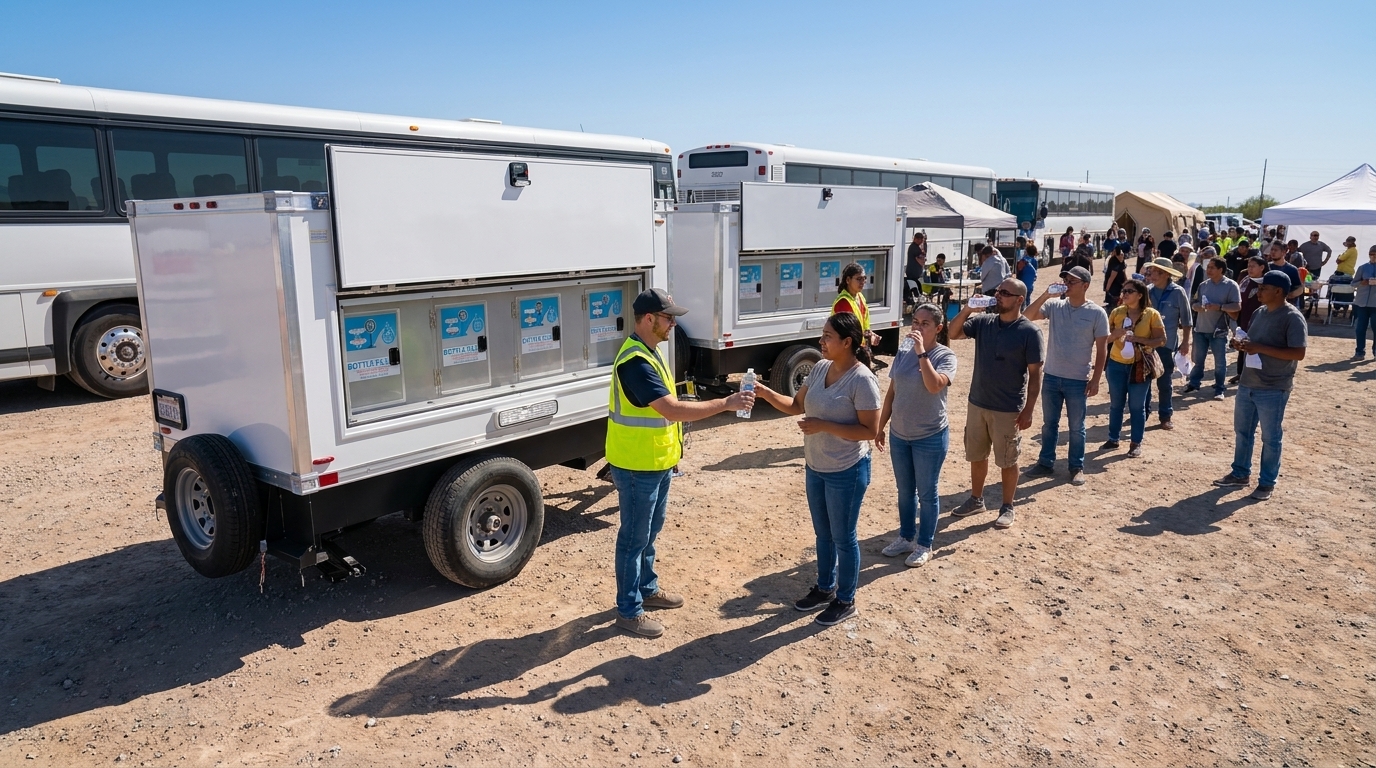
On-Site Hydration Services delivers mobile drinking fountain rentals to parks, trail entrances, outdoor markets, street festivals and work sites where the nearest tap is a quarter mile off or shut down for the season. Every Signature Series trailer is towed in and set up ready, with 300 gallons of filtered, chilled water on board and four push back fill stations, one low enough to use from a wheelchair. No hose bib needed. Call us with the site, the dates and a head count and we will tell you what fits, and ask for a quote while the plan is still in draft, because that is the week a water point is free to move.
Licensed and insured | A+ BBB rated | 24/7 dispatch
See the Signature Series water station specs
“Our fountains come back on in April and the trail is busy in March. We put your unit at the trail entrance for six weeks and the complaints stopped the first weekend.”
“We had sink water for the vendors and nothing for the public, so people bought a bottle or went without. One station at the entrance changed how long families stay.”
“No service line on that stretch yet, so we ran jugs out twice a day and still came up short. The trailer put cold water fifty feet from the work and my foremen stopped babysitting coolers.”
References for this kind of booking are available on request.
We have been putting cold water in front of the public and in front of working crews for years, and the call is always the same shape. Somebody has a crowd, a trail or a crew, and the closest tap is too far, shut off for the season, or on the wrong side of a fence. So we bring the fountain to them, towed in full: no plumbing, no pump, no friendly neighbor with a spigot. Our trucks run nationwide and we keep city pages for the metros we cover most, including Denver water station rentals. Call us with the location and the dates and we will tell you what fits. Ask for a quote early, because moving a water point on paper costs nothing.
One Signature trailer can pour for a weekend concert and be working a slab pour a couple of days later. Hiring one company for your events and a separate one for your worksites makes no sense. Either way, the planning, the delivery, and the refills are ours.
The onboard cooling unit keeps the tank genuinely cold all the way through a long afternoon outdoors, and that single detail carries the whole thing. Warm water is water people abandon, and midsummer is exactly when a crew or a crowd is drinking the most. Cold water gets finished, and finishing it is what keeps heat illness off the site.
Typical deliveries land in about 45 minutes once a truck is rolling in your metro, longer out on the rural routes, and we keep emergency runs going around the clock whenever a heat advisory or a power shutoff hits. The morning a foreman finds his 40-person crew stuck with one warm cooler, speed is the whole game.
One rule sits under every job we take: water that people walk past might as well not be there. We've stood on a bare site and watched shrink-wrapped pallets cook next to the job-trailer while the crew baked thirty yards off. We've watched the opposite too, a chilled station ten steps off the work face run bone-dry twice inside one shift. Everything that matters lives in the distance between those two pictures. Which is why we don't drop a unit and disappear. We match it to your headcount or your gate count, set the refill rhythm to how hard you're really pulling on it, and treat a heat call the way you'd want your own treated, meaning right now, because out here one hot hour can swing the whole day.
We deliver water stations to job sites, venues and event grounds in all 50 states, with the heaviest route coverage across the West.
We plan for the walk, not the map. The spot that looks right on a site plan is usually the shaded service drive nobody walks past. We set the station where the public actually enters and keep a firm, level path to the taps that anyone can reach, because a fountain fifty feet off the route may as well be back on our lot.
One trailer, four fill points and a tank big enough that a park crew or a job site stops thinking about water for the day.
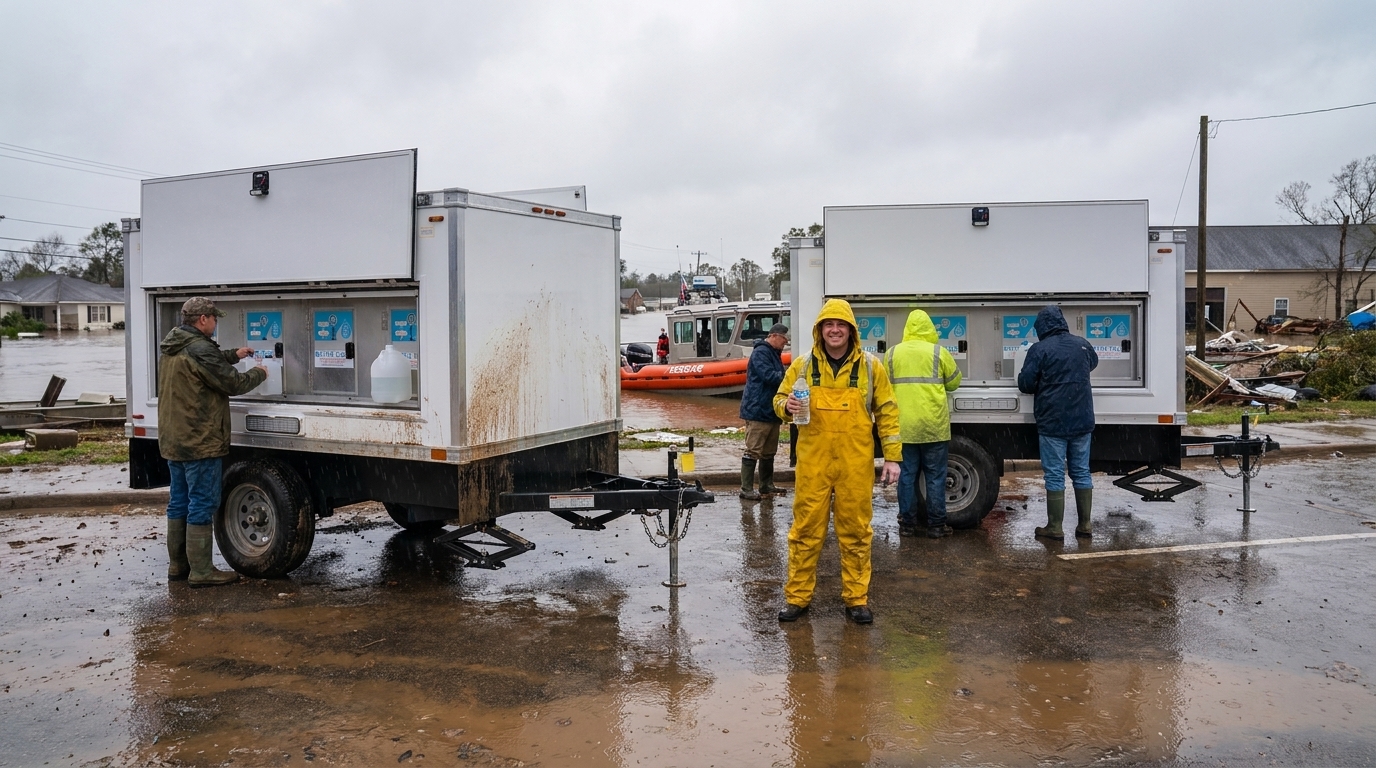
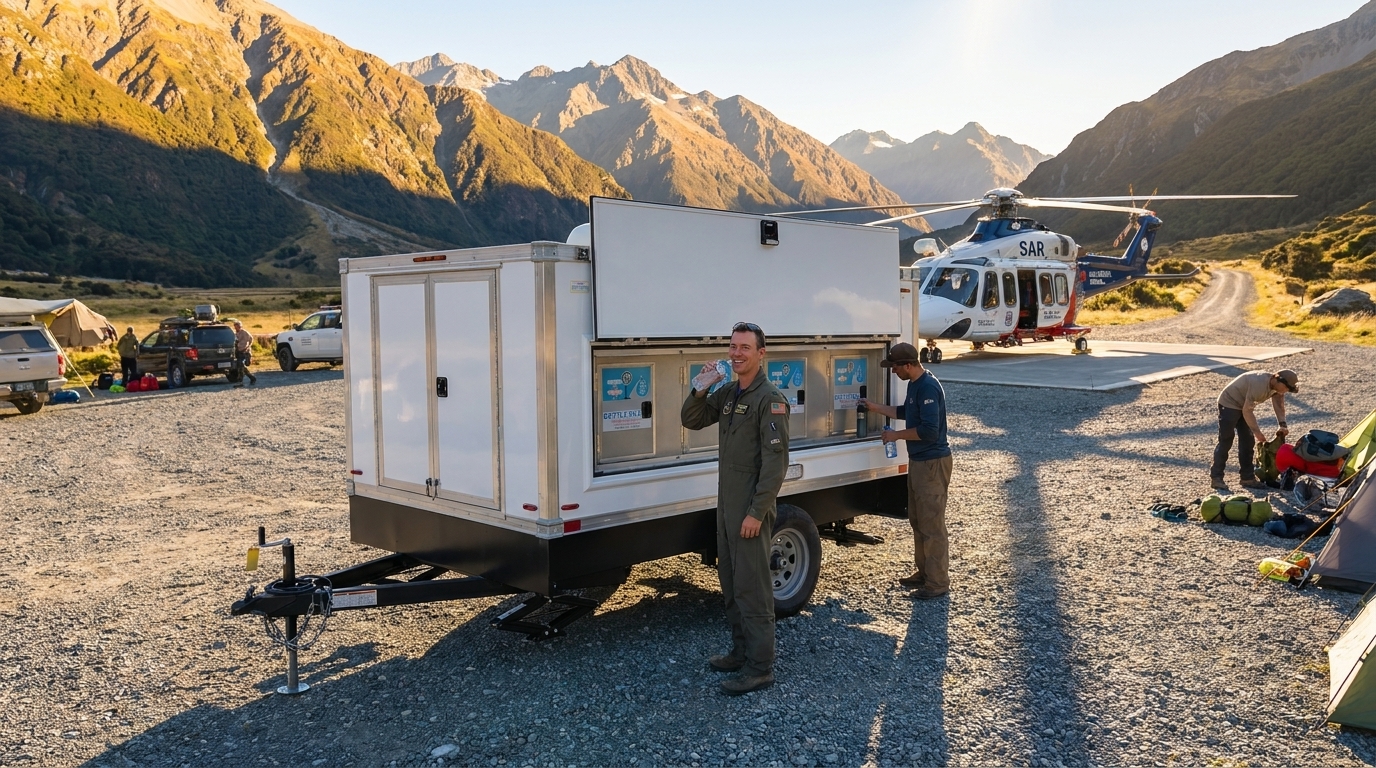
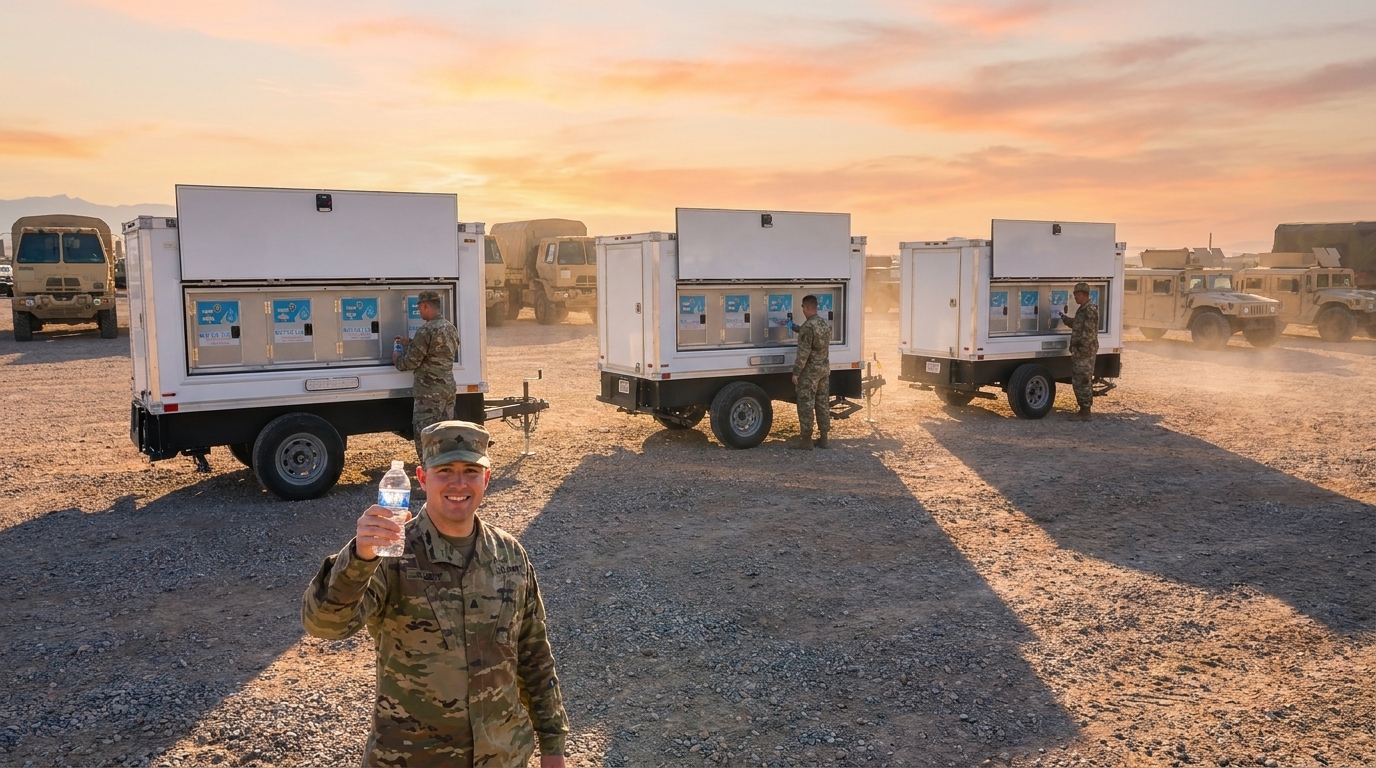
With a frame, a hitch, and tires under it, the unit hauls out to a remote build, an event field, a working orchard, or a disaster staging yard with equal ease. Contractors and event planners request this exact rig by name. The whole design is built around backing in, leveling off, and pouring cold by the same afternoon.
| No. of stations | (4) Bottle Filling Stations |
| Length | 12' 3" |
| Weight | 3,100 lbs. |
| Height | 8' |
| Fresh water tank | 300 Gallons |
| Power requirements | 1 to 4 dedicated 20A/120V circuits OR 1 dedicated 50A/240V circuit |
| No. of AC units | 1 |
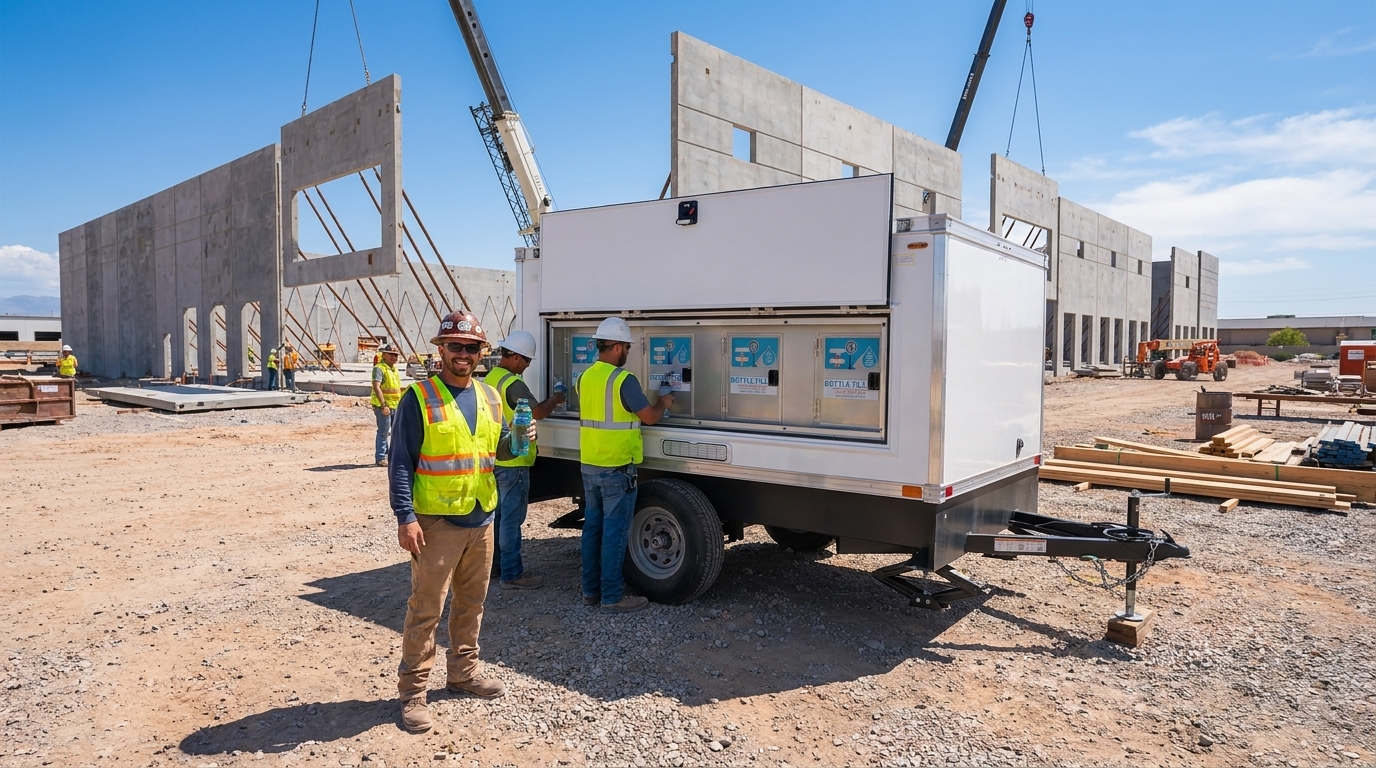
The Signature Series is a road towable trailer, 12 feet 3 inches long, 7 feet 6 inches wide, 8 feet tall and about 3,100 pounds empty, carrying 300 gallons of fresh water and a 200 gallon grey tank. Four push back bottle fill stations with adjustable taps sit across the serving side, and a rear jug station handles five gallon jugs and cooler fills. Three hundred gallons is roughly 2,400 sixteen ounce pours, so a park weekend or a full crew day rarely reaches the bottom of the tank.
Water never reaches the taps raw. Three filter stages take out sediment, chlorine and microscopic particles, an ultraviolet chamber kills germs, and an onboard electric cooling unit drops the temperature before it hits a nozzle. That detail is what people actually notice. Warm water gets poured on the ground and cold water gets finished. Power is 1 to 4 dedicated 20A/120V circuits, or one dedicated 50A/240V circuit, and one air conditioning unit keeps the equipment bay stable in summer.
It travels like any road legal trailer, on a rated hitch with lighting, guards and safety chains, which is why the first thing we ask about is the last hundred feet of the approach. Posts, low branches and a locked park gate stop deliveries, not the drive itself. A room with a water line already built into the wall can use a fountain connected straight to that line, but a fountain connected that way cannot move once it is set. Off grid, away from any water hookup, the towed station is the one that works.
A public fountain gets one chance with a stranger. If the first pour tastes like a warm garden hose, the next person is told about it before they try. Three filter stages and an ultraviolet pass handle the taste and the safety side, and the cooling unit does the rest, which is why cups come back empty instead of half full.
The opening filter traps sand, scale, and the fine grit local mains occasionally push through. On a dusty lot, that's what keeps a pour from tasting like the parcel it's parked on.
Activated carbon comes next, lifting the chlorine bite and the dull seasonal notes local tap can carry until the taste lands clean and neutral. When it's 89 out, that flavor decides whether a crew keeps drinking or walks past the tap dry.
A finer cartridge then catches the microscopic particles that slip past the first two, so what reaches the spout is clear rather than merely cold for the crews and crowds drawing off it.
The last step is an ultraviolet chamber that wipes out bacteria and microbes without adding a single chemical. Even after a long tow out to a remote site, the water off the nozzle is clean.
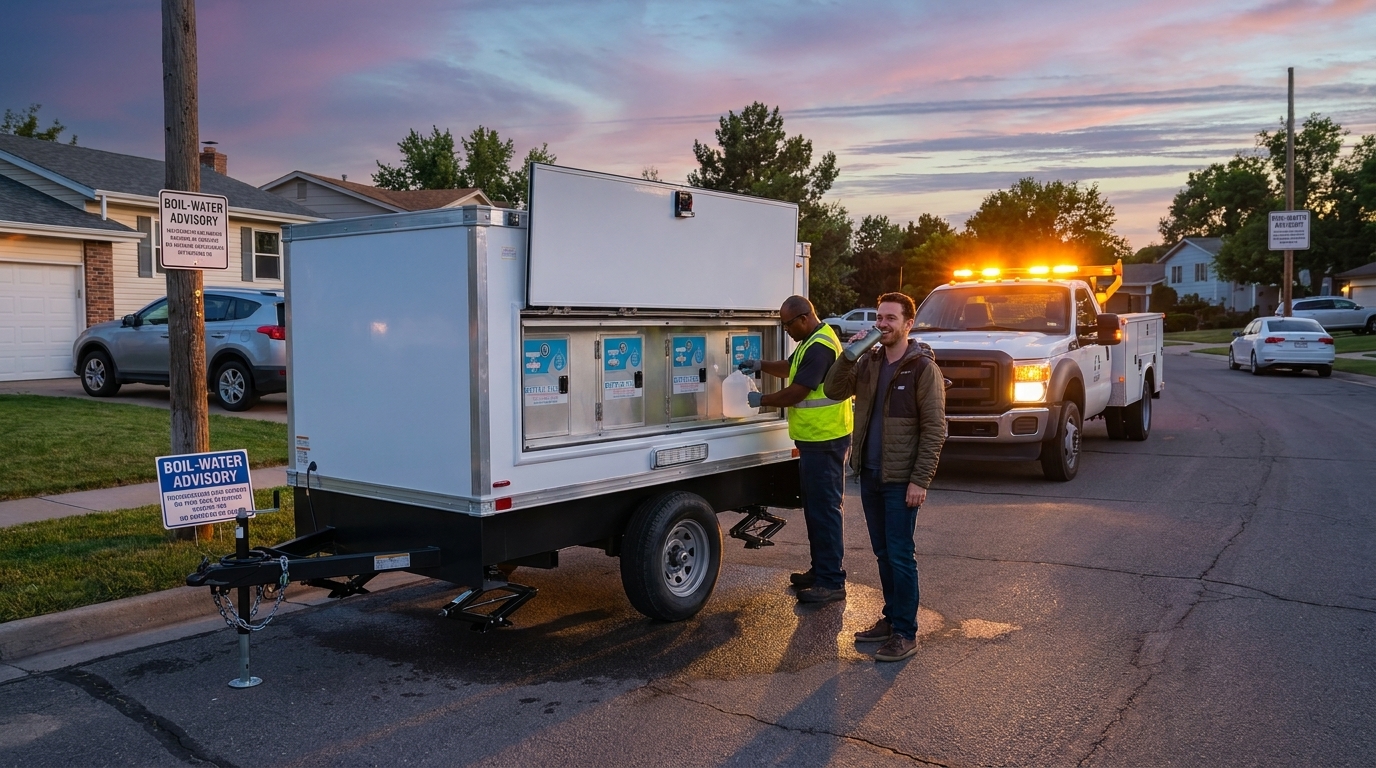
Along the wall sit four adjustable push-back taps, press a bottle to the bar and it pours. One of them is set at ADA-reachable height, so a single trailer includes everybody in a crew or crowd with no add-on gear. Out back, a large-jug spout services five-gallon coolers and hydration packs, while a bank of hose connection taps handles work-site chores, event support, and refills down the orchard rows. Stainless, food-grade plumbing the whole way through keeps the filtered, chilled water at quality right to the spout.
Every Signature trailer carries a 300-gallon load, roughly 2,400 cups at sixteen ounces each, and we recharge it on demand, so the unit doesn't turn into the choke point on a busy shift or a packed show night.
A trail entrance can have its water shut off until spring. A blocked off street can have vendor sinks and nothing for visitors. A crew can be working a mile from the nearest service line. Those are three different problems, but the unit that solves them is the same one. What changes is how fast it has to arrive, where it parks, and who is counting.
Freeze risk sets the calendar for every fixed fountain outdoors. Standing water in an exposed line can crack it in one night below 32 degrees, so park systems drain the lines and shut them down every fall, and do not turn the water back on until the forecast agrees. That leaves a real gap. Trails stay busy in March. The water comes back in May.
The National Park Service installed 14 freeze resistant fountains and bottle fillers along the Mount Vernon Trail for exactly this reason, several with pet bowls, so a year round trail would not go half the year without water. Yosemite runs the same pattern at the Vernal Fall comfort station, open around April and closed by October. Most departments cannot justify that retrofit at every trail entrance, and they should not have to.
Then there is the stretch that never had plumbing at all. An overlook two miles from the lot, a new segment opened ahead of the utility work, a tournament weekend at a complex with one fountain by the restrooms and eight fields in play. We handle those the way we handle portable water station rentals in Portland or anywhere else, by setting the station where foot traffic already turns rather than where the map has open space.
Dogs are worth a sentence. Trail users bring them, and the rear jug spout fills a bowl without tying up a fill station.
A farmers market already has water, and it is not for the public. Market rules require potable water from an approved source for vendor sinks, municipal preferred, a private well only with quarterly bacteria and annual nitrate testing on file, and food grade hose rather than a garden hose. That covers vendors. It leaves visitors buying a bottle or going without on the one morning a month everybody is outside for three hours.
City permitting puts the same gap on paper. Special event and parade offices want a full footprint site plan before they issue anything, and for athletic events that plan has to show the water points along the route with a fire lane at least 20 feet wide kept clear. Health departments want the temporary event application about two weeks ahead, and a month is the common recommendation. So the equipment call is a desk decision, not a favor somebody phones in on Friday.
The footprint decides where a unit can sit. A blocked off street has crowned asphalt and a curb. A civic lawn goes soft after a Thursday rain. A vendor row already has power runs taped down and a lane the fire marshal will not let you narrow. We walk that with the event lead before load in, because a station behind a stage is a station nobody drinks from.
One detail markets notice fast. A fill station mid footprint keeps the family with two kids on site another hour instead of leaving to find water.
The federal sanitation standard for construction, 29 CFR 1926.51, says an adequate supply of potable water has to be provided at every place of employment, poured from a container with a tap. It names no volume for construction or general industry. Maritime and agriculture carry the tighter adequate to meet health and personal needs language. Any superintendent who has stood in front of a compliance officer knows which answer is easier to give with a measured, enclosed station than with a cooler.
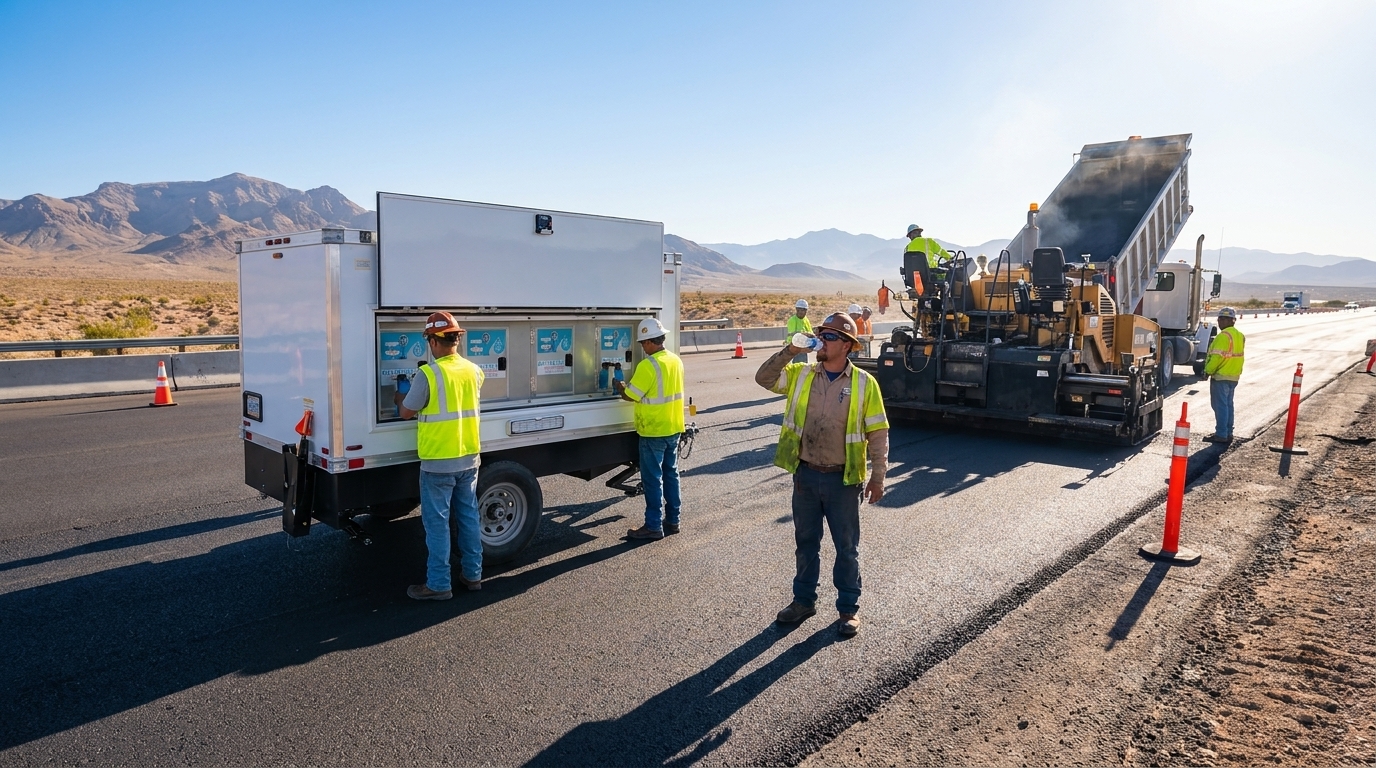
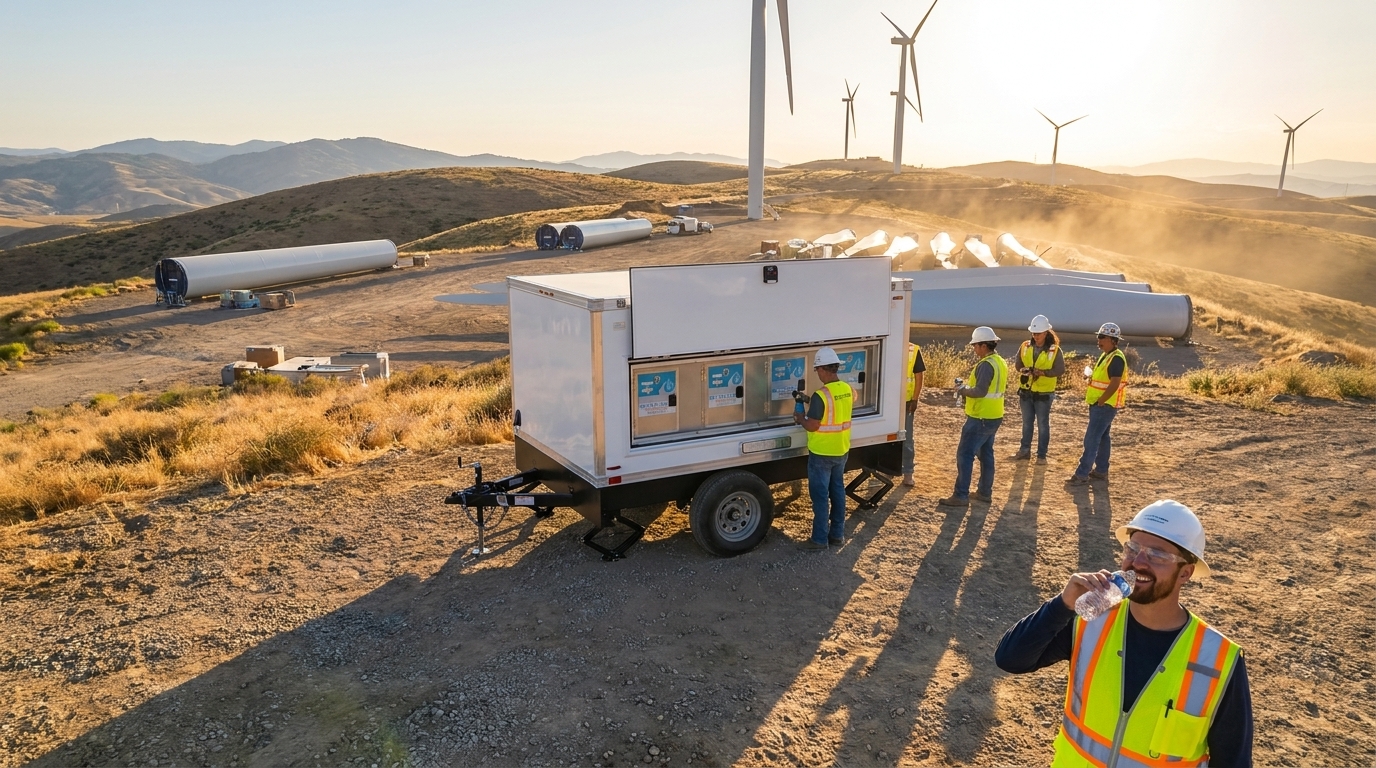
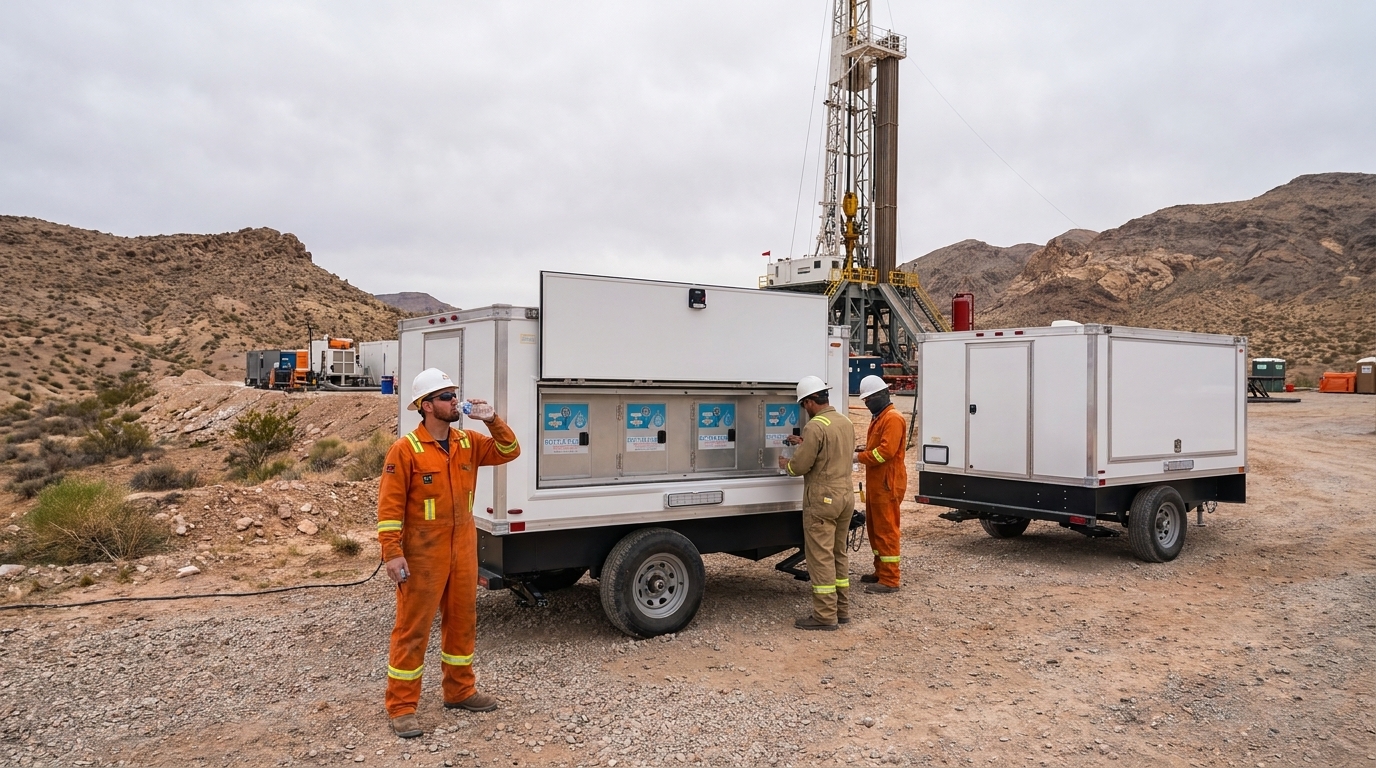
The sites that call us share one thing. No tie in yet. Road and highway work, pipeline corridors, solar and wind construction, early phase grading before the utility is run. Add refinery turnarounds where the break trailer is a long walk from the unit, distribution yards with no plumbing near the dock face, and harvest crews working a field where the closest tap is an office trailer a quarter mile back. Water either gets carried out by somebody with other work to do, or it does not arrive.
Dispensing method matters as much as volume. An open barrel, a pail or a tank somebody dips a cup into is not acceptable under the rules covering worker drinking water, and a shared cup or common scoop is out on its own. A fountain head, a covered container with single use cups, or sealed bottles are the accepted ways. Four enclosed push back taps and a rear jug spout put a crew on the right side of that without anyone thinking about it.
Then there is the shift start rule that catches people. Where no running water exists on site, the full day's water is supposed to be on hand when the shift begins, not hauled in at two in the afternoon. A 300 gallon tank in the yard at 6 a.m. answers that in one sentence.
Most of this job happens before the trailer moves. Where it parks, how people reach it, and who has the gate key.
For an event we deliver the day before whenever load in allows, so the station is set, filled and tested before vendors arrive and the lane fills with trucks. For a crew we deliver ahead of shift start. For a heat call we move the same day where a truck can legally reach the site, the same way we run fire camp water station rentals when a staging area stands up overnight. Give us the delivery window and the gate contact, in that order, because the gate is what holds up a drop.
Placement is the decision we argue about most. The site plan shows a tidy spot on a shaded service drive. The public walks in from the parking lot on the other side. We set the station where feet already go, then check the path: firm, level, at least 36 inches wide, room for two people using wheelchairs to pass, and no lip over a quarter inch without a smooth edge. Grass and gravel are fine if they drain. A tilted asphalt apron is not, because a cross slope that feels like nothing under your feet is enough to fail an access review.
What goes wrong is rarely the equipment. Soft turf two days after rain, a locked post nobody has a key for, a power drop shared with a food vendor who trips it at noon, a closure that moved a block overnight, a park gate an inch under the trailer's width. Each one is a five minute call the week before.
On multi day runs we schedule top offs instead of waiting for a call, because the day a station runs low is the day the forecast spiked and nobody had a spare minute to dial. Crews use the rear jug spout for coolers so the public taps stay open. Before a hard freeze we shut down or pull the unit, which is the usual reason a park rental ends in October. Pickup gets a contact and a window, same as delivery.
People count, number of days, where exactly it parks on your site, and what power is there. Those four answers let us spec it correctly the first time around.
Reckon roughly 45 minutes from the nearest yard once we are in your metro, longer on the outer routes, with round-the-clock emergency runs whenever a heat advisory or a power shutoff hits.
Once on site we set it level, charge the 300-gallon tank, and tie in power off one to four standard 120V circuits, or a single 50-amp 240V drop, depending on what the site gives us.
After that the tankers cycle back on a cadence matched to how fast your crew or crowd pulls it down, and we maintain the unit through the whole rental term.
No power on the parcel at all? We price that in. The unit draws very little, and with the service fleet backing it we've run stations on lots that had no permanent power whatsoever. Lay out what the site offers and the rest is on us.
Want this math run for your own booking? Two minutes on the phone gets you a real number.
One station covers most single gathering points. Distance and stay length are what add the second one, not crowd size alone.
| Trail entrance or neighborhood park, fountains shut down for winter (150 to 250 people a day) | 1 station |
| Weekly farmers market, one entrance (1,200 to 1,800 visitors over a morning) | 1 station at the entrance |
| Street festival, two blocks closed, two ends (up to 5,000 across a day) | 2 stations, one per end |
| Work crew in heat trigger conditions (20 people, 8 hour shift) | 1 station, about 40 gallons drawn |
| Large crew or multi trade site (100 people, 8 hour shift) | 1 station, midday top off |
| 5K or community walk (1,500 participants on a 3 mile course) | 2 stations, start finish and turn |
| Heat deployment at a transit hub or plaza (steady foot traffic, 10 hours) | 1 station, evening refill |
Start with arithmetic anybody can check. Public heat guidance puts a person at about one cup every 15 to 20 minutes in the heat, which is 24 to 32 ounces an hour, and the worker figure in federal and state heat rules is one quart, 32 ounces, per person per hour once conditions trigger. A 20 person crew on an 8 hour shift needs 40 gallons total, using that same one quart per hour figure. Fifty people is 100 gallons. A hundred people is 200 gallons, still one 300 gallon tank with room left.
Public crowds pull less per head, because most visitors are on site an hour and are not swinging a shovel. A market morning with 1,500 visitors, maybe a third filling something, lands closer to 40 or 50 gallons than to the tank. Heat, stay length and running children move that fast, and an afternoon in the high 90s at an athletic complex can double a per person figure that looked safe in June. That is why water bottle filling station rentals get quoted per gathering point rather than per attendee.
Route events use distance instead of head count. Smaller marathons place water every other mile starting around mile 3, and the biggest tighten to about every mile, which puts a dozen stops on a 26.2 mile course and closer to 20 on a Chicago sized field. Shorter closures follow the same logic: nobody more than about a mile from water, so a two mile route gets two stations. Our default is one station per gathering point. We add a second when there is a second entrance, another mile to cover, or a crowd that will not cross the street to reach the first one.
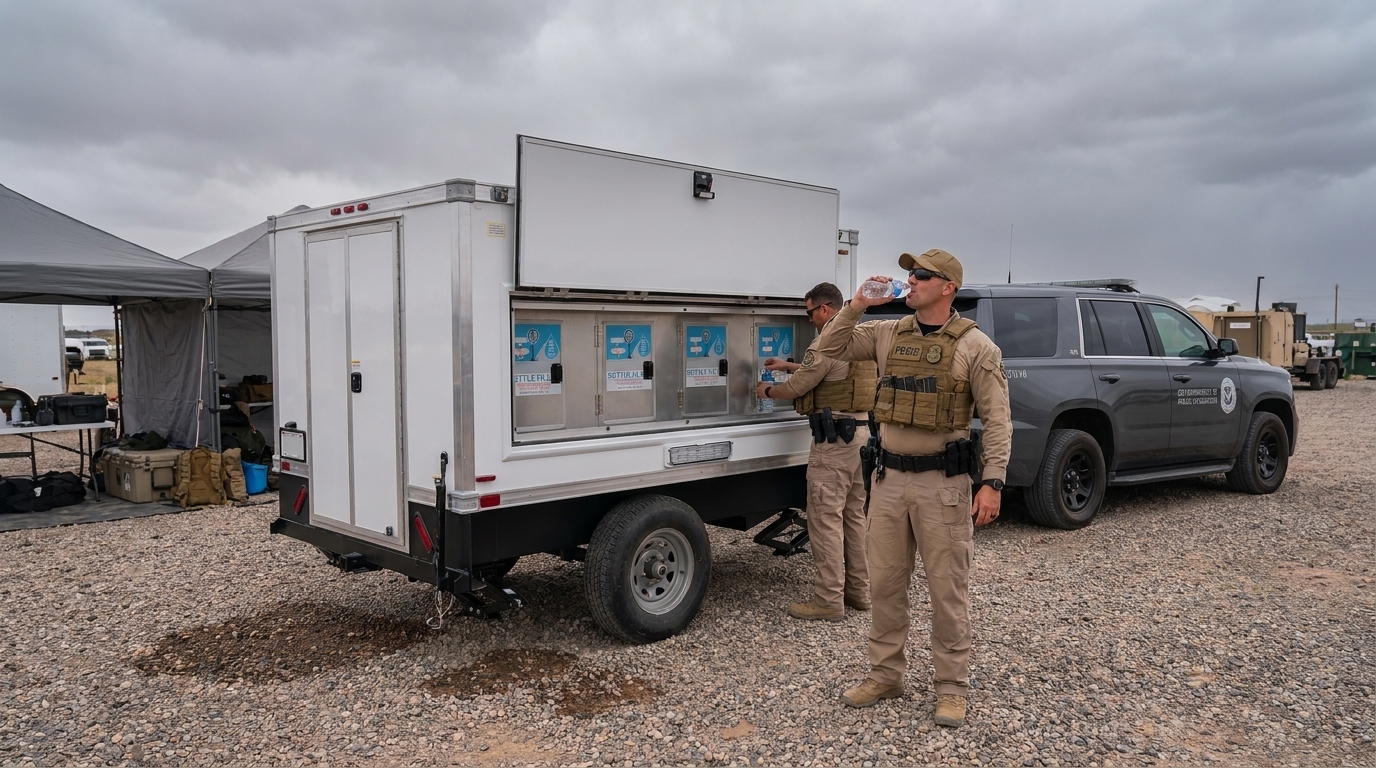
Three rule sets land on one trailer and they belong to three different people. Worker heat and sanitation rules belong to the employer on site. Water source approval for a temporary public event belongs to the county environmental health department and the permit holder. Accessibility at a permitted city event belongs to the public entity under Title II and the venue under Title III. We are the equipment, so our job is to arrive in a condition that lets all three answer yes.
On the worker side the trigger temperatures are already real in several states, ahead of the proposed federal heat rule. California requires at least a quart per person per hour outdoors and encourages up to four cups an hour in hot conditions, with a mandatory cool down rest in shade at 80 degrees. Washington sets its quart per hour requirement at 89 degrees, adds paid ten minute breaks every two hours at 90, and tightens again at 100. Oregon triggers shade, water and acclimatization at 80. Full acclimatization takes about 14 days, which is why the first hot week of the season is the dangerous one rather than the hottest.
Enforcement is not theoretical. Between April 2022 and December 2024 the federal heat emphasis program ran roughly 7,000 heat related inspections, issued about 60 citations and sent nearly 1,400 hazard alert letters. Penalty exposure for a serious violation runs into five figures per instance, and a willful or repeated one into six figures. What an inspector looks for is simple: can you show the day's water was on hand at shift start and poured through an enclosed system.
Accessibility is the one people leave for last and should not. Temporary event guidance is blunt that access gets designed in at the start, not fixed the week of. The route to the taps gets decided alongside the stage and the vendor row. So does the surface under the taps. So does the clear space in front of them. The same thinking runs through our marathon and race hydration station rentals and every other footprint we serve, because a fountain nobody can roll up to is not a fountain for everybody.
Federal OSHA heat illness prevention guidance and the CDC and NIOSH heat stress program point at the same baseline: cool drinking water, close to the people doing the work, and documented.
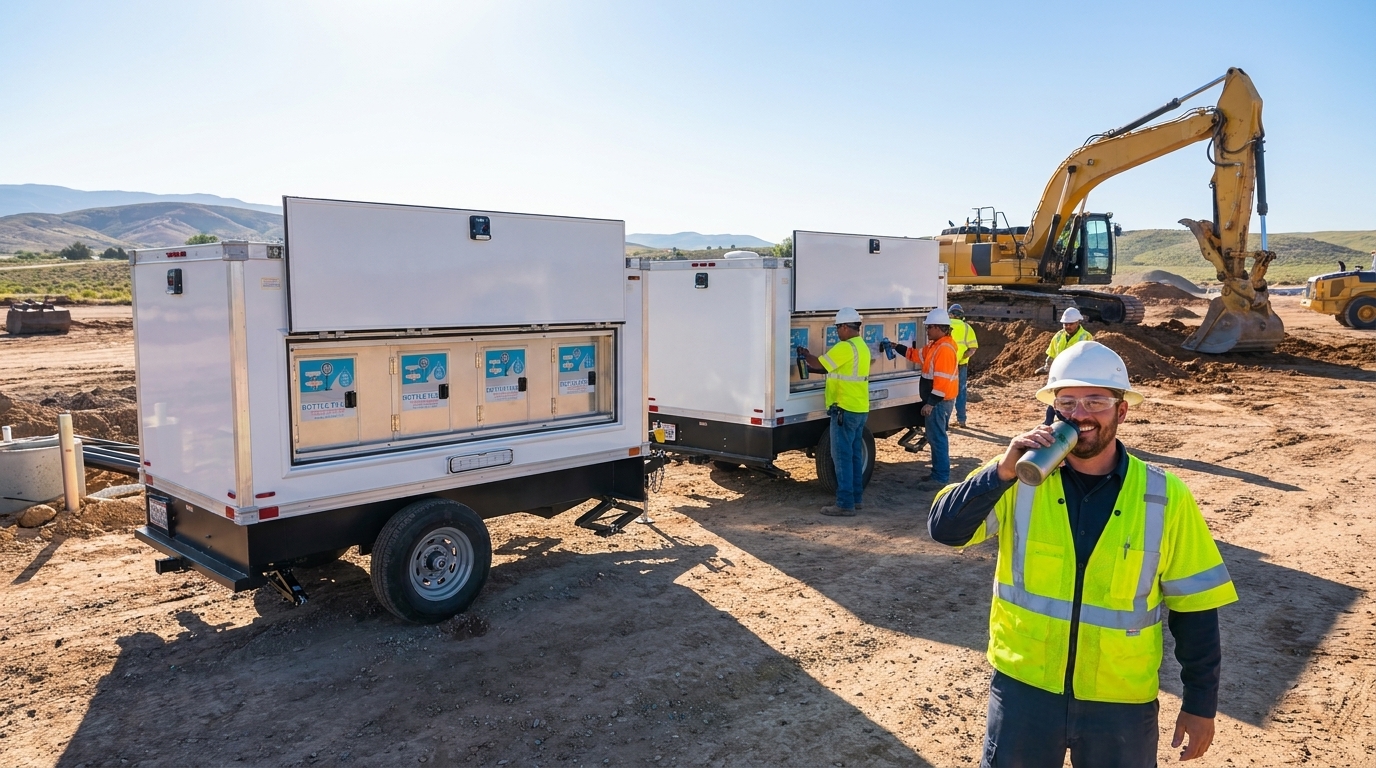
Need a station your written heat plan can point to? We can have one pouring cold within days.
On a remote site the fallback is a cooler, a bag of ice and jugs somebody carried out in a truck bed, refilled by whoever had twenty spare minutes. No filtration, no chill past the morning's ice, and no way to show a compliance officer the day's water was ever on hand. The moment somebody dips a shared cup in it, the setup fails on method as well as volume.
On a route the fallback is cases and coolers staged by volunteers at every stop, which means a truck run to each point before the start and a trash sweep after. Twelve stops on a marathon is that loop twelve times in one morning, plus the cardboard. At a market it is simpler and worse: no public drinking water at all, just the vendor sink water the public is not meant to touch.
The pallet is the part nobody pictures until it is in the lot. A standard pallet runs around 1,900 bottles, and one manufacturer's own figures put the plastic avoided at over 100 pounds per 100 workers against that pallet. Somebody carries it off the truck, somebody breaks down the wrap, somebody hauls the empty bottles away, and none of them were hired for that. A 300 gallon tank covers roughly 2,400 pours without any of it.
Look at everything bottled water actually demands of a person: cutting the order, receiving and breaking down pallets, icing coolers before dawn, topping them up through the day, then flattening empty bottles for the bin. On a large crew that's hours of paid time burned every single day, scraped right off the work that's supposed to be getting done. The trailer erases that loop entirely. A local contractor once let us pencil it out with him, and the recovered labor by itself paid for the unit. His words were that the bottle runs had been quietly costing him close to a day of payroll a week. Our trailer arrives full, the tankers keep it full, and your superintendent owes it nothing but a parking spot.
Ice a cooler at 6 a.m. and by mid-morning in July it's as warm as a bath. Warm water is water people stop touching, and the slowdown that follows is precisely where heat illness gets its opening. A chilled station never rides that warm-up curve at all. Whatever pours at clock-out is as cold as the sunrise fill, which happens to be the moment a spent crew, or a crowd deep into a long concert, leans on it hardest.
Bottled-water pallets devour staging space, jam the lay-down area, and sit cooking in the sun until somebody finally cracks them open. Empties build up faster than anyone keeps up with, and on a tight commercial lot that pile turns into its own problem. Set a trailer in one parking stall instead and it serves a crew or crowd that would otherwise burn through hundreds of plastic bottles every day.
Every bottle bought is a bottle thrown out, and across a season a busy site or event generates a small mountain of them. That's a disposal line on the budget, a dent in the sustainability numbers, and, given that a single bottle can linger in the ground for centuries, a footprint that lasts longer than the project that made it. Move to a refill station and the line drops to zero, which finally gives your reporting a figure worth publishing.
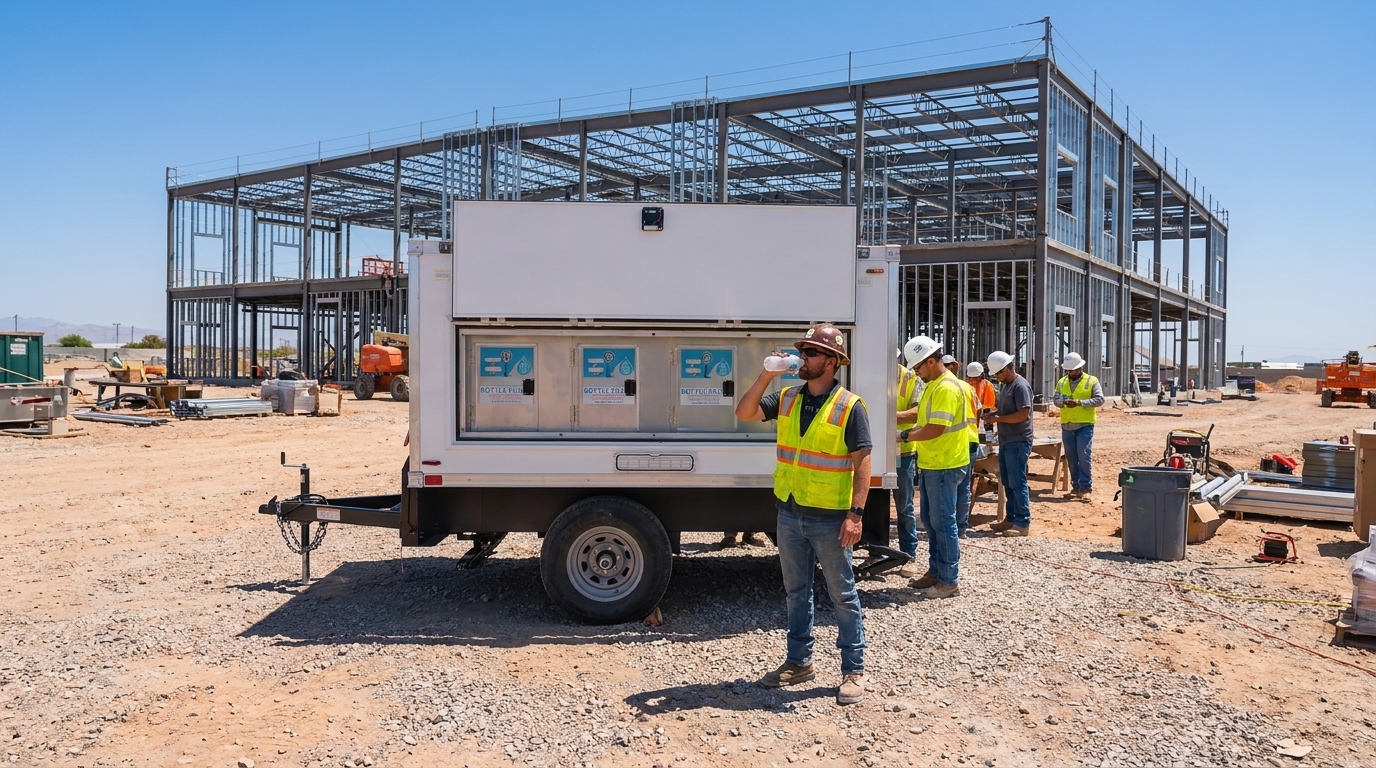
Three bookings of this kind, and what we planned around on each one. Names and details are kept generic on purpose.
River trail system, late March, fixed fountains still shut down for winter. The department drains its outdoor lines every fall and does not recharge until overnight lows stay clear of freezing, which in a normal year means May. The trail does not wait. By the second warm Saturday the lot was full and the only water on the corridor was whatever people carried in. We set a station where the paved path meets the gravel, on the lot side so the tow in was a straight shot, and ran it six weeks until the fixed fountains came back.
Downtown farmers market, 60 stalls, first heat advisory of July. Vendors had approved source water for their own sinks and the public had nothing, which was fine in May and stopped being fine at 99 degrees. The manager wanted the station mid row for fairness. We put it at the entrance instead, because that is where the line of arrivals forms and mid row would have narrowed a lane the fire marshal had already measured. Attendance held through the hot weeks and the rest of the season got booked before August.
Highway widening job, crew of about 60, third week above 90 degrees. Service water had not been run to that stretch, so the site moved jugs by pickup twice a day and came up short by mid afternoon on the hot ones. That is the shortfall a heat rule is written against, and the one a superintendent cannot prove away later. We put the trailer on the haul road within fifty feet of the working face and moved it twice as the work advanced. Foremen stopped tracking coolers.
Service information current as of September 2026.
Still weighing it? Call and ask. Most of these questions get settled in one short conversation.
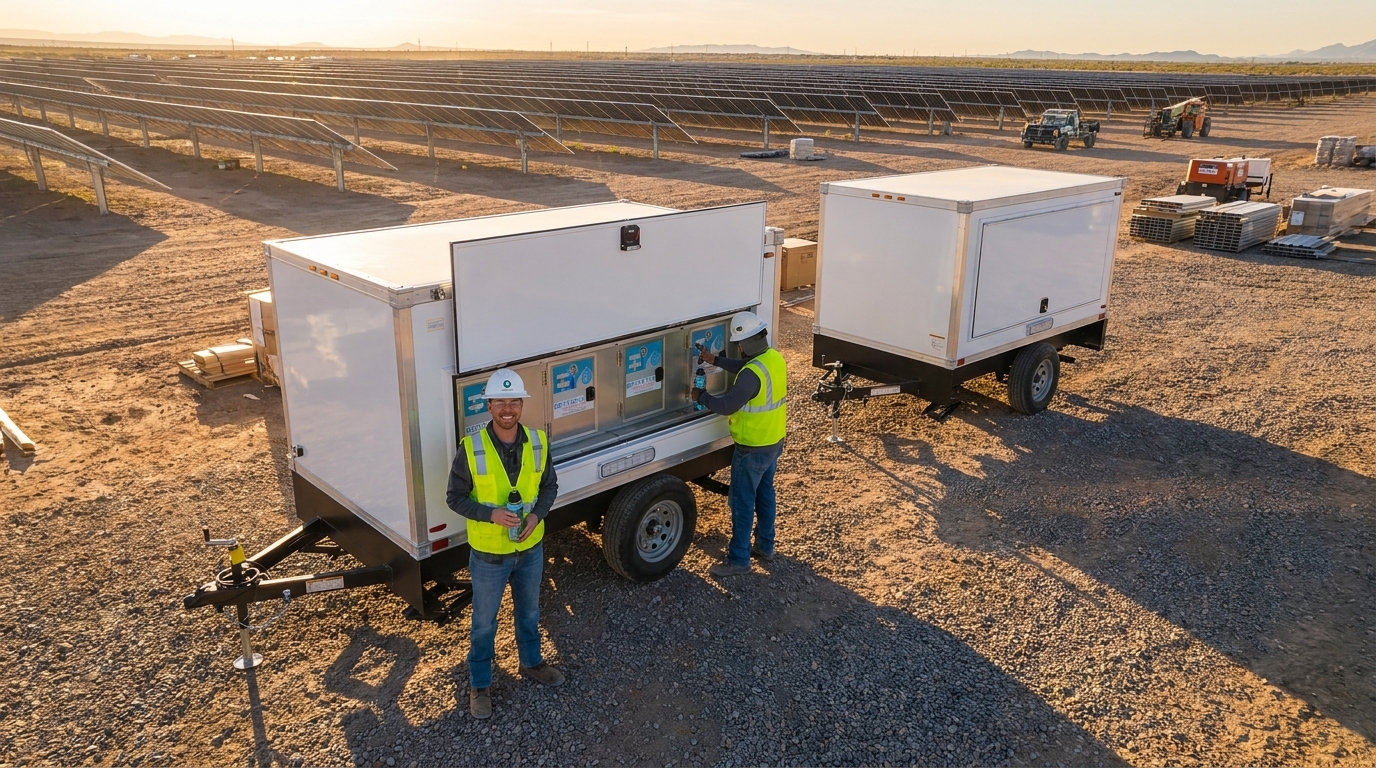
Same equipment, described from two angles. A mobile drinking fountain is the public facing idea, a place a stranger can walk up to and drink. A bottle filling station is the fixture itself, a push back tap sized for a personal bottle. Our trailer carries four fill stations plus a rear jug spout, so one unit answers both.
No. The Signature Series carries 300 gallons of fresh water on board, filtered and chilled by equipment in the trailer, so it can sit in an open field or at a trail entrance with no plumbing within a mile. It does need power, either 1 to 4 dedicated 20A/120V circuits or one dedicated 50A/240V circuit.
Mobility is the difference. An indoor fountain connected to a water line only works where that line already runs, and it cannot move once it is set. A towed station brings its own fresh water supply, so placement is limited only by where a tow vehicle can reach. That is why an outdoor site or one with no water hookup always calls for the towed unit.
The figure in the worker heat rules is one quart, 32 ounces, per person per hour once conditions trigger, and California guidance encourages up to four cups an hour in hot weather. Run it for your crew: 20 people on an 8 hour shift is 40 gallons, 50 people is 100 gallons, 100 people is 200. All three fit inside one tank.
Smaller marathons place water every other mile starting around mile 3, and the largest tighten to roughly every mile, which puts about a dozen stops on a 26.2 mile course and closer to 20 on a Chicago sized field. On a shorter closure, nobody should be more than about a mile from a water point, so a two mile route gets two.
One of the four fill stations sits at a height a person can use from a wheelchair, and placement is the rest of the answer. The route needs to be firm, level and at least 36 inches wide, with about 30 by 48 inches of clear floor space at the tap and no abrupt lip over a quarter inch. We walk that path with you before the trailer is set.
Grass and gravel are fine when the ground is firm, reasonably level and drains. What we avoid is soft turf a day after rain, a tilted apron with a cross slope steeper than about 1:48, and any surface the approach path cannot cross cleanly.
Standing water in an exposed line can crack it in one night below 32 degrees, which is why park systems shut down fixed fountains every fall. A rental gets around that: we shut down or pull the unit before a hard freeze and bring it back when the site needs it. That is why park rentals usually run March to October.
The requirement markets are held to covers potable water from an approved source for vendor sinks, with food grade hose and testing on file if the source is a private well. General public drinking water is usually the organizer's choice. That is the gap a mobile drinking fountain fills, and it is why managers who add one tend to keep it.
The fixture is the easy part. A fill station at wheelchair reach with about 30 by 48 inches of clear floor space in front of it satisfies the point of use. What fails review is everything between that station and where people actually are.
Start with the route. An accessible path needs at least 36 inches of width, with 32 inches tolerated only at a doorway or a pinch no longer than 24 inches, and a 60 by 60 inch passing space about every 200 feet so two people using wheelchairs can get past each other. Running slope stays under 1:20 or the surface counts as a ramp and inherits ramp rules at 1:12. Cross slope stays under 1:48, the number that quietly rules out good looking spots, because a crowned street feels level under your feet and measures steeper.
Then look at the transitions. A vertical change over a quarter inch needs a smooth edge and anything over half an inch needs a ramp. Cable ramps, a curb lip, plywood over a cable run and the edge of a mat are the usual offenders on an event footprint. A 60 inch turning circle near the taps is what lets somebody leave the way they came without a three point turn in a crowd.
Every outdoor fountain with standing water in an exposed line is one cold night from a crack. Below 32 degrees the water in that pipe expands, and a single overnight stretch is enough to split a line and flood a vault. So park systems drain the lines and shut them down every fall rather than gamble on a mild December.
The shutdown is easy to schedule and slow to reverse. Recharging means thawing, pressure testing, flushing and often a bacteria test before the public drinks from it, which is why the calendar slips toward late spring. Meanwhile the trail is busy in March, the running clubs are back in February, and the first warm Saturday fills a parking lot on a corridor with no water on it.
Some agencies solve it permanently. The National Park Service installed 14 freeze resistant fountains and bottle fillers along the Mount Vernon Trail, several with pet bowls, so a year round corridor would not go half the year dry. That is right for a trail with that much traffic and a budget line to match. It is not right for a trail entrance busy nine weekends a year, and most systems have more of the second kind. Yosemite's Vernal Fall comfort station runs the same seasonal calendar, open around April and closed in October.
Ask what the permit office wants to see first, because that sets the rest. Special event and parade offices want a footprint site plan, and for athletic events it has to show water points along the route with a fire lane at least 20 feet wide kept clear. Health departments want the temporary event application about two weeks out, with a month the common recommendation. Both dates sit well before anybody thinks about equipment.
Ask where the water comes from. An approved source means municipal water in most jurisdictions, or a private well with quarterly bacteria and annual nitrate testing on file, and the hose has to be food grade rather than the one in the maintenance shed. A unit that arrives already filled from an approved source takes that conversation off event day entirely.
Ask about the last hundred feet. Tow vehicle access, gate and post clearance, low branches, a firm level pad that drains, and the honest weather history of that patch of grass. A trailer about 12 feet long and 8 feet tall does not need much, but it needs a path in and it needs to sit level to serve.
→
The refill fixture itself, for any site replacing a standing bottled water order.
→
Courses with no fixed water anywhere along the route, planned by mile.
→
Grounds with big crowds, long days and water points spread across a midway.
→
Relief sites that open on a few days of notice when a heat warning posts.
→
Base camps and staging areas running crews through long shifts in smoke and heat.
→
Outages, main breaks and disaster staging, where the water is the emergency.
We run water station rentals nationwide, and we keep dedicated local pages for the metros our trucks work hardest. Start with the closest one.
Booking this kind of work in a metro we already run? Start with mobile water stations serving Portland, mobile water stations serving Seattle, mobile water stations serving Denver, water station delivery around Manteca, El Paso drinking water station rentals and water station rentals in Yuma, and call us for anywhere else in the country.
 Willamette Valley
→
A large trail and park system on a calendar where outdoor water comes back late.
 Puget Sound
→
Street festivals and market days that run all summer on closed blocks.
 Front Range
→
Trail corridors and tournament complexes with a hard freeze season on both ends.
 Northern San Joaquin Valley
→
Valley heat, farm crews and a long outdoor event season in the same months.
 Far West Texas
→
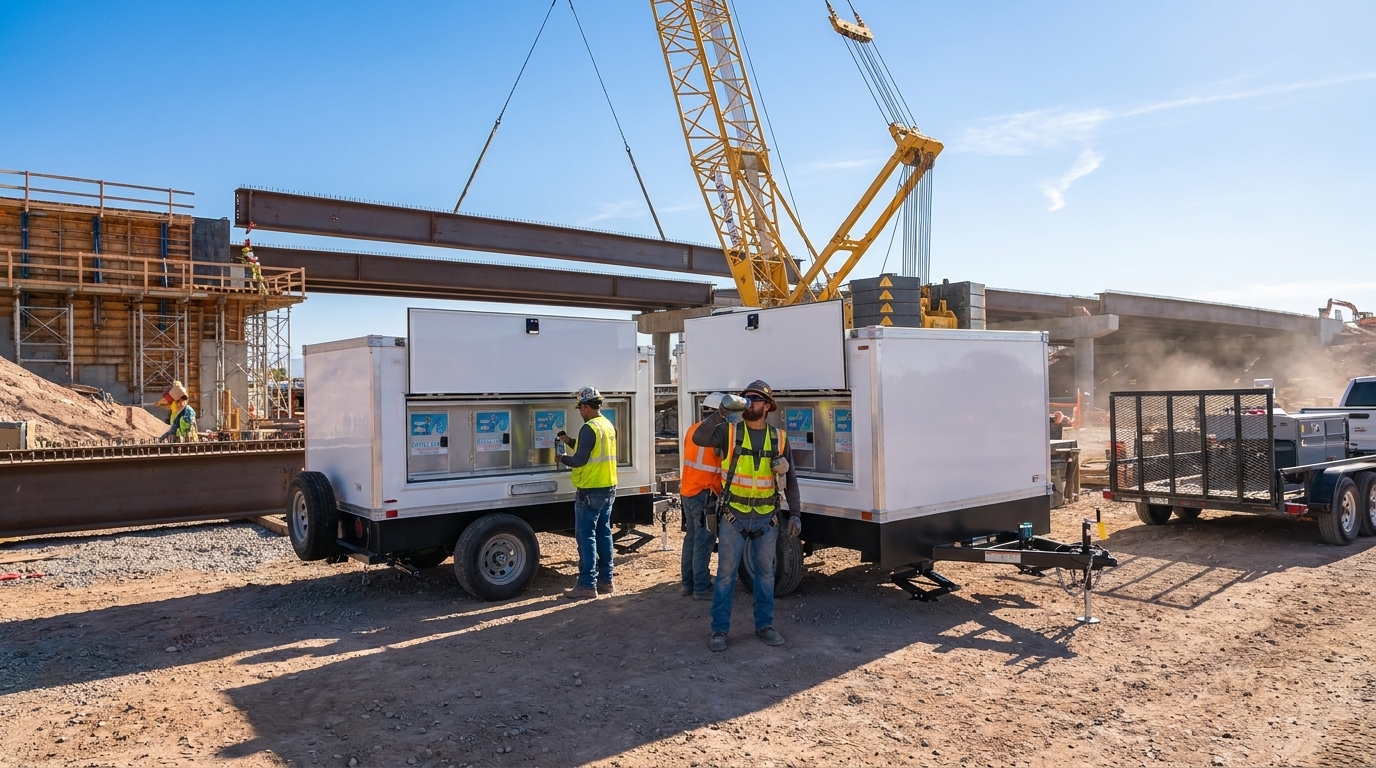
Desert sun and public works crews working through a long, hot stretch.
 Lower Colorado River
→
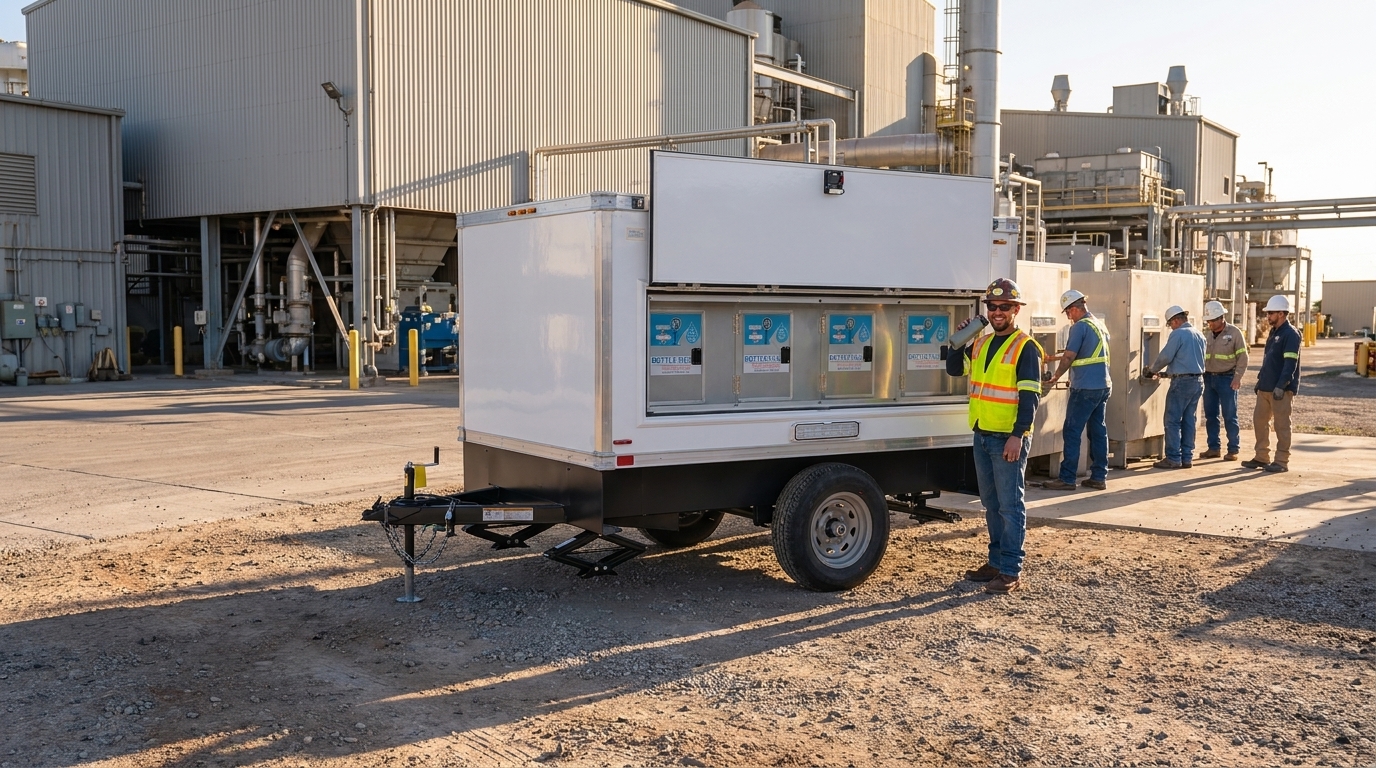
Agriculture and outdoor work in one of the hottest metros in the country.
Give us the head count or the guest count, the date, and the spot it will park. We will spec the right setup, confirm the delivery window, and have cold filtered water pouring before the day starts.