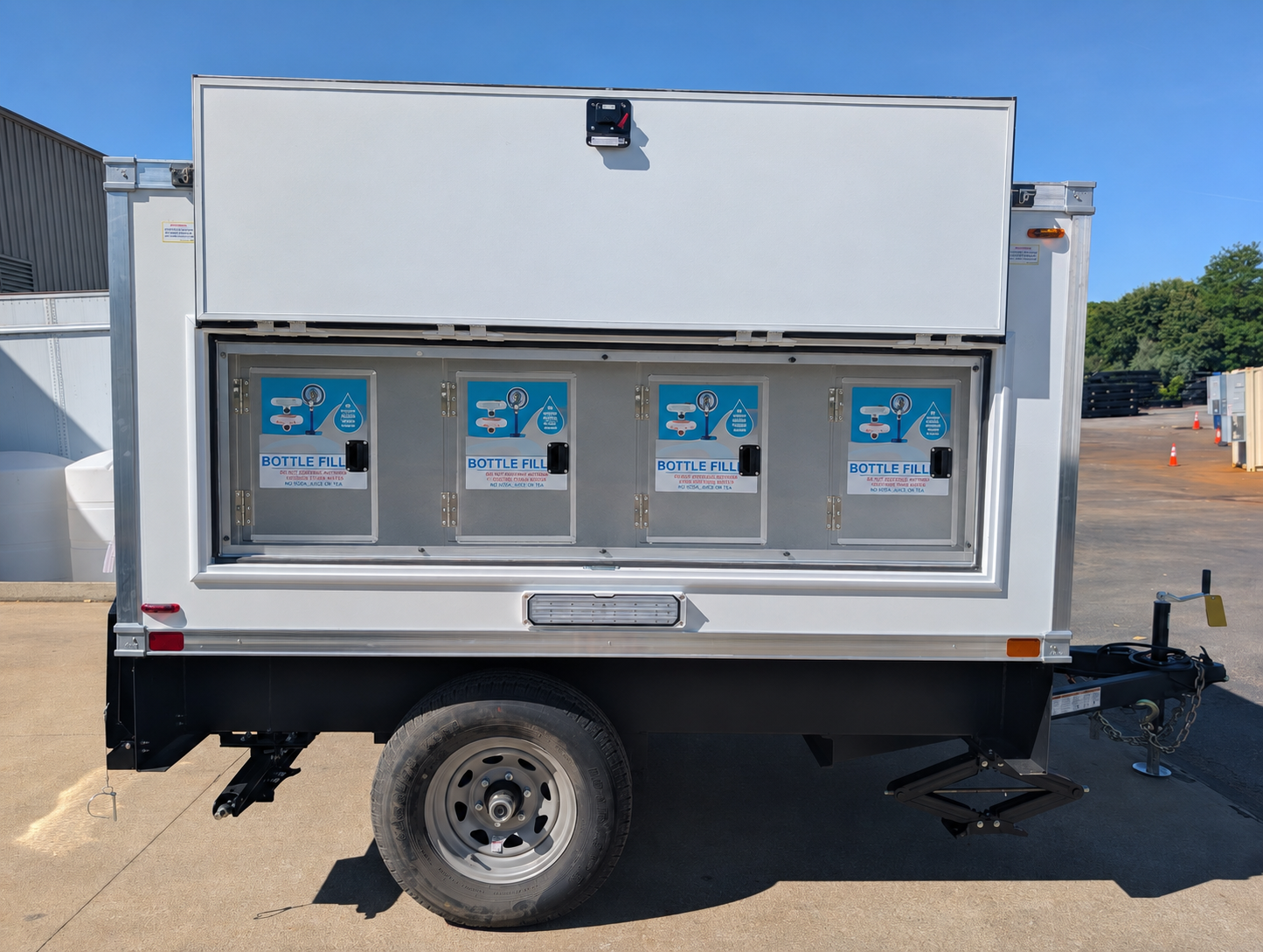
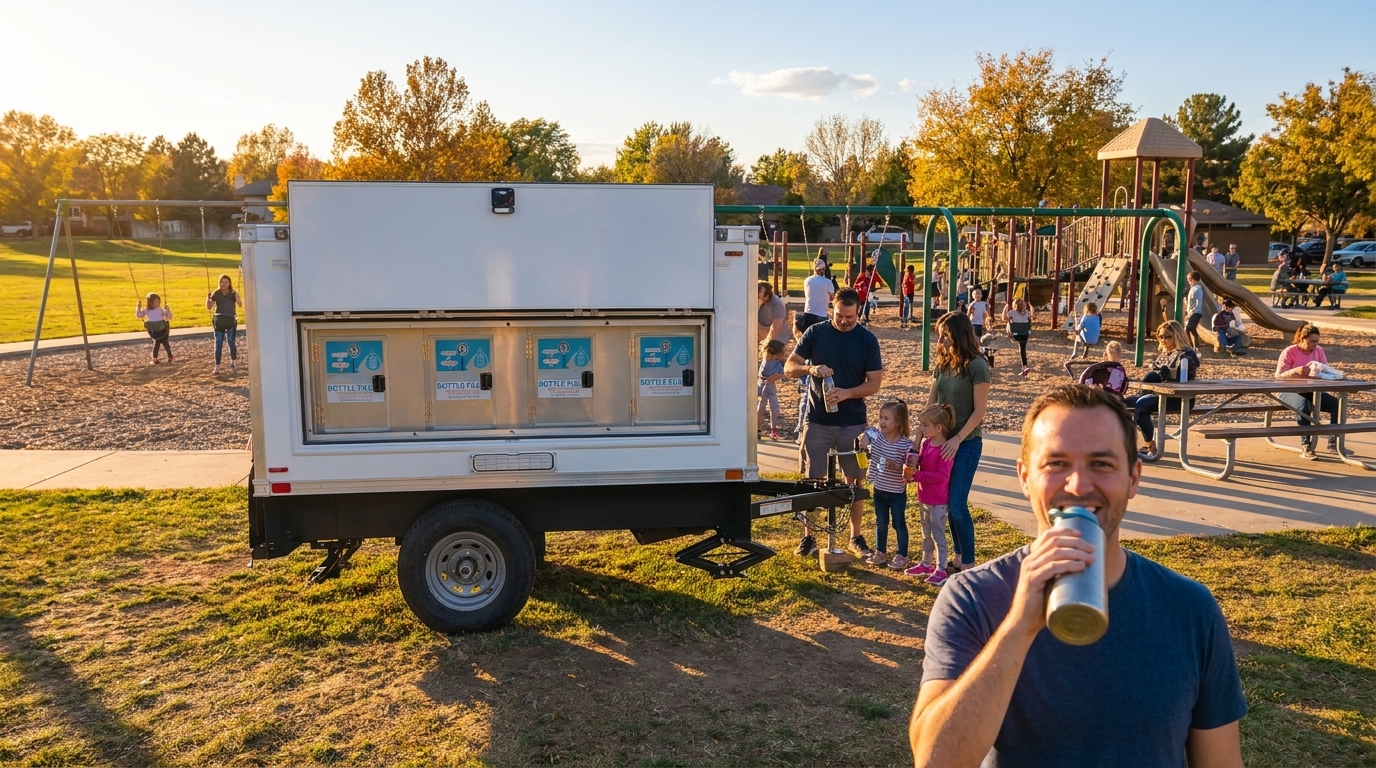
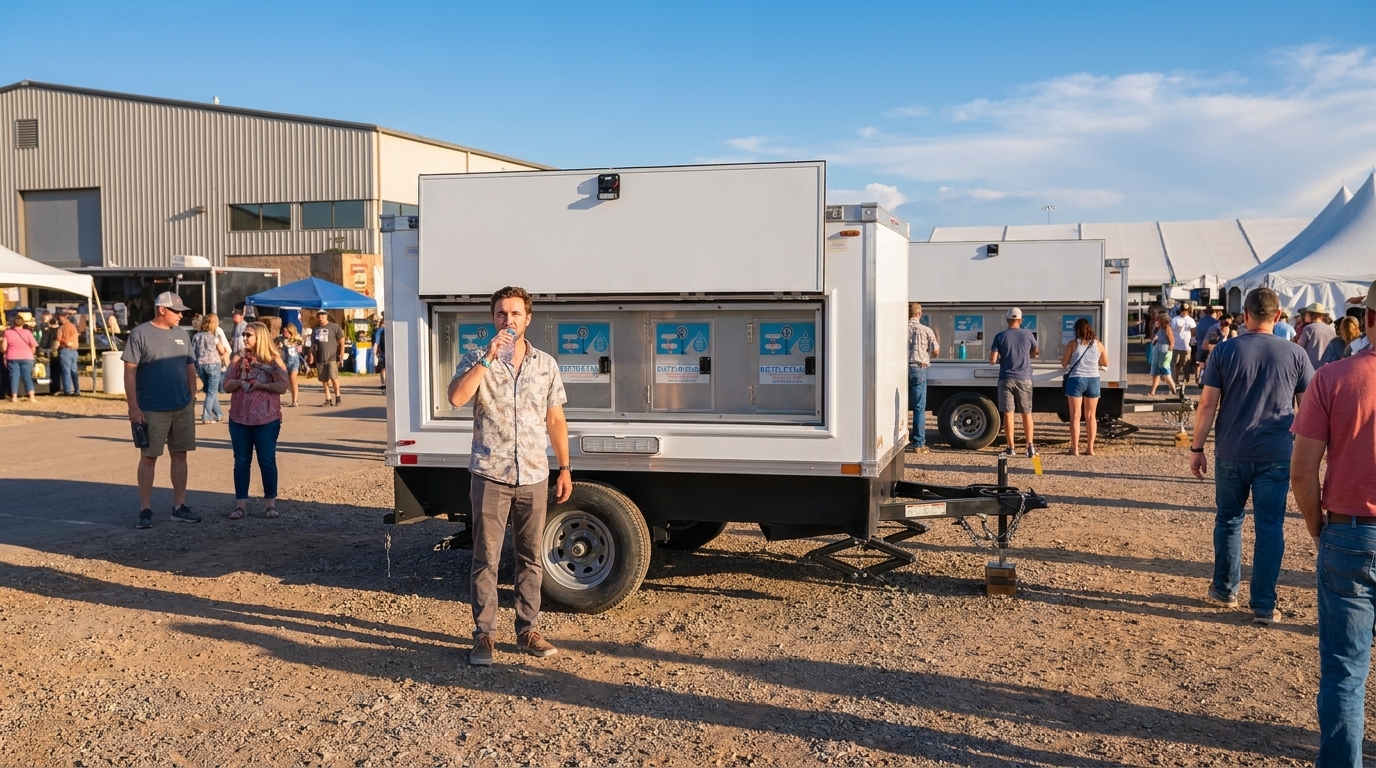
On-Site Hydration Services delivers the Signature Series water bottle filling trailer to school campuses, college quad areas, city parks and tournament fields, set up and pouring cold filtered water before the first group shows up. Four push back fill taps, one at ADA reach, let a student or a runner top off a reusable bottle in seconds instead of hunting for a fountain that works. We tow it in, level it, charge the tank and come back to service it, so nobody on your staff spends the morning carrying cases across a parking lot. Call us today or request a free quote and we will hold a delivery date on your calendar.
Licensed and insured | A+ BBB rated | 24/7 dispatch
See the Signature Series water station specs
“Our cafeteria wing went offline for six weeks and the fountains went behind the fence with it. They set a fill station on the pavement the Friday before, and the kids used it more than the fountains they lost.”
“Move in weekend puts several thousand people on the quad over three days in the worst heat we get. Two stations at the ends of the walk did what our fixed fountains could not, and the counter we report every year went up because of it.”
“Four fields, ten hours, and the nearest fountain is at the restroom building by the lot. One refill station per field cluster kept the water breaks from stacking into a line.”
References for this kind of booking are available on request.
We have put bottle filling trailers on school pavement, college quad areas and park lawns long enough to know what decides whether people drink. It is the walk. A station a hundred feet past the last row of chairs is a station nobody uses, so the first thing we ask about is where feet already go, not the head count. Each unit runs four push back fill taps off a 300 gallon tank of chilled filtered water, roughly 2,400 sixteen ounce refills. A district calling us about water bottle filling station rentals in Plano usually starts with one field day and ends up booking the whole spring. We deliver to all 50 states, and we plan around bell schedules, tournament break cycles and move in traffic instead of guessing at them. Call us and we will walk the site plan with you, or request a free quote and we will size it the same day.
One Signature trailer can pour for a weekend concert and be working a slab pour a couple of days later. Hiring one company for your events and a separate one for your worksites makes no sense. Either way, the planning, the delivery, and the refills are ours.
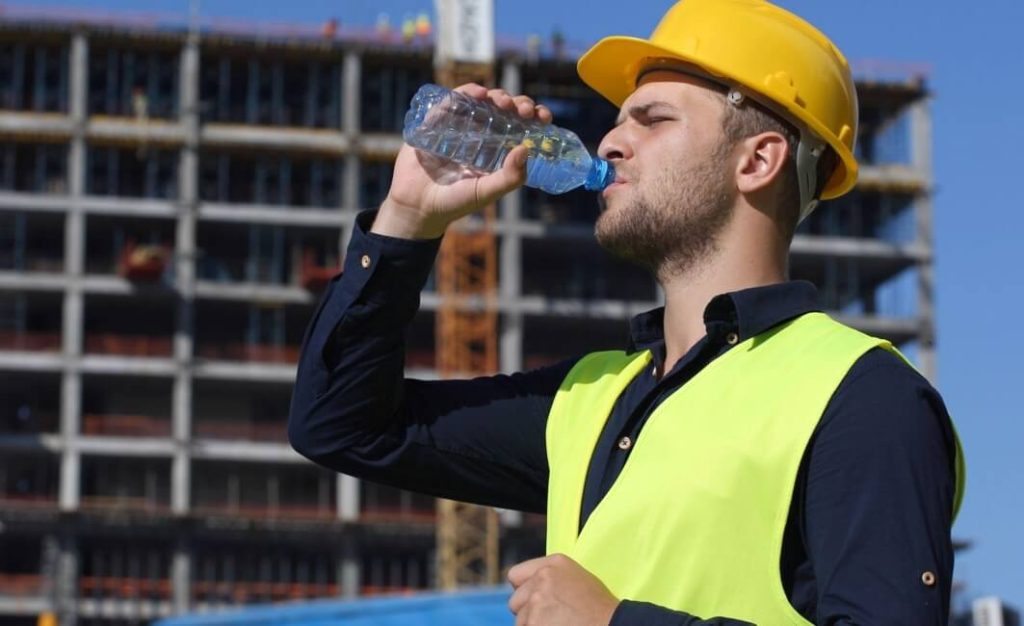
The onboard cooling unit keeps the tank genuinely cold all the way through a long afternoon outdoors, and that single detail carries the whole thing. Warm water is water people abandon, and midsummer is exactly when a crew or a crowd is drinking the most. Cold water gets finished, and finishing it is what keeps heat illness off the site.
Typical deliveries land in about 45 minutes once a truck is rolling in your metro, longer out on the rural routes, and we keep emergency runs going around the clock whenever a heat advisory or a power shutoff hits. The morning a foreman finds his 40-person crew stuck with one warm cooler, speed is the whole game.
One rule sits under every job we take: water that people walk past might as well not be there. We've stood on a bare site and watched shrink-wrapped pallets cook next to the job-trailer while the crew baked thirty yards off. We've watched the opposite too, a chilled station ten steps off the work face run bone-dry twice inside one shift. Everything that matters lives in the distance between those two pictures. Which is why we don't drop a unit and disappear. We match it to your headcount or your gate count, set the refill rhythm to how hard you're really pulling on it, and treat a heat call the way you'd want your own treated, meaning right now, because out here one hot hour can swing the whole day.
We deliver water stations to job sites, venues and event grounds in all 50 states, with the heaviest route coverage across the West.
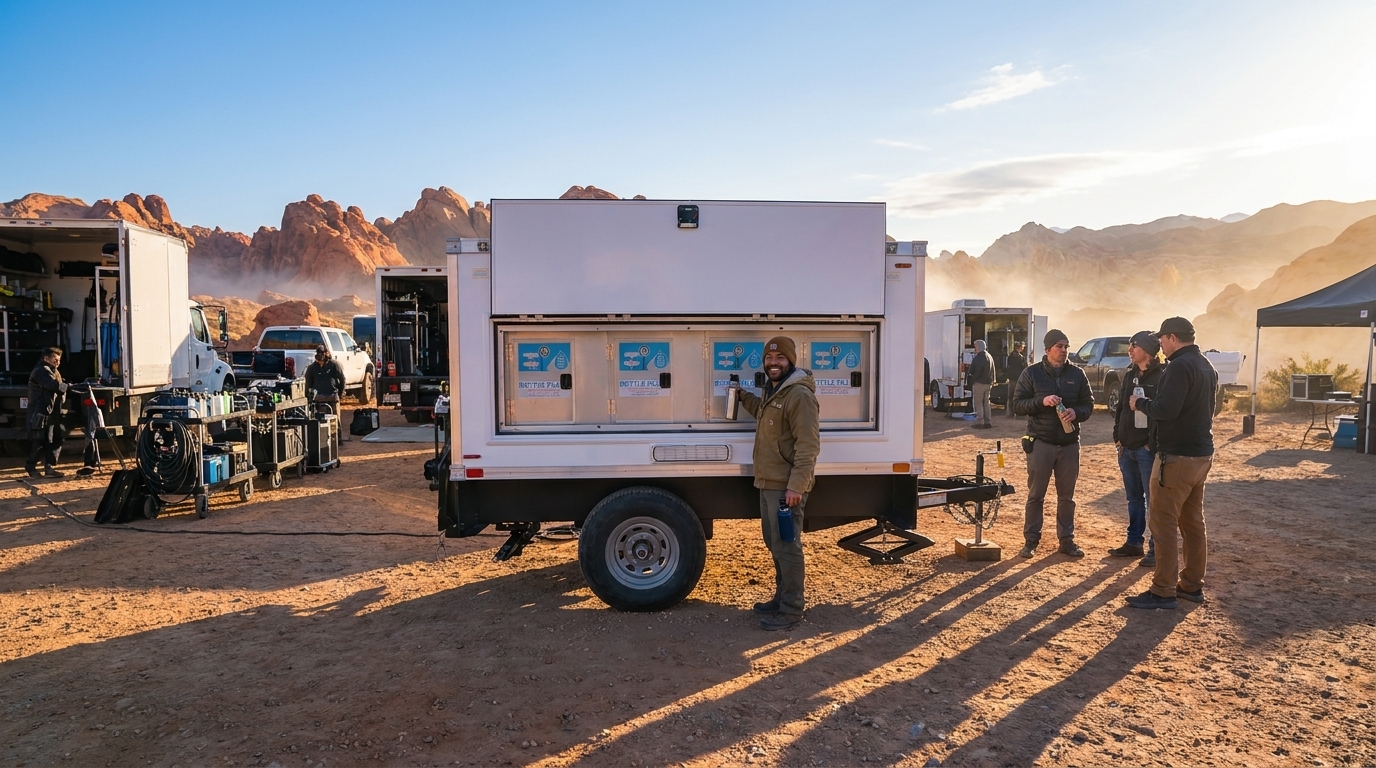
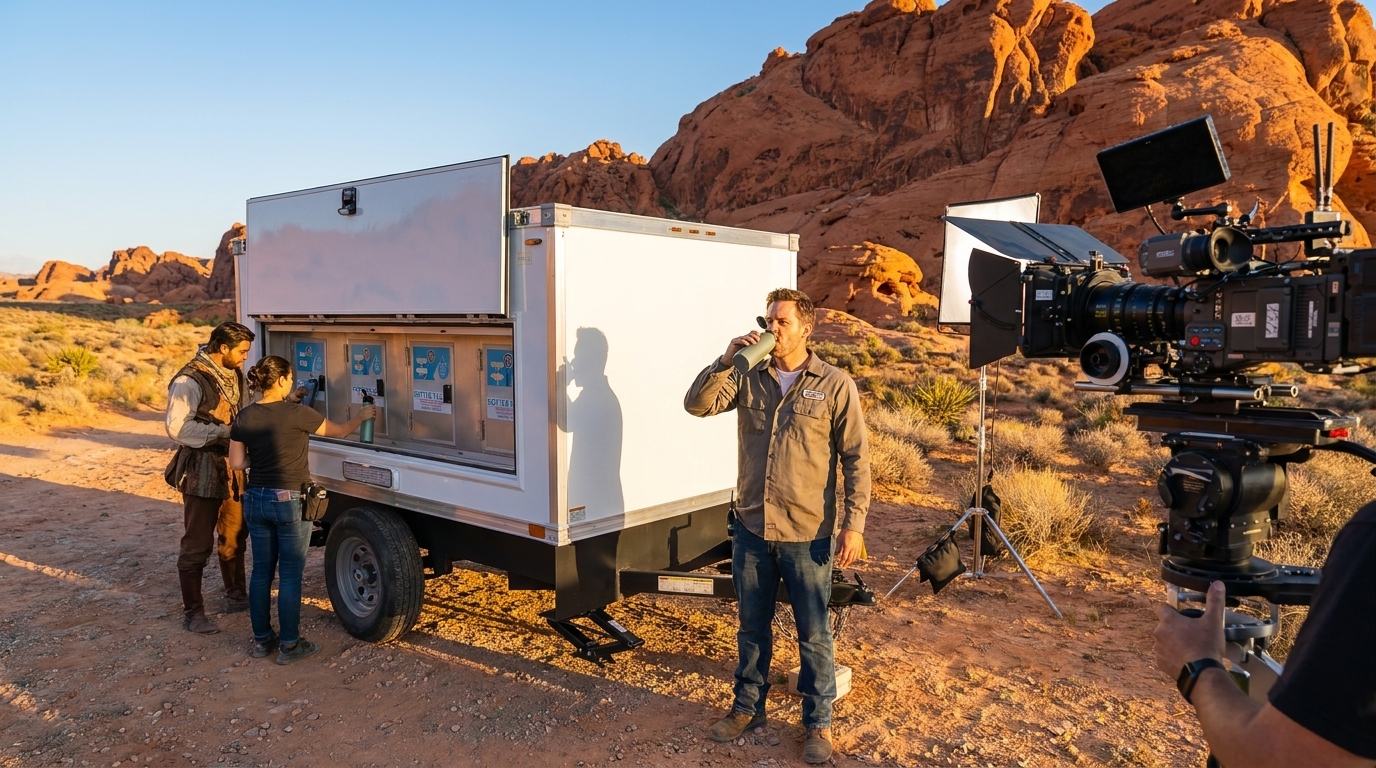
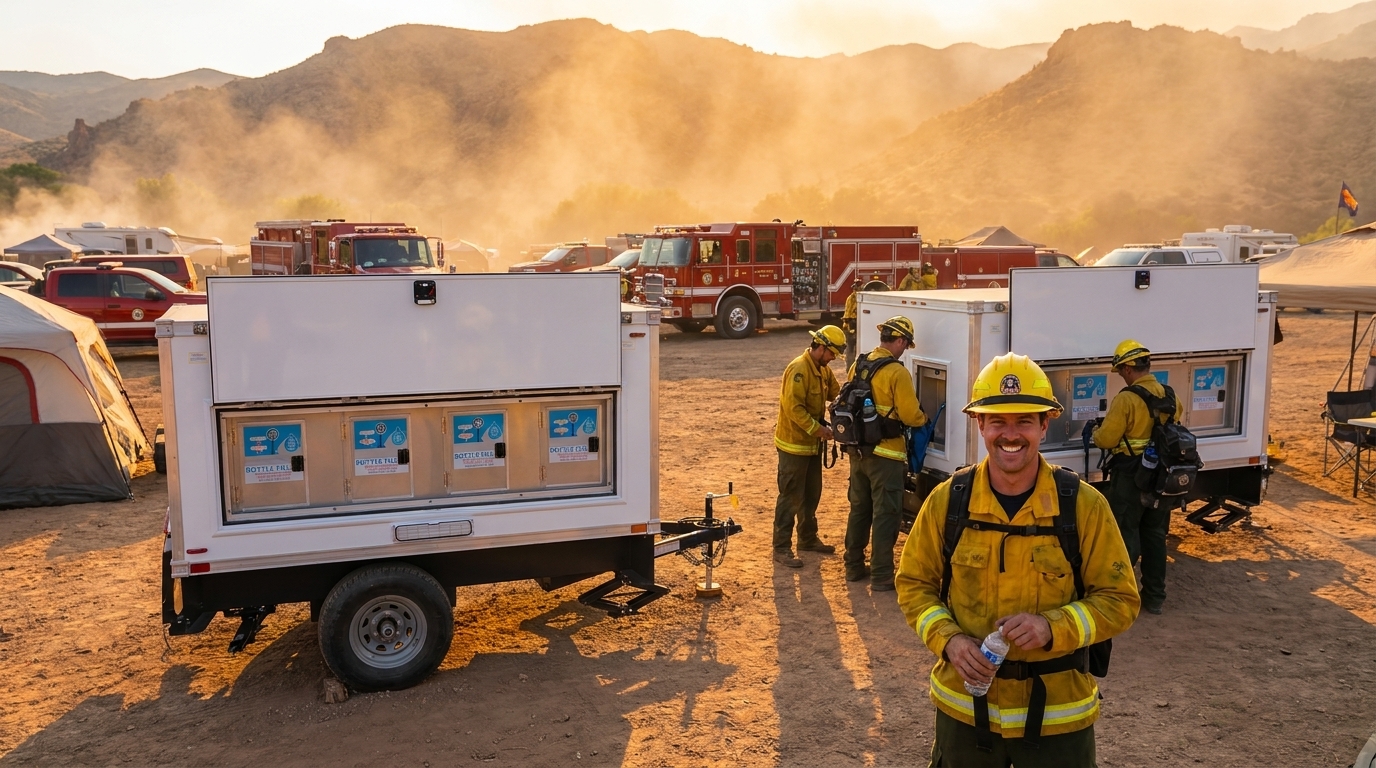
The unit that shows up is the Signature Series water bottle filling trailer, a road towable station built to pour all day on ground with no plumbing under it.
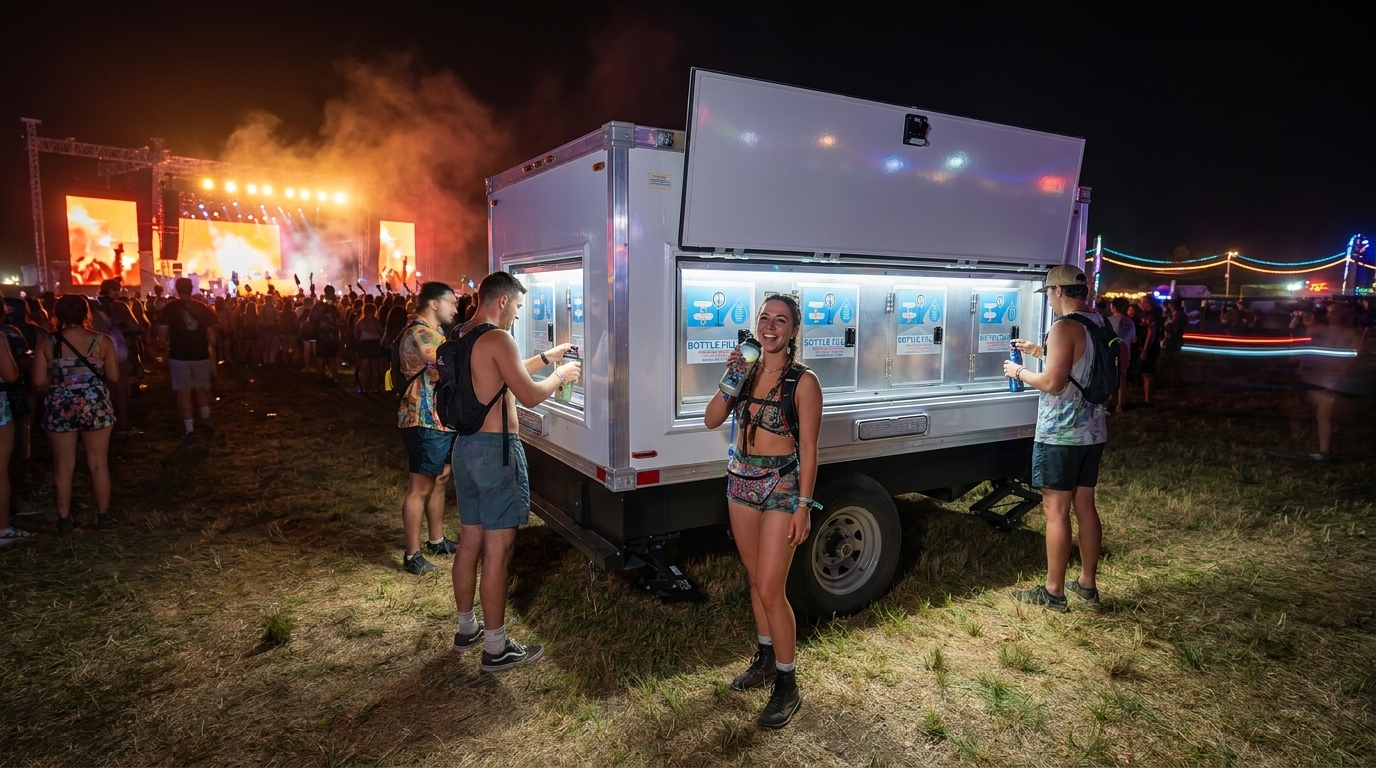
With a frame, a hitch, and tires under it, the unit hauls out to a remote build, an event field, a working orchard, or a disaster staging yard with equal ease. Contractors and event planners request this exact rig by name. The whole design is built around backing in, leveling off, and pouring cold by the same afternoon.
| No. of stations | (4) Bottle Filling Stations |
| Length | 12' 3" |
| Weight | 3,100 lbs. |
| Height | 8' |
| Fresh water tank | 300 Gallons |
| Power requirements | 1 to 4 dedicated 20A/120V circuits OR 1 dedicated 50A/240V circuit |
| No. of AC units | 1 |
Four bottle filling stations sit across the unit, each a push back head with an adjustable nozzle, so a kid with a 20 ounce sport bottle and a coach with a 64 ounce jug are not waiting on each other. One tap sits at ADA reach. Water comes off a 300 gallon fresh tank through three filter stages for sediment, chlorine and microscopic particles, then past a separate UV pass that kills germs, and it arrives cold because the cooling unit runs the whole time the unit is powered. A rear jug filling station handles team coolers and five gallon carriers.
On a campus it reads as equipment, not decoration, and that is fine. Stainless dispensing surfaces, food grade components from tank to nozzle, one air conditioning unit and the low hum of a cooling unit. It sits fifty feet from an outdoor assembly without anyone raising their voice over it. Kids work out the push back head in two seconds, which matters more than it sounds, because a station people have to be shown how to use grows a line behind it.
It travels on its own wheels. The trailer is 12 feet 3 inches long, 7 feet 6 inches wide and 8 feet tall, weighs 3,100 pounds and comes in behind a pickup, so it clears a service gate without a larger truck. A 200 gallon grey tank catches what drains. Power is 1 to 4 dedicated 20A/120V circuits or one dedicated 50A/240V circuit, from a building panel or a generator sized for it. Ask your maintenance lead which panel is open before we arrive and setup takes under an hour.
A water source people don't trust gets ignored, and an ignored station is rented money wasted. That's why municipal water doesn't reach the tap raw on our trailers. It passes through three filter stages and a UV chamber, then an onboard cooling unit drops the temperature. The result tastes clean and comes out cold, even on the worst afternoon of the year.
The opening filter traps sand, scale, and the fine grit local mains occasionally push through. On a dusty lot, that's what keeps a pour from tasting like the parcel it's parked on.
Activated carbon comes next, lifting the chlorine bite and the dull seasonal notes local tap can carry until the taste lands clean and neutral. When it's 100 out, that flavor decides whether a crew keeps drinking or walks past the tap dry.
A finer cartridge then catches the microscopic particles that slip past the first two, so what reaches the spout is clear rather than merely cold for the crews and crowds drawing off it.
The last step is an ultraviolet chamber that wipes out bacteria and microbes without adding a single chemical. Even after a long tow out to a remote site, the water off the nozzle is clean.
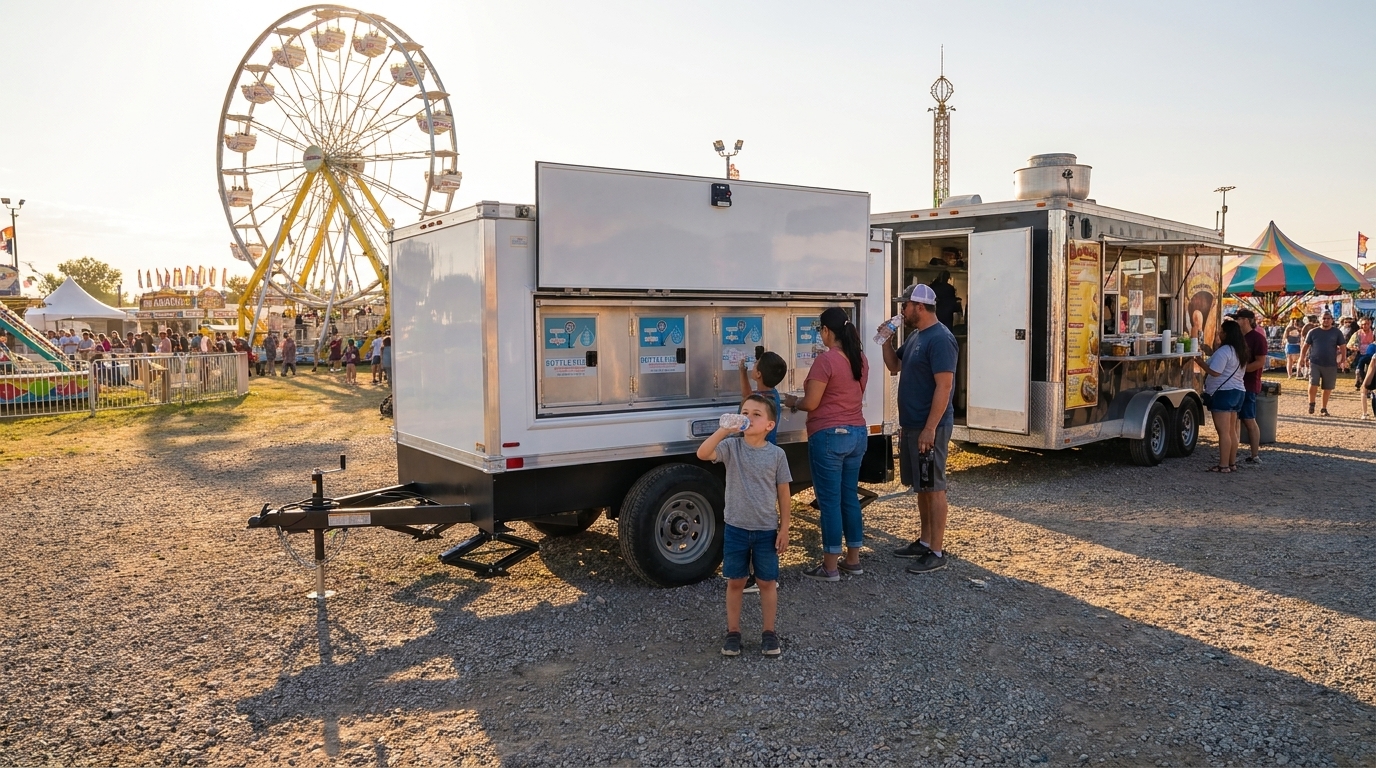
Along the wall sit four adjustable push-back taps, press a bottle to the bar and it pours. One of them is set at ADA-reachable height, so a single trailer includes everybody in a crew or crowd with no add-on gear. Out back, a large-jug spout services five-gallon coolers and hydration packs, while a bank of hose connection taps handles work-site chores, event support, and refills down the orchard rows. Stainless, food-grade plumbing the whole way through keeps the filtered, chilled water at quality right to the spout.
Every Signature trailer carries a 300-gallon load, roughly 2,400 cups at sixteen ounces each, and we recharge it on demand, so the unit doesn't turn into the choke point on a busy shift or a packed show night.
Almost every call we take for a filling station comes from one of three places, and each has a different clock on it. A school works a bell schedule and a construction window. A campus works four enormous dates a year. A parks department works weather and a tournament calendar.
Free drinking water at meal service is a federal condition of taking part in the National School Lunch Program and the School Breakfast Program, so every participating campus has to make potable water available where meals are served. That baseline is why the calls cluster at three moments. A modernization window, when a wing or a cafeteria goes offline and the fountains go behind the fence with it. Field day and graduation season, when several hundred students are outside at once. And the first weeks of a hot fall semester, while staff are still commissioning repaired fixtures.
The failures behind those calls repeat. Fountains get capped and nobody tells the parents until a student does. Vandalism takes a fixture out and it stays out, because replacing it competes with every other capital need. Lead testing pulls a whole bank of faucets offline against state mitigation money that rarely matches what testing finds. None of that resolves in a week, which is the argument for bottle filling trailer rentals in Columbus and districts like it. A gap measured in weeks needs a bridge, not a work order.
One behavior number explains the rest. Children commonly draw about 2.4 ounces drinking straight from a standard fountain, roughly a small paper cup, because a quick sip is what a spout invites. Give the same kid a refill station and a bottle and intake can as much as triple, because the water leaves with them. California wrote that into law in 2022 with Assembly Bill 2638, requiring filling stations in newly built and updated public schools. Three rounds of state school drinking water grants in five years funded the equipment behind it.
So we ask for the bell schedule before the enrollment number. A 600 student campus on a five minute passing period does not need more gallons. It needs the station where the hallway already clears out, plus a second at the far end if the building runs long. We place between the cafeteria doors and the field, never at the maintenance gate where the tow was easiest, and we set up the day before students return.
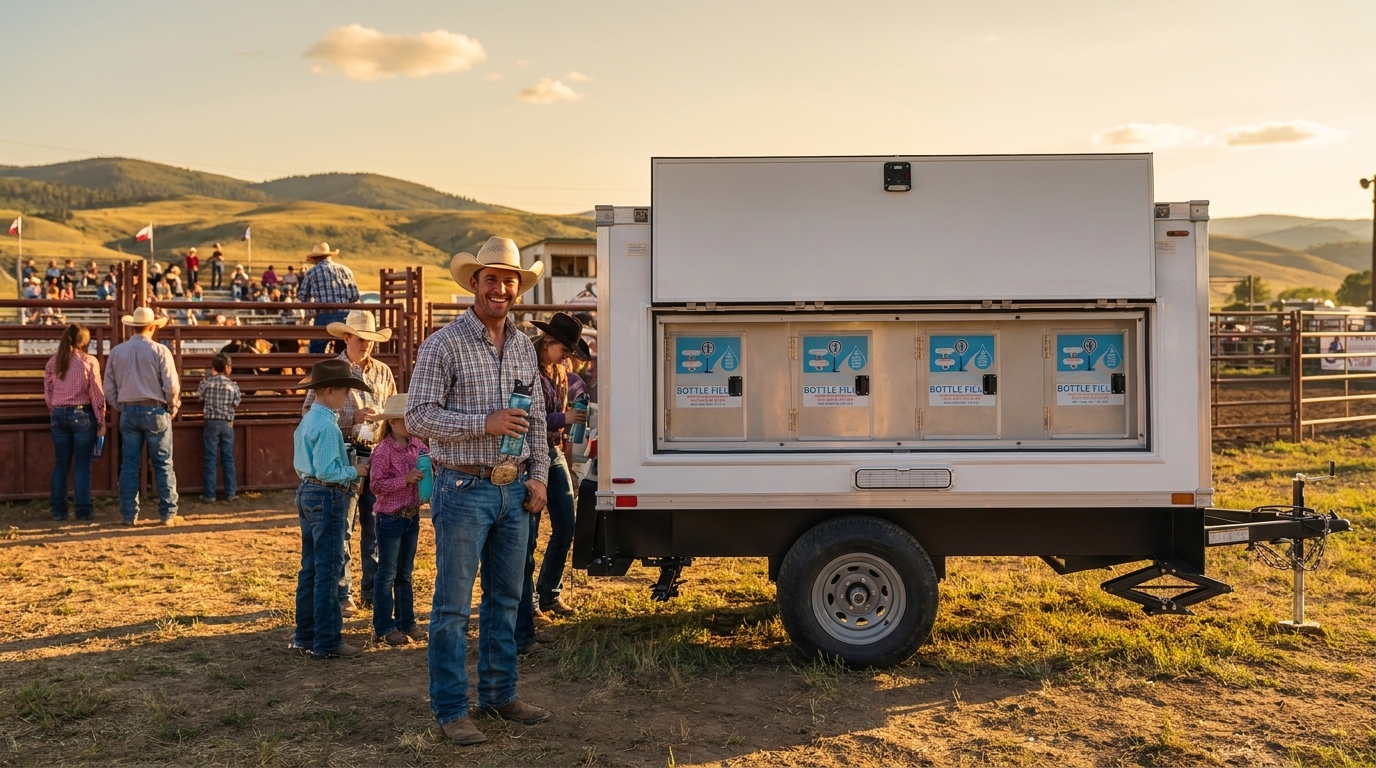
Campuses are the best documented buyers in this category, because sustainability offices count what their stations dispense and publish it. The University of Chicago's bottle fill data showed an average of 177,480 plastic bottles displaced across 102 stations in a two week window, scaled up to roughly 3,470,177 over a nine month academic year. That is about 124 bottles per station per day. The University of Michigan-Dearborn reported 14,261 gallons poured out as of October 2022, replacing 107,968 sixteen ounce bottles, about 7.6 bottles per gallon poured.
The pattern holds wherever a campus commits to it. One Pennsylvania university has diverted more than 1.8 million bottles since a 2013 pilot, and its refrigerated units are rated at 9 gallons an hour from an 80 degree inlet to a 50 degree outlet, a fair benchmark for what cold costs in throughput. A large West Coast university banned single use plastic bottle purchasing across athletics, dining and every administrative unit starting July 1, 2022. Less than 8 percent of discarded plastic here is recycled, so replacing a bottle beats sorting one.
Temporary units come in for the four dates a year when fixed infrastructure runs out. Orientation and move in puts thousands of new students and families on campus across two or three days of August heat. Home football weekends fill the tailgate lots before the gates open. Commencement puts a graduating class on one lawn in a morning. And dorm renovation takes a building's stations offline for a semester.
Our rule on a quad is to split the capacity rather than stack it. Two stations at the ends of the walk beat one big unit in the middle, because the constraint is walking distance in heat, not gallons per minute. We ask which gate the moving trucks use and stay off that lane, and whether the cooling unit can stay powered overnight, because a unit that sat warm until eight pours warm water to the first two hundred people through it.
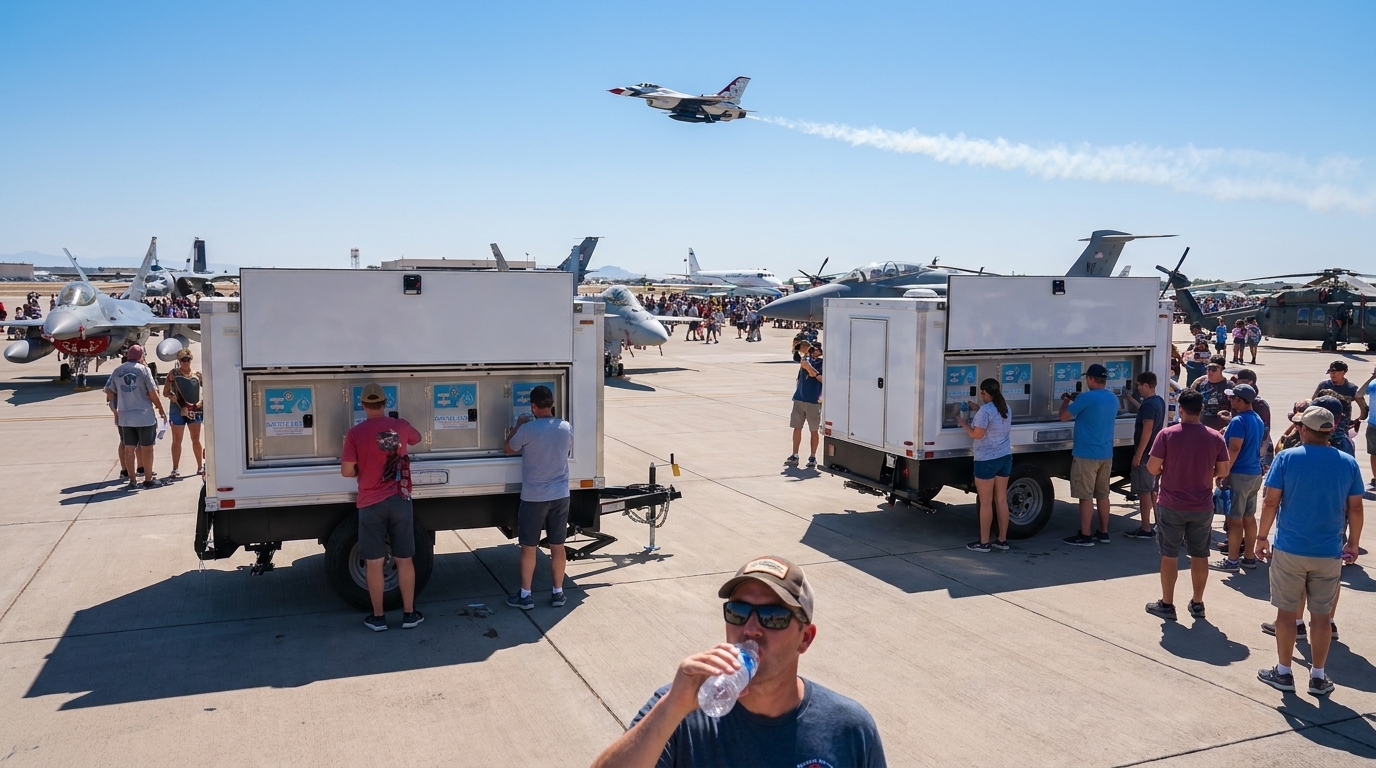
Parks departments treat refill capacity as core infrastructure and chase grant money for it, which is why a department with no capital budget left reaches for a rental instead. A federal source reduction project run through the EPA put 16 fountains into one state's parks and 32 into another's across 11 parks. Two of the busiest stations at a single state park prevented an estimated 129,765 bottle purchases in one year, and the full 32 station network saved 349,189 bottles through June 2019, enough that the state funded 42 more.
Then comes the part of the calendar that has nothing to do with budgets. Standing water in an outdoor fixture freezes and splits the line, so park and trail systems shut outdoor plumbing down every fall and do not bring it back until spring. That is half the year with no water on a trail, which is why the National Park Service installed 14 freeze resistant fountains and filling stations along one heavily used trail. Departments get a shoulder season hole at both ends of the year.
Youth sports run a tournament calendar instead of a season. One Saturday puts 8 to 10 games across 2 to 4 fields from roughly 8 a.m. to 6 p.m., with 200 to 600 players, coaches and families on a site with no plumbing near the outfield. The sports science guidance is specific: water breaks every 15 to 20 minutes in high heat, and water never held back or treated as a reward. Athletes aged 9 to 12 are advised to take 3 to 8 ounces every 20 minutes, and adolescent athletes can sweat more than a liter an hour, up to about 2.5 liters in hot humid conditions.
Those break cycles are why we argue for distributed placement on every multi field site. A 15 minute break across four fields does not make one long line, it makes four short ones at once, and a station at the edge of the complex turns that into a walk nobody makes twice. Trailheads have the opposite problem: no fixture, no line to tie into, no capital project coming. That is where water refill station rentals in Denver and park systems like it are the only water on site.
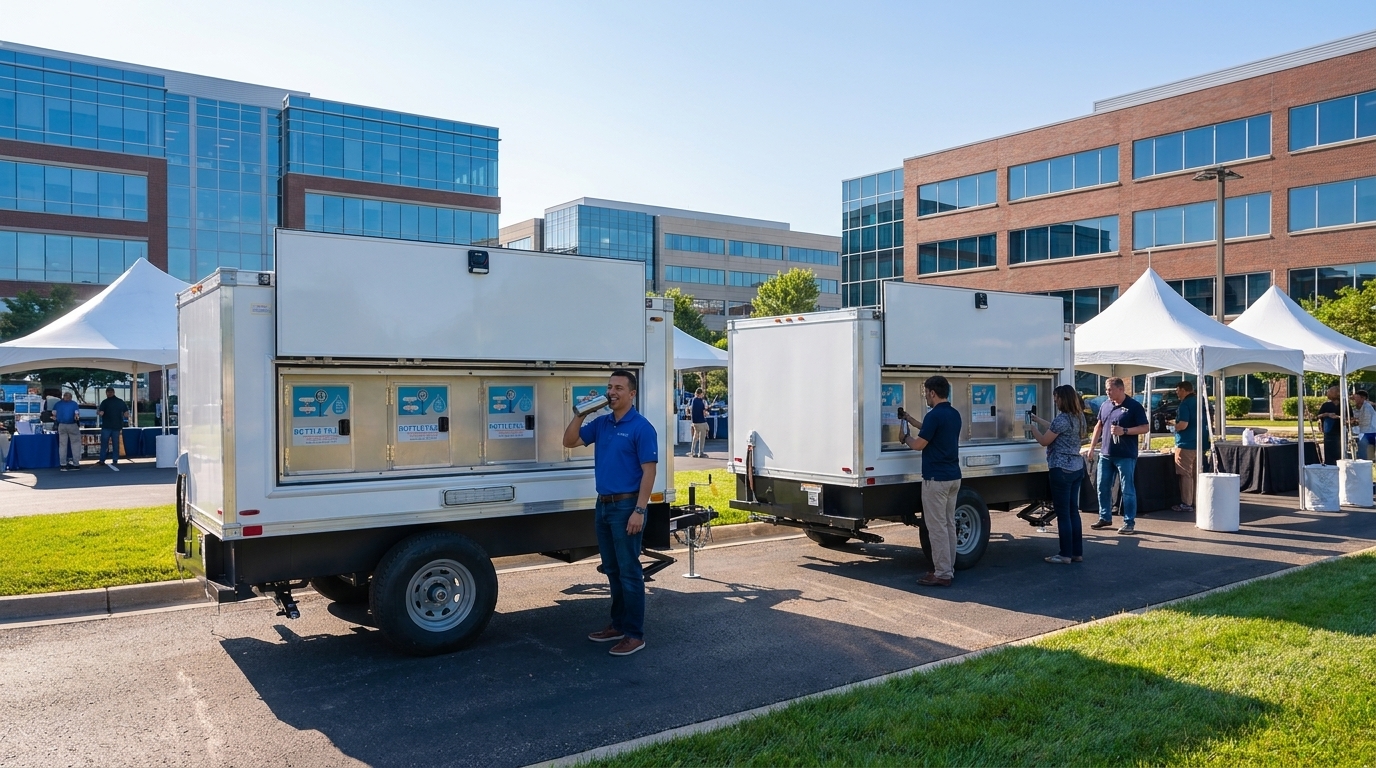
Every site we deliver to has a gate, a clock and a circuit, and those three decide the whole day.
For a one day event we deliver the afternoon before and charge the tank on site, so the cooling unit has all night to pull the water down. Warm water on the first morning is the most common complaint in this category, and a same day delivery is almost always what caused it. For a school construction window we set the unit the week the wing goes offline, in and out before first bell or after dismissal. Parks and tournament sites get scheduled around the gate code and whoever holds it on a Saturday.
Placement is where experience pays. The unit needs a hard, level approach with at least 30 inches by 48 inches of clear floor space in front of the accessible tap, which rules out soft turf the day after irrigation and loose gravel that catches a wheel. We put it on the path people already walk, not where the tow was easiest, and we route dripping water away from feet, because a puddle under a station on pavement is a slip report waiting to happen.
What goes wrong is logistical, not mechanical. A locked gate with no contact number on a Saturday morning. A circuit assumed free that turns out shared with concession cooking equipment. A field cluster the site map showed 200 feet from the lot that is really 600 feet across turf. An overnight freeze with the unit left charged. We ask about all four before the truck rolls.
Multi day bookings get service visits on a set schedule rather than on request, because the point is that nobody on your staff watches a water level. We track filter changes off gallons poured instead of a calendar guess, which is how a commercial cartridge is rated. At the end we drain, clean and haul. Departments booking mobile drinking fountain rentals in Seattle through a wet shoulder season get the same freeze discipline as a mountain site, because the physics does not care which one it is.
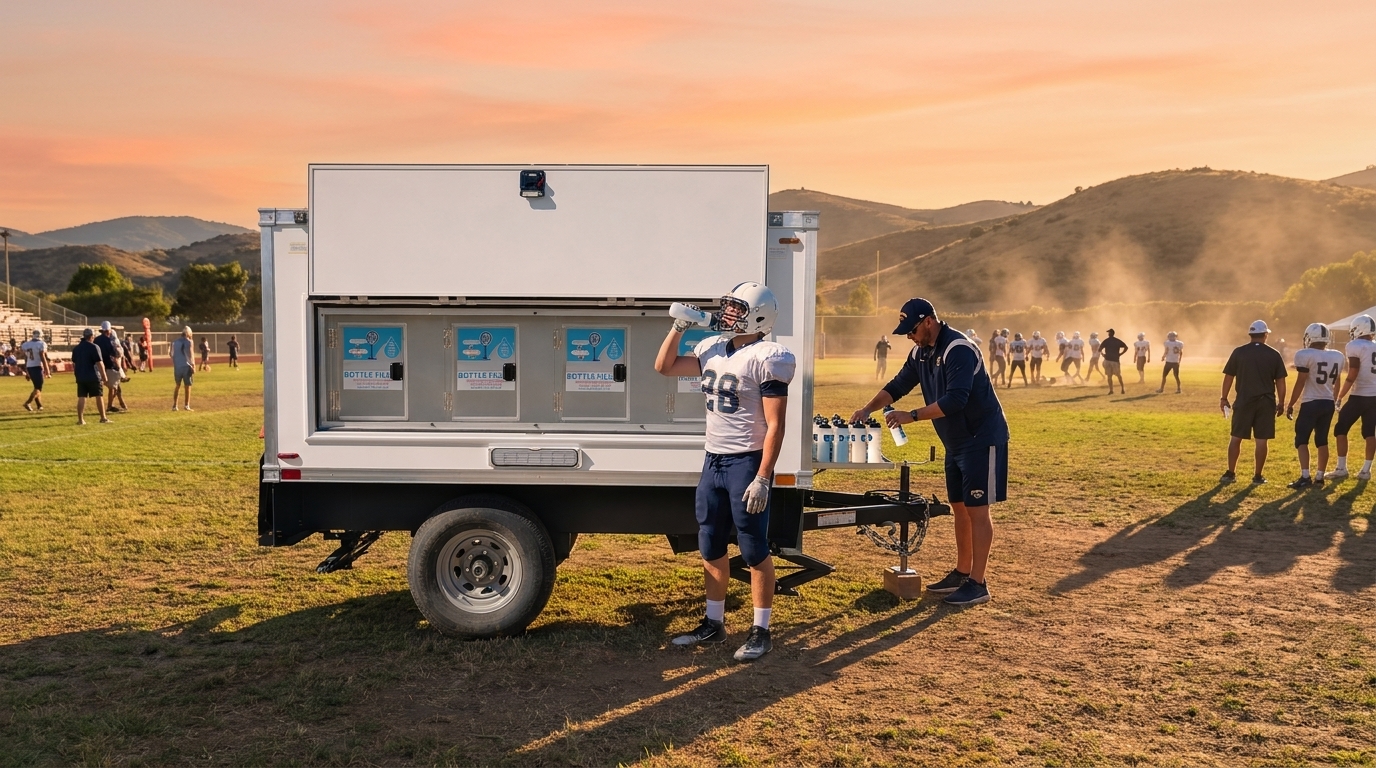
People count, number of days, where exactly it parks on your site, and what power is there. Those four answers let us spec it correctly the first time around.
Reckon roughly 45 minutes from the nearest yard once we are in your metro, longer on the outer routes, with round-the-clock emergency runs whenever a heat advisory or a power shutoff hits.
Once on site we set it level, charge the 300-gallon tank, and tie in power off one to four standard 120V circuits, or a single 50-amp 240V drop, depending on what the site gives us.
After that the tankers cycle back on a cadence matched to how fast your crew or crowd pulls it down, and we maintain the unit through the whole rental term.
No power on the parcel at all? We price that in. The unit draws very little, and with the service fleet backing it we've run stations on lots that had no permanent power whatsoever. Lay out what the site offers and the rest is on us.
Want this math run for your own booking? Two minutes on the phone gets you a real number.
Distance sets this number far more often than gallons do. Here is the math we run before we quote.
| Elementary or middle school with one wing offline (up to 600 students) | 1 station |
| High school campus on an outdoor field day (600 to 1,200 students) | 2 stations |
| University move in weekend or commencement (2,000 or more across a quad) | 2 to 3 stations |
| Single field youth tournament (200 players, coaches and families) | 1 station at the field cluster |
| Multi field tournament complex, 2 to 4 fields (200 to 600 across a ten hour day) | 1 station per field cluster |
| Park festival or farmers market, shoulder season (500 to 1,500 visitors across the day) | 1 to 2 stations |
| Charity walk or fun run on a linear course (300 to 800 participants) | 1 at start and finish, 1 mid course |
Start with throughput. A commercial filling head runs roughly 1.1 to 1.5 gallons per minute. A 20 ounce bottle is 0.156 gallons, so it fills in about 8.5 seconds at the slower rate and about 5 at the faster one. A 32 ounce bottle takes 13 to 14 seconds. Commercial units cap a single automatic dispense around 20 seconds to stop overflow. Call it 10 seconds a fill with walk up time, and one station clears about 6 fills a minute, or 360 an hour. That is a ceiling, not a plan. A 300 gallon tank is about 2,400 sixteen ounce refills, so it lasts longer than the patience of the line.
Now the number that matters. An unattended station under moderate traffic sustains closer to 90 to 150 fills an hour, because people talk and kids top off bottles that are already half full. Past roughly 100 people wanting water in one short window, a single station grows a visible line no matter how fast the head pours. Run the school version. A 600 student campus on a five minute passing period, with one student in ten going for water, needs about 12 fills a minute. One station covers that on paper and still builds a line, because everyone arrives at once.
So our default is simple, and we say it out loud even when it costs us a bigger booking. Below about 100 people in one spot, one station. Above that, or any time the crowd spreads across more than one cluster, split the capacity instead of making it bigger. Two stations 200 feet apart beat one that pours twice as fast, because nobody walks past a line to reach a faster tap. Leagues booking water station rentals in Manteca and towns like it land on one unit per field cluster and hold there.
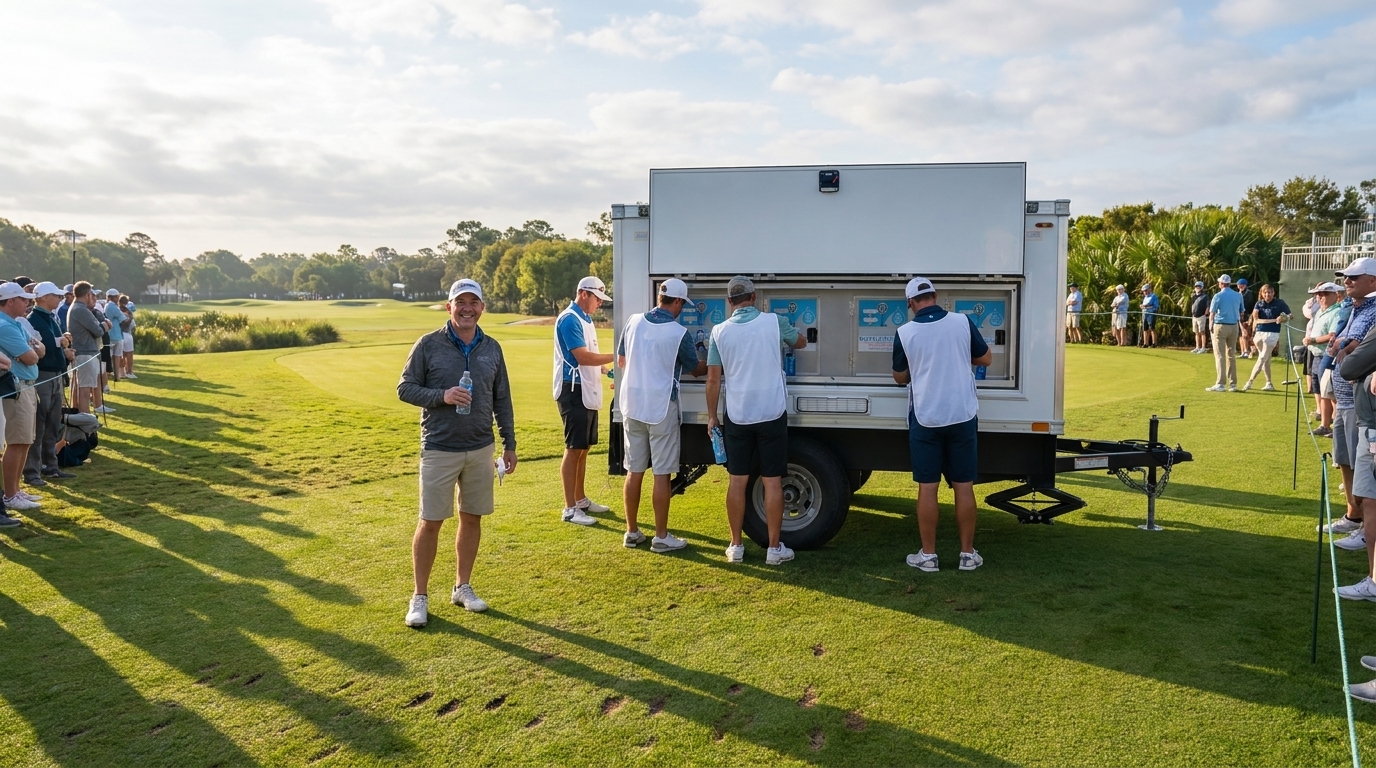
Accessibility catches the most people, because it applies to a rented station exactly as it applies to a fixture connected to a water line. Under the 2010 ADA Standards for Accessible Design, Section 602, a wheelchair accessible spout outlet sits 36 inches maximum above the ground. Schools get a hi lo pairing, one spout at 38 to 43 inches for standing users and one at 36 inches maximum for a forward approach. The filler control cannot sit higher than 48 inches, dropping to 44 above a child height fountain. Every accessible unit needs 30 inches by 48 inches of clear floor space in front of it, and any button or sensor sits between 15 and 48 inches and works without tight grasping or twisting.
Materials carry two standards worth knowing by name. NSF/ANSI 372 governs the lead content of the materials that touch water, and exists because the Safe Drinking Water Act defines lead free as a weighted average of 0.25 percent across water contact surfaces and 0.2 percent for solder and flux. NSF/ANSI 61 governs what can migrate out of a material into the water passing through it. Buyers also see NSF/ANSI 42 and 53 on permanent unit spec sheets, where 42 covers chlorine taste, odor and particulate and 53 covers health effect contaminants. Here is plainly where we sit. Our system is food grade components with stainless surfaces, three filter stages for sediment, chlorine and microscopic particles, then a separate UV pass that kills germs, exactly as the manufacturer publishes it. We do not advertise lead reduction, because that is a health claim and not in the published spec.
School water access sits on its own stack. Federal school meal rules oblige participating schools to make potable water available free where meals are served, during meal service. California went further with Assembly Bill 2638 in 2022, requiring filling stations in newly constructed and updated public schools and protecting a student's right to carry a reusable bottle through the day. Districts in a modernization project feel both at once, because the obligation does not pause while the fountains sit behind a fence. That gap is what temporary water station rentals in Flagstaff and any district on a construction clock are there to cover.
Public events add a permit from the county or city environmental health department, and who carries what is usually clear: the district or venue owns the site and the power, the organizer owns the permit, and we own the unit, the water quality chain and the service.
Federal OSHA heat illness prevention guidance and the CDC and NIOSH heat stress program point at the same baseline: cool drinking water, close to the people doing the work, and documented.
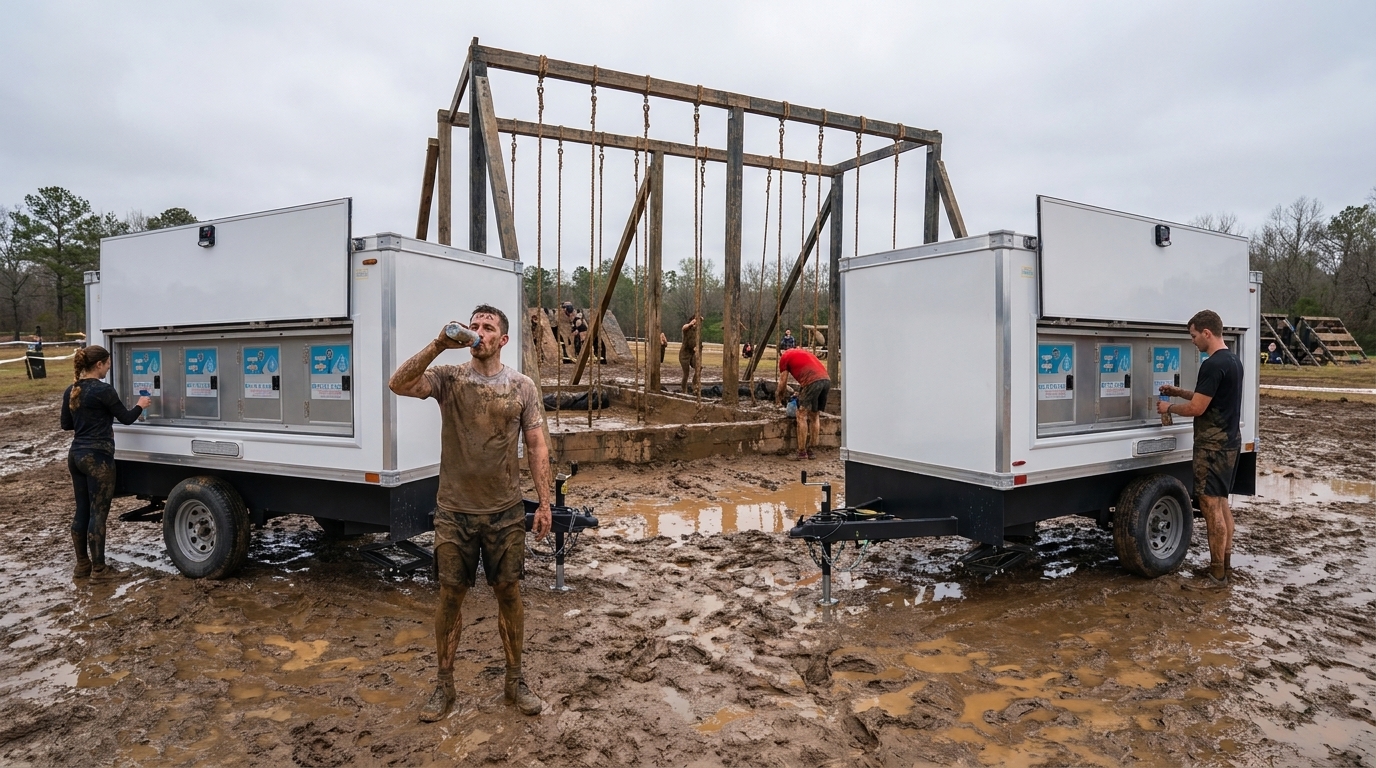
Need a station your written heat plan can point to? We can have one pouring cold within days.
The fallback before anyone rents a station is a pallet of cases and a row of coolers, and the work in that sentence stays invisible until you watch somebody do it. Somebody buys the cases, loads them, hauls them out to a field or a paved lot, buys ice separately, stages the coolers, restocks cups, then watches all day so a cooler never runs dry mid game. At a 600 person tournament where each person takes three bottles across ten hours, that is about 75 cases moved by hand, twice, since the empty bottles go back out at the end.
The person doing that work almost always has a different actual job. A booster parent who came to watch their kid play. A custodian with a punch list. None of them signed up to run a beverage supply chain for a Saturday, and the water still goes warm by noon because ice melts. A filling station removes the whole loop. No case carrying, no ice runs, no cooler watching.
The waste side is what institutions can actually report on, which is why sustainability offices and parks departments track counters at all. Americans buy roughly 50 billion water bottles a year, about 13 per person per month, and more than 35 billion single use bottles get thrown in landfills or burned here annually. Beverage containers make up around 12 percent by weight of the plastic entering the oceans, and a bottle that gets there takes at least 400 years to break down.
Look at everything bottled water actually demands of a person: cutting the order, receiving and breaking down pallets, icing coolers before dawn, topping them up through the day, then flattening empty bottles for the bin. On a large crew that's hours of paid time burned every single day, scraped right off the work that's supposed to be getting done. The trailer erases that loop entirely. A local contractor once let us pencil it out with him, and the recovered labor by itself paid for the unit. His words were that the bottle runs had been quietly costing him close to a day of payroll a week. Our trailer arrives full, the tankers keep it full, and your superintendent owes it nothing but a parking spot.
Ice a cooler at 6 a.m. and by mid-morning in July it's as warm as a bath. Warm water is water people stop touching, and the slowdown that follows is precisely where heat illness gets its opening. A chilled station never rides that warm-up curve at all. Whatever pours at clock-out is as cold as the sunrise fill, which happens to be the moment a spent crew, or a crowd deep into a long concert, leans on it hardest.
Bottled-water pallets devour staging space, jam the lay-down area, and sit cooking in the sun until somebody finally cracks them open. Empties build up faster than anyone keeps up with, and on a tight commercial lot that pile turns into its own problem. Set a trailer in one parking stall instead and it serves a crew or crowd that would otherwise burn through hundreds of plastic bottles every day.
Every bottle bought is a bottle thrown out, and across a season a busy site or event generates a small mountain of them. That's a disposal line on the budget, a dent in the sustainability numbers, and, given that a single bottle can linger in the ground for centuries, a footprint that lasts longer than the project that made it. Move to a refill station and the line drops to zero, which finally gives your reporting a figure worth publishing.
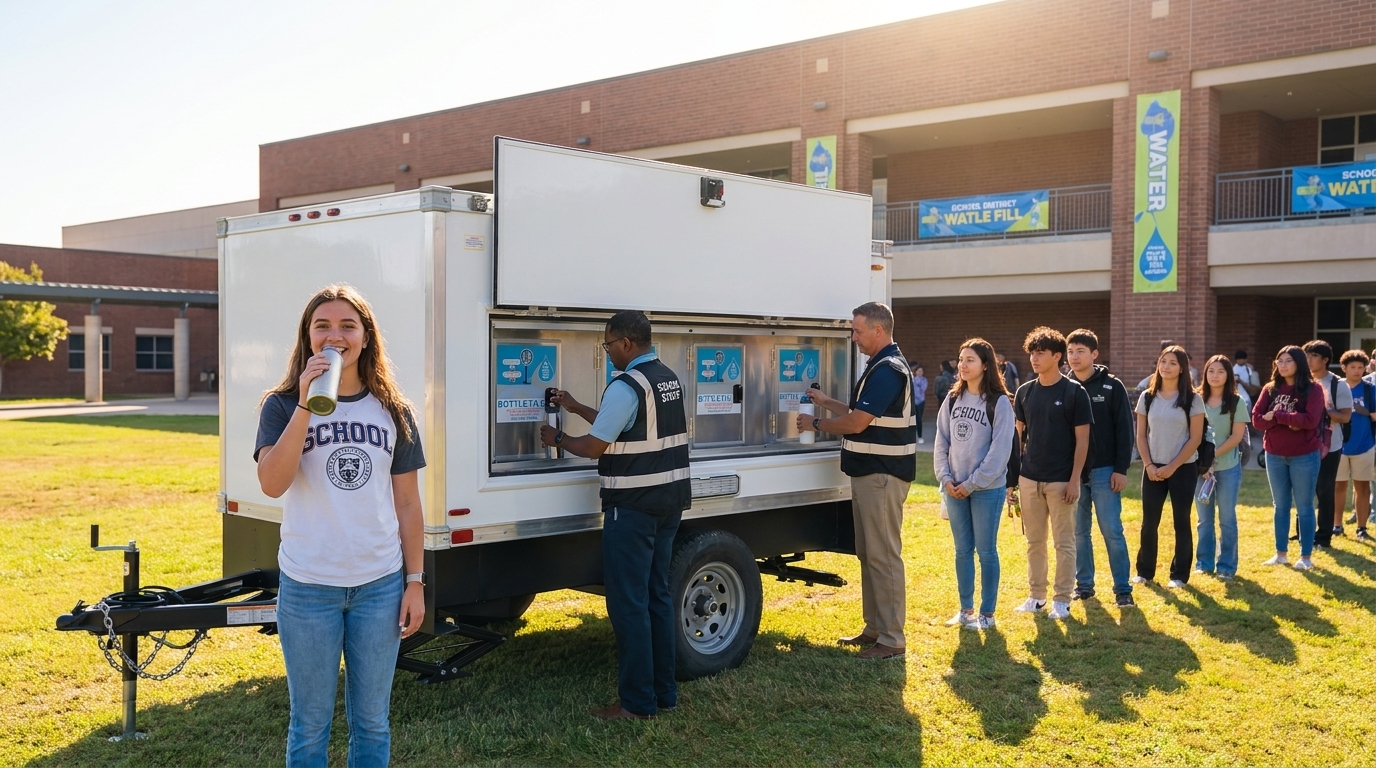
Three bookings of this kind, and what we planned around on each one. Names and details are kept generic on purpose.
Middle school cafeteria remodel, 620 students, six week window. The district called on a Wednesday because the cafeteria and its corridor were going behind a fence on Monday, and those fountains were the only ones on that side of the building. We set a station on the pavement the Friday before, on the path between the gym doors and the lunch tables, accessible tap facing the paved approach rather than the turf. Facilities confirmed a free circuit at the gym panel two days ahead, the step that usually slips. The unit stayed six weeks on a fixed service schedule.
Regional university move in weekend, three days, roughly 2,400 new students. Move in ran Thursday through Saturday in the last week of August, with families, carts and rented vans on every residence hall lane. The sustainability office wanted the weekend on its annual counter and the housing office wanted nothing blocking the truck lane, which are not the same goal. We put two stations at opposite ends of the main walk instead of one at the center, delivered Wednesday afternoon so the cooling units had all night, and stayed off the unloading lane. Each tank was refilled twice a day.
Youth soccer tournament, four fields, about 480 people, first Saturday in August. Games started at eight and ran past six, with water breaks every fifteen minutes because the heat index was climbing by nine. The league had planned on one station near the restroom building, which looked close on the site map and measured about 600 feet of turf from the far fields. We split it: one unit per field cluster, both on the packed gravel strip rather than the grass. Coaches sent teams to whichever was closer and the lines never stacked.
Service information current as of September 2026.
Still weighing it? Call and ask. Most of these questions get settled in one short conversation.
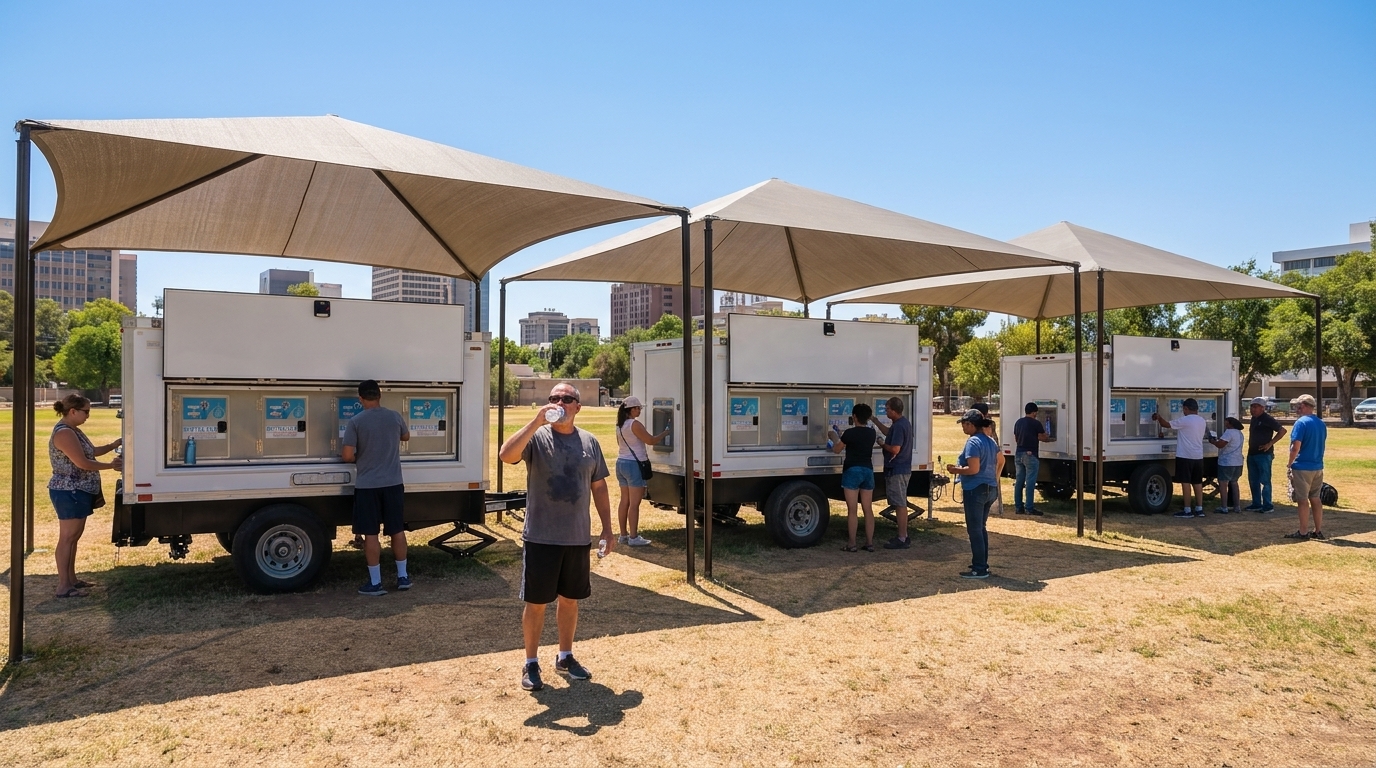
A fountain gives you a stream to sip from. A filling station gives you a vertical opening and a push back head that fills a reusable bottle, usually with an automatic shutoff. Children commonly draw about 2.4 ounces sipping at a fountain, while a filled bottle leaves with them. Our trailer carries four fill heads and a rear jug station.
It runs on its own tank. The Signature Series carries 300 gallons of fresh water and a 200 gallon grey tank, so it works at a trail entrance, an outfield or a closed campus wing with no line to tie into. Where there is a water source we fill from it with food grade hose, and where there is not, we schedule refill visits. It does need power: 1 to 4 dedicated 20A/120V circuits or one dedicated 50A/240V circuit.
The ceiling is about 360 fills an hour, assuming a continuous line and ten seconds a fill. The realistic sustained rate is 90 to 150, because lines have gaps and people top off bottles that are already half full. A full 300 gallon tank is roughly 2,400 sixteen ounce refills, so the tank rarely runs out before the line gets long. That is why we size on placement rather than gallons.
The unit runs three filter stages for sediment, chlorine and microscopic particles, then a separate UV pass that kills germs, with food grade components and stainless dispensing surfaces from tank to nozzle. That is exactly how the manufacturer publishes it. We do not advertise lead reduction, because that is a health claim and it is not in the published spec.
One of the four taps is set at accessible reach. Under the 2010 ADA Standards a wheelchair accessible spout outlet sits no higher than 36 inches above the ground, controls sit between 15 and 48 inches, and the unit needs 30 inches by 48 inches of clear floor space in front of it. That clear space is the part sites get wrong: a correctly set tap on soft turf still fails.
For a public event with a temporary water supply, usually yes, from the county or city environmental health department rather than from us. Most want the application at least two weeks ahead, an approved source with municipal water preferred, any private well lab tested for bacteria and nitrate nitrogen, and food grade hose only.
Standing water in an exposed line freezes and splits it, which is why park systems shut outdoor plumbing down every fall and do not restart until spring. We treat a rented unit the same way. On shoulder season bookings we shut it down when it is unattended or drain it each evening, and that goes in the schedule.
Published campus counters are the best answer available. One university measured an average of 177,480 bottles displaced across 102 stations in two weeks, roughly 124 per station per day. Another reported 14,261 gallons poured out, replacing 107,968 sixteen ounce bottles, about 7.6 per gallon. For a rental, track gallons and use that ratio.
On a schedule we set before delivery, not on request. We refill the fresh tank, pump the grey tank, wipe the dispensing surfaces and check filter status against gallons poured rather than the calendar, which is how a commercial cartridge is rated. Heavy bookings get that twice a day.
Modernization projects rarely fail on the construction schedule. They fail on the water gap around it, which nobody owns until the fence goes up and a corridor of fountains disappears behind it. Start with the fixture map rather than the floor plan. Mark every fountain and filler that goes offline, including the ones in adjacent spaces that lose access even though construction never touches them.
Then set coverage dates against the school calendar, not the contractor's. The contractor's date is when the wing closes. Yours is the last day students have normal access, usually earlier, and the first day they get it back, usually later than the punch list suggests. Build in two weeks on the back end.
Place for the route students take. A station near the cafeteria doors and the field path gets used. One by the maintenance gate does not, however convenient it was to park. On a long building plan two positions instead of one central one, because a five minute passing period does not give a kid at the far end time to walk the length of the building and back.
Most people meet the shoulder season problem the same way. They book a spring festival at a park in March, walk the site, and find every fountain capped and dry. Nothing is broken. Outdoor park plumbing gets shut down every fall on purpose, because standing water in an exposed line freezes and splits it, and it stays off until overnight lows are reliably above freezing.
So a park system has a predictable hole at both ends of the year that has nothing to do with budget or maintenance quality. The National Park Service put 14 freeze resistant fountains and filling stations along one heavily used trail because trail users were going without water for roughly half the year. Most departments cannot retrofit at that scale, so shoulder season events keep landing in the gap.
A rented unit fills it, with one condition. It needs the same freeze discipline a permanent fixture gets. We shut it down when the unit is unattended or drain it each evening, and with a hard overnight freeze in the forecast that goes in the schedule rather than getting left to whoever locks up.
Rental listings in this category all read the same, so the questions that separate them are about the site rather than the equipment. One, how many fill taps does the unit have, and is one at accessible reach. Two, does it carry its own water, and how many gallons, because a tanked unit works where there is no line and one connected to a water line does not.
Three, what exactly does the filtration do. Ask for the published stages and be suspicious of anyone who answers with a certification number they cannot point to on a manufacturer spec. Four, is the water chilled, and when will the unit be delivered relative to your start time. Those two are really one question, because a cooling unit needs hours, not minutes.
Five, what power does it need and who is confirming it. Six, what is the approach surface where you plan to put it, and does it give 30 inches by 48 inches of clear, level floor space at the accessible tap. Seven, who services it during a multi day booking, on what schedule, and does that require anyone on your staff to call it in.
→
The same cold filtered water framed for sites that want a fountain rather than a refill program.
→
Starting areas, course stops and finish festivals that need volume inside very short windows.
→
Multi day grounds where the crowd footprint sits far from whatever fixed water exists.
→
Festivals, picnics and outreach days on lawns and lots with no drinking fountain nearby.
→
Company picnics, campus field days and conference grounds where bottled cases are the default.
We run water station rentals nationwide, and we keep dedicated local pages for the metros our trucks work hardest. Start with the closest one.
Booking this kind of work in a metro we already run? Start with mobile water stations serving Plano, Columbus drinking water station rentals, Denver drinking water station rentals, Seattle drinking water station rentals, Manteca hydration station rentals and Flagstaff hydration station rentals, and call us for anywhere else in the country.
 North Texas
→
Large district campuses and a heavy spring tournament calendar in real heat.
 central Ohio
→
University crowds and park complexes with fountains that shut down every fall.
 Front Range
→
Trailheads and park events at altitude, where the shoulder season gap runs long.
 Puget Sound
→
Campus move in weeks and park festivals in a long, wet shoulder season.
 Central Valley
→
School modernization projects and weekend tournaments in triple digit summer heat.
 high country
→
Mountain town schools and park events with freeze risk on both ends of the season.
Give us the head count or the guest count, the date, and the spot it will park. We will spec the right setup, confirm the delivery window, and have cold filtered water pouring before the day starts.