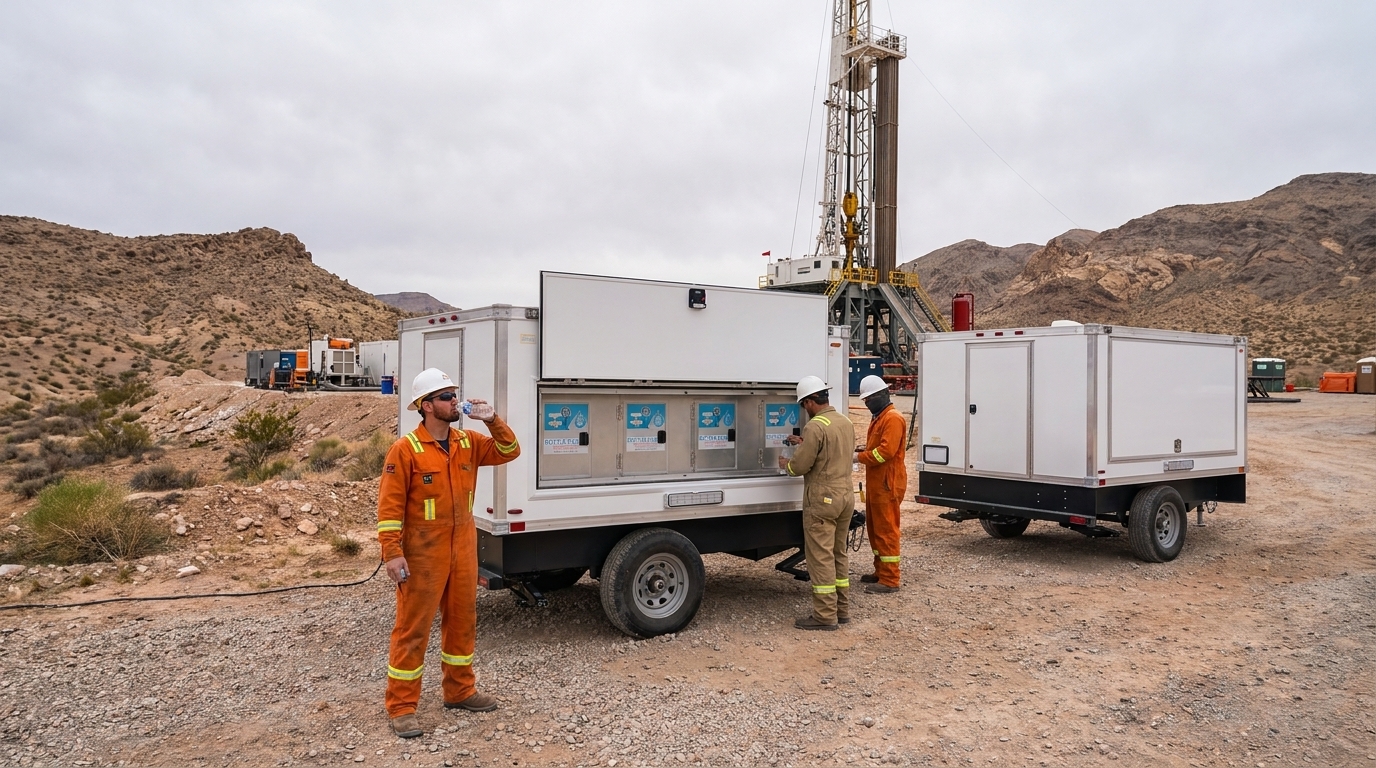
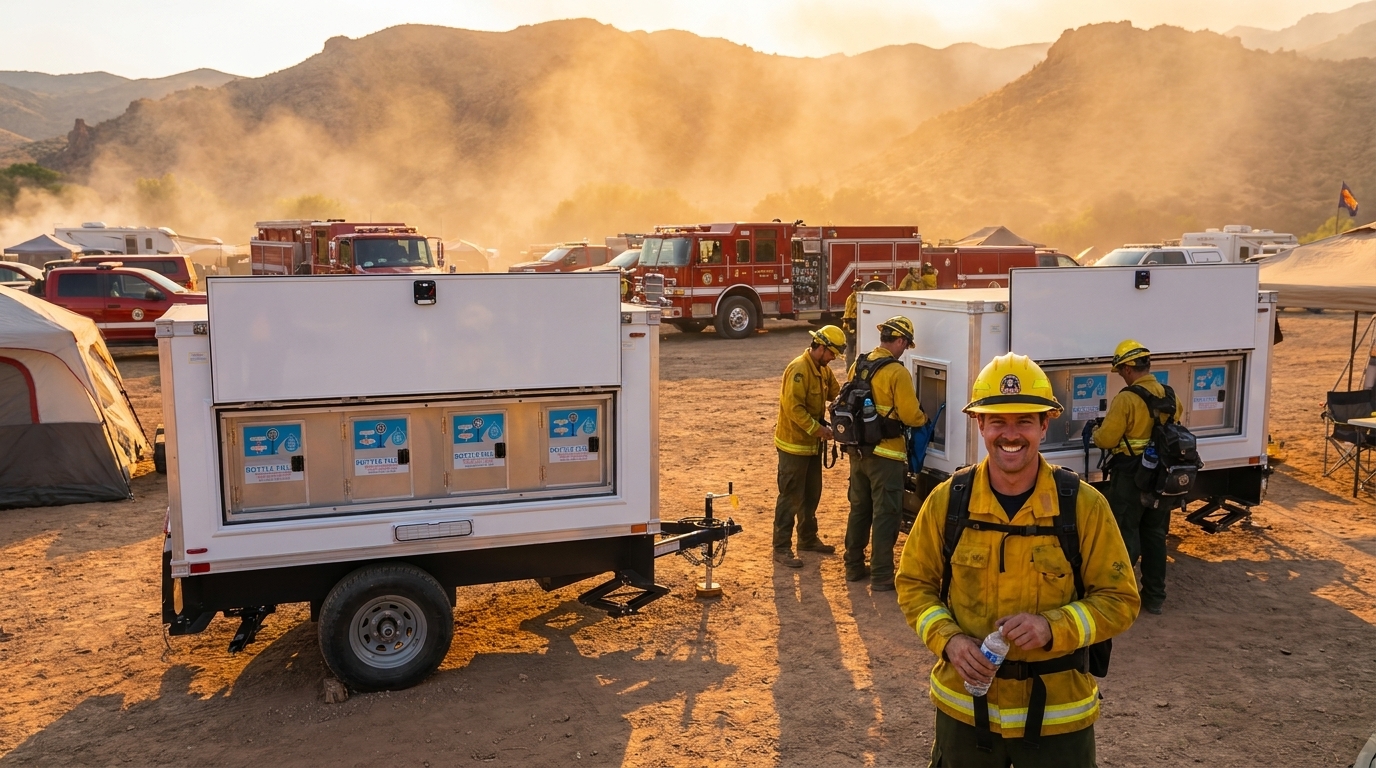
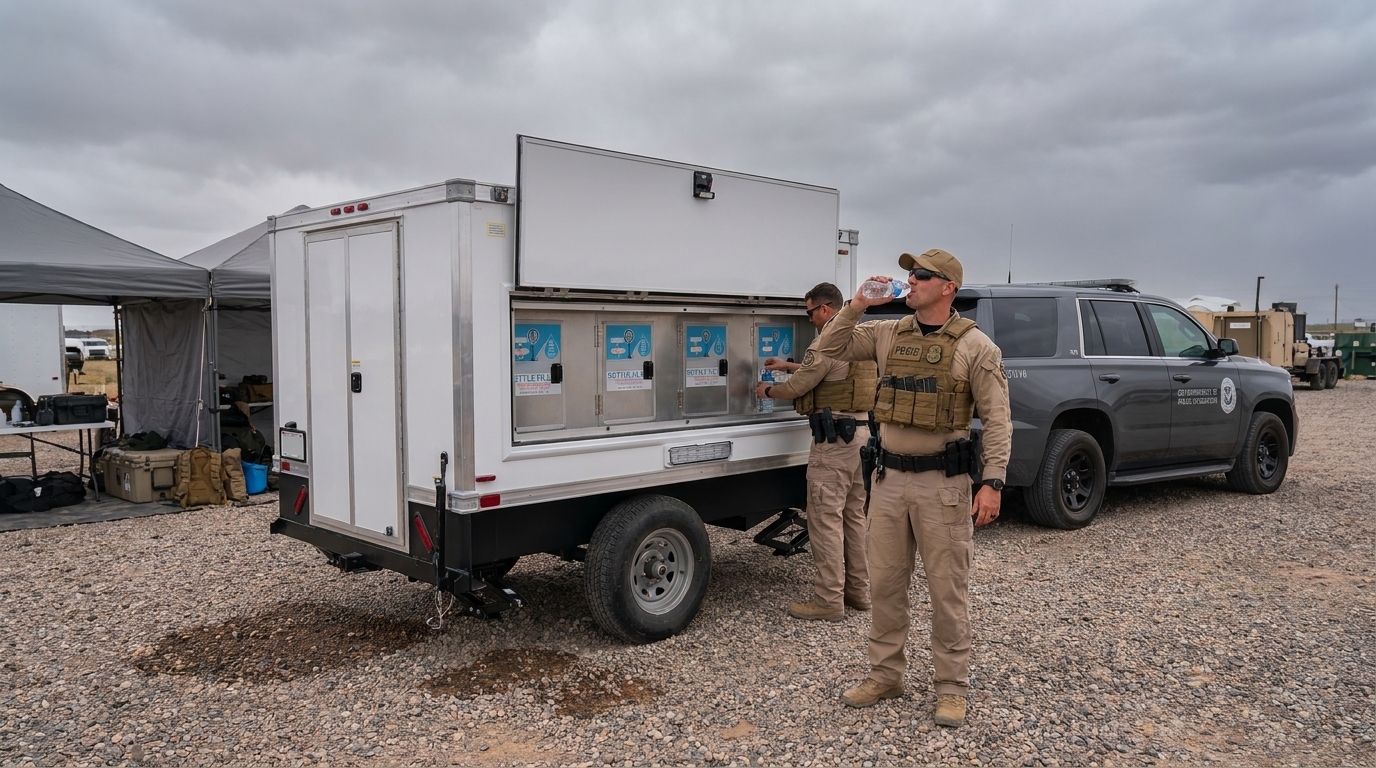
On-Site Hydration Services brings chilled, filtered drinking water to wildfire incidents, and the unit lands set up and pouring before your first crews roll in. The Signature Series water trailer carries 300 gallons and four bottle filling taps. A base camp gets a real water point on rodeo grounds. A spike camp gets one on a gravel turnout. A staging area gets one at a small county airport. Nobody is stuck with warm cases and a melting cooler. Give us the headcount and the access road and we will size it on the phone. Call us or ask for a quote, and we can be rolling the same day.
Licensed and insured | A+ BBB rated | 24/7 dispatch
See the Signature Series water station specs
“We went from 300 people to almost 900 in four days and water was the thing I stopped worrying about. One unit by the sleeping area, one at the staging line, and the morning fill never backed up past a few minutes.”
“Water sits under my unit on the org chart, so it is my phone that rings at nine at night when a crew comes back and the cooler is empty. A chilled fill point outside the dining canopy took that call off my night.”
“They asked me for tank capacity, taps and refill interval before I had to ask them. That is not how most equipment calls go. The spike camp unit went out on the supply run the next morning.”
References for this kind of booking are available on request.
We have been putting water trailers on open ground and hard job sites for years, and a fire camp is that same work with the clock running. A camp goes from empty fairgrounds to a thousand people in about three days, potable water rides under the Food Unit instead of a desk of its own, and nobody has time to explain the site twice. So we show up fluent in the numbers you already work from: gallons on board, taps per unit, refill interval, power draw, tow weight. Call the office with a headcount and an access road and we will size it while you are on the phone, or ask for a written quote you can hand up with the rest of the camp paperwork. We run Portland Oregon water station rentals and every other route the same way, on short notice, in all 50 states.
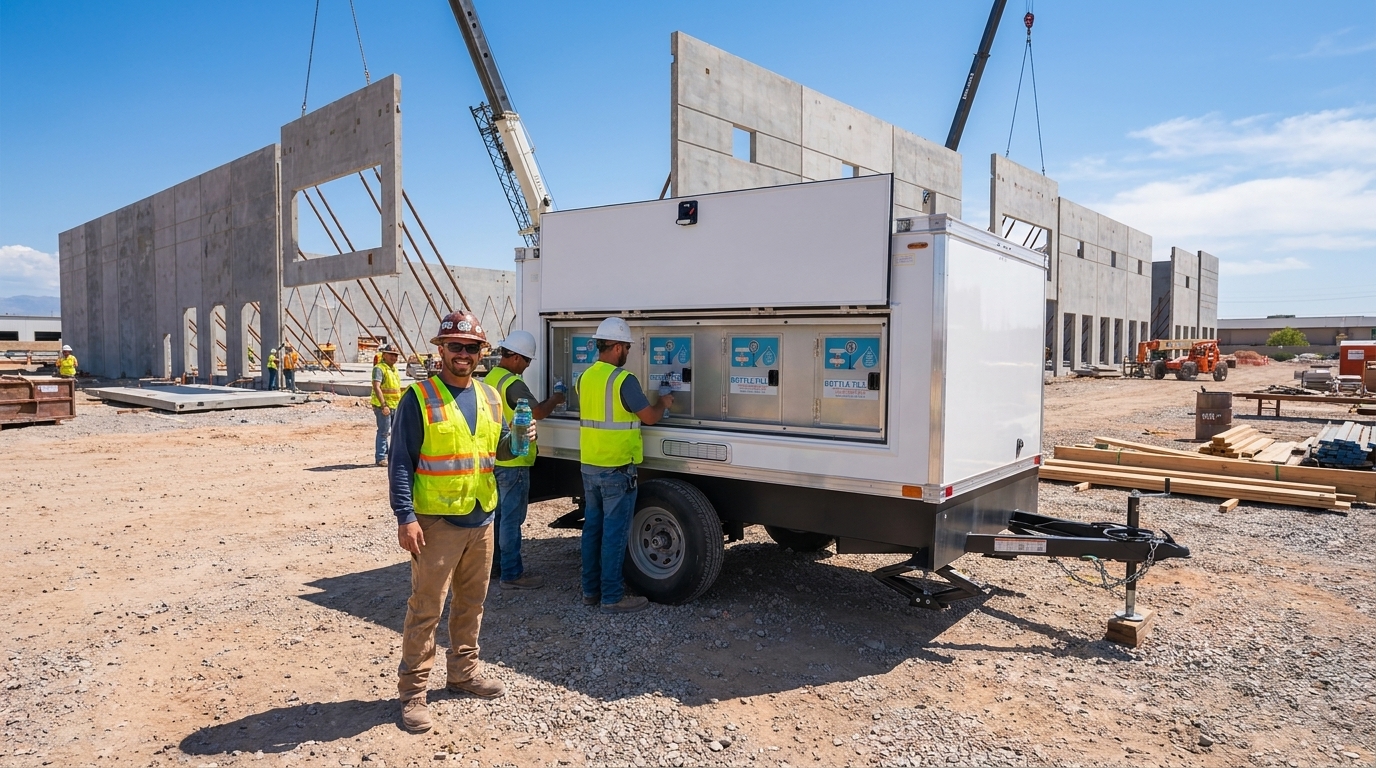
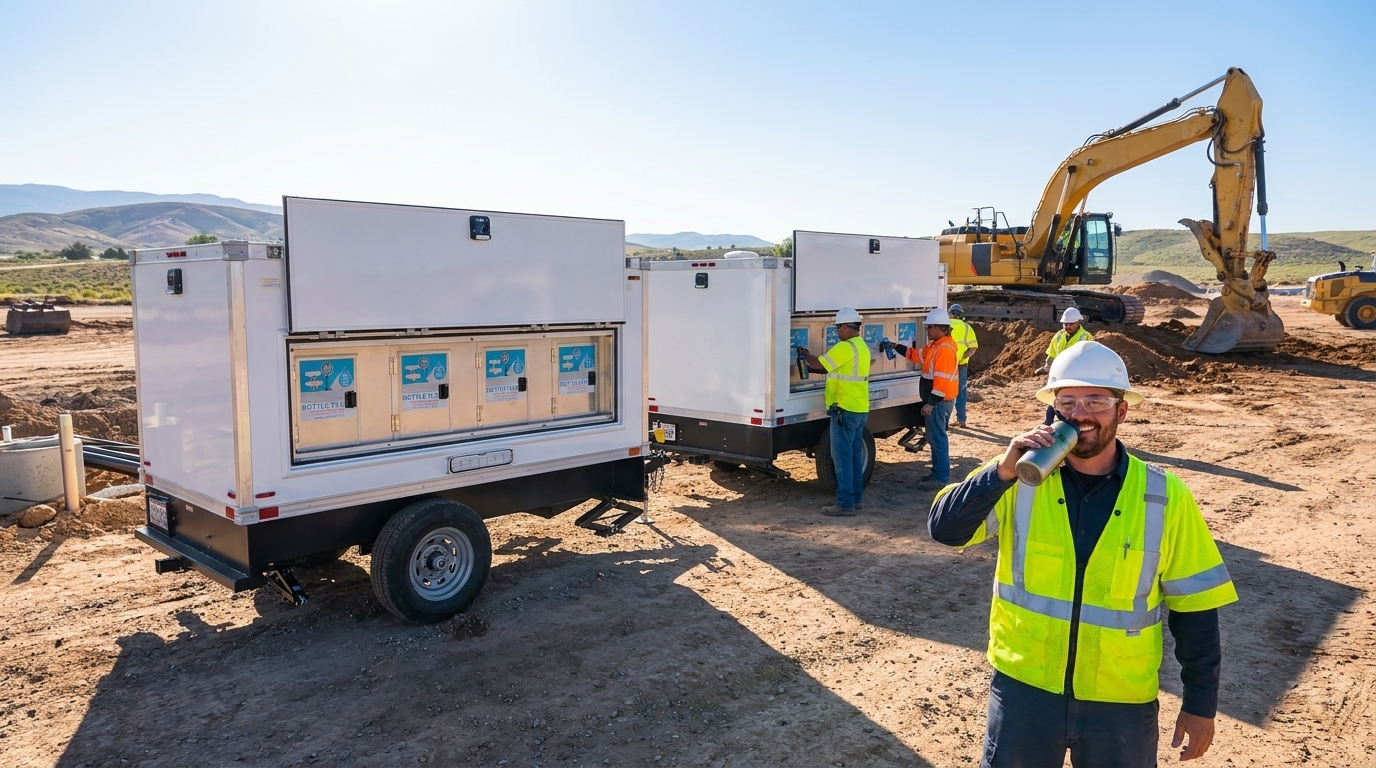
One Signature trailer can pour for a weekend concert and be working a slab pour a couple of days later. Hiring one company for your events and a separate one for your worksites makes no sense. Either way, the planning, the delivery, and the refills are ours.
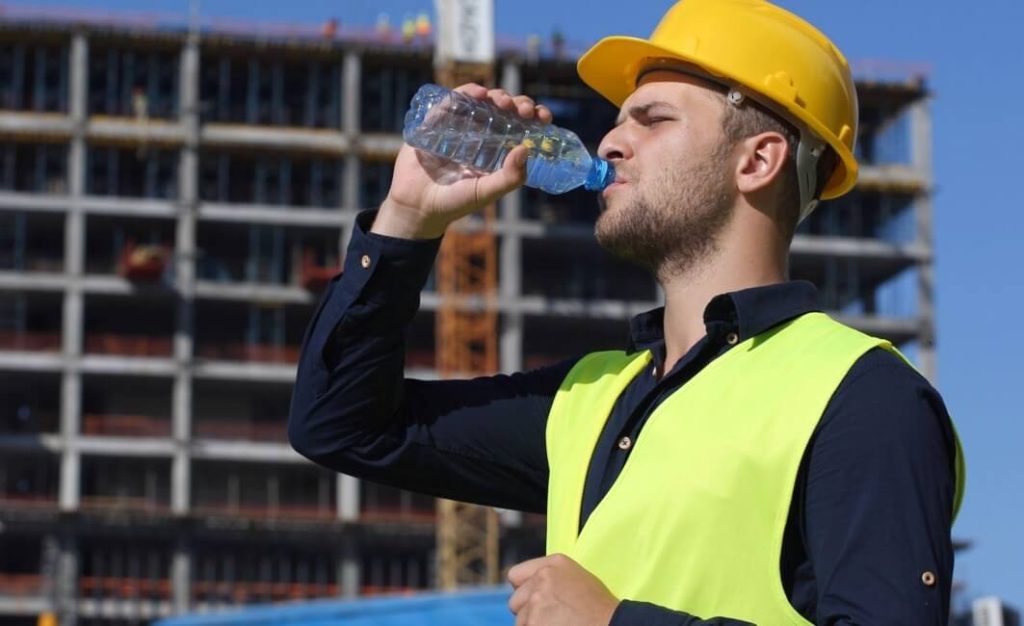
The onboard cooling unit keeps the tank genuinely cold all the way through a long afternoon outdoors, and that single detail carries the whole thing. Warm water is water people abandon, and midsummer is exactly when a crew or a crowd is drinking the most. Cold water gets finished, and finishing it is what keeps heat illness off the site.
Typical deliveries land in about 45 minutes once a truck is rolling in your metro, longer out on the rural routes, and we keep emergency runs going around the clock whenever a heat advisory or a power shutoff hits. The morning a foreman finds his 40-person crew stuck with one warm cooler, speed is the whole game.
One rule sits under every job we take: water that people walk past might as well not be there. We've stood on a bare site and watched shrink-wrapped pallets cook next to the job-trailer while the crew baked thirty yards off. We've watched the opposite too, a chilled station ten steps off the work face run bone-dry twice inside one shift. Everything that matters lives in the distance between those two pictures. Which is why we don't drop a unit and disappear. We match it to your headcount or your gate count, set the refill rhythm to how hard you're really pulling on it, and treat a heat call the way you'd want your own treated, meaning right now, because out here one hot hour can swing the whole day.
We deliver water stations to job sites, venues and event grounds in all 50 states, with the heaviest route coverage across the West.
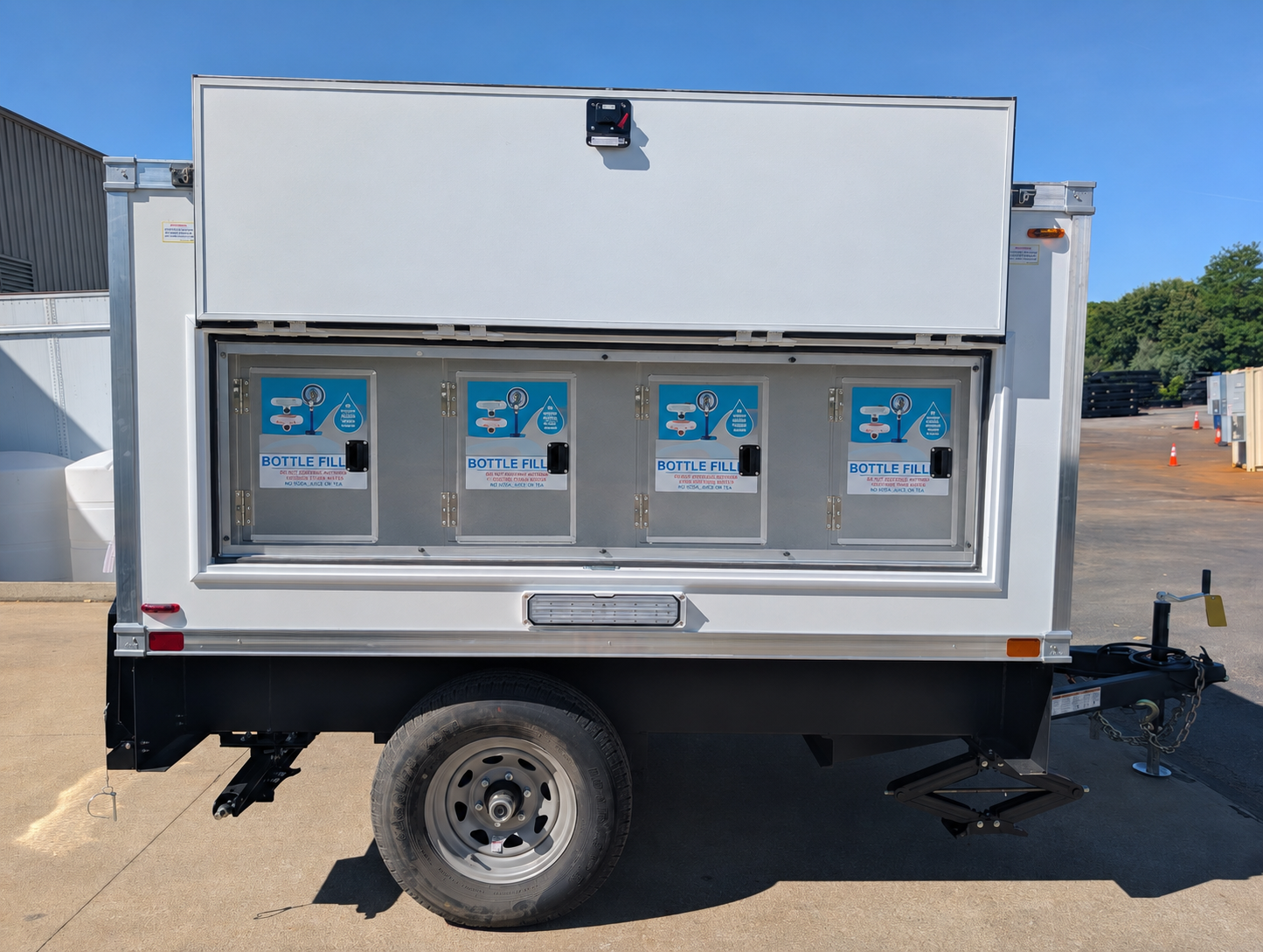
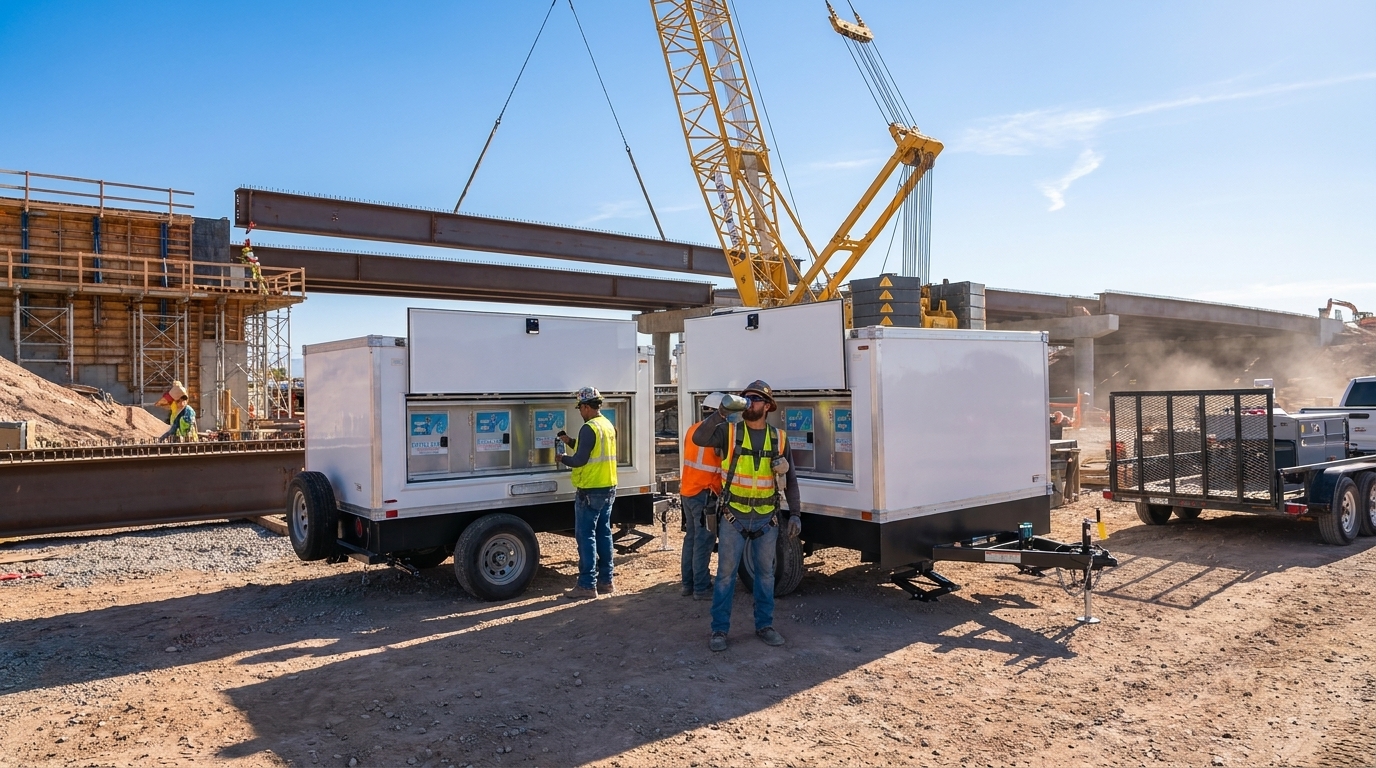
The Signature Series water trailer is a self contained drinking water point, which is the only kind that works on ground with no main to tie into.
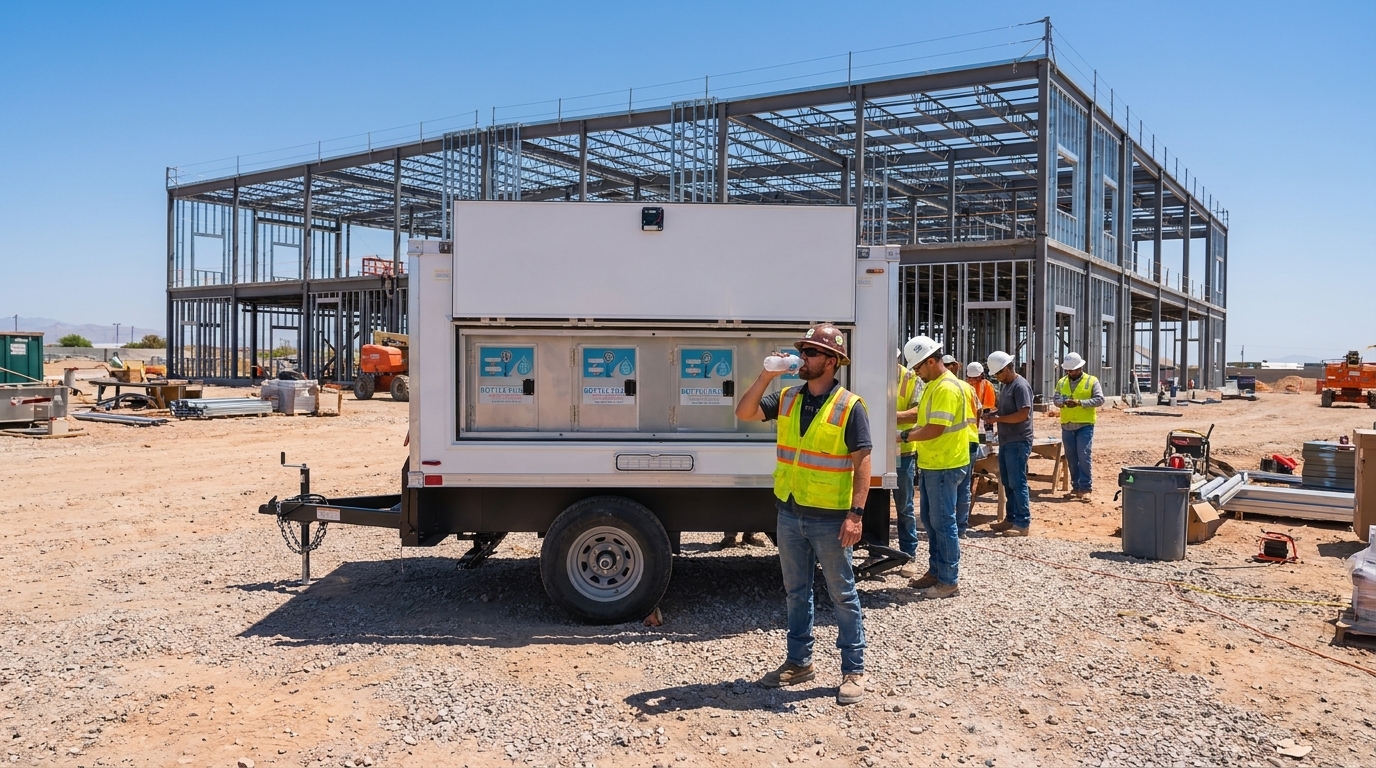
With a frame, a hitch, and tires under it, the unit hauls out to a remote build, an event field, a working orchard, or a disaster staging yard with equal ease. Contractors and event planners request this exact rig by name. The whole design is built around backing in, leveling off, and pouring cold by the same afternoon.
| No. of stations | (4) Bottle Filling Stations |
| Length | 12' 3" |
| Weight | 3,100 lbs. |
| Height | 8' |
| Fresh water tank | 300 Gallons |
| Power requirements | 1 to 4 dedicated 20A/120V circuits OR 1 dedicated 50A/240V circuit |
| No. of AC units | 1 |
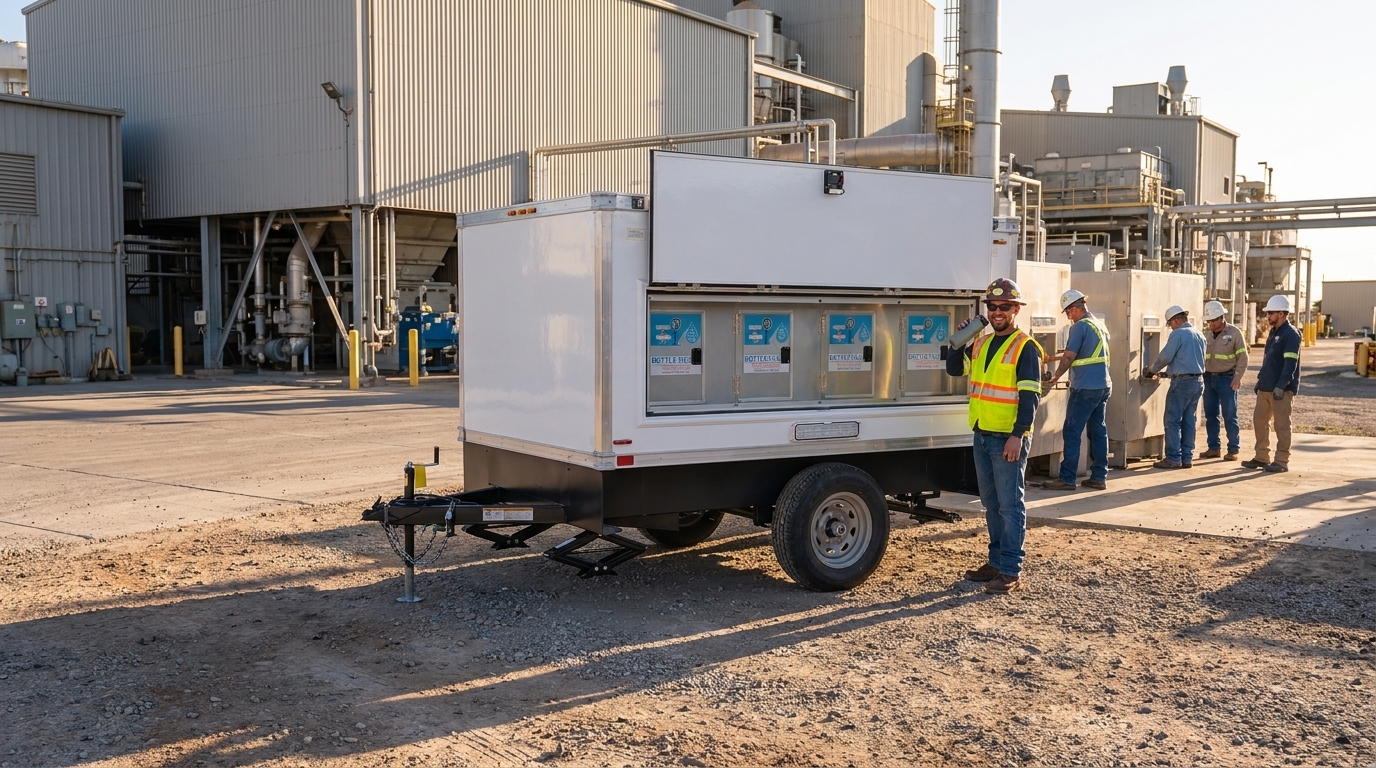
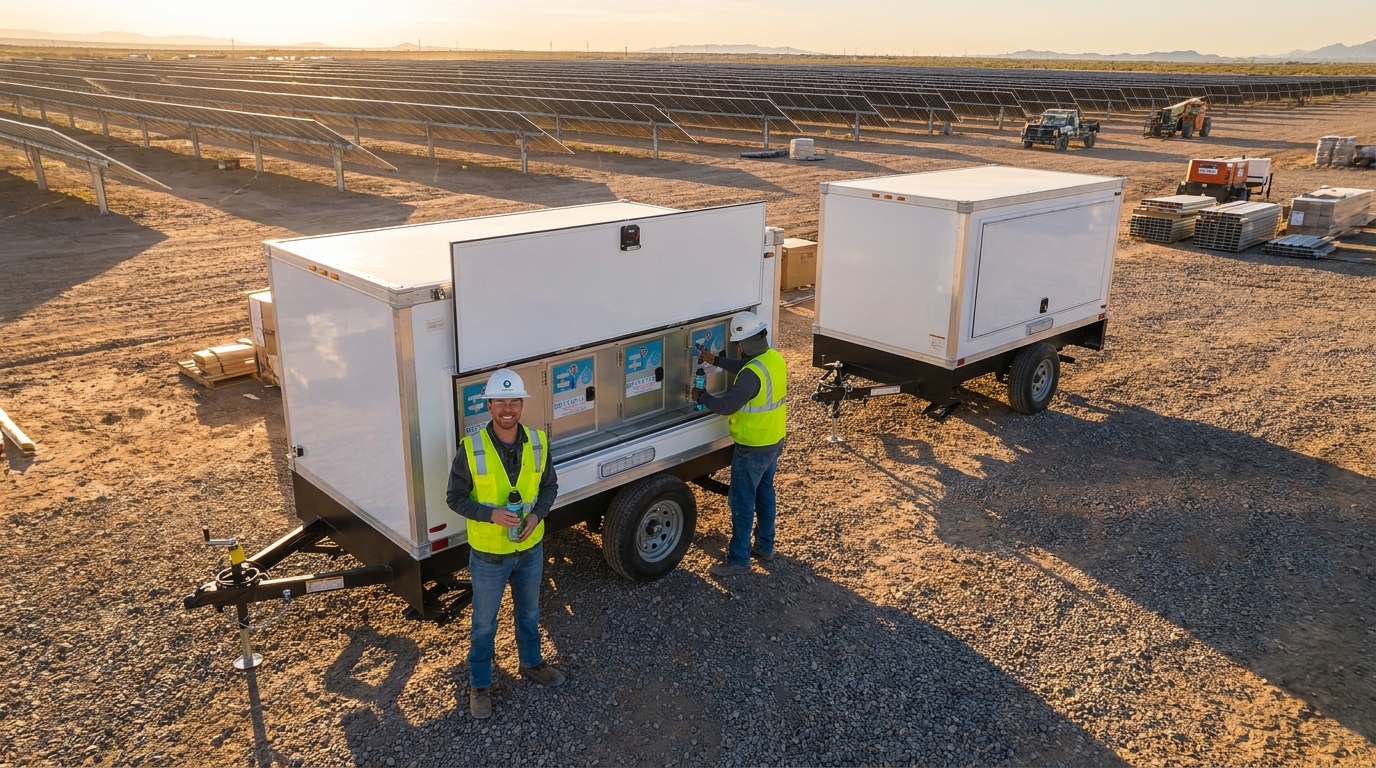
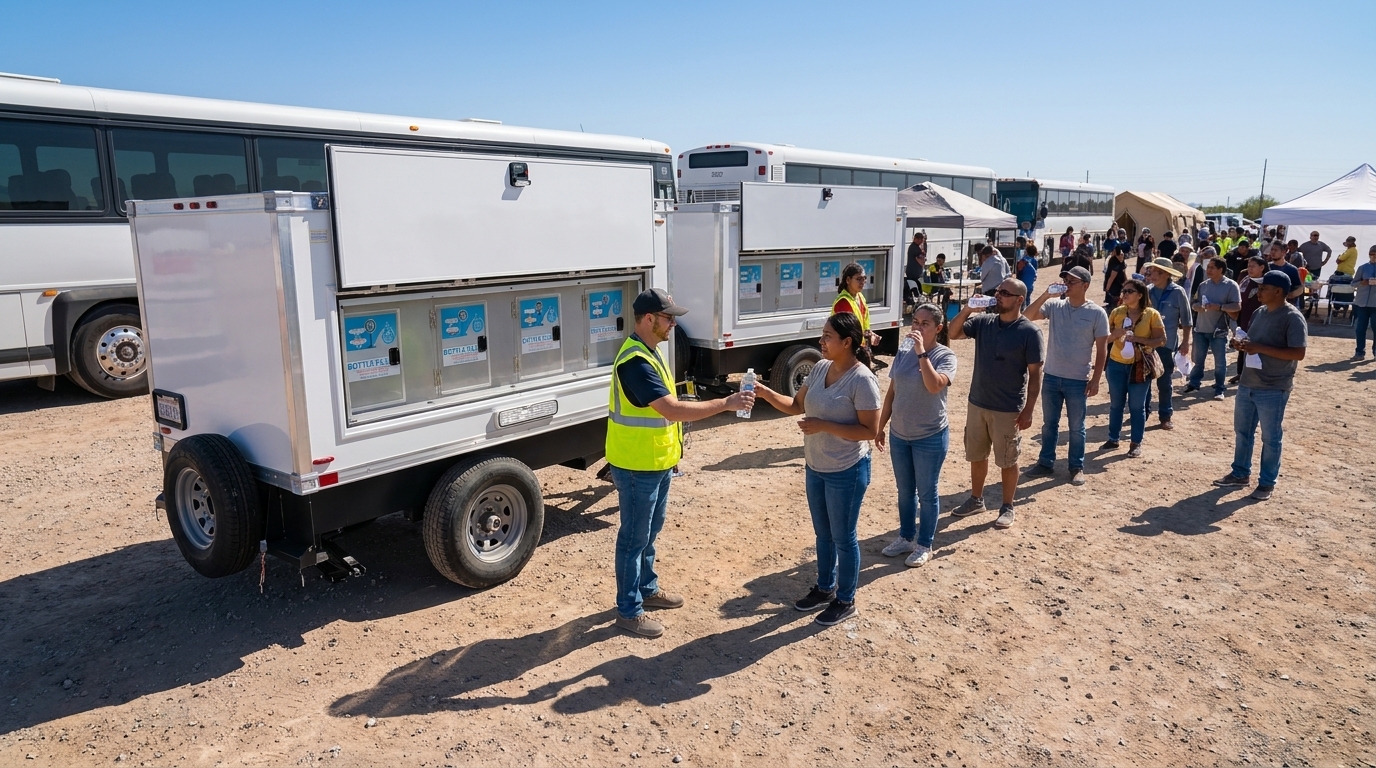
Three hundred gallons ride on board, filtered in three stages for sediment, chlorine and microscopic particles, passed under a UV treatment lamp, then flash chilled before it reaches a tap. Four push back bottle filling stations run at once, with adjustable taps that take a bottle, a one liter jug or a pack bladder, and one of the four sits at ADA height. A rear jug filling station handles the five gallon coolers that go out with a crew buggy, and hose bib connections let support crews draw for wash lines. Three hundred gallons is roughly 2,400 sixteen ounce fills, a useful number to hold next to a camp roster. We run the same unit on Sacramento water trailer rentals, so nothing about the equipment changes when the job gets harder.
The trailer is 12 feet 3 inches long, 7 feet 6 inches wide, 8 feet tall and 3,100 pounds, with one air conditioning unit. Power is 1 to 4 dedicated 20A/120V circuits or a single 50A/240V circuit, which matters more at a fire camp than anywhere else we work. Camp generators already carry kitchen equipment, shower heat, light plants and communications, and every new draw is an argument with ground support. A unit that shares a standard circuit spur gets said yes to. It also runs quiet enough to park near a sleeping area, which is the whole point of putting water where people sleep.
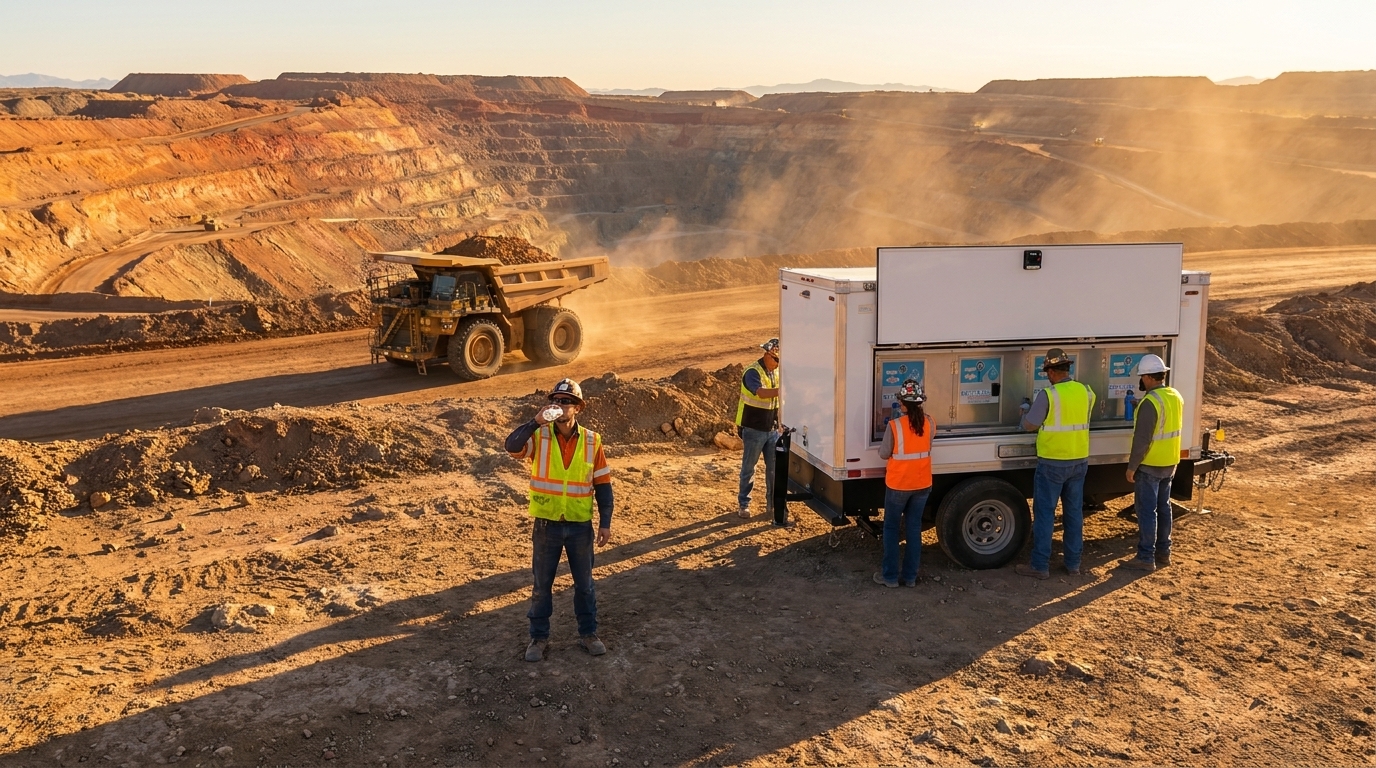
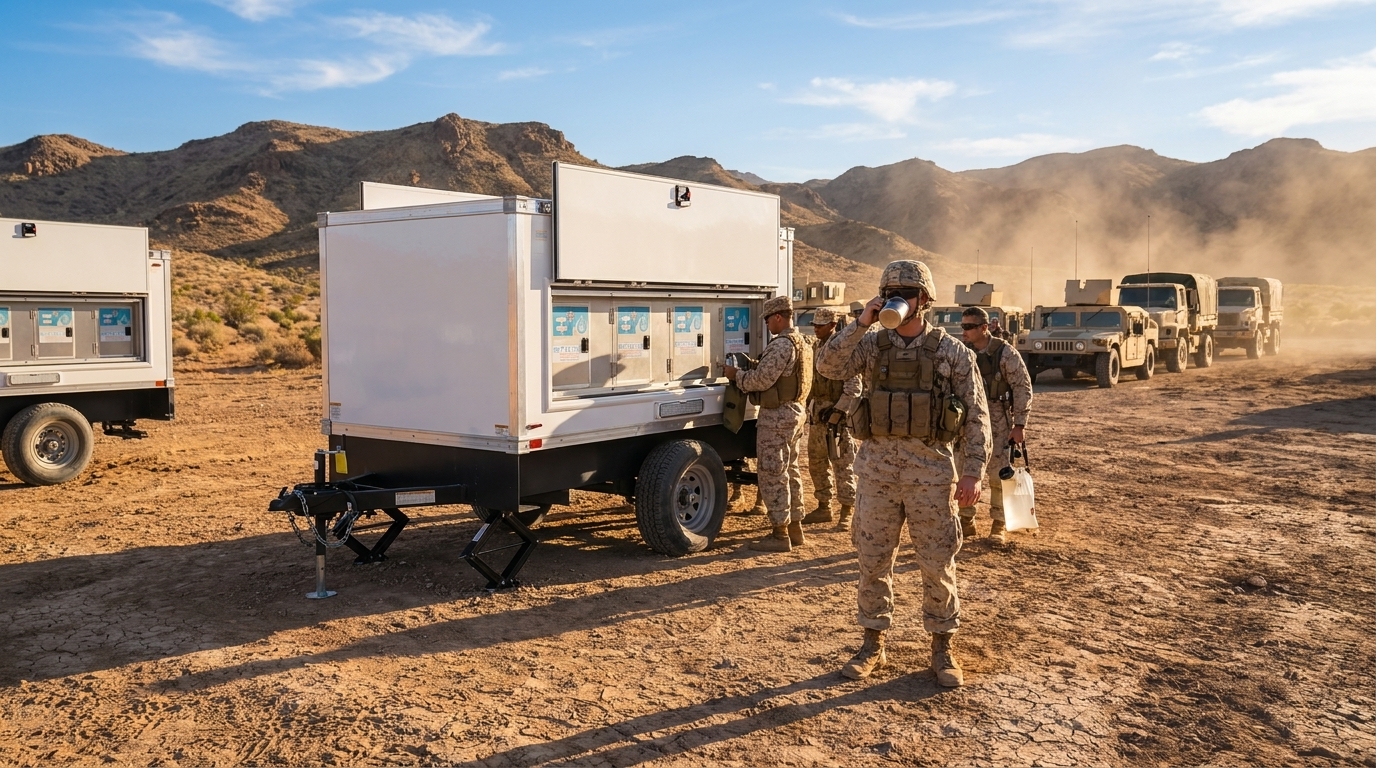
It tows on a standard hitch behind a three quarter ton pickup, so it follows the same gravel and cattle guard approach the kitchen and shower trailers took in. We level it on jacks on bare ground, because bare ground is what a camp sits on: rodeo grounds, ball fields, county road yards, a school lot with the irrigation shut off. A 200 gallon grey tank catches splash and rinse water instead of leaving a wet spot in a dusty camp.
A water source people don't trust gets ignored, and an ignored station is rented money wasted. That's why municipal water doesn't reach the tap raw on our trailers. It passes through three filter stages and a UV chamber, then an onboard cooling unit drops the temperature. The result tastes clean and comes out cold, even on the worst afternoon of the year.
The opening filter traps sand, scale, and the fine grit local mains occasionally push through. On a dusty lot, that's what keeps a pour from tasting like the parcel it's parked on.
Activated carbon comes next, lifting the chlorine bite and the dull seasonal notes local tap can carry until the taste lands clean and neutral. When it's 100 out, that flavor decides whether a crew keeps drinking or walks past the tap dry.
A finer cartridge then catches the microscopic particles that slip past the first two, so what reaches the spout is clear rather than merely cold for the crews and crowds drawing off it.
The last step is an ultraviolet chamber that wipes out bacteria and microbes without adding a single chemical. Even after a long tow out to a remote site, the water off the nozzle is clean.
Along the wall sit four adjustable push-back taps, press a bottle to the bar and it pours. One of them is set at ADA-reachable height, so a single trailer includes everybody in a crew or crowd with no add-on gear. Out back, a large-jug spout services five-gallon coolers and hydration packs, while a bank of hose connection taps handles work-site chores, event support, and refills down the orchard rows. Stainless, food-grade plumbing the whole way through keeps the filtered, chilled water at quality right to the spout.
Every Signature trailer carries a 300-gallon load, roughly 2,400 cups at sixteen ounces each, and we recharge it on demand, so the unit doesn't turn into the choke point on a busy shift or a packed show night.
An incident is not one site. It is a main camp, satellite camps that feed off it, and a support row of contracted units with crews of its own. Each has a different water problem, and solving only the first leaves two thirds of the people short.
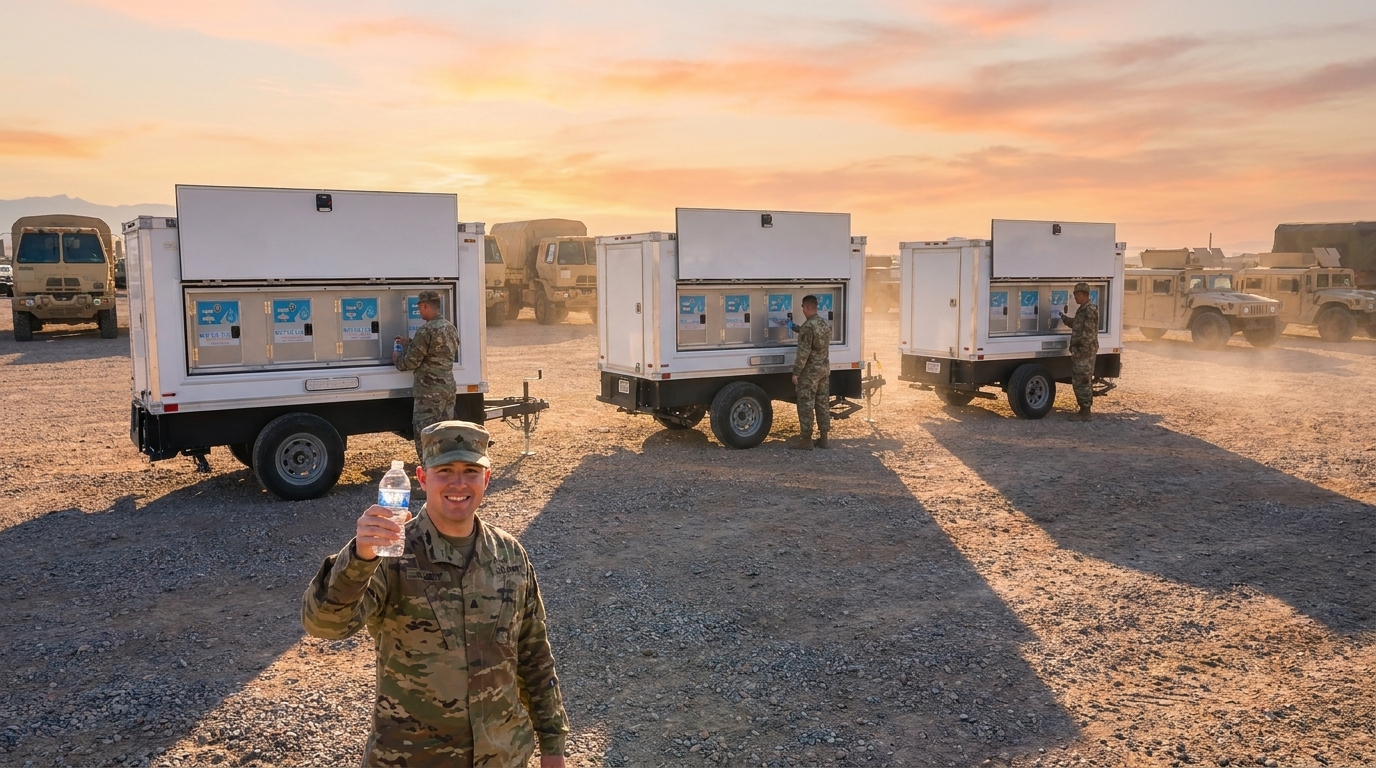
A base camp is a small town built in about 72 hours and taken down in a morning. Reporting from a 2026 Oregon incident described a camp at a rodeo grounds holding roughly 1,200 workers, with a 25 person food unit running a kitchen trailer and a dining canopy, and hygiene stations placed across camp on purpose. A Northern California incident the same era ran about 4,000 personnel out of a base camp reporters called a small city. That is the range, and it is why one water point at the kitchen end is never the answer. People will not walk past two rows of tents at five in the morning.
The ground is almost always bare. Camps go on fairgrounds, rodeo arenas, school athletic fields, county road yards, small airports and open pasture, because those are the only places big enough on 24 hours notice. None has a drinking tap near the tents, and most have one hose bib by a maintenance building the shower contractor already claimed. So a water trailer here gets judged on what it carries and how fast it refills. We run Fresno Central Valley water station rentals on the same assumption and it has never once been wrong.
Demand is not flat. It spikes twice. Crews stage before dawn and fill every canteen and bladder they own inside a 60 to 90 minute window, camp goes quiet, then the same crews come back after a 12 to 16 hour shift and drink hard before they eat. We ask for the camp map and the staging location before deciding where a unit sits, because the last hundred feet of walking distance decides whether it gets used.
Camps also grow past their own plan. That Oregon camp stood up a separate overflow site when crews arrived from out of state faster than the primary grounds could hold. That is the normal failure mode. We would rather tow a second unit in on day four than watch a camp ration a tank at nine at night in front of 400 new arrivals.
A spike camp leans on the main camp for supplies and food but runs its own sanitation. It exists for one reason: to keep a crew working a far section of line from burning an hour each way on rough incident roads at the end of a 14 hour shift. That drive is a fatigue problem and a collision problem, both life safety items in incident planning. So the moment a site is far enough out to justify its own sanitation, it is far enough out to justify its own water.
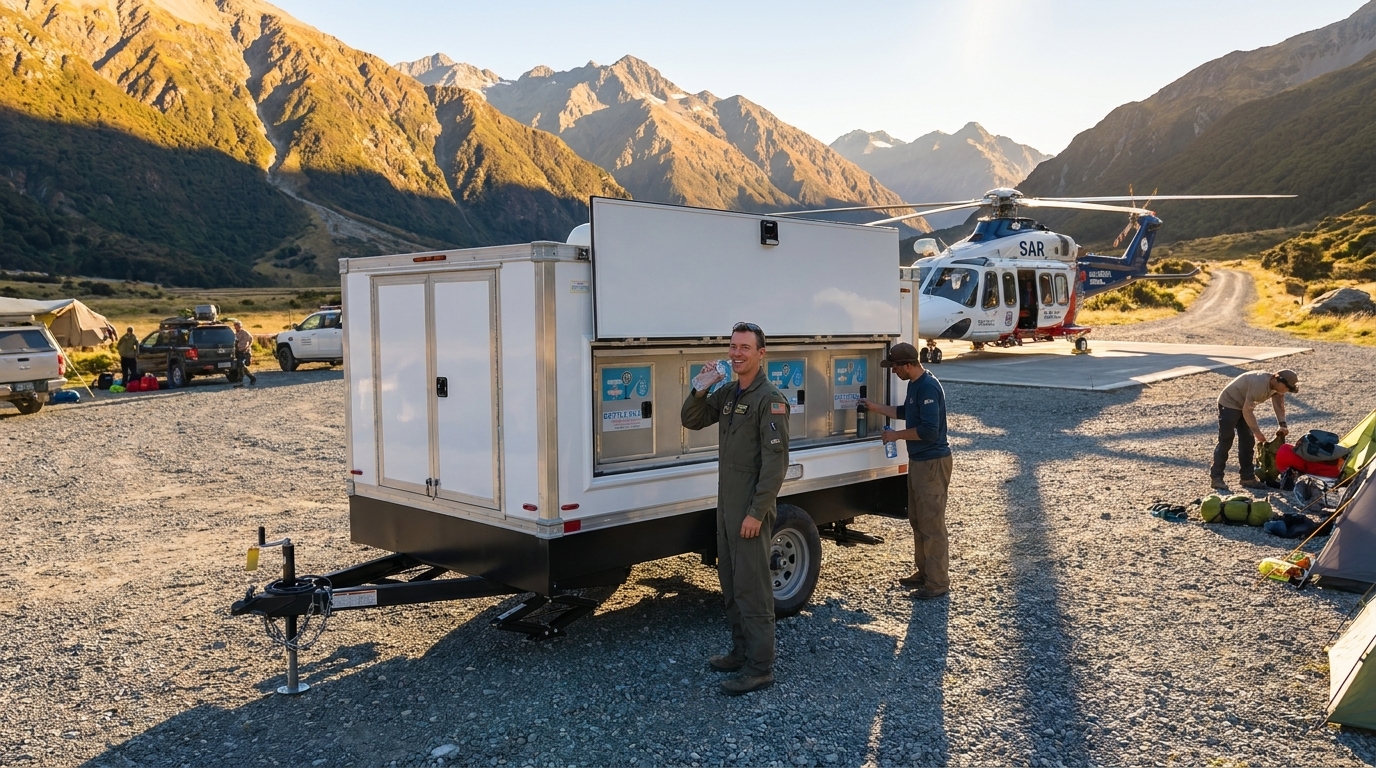
Spike sites are smaller and tougher. Gravel pull-offs, closed campgrounds, log landings, ranch meadows, forest work centers, helibases and drop points. Two or three crews, call it 40 to 75 people, is a headcount one 300 gallon unit covers on a two day refill interval. If a supply run already goes out every morning with sack lunches and fuel, water rides along and costs nothing in extra truck trips.
What goes wrong is a vendor solving only the main camp. Logistics orders one big unit for the base, the spike site gets a stack of cases and a cooler with yesterday's ice, and by day three those crews are drinking warm water in the worst air on the incident. Smaller footprints at each site beat one impressive unit at the site that already has the most attention.
Staging areas are the third version. A strike team holding at a county yard or a wide spot on a state route may only be there a day, but it is a day in fire gear in the sun, and the bottles they leave with are the bottles they carry on the line. We drop and go, then pick up when the assignment clears.
Camp support is its own workforce and it gets forgotten. A food unit at a large camp can run 25 people, working a hot breakfast, sack lunches and a hot dinner every day, sometimes preparing on the order of 3,000 burgers for one seating. Shower and laundry contractors run their own crews. Ground support, supply cache, communications and the medical unit stand on that same dusty ground the entire incident, and none of them are on the fire line, so none show up in fire line planning.
Water for these crews already sits with the Food Unit inside the Logistics Section, alongside feeding requirements. That means the person deciding on drinking water is the person deciding on catering, often in one conversation. Under the national mobile food services contract, a mobile food service unit arrives with a minimum of 200 gallons of potable water in its tanks. That is a floor written for one contracted asset, not a reserve sized to a camp, and support row feels the difference first.
Shower units are classed by stall count under their own national contract, small at 4 to 11 stalls and large at 12 or more, and every stall draws on camp water. A drinking point on that row keeps crews out of the shower line for a cup of water and keeps the caterer's tank on cooking. Small separation, real difference by day nine.
There is an illness argument too, and camp leadership already accepts it. Hundreds of exhausted people, shared surfaces and a handful of fixed service points is a transmission environment, which is why that Oregon camp spread hygiene stations across the grounds deliberately. Drinking water deserves the same thinking: several points people can reach, not one backup point everyone touches in the same 20 minutes.
Everything on an incident runs on a shorter clock than normal rental work. We plan for that instead of asking the camp to slow down.
The call usually comes after the site is picked and the caterer and shower contractor are committed, so the window we are matching is hours, not days. We keep units staged and tow the same day when the route allows. What we need on that call is short: headcount now and headcount expected, camp location and gate, the facilities unit contact, and whether the approach is paved, gravel or dirt.
Placement is the decision that makes or breaks the unit. We want water near sleeping areas and the staging line, not clustered where the camp map happens to have space, and off the main vehicle route, because monitoring at real incident base camps found camp sources like traffic, road dust and generator exhaust driving overnight particulate levels that in some cases matched the wildfire's own contribution. Nobody wants to drink in a truck's dust plume. We also want firm ground for the jacks and a line of sight a tender driver can find at night. Bakersfield mobile water station rentals get the same walk around.
What goes wrong is growth or refill, almost never equipment. A camp doubles for a few common reasons. Two incidents can combine into one larger complex. An overflow site can open on short notice. A shift change can stack 400 people at one point for 20 minutes. The first two are fixed with another tow. The third is fixed with placement and taps, which is why we ask about the staging window early. We set a refill interval against the headcount before the unit is parked, and we move it the day the numbers move.
Wrap-up is abrupt. A camp that took three days to build gets released and is gone in a morning. We pull on your release, drain the fresh tank, pump the grey tank to an approved disposal point rather than onto the ground, and leave the pad as the grounds manager handed it over.
People count, number of days, where exactly it parks on your site, and what power is there. Those four answers let us spec it correctly the first time around.
Reckon roughly 45 minutes from the nearest yard once we are in your metro, longer on the outer routes, with round-the-clock emergency runs whenever a heat advisory or a power shutoff hits.
Once on site we set it level, charge the 300-gallon tank, and tie in power off one to four standard 120V circuits, or a single 50-amp 240V drop, depending on what the site gives us.
After that the tankers cycle back on a cadence matched to how fast your crew or crowd pulls it down, and we maintain the unit through the whole rental term.
No power on the parcel at all? We price that in. The unit draws very little, and with the service fleet backing it we've run stations on lots that had no permanent power whatsoever. Lay out what the site offers and the rest is on us.
Want this math run for your own booking? Two minutes on the phone gets you a real number.
This is arithmetic, not a guess. Start with the published per person numbers, multiply by the roster, then set the refill cadence.
| Hand crew at a staging area (20 to 25 people) | 1 unit, filled before the shift |
| Spike camp holding two or three crews (40 to 75 people) | 1 unit, refill every second day |
| Small incident base camp (150 to 300 people) | 1 unit on a daily refill |
| Mid size base camp (500 to 800 people) | 2 units, sleeping and staging |
| Large base camp (1,000 to 1,500 people) | 3 units plus a scheduled tender run |
| Complex with an overflow camp (2,000 to 3,000 people) | 4 or more, one per sleeping area |
| Multi thousand person incident base (4,000 people or more) | 5 or more by zone, restocked daily |
Agency guidance sets a minimum of one quart of fluid per hour of work. Daily guidance for wildfire crews runs 4 to 6 liters, call it 1 to 1.5 gallons, and on the hardest line days firefighters take in 3 gallons or more. Run that against a roster. A 1,200 person camp at the conservative baseline needs roughly 1,200 to 1,800 gallons a day. A 4,000 person camp needs 4,000 to 6,000 and up. Those numbers are not ours, which is why they hold up in a logistics meeting.
Now put tank capacity next to it. One unit carries 300 gallons, about 2,400 sixteen ounce fills, a full day for 200 to 300 camp residents at the baseline rate, or roughly 150 people working at fire line intensity. So the real planning variable is refill interval, not tank size. No single trailer holds a thousand person camp's daily demand, and any vendor implying otherwise has not done the arithmetic. What a unit holds is a chilled, filtered, high volume dispensing point that refills off your regular supply run the way suppression water already does. Tacoma Washington water bottle filling station rentals size the same way, against a shift roster.
The honest default: one unit per 250 camp residents, one per sleeping or staging zone, whichever is higher, with refill tied to a supply run you already make. Heat, elevation, smoke and dust push consumption up, so round up in August and keep a quarter of the number as a buffer.
Support equipment comes onto a wildfire incident through an emergency equipment rental agreement, written at the incident on federal form OF-294 and good for the length of that incident only. Chapter 20 of the interagency incident business management handbook governs it, and the agreement covers camp support well beyond engines and tenders, including hand hygiene service and sink, shower and laundry trailers, with defined responsibility for grey water disposal and potable water supply. CAL FIRE runs its own version through its hired equipment program, where approved applicants sign ahead of time and respond with their own equipment and crews.
Potable water sits under the Food Unit inside the Logistics Section, which determines feeding requirements and provides potable water at incident facilities. The facilities unit leader owns the layout of the incident base, spike camps and the command post, and the base or camp manager runs the equipment inside them. Calling the wrong desk costs a day, and a day is most of the stand up window.
The numbers in those documents prove this is already a specification driven purchase. The national mobile food services contract sets a 200 gallon minimum of potable water in a food service unit's tanks on arrival. The national mobile shower facilities contract classes units small at 4 to 11 stalls and large at 12 or more. Hydration guidance sets the one quart per hour floor. Logistics staff read those tables all season, so when they ask for tank capacity, dispensing points, refill interval and power draw, they expect numbers back, not adjectives.
On our side the equipment carries its own standards no matter which agency signs. Wetted components are built to drinking water standards, the treatment train is three filtration stages plus a separate UV pass, and one of the four fill points sits at accessible height. We document fill source, tank cleaning and service dates, because the first thing an environmental health officer asks about stored water is where it came from and when. Denver Front Range water station rentals carry the same paperwork.
Federal OSHA heat illness prevention guidance and the CDC and NIOSH heat stress program point at the same baseline: cool drinking water, close to the people doing the work, and documented.
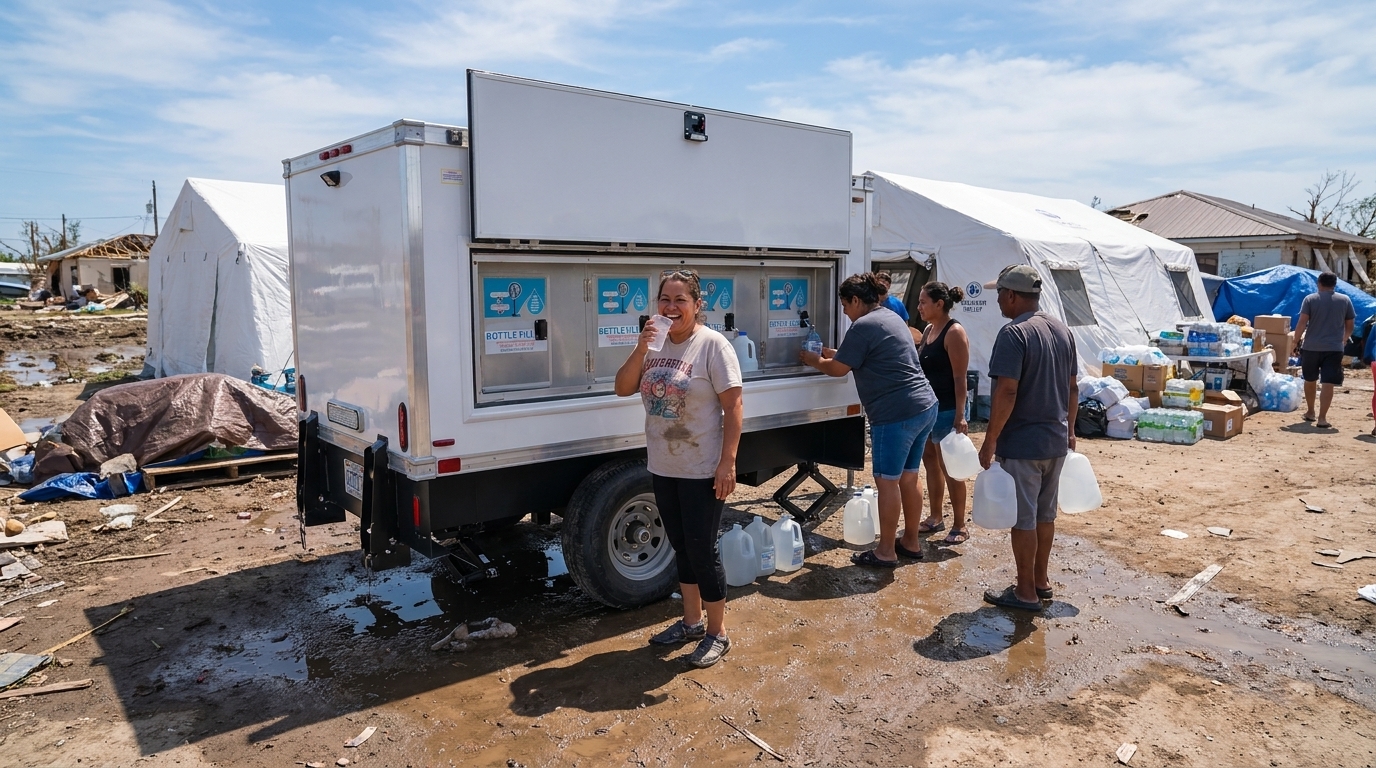
Need a station your written heat plan can point to? We can have one pouring cold within days.
Channel one is the caterer's onboard tank, held to that 200 gallon minimum on arrival. It is a floor written for a kitchen, not a reserve sized to a roster, and at a camp of a thousand it is a few hours of drinking demand on paper. Every gallon the camp pulls off it is a gallon the kitchen planned to cook with, which is how a food unit ends up rationing water while putting out 3,000 plates.
Channel two is the tender fleet. Support tenders carry 1,000 to 4,000 gallons and tactical tenders 1,000 to 2,000, but that is suppression water and dust control water, hauled and staffed for the fire line and for keeping camp roads down. A tender is not a chilled drinking point, it is not placed for a queue of people, and when it is filling engines it is not in camp at all.
Channel three is the canteen and the pallet of cases. That puts the whole burden of a quart per hour on a person who just worked 14 hours in smoke and is trying to remember how much they drank. Cases arrive warm, sit warm, and leave a waste stream someone hauls off a site already fighting its own dust. None of the three was built as a chilled, high volume drinking point for a camp population. Each was built for something else, with crew hydration bolted on.
Look at everything bottled water actually demands of a person: cutting the order, receiving and breaking down pallets, icing coolers before dawn, topping them up through the day, then flattening empty bottles for the bin. On a large crew that's hours of paid time burned every single day, scraped right off the work that's supposed to be getting done. The trailer erases that loop entirely. A local contractor once let us pencil it out with him, and the recovered labor by itself paid for the unit. His words were that the bottle runs had been quietly costing him close to a day of payroll a week. Our trailer arrives full, the tankers keep it full, and your superintendent owes it nothing but a parking spot.
Ice a cooler at 6 a.m. and by mid-morning in July it's as warm as a bath. Warm water is water people stop touching, and the slowdown that follows is precisely where heat illness gets its opening. A chilled station never rides that warm-up curve at all. Whatever pours at clock-out is as cold as the sunrise fill, which happens to be the moment a spent crew, or a crowd deep into a long concert, leans on it hardest.
Bottled-water pallets devour staging space, jam the lay-down area, and sit cooking in the sun until somebody finally cracks them open. Empties build up faster than anyone keeps up with, and on a tight commercial lot that pile turns into its own problem. Set a trailer in one parking stall instead and it serves a crew or crowd that would otherwise burn through hundreds of plastic bottles every day.
Every bottle bought is a bottle thrown out, and across a season a busy site or event generates a small mountain of them. That's a disposal line on the budget, a dent in the sustainability numbers, and, given that a single bottle can linger in the ground for centuries, a footprint that lasts longer than the project that made it. Move to a refill station and the line drops to zero, which finally gives your reporting a figure worth publishing.
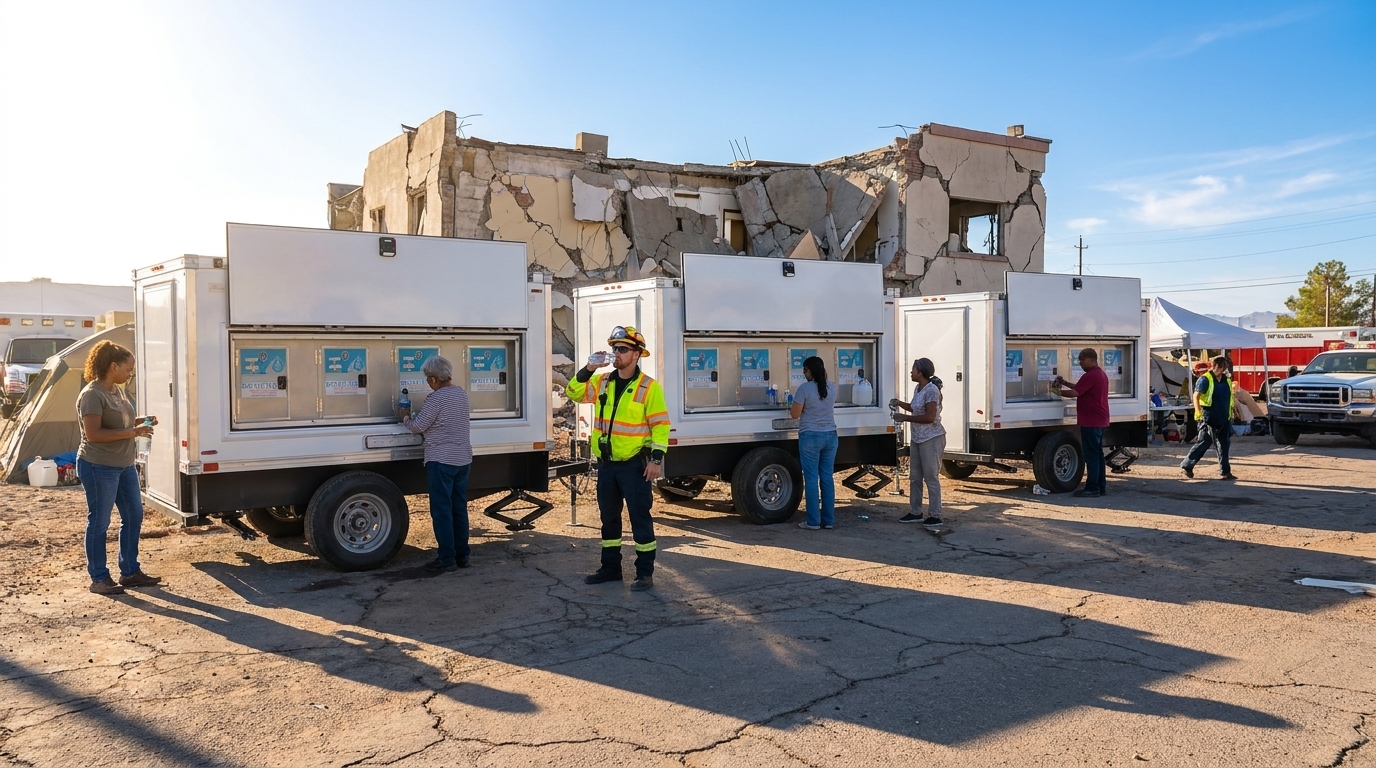
Three bookings of this kind, and what we planned around on each one. Names and details are kept generic on purpose.
Base camp on a rodeo grounds, 1,200 people, first week of August. Camp stood up in three days on packed dirt with one hose bib near the maintenance shed, already claimed by the shower contractor. Two units went in that first afternoon, one at the head of the sleeping area and one at the staging line, on a daily refill off the tender run already watering the camp roads. Headcount climbed past 1,500 in week two when an overflow site opened, so a third unit rode out on the morning supply run. The camp manager's only note at demob was that the morning line never ran past a few minutes.
Spike camp on a log landing, three crews, mid September. The main camp was 50 minutes out on incident road, an hour and forty round trip at the end of a 14 hour shift, which is the fatigue and collision risk a spike camp exists to remove. One unit rode out on the morning supply run and got leveled on the most level corner of the landing, off the turnaround so the crew trucks could still swing. Forty eight people at the baseline rate meant a refill every second day, which that truck was already making.
Support row at a 900 person camp, late July. The food unit leader called because water sat under her on the org chart and she was taking the nine at night calls when a returning crew found an empty cooler. One unit went at the head of support row between the dining canopy and the shower trailers, putting a chilled fill point inside 50 feet of kitchen staff on a 16 hour day, laundry crews and returning line crews. She kept the caterer's tank for cooking. The late calls stopped.
Service information current as of September 2026.
Still weighing it? Call and ask. Most of these questions get settled in one short conversation.
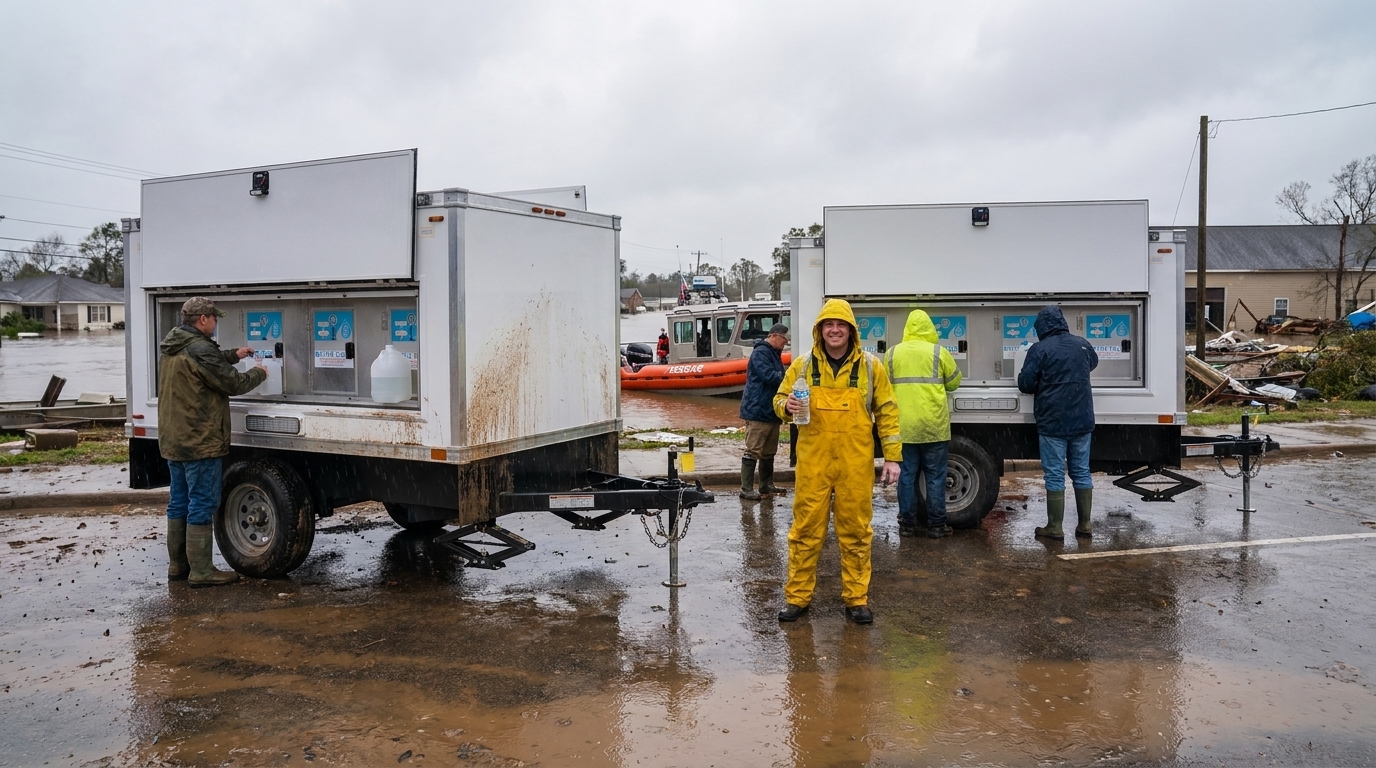
Agency guidance sets a minimum of one quart of fluid for every hour of work. Average daily guidance runs 4 to 6 liters, roughly 1 to 1.5 gallons, and on the hardest line days firefighters take in 3 gallons or more. A third to half of that should come from an electrolyte drink rather than plain water, because taking in large volumes of plain water without replacing salt carries its own risk.
The Food Unit, inside the Logistics Section. The same unit that determines feeding requirements also provides potable water at incident facilities, which is why water and catering conversations usually happen with the same staff. Above that, the facilities unit leader owns the layout of the incident base and spike camps, and the base or camp manager runs the equipment inside them. Those are the three desks that matter.
Through an emergency equipment rental agreement, written at the incident on federal form OF-294 and good for that incident only, under chapter 20 of the interagency incident business management handbook. CAL FIRE runs a parallel path through its hired equipment program, where the agreement is signed ahead of time and equipment responds when called. Call us with the incident and the ordering contact and we bring the paperwork we already have on file.
A spike camp depends on the main camp for supplies and food but runs its own sanitation, and it exists to keep crews off a long round trip on rough roads after a full shift. For water that means a second, smaller, independently stocked point rather than one central unit people drive to. Two or three crews, call it 40 to 75 people, is comfortable on one unit with a refill every second day, usually riding the supply run already going out.
Three is the usual answer, placed by zone rather than clustered, with a scheduled refill run. One unit holds 300 gallons, about 2,400 sixteen ounce fills, covering 200 to 300 camp residents for a day at the baseline rate. A thousand person camp needs somewhere around 1,000 to 1,500 gallons of drinking water a day, so tank capacity is the buffer and refill cadence is the plan. If sleeping areas are spread out, go by zone count and take the higher number.
1 to 4 dedicated 20A/120V circuits, or a single 50A/240V circuit. That matters at a camp because generator capacity is already spoken for by kitchen equipment, shower heat, light plants and communications, and ground support approves every new draw. A unit that shares a standard circuit spur instead of demanding its own service is far easier to say yes to, and it runs quiet enough to sit near a sleeping area.
Three filtration stages for sediment, chlorine and microscopic particles, a UV treatment pass, and flash chilling before it reaches the tap. Chilling is not just comfort here: water sitting static and warm in a tank for days in direct sun is a different risk profile than water that turns over on a schedule and stays cold. We document fill source and service dates, clean between fills, and keep the taps on a set schedule.
Because crowded camps have a documented history of it. One investigation at a wildfire base camp found 49 illnesses, about 27 percent of roughly 180 responders. A separate norovirus outbreak across nine wildfire evacuation shelters counted 292 patients. Crews even have a name for the respiratory bug that circles a normal season camp. Spreading fixed water and hygiene points across a camp instead of channeling everyone through one backup point is a lesson history already paid for.
Yes. Camps close and reopen elsewhere all season, and a unit already on an agreement tows to the new grounds instead of going home and coming back. We drain the fresh tank, pump the grey tank to an approved disposal point, and re level at the new site.
Logistics staff spend a season reading specification tables. Tender types with tank sizes and flow rates. Shower units classed by stall count. A food service unit's 200 gallon arrival minimum. So a new piece of camp equipment arrives into a frame that already exists, and a vendor answering in adjectives instead of numbers reads as unprepared before the call goes anywhere.
Start with capacity and turnover. How many gallons on board, how many dispensing points, and how long does that last at your headcount using the one quart per hour figure crews already train on. Then the harder one: what is the refill interval, who fills it, and does that ride a supply run you already make or add a truck trip. A vendor who only talks tank size has skipped the second half.
Power and ground come next. What circuits does it need, and can it share a generator spur or want its own service. What does it weigh and what tows it up the approach road you actually have. Can it level on bare dirt without a pad. Those three answers decide whether it can physically exist where your camp is, and they are cheaper to ask now than to discover at the gate.
Interagency guidance on incident contracting and rental agreements
The western season has a shape, and it keeps shifting later. A recent California season opened heavy, with more than 2,800 personnel and equipment committed by late May, then ran below its own historical pace through July, only about 68 percent of what the calendar would predict. Then it turned. By mid September that same season had logged 4,944 fires and 273,460 acres.
What that does to camp planning is specific. The biggest camps of the year are not built in the month most people picture. An Oregon incident became the nation's top priority fire in late July and was still running a camp of more than 1,200 people, plus an overflow site, well into August. Late season dry fuel after long drought pushes what used to be a shoulder period into September and sometimes October, which is after a lot of seasonal equipment has already been released.
Early season is different work. A 4,176 acre fire contained in early April, or a 1,647 acre fire in the Central Valley, generates staging areas and short duration camps rather than the multi week small cities of August. Those calls want speed and a single unit, and they often come from a strike team holding at a county yard rather than from a full incident management team.
A full tank is not automatically a safe tank. Every drop at a camp arrives by truck and sits in storage, sometimes for days, in direct summer sun, on a site with dust, heavy foot traffic and shared touch points. The difference between a supply that turns over on a schedule and one that sits static and warm is not a comfort question. It is two different risk profiles.
Camp illness history is specific enough to plan against. One investigation at a wildfire base camp identified 49 illnesses among about 180 responders, with 89 percent of the crews who ate at one particular place reporting illness among their members. During a November outbreak tied to a Northern California wildfire evacuation, 292 acute gastroenteritis patients were identified across nine shelters, and follow up assessments found gaps in cleaning, isolation and hand hygiene practice.
So the questions worth asking about stored water are plain ones. Where was the tank filled and is that source documented as potable. How is the tank cleaned between fills. How long has this water been sitting, and at what temperature. Is the tap people touch with a bottle cleaned on a schedule, or left to collect whatever the last two hundred hands left on it.
→
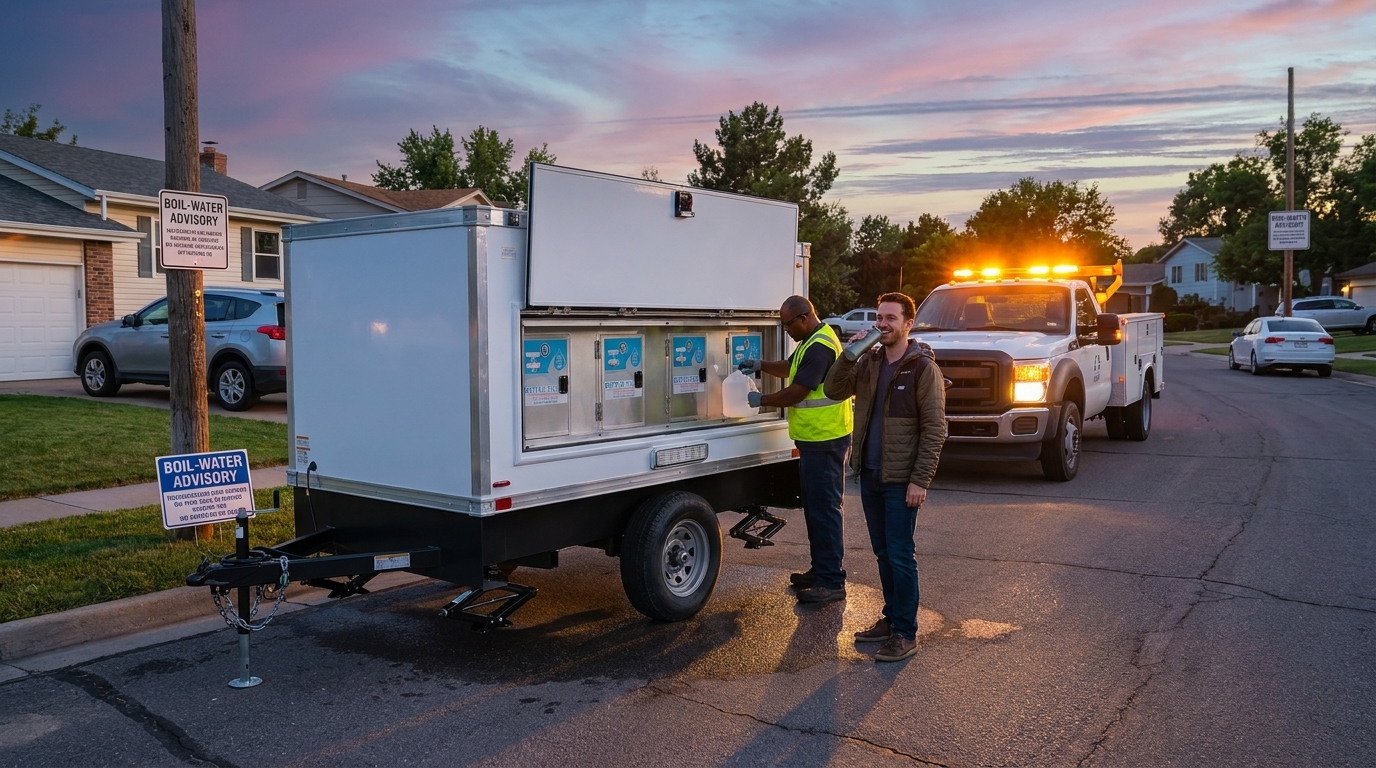
Boil notices, main breaks and disaster response where a community needs a fill point fast.
→
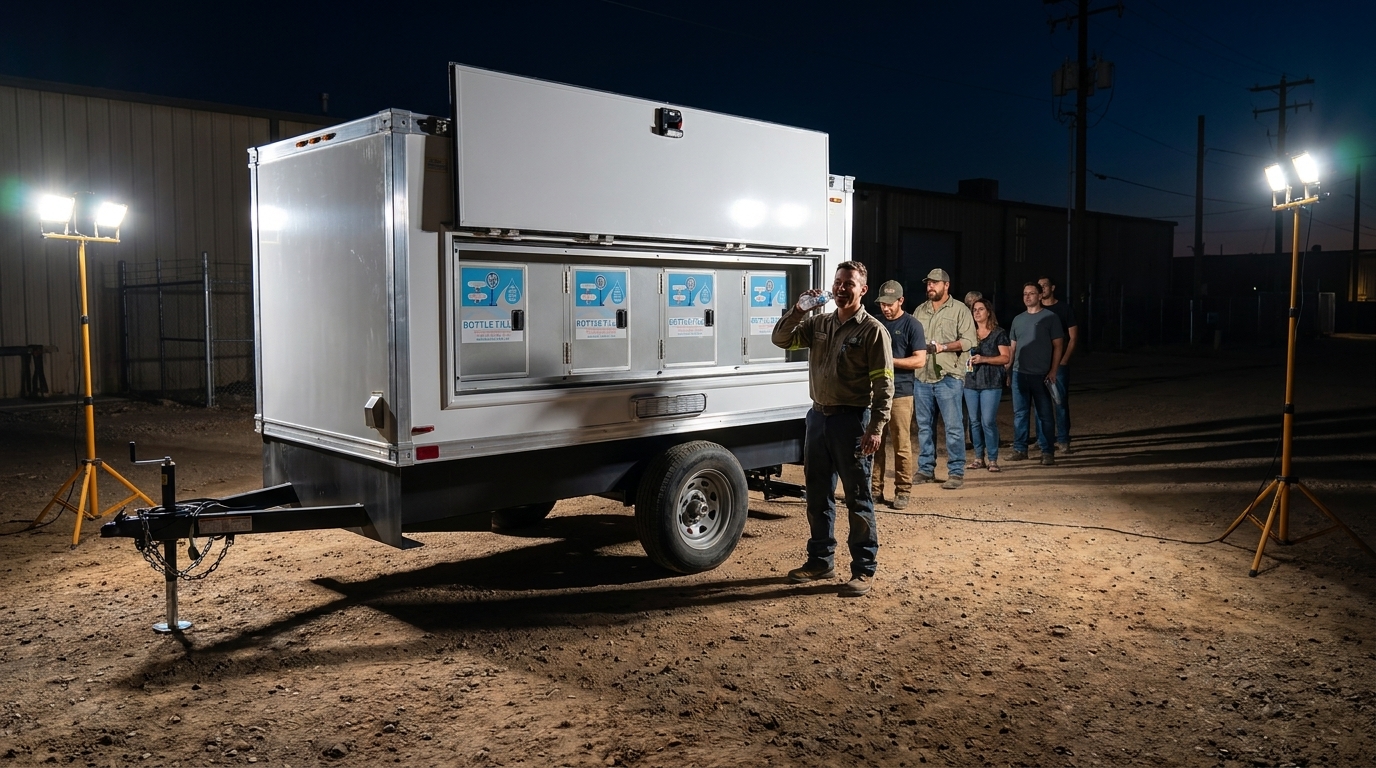
Heat emergency sites that open on short notice with no drinking tap near the people using them.
→
Remote sites on well or hauled water where a season of guests needs a safe fill point.
→
What outdoor crews are owed for drinking water and how documented access gets met.
→
The same fairgrounds and arenas that host camps, in their other life as event grounds.
We run water station rentals nationwide, and we keep dedicated local pages for the metros our trucks work hardest. Start with the closest one.
Booking this kind of work in a metro we already run? Start with water station rentals in Portland, mobile water stations serving Sacramento, water station rentals in Fresno, water station rentals in Bakersfield, mobile water stations serving Spokane, mobile water stations serving Tacoma, water station delivery around Denver and mobile water stations serving Flagstaff, and call us for anywhere else in the country.
 Willamette Valley
→
A staging and supply base for Cascade and eastern Oregon incidents all season.
 Sacramento Valley
→
Valley fairgrounds and county yards that become camps when the foothills light up.
 Central Valley
→
The gateway for Sierra incidents, with the season's hottest staging conditions.
 Southern San Joaquin
→
Grass and brush country where early season camps go up before the mountains do.
 Inland Northwest
→
A hub for multi-agency crews working timber and range fires east of the crest.
 South Puget Sound
→
Equipment and crew staging for Cascade incidents deep into September.
 Front Range
→
Front Range camps where altitude and dry air push consumption above the baseline.
 Northern Arizona
→
High country fires with camps on forest work centers and fairgrounds.
Give us the head count or the guest count, the date, and the spot it will park. We will spec the right setup, confirm the delivery window, and have cold filtered water pouring before the day starts.