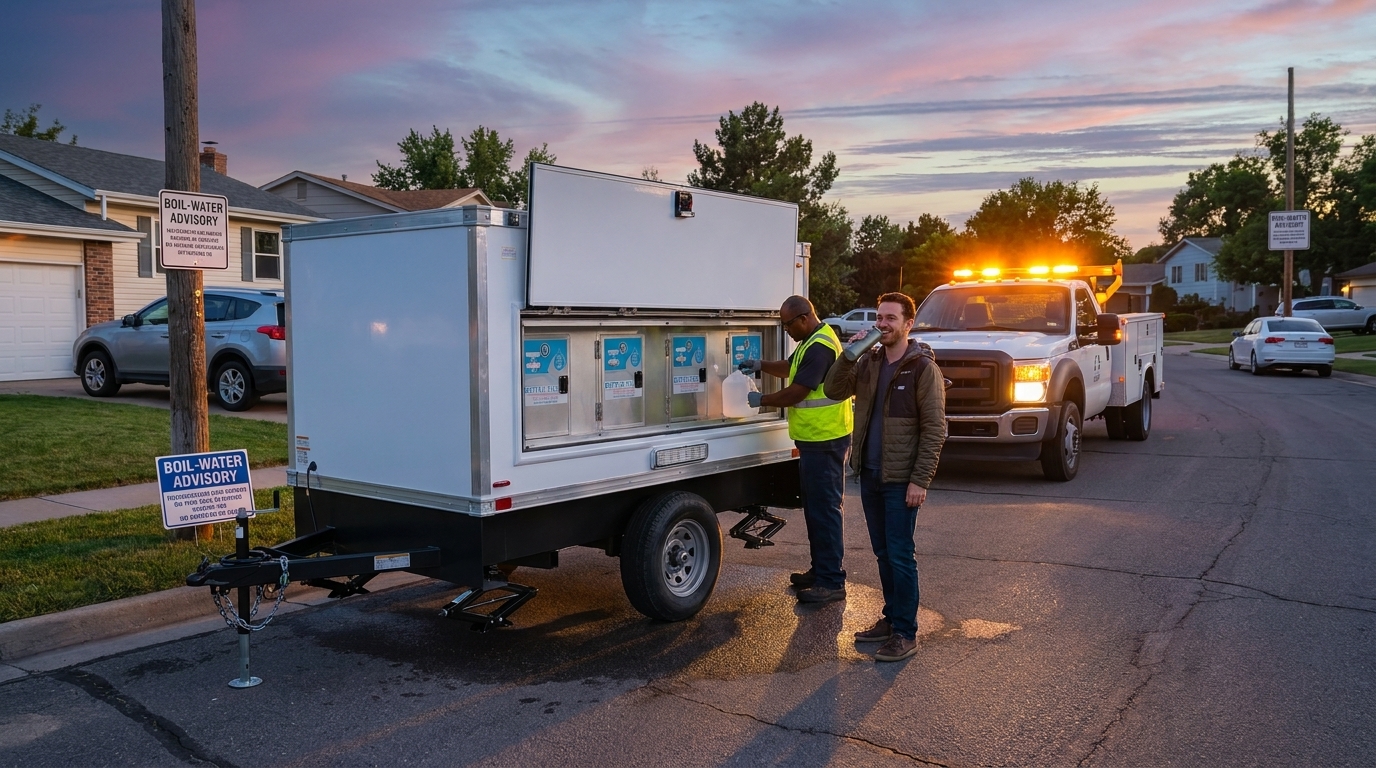
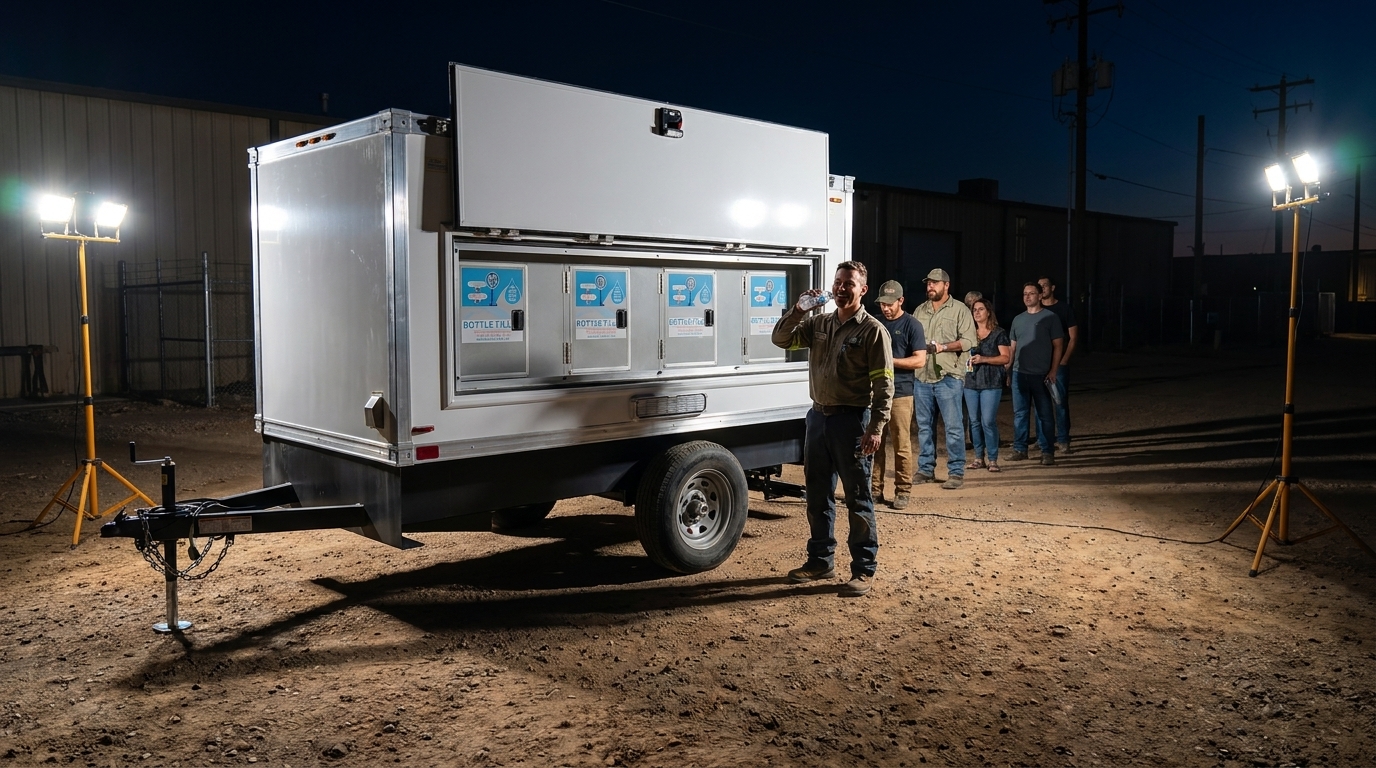
On-Site Hydration Services puts chilled, filtered drinking water in the middle of a working job site, and the trailer arrives leveled, plugged in and pouring before your crew takes a first break. The Signature Series carries 300 gallons and four bottle filling taps, so a highway spread gets a real water point instead of a gang box full of warm cases. So does a hospital addition. So does a solar field or a tract of houses. Tell us the headcount, the gate and the shift length and we will size it on the phone. Call us or ask for a quote, and on most routes we roll the same day.
Licensed and insured | A+ BBB rated | 24/7 dispatch
See the Signature Series water station specs
“We had two trades stacked on the deck and a cooler route nobody wanted to run. The trailer went in next to the hoist and water stopped being a daily conversation.”
“Our spread moves a quarter mile a day, and the water used to stay wherever we parked it Monday morning. They set it up so we tow it forward with the crew.”
“The question I used to dread on a walkthrough was where the water was and how much of it there was. Now I point at it. Cold, tapped, marked, and I can tell you the gallons.”
References for this kind of booking are available on request.
We have been parking drinking water trailers on active construction sites for years, and one lesson keeps repeating. Water that is far away is water nobody drinks. So we ask about the last two hundred feet of the walk before we ask about anything on a spec sheet. The Signature Series lands with 300 gallons on board, four filling taps, three stages of filtration, a UV lamp and a cooling unit that holds the water cold through an August afternoon. We run that same unit on a twelve house tract and on Denver Front Range job site water station rentals, so a superintendent gets identical equipment whether the roster says twenty people or twelve hundred. Call us with a headcount and a gate address, or ask for a quote, and we will tell you how many units the site needs and where they go.
One Signature trailer can pour for a weekend concert and be working a slab pour a couple of days later. Hiring one company for your events and a separate one for your worksites makes no sense. Either way, the planning, the delivery, and the refills are ours.
The onboard cooling unit keeps the tank genuinely cold all the way through a long afternoon outdoors, and that single detail carries the whole thing. Warm water is water people abandon, and midsummer is exactly when a crew or a crowd is drinking the most. Cold water gets finished, and finishing it is what keeps heat illness off the site.
Typical deliveries land in about 45 minutes once a truck is rolling in your metro, longer out on the rural routes, and we keep emergency runs going around the clock whenever a heat advisory or a power shutoff hits. The morning a foreman finds his 40-person crew stuck with one warm cooler, speed is the whole game.
One rule sits under every job we take: water that people walk past might as well not be there. We've stood on a bare site and watched shrink-wrapped pallets cook next to the job-trailer while the crew baked thirty yards off. We've watched the opposite too, a chilled station ten steps off the work face run bone-dry twice inside one shift. Everything that matters lives in the distance between those two pictures. Which is why we don't drop a unit and disappear. We match it to your headcount or your gate count, set the refill rhythm to how hard you're really pulling on it, and treat a heat call the way you'd want your own treated, meaning right now, because out here one hot hour can swing the whole day.
We deliver water stations to job sites, venues and event grounds in all 50 states, with the heaviest route coverage across the West.
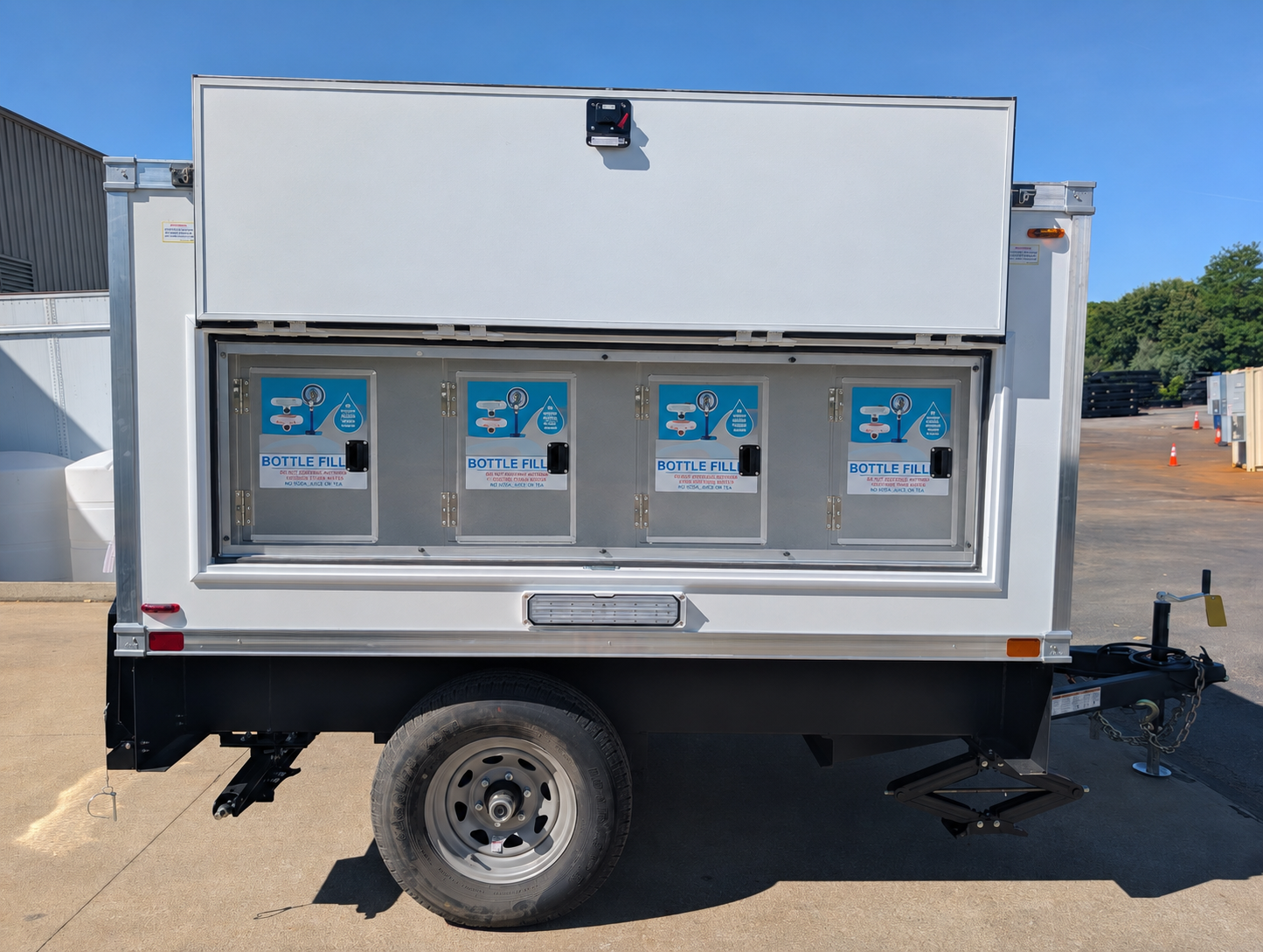
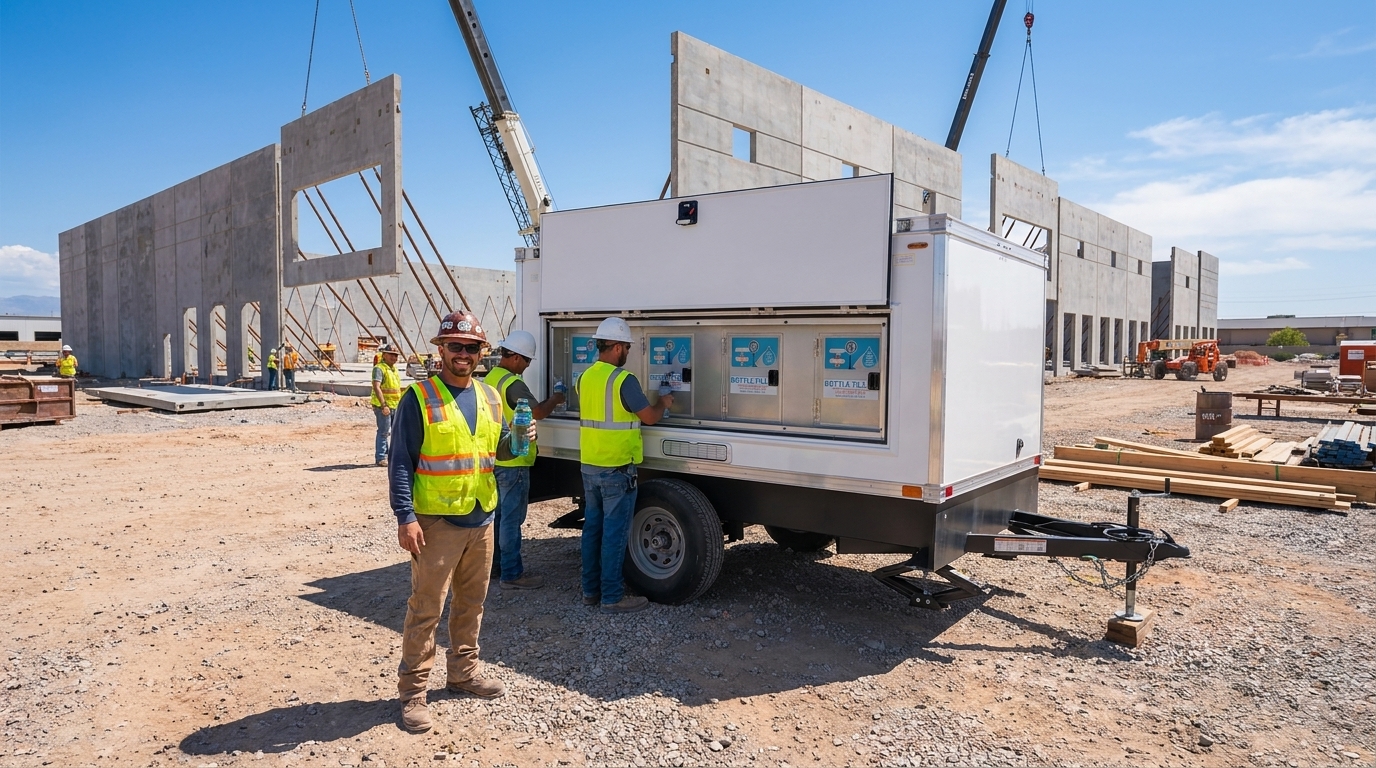
The Signature Series water trailer is a self contained drinking water point, and self contained is the only kind that works on a site where the permanent main is still a line on a drawing.
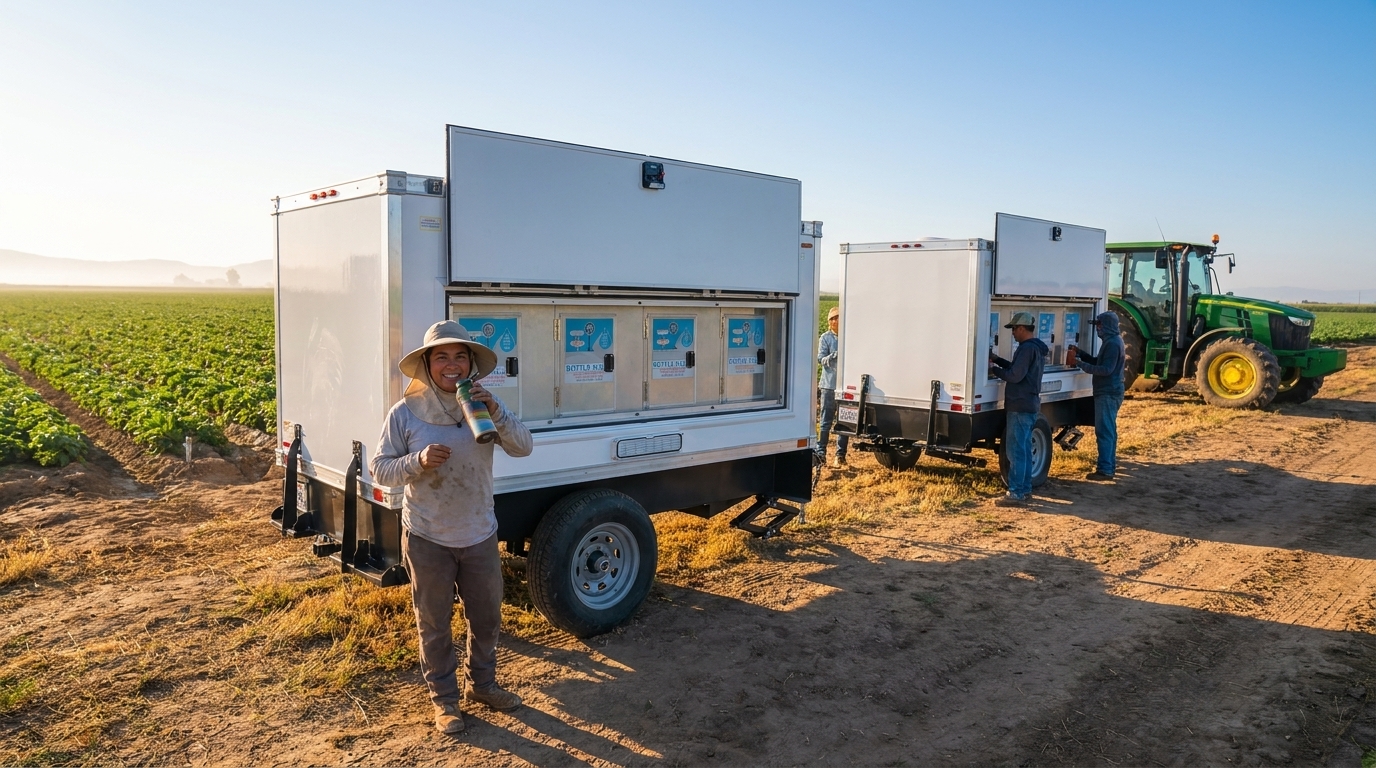
With a frame, a hitch, and tires under it, the unit hauls out to a remote build, an event field, a working orchard, or a disaster staging yard with equal ease. Contractors and event planners request this exact rig by name. The whole design is built around backing in, leveling off, and pouring cold by the same afternoon.
| No. of stations | (4) Bottle Filling Stations |
| Length | 12' 3" |
| Weight | 3,100 lbs. |
| Height | 8' |
| Fresh water tank | 300 Gallons |
| Power requirements | 1 to 4 dedicated 20A/120V circuits OR 1 dedicated 50A/240V circuit |
| No. of AC units | 1 |
Three hundred gallons ride on board, filtered in three stages for sediment, chlorine and fine particles, passed under a UV lamp, then chilled before the water reaches a tap. Four push back filling stations run at once. One takes a one liter bottle. Another takes a five gallon jug or a pack bladder. One of the four sits at ADA height. A rear jug filling station handles the coolers that ride out to a remote crew in a truck bed. A 25 person crew on an eight hour shift is owed 50 gallons of that tank.
The trailer is 12 feet 3 inches long, 7 feet 6 inches wide, 8 feet tall and 3,100 pounds, with one air conditioning unit keeping the cabinet and the cooling system in range. Power is 1 to 4 dedicated 20A/120V circuits, or a single 50A/240V circuit. That range matters more on a job site than anywhere else we work, because temporary power already carries a tower crane, a welder, an office trailer and a personnel hoist, and every new draw turns into a conversation with the electrician. A unit that runs off a standard circuit spur gets approved the same day.
It tows on a standard hitch behind a three quarter ton pickup, so it follows the same haul road the digging equipment came in on. We level it on jacks, and the jacks are why it works on base rock, compacted fill, a gravel laydown pad or the dirt shoulder of a widening job. A 200 gallon grey tank catches splash and rinse water instead of making a mud hole where people stand. And the whole unit moves in minutes, which matters most where the work face moves every week.
A water source people don't trust gets ignored, and an ignored station is rented money wasted. That's why municipal water doesn't reach the tap raw on our trailers. It passes through three filter stages and a UV chamber, then an onboard cooling unit drops the temperature. The result tastes clean and comes out cold, even on the worst afternoon of the year.
The opening filter traps sand, scale, and the fine grit local mains occasionally push through. On a dusty lot, that's what keeps a pour from tasting like the parcel it's parked on.
Activated carbon comes next, lifting the chlorine bite and the dull seasonal notes local tap can carry until the taste lands clean and neutral. When it's 100 out, that flavor decides whether a crew keeps drinking or walks past the tap dry.
A finer cartridge then catches the microscopic particles that slip past the first two, so what reaches the spout is clear rather than merely cold for the crews and crowds drawing off it.
The last step is an ultraviolet chamber that wipes out bacteria and microbes without adding a single chemical. Even after a long tow out to a remote site, the water off the nozzle is clean.
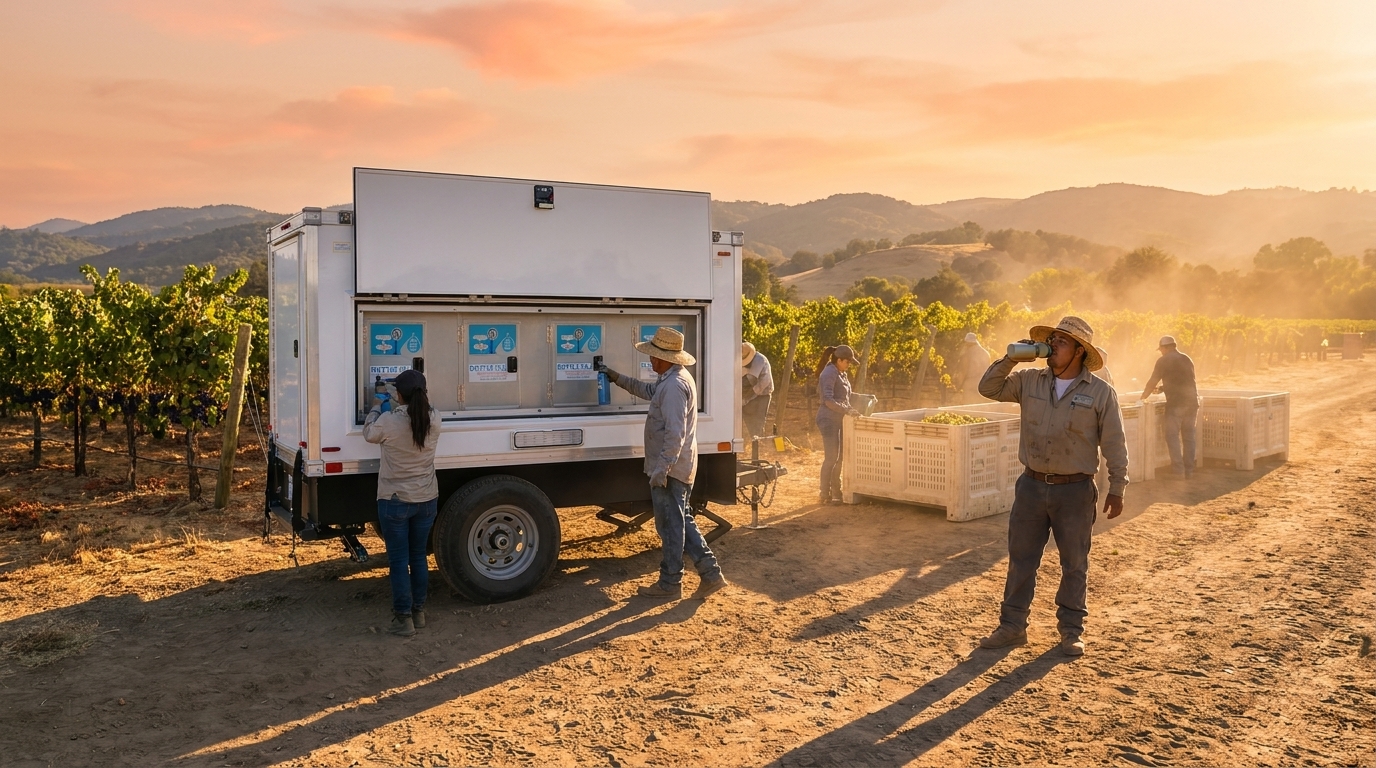
Along the wall sit four adjustable push-back taps, press a bottle to the bar and it pours. One of them is set at ADA-reachable height, so a single trailer includes everybody in a crew or crowd with no add-on gear. Out back, a large-jug spout services five-gallon coolers and hydration packs, while a bank of hose connection taps handles work-site chores, event support, and refills down the orchard rows. Stainless, food-grade plumbing the whole way through keeps the filtered, chilled water at quality right to the spout.
Every Signature trailer carries a 300-gallon load, roughly 2,400 cups at sixteen ounces each, and we recharge it on demand, so the unit doesn't turn into the choke point on a busy shift or a packed show night.
A drinking water station is not one decision. It is a placement decision. It is also a refill decision and a moving decision. Which one dominates depends entirely on what kind of work the site is doing.
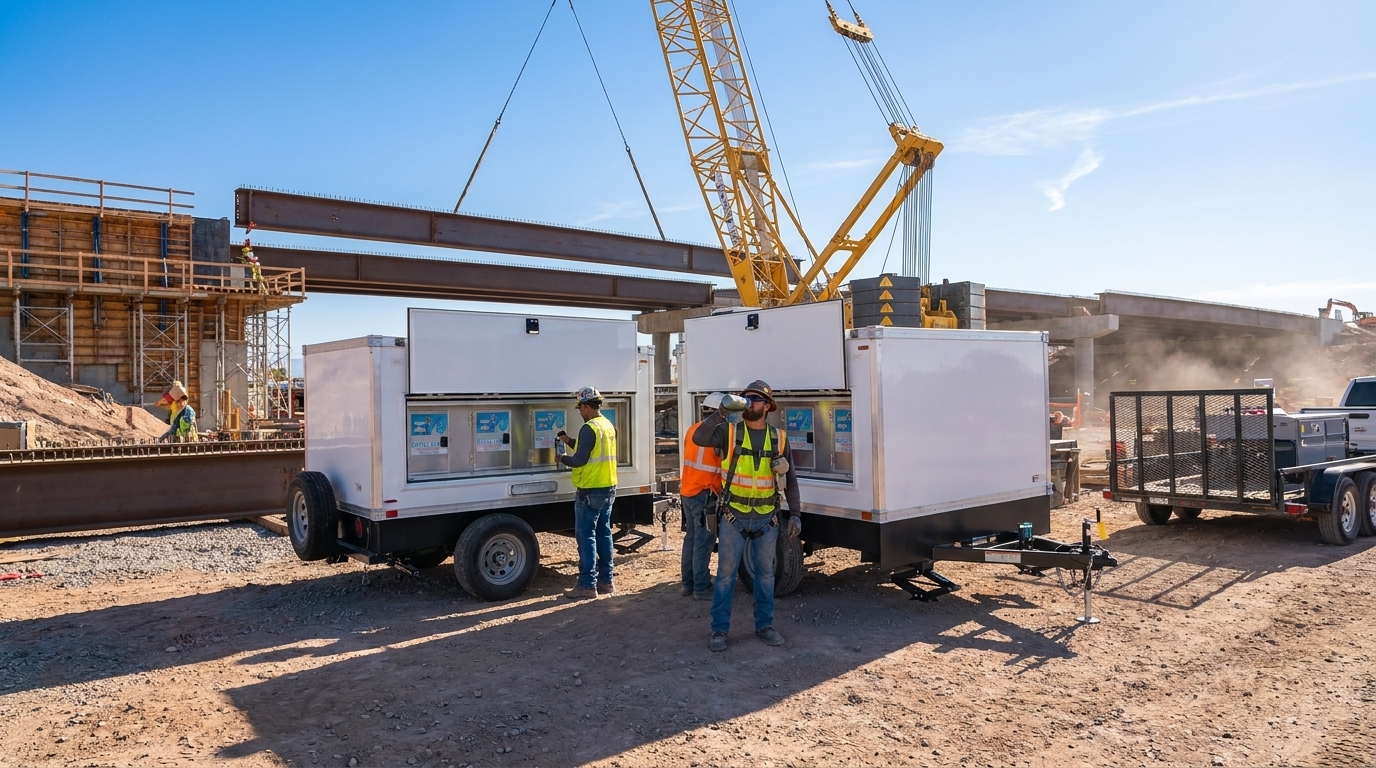
On linear work the water problem is distance, and it grows every hour. A paving train walks a lane. A pipeline spread lays a quarter mile a day. A transmission crew hops structure to structure. The federal heat rule still under review puts the standard plainly: water is not readily accessible if it sits at a distant or inconvenient location relative to where people are working, or if it is locked inside a trailer.
Timing makes it worse. Road work runs hours that fight the heat and lose anyway: a 4 a.m. start that ends at 2 p.m. in the worst part of the day, a night pour on pavement still holding the afternoon, a shoulder crew with fresh asphalt radiating from one side. And a traffic control worker cannot leave a post to get a drink. We run the same setup on Sacramento construction water station rentals, where valley jobs stack 100 degree afternoons all week.
What goes wrong is almost never the equipment. It is that the water stayed where the trucks parked on Monday. A trench crew will not climb a ladder out of an eight foot excavation for a warm bottle, so they wait. On a mile of work face with one water point at the field office, the crews at the far end are working with no water at all.
So we set these up to move. The trailer goes on the shoulder inside the cone taper. It sits a couple hundred feet behind the work, and the foreman tows it forward twice a day. We size the refill interval against the roster and the shift length before it is ever parked, because a ten hour day burns a tank faster than an eight.
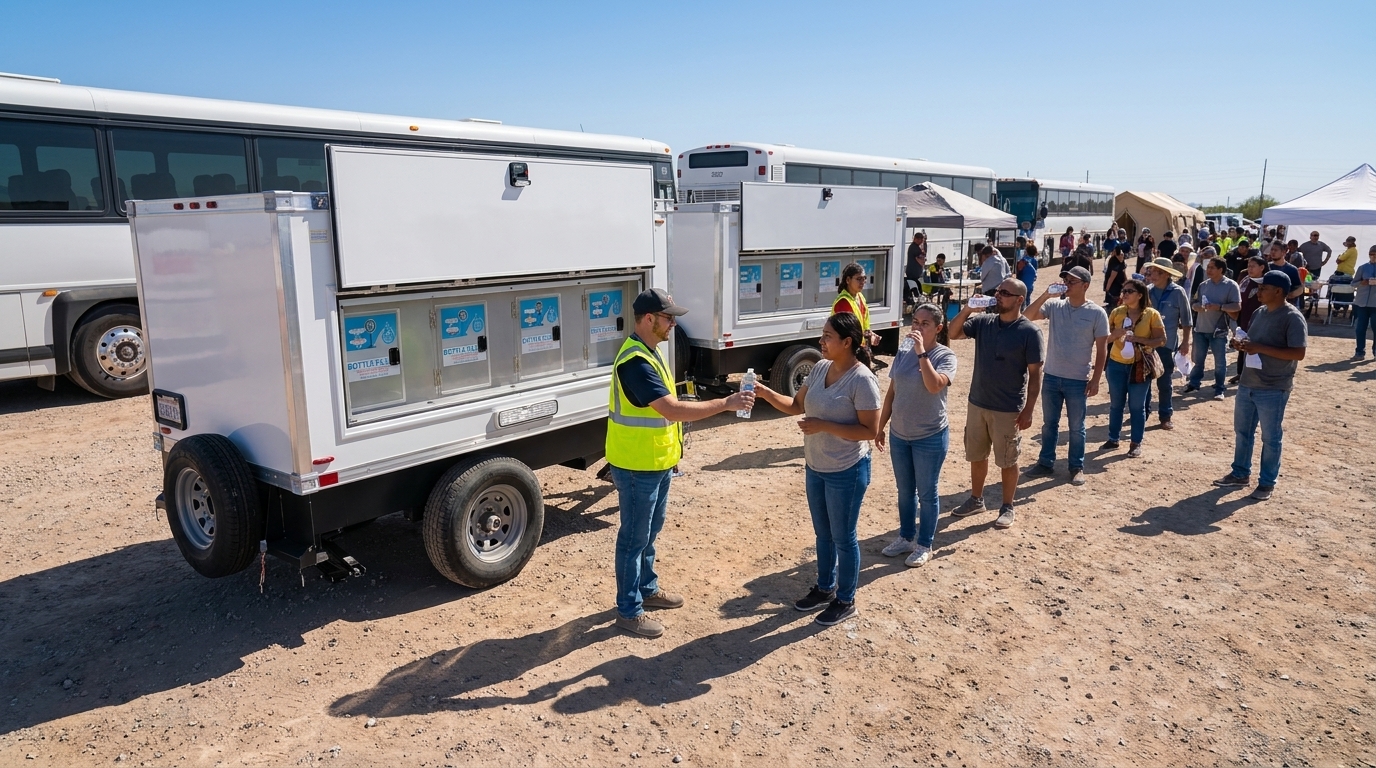
On a vertical build the distance is not horizontal, it is stairs. A deck crew on the twelfth floor with the only water at the gate either rides the hoist down and turns a fifteen minute break into twenty five, or does not go. Superintendents see it in the schedule before they see it in the safety numbers. Put a station at the base of the hoist, send jug fills up with the material, and the walk stops being a reason to skip a drink.
The roster on vertical work is a roller coaster. A structure job runs forty people for weeks, then a deck pour brings 160 through the gate at 3 a.m. and everybody leaves by noon. Drywall and mechanical rough in stack trades floor by floor. Sizing to the average is how a site runs dry in the week it can least afford to, so we size to the peak week. Seattle water bottle filling station rentals follow the same pattern on hospital and campus jobs.
Skin and roofing crews are their own case. A membrane roof in July throws heat back at the crew standing on it, and a glazing crew on a swing stage has no practical way to leave the stage. Those get planned separately: a station at the top of the stairs on the working roof rather than at grade.
Inspections are the other reason building sites like a fixed station. When somebody asks where the drinking water is and how much of it there is, a superintendent walks twenty feet and points at a marked, tapped, chilled source with a known tank capacity and a delivery date on paper.
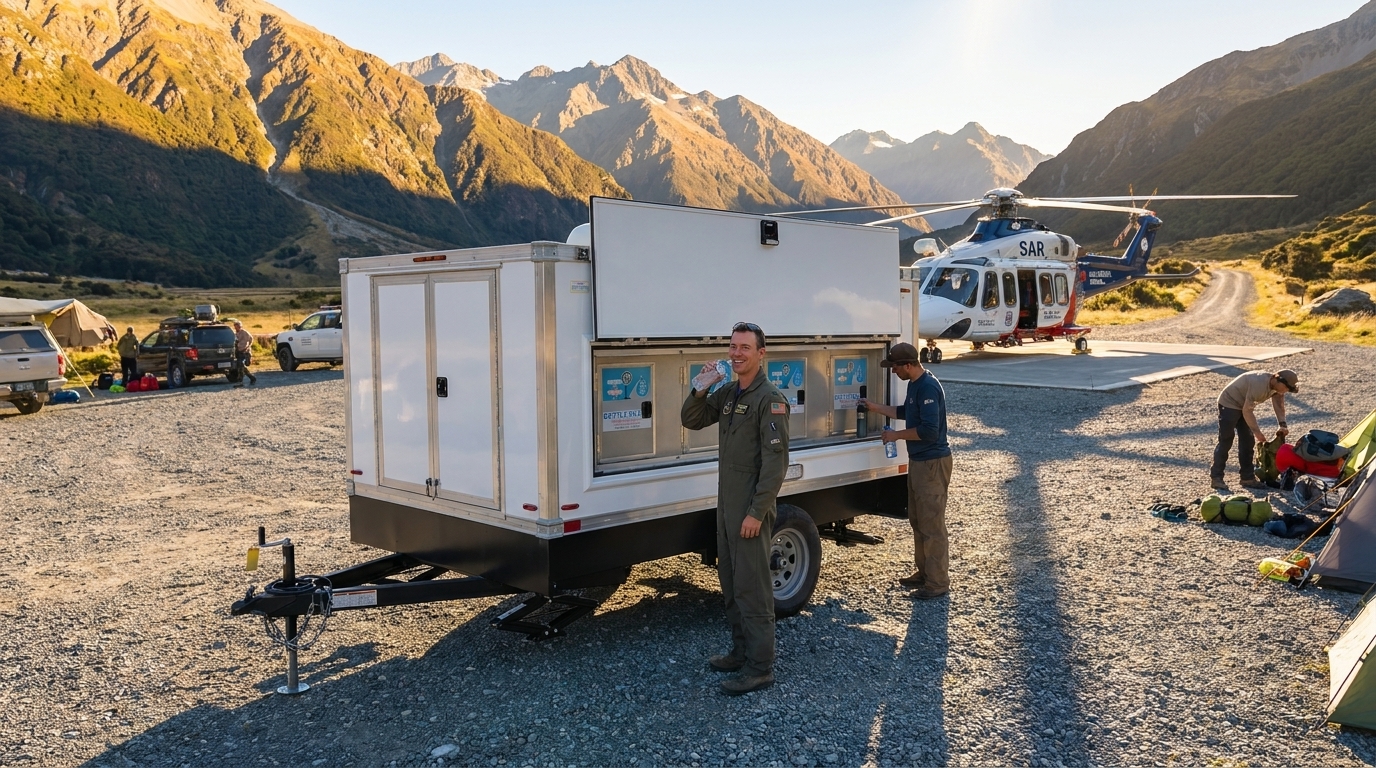
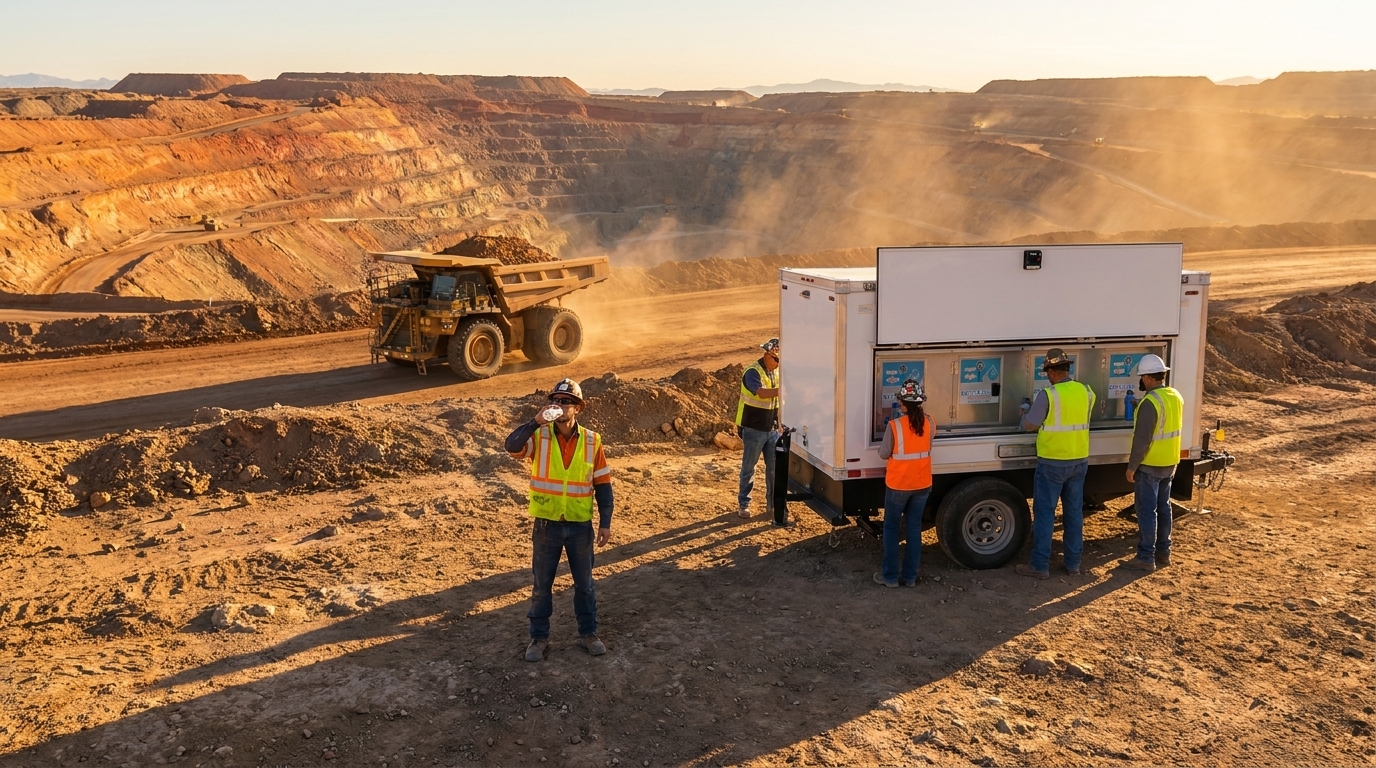
Past a certain headcount the water question changes shape. A utility scale solar field puts 300 to 1,200 workers on raw ground with module rows that run a mile, parking a half mile from the work face, and no permanent water until the job is nearly over. A data center campus runs that way for a year. So does a battery plant or a warehouse megasite. The instinct is to make the water point bigger. The right move is to make it closer.
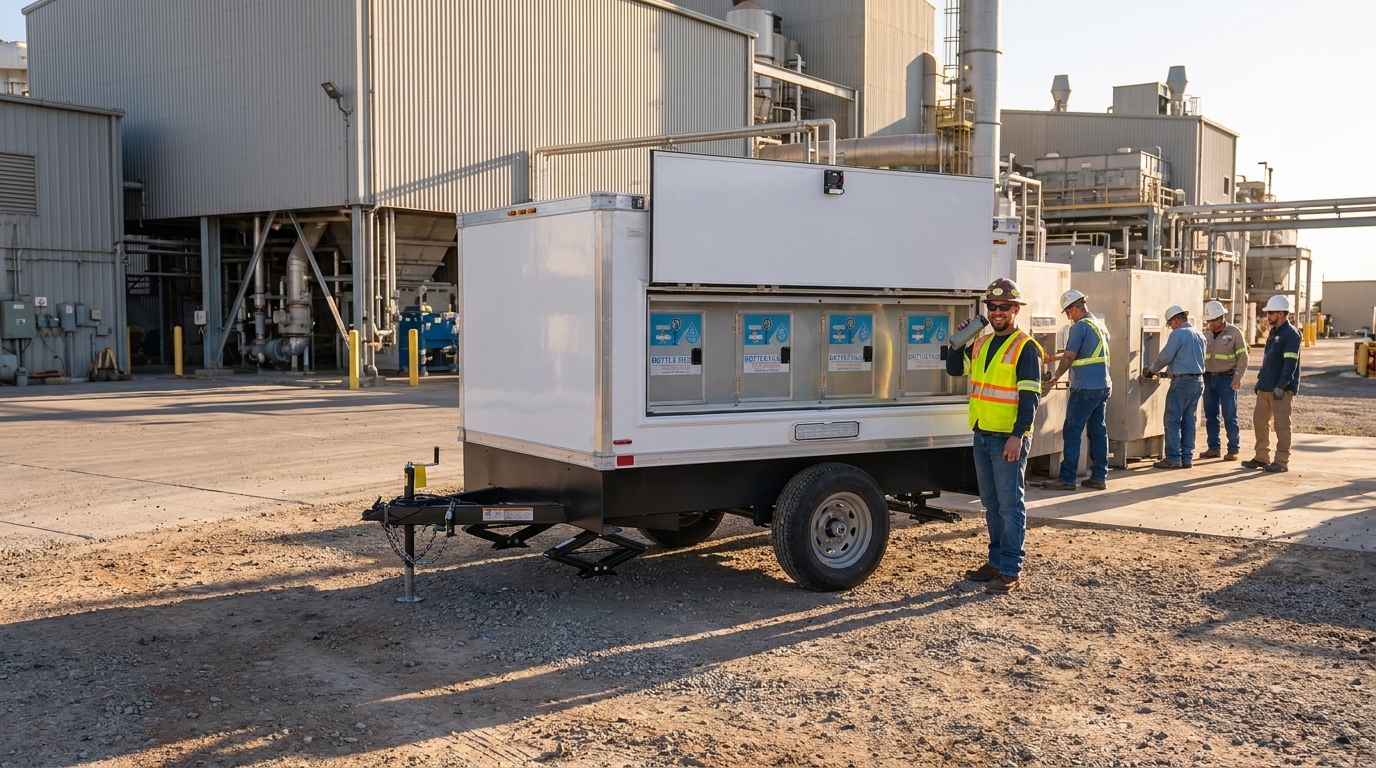
Plant turnarounds are the intense version. A refinery turnaround brings hundreds of contractors through a gate for a fixed window, runs around the clock, and puts people in fire resistant clothing and full safety gear in midsummer. Vapor barrier clothing is why Washington's heat rule sets a second action level at 52 degrees for crews wearing it. Night shift gets sized exactly like day shift, because steel and concrete hold the afternoon well past sundown.
The cooler model stops working here, and it is not close. The federal heat rule's cost analysis assumes 40 quart coolers at one per 40 employees, filled again as supply runs down. Run that against a quart per worker per hour: a 300 person crew on an eight hour shift needs 600 gallons, which is 60 cooler refills a day, and the person pushing that cart is doing nothing else. Somewhere past a hundred workers, a fixed tank on a refill schedule becomes the only version a site can execute.
So we zone the site before we deliver anything. We walk it with the safety manager, split the work area into zones that match how crews actually travel, put a station in each, and set a refill route timed to shift change. One named contact per zone, and a plan for moving stations as the work face marches.
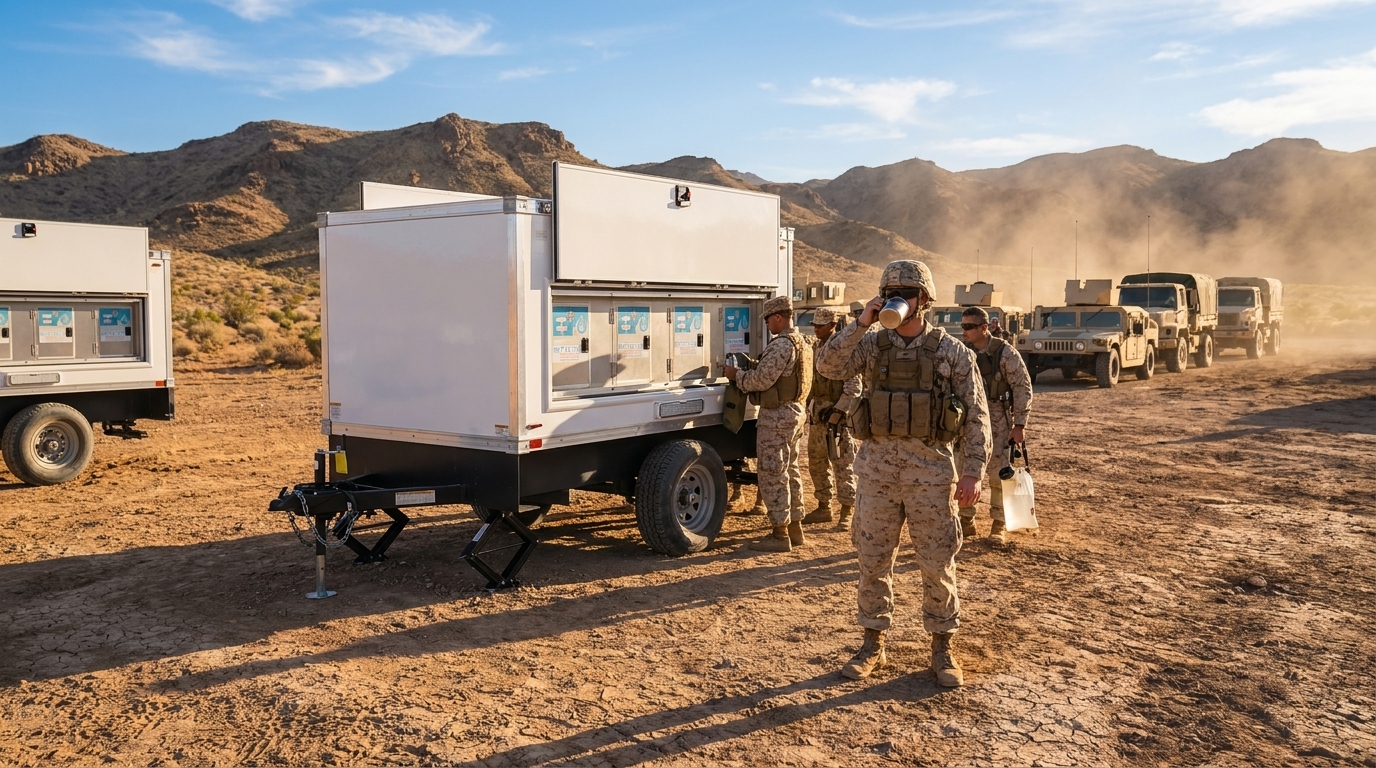
None of this should cost a superintendent a morning. We work around the pour, the crane pick and the gate, and we ask our questions once.
The call we want is short. Headcount now and at peak manpower, the gate address and whatever ID our driver needs, whether the approach is paved, base rock or dirt, the power source, and one contact who answers during your shift. On most routes we deliver the same day.
Placement is where the job gets won or lost, and it is a five minute walk, not a drawing exercise. We want the unit at the break area and near the work face, not wherever the site plan has room. Off the haul road, out of the dust, on ground firm enough to hold jacks. Two gates almost always means two units rather than one bigger one, because distance beats capacity every time. Bakersfield potable water trailer rentals get the same walk around.
What goes wrong is growth, refills and access, in that order. A job adds a hundred people for a pour week and nobody tells the water vendor. A ten hour shift replaces an eight and the tank runs dry an afternoon early. Or the unit ends up inside a fenced laydown yard that gets locked at close, which is the exact failure federal regulators have described in writing. Water behind a locked gate is not accessible water.
Refills run on a schedule we agree to up front, adjusted the day your numbers move rather than the week after. Pickup is on your call. We drain the fresh tank, pump the grey tank to an approved disposal point instead of onto the dirt, and leave the pad the way the site handed it over.
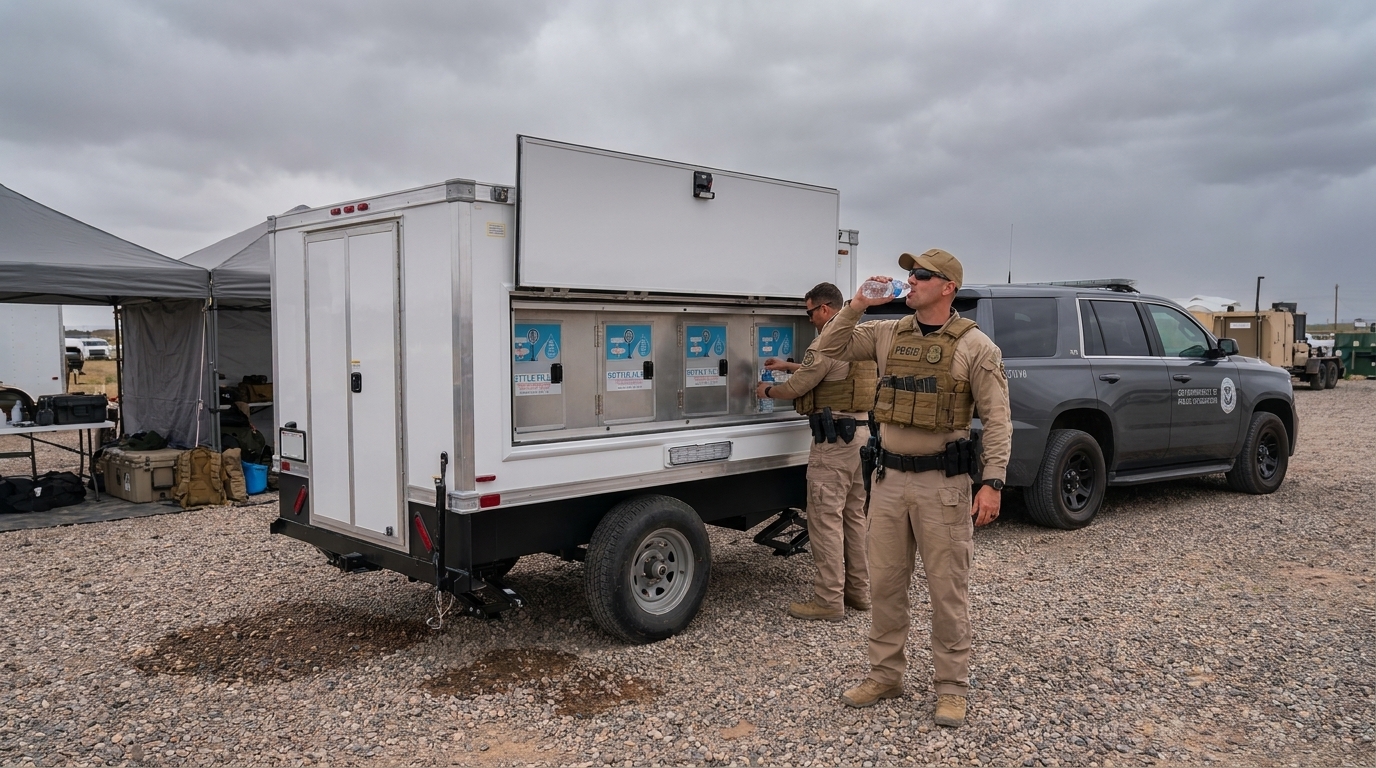
People count, number of days, where exactly it parks on your site, and what power is there. Those four answers let us spec it correctly the first time around.
Reckon roughly 45 minutes from the nearest yard once we are in your metro, longer on the outer routes, with round-the-clock emergency runs whenever a heat advisory or a power shutoff hits.
Once on site we set it level, charge the 300-gallon tank, and tie in power off one to four standard 120V circuits, or a single 50-amp 240V drop, depending on what the site gives us.
After that the tankers cycle back on a cadence matched to how fast your crew or crowd pulls it down, and we maintain the unit through the whole rental term.
No power on the parcel at all? We price that in. The unit draws very little, and with the service fleet backing it we've run stations on lots that had no permanent power whatsoever. Lay out what the site offers and the rest is on us.
Want this math run for your own booking? Two minutes on the phone gets you a real number.
One quart per worker per hour is the figure every rule that sets a figure has landed on. Everything below is that number multiplied by your roster and your hours.
| Site work or utility crew, single shift (up to 25 workers) | 1 station |
| Crew that moves with the work face (up to 30 workers, moving) | 1 station, moved twice a day |
| Commercial build, two or three trades (40 to 60 workers) | 1 station, filled again midshift |
| Vertical build at peak manpower (100 to 150 workers) | 2 stations, gate and hoist |
| Solar field or industrial site (250 to 400 workers) | 3 to 4 stations on a refill route |
| Turnaround or megaproject at full manpower (600 workers and up) | stations by zone, filled again on a schedule |
| Night shift on a summer job (up to 50 workers) | 1 station, same placement as day shift |
Start with the quart. At one quart per worker per hour, a 25 person crew drinks 6.25 gallons an hour and 50 gallons across an eight hour shift. Fifty workers is 100 gallons. A hundred workers is 200. Three hundred workers is 600. Stretch those crews to a ten hour day, normal on commercial and infrastructure work, and the numbers become 62.5, 125, 250 and 750 gallons. That is the whole model, and it is the one we use on Fresno job site drinking water stations.
Then account for what moves it. The NIOSH fluid replacement table runs as high as six cups an hour for hard labor in the worst heat bands, which takes that 25 person crew to 75 gallons in a shift and the 100 person crew to 300. Shift length moves it more than people expect, because the hourly rate does not change when the day gets longer. Every jug fill that leaves in a truck bed comes out of the same tank. And headcount is never flat, so the peak week is the number that matters.
Our honest default is this. One 300 gallon station covers a 25 to 40 person crew for a normal eight hour summer shift with real margin, and a 60 person crew with a midshift refill. Past about 100 workers, split the site rather than chase capacity, because two stations at two gates beat one big station at one gate. Past roughly 150, the cooler route is finished: at one 40 quart cooler per 40 employees, a 25 person crew already burns five refills in a shift.
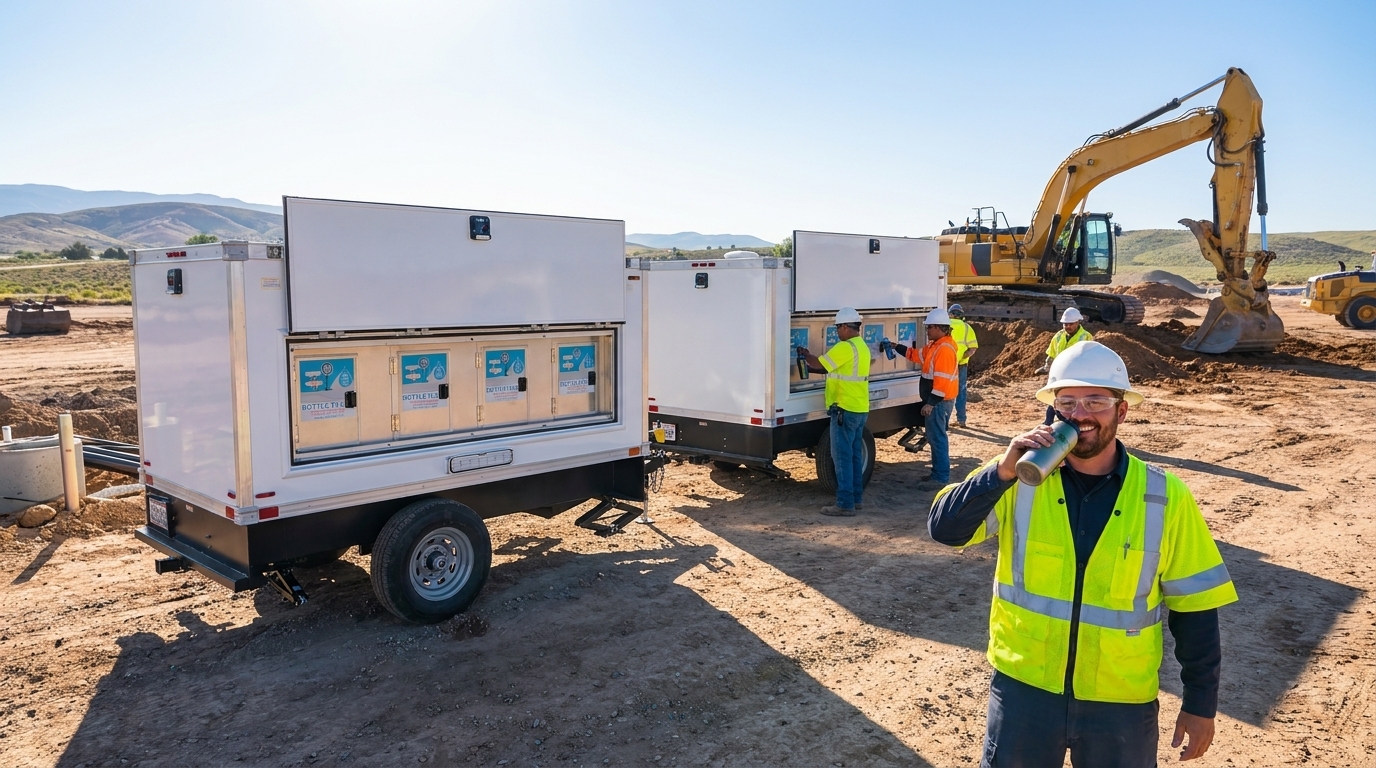
The binding federal text for construction is 29 CFR 1926.51, and it is shorter than most people expect. Subsection (a)(1) requires an adequate supply of potable water in all places of employment. Subsection (a)(2) says portable dispensing containers must be capable of being tightly closed and equipped with a tap, and that water shall not be dipped from containers. Subsection (a)(3) requires every container to be clearly marked and used for nothing else. Subsection (a)(4) prohibits the common drinking cup outright. Subsection (a)(6) defines potable water by the state or local drinking water standard, or the EPA National Primary Drinking Water Regulations at 40 CFR Part 141. Read it twice and you will notice what is not in it: a number.
The numbers come from the states. California Title 8 CCR Section 3395 sets one quart per employee per hour for the entire shift, fresh, pure and suitably cool, as close as practicable to where people are working, with shade above 80 degrees, high heat procedures above 95, and close supervisor observation through a new employee's first 14 days in high heat work. Washington WAC 296-62-095 has applied year round since 2023, with action levels at 80 degrees and at 52 for crews in vapor barrier gear, the same quart per hour, a paid 10 minute cool down every two hours at 90 degrees and 15 minutes every hour at 100. Oregon OAR 437-002-0156 writes it in ounces, 32 per employee per hour, triggered by a heat index of 80 rather than air temperature, with water kept cool at 66 to 77 degrees or cold at 35 to 65. Nevada R131-24AP took a different route: adopted October 2024 and enforced since late April 2025, it requires a written job hazard analysis and a written plan addressing potable water by direct reference to 1926.51(a)(1), for employers with more than 10 employees.
Then there is the federal rule still working its way through. The proposed heat standard was published in the Federal Register on August 30, 2024 under docket OSHA-2021-0009, with an initial heat trigger at a heat index of 80 degrees and a high heat trigger at 90. Proposed Section 1910.148(e)(2) would require access to one quart, 32 fluid ounces, of suitably cool drinking water per employee per hour for the entire shift, plus a shaded or air conditioned break area, and for mobile crews it would require that shade and water move with the work. It is not final. Meanwhile federal heat enforcement runs through the General Duty Clause, Section 5(a)(1) of the OSH Act, under a national emphasis program that has produced thousands of heat related inspections since 2022.
Who carries it is worth saying plainly. The duty sits with the employer of the exposed worker, which on a multi employer job means every subcontractor on the property, with the general contractor looked at as the controlling employer on top of that. One California landscape contractor drew that state's first willful serious heat citation in more than five years, carrying six figure penalties, after a complaint found a crew working above 95 degrees with no water, no shade and no training. But the record carries a harder lesson than the penalty column. In several fatal construction heat cases the worker had water available and had been drinking it shortly before collapse. Monitoring, cool down response and the first two weeks of acclimatization are what those files turn on. Our part is narrow and we are good at it: a dated, cold, tapped, marked potable water source sitting where the crew is, with a capacity number you can say out loud. The same question shows up on fire camp water station rentals, where an agency contract asks for it in writing.
Federal OSHA heat illness prevention guidance and the CDC and NIOSH heat stress program point at the same baseline: cool drinking water, close to the people doing the work, and documented.
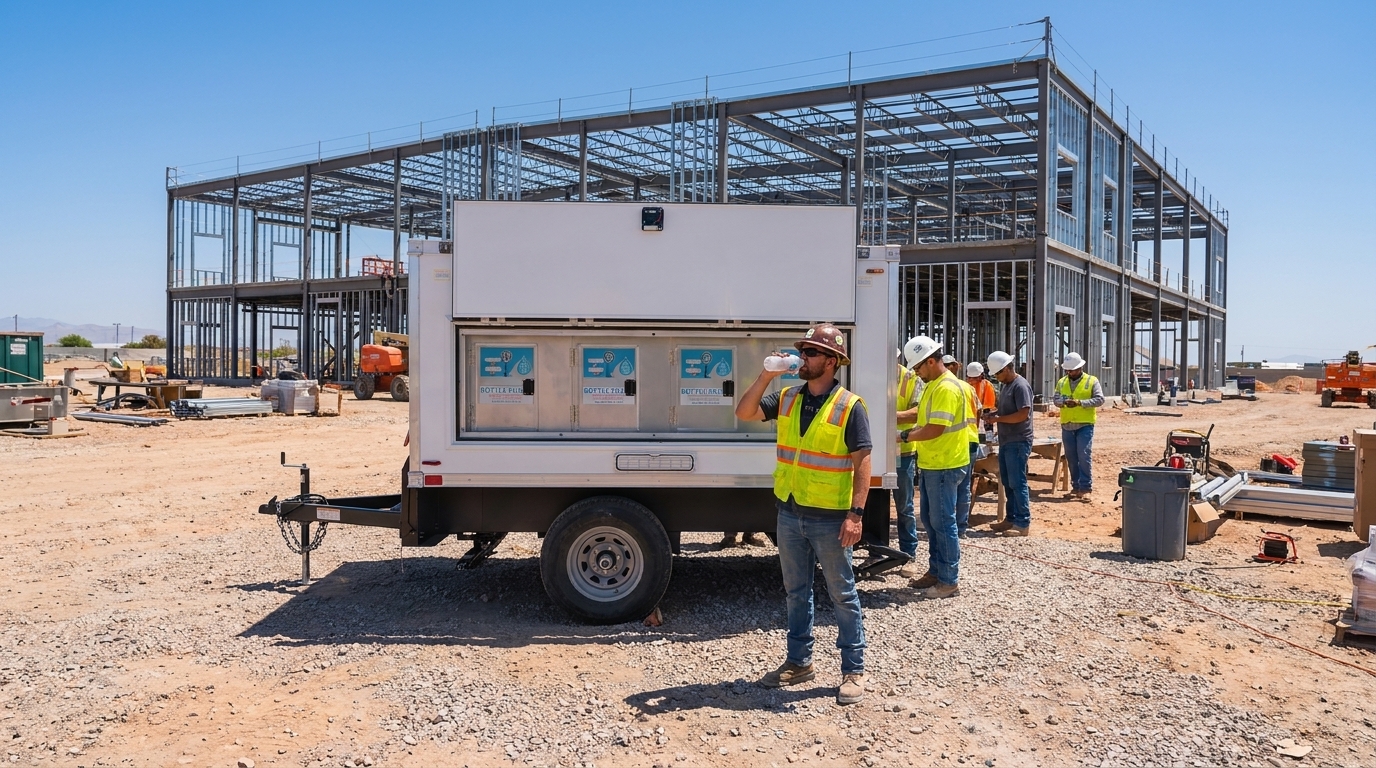
Need a station your written heat plan can point to? We can have one pouring cold within days.
Look at who does this work today. On most sites it is a foreman or the newest apprentice making a morning run, hauling cases in, icing two coolers by the gang box, then doing half of it again at lunch. Call it 45 minutes of a skilled person's day, five days a week, through a five month summer. Nobody puts those hours in a cost code.
Then look at what it leaves behind. Pallets taking floor space in the conex, empty bottles filling a dumpster hauled by weight, ice that is water by one in the afternoon, and a cooler nobody filled again sitting in the sun at two. That last one is the real failure, because a warm bottle does not get drunk. The federal cost model assumes a 40 quart cooler per 40 employees filled again as supply runs down, which sounds manageable until you count refill cycles against a 200 quart day.
And look at how it answers a question. Cases of sealed bottled water meet the letter of the container rules, and nobody writes a citation over a pallet of them. But a stack of cases is not a water point, and it does not answer the two questions asked on a walkthrough: how much, and how close.
Look at everything bottled water actually demands of a person: cutting the order, receiving and breaking down pallets, icing coolers before dawn, topping them up through the day, then flattening empty bottles for the bin. On a large crew that's hours of paid time burned every single day, scraped right off the work that's supposed to be getting done. The trailer erases that loop entirely. A local contractor once let us pencil it out with him, and the recovered labor by itself paid for the unit. His words were that the bottle runs had been quietly costing him close to a day of payroll a week. Our trailer arrives full, the tankers keep it full, and your superintendent owes it nothing but a parking spot.
Ice a cooler at 6 a.m. and by mid-morning in July it's as warm as a bath. Warm water is water people stop touching, and the slowdown that follows is precisely where heat illness gets its opening. A chilled station never rides that warm-up curve at all. Whatever pours at clock-out is as cold as the sunrise fill, which happens to be the moment a spent crew, or a crowd deep into a long concert, leans on it hardest.
Bottled-water pallets devour staging space, jam the lay-down area, and sit cooking in the sun until somebody finally cracks them open. Empties build up faster than anyone keeps up with, and on a tight commercial lot that pile turns into its own problem. Set a trailer in one parking stall instead and it serves a crew or crowd that would otherwise burn through hundreds of plastic bottles every day.
Every bottle bought is a bottle thrown out, and across a season a busy site or event generates a small mountain of them. That's a disposal line on the budget, a dent in the sustainability numbers, and, given that a single bottle can linger in the ground for centuries, a footprint that lasts longer than the project that made it. Move to a refill station and the line drops to zero, which finally gives your reporting a figure worth publishing.
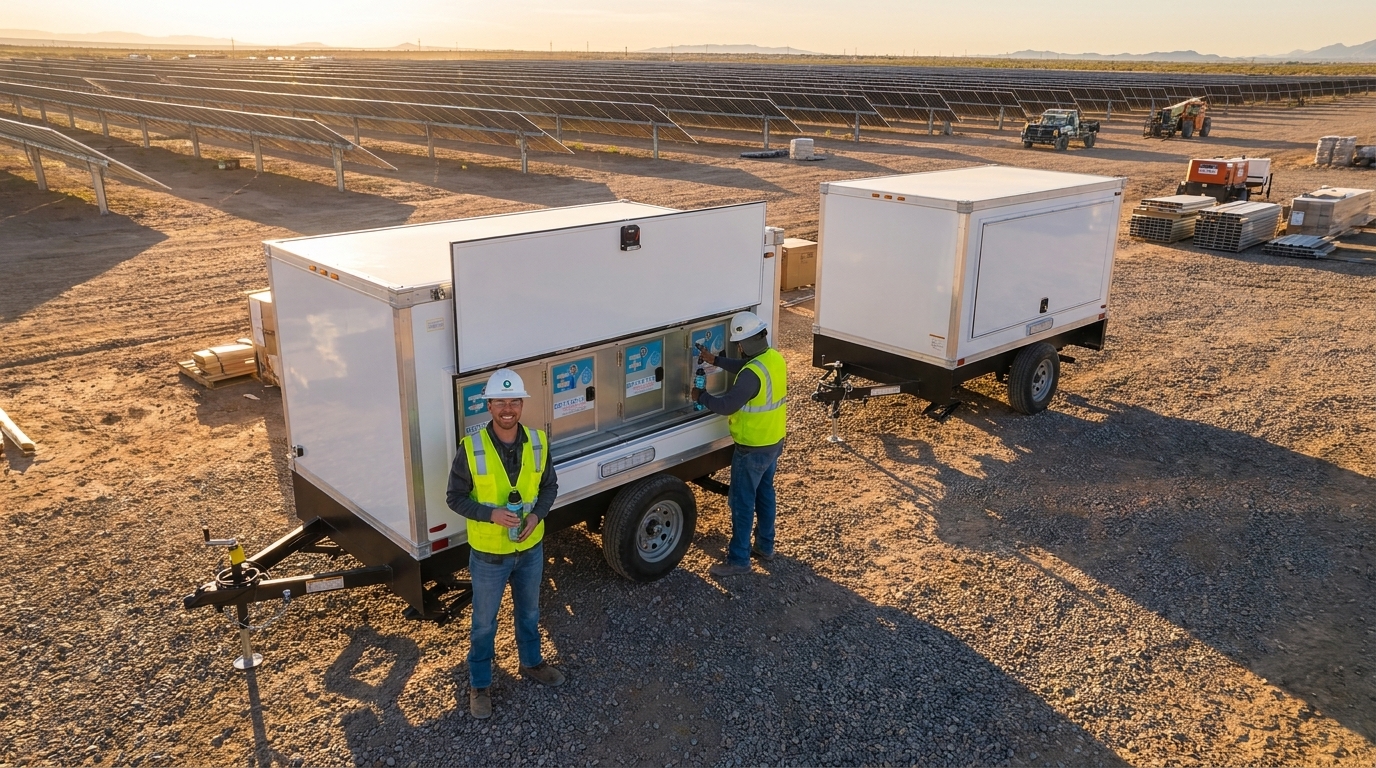
Three bookings of this kind, and what we planned around on each one. Names and details are kept generic on purpose.
Highway widening job, 28 person crew, second week of July. The call came from a general superintendent who had already lost an afternoon to a near miss. His water sat at the field office at one end of a mile of shoulder work, and the paving crew at the far end had quietly stopped walking back for it. We set the trailer on the dirt shoulder inside the cone taper, a couple hundred feet behind the paving crew, and showed the foreman how to tow it forward as the work moved. The refill interval we set against 28 people on a ten hour shift, 175 gallons, held all summer.
Hospital addition, 140 workers at peak, late August. Two trades were stacked on the fourth floor deck and the only water was at the gate. Breaks ran long because the stair climb ate them, and the safety director saw it in his own numbers before anyone said a word about heat. We put one station at the gate and a second at the base of the hoist, then ran jug fills up to the deck twice a shift. Break length came back down inside a week.
Solar field, 380 workers across three zones, first heat wave of the season. The site had run the cooler route since the first module row went in, and it had just added 120 people. We walked it with the safety manager and split the work area into three zones that matched how crews actually traveled, with a station in each and a refill route timed to shift change. The number that decided it was not ours. At a quart per worker per hour, 380 people on a ten hour shift are owed 950 gallons a day, which is 95 cooler refills.
Service information current as of September 2026.
Still weighing it? Call and ask. Most of these questions get settled in one short conversation.
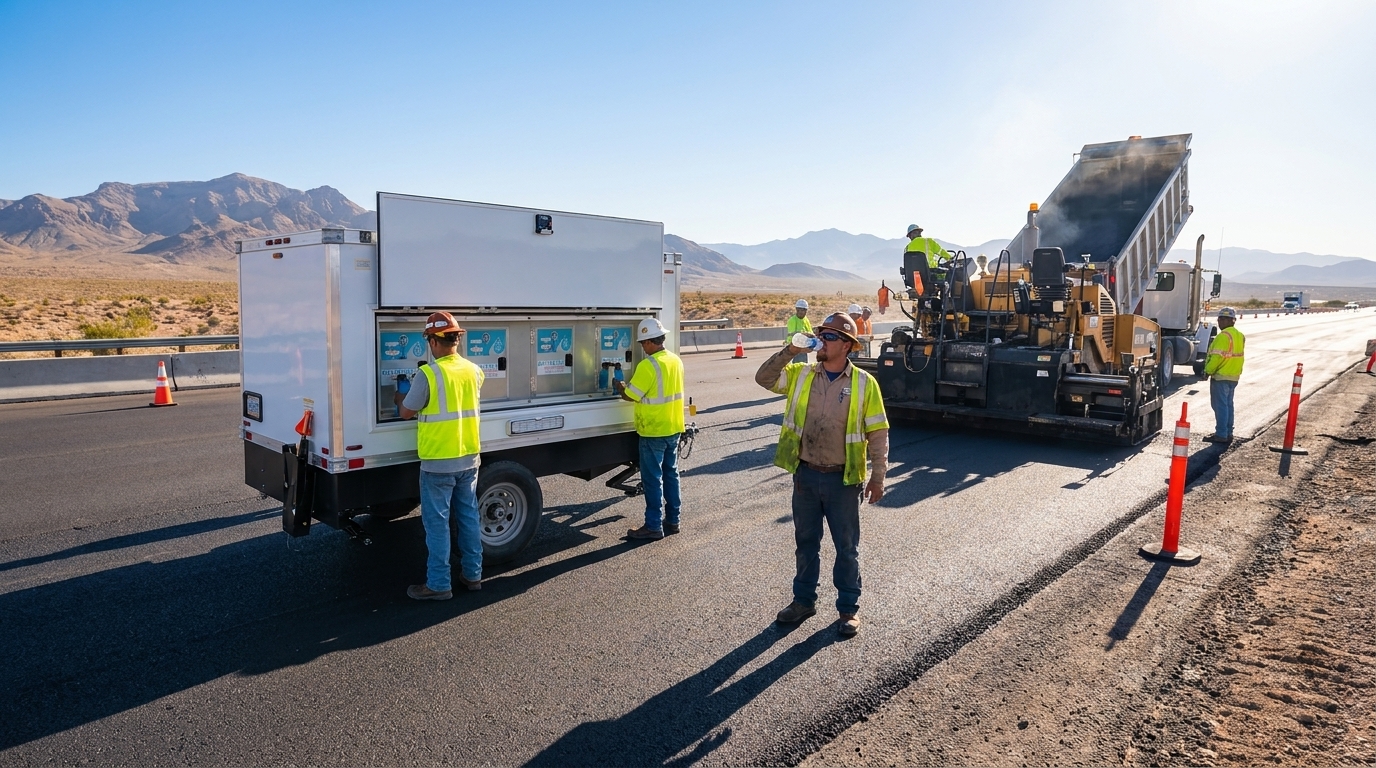
The federal construction standard, 29 CFR 1926.51(a)(1), requires an adequate supply of potable water in all places of employment, and that is where the federal text stops. No gallons figure, no per worker number. Every quantity you find in a search result traces back to a state heat standard or to the federal heat rule still under review, and they converge on one quart, 32 ounces, per worker per hour.
Five things. An adequate supply of potable water. Portable containers that can be tightly closed and are equipped with a tap, with no dipping. Every container clearly marked and used for nothing else. The common drinking cup prohibited. And where single service cups are used, a sanitary container for clean cups plus a receptacle for used ones.
The federal break requirement sits in the proposed heat rule rather than a final standard, so federal heat enforcement today runs through the General Duty Clause, Section 5(a)(1) of the OSH Act. Several states have written their own. Washington requires a paid 10 minute cool down every two hours at 90 degrees and 15 minutes every hour at 100, and California's high heat procedures start at 95.
At a quart per hour, a worker on an eight hour shift is owed two gallons, and on a ten hour shift two and a half. Against the roster: 25 workers on an eight hour day is 50 gallons, 100 workers is 200, and 300 workers on a ten hour day is 750. In hard labor and real heat the NIOSH table runs to six cups per hour.
No. The federal standard prohibits the common drinking cup outright, prohibits dipping water out of a container, and requires the container to be able to close tightly with a tap on it. NIOSH makes the same point from the other direction: individual cups, not communal ones. A station with taps and personal bottles clears every part of it.
Suitably cool is the phrase the rules use, and sources put numbers behind it. The joint federal outreach sheet says 50 to 60 degrees where possible, NIOSH says under 59, and Oregon writes it in as cool at 66 to 77 degrees or cold at 35 to 65. Warm water does not get drunk, and the crew that skips water at two is the crew somebody is cooling down at four.
The federal construction standard and the General Duty Clause apply on every job site in the country, regardless of which state it sits in. Federal heat inspections have run under a national emphasis program since 2022, and citations have been issued through that clause on sites nationwide. The proposed federal heat rule, still moving through rulemaking, would set the same one quart per worker per hour figure everywhere. Careful contractors write that number into their own site specific safety plan regardless of what their state requires.
California and Washington both use the phrase as close as practicable to where employees are working. The clearest language is in the federal proposal: water is not readily accessible if it is inside a locked building or trailer, or at a distant or inconvenient location relative to the work.
A written heat illness prevention plan names who runs it. Training records show the crew was trained in a language they understand. The hazard analysis identifies which job classifications are exposed. A log tracks anyone pulled off work with heat symptoms. Nevada builds the job hazard analysis in explicitly, and California, Washington and Oregon each require a written program.
Same day on most routes, next day almost everywhere else. What we need is short: headcount now and at peak, the gate address and any ID needed, whether the approach is paved, base rock or dirt, and a contact who answers during your shift. Power is 1 to 4 dedicated 20A/120V circuits or a single 50A/240V circuit. Call us or ask for a quote.
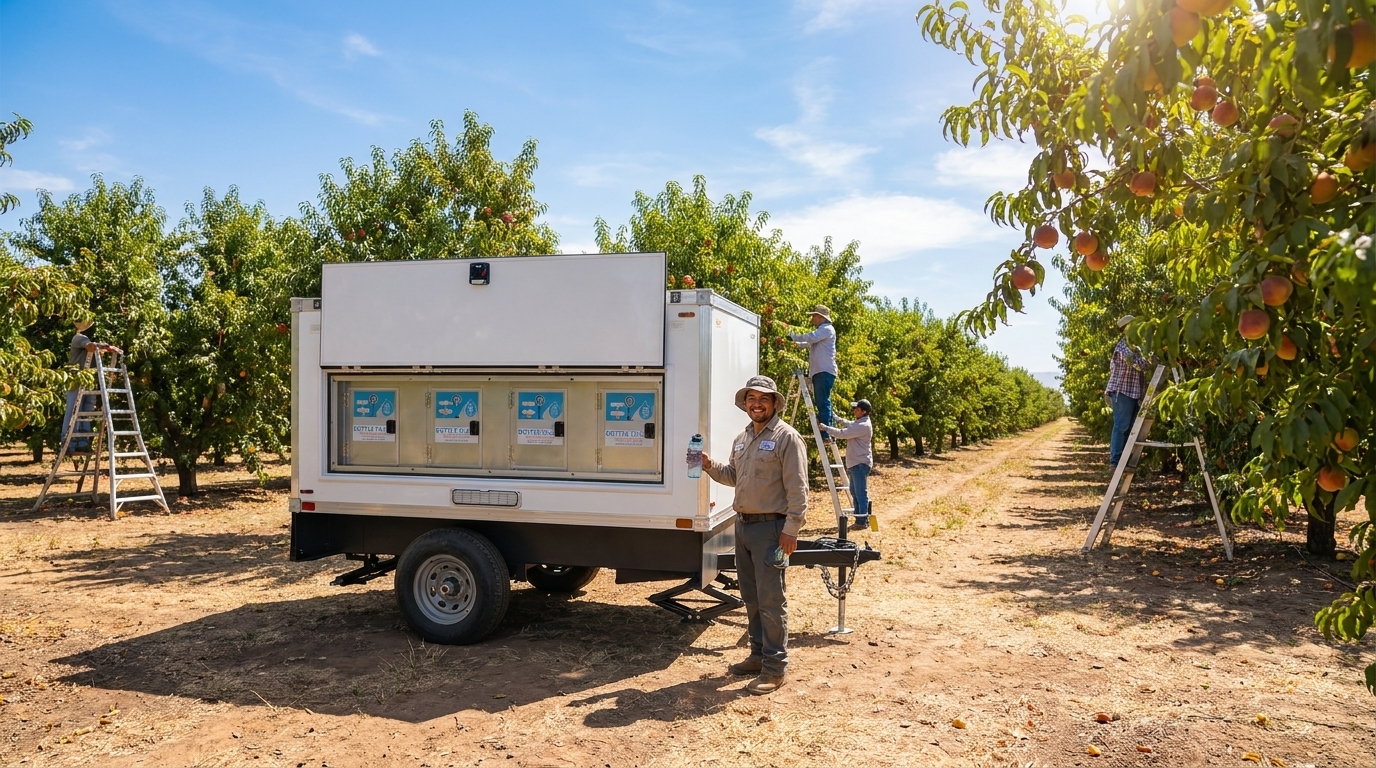
Every written heat program the states require asks for the same handful of things in a slightly different order. Build the section once around those and it travels from job to job with only the trigger numbers changing.
Water comes first, and it needs a quantity, a location, an owner and an interval. Quantity is a quart per worker per hour for the full shift, multiplied by the peak roster. Location has to be written as a rule rather than a spot, because the spot moves: at the break area and within a short walk of the active work face, relocated when the work face moves. Owner is a named position, not a person, so the plan survives turnover.
Shade and the break area belong in the same paragraph as the water. Federal outreach guidance has framed water, rest and shade as one system since 2012, and the point of that framing is physical. Two separate stops means people skip one, and it is never the shade they skip.
Oregon OSHA fact sheet on heat illness prevention requirements
Read enough heat fatality investigations and one pattern shows up faster than any other. The worker was new. Not new to the trade necessarily, just new to that job, that week, that heat. One of the most cited cases involved a worker four days into a new job at a heat index near 97 degrees. Another was ruled heat stroke due to lack of acclimatization, on a residential site in roughly 90 degree weather.
The body adapts slowly, and every rule that addresses it agrees on roughly the same window. California requires close supervisor observation through a new employee's first 14 days in high heat work. Washington requires 14 consecutive days for new employees, for anyone back from an absence, and for everyone during a heat wave. Nevada's guidance recommends starting new workers at 20 percent of normal workload and ramping across 7 to 14 days.
The part almost nobody schedules for is the loss side. Washington's own guidance states that acclimatization takes 7 to 14 days to develop and can be lost after seven days away from working in heat. A vacation, a rain delay or a shutdown week all reset the clock. So does the weather: a heat wave is commonly defined as a day at least 10 degrees above the average high of the previous five days, and on that day nobody on the crew has adjusted to the heat yet.
The schedule gets written in winter and the heat arrives in summer, which is why heat planning usually happens too late to change anything. The fix is small: a handful of dates and thresholds added while sequencing is still soft, in the window where moving a pour is a phone call rather than a change order.
Start with the thresholds, because they turn a forecast into an action. The common trigger points across the rules are 80, 90, 95 and 100 degrees, and each carries a different obligation depending on where the job is. Note which measure applies too. Oregon and the federal proposal both use heat index rather than plain air temperature, which on a humid day trips a trigger while the thermometer looks reasonable.
Then sequence against them. The hottest work should not be the afternoon work: put the pour at night, start the crew at 5 a.m., move roofing and flatwork to the front of the day. Shifting start times earlier is a documented practice, and state inspectors have observed employers doing it specifically to cut hours logged above 100 degrees. It costs coordination, not money.
→
Incident base camps and staging areas running crews through long shifts in heat and smoke.
→
Boil notices, main breaks and disaster response where the water itself is the emergency.
→
Relief sites that open on short notice with no drinking tap near the people using them.
→
The refill station itself, for any site replacing a standing bottled water order.
→
Public facing fountains for parks, public squares and grounds with no fixed water point.
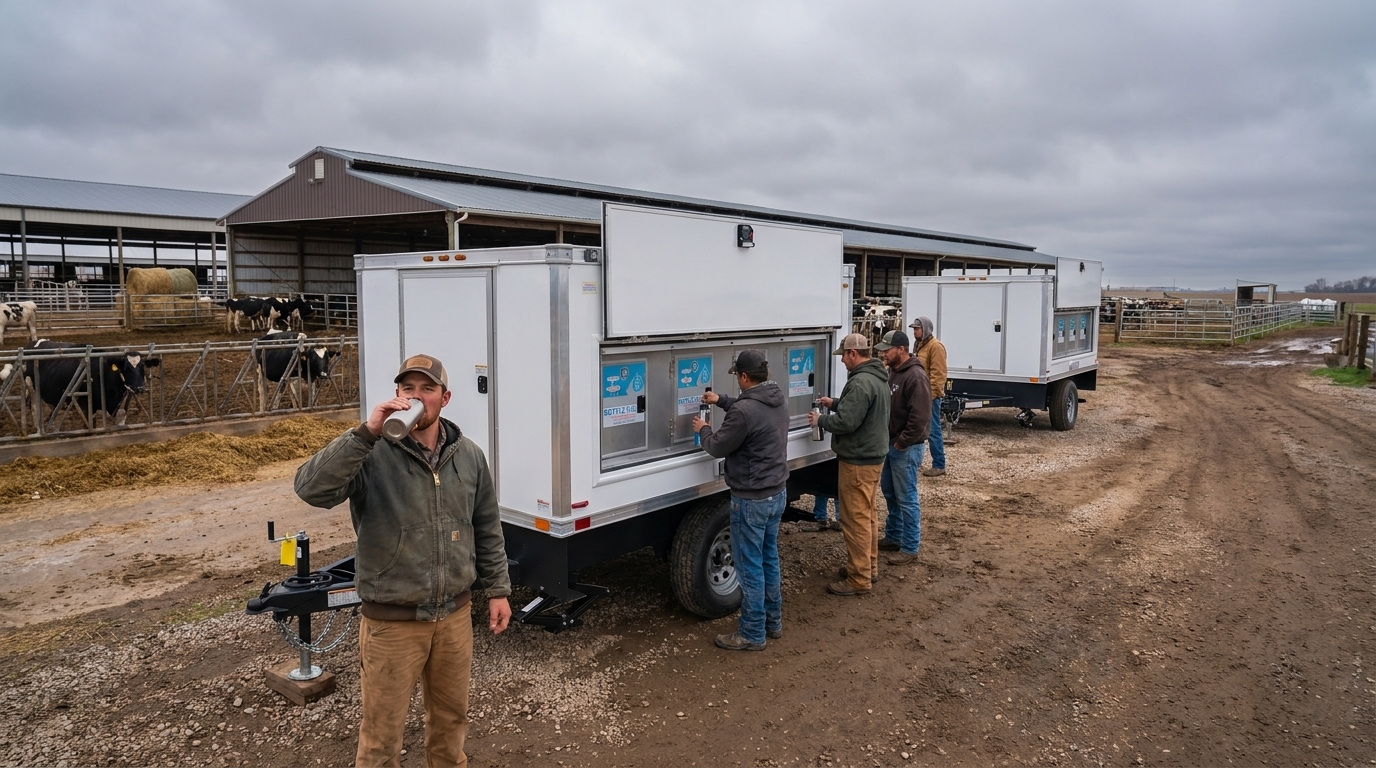
We run water station rentals nationwide, and we keep dedicated local pages for the metros our trucks work hardest. Start with the closest one.
Booking this kind of work in a metro we already run? Start with Houston drinking water station rentals, water station delivery around Fort Worth, water station delivery around Austin, Denver hydration station rentals, Sacramento hydration station rentals, Fresno hydration station rentals, water station rentals in Portland and Seattle drinking water station rentals, and call us for anywhere else in the country.
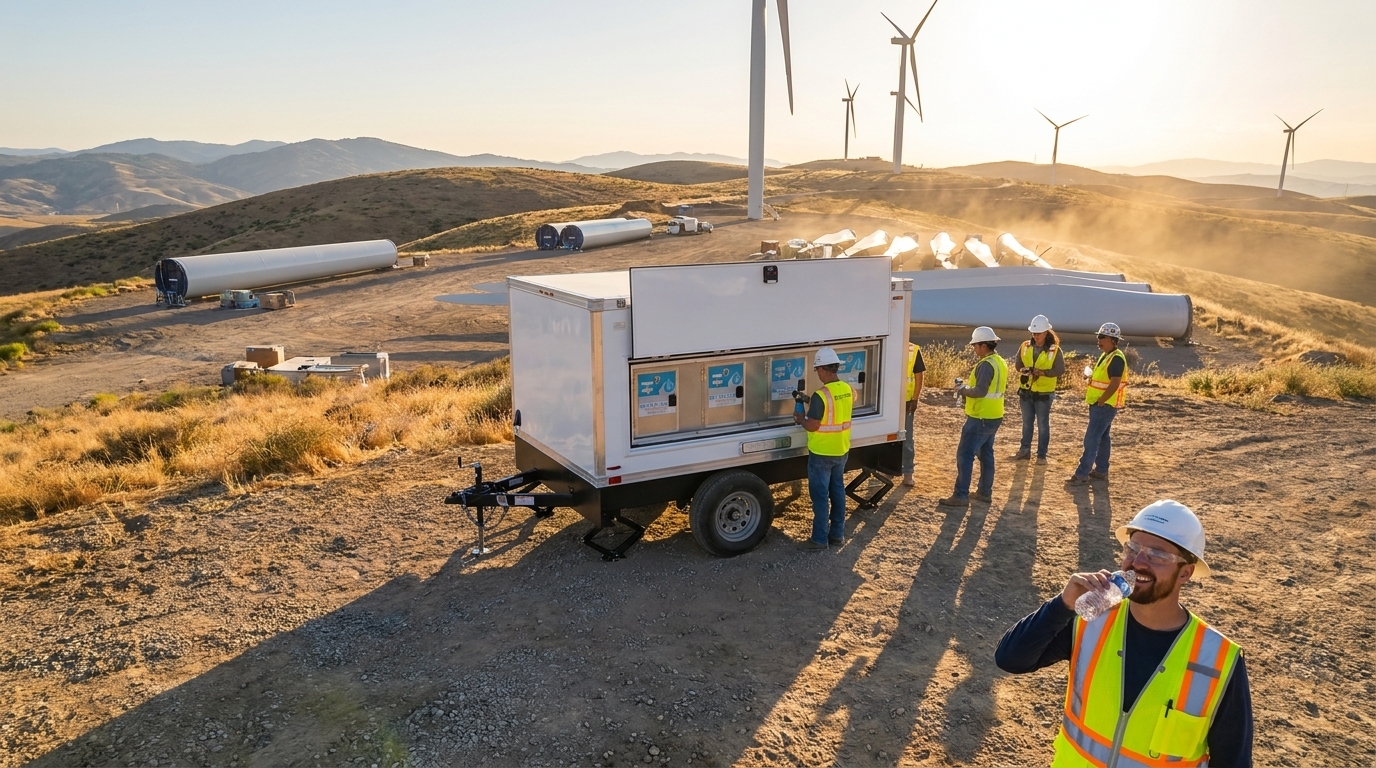 Gulf Coast
→
Plant turnarounds and humidity that pushes the heat index past the thermometer.
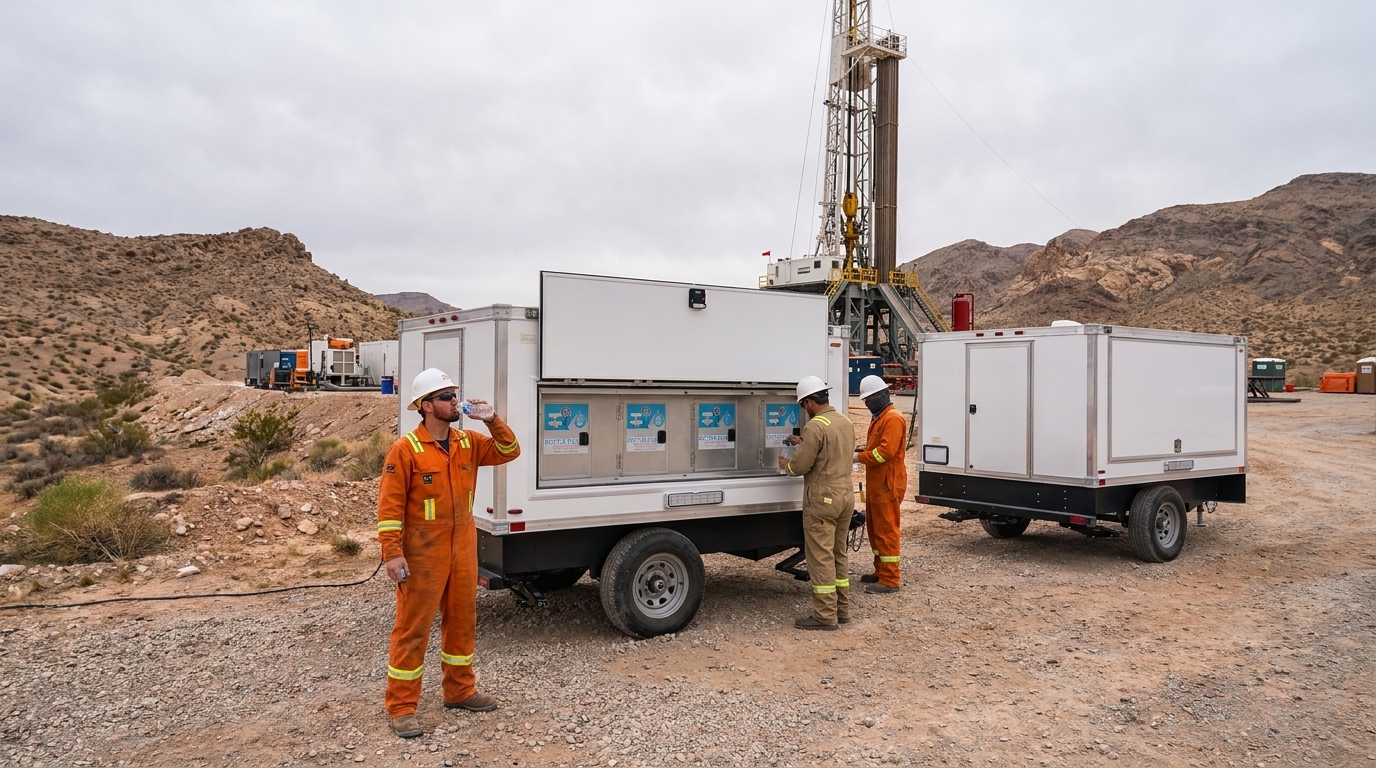 North Texas
→
Warehouse megasites and tract work in a metro that builds through August.
 Central Texas
→
Vertical cores and campus builds where the water break question has local history.
 Front Range
→
Framing, site work and data center jobs where the sun outruns the air temperature.
 Sacramento Valley
→
Highway and flood control work under the strictest heat rule any state has written.
 Central Valley
→
Solar fields and infrastructure jobs in the hottest sustained conditions we run.
 Willamette Valley
→
Commercial builds under a heat index trigger that starts lower than crews expect.
 Puget Sound
→
Tech campus and hospital jobs under a year round outdoor heat rule.
Give us the head count or the guest count, the date, and the spot it will park. We will spec the right setup, confirm the delivery window, and have cold filtered water pouring before the day starts.