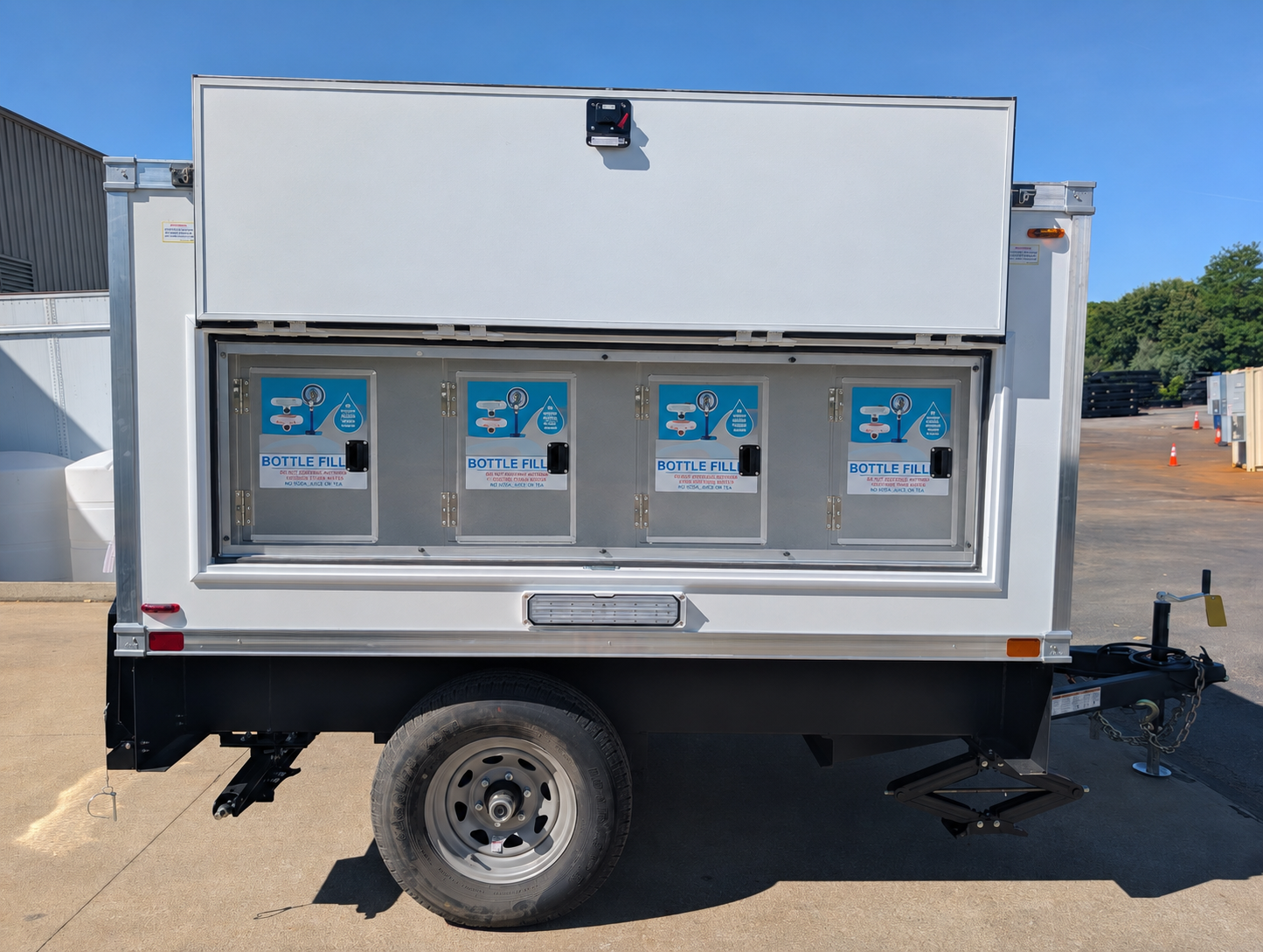
On-Site Hydration Services brings chilled, filtered drinking water to communities that have lost their tap, and the unit lands set up and pouring. The Signature Series water trailer carries 300 gallons and four bottle filling taps, filled from a certified potable source you name. A drive through distribution point gets a real water point. So does a shelter in a school gym, or a two block advisory zone. Nobody is stuck with a pallet of warm cases. Tell us the headcount, the site and the fill source, and we will size it while you are on the phone. Call the office or ask for a written quote, and we can be rolling the same day.
Licensed and insured | A+ BBB rated | 24/7 dispatch
See the Signature Series water station specs
“We had a main break Thursday and a four neighborhood advisory by Friday morning. The trailer was on the park lot that afternoon, filled off a hydrant two pressure zones away, so nobody had to wonder where the water came from.”
“Our drive through site moved boxed bottles all day, but the crews on the loading line were the ones going down in the heat. Two units gave us cold water at the break area and a walk up point for people who came on foot. Refill rode along with the commodity trucks.”
“A gym full of families overnight needs water people can actually reach, not a folding table of half empty cases. We put one inside near the cots and a second by the intake door. The accessible fill point mattered more than anything else on the list.”
References for this kind of booking are available on request.
We have been putting drinking water trailers on open ground for years, and an emergency activation is that same work with a clock on it. Somebody has just told several thousand people not to drink what comes out of the tap, and the only question on the table is where the water is instead. So we answer in the units you already plan in: gallons on board, taps per unit, fills per tank, refill interval, and the fill source printed on the ticket. We are also straight about what the equipment does, which matters more here than on any job we take. The unit chills and filters water that is already safe to drink, so you name the potable source and we work from it. Call the office with a headcount and a site and we will size it before you hang up, or ask for a written quote purchasing can process with the rest of the activation paperwork. We run Denver metro water station rentals and every other route the same way, on short notice, in all 50 states.
One Signature trailer can pour for a weekend concert and be working a slab pour a couple of days later. Hiring one company for your events and a separate one for your worksites makes no sense. Either way, the planning, the delivery, and the refills are ours.
The onboard cooling unit keeps the tank genuinely cold all the way through a long afternoon outdoors, and that single detail carries the whole thing. Warm water is water people abandon, and midsummer is exactly when a crew or a crowd is drinking the most. Cold water gets finished, and finishing it is what keeps heat illness off the site.
Typical deliveries land in about 45 minutes once a truck is rolling in your metro, longer out on the rural routes, and we keep emergency runs going around the clock whenever a heat advisory or a power shutoff hits. The morning a foreman finds his 40-person crew stuck with one warm cooler, speed is the whole game.
One rule sits under every job we take: water that people walk past might as well not be there. We've stood on a bare site and watched shrink-wrapped pallets cook next to the job-trailer while the crew baked thirty yards off. We've watched the opposite too, a chilled station ten steps off the work face run bone-dry twice inside one shift. Everything that matters lives in the distance between those two pictures. Which is why we don't drop a unit and disappear. We match it to your headcount or your gate count, set the refill rhythm to how hard you're really pulling on it, and treat a heat call the way you'd want your own treated, meaning right now, because out here one hot hour can swing the whole day.
We deliver water stations to job sites, venues and event grounds in all 50 states, with the heaviest route coverage across the West.
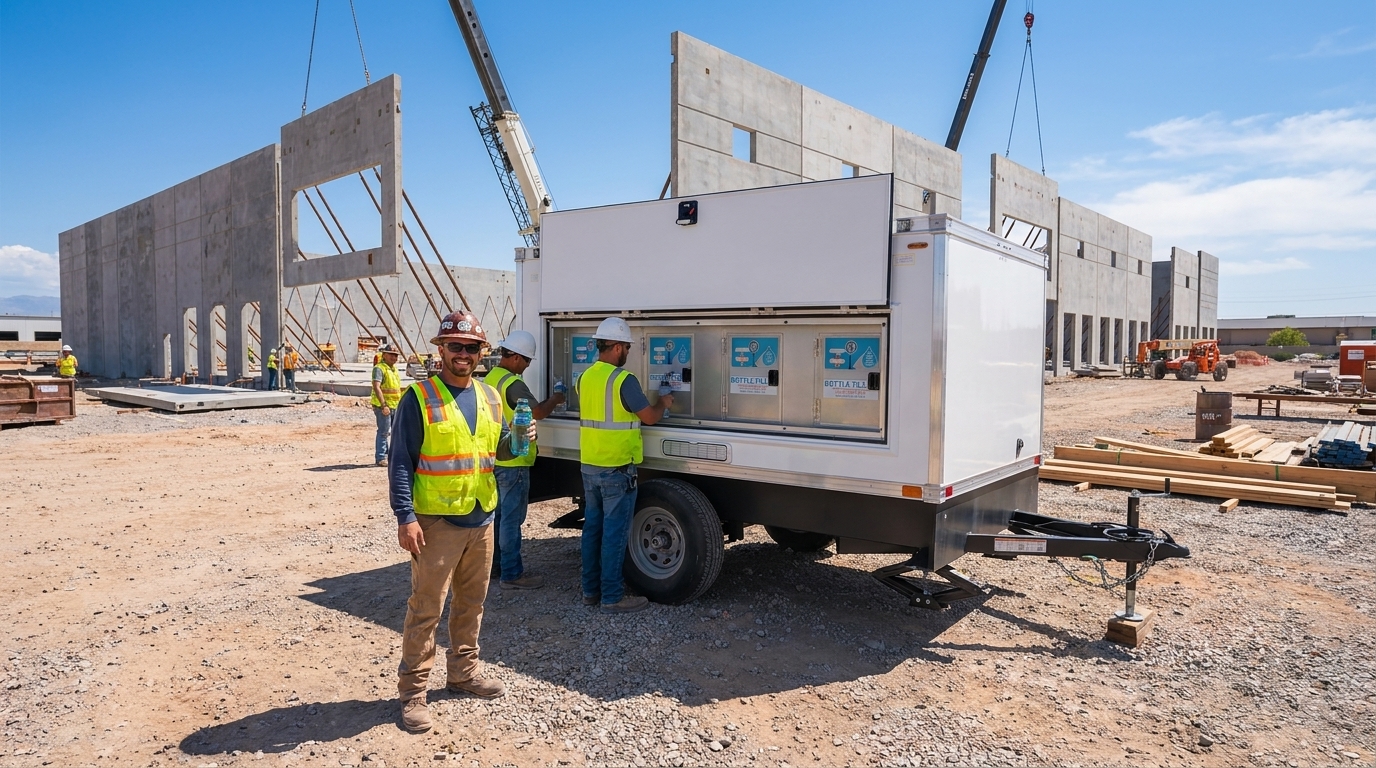
The Signature Series water trailer is a self contained drinking water point that runs off a potable fill and a standard circuit, which is exactly what you need when the tap everybody used is the thing that failed.
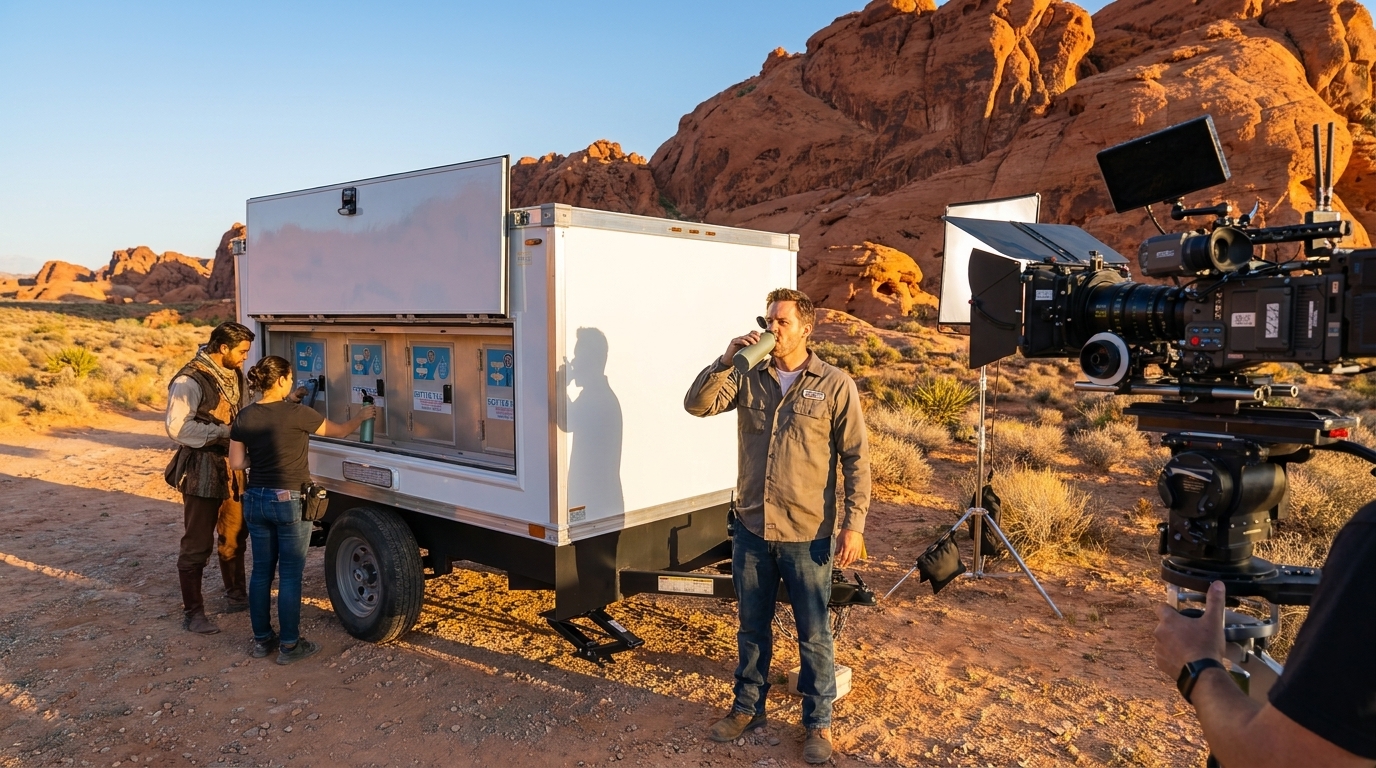
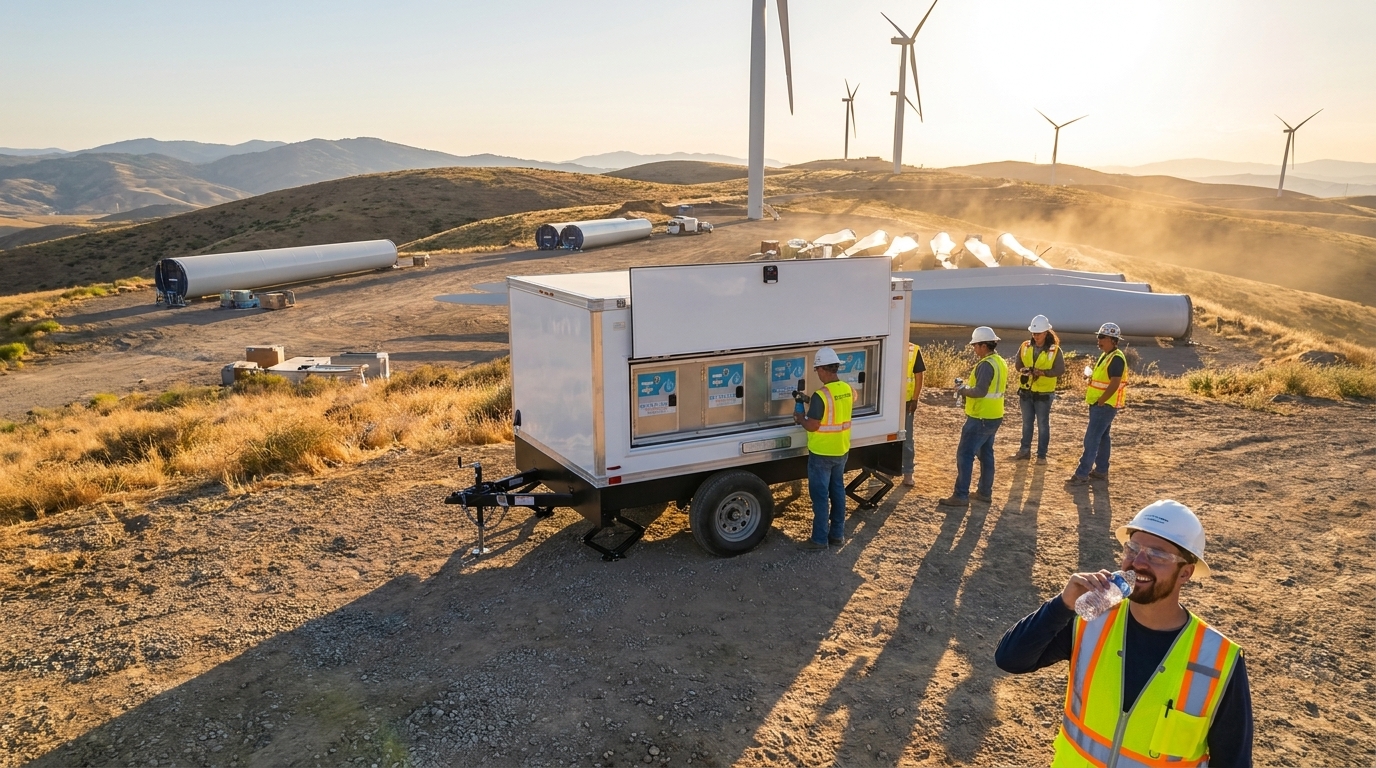
With a frame, a hitch, and tires under it, the unit hauls out to a remote build, an event field, a working orchard, or a disaster staging yard with equal ease. Contractors and event planners request this exact rig by name. The whole design is built around backing in, leveling off, and pouring cold by the same afternoon.
| No. of stations | (4) Bottle Filling Stations |
| Length | 12' 3" |
| Weight | 3,100 lbs. |
| Height | 8' |
| Fresh water tank | 300 Gallons |
| Power requirements | 1 to 4 dedicated 20A/120V circuits OR 1 dedicated 50A/240V circuit |
| No. of AC units | 1 |
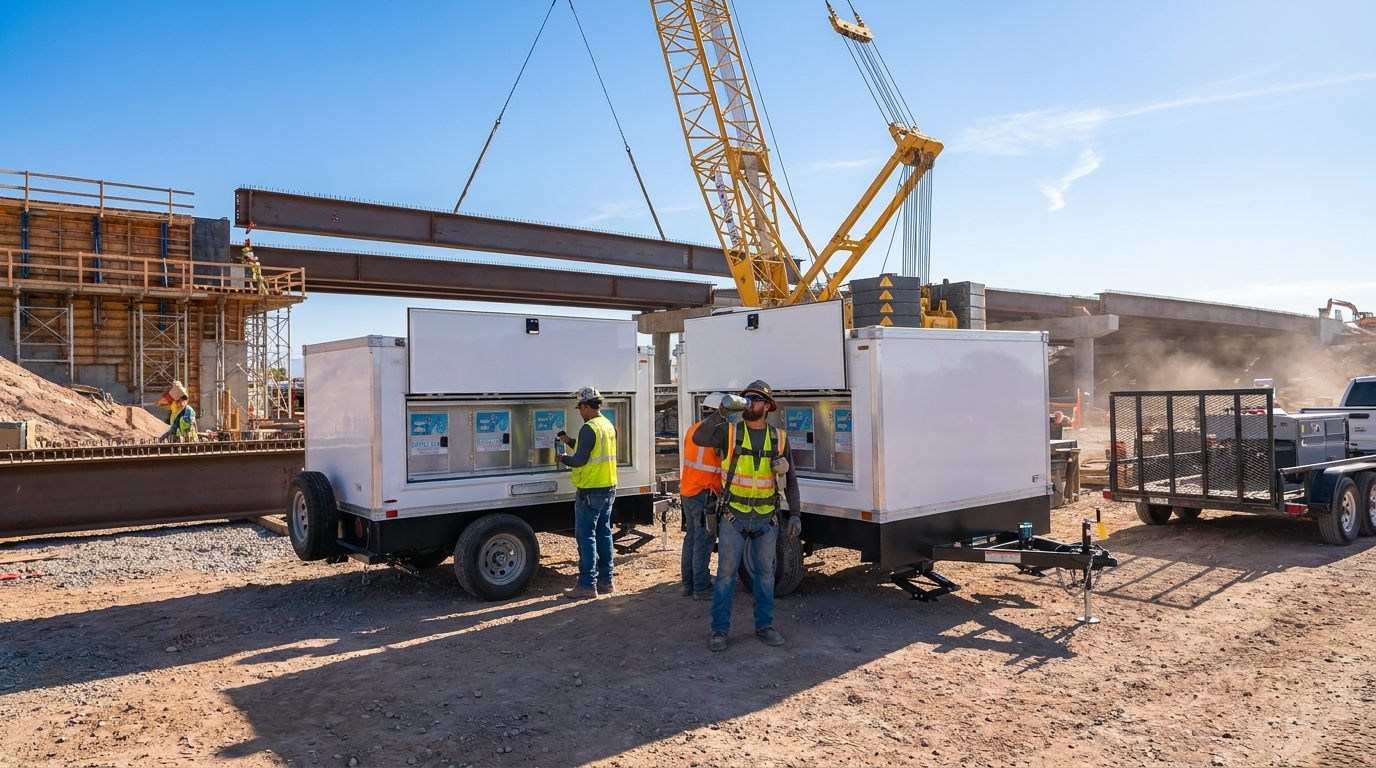
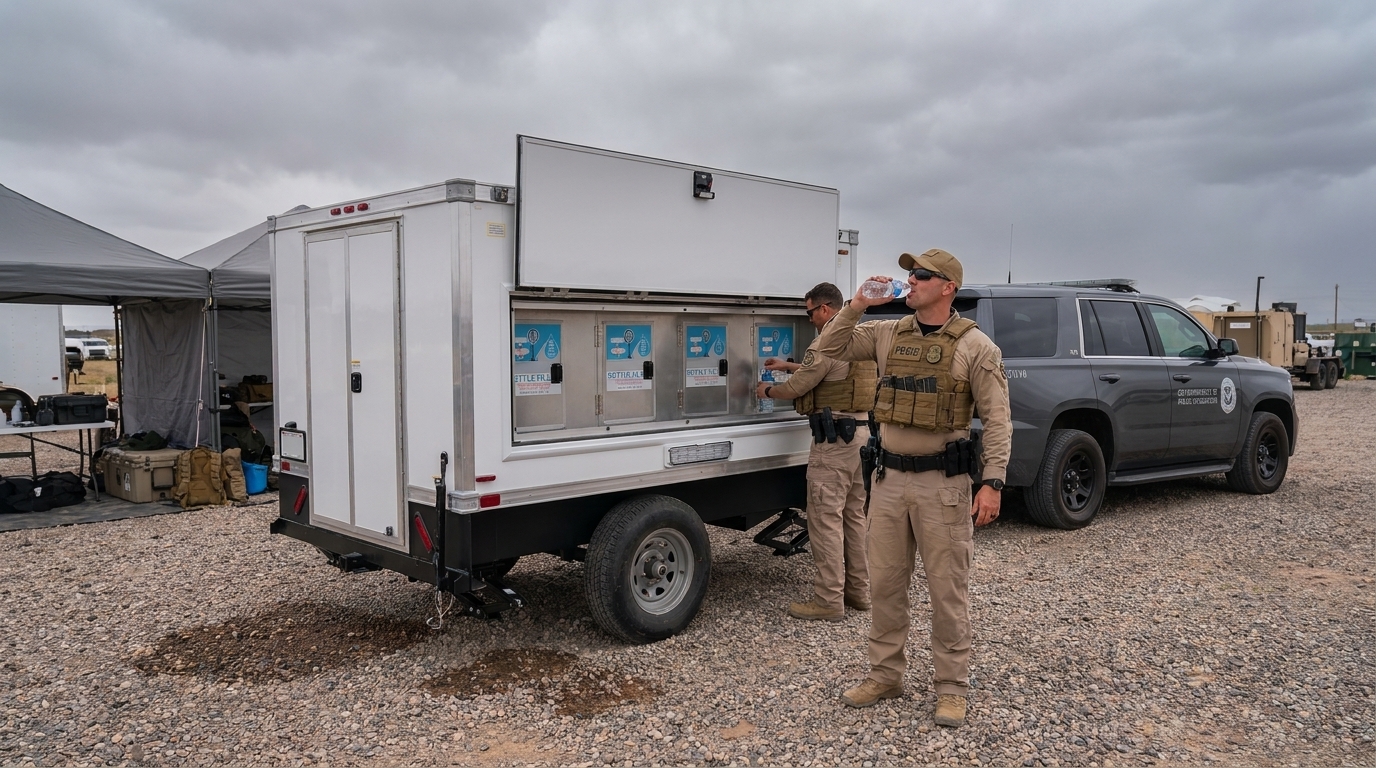
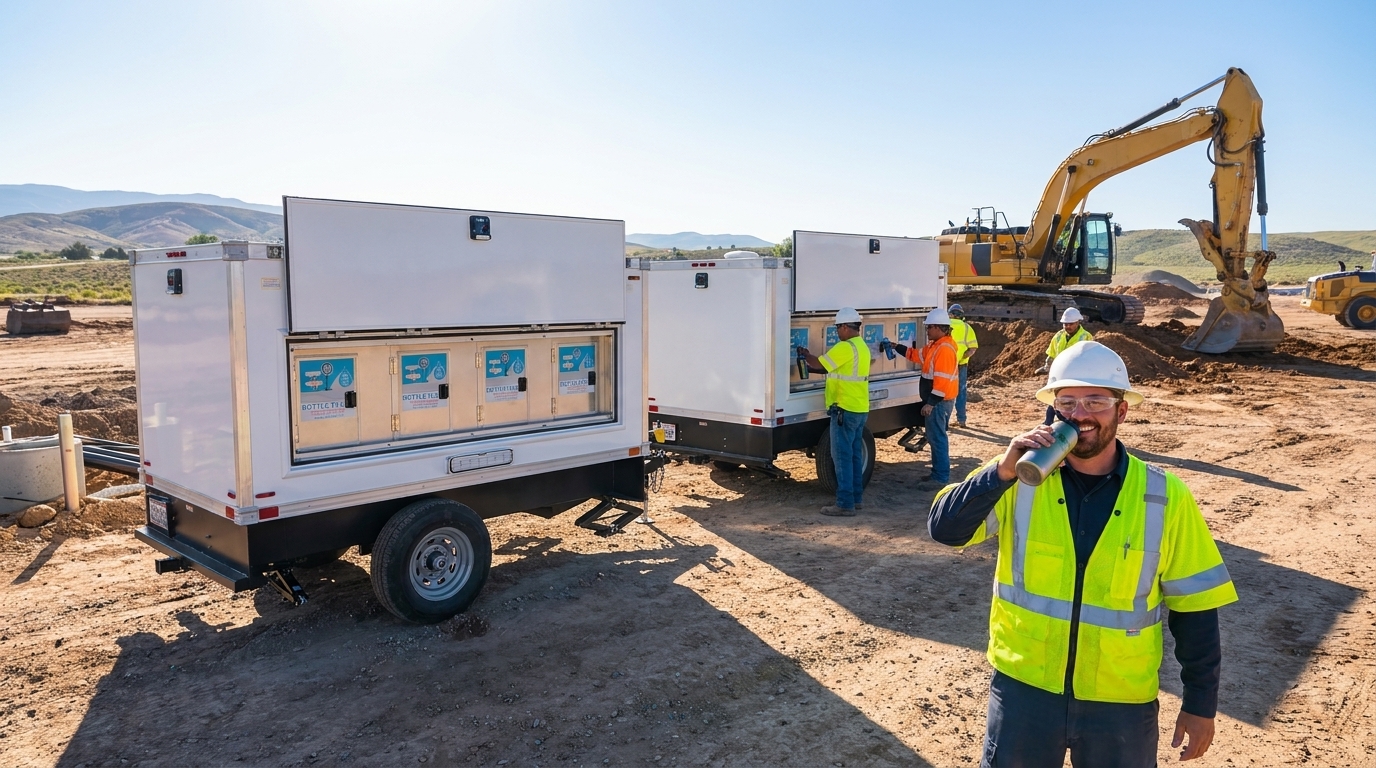
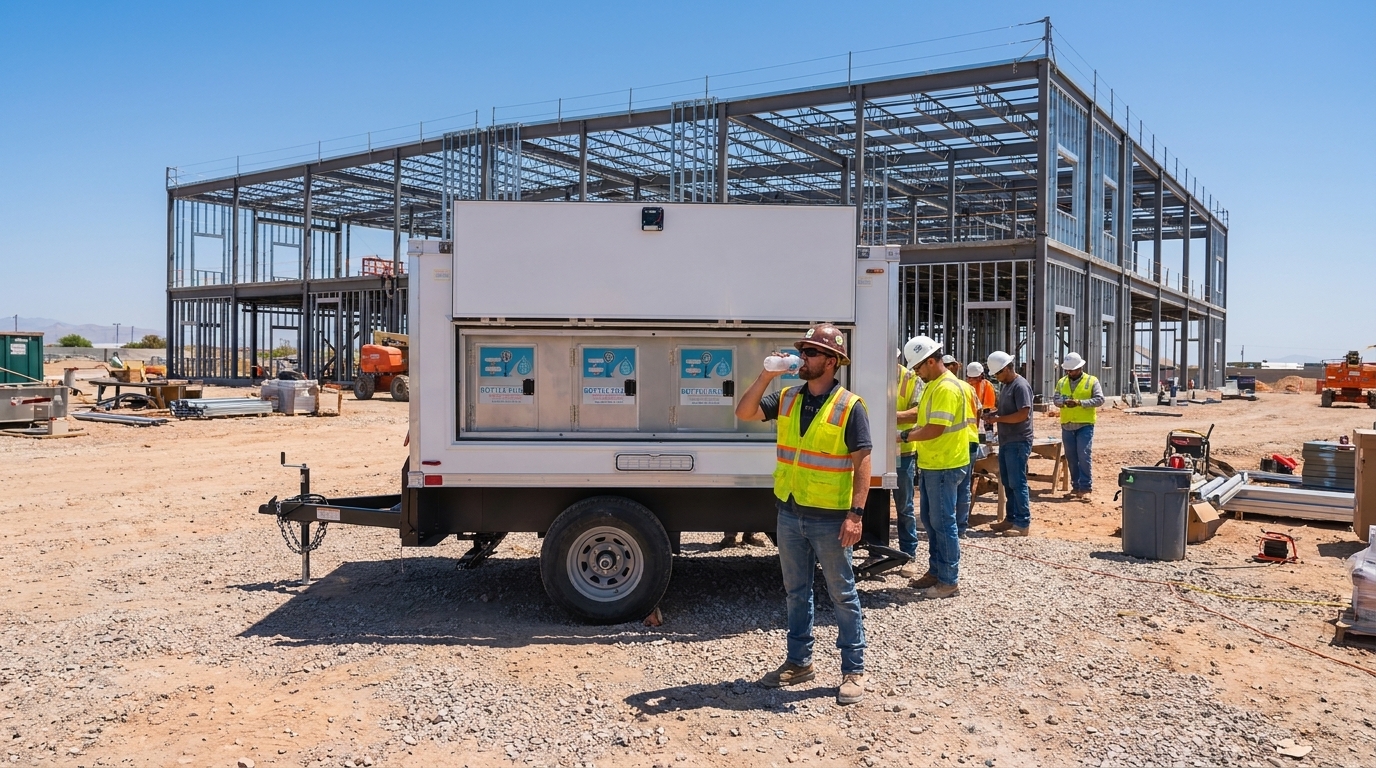
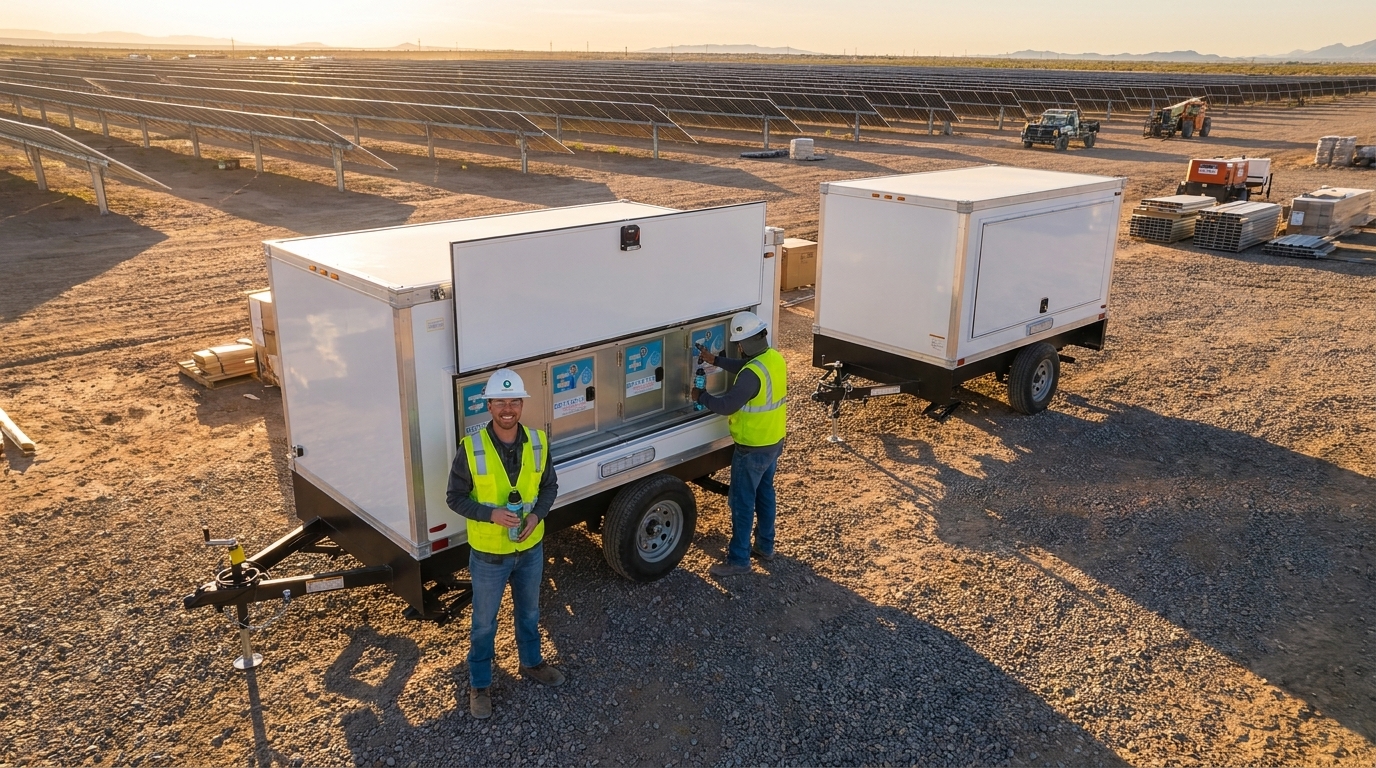
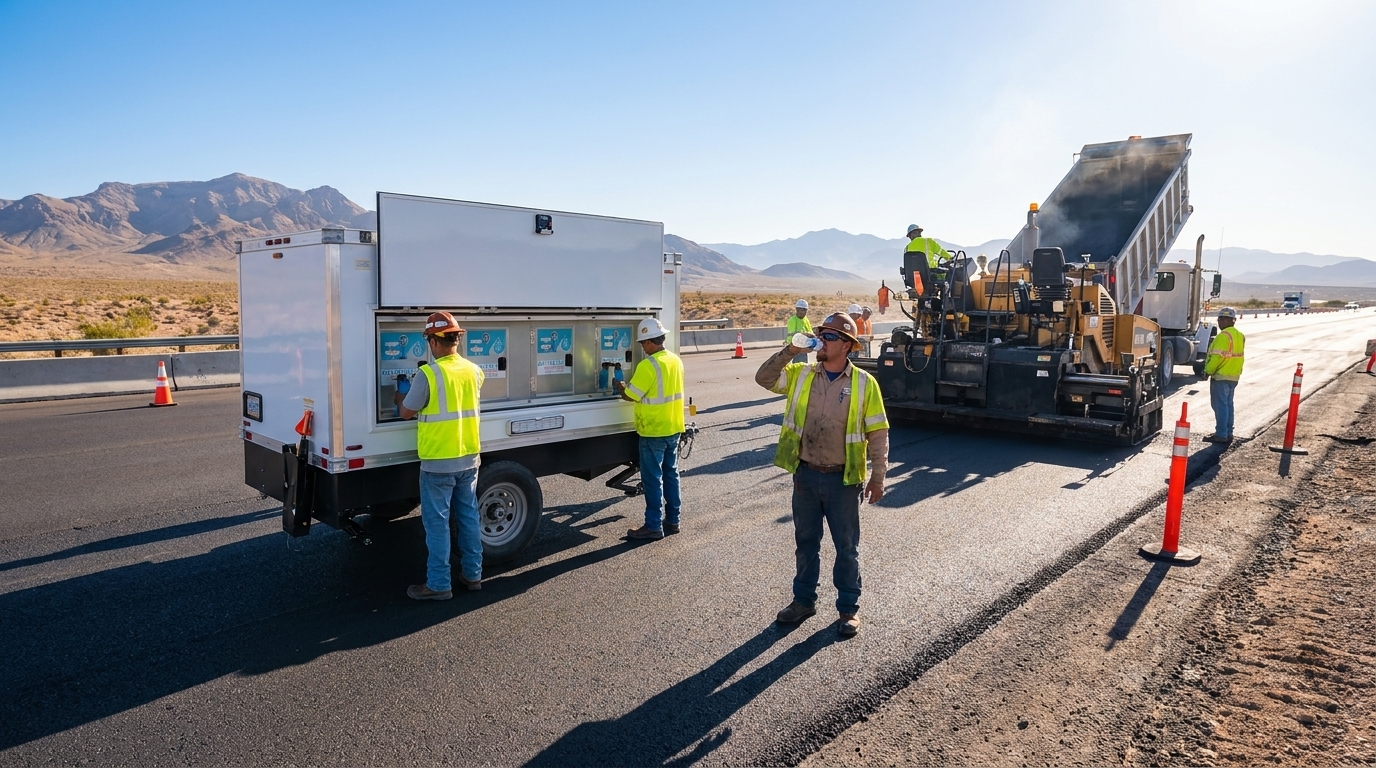
Three hundred gallons ride on board. The water passes three filtration stages for sediment, chlorine taste and fine particles, then a UV lamp, then a cooling unit, before it reaches a tap. Four push back bottle filling stations run at once, with adjustable taps. They take a sixteen ounce bottle or a one liter bottle, and a family jug works too, and one of the four sits at accessible height. A rear jug filling station handles the five gallon coolers that go out to a cot area. Three hundred gallons is roughly 2,400 sixteen ounce fills, a useful number next to a shelter roster, and the same equipment goes out on Sacramento Valley water trailer rentals.
Here is the part we say out loud on every emergency call, because getting it wrong would be dangerous. This is not a treatment plant and it is not a remediation unit. It is filled from a certified potable source you identify. That can be a bulk water delivery or a tanker with current test results. A hydrant meter on a pressure zone the advisory does not cover works too. The filtration train and the UV lamp are a safeguard and a taste polish on water that is already safe, not a way to make unsafe water safe to drink. Federal health guidance is blunt about the limit, that water containing fuel, toxic chemicals or radioactive material cannot be made safe by boiling or home water treatment.
The trailer is 12 feet 3 inches long, 7 feet 6 inches wide, 8 feet tall and 3,100 pounds, with one air conditioning unit. Power is 1 to 4 dedicated 20A/120V circuits or a single 50A/240V circuit, which is the number that decides whether a shelter facilities manager says yes in thirty seconds or sends you to the building engineer. A gym on generator power already carries lighting, kitchen equipment and medical gear, and a unit that shares a standard circuit spur gets approved. It tows on a standard hitch behind a three quarter ton pickup, and a 200 gallon grey tank catches splash and rinse water instead of leaving a wet spot across a traffic lane.
A water source people don't trust gets ignored, and an ignored station is rented money wasted. That's why municipal water doesn't reach the tap raw on our trailers. It passes through three filter stages and a UV chamber, then an onboard cooling unit drops the temperature. The result tastes clean and comes out cold, even on the worst afternoon of the year.
The opening filter traps sand, scale, and the fine grit local mains occasionally push through. On a dusty lot, that's what keeps a pour from tasting like the parcel it's parked on.
Activated carbon comes next, lifting the chlorine bite and the dull seasonal notes local tap can carry until the taste lands clean and neutral. When it's 100 out, that flavor decides whether a crew keeps drinking or walks past the tap dry.
A finer cartridge then catches the microscopic particles that slip past the first two, so what reaches the spout is clear rather than merely cold for the crews and crowds drawing off it.
The last step is an ultraviolet chamber that wipes out bacteria and microbes without adding a single chemical. Even after a long tow out to a remote site, the water off the nozzle is clean.
Along the wall sit four adjustable push-back taps, press a bottle to the bar and it pours. One of them is set at ADA-reachable height, so a single trailer includes everybody in a crew or crowd with no add-on gear. Out back, a large-jug spout services five-gallon coolers and hydration packs, while a bank of hose connection taps handles work-site chores, event support, and refills down the orchard rows. Stainless, food-grade plumbing the whole way through keeps the filtered, chilled water at quality right to the spout.
Every Signature trailer carries a 300-gallon load, roughly 2,400 cups at sixteen ounces each, and we recharge it on demand, so the unit doesn't turn into the choke point on a busy shift or a packed show night.
A main break is a two day problem. A hurricane activation is a two week problem. A burned water system is a two year problem. The equipment is the same and almost nothing else is, so we plan each one separately.
This is the most common emergency water job in the country and the fastest moving one. Detection of a fecal indicator such as E. coli in a source sample is a Tier 1 situation, and 40 CFR 141.202(b) gives the water system no more than 24 hours from learning of the violation to notify the people it serves. Delivery methods at 141.202(c) run from radio and television to hand delivery and posting in conspicuous locations.
The federal notice template names the fix itself. Among the corrective action lines a system can publish is a plain one: we are providing water from an alternative source until the problem is resolved. That is the slot a water trailer fills. A two block Los Angeles advisory in the summer of 2026, triggered by one positive test station on June 30, lifted on July 2. A San Diego main break opened by a contractor on June 10 that year ran about 48 hours across four neighborhoods.
Duration is the planning number. Most notices lift within 24 to 72 hours, once repairs are done and two rounds of bacteria testing come back clean. So the rental window is short and the mobilization window is shorter. We keep the questions to three: how many households sit inside the boundary, what lot can we use, and what potable source can we draw from. Seattle water bottle filling station rentals get sized off the same three answers.
That third question is not a formality. The affected mains are exactly what we cannot use, so the fill comes from a hydrant on a clean pressure zone. A bulk delivery or a tanker with current results works too. Utilities already know which zone is clean, because they drew the boundary. We put the source and fill date on the ticket, because that is the first thing an environmental health officer asks about stored water.
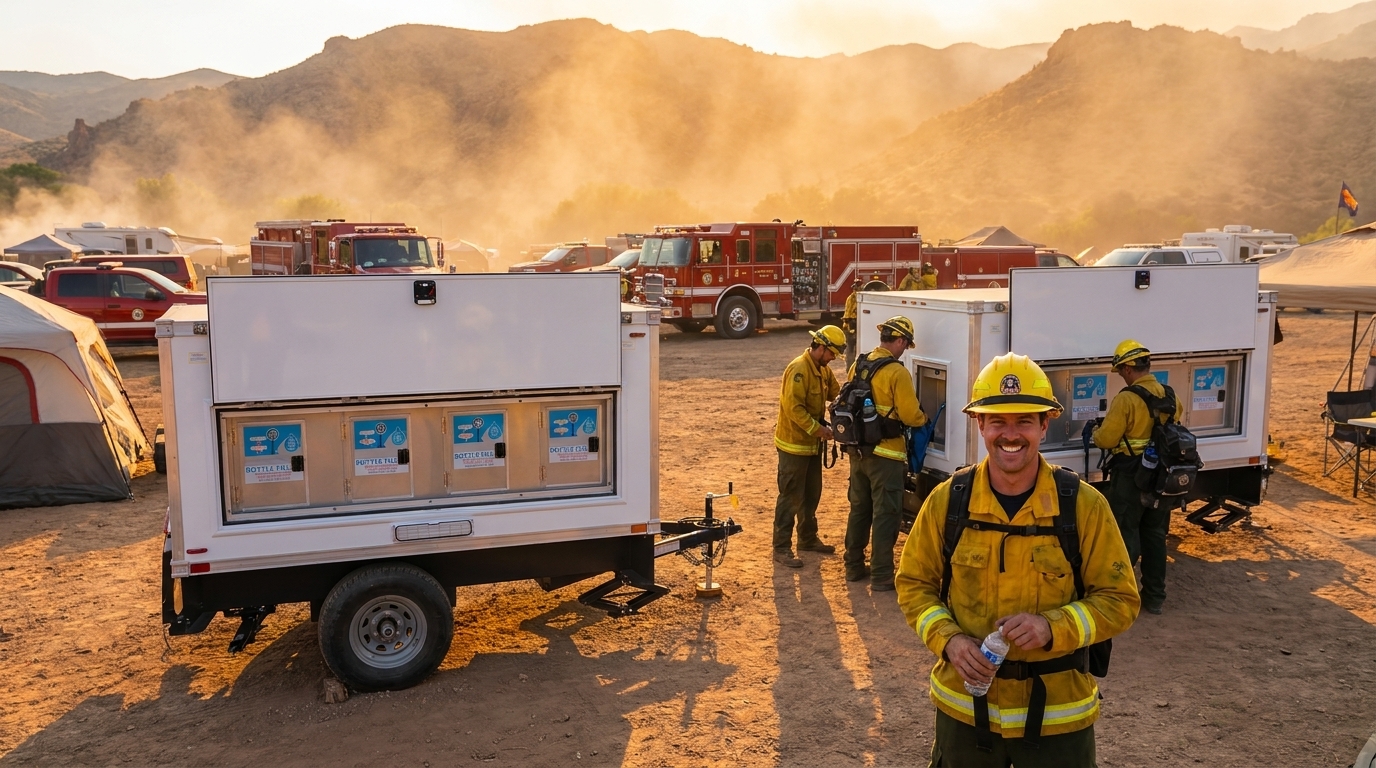
A wildfire creates two separate water crises, and treating them as one is the planning mistake we see most. The first is immediate: people staying at a shelter, residents at a checkpoint for those coming back home, and debris crews working in ash all need water right away. The second is slow. When a fire takes out power, pumps stop and pressure drops, so a system that has lost pressure can draw smoke in through any breach, while plastic service lines and meters that melt or partially burn off gas chemicals into the water standing in the pipe.
Paradise, California is the reference case. The November 2018 fire killed 85 people and destroyed 87 percent of the roughly 10,480 buildings in town, across about 172 miles of mains and 10,500 service lines. Samples came back with benzene at 2,217 parts per billion. The federal safety limit is 5 parts per billion and California holds its own systems to 1, so the worst readings sat around 443 times the federal limit. Naphthalene, toluene, styrene, methylene chloride and vinyl chloride turned up too.
Then look at how long it took. An ordinary bacterial advisory clears in 24 to 72 hours. That do not drink and do not boil advisory was not lifted for standing homes until May 2020, roughly a year and a half, because boiling does nothing to chemical contamination and the system had to be sampled, flushed and in many cases rebuilt line by line. The Marshall Fire in Boulder County in December 2021 damaged six public drinking water systems the same way.
That changes the rental shape on our side. A burned system does not need a two day bridge. It needs a standing drinking water point for weeks or months, in a neighborhood where people are living in homes whose taps they have been told not to use. So we plan a recurring refill from a source entirely outside the affected system. We also say plainly what we will not do: we do not treat contaminated water, and we do not fill from a system under a do not drink order.
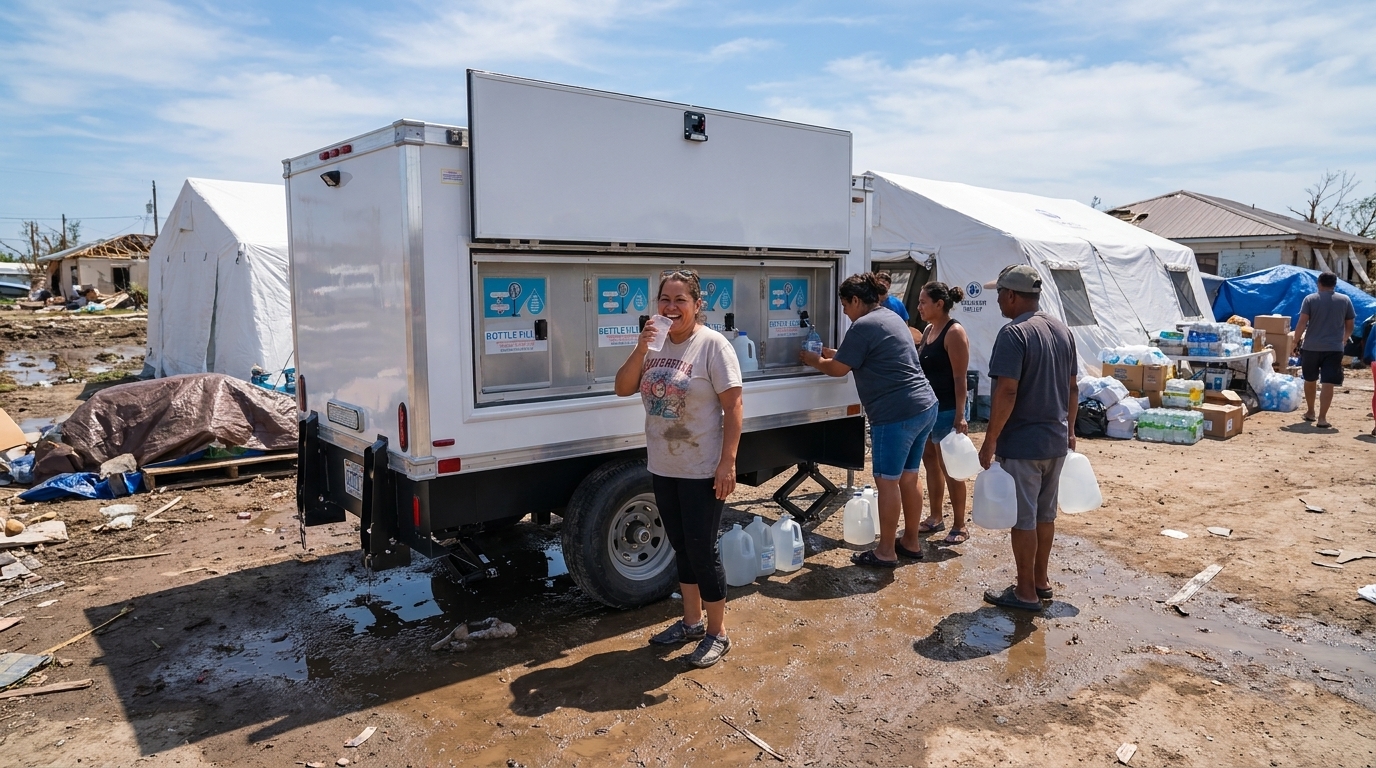
Large disaster response runs on a framework with real numbers in it, and reading it is most of what separates a useful vendor from a nuisance. FEMA's Distribution Management Plan Guide 2.0, published in January 2022, puts the principle in one line: distribution management is locally executed, state managed and federally supported. Absent a deliberate local plan, the generic federal planning factor is two meals and three liters of water per person of the impacted population each day.
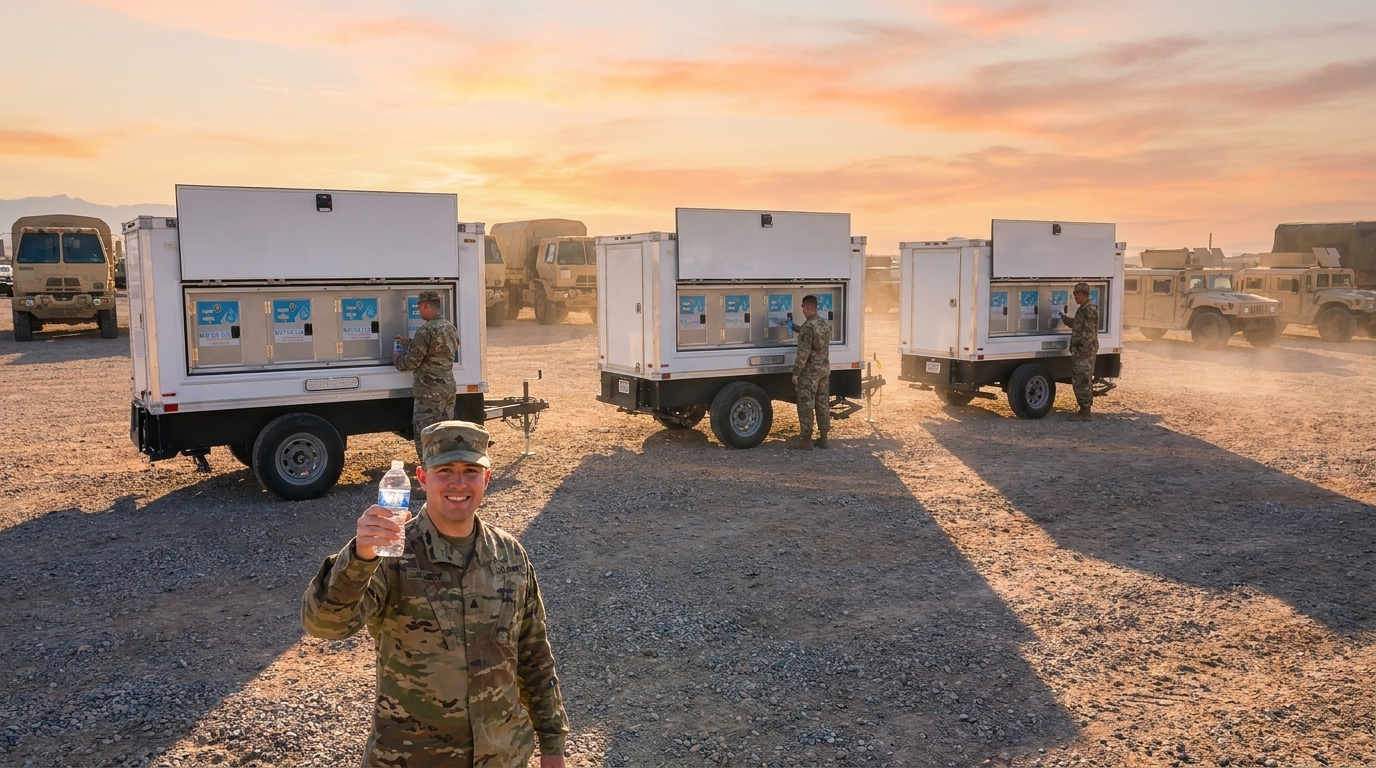
The guide names exactly two distribution methods. Direct distribution moves supplies to a central point and then door to door, which is how people with disabilities, nursing home residents and isolated rural households get served, often with National Guard units running house to house. The other is the commodity point of distribution. A drive through Type III site serves up to 5,000 people a day through one lane at up to 140 vehicles an hour. Type II doubles it: 10,000 people, 280 vehicles an hour, two lanes. Type I handles up to 20,000 people a day, 560 vehicles an hour, four lanes and twelve loading points. Those figures assume three people per car and distribution from 07:00 to 19:00.
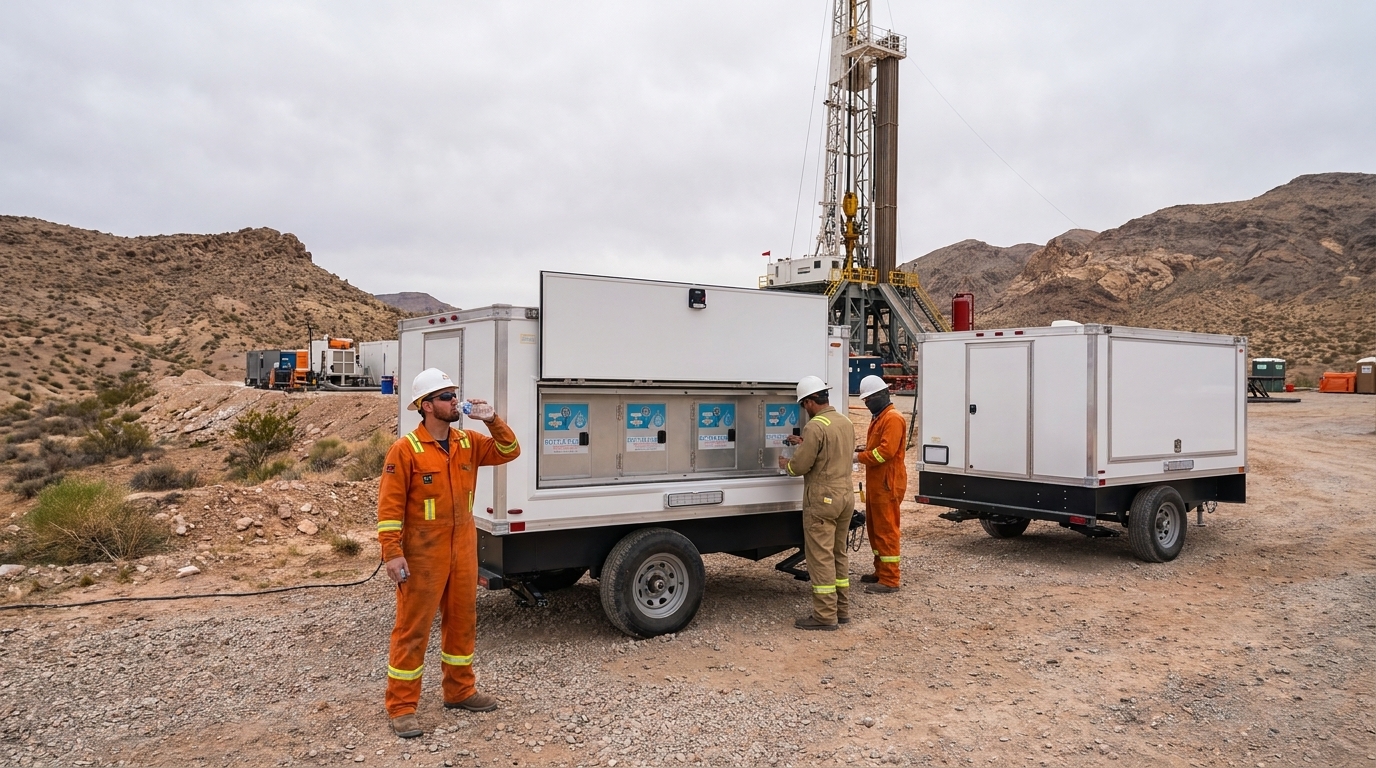
Staffing is where the heat problem hides. A single site runs 19 to 98 people before you add security, medical and public information staff. A Type III needs 25 on days and 6 overnight, a Type II needs 42 and 8, a Type I needs 85 and 13, including 36 workers lifting cases into car trunks for twelve hours. In our experience those crews are the ones nobody budgeted water for, because every gallon on site is already counted as public commodity.
The same framework says when this work ends, and honest vendors plan for it. A distribution site is activated only when residents cannot get life sustaining supplies, and it closes as soon as commercial supply recovers. That is a bridge, not a standing service, and we quote it that way. States reach across borders through the Emergency Management Assistance Compact once a governor declares, and escalate to FEMA through a resource request form in WebEOC after a presidential declaration.
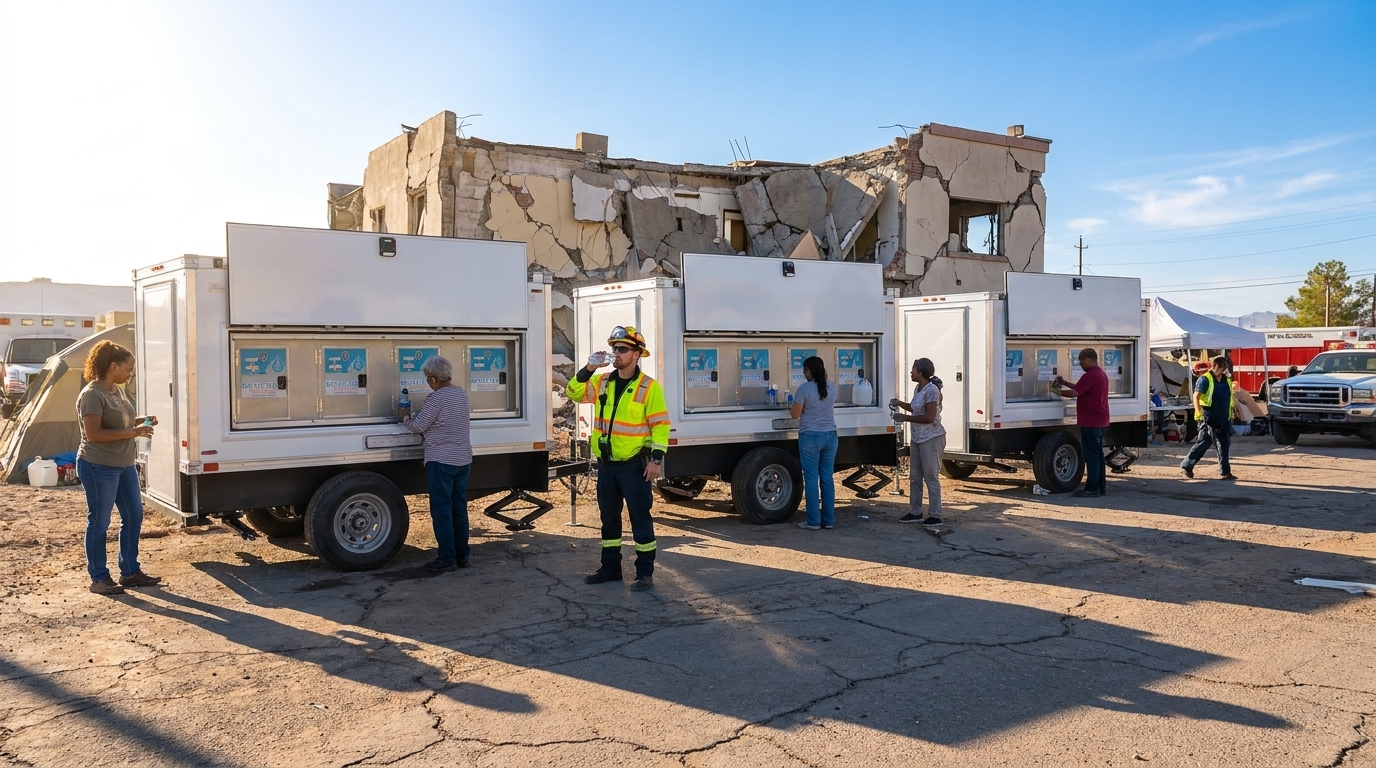
Emergency work is won in the first few hours and lost in the last hundred feet of the approach. Here is how we run it.
Timing first. On an advisory the notice clock is 24 hours from the moment the system learns of the violation, so the useful delivery window is the same day, not the next business day. On a declared disaster the first 72 to 96 hours set the size of everything, and day one requests are the ones that get filled. We take the call, confirm the site and the fill source, and put a unit on the road. Fresno mobile water station rentals move on the same footing.
Placement is a layout constraint, not a preference. A drive through site marks a vehicle line 20 feet wide and 300 feet long, with a 12 foot drive lane inside it. Behind that sits a loading line 80 feet wide holding three 40 foot loading points, and a supply line 50 feet wide for tractor trailers up to 54 feet. Cones sit no more than 20 feet apart on vehicle lanes and no more than 10 feet apart on the 5 foot pedestrian lanes, and sanitation goes at least 50 feet from the break area, with the wind moving away from it. So we ask for the site diagram.
What goes wrong is predictable enough that we ask before we load. Power is first, because a site on generator has allocated every circuit already. Access is second: a ball field gate a pickup and trailer cannot turn through, or a shelter loading door on the far side of the building from the only outlet. The fill source is third and it stalls jobs longest, because the nearest hydrant is often the one we cannot use. Fourth is a refill nobody scheduled, which turns a working water point into an empty tank on day three.
Pickup gets planned with delivery, because these missions are designed to end. An advisory ends when sampling clears and flushing instructions go out. A distribution site demobilizes when commercial retail recovers, the explicit trigger in the planning guidance. A burned system is the exception, since a do not drink zone can run for months and belongs on a standing schedule with a named contact. Either way we want one signal from one person.
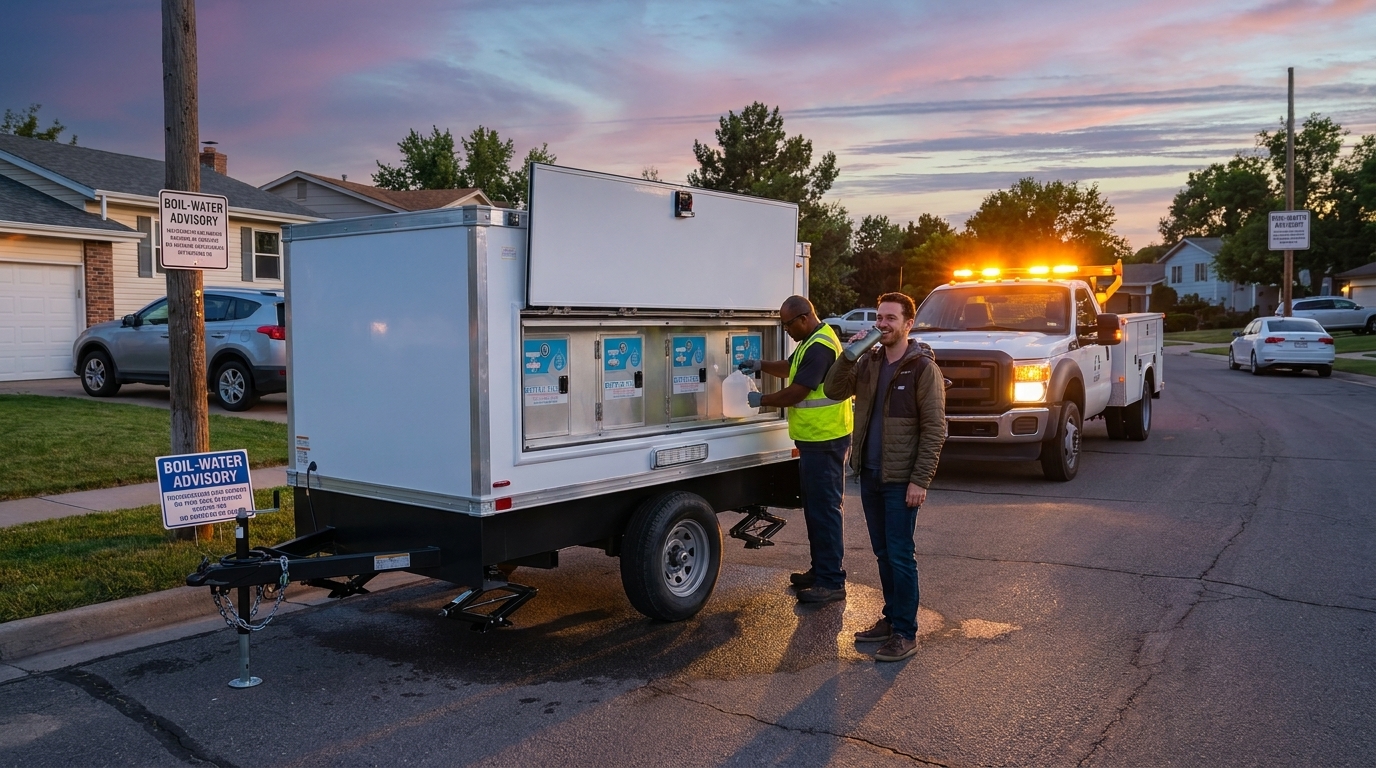
People count, number of days, where exactly it parks on your site, and what power is there. Those four answers let us spec it correctly the first time around.
Reckon roughly 45 minutes from the nearest yard once we are in your metro, longer on the outer routes, with round-the-clock emergency runs whenever a heat advisory or a power shutoff hits.
Once on site we set it level, charge the 300-gallon tank, and tie in power off one to four standard 120V circuits, or a single 50-amp 240V drop, depending on what the site gives us.
After that the tankers cycle back on a cadence matched to how fast your crew or crowd pulls it down, and we maintain the unit through the whole rental term.
No power on the parcel at all? We price that in. The unit draws very little, and with the service fleet backing it we've run stations on lots that had no permanent power whatsoever. Lay out what the site offers and the rest is on us.
Want this math run for your own booking? Two minutes on the phone gets you a real number.
This is arithmetic and the published figures do the work. Start with the per person number that fits your situation, multiply by the population inside the boundary, then set the refill cadence.
| Single block advisory (200 to 400 residents) | 1 unit at the notice area |
| Multi neighborhood main break (2,000 to 5,000 residents) | 2 units on a daily refill |
| Congregate shelter, overnight (150 to 300 people) | 1 unit inside the sleeping area |
| Type III drive through site (up to 5,000 people a day) | 1 unit at the break area |
| Type II drive through site (up to 10,000 people a day) | 2 units, staff and walk ups |
| Type I drive through or walk up site (up to 20,000 people a day) | 3 or more plus a tanker cycle |
| Do not drink zone, standing homes (1,000 to 2,500 households) | 3 or more by neighborhood |
Three published numbers matter here and they are not the same number, so do not average them. Household preparedness guidance says store at least one gallon per person per day for drinking and sanitation, noting a normally active person needs about three quarters of a gallon of fluid daily and that very hot weather can double it. State distribution site guidance sets a restricted first 72 hour issue of one gallon per person, handed over as eight 16 or 16.9 ounce bottles with ice and meals. FEMA's bulk planning factor is three liters per person per day, about 0.79 gallons, for what a state must be ready to move.
Now put tank capacity next to it. One unit carries 300 gallons, roughly 2,400 sixteen ounce fills. At the one gallon figure that is a full day of drinking and basic sanitation for about 300 people, and at the federal bulk figure closer to 380. So the real planning variable is refill interval, not tank size. No single trailer covers a 10,000 person distribution site for a day, and any vendor implying otherwise has not done the arithmetic in front of you. Bakersfield hydration station rentals size the same way.
The honest default we give agencies: one unit per 300 people served per day, one per distinct crowd area, whichever is higher, with the refill scheduled before the tank is theoretically empty rather than after somebody reports it dry. At a shelter, put the unit where people sleep and eat, because at two in the morning distance decides whether people drink.
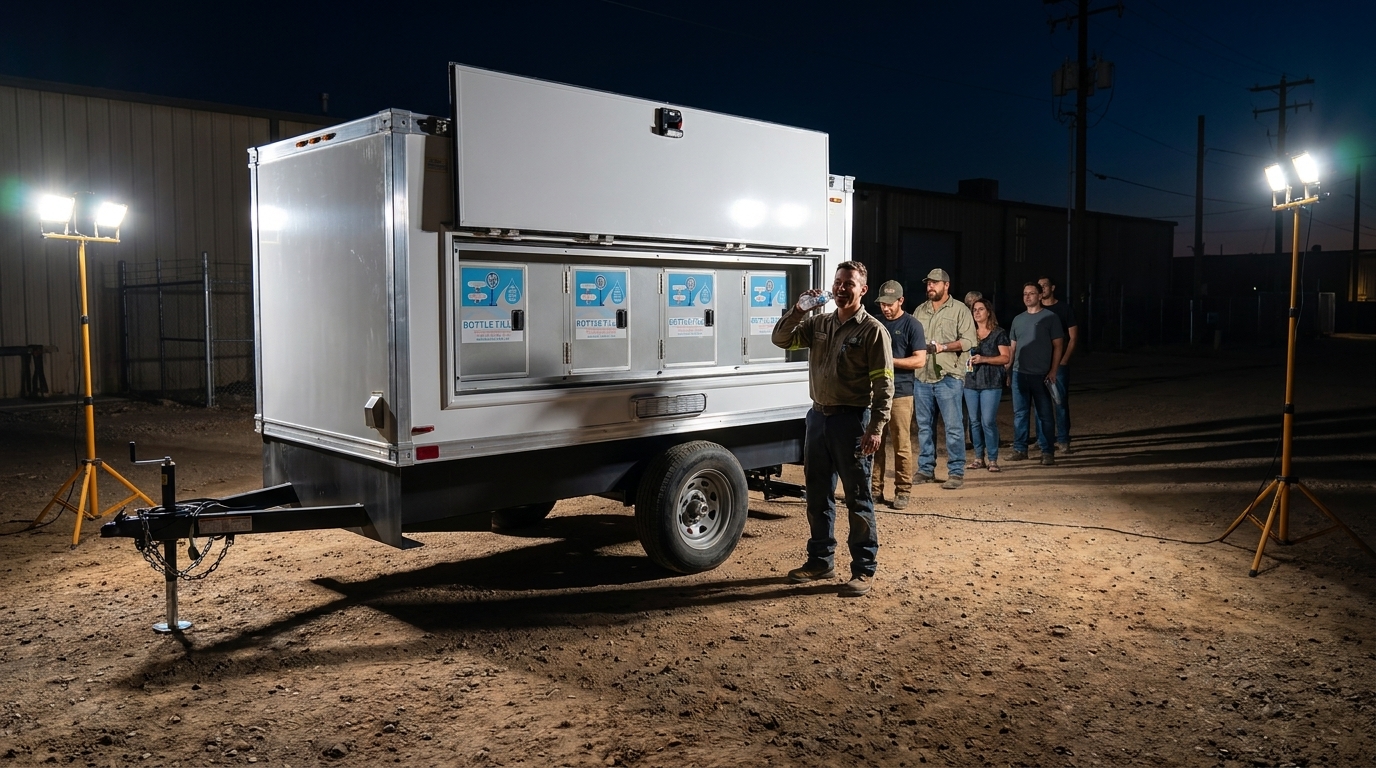
The clock is federal. Under 40 CFR 141.202(b), a Tier 1 situation such as a fecal indicator in a source sample requires public notice to persons served as soon as practical and no more than 24 hours after the system learns of the violation, delivered in ways reasonably calculated to reach everybody, including people in apartments, nursing homes, schools and businesses. The system carries that, not the vendor. It also contacts its state drinking water agency inside the same window and within ten days mails a signed certification of public notification.
Three advisory categories exist and they are not interchangeable. A boil water notice tells people to bring water to a rolling boil, one minute at most elevations and three minutes above 6,500 feet. A do not drink notice means alternative water only for drinking and cooking. A do not use notice is the most restrictive, alternative water for any purpose. The category drives the whole response, because the first is a microbial problem boiling solves and the last two usually are not. Denver metro water station rentals get planned off the same distinction.
On the distribution side the requirement is planning, not permitting. Emergency Management Performance Grant recipients have had to carry a distribution management plan since 2019, and the federal guide behind those plans sets the planning factors, two distribution methods, and the activation and pack-out triggers. A state can also ask FEMA for technical assistance at any time regardless of declaration status.
Our own obligations travel with the equipment no matter who signs. Wetted components are built to drinking water material standards, the treatment train is three filtration stages plus a separate UV pass, and one of the four fill points sits at accessible height on a route that needs firm, stable ground at least 36 inches wide to be usable from a seated position. We document the potable fill source, the fill date and tank cleaning records, because in a declared emergency that paperwork is what an environmental health officer and a grant auditor both ask for.
Federal OSHA heat illness prevention guidance and the CDC and NIOSH heat stress program point at the same baseline: cool drinking water, close to the people doing the work, and documented.
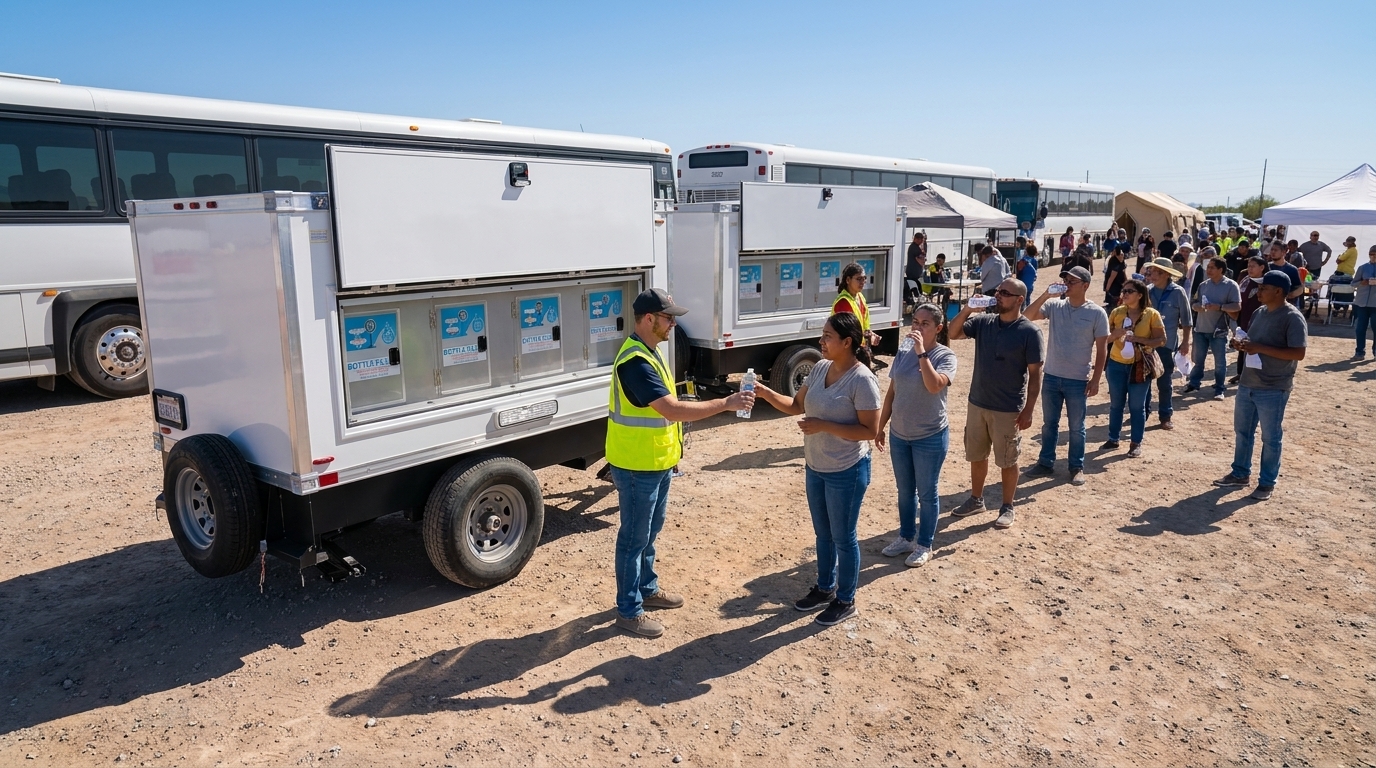
Need a station your written heat plan can point to? We can have one pouring cold within days.
Boxed bottled water is the default and it will stay part of every response, because a car drives through a line and leaves with something people can carry home. But look at what it takes to move. A pallet of boxed 16.9 ounce bottles lands between about 211 and 266 usable gallons depending on the case count, so covering 3,000 gallons means roughly twelve pallets staged, shaded, guarded and lifted case by case. That is a forklift, a pallet jack and a crew to run them. Our unit holds 300 gallons in one towable box, and cooling center water station rentals run on the same idea.
The labor rarely makes it into the plan. A Type I drive through site puts 36 workers on truck loading duty on the day shift alone, inside a total of 85 people, before security, medical and public information staff. Every one of them is lifting cases in the weather that caused the disaster, for twelve hours, and then the site restocks overnight so it can do it again. Cold water on that line is the difference between holding a shift schedule and pulling people off the line at hour seven.
Then there is what the public gets. In the first 72 hours, when supply is tight, a restricted issue is one gallon per person handed over as eight small bottles. That is a limited day, carried by hand, and every bottle becomes waste inside a community that just lost its water. A reusable pour point does not replace the case line and we have never pitched it that way. It takes the load that does not need packaging: the break area, the walk up lane, the shelter cot area, the family who came back with a jug because carrying bottles was not working.
Look at everything bottled water actually demands of a person: cutting the order, receiving and breaking down pallets, icing coolers before dawn, topping them up through the day, then flattening empty bottles for the bin. On a large crew that's hours of paid time burned every single day, scraped right off the work that's supposed to be getting done. The trailer erases that loop entirely. A local contractor once let us pencil it out with him, and the recovered labor by itself paid for the unit. His words were that the bottle runs had been quietly costing him close to a day of payroll a week. Our trailer arrives full, the tankers keep it full, and your superintendent owes it nothing but a parking spot.
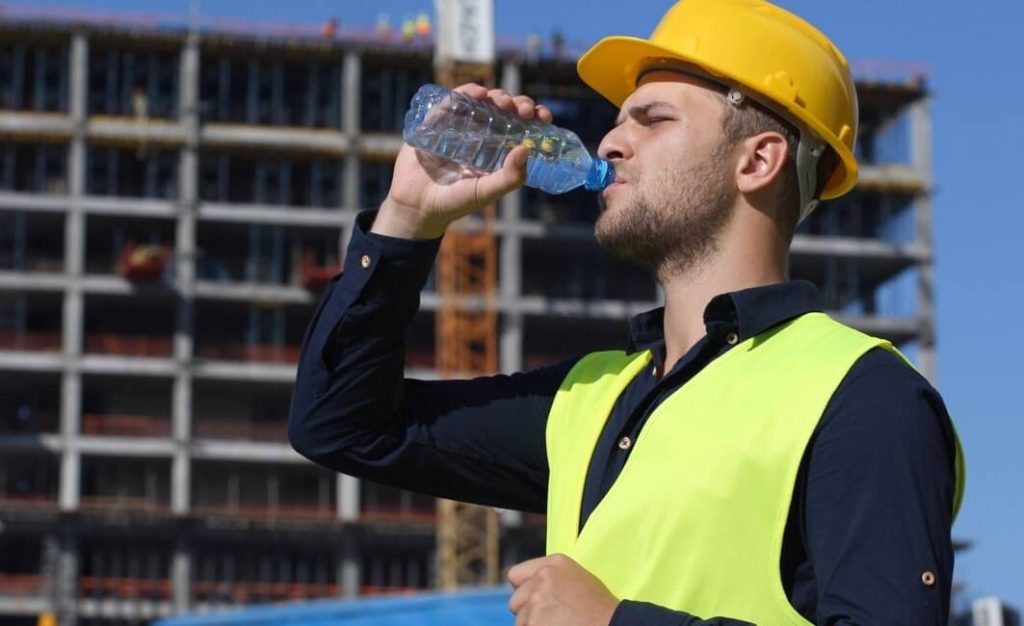
Ice a cooler at 6 a.m. and by mid-morning in July it's as warm as a bath. Warm water is water people stop touching, and the slowdown that follows is precisely where heat illness gets its opening. A chilled station never rides that warm-up curve at all. Whatever pours at clock-out is as cold as the sunrise fill, which happens to be the moment a spent crew, or a crowd deep into a long concert, leans on it hardest.
Bottled-water pallets devour staging space, jam the lay-down area, and sit cooking in the sun until somebody finally cracks them open. Empties build up faster than anyone keeps up with, and on a tight commercial lot that pile turns into its own problem. Set a trailer in one parking stall instead and it serves a crew or crowd that would otherwise burn through hundreds of plastic bottles every day.
Every bottle bought is a bottle thrown out, and across a season a busy site or event generates a small mountain of them. That's a disposal line on the budget, a dent in the sustainability numbers, and, given that a single bottle can linger in the ground for centuries, a footprint that lasts longer than the project that made it. Move to a refill station and the line drops to zero, which finally gives your reporting a figure worth publishing.
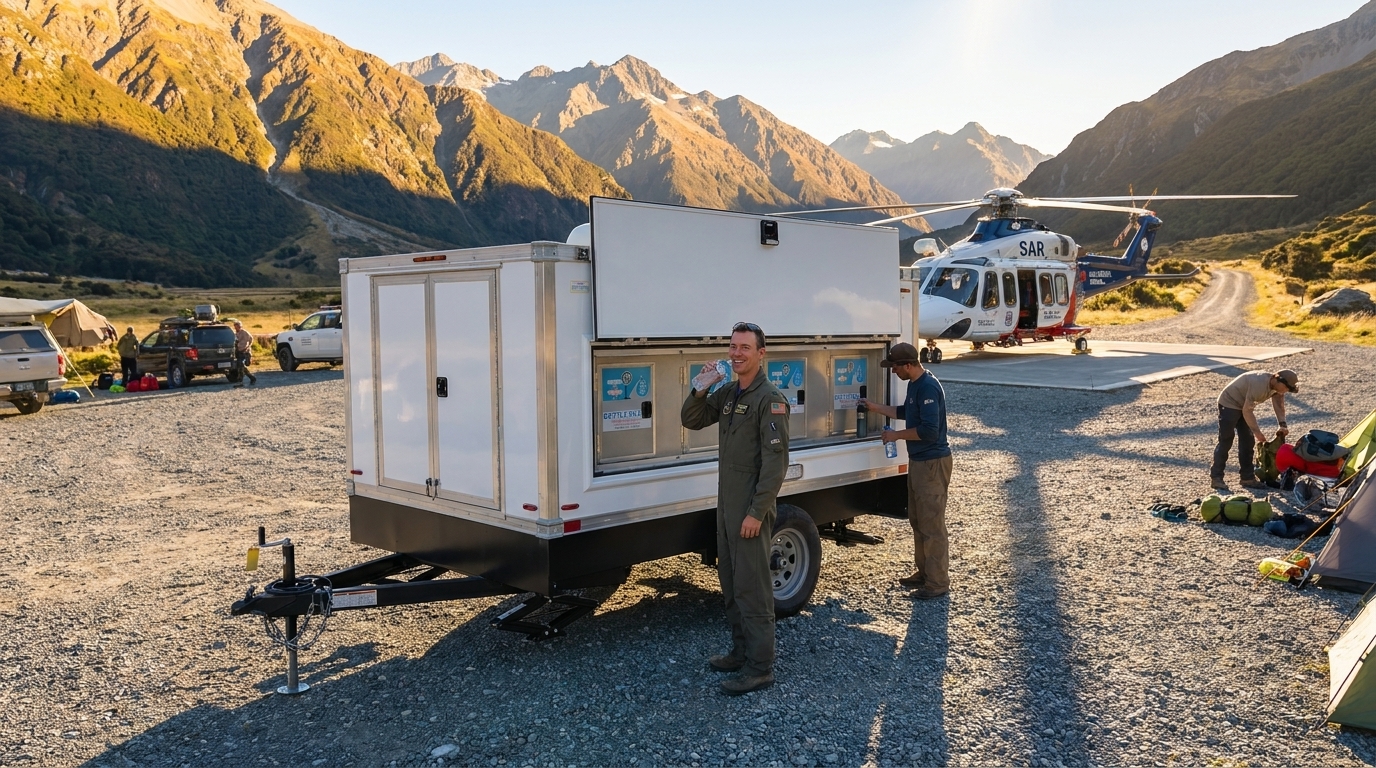
Three bookings of this kind, and what we planned around on each one. Names and details are kept generic on purpose.
Two block advisory, about 400 residents, first week of July. A routine sample came back positive on a Tuesday and the notice went out the next morning, which is the 24 hour rule working as written. The utility already had a bottled water point planned on a park lot inside the boundary, and the gap was cold water and jug fills for families who walked over rather than drove. We landed one unit that afternoon, filled from a hydrant meter two pressure zones outside the advisory area. The notice lifted on day three.
Type II drive through distribution site, day three of a hurricane activation. Ten thousand people a day were coming through two lanes, seven in the morning until seven at night, with 42 staff on days and 8 more restocking overnight. The commodity plan was solid and the staff plan had a hole in it, because every gallon on the lot was counted as public issue and the loading crews were drinking out of the cases they were handing away. We put one unit at the break area, well back with the wind moving away from the sanitation line, and a second at the walk up lane. The afternoon shift stopped losing people at hour seven.
Do not drink zone after a wildfire, about 1,200 standing homes, month two. This is the job that does not end on schedule. The fire was out. The surviving homes were occupied again. But the water inside the service lines was still failing chemical tests, which means boiling fixes nothing and the timeline runs in months while lines get sampled, flushed and in many cases replaced. We set three units across the zone where residents and rebuild crews both passed, on a standing weekly refill drawn entirely from outside the affected system. Nobody ever asked us to filter the tap water, because we had said in the first conversation that we would not.
Service information current as of September 2026.
Still weighing it? Call and ask. Most of these questions get settled in one short conversation.
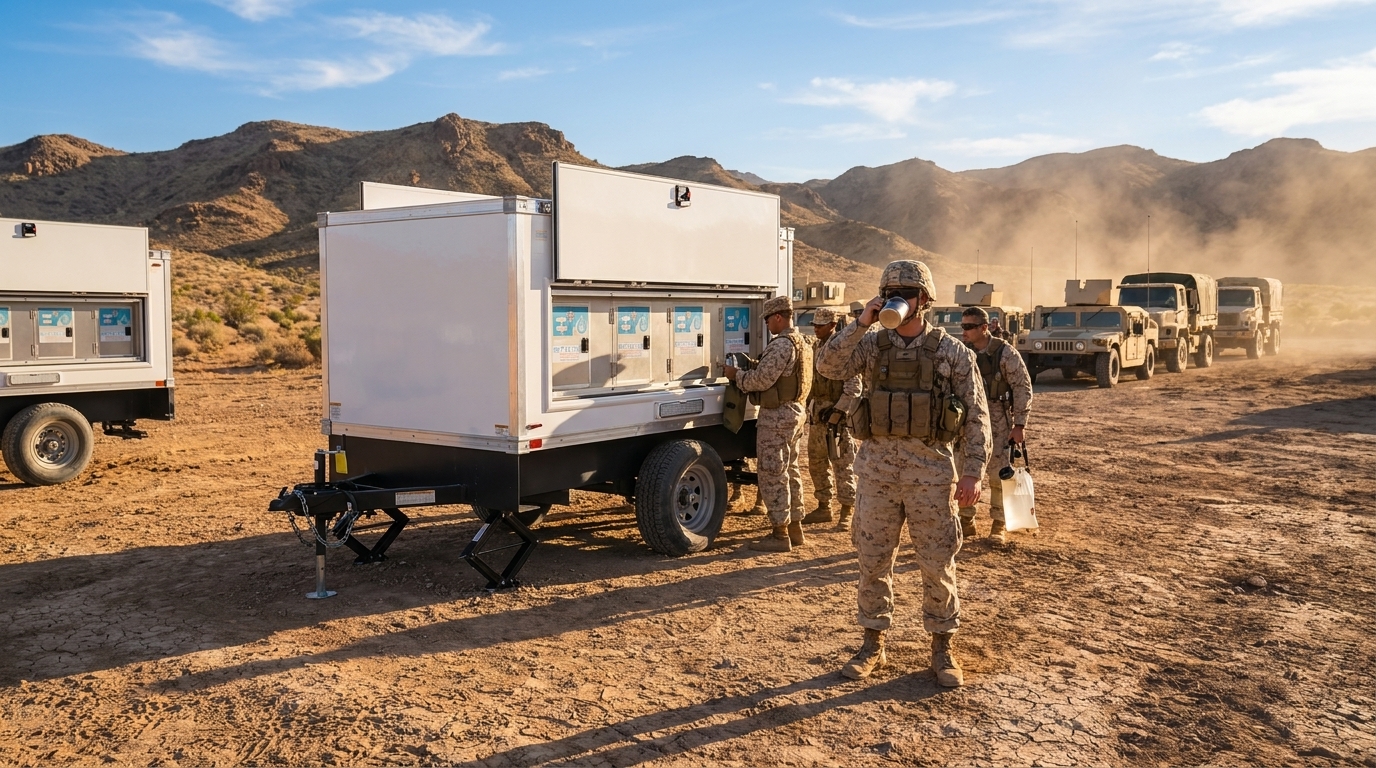
No, and we say that before we quote. The unit is a dispensing station, not a treatment plant. It is filled from a certified potable source you identify, and its three filtration stages and UV lamp are a safeguard and a taste polish on water that is already safe. Federal health guidance is clear that water containing fuel, toxic chemicals or radioactive material cannot be made safe by boiling or home water treatment.
From outside the advisory boundary, always. In practice that could be a hydrant meter on a pressure zone the notice does not cover. A bulk water delivery or a tanker with current test results works too. Utilities already know which zones are clean because they drew the boundary. We record the source and fill time on the ticket and clean the tank between jobs.
Household preparedness guidance says at least one gallon per person per day covering drinking and sanitation, with a normally active person needing about three quarters of a gallon of fluid daily and hot weather doubling that. State distribution site guidance uses the same one gallon figure for a restricted first 72 hour issue. FEMA's bulk planning factor is deliberately different, three liters per person per day or about 0.79 gallons.
Most lift within 24 to 72 hours, once repairs are finished and two rounds of bacteria testing come back clean, which takes roughly 48 hours by itself. Major events take longer. Plan the rental short and the mobilization fast.
They are separate categories with different remedies. A boil water notice means the suspected problem is microbial, so a rolling boil for one minute, three minutes above 6,500 feet, makes it safe. A do not drink notice means boiling will not fix it and alternative water is required. A do not use notice is stricter still, alternative water for any purpose. The category tells you whether you are planning a two day bridge or a months long supply.
It cannot. Wildfire contamination of a water system is typically chemical, not microbial. Toxic chemicals and other compounds can enter lines that have lost pressure, coming in with smoke, and plastic service lines can break down in the heat too. Boiling and home water treatment do nothing about those compounds. That is why post fire notices are issued as do not drink and do not boil, and why one California town's notice was not lifted for standing homes for roughly a year and a half.
Start with crowd areas rather than headcount. A Type III drive through site serving up to 5,000 people a day usually needs one unit at the staff break area, a Type II serving up to 10,000 needs two, and a Type I serving up to 20,000 across four lanes needs three or more plus a tanker cycle. Throughput is capped by loading points, not water.
Same day is the normal target, because the useful window on an advisory is the same 24 hours the notice runs on, and on a declared disaster the first 72 to 96 hours set the size of everything. We need three answers to move: population inside the boundary, the lot we can use, and the potable fill source. Give us those on the phone and we will size it and dispatch.
The fastest path is a vendor already sitting on a vehicle you can use, which is why federal guidance says the best time to prepare contracts is before an incident. Agencies commonly work through an existing state contract or a cooperative purchasing program, and adding capacity to a contract already in place beats a new solicitation during a response. Standby and vendor managed inventory arrangements exist for exactly this.
The hardest part of an advisory is not the water. It is that six things have to happen at once inside a single day, and the person who would normally solve the drinking water question is busy doing three of the other five. Laying the day out in order makes it manageable.
Hour zero is the lab result or the pressure event. From that moment a Tier 1 situation gives the system no more than 24 hours to notify the people it serves, and the same window covers the state drinking water agency and the county health department. The boundary gets drawn, which is the most useful artifact of the day, because it also identifies which pressure zones are clean.
Hours one through four are notification: door hangers, phone, text, email, radio and television, with extra effort for apartments, assisted living properties and schools, where a single method misses most of the people inside. Somewhere in here the question gets asked out loud for the first time, which is where people get water today.
Every emergency water conversation we have in July would have been easier in February. Federal distribution guidance says it plainly: the best time to prepare contracts is before an incident occurs, when a jurisdiction can assess its capability and find out who can actually supply it. During a response, the agencies that move fastest are the ones that are not shopping.
The practical reason is that a new solicitation is slower than adding capacity to a vehicle that already exists. Agencies commonly buy through an existing state contract or a cooperative purchasing program, where one lead state or a national body runs the competitive solicitation once and every eligible public entity can use the resulting agreement.
Standby arrangements are the next layer and they exist in the real world. Vendor managed inventory is named in federal guidance with a live example: a state that stores disaster meals and water with a vendor who rotates the stock toward other customers and backfills what it draws. For equipment the same logic applies to capacity. A unit committed to you in advance is not already three counties away when the declaration comes.
A drinking water station is easy to place badly, and on an emergency site a bad placement is more than inconvenient. It blocks a lane, it sits somewhere people will not walk at night, or it ends up where the sanitation line should have been. These are the questions we ask on every one.
Where does the traffic actually go. On a drive through site the ground is already spoken for: a vehicle line 20 feet wide and 300 feet long. Behind that sits a loading line 80 feet wide holding three 40 foot loading points, and a supply line 50 feet wide for tractor trailers up to 54 feet. If there is no site diagram yet, ask which side the commodity trucks enter from and stay clear of it.
How far from sanitation, and can somebody in a wheelchair use it. Latrines and sanitation stations belong at least 50 feet from the break area, with the wind blowing away from it, and a drinking water point wants the other end of that relationship. Accessibility means a route at least 36 inches wide on firm, stable ground reaching a fill point usable from a seated position, not a unit parked over a curb or across soft turf. At a shelter that is the most important placement question of all.
→
The crew side of a fire, where an incident base goes up on bare ground and needs drinking water before the first shift returns.
→
Heat emergencies open the same public buildings as a shelter activation, with the same drinking water gap.
→
The fellowship halls that become relief sites are the same buildings that host events the rest of the year.
→
Parks absorb displaced households after a disaster and often run on limited potable capacity.
We run water station rentals nationwide, and we keep dedicated local pages for the metros our trucks work hardest. Start with the closest one.
Booking this kind of work in a metro we already run? Start with Sacramento drinking water station rentals, mobile water stations serving Fresno, water station delivery around Bakersfield, mobile water stations serving Portland, water station delivery around Seattle, Denver drinking water station rentals, Houston drinking water station rentals and water station rentals in Corpus Christi, and call us for anywhere else in the country.
 Sacramento Valley
→
Agency offices and fairgrounds that become staging ground in a Northern California activation.
 Central Valley
→
The valley hub for Sierra emergencies, with the hottest summer conditions we work in.
 Southern San Joaquin
→
Brush country where early season fires and aging mains make news in the same month.
 Willamette Valley
→
A supply base for Cascade incidents, with winter freeze breaks behind its short notices.
 Puget Sound
→
Dense blocks where one main break puts thousands of households inside a single boundary.
 Front Range
→
The metro beside the county where one December fire damaged six public water systems.
 Gulf Coast
→
Hurricane country with the population for the largest drive through sites in the tables.
 Coastal Bend
→
A coastal city that plans for landfall every season and has run its own notices.
Give us the head count or the guest count, the date, and the spot it will park. We will spec the right setup, confirm the delivery window, and have cold filtered water pouring before the day starts.