Arizona Cold Water Station Rentals for Events & Job Sites, 24/7 Dispatch
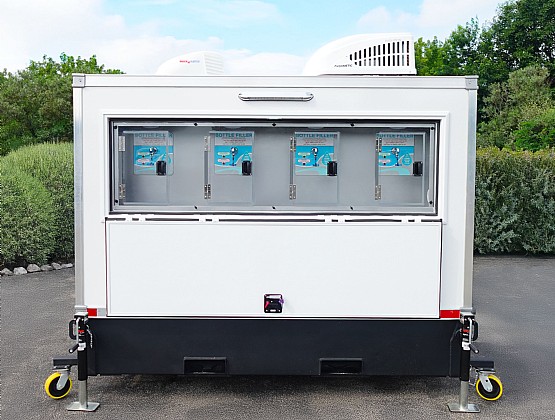
We dispatch cold, filtered water stations across Arizona for events and job sites, 24/7. With 110-degree afternoons running for months and more than a hundred triple-digit days a year, warm bottled water gets ignored right when people need it most, whether it’s a wedding lawn in Scottsdale or a build crew out past Buckeye. Our self-contained stations stay cold and refill themselves all day, so guests stay comfortable and crews stay safe, on the Valley floor or up in the high country.
- Dispatched across Arizona
- ~45-min metro delivery
- Cold, four-stage-filtered water
- ADA bottle filling
- OSHA heat-illness ready
- 24/7 emergency dispatch
We know what a Sonoran summer does to a job site, and we plan for it
Arizona isn’t a state where running out of cold water is an inconvenience, it’s a shutdown. From the Valley of the Sun up through Tucson and out to the agricultural West Valley, we stage mobile water stations for the people who can’t pull their crews off the line when the asphalt hits 150 degrees: contractors on the semiconductor megaprojects in north Phoenix, data-center builders around Goodyear and Mesa, landscape and solar crews who start before dawn to outrun the heat, and event organizers who plan around triple-digit afternoons the way coastal cities plan around rain. The questions you’d ask a seasoned operator are the ones we’ve already solved in this exact climate: how fast can you get here, will the water still be cold by 2 p.m., and what happens when a 300-gallon tank runs low on a Friday afternoon.
We move at Arizona’s tempo
Metro deliveries across the Valley and Tucson typically land inside about 45 minutes from dispatch, and we run emergency drop-offs around the clock during heat waves. When a safety lead realizes at 6 a.m. that a 60-person crew has nothing but a warm cooler, that response time is the whole game, whether the site is in Tempe or out toward Gila Bend.
Genuinely chilled, not just “wet”
Every station flash-chills its own supply, so the last fill of the afternoon is as cold as the first one at dawn. Warm water doesn’t get consumed, and water that doesn’t get consumed doesn’t prevent heat illness. In Arizona that distinction matters more than almost anywhere in the country.
Delivered, serviced, refilled, hauled
You aren’t juggling a bottled-water vendor, an ice run, and a waste contractor across a sprawling state. We drop the station, keep it filled from our own water trucks, service it, and pull it when you’re done, a single point of contact for the whole hydration loop on your Arizona site.
I tell every new Arizona client the same thing on the first call: “If your crew won’t drink it, it isn’t working.” I’ve watched warm bottled water sit full while people quietly slid into heat trouble, and I’ve watched the opposite, a cold station ten steps away that a crew empties twice a shift. That gap is the whole job. So we don’t just drop a trailer and disappear. We size it to your headcount, set the refill cadence to your demand, and treat a hot-weather emergency call the way you’d want it treated, fast, because in an Arizona summer the difference is measured in degrees and minutes.
A few years back I staged a unit on a north-Valley high-rise and parked it near the gate on day one, the obvious spot. It sat half-used, because the work face was eleven floors up and nobody wanted to burn a hot break walking to it. We moved it to the hoist landing the next morning, and consumption doubled by lunch. The foreman put it plainly: “Make the water closer than the shade and they’ll drink it.” That one job rewired how we place every station in this state, metro or rural.
One rugged, road-towable trailer built for Arizona work in the open sun
We bring a single, purpose-built unit anywhere in the state: the Signature Series water station trailer. It rides on a full road chassis, so it hauls straight to wherever the work happens, the grading site out past Buckeye, the festival field in Scottsdale, the solar install toward Gila Bend, the pecan and produce operations of the West Valley. No building required, no permanent plumbing, just cold filtered water on tap the day it arrives.
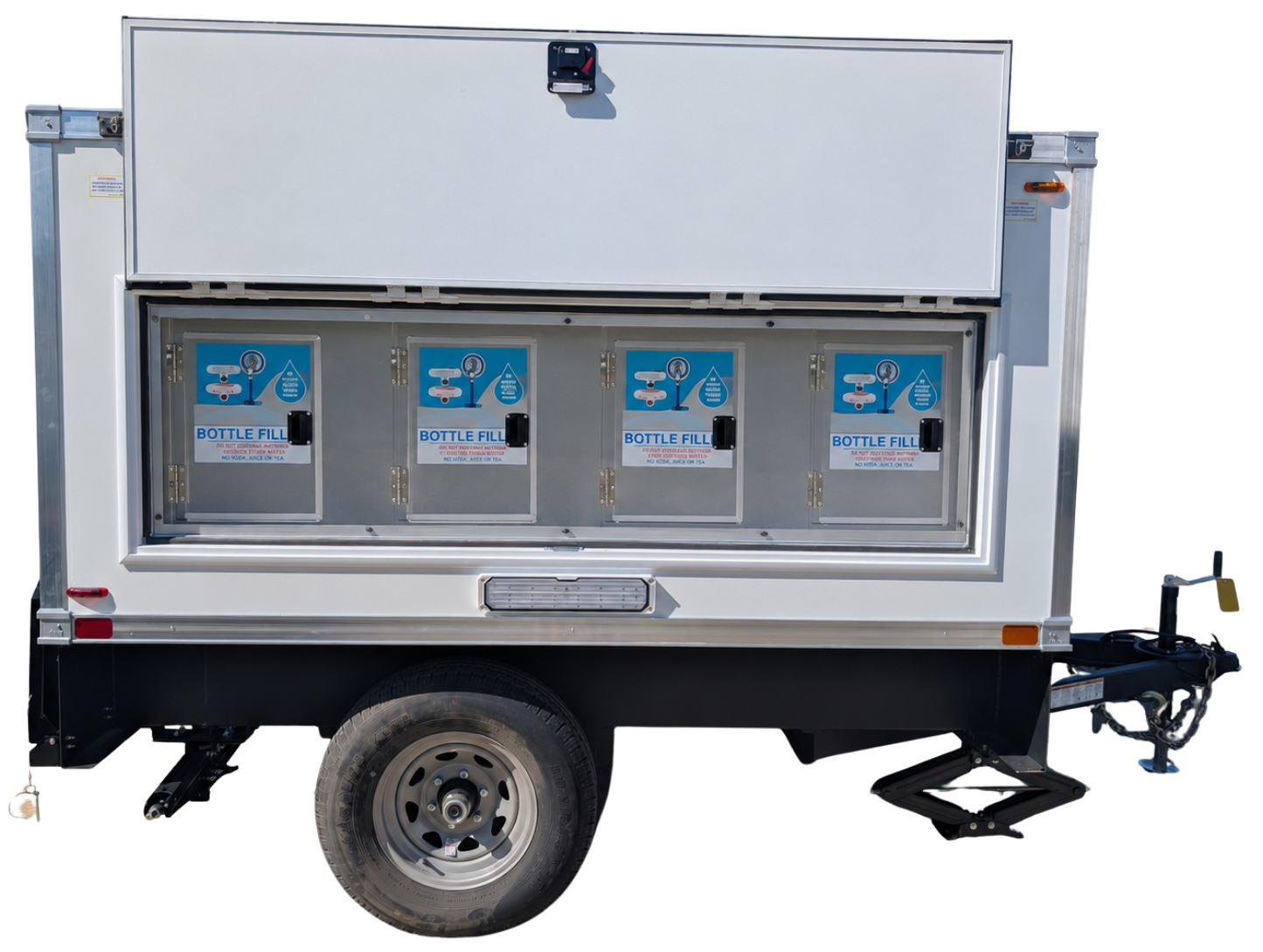
Signature Series specifications
Built on a full trailer chassis with tires and a hitch, it tows to a remote job site, an event field, an ag operation, or a disaster staging area anywhere in Arizona. This is the unit construction and outdoor-event clients ask for by name, sized to drop in, level out, and start pouring the same afternoon it lands.
| No. of stations | (4) Bottle Filling Stations |
| Length | 12′ 3″ |
| Weight | 3,100 lbs. |
| Height | 8′ |
| Fresh water tank | 300 Gallons |
| Power requirements | 1–4 dedicated 20A/120V circuits OR 1 dedicated 50A/240V circuit |
| No. of AC units | 1 |
Why this is the right trailer for Arizona
Everything about the Signature is tuned for heat and distance, the two things an Arizona job throws at you most. The four push-back filling stations sit on an exterior wall under an awning, so a whole crew can rotate through fast on a hot break without bottlenecking at a single tap. The onboard AC and built-in chillers keep the supply cold even when the trailer is baking in direct afternoon sun, which is the part most coolers and bottled-water plans get wrong in the desert.
The 300-gallon fresh tank is enough to run a sizeable crew through a shift, and because the unit is road-towable, we can relocate it across a sprawling site, follow a build to its next phase, or relocate it between a metro event and a high-country one without tearing down a fixed install. It runs on ordinary job-site power and tolerates a wide power range, so the same trailer works on a fully built site in Chandler or a bare desert lot we power around near Yuma.
It also carries more than the headline bottle-fill stations: a rear large-jug filling point for five-gallon coolers and hydration packs, plus multiple hose-bib outlets for crew tasks, wash-up, and ag use. One trailer covers the whole hydration picture for an Arizona job site or event.
The math that ends the bottled-water habit
Walk a 50-person Arizona crew through a single summer and the case writes itself. At roughly six bottles a person on a triple-digit day, you’re buying, hauling, icing, and throwing away around 300 plastic bottles every single day.
Across a 200-day project that’s more than 60,000 bottles, and on the bigger multi-phase builds out by the fabs and data centers, north of 100,000. One station replaces all of it, with cold water on tap and nothing left to land in the dumpster.
It’s a logistics decision before it’s a sustainability one
The plastic-waste story is real. Americans throw out roughly 60 million water bottles a day, only about a third get recycled, and a single bottle can sit in an Arizona landfill for centuries. That’s worth putting in your ESG report. But most Arizona project managers switch for a plainer reason: a centralized station erases the daily scramble. No standing bottled-water purchase order. No cooler that’s lukewarm by mid-morning. No pallet of empties baking by the gate. Your superintendent gets to manage the build instead of babysitting the water.
And because we keep the station filled from our own potable water trucks, supply scales with the job. A crew that doubles for a concrete pour doesn’t out-drink the plan. We just top off the tank. Simple as that.
Hydration sized for the way Arizona really works
Arizona doesn’t have one hydration problem, it has a dozen. A semiconductor build in the north Valley needs something different than a Cactus League game in Mesa, which needs something different than a melon harvest in the far West Valley. Here’s where these stations earn their keep across the state.
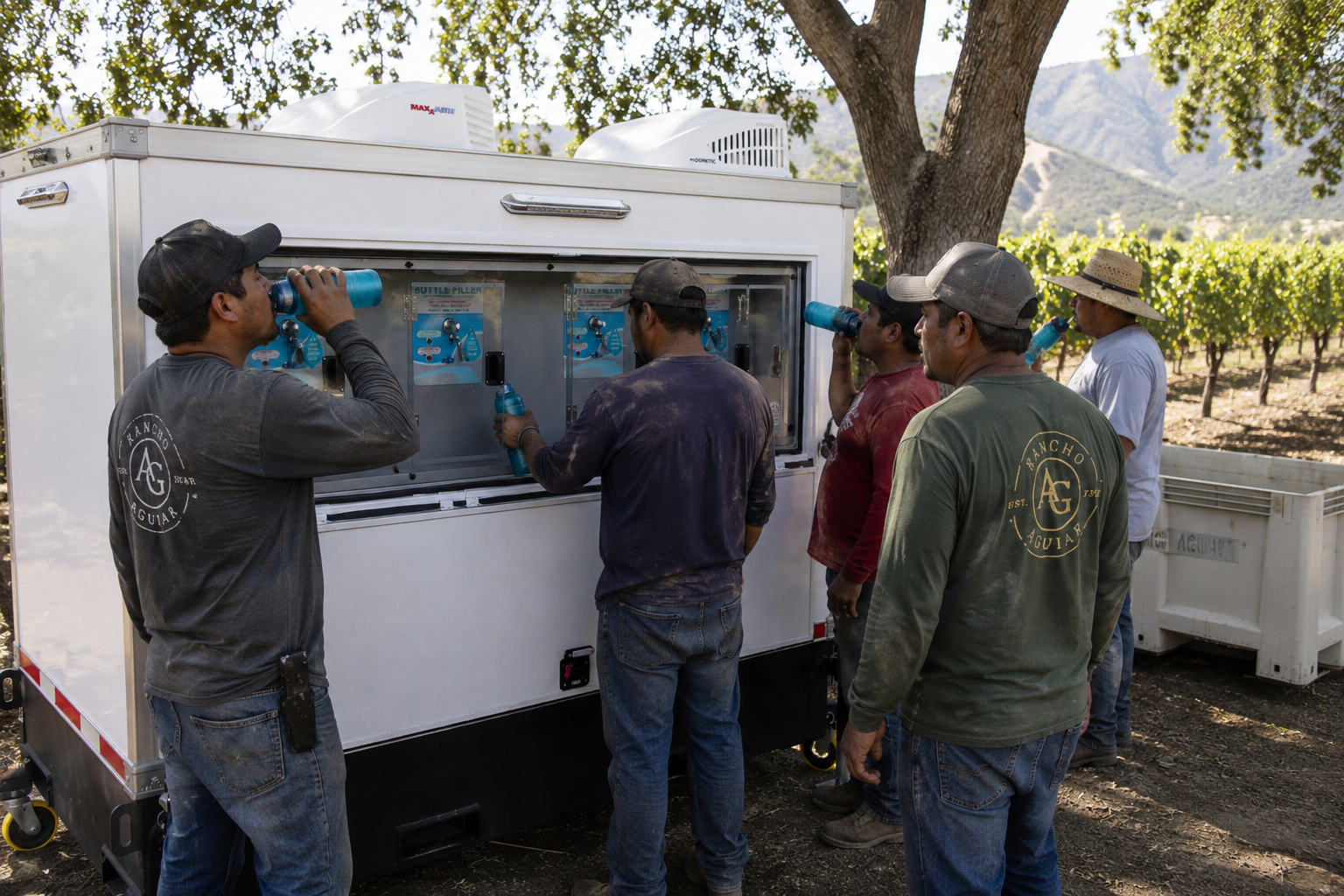
Agriculture, solar & outdoor labor
Arizona’s farms and vineyards, the dairies, the sprawling solar installs toward Gila Bend and out past Yuma, the landscaping and utility crews across every county. This is some of the most heat-exposed work in the country. Jug-fill and hose-bib outlets let field crews top off coolers and personal gear right where they’re working, no run back to the truck.
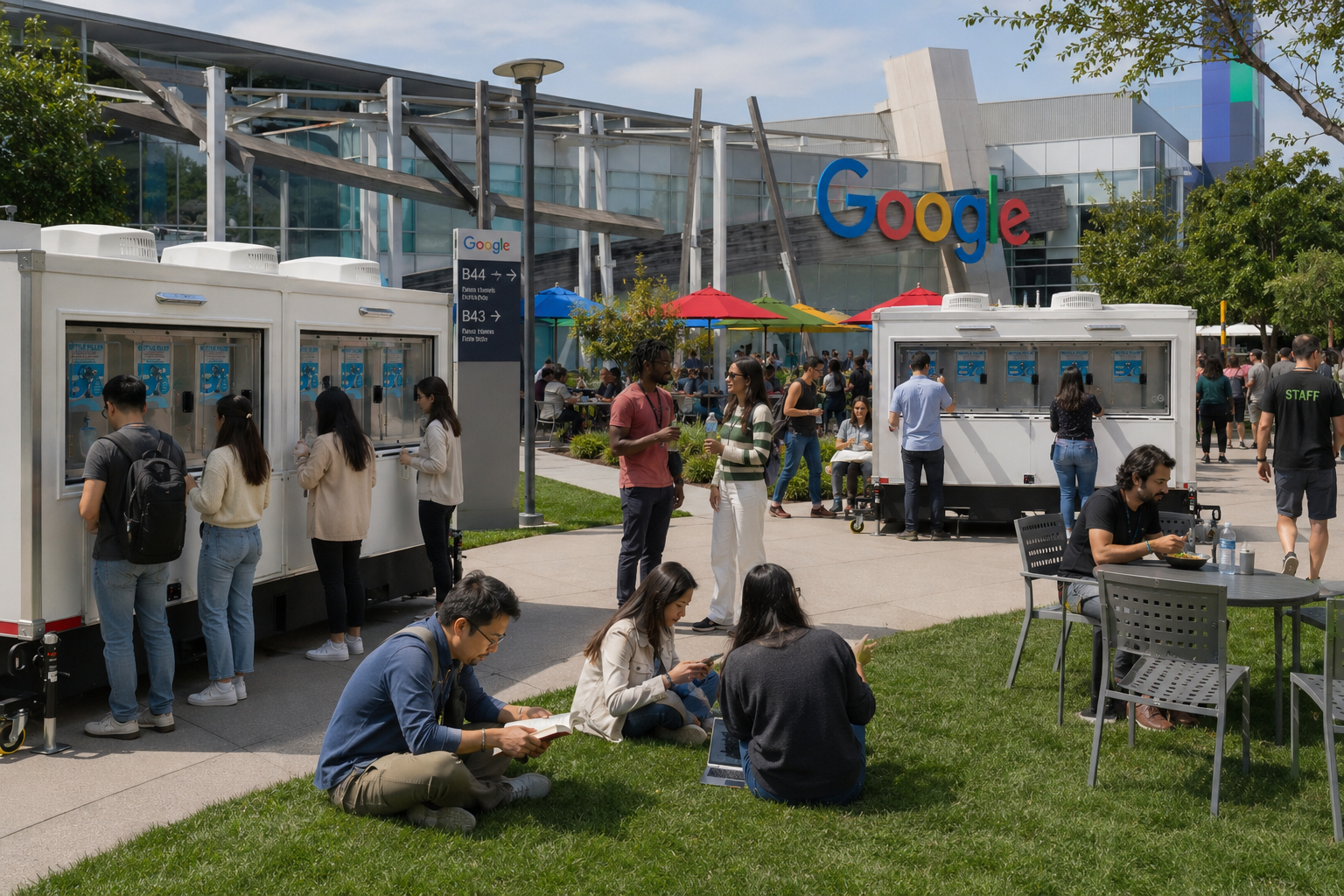
Semiconductor fabs, data centers & corporate campuses
Arizona’s generational build-out runs on crews of hundreds in open sun, the TSMC fabs rising in north Phoenix, Intel’s long-running Chandler expansion, the data-center clusters around Goodyear, Mesa, and Tucson. We stage stations along these corridors and on finished campuses alike, so contractors and employers can put documented cold hydration within a short walk of every work face.
Outdoor events, festivals, races & spring training
The WM Phoenix Open galleries in Scottsdale, Cactus League spring training across the Valley, Tucson’s gem show and rodeo, festivals, fairs, and charity 5Ks, an outdoor crowd in Arizona drinks fast. I once watched a single station near a festival main stage draw a line forty deep by mid-afternoon (heat plus thousands of people is a quick equation), so the next year we spread four units across the grounds and the lines simply vanished. A station gives organizers free-flowing cold water and refill points without a mountain of single-use bottles to cart in and cart out.
Industrial yards & disaster response
Outdoor industrial yards, laydown areas, and equipment lots around Tolleson, Glendale, and Tucson put crews in the same brutal sun as any construction site, and a towable station drops right into the yard where they work. When a heat emergency or a water-main failure hits an Arizona community, we also deploy potable water stations to cooling centers and base camps on short notice.
Four stages of treatment, then chilled, then poured
A water station is only worth renting if people want to drink from it. Ours run city water through a full treatment train and a UV chamber before a built-in chiller takes over, so what comes out of the nozzle tastes like it should and is genuinely cold, even on the worst afternoon of an Arizona summer.
Sediment stage
Strips out grit, rust flecks, and the fine particulates Arizona supply lines pick up before anything else touches the water.
Carbon stage
Pulls chlorine, odors, and off-tastes so the water is clean on the palate. The difference between a station people use and one they ignore.
Micro-particulate stage
A dedicated polishing cartridge traps the microscopic particles still riding the water, protecting workers and the public alike.
UV disinfection
An ultraviolet chamber neutralizes bacteria and pathogens with light, not added chemicals, as a final safeguard before the tap.
Three ways to fill, including ADA
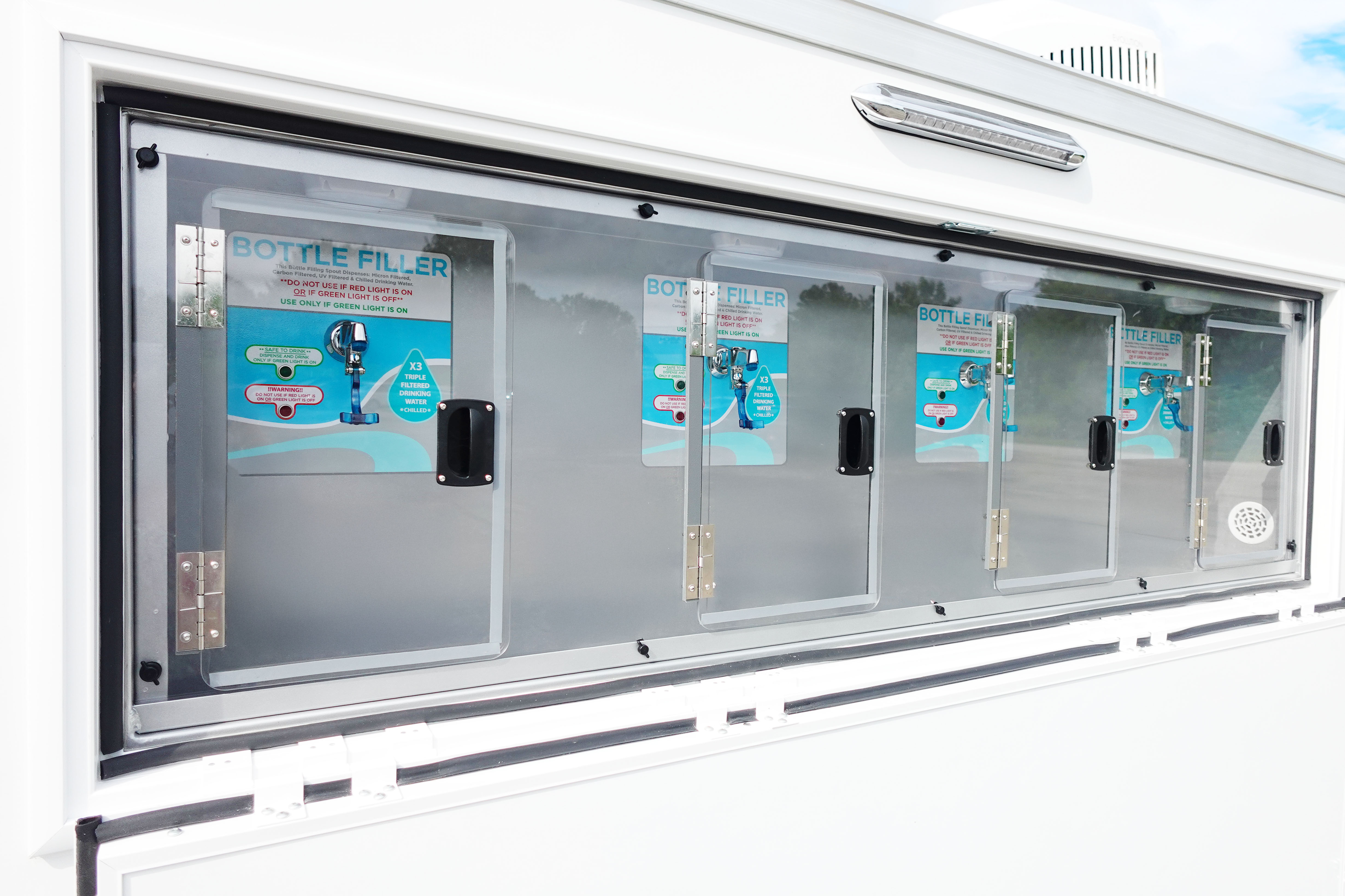
Every unit carries four push-back bottle-filling stations with adjustable nozzles, touch a bottle to the bar and it fills. One position is mounted at an ADA-accessible height, so the station serves everyone on site without a workaround. A rear large-jug filling station handles five-gallon coolers and personal hydration packs, and multiple hose-bib outlets feed job-site tasks, event support, and ag crews. Food-grade components and stainless equipment hold that filtered-and-chilled quality at every point the water touches before it reaches the nozzle.
A single Signature trailer holds 300 gallons, roughly 2,400 sixteen-ounce pours. And we refill it on demand, so a station never becomes the bottleneck on a busy Arizona shift.
Water Station Rentals across Arizona
Our local Arizona dispatch reaches the whole Valley of the Sun, Southern Arizona, and the corridors in between. Explore the metros where we run dedicated coverage, then call for anywhere else in the state.
Valley of the Sun
Phoenix
→
The state’s hub: downtown and Sky Harbor, the north-Valley fab corridor, the resort district, and Ahwatukee.
East Valley
Mesa
→
East Valley builds, Cactus League ballparks, and industrial yards under relentless summer sun.
East Valley
Chandler
→
Home to Intel’s long-running expansion and a dense tech-and-construction workforce.
East Valley
Gilbert
→
Fast-growing East Valley town with sprawling outdoor events, sports, and new development.
Valley of the Sun
Scottsdale
→
Resort weddings, the WM Phoenix Open galleries, and high-end outdoor gatherings.
West Valley
Glendale
→
Stadium events, festivals, and West Valley industrial yards and logistics parks.
Southern Arizona
Tucson
→
Southern Arizona’s hub, gem-show crowds, university events, and desert job sites.
Working a town we don’t list above? We also dispatch to Tempe, Peoria, Surprise, Goodyear, Avondale, Buckeye, Queen Creek, Yuma, Flagstaff, Prescott, Casa Grande, and communities across every Arizona county. If your project sits along the I-10, the I-17, or the I-8, you’re inside our service reach, just call and we’ll route a station to you.
We deliver, fill, and hook it up, usually pouring cold water inside an hour
There’s no project to manage on your end. We handle placement, the fresh-water fill, and the hookup, and we walk your team through it before we leave the site.
You tell us the basics
Crew or attendee count, how long you need it, where on the site it should sit, and what power is on hand. That’s enough to right-size the job.
We deliver across Arizona
Typically about 45 minutes from dispatch in the Phoenix and Tucson metros, with scheduled runs to outlying towns and emergency drops 24/7 during heat events.
We set it up
Level the station, fill the 300-gallon fresh tank, and connect power, one to three 20-amp 120-volt circuits, or a single 50-amp 240-volt drop.
We keep it running
Our water trucks top off the tank on a schedule that matches your demand, and we service the unit for the length of the rental.
No generator on a remote site? It comes up in the quote (between the trailer’s modest power draw and our service fleet, we’ve staged stations in places with no permanent power at all). I remember a bare desert lot near Casa Grande where the super assumed we’d never make it work, and we had cold water pouring by the time his first crew clocked in. “Didn’t think you could pull that off out here,” he admitted. Just tell us what’s there and we’ll engineer around it.
In an Arizona summer, hydration access is a documented safety obligation
Much of Arizona sees more than a hundred 100-degree days in a typical year, with long stretches where it never drops below triple digits before sundown. Arizona has no state-specific heat standard, which means employers fall under federal OSHA, which already requires accessible potable drinking water on the job. And OSHA’s proposed national Heat Injury and Illness Prevention standard would push that further, toward documented, suitably cool water positioned close to where people work.
A water station turns that obligation into something you can point to. It’s a fixed, mapped hydration point producing cold, potable water on demand, the backbone of a credible Heat Illness Prevention Plan (HIPP) and exactly the kind of infrastructure a safety audit wants to see, anywhere in the state.
We saw how much that matters on a West Valley solar job where the safety lead needed documented cold-water access for an audit. We mapped the station into her HIPP, kept the refills ahead of demand, and she later told us the inspector flagged it as a model setup. “Easiest line item in the whole review,” she said.
- Continuous access to suitably cool, potable water on the work face
- Centralized, documentable hydration points for your HIPP records
- Supports acclimatization and scheduled hydration breaks for heat-exposed crews
- Ready for tightening federal heat rules instead of scrambling after them
Why this is the hardest hydration climate in the country to plan around
Most states get a hot week or two. Arizona gets a hot season measured in months. And the people building the state’s future are out in the worst of it.
Across the Sonoran Desert lowlands, a typical year runs more than a hundred days at or above 100 degrees, with long July and August stretches where the overnight low never even drops out of the 90s and the monsoon adds humidity to the heat. Surface temperatures on fresh asphalt and bare concrete climb far higher than the air reading, which is why a crew can be in genuine heat-illness territory by mid-morning while the thermometer still says “only” 102. Cold water isn’t a nicety in that environment. It’s the single cheapest piece of safety equipment on the site. Full stop.
What makes the planning hard is that the danger window is so long, and the state so varied. The Valley floor, Tucson, and Yuma bake for months. Up in Flagstaff and the high country the summer is milder, but the events still draw crowds that need water. A contractor running a six-month summer schedule in the desert can’t cooler-and-ice their way through it, the volume is too high, the warm-up too fast, and the labor of hauling, icing, and disposing of bottled water compounds every single day. A centralized, self-chilling station is the only setup that holds up across a full Arizona summer without becoming its own logistics project.
And the demand is only climbing, because Arizona is in the middle of a generational build-out. The TSMC semiconductor campus going up in north Phoenix is one of the largest private construction projects in state history, surrounded by a growing cluster of suppliers and data centers. Intel’s long-running expansion sits just south in Chandler. Warehouse and logistics parks keep spreading across the West Valley around Goodyear, Buckeye, and Tolleson, and similar growth is reaching Tucson and Pinal County. Every one of those sites means hundreds of workers in open desert sun, often on schedules that start before dawn specifically to outrun the afternoon.
We built our Arizona dispatch around exactly that pattern. When we first started staging units along the I-10, I-17, and Loop 303 industrial corridors, we timed refills to crew size rather than a fixed calendar, and we added emergency drops during heat advisories. Because on an Arizona megaproject, a hydration gap doesn’t just slow the work, it can stop it cold and put people in an ambulance.
We learned that margin the hard way. During one July heat advisory we’d pre-staged extra water trucks on a hunch, and when three Goodyear sites called the same afternoon, we covered all three without a single crew running dry. A safety lead texted us that evening: “You showed up before we even knew we were low.” That’s the standard we now build into every hot-season Arizona contract, the refill plan reads the forecast, not the calendar.
One state, several very different hydration jobs
Arizona isn’t a single market, it’s a string of regions with their own crowds, crews, and climates. We dispatch the same trailer to all of them and tune the refill plan to each.
A West Valley solar superintendent once bet us we couldn’t keep 300 gallons genuinely cold in open desert past noon. We delivered, dialed in the refill cadence, and a week later he called to add a second unit. “The crew stopped asking for ice,” was all he said. Cold water that stays cold is the whole pitch out here, and once a station lands, it tends to sell the next one itself.
Phoenix & metro Maricopa
The state’s center of gravity, downtown Phoenix, the north-Valley fab corridor, Sky Harbor, and the resort district. The densest concentration of megaprojects and outdoor events in Arizona, and where our fastest delivery windows live.
Mesa · Chandler · Gilbert · Tempe
The tech-and-construction belt, Intel in Chandler, fast-growing Gilbert, Cactus League ballparks in Mesa, and the university crowds of Tempe. Job sites and events sit side by side here, often within a few miles.
Glendale · Goodyear · Buckeye · Surprise
Stadium and festival country crossed with the state’s logistics and agricultural engine, warehouse parks, dairies, vineyards, and solar installs reaching out toward Gila Bend. Some of Arizona’s most heat-exposed outdoor labor.
Tucson & the south
Tucson anchors the south, the gem show, university events, rodeo crowds (the February crush is a market all its own), and a growing ring of desert job sites and data centers. We dispatch dedicated coverage here on the same ~45-minute metro tempo.
Flagstaff · Prescott & the rim
A cooler, higher-elevation contrast to the desert floor, but the summer festivals, races, and outdoor gatherings still draw crowds that need clean, cold refill points. We run scheduled trips up north on request.
Yuma · Casa Grande · the freeways
Yuma’s winter-vegetable fields, Pinal County’s expanding industrial and ag sites, and the long I-8, I-10, and I-17 corridors that tie the state together. Multi-site and corridor projects get the same right-sized service as a single address.
Beyond the station: the trucks that keep an Arizona site supplied
A water station is the visible piece. Behind it sits a support fleet that handles fresh water in, on-site storage, and waste out, so a single phone call covers the entire loop instead of three separate vendors, statewide.
Potable water trucks
Our water trucks haul drinking-grade water in volume and keep your station’s 300-gallon tank topped off on a schedule sized to your crew. They also fill cisterns, on-site tanks, and bladder bags when a project’s demand outruns a single delivery, a concrete pour or a peak event day, for instance.
Bladder bags & buffer supply
Flexible portable water bladders add a fresh-water buffer for high-demand stretches, or hold greywater temporarily when a site has nowhere to drain. They’re the quiet piece that keeps a remote Arizona job site running between truck visits.
Pump trucks
When water needs to be moved, transferred, or drawn down, a pump truck handles it: filling storage, relocating supply across a large footprint. It earns its keep on sprawling sites where the station and the fill point aren’t in the same place.
Vacuum & waste trucks
A waste truck pumps out and hauls greywater and wastewater to proper, permitted disposal, closing the loop. You’re never left figuring out where the used water goes. We built that into the service from the start.
These services interlock. A remote desert site might take a station plus a bladder bag for buffer storage and a scheduled water-truck fill. A large event might need a pump truck to move supply and a waste pickup at teardown. Tell us the shape of your project and we’ll assemble the right combination, one contact, one invoice, one team that knows your site.
What we’ll ask, and why each answer changes the plan
A two-minute conversation gets you an accurate quote. Here’s what we’ll want to know, so you can have it ready (and so you can see how we right-size every job instead of pushing one default).
The four things that shape the recommendation
- How many people? A 15-person framing crew and a 400-person stadium event are different problems. Headcount drives how many stations and how aggressive the refill schedule needs to be.
- How long? A weekend festival, a three-week pour, or a nine-month build each get a different service cadence. Short events lean on buffer storage, long jobs lean on scheduled truck fills.
- Where will it sit? The towable Signature drops into a yard, a lot, a field, or a corridor staging area anywhere in the state. Knowing the spot and how a delivery truck reaches it lets us place it where crews actually walk.
- What power is on site? One to three 20-amp circuits or a single 50-amp drop runs a station. No permanent power on a remote Arizona site is common, and solvable. We just need to know up front.
The details that help us get it perfectly right
- Which region of Arizona, and whether it’s a metro address or an outlying corridor
- Whether crews are spread across a footprint or concentrated at one work face
- Any heat-illness documentation your safety program needs the station to support
- Whether you’ll also want bulk water delivery, bladder storage, or waste pickup as part of the same job
The hidden costs a pallet of bottled water never shows on the invoice
Bottled water looks cheap on a purchase order. The real expense hides in the labor, the storage, the warm-up, and the waste, and in Arizona every one of those costs runs hotter than it would anywhere else.
The labor nobody budgets for
Somebody has to order the bottled water, take delivery of the pallets, break them down, ice the coolers each morning, restock through the day, and break the empties down for disposal. On a large Arizona crew that is hours of paid labor every single day (and it is labor pulled straight off the actual build). A water station erases the chore. When we ran the numbers with one Chandler contractor, the savings in labor alone covered the rental. He told us afterward, “I had no idea the bottles were costing me a half-day of payroll a week.” The trailer arrives full, refills itself from our trucks, and asks nothing of your superintendent beyond a place to park (one parking spot, that’s the footprint). I’ve had a foreman tell me he reclaimed a worker’s entire morning just by retiring the cooler-and-ice ritual.
The warm-up problem
A cooler of bottled water that started cold at 6 a.m. is bath-temperature by 10 in an Arizona July. Warm water is water people stop drinking, and the moment a crew stops drinking is the moment heat illness starts creeping in. A station with onboard chilling does not have a warm-up curve (none, by design). The pour at quitting time is as cold as the pour at dawn, which is exactly when a tired, overheated crew needs it most. That’s the whole point.
The storage and footprint tax
Pallets of bottled water take up staging space, block laydown areas, and bake in the sun until they are used. The empties pile up faster than they get hauled, and on a tight urban Arizona site that clutter is its own headache. A single trailer occupies one parking spot and handles the hydration of a crew that would otherwise burn through hundreds of bottles a day.
The waste that follows you
Every bottle bought is a bottle to throw away, and a busy site generates a mountain of them across a summer. That is disposal cost, it is a sustainability black mark on a project report, and in a state where a discarded bottle can linger for centuries, it is a footprint that outlives the building. Switching to a refill station zeroes that line out and gives your ESG reporting a number worth printing.
Staging cold water across the whole state
Our local dispatch covers Arizona end to end, the Valley of the Sun, the East and West Valley, Southern Arizona around Tucson, the agricultural West and Yuma, and the high country up toward Flagstaff and Prescott. If you’re in Arizona, you’re inside our service reach.
ScottsdaleGlendaleTucsonTempe
PeoriaSurpriseGoodyearAvondale
BuckeyeQueen CreekYumaCasa Grande
FlagstaffPrescott
Working a corridor more than a single metro? We follow the freeways Arizona is built on, the I-10, the I-17, the I-8, and the Valley loops, so corridor and multi-site projects get the same fast turnaround as a single address.
The questions Arizona crews and organizers actually ask
Do you serve all of Arizona, or just Phoenix?
All of Arizona. We run dedicated metro coverage in the Valley of the Sun and Tucson, with scheduled service out to the East and West Valley, the agricultural West and Yuma, Pinal County, and the high country around Flagstaff and Prescott. If your project sits along the I-10, I-17, or I-8, you’re inside our reach. The honest variable for outlying towns is lead time, so call early and we’ll route a station to you.
How fast can you get a water station to my Arizona job site?
Most deliveries in the Phoenix and Tucson metros land within about 45 minutes of dispatch, and we schedule runs to outlying towns and corridors. During heat waves we also run emergency drop-offs around the clock, so if a crew shows up to a site with no cold water on a 112-degree morning, we can usually have a station pouring before lunch. The variables are access, power, and distance from a metro. Tell us what’s there and we’ll sequence the delivery to match.
Is the water actually cold, or just filtered?
Both. Every station flash-chills its own supply with a built-in chiller, so the water stays genuinely cold all day, the dawn fill and the quitting-time fill alike. That’s deliberate: in Arizona, lukewarm water sits untouched while people quietly get dehydrated. Cold water gets consumed, and consumed water is what prevents heat illness, so we treat chilling as a safety feature, not a comfort upgrade.
How much water does one station hold, and what happens when it runs low?
A Signature trailer carries 300 gallons of fresh water, roughly 2,400 sixteen-ounce pours. For a big crew on a hot day, we keep it topped off with our own potable water trucks on a schedule built around your demand, so the tank size never becomes the limit. You don’t manage refills. We do.
Does renting a station help with OSHA heat-illness compliance?
It directly supports it. Arizona has no state-specific heat rule, so employers fall under federal OSHA, which already requires accessible potable drinking water on the job, and the proposed federal Heat Injury and Illness Prevention standard raises the bar toward documented, suitably cool water near the work. A station is a fixed, mapped, cold hydration point you can name in your Heat Illness Prevention Plan and show an auditor. We can’t write your safety program, but we provide the hydration infrastructure it’s built on.
Are the stations ADA accessible?
Yes. Each unit includes four push-back bottle-filling positions, one of them mounted at an ADA-accessible height, so the station serves everyone on a job site or at an event without a separate setup. There’s also a rear large-jug fill point for coolers and hydration packs, plus hose-bib outlets for crew tasks.
Can you handle outdoor events as well as construction?
Absolutely. Events are a core part of what we do across Arizona. For a festival, race, fair, Cactus League game, or corporate gathering we can stage one station or several across a large footprint, with delivery and pickup timed to your event window. Attendees get free-flowing cold water and clean refill points, and you skip the cost and waste of trucking in single-use bottles.
What do you need from me to set one up?
Four quick things: how many people you’re serving, how long you need the station, where on the site it should sit, and what power is available. The Signature runs on one to three 20-amp 120-volt circuits or a single 50-amp 240-volt drop. No power on a remote site? Mention it, and we’ll factor a solution into the quote.
What does the water taste like compared to bottled?
Clean, with no chlorine bite. The carbon stage pulls the chlorine and the off-tastes that Arizona tap water can carry, so what comes out of the nozzle reads as fresh and neutral rather than like a garden hose. That matters more than it sounds: a station only does its job if people genuinely prefer drinking from it, so we treat taste as part of the safety equation, not an afterthought.
Can you deliver during a heat emergency on short notice?
Yes, and it is one of the main reasons clients keep our number. We run emergency drop-offs around the clock during heat advisories, and we pre-stage extra water trucks when the forecast turns dangerous. If a crew shows up to a site with no working hydration on a triple-digit morning, a fast call to us usually means a station pouring cold water before the worst of the afternoon arrives.
Built for the people who can’t afford a hydration gap
“We had a crew of forty on a north Phoenix pour in July and our bottled-water plan fell apart by 10 a.m. They had a station on site that afternoon, and the water was actually cold. We never went back to pallets.”
“For our spring festival in Scottsdale, the refill stations cut our single-use bottle order to almost nothing and the line moved fast. Delivery and pickup were on our schedule, not theirs. Easy call to rebook.”
“Our safety audit wanted documented cold-water access for a heat-exposed West Valley crew. A mapped station gave us exactly that for the HIPP. Refills showed up before we ever ran low.”
Service information current as of June 2026.
Get cold, filtered water on your Arizona site before the next heat wave
Tell us your crew size, your dates, your region of the state, and where on the site the station should sit. We’ll right-size the job and get a trailer dispatched, usually inside about 45 minutes from dispatch in the metros.
Arizona Coverage, Valley to Tucson
Phoenix summers make drinking water a safety plan, not a nice-to-have. We deliver Phoenix water station rentals across the metro, plus portable water trailers in Mesa, Chandler drinking water stations, bottle-fill stations in Gilbert, Scottsdale event water station rentals, and cold water trailers in Glendale for stadium crowds and construction sites alike.
Southern Arizona gets full service too. Tucson filtered water station rentals cover everything from gem show season to university events, delivered filled, set up on site, and swapped out whenever you need more.
Where else On-Site Hydration Services delivers in Arizona
These Arizona cities joined the route this season. Each page covers local delivery, water hookups on site and the venues and jobsites we serve there.