
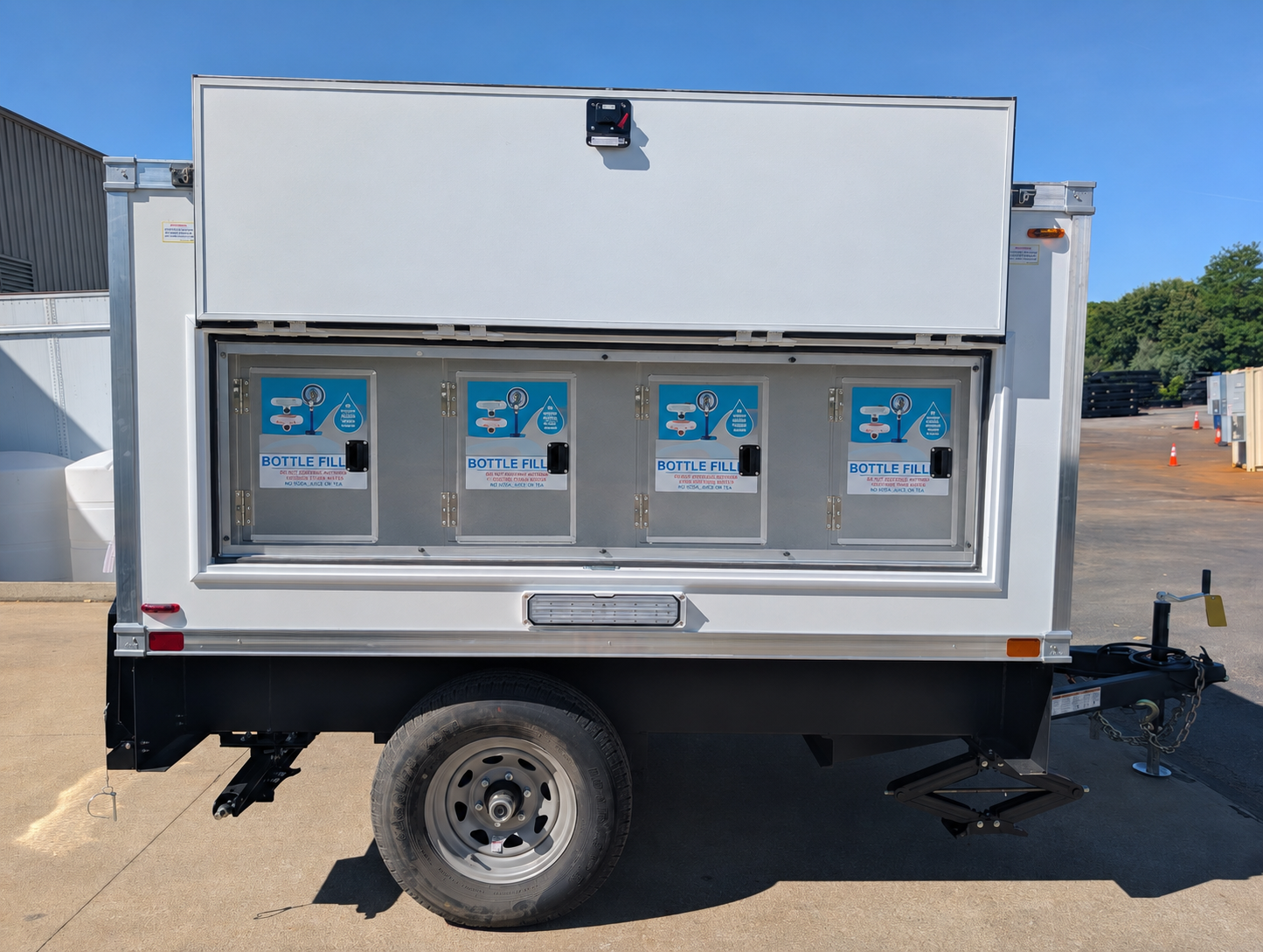
We tow chilled, filtered water station trailers into marathons, half marathons, triathlon events, trail races and obstacle courses, and we have the unit pouring before your first wave goes off. It arrives full and cold, pours from four push-back taps, and fills runner bottles, volunteer jugs and five-gallon coolers at the start village, the finish chute, or any aid station a truck can still reach. Give us the date, the field size and the spot it parks. Call (866) 748-5932 or send the course map through the quote form.
Licensed and insured | A+ BBB rated | 24/7 dispatch
See the Signature Series water station specs
“We lost two aid station captains the Thursday before the race and I spent that night deciding what to cut. The trailer at the finish meant I did not have to cut water. It was cold at 6 a.m. and still cold when the last walker came in at four hours.”
“Our runners carry soft bottles now, so a table of paper cups was doing nothing for half the field. Four taps in one spot moved more people through than the jug line ever did, and nobody stood there waiting.”
“Transition is the one place everybody comes back to twice. Having the unit right there meant bottles got topped off without a volunteer pouring for six hours straight, and my medical lead stopped asking me about water.”
References for this kind of booking are available on request.
We have been towing water stations into race weekends for years, and this work has a shape nothing else has. A job site drinks steadily all day. A race drinks in one surge that moves down the course at eight or nine minutes a mile, so the station that looked fine at 7 a.m. is a table of empty jugs at 9:40 unless somebody planned the refill before the roads closed. So we plan it with you. We stage where a truck can still reach the trailer after the barricades go up, we arrive with 300 gallons already cold, and our tankers come back on a cadence built off your wave chart instead of our route sheet. We are licensed and insured, and our dispatch team runs 24/7. Directors working the fall calendar in the Pacific Northwest start with water station rentals in Portland, and everywhere else in the country we quote off the same sheet. Call (866) 748-5932 with your field size, or send the course map and permit dates through the quote form.
One Signature trailer can pour for a weekend concert and be working a slab pour a couple of days later. Hiring one company for your events and a separate one for your worksites makes no sense. Either way, the planning, the delivery, and the refills are ours.
The onboard cooling unit keeps the tank genuinely cold all the way through a long afternoon outdoors, and that single detail carries the whole thing. Warm water is water people abandon, and midsummer is exactly when a crew or a crowd is drinking the most. Cold water gets finished, and finishing it is what keeps heat illness off the site.
Typical deliveries land in about 45 minutes once a truck is rolling in your metro, longer out on the rural routes, and we keep emergency runs going around the clock whenever a heat advisory or a power shutoff hits. The morning a foreman finds his 40-person crew stuck with one warm cooler, speed is the whole game.
One rule sits under every job we take: water that people walk past might as well not be there. We've stood on a bare site and watched shrink-wrapped pallets cook next to the job-trailer while the crew baked thirty yards off. We've watched the opposite too, a chilled station ten steps off the work face run bone-dry twice inside one shift. Everything that matters lives in the distance between those two pictures. Which is why we don't drop a unit and disappear. We match it to your headcount or your gate count, set the refill rhythm to how hard you're really pulling on it, and treat a heat call the way you'd want your own treated, meaning right now, because out here one hot hour can swing the whole day.
We deliver water stations to job sites, venues and event grounds in all 50 states, with the heaviest route coverage across the West.
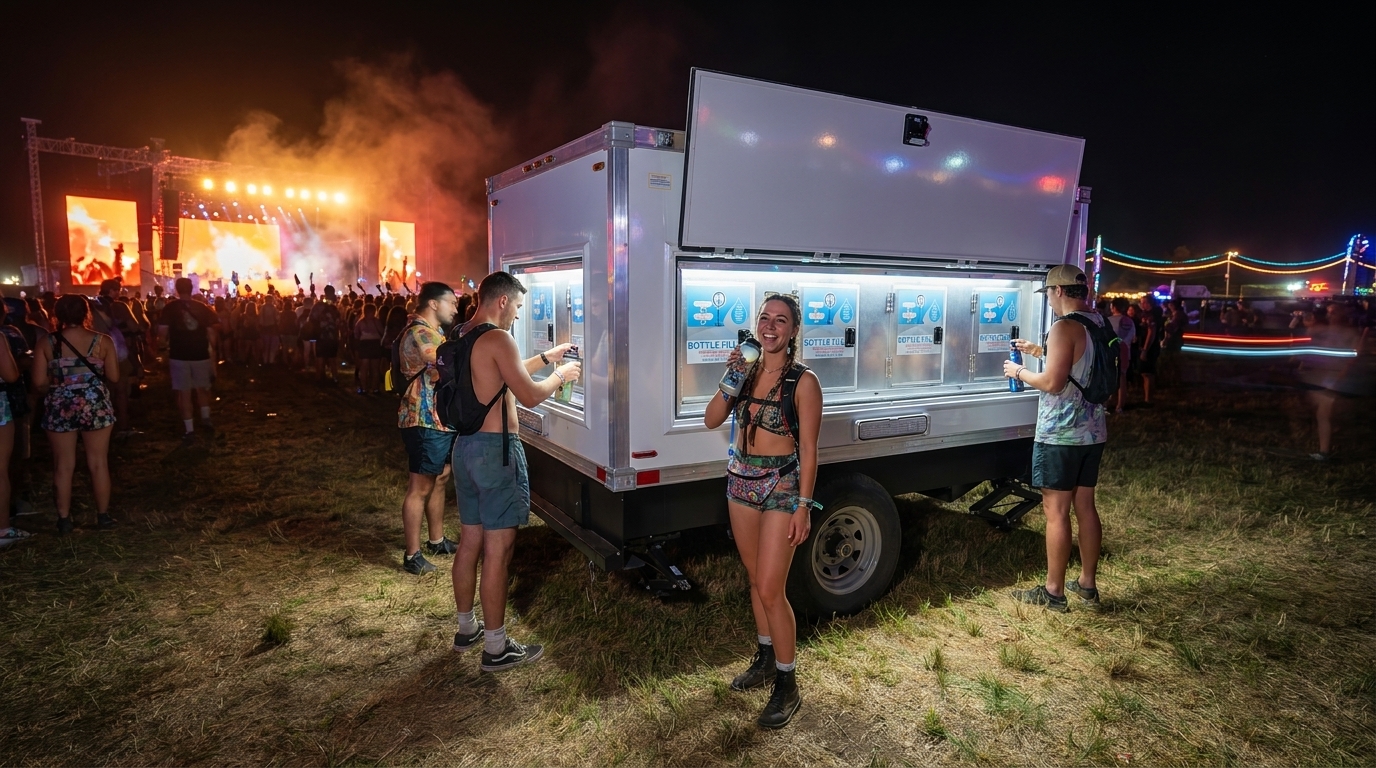
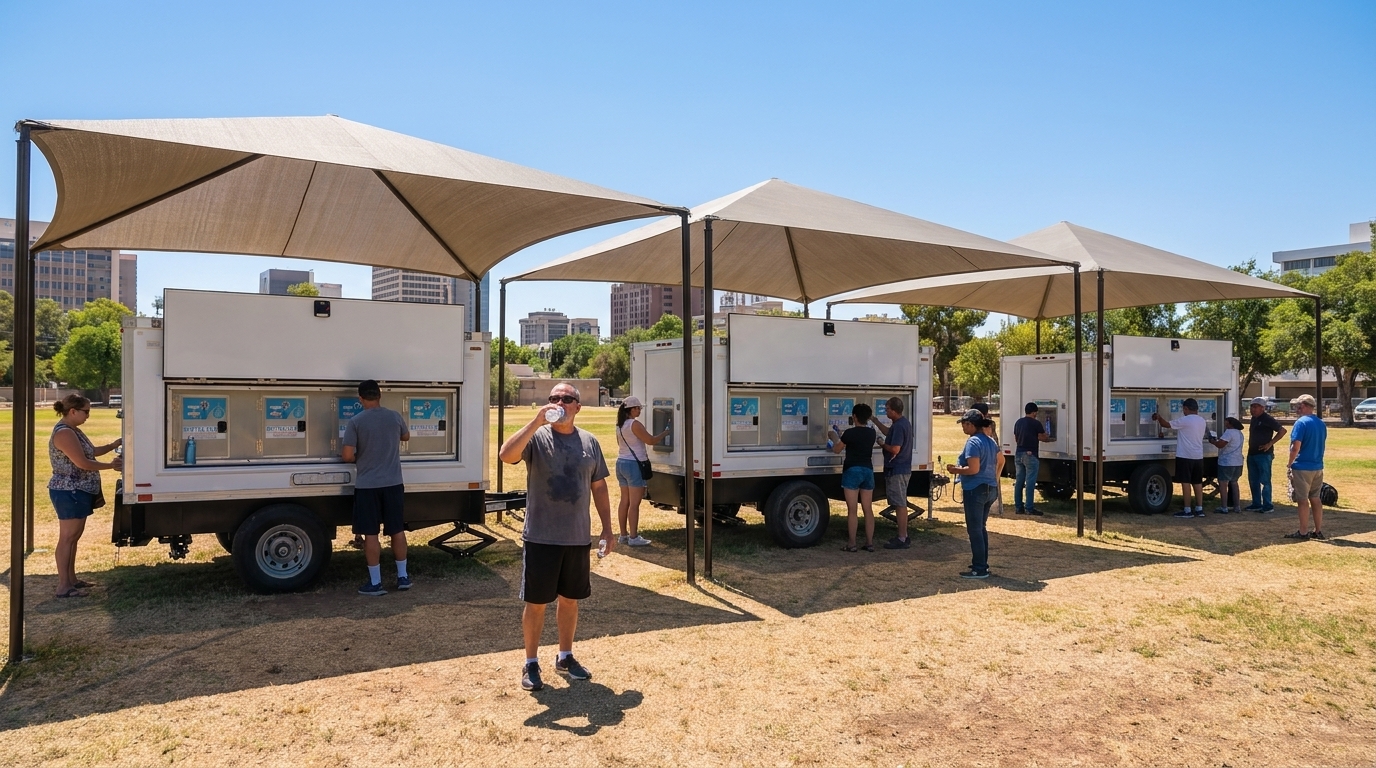
The Signature Series is the unit we tow to races, and it is built for the exact thing a race does to a water supply: a lot of people, all at once, inside about ninety minutes.
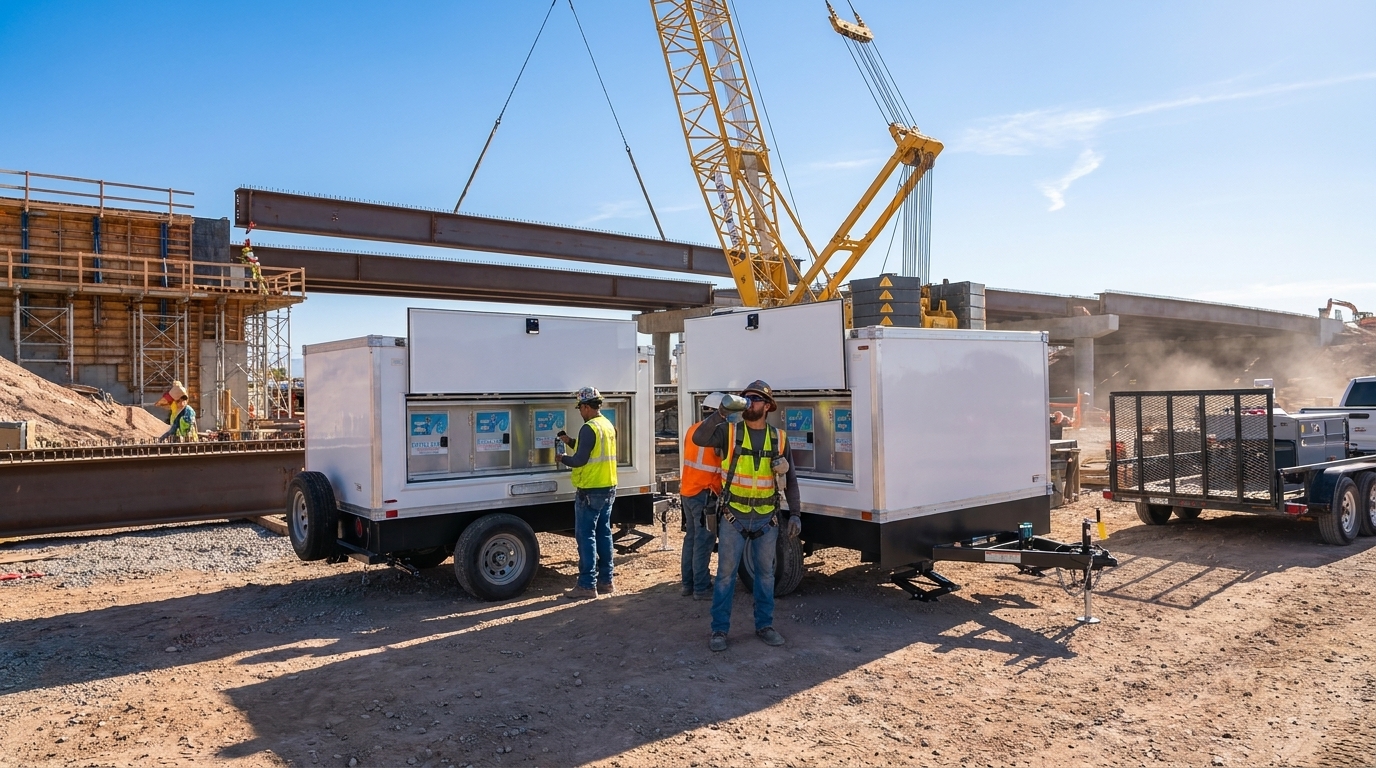
With a frame, a hitch, and tires under it, the unit hauls out to a remote build, an event field, a working orchard, or a disaster staging yard with equal ease. Contractors and event planners request this exact rig by name. The whole design is built around backing in, leveling off, and pouring cold by the same afternoon.
| No. of stations | (4) Bottle Filling Stations |
| Length | 12' 3" |
| Weight | 3,100 lbs. |
| Height | 8' |
| Fresh water tank | 300 Gallons |
| Power requirements | 1 to 4 dedicated 20A/120V circuits OR 1 dedicated 50A/240V circuit |
| No. of AC units | 1 |
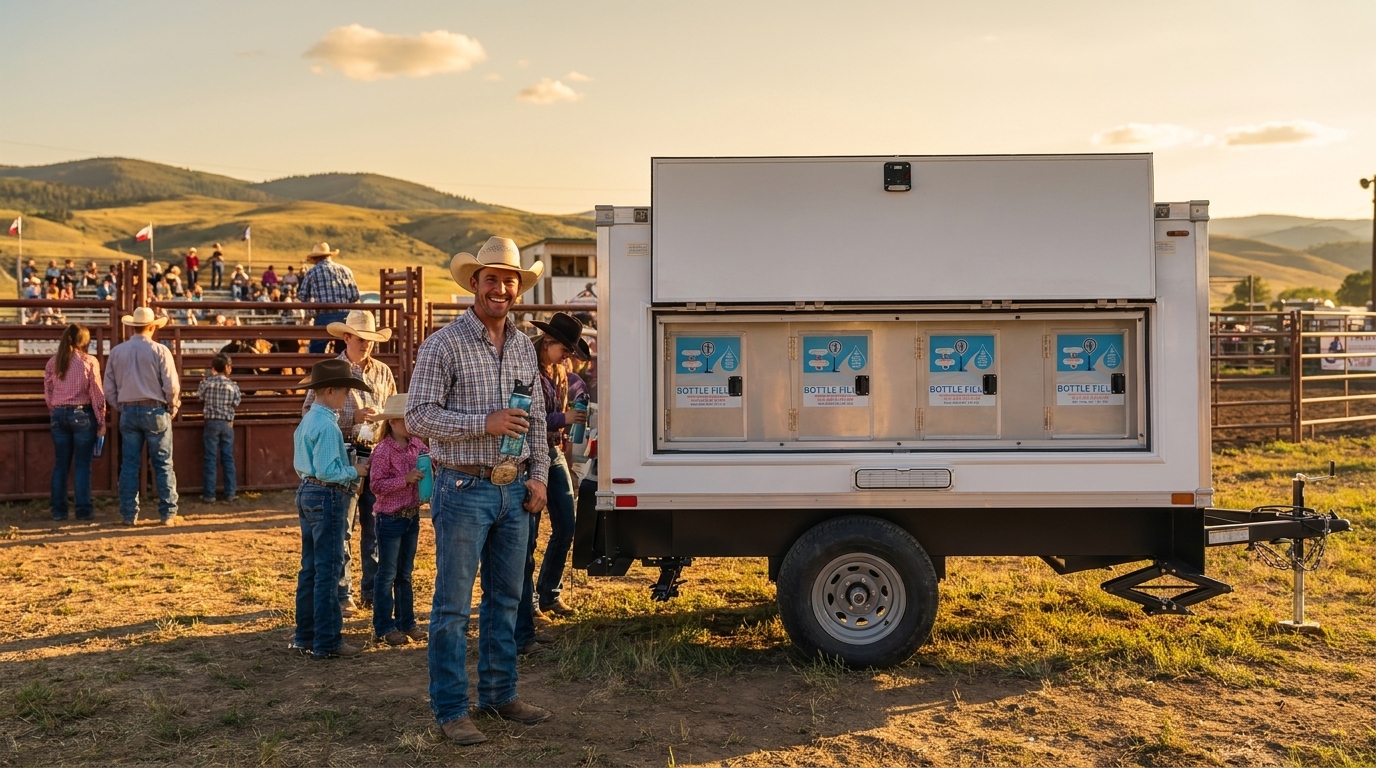
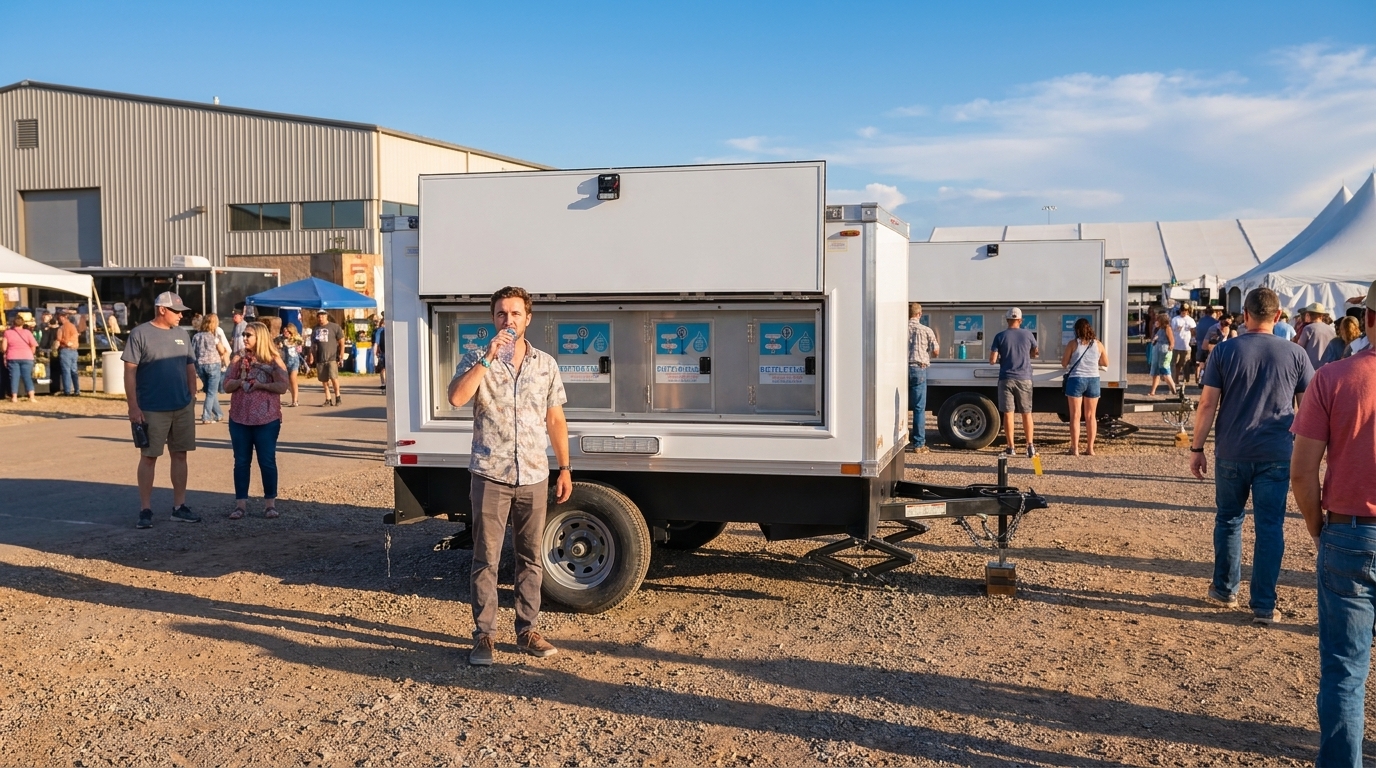
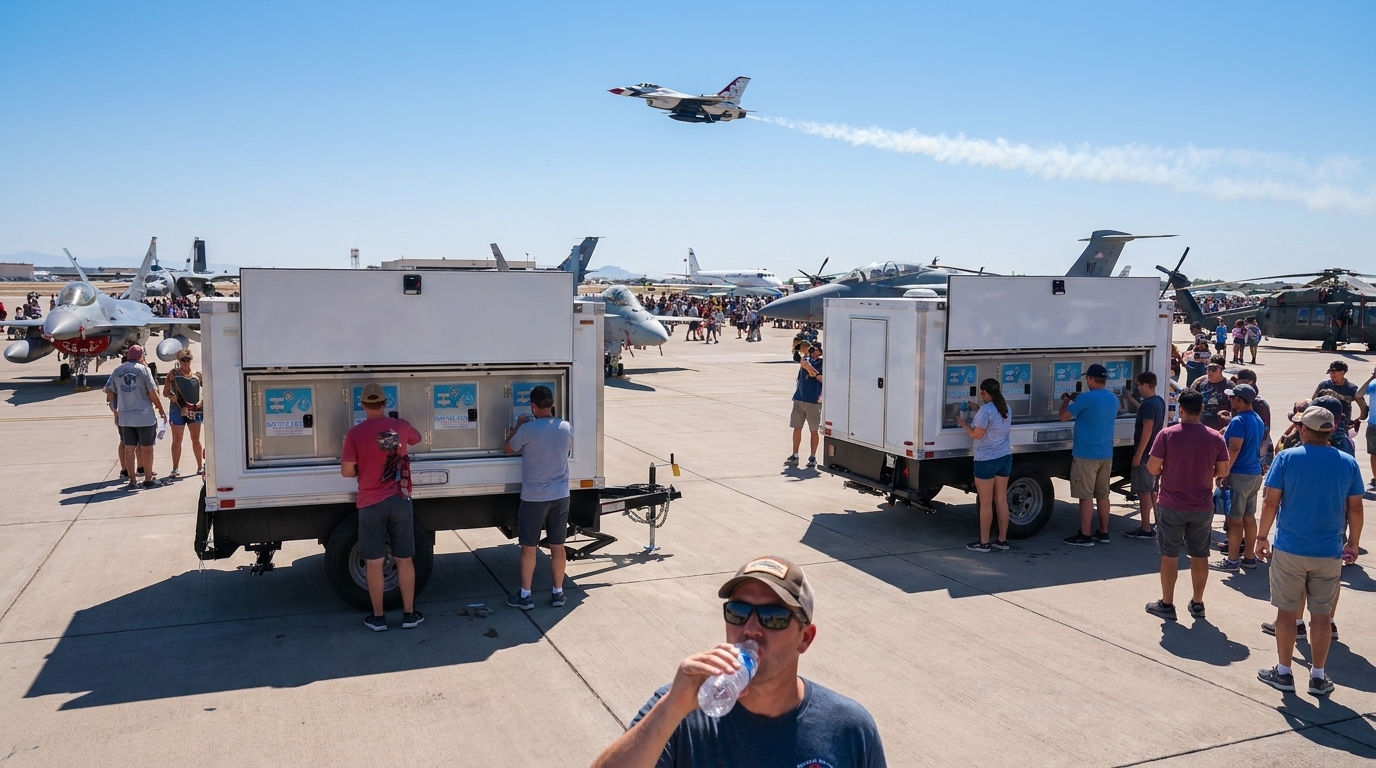
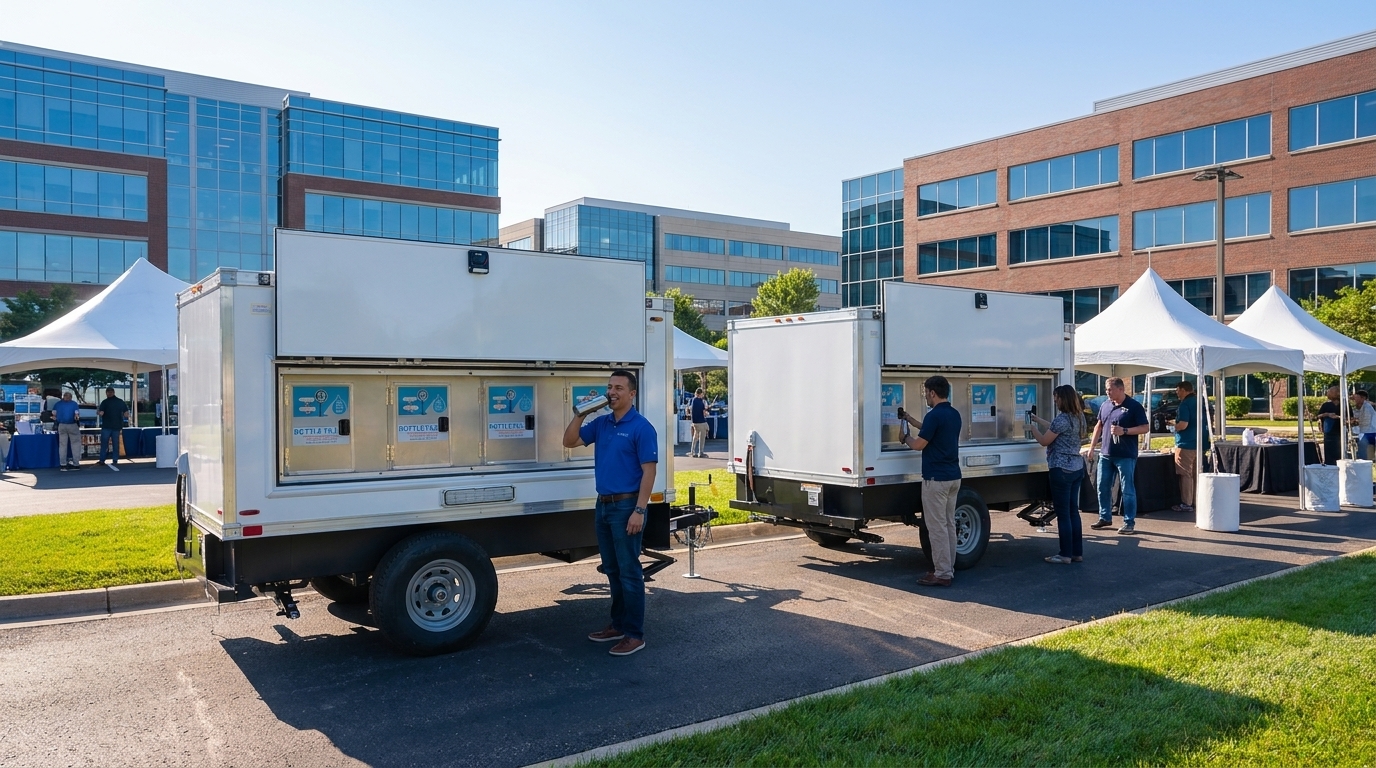
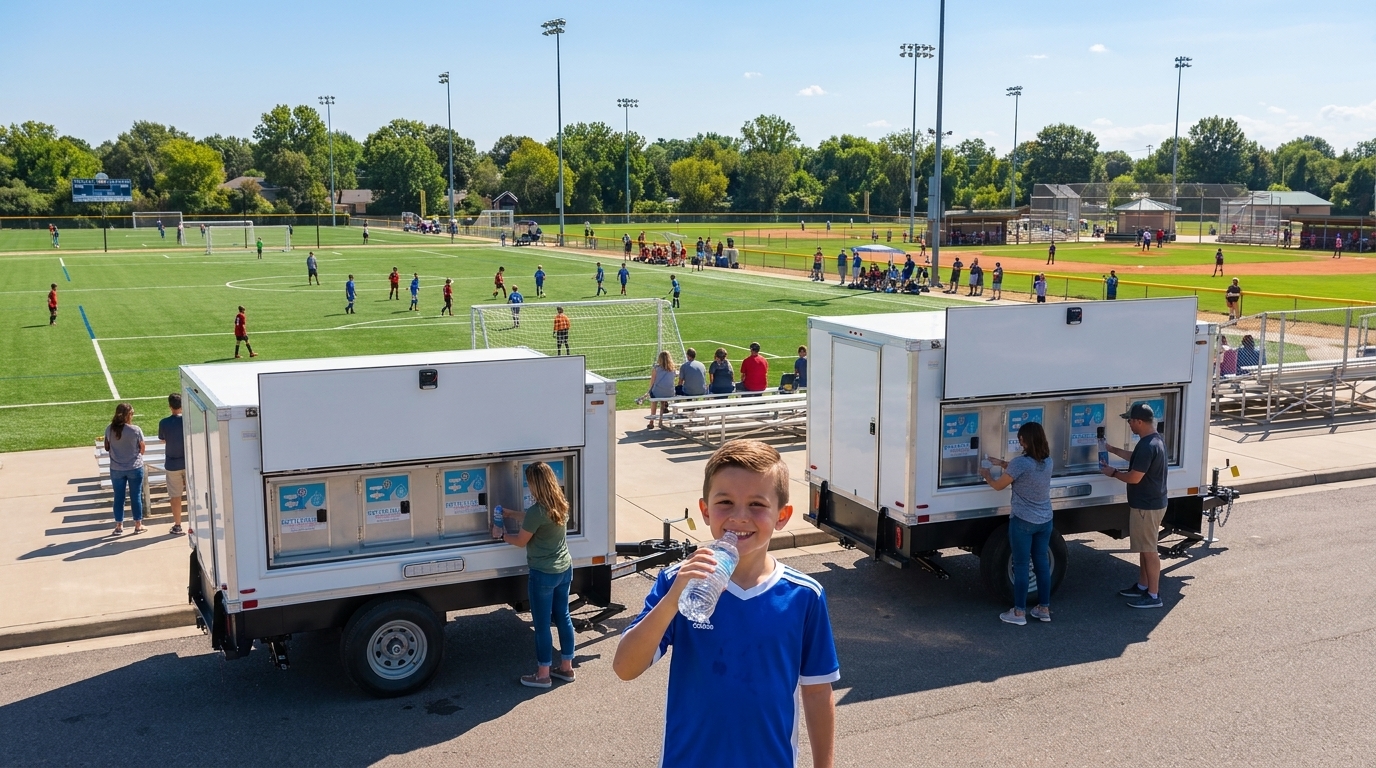
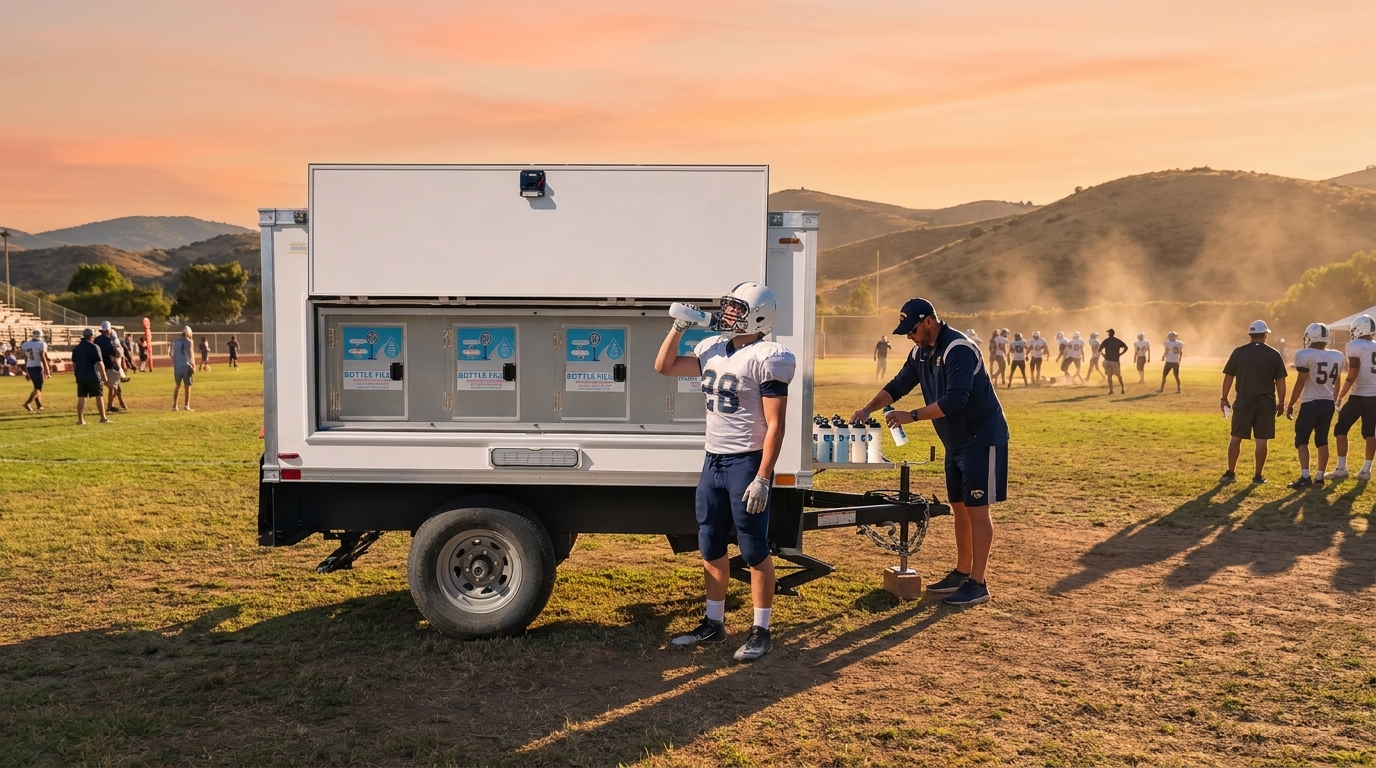
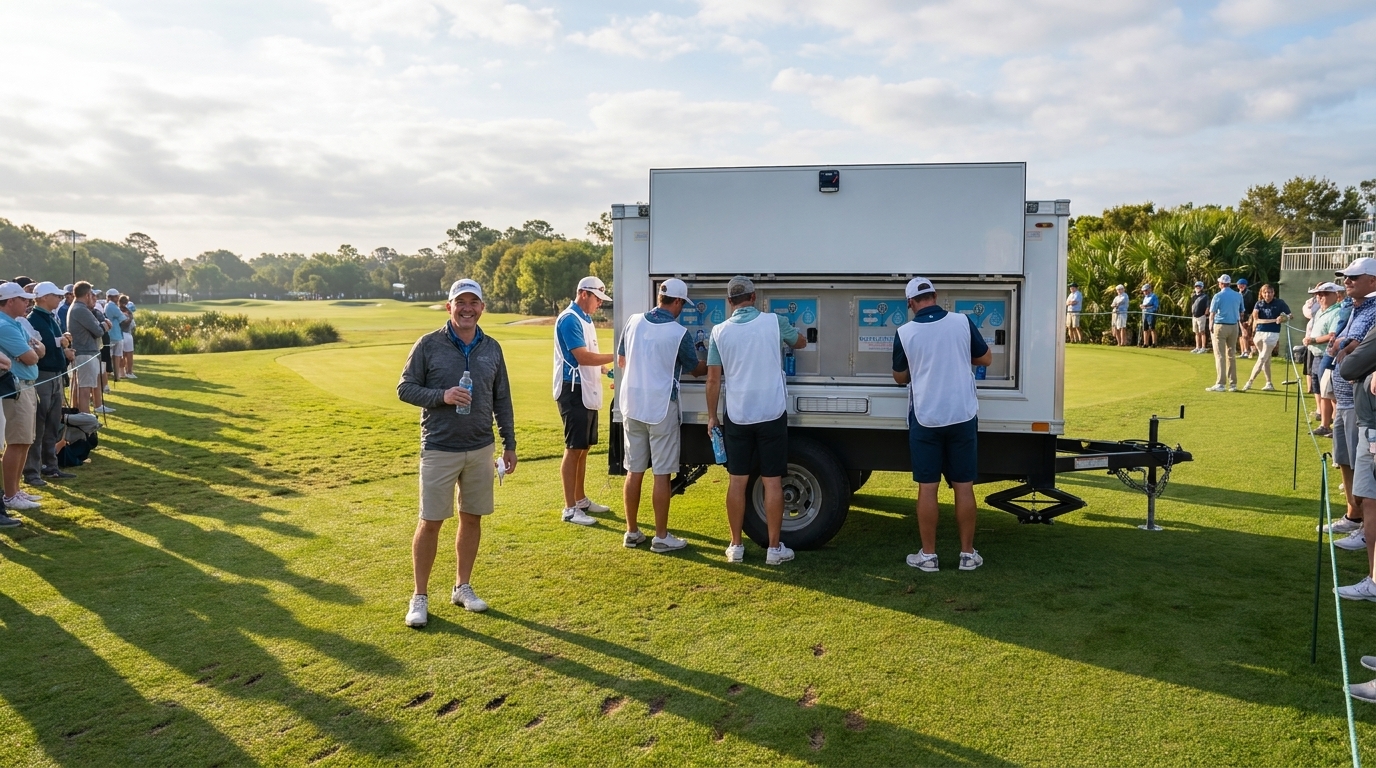
Four push-back taps sit along the wall, and one is set at ADA-reachable height, which matters on a course where the adaptive and wheelchair waves go off ahead of the main field. A runner presses a soft flask to the bar and it pours. Out back, a large-jug spout fills five-gallon coolers, which is the piece volunteer captains care about most, because that is what refills the jugs going out to a table two blocks away. Hose taps handle the rest, down to the medical tent's ice buckets.
It is quiet. That sounds small until you have parked something beside a start line PA and watched the announcer fight it. The cooling unit runs off one to four dedicated 20A/120V circuits, or a single 50A/240V circuit, so on most start and finish sites we tie into the same power drop feeding timing and sound rather than adding a generator to the footprint.
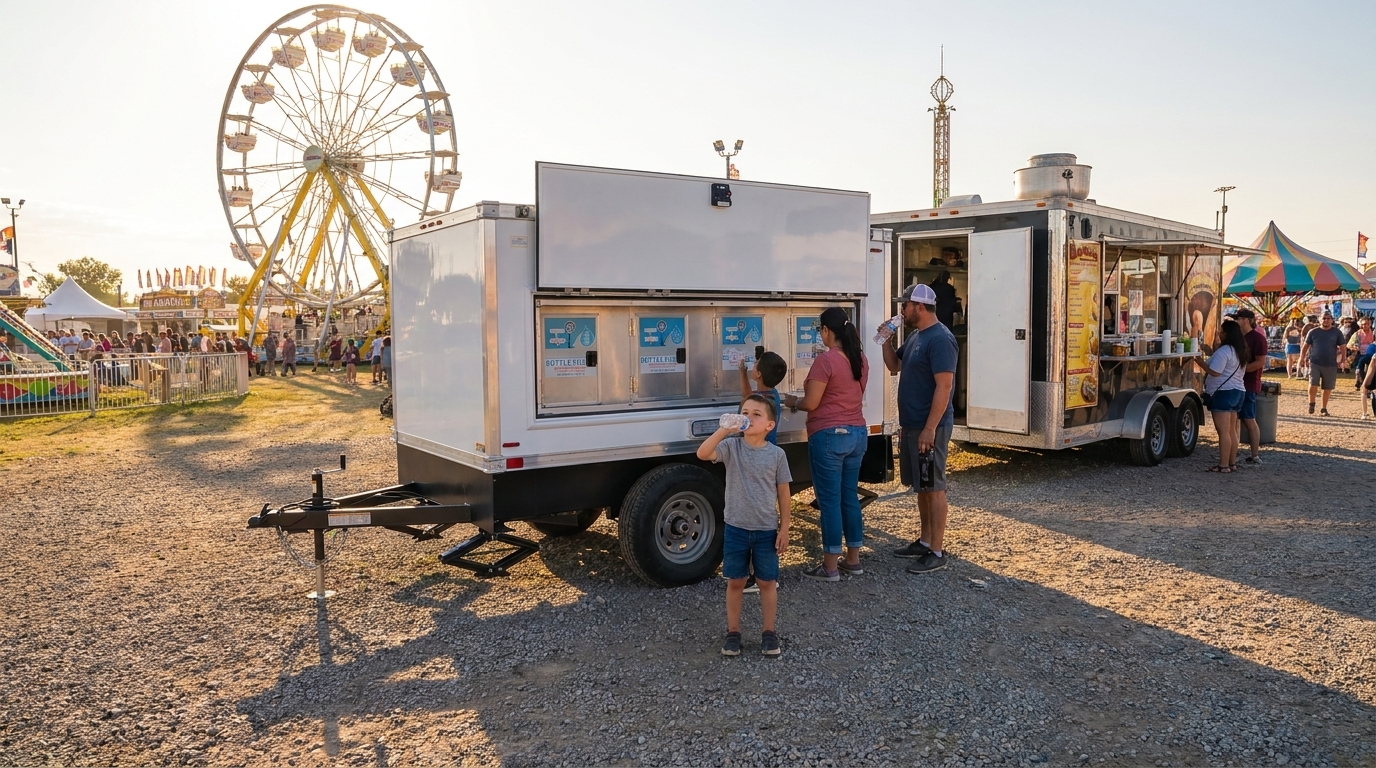
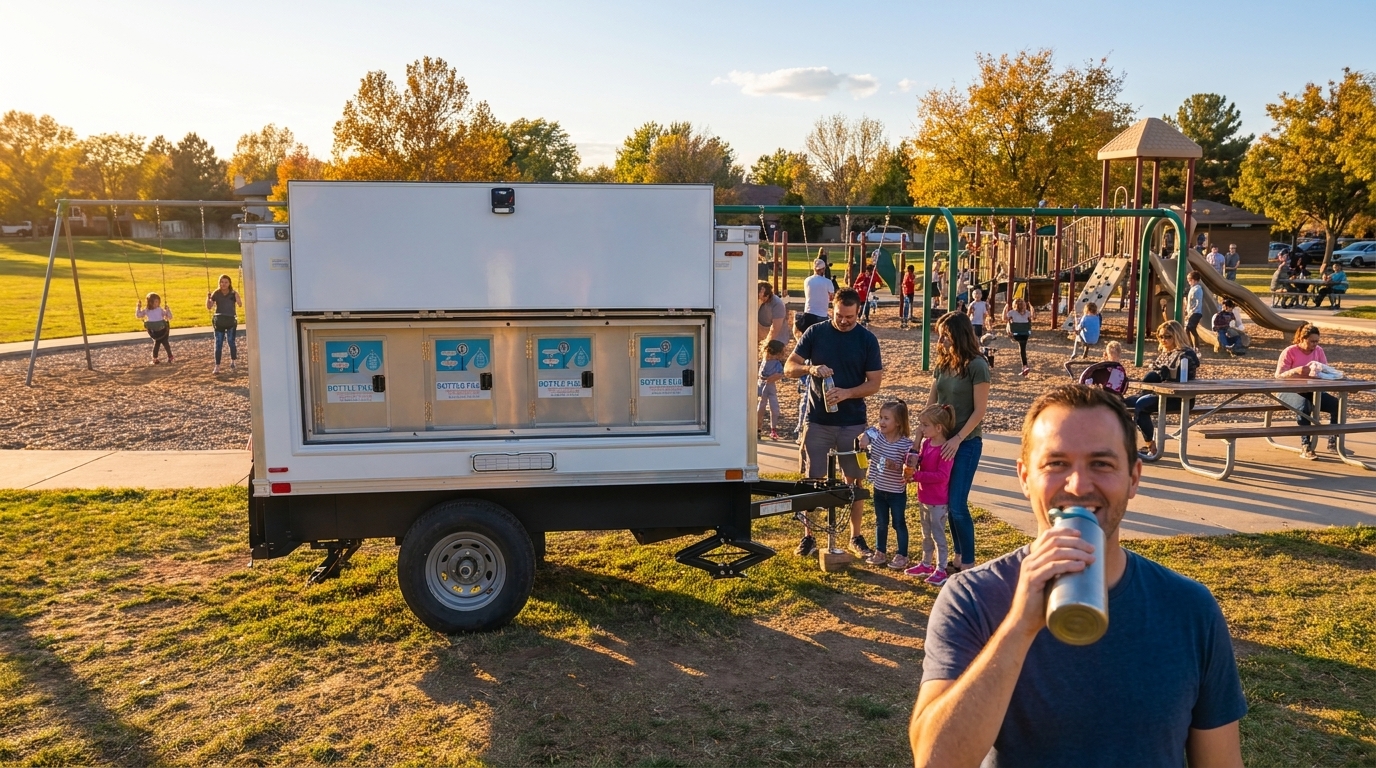
It travels like a trailer, because it is one. Twelve feet three inches long, eight feet tall, 3,100 pounds, and it backs into a single parking stall. That number decides most race placements, since a start village is a jigsaw of gear check, medical, sound, portable toilets and sponsor tents. On grass we bring ground protection. On a street closure we get in before the barricades, level it, charge the tank and leave it pouring.
A water source people don't trust gets ignored, and an ignored station is rented money wasted. That's why municipal water doesn't reach the tap raw on our trailers. It passes through three filter stages and a UV chamber, then an onboard cooling unit drops the temperature. The result tastes clean and comes out cold, even on the worst afternoon of the year.
The opening filter traps sand, scale, and the fine grit local mains occasionally push through. On a dusty lot, that's what keeps a pour from tasting like the parcel it's parked on.
Activated carbon comes next, lifting the chlorine bite and the dull seasonal notes local tap can carry until the taste lands clean and neutral. When it's 90 out, that flavor decides whether a crew keeps drinking or walks past the tap dry.
A finer cartridge then catches the microscopic particles that slip past the first two, so what reaches the spout is clear rather than merely cold for the crews and crowds drawing off it.
The last step is an ultraviolet chamber that wipes out bacteria and microbes without adding a single chemical. Even after a long tow out to a remote site, the water off the nozzle is clean.
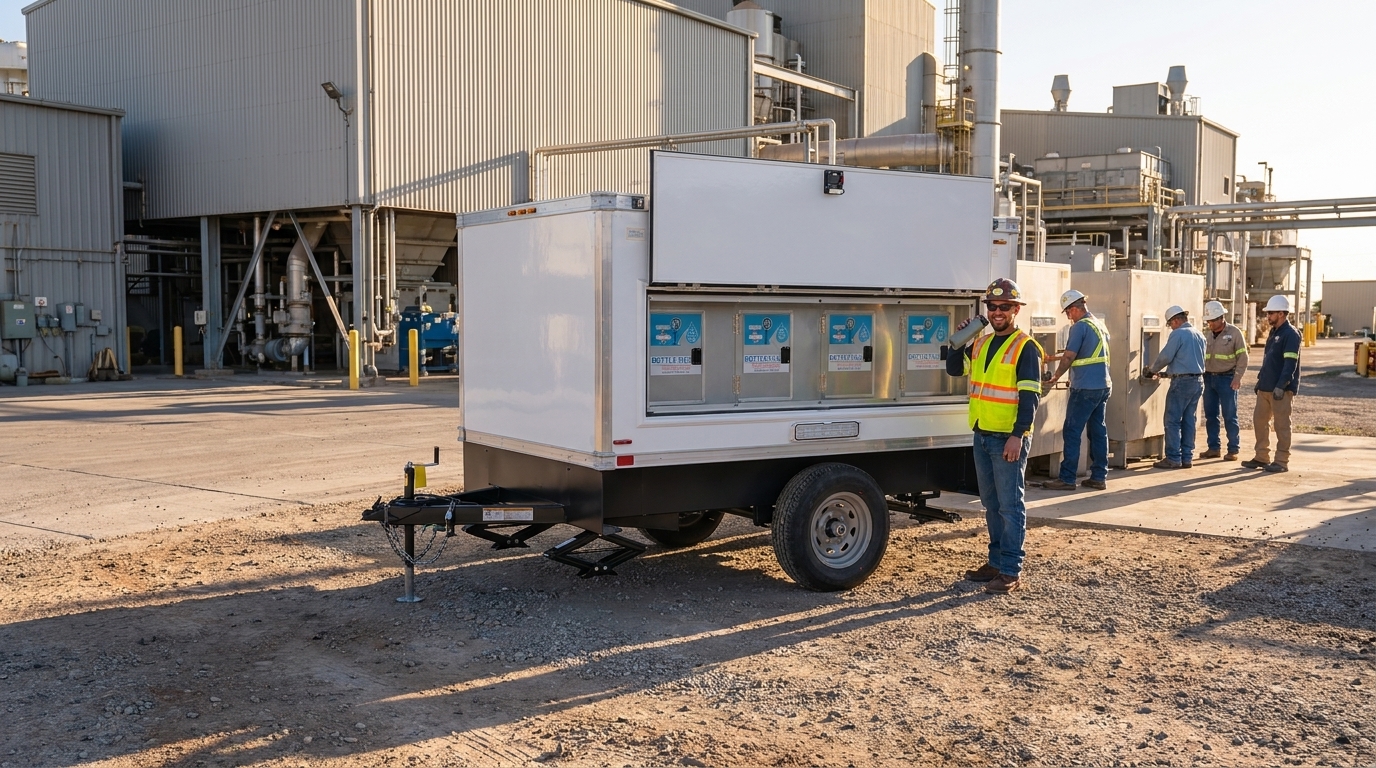
Along the wall sit four adjustable push-back taps, press a bottle to the bar and it pours. One of them is set at ADA-reachable height, so a single trailer includes everybody in a crew or crowd with no add-on gear. Out back, a large-jug spout services five-gallon coolers and hydration packs, while a bank of hose connection taps handles work-site chores, event support, and refills down the orchard rows. Stainless, food-grade plumbing the whole way through keeps the filtered, chilled water at quality right to the spout.
Every Signature trailer carries a 300-gallon load, roughly 2,400 cups at sixteen ounces each, and we recharge it on demand, so the unit doesn't turn into the choke point on a busy shift or a packed show night.
A road marathon, a triathlon and a cupless trail race all need cold water, but in different places and on different clocks. These are the three setups we build most, and what we ask about before each one.
USA Track and Field's sanction language is the number everybody plans around: aid stations shall be available on the course every two to three miles. Most road marathons land at 8 to 12 stations on that default. The biggest space them closer together. The Chicago Marathon runs 20 aid stations spaced roughly one to two miles apart, and its largest single stations are staffed by more than 300 volunteers apiece working from the race's own Aid Station Instruction Book.
The two placements we get asked for most are the start village and the finish chute, because that is where the whole field stands still. The Los Angeles Marathon sent more than 26,000 runners from Dodger Stadium to the Avenue of the Stars on March 8, 2026, against a field capacity near 27,000. The Portland Marathon runs about 10,000 on October 4, 2026, and the Seattle Marathon about 15,000 on June 27, 2026. Crews planning the Rose City weekend book water station rentals in Portland for the start area and let us cover the finish festival off the same trailer.
Mid-course is where format decides everything. If a station sits at a mile marker a truck can reach, a shoulder, a park entrance, a lot behind a school, a unit goes there and your volunteers stop hauling jugs. If it does not, we stage at the points a truck can still reach and the jug chain covers the rest. Race-planning guides call it the standard contingency: full jugs get moved down the course to whichever station is running low. The move exists because the failure is common.
The failure has names. On October 7, 2007 the Chicago Marathon ran in 90 degrees, went short on water and sports drink, and race organizers shut the course down about four hours in. A runner that day described people drinking out of their hands and a stretch near mile 14 with no water at all. In April 2018 the hottest London Marathon on record at 23.2 degrees Celsius emptied its stations between roughly miles eight and ten, and organizers dispatched mobile water stations to plug the gap. Both races had fluid somewhere. Neither had it at the table.
USA Triathlon sanctioned events put water at the run start and every mile of the run course, each stocked with water and a sports drink, with one bottle exchange midway through the bike leg where riders grab sport-top bottles on the fly. Trash cans are required at every station. Transition is the pinch point we get called about, since every athlete passes through twice and stops both times. IRONMAN California runs out of Sacramento on October 18, 2026, and IRONMAN 70.3 Northern California brings a new course through Redding on August 16, 2026.
Trail races flip the problem. The course is often almost entirely out of a vehicle's reach, so the stations that matter are the two or three a crew vehicle can get to. The Big Sur Trail Marathon caps at 300 runners on September 26, 2026 and sells out every year, and a field that small still needs the same per-runner ounces as a field of 5,000. The Rock Tahoe Half Marathon drops more than 800 feet from Spooner Summit down Highway 50 on June 14, 2026. On courses like those the unit sits at the trail parking area and becomes the refill point the jug runs are filled from.
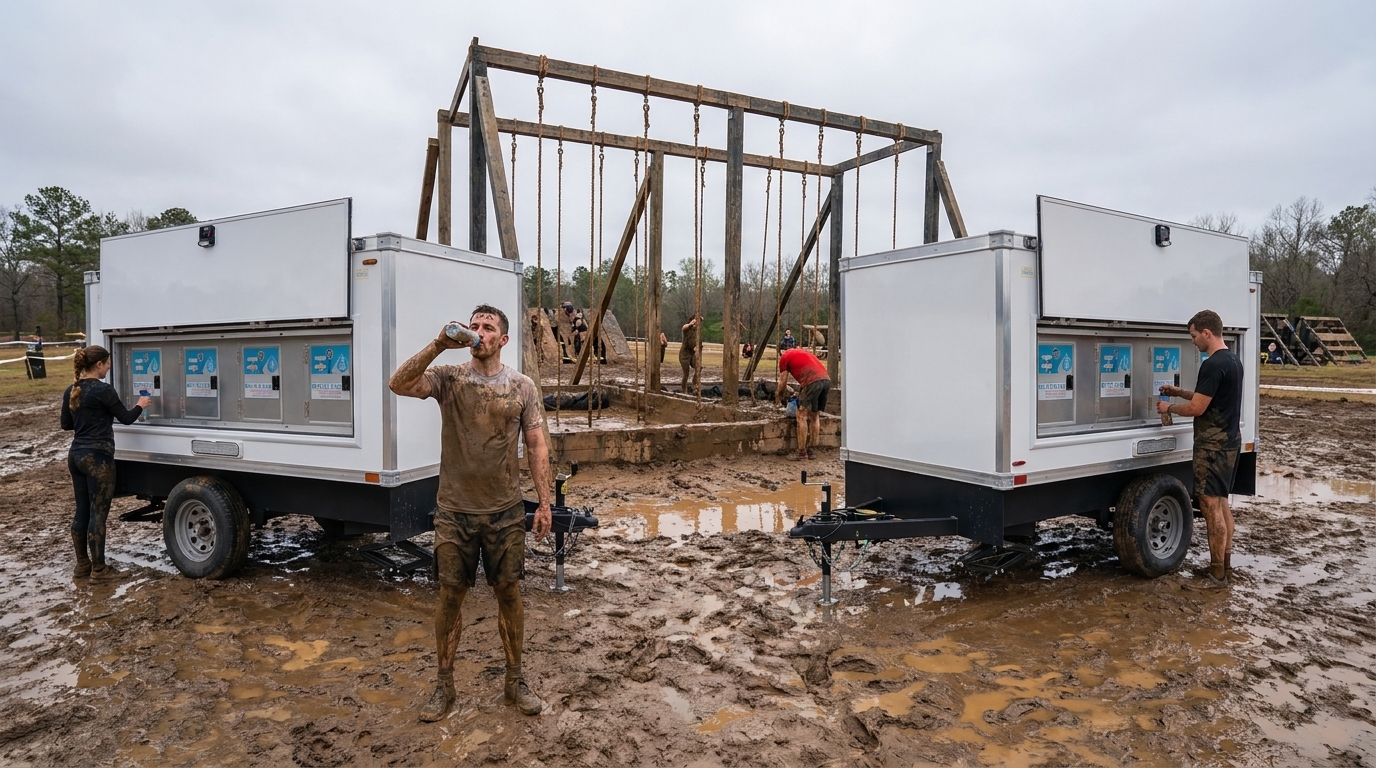
Obstacle racing runs the least coverage of any format, deliberately. A Spartan 5K Sprint may carry a single aid station in the middle. A Super or a Beast provides up to four, and obstacle events generally space water stops one to three miles apart with no promise of an electrolyte option at every stop. Packs are recommended at the short distances and mandatory for the Beast, Ultra and HH12HR formats. Spartan Race Sacramento runs August 29 and 30, 2026 at Mahon Ranch in Elk Grove. The demand does not disappear, it moves to the festival field.
So we size these differently. On a triathlon we plan around two touches per athlete and a compressed transition window. On a trail race we plan around jug throughput to the crew vehicles, not runners at the tap. On an obstacle weekend we plan around the festival, because that is where four thousand people spend six hours waiting on heats.
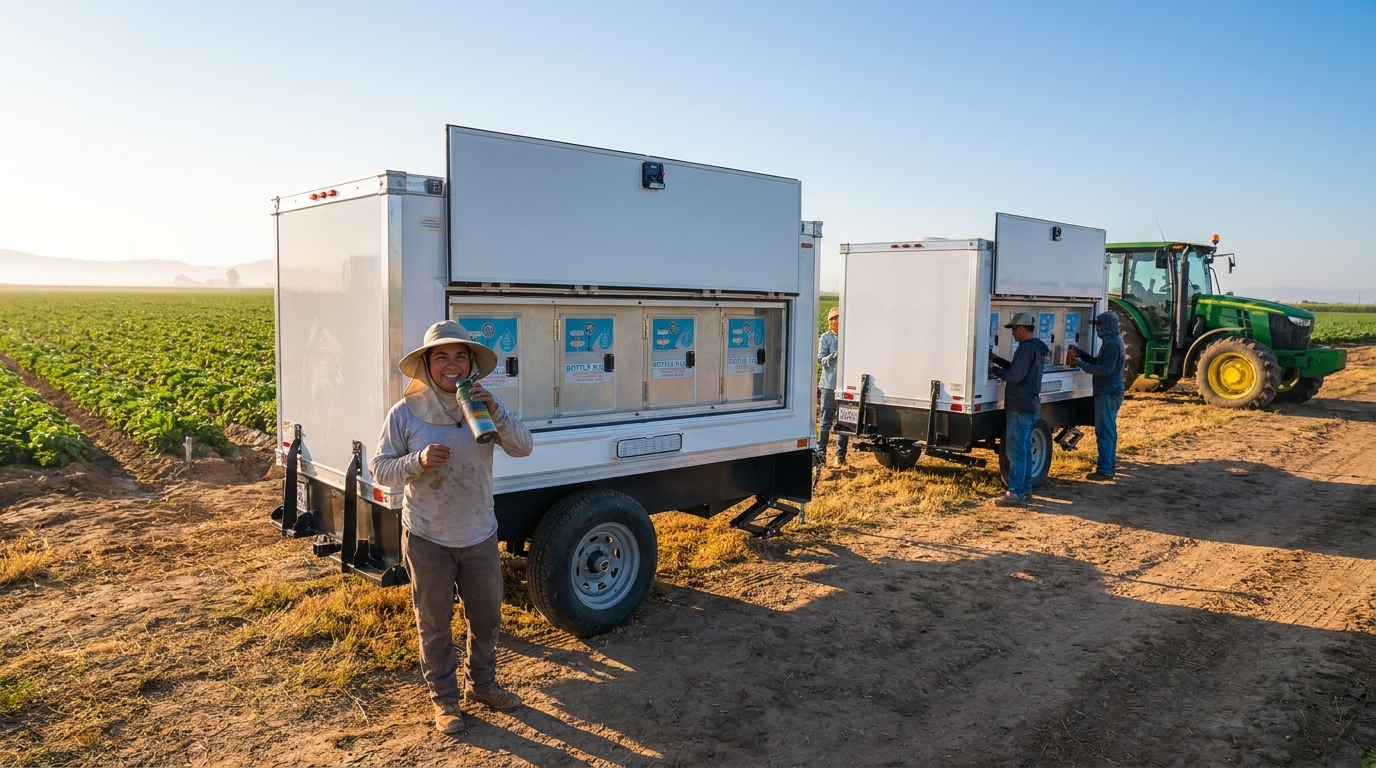
The 2026 Paris Marathon cut single-use plastic bottles and paper cups from its aid stations entirely and required every one of its roughly 55,000 to 60,000 runners to start carrying a personal container, a soft flask, a folding cup or a pack. It was called a world first at that scale. Representatives from the London, New York and Chicago marathons went to watch how it ran, which tells you where this is heading. And it changes what a station is. The table stops handing out servings and starts filling back up what a runner already carries.
Short of a full ban, the reusable-cup programs do the same thing in stages. The Boston Athletic Association sources roughly 30,000 reusable silicone cups from Hiccup, collected after the race and sanitized rather than thrown out, and Hiccup has kept more than 902,000 disposable cups out of the trash. Nuun partnered with Mascot Sports and HydraPak in 2020 to remove about 100,000 single-use cups across an Oakland-area series, the first cupless road-race series in the country. HydraPak and the Big Sur Marathon Foundation run a Choose to Reuse pledge with a 33 percent opt-in target.
Here is the part directors underestimate. A cup line is fast because the pour already happened before the runner arrived. A refill is slower per person, so a cupless race needs more taps, not more gallons. Four push-back taps with a runner pressing a flask to the bar is different throughput math than two volunteers pouring from a jug. We have watched a refill point back up at a race that planned gallons correctly and taps badly, and the fix was never more water.
The other half is the tap itself. A cupless race asks every runner to trust the water, so what comes out has to be cold and taste like nothing. Municipal water on our trailers passes three filter stages and a UV chamber before the cooling unit takes it down, which is the answer we give when a permit reviewer or a sustainability lead asks what is in the tank. Races going cupless usually pair the course units with water bottle filling station rentals at the expo and packet pickup.
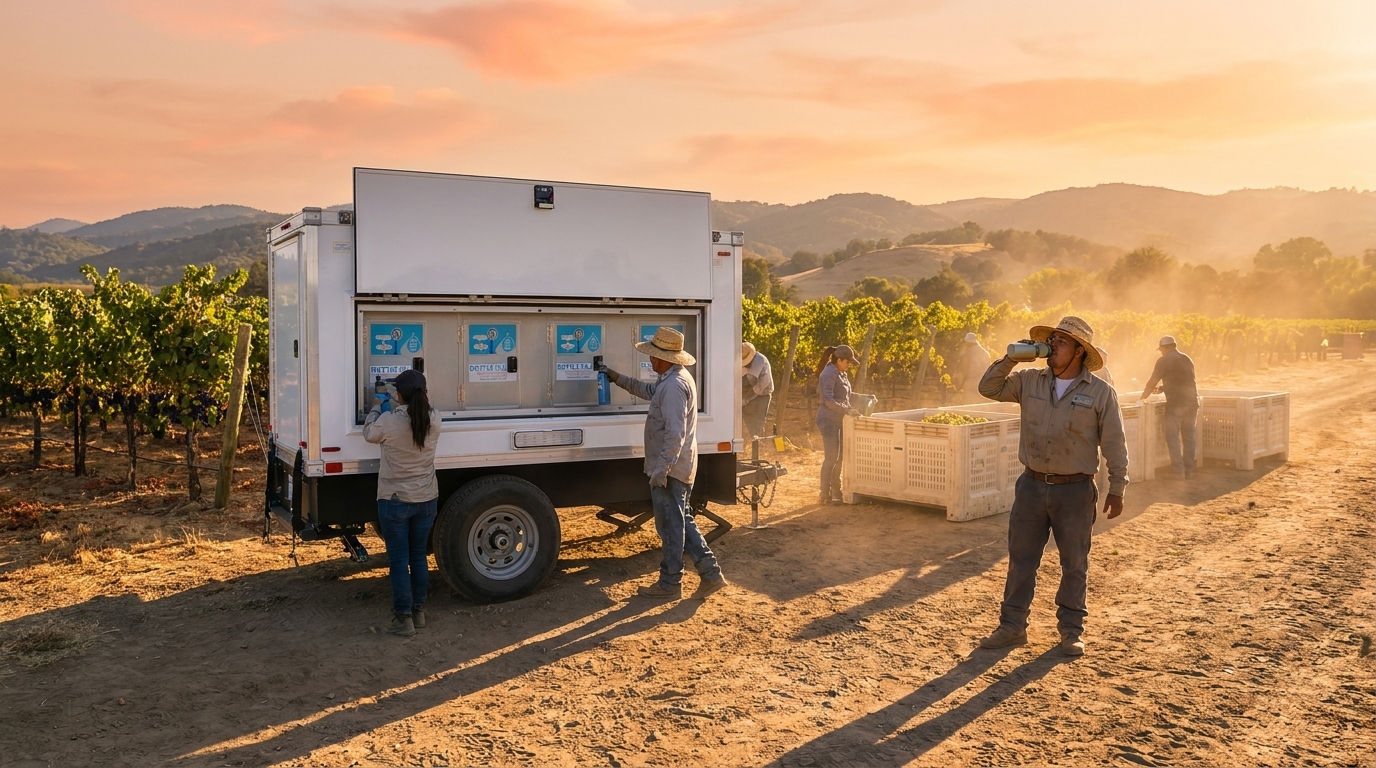
Race delivery is a timing problem more than a driving problem. We work backward from the hour your barricades go up, not from the hour your first runner starts.
Most race deliveries happen the afternoon before or very early on race morning, and which one comes down to the permit. Cities that require a special-event or street-closure permit set the closure window in it, and once that starts, a truck and trailer are not reaching your start village. San Francisco's street closure application goes further than most and asks about water specifically: if water is deemed important to public safety, the organizer submits a plan describing how it will be supplied. We would rather be named in that plan than argue with a barricade captain at 5 a.m.
Placement is the next decision and it is worth ten minutes. The unit goes inside the footprint you control, out of the runner lane, near the two things that generate demand: gear check and the medical tent. We want a hard surface or a lawn we can mat, a level spot within a hitch turn of the access road, and power within reach of one to four dedicated 20A/120V circuits or a single 50A/240V circuit. Teams who already run our Seattle hydration station rentals on summer job sites know the drill on a tighter clock.
What goes wrong is almost never the equipment. It is staffing. Race-planning guidance puts volunteer recruitment at three to four months out, the last layer locked in and the first to fall apart, and a station with nobody to crack a fresh jug when a wave arrives is the exact failure documented at Chicago in 2007 and London in 2018. A trailer that arrives full and pours on its own does not need a person behind it. After enough race mornings, the first thing we ask about is the last hundred feet of the approach.
Pickup runs behind your closing sweep vehicle. We do not pull a trailer out of a finish area while walkers are still coming in, so we wait for the sweep and the course reopening, then hitch and go. If your race holds an awards ceremony or a festival that runs three hours past the last finisher, say so, because that is three more hours of people drinking.
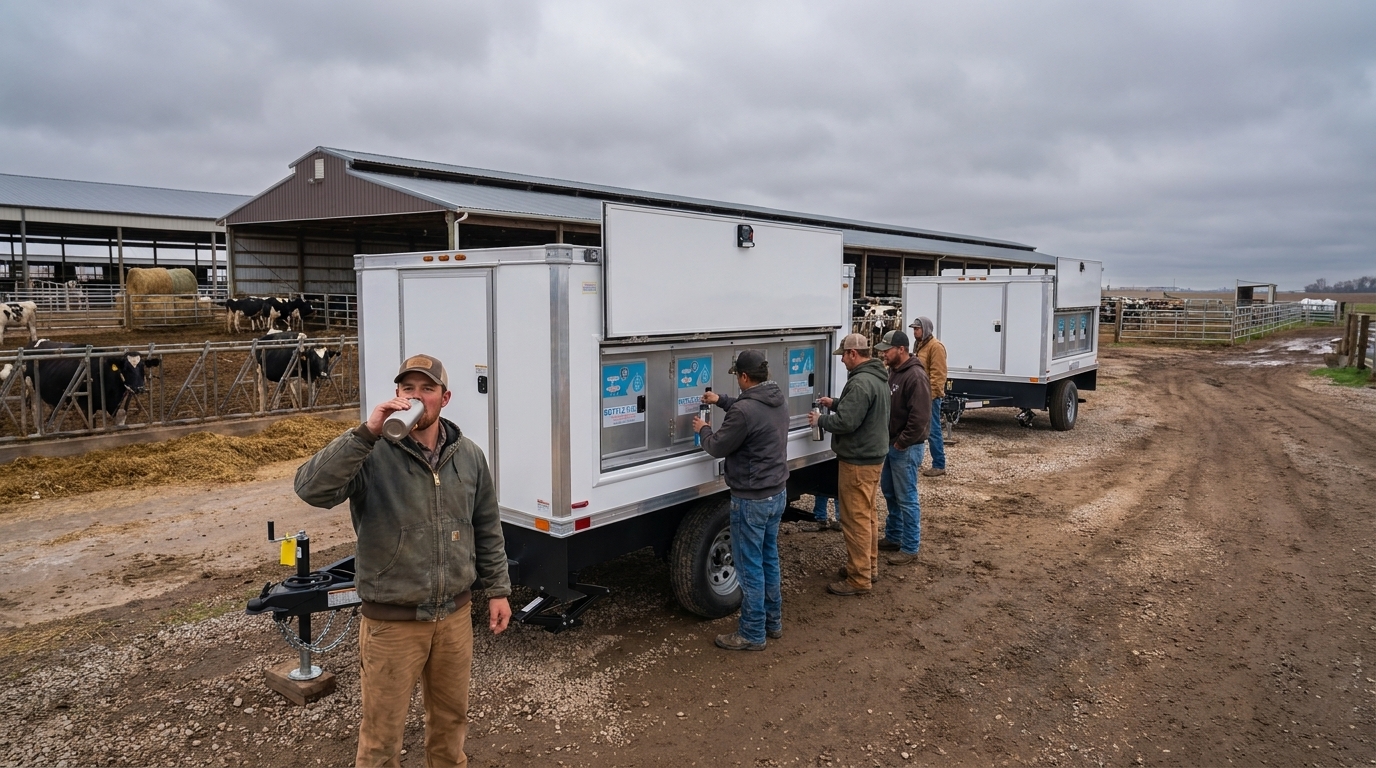
People count, number of days, where exactly it parks on your site, and what power is there. Those four answers let us spec it correctly the first time around.
Reckon roughly 45 minutes from the nearest yard once we are in your metro, longer on the outer routes, with round-the-clock emergency runs whenever a heat advisory or a power shutoff hits.
Once on site we set it level, charge the 300-gallon tank, and tie in power off one to four standard 120V circuits, or a single 50-amp 240V drop, depending on what the site gives us.
After that the tankers cycle back on a cadence matched to how fast your crew or crowd pulls it down, and we maintain the unit through the whole rental term.
No power on the parcel at all? We price that in. The unit draws very little, and with the service fleet backing it we've run stations on lots that had no permanent power whatsoever. Lay out what the site offers and the rest is on us.
Want this math run for your own booking? Two minutes on the phone gets you a real number.
Total gallons is the easy half. The number that actually sizes a race is how many people arrive inside the same twenty minutes.
| 5K or 10K, one start and finish area (up to 1,200 runners) | 1 station at the finish |
| Half marathon, start and finish in one park (up to 3,000 runners) | 1 at the finish, 1 at the start village |
| Marathon, point to point (up to 5,000 runners) | 1 start, 1 finish, 1 mid-course station a truck can reach |
| Big-city marathon on a hot forecast (10,000 runners and up) | 2 at the finish, plus 1 per course station a truck can reach |
| Olympic-distance triathlon (up to 1,500 athletes) | 1 at transition, 1 at the run turnaround |
| Two-day obstacle race weekend (up to 4,000 across both days) | 1 in the festival area, 1 at the mid-course access point |
| Cupless race, every runner carrying a flask (any distance) | 1 per refill point, sized on fills per hour |
Start with the runner. Practical guidance from the American College of Sports Medicine works out to roughly 5 to 12 ounces every 15 to 20 minutes of hard effort, about 16 to 30 ounces an hour once a runner is a few miles in. The ceiling is not the tap, it is the stomach: a running athlete's stomach clears only about 6 to 7 ounces every 15 minutes, capping real absorption near 24 to 28 ounces an hour. So a four-hour finisher takes on something like 64 to 120 ounces across the morning, in 4 to 6 ounce pulls.
Then work out what moves it. Heat moves it hardest, and race medicine measures that with Wet Bulb Globe Temperature rather than the forecast high: ideal conditions sit between about 4.4 and 15 degrees Celsius, and adverse medical events climb once WBGT clears 15.6 degrees Celsius, roughly 60 degrees Fahrenheit. That is lower than most people expect. Wave structure moves it too, since a race that sends 26,000 people off in start pens spreads demand while a single gun stacks it. And format moves it: at 10 to 12 ounces per fill, a 300-gallon tank is about 3,200 fills, so the constraint becomes taps per minute.
Our honest default is one unit at the finish under about 3,000 runners in mild conditions, two once the field or the forecast climbs, and a third at the start village whenever start and finish sit in different places. Directors who book our Seattle hydration station rentals in summer usually add the second unit before we suggest it. Give us the field, the format and the date and we will give you the number and the reasoning, and if we think you are over-ordering we will say so.
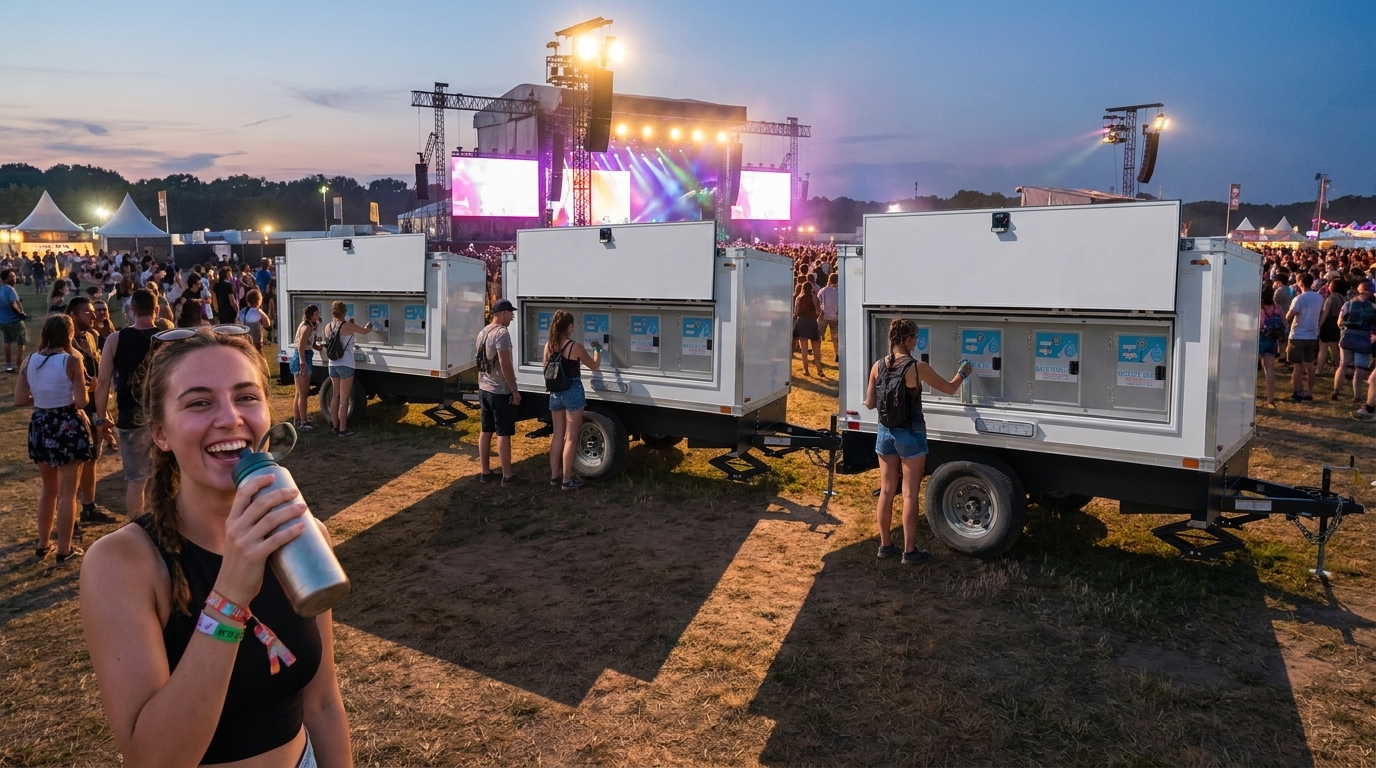
Nobody writes a rule that says a race must rent a water station. What the governing bodies write is where water has to be, who has to be trained to hand it out, and what goes in the plan you submit. USA Track and Field's sanction application calls for aid stations providing water and other suitable refreshments every two to three miles, a course marked with marshals at turns and major intersections, and appropriate medical supervision, preferably including a mobile medical unit on the running course. Sanctioning is separate from course certification, which measures distance and says nothing about aid stations.
The Road Runners Club of America comes at it from the safety side. Its Safe Event Guidelines put Emergency Action System signs or flags near aid stations on purpose, because that is where participants slow down and can be given instructions if conditions escalate to a red or black alert. RRCA also requires station staff to sit inside the event communication network, briefed on where the medical team is, and requires course, station, start and finish volunteers to be trained and supervised by the host club or a hired race director. Read that list and nearly every line is about people, not product.
Accessibility is planned rather than prescribed. Organizers are expected to seat wheelchair and adaptive athletes in a designated wave ahead of the main field, keep the full road surface available instead of shortening the course with inside cones, and provide accessible portable toilets, dedicated parking and drop-off, and bag check. Grades over about 10 percent get flagged as a hardship for wheelchair athletes. Careful organizers extend the same spacing and volume planning they use everywhere else on the course to adaptive athletes at a station, since water planning there runs on judgment rather than one published number. We put an ADA-height tap on every unit so the accessible option is standard.
Then there is the paperwork that has nothing to do with runners. Cities require certificates of insurance, they scale with event size, and they are commonly due thirty to sixty days ahead. We are licensed and insured, we carry certificates, and we have been named on enough event permits to know what a permit office wants to see.
Federal OSHA heat illness prevention guidance and the CDC and NIOSH heat stress program point at the same baseline: cool drinking water, close to the people doing the work, and documented.
Need a station your written heat plan can point to? We can have one pouring cold within days.
The standard aid station build has not changed in decades: a pop-up canopy, folding tables, covers for spills, trash cans, blue plastic jugs used only for water so germs never spread between drinks, separate containers for sports drink, and coolers of ice when it is hot. Volunteers pre-pour cups ahead of each wave so there is something to grab rather than something to wait for, then the same crew picks up the dropped cups as the field goes through. It works. It runs entirely on people who are not paid and who were recruited three months ago.
Count the hours honestly. Chicago Marathon station shifts run roughly 5:30 a.m. to 12:30 p.m. on race Sunday, covering setup, service and teardown, and a Seattle-area marathon spreads volunteer shifts from about 5:45 a.m. to 2:00 p.m. across course positions. A medium marathon with 8 to 12 stations is dozens of volunteer hours per station and hundreds across the course, each recruited, trained and supervised under RRCA's guidance. Then somebody drives jugs and ice to each mile marker ahead of the field and back to strike them after the sweep.
And then there is the trash. A medium marathon of about 9,000 runners running 17 aid stations goes through on the order of 150,000 single-use cups, most of them plastic-lined, so they do not compost the way plain paper would. A trailer with four taps does not remove the volunteers you want on course. It removes the pouring, the hauling and the pile at the end. Event teams who already book our corporate event hydration station rentals for weekday work tend to book the race the same way.
Look at everything bottled water actually demands of a person: cutting the order, receiving and breaking down pallets, icing coolers before dawn, topping them up through the day, then flattening empty bottles for the bin. On a large crew that's hours of paid time burned every single day, scraped right off the work that's supposed to be getting done. The trailer erases that loop entirely. A local contractor once let us pencil it out with him, and the recovered labor by itself paid for the unit. His words were that the bottle runs had been quietly costing him close to a day of payroll a week. Our trailer arrives full, the tankers keep it full, and your superintendent owes it nothing but a parking spot.
Ice a cooler at 6 a.m. and by mid-morning in July it's as warm as a bath. Warm water is water people stop touching, and the slowdown that follows is precisely where heat illness gets its opening. A chilled station never rides that warm-up curve at all. Whatever pours at clock-out is as cold as the sunrise fill, which happens to be the moment a spent crew, or a crowd deep into a long concert, leans on it hardest.
Bottled-water pallets devour staging space, jam the lay-down area, and sit cooking in the sun until somebody finally cracks them open. Empties build up faster than anyone keeps up with, and on a tight commercial lot that pile turns into its own problem. Set a trailer in one parking stall instead and it serves a crew or crowd that would otherwise burn through hundreds of plastic bottles every day.
Every bottle bought is a bottle thrown out, and across a season a busy site or event generates a small mountain of them. That's a disposal line on the budget, a dent in the sustainability numbers, and, given that a single bottle can linger in the ground for centuries, a footprint that lasts longer than the project that made it. Move to a refill station and the line drops to zero, which finally gives your reporting a figure worth publishing.
Three bookings of this kind, and what we planned around on each one. Names and details are kept generic on purpose.
City half marathon, about 4,000 runners, late June. The director called eleven days out with a forecast that had moved seven degrees the wrong way. Start and finish shared one waterfront park, so we put a unit in the start village near gear check and one past the medal tables at the end of the finish chute. Both were filled the evening before, since the closure began at 4:30 a.m. The tanker came back once, at 8:15, with the last corral still on course. Nothing dramatic happened, which was the point.
Trail 50K, three crew-access aid stations, September. Only two of the five stations on this course could be reached by a vehicle, and one was a fire road that got interesting after rain. We staged at the base area and the unit worked as the refill point rather than a runner-facing tap, filling five-gallon coolers off the rear jug spout for the crew runs. Their captains cut two jug trips down to one. The field was under 400 people and water was still the hardest part of the weekend.
Sprint triathlon and obstacle weekend, two days, fairground festival field. Two events, one venue, back to back, and the demand curve looked nothing like a road race. Athletes came through transition in a tight window Saturday morning, then four thousand people waited on heats at the festival field all afternoon and most of Sunday. We ran one unit at transition and one in the festival, and the festival unit drew a much bigger crowd than transition both days. The organizer had planned it the other way around, and said so.
Service information current as of September 2026.
Still weighing it? Call and ask. Most of these questions get settled in one short conversation.
Practical guidance runs about 5 to 12 ounces every 15 to 20 minutes of hard effort, roughly 16 to 30 ounces an hour. The real ceiling is absorption, since a running athlete's stomach clears only about 6 to 7 ounces every 15 minutes, so about 24 to 28 ounces an hour is all the body takes. Plan small volumes offered often, and budget 64 to 120 ounces per finisher across a four-hour morning.
USA Track and Field's sanction language calls for stations every two to three miles. Most road marathons land at 8 to 12 on that default, and the biggest urban races space them closer together: Chicago runs 20 at roughly one to two mile spacing. Obstacle races are far thinner, one to three miles apart and sometimes a single station on a 5K course.
If a truck can reach the spot, yes. We deliver before your closure window starts, usually the night before or very early race morning, and the trailer stays in place through the race. If a mile marker has no vehicle access, we stage at the points a truck can still reach and the unit becomes the refill source your jug runs pull from. Tell us the closure hours on the first call.
The date, the field size, the format, the permit closure window, the parking spot, what power is there, and one race-day contact with a radio. Your wave chart helps a lot, because it tells us when the surge lands at each point. If a festival or awards ceremony runs past the last finisher, say so, since that extends the fill plan and the pickup window.
That is the format the trailer is best at. Four push-back taps let runners press a flask to the bar and move, which is a different throughput problem than volunteers pouring from a jug. At 10 to 12 ounces per fill a full tank is roughly 3,200 fills, and the limit is taps per minute, not gallons. If you are running a partial reusable-cup program, we plan the refill point and the wash-and-return side with you.
They do, and usually more than organizers expect. Packs are recommended at the short obstacle distances and mandatory for the longest formats, but the festival area is where a weekend crowd actually spends its day, waiting on heats for hours. We have seen a festival unit draw a much bigger crowd than a course-side unit at the same event. Plan course stops to the series rules and the festival to the head count on the grounds.
Call us. Race medicine tracks risk by Wet Bulb Globe Temperature rather than air temperature, and adverse events climb once WBGT clears about 15.6 degrees Celsius, near 60 degrees Fahrenheit. We keep emergency runs going around the clock through heat warnings, so adding a second unit at the finish or an extra tanker cycle is a short conversation.
One of the four filling stations on every unit sits at ADA-reachable height, standard rather than an add-on. Careful organizers plan water for adaptive athletes with the same spacing and volume they use everywhere else on the course, since this is a place where planning does the work rather than a single published number. Remember that adaptive and wheelchair waves are sent off ahead of the main field, so your station has to be pouring earlier than the published start.
Street closure permits commonly go in six to twelve months out, and vendor and equipment contracts land in the six-to-three-month window. Volunteer recruitment, the layer that staffs every traditional aid station, starts only three to four months before race day. Short notice is workable, because a trailer that arrives full does not need a volunteer crew recruited to run it.
Every race water plan fails in the same place, which is not the buying and not the pouring but the handoff between them. So build the plan on the permit calendar rather than the race date. Street closure applications commonly go in six to twelve months ahead, and volunteer recruitment, the layer that physically staffs every traditional aid station, usually starts only three to four months before the gun.
At nine to twelve months you are drawing the course and writing the closure request. Mark which mile markers a truck can reach and which it cannot, because that map decides your entire water plan and it never changes later. Shoulders, park entrances, school lots, fire roads.
At six months you match station count to sanction. USA Track and Field's language is every two to three miles, which puts a marathon at 8 to 12 stations at the default. Decide here whether you are running cups, reusable cups, or asking runners to carry, because that choice changes throughput at every station.
Race medicine does not measure race-day risk with the forecast high. The measure is Wet Bulb Globe Temperature, a combined index of heat, humidity and radiant heat. Ideal racing conditions sit between about 4.4 and 15 degrees Celsius, and adverse medical events climb once WBGT clears 15.6 degrees Celsius, roughly 60 degrees Fahrenheit. Sixty. That is a pleasant morning by any normal description.
The mechanism is simple. Sweat rate rises with heat, per-runner fluid need rises with sweat rate, and the fixed volume of jugs and cups that covered a cool-day field is suddenly short. Nothing about the supply changed. The demand moved.
Chicago in October 2007 is the whole story in one morning. The course ran in 90 degrees, water and sports drink ran short, and race organizers shut it down about four hours in, turning the remaining field back toward the start. It is the story of London in April 2018, when the hottest running on record at 23.2 degrees Celsius emptied stations between miles eight and ten and organizers had to dispatch mobile water stations.
Most race vendor conversations run on price and availability, and then race morning turns up the questions nobody asked. Here is the list we would want a director to put to us, and to anybody else bidding the same weekend.
Start with access. When can you deliver relative to my closure window, and what if my barricades go up earlier than planned? Can you reach the mid-course placements on my map, and if not, will you say so before I build a station there? Who pulls the unit out, and does that happen behind my sweep vehicle?
Then ask about refills. How many gallons arrive on the trailer, how fast can it be topped off, and does the refill happen with a tanker or by swapping the unit? What is the response time if a unit runs low at 9:40 on a Sunday morning when every road in the area is closed? The honest answer to that one tells you whether a vendor has worked races or only job sites.
→
Sponsor events, company field days and multi-day conferences that need a cold tap instead of a bottle order.
→
Multi-day grounds with long midway walks, livestock barns and crowds that stay put for hours.
→
Outdoor ceremony sites and tent receptions where the nearest drinking tap is inside a building nobody is using.
→
Expos, packet pickup halls and any event asking guests to carry a reusable bottle.
→
Heat warnings, power shutoffs and the emergency runs we keep going around the clock.
We run water station rentals nationwide, and we keep dedicated local pages for the metros our trucks work hardest. Start with the closest one.
Booking this kind of work in a metro we already run? Start with mobile water stations serving Portland, water station rentals in Seattle, water station rentals in Tacoma, water station delivery around Tempe, water station delivery around Hurricane, mobile water stations serving Manteca, mobile water stations serving Pleasanton and water station rentals in Denver, and call us for anywhere else in the country.
 Pacific Northwest
→
A marathon of about 10,000 runners on October 4, 2026, deep in the fall race stretch our trucks already work.
 Puget Sound
→
A roughly 15,000-runner marathon on June 27, 2026, with volunteer shifts that start before 6 a.m.
 South Sound
→
Waterfront and park courses where the start and finish share one footprint and one power drop.
 Phoenix metro
→
Desert race season means dawn starts and a finish area that heats up long before the last walker arrives.
 Southern Utah
→
Next door to an October marathon capped at 5,500 marathon runners, 2,500 half runners and 600 in the 5K.
 Central Valley
→
An easy tow to the full-distance triathlon Sacramento hosts on October 18, 2026, and to valley road races all spring.
 East Bay
→
The corner of the map where the first cupless road-race series in the country removed about 100,000 cups.
 Front Range
→
Summer and fall race weekends with start villages in city parks and finish festivals that run long.
Give us the head count or the guest count, the date, and the spot it will park. We will spec the right setup, confirm the delivery window, and have cold filtered water pouring before the day starts.