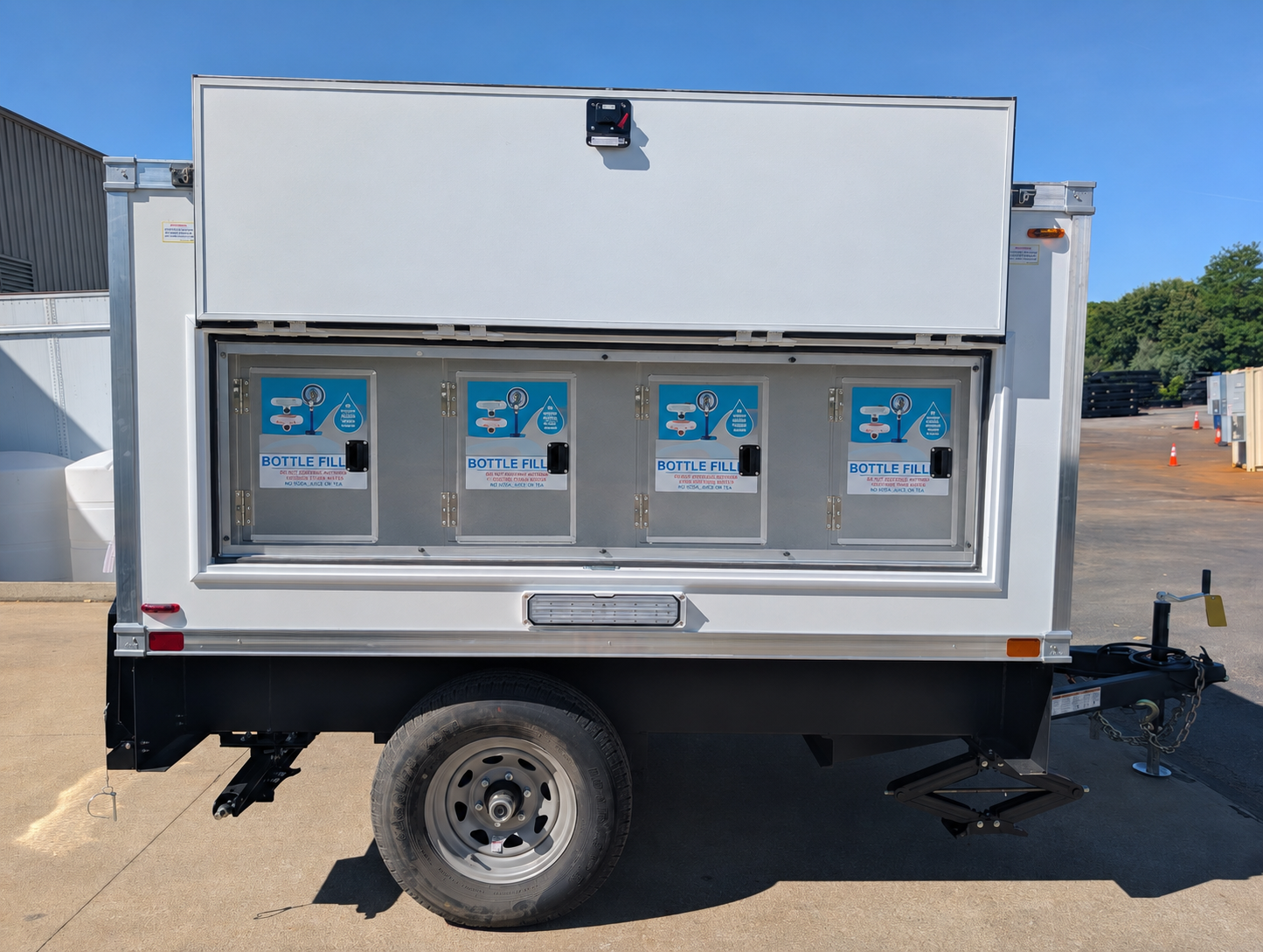
On-Site Hydration Services delivers chilled, filtered drinking water to corporate events in all 50 states. We tow the Signature Series trailer in, set it level, tie into power and charge the tank, so all four fill stations are pouring before the first guest parks. Company picnics on a campus lawn, client golf outings, a launch under tents in a parking lot, a wellness day on the field behind the building. Send us the date, the headcount and the address and we will quote it this week. Inside of two weeks, call instead.
Licensed and insured | A+ BBB rated | 24/7 dispatch
See the Signature Series water station specs
“We ran the company picnic off pallets for four years and someone from my team spent the whole day hauling ice. Last summer we booked the trailer instead and I got my staff back.”
“Our client outing runs four and a half hours in full sun, and the clubhouse cooler does nothing for anybody past the third hole. They put a second station near the turn. The complaints stopped.”
“The launch was our sustainability story for the year, so shrink wrapped bottles could not be in the photos. The trailer showed up clean, we put our signage on it, and the water was still cold at four.”
References for this kind of booking are available on request.
We have been parking mobile drinking water stations on office campuses, parking lots and golf courses for years, and the story barely changes. The brief says water, somebody orders cases, and by two in the afternoon the cases are warm and the nearest one sits a hundred yards from where people are. Our Signature Series trailer fixes the part that matters. Chilled water, four push back fill stations, a jug spout out back for coolers and beverage tubs, and a footprint small enough to park where the crowd is instead of where the truck fit. We deliver corporate event hydration station rentals in all 50 states, set up before guests arrive, and pull out after the last tent comes down. Tell us the headcount, the surface and the date and we will quote it. Short notice is worth a phone call.
One Signature trailer can pour for a weekend concert and be working a slab pour a couple of days later. Hiring one company for your events and a separate one for your worksites makes no sense. Either way, the planning, the delivery, and the refills are ours.
The onboard cooling unit keeps the tank genuinely cold all the way through a long afternoon outdoors, and that single detail carries the whole thing. Warm water is water people abandon, and midsummer is exactly when a crew or a crowd is drinking the most. Cold water gets finished, and finishing it is what keeps heat illness off the site.
Typical deliveries land in about 45 minutes once a truck is rolling in your metro, longer out on the rural routes, and we keep emergency runs going around the clock whenever a heat advisory or a power shutoff hits. The morning a foreman finds his 40-person crew stuck with one warm cooler, speed is the whole game.
One rule sits under every job we take: water that people walk past might as well not be there. We've stood on a bare site and watched shrink-wrapped pallets cook next to the job-trailer while the crew baked thirty yards off. We've watched the opposite too, a chilled station ten steps off the work face run bone-dry twice inside one shift. Everything that matters lives in the distance between those two pictures. Which is why we don't drop a unit and disappear. We match it to your headcount or your gate count, set the refill rhythm to how hard you're really pulling on it, and treat a heat call the way you'd want your own treated, meaning right now, because out here one hot hour can swing the whole day.
We deliver water stations to job sites, venues and event grounds in all 50 states, with the heaviest route coverage across the West.
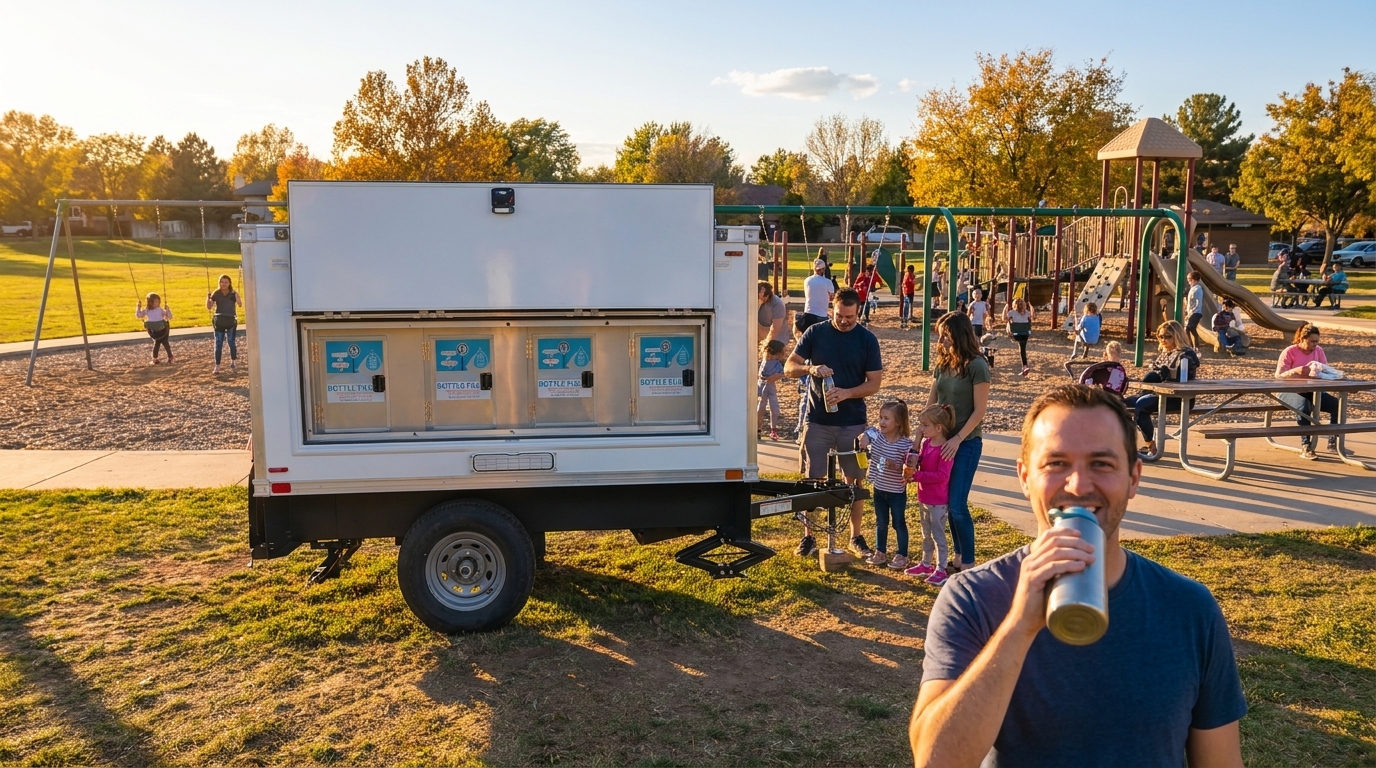
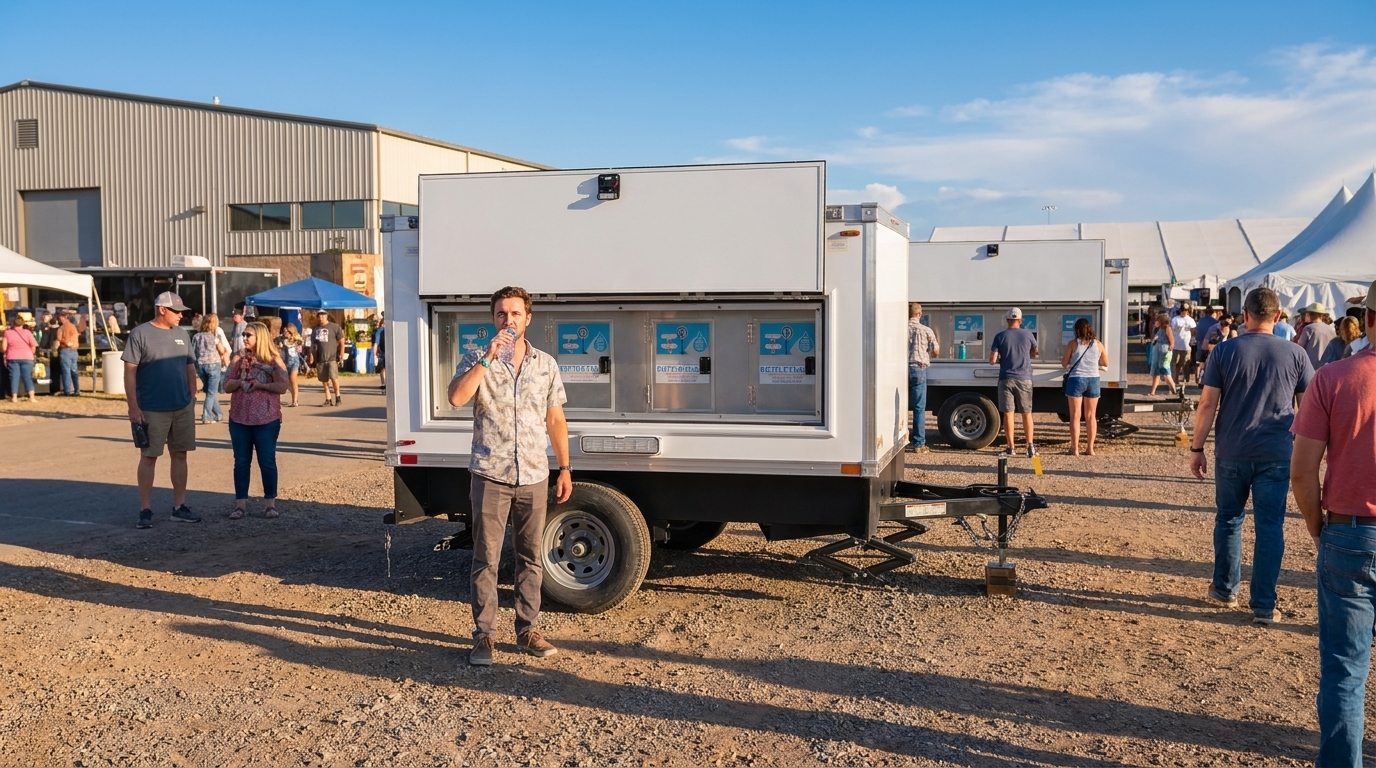
The Signature Series is the unit we send to corporate events, because it carries a full day of water for a mid size crowd and it looks right parked next to a branded tent.
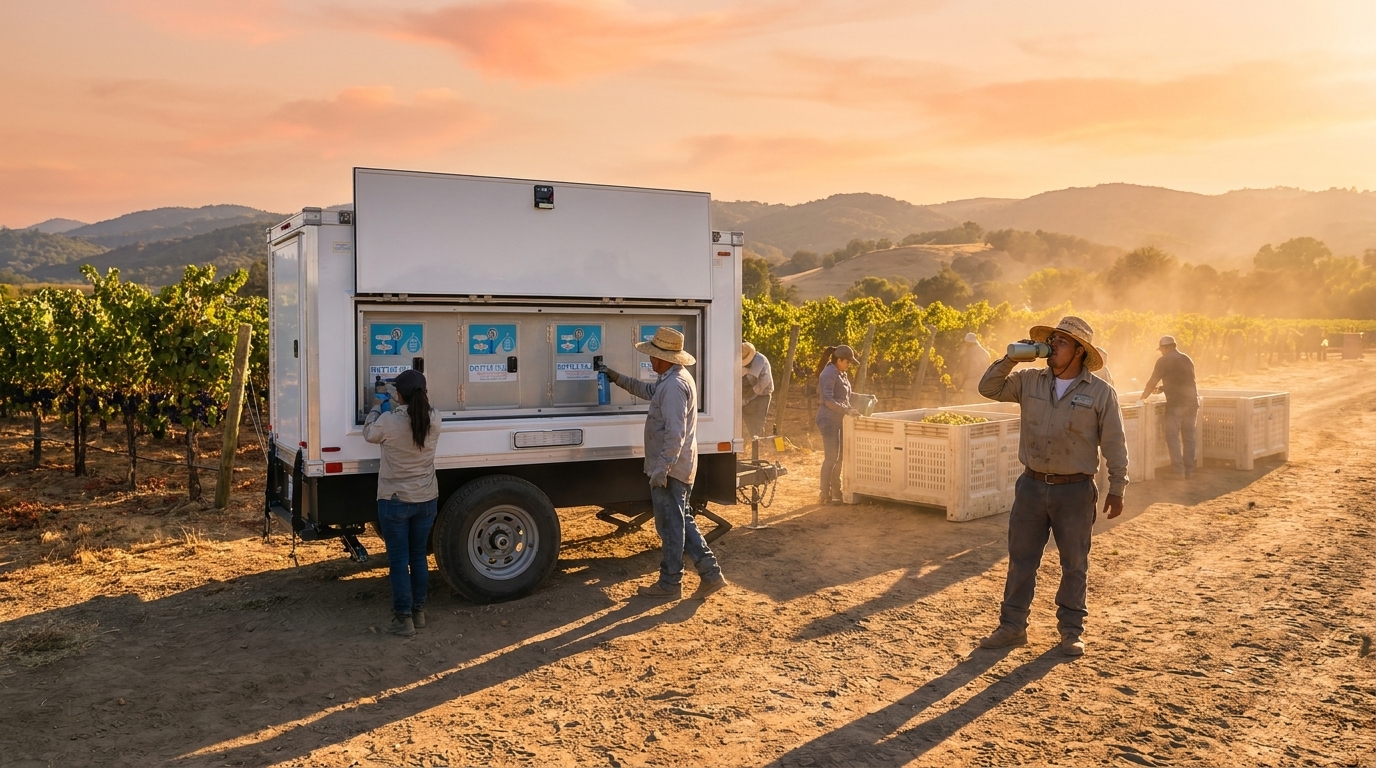
With a frame, a hitch, and tires under it, the unit hauls out to a remote build, an event field, a working orchard, or a disaster staging yard with equal ease. Contractors and event planners request this exact rig by name. The whole design is built around backing in, leveling off, and pouring cold by the same afternoon.
| No. of stations | (4) Bottle Filling Stations |
| Length | 12' 3" |
| Weight | 3,100 lbs. |
| Height | 8' |
| Fresh water tank | 300 Gallons |
| Power requirements | 1 to 4 dedicated 20A/120V circuits OR 1 dedicated 50A/240V circuit |
| No. of AC units | 1 |
One trailer holds 300 gallons of fresh water, and that number starts the whole plan. Four adjustable push back taps run along the side wall. A guest presses a bottle or a cup to the bar and it pours, with no handle to touch and no line stacking up behind one slow spigot. One of those positions sits at an accessible fill height, so a guest using a wheelchair uses the same station as everybody else instead of a side arrangement somebody has to ask for. Out back there is a large jug spout for five gallon coolers, beverage tubs and the catering team's pitchers, plus hose bib connections. That is why our water bottle filling station rentals serve a crowd and a vendor crew off one unit.
Water passes three filter stages and a separate UV treatment step before it reaches a tap, and the on board electric cooling units chill it fast, which is the detail guests notice at four in the afternoon. The trailer is white, clean and quiet. One air conditioning unit on the roof and the cooling units, nothing louder than the catering fridge behind the tent. Give us a circuit and there is no generator, which matters at a launch where somebody is speaking twenty feet away.
Getting it to you is a towing problem, so the numbers matter. The Signature Series runs 12 feet 3 inches long, 7 feet 6 inches wide and 8 feet tall, at 3,100 pounds empty. It needs a path wide enough for a truck and trailer and a reasonably level spot. Power is one to four dedicated 20A/120V circuits or one dedicated 50A/240V circuit. That single question decides more corporate placements than any other, because a campus almost always has exterior outlets and almost never has four free dedicated circuits in one panel near the lawn. We can plan around it. We would just rather know a week out than at seven on event morning.
A water source people don't trust gets ignored, and an ignored station is rented money wasted. That's why municipal water doesn't reach the tap raw on our trailers. It passes through three filter stages and a UV chamber, then an onboard cooling unit drops the temperature. The result tastes clean and comes out cold, even on the worst afternoon of the year.
The opening filter traps sand, scale, and the fine grit local mains occasionally push through. On a dusty lot, that's what keeps a pour from tasting like the parcel it's parked on.
Activated carbon comes next, lifting the chlorine bite and the dull seasonal notes local tap can carry until the taste lands clean and neutral. When it's 95 out, that flavor decides whether a crew keeps drinking or walks past the tap dry.
A finer cartridge then catches the microscopic particles that slip past the first two, so what reaches the spout is clear rather than merely cold for the crews and crowds drawing off it.
The last step is an ultraviolet chamber that wipes out bacteria and microbes without adding a single chemical. Even after a long tow out to a remote site, the water off the nozzle is clean.
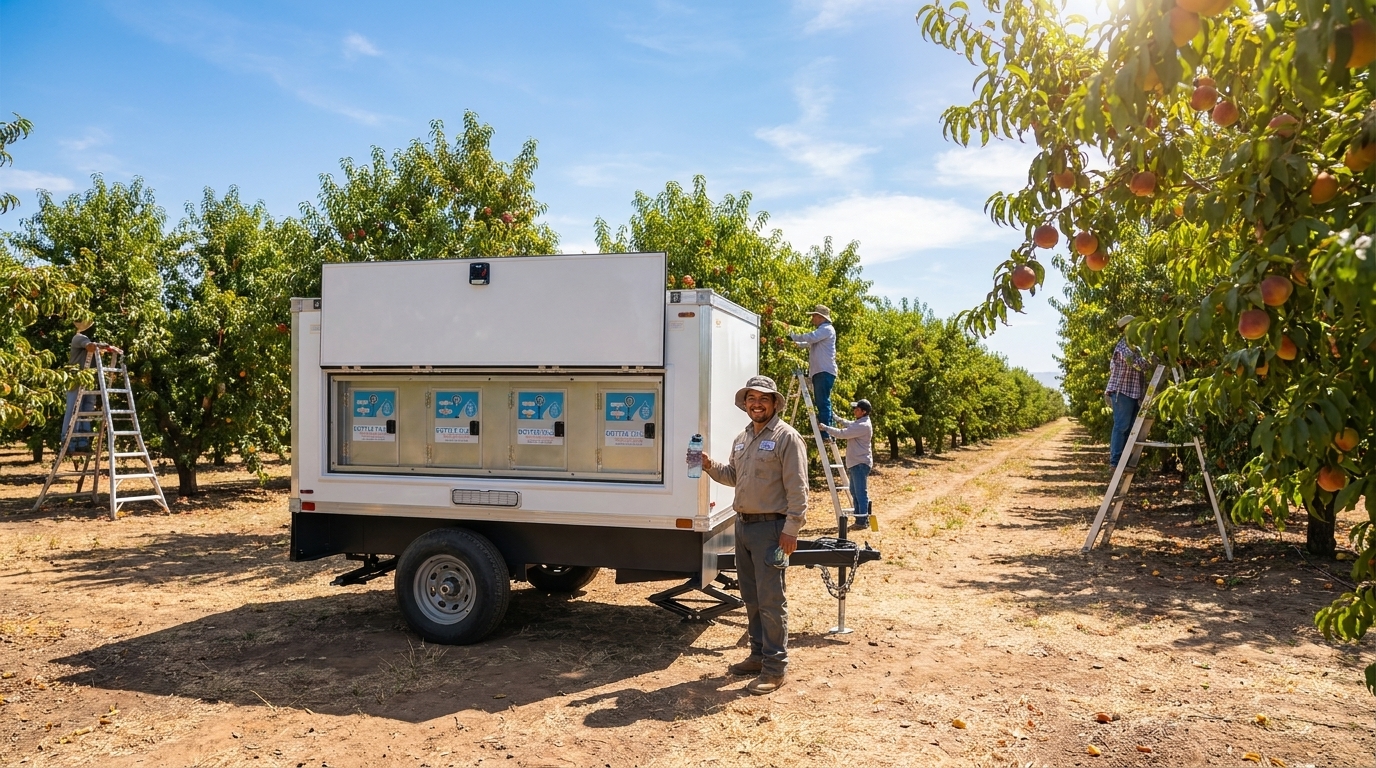
Along the wall sit four adjustable push-back taps, press a bottle to the bar and it pours. One of them is set at ADA-reachable height, so a single trailer includes everybody in a crew or crowd with no add-on gear. Out back, a large-jug spout services five-gallon coolers and hydration packs, while a bank of hose connection taps handles work-site chores, event support, and refills down the orchard rows. Stainless, food-grade plumbing the whole way through keeps the filtered, chilled water at quality right to the spout.
Every Signature trailer carries a 300-gallon load, roughly 2,400 cups at sixteen ounces each, and we recharge it on demand, so the unit doesn't turn into the choke point on a busy shift or a packed show night.
Corporate event is one phrase covering very different days. A picnic keeps 600 people inside a hundred yards of each other for four hours. A golf outing spreads 120 across a few hundred acres. A launch puts a small crowd in a hot lot with a camera on everything.
Most company picnics run three to four hours in the afternoon. Trade coverage of the 2026 picnic describes the category shifting from a casual outing into a budgeted employee experience, with the weather contingency now treated as part of the venue decision rather than an extra. Heat is the version of that contingency nobody writes down. Employee Appreciation Day is a fixed date, the first Friday in March, which reads as cool weather in most of the country and does not always behave that way on the West Coast, where a March heat wave broke records in 2026.
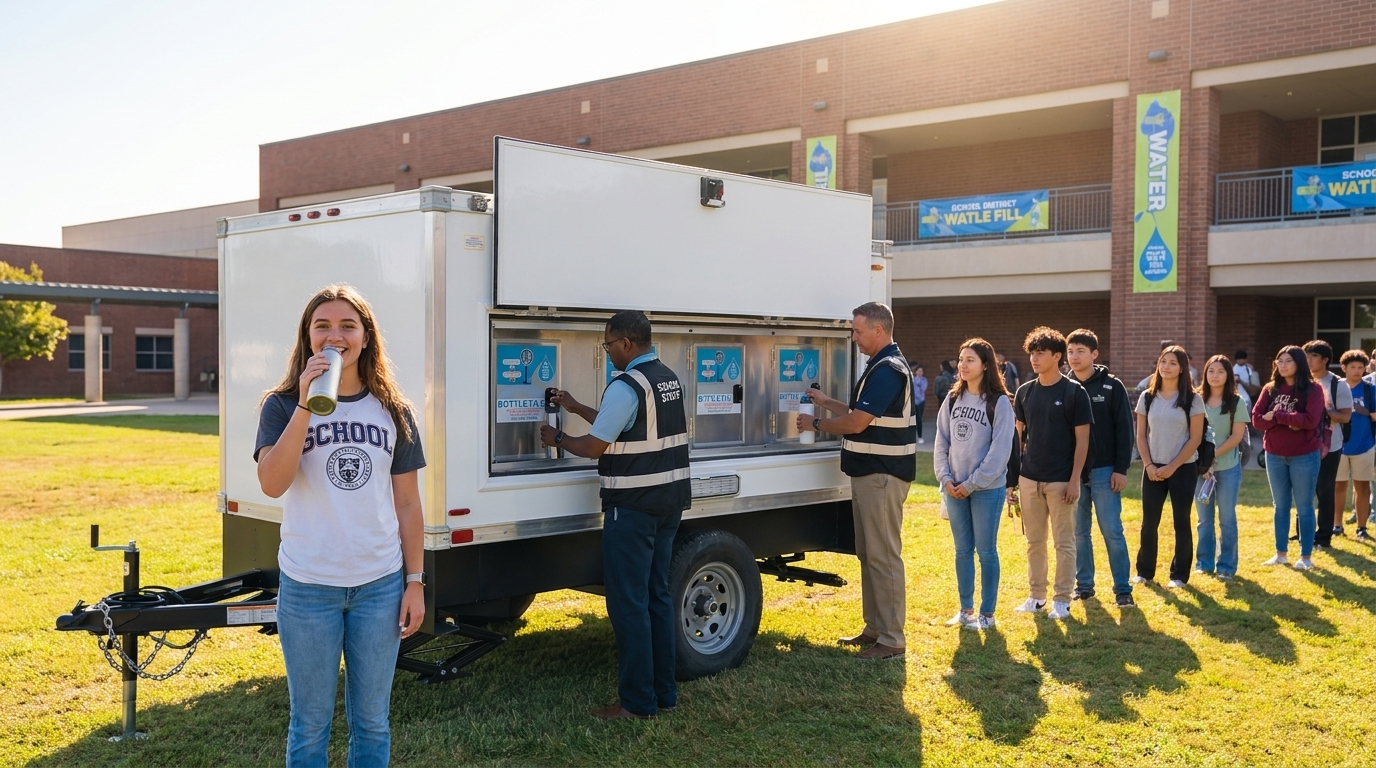
The sites repeat. A campus lawn, the employee lot cleared for the day, a picnic grove at a rented park, the apron outside a distribution center. Lawns are the nicest for guests and the hardest on us, because irrigation ran overnight and a truck crossing soft turf leaves ruts. Parking lots are the opposite. Flat, stable, easy to level on, and radiating heat off asphalt with no natural shade, which is the condition that pushes per person need toward the outdoor benchmark.
Placement decides whether the station gets used. Between the food line and the seating, inside the shade if there is any, and people refill without thinking. Out at the edge of the lot next to the panel because the cord reached, and half the crowd never walks over. We ask two things before the truck leaves. Where is the food, and what is the surface between the parking area and the tents. The second one catches more problems.
What goes wrong is almost never quantity. It is staging. At one large outdoor event this summer, pallets of bottled water reportedly sat in the sun near the grounds while eleven people went to the hospital with heat illness. The supply existed. It was warm, it was far away, and nobody was moving it. A station pouring cold at a point people can see solves a different problem than ordering more cases does.
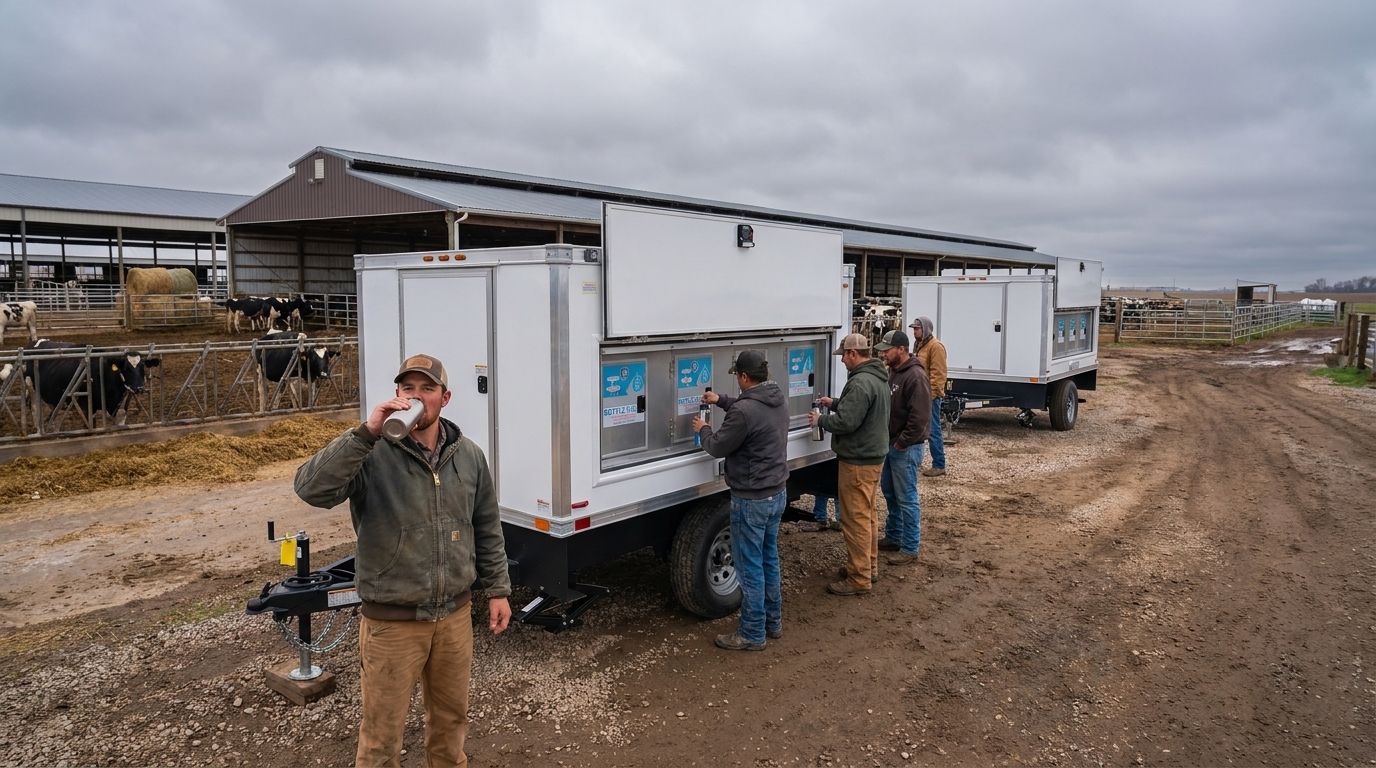
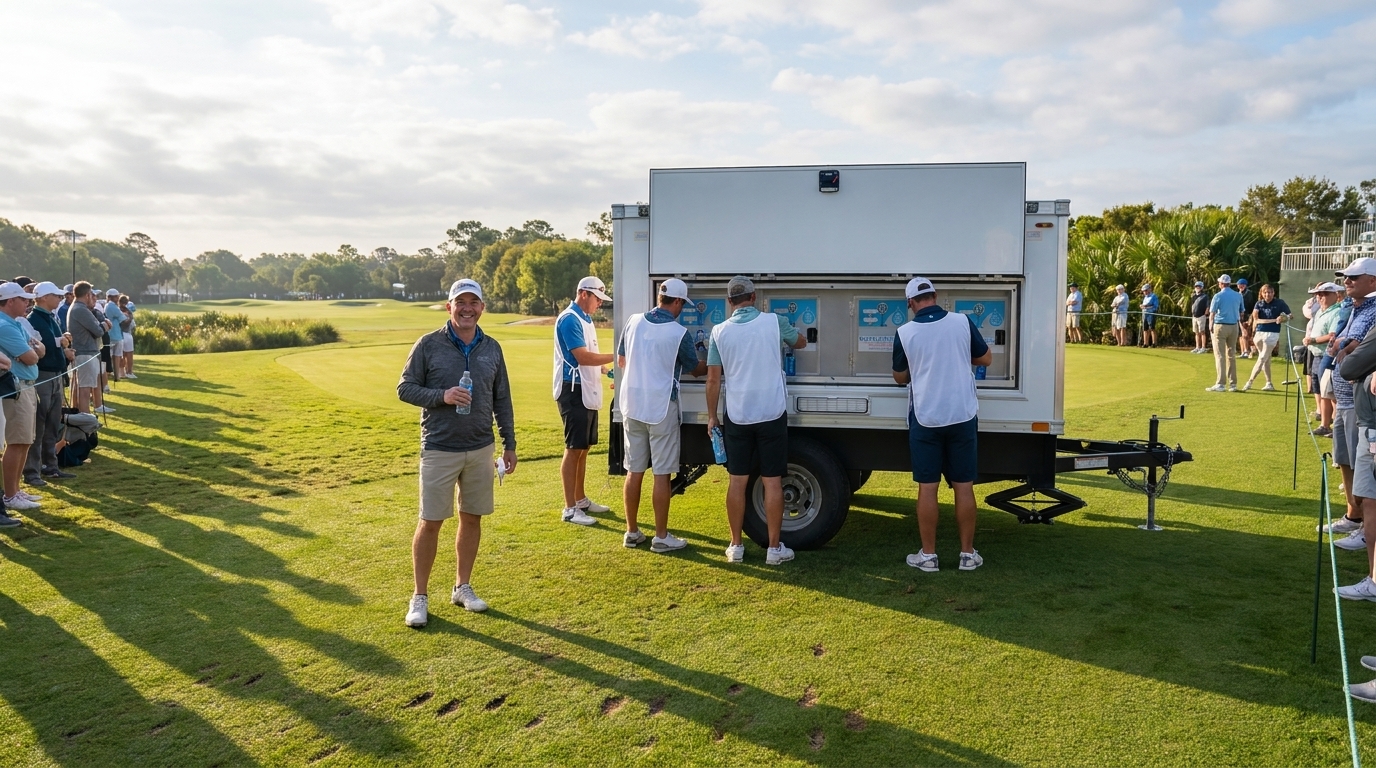
A golf course is not one lawn. Corporate golf outings commonly run 20 to 144 players, a shotgun start keeps everyone out there four hours or more in full sun, and the clubhouse cooler serves the first tee and the reception and nothing in between. This is the clearest case in the category for a second station, or for one positioned at the turn rather than parked where the truck naturally stopped. Cart path access and the club's own rules about vehicles set the real options, so we walk a course before quoting it whenever the date allows.
Runs are different because the people are working. The Houston Corporate 5K drew a record 10,230 participants from 244 companies in 2025, so this is real scale. Athletic event guidance puts water need far above a picnic figure, and a race has two consumption windows instead of one: staging before the gun, and the recovery zone after, where everybody arrives at once. We plan those as two positions. The same logic drives our marathon and race hydration station rentals.
Wellness days land between the two. Corporate wellness reporting for 2026 names outdoor recreation as one of the fastest growing formats, with pickleball, group hikes, nature walks and sunset yoga cited by name. A health fair with tables on the field behind the office is a low effort afternoon. A group hike from a trail parking lot is not. When a day mixes both, we size for the active half.
The failure mode across all three is distance. People will walk to water once. They will not walk to it four times over four hours, and the ones who stop walking are the ones you most want drinking. On a spread out site the honest answer is usually a second unit, and we say that before you book.
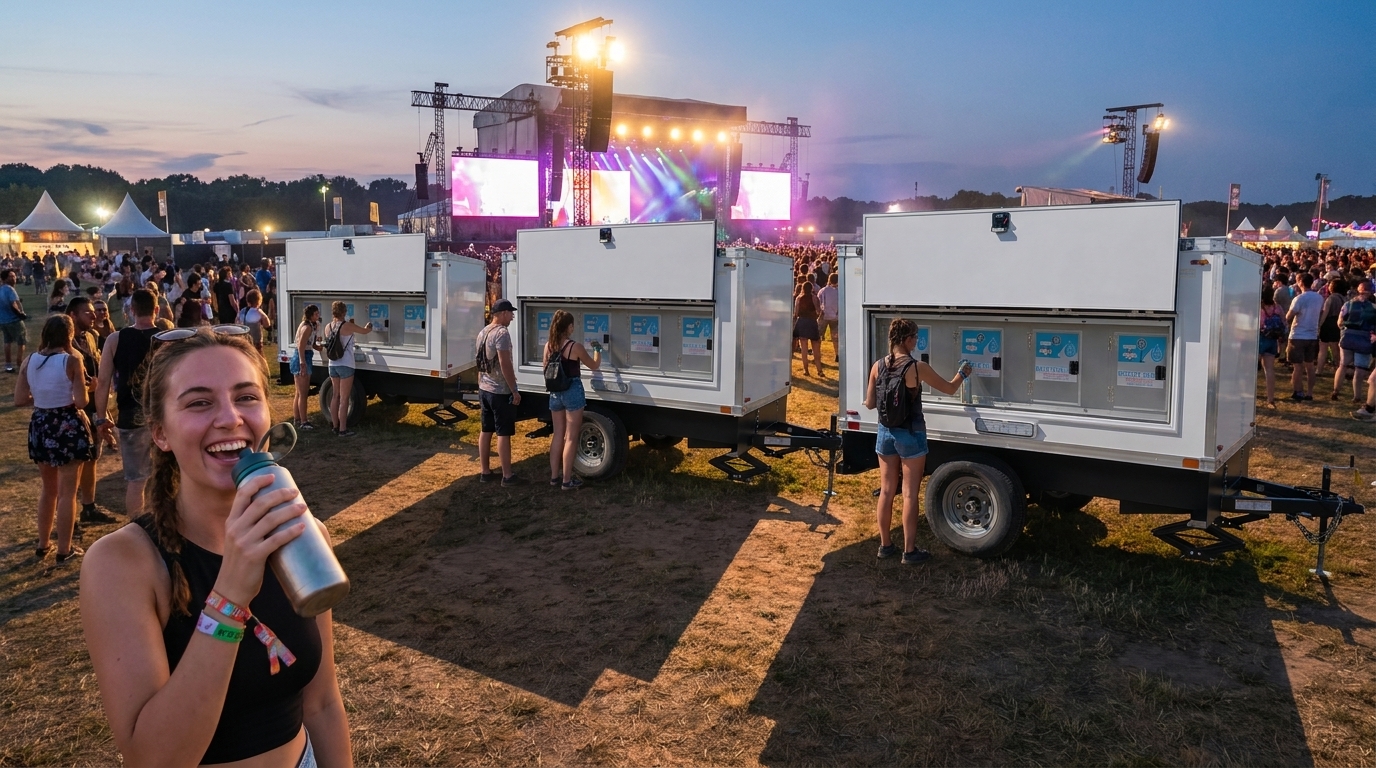
Product launches and brand events typically get three to six months of planning runway, against six to twelve for a large conference. That is why these calls reach us later and hotter. The sites are usually paved: a lot beside the building, a plaza, a fenced pad at a construction site. Paved is easy for us and hard on guests, because there is no shade and the surface holds heat.
Groundbreakings look short on paper. The ceremony runs twenty to thirty minutes. The event does not. Guests arrive early, remarks run long, and the reception is where executives and clients stand around in the sun. Municipal planning guides for these ceremonies tell organizers to line up tents or an indoor backup for rain or extreme heat, and to secure permission in advance if any part of the event sits in a public right of way such as a sidewalk. Water is the piece of that contingency left off the list most often.
The sustainability angle is not soft here. The Events Industry Council Sustainable Event Standards call for eliminating the use of all single use water bottles for a certified event. Meeting Professionals International has documented member organizations replacing bottled water at meetings with fill stations, and at least one turning sponsored reusable bottles into a revenue line instead of a cost. If your launch is themed on an environmental commitment, a pallet of shrink wrapped bottles in frame is the most photographable contradiction on the site.
We plan these around the camera and the microphone. A clean flank facing the crowd for your signage, a cord run that does not cross the guest path, no generator within hearing distance of the podium. It also means a delivery window ahead of the AV truck, because once the stage and tents are set there is often no way to get a trailer into the spot everyone agreed on.
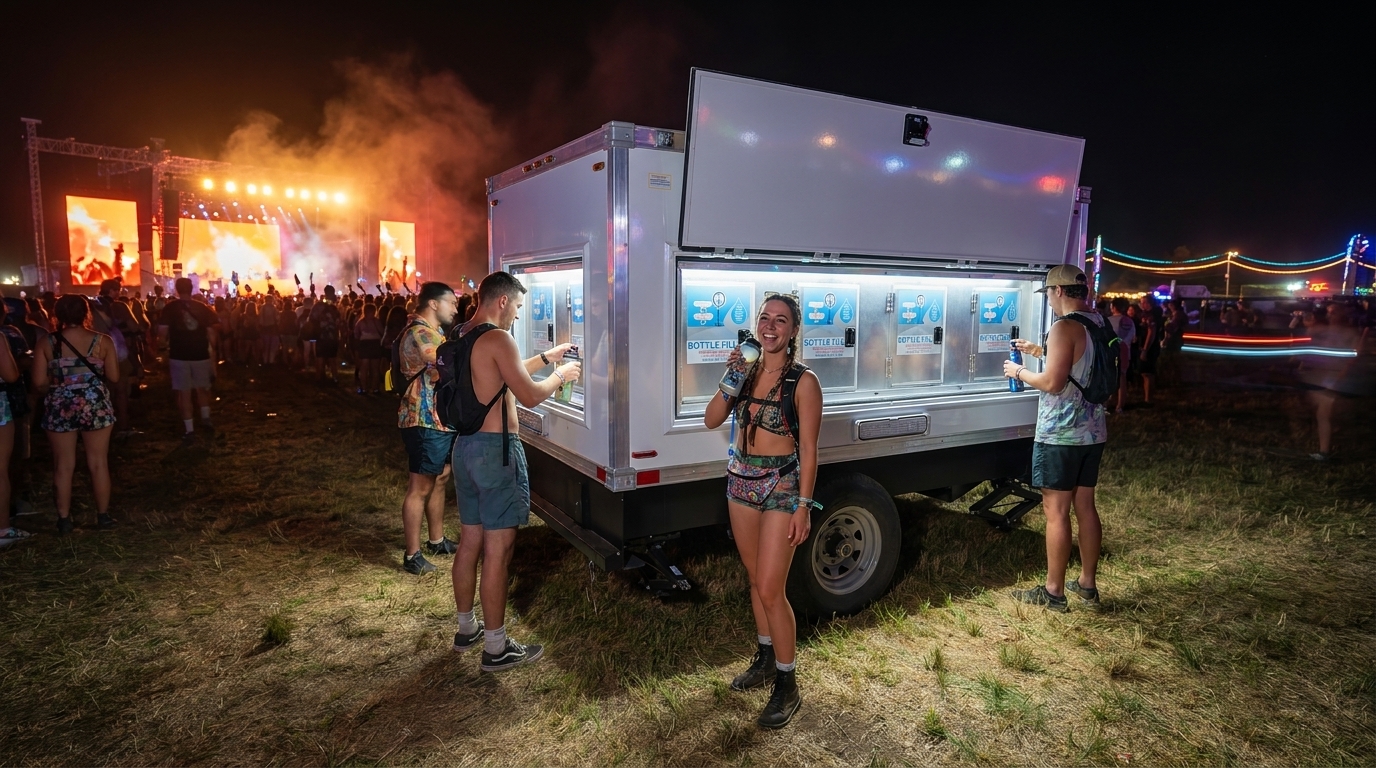
The trailer is the easy part. What decides the day happens in the last hundred feet of the approach and in the hour before guests arrive.
We deliver the day before whenever the venue allows it. Tents, staging, rental furniture and the AV truck all arrive early, and all of them sit exactly where a trailer needs to pass. A spot that was open on the site map is often blocked once the build is up. When an overnight is not possible we take the earliest morning window the site will give us, ahead of catering, and set, level and charge the tank while the lot is still empty.
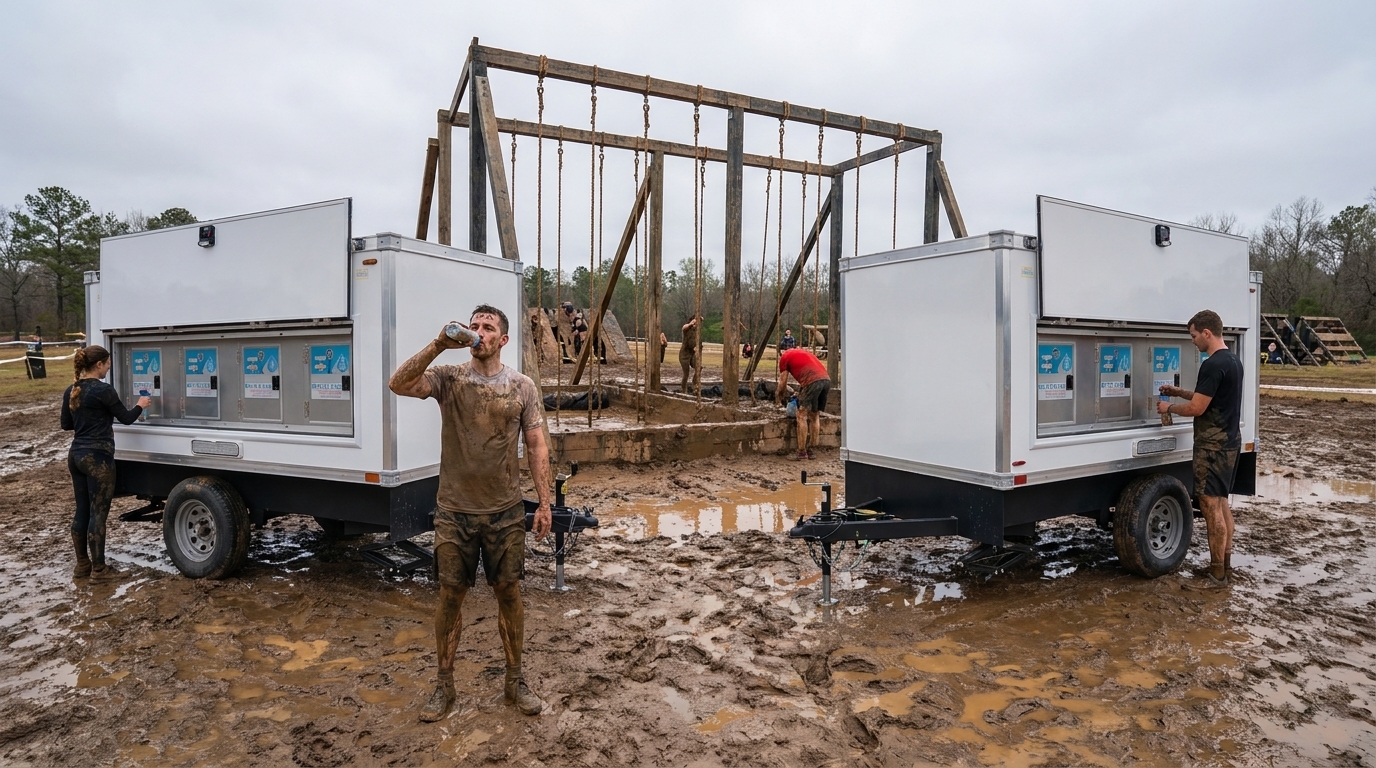
Placement is a conversation, not a drop. We want the station inside the crowd, near the food line, in shade if the site has any, with a cord run that does not cross a walking path. We want a firm, continuous surface between the station and the gathering area, because a unit guests reach only by crossing soft turf or a mud line is a unit half your people will not use.
What goes wrong is the same every time. A gate narrower than the site plan claimed. A dock apron with a curb and no cut. A watering system that ran at four in the morning and turned the tow path to ruts. Badge access at a secured campus with nobody on site at six to wave the truck through. Outlets by the pavilion that turn out to share a panel with the kitchen. None are dramatic alone, and each costs an hour you do not have. Heat is the one that gets worse on its own, which is why cooling center water station rentals exist as a separate service for the days when weather stops being a planning input.
Pickup is scheduled around teardown, not the end of the program. We come back after the tents are down and the lot opens back up, drain and secure the tank, and leave the surface the way we found it. On multi day offsites we return between days to recharge from our own bulk water rather than turning the venue's hose bib into a supply line.
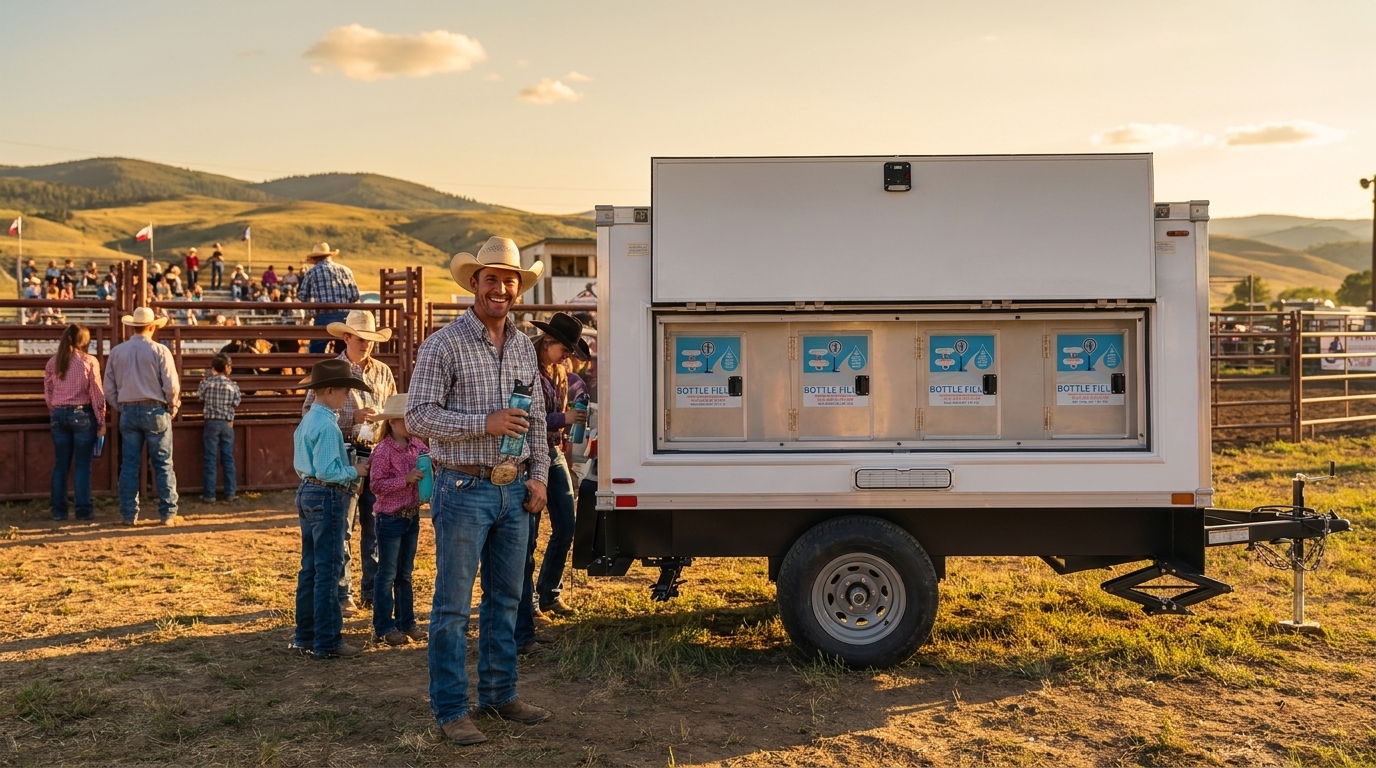
People count, number of days, where exactly it parks on your site, and what power is there. Those four answers let us spec it correctly the first time around.
Reckon roughly 45 minutes from the nearest yard once we are in your metro, longer on the outer routes, with round-the-clock emergency runs whenever a heat advisory or a power shutoff hits.
Once on site we set it level, charge the 300-gallon tank, and tie in power off one to four standard 120V circuits, or a single 50-amp 240V drop, depending on what the site gives us.
After that the tankers cycle back on a cadence matched to how fast your crew or crowd pulls it down, and we maintain the unit through the whole rental term.
No power on the parcel at all? We price that in. The unit draws very little, and with the service fleet backing it we've run stations on lots that had no permanent power whatsoever. Lay out what the site offers and the rest is on us.
Want this math run for your own booking? Two minutes on the phone gets you a real number.
Two numbers set this and headcount is only one. The other is how long people are outside and how hard they are working while they are out there.
| Ribbon cutting or construction kickoff with a reception (up to 100 guests, 2 hours) | 1 station |
| Half day company picnic on a campus lawn (up to 300 guests, 4 hours) | 1 station |
| Product launch in a paved lot (up to 400 guests, 3 hours) | 1 station |
| All company picnic, full day, warm weather (500 to 800 guests, 6 to 8 hours) | 2 stations |
| Client golf outing across 18 holes (up to 144 players, 4 to 5 hours) | 2 stations, one near the turn |
| Corporate 5K with a recovery zone (300 to 600 participants) | 2 stations, start and finish |
| Multi day corporate retreat (150 guests, 3 days) | 1 station, daily recharge |
Here is the arithmetic, and it is published guidance rather than anything we invented. Event catering benchmarks put water need at about half a gallon per person for a four hour indoor event, three quarters of a gallon for four hours outdoors in warm weather, and a full gallon for an all day outdoor event. For a physically active event the same guidance jumps to a gallon and a half to two gallons per person. Standard practice adds ten percent over headcount for walk ins. Run 300 people, four hours, outdoors through that and you get about 225 gallons, call it 250 with the buffer, which one 300 gallon trailer covers.
Duration moves the number harder than headcount does. The same 500 people need roughly 375 gallons at a four hour picnic and roughly 500 at an eight hour retreat, before you account for the structured activity a retreat usually has in it. Effort moves it again. Six hundred runners at the athletic benchmark is 900 to 1,200 gallons for the race window alone, which is why a 5K gets two stations and a recharge rather than a bigger tank.
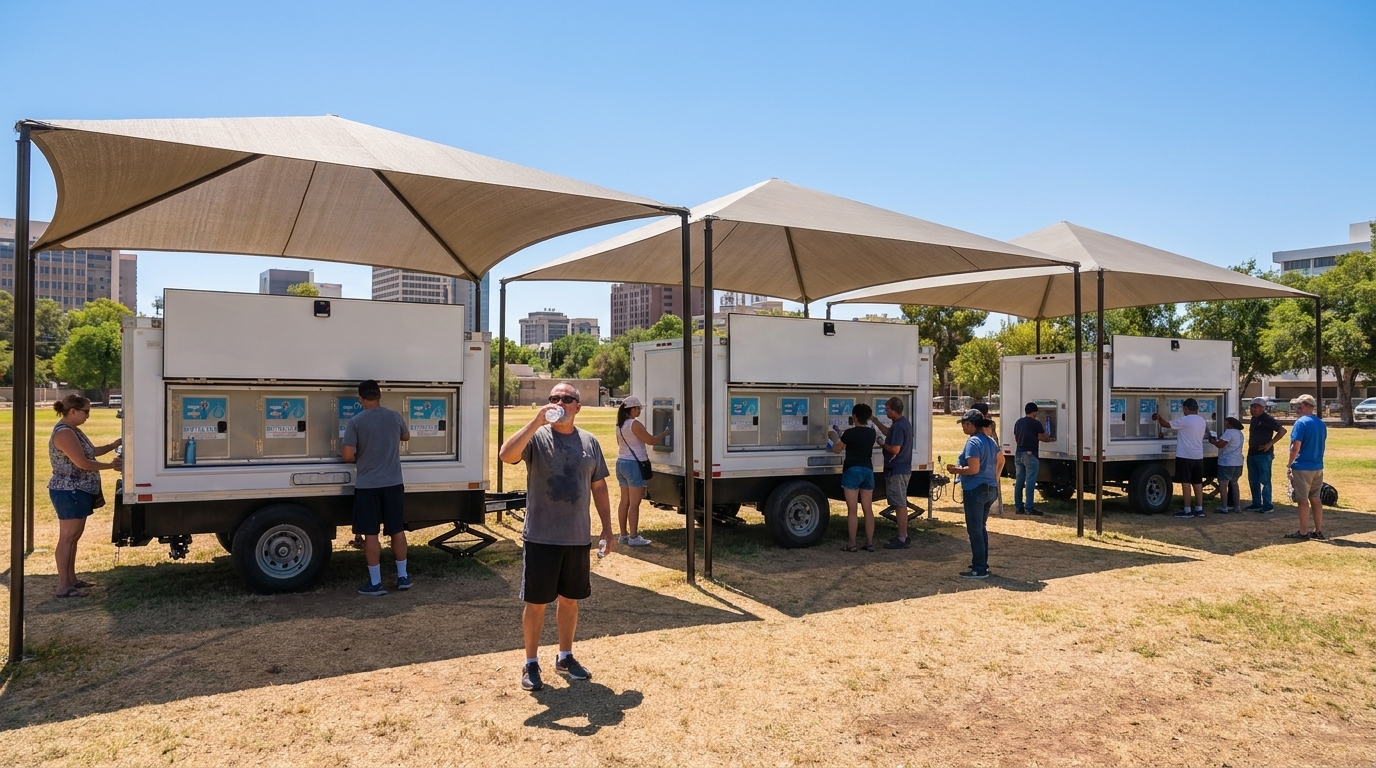
Our honest default is one trailer per 300 to 400 guests for a half day outdoor event on a compact site, and a second unit the moment the site spreads out or the day runs past six hours. We would rather send two and have the second one quiet than send one and spend the afternoon chasing a tanker across town. If your count is genuinely uncertain, give us the high number and the surface.
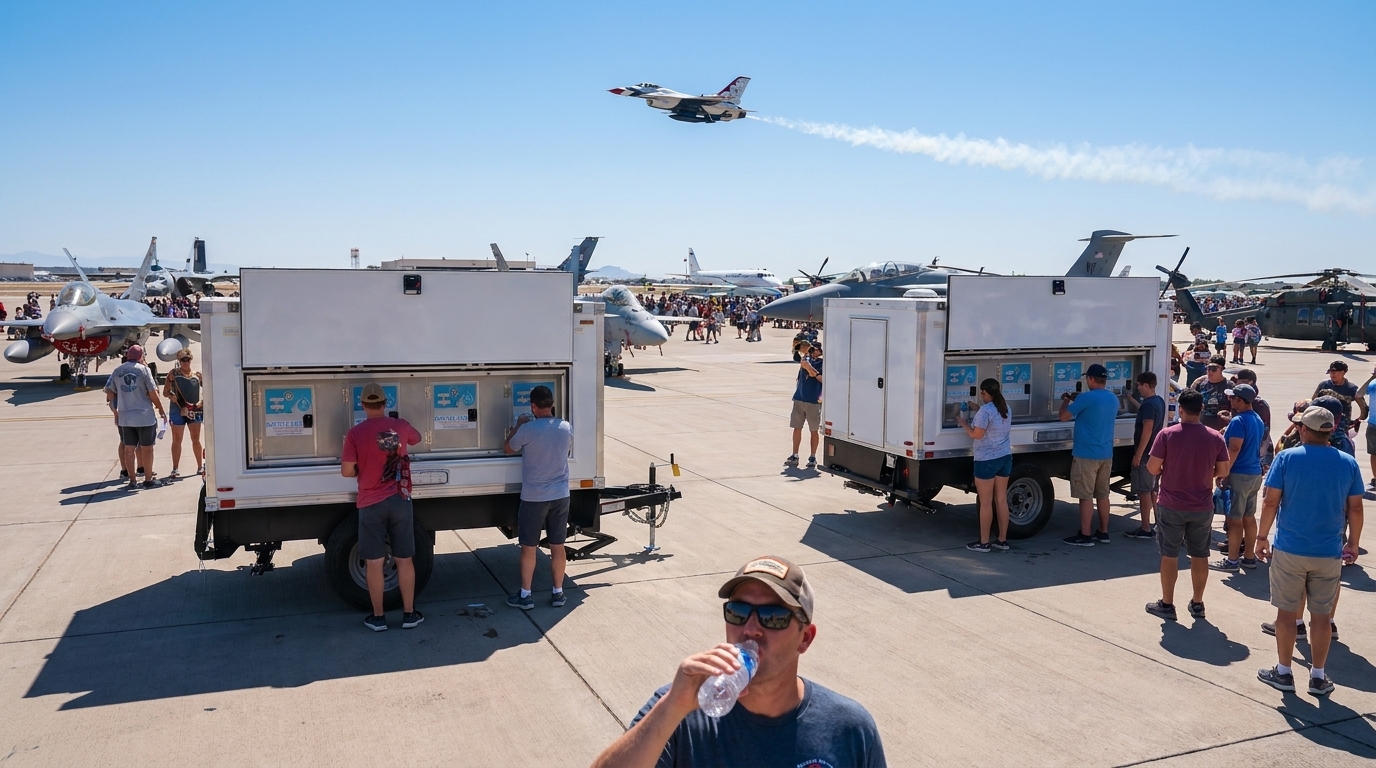
Start with the water. NSF/ANSI/CAN 61 is the material safety standard for anything touching potable water on its way to a person: pipes, fittings, valves, tanks, mechanical components. It was developed at the request of the US Environmental Protection Agency, it is performance based, meaning it measures what gets into the water instead of listing which materials are required, and most states require it for products in the drinking water supply chain. When a facilities manager asks whether our equipment is food safe, that is the standard behind the question.
Then the path to it. Section 206.2.2 of the 2010 ADA Standards for Accessible Design requires at least one accessible route connecting elements and spaces on a site, and event guidance applies that to temporary elements guests are expected to use. A central water station is exactly that. The practical version is stricter than planners expect: the route has to be continuous, stable and slip resistant the whole way, and a path crossing mud, soft grass or loose gravel fails even when a ramp exists elsewhere. Short dry grass can work. Wet grass does not, and a mat path over it is the standard fix.
Heat is where planners want a number, and the most specific one belongs to California. Cal/OSHA Title 8 Section 3395 requires employers to provide enough fresh water for each employee to drink at least one quart per hour, kept suitably cool, free of charge and as close as practicable to the work, with shade available above 80 degrees and further protections at 95 degrees for named higher risk industries. That standard governs outdoor work, not a voluntary company picnic, and we will not tell you otherwise. What it gives an HR team is a benchmark a regulator wrote: enough water, cold, free, and close to the people. Our sizing math is built to beat it.
Permits are local and they are real. Cities and counties commonly require a temporary event permit, and outdoor events often need sub permits touching restrooms, water stations, tents, EMS and lane closures. Requirements vary by jurisdiction, so call the city or county with your site and headcount rather than assuming the venue has it covered. On the sustainability side, the Events Industry Council Sustainable Event Standards, ISO 20121:2024 and the MPI Sustainable Meeting Professional certificate connect into one framework, and a fill station instead of a pallet is one of the easiest boxes to check inside any of them. Our fair, carnival and rodeo water station rentals answer the same questions from a health inspector.
Federal OSHA heat illness prevention guidance and the CDC and NIOSH heat stress program point at the same baseline: cool drinking water, close to the people doing the work, and documented.
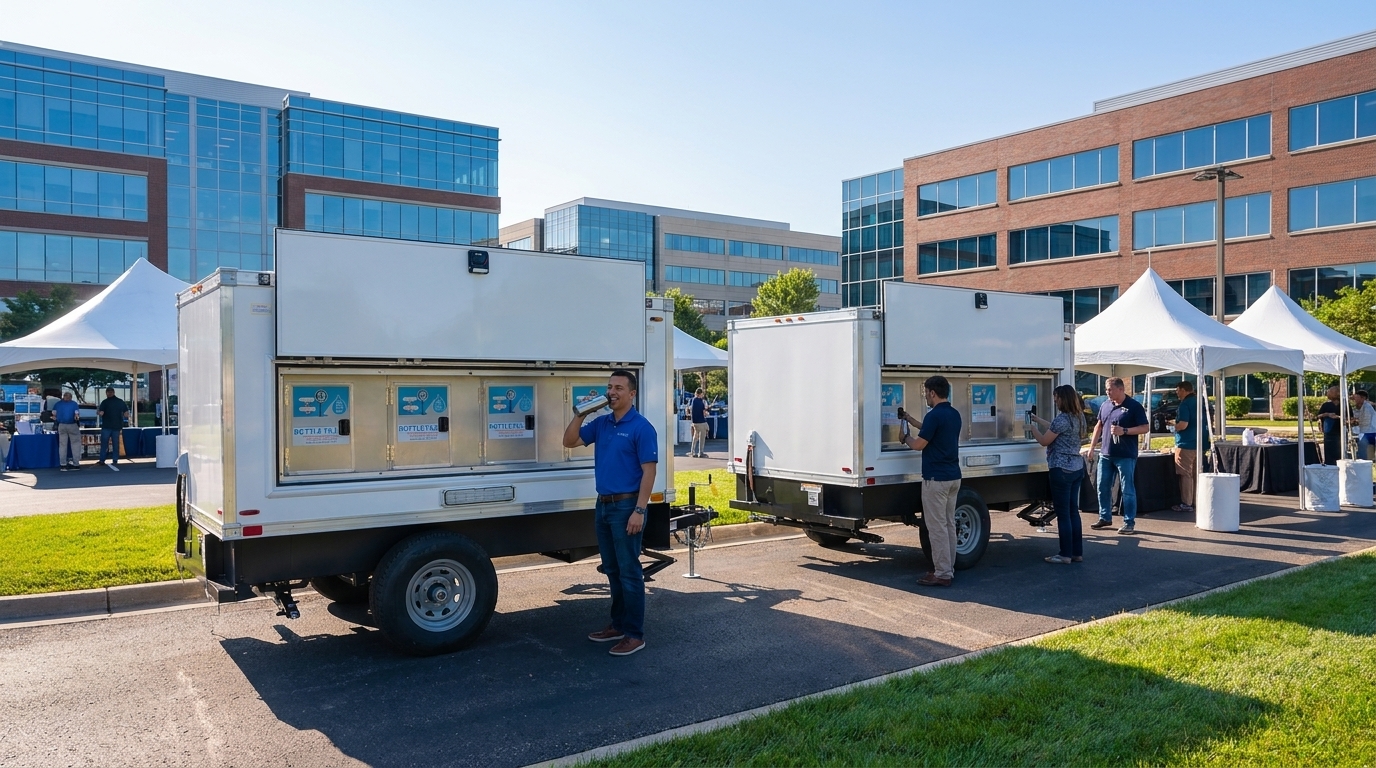
Need a station your written heat plan can point to? We can have one pouring cold within days.
Ask who physically does that work and the answer is never a dedicated role. Industry material on event beverage service names volunteers, general event staff and catering teams, and inside a company it lands on whoever owns event logistics: an HR coordinator, a facilities lead, an executive assistant who already has the run of show. Bottled water's whole appeal is that it needs no equipment, which is the same reason it needs a person. Somebody cuts the order, receives it, finds somewhere cold for it, breaks cases, refills bins with ice all afternoon, then deals with what is left.
The freight is heavier than it looks on a purchase order. Bulk delivery guidance for warm weather outdoor events plans around two bottles per attendee per day, and a pallet of standard 16.9 ounce bottles weighs roughly 1,800 pounds. A 500 person picnic is a thousand bottles to receive, stage, chill, distribute and then collect as empties. Quantity is rarely the failure. Position and temperature are. Warm bottles at the far end of a lot are functionally not there.
Then there is what it looks like. Shrink wrapped plastic in the background of every photo, bins overflowing by mid afternoon, a recycling story you cannot verify. The average American throws out about 156 plastic bottles a year, and reusable bottles are credited with cutting single use waste by up to 90 percent over their lifetime, which is why sponsored bottles paired with fill stations have become a real budget line. The trend is genuine but uneven. One major beverage company dropped its reusable packaging target in 2025 after stalling at half of it, so anyone claiming the whole market has moved is exaggerating.
Look at everything bottled water actually demands of a person: cutting the order, receiving and breaking down pallets, icing coolers before dawn, topping them up through the day, then flattening empty bottles for the bin. On a large crew that's hours of paid time burned every single day, scraped right off the work that's supposed to be getting done. The trailer erases that loop entirely. A local contractor once let us pencil it out with him, and the recovered labor by itself paid for the unit. His words were that the bottle runs had been quietly costing him close to a day of payroll a week. Our trailer arrives full, the tankers keep it full, and your superintendent owes it nothing but a parking spot.
Ice a cooler at 6 a.m. and by mid-morning in July it's as warm as a bath. Warm water is water people stop touching, and the slowdown that follows is precisely where heat illness gets its opening. A chilled station never rides that warm-up curve at all. Whatever pours at clock-out is as cold as the sunrise fill, which happens to be the moment a spent crew, or a crowd deep into a long concert, leans on it hardest.
Bottled-water pallets devour staging space, jam the lay-down area, and sit cooking in the sun until somebody finally cracks them open. Empties build up faster than anyone keeps up with, and on a tight commercial lot that pile turns into its own problem. Set a trailer in one parking stall instead and it serves a crew or crowd that would otherwise burn through hundreds of plastic bottles every day.
Every bottle bought is a bottle thrown out, and across a season a busy site or event generates a small mountain of them. That's a disposal line on the budget, a dent in the sustainability numbers, and, given that a single bottle can linger in the ground for centuries, a footprint that lasts longer than the project that made it. Move to a refill station and the line drops to zero, which finally gives your reporting a figure worth publishing.
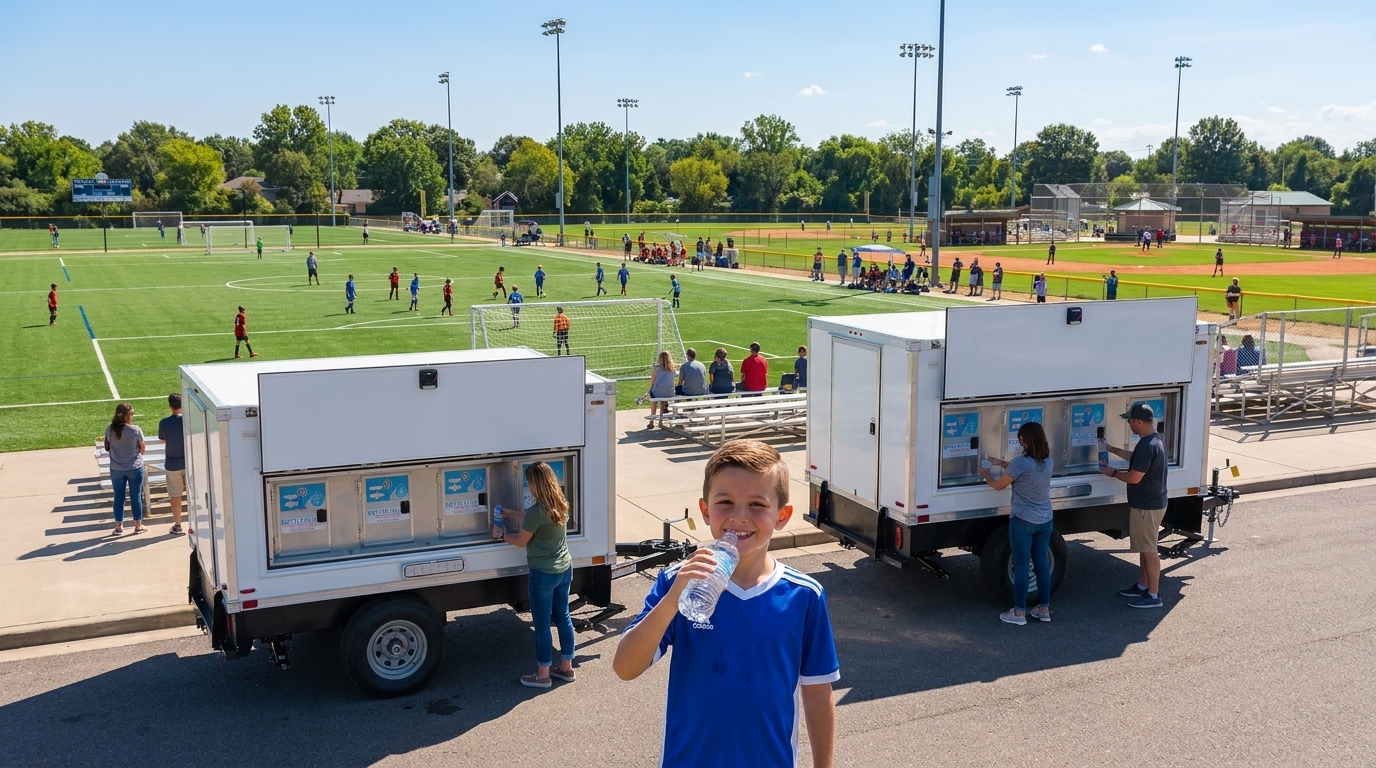
Three bookings of this kind, and what we planned around on each one. Names and details are kept generic on purpose.
Campus picnic, 600 employees, second week of July. Facilities called eleven days out after the forecast turned. The plan had been pallets in the shade of the building, ninety yards from where the tents were going. We walked the site on a video call, found the main lawn's watering system ran at four in the morning, and moved the placement to the paved edge of the employee lot with a mat path across the eight feet of turf between it and the seating. We delivered the afternoon before and charged the tank overnight. It sat between the taco line and the shade sails and was nearly empty by five.
Client golf outing, 120 players, shotgun start at 8 a.m.. The assistant organizing it had run the outing three years and knew the complaint by heart. The clubhouse cooler is useless once you are on the course. We put one unit on the apron near the clubhouse for check in and the reception, and a second near the cart path at the turn, which the superintendent approved on the condition we stayed off the grass. Carts topped off going through instead of running dry by the twelfth. The second unit is what got mentioned in the follow up email.
Construction kickoff and reception, 150 guests, a paved lot with no tap. Twenty five minutes of ceremony, then two hours of executives and clients standing on asphalt in September. The contractor had a connection available but the closest usable power was a shared panel, so we confirmed circuits a week out and brought our own cord run rather than finding out at seven in the morning. The client put printed signage on the flank facing the crowd and it photographed as part of the build. We arrived the evening before, sat overnight inside the fence, and were gone before the lot reopened.
Service information current as of September 2026.
Still weighing it? Call and ask. Most of these questions get settled in one short conversation.
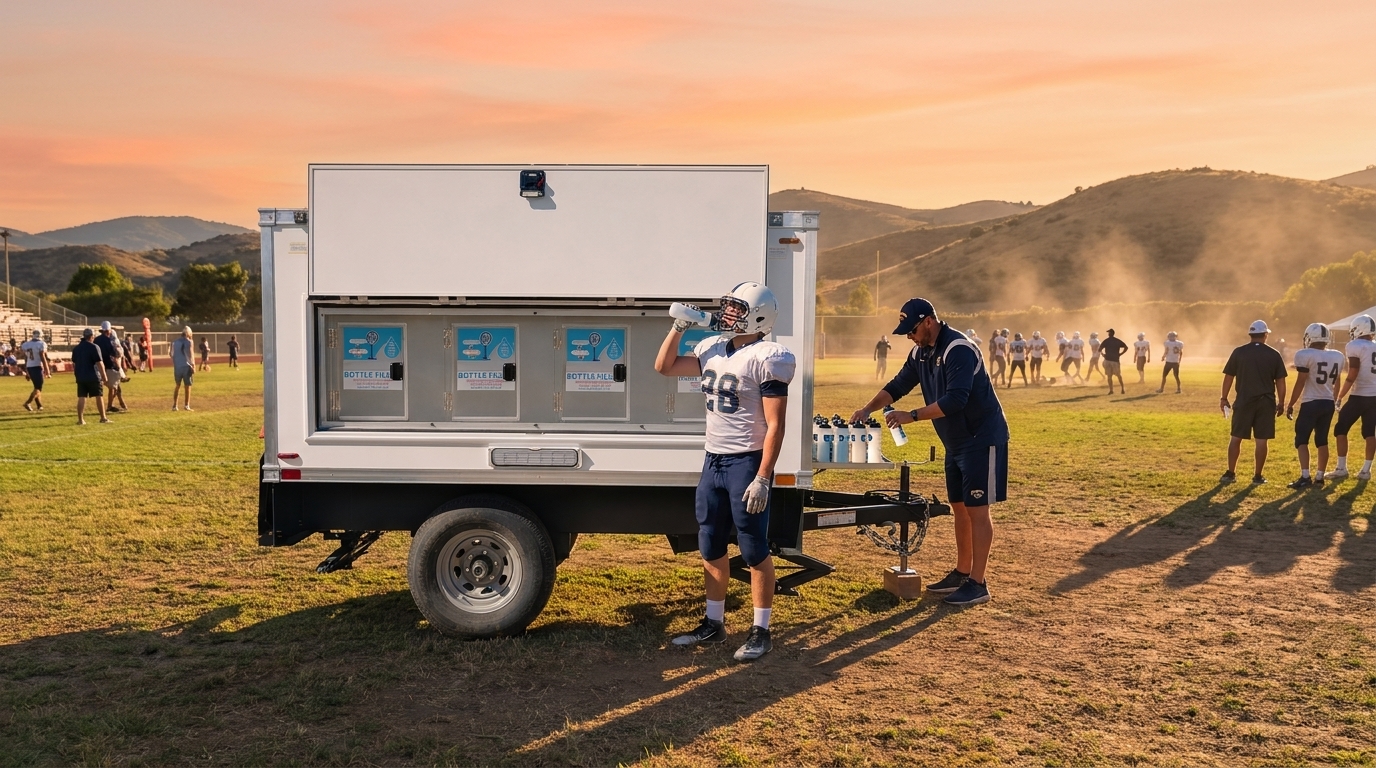
The two working options are bottled supply or a fill station. Bottled means ordering cases, receiving them, keeping them cold and having someone move them around all day. A rented water station means one trailer delivered, set level, tied into power and charged, pouring chilled filtered water from four positions for as long as your event runs. Over about a hundred guests outdoors, the station is less work.
Catering benchmarks put it at about three quarters of a gallon per person for four hours outdoors in warm weather and a full gallon for an all day outdoor event, with a gallon and a half to two gallons for a physically active event like a corporate 5K. Add ten percent over headcount for walk ins. One trailer carries 300 gallons, so a 300 person half day picnic fits inside one unit and a 700 person full day event does not.
One to four dedicated 20A/120V circuits or one dedicated 50A/240V circuit. The word that matters is dedicated. A corporate campus almost always has exterior outlets and frequently has no free dedicated circuits in one panel near the lawn, and an outlet sharing a panel with a kitchen or a pump is the most common surprise on delivery morning. Have facilities confirm the panel before your date.
One of the four fill positions sits at an accessible height, so a guest using a wheelchair uses the same station as everyone else. Placement is the harder half. Section 206.2.2 of the 2010 ADA Standards requires a continuous accessible route to site elements, and event guidance extends that to temporary ones guests are expected to use. That means a firm, stable, slip resistant path the entire way. Soft turf, loose gravel or a mud line breaks it, and a mat path over it is the standard fix.
It depends on the jurisdiction and the site. Cities and counties commonly require a temporary event permit, and outdoor events often need sub permits covering restrooms, water stations, tents and any lane closure. Some county health codes attach specific potable water requirements to food service at temporary events. Call the city or county with your address, date and headcount, early enough that a permit condition does not change your layout.
Federal OSHA regulates heat hazards under the general duty clause and publishes hydration guidance, and CDC and NIOSH guidance recommends about a cup of water every 15 to 20 minutes in the heat, roughly three quarters of a quart to a quart per hour. California goes further for outdoor work with Cal/OSHA Title 8 Section 3395: a quart per employee per hour, cool and free and close to the work. That governs work, not a voluntary company event, but it is the benchmark careful teams plan against.
Corporate events generally need three to six months of runway, with large conferences and multi day offsites at six to twelve months, golf outings sending save the dates six to eight weeks ahead, and events under fifty people often assembled in four to six weeks. Book us once the date and site are locked. Short notice is still worth a call.
Usually not, and we will say so before you book. A corporate scramble can keep up to 144 players across a course for four hours or more, so a single point at the clubhouse serves check in and the reception and nothing in between. The same is true of a campus event split across a lawn, a lot and a field. On spread out sites we count stations by distance rather than headcount.
Yes. We deliver to corporate events in all 50 states, including sites with no potable water connection at all. A remote site changes the planning, not the answer. We confirm the tow path, the surface and the power situation further ahead, and on multi day events we come back to top off from our own bulk water rather than relying on whatever hose bib is nearby.
Most of the trouble we see with corporate event water comes from sequence, not budget. Water gets decided after the venue and the caterer, which means it gets decided after the choices that determine whether a trailer can reach the crowd at all. Flip the order.
At six to twelve months you are choosing the venue, which is the real water decision even though nobody calls it that. Large conferences and multi day offsites book here, and major urban venues sometimes go ten to twelve months out. The questions to ask on the venue walk are not glamorous. Where can a truck and trailer get in, how wide is the gate, and are the exterior circuits dedicated.
At three to six months the mid size events land: launches, brand events, the summer picnic if you are ahead of it. Lock a headcount range and a surface, because those two facts settle the unit count. Golf outings start moving here too, since save the dates go out six to eight weeks ahead, and groundbreakings run on a similar six to eight week minimum in most municipal planning guides.
Rain plans are standard now. Every planner we work with has a tent answer. Very few have a heat answer, and heat is the condition that sends people to a medic tent. A heat plan is three things: shade, water within sight of where people are, and a stated point at which somebody cuts the program short.
Start with the calendar being less reliable than it used to be. A Western heat dome in August 2026 put roughly 45 million people under heat alerts, and a prolonged March heat wave broke records the same year. The second one matters more for planning, because it means a fixed early season date can land in real heat. Employee Appreciation Day is the first Friday in March, and treating that as automatically cool is planning on an average instead of a forecast.
Then read the surface, not just the air temperature. A lot in full sun behaves hotter than the number on the app, which is why per person benchmarks jump from the indoor figure to the outdoor one. California's outdoor work standard makes shade mandatory above 80 degrees for covered work. If a regulator's line for outdoor labor sits at 80, a company picnic at 95 on asphalt is not a day to improvise.
Event rental is a category where three quotes look the same and three event days do not. These are the questions that separate them, in the order we would ask them from your side of the call.
First, the equipment. How many fill positions, and are any at an accessible height. What is the fresh water capacity. Is the water filtered and chilled on board, or is it a tank with a tap. How many people does one unit cover, and can they show the math rather than a round figure. A vendor who cannot give you gallons per person per hour is guessing.
Second, the site. Will they walk or video review it beforehand. What tow path width do they need, and what happens when the gate is narrower than the plan says. What power do they require and must it be dedicated. Will they deliver the day before. What is their answer when the surface between the unit and the guests is soft turf, because if it is not a mat path or a different placement, accessibility becomes your problem.
→
Start areas, course stations and a recovery zone that all fill at once.
→
Open air ceremony sites where the nearest tap is inside a building nobody is using.
→
Multi day grounds with health department eyes on every potable water source.
→
Volunteer run days with nobody to spare for hauling ice.
→
Emergency heat response where the water point is the reason people came.
→
The base rental, explained from the equipment out.
We run water station rentals nationwide, and we keep dedicated local pages for the metros our trucks work hardest. Start with the closest one.
Booking this kind of work in a metro we already run? Start with Seattle hydration station rentals, Denver drinking water station rentals, mobile water stations serving Portland, Plano drinking water station rentals, Frisco drinking water station rentals and Irving hydration station rentals, and call us for anywhere else in the country.
 Puget Sound
→
Tech campus picnics and waterfront client days on a coast that now gets real heat events.
 Front Range
→
Altitude, dry air and full sun push event water need past what the forecast suggests.
 Willamette Valley
→
Summer retreats and lot side brand events on sites with no guest facing tap.
 Collin County
→
Headquarters campuses running family days and golf outings through a long hot season.
 North Texas
→
Stadium squares and office park lawns hosting launches and appreciation days.
 Dallas County
→
Las Colinas towers with plaza level events and no easy exterior water source.
Give us the head count or the guest count, the date, and the spot it will park. We will spec the right setup, confirm the delivery window, and have cold filtered water pouring before the day starts.