Construction & Job-Site Water Station Rentals
Portable “Chilled” Refillable Hydration Services for Construction Crews & Job-Sites. Serving Indoor, Outdoor, and Rural Areas.
Construction work is physically demanding on a good day. Add 100-degree heat, direct sun exposure, hard labor, and no reliable cold water on site, and you have the conditions that send workers to the hospital. Heat illness is the most preventable serious injury in the construction industry, and inadequate water access is the most common reason it happens.
Our team at Onsite Hydration Services has over 60 years of combined experience in potable water systems, construction site logistics, and on-site hydration across California, Nevada, and Utah. We are registered with SAM.gov, SBA-recognized, and hold an A+ rating with the Better Business Bureau. We have placed construction site water stations at job sites ranging from small residential builds to large-scale commercial projects, highway construction zones, solar farm installations, pipeline projects, and remote infrastructure work with no utility connections for miles.
This page covers everything relevant to water station rentals for construction sites: what OSHA actually requires and what the consequences of non-compliance look like, why cold water specifically matters in hot climates, how our Signature Series performs in the field, what the real cost comparison looks like against bottled water, and why the construction sites in our service areas have some of the most demanding hydration requirements in the country.
OSHA Requirements for Drinking Water on Construction Sites
This is not optional and it is not a gray area. OSHA standard 29 CFR 1926.51 requires that construction employers provide an adequate supply of potable drinking water at every job site. The regulation specifies that the water must be cool, that it must be accessible to workers at all times during the workday, and that the supply must be sufficient for the number of workers present. Individual water cups or personal water containers do not satisfy the requirement on their own. You need a centralized, accessible potable water source that meets the standard.
California takes this further. Cal/OSHA has its own heat illness prevention standard under Title 8, Section 3395, which is stricter than the federal baseline and applies to all outdoor workers including construction. California requires one quart of cool drinking water per hour per worker during heat conditions, and employers must have water on site before work begins, not after the crew arrives. The cool water requirement is specific and enforceable. Warm water in a cooler that lost its ice two hours ago does not satisfy it.
Nevada OSHA and Utah OSHA both align with federal standards and have enforcement mechanisms for construction site violations. In all three states, non-compliance with drinking water requirements can result in citations, fines, and in cases involving heat illness incidents, significantly larger liability exposure. Cal/OSHA heat illness citations can run from several hundred dollars for a first violation to over $25,000 per violation for willful or repeat offenses.
Beyond the regulatory piece, the practical reality is that heat illness incidents generate workers compensation claims, project delays, and in serious cases, litigation. A construction company that documents its compliance with water access requirements through a properly equipped job site is in a much better position than one that was relying on cases of bottled water that ran out at noon. Our OSHA water requirements page goes deeper on the California-specific standards.
Why Our Service Areas Are Some of the Toughest Places to Work Outdoors
Not every construction market has the same heat exposure problem. A job site in coastal San Francisco in October is a different environment than a job site in Las Vegas in July. Our service area covers some of the hottest, driest, most physically demanding outdoor work environments in the country. The workers on these sites face heat conditions that most people in other industries never experience, and the hydration requirements that come with those conditions are serious.
Las Vegas and the Nevada Desert
Las Vegas construction never really stops. The metro area has been in near-continuous build mode for decades, with commercial, residential, and infrastructure projects running year-round. Summer in Las Vegas means sustained ambient temperatures between 105 and 115 degrees from June through September, with overnight lows that barely drop below 90. There is no coastal breeze, no shade from mountains nearby, and no relief during the workday. Workers on a concrete pour or steel erection job in Las Vegas in August are working in conditions that are genuinely dangerous without proper hydration support.
Radiant heat from pavement and building surfaces adds another layer on top of the air temperature. A worker standing on fresh concrete or black asphalt in Las Vegas summer heat is dealing with a felt temperature that can exceed 120 degrees at foot level. The CDC's heat stress guidance for outdoor workers recommends water intake at a rate that most improvised job site water setups simply cannot sustain. Cold water is not a luxury in that environment. It is a physiological necessity for safe work performance.
We have serviced construction projects across the Las Vegas valley, Henderson, and surrounding desert areas for years. The crew sizes, the site durations, and the heat conditions in this market require water infrastructure that can keep up. Cases of bottled water that warm up in the sun within an hour are not a solution. See our Las Vegas water station page for more on how we serve this market.
Southern Utah: St. George and the Dixie Region
St. George has become one of the fastest-growing construction markets in the western United States. The area has seen explosive residential and commercial development over the past decade, and the build activity shows no sign of slowing. The climate in St. George is a desert climate that rivals Las Vegas in intensity. Summer temperatures regularly exceed 110 degrees, and the terrain means that many construction sites have no natural shade and no access to any municipal water connection during the early phases of a project.
The workforce in Southern Utah is active and experienced, but the heat exposure on a St. George job site in July is something that can affect even veteran workers who are not maintaining hydration properly. Projects in the surrounding Washington County area, Hurricane, and the broader Dixie region share the same climate conditions and the same infrastructure challenges. Remote sites are common and a water delivery truck visit every morning is not a viable long-term hydration plan for a multi-month build. Our St. George water station page covers this market in detail.
The Inland Empire: Riverside, San Bernardino, and the High Desert
The Inland Empire is one of the most active construction regions in California. Logistics centers, distribution warehouses, residential subdivisions, and commercial development are going up constantly across Riverside and San Bernardino counties. The inland geography means that summer temperatures in cities like Riverside, Ontario, Fontana, Victorville, and Hesperia regularly hit 100 to 108 degrees without the coastal moderation that Los Angeles proper gets from the ocean.
The high desert communities north of the Inland Empire, including Palmdale, Lancaster, and the Antelope Valley, are among the hottest work environments in California. Construction crews on warehouse projects or solar installations in the high desert are working at sustained high temperatures with zero shade and often no on-site water infrastructure during the early phases of large-scale ground-up construction. This is exactly the scenario our Signature Series was built for. Learn more at our Riverside water station page.
Central Valley: Fresno, Stockton, Modesto, and Bakersfield
The Central Valley is the agricultural and logistics backbone of California, and it is also one of the hottest places in the state to work outside. Fresno, Stockton, Modesto, and Bakersfield all regularly post summer temperatures between 100 and 108 degrees, and the valley geography traps heat with minimal wind relief. Agricultural construction, infrastructure projects, and commercial development in the Central Valley run throughout the summer months because the project timelines do not stop for heat.
Cal/OSHA enforcement in the Central Valley is active and well-documented. The region has a history of heat illness incidents in outdoor work environments, and regulatory inspections of construction sites in Fresno and Kern counties are not uncommon during heat events. A properly equipped job site with documented water access is the first line of defense in any Cal/OSHA review. Our Fresno and Stockton service areas see consistent demand from contractors who understand what proper hydration infrastructure actually means.
Sacramento and Northern California
Sacramento gets overlooked in discussions about California heat because the Bay Area tends to dominate the conversation. But Sacramento routinely posts summer temperatures above 100 degrees, and the construction activity in the Sacramento metro is substantial. Residential expansion in Elk Grove, Roseville, Folsom, and surrounding areas combined with ongoing commercial and infrastructure projects means active job sites throughout the summer heat window. The Sacramento Valley shares the same heat characteristics as the broader Central Valley. Workers on outdoor construction projects here face the same physiological demands as workers further south. Our Sacramento water station page covers this region.
Los Angeles and the Greater LA Area
Los Angeles is a massive construction market with projects ranging from high-rise commercial towers in downtown to residential builds across the San Fernando Valley to infrastructure work along the 405 and 10 corridors. The coastal communities moderate heat somewhat, but inland LA areas like the San Fernando Valley, Sylmar, and the eastern San Gabriel Valley regularly see summer temperatures above 100 degrees. Highway and infrastructure construction in LA often takes place on exposed asphalt and concrete in direct sun, with radiant heat from road surfaces amplifying the thermal exposure for workers.
LA County's size also means that project sites can be in dramatically different climate zones on the same day. A crew working in Santa Monica has a very different day than a crew working in Chatsworth or Azusa. We work with general contractors and subcontractors across the full LA market and understand the range of conditions their crews face. Our Los Angeles water station page has more on serving this market.
San Diego and Southern California
San Diego has a reputation for mild weather, and coastal San Diego is genuinely moderate most of the year. But San Diego County is large and geographically diverse. East County communities like El Cajon, Santee, El Centro, and the Imperial Valley experience summer heat that is comparable to the Inland Empire. Construction projects in east San Diego County and in Imperial County are in some of the hottest outdoor work conditions in the state. We service the full San Diego market, including the desert-adjacent areas where heat conditions are serious. Details at our San Diego water station page.
Why Cold Water Specifically Matters on a Job Site
This is a point that gets glossed over a lot, and it should not. There is a meaningful physiological difference between cold water and ambient-temperature water for a worker doing hard physical labor in heat. It is not just about preference or comfort. Cold water performs a different function in the body than warm water does.
When a worker drinks cold water during physical exertion in heat, the body uses some of that cold to help reduce core temperature directly. The stomach and surrounding tissue absorb the cooling effect before the water is absorbed into the bloodstream. Research from the American College of Sports Medicine has consistently shown that cold water is absorbed by the body more rapidly than warm water during exercise, and that it does more to reduce the rate of core body temperature rise during sustained physical activity in hot conditions.
On a practical level, cold water also gets consumed more. Workers who have access to genuinely cold water drink more of it, more frequently. Workers with access to warm or ambient-temperature water drink less, often because the act of drinking warm water in heat is unpleasant and does not provide the immediate relief that cold water does. Less water consumption means faster dehydration, faster fatigue, higher error rates, and greater heat illness risk.
OSHA and Cal/OSHA both specify that drinking water for outdoor workers must be cool. That language is in the regulation for exactly this reason. Cool water is not just more comfortable. It is more effective as a heat illness prevention measure. A cooler full of ice water that starts the day cold and is warm by 9 AM does not meet the standard because it cannot sustain the cool temperature requirement throughout the workday.
The Signature Series solves this completely. Built-in electric chillers run continuously and maintain cold water temperature throughout the full workday, from the moment the first worker arrives to the end of the shift. The water dispensed at 2 PM in 108-degree heat in the Inland Empire is just as cold as the water dispensed at 6 AM. That consistency is the difference between equipment that actually prevents heat illness and equipment that satisfies a checkbox in the morning and fails the crew in the afternoon when the heat peaks.
There is also a morale and performance dimension to cold water access that experienced job site supervisors will recognize. A crew that has access to genuinely cold drinking water throughout the day works better. They take their required water breaks. They come back from breaks ready to work rather than sluggish from heat. Fatigue sets in later. Errors happen less. The cognitive and physical performance degradation that comes from even mild dehydration is well-documented, and it costs contractors real money in productivity losses, rework, and safety incidents that have nothing to do with a dramatic heat illness event.
The Signature Series on a Construction Site
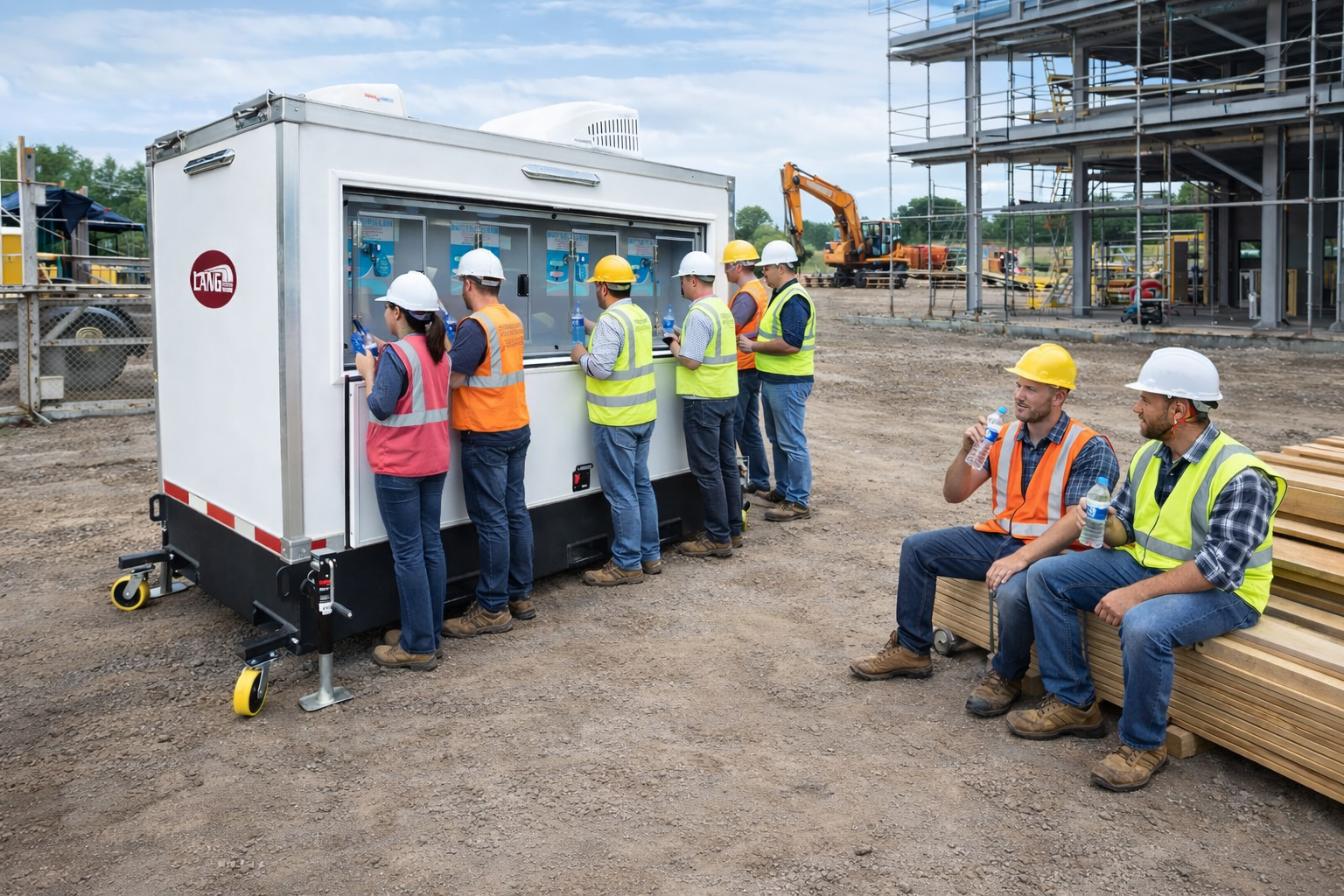
The Signature Series was designed specifically for environments like construction sites. Not as an afterthought, not as a modified event unit. The build tolerances, the durability, and the operational characteristics are all calibrated for demanding job site conditions where the equipment gets moved, exposed to weather, operated by crews who need it to work without any fuss, and expected to perform reliably for the full duration of a project.
Here is what it brings to a job site:
- 300-gallon sealed potable water tank that holds enough supply for a full crew through a full shift without constant refilling
- 4 simultaneous bottle filling stations with adjustable nozzles, so a crew coming off a pour or finishing a phase does not stack up at a single spigot waiting their turn
- Triple-stage filtration on every dispense, so the water is clean and safe regardless of what source water comes in during a refill
- Continuous electric chilling that maintains cold water temperature all day in any ambient temperature condition
- Powder-coated steel frame that handles job site conditions, not a lightweight panel unit that dents when a forklift gets close
- Weatherproof composite exterior rated for exposure to construction site dust, debris, and weather
- Forklift pockets and tie-downs so it can be repositioned across a site as work phases move, without needing special equipment or a rigging crew
- Tamper-resistant lockable access panels so overnight security on the unit is not a concern
- Deploys in under 15 minutes from arrival to operational
- Power requirements: 1 to 3 dedicated 20A/120V circuits, or 1 dedicated 50A/240V circuit. A standard jobsite generator handles this without any special electrical setup
The forklift pocket feature matters more on a construction site than anywhere else we deploy. Construction projects move. The staging area for week one is not the same as week six. As the project phases advance, the location where workers are concentrated shifts. A unit with forklift pockets can be repositioned to stay close to the active work area without a separate logistics operation. You do not need to schedule a delivery and pickup every time the crew moves to a new phase of the build. It goes where the work goes.
The gray water tank option is worth noting for sites where drainage is a consideration. The optional 29-gallon gray water containment tank captures runoff from the fill stations so water does not pool on the ground around the unit. On a job site where drainage and runoff are managed actively, this keeps the water station footprint clean and avoids any site drainage issues.
What Bottled Water Actually Costs a Construction Company
Most construction companies default to bottled water because it is familiar and the upfront cost per case seems manageable. But the actual cost of keeping a construction crew properly hydrated with bottled water over a multi-week or multi-month project is significantly higher than most project managers initially account for.
A case of 24 sixteen-ounce water bottles is roughly $8 to $15 depending on supplier and location. Each case is about 3 gallons. A crew of 20 workers on a hot day in the Inland Empire in July, working physically hard, following proper hydration guidelines, will consume somewhere between 40 and 80 gallons of water during an 8-hour shift. That is 14 to 27 cases of bottled water per day for one crew. At $10 per case, that is $140 to $270 per day. Over a five-day week, that is $700 to $1,350 per week just in water costs for a 20-person crew.
For a 50-person crew in peak summer conditions, the numbers scale quickly. Construction companies that run the actual math on their bottled water spend are often surprised by the total. We hear regularly from contractors that switching to a Signature Series rental cuts their weekly water cost by $1,500 to $2,000 or more on mid-size crews. Over a six-month project, that is a meaningful budget line.
Beyond the direct cost, there is the operational burden. Someone has to order the water, receive the delivery, store it on site, keep it cold, manage the ice supply, distribute cases to different areas of the job site, and deal with the empty bottles and cardboard. That is real labor time from someone on the project who could be doing something else. The empty bottle waste is also a job site cleanliness issue and often a permit compliance issue on sites that have environmental or waste management requirements.
A Signature Series rental eliminates all of that. One delivery, one setup, scheduled refills coordinated by our team, and one pickup at the end of the project. The crew has better water than they had with bottled product, the job site is cleaner, and the weekly cost is lower. More detail on the cost breakdown at our blog: Bottled Water vs Water Stations.
Types of Construction Projects We Service
We have placed Signature Series stations at nearly every type of construction project imaginable. The water access challenge is consistent across all of them: the site does not have the infrastructure to keep a working crew properly hydrated, and the standard improvised solutions are not adequate for the conditions.
Residential Subdivision and Tract Home Development
Residential subdivisions are one of our most common construction site deployments. A large tract development in the Inland Empire, Sacramento suburbs, or the Las Vegas valley can have dozens of homes in various stages of construction simultaneously, with crews working across multiple pads on any given day. The early phases of tract development have no utilities at all on the site, and even as utilities come online for individual lots, they are not accessible for crew hydration in a centralized way. A Signature Series station at the site trailer serves the full crew working the subdivision and gets repositioned as the active work zone shifts through the project.
Commercial and Industrial Ground-Up Construction
Commercial construction projects including office buildings, retail centers, logistics warehouses, and industrial facilities are large-scale operations with substantial crew sizes at peak phases. A large warehouse or distribution center build in the Inland Empire or Central Valley can have 100 or more workers on site during structural steel and concrete phases. A single water station covers a crew that size with scheduled mid-day refills. For phased projects where different contractor crews cycle on and off the site, the Signature Series handles whatever crew is present that day.
Highway and Infrastructure Construction
Highway construction crews work in some of the most extreme heat exposure conditions in the industry. They are on open asphalt and concrete in direct sun for extended periods, often in locations far from any commercial water access. A road widening project on Interstate 15 through the Mojave, a bridge replacement project on a state highway in the Central Valley, or a drainage infrastructure project in a desert development area all share the same challenge. The work location changes as the project advances, and the Signature Series can be repositioned along the corridor as the active work zone moves. Generator power handles the electrical requirement on highway projects where shore power is not available.
Solar Farm and Renewable Energy Construction
Solar farm construction in California and Nevada is booming, and it happens overwhelmingly in desert locations specifically because of the sun exposure those sites get. That same sun exposure that makes a desert site ideal for solar power makes it an extreme heat environment for the construction workers installing the panels and infrastructure. Solar farm builds in the Mojave, the Coachella Valley, the Nevada desert, and the California high desert are among the most challenging hydration environments we service. These sites are remote by definition, often with no utility infrastructure beyond what the construction operation brings in, and the crew sizes during peak installation phases are substantial.
Pipeline and Underground Utility Construction
Pipeline construction and underground utility work involves crews that move continuously along a route, often through areas with zero commercial infrastructure nearby. The trench environment also creates its own heat dynamics: workers below grade in a trench are somewhat protected from direct sun but are in a confined space with limited airflow, which changes the heat exposure picture. Proper hydration support for a pipeline crew requires equipment that can move with the crew as the project advances and does not depend on finding a water source at each new location along the route.
Large-Scale Demolition Projects
Demolition work is physically demanding even in mild conditions. In summer heat in Southern California or Nevada, it is one of the most taxing job types in the construction industry. Demolition crews are generating and breathing dust, working with heavy equipment and hand tools, and exerting significant physical effort in environments that often have no shade and are surrounded by materials that absorb and radiate heat. Hydration requirements for demolition crews in hot conditions are at the high end of what we plan for on any deployment.
Tenant Improvement and Interior Renovation at Scale
Large-scale interior renovation projects, including commercial tenant improvements and industrial facility renovations, are sometimes overlooked in the hydration conversation because the work is technically indoors. But large commercial and industrial spaces under construction often have no functioning HVAC during the renovation phase, and interior temperatures in a warehouse or commercial shell building without cooling in summer can exceed outdoor ambient temperatures due to radiated heat from the roof and walls. Workers in these environments need the same quality cold water access as outdoor crews.
Remote and Off-Grid Construction Sites
Some of the most challenging deployments we handle are at sites that are genuinely remote. A cell tower construction project in the mountains, a water treatment facility build in a rural area, a transmission line project crossing desert terrain — these jobs happen in locations where there is no nearby water source, no utility hookup, and no option to run down the street for supplies. The Signature Series was designed for exactly this. It carries its own supply, requires nothing from the site's infrastructure beyond power, and provides the same quality cold filtered water at a remote desert site as it does at an urban commercial project. Our remote site water solutions page covers this in more detail.
Heat Illness on Construction Sites: What the Data Says
Heat illness is the leading cause of weather-related worker death in the United States. OSHA data consistently shows that construction workers account for a disproportionate share of heat-related fatalities and serious injuries compared to other industries. The construction industry has outdoor exposure, physical exertion, and often the least schedule flexibility when it comes to stopping work during peak heat hours.
California has the most documented heat illness incidents of any state in the country, in part because Cal/OSHA tracks and reports these incidents more rigorously than most state programs. The Central Valley, Inland Empire, and Southern California desert regions account for a significant share of those incidents. These are exactly the markets we service, and the reason our team takes the construction site hydration question very seriously.
Heat illness progresses through stages: heat cramps, heat exhaustion, and heat stroke. Heat cramps are the first warning sign and often get ignored because workers push through them. Heat exhaustion follows with symptoms including heavy sweating, dizziness, nausea, and weakness. Heat stroke is the emergency: core body temperature above 103 degrees, confusion, loss of consciousness, and potential organ damage. The transition from heat exhaustion to heat stroke can happen in minutes in extreme conditions.
The most important preventive factor at every stage is continuous adequate hydration with cool water. Not a water break once an hour. Continuous access and consumption throughout the shift so the body never falls behind on fluid replacement. That requires water infrastructure on the job site that is actually capable of providing that access for the full workday, not just the first two hours before the ice melts and the bottled water bakes in the sun.
Contractors who have experienced a serious heat illness incident on their job site understand this at a level that no article can fully communicate. The workers compensation costs, the Cal/OSHA investigation, the project delays, and the human cost of a serious or fatal heat illness are all outcomes of inadequate preparation for a foreseeable risk. The Signature Series is, at its core, a heat illness prevention tool. That is what it does on a construction site.
Documentation, Compliance Records, and Cal/OSHA Readiness
When a Cal/OSHA compliance officer arrives at a job site during a heat event, one of the first things they check is the water situation. Is potable water available? Is it cool? Is it accessible? Is there enough of it for the crew on site? A job site with a Signature Series water station in operation has a clear, visible, documented answer to all of those questions.
The unit's specs confirm compliance with 29 CFR 1926.51 and Cal/OSHA Title 8 Section 3395 requirements. The filtration system produces potable-quality water. The chilling system maintains cool temperature as the standard requires. The four filling stations make the water accessible without workers waiting in a line that could discourage hydration. And because our team handles delivery documentation, refill records, and service logs, the contractor has a paper trail supporting their compliance posture.
For general contractors on large projects with multiple subcontractors, the water station also serves as a shared compliance asset. All trades working on the site have access to the same compliant water supply, which simplifies the GC's oversight responsibility and ensures that every crew on the project is meeting the hydration standard regardless of what their individual company would have brought to the site.
Our Cal/OSHA water requirements page covers the specific regulatory language and what compliance documentation looks like in practice.
Construction Site Water Station Service Areas
We deliver and service Signature Series water stations at construction sites throughout California, Nevada, and Utah. Our team handles remote sites, phased projects, multi-location deployments, and short or long-term rentals.
Nevada: Las Vegas, Henderson, North Las Vegas, and surrounding desert areas. Las Vegas is one of our most active construction markets year-round.
Utah: St. George, Salt Lake City, Provo, Ogden, Washington County, and surrounding areas. St. George and the Dixie region have seen extraordinary construction growth and have the desert heat conditions to match.
Southern California: Los Angeles, San Diego, Riverside, San Bernardino, Anaheim, Irvine, Palm Springs, Coachella Valley, Victorville, and throughout the Inland Empire and high desert.
Central Valley and Northern California: Fresno, Stockton, Modesto, Bakersfield, Sacramento, and surrounding valley communities.
Remote and off-grid sites are handled regularly. If your project site has power access and a delivery vehicle can get in, we can set up a Signature Series station and keep it running for the duration of your project.
Frequently Asked Questions
Does OSHA require drinking water on construction sites?
Yes. OSHA standard 29 CFR 1926.51 requires employers to provide an adequate supply of cool, potable drinking water at construction sites. California's Cal/OSHA standard under Title 8 Section 3395 is stricter, requiring one quart of cool water per worker per hour during heat conditions. Non-compliance can result in citations, fines, and significant liability exposure. Our Signature Series water stations meet both the federal and California standards.
How does a portable water station work on a site with no water line?
The Signature Series is completely self-contained. It carries 300 gallons of potable water in a sealed onboard tank, filters every dispense through a triple-stage system, and chills water continuously. No water line connection is required. We deliver the unit, fill the tank, and schedule refills based on your crew size and site conditions. A jobsite generator handles the power requirement if shore power is not available.
Why does cold water matter specifically on a construction site?
Cold water is absorbed faster by the body than warm water and does more to reduce core body temperature during physical exertion in heat. It also gets consumed more, because workers actively avoid drinking warm water in hot conditions. Cal/OSHA specifically requires cool water for exactly this reason. The Signature Series maintains cold water temperature all day through continuous electric chilling, not just during the first few hours before the ice situation fails.
How much does it cost to rent a water station for a construction site?
Pricing depends on project duration, location, crew size, and refill frequency. Construction companies switching from bottled water commonly save $1,500 to $2,000 or more per week on mid-size crews. Contact us for a quote specific to your job site and project timeline.
Can one Signature Series station serve a large construction crew?
Yes. The unit has four simultaneous filling stations so multiple workers can fill at the same time. The 300-gallon tank supports full-crew hydration through a full shift. For very large crews or sites with multiple active zones, we deploy multiple units positioned across the project footprint.
Do portable water stations work at remote or off-grid construction sites?
Yes. The Signature Series requires no water line. It only needs a dedicated electrical circuit, and a jobsite generator works perfectly. We have serviced remote highway projects, solar farm builds in the desert, and pipeline jobs miles from the nearest utility connection.
What areas do you service for construction site water stations?
We service construction sites throughout California, Nevada, and Utah. Key markets include Las Vegas, Henderson, St. George, Salt Lake City, the Inland Empire, Los Angeles, San Diego, Fresno, Bakersfield, Stockton, Sacramento, and surrounding areas. Remote job sites are handled regularly.
Get a Quote for Your Job Site
Tell us your project location, crew size, estimated project duration, and whether you have shore power available or need generator-based power. Our team will get back to you quickly with a quote and a hydration plan built around your specific site conditions.
We have 15 hydration professionals on staff with over 60 years combined experience in potable water systems, construction logistics, and job site hydration. We understand what heat looks like in the markets we serve, and we have seen what happens when the water situation on a job site is improvised and underprepared. We are not going to let that happen on your site. Call us directly or use the contact form. Real people answer and they know this subject well.
Request Quote
Our team at On-Site Hydration Services is available 24/7 to provide rapid, on-site support tailored to your situation. Fill out our Quote Request form to request immediate assistance, schedule a consultation, or learn more about our nationwide environmental and disaster recovery services. A dedicated representative will review your request and respond promptly to ensure you get the expertise and resources you need, when you need them most.
For Fastest Service please call us at 866-748-5932