Emergency Water Solutions
Rapid, reliable water delivery when conditions change and people need it most.
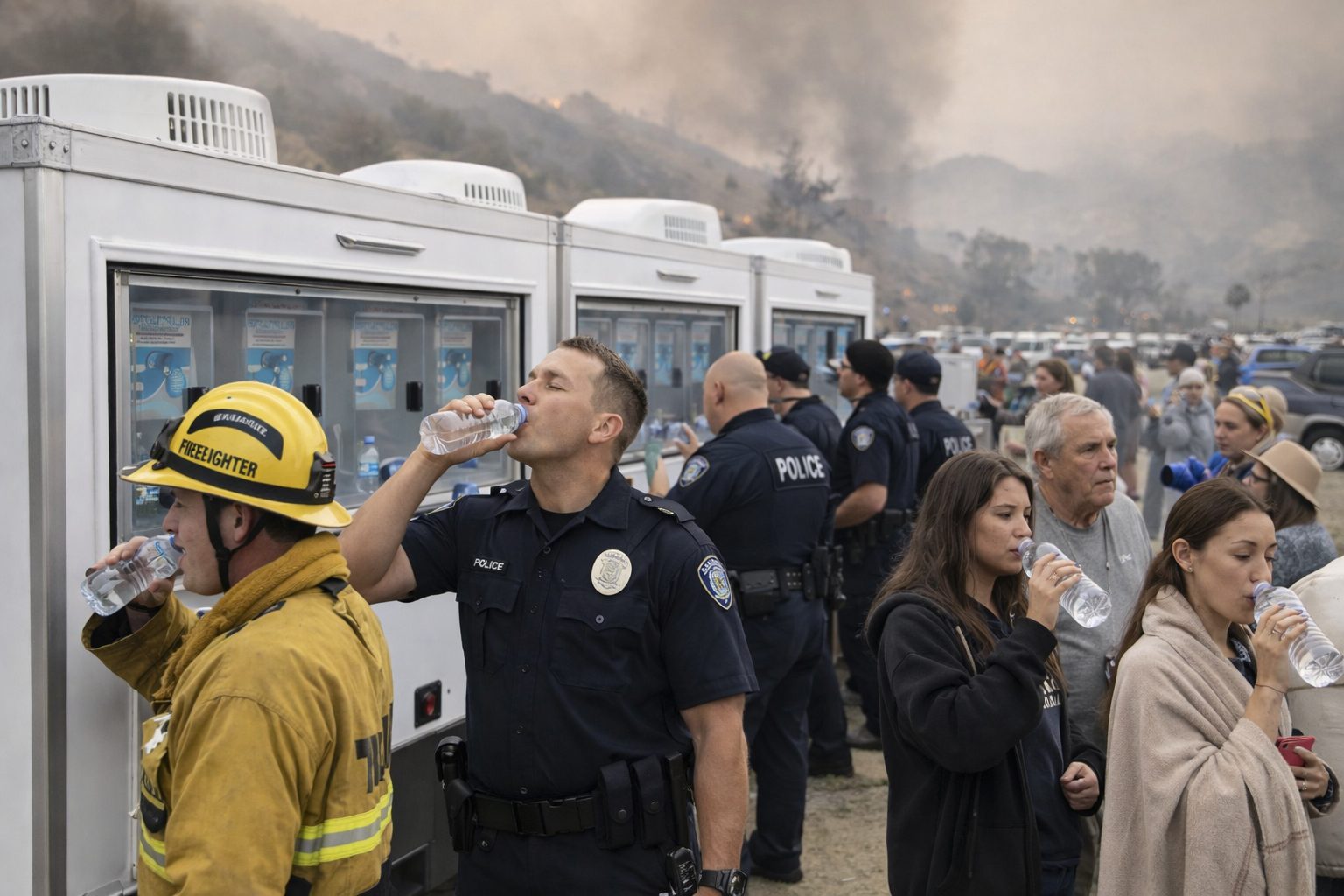
When a disaster hits, the list of immediate needs is long and the resources to address them are always stretched. Power restoration. Shelter. Medical support. Communications. Logistics. In the middle of all of that, drinking water is not optional and it cannot wait. Crews working 16-hour shifts at a wildfire camp, utility workers restoring power after a major storm, FEMA field teams running a disaster relief operation, public health crews managing an emergency in a community that has lost its water system — every single one of those situations requires cold, safe, potable drinking water, and requires it now, not after the infrastructure catches up.
That is exactly what we built Onsite Hydration Services to handle. Our Signature Series water station was designed from the ground up for high-demand environments where there is no existing water infrastructure to lean on. It carries its own supply, filters everything it dispenses, chills water continuously in any ambient temperature, and is operational in under 15 minutes from the time it arrives on site. No water line. No permanent hookup. No waiting.
Our team has over 60 years of combined experience in potable water systems, field logistics, and emergency hydration support. We are SAM.gov registered, CAL FIRE certified, ISN certified, and SBA recognized — credentials that exist specifically because we operate in regulated emergency environments where vendor qualification is not a formality, it is a requirement. When the call comes in for an emergency deployment, we move.
Why Water Access Fails in Emergencies and What That Costs
Disasters disrupt water infrastructure in predictable ways. Wildfires damage or destroy municipal water mains in the affected area. Major storms knock out the power that runs water treatment and pumping systems. Floods contaminate water supplies that were safe the day before. Extended power outages shut down everything that depends on electricity, which in most modern water systems is everything. The result is always the same: large numbers of people in a geographic area suddenly have no access to potable water, and the response crews sent to help them face the same problem the affected population does.
The FEMA National Response Framework identifies potable water as a critical resource under Emergency Support Function 3 (Public Works and Engineering), and water supply logistics are a core component of any large-scale disaster response operation. Getting water to response crews and affected populations is not a secondary task that gets addressed after the primary response is underway. It runs in parallel from the first operational period because the people doing the response work cannot function without it.
Response crews face a specific physiological challenge that makes water access even more critical than it is in normal operations. Firefighters, utility crews, and disaster response workers are doing physically demanding work in often extreme conditions, frequently in full protective gear that dramatically increases heat load on the body. A wildland firefighter in full PPE working a fire line in Northern California in August is producing heat at a rate the body can only manage with continuous, aggressive hydration. Falling behind on fluid replacement in those conditions is not just an individual health risk. It degrades the performance and decision-making of every person it affects, and in emergency response, degraded performance and poor decisions have consequences that extend well beyond the individual worker.
Inadequate water access in emergency operations also creates downstream problems for incident management. Heat illness incidents pull resources from the response operation to manage the medical situation. Workers who are dehydrated and fatigued are more prone to injury. Morale in a field camp drops measurably when basic needs are not being met. None of these outcomes help the people the response is trying to serve, and all of them are preventable with proper water infrastructure in place from the start of the operation.
Wildfire Response and Fire Camp Hydration
California has become the national standard for large-scale wildfire response, and not in a way anyone wanted. The fire seasons that have burned through Northern California, the Sierra Nevada foothills, the central and southern coastal ranges, and the forests of the Inland Empire over the past decade have required response operations of a scale and duration that most emergency management frameworks were not originally designed for. Fire camps supporting major incidents now routinely house hundreds of personnel from multiple agencies operating across extended incident periods that stretch days or weeks.
A fire camp is a complete temporary city built from nothing in a short period of time at a location that was chosen because it is near the fire, not because it has good infrastructure. The camp needs sleeping areas, food service, equipment staging, communications, medical support, and water. All of it, built from scratch, operational immediately, and sustained for as long as the incident runs. Water for drinking, which is separate from water for suppression operations, has to be available to every person in camp at any hour of the day or night.
Firefighters coming off a shift rotation arrive at camp fatigued, overheated, and significantly dehydrated from hours of physical work in smoke and heat. The physiological research on wildland firefighter hydration is unambiguous: these workers arrive at fire camp in fluid deficits that require serious, immediate rehydration before they rest and before they go back out. Cold water is not a comfort item in that context. It is the fastest and most effective way to begin replacing the fluid deficit and start bringing core temperature back down. Warm water slows that process.
Our Signature Series is CAL FIRE certified and has supported fire camp operations in California. We understand the operational tempo of a fire camp, the unpredictability of crew rotation schedules, the way demand spikes when a large crew rotation comes in off the line, and the importance of having a water supply that does not require someone in incident management to track it. We handle the refill schedule, we coordinate around the camp logistics, and we keep the water cold and available from the first operational period through the last.
For large incidents with multiple operational sections, we can stage multiple Signature Series units across the camp footprint so water is accessible from every major crew staging and rest area. More detail at our fire camp water solutions page.
FEMA and Federal Disaster Response Operations
Federal disaster declarations trigger response operations that involve multiple agencies, large field workforces, and logistical requirements that have to be met under significant time pressure and in environments that may have lost basic infrastructure entirely. FEMA field operations, National Guard deployments, and multi-agency disaster response efforts all need potable water for the people doing the work, separate from the water distribution operations serving the affected civilian population.
Working in the federal disaster response space requires more than showing up with equipment. It requires vendor qualification. Onsite Hydration Services is registered with SAM.gov, which is the federal government's primary database for entities doing business with the federal government. Our SAM.gov registration, combined with our SBA recognition and ISN certification, means we can operate under government contracts and formal emergency procurement agreements without the administrative friction that unqualified vendors create for incident management teams under time pressure.
We have supported operations related to federal disaster responses in California and Nevada. The demands of those deployments are different from commercial or event work in specific ways: the communication protocols, the documentation requirements, the coordination with incident command structure, and the expectation that your vendor is going to perform reliably under the same stressful conditions everyone else on site is managing. We understand that environment and we operate within it without creating additional problems for the teams we are supporting.
For state agencies, county emergency management offices, and municipal emergency operations, our credentials and operational track record make us a reliable vendor for pre-positioned emergency contracts and disaster procurement frameworks. If your agency is building or reviewing its emergency water supply plan, we are worth talking to before the next incident, not during it. Our government hydration services page covers the procurement and contracting side in more detail.
Utility Restoration and Infrastructure Emergency Crews
Power restoration after a major storm, earthquake, or infrastructure failure is one of the most demanding and least visible forms of emergency response work. Utility crews work extended shifts in difficult conditions, often in the same areas that are still experiencing the effects of the disaster they are responding to. Downed lines in flooded areas. Damaged substations in fire-affected zones. Transmission infrastructure repairs in remote locations that lost road access in the same event that damaged the power system.
These crews are on 16-hour shifts, sometimes longer, in field conditions that may be hot, cold, wet, or some combination depending on what the disaster brought. The staging areas and work zones are wherever the damage is, which is rarely a location with functioning utilities including water. The utility company's fleet of service vehicles includes every type of specialized equipment needed for electrical restoration. Cold potable drinking water for the crew is frequently an afterthought that gets improvised with whatever water delivery arrangement someone puts together under pressure.
We work with utility contractors and utility companies directly to provide water station support for restoration operations. The Signature Series runs off a generator, which is always available on a utility restoration staging area, and handles any crew size with scheduled refills coordinated by our team. The utility crew's supervisors are not tracking water supply on top of managing a complex technical restoration operation. We handle that completely.
After major wind events, the grid damage in Southern California, Nevada, and Utah can affect large geographic areas and require restoration operations spanning days or weeks across multiple staging locations. We have the fleet capacity and the logistical experience to support multi-location utility operations and coordinate water supply across several simultaneous staging areas. Our emergency drinking water systems page goes into more detail on extended multi-site operations.
Public Health Emergencies and Municipal Water System Failures
Not every water emergency comes from a dramatic natural disaster. Municipal water system failures, boil water advisories covering large populations, contamination events, and infrastructure failures that compromise a community's water supply create a specific type of emergency that requires potable water distribution to large numbers of people quickly and in a way that is organized, safe, and sustainable over the duration of the event.
Public health agencies, county emergency management offices, and municipal governments responding to water system emergencies need distribution points that can serve large numbers of residents efficiently while maintaining the water quality standards that a public health emergency demands. The Signature Series filters every dispense through a triple-stage filtration system and stores water in a sealed, tamper-resistant tank. The water quality is consistent and documented. It is not a bucket brigade or a pallet of bottled water with a volunteer handing out bottles. It is a proper water distribution point that can serve hundreds of people per hour in an organized and accountable way.
We have worked with public health and municipal emergency teams in California on water distribution support operations. We understand the coordination requirements, the documentation expectations, and the need for a vendor who can operate cleanly within the incident command structure rather than adding complexity to an already challenging situation. For county and municipal emergency managers who are building or updating their potable water emergency response plans, we are a resource worth including in that process before an event triggers the need. See our temporary public water access page for more.
Search and Rescue, Military, and Field Exercise Operations
Search and rescue operations involve staging areas that appear quickly at trailheads, remote road access points, or open field locations chosen for proximity to the search area rather than infrastructure availability. SAR teams, incident command personnel, family members and volunteers at the staging area, and the medical support team all need water access for potentially extended operations that have no defined end time when they begin.
Military field exercises in the Western United States, particularly in California and Nevada where large training areas include some of the most extreme desert terrain in the country, present the same challenge at a larger scale. Training operations in the Mojave, in the Nevada Test and Training Range, and in the high desert areas of California put large numbers of personnel in remote locations in conditions where heat illness is a genuine operational risk. Cold potable water for training personnel is a readiness issue, not just a welfare issue. Troops who are heat-impaired are not performing at the level the training is designed to build.
Our SAM.gov registration and government vendor credentials make us a qualified provider for military and government field operation support. We have experience coordinating water supply for field operations that require generator power, that involve multiple staging locations, and that operate on timelines that can shift on short notice. We are built for that kind of operational flexibility because emergency work, by definition, does not run on a predictable schedule.
Why the Signature Series Works in Emergency Conditions
Emergency deployments stress equipment in ways that normal commercial or event use does not. The unit may be positioned in extreme ambient temperatures. It may be operated continuously for days rather than hours. It may be accessed by large numbers of people in rapid succession when a crew rotation comes through. It may need to be repositioned as the operational footprint of the incident changes. And it needs to work reliably without anyone on the incident management team spending mental bandwidth on whether the water situation is handled.
The Signature Series was designed with exactly these demands in mind:
- 300-gallon sealed potable water tank provides enough supply for a large crew through a full operational period between refills
- Triple-stage filtration on every dispense maintains safe potable water quality regardless of source water conditions during refills
- Continuous electric chilling maintains cold water temperature in any ambient temperature environment, including extreme desert heat conditions
- Four simultaneous filling stations handle high-demand surge periods when a large crew rotation arrives at the water station at the same time
- Powder-coated steel frame and weatherproof composite exterior rated for outdoor field conditions including dust, debris, wind, and temperature extremes
- Tamper-resistant locked panels for overnight and unattended security in field camp environments
- Forklift pockets and tie-downs allow repositioning as the operational footprint shifts without requiring a separate logistics operation
- Deploys in under 15 minutes from arrival on site to fully operational
- Generator compatible — runs off a standard generator with no special electrical requirements, which covers virtually every emergency deployment scenario where shore power is unavailable
- Optional 29-gallon gray water containment tank for field environments where drainage management is required
The speed of deployment deserves specific emphasis in the emergency context. Fifteen minutes from arrival to operational is not a casual target. In an emergency deployment, the time between when the unit arrives and when it is serving the crew is time that crew is waiting. We have refined the delivery and setup process specifically to minimize that window. A team that has been working a fire line for hours and arrives at camp expecting water should not be waiting for equipment to get set up. It should be running when they get there.
Full specifications are on our portable water stations page.
Credentials That Matter in Emergency Work
Emergency response environments have vendor requirements that most commercial situations do not. The agencies, contractors, and incident management teams operating in those environments need to know that their vendors are qualified, insured, and capable of operating within the regulatory and safety frameworks that govern emergency response work. Here is where we stand:
- SAM.gov Registered — Active registration in the System for Award Management qualifies us for federal government contracts and procurement, including FEMA-related deployments and other federal emergency response work
- CAL FIRE Certified — Our CAL FIRE certification is specific to wildfire response operations in California and qualifies us to operate at fire camps and in fire-adjacent environments under CAL FIRE operational authority
- ISN Certified Vendor — ISN certification confirms that our safety practices, insurance documentation, and compliance posture meet the standards required by major corporations and government entities managing contractor relationships in high-risk environments
- SBA Recognized — Our SBA standing confirms our status as a verified small business in the federal marketplace
- Fully Licensed and Insured — We carry all required licenses and insurance coverage to operate in California, Nevada, and Utah, including in regulated emergency response environments
These credentials are not marketing items. They exist because the environments we work in require them and the clients we work with verify them. If your agency or organization has a vendor qualification process, we will clear it. That is the point of doing this work properly from the beginning.
Extended Operations and Multi-Day Deployments
Most emergency operations do not resolve in a day. Wildfire incidents run for weeks. Major storm recovery operations stretch over days and sometimes weeks as crews work through damaged infrastructure systematically. Public health water emergencies can last for extended periods while repairs or remediation are completed. Any water solution for these operations has to be sustainable over time, not just adequate for the first 24 hours.
We build the refill schedule around the operational tempo and crew size from the beginning of the deployment. For a fire camp with 300 personnel running three shift rotations, we know roughly what daily consumption looks like and we schedule refills accordingly. For a utility restoration operation that is expanding or contracting as different areas come back online, we adjust the schedule as the operation changes. For a public health distribution point serving a variable number of residents per day depending on how the event is progressing, we track consumption and stay ahead of it.
The incident management team is not managing the water supply. That is our job. From the first deployment to the final pickup, the water situation is handled. The teams running the response have one less thing to track, one less vendor to coordinate, and one fewer operational variable to manage in an environment that already has more variables than anyone wants.
For situations that require water stations at multiple locations simultaneously, we can coordinate multi-unit deployments across a single incident or across related operations in a region. We have the fleet and the logistics capability to support complex, multi-site emergency operations. Our disaster response water page covers multi-site deployment planning in more detail.
Emergency Response Service Coverage
We are active across California, Nevada, and Utah and can respond to emergency deployment requests throughout our service territory. Remote locations are handled regularly. If access is possible and power is available, we can operate.
California is our primary emergency market given the scale and frequency of wildfire incidents, the size of the state's utility infrastructure, and the regulatory environment around emergency response operations. We cover the full state from the Oregon border to the Mexican border, including remote locations in the Sierra Nevada, the Mojave Desert, the Central Valley, and the coastal ranges where emergency incidents frequently occur far from urban infrastructure. Key urban and regional markets include Los Angeles, San Diego, Sacramento, Fresno, Stockton, and Riverside.
Nevada emergency deployments concentrate in the Las Vegas metro and surrounding desert areas, where utility emergencies, extreme heat events, and infrastructure incidents create demand for emergency hydration support. Remote Nevada locations including areas adjacent to military and federal land are also within our service reach.
Utah emergency work includes wildfire response in the southern part of the state, utility and infrastructure incidents along the Wasatch Front, and emergency operations in the desert communities around St. George and Washington County. We cover Salt Lake City, Provo, and surrounding communities as well as remote areas throughout the state.
Frequently Asked Questions
How fast can an emergency water station be deployed?
The Signature Series deploys in under 15 minutes from arrival on site. We deliver fully loaded with 300 gallons of potable water and have the unit operational before your crew needs it. For emergency deployments, we prioritize response time and coordinate delivery on short notice depending on location and unit availability.
Does the unit require a water line or permanent infrastructure?
No. The Signature Series is completely self-contained with a sealed 300-gallon potable water tank, triple-stage filtration, and continuous electric chilling. The only requirement is a power source. A standard generator works perfectly, which covers virtually every emergency deployment scenario where shore power is unavailable.
Is Onsite Hydration Services qualified for government and FEMA emergency contracts?
Yes. We are SAM.gov registered, SBA recognized, CAL FIRE certified, and ISN certified. These credentials qualify us for government contracts, FEMA-related deployments, and regulated emergency response operations at the federal, state, and local level.
Can the Signature Series handle a large wildfire response camp?
Yes. Large fire camps can be served with multiple units staged across the camp footprint. Each unit holds 300 gallons per fill with four simultaneous filling stations. We coordinate refill schedules based on crew size and operational tempo so the water supply stays consistent through multi-day and extended deployments.
What happens when the tank runs low during an extended emergency operation?
We schedule proactive refills based on crew size and daily consumption so the tank never runs dry during an active operation. For extended deployments, our team manages the refill logistics entirely so your incident management team is not tracking water volume on top of everything else they are managing.
What types of emergency operations do you support?
Wildfire response camps, FEMA disaster deployments, hurricane and flood response, utility restoration operations, public health emergencies, military field exercises, search and rescue staging areas, and municipal emergency operations. Any situation where a large group needs safe cold filtered drinking water in a location without functioning water infrastructure is a situation we can support.
Request Emergency Deployment Support
If you are planning for an emergency operation or are in the middle of one right now, contact us directly. Tell us your location, the nature of the operation, your estimated crew or population size, and whether you have generator power available. We will get back to you fast with a deployment plan and confirm availability for your timeline.
For agencies and organizations building emergency water supply plans in advance of incidents, we are available for pre-incident planning conversations, vendor qualification review, and pre-positioning arrangements. The best time to work out those details is before an incident forces the issue. Call us directly or use the contact form. Real people answer here around the clock.
Request Quote
Our team at On-Site Hydration Services is available 24/7 to provide rapid, on-site support tailored to your situation. Fill out our Quote Request form to request immediate assistance, schedule a consultation, or learn more about our nationwide environmental and disaster recovery services. A dedicated representative will review your request and respond promptly to ensure you get the expertise and resources you need, when you need them most.
For Fastest Service please call us at 866-748-5932