Government & Municipal Water Station Rentals
Dependable water access for public works, military, forest service, community events, and emergency response operations across city and state agencies.
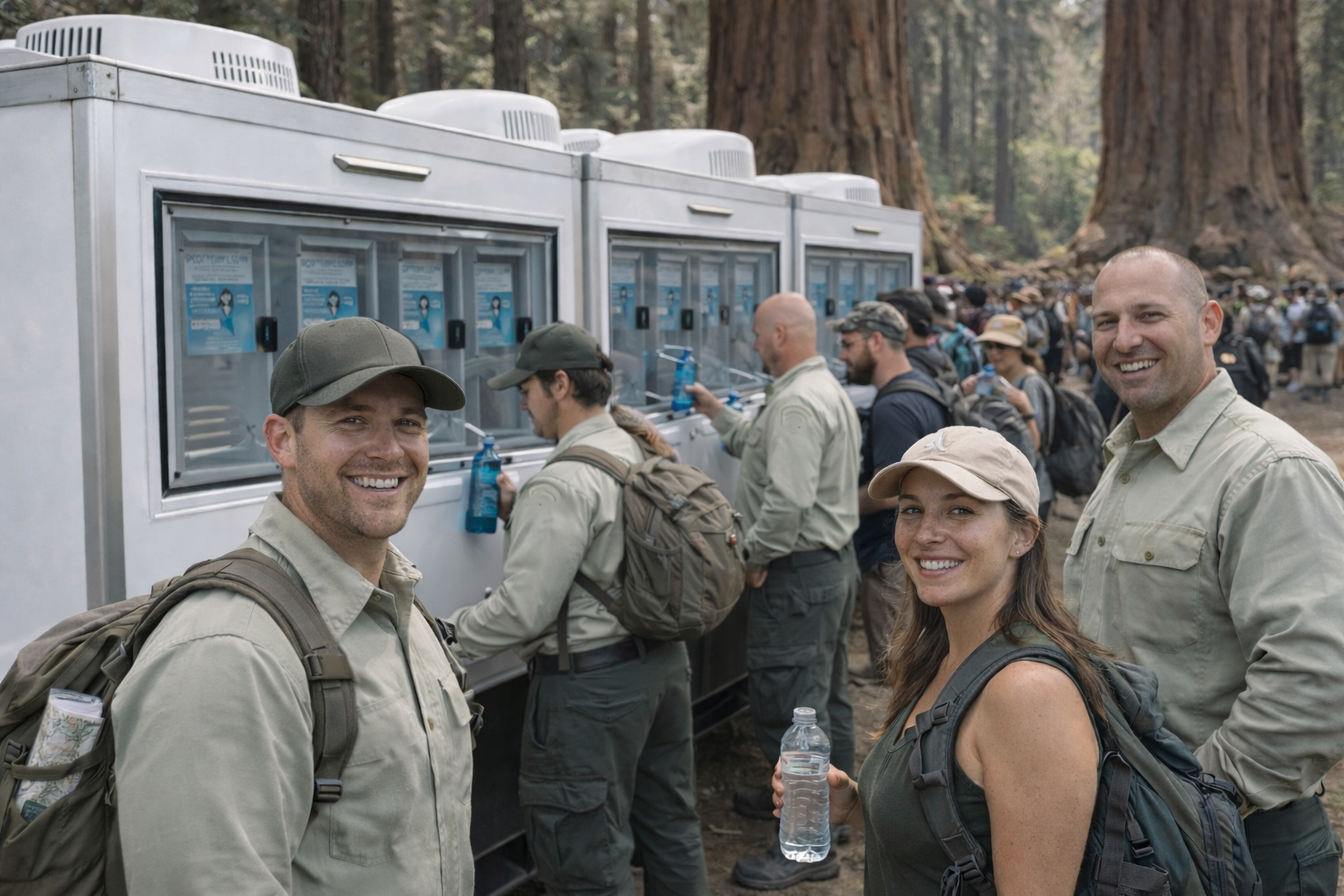
Government operations at every level share a hydration challenge that does not get the attention it deserves. The work happens where it needs to happen: on a highway median, at a remote training range, along a park trail that has not seen a water fountain since it was built thirty years ago, at a disaster staging area that did not exist last week, on a military base running field exercises in the Nevada desert in August. The people doing that work need cold, safe, potable drinking water. The locations rarely have it in any adequate form.
Onsite Hydration Services is built to serve the government and public sector at every level. We are an active SAM.gov registrant, which qualifies us for federal procurement across all agencies. We are SBA recognized, CAL FIRE certified, and ISN certified. We carry all required licenses and insurance to operate in California, Nevada, and Utah. Our Signature Series water station meets federal potable water standards, OSHA 29 CFR 1926.51, and Cal/OSHA Title 8 Section 3395. We have worked with federal agencies, military operations, state programs, county departments, municipal governments, and national and state park operations throughout our service territory.
This page covers the full range of government and public sector use cases for portable water station rentals: what the procurement process looks like for agencies sourcing through SAM.gov, how we serve military operations across all branches, what we provide for city and county public works and municipal events, how we support national and state parks, and why the credentialing and compliance posture we have built specifically opens doors in the government space that most portable equipment vendors cannot walk through.
SAM.gov Procurement and Federal Contract Eligibility
Federal agencies, military branches, and FEMA procure goods and services through the System for Award Management (SAM.gov), the federal government's central database for entities doing business with the government. An active SAM.gov registration is a prerequisite for receiving federal contracts, grants, and procurement orders. Onsite Hydration Services maintains an active SAM.gov registration, which means contracting officers at any federal agency can source our Signature Series water stations through standard federal acquisition channels without any special vendor approval process.
For contracting officers and procurement specialists, working with a SAM.gov registered vendor simplifies the acquisition process. You are not vetting an unknown vendor under time pressure. The registration itself confirms that the vendor has passed the basic federal compliance checks, has current insurance and tax documentation on file, and is operating as a legitimate entity eligible to receive federal funds. That matters in emergency procurement situations especially, where the pressure to move fast can create problems when unqualified vendors get pulled into the process.
Our SBA recognition as a small business also has procurement implications. Many federal contracts and set-asides prioritize or require small business vendors. Our SBA standing means we qualify for those procurement vehicles, which can streamline the contracting process for agencies working within small business acquisition requirements.
If your agency has a specific contract vehicle, IDIQ, or blanket purchase agreement framework you are working within, contact us directly. We have experience navigating federal procurement documentation and can work within your acquisition process without creating administrative complexity on your end. The goal is to get the equipment where it needs to be as fast as the procurement rules allow.
Military Operations Across All Branches
The United States military conducts a substantial portion of its training operations in the Western United States, and for good reason. California, Nevada, and Utah contain some of the largest military training ranges in the world, including the Nevada Test and Training Range, the National Training Center at Fort Irwin in the Mojave Desert, the Marine Corps Air Ground Combat Center at Twentynine Palms, and multiple Navy and Air Force installations across the region. The terrain and climate conditions in these areas — extreme heat, remote geography, no civilian infrastructure for miles — make them ideal for realistic field training and extremely demanding for the personnel conducting that training.
Army
Army field training operations at installations like Fort Irwin put soldiers through sustained physical activity in some of the hottest outdoor environments in the country. The National Training Center sits in the heart of the Mojave Desert, where summer temperatures regularly exceed 110 degrees. Soldiers conducting multi-day field exercises at NTC and at other California and Nevada Army training areas need cold potable water that keeps up with the physiological demands of hard physical work in extreme heat. The Army's own field manual doctrine on heat injury prevention is explicit about the importance of continuous cool water access for soldiers in hot weather operations. A Signature Series unit positioned at a field training staging area or base camp provides compliant, reliable cold water for the duration of the exercise without requiring any permanent infrastructure.
Marine Corps
The Marine Corps Air Ground Combat Center at Twentynine Palms is the largest Marine Corps base in the world and sits in one of the hottest desert environments in the United States. Marines training at MCAGCC operate in conditions that are genuinely extreme by any measure. Summer temperatures at Twentynine Palms regularly exceed 115 degrees, and the training operations conducted there are among the most physically demanding in the Marine Corps training pipeline. Cold water is not a comfort item at Twentynine Palms. It is a readiness and safety requirement that directly affects the ability to conduct and complete training operations safely.
Marine Corps installations throughout Southern California, including Camp Pendleton and MCAS Miramar, also run extensive outdoor operations and training exercises in warm to hot conditions for much of the year. Field exercises, combat conditioning events, and outdoor training activities across these installations all benefit from reliable cold potable water access at the exercise location rather than depending on water points that require personnel to leave the training area.
Navy
Naval installations in California and Nevada operate large shore facilities with extensive outdoor infrastructure, training ranges, and operational areas where personnel work in warm to hot conditions for extended periods. Naval Air Weapons Station China Lake, sitting in the Mojave Desert north of Ridgecrest, is one of the Navy's primary weapons testing and evaluation facilities and operates in desert heat conditions that match anything found at Army or Marine Corps desert installations. Shore duty in the Navy does not mean air-conditioned comfort when you are doing maintenance, security, or operational support work at a desert installation.
We work with Navy installations on both routine operational support and event-based hydration needs. Large base events, outdoor training exercises, and extended maintenance operations at Navy facilities across California are all situations where the Signature Series provides a reliable, compliant cold water solution that integrates cleanly into base operations.
Air Force and Space Force
Air Force and Space Force installations in our service area include Edwards Air Force Base in the high desert, Vandenberg Space Force Base on the central California coast, and Nellis Air Force Base outside Las Vegas. Edwards sits in conditions comparable to the rest of the Mojave Desert, with summer temperatures that create serious heat exposure for personnel doing outdoor work on the flight line, at test ranges, and across the large installation footprint. Nellis, outside Las Vegas, operates year-round in conditions where summer heat regularly exceeds 110 degrees.
Flight line operations, security forces personnel, civil engineering crews, and any other Air Force or Space Force personnel doing outdoor work at these installations face the same heat exposure challenge as their Army and Marine Corps counterparts, just in a different operational context. Cold potable water at the work location rather than at a building across the base is a meaningful improvement in both safety and operational efficiency.
National Guard and Reserve Components
California, Nevada, and Utah National Guard units conduct training operations at armories, training areas, and field locations throughout the three states. Annual Training periods bring large numbers of Guard members to field locations for extended exercises, and weekend drill periods often include outdoor training activities at installations that may have limited water infrastructure. The California National Guard in particular operates across a geographically diverse state that includes some extremely hot training environments.
Reserve component units training at federal installations alongside active duty forces share the same infrastructure and the same heat exposure challenges. We are a qualified vendor for all components of the armed forces through our SAM.gov registration and can support both active duty and reserve component training operations.
City and County Government Operations
Municipal and county governments run outdoor operations every day that create the same water access gap that construction companies and commercial operations face, with the additional dimension of public accountability and regulatory compliance that comes with government employment. City and county employees doing outdoor work deserve the same quality of hydration infrastructure that properly managed private sector operations provide, and the legal and liability framework around government employer obligations to outdoor workers is identical to the private sector.
Public Works and Road Maintenance Crews
Public works departments run road maintenance, pothole repair, striping, drainage clearing, and infrastructure inspection operations every day throughout the year. These crews work at locations across a city or county road network that have no drinking water access by definition. A crew patching asphalt on a residential street in Riverside in July, maintaining drainage channels in the Sacramento Delta in August, or running road striping operations across a stretch of county highway in Nevada is working in conditions where heat illness is a documented occupational risk and where adequate cool potable water is both a legal requirement and a practical safety necessity.
Cal/OSHA's outdoor worker heat illness prevention standard applies to public sector employers in California with the same force it applies to private employers. County and city public works directors who have experienced a Cal/OSHA heat illness investigation understand exactly what the stakes are. A Signature Series rental for a public works crew provides the documented compliant cool water access the standard requires, keeps it cold all day unlike a cooler that loses its effectiveness within a few hours, and costs significantly less per week than the bottled water alternative that most public works departments currently use.
Parks and Recreation Departments
City and county parks and recreation departments host outdoor programs, seasonal events, and large public gatherings at parks that were designed for normal daily use, not for the crowd sizes that summer concerts, holiday festivals, outdoor fitness programs, and community events bring in. The park's existing water fountain infrastructure handles the daily visitor load reasonably well. It does not handle 5,000 people at a summer concert on a July evening without significant water access problems developing in the crowd.
Parks and recreation also runs staff-intensive outdoor programs during summer months: youth camps, outdoor fitness classes, nature programs, and seasonal recreational activities that put staff and participants in direct sun for extended periods at park locations where fountain access is limited. A portable water station for a seasonal summer program serves the staff and participants in the program while the park's regular infrastructure handles the rest of the daily visitor load.
Municipal Public Events and City-Sponsored Festivals
Cities across California, Nevada, and Utah host large outdoor public events as part of their community programming: Fourth of July celebrations, holiday festivals, outdoor concert series, community health fairs, and cultural celebrations that bring thousands of residents to parks, civic centers, and closed streets for extended outdoor gatherings. These events are organized by city staff, often with limited event production budgets, and the water situation frequently gets under-resourced.
A city that hosts a Fourth of July event drawing 8,000 residents to a park without adequate cold water access is creating a public health risk and a liability exposure that its risk management office takes seriously. Cold portable water stations at municipal public events are a straightforward, cost-effective way to address both the public safety responsibility and the practical hydration needs of a large outdoor crowd in the summer heat that characterizes most of our service area from June through September.
Fire Departments and Emergency Services
Municipal fire departments conduct regular outdoor training exercises, physical fitness programs, and equipment testing operations at fire stations and training facilities where the water infrastructure was designed for station operations, not for large outdoor training activities involving multiple crews. Fire department training academies in particular run intensive physical training in outdoor environments during warm months, and the hydration demands on recruits going through academy training are substantial.
Beyond training, fire departments respond to extended incidents including structure fires, hazmat situations, and wildland-urban interface events where crews may be operating at a staging area for many hours without access to a building. A portable water station at a fire department incident staging area provides cold potable water for crews coming off rotation and waiting for reassignment, which is directly relevant to their readiness and safety for the next operational period. Our fire camp water solutions page covers extended fire operation support in more detail.
County Fairgrounds and Public Facility Operations
County-owned fairgrounds, civic centers, and public event facilities host a continuous calendar of events, agricultural shows, trade shows, and public gatherings throughout the year. The facilities staff managing these venues deal with the same water access gap at large events that private event venues do: the building's water infrastructure handles daily operations but was not designed for 10,000 people at a three-day agricultural fair in September. County facilities managers who have dealt with this problem repeatedly often move toward a standing rental arrangement for peak event periods rather than solving it from scratch every time a large event approaches.
National Parks, State Parks, and Public Lands
The national and state parks of California, Nevada, and Utah attract millions of visitors each year, and the infrastructure within those parks was in most cases built decades ago for a fraction of the current visitation levels. The gap between what the existing park water infrastructure can handle and what peak visitation periods actually demand is significant, and it creates both a visitor safety problem and an operational challenge for park staff managing large crowds in often extreme environmental conditions.
National Parks in Our Service Area
The national parks of the Southwest and California interior represent some of the most visited and most environmentally demanding parks in the entire national park system. Death Valley National Park, Joshua Tree National Park, Mojave National Preserve, Zion National Park, Bryce Canyon National Park, and Grand Canyon National Park all sit within or adjacent to our service territory and all operate in desert or high-desert conditions where visitor heat illness is a documented and recurring problem.
The National Park Service's own heat safety guidance identifies Death Valley and desert southwest parks as high-risk heat environments and actively communicates hydration requirements to visitors. Peak visitation periods at these parks, which often coincide with summer school vacation schedules, bring large numbers of visitors who may not be adequately prepared for the heat conditions they encounter. Visitor centers and trailheads at these parks often have limited water access relative to visitor volume, particularly at secondary trailheads and less-developed areas of the park.
Park operations staff at national parks also include maintenance crews, trail crews, and seasonal workers doing physical outdoor work in the same extreme conditions the visitors are navigating. These workers have the same occupational heat exposure challenge as any other outdoor workforce, and they face it in environments that are often far from any developed facility with reliable water access.
California State Parks
California's state park system is the largest in the country, covering coastal parks, inland desert parks, mountain parks, and urban recreation areas across the full geographic range of the state. California State Parks hosts major events, outdoor education programs, summer youth camps, and seasonal programs at park facilities throughout the year. The peak summer period brings extraordinary visitor volumes to popular parks in the Inland Empire, Sacramento region, and desert areas, and the water infrastructure at many of these parks was not designed for current visitation levels.
California State Parks also manages significant deferred maintenance backlogs that affect, among other things, the functioning and condition of water fountains and potable water access points throughout the park system. A portable water station positioned at a high-traffic visitor area or event location within a state park provides reliable cold filtered water independent of the park's fixed infrastructure, which may be unreliable or insufficient during peak periods.
Nevada and Utah State Parks
Nevada and Utah state parks sit in some of the most dramatic and most demanding desert and canyon environments in the western United States. Valley of Fire State Park in Nevada, Red Rock Canyon National Conservation Area, Snow Canyon State Park in Utah, and the parks surrounding the St. George and Las Vegas areas attract large visitor volumes in conditions that require serious hydration attention. Trail parking areas at these parks on busy weekends can see hundreds of visitors per hour, and the water access available at most of these locations is minimal.
Utah State Parks in particular has seen visitor volume growth that has significantly outpaced infrastructure investment at many facilities. The parks in Washington County and the greater St. George area have seen the same population and visitation boom that has driven construction growth in the region, and park infrastructure has not kept pace. A portable water station at a high-demand trailhead or visitor gathering area fills a real and documented gap in visitor services.
BLM and Forest Service Public Lands
Bureau of Land Management lands and National Forest areas in California, Nevada, and Utah host extensive outdoor recreation, permitted events, and resource management operations. BLM field offices and Forest Service ranger districts manage everything from large off-road vehicle events to hiking trail maintenance to prescribed burn operations across land that, by its nature, has no developed utility infrastructure. Permitted events on BLM land and Forest Service areas often have specific water access requirements written into the permit conditions, and the permit holder is responsible for meeting them. A Signature Series station covers those permit conditions cleanly and provides documented potable water access that satisfies both the permit requirement and the practical needs of the event or operation.
Why Our Credentials Matter in the Government Space
Working with government clients at any level requires a vendor qualification posture that most portable equipment companies simply have not built. Government contracts, military service orders, and emergency procurement agreements all involve documentation requirements, compliance standards, and accountability frameworks that require vendors to have done the work in advance. Here is where we stand and why each credential matters in the government context specifically:
- SAM.gov Active Registration — The baseline requirement for any federal procurement. Without an active SAM.gov registration, a vendor cannot legally receive federal contract awards. Our registration is current, our documentation is on file, and contracting officers can verify our status instantly through the SAM.gov database. This applies to all federal agencies including FEMA, the Department of Defense, the National Park Service, the Forest Service, and BLM.
- CAL FIRE Certified — This certification is specific to wildfire response operations in California and is required for vendors operating at fire camps and in fire-adjacent environments under CAL FIRE operational authority. It is not a credential that general rental companies hold. We pursued it specifically because of the work we do in wildfire response, and it qualifies us for CAL FIRE contract vehicles that are unavailable to uncertified vendors.
- ISN Certified Vendor — ISN certification is used by large corporations and government entities to verify that their contractor and vendor relationships meet minimum safety, insurance, and compliance standards. Government agencies that use ISN as part of their vendor management process can onboard us without a separate vetting process.
- SBA Small Business Recognition — Our SBA standing qualifies us for small business set-aside contracts and small business preference programs in federal procurement. For contracting officers working within small business acquisition requirements, our SBA status is a procurement advantage.
- Fully Licensed and Insured in California, Nevada, and Utah — Government contracts and permit conditions in all three states require vendors to carry appropriate licensing and insurance coverage. We carry all required coverage and can provide certificates of insurance and licensing documentation to meet any agency's vendor requirements.
For agencies and procurement officers who want to verify our credentials before initiating a procurement action, our SAM.gov registration is searchable in the public database. We are prepared to provide any additional documentation required by your agency's vendor qualification process.
The Signature Series in Government and Public Sector Environments
Government operations put specific demands on equipment that commercial rental uses do not always surface. Military field operations reposition frequently. Public works crews move to new locations every day. Park operations deal with remote locations and challenging terrain. Emergency management deployments happen under time pressure at locations that do not appear on any normal delivery route. The Signature Series was designed for the most demanding deployment conditions we encounter, which is exactly why it works as well in government settings as it does anywhere else we deploy it.
- 300-gallon sealed potable water tank that carries its own supply to any location without requiring a water line or connection to existing infrastructure
- Triple-stage filtration on every dispense that maintains potable water quality regardless of source water conditions at the refill location
- Continuous electric chilling that keeps water cold throughout an operational day in any ambient temperature, from a cool morning to a 115-degree afternoon at a desert military installation
- Four simultaneous filling stations that handle surge demand when a large crew rotation arrives at the water point without building a line
- Powder-coated steel frame with weatherproof composite exterior built for field conditions including dust, wind, temperature extremes, and the kind of incidental contact that happens in operational environments
- Forklift pockets and tie-downs for repositioning across a large installation or operational area without a separate logistics operation
- Tamper-resistant lockable access panels for overnight security in field environments and on public access sites
- Operational in under 15 minutes from delivery to first dispense
- Generator compatible with standard power requirements that any military or government generator can handle
- Optional 29-gallon gray water containment tank for operations where site drainage management is required by permit or operational protocol
Full technical specifications are available on our portable water stations page and we can provide specification sheets formatted for government procurement documentation upon request.
Extended Operations, Multi-Site Deployments, and Long-Term Contracts
Government operations rarely fit into the single-day or single-event rental model that most portable equipment companies are structured around. Military training cycles run for weeks. Public works maintenance seasons run for months. National park peak visitation periods run for the full summer. Emergency management activations have no defined end date when they begin. The water supply solution for these operations has to be sustainable and reliable over an extended timeline, not just adequate for the first day.
We offer flexible contract structures that fit government operational timelines. Short-term rentals for specific events or exercises, seasonal contracts for parks and public works departments that need consistent summer coverage, and extended contracts for ongoing operations that require a dependable water supply for the duration of a project or program. For military installations and federal agencies that need to structure payments within a fiscal year procurement framework, we work within those constraints.
For operations that span multiple locations simultaneously, we have the fleet capacity and logistics infrastructure to support multi-site deployments. A county public works department running crews at five different project locations, a military base conducting simultaneous training exercises at two different range areas, or a state park system needing units at multiple high-traffic parks during peak summer weekends — all of these are situations we can coordinate and manage. Our team handles delivery scheduling, refill coordination, and pickup across all locations so the government client is not managing vendor logistics on top of running the operation.
Pre-positioning arrangements for emergency management agencies are something we actively encourage. The best time to establish a vendor relationship and work out the procurement details for emergency water supply is before an incident creates the need, not during one. Agencies that have a standing contract or blanket purchase agreement in place with a qualified water station vendor move faster when an emergency hits and have better documented compliance when the after-action review happens. Our emergency water solutions page covers the pre-incident planning side in more detail.
Government Service Coverage: California, Nevada, and Utah
We are active throughout California, Nevada, and Utah and serve government clients at the federal, state, county, and municipal level across all three states. Remote locations, military installations, and public lands in areas far from urban centers are all within our operational reach as long as vehicle access and power are available.
California is our largest and most diverse government market. Federal installations including Fort Irwin, Twentynine Palms, Edwards AFB, Vandenberg SFB, and Naval installations throughout Southern and Central California are within our service territory. State agency operations, Cal/OES emergency management, CAL FIRE, and California State Parks are all clients we serve or are qualified to serve. County public works and municipal government operations across Los Angeles, San Diego, Riverside, Fresno, Sacramento, Stockton, and throughout the state are served regularly.
Nevada government operations include Nellis AFB, the Nevada Test and Training Range, Nevada National Security Site, and extensive BLM and public lands operations throughout the state. Municipal and county government operations in the Las Vegas metro, Henderson, and Reno are active markets. Nevada State Parks and the Nevada Division of Forestry are both relevant state agency clients in our service area.
Utah government operations include Hill Air Force Base, Dugway Proving Ground, and extensive national park and BLM land operations in southern Utah. State agency operations through Utah Division of Emergency Management and Utah State Parks fall within our service coverage. Municipal and county operations across Salt Lake City, Provo, St. George, and Washington County are served regularly given the strong growth and active construction and public works activity in those markets.
Frequently Asked Questions
Is Onsite Hydration Services a qualified government vendor?
Yes. We maintain an active SAM.gov registration, are SBA recognized, CAL FIRE certified, and ISN certified. These credentials qualify us for federal, state, and local government contracts, military service orders, and emergency procurement agreements across California, Nevada, and Utah.
Can we fulfill a SAM.gov contract for portable water stations?
Yes. Our active SAM.gov registration makes us eligible to receive and fulfill government procurement orders through federal acquisition channels. We are familiar with government procurement documentation requirements and can operate within standard federal acquisition frameworks without creating administrative burden for the contracting agency.
Does the Signature Series meet federal potable water and OSHA standards?
Yes. The unit meets OSHA 29 CFR 1926.51, general industry standard 29 CFR 1910.141, and California's Cal/OSHA Title 8 Section 3395. Water is stored in a sealed tamper-resistant tank and filtered through a triple-stage system on every dispense. Full specification documentation is available for procurement purposes upon request.
Can the Signature Series support military field training operations?
Yes. The unit is self-contained with a 300-gallon sealed potable tank, runs four simultaneous filling stations, chills water continuously, and operates off a generator. It deploys in under 15 minutes and can be repositioned as the training area shifts. We can fulfill orders through SAM.gov procurement for all military branches.
Can portable water stations be used at national or state parks?
Yes. National and state parks use the Signature Series to fill the gap between existing visitor water infrastructure and peak visitation demand. The unit requires no permanent installation, leaves no footprint, and can be removed cleanly at the end of the deployment. It supports both public visitor hydration and crew hydration for park operations staff.
What municipal operations benefit most from a portable water station rental?
Public works road crews, parks and recreation outdoor programs, city-sponsored public events, fire department training operations, emergency management field teams, and county fair and public facility operations are the most common. Any city or county operation where workers or the public need cold potable water without adequate existing infrastructure is a candidate.
Work With Us on Your Government or Municipal Project
Whether you are a contracting officer sourcing through SAM.gov, a public works director planning a seasonal field crew hydration solution, a park superintendent addressing a peak visitation water gap, or a military logistics coordinator supporting a field training exercise, our team is ready to help you work through the right setup for your operation.
We understand government procurement timelines, documentation requirements, and the operational realities of public sector work. We have done this across federal, state, county, and municipal environments and we will give you a straight answer on what your situation needs, what it costs, and how to get the paperwork done. Call us directly or use the contact form. For procurement officers, we can provide specification sheets, insurance certificates, SAM.gov registration verification, and any other documentation your agency requires to initiate a contract.
Request Quote
Our team at On-Site Hydration Services is available 24/7 to provide rapid, on-site support tailored to your situation. Fill out our Quote Request form to request immediate assistance, schedule a consultation, or learn more about our nationwide environmental and disaster recovery services. A dedicated representative will review your request and respond promptly to ensure you get the expertise and resources you need, when you need them most.
For Fastest Service please call us at 866-748-5932